
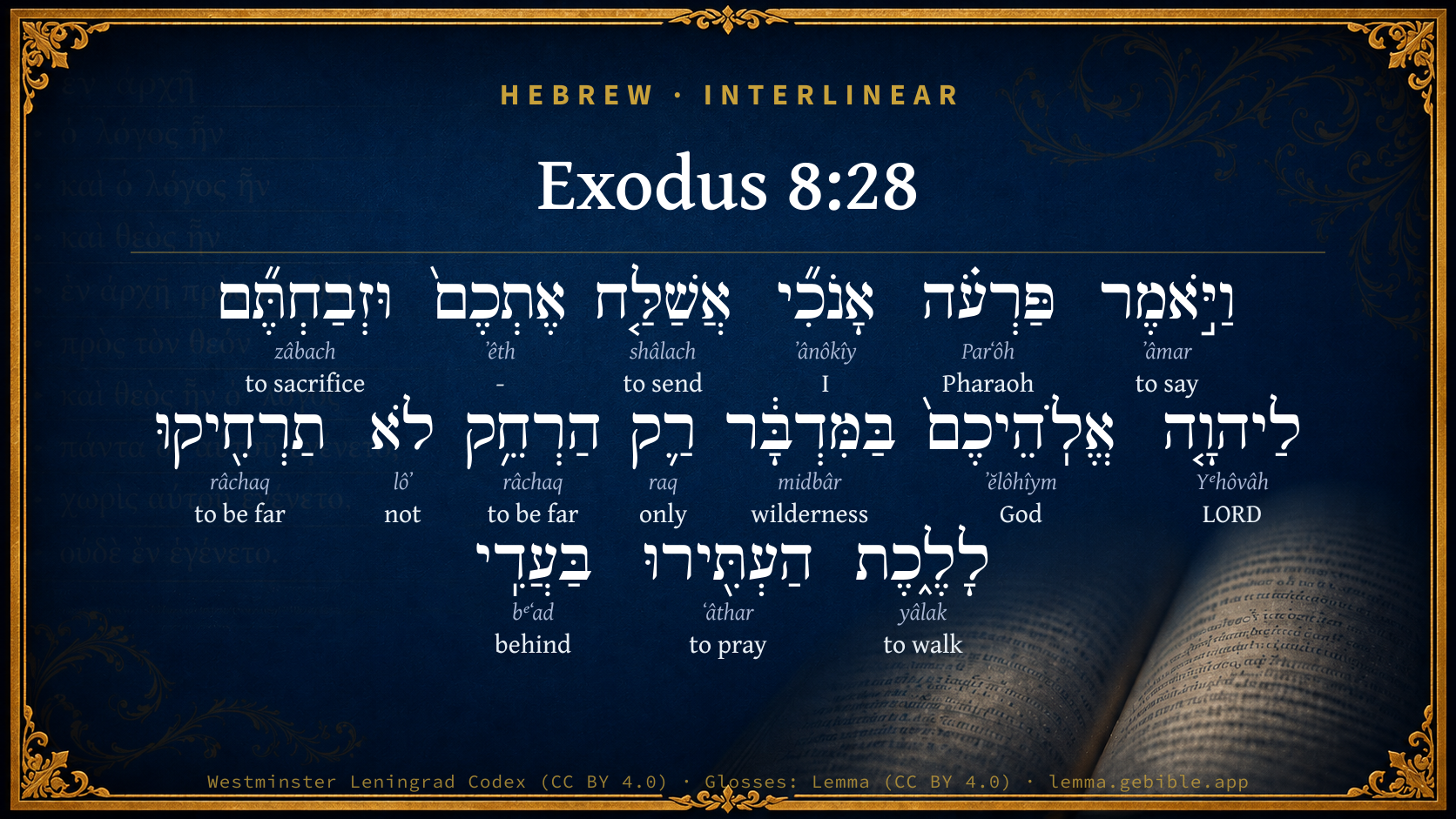
Exodus 8:28

Hebrew (Westminster Leningrad Codex) Exodus 8:28 appears in the Hebrew Old Testament. The text above is from the Westminster Leningrad Codex. Each word links to its Strong’s number, a concise gloss, and parsing drawn from the Open Scriptures Hebrew Bible morphology. Click any word for its full Brown-Driver-Briggs (BDB) entry.
Download image
Cite this verse

Exodus 8:28 (World English Bible). Public Domain. Lemma interlinear Bible study tool, https://lemma.gebible.app/v/exodus/8/28.

Show BibTeX & RIS
BibTeX
RIS
English Translation
Pharaoh said, "I will let you go, that you may sacrifice to Yahweh your God in the wilderness, only you shall not go very far away. Pray for me."
World English Bible · Public Domain
Download a study sheet

One document with this verse’s original text, its word-by-word gloss line, the meaning frame, cross-references with their text, attributed commentary, and full source and license credits — printable, and it pastes into notes with its structure intact.

This verse Autodidact and up

Study sheet (.html) Plain text (.txt)

A passage Seminary Student

Up to 50 verses in one chapter. A passage sheet keeps up to 6 commentary sources and 12 cross-references per verse, in the order this page ranks them, and says so on the sheet whenever that leaves anything out. Ask for a single verse and you get the Autodidact verse sheet above.

Everything on this page stays free to read, with no account — the sheet is a download of what is already on screen, not access to it.

Want to remove ads? Support Godless Engineer
Compare translations 3

The same verse in 3 English versions, stacked beneath the original-language interlinear above. Click any original word for its lexicon entry.

Each is an independent rendering of the whole verse — the interlinear is not word-aligned to these translations.

Highlighted words mark where these versions differ — a whole-verse word diff, not a word-by-word alignment.

  • World English Bible Public Domain
    Pharaoh said, "I will let you go, that you may sacrifice to Yahweh your God in the wilderness, only you shall not go very far away. Pray for me."
  • King James Version Public Domain
    And Pharaoh said, I will let you go, that ye may sacrifice to the LORD your God in the wilderness; only ye shall not go very far away: entreat for me.
  • unfoldingWord Literal Text CC BY-SA 4.0
    And Pharaoh said, “I will let you go and sacrifice to Yahweh your God in the wilderness; only you may certainly not go very far. Pray for me.”

unfoldingWord Literal Text — © unfoldingWord, licensed CC BY-SA 4.0. Word-aligned USFM3 via Door43 (git.door43.org/unfoldingWord/en_ult).

Versions to compare (up to 4)

3 of 4 selected

Show all 18 translations

Every available English version of this verse, each an independent rendering of the whole verse.

  • World English Bible Public Domain
    Pharaoh said, "I will let you go, that you may sacrifice to Yahweh your God in the wilderness, only you shall not go very far away. Pray for me."
  • Berean Standard Bible Public Domain
    Pharaoh answered, “I will let you go and sacrifice to the LORD your God in the wilderness, but you must not go very far. Now pray for me.”
  • Majority Standard Bible Public Domain
    Pharaoh answered, “I will let you go and sacrifice to the LORD your God in the wilderness, but you must not go very far. Now pray for me.”
  • King James Version Public Domain
    And Pharaoh said, I will let you go, that ye may sacrifice to the LORD your God in the wilderness; only ye shall not go very far away: entreat for me.
  • American Standard Version (1901) Public Domain
    And Pharaoh said, I will let you go, that ye may sacrifice to Jehovah your God in the wilderness; only ye shall not go very far away: entreat for me.
  • Revised Version (1885) Public Domain
    And Pharaoh said, I will let you go, that ye may sacrifice to the LORD your God in the wilderness; only ye shall not go very far away: entreat for me.
  • Geneva Bible (1599) Public Domain
    And Pharaoh said, I will let you go, that ye may sacrifice vnto the Lord your God in the wildernesse: but goe not farre away, pray for me.
  • Douay-Rheims (1899) Public Domain
    And Pharao said: I will let you go to sacrifice to the Lord your God in the wilderness: but go no farther: pray for me.
  • Young's Literal Translation Public Domain
    And Pharaoh saith, `I send you away, and ye have sacrificed to Jehovah your God in the wilderness, only go not very far off; make ye supplication for me;'
  • Literal Standard Version CC BY-SA 4.0
    And Pharaoh says, “I send you away, and you have sacrificed to your God YHWH in the wilderness, only do not go very far off; make supplication for me”;
  • Unlocked Literal Bible CC BY-SA 4.0
    Pharaoh said, “I will allow you to go and sacrifice to Yahweh your God in the wilderness. Only you must not go very far away. Pray for me.”
  • unfoldingWord Literal Text CC BY-SA 4.0
    And Pharaoh said, “I will let you go and sacrifice to Yahweh your God in the wilderness; only you may certainly not go very far. Pray for me.”
  • Darby Bible Public Domain
    And Pharaoh said, I will let you go, that you may sacrifice to Jehovah your God in the wilderness; only, go not very far away: intreat for me!
  • World Messianic Bible Public Domain
    Pharaoh said, “I will let you go, that you may sacrifice to the LORD your God in the wilderness, only you shall not go very far away. Pray for me.”
  • Webster's Bible Public Domain
    And Pharaoh said, I will let you go, that ye may sacrifice to the LORD your God in the wilderness; only ye shall not go very far away: entreat for me.
  • Free Bible Version CC BY-SA 4.0
    “I'll let you go and offer sacrifices to the Lord your God in the desert, but don't go very far,” Pharaoh answered. “Now pray for me that this plague ends.”
  • Bible in Basic English Public Domain
    Then Pharaoh said, I will let you go to make an offering to the Lord your God in the waste land; but do not go very far away, and make prayer for me.
  • JPS Tanakh (1917) Public Domain
    (8-24) And Pharaoh said: 'I will let you go, that ye may sacrifice to the LORD your God in the wilderness; only ye shall not go very far away; entreat for me.'

Literal Standard Version (2020), Covenant Press — licensed CC BY-SA 4.0. Text via the HelloAO Bible API (eBible.org). Unlocked Literal Bible (unfoldingWord) — licensed CC BY-SA 4.0. Text via the HelloAO Bible API (eBible.org). unfoldingWord Literal Text — © unfoldingWord, licensed CC BY-SA 4.0. Word-aligned USFM3 via Door43 (git.door43.org/unfoldingWord/en_ult). Free Bible Version, Dr. Jonathan Gallagher — licensed CC BY-SA 4.0. Text via the HelloAO Bible API (eBible.org).

Word by word

More ways to search: Search by grammar → Find every occurrence → Compare this word →

Practice this passage: Drill this verse → Learn its vocabulary →

הַעְתִּ֖ירוּ
ʻâthar
H6279
“pray”
Verb, Hiphil, Imperative, 2nd Person, Masculine, Plural
Part of Speech
Verb
Stem
Hiphil
Form
Imperative
Person
2nd Person
Gender
Masculine
Number
Plural
Full BDB Definition

Origin: a primitive root [rather denominative from H6281 ]

TWOT: 1722

to pray, entreat, supplicate - (Qal) to pray, entreat - (Niphal) to be supplicated, be entreated - (Hiphil) to make supplication, plead
  1. וַיֹּ֣אמֶר ʼâmar H559 “and · to say” Conjunction + Verb, Qal, Sequential Imperfect, 3rd Person, Masculine, Singular
  2. פַּרְעֹ֗ה Parʻôh H6547 “Pharaoh” Noun, Proper
  3. אָנֹכִ֞י ʼânôkîy H595 “I” Pronoun, Personal, 1st Person, Common, Singular
  4. אֲשַׁלַּ֤ח shâlach H7971 “to send” Verb, Piel, Imperfect, 1st Person, Common, Singular
  5. אֶתְכֶם֙ ʼêth H853 “- · you” Particle, Direct Object + Suffix, Personal, 2nd Person, Masculine, Plural
  6. וּזְבַחְתֶּ֞ם zâbach H2076 “and · to sacrifice” Conjunction + Verb, Qal, Sequential Perfect, 2nd Person, Masculine, Plural
  7. לַיהוָ֤ה Yᵉhôvâh H3068 “to/for · LORD” Preposition + Noun, Proper
  8. אֱלֹֽהֵיכֶם֙ ʼĕlôhîym H430 “God(s) · your” Noun, Common, Masculine, Plural, Construct + Suffix, Personal, 2nd Person, Masculine, Plural
  9. בַּמִּדְבָּ֔ר midbâr H4057 “in/at the · wilderness” Preposition, Determined + Noun, Common, Masculine, Singular, Absolute
  10. רַ֛ק raq H7535 “only” Particle, Accusative
  11. הַרְחֵ֥ק râchaq H7368 “to be far” Verb, Hiphil, Infinitive Absolute
  12. לֹא lôʼ H3808 “not” Particle, Negative
  13. תַרְחִ֖יקוּ râchaq H7368 “to be far” Verb, Hiphil, Imperfect, 2nd Person, Masculine, Plural
  14. לָלֶ֑כֶת yâlak H3212 “to walk” Preposition + Verb, Qal, Infinitive Construct
  15. בַּעֲדִֽי bᵉʻad H1157 “behind · me” Preposition + Suffix, Personal, 1st Person, Common, Singular

About this verse

These counts appear in no published source. They are computed here, from the morphology-tagged text and Lemma’s own curated glosses. What Lemma adds →

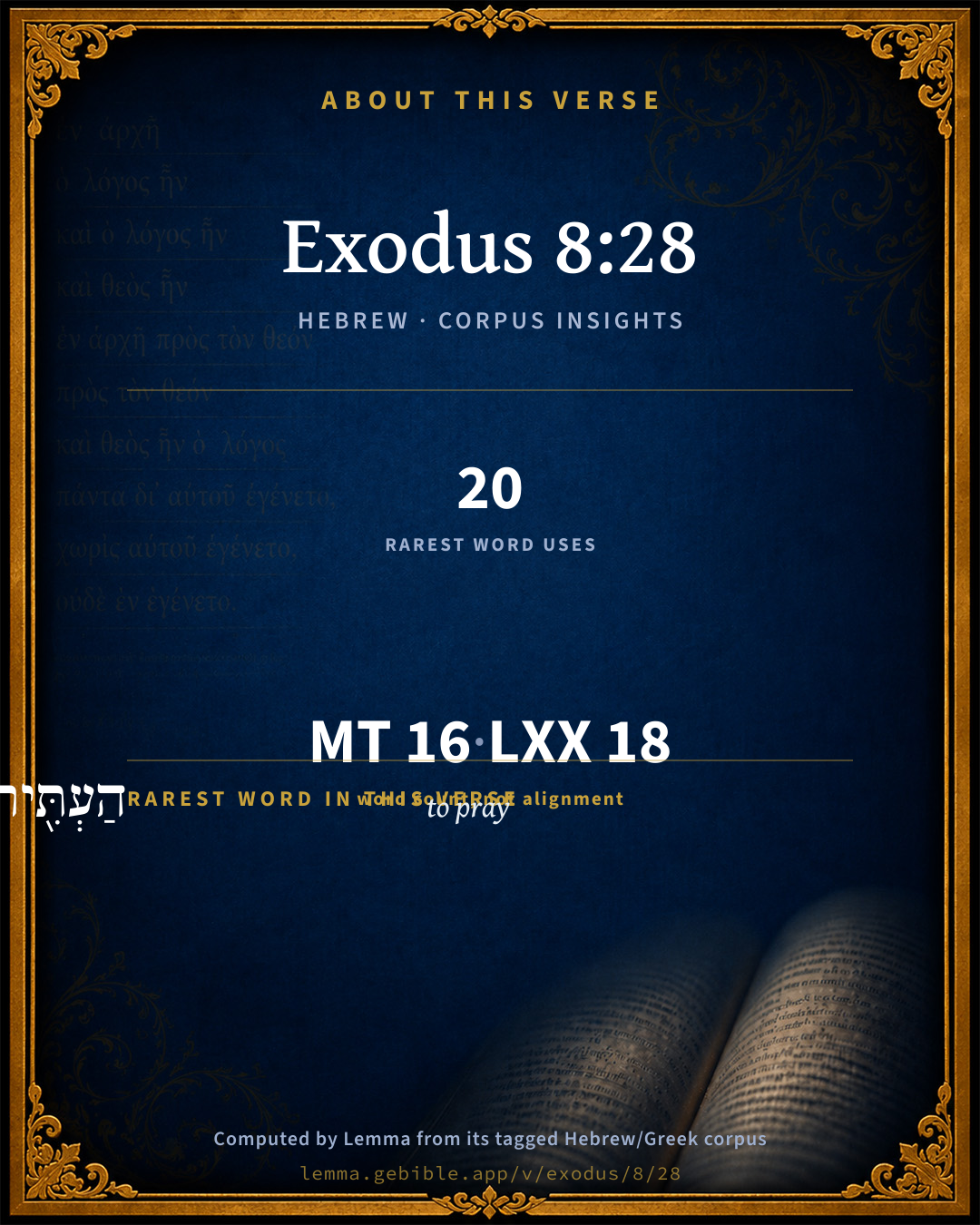
16
words
15
distinct lemmas
Pentateuch
section

Notable vocabulary

The rarest word here is הַעְתִּ֖ירוּ to pray H6279 — appearing just 20 times in the whole Hebrew Bible.

Shared distinctive vocabulary

הַעְתִּ֖ירוּ to pray H6279 occurs in 19 verses of the Hebrew Bible. Also found in:

Grammatical profile

  • 7 verbs
  • 4 nouns
  • 1 pronoun
  • 1 preposition
  • 3 particles

Verb forms

  • וַיֹּ֣אמֶר Qal · Sequential Imperfect
  • אֲשַׁלַּ֤ח Piel · Imperfect
  • וּזְבַחְתֶּ֞ם Qal · Sequential Perfect
  • הַרְחֵ֥ק Hiphil · Infinitive Absolute
  • תַרְחִ֖יקוּ Hiphil · Imperfect
  • לָלֶ֑כֶת Qal · Infinitive Construct
  • הַעְתִּ֖ירוּ Hiphil · Imperative

Repetition

A word recurs within this verse — often emphatic in Hebrew:

  • הַרְחֵ֥ק to be far H7368 ×2

Hebrew & Septuagint length

In English translation the verse runs 29 words from the Hebrew and 32 from the Septuagint (LXX English) — closely comparable.

A rough comparison of the two English renderings, which tokenize alike — not a word-level alignment.

Word counts can differ between the Hebrew and the Greek without any difference in meaning — e.g. the Hebrew direct-object marker אֵת has no separate Greek word, and Greek often adds the article ὁ.

In the original languages it is 16 Hebrew tokens and 18 Greek tokens — but the two are counted differently (Hebrew bundles its prefixes and suffixes into one token; the Greek is in lemma form), so that isn’t a like-for-like length.

Cross-references

9

Topical passages linked to Exodus 8:28 in the Treasury of Scripture Knowledge — connected by theme and wording, ordered by reader-vote popularity; previews shown in the World English Bible.

  • Exodus 8:8 Then Pharaoh called for Moses and Aaron, and said, "Entreat Yahweh, that he take away the frogs from me, and from my people; and I will let the people go, that they may sacrifice to Yahweh."
  • Exodus 9:28 Pray to Yahweh; for there has been enough of mighty thunderings and hail. I will let you go, and you shall stay no longer."
  • 1 Kings 13:6 The king answered the man of God, Entreat now the favor of Yahweh your God, and pray for me, that my hand may be restored me again. The man of God entreated Yahweh, and the king's hand was restored him again, and became as it was before.
  • Acts 8:24 Simon answered, "Pray for me to the Lord, that none of the things which you have spoken happen to me."
  • Exodus 8:29 Moses said, "Behold, I go out from you, and I will pray to Yahweh that the swarms of flies may depart from Pharaoh, from his servants, and from his people, tomorrow; only don't let Pharaoh deal deceitfully any more in not letting the people go to sacrifice to Yahweh."
  • Exodus 10:17 Now therefore please forgive my sin again, and pray to Yahweh your God, that he may also take away from me this death."
  • Ezra 6:10 that they may offer sacrifices of sweet savor to the God of heaven, and pray for the life of the king, and of his sons.
  • Ecclesiastes 6:10 Whatever has been, its name was given long ago; and it is known what man is; neither can he contend with him who is mightier than he.
  • Hosea 10:2 Their heart is divided. Now they will be found guilty. He will demolish their altars. He will destroy their sacred stones.

Cross-references courtesy of OpenBible.info (CC BY 4.0).

Hebrew and Greek witnesses Masoretic Hebrew ↔ Greek Septuagint

The same verse in the two great witnesses to the Old Testament, shown verse-for-verse.

These are two independent witnesses, not word-aligned to each other, and the Septuagint is shown in lemma (dictionary) form.

Hebrew Exodus 8:28 Masoretic · Westminster Leningrad Codex

וַיֹּ֣אמֶר פַּרְעֹ֗ה אָנֹכִ֞י אֲשַׁלַּ֤ח אֶתְכֶם֙ וּזְבַחְתֶּ֞ם לַיהוָ֤ה אֱלֹֽהֵיכֶם֙ בַּמִּדְבָּ֔ר רַ֛ק הַרְחֵ֥ק לֹא תַרְחִ֖יקוּ לָלֶ֑כֶת הַעְתִּ֖ירוּ בַּעֲדִֽי

Pharaoh said, "I will let you go, that you may sacrifice to Yahweh your God in the wilderness, only you shall not go very far away. Pray for me."

World English Bible · Public Domain

Greek LXX Exodus 8:28 Septuagint · lemma form

καί βαρύνω φαραώ ὁ καρδία αὐτός καί ἐπί ὁ καιρός οὗτος καί οὐ θέλω ἐκ ἀποστέλλω ὁ λαός

And Pharao said, I will let you go, and do you⌃ sacrifice to your God in the wilderness, but do not go very far away: pray then for me to the Lord.

LXX2012 (modern English Septuagint) · Public Domain

Hebrew: Westminster Leningrad Codex (CC BY 4.0). Greek: Septuagint (public domain); English from LXX2012 (modern English Septuagint) (Public Domain). How the Septuagint differs from the Hebrew →

Targum (Aramaic paraphrase)

2

The Targum is the ancient Jewish Aramaic paraphrase of the Hebrew Scriptures — an interpretive translation, not the Hebrew text itself. Onkelos (literal) and Pseudo-Jonathan (expansive) render the Torah, and Jonathan the Prophets. Coverage is partial: where no permissively-licensed English translation exists for a verse, only the Aramaic is shown. This is verse-level text, not a word-by-word alignment to the Hebrew.

  1. Targum Onkelos Torah (Genesis–Deuteronomy)
    וְיַקַר פַּרְעֹה יָת לִבֵּהּ אַף בְּזִמְנָא הָדָא וְלָא שַׁלַח יָת עַמָא:

    (no public-domain English translation for this verse)

    Targum Onkelos — Aramaic: “Onkelos Genesis” (public domain); “Onkelos Exodus” (public domain); “Onkelos Leviticus” (public domain); “Onkelos Numbers” (public domain); “Onkelos Deuteronomy” (public domain). English: “Sefaria Community Translation” (CC0 1.0 (public-domain dedication)); “J.W. Etheridge. The Targums of Onkelos and Jonathan Ben Uzziel on the Pentateuch. London: Longmans, Green, 1862” (public domain). Text via Sefaria.

  2. Targum Pseudo-Jonathan Torah (Genesis–Deuteronomy)
    וִיקַר פַּרְעה יַת יִצְרָא דְלִבֵּיהּ אוּף בְּזִמְנָא הָדָא וְלָא פְּטַר יַת עַמָא

    Yet did Pharoh strengthen the design of his heart this time also, and released not the people.

    Targum Pseudo-Jonathan — Aramaic: “Targum Jonathan on Genesis” (public domain); “Targum Jonathan on Exodus” (public domain); “Targum Jonathan on Leviticus” (public domain); “Targum Jonathan on Numbers” (public domain); “Targum Jonathan on Deuteronomy” (public domain). English: “The Targum of Jonathan ben Uzziel, trans. J. W. Etheridge, London, 1862” (public domain). Text via Sefaria.

Commentary

Notes on Exodus 8:28 from classic Christian and Jewish commentators (each source and its license shown beneath its notes). The classic Christian expositions comment on the surrounding passage and are grouped to its opening verse, so a note may address several verses; the Jewish commentaries on the Tanakh (Rashi and others) are per-verse, so they appear only where the commentator wrote on this verse.

Lemma curates 59 commentaries, every one of them public domain or Creative Commons licensed, each selected and text-cleaned for this edition rather than reprinted as found. About our sources →

Trapp's Complete Commentary

John Trapp

Exo 8:28 And Pharaoh said, I will let you go, that ye may sacrifice to the LORD your God in the wilderness; only ye shall not go very far away: intreat for me.

Ver. 28. Only ye shall not go very far.] So loath was he to lose his hold. So is the devil. {a} The Pope made large offers to Queen Elizabeth, as also to our king, when in Spain.

Intreat for me.] So Simon Magus, in a fright, begs Peter’s prayers. So Maximinus, the persecuting emperor, sent to the Church for prayers, when God had laid upon him a grievous disease. So Ezr 6:10, "Pray for the king’s life, and for his sons."

{a} Euseb.

John Trapp, A Commentary or Exposition upon All the Books of the Old and New Testament (1647–1656) — public domain. Text from a community e-Sword module.

Geneva Bible (1599)

Geneva Bible translators

So the wicked prescribe unto God’s messengers how far they shall go.

Geneva Bible (1599) marginal notes — public domain. Text via Bolls.life.

Adam Clarke's Commentary

Verse 28. I will let you go only ye shall not go very far away] Pharaoh relented because the hand of God was heavy upon him; but he was not willing to give up his gain. The Israelites were very profitable to him; they were slaves of the state, and their hard labour was very productive: hence he professed a willingness, first to tolerate their religion in the land, (Ex 8:25); or to permit them to go into the wilderness, so that they went not far away, and would soon return. How ready is foolish man, when the hand of God presses him sore, to compound with his Maker! He will consent to give up some sins, provided God will permit him to keep others.

Entreat for me.] Exactly similar to the case of Simon Magus, who, like Pharaoh, fearing the Divine judgments, begged an interest in the prayers of Peter, Ac 8:24.

Adam Clarke's Commentary on the Bible (1810–1826) — public domain. Text from a community e-Sword/MySword module.

The Cambridge Bible for Schools and Colleges

gen. ed. J. J. S. Perowne

28. The Pharaoh recognises the force of Moses’ argument, and grants the required permission: they are only not to go very far away.

The Cambridge Bible for Schools and Colleges (gen. ed. J. J. S. Perowne; Cambridge University Press, 1878–1918) — public domain. Text from a community e-Sword module.

John Gill's Exposition

And Moses said, behold, I go out from thee,.... Directly, immediately, to the place where he was wont to meet the Lord, and receive orders and instructions from him:

and I will entreat the Lord that the swarms of flies may depart from Pharaoh; for as he sent them, he only could remove them, and he could do the one as easily as he did the other:

from his servants, and from his people, tomorrow; that there might be a thorough and clear riddance of them from him and all his subjects, and out of every part of his kingdom; which should be done, and was done on the morrow, that is, on the thirtieth day of Adar, answering to part of our February, and part of our March, so that this must be about the middle of March:

but let not Pharaoh deal deceitfully any more, in not letting the people go to sacrifice to the Lord; as in the plague of frogs, refusing to let them go when it was past; which Moses calls an illusion, a mocking of them, and dealing deceitfully, to which he here refers; see Exo 8:15.

John Gill's Exposition of the Whole Bible (1746–1763) — public domain (CC PDM 1.0). Text via the HelloAO Bible API.

The Pulpit Commentary

Only ye shall not go very far away. Here for the first time Pharaoh shows his real objection to letting the Israelites go he is afraid that they will escape him. So he suggests the compromise, that they shall just enter the wilderness on his eastern border, remaining near the frontier, and therefore within his reach. Moses seems to have made no objection to this proviso. As Kalisch says, "he committal himself entirely to the guidance and direction of God." The three days" journey which he had requested by Divine command (Exo_3:18) would not take him far beyond the Egyptian frontier. Entreat for me. Compare ver. 8. An abbreviated form is now used, as sufficiently intelligible.

The Pulpit Commentary (1880–1919), ed. H.D.M. Spence-Jones & Joseph S. Exell — public domain. Text from a community e-Sword module.

John Wesley's Explanatory Notes

Ye shall not go very far away - Not so far but that he might fetch them back again. It is likely he suspected that if once they left Egypt, they would never come back; and therefore when he is forced to consent that they shall go, yet he is not willing they should go out of his reach. See how ready God is to accept sinners submissions. Pharaoh only says, Intreat for me - Moses promises immediately, I will intreat the Lord for thee; and that he might see what the design of the plague was, not to bring him to ruin, but to repentance.

John Wesley, Explanatory Notes Upon the Whole Bible (1754–1765) — public domain. Text via the GEBible commentary corpus.

Scofield Reference Notes

C. I. Scofield

very far The second compromise is a modification merely of the first. "Do not be too unwordly." Cf. 1Sa 15:3; 1Sa 15:9; 1Sa 15:13-15; 1Sa 15:19-23.

The Scofield Reference Bible (1917 edition), notes by C. I. Scofield — public domain. Text from a community e-Sword module.

unfoldingWord translationNotes

Door43 World Missions Community

you must not deal deceitfully any more by not letting our people go

This can be stated in positive form. AT: "you must begin to deal truthfully with us and let our people go" (See: Double Negatives)

But you must not deal deceitfully

"But you must not deceive us" or "But you must not lie to us"

translationWords

Pharaoh

sacrifice

Yahweh

Moses

deceive

unfoldingWord translationNotes — © Distant Shores Media and the Door43 World Missions Community, licensed CC BY-SA 4.0. Source: git.door43.org/Door43/en_tn.

Lesson kit

Teaching starters — assembled from the data on this page, not authored interpretation. Every prompt links to the verse data it draws on. Edit before teaching.

Exodus, in the Pentateuch, opens this verse with 16 words (15 distinct Hebrew lemmas). Its most distinctive word is ʻâthar (“to pray”). A historical commentator’s framing appears above. Read the whole chapter for the surrounding context.

Discussion questions

  1. What does “to pray” (ʻâthar) contribute to the verse as a whole?
  2. Genesis 25:21 shares the word «to pray» with this verse. How do the two illuminate each other?
  3. “to be far” occurs 2× in this one verse. What is the effect of the repetition?
  4. These translations render this verse differently. What is at stake in choosing one wording over another?
  5. The verb «וַיֹּ֣אמֶר» is Qal Sequential Imperfect. How does its form color the action?
  6. Reading how Trapp's Complete Commentary and Geneva Bible (1599) read this verse, where do the two commentators agree and where do they part?

Things to notice

Reading settings

Reading text

Shown beneath each verse's original-language words.

Old Testament
Old Testament edition

Read the OT as the Masoretic Hebrew (MT) or the Greek Septuagint (LXX).

English shown for the Greek Septuagint (in the Hebrew ↔ Greek comparison).

Comparing translations? Open the Compare panel on any verse page to stack up to four side by side.