2 Samuel 14:29

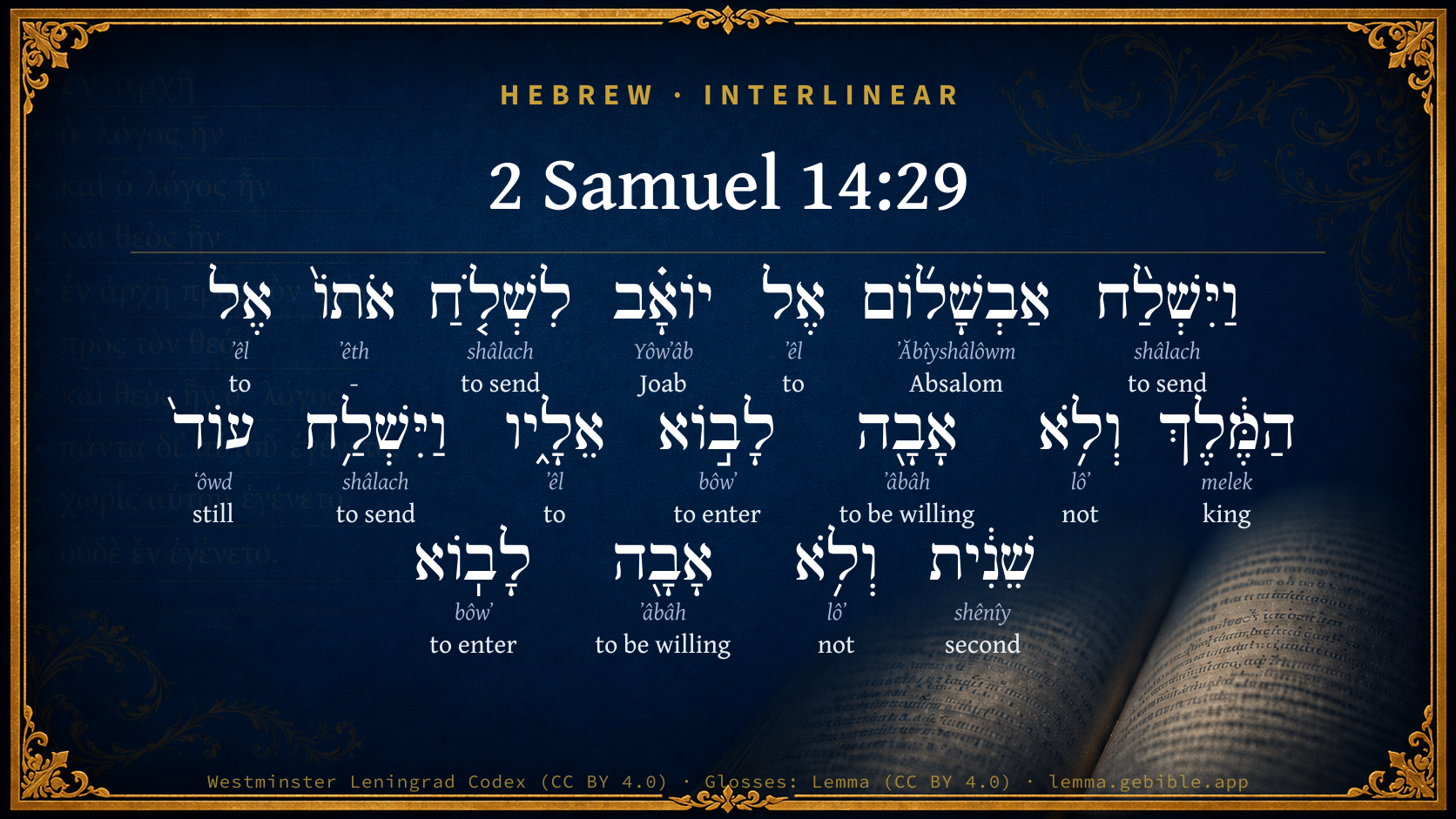
Hebrew (Westminster Leningrad Codex) 2 Samuel 14:29 appears in the Hebrew Old Testament. The text above is from the Westminster Leningrad Codex. Each word links to its Strong’s number, a concise gloss, and parsing drawn from the Open Scriptures Hebrew Bible morphology. Click any word for its full Brown-Driver-Briggs (BDB) entry.
Download image
Cite this verse

2 Samuel 14:29 (World English Bible). Public Domain. Lemma interlinear Bible study tool, https://lemma.gebible.app/v/2-samuel/14/29.

Show BibTeX & RIS
BibTeX
RIS
English Translation
Then Absalom sent for Joab, to send him to the king; but he would not come to him: and he sent again a second time, but he would not come.
World English Bible · Public Domain
Download a study sheet

One document with this verse’s original text, its word-by-word gloss line, the meaning frame, cross-references with their text, attributed commentary, and full source and license credits — printable, and it pastes into notes with its structure intact.

This verse Autodidact and up

Study sheet (.html) Plain text (.txt)

A passage Seminary Student

Up to 50 verses in one chapter. A passage sheet keeps up to 6 commentary sources and 12 cross-references per verse, in the order this page ranks them, and says so on the sheet whenever that leaves anything out. Ask for a single verse and you get the Autodidact verse sheet above.

Everything on this page stays free to read, with no account — the sheet is a download of what is already on screen, not access to it.

Want to remove ads? Support Godless Engineer
Compare translations 3

The same verse in 3 English versions, stacked beneath the original-language interlinear above. Click any original word for its lexicon entry.

Each is an independent rendering of the whole verse — the interlinear is not word-aligned to these translations.

Highlighted words mark where these versions differ — a whole-verse word diff, not a word-by-word alignment.

  • World English Bible Public Domain
    Then Absalom sent for Joab, to send him to the king; but he would not come to him: and he sent again a second time, but he would not come.
  • King James Version Public Domain
    Therefore Absalom sent for Joab, to have sent him to the king; but he would not come to him: and when he sent again the second time, he would not come.
  • unfoldingWord Literal Text CC BY-SA 4.0
    So Absalom sent to Joab to send him to the king, but he was not willing to come to him. So Absalom sent again a second time, but he was not willing to come.

unfoldingWord Literal Text — © unfoldingWord, licensed CC BY-SA 4.0. Word-aligned USFM3 via Door43 (git.door43.org/unfoldingWord/en_ult).

Versions to compare (up to 4)

3 of 4 selected

Show all 18 translations

Every available English version of this verse, each an independent rendering of the whole verse.

  • World English Bible Public Domain
    Then Absalom sent for Joab, to send him to the king; but he would not come to him: and he sent again a second time, but he would not come.
  • Berean Standard Bible Public Domain
    Then he sent for Joab to send him to the king, but Joab refused to come to him. So Absalom sent a second time, but Joab still would not come.
  • Majority Standard Bible Public Domain
    Then he sent for Joab to send him to the king, but Joab refused to come to him. So Absalom sent a second time, but Joab still would not come.
  • King James Version Public Domain
    Therefore Absalom sent for Joab, to have sent him to the king; but he would not come to him: and when he sent again the second time, he would not come.
  • American Standard Version (1901) Public Domain
    Then Absalom sent for Joab, to send him to the king; but he would not come to him: and he sent again a second time, but he would not come.
  • Revised Version (1885) Public Domain
    Then Absalom sent for Joab, to send him to the king; but he would not come to him: and he sent again a second time, but he would not come.
  • Geneva Bible (1599) Public Domain
    Therefore Absalom sent for Ioab to sende him to the King, but he would not come to him: and when he sent againe, he would not come.
  • Douay-Rheims (1899) Public Domain
    He sent therefore to Joab, to send him to the king: but he would not come to him. And when he had sent the second time, and he would not come to him,
  • Young's Literal Translation Public Domain
    and Absalom sendeth unto Joab, to send him unto the king, and he hath not been willing to come unto him; and he sendeth again a second time, and he hath not been willing to come.
  • Literal Standard Version CC BY-SA 4.0
    and Absalom sends to Joab, to send him to the king, and he has not been willing to come to him; and he sends again a second time, and he has not been willing to come.
  • Unlocked Literal Bible CC BY-SA 4.0
    Then Absalom sent word for Joab to send him to the king, but Joab would not come to him. So Absalom sent word a second time, but Joab still did not come.
  • unfoldingWord Literal Text CC BY-SA 4.0
    So Absalom sent to Joab to send him to the king, but he was not willing to come to him. So Absalom sent again a second time, but he was not willing to come.
  • Darby Bible Public Domain
    Then Absalom sent for Joab, to send him to the king; but he would not come to him; and he sent again the second time, but he would not come.
  • World Messianic Bible Public Domain
    Then Absalom sent for Joab, to send him to the king, but he would not come to him. Then he sent again a second time, but he would not come.
  • Webster's Bible Public Domain
    Therefore Absalom sent for Joab, that he might send him to the king; but he would not come to him: and when he sent again the second time, he would not come.
  • Free Bible Version CC BY-SA 4.0
    Absalom called Joab to arrange for him to see the king, but Joab refused to come. Absalom called Joab again, but Joab still wouldn't come.
  • Bible in Basic English Public Domain
    Then Absalom sent for Joab to send him to the king, but he would not come to him: and he sent again a second time, but he would not come.
  • JPS Tanakh (1917) Public Domain
    Then Absalom sent for Joab, to send him to the king; but he would not come to him; and he sent again a second time, but he would not come.

Literal Standard Version (2020), Covenant Press — licensed CC BY-SA 4.0. Text via the HelloAO Bible API (eBible.org). Unlocked Literal Bible (unfoldingWord) — licensed CC BY-SA 4.0. Text via the HelloAO Bible API (eBible.org). unfoldingWord Literal Text — © unfoldingWord, licensed CC BY-SA 4.0. Word-aligned USFM3 via Door43 (git.door43.org/unfoldingWord/en_ult). Free Bible Version, Dr. Jonathan Gallagher — licensed CC BY-SA 4.0. Text via the HelloAO Bible API (eBible.org).

Word by word

More ways to search: Search by grammar → Find every occurrence → Compare this word →

Practice this passage: Drill this verse → Learn its vocabulary →

אָבָ֖ה
ʼâbâh
H14
“to be willing”
Verb, Qal, Perfect, 3rd Person, Masculine, Singular
Part of Speech
Verb
Stem
Qal
Form
Perfect
Person
3rd Person
Gender
Masculine
Number
Singular
Full BDB Definition

Origin: a primitive root

TWOT: 3

to be willing, consent - (Qal) - to be willing - to consent, yield to, accept - to desire
  1. וַיִּשְׁלַ֨ח shâlach H7971 “and · to send” Conjunction + Verb, Qal, Sequential Imperfect, 3rd Person, Masculine, Singular
  2. אַבְשָׁל֜וֹם ʼĂbîyshâlôwm H53 “Absalom” Noun, Proper
  3. אֶל ʼêl H413 “to” Preposition
  4. יוֹאָ֗ב Yôwʼâb H3097 “Joab” Noun, Proper
  5. לִשְׁלֹ֤חַ shâlach H7971 “to send” Preposition + Verb, Qal, Infinitive Construct
  6. אֹתוֹ֙ ʼêth H853 “- · him” Particle, Direct Object + Suffix, Personal, 3rd Person, Masculine, Singular
  7. אֶל ʼêl H413 “to” Preposition
  8. הַמֶּ֔לֶךְ melek H4428 “the · king” Particle, Definite Article + Noun, Common, Masculine, Singular, Absolute
  9. וְלֹ֥א lôʼ H3808 “and · not” Conjunction + Particle, Negative
  10. לָב֣וֹא bôwʼ H935 “to enter” Preposition + Verb, Qal, Infinitive Construct
  11. אֵלָ֑יו ʼêl H413 “to · him” Preposition + Suffix, Personal, 3rd Person, Masculine, Singular
  12. וַיִּשְׁלַ֥ח shâlach H7971 “and · to send” Conjunction + Verb, Qal, Sequential Imperfect, 3rd Person, Masculine, Singular
  13. עוֹד֙ ʻôwd H5750 “still” Adverb
  14. שֵׁנִ֔ית shênîy H8145 “second” Adjective, Ordinal number, Feminine, Singular, Absolute
  15. וְלֹ֥א lôʼ H3808 “and · not” Conjunction + Particle, Negative
  16. אָבָ֖ה ʼâbâh H14 “to be willing” Verb, Qal, Perfect, 3rd Person, Masculine, Singular
  17. לָבֽוֹא bôwʼ H935 “to enter” Preposition + Verb, Qal, Infinitive Construct

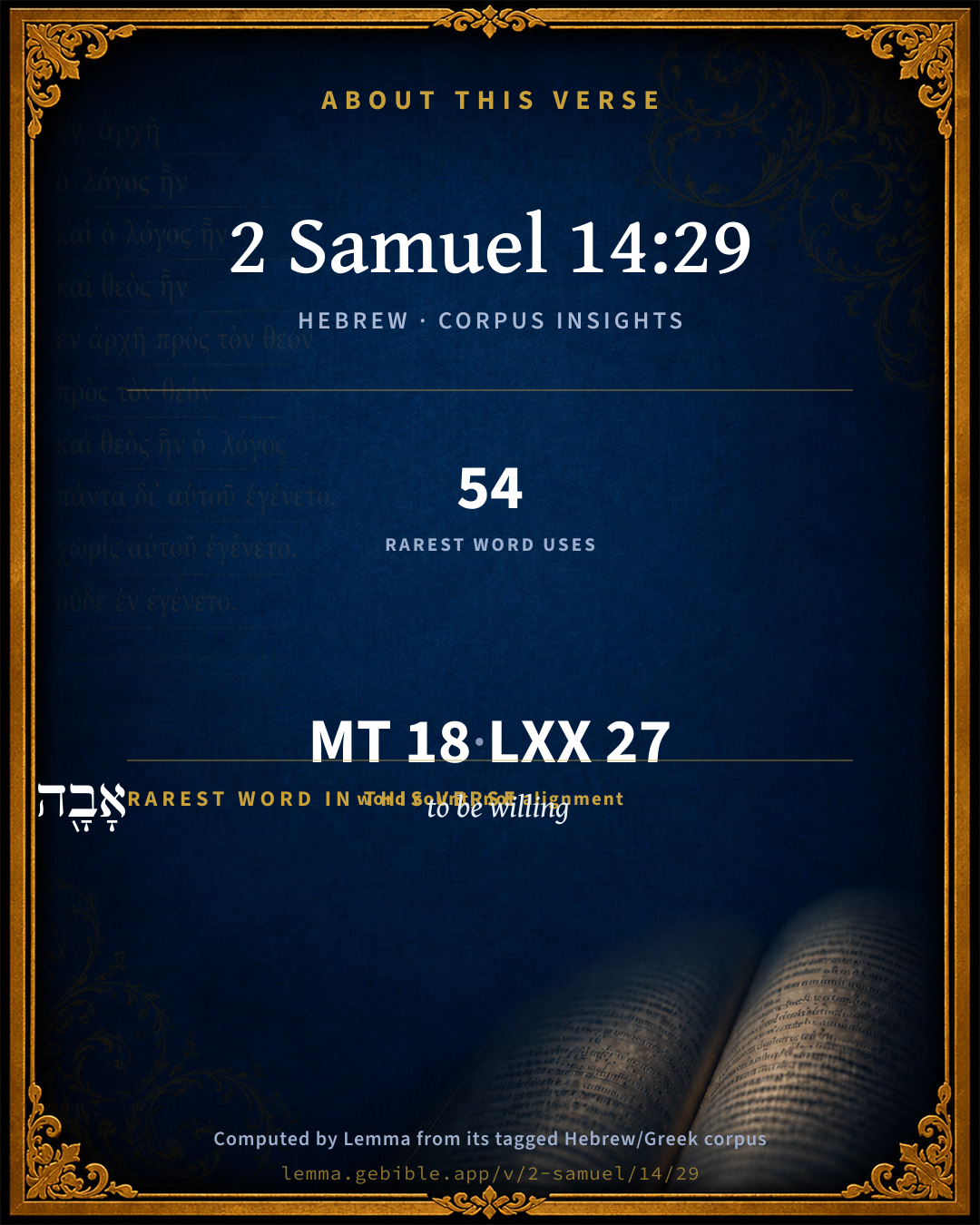
About this verse

These counts appear in no published source. They are computed here, from the morphology-tagged text and Lemma’s own curated glosses. What Lemma adds →

18
words
11
distinct lemmas
Historical
section

Shared distinctive vocabulary

אָבָ֖ה to be willing H14 occurs in 52 verses of the Hebrew Bible. Also found in:

Grammatical profile

  • 7 verbs
  • 3 nouns
  • 1 adjective
  • 3 prepositions
  • 1 adverb
  • 3 particles

Verb forms

  • וַיִּשְׁלַ֨ח Qal · Sequential Imperfect
  • לִשְׁלֹ֤חַ Qal · Infinitive Construct
  • אָבָ֖ה Qal · Perfect
  • לָב֣וֹא Qal · Infinitive Construct
  • וַיִּשְׁלַ֥ח Qal · Sequential Imperfect
  • אָבָ֖ה Qal · Perfect
  • לָבֽוֹא Qal · Infinitive Construct

Repetition

Words recur within this verse — often emphatic in Hebrew:

  • וַיִּשְׁלַ֨ח to send H7971 ×3
  • אָבָ֖ה to be willing H14 ×2
  • לָב֣וֹא to enter H935 ×2
  • אֶל to H413 ×3
  • וְלֹ֥א not H3808 ×2

Hebrew & Septuagint length

In English translation the verse runs 30 words from the Hebrew and 32 from the Septuagint (LXX English) — closely comparable.

A rough comparison of the two English renderings, which tokenize alike — not a word-level alignment.

Word counts can differ between the Hebrew and the Greek without any difference in meaning — e.g. the Hebrew direct-object marker אֵת has no separate Greek word, and Greek often adds the article ὁ.

In the original languages it is 18 Hebrew tokens and 27 Greek tokens — but the two are counted differently (Hebrew bundles its prefixes and suffixes into one token; the Greek is in lemma form), so that isn’t a like-for-like length.

Cross-references

3

Topical passages linked to 2 Samuel 14:29 in the Treasury of Scripture Knowledge — connected by theme and wording, ordered by reader-vote popularity; previews shown in the World English Bible.

  • 2 Samuel 14:30–31 Therefore he said to his servants, Behold, Joab's field is near mine, and he has barley there; go and set it on fire. Absalom's servants set the field on fire.
  • Esther 1:12 But the queen Vashti refused to come at the king's commandment by the chamberlains: therefore was the king very angry, and his anger burned in him.
  • Matthew 22:3 and sent out his servants to call those who were invited to the marriage feast, but they would not come.

Cross-references courtesy of OpenBible.info (CC BY 4.0).

Hebrew and Greek witnesses Masoretic Hebrew ↔ Greek Septuagint

The same verse in the two great witnesses to the Old Testament, shown verse-for-verse.

These are two independent witnesses, not word-aligned to each other, and the Septuagint is shown in lemma (dictionary) form.

Hebrew 2 Samuel 14:29 Masoretic · Westminster Leningrad Codex

וַיִּשְׁלַ֨ח אַבְשָׁל֜וֹם אֶל יוֹאָ֗ב לִשְׁלֹ֤חַ אֹתוֹ֙ אֶל הַמֶּ֔לֶךְ וְלֹ֥א אָבָ֖ה לָב֣וֹא אֵלָ֑יו וַיִּשְׁלַ֥ח עוֹד֙ שֵׁנִ֔ית וְלֹ֥א אָבָ֖ה לָבֽוֹא

Then Absalom sent for Joab, to send him to the king; but he would not come to him: and he sent again a second time, but he would not come.

World English Bible · Public Domain

Greek LXX 2 Samuel 14:29 Septuagint · lemma form

καί ἀποστέλλω αβεσσαλωμ πρός ιωαβ ὁ ἀποστέλλω αὐτός πρός ὁ βασιλεύς καί οὐ θέλω ἔρχομαι πρός αὐτός καί ἀποστέλλω ἐκ δεύτερος πρός αὐτός καί οὐ θέλω παραγίγνομαι

And Abessalom sent to Joab to bring him in to the king, and he would not come to him: and he sent to him the second time, and he would not come.

LXX2012 (modern English Septuagint) · Public Domain

Hebrew: Westminster Leningrad Codex (CC BY 4.0). Greek: Septuagint (public domain); English from LXX2012 (modern English Septuagint) (Public Domain). How the Septuagint differs from the Hebrew →

Targum (Aramaic paraphrase)

1

The Targum is the ancient Jewish Aramaic paraphrase of the Hebrew Scriptures — an interpretive translation, not the Hebrew text itself. Onkelos (literal) and Pseudo-Jonathan (expansive) render the Torah, and Jonathan the Prophets. Coverage is partial: where no permissively-licensed English translation exists for a verse, only the Aramaic is shown. This is verse-level text, not a word-by-word alignment to the Hebrew.

  1. Targum Jonathan Prophets (Joshua–Malachi)
    וּשְׁלַח אַבְשָׁלוֹם לְוַת יוֹאָב לְשַׁלְחָא יָתֵיהּ לְוַת מַלְכָּא וְלָא אֲבָה לְמֵיתֵי לְוָתֵיהּ וּשְׁלַח עוֹד תִּנְיָנוּת וְלָא אֲבָה לְמֵיתֵי:

    (no public-domain English translation for this verse)

    Targum Jonathan — Aramaic: “Mikraot Gedolot” (public domain). English: “Sefaria Community Translation” (CC0 1.0 (public-domain dedication)); “London "Chaldee Paraphrase," 1871” (public domain). Text via Sefaria.

Commentary

Notes on 2 Samuel 14:29 from classic Christian and Jewish commentators (each source and its license shown beneath its notes). The classic Christian expositions comment on the surrounding passage and are grouped to its opening verse, so a note may address several verses; the Jewish commentaries on the Tanakh (Rashi and others) are per-verse, so they appear only where the commentator wrote on this verse.

Lemma curates 59 commentaries, every one of them public domain or Creative Commons licensed, each selected and text-cleaned for this edition rather than reprinted as found. About our sources →

Trapp's Complete Commentary

John Trapp

2Sa 14:29 Therefore Absalom sent for Joab, to have sent him to the king; but he would not come to him: and when he sent again the second time, he would not come.

Ver. 29. But he would not come to him.] As disliking his pride and ambition, saith Pellican; as fearing lest David thereby might suspect that there was some secret practice or conspiracy betwixt them, saith Diodate.

John Trapp, A Commentary or Exposition upon All the Books of the Old and New Testament (1647–1656) — public domain. Text from a community e-Sword module.

The Biblical Illustrator

Joseph S. Exell

2Sa_14:29-32

Absalom sent for Joab . . . but he would not come to him.

The barley-field on fire

Absalom had fled from Jerusalem under fear of Davids anger; he was after a time permitted to return, but he was not admitted into the presence of the king. Earnestly desiring to be restored to his former posts of honour and favour, he besought Joab to come to him, intending to request him to act as mediator. Joab, having lost much of his liking for the young prince, refused to come; and, though he was sent for repeatedly, he declined to attend at his desire. Absalom therefore thought of a most wicked, but most effective plan of bringing Joab into his company. He bade his servants set Joabs field of barley on fire. This brought Joab down in high wrath to ask the question, Wherefore have thy servants set my field on fire? This was all that, Absalom wanted; he wished an interview, and he was not scrupuluous as to the method by which he obtained it. The burning of the barley-field brought Joab into his presence, and Absaloms ends were accomplished. Omitting the sin of the deed, we have here a picture of what is often done by our gracious God with the wisest and best design. Often he sendeth for us, not for his profit, but for ours; he would have us come near to him and receive a blessing at his hands, but we are foolish, and cold-hearted and wicked, and we will not come. He, knowing that we will not come by any other means, sendeth a serious trial--he sets our barley-field on fire, which he has a right to do, seeing our barley-fields are far more his than they are ours. In Absaloms case it was wrong; in Gods case he has a right to do as he wills with his own. He takes away from us our most choice delight, upon which we have set out heart, and then we enquire at, his hands, Wherefore contendest thou with me?

I. The text with reference to believers in christ. We cannot expect to avoid tribulation. If other mens barley-fields are not burned, ours will be. If the Father uses the rod nowhere else, he will surely make his true children smart. Your Saviour hath left, you a double legacy, In the world ye shall have tribulation, but in Me ye shall have peace. Gold must be tried in the fire: and truly the Lord hath a fire in Zion and his furnace in Jerusalem.

1. You have first, this sweet reflection, that there is no curse in your cross.

2. That your troubles are all apportioned to you by Divine wisdom and love. As for their number, if He appoint them ten they never can be eleven. As for their weight, he who weigheth the mountains in scales and the hills in a balance, takes care to measure your troubles, and you shall not have a grain more than His infinite wisdom sees fit.

3. That under your cross you have many special comforts. There are cordials which God giveth to sick saints which He never putteth to the lips of those who are in health. Dark caverns keep not back the miners, if they know that diamonds are to be found there: you need net fear suffering when you remember what riches it yields to your soul. There is no hearing the nightingale without night, and there are some promises which only sing to us in trouble. It is in the cellar of affliction that the good old wine of the kingdom is stored. You shall never see Christs face so well as when all others turn their backs upon you. When you have come into such confusion that human wisdom is at a nonplus, then shall you see Gods wisdom manifest and clear.

4. That your trials work your lasting good by bringing you nearer and nearer to your God.

(1) Our heavenly Father often sends for us and we will not come. He sends for us to exercise a more simple faith in Him.

(2) At another time He calls us to closer communion with Himself. We have been sitting on the doorstep of Gods house, and He bids us advance into the banquetting hall and sup with Him, but we decline the honour. He has admitted us into the inner chambers, but there are secret rooms not yet, opened to us; He invites Us to enter them, but we hold back. Jesus longs to have near communion with His people.

(3) Frequently the call is to more fervent prayer.

(4) Often, too, He calls us to a higher state of piety.

II. A few words to the sinner.

I. God also has sent for you, O unconverted man, God has often sent, for you. Early in your childhood your mothers prayers sought to woo you to a Saviours love, and your godly fathers first instructions were as so many meshes of the net in which it was desired that you should be taken; but you have broken through all these and lived to sin away early impressions and youthful promises.

2. If God is sending these, are you listening to them? (C. H. Spurgeon.)

Burning the barley field

Now, just as the shrewd young prince dealt with Joab in order to bring him unto him, so God employs a regimen of discipline very often in order to bring wayward hearts to Himself. Many a reader may have had his barley-field set on fire; there are some even now whose fields are wrapped in flames or are covered with the ashes of extinguished hopes. With backsliders this method is often Gods last resorts. He sees that the wayward wanderers care more for their earthly possessions than they do for His honour or His service. So He touches them in the tenderest spot, and sweeps away the objects they love too well. They have become idolaters, and He sternly dashes their idols to atoms.

Compulsory measures

For two whole years Joab paid no attention to the returned son of David, but the moment his barley-field was set on fire he paid Absalom a visit of inquiry. It was crafty on the part of Absalom. Perhaps he looked upon it as a last resort and thought the end would lustily the means. But there is a spiritual use of this incident which is well worth considering. Is it not so that when we will not go to God lovingly, voluntarily, He sets our barley-fields on fire, saying, Now they will pray? We desert His Church, we abandon His book, we release ourselves from all religious responsibilities; God calls, and we will not hear; then He sets all the harvest in a blaze, and we become religious instantaneously. We are richer if we have lost a barley-field, and found the God of the harvest. He will make up the barley-field to us, if so be we accept the providence aright, and say, This is Gods thought concerning us. (J. Parker, D. D.)

The Biblical Illustrator, edited by Joseph S. Exell (c. 1880s–1900s) — public domain. Text from a community e-Sword module.

Joseph Benson's Commentary

2Sa 14:29. Absalom sent for Joab — This vain young man, whose only excellence seems to have been his singular beauty, weary with being so long detained in that confinement and obscurity, so mortifying to his pride, and so unfriendly to his popularity, sent a messenger to Joab, to desire to speak with him, in order to prevail upon him to solicit, by his intercession with the king, to be admitted to his presence. But he would not come to him — “The reader little versed in courts is apt to be surprised to see Joab so zealous to get Absalom recalled from exile, and afterward so cold and indifferent to have him re-established in his father’s favour. The truth is, when Joab had greatly gratified the king and gained credit with him, by bringing back Absalom to Jerusalem, he had little reason, as a minister, to be solicitous to bring him near the king’s person, and restore him to full favour; because, in that case, he might naturally apprehend that Absalom’s interest with his father might impair his own.”

Joseph Benson's Commentary on the Old and New Testaments (1811–1818) — public domain. Text from a community e-Sword module.

Tyndale Open Study Notes

Tyndale Open Resources

14:29 Joab persuaded David to welcome Absalom back (14:21-22) but then backed off from assisting Absalom further; perhaps Joab wanted to avoid aiding a would-be usurper (15:1-12).

Tyndale Open Study Notes — © Tyndale Open Resources, licensed CC BY-SA 4.0. Text via the HelloAO Bible API.

Ellicott's Commentary for English Readers

(29) He would not come.—Joab felt that he had already gone far enough in procuring Absalom’s return, and, as he still continued under the displeasure of the king, he was not disposed to do anything more. Possibly also he thought Absalom should have shown some sign of penitence for his great crime.

A Bible Commentary for English Readers, edited by Charles John Ellicott (1878–1897) — public domain. Text from a community e-Sword module.

The Cambridge Bible for Schools and Colleges

gen. ed. J. J. S. Perowne

28–33. Absalom readmitted to David’s presence through Joab’s mediation

29. he would not come to him] Not choosing to incur David’s displeasure by visiting Absalom while he was still in disgrace.

The Cambridge Bible for Schools and Colleges (gen. ed. J. J. S. Perowne; Cambridge University Press, 1878–1918) — public domain. Text from a community e-Sword module.

John Gill's Exposition

Therefore Absalom sent for Joab, to have sent him to the king,.... To introduce him into his presence, being uneasy to be thus confined at his own house, and not suffered to come to court:

but he would not come to him; knowing the king's mind, and being unwilling to disoblige him by a troublesome solicitation:

and when he sent again the second time, he would not come; knowing his business with him; and perhaps between the first time of his sending and this he had sounded the king about it, and found it was not agreeable to him to admit him to access to him as yet.

John Gill's Exposition of the Whole Bible (1746–1763) — public domain (CC PDM 1.0). Text via the HelloAO Bible API.

Haydock's Catholic Bible Commentary

To him. Joab, like a crafty courtier, would neither disoblige the king nor the prince, and therefore wished not to meddle in this affair; as he might either excite the suspicions of the own, or the resentment of the other. (Calmet)

George Leo Haydock (1774–1849), Haydock's Catholic Family Bible and Commentary, 1859 edition — public domain. Excludes Psalms (Douay-Rheims chapter numbering differs from Protestant) and Deuterocanonical books (Catholic canon only).

Matthew Poole's English Annotations

To have sent him to the king; that by his mediation he might be admitted into the king’s favour and presence.

He would not come; partly, because perceiving David’s affections to be cold to Absalom, he would not venture his own interest for him, especially in desiring that which he feared he should be denied; partly, lest by interceding further for Absalom, he should revive the remembrance of his former murder, and meet with the reproach of one murderer’s interceding for another; and partly, because by converse with Absalom he observed his temper to be such, that if once he were fully restored to the king’s favour, he would not only eclipse and oppose Joab’s interest and power with the king, but also attempt high things, not without danger to the king and kingdom, as it happened.

Matthew Poole's English Annotations on the Holy Bible (1683–1685) — public domain. Text from a community e-Sword/MySword module.

Whedon's Commentary on the Bible

Daniel D. Whedon

29. He would not come — Joab deemed it prudent for him to avoid any intimacy with Absalom. Perhaps during his two years’ residence in Jerusalem some of his aspirations to the throne had become manifest, and Joab, seeing the king did not visit him or allow him to come to his palace, thought it best for himself to be cautious.

Daniel D. Whedon (gen. ed.), Commentary on the Old and New Testaments (1874–1909) — public domain. Text from a community e-Sword module.

The Pulpit Commentary

Absalom sent for Joab. As Joab had been the means of bringing him back, Absalom naturally regarded him as a friend. But Joab had performed the former service for other reasons, and it does not seem as if he really had any affection for Absalom.

The Pulpit Commentary (1880–1919), ed. H.D.M. Spence-Jones & Joseph S. Exell — public domain. Text from a community e-Sword module.

Lesson kit

Teaching starters — assembled from the data on this page, not authored interpretation. Every prompt links to the verse data it draws on. Edit before teaching.

2 Samuel, in the Historical, opens this verse with 18 words (11 distinct Hebrew lemmas). Its most distinctive word is ʼâbâh (“to be willing”). A historical commentator’s framing appears above. Read the whole chapter for the surrounding context.

Discussion questions

  1. How does “to be willing” (ʼâbâh) shape what this verse is saying?
  2. How does Genesis 24:5, which shares the word «to be willing», read alongside this verse?
  3. What does the repetition of “to send” (3× in this one verse) do in this verse?
  4. These translations render this verse differently. What is at stake in choosing one wording over another?
  5. «וַיִּשְׁלַ֨ח» is a Qal Sequential Imperfect verb. How does that grammatical form shape the action described?
  6. Compare how Trapp's Complete Commentary and The Biblical Illustrator read this verse. Where do they agree or differ?

Things to notice

Reading settings

Reading text

Shown beneath each verse's original-language words.

Old Testament
Old Testament edition

Read the OT as the Masoretic Hebrew (MT) or the Greek Septuagint (LXX).

English shown for the Greek Septuagint (in the Hebrew ↔ Greek comparison).

Comparing translations? Open the Compare panel on any verse page to stack up to four side by side.