Philippians 2:13

Greek (Tischendorf 8th ed.) Philippians 2:13 appears in the Greek New Testament. The text above is from the Tischendorf 8th edition. Each word links to its Strong’s number and a concise gloss. Click any word for its full Thayer’s Greek Lexicon entry.
Download image
Cite this verse

Philippians 2:13 (World English Bible). Public Domain. Lemma interlinear Bible study tool, https://lemma.gebible.app/v/philippians/2/13.

Show BibTeX & RIS
BibTeX
RIS
English Translation
For it is God who works in you both to will and to work, for his good pleasure.
World English Bible · Public Domain
Download a study sheet

One document with this verse’s original text, its word-by-word gloss line, the meaning frame, cross-references with their text, attributed commentary, and full source and license credits — printable, and it pastes into notes with its structure intact.

This verse Autodidact and up

Study sheet (.html) Plain text (.txt)

A passage Seminary Student

Up to 50 verses in one chapter. A passage sheet keeps up to 6 commentary sources and 12 cross-references per verse, in the order this page ranks them, and says so on the sheet whenever that leaves anything out. Ask for a single verse and you get the Autodidact verse sheet above.

Everything on this page stays free to read, with no account — the sheet is a download of what is already on screen, not access to it.

Want to remove ads? Support Godless Engineer
Compare translations 3

The same verse in 3 English versions, stacked beneath the original-language interlinear above. Click any original word for its lexicon entry.

Each is an independent rendering of the whole verse — the interlinear is not word-aligned to these translations.

Highlighted words mark where these versions differ — a whole-verse word diff, not a word-by-word alignment.

  • World English Bible Public Domain
    For it is God who works in you both to will and to work, for his good pleasure.
  • King James Version Public Domain
    For it is God which worketh in you both to will and to do of his good pleasure.
  • unfoldingWord Literal Text CC BY-SA 4.0
    For God is the one working in you both to will and to work for his good pleasure.

unfoldingWord Literal Text — © unfoldingWord, licensed CC BY-SA 4.0. Word-aligned USFM3 via Door43 (git.door43.org/unfoldingWord/en_ult).

Versions to compare (up to 4)

3 of 4 selected

Show all 19 translations

Every available English version of this verse, each an independent rendering of the whole verse.

  • World English Bible Public Domain
    For it is God who works in you both to will and to work, for his good pleasure.
  • Berean Standard Bible Public Domain
    For it is God who works in you to will and to act on behalf of His good purpose.
  • Majority Standard Bible Public Domain
    For it is God who works in you to will and to act on behalf of His good purpose.
  • King James Version Public Domain
    For it is God which worketh in you both to will and to do of his good pleasure.
  • American Standard Version (1901) Public Domain
    for it is God who worketh in you both to will and to work, for his good pleasure.
  • Revised Version (1885) Public Domain
    for it is God which worketh in you both to will and to work, for his good pleasure.
  • Geneva Bible (1599) Public Domain
    For it is God which worketh in you, both the will and the deede, euen of his good pleasure.
  • Douay-Rheims (1899) Public Domain
    For it is God who worketh in you, both to will and to accomplish, according to his good will.
  • Young's Literal Translation Public Domain
    for God it is who is working in you both to will and to work for His good pleasure.
  • Literal Standard Version CC BY-SA 4.0
    for it is God who is working in you both to will and to work for His good pleasure.
  • Unlocked Literal Bible CC BY-SA 4.0
    For it is God who is working in you both to will and to work for his good pleasure.
  • unfoldingWord Literal Text CC BY-SA 4.0
    For God is the one working in you both to will and to work for his good pleasure.
  • Darby Bible Public Domain
    for it is God who works in you both the willing and the working according to [his] good pleasure.
  • World Messianic Bible Public Domain
    For it is God who works in you both to will and to work for his good pleasure.
  • Webster's Bible Public Domain
    For it is God who worketh in you both to will and to do of his good pleasure.
  • Free Bible Version CC BY-SA 4.0
    For it's God who is working within you, creating the will and the ability to do what he wants you to do.
  • Bible in Basic English Public Domain
    For it is God who is the cause of your desires and of your acts, for his good pleasure.
  • Text-Critical English NT CC BY 4.0
    for God is the one at work in you, granting you the will and power to do so, according to his good pleasure.
  • Tyndale New Testament (1534) Public Domain
    For it is god which worketh in you both the will and also that dede even of good will

Literal Standard Version (2020), Covenant Press — licensed CC BY-SA 4.0. Text via the HelloAO Bible API (eBible.org). Unlocked Literal Bible (unfoldingWord) — licensed CC BY-SA 4.0. Text via the HelloAO Bible API (eBible.org). unfoldingWord Literal Text — © unfoldingWord, licensed CC BY-SA 4.0. Word-aligned USFM3 via Door43 (git.door43.org/unfoldingWord/en_ult). Free Bible Version, Dr. Jonathan Gallagher — licensed CC BY-SA 4.0. Text via the HelloAO Bible API (eBible.org).

Word by word

More ways to search: Search by grammar → Find every occurrence → Compare this word →

Practice this passage: Drill this verse → Learn its vocabulary →

εὐδοκίας
eudokía
G2107
“pleasure”
Noun, Genitive, Singular, Feminine
Part of Speech
Noun
Case
Genitive
Number
Singular
Gender
Feminine
Full Thayer's Definition

Origin: from a presumed compound of G2095 and the base of G1380

TDNT: 14:22,3

1. will, choice a. good will, kindly intent, benevolence 2. delight, pleasure, satisfaction 3. desire a. for delight in any absent thing easily produces longing for it
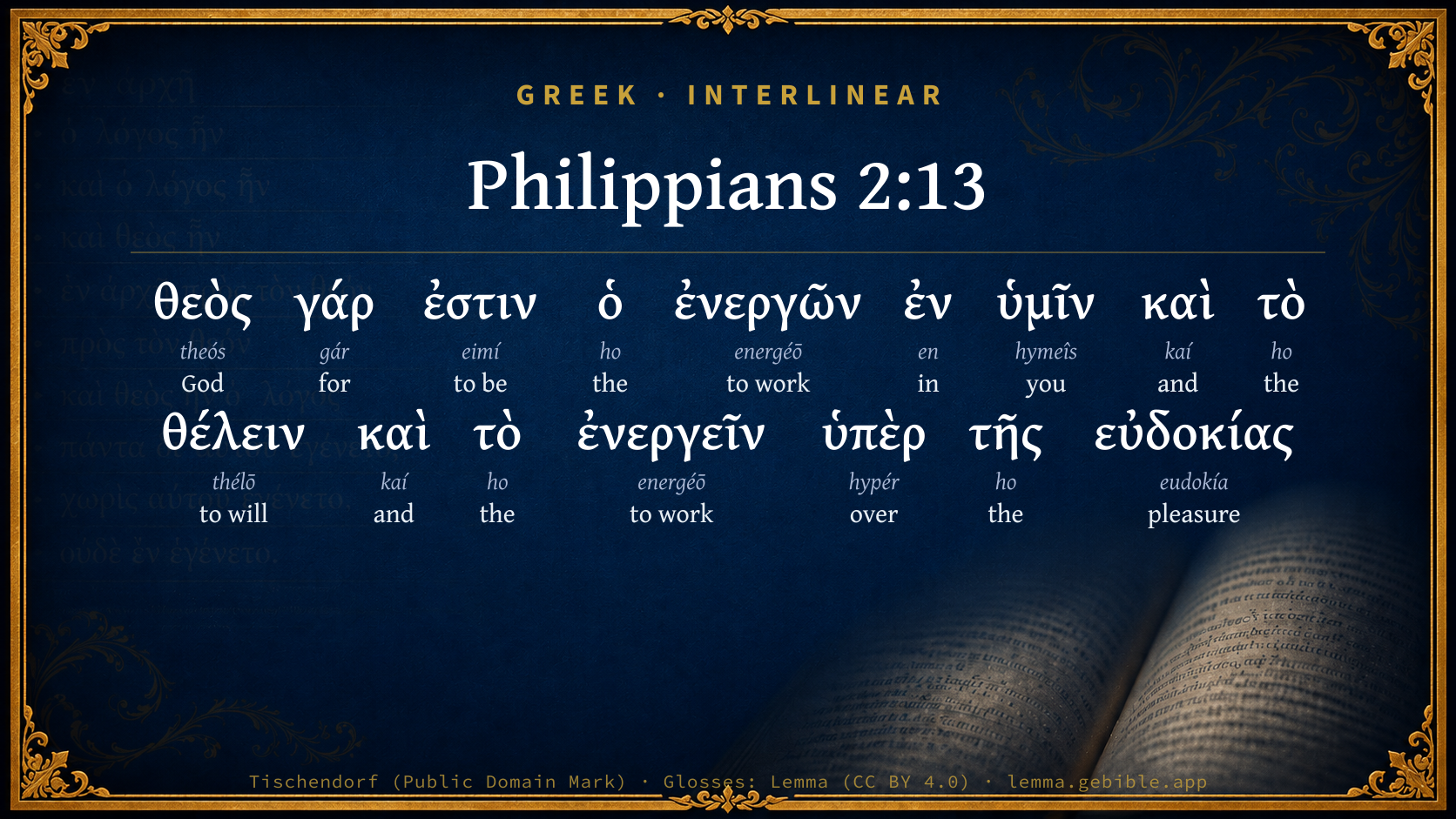
  1. θεὸς theós G2316 “God” Noun, Nominative, Singular, Masculine
  2. γάρ gár G1063 “for” Conjunction
  3. ἐστιν eimí G1510 “to be” Verb, Present, Active, Indicative, 3rd person, Singular
  4. ὁ ho G3588 “the” Article, Nominative, Singular, Masculine
  5. ἐνεργῶν energéō G1754 “to work” Verb, Present, Active, Participle, Nominative, Singular, Masculine
  6. ἐν en G1722 “in” Preposition
  7. ὑμῖν hymeîs G5210 “you” Personal pronoun, 2nd person, Dative, Plural
  8. καὶ kaí G2532 “and” Conjunction
  9. τὸ ho G3588 “the” Article, Accusative, Singular, Neuter
  10. θέλειν thélō G2309 “to will” Verb, Present, Active, Infinitive
  11. καὶ kaí G2532 “and” Conjunction
  12. τὸ ho G3588 “the” Article, Accusative, Singular, Neuter
  13. ἐνεργεῖν energéō G1754 “to work” Verb, Present, Active, Infinitive
  14. ὑπὲρ hypér G5228 “over” Preposition
  15. τῆς ho G3588 “the” Article, Genitive, Singular, Feminine

About this verse

These counts appear in no published source. They are computed here, from the morphology-tagged text and Lemma’s own curated glosses. What Lemma adds →

16
words
11
distinct lemmas
Pauline Epistles
section

Notable vocabulary

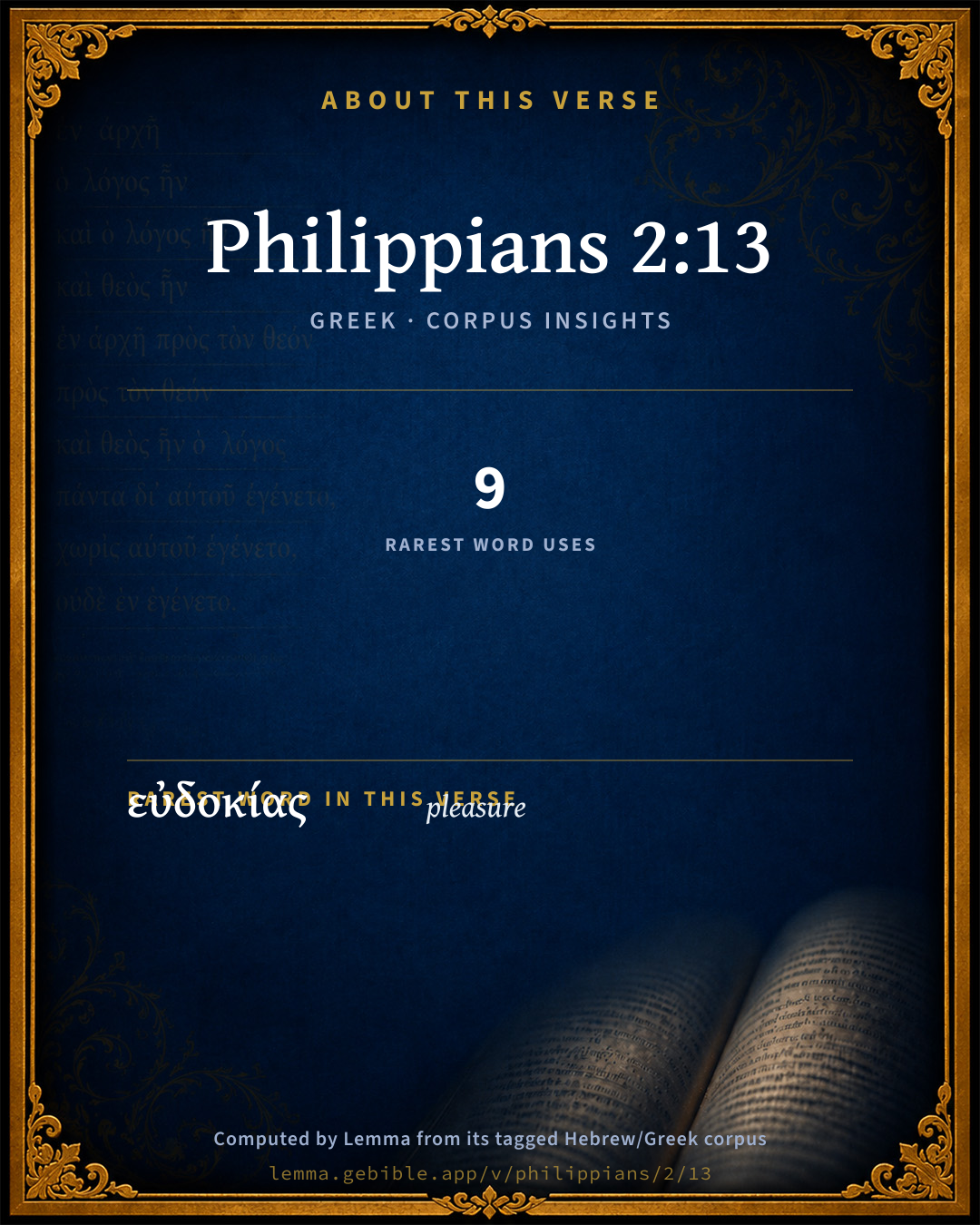
The rarest word here is εὐδοκίας pleasure G2107 — appearing just 9 times in the whole Greek New Testament.

Shared distinctive vocabulary

εὐδοκίας pleasure G2107 occurs in 9 verses of the Greek New Testament. Also found in:

Repetition

Words recur within this verse:

  • ἐνεργῶν to work G1754 ×2
  • ὁ the G3588 ×4
  • καὶ and G2532 ×2

Cross-references

36

Topical passages linked to Philippians 2:13 in the Treasury of Scripture Knowledge — connected by theme and wording, ordered by reader-vote popularity; previews shown in the World English Bible.

  • Hebrews 13:21 make you complete in every good work to do his will, working in you that which is well pleasing in his sight, through Jesus Christ, to whom be the glory forever and ever. Amen.
  • 2 Corinthians 3:5 not that we are sufficient of ourselves, to account anything as from ourselves; but our sufficiency is from God;
  • 2 Timothy 1:9 who saved us and called us with a holy calling, not according to our works, but according to his own purpose and grace, which was given to us in Christ Jesus before times eternal,
  • Romans 9:16 So then it is not of him who wills, nor of him who runs, but of God who has mercy.
  • 1 Corinthians 15:10 But by the grace of God I am what I am. His grace which was bestowed on me was not futile, but I worked more than all of them; yet not I, but the grace of God which was with me.
  • Ephesians 1:11 in whom also we were assigned an inheritance, having been foreordained according to the purpose of him who works all things after the counsel of his will;
  • James 1:16–18 Don't be deceived, my beloved brothers.
  • John 3:27 John answered, "A man can receive nothing, unless it has been given him from heaven.
  • 2 Thessalonians 1:11 To this end we also pray always for you, that our God may count you worthy of your calling, and fulfill every desire of goodness and work of faith, with power;
  • 1 Corinthians 12:6 There are various kinds of workings, but the same God, who works all things in all.
  • 1 Kings 8:58 that he may incline our hearts to him, to walk in all his ways, and to keep his commandments, and his statutes, and his ordinances, which he commanded our fathers.
  • Ephesians 1:5 having predestined us for adoption as children through Jesus Christ to himself, according to the good pleasure of his desire,
  • Ephesians 2:8 for by grace you have been saved through faith, and that not of yourselves; it is the gift of God,
  • Titus 3:4–5 But when the kindness of God our Savior and his love toward mankind appeared,
  • Psalms 119:36 Turn my heart toward your statutes, Not toward selfish gain.
  • Luke 12:32 Don't be afraid, little flock, for it is your Father's good pleasure to give you the Kingdom.
  • Ephesians 2:4–5 But God, being rich in mercy, for his great love with which he loved us,
  • Ephesians 1:9 making known to us the mystery of his will, according to his good pleasure which he purposed in him
  • Jeremiah 32:38 and they shall be my people, and I will be their God:
  • John 6:65 He said, "For this cause have I said to you that no one can come to me, unless it is given to him by my Father."
  • Romans 9:11 For being not yet born, neither having done anything good or bad, that the purpose of God according to election might stand, not of works, but of him who calls,
  • Proverbs 21:1 The king's heart is in Yahweh's hand like the watercourses. He turns it wherever he desires.
  • Jeremiah 31:33 But this is the covenant that I will make with the house of Israel after those days, says Yahweh: I will put my law in their inward parts, and in their heart will I write it; and I will be their God, and they shall be my people:
  • 1 Chronicles 29:14–18 But who am I, and what is my people, that we should be able to offer so willingly as this? For all things come of you, and of your own have we given you.
  • 2 Chronicles 30:12 Also on Judah came the hand of God to give them one heart, to do the commandment of the king and of the princes by the word of Yahweh.
  • Ezra 1:1 Now in the first year of Cyrus king of Persia, that the word of Yahweh by the mouth of Jeremiah might be accomplished, Yahweh stirred up the spirit of Cyrus king of Persia, so that he made a proclamation throughout all his kingdom, and [put it] also in writing, saying,
  • Ezra 7:27 Blessed be Yahweh, the God of our fathers, who has put such a thing as this in the king's heart, to beautify the house of Yahweh which is in Jerusalem;
  • Ezra 1:5 Then rose up the heads of fathers' [houses] of Judah and Benjamin, and the priests, and the Levites, even all whose spirit God had stirred to go up to build the house of Yahweh which is in Jerusalem.
  • Isaiah 26:12 Yahweh, you will ordain peace for us; for you have also worked all our works for us.
  • John 6:45 It is written in the prophets, 'They will all be taught by God.' Therefore everyone who hears from the Father, and has learned, comes to me.
  • 2 Thessalonians 2:13–14 But we are bound to always give thanks to God for you, brothers loved by the Lord, because God chose you from the beginning for salvation through sanctification of the Spirit and belief in the truth;
  • Psalms 141:4 Don't incline my heart to any evil thing, To practice deeds of wickedness with men who work iniquity. Don't let me eat of their delicacies.
  • 1 Peter 1:3 Blessed be the God and Father of our Lord Jesus Christ, who according to his great mercy became our father again to a living hope through the resurrection of Jesus Christ from the dead,
  • Acts 11:21 The hand of the Lord was with them, and a great number believed and turned to the Lord.
  • Nehemiah 2:4 Then the king said to me, For what do you make request? So I prayed to the God of heaven.
  • Psalms 110:3 Your people offer themselves willingly in the day of your power, in holy array. Out of the womb of the morning, you have the dew of your youth.

Cross-references courtesy of OpenBible.info (CC BY 4.0).

Commentary

Notes on Philippians 2:13 from classic Christian and Jewish commentators (each source and its license shown beneath its notes). The classic Christian expositions comment on the surrounding passage and are grouped to its opening verse, so a note may address several verses; the Jewish commentaries on the Tanakh (Rashi and others) are per-verse, so they appear only where the commentator wrote on this verse.

Lemma curates 59 commentaries, every one of them public domain or Creative Commons licensed, each selected and text-cleaned for this edition rather than reprinted as found. About our sources →

Tyndale Open Study Notes

Tyndale Open Resources

2:13 For God is working in you: God empowers and energizes believers’ lives (see John 15:5; 1 Cor 12:6; 15:10; 2 Cor 3:5; 1 Thes 2:13). Both the desire and the power to do what pleases him come from God.

Tyndale Open Study Notes — © Tyndale Open Resources, licensed CC BY-SA 4.0. Text via the HelloAO Bible API.

Bengel's Gnomon

Johann Albrecht Bengel

Php 2:13. Ὁ Θεὸς γὰρ, for God) God alone; He is present with you even in my absence. You want nothing, only be not wanting to yourselves; comp. 2Pe 1:5; 2Pe 1:3. [You can do nothing of yourselves; avoid security. Some, trusting too much to their exalted condition, think that they may hold the grace of GOD on the same footing as the Israelites held the food sent down from heaven, Num 11:8, and therefore that it is at their own will either to struggle against it or anew to grant it admission.—V. g.]—τὸ θέλειν, to will) that you have willed salvation in my presence, and still will it.—τὸ ἐνεργεῖν, to do) even now in my absence.—ὑπὲρ τῆς εὐδοκίας, of His good pleasure) To this refer, to will; and to do, to, who worketh.

Bengel's Gnomon of the New Testament — English translation (T&T Clark, Edinburgh, 1860) — public domain. Text from a community e-Sword module.

Meyer's Critical & Exegetical Commentary

Heinrich August Wilhelm Meyer

Php_2:13. Ground of encouragement to the fulfilment of this precept, in which it is not their own, but Gods power, which works in them, etc. Here Θεός is placed first as the subject, not as the predicate (Hofmann): God is the agent. It is, however, unnecessary and arbitrary to assume before γάρ (with Chrysostom, Oecumenius, Theophylact, Erasmus, and others) an unexpressed thought (be not terrified at my having said: with fear and trembling). Bengel gratuitously supplies with Θεός the thought: praesens vobis etiam absente me (comp. also van Hengel), while others, as Calvin, Beza, Hoelemann, Rilliet, Wiesinger, who found in μετὰ φόβ. κ. τρ. the antithesis of pride (see on Php_2:12), see in Php_2:13 the motive to humility; and de Wette is of opinion that what was expressed in Php_2:12 under the aspect of fear is here expressed under the aspect of confidence. In accordance with the unity of the sense we ought rather to say: that the great moral demand μετὰ φόβ. κ. τρ. τὴν ἑαυτῶν σωτ. κατεργάζεσθαι, containing as it did the utmost incentive to personal activity, needed for the readers the support of a confidence which should be founded not on their own, but on the divine working. According to Ewald, the μετὰ φόβου κ. τρόμου is to be made good by pointing to the fact that they work before God, who is even already producing in them the right tendency of will. But the idea of the ἐνώπιον τοῦ Θεοῦ was so familiar to the apostle, that he would doubtless have here also directly expressed it. Kähler (comp. Weiss) imports a hint of the divine punishment, of which, however, nothing is contained in the text. So also Hofmann: with fear in presence of Him who is a devouring fire (Heb_12:28 f.), who will not leave unpunished him who does not subordinate his own will and working to the divine. As if Paul had hinted at such thoughts, and had not, on the contrary, himself excluded them by the ὑπὲρ τῆς εὐδοκίας which is added! The thought is rather dulcissima sententia omnibus piis mentibus, Form. Conc. p. 659.

Calvin (comp. Calovius) rightly observes on the subject-matter: intelligo gratiam supernaturalem, quae provenit ex spiritu regenerationis; nam quatenus sumus homines, jam in Deo sumus et vivimus et movemur, verum hic de alio motu disputat Paulus, quam illo universali. Augustine has justly (in opposition to the Pelagian rationalizing interpretation of a mediate working: velle operatur suadendo et praemia promittendo), in conformity with the words, urged the efficaciter operari, which Origen, de Princ. iii. 1, had obliterated, and the Greeks who followed qualified with synergistic reservations.

ἐν ὑμῖν] not intra coetum vestrum (Hoelemann), but in animis vestris (1Co_12:6; 2Co_4:12; Eph_2:2; Col_1:29; 1Th_2:13), in which He produces the self-determination directed to the κατεργάζεσθαι of their own σωτηρία, and the activity in carrying out this Christian-moral volition.[125] This activity, the ἐνεργεῖν, is the inner moral one, which has the κατεργάζεσθαι as its consequence, and therefore is not to be taken as equivalent to the latter (Vulgate, Luther, and others, including Matthies and Hoelemann). Note, on the contrary, the climactic selection of the two cognate verbs. The regenerate man brings about his own salvation (κατεργάζεται) when he does not resist the divine working (ἘΝΕΡΓῶΝ) of the willing and the working (ἘΝΕΡΓΕῖΝ) in his soul, but yields steady obedience to it in continual conflict with the opposing powers (Eph_6:10 ff.; Gal_5:16; 1Th_5:8, al.); so that he περιπατεῖ, not ΚΑΤᾺ ΣΆΡΚΑ, but ΚΑΤᾺ ΠΝΕῦΜΑ (Rom_8:4), is consequently the child of God, and as child becomes heir (Rom_8:14; Rom_8:17; Rom_8:23). According, therefore, as the matter is viewed from the standpoint of the human activity, which yields obedience to the divine working of the θέλειν and ἘΝΕΡΓΕῖΝ, or from that of the divine activity, which works the θέλειν and ἘΝΕΡΓΕῖΝ, we may say with equal justice, either that God accomplishes the good which He has begun in man, up to the day of Christ; or, that man brings about his own salvation. Nos ergo volumus, sed Deus in nobis operatur et velle; nos ergo operamur, sed Deus in nobis operatur et operari, Augustine. How wholly is it otherwise with the unregenerate in Romans 7!

The repetition by Paul of the same word, ἐνεργῶν … τὸ ἐνεργεῖν, has its ground in the encouraging design which he has of making Gods agency felt distinctly and emphatically; hence, also, he specifies the two elements of all morality, not merely the ἐνεργεῖν, but also its premiss, the ΘΈΛΕΙΝ, and keeps them apart by using ΚΑΊ twice: God is the worker in you, as of the willing, so of the working. From His working comes mans working, just as already his willing.[126]

ὑπὲρ τῆς εὐδοκίας] for the sake of goodwill, in order to satisfy His own benignant disposition. On the causal ὑπέρ, which is not secundum, comp. Rom_15:8; Kühner, II. 1, p. 421; Winer, p. 359 [E. T. p. 480]; and on εὐδοκία, which is not, with Ewald, to be taken in a deterministic sense, comp. Php_1:15; Rom_10:1. Theodoret aptly says: ΕὐΔΟΚΊΑΝ ΔῈ ΤῸ ἈΓΑΘῸΝ ΤΟῦ ΘΕΟῦ ΠΡΟΣΗΓΌΡΕΥΣΕ ΘΈΛΗΜΑ· ΘΈΛΕΙ ΔῈ ΠΆΝΤΑς ἈΝΘΡΏΠΟΥς ΣΩΘῆΝΑΙ Κ.Τ.Λ. The explanation: for the sake of the good pleasure, which He has in such willing and working (Weiss), would amount to something self-evident. Hofmann erroneously makes ὑπὲρ τ. εὐδοκ. belong to ΠΆΝΤΑ ΠΟΙΕῖΤΕ, and convey the sense, that they are to do everything for the sake of the divine good pleasure, about which they must necessarily be concerned, etc. In opposition to this view, which is connected with the misunderstanding of the previous words, the fact is decisive, that τῆς εὐδοκίας only obtains its reference to God through its belonging to ὁ ἐνεργῶν κ.τ.λ.; but if it be joined with what follows, this reference must have been marked,[127] and that, on account of the emphasized position which ὑπ. τ. εὐδοκ. would have, with emphasis (as possibly by ὙΠῈΡ Τῆς ΑὐΤΟῦ ΕὐΔΟΚΊΑς).

[125] Velle quidem, quatenus est actus voluntatis, nostrum est ex creatione: bene velle etiam nostrum est, sed quatenus volentes facti per conversionem bene volumus, Calovius.

[126] This is Gods creative moral action in salvation, Eph_2:10. Comp. Thomasius, Chr. Pers. u. Werk, I. p. 287. Incorrectly, however, the Reformed theologians add: quae prohiberi non potest.

[127] Hofmann groundlessly compares Luk_2:14 (but see on that passage) and even Sir_15:15, where Fritzsche, Handb. p. 74 f., gives the right view.

Meyer — Critical and Exegetical Commentary on the New Testament — English translation by Peter Christie, edited by Frederick Crombie (T&T Clark, 1880) — public domain. Text from a community e-Sword module.

Expositor's Greek Testament

ed. W. Robertson Nicoll

Phi 2:13 . ὁ must certainly be omitted with all the best authorities. “For God is He that works,” etc. The emphasis lies on Θεός for two reasons. First, in the matter of attaining salvation they have to do not with Paul, but with God. Second, they must enter upon this momentous course not lightly, but “with fear and trembling,” for if they miss the goal it means that they have deliberately rejected the purpose of God. This explains the connecting γάρ . ὁ ἐνεργῶν . It seems always to have the idea of effective working. In N.T. the active is invariably used of God. The middle is always intransitive. The verb has become transitive only in later Greek ( cf. Krebs, Rection d. Casus , ii., 21). Many exx. occur in Justin M. τὸ θέλειν . The first resolution in the direction of salvation takes its origin from God. So also does the ἐνεργεῖν , the carrying of this inward resolve into practical effect, the acting on the assurance that God’s promise is genuine. Cf. Eph 2:8 , τῇ γὰρ χάριτί ἐστε σεσωσμένοι , διὰ πίστεως · καὶ τοῦτο οὐκ ἐξ ὑμῶν , Θεοῦ τὸ δῶρον . To Paul the Divine working and the human self-determination are compatible. But “all efforts to divide the ground between God and man go astray” (Rainy, op. cit. , p. 136). ὑπὲρ τῆς εὐδοκίας . “To carry out His own gracious will.” So Thdrt [1] . (see also Gennrich, SK [2] . , 1898, p. 383, n. 1). His great purpose of mercy is the salvation of men. To realise this He surrounds them with the influences of His gracious Spirit. For the word cf. Ps. Sol. 8:39, ἡμῖν καὶ τοῖς τέκνοις ἡμῶν ἡ εὐδοκία εἰς τὸν αἰῶνα . Conyb.-Hows. and Hfm [3] . would join ὑπὲρ τ . εὐδ . with the words following, but this would be unintelligible without αὐτοῦ . Blass boldly reads ὑπὲρ ( οὗ ) τ . εὐδοκίας πάντα ποι . ( N.T. Gramm. , p. 132). Such procedure is arbitrary. Zahn and Wohl [4] . (with Pesh. and O.L. versions) connect the words with τὸ ἐνεργ . preceding, and, comparing Rom 7:15-21 , make εὐδ . = human inclination to goodness, i.e. , practically equiv. to θέλειν . But this is the interpretation of a subtle exegete, which would scarcely appeal to a plain reader. The interpretation given above, connecting ὑπ . τ . εὐδ . with ὁ ἐνεργ ., is thoroughly natural and has many parallels in Paul, e.g. , Eph 1:5 ; Eph 1:9 , etc. See esp [5] . SH [6] . on Rom 10:1 . These verses are a rebuke to all egotism and empty boasting (see Phi 2:3 ).

[1]hdrt. Theodoret.

[2] Studien und Kritiken .

[3] Hofmann.

[4]ohl. Wohlenberg.

[5] especially.

[6] Sanday and Headlam ( Romans ).

The Expositor's Greek Testament, edited by W. Robertson Nicoll (1897–1910) — public domain. Text from a community e-Sword module.

Geneva Bible (1599)

Geneva Bible translators

A most sure and grounded argument against pride, for that we have nothing in us praiseworthy but it cometh of the free gift of God, and is without us, for we have no ability or power, so much as to will well (much less to do well) but only of the free mercy of God.

Why then, we are not stocks, but yet we do not will well of nature, but only because God hath made of our naughty will a good will.

Geneva Bible (1599) marginal notes — public domain. Text via Bolls.life.

Jamieson, Fausset & Brown

Robert Jamieson, A. R. Fausset & David Brown

For--encouragement to work: "For it is God who worketh in you," always present with you, though I be absent. It is not said, "Work out your own salvation, though it is God," &c., but, "because it is God who," &c. The will, and the power to work, being first instalments of His grace, encourage us to make full proof of, and carry out to the end, the "salvation" which He has first "worked," and is still "working in" us, enabling us to "work it out." "Our will does nothing thereunto without grace; but grace is inactive without our will" [ST. BERNARD]. Man is, in different senses, entirely active, and entirely passive: God producing all, and we acting all. What He produced is our own acts. It is not that God does some, and we the rest. God does all, and we do all. God is the only proper author, we the only proper actors. Thus the same things in Scripture are represented as from God, and from us. God makes a new heart, and we are commanded to make us a new heart; not merely because we must use the means in order to the effect, but the effect itself is our act and our duty (Eze 11:19; Eze 18:31; Eze 36:26) [EDWARDS].

worketh--rather as Greek, "worketh effectually." We cannot of ourselves embrace the Gospel of grace: "the will" (Psa 110:3; Co2 3:5) comes solely of God's gift to whom He will (Joh 6:44, Joh 6:65); so also the power "to do" (rather, "to work effectually," as the Greek is the same as that for "worketh in"), that is, effectual perseverance to the end, is wholly of God's gift (Phi 1:6; Heb 13:21).

of his good pleasure--rather as Greek, "FOR His good pleasure"; in order to carry out His sovereign gracious purpose towards you (Eph 1:5, Eph 1:9).

Jamieson, Fausset & Brown — Commentary Critical and Explanatory on the Whole Bible (1871) — public domain (CC PDM 1.0). Text via the HelloAO Bible API.

Adam Clarke's Commentary

Verse 13. For it is God which worketh in you] Every holy purpose, pious resolution, good word, and good work, must come from him; ye must be workers together with him, that ye receive not his grace in vain; because he worketh in you, therefore work with him, and work out your own salvation.

To will and to do] το θελειν και το ενεργειν. The power to will and the power to act must necessarily come from God, who is the author both of the soul and body, and of all their powers and energies, but the act of volition and the act of working come from the man. God gives power to will, man wills through that power; God gives power to act, and man acts through that power. Without the power to will, man can will nothing; without the power to work, man can do nothing. God neither wills for man, nor works in man's stead, but he furnishes him with power to do both; he is therefore accountable to God for these powers.

Because God works in them the power to will and the power to do, therefore the apostle exhorts them to work out their own salvation; most manifestly showing that the use of the powers of volition and action belongs to themselves. They cannot do God's work, they cannot produce in themselves a power to will and to do; and God will not do their work, he will not work out their salvation with fear and trembling.

Though men have grievously puzzled themselves with questions relative to the will and power of the human being; yet no case can be plainer than that which the apostle lays down here: the power to will and do comes from GOD; the use of that power belongs to man. He that has not got this power can neither will nor work; he that has this power can do both. But it does not necessarily follow that he who has these powers will use them; the possession of the powers does not necessarily imply the use of those powers, because a man might have them, and not use or abuse them; therefore the apostle exhorts: Work out your own salvation.

This is a general exhortation; it may be applied to all men, for to all it is applicable, there not being a rational being on the face of the earth, who has not from God both power to will and act in the things which concern his salvation. Hence the accountableness of man.

Of his good pleasure.] Every good is freely given of God; no man deserves any thing from him; and as it pleaseth him, so he deals out to men those measures of mental and corporeal energy which he sees to be necessary; giving to some more, to others less, but to all what is sufficient for their salvation.

Adam Clarke's Commentary on the Bible (1810–1826) — public domain. Text from a community e-Sword/MySword module.

John Calvin's Commentaries

13 It is God that worketh. This is the true engine for bringing down all haughtiness — this the sword for putting an end to all pride, when we are taught that we are utterly nothing, and can do nothing, except through the grace of God alone. I mean supernatural grace, which comes forth from the spirit of regeneration. For, considered as men, we already are, and live and move in God. (Acts 17:28.) But Paul reasons here as to a kind of movement different from that universal one. Let us now observe how much he ascribes to God, and how much he leaves to us.

There are, in any action, two principal departments — the inclination, and the power to carry it into effect. Both of these he ascribes wholly to God; what more remains to us as a ground of glorying? Nor is there any reason to doubt that this division has the same force as if Paul had expressed the whole in a single word; for the inclination is the groundwork; the accomplishment of it is the summit of the building brought to a completion. He has also expressed much more than if he had said that God is the Author of the beginning and of the end. For in that case sophists would have alleged, by way of cavil, that something between the two was left to men. But as it is, what will they find that is in any degree peculiar to us? They toil hard in their schools to reconcile with the grace of God free-will — of such a nature, I mean, as they conceive of — which might be capable of turning itself by its own movement, and might have a peculiar and separate power, by which it might co-operate with the grace of God. I do not dispute as to the name, but as to the thing itself. In order, therefore, that free-will may harmonize with grace, they divide in such a manner, that God restores in us a free choice, that we may have it in our power to will aright. Thus they acknowledge to have received from God the power of willing aright, but assign to man a good inclination. Paul, however, declares this to be a work of God, without any reservation. For he does not say that our hearts are simply turned or stirred up, or that the infirmity of a good will is helped, but that a good inclination is wholly the work of God.

Now, in the calumny brought forward by them against us — that we make men to be like stones, when we teach that they have nothing good, except from pure grace, they act a shameless part. For we acknowledge that we have from nature an inclination, but as it is depraved through the corruption of sin, it begins to be good only when it has been renewed by God. Nor do we say that a man does anything good without willing it, but that it is only when his inclination is regulated by the Spirit of God. Hence, in so far as concerns this department, we see that the entire praise is ascribed to God, and that what sophists teach us is frivolous — that grace is offered to us, and placed, as it were, in the midst of us, that we may embrace it if we choose; for if God did not work in us efficaciously, he could not be said to produce in us a good inclination. As to the second department, we must entertain the same view. “God,” says he, “is ̔Ο ἐνεργῶν το ἐνεργεῖν he that worketh in us to do.” He brings, therefore, to perfection those pious dispositions which he has implanted in us, that they may not be unproductive, as he promises by Ezekiel, —

“I will cause them to walk in my commandments.” (Ezekiel 11:20.)

From this we infer that perseverance, also, is his free gift.

According to his good pleasure. Some explain this to mean — the good intention of the mind. I, on the other hand, take it rather as referring to God, and understand by it his benevolent disposition, which they commonly call beneplacitum, (good pleasure.) For the Greek word εὐδοκία is very frequently employed in this sense; and the context requires it. For Paul has it in view to ascribe everything to God, and to take everything from us. Accordingly, not satisfied with having assigned to God the production both of willing and of doing aright, he ascribes both to his unmerited mercy. By this means he shuts out the contrivance of the sophists as to subsequent grace, which they imagine to be the reward of merit. Hence he teaches, that the whole course of our life, if we live aright, is regulated by God, and that, too, from his unmerited goodness.

With fear and trembling. From this Paul deduces an exhortation — that they must with fear work out their own salvation. He conjoins, as he is accustomed, fear and trembling, for the sake of greater intensity, to denote — serious and anxious fear. He, accordingly, represses drowsiness as well as confidence. By the term work he reproves our indolence, which is always ingenious in seeking advantages. Now it seems as if it had in the grace of God a sweet occasion of repose; for if He worketh in us, why should we not indulge ourselves at our ease? The Holy Spirit, however, calls us to consider, that he wishes to work upon living organs, but he immediately represses arrogance by recommending fear and trembling

The inference, also, is to be carefully observed: “You have,” says he, “all things from God; therefore be solicitous and humble.” For there is nothing that ought to train us more to modesty and fear, than our being taught, that it is by the grace of God alone that we stand, and will instantly fall down, if he even in the slightest degree withdraw his hand. Confidence in ourselves produces carelessness and arrogance. We know from experience, that all who confide in their own strength, grow insolent through presumption, and at the same time, devoid of care, resign themselves to sleep. The remedy for both evils is, when, distrusting ourselves, we depend entirely on God alone. And assuredly, that man has made decided progress in the knowledge, both of the grace of God, and of his own weakness, who, aroused from carelessness, diligently seeks God’s help; while those that are puffed up with confidence in their own strength, must necessarily be at the same time in a state of intoxicated security. Hence it is a shameless calumny that Papists bring against us, — that in extolling the grace of God, and putting down free-will, we make men indolent, shake off the fear of God, and destroy all feeling of concern. It is obvious, however, to every reader, that Paul finds matter of exhortation here — not in the doctrine of Papists, but in what is held by us. “God,” says he, “works all things in us; therefore submit to him with fear.” I do not, indeed, deny that there are many who, on being told that there is in us nothing that is good, indulge themselves the more freely in their vices; but I deny that this is the fault of the doctrine, which, on the contrary, when received as it ought to be, produces in our hearts a feeling of concern.

Papists, however, pervert this passage so as to shake the assurance of faith, for the man that trembles is in uncertainty. They, accordingly, understand Paul’s words as if they meant that we ought, during our whole life, to waver as to assurance of salvation. If, however, we would not have Paul contradict himself, he does not by any means exhort us to hesitation, inasmuch as he everywhere recommends confidence and (πληροφορίαν) full assurance. The solution, however, is easy, if any one is desirous of attaining the true meaning without any spirit of contention. There are two kinds of fear; the one produces anxiety along with humility; the other hesitation. The former is opposed to fleshly confidence and carelessness, equally as to arrogance; the latter, to assurance of faith. Farther, we must take notice, that, as believers repose with assurance upon the grace of God, so, when they direct their views to their own frailty, they do not by any means resign themselves carelessly to sleep, but are by fear of dangers stirred up to prayer. Yet, so far is this fear from disturbing tranquillity of conscience, and shaking confidence, that it rather confirms it. For distrust of ourselves leads us to lean more confidently upon the mercy of God. And this is what Paul’s words import, for he requires nothing from the Philippians, but that they submit themselves to God with true self-renunciation.

Work out your own salvation. As Pelagians of old, so Papists at this day make a proud boast of this passage, with the view of extolling man’s excellence. Nay more, when the preceding statement is mentioned to them by way of objection, It is God that worketh in us, etc., they immediately by this shield ward it off (so to speak) — Work out your own salvation. Inasmuch, then, as the work is ascribed to God and man in common, they assign the half to each. In short, from the word work they derive free-will; from the term salvation they derive the merit of eternal life. I answer, that salvation is taken to mean the entire course of our calling, and that this term includes all things, by which God accomplishes that perfection, to which he has predestinated us by his gracious choice. This no one will deny, that is not obstinate and impudent. We are said to perfect it, when, under the regulation of the Spirit, we aspire after a life of blessedness. It is God that calls us, and offers to us salvation; it is our part to embrace by faith what he gives, and by obedience act suitably to his calling; but we have neither from ourselves. Hence we act only when he has prepared us for acting.

The word which he employs properly signifies — to continue until the end; but we must keep in mind what I have said, that Paul does not reason here as to how far our ability extends, but simply teaches that God acts in us in such a manner, that he, at the same time, does not allow us to be inactive, but exercises us diligently, after having stirred us up by a secret influence.

John Calvin's Commentaries (1540-1563) — public domain. Text from the Calvin Translation Society English edition (1840s-50s) via the Christian Classics Ethereal Library (ccel.org). Calvin's coverage is partial (roughly two-thirds of the Bible); uncommented books and verses are honest gaps, never fabricated. The 19th-century editor's footnotes and remarks are omitted so the notes are faithfully Calvin's own voice.

Ellicott's Commentary for English Readers

(13) For it is God which worketh in you both to will and to do.—In this famous paradox St. Paul calls on men to work by their own will, just because only God can grant them power both to will and to do. The origination of all in God, and the free action (which is in some sense origination) of man, are both truths recognised by our deepest consciousness, but to our logic irreconcilable. In one passage only (Rom_9:14-24) does St. Paul touch, and that slightly and suggestively, on their reconcilement: generally Holy Scripture—in this confirming human reason—brings out each vividly and profoundly in turn, and leaves the problem of their reconcilement untouched. Here the paradoxical form of the sentence forces on the mind the recognition of the co-existence of both. If that recognition be accepted, the force of the reasoning is clear. The only encouragement to work, in a being weak and finite like man, is the conviction that the Almighty power is working in him, both as to will and deed.

The word “worketh in you” is constantly applied to the divine operation in the soul (see 1Co_12:6; 1Co_12:11; Gal_2:8; Eph_1:11; Eph_1:20; Eph_2:2); rarely, as here (in the word rendered “to do”) to the action of men. It must necessarily extend to the will as well as the action; otherwise God would not be sovereign in the inner realm of mind (as, indeed, Stoic philosophy denied that He was). We are familiar with the influence of one created will over another—an influence real, though limited, yet in no sense compulsive. From this experience we may catch a faint glimpse of the inner working of the Spirit of God on the spirit of man. Hence, while we cannot even conceive the existence of freedom under an unbending impersonal law or force, the harmony of our will with a Supreme Personal Will is mysterious, indeed, but not inconceivable.

Of his good pleasure.—Literally, on behalf of His good pleasure; that is, in harmony with it. On the double sense of “good pleasure” see Note on Eph_1:5. Here, probably, the meaning is His “gracious will” for our salvation.

A Bible Commentary for English Readers, edited by Charles John Ellicott (1878–1897) — public domain. Text from a community e-Sword module.

The Cambridge Bible for Schools and Colleges

gen. ed. J. J. S. Perowne

13. For it is God &c.] Here is the reason for the “fear and trembling.” The process of “working out” is one which touches at every point the internal presence of Him before whom “the stars are not pure” (Job_25:5). Meanwhile the same fact, in its aspect of the presence of His power, is the deepest reason for strength and hope in the process; and this thought also, very possibly, is present here.

God which worketh in you] The Immanence, Indwelling, of God in His saints, in deep and sacred speciality and reality, is a main doctrine of the Gospel. The Paraclete is not only “with” but “in” them (Joh_14:17; and see below, on Php_4:23). By the Paraclete’s work, in giving new birth and new life, “Christ, who is our life” (Col_3:3), “is in them” (cp. esp. Rom_8:9-11, and see 2Co_4:10-11; 2Co_13:5; Col_1:27); and “in Christ dwelleth all the fulness of the Godhead” (Col_2:9). See further on this all-important subject Eph_3:17.—In the light of a passage like this we arrive at the animating truth that the “grace” which is present in the Christian is not only a power, or influence, emitted as it were from above; it is the living and eternal God Himself, present and operating at “the first springs of thought and will.”

“Worketh”:—the Greek word has a certain intensity about it, “worketh effectually.”

to will] I.e. His working produces these effects, not merely tends towards them. Effecteth in you your willing would be a fair rendering. Here, though in passing, one of the deepest mysteries of grace is touched upon. On the one hand is the will of the Christian, real, personal, and in full exercise; appealed to powerfully as such in this very passage. On the other hand, beneath it, as cause beneath result, if the will is to work in God’s way, is seen God working, God “effecting.” A true theology will recognize with equal reverence and entireness of conviction both these great parallels of truth. It will realize human responsibility with “fear and trembling”; it will adore the depths of grace with deep submission, and attribute every link in the chain of actual salvation to God alone ultimately[21].

[21] On the philosophy of the subject see some excellent suggestions in M’Cosh’s Intuitions of the Mind, Bk. iv. ch. iii.

and to do] Or, as before, and your doing, or better, your working; the verb is the same as that just above. The “will” is such as to express itself in “effectual work.”

of his good pleasure] Better, with R.V., for His good pleasure; for its sake, to carry it out. The saint, new created, enabled by grace to will and do, is all the while the implement of the purposes of God, and used for them. Cp. Eph_2:10 for a close and suggestive parallel in respect of this last point.

The Cambridge Bible for Schools and Colleges (gen. ed. J. J. S. Perowne; Cambridge University Press, 1878–1918) — public domain. Text from a community e-Sword module.

John Gill's Exposition

For it is God which worketh in you,.... Which is both an encouragement to persons conscious of their own weakness to work, as before exhorted to; see Hag 2:4; and a reason and argument for humility and meekness, and against pride and vain glory, since all we have, and do, is from God; and also points out the spring, principle, and foundation of all good works; namely, the grace of God wrought in the heart, which is an internal work, and purely the work of God: by this men become the workmanship of God, created unto good works, Eph 2:10, and are new men, and fitted for the performance of acts of righteousness, and true holiness; and this grace, which God works in them, is wrought in a powerful and efficacious manner, so as not to be frustrated and made void. The word here used signifies an inward, powerful, and efficacious operation; and the "king's manuscript", mentioned by Grotius and Hammond, adds another word to it, which makes the sense still stronger, reading it thus, "which worketh in you", "by power"; not by moral persuasion, but by his own power, the power of his efficacious grace. The Alexandrian copy reads, "powers", or "mighty works": God works in his people

both to will and to do of his good pleasure; God works in converted men a will to that which is spiritually good; which is to be understood, not of the formation of the natural faculty of the will; or of the preservation of it, and its natural liberty; or of the general motion of it to natural objects; nor of his influence on it in a providential way; but of the making of it good, and causing a willingness in it to that which is spiritually good. Men have no will naturally to come to Christ, or to have him to reign over them; they have no desire, nor hungerings and thirstings after his righteousness and salvation; wherever there are any such inclinations and desires, they are wrought in men by God; who works upon the stubborn and inflexible will, and, without any force to it, makes the soul willing to be saved by Christ, and submit to his righteousness, and do his will; he sweetly and powerfully draws it with the cords of love to himself, and to his Son, and so influences it by his grace and spirit, and which he continues, that it freely wills everything spiritually good, and for the glory of God: and he works in them also to "do"; for there is sometimes in believers a will, when there wants a power of doing. God therefore both implants in them principles of action to work from, as faith and love, and a regard for his glory, and gives them grace and strength to work with, without which they can do nothing, but having these, can do all things: and all this is "of his good pleasure"; the word "his" not being in the original text, some have taken the liberty to ascribe this to the will of man; and so the Syriac version renders it, "both to will and to do that", , "which ye will", or according to your good will; but such a sense is both bad and senseless; for if they have a good will of themselves, what occasion is there for God to work one in them? no; these internal operations of divine power and grace are not owing to the will of men, nor to any merits of theirs, or are what God is obliged to do, but what flow from his sovereign will and pleasure; who works when, where, and as he pleases, and that for his own glory; and who continues to do so in the hearts of his people; otherwise, notwithstanding the work of grace in them, they would find very little inclination to, and few and faint desires after spiritual things; and less strength to do what is spiritually good; but God of his good pleasure goes on working what is well pleasing in his sight.

John Gill's Exposition of the Whole Bible (1746–1763) — public domain (CC PDM 1.0). Text via the HelloAO Bible API.

Trapp's Complete Commentary

John Trapp

13 For it is God which worketh in you both to will and to do of his good pleasure.

Ver. 13. For it is God which worketh] Therefore work out, &c. As acti agentes, moti moventes, as the inferior orbs move, as acted by the superior. When God hath turned, and doth touch us, we must move; and while the Spirit imbreathes us, we must turn about like the mill.

To will and to do] Sub laudibus naturae latent inimici gratiae, saith Augustine; who stood so much for grace, that the schoolmen say he yielded too little to freewill. That we live is the gift of the gods (saith Seneca); that we live well, is of ourselves. A base speech! So Cicero (De Nat. Deor.), Iudicium hoc omnium mortalium est fortunam a Deo petendam, a seipso sumendam sapientiam. For which impious sentence Augustine saith of him, Eum, ut faceret homnes liberos, fecisse sacrileges. (De Civ. Dei, 5.)

John Trapp, A Commentary or Exposition upon All the Books of the Old and New Testament (1647–1656) — public domain. Text from a community e-Sword module.

Albert Barnes' Notes on the Bible

For it is God that worketh in you - This is given as a reason for making an effort to be saved, or for working out our salvation. It is often thought to be the very reverse, and people often feel that if God works “in us to will and to do,” there can be no need of our making an effort, and that there would be no use in it. If God does all the work, say they, why should we not patiently sit still, and wait until He puts forth His power and accomplishes in us what He wills? It is of importance, therefore, to understand what this declaration of the apostle means, in order to see whether this objection is valid, or whether the fact that God “works in us” is to be regarded as a reason why we should make no effort. The word rendered “worketh” - ἐνεργῶν energōn - working - is from a verb meaning to work, to be active to produce effect - and is that from which we have derived the word “energetic.” The meaning is, that God “produces a certain effect in us;” he exerts such an influence over us as to lead to a certain result in our minds - to wit, “to will and to do.” Nothing is said of the mode in which this is done, and probably this cannot be understood by us here; compare Joh 3:8. In regard to the divine agency here referred to, however, certain things, though of a negative character, are clear:

(1) It is not God who acts for us. He leads us to “will and to do.” It is not said that he wills and does for us, and it cannot be. It is man that “wills and does” - though God so influences him that he does it.

(2) He does not compel or force us against our will. He leads us to will as well as to do. The will cannot be forced; and the meaning here must be that God exerts such an influence as to make us willing to obey Him; compare Psa 110:3.

(3) It is not a physical force, but it must be a moral influence. A physical power cannot act on the will. You may chain a man, incarcerate him in the deepest dungeon, starve him, scourge him, apply red-hot pincers to his flesh, or place on him the thumb-screw, but the will is still free. You cannot bend that or control it, or make him believe otherwise than as he chooses to believe. The declaration here, therefore, cannot mean that God compels us, or that we are anything else but free agents still, though He “works in us to will and to do.” It must mean merely that he exerts such an influence as to secure this result.

To will and to do of his good pleasure - Not to will and to do everything, but “His good pleasure.” The extent of the divine agency here referred to, is limited to that, and no man should adduce this passage to prove that God “works” in him to lead him to commit sin. This passage teaches no such doctrine. It refers here to Christians, and means that he works in their hearts that which is agreeable to him, or leads them to “will and to do” that which is in accordance with his own will. The word rendered “good pleasure” - εὐδοκία eudokia - means “delight, good-will, favor;” then “good pleasure, purpose, will;” see Eph 1:5; 2Th 1:11. Here it means that which would be agreeable to him; and the idea is, that he exerts such an influence as to lead people to will and to do that which is in accordance with his will. Paul regarded this fact as a reason why we should work out our salvation with fear and trembling. It is with that view that he urges it, and not with any idea that it will embarrass our efforts, or be a hindrance to us in seeking salvation. The question then is, how this fact can be a motive to us to make an effort? In regard to this we may observe:

(1) That the work of our salvation is such that we need help, and such help as God only can impart. We need it to enable us to overcome our sins; to give us such a view of them as to produce true penitence; to break away from our evil companions; to give up our plans of evil, and to resolve to lead different lives. We need help that our minds may be enlightened; that we may be led in the way of truth; that we may be saved from the danger of error, and that we may not be suffered to fall back into the ways of transgression. Such help we should welcome from any quarter; and any assistance furnished on these points will not interfere with our freedom.

(2) The influence which God exerts on the mind is in the way of help or aid. What He does will not embarrass or hinder us. It will prevent no effort which we make to be saved; it will throw no hindrance or obstacle in the way. When we speak of Gods working “in us to will and to do,” people often seem to suppose that His agency will hinder us, or throw some obstacle in our way, or exert some evil influence on our minds, or make it more difficult for us to work out our salvation than it would be without His agency. But this cannot be. We may be sure that all the influence which God exerts over our minds, will be to aid us in the work of salvation, not to embarrass us; will be to enable us to overcome our spiritual enemies and our sins, and not to put additional weapons into their hands or to confer on them new power. Why should people ever dread the influence of God on their hearts, as if he would hinder their efforts for their own good?

(3) The fact that God works is an encouragement for us to work. When a man is about to set out a peach or an apple tree, it is an encouragement for him to reflect that the agency of God is around him, and that he can cause the tree to produce blossoms, and leaves, and fruit. When he is about to plow and sow his farm, it is an encouragement, not a hindrance, to reflect that God works, and that he can quicken the grain that is sown, and produce an abundant harvest. What encouragement of a higher order can man ask? And what farmer is afraid of the agency of God in the case, or supposes that the fact that God exerts an agency is a reason why he should not plow and plant his field, or set out his orchard? Poor encouragement would a man have in these things if God did not exert any agency in the world, and could not be expected to make the tree grow or to cause the grain to spring up; and equally poor would be all the encouragement in religion without his aid.

Albert Barnes' Notes on the Bible (1834–1885) — public domain. Text from a community e-Sword/MySword module.

Haydock's Catholic Bible Commentary

It is God who worketh in you both to will and to accomplish. We can neither have a will, nor begin, nor fulfil any thing of ourselves, in order to a reward in heaven. (Witham) --- Our free-will is not taken away, or we should not be commanded to work; but it is added, with fear and trembling, says St. Augustine, that we might not be proud of our good works. (De grat. et de lib. ab. chap. ix.)

George Leo Haydock (1774–1849), Haydock's Catholic Family Bible and Commentary, 1859 edition — public domain. Excludes Psalms (Douay-Rheims chapter numbering differs from Protestant) and Deuterocanonical books (Catholic canon only).

Matthew Poole's English Annotations

That they might not be negligent in working out their salvation with humility, from any conceit or carnal confidence any might have that they could believe and repent when they pleased, imagining their wills to be as pliable to good as evil; the apostle urgeth the effectual grace of God, as a powerful inducement and encouragement to embrace his exhortation.

For it is God which worketh in you: they should not despond of any attaining salvation, or think they did labour in vain in the diligent use of means, and should altogether fall under the dominion of sin, considering, though they were free agents, yet the efficiency and sufficiency was of God, Rom 6:13,14; 1Co 4:7; 2Co 3:5; who worketh within them powerfully and effectually, carrying on the work through all difficulties and obstacles, with victorious efficacy, till it be wrought, Phi 1:6; Isa 41:4; Heb 13:20,21; God worketh not only by suasion to gain assent, but by a special energy effecting what he would have us to do.

Both to will: and not only in a general way, Act 17:28, but in a special way, making us willing, Psa 110:3, remotely in regard of the principle, nextly in regard of the act: circumcising the heart, Deu 30:6; taking away the heart of stone, and giving a heart of flesh, Eze 11:19; 36:26,27; causing light to shine out of darkness, 2Co 4:6; and so renewing the will, to choose that which is savingly good, the natural bent of which, before the influence of this insuperable grace, stands another way, Joh 8:44, viz. to will and do contrary: yet he doth not necessitate by any compulsion, but powerfully, yet sweetly, and suitably to man’s free faculty, incline the will to that which is good, Joh 6:37,44, i.e. to a certain effect. For the will influenced to will that it doth perform, it undoubtedly wills somewhat that is certain, and so is determined by God.

And to do; to do that which is savingly good. Whereupon being made willing, it hath not only an inclination, and doth not only exert a woulding, but, being moved by God’s insuperable grace, 1Co 3:7, that will is effectual, and is the very deed, where the command of the will is executed to the glory of God, as the author. As in alms, not only doth God incline the will to relieve the poor, but further contributes special gracious aids to perform what was deliberated, which evinceth that it is from another principle than ourselves. It is not, that ye may be able to will, and may be able to do; but he worketh

both to will and to do: which connotes the very act itself; that ye will to believe, obey, pray, persevere, and that ye do believe, obey, pray, persevere: of unwilling, he makes willing; and further, to will and to do. It is true, to will, as it is an act of the will, is ours by creation; and to will well is so far ours, we being made effectually willing by God’s grace: yet not ours, as though of ourselves we begin to will, or go on, but it is of him who worketh in us. Not that we cannot will well, but that of ourselves we cannot will well. The precept therefore requiring our obedience does not show what we can or will of ourselves, but what we ought to will and to do by God’s special help. But though God work in us obedience, yet we obey, we ourselves act, being acted of God.

Of his good pleasure; not for any previous disposition in any of us, but of, or according to, his own good pleasure, Luk 10:21; Eph 1:5,9,11; 2:8; 2Th 1:11, with 2Ti 1:9. In working out our own salvation, the very beginning in the will, as well as the perfection, is ascribed to the efficacy of God; his good pleasure is the procreating and helping cause of this work on the will, and not the will’s good pleasure.

Matthew Poole's English Annotations on the Holy Bible (1683–1685) — public domain. Text from a community e-Sword/MySword module.

Whedon's Commentary on the Bible

Daniel D. Whedon

13. God… worketh in you—One of the strongest reasons for our working.

Both to will… do—Both the willing and working, and the one as truly as the other. The volition and execution of it in action are our own, the working in us, that we may resolve and act, is God’s. Our working does not, on the one hand, proceed from ourselves unassisted and uninfluenced by him; and on the other, his working is not of a nature that precludes the necessity of our working. God, then, does not create in us the volition, or necessitate the acting; for, then, they would be his and not ours, except mechanically and unrewardably, and the exhortation to work out, etc., would be as proper as if a bell were exhorted to ring when it is struck. Underlying the passage is the well-known truth that a gracious ability to repentance and holiness is given to all men through the atonement, and while this is inferable from what is said, it is not here affirmed. The Philippians were using this power and had entered upon the way of salvation. Over and above the power just named, and the added power through their new nature and the indwelling of the Holy Spirit, they are receiving special influences inciting them to fresh resolution and action in pushing through the life they have begun. The statement is more than God works. Emphasize God, and the meaning is, it is God, and nobody less; your God and Father, who is quickening your thoughts, moving your hearts, stirring your consciences, and rousing your wills; and since he is so earnest, be you earnest also. Add to this the divine motive, of his good pleasure; on which see notes, Eph_1:9.

Daniel D. Whedon (gen. ed.), Commentary on the Old and New Testaments (1874–1909) — public domain. Text from a community e-Sword module.

The Pulpit Commentary

For it is God which worketh in you. "Prmsens vobis," says Bengel, "etiam absente me." Worketh (energwn); not the same word as "work out" (katergazesye) in Ver. 12; acts powerfully, with energy. In you; not lnerely among you, but in the heart of each individual believer.

Both to will and to do; translate, with R.V, to work; the same word as before, energein . "Nos ergo volumus, sed Deus in nobis operatur et velle: nos ergo operamur, sed Deus in nobis operatur ct operari" (Augustine, quoted by Meyer). The grace of God is alleged as a motive for earnest Christian work. The doctrines of grace and free-will are not contradictory: they may seem so to our limited understanding; but in truth they complete and supplement one another. St. Paul does not attempt to solve the problem in theory; he bids us solve it in the life of faith. (comp. 1Co_9:24. he "So run that ye may obtain;" and Rom_9:16, "It is not of him that willeth, nor of him that runneth, but of God that showeth mercy Of his good pleasure (eudokiav). As the glory of God is the ultimate end (Ver. 11), so the good will of God is the first cause of our salwttiou: "God will have all men to be saved". (1Ti_2:4)

The Pulpit Commentary (1880–1919), ed. H.D.M. Spence-Jones & Joseph S. Exell — public domain. Text from a community e-Sword module.

John Wesley's Explanatory Notes

For it is God - God alone, who is with you, though I am not. That worketh in you according to his good pleasure - Not for any merit of yours. Yet his influences are not to supersede, but to encourage, our own efforts. Work out your own salvation - Here is our duty. For it is God that worketh in you - Here is our encouragement. And O, what a glorious encouragement, to have the arm of Omnipotence stretched out for our support and our succor!

John Wesley, Explanatory Notes Upon the Whole Bible (1754–1765) — public domain. Text via the GEBible commentary corpus.

The People's New Testament

B. W. Johnson

13. For it is God which worketh in you. God works in the converted person by his word and Spirit. His Spirit is a helper. It does not destroy our free will, for we may resist it (1 Thess. 5:19). Both to will and to work. God shows his will by his word and spirit and work in us. We ought to heed it. We can work in harmony with the divine will, or we may reject to our damnation. His good pleasure. As seemeth best to him.

B. W. Johnson's The People's New Testament with Notes (1889–1891) — public domain. Electronic text from the Christian Classics Ethereal Library (CCEL) ThML edition.

Cambridge Greek Testament for Schools and Colleges

13. θεὸς γάρ. Here is the reason both for “fear and trembling” and for the assurance that their Apostle’s absence “leaves them not comfortless”: they are indwelt by the eternal Holy One and Loving One Himself; let that fact at once awe them and give them a calm confidence.

ὁ ἐνεργῶν ἐν ὑμῖν. Ἐνεργεῖν (ἐνεργεῖσθαι) carries a certain intensity of meaning, and is used habitually in N.T. of spiritual forces. Cp. Mat 14:2, αἱ δυνάμεις ἐνεργοῦσιν ἐν αὐτῷ: Eph 2:2, τοῦ πνεύματος τοῦ νῦν ἐνεργοῦντος ἐν τοῖς υἱοῖς τῆς ἀπειθείας: 2Th 3:7, τὸ μυστήριον … ἤδη ἐνεργεῖται. Here it is supremely appropriate therefore.

The In-dwelling and In-working of God in His saints is a main doctrine of the Gospel. The manner is perfectly mysterious; the fact is certain. By the Holy Spirit, Christ is “in” the disciple (2Co 13:5); and “in Christ dwelleth all the fulness of the Godhead” (Col 2:9). See further Eph 3:17. In the light of a passage like this we read the deep truth that the “grace” which is in the Christian is not merely an emitted influence from above; it is the living Lord Himself, present and operative at the “first springs of thought and will.”

καὶ τὸ θέλειν καὶ τὸ ἐνεργεῖν. Almost, “both your willing and your (spiritual) working.” Here, though in passing, we touch one of the deepest mysteries of grace. On the one hand is the Christian’s will, real, personal, and powerfully appealed to as such. On the other hand, beneath it, as cause is beneath result, is the will and work of God; God Himself the hidden secret of the right action of the true human will. Let us recognize with equal reverence and simplicity both these great parallels of truth. “With fear and trembling” let us remember human responsibility; with deep submission let us adore the ways of grace, attributing ultimately to God alone every link in the chain of actual salvation.

ὑπὲρ τῆς εὐδοκίας. “For the sake of His good pleasure,” His sovereign and gracious will. The Christian, enabled by the Divine power within to will and to do, wills and does, not for himself, but for Him whose implement he is.

Cambridge Greek Testament for Schools and Colleges (Cambridge University Press, 1896; 21 vols, various authors incl. Carr, Maclear, Plummer, Farrar, Lumby, Moule, M. R. James, Simcox) — public domain. Text from a community e-Sword module.

Alford’s Greek Testament

Henry Alford

13.] encouragement to fulfil the last exhortation—for you are not left to yourselves, but have the almighty Spirit dwelling in you to aid you. “Intelligo,” says Calvin, “gratiam supernaturalem, quæ provenit ex Spiritu regenerationis. Nam quatenus sumus homines, jam in Deo sumus, et vivimus, et movemur; verum hic de alio motu disputat, quam illo universali.”

This working must not be explained away with Pelagius (in Mey.), ‘velle operatur suadendo et præmia promittendo:’ it is an efficacious working which is here spoken of: God not only brings about the will, but creates the will—we owe both the will to do good, and the power, to His indwelling Spirit.

ἐν ὑμ. not among you, but in you, as in ref. 1 Cor., and 2Co 4:12; Eph 2:2; Col 1:29. The θέλειν and ἐνεργεῖν are well explained by Calvin: “Fatemur, nos a natura habere voluntatem: sed quoniam peccati corruptione mala est, tunc bona esse incipit, quum reformata est a Deo. Nec dicimus hominem quicquam boni facere, nisi volentem: sed tunc, quum voluntas regitur a Spiritu Dei. Ergo quod ad hanc partem spectat, videmus Deo integram laudem asseri, ac frivolum esse quod sophistæ docent, offerri nobis gratiam et quasi in medio poni, ut eam amplectemur si libeat. Nisi enim efficaciter ageret Deus in nobis, non diceretur efficere bonam voluntatem. De secunda parte idem sentiendum. Deus, inquit, est (ὁ) ἐνεργῶν ἐνεργεῖν. Perducit igitur ad finem usque pios affectus, quos nobis inspiravit, ne sint irriti: sicut per Ezechielem (11:20) promittit: Faciam ut in præceptis meis ambulent. Unde colligimus, perseverantiam quoque merum esse ejus donum.”

ὑπὲρ τῆς εὐδοκίας] for the sake of His good pleasure,—i.e. in order to carry out that good counsel of His will which He hath purposed towards you: εὐδοκίαν δὲ τὸ ἀγαθὸν τοῦ θεοῦ προσηγόρευσε θέλημα· θέλει δὲ πάντας ἀνθρώπους σωθῆναι, κ. εἰς ἐπίγνωσιν ἀληθείας ἐλθεῖν, Thdrt. Conyb. would join ὑπὲρ τῆς εὐδ. with the following verse,—‘do all things for the sake of good will’—and remarks, ‘It is strange that so clear and simple a construction, involving no alteration in the text, should not have been before suggested.’ But surely St. Paul could not have written thus. The sense of εὐδοκία indeed, would be the same as in ch. 1:15:—but that very passage should have prevented this conjecture. It must have been in that case here as there, διʼ εὐδοκίαν, or at all events, ὑπὲρ εὐδοκίας: the insertion of the article where it is generally omitted from abstract nouns after a preposition, as here, necessarily brings in a reflexive sense,—to be referred to the subject of the sentence: and thus we should get a meaning very different from that given by Conyb., viz.: ‘Do all things for the sake of (to carry out) your own good pleasure.’ It has been proposed (I know not by whom, but it was communicated to me by letter: I see it also noticed in Ellic.’s note, and Van Hengel’s refutation of it referred to) to take ἑαυτῶν (ver. 12) as = ἀλλήλων, and render “with fear and trembling labour heartily for one another’s salvation;” thus connecting the ὥστε with ver. 4. The suggestion is ingenious, and as far as the mere question of the sense of ἑαυτῶν goes, perhaps allowable; but see Eph 4:32; Col 3:13, Col 3:16; 1Pe 4:8, 1Pe 4:10: there are, however, weighty and I conceive fatal objections to it. 1) the emphatic position of ἑαυτῶν, which restricts it to its proper meaning: 2) the occurrence of ἑαυτῶν, in the very verse (4) with which it is sought to connect our passage, in its proper meaning—μὴ τὰ ἑαυτῶν ἕκαστοι σκοπεῖτε, ἀλλὰ καὶ τὰ ἑτέρων ἕκαστοι: 3) the context, and inference drawn by ὥστε, which this rendering altogether mistakes: see it explained above.

14 ff.] More detailed exhortations, as to the manner of their Christian energizing.

γογγυσμός, in every other place in the N. T. (reff.), as also in ref. Exod., signifies murmuring against men, not against God (as Mey.). And the context here makes it best to keep the same sense: such murmurings arising from selfishness, which is especially discommended to us by the example of Christ. This I still maintain as against Ellic.: his rejection of Joh 7:12 and 1Pe 4:9, as not applicable, not seeming to me to be justified.

διαλογισμῶν] by the same rule, we should rather understand disputings with men, than doubts respecting God or duty (Mey.). It is objected that the N. T. meaning of διαλογισμός is generally the latter. But this may be doubted (see on 1Ti 2:8); and at all events the verb διαλογίζω, and its cognate διαλέγομαι, must be taken for ‘to dispute’ in Mar 9:33, Mar 9:34. I cannot understand how either word can apply to matters merely internal, seeing that the primary object is stated below to be blamelessness, and good example to others: cf. μέσον γενεᾶς, κ.τ.λ.

Henry Alford, The Greek Testament (1849–1861) — public domain. Text from a community e-Sword module.

International Critical Commentary

13. θεὸς γάρ ἐστιν ὁ ἐνεργῶν ἐν ὑμῖν καὶ τὸ θέλειν καὶ τὸ ἐνεργεῖν ὑπὲρ τῆς εὐδοκίας: ‘for it is God that worketh in you both the willing and the working for his good pleasure.’ The reason for the exhortation κατεργ. is that it is God’s own work which they have to do. It is God’s good pleasure which they are to fulfil, as did their great example, Jesus Christ; and it is God who, to that end, is energising their will and their working. (See 2Co 5:18.) This is a serious task, to be performed in no self-reliant spirit, but with reverent caution and dependence on God.

Γάρ does not introduce the reason for the fear and trembling especially, but only as these are attached to κατεργ. It gives the reason for the entire clause, κατεργ. … τρόμου.

ὁ ἐνεργῶν: Ἐνεργεῖν is ‘to put forth power’; and the kindred ἐνέργεια (always in N.T. of superhuman power) is ‘power in exercise.’ Paul invariably uses the active, ἐνεργεῖν, of the working of God or of Satan, and the middle, ἐνεργεῖσθαι, in other cases, as Rom 7:5; Gal 5:6. Never the passive. The verb carries the idea of effectual working, as here; and the result is often specified. (See Rom 7:5; Gal 2:8, Gal 2:3:5; Eph 1:11 ff.) On the different words for ‘power’ in N.T., see W. St. on Joh 1:12.

ἐν ὑμῖν: ‘in you,’ as 1Co 12:6; 2Co 4:12; Eph 2:2; Col 1:29. Not ‘among you.’

τὸ θέλειν: As between θέλειν and βούλεσθαι, the general distinction is that θέλ. expresses a determination or definite resolution of the will; while βούλ. expresses an inclination, disposition, or wish. The two words are, however, often interchanged in N.T. when no distinction is emphasised. (Comp. Mar 15:15 and Luk 23:20; Act 27:43 and Mat 27:17; Joh 18:39 and Mat 14:5; Mar 6:48 and Act 19:30.) (See W. St. on Mat 1:19.) Here θέλειν, of a definite purpose or determination.

τὸ ἐνεργεῖν: The inward working in the soul, producing the determination which is directed at the κατεργ. (Comp. 1Co 12:6; Gal 3:5; Eph 3:20.) The two substantive-infinitives are used rather than nouns because active energy is emphasised; and the two καὶ’s point to the fact that both—the willing and the working alike—are of God. God so works upon the moral nature that it not only intellectually and theoretically approves what is good (Rom 7:14-23), but appropriates God’s will as its own. The willing wrought by God unfolds into all the positive and determinate movements of the human will to carry God’s will into effect.

ὑπὲρ τῆς εὐδοκίας: ‘for the sake of his good pleasure.’ Different connections have been proposed for this clause. That with the succeeding verse, ‘for good will’s sake do all things,’ etc., may be summarily dismissed. The majority of interpreters rightly connect it with ὁ ἐνεργῶν: ‘it is God who works in you the willing and the working in order that he may carry out his good pleasure.’ Paul’s thought is this: Carry out your own salvation with holy fear, and especially for the reason that it is God’s good pleasure that you should achieve that result; and therefore he energises your will and your activity in order that you may fulfil his good pleasure in your completed salvation.

εὐδοκίας: See on 1:15. Not mere arbitrary preference, as if Paul meant that God thus works because it suits him to do so. Nor, as Weiss, the pleasure which he has in working. Rather that his good pleasure is bound up with his fatherly love and benevolence which find their satisfaction in his children’s accomplished salvation. Hence ὑπὲρ is not=κατὰ, as if εὐδοκία were the norm or standard of God’s working (however true that may be abstractly), but expresses “the interested cause of the action” (Ellic.), as Joh 11:4; Rom 15:8.

Certain elements of the σωτ. κατεργ.

International Critical Commentary — older volumes (1896–1929), various authors — public domain. Text from a community e-Sword module.

Vincent's Word Studies in the New Testament

Marvin R. Vincent

For it is God which worketh in you. Completing and guarding the previous statement. In you, not among you. Worketh [ενεργων] . See on Mr 6:14; Jas 5:16. The verb means effectual working. In the active voice, to be at work. In the middle voice, as here (used only by James and Paul, and only of things), to display one's activity; show one's self - operative. Compare Eph 3:20.

To will and to do [το θελειν και το ενεργειν] . Lit., the willing and the doing. Both are from God, and are of one piece, so that he who wills inevitably does. The willing which is wrought by God, by its own nature and pressure, works out into action. "We will, but God works the will in us. We work, therefore, but God works the working in us" (Augustine). For to do, Rev. substitutes to work, thus preserving the harmony in the Greek between "God which worketh" and "to work."

Of His good pleasure [υπερ της ευδοκιας] . Rev., better, for His, etc. Lit., for the sake of; in order to subserve. See 1Ti 2:4.

Marvin R. Vincent, Word Studies in the New Testament (1887–1900) — public domain. Text from a community e-Sword/MySword module.

Lesson kit

Teaching starters — assembled from the data on this page, not authored interpretation. Every prompt links to the verse data it draws on. Edit before teaching.

Philippians, in the Pauline Epistles, opens this verse with 16 words (11 distinct Greek lemmas). Its most distinctive word is eudokía (“pleasure”). A historical commentator’s framing appears above. Read the whole chapter for the surrounding context.

Discussion questions

  1. What does “pleasure” (eudokía) contribute to the verse as a whole?
  2. How does Matthew 11:26, which shares the word «pleasure», read alongside this verse?
  3. What does the repetition of “to work” (2× in this one verse) do in this verse?
  4. These translations render this verse differently; the difference is in the English rendering, not the original. What questions does that raise?
  5. Compare how Tyndale Open Study Notes and Bengel's Gnomon read this verse. Where do they agree or differ?

Things to notice

  • These translations choose different wording for 8 words in this verse.
  • “to work” occurs 2× in this single verse.
  • 11 distinct Greek lemmas span 16 words in this verse.

Reading settings

Reading text

Shown beneath each verse's original-language words.

Old Testament
Old Testament edition

Read the OT as the Masoretic Hebrew (MT) or the Greek Septuagint (LXX).

English shown for the Greek Septuagint (in the Hebrew ↔ Greek comparison).

Comparing translations? Open the Compare panel on any verse page to stack up to four side by side.