1 Timothy 1:7

Greek (Tischendorf 8th ed.) 1 Timothy 1:7 appears in the Greek New Testament. The text above is from the Tischendorf 8th edition. Each word links to its Strong’s number and a concise gloss. Click any word for its full Thayer’s Greek Lexicon entry.
Download image
Cite this verse

1 Timothy 1:7 (World English Bible). Public Domain. Lemma interlinear Bible study tool, https://lemma.gebible.app/v/1-timothy/1/7.

Show BibTeX & RIS
BibTeX
RIS
English Translation
desiring to be teachers of the law, though they understand neither what they say, nor about what they strongly affirm.
World English Bible · Public Domain
Highlights
  • 1 first appearance in the Greek New Testament
Full analysis ↓
Download a study sheet

One document with this verse’s original text, its word-by-word gloss line, the meaning frame, cross-references with their text, attributed commentary, and full source and license credits — printable, and it pastes into notes with its structure intact.

This verse Autodidact and up

Study sheet (.html) Plain text (.txt)

A passage Seminary Student

Up to 50 verses in one chapter. A passage sheet keeps up to 6 commentary sources and 12 cross-references per verse, in the order this page ranks them, and says so on the sheet whenever that leaves anything out. Ask for a single verse and you get the Autodidact verse sheet above.

Everything on this page stays free to read, with no account — the sheet is a download of what is already on screen, not access to it.

Want to remove ads? Support Godless Engineer
Compare translations 3

The same verse in 3 English versions, stacked beneath the original-language interlinear above. Click any original word for its lexicon entry.

Each is an independent rendering of the whole verse — the interlinear is not word-aligned to these translations.

Highlighted words mark where these versions differ — a whole-verse word diff, not a word-by-word alignment.

  • World English Bible Public Domain
    desiring to be teachers of the law, though they understand neither what they say, nor about what they strongly affirm.
  • King James Version Public Domain
    Desiring to be teachers of the law; understanding neither what they say, nor whereof they affirm.
  • unfoldingWord Literal Text CC BY-SA 4.0
    wanting to be teachers of the law, not understanding neither what they are saying nor what they insist on.

unfoldingWord Literal Text — © unfoldingWord, licensed CC BY-SA 4.0. Word-aligned USFM3 via Door43 (git.door43.org/unfoldingWord/en_ult).

Versions to compare (up to 4)

3 of 4 selected

Show all 19 translations

Every available English version of this verse, each an independent rendering of the whole verse.

  • World English Bible Public Domain
    desiring to be teachers of the law, though they understand neither what they say, nor about what they strongly affirm.
  • Berean Standard Bible Public Domain
    They want to be teachers of the law, but they do not understand what they are saying or that which they so confidently assert.
  • Majority Standard Bible Public Domain
    They want to be teachers of the law, but they do not understand what they are saying or that which they so confidently assert.
  • King James Version Public Domain
    Desiring to be teachers of the law; understanding neither what they say, nor whereof they affirm.
  • American Standard Version (1901) Public Domain
    desiring to be teachers of the law, though they understand neither what they say, nor whereof they confidently affirm.
  • Revised Version (1885) Public Domain
    desiring to be teachers of the law, though they understand neither what they say, nor whereof they confidently affirm.
  • Geneva Bible (1599) Public Domain
    They would be doctours of the Law, and yet vnderstande not what they speake, neither whereof they affirme.
  • Douay-Rheims (1899) Public Domain
    Desiring to be teachers of the law, understanding neither the things they say, nor whereof they affirm.
  • Young's Literal Translation Public Domain
    willing to be teachers of law, not understanding either the things they say, nor concerning what they asseverate,
  • Literal Standard Version CC BY-SA 4.0
    willing to be teachers of law, not understanding either the things they say, nor concerning what they confidently assert,
  • Unlocked Literal Bible CC BY-SA 4.0
    They want to be teachers of the law, but they do not understand what they are saying or what they so confidently affirm.
  • unfoldingWord Literal Text CC BY-SA 4.0
    wanting to be teachers of the law, not understanding neither what they are saying nor what they insist on.
  • Darby Bible Public Domain
    desiring to be law-teachers, not understanding either what they say or concerning what they [so] strenuously affirm.
  • World Messianic Bible Public Domain
    desiring to be teachers of the law, though they understand neither what they say nor about what they strongly affirm.
  • Webster's Bible Public Domain
    Desiring to be teachers of the law; understanding neither what they say, nor concerning what they affirm.
  • Free Bible Version CC BY-SA 4.0
    They have ambitions to be teachers of the law, but they have no idea what they're talking about or what they're so boldly announcing!
  • Bible in Basic English Public Domain
    Desiring to be teachers of the law, though they have no knowledge of what they say or of the statements which they make so certainly.
  • Text-Critical English NT CC BY 4.0
    desiring to be teachers of the law, although they do not understand what they are talking about or what they so confidently affirm.
  • Tyndale New Testament (1534) Public Domain
    because they wolde be doctours the scripture and yet vnderstonde not what they speake nether wherof they affirme.

Literal Standard Version (2020), Covenant Press — licensed CC BY-SA 4.0. Text via the HelloAO Bible API (eBible.org). Unlocked Literal Bible (unfoldingWord) — licensed CC BY-SA 4.0. Text via the HelloAO Bible API (eBible.org). unfoldingWord Literal Text — © unfoldingWord, licensed CC BY-SA 4.0. Word-aligned USFM3 via Door43 (git.door43.org/unfoldingWord/en_ult). Free Bible Version, Dr. Jonathan Gallagher — licensed CC BY-SA 4.0. Text via the HelloAO Bible API (eBible.org).

Word by word

More ways to search: Search by grammar → Find every occurrence → Compare this word →

Practice this passage: Drill this verse → Learn its vocabulary →

διαβεβαιοῦνται
diabebaióomai
G1226
“to affirm strongly”
Verb, Present, Middle or Passive deponent, Indicative, 3rd person, Plural
Part of Speech
Verb
Tense
Present
Voice
Middle or Passive deponent
Mood
Indicative
Person
3rd person
Number
Plural
Full Thayer's Definition

Origin: middle voice of a compound of G1223 and G950

TDNT: None

1. to affirm strongly, assert confidently
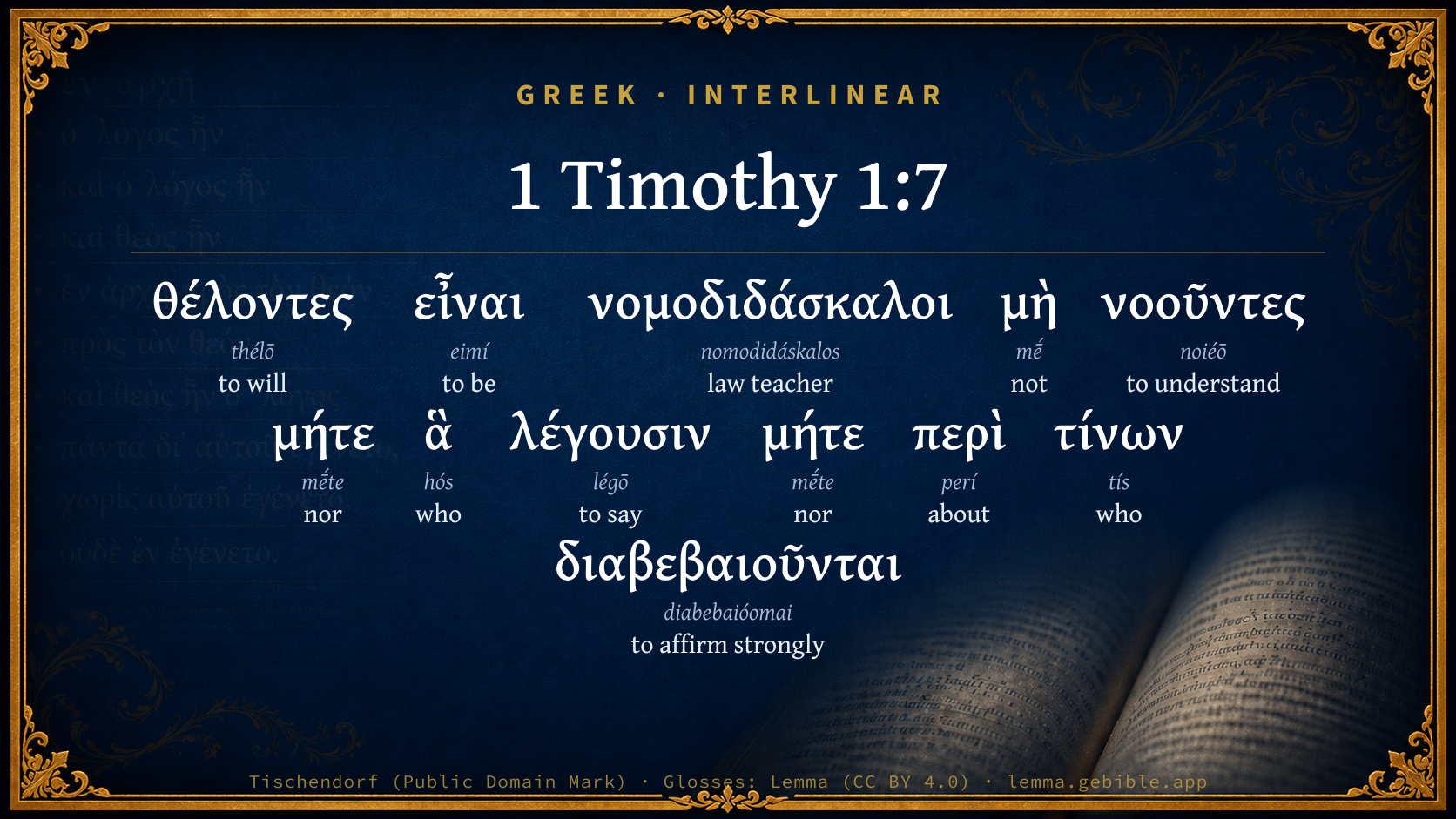
  1. θέλοντες thélō G2309 “to will” Verb, Present, Active, Participle, Nominative, Plural, Masculine
  2. εἶναι eimí G1510 “to be” Verb, Present, Active, Infinitive
  3. νομοδιδάσκαλοι nomodidáskalos G3547 “law teacher” Noun, Nominative, Plural, Masculine
  4. μὴ mḗ G3361 “not” Particle, Negative
  5. νοοῦντες noiéō G3539 “to understand” Verb, Present, Active, Participle, Nominative, Plural, Masculine
  6. μήτε mḗte G3383 “nor” Conjunction, Negative
  7. ἃ hós G3739 “who” Relative pronoun, Accusative, Plural, Neuter
  8. λέγουσιν légō G3004 “to say” Verb, Present, Active, Indicative, 3rd person, Plural
  9. μήτε mḗte G3383 “nor” Conjunction, Negative
  10. περὶ perí G4012 “about” Preposition
  11. τίνων tís G5101 “who” Interrogative pronoun, Genitive, Plural, Neuter

About this verse

These counts appear in no published source. They are computed here, from the morphology-tagged text and Lemma’s own curated glosses. What Lemma adds →

12
words
11
distinct lemmas
Pauline Epistles
section

Notable vocabulary

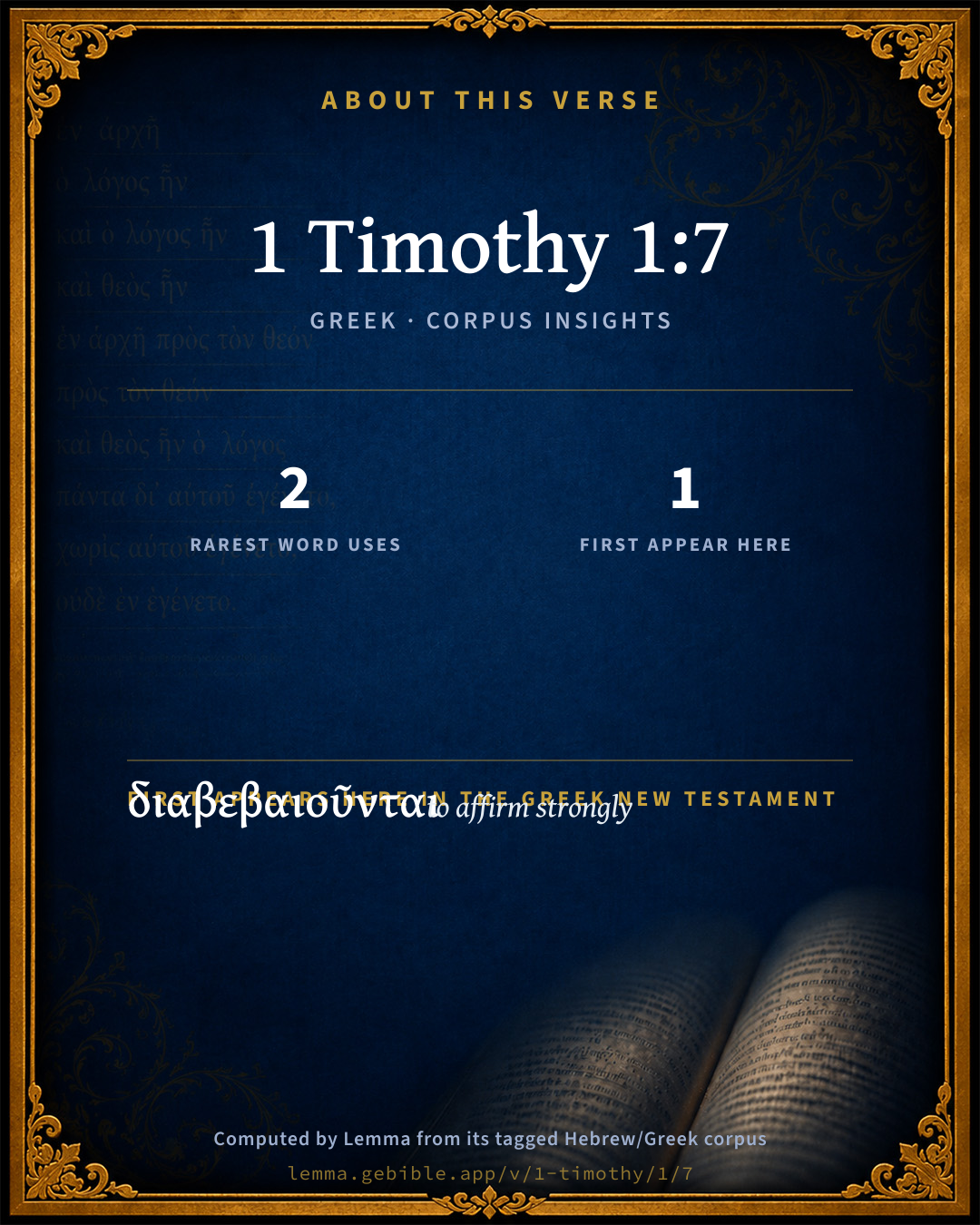
The rarest word here is διαβεβαιοῦνται to affirm strongly G1226 — appearing just 2 times in the whole Greek New Testament.

First appearance in Scripture

This word makes its first canonical appearance in the Greek New Testament here:

  • διαβεβαιοῦνται to affirm strongly G1226

Shared distinctive vocabulary

διαβεβαιοῦνται to affirm strongly G1226 occurs in 2 verses of the Greek New Testament. Also found in:

Repetition

A word recurs within this verse:

Cross-references

17

Topical passages linked to 1 Timothy 1:7 in the Treasury of Scripture Knowledge — connected by theme and wording, ordered by reader-vote popularity; previews shown in the World English Bible.

  • Romans 1:22 Professing themselves to be wise, they became fools,
  • 2 Peter 2:12 But these, as unreasoning creatures, born natural animals to be taken and destroyed, speaking evil in matters about which they are ignorant, will in their destroying surely be destroyed,
  • 1 Timothy 6:4 he is conceited, knowing nothing, but obsessed with arguments, disputes, and word battles, from which come envy, strife, reviling, evil suspicions,
  • Galatians 3:5 He therefore who supplies the Spirit to you, and works miracles among you, does he do it by the works of the law, or by hearing of faith?
  • Galatians 5:3–4 Yes, I testify again to every man who receives circumcision, that he is a debtor to do the whole law.
  • Romans 2:19–21 and are confident that you yourself are a guide of the blind, a light to those who are in darkness,
  • Galatians 3:2 I just want to learn this from you. Did you receive the Spirit by the works of the law, or by hearing of faith?
  • 2 Timothy 3:7 always learning, and never able to come to the knowledge of the truth.
  • Titus 1:10–11 For there are also many unruly men, vain talkers and deceivers, especially those of the circumcision,
  • Matthew 15:14 Leave them alone. They are blind guides of the blind. If the blind guide the blind, both will fall into a pit."
  • John 9:40–41 Those of the Pharisees who were with him heard these things, and said to him, "Are we also blind?"
  • Galatians 4:21 Tell me, you that desire to be under the law, don't you listen to the law?
  • Isaiah 29:13–14 The Lord said, Because this people draw near [to me], and with their mouth and with their lips to honor me, but have removed their heart far from me, and their fear of me is a commandment of men which has been taught [them];
  • Jeremiah 8:8–9 How do you say, We are wise, and the law of Yahweh is with us? But, behold, the false pen of the scribes has worked falsely.
  • Matthew 23:16–24 "Woe to you, you blind guides, who say, 'Whoever swears by the temple, it is nothing; but whoever swears by the gold of the temple, he is obligated.'
  • John 3:9–10 Nicodemus answered him, "How can these things be?"
  • Acts 15:1 Some men came down from Judea and taught the brothers, "Unless you are circumcised after the custom of Moses, you can't be saved."

Cross-references courtesy of OpenBible.info (CC BY 4.0).

Commentary

Notes on 1 Timothy 1:7 from classic Christian and Jewish commentators (each source and its license shown beneath its notes). The classic Christian expositions comment on the surrounding passage and are grouped to its opening verse, so a note may address several verses; the Jewish commentaries on the Tanakh (Rashi and others) are per-verse, so they appear only where the commentator wrote on this verse.

Lemma curates 59 commentaries, every one of them public domain or Creative Commons licensed, each selected and text-cleaned for this edition rather than reprinted as found. About our sources →

Tyndale Open Study Notes

Tyndale Open Resources

1:7 Their aspirations to be teachers of the law of Moses were ironic; their handling of the law was deficient in the light of the Good News, and they neither understood nor fulfilled the law (see 1:8-11).

Tyndale Open Study Notes — © Tyndale Open Resources, licensed CC BY-SA 4.0. Text via the HelloAO Bible API.

Bengel's Gnomon

Johann Albrecht Bengel

1Ti 1:7. Θέλονες, desiring) rashly.—μήτε—μήτε, neither—nor) A good teacher ought to be intelligent, and at the same time well-informed. Paul says, both of these qualities are wanting to those of whom he is here speaking.—ἃ) those things, which: περὶ τίνων, concerning what things [whereof]. ὃς and τίς differ.—μήτε ἃ λέγουσι, neither what they say) Thence arise the profane vanities of words [“vain babblings”], ch. 1Ti 6:20.—μήτε περὶ τίνων διαβεβαιοῦνται nor whereof they affirm) Thence arise the oppositions of science, falsely so called, ch. 1Ti 6:20. βέβαιος and θέσις, firm and position, accord with one another.[5]—διαβεβαιοῦνται, affirm) Tit 3:8.

[5] i.e. The βέβαιος in διαβεβαιοῦνται here, answers to the θέσις in the ἀντιθέσεις, ch. 1Ti 6:20.—ED.

Bengel's Gnomon of the New Testament — English translation (T&T Clark, Edinburgh, 1860) — public domain. Text from a community e-Sword module.

Expositor's Greek Testament

ed. W. Robertson Nicoll

1Ti 1:7 . νομαδιδάσκαλοι : The Mosaic or Jewish law is meant. See Tit 3:9 . The term is used seriously, of official teachers of the law, in reff.

μὴ νοοῦντες , κ . τ . λ .: Though they understand neither, etc . The participle is concessive, and με is here subjective, as usual, expressing St. Paul’s opinion about them. For the sentiment cf. 1Ti 6:4 , 1Co 8:2 . λέγουσιν refers to the substance of their assertions, while διαβεβαιοῦνται ( affirmant , see Tit 3:8 ) is expressive of the confident manner (R.V.) in which they made them. They did not grasp the force either of their own propositions (hence resulted βέβηλοι κενοφωνίαι ), or the nature of the great topics Law, Philosophy, etc. an which they dogmatised, hence their inconsistencies, ἀνιθέσεις τοῦ ψευδωνύμου γνώσεως (1Ti 6:20 ). On the combination of the relative and interrogative pronouns in one sentence, see Winer-Moulton, Grammar , p. 211.

The Expositor's Greek Testament, edited by W. Robertson Nicoll (1897–1910) — public domain. Text from a community e-Sword module.

Geneva Bible (1599)

Geneva Bible translators

There are none more unlearned, and more impudent in usurping the name of holiness, than foolish sophistical babblers.

Geneva Bible (1599) marginal notes — public domain. Text via Bolls.life.

Jamieson, Fausset & Brown

Robert Jamieson, A. R. Fausset & David Brown

Sample of their "vain talk" (Ti1 1:6).

Desiring--They are would-be teachers, not really so.

the law--the Jewish law (Tit 1:14; Tit 3:9). The Judaizers here meant seem to be distinct from those impugned in the Epistles to the Galatians and Romans, who made the works of the law necessary to justification in opposition to Gospel grace. The Judaizers here meant corrupted the law with "fables," which they pretended to found on it, subversive of morals as well as of truth. Their error was not in maintaining the obligation of the law, but in abusing it by fabulous and immoral interpretations of, and additions to, it.

neither what they say, nor whereof--neither understanding their own assertions, nor the object itself about which they make them. They understand as little about the one as the other [ALFORD].

Jamieson, Fausset & Brown — Commentary Critical and Explanatory on the Whole Bible (1871) — public domain (CC PDM 1.0). Text via the HelloAO Bible API.

Adam Clarke's Commentary

Verse 7. Teachers of the law] To be esteemed or celebrated as rabbins; to be reputed cunning in solving knotty questions and enigmas, which answered no end to true religion. Of such the rabbinical teaching was full.

Understanding neither what they say] This is evident from almost all the Jewish comments which yet remain. Things are asserted which are either false or dubious; words, the import of which they did not understand, were brought to illustrate them: so that it may be said, They understand not what they say, nor whereof they affirm. I will give one instance from the Jerusalem Targum, on Ge 1:15: And God made two great lights, and they were equal in splendour twenty-one years, the six hundred and seventy-second part of an hour excepted: and afterwards the moon brought a false accusation against the sun, and therefore she was lessened; and God made the sun the greater light to superintend the day, &c. I could produce a thousand of a similar complexion.

Adam Clarke's Commentary on the Bible (1810–1826) — public domain. Text from a community e-Sword/MySword module.

John Calvin's Commentaries

7 Wishing to be teachers of the law He does not reprove those who openly attack the instruction of the law, but those who boast of belonging to the rank of teachers of it. He affirms that such persons have no understanding, because they harass their faculties to no purpose by curious questions. And, at the same time, he rebukes their pride by adding, —

Of what things they affirm, for none will be found more bold in pronouncing rashly on matters unknown to them than the teachers of such fables. We see in the present day with what pride and haughtiness the schools of the Sorbonne pronounce their authoritative decisions. And on what subjects? On those which are altogether hidden from the minds of men — which no word of Scripture, and no revelation has ever made known to us. With greater boldness do they affirm their purgatory than the resurrection of the dead. As to their contrivances about the intercession of the saints, if we do not hold them to be an undoubted oracle, they cry out that the whole of religion is overturned. What shall I say as to their vast labyrinths about the hierarchies of heaven, relationships, and similar contrivances? It is a matter that has no end. The Apostle declares that in all these is fulfilled what is said in a well-known ancient proverb,

“Ignorance is rash;” as he says that, “puffed up by their carnal mind, they intrude into things which they know not.” (Colossians 2:18.)

John Calvin's Commentaries (1540-1563) — public domain. Text from the Calvin Translation Society English edition (1840s-50s) via the Christian Classics Ethereal Library (ccel.org). Calvin's coverage is partial (roughly two-thirds of the Bible); uncommented books and verses are honest gaps, never fabricated. The 19th-century editor's footnotes and remarks are omitted so the notes are faithfully Calvin's own voice.

Ellicott's Commentary for English Readers

(7) Desiring to be teachers of the law.—“Desiring,” though they really were not. They coveted the respect and influence which was ever paid to the acknowledged teachers of the Law of Moses; but these men utterly failed to understand the real spiritual meaning of that Law which they pretended to teach. Similar pretenders in a neighbouring Church, some years later, received from another Apostle—St. John—a stern rebuke for such pretensions. “I know,” wrote St. John to the Christians of Smyrna, “the blasphemy of them which say they are Jews, and are not, but are the synagogue of Satan” (Rev_2:9).

Understanding neither what they say, nor whereof they affirm.—A wise teacher must understand what he teaches, and must, at the same time, be clear in his own mind that what he teaches is true.

The false teachers are here charged (1) with not understanding the wild fables and traditions upon which their teaching was based, and (2) with not comprehending the things whereof they make their assertions: that is, they had no real belief in those great truths which really underlie that Law with which they were meddling.

A Bible Commentary for English Readers, edited by Charles John Ellicott (1878–1897) — public domain. Text from a community e-Sword module.

The Cambridge Bible for Schools and Colleges

gen. ed. J. J. S. Perowne

7. understanding] More exactly, though they understand; the negative particle used shews that the clause is subordinate to, not parallel with ‘setting themselves up,’ or ‘desiring,’ and expresses their thoughts. ‘We choose to teach, without understanding.’ Winer, § 55. 5 b, p. 607.

neither what they say, nor whereof] They neither understand the statements they make nor even what the questions are about which they make such confident assertions. Confidently affirm gives the force of the preposition in the compound verb; it occurs in Tit_3:8; but not elsewhere in N. T. The middle voice expresses the secondary kind of making firm, by speech, instead of act, as commonly in Class. Gr. Compare to draw up a narrative, Luk_1:1; ‘I laid before them the Gospel,’ Gal_2:2; Winer, Pt. iii. § 38, 2–6, p. 317.

The Cambridge Bible for Schools and Colleges (gen. ed. J. J. S. Perowne; Cambridge University Press, 1878–1918) — public domain. Text from a community e-Sword module.

John Gill's Exposition

Desiring to be teachers of the law,.... They were very fond of being called Rabbi, Rabbi, and styled doctors of the law, and of being thought to have skill in interpreting the law, and good talents in expounding it, and preaching upon it; which was now most in vogue, and gained the greatest applause, when the preaching of the Gospel was treated with contempt, not only by the unbelieving Jews, but by judaizing Christians, and carnal professors,

Understanding neither what they say, nor whereof they affirm: they did not understand the law, the nature and end, the purity and spirituality, and perfection of it, which they were so fond of teaching, and went into many foolish and unlearned questions about it; see Ti2 2:23, and which they as foolishly answered: these are the ignorant and unlearned men, who, notwithstanding their vain show of learning, and pretence to skill in interpreting the law, wrested the Scriptures to their own destruction, and that of others; they were ignorant of the things they talked of, and knew not by what arguments to confirm them, and yet were very bold and confident in their assertions: and generally speaking so it is, that those who can prove least assert most, and that with the greatest assurance.

John Gill's Exposition of the Whole Bible (1746–1763) — public domain (CC PDM 1.0). Text via the HelloAO Bible API.

Trapp's Complete Commentary

John Trapp

7 Desiring to be teachers of the law; understanding neither what they say, nor whereof they affirm.

Ver. 7. Understanding neither what] Non curo illos, saith Augustine, qui vel non intelligendo reprehendunt, vel reprehendendo non intelligunt. I pass not for the censures of such as dare to reprehend what they do not comprehend.

Nor whereof they affirm] And are therefore to be slighted. Galatinus (saith Mr Sarson), as he affirmeth without reason, so he may be dismissed without refutation.

John Trapp, A Commentary or Exposition upon All the Books of the Old and New Testament (1647–1656) — public domain. Text from a community e-Sword module.

Albert Barnes' Notes on the Bible

Desiring to be teachers of the law - That is, to have the credit and reputation of being well versed in the law of Moses, and qualified to explain it to others. This was a high honor among the Jews, and these teachers laid claim to the same distinction.

Understanding neither what they say - That is, they do not understand the true nature and design of that law which they attempt to explain to others. This was true of the Jewish teachers, and equally so of those in the church at Ephesus, who attempted to explain it. They appear to have explained the law on the principles which commonly prevailed among the Jews, and hence their instructions tended greatly to corrupt the faith of the gospel. They made affirmations of what they knew nothing of, and though they made confident observations, yet they often pertained to things about which they had no knowledge. One needs only a slight acquaintance with the manner of teaching among Jewish rabbies, or with the things found in their traditions, to see the accuracy of this statement of the apostle. A sufficient illustration of this may be found in Allen’s “Modern Judaism.”

Albert Barnes' Notes on the Bible (1834–1885) — public domain. Text from a community e-Sword/MySword module.

Matthew Poole's English Annotations

Desiring to be teachers of the law; Nomodidaskaloi. This term lets us know, that the apostle reflecteth upon some who were or had been Jews, who either pressed the observance of the law in order to justification, or spent their time in pressing the traditions of the elders, and constitutions of the scribes, as sepimenta legis, hedges (as they called them) to the Divine law, though not of the letter of it; upon which there arose a great many questions as insignificant as their traditions themselves, which these vain preachers spent their time in speaking to.

Understanding neither what they say, nor whereof they affirm; neither understanding the Divine law, nor the questions themselves started and spoke unto, yet ambitious to be accounted

teachers of the law. This vain desire of reputation, as persons of excellent skill in the land, was the cause of their erroneous, idle sermons: and their ignorance is aggravated and inexcusable, in that they with presumptuous boldness assert the things of which they are ignorant.

Matthew Poole's English Annotations on the Holy Bible (1683–1685) — public domain. Text from a community e-Sword/MySword module.

Whedon's Commentary on the Bible

Daniel D. Whedon

7. Teachers of the law—The Mosaic law; the Old Testament. These teachers wanted to transform the Churches into rabbinical schools, in which themselves should be the rabbies, and the teachings should be the new fangled fantasies of which Grotius gives us specimens above.

What they say—Their words and phrases really often express no meaning, because they have no understanding of the subject whereof they affirm. That is, they explained an unintelligible subject by unmeaning words.

Daniel D. Whedon (gen. ed.), Commentary on the Old and New Testaments (1874–1909) — public domain. Text from a community e-Sword module.

The Pulpit Commentary

Though they understand for understanding. A.V; confidently affirm for affirm, A.V Teachers of the Law. (nomodidaskaloi as Luk_5:17; Act_5:34) This, again, distinctly marks the Jewish origin of these heretics. Though they understand, etc. So our Lord rebuke, 1 the scribes and teachers of the Law in his day: "Ye do err, not knowing the Scriptures nor the power of God;" "Ye do greatly err" Mat_22:29; Mar_12:27; Mat_12:7, etc.. (compare, Rom_2:17-24) They confidently affirm (diabebaiountai). Elsewhere in the New Testament only in Tit_3:8, "I will that thou affirm confidently." So in classical Greek, "to maintain strongly," "to be positive." This was right in the minister of Christ declaring Divine truth, but very wrong in these vain janglers. The nature of their confident assertions is apparent from what follows they spoke of the Law, but not lawfully.

The Pulpit Commentary (1880–1919), ed. H.D.M. Spence-Jones & Joseph S. Exell — public domain. Text from a community e-Sword module.

John Wesley's Explanatory Notes

Understanding neither the very things they speak, nor the subject they speak of.

John Wesley, Explanatory Notes Upon the Whole Bible (1754–1765) — public domain. Text via the GEBible commentary corpus.

Fairbairn on Ezekiel, Jonah & the Pastoral Epistles

Patrick Fairbairn

Ver. 7. The parties warned against are further characterized as desiring (θέλοντες, wishing) to be teachers of the law; implying that it was but a wish, a bootless aiming at what, in its proper reality, lay far from them, as is afterwards more distinctly brought out. The interpretation of Baur, which was demanded by his hypothesis, would find in this description not law teachers, but law opposers, Antinomians of the Marcionite school; but the view is so arbitrary, and so much at variance with the natural import of the words, that it has met with almost universal rejection. The apostle is evidently speaking of men who by no means disparaged the law as vile, or at least as too low and carnal for persons aspiring to perfection, but rather had high notions of the law, and set themselves up as its more advanced and enlightened advocates, though utterly disqualified qualified for the office they assumed. It is also evident, from the concession made in regard to their pretensions in 1Ti 1:8, “We know, indeed, that the law is good; “so far there is no dispute between us. It was an admission to the parties against whom he was contending, in favour of that which they so zealously lauded, in case the apostle’s own position regarding it might be perverted or misunderstood. The false teachers, then, were in some sense legalists; the question is, in what sense? In what form, or with what intent, did they press the claims of law? Not, we have good reason to believe, after the manner of the Jewish Christians, who first disturbed the church—zealous for the maintenance of the ancient customs; for the way in which the apostle meets them (as noticed by all the recent better commentators) is quite different from what we find in the Epistles to the Romans, Galatians, and Colossians. Here he charges the parties in question, not with bringing in legal observances out of their proper place, but with utter ignorance and misapprehension as to the real nature and design of the law: μὴ νοοῦντες μήτε ἃ λέγουσιν μήτε περὶ τίνων διαβεβαιοῦνται—not understanding neither, or, as suits our idiom better, without understanding either what things they speak, or concerning what things they affirm. They spoke, it would seem, dogmatically enough; for the verb (διαβεβαιοῦσθαι) means to make asseveration, or give forth one’s view in a firm, dogmatic tone. But in doing so, the apostle declares they went beyond their depth; they merely displayed their own ignorance, and that in two respects—both as regards the things they said, and the topics concerning which they uttered their sentiments. The language is such as might very readily be applied to persons of a dreamy and speculative mood, disposed to take things otherwise than in their plain natural sense; attempting, as men of a higher order of thought, to refine and soar, and lose themselves in mystic reveries or fanciful allegorizings. And this, as already stated, is precisely the form of evil which we are led to understand then began to develope itself. It was a compound of Gnostic and Judaic elements. The persons who advocated it would keep the law—they would even make more of it than the apostle did; but then, the law not according to the letter—the law sublimated by the speculative reason, and explained in accordance with the theosophy of the East. A dangerous spirit this in which to meddle with the law! Even as applied by the thoughtful, discreet, Platonic mind of Philo, it served in good measure to evacuate the moral element in the old revelation, and sought to explain by the help of a mistaken physics many things that should have been viewed with a direct reference to the heart and conscience. But in the hands of inferior men—especially men of a sophistical cast of mind, who wished to employ religion to their own sinister purposes—both the fancifulness of the explanations given of the law, and its misapplication to other than its legitimate and proper ends, may justly be supposed to have been of a much more marked and conspicuous kind. There would now, probably, be frivolous distinctions, wild extravagance, possibly licentious freedom cloaked under high-sounding professions, a hunting after everything but that which should have been most especially regarded. And so, indeed, the corresponding passage in Titus distinctly tells us, 1Ti 1:10 sq., “There are many unruly and vain talkers and deceivers, specially they of the circumcision, whose mouths must be stopped, who subvert whole houses, teaching things which they ought not, for filthy lucre’s sake.” Then he refers to the Jewish fables and commandments of men that turn from the truth, and speaks of those who set them forth as unbelieving, and in their very conscience defiled. Their dreamy refinements and speculations on the law not only led them into practical neglect of its profoundly ethical spirit, but left them in a manner incapable of perceiving it—deadened their whole moral nature. And in the writings of St. John, so far as they bore respect to the state of things existing at a later period, and existing in that very region in which Timothy now laboured, we perceive indications of the same spirit, only in a more advanced stage of development. They make mention of “the blasphemy of those which say they are Jews and are not, but are of the synagogue of Satan” (Rev 2:9); of persons “teaching the doctrine of Balaam,” practising the seductions of Jezebel, and knowing the depths of Satan (Rev 2:14, Rev 2:20, Rev 2:24); in short, of men who had so sophisticated their own minds, and tried so to sophisticate the minds of others, that the apostle had to warn the disciples to remember that “he who doeth righteousness is righteous, and that he who committeth sin is of the devil;” that “no lie is of the truth;” that for one to say he has fellowship with God, while he walks in darkness, is practically to lie (1Jn 3:7, 1Jn 2:21, 1Jn 1:6). The state of things had come to be such, that it was found necessary to recall them to first principles, and teach them, as it were, the A B C of Christian truth and morality.

[Mark here the progression of error in false teaching. What in its first movements may be but a deflection in a single line, may in course of time lead to a general depravation; for example, ritualism in the early church. Mark, too, what is the result of that knowledge and teaching which would soar above the simplicity of the gospel: it ends in licence and corruption—becomes dazzled in the clearer light it affects to live in, and stumbles as in gross darkness.]

Patrick Fairbairn — An Exposition of Ezekiel (1851), Jonah (1849), and The Pastoral Epistles (1874) — public domain. Text from a community e-Sword module.

The People's New Testament

B. W. Johnson

7. Desiring to be teachers. To be teachers of law; there is no article. These aspire to a work for which they are totally unfitted. Who has not met the class of men described?

B. W. Johnson's The People's New Testament with Notes (1889–1891) — public domain. Electronic text from the Christian Classics Ethereal Library (CCEL) ThML edition.

Cambridge Greek Testament for Schools and Colleges

7. θέλοντες εἶναι νομοδιδάσκαλοι. Desiring to be (i.e. almost claiming to be) teachers of the law, sc. of the Mosaic law. The false teaching had its roots in Judaism, and the intention of its exponents was good; they failed in their aims for the reasons now to be explained.

μὴ νοοῦντες μήτε ἃ λέγουσιν κ.τ.λ. Understanding neither what they say, nor the subjects concerning which they make confident assertions. Their ματαιολογία was, in many instances, devoid of meaning (μὴ νοοῦντες κ.τ.λ.); and they did not understand the principles underlying the Mosaic law which they professed to expound (μήτε περὶ τίνων κ.τ.λ.). Cp. 2Ti 2:7 νόει ὃ λέγω. διαβεβαιοῦσθαι is found in the Greek Bible only here and at Tit 3:8 περὶ τούτων βούλομαί σε διαβεβαιοῦσθαι; it signifies positive affirmation and entire confidence on the part of the speaker.

Cambridge Greek Testament for Schools and Colleges (Cambridge University Press, 1896; 21 vols, various authors incl. Carr, Maclear, Plummer, Farrar, Lumby, Moule, M. R. James, Simcox) — public domain. Text from a community e-Sword module.

International Critical Commentary

7. νομοδιδάσκαλοι] Perhaps without reference to the Jewish law, half-ironical, “claiming to be professors of moral philosophy”; cf. Epict. ii. I, 25, πῶς οὖν ἔτι ὑμῖν πιστεύσομεν, ὦ φίλτατοι νομοθέται (Dibelius); but vv. 4, 8, 9, 10 make a reference to the Jewish law more probable.

τίνων] The interrogative is probably used for the relative for the sake of variety alone, as in late Greek they tended to become interchangeable; cf. Moulton, N.T. Greek, p. 93; Blass, P. 175.

διαβεβαιοῦνται] Tit 3:8 only in N.T., “on which they insist, lay so much stress.” Hort (W.H. App., pp. 167 and 171) suggests that the form is really subjunctive, Cf. ζηλοῦτε, Gal 4:17 φυσιοῦσθε, 1Co 4:6, “nor on what points they ought to insist”; cf. Rom 8:26 τὸ γὰρ τί προσευξώμεθα καθὸ δεῖ οὐκ οἴδαμεν: but this would probably have been stated more clearly.

International Critical Commentary — older volumes (1896–1929), various authors — public domain. Text from a community e-Sword module.

Vincent's Word Studies in the New Testament

Marvin R. Vincent

Desiring [θελοντες] . The participle is explanatory and confirmatory of the preceding statement : since they desire.

Teachers of the law [νομοδιδασκαλοι] . o P. It occurs in Luk 5:17 and Act 5:34. Nomov is, apparently, the Mosaic law. These teachers may have been arbitrary interpreters of that law, but in what way, cannot be shown.

Understanding [νοουντες] . Better, though they understand.

What they say - whereof they affirm [α λεγουσιν - περι τινων διαβεβαιουνται] . The latter expression is an advance on the former, as appears not only from the verbs themselves, but from the different pronominal expressions. They know not what they say, nor what kind of things they are of which they speak so confidently. The compound diabebaiouswai to affirm, Past o. Comp. Tit 3:8. The false teachers announce their errors with assurance.

Marvin R. Vincent, Word Studies in the New Testament (1887–1900) — public domain. Text from a community e-Sword/MySword module.

Lesson kit

Teaching starters — assembled from the data on this page, not authored interpretation. Every prompt links to the verse data it draws on. Edit before teaching.

1 Timothy, in the Pauline Epistles, opens this verse with 12 words (11 distinct Greek lemmas). Its most distinctive word is diabebaióomai (“to affirm strongly”). A historical commentator’s framing appears above. Read the whole chapter for the surrounding context.

Discussion questions

  1. What does “to affirm strongly” (diabebaióomai) contribute to the verse as a whole?
  2. This is the first place “to affirm strongly” appears in Scripture (first appears here). What does its debut here establish?
  3. How does Titus 3:8, which shares the word «to affirm strongly», read alongside this verse?
  4. What does the repetition of “nor” (2× in this one verse) do in this verse?
  5. These translations render this verse differently. What is at stake in choosing one wording over another?
  6. Compare how Tyndale Open Study Notes and Bengel's Gnomon read this verse. Where do they agree or differ?

Things to notice

  • 1 word makes its first canonical appearance in Scripture here.
  • These translations choose different wording for 12 words in this verse.
  • “nor” occurs 2× in this single verse.
  • 11 distinct Greek lemmas span 12 words in this verse.

Reading settings

Reading text

Shown beneath each verse's original-language words.

Old Testament
Old Testament edition

Read the OT as the Masoretic Hebrew (MT) or the Greek Septuagint (LXX).

English shown for the Greek Septuagint (in the Hebrew ↔ Greek comparison).

Comparing translations? Open the Compare panel on any verse page to stack up to four side by side.