
2 Corinthians 8:10

Greek (Tischendorf 8th ed.) 2 Corinthians 8:10 appears in the Greek New Testament. The text above is from the Tischendorf 8th edition. Each word links to its Strong’s number and a concise gloss. Click any word for its full Thayer’s Greek Lexicon entry.

Download image
Cite this verse

2 Corinthians 8:10 (World English Bible). Public Domain. Lemma interlinear Bible study tool, https://lemma.gebible.app/v/2-corinthians/8/10.

Show BibTeX & RIS
BibTeX
RIS
English Translation
I give a judgment in this: for this is expedient for you, who were the first to start a year ago, not only to do, but also to be willing.
World English Bible · Public Domain
Highlights
  • 1 first appearance in the Greek New Testament
Full analysis ↓
Download a study sheet

One document with this verse’s original text, its word-by-word gloss line, the meaning frame, cross-references with their text, attributed commentary, and full source and license credits — printable, and it pastes into notes with its structure intact.

This verse Autodidact and up

Study sheet (.html) Plain text (.txt)

A passage Seminary Student

Up to 50 verses in one chapter. A passage sheet keeps up to 6 commentary sources and 12 cross-references per verse, in the order this page ranks them, and says so on the sheet whenever that leaves anything out. Ask for a single verse and you get the Autodidact verse sheet above.

Everything on this page stays free to read, with no account — the sheet is a download of what is already on screen, not access to it.

Want to remove ads? Support Godless Engineer
Compare translations 3

The same verse in 3 English versions, stacked beneath the original-language interlinear above. Click any original word for its lexicon entry.

Each is an independent rendering of the whole verse — the interlinear is not word-aligned to these translations.

Highlighted words mark where these versions differ — a whole-verse word diff, not a word-by-word alignment.

  • World English Bible Public Domain
    I give a judgment in this: for this is expedient for you, who were the first to start a year ago, not only to do, but also to be willing.
  • King James Version Public Domain
    And herein I give my advice: for this is expedient for you, who have begun before, not only to do, but also to be forward a year ago.
  • unfoldingWord Literal Text CC BY-SA 4.0
    And I give my opinion in this, for this is profitable for you, who not only began to do this a year ago, but also to desire.

unfoldingWord Literal Text — © unfoldingWord, licensed CC BY-SA 4.0. Word-aligned USFM3 via Door43 (git.door43.org/unfoldingWord/en_ult).

Versions to compare (up to 4)

3 of 4 selected

Show all 19 translations

Every available English version of this verse, each an independent rendering of the whole verse.

  • World English Bible Public Domain
    I give a judgment in this: for this is expedient for you, who were the first to start a year ago, not only to do, but also to be willing.
  • Berean Standard Bible Public Domain
    And this is my opinion about what is helpful for you in this matter: Last year you were the first not only to give, but even to have such a desire.
  • Majority Standard Bible Public Domain
    And this is my opinion about what is helpful for you in this matter: Last year you were the first not only to give, but even to have such a desire.
  • King James Version Public Domain
    And herein I give my advice: for this is expedient for you, who have begun before, not only to do, but also to be forward a year ago.
  • American Standard Version (1901) Public Domain
    And herein I give `my' judgment: for this is expedient for you, who were the first to make a beginning a year ago, not only to do, but also to will.
  • Revised Version (1885) Public Domain
    And herein I give my judgment: for this is expedient for you, who were the first to make a beginning a year ago, not only to do, but also to will.
  • Geneva Bible (1599) Public Domain
    And I shewe my minde herein: for this is expedient for you, which haue begun not to doe onely, but also to will, a yeare agoe.
  • Douay-Rheims (1899) Public Domain
    And herein I give my advice; for this is profitable for you, who have begun not only to do, but also to be willing, a year ago.
  • Young's Literal Translation Public Domain
    and an opinion in this do I give: for this to you `is' expedient, who not only to do, but also to will, did begin before -- a year ago,
  • Literal Standard Version CC BY-SA 4.0
    And I give an opinion in this: for this [is] expedient to you, who not only to do, but also to will, began before—a year ago,
  • Unlocked Literal Bible CC BY-SA 4.0
    In this matter I will give you advice that will help you. One year ago, you not only started to do something, but you desired to do it.
  • unfoldingWord Literal Text CC BY-SA 4.0
    And I give my opinion in this, for this is profitable for you, who not only began to do this a year ago, but also to desire.
  • Darby Bible Public Domain
    And I give [my] opinion in this, for this is profitable for you who began before, not only to do, but also to be willing, a year ago.
  • World Messianic Bible Public Domain
    I give advice in this: it is expedient for you who were the first to start a year ago, not only to do, but also to be willing.
  • Webster's Bible Public Domain
    And in this I give my advice: for this is expedient for you, who have begun before, not only to do, but also to be forward a year ago.
  • Free Bible Version CC BY-SA 4.0
    This is my advice: it would be good if you finished what you started. Last year you were not only the first to give but the first to want to do so.
  • Bible in Basic English Public Domain
    And in this I give my opinion: for it is to your profit, who were the first to make a start a year before, not only to do this, but to make clear that your minds were more than ready to do it.
  • Text-Critical English NT CC BY 4.0
    So I am giving my advice about what is best for you in this matter. Last year you were not only the first who wanted to give, but you were also the first to begin doing so.
  • Tyndale New Testament (1534) Public Domain
    And I geve counsell hereto. For this is expedient for you which beganne not to do only: but also to will a yeare agoo.

Literal Standard Version (2020), Covenant Press — licensed CC BY-SA 4.0. Text via the HelloAO Bible API (eBible.org). Unlocked Literal Bible (unfoldingWord) — licensed CC BY-SA 4.0. Text via the HelloAO Bible API (eBible.org). unfoldingWord Literal Text — © unfoldingWord, licensed CC BY-SA 4.0. Word-aligned USFM3 via Door43 (git.door43.org/unfoldingWord/en_ult). Free Bible Version, Dr. Jonathan Gallagher — licensed CC BY-SA 4.0. Text via the HelloAO Bible API (eBible.org).

Word by word

More ways to search: Search by grammar → Find every occurrence → Compare this word →

Practice this passage: Drill this verse → Learn its vocabulary →

προενήρξασθε
proenárchomai
G4278
“to begin before”
Verb, Aorist, Middle deponent, Indicative, 2nd person, Plural
Part of Speech
Verb
Tense
Aorist
Voice
Middle deponent
Mood
Indicative
Person
2nd person
Number
Plural
Full Thayer's Definition

Origin: from G4253 and G1728

TDNT: None

1. to make a beginning before
  1. καὶ kaí G2532 “and” Conjunction
  2. γνώμην gnṓmē G1106 “mind” Noun, Accusative, Singular, Feminine
  3. ἐν en G1722 “in” Preposition
  4. τούτῳ hoûtos G3778 “this” Demonstrative pronoun, Dative, Singular, Neuter
  5. δίδωμι dídōmi G1325 “to give” Verb, Present, Active, Indicative, 1st person, Singular
  6. τοῦτο hoûtos G3778 “this” Demonstrative pronoun, Nominative, Singular, Neuter
  7. γὰρ gár G1063 “for” Conjunction
  8. ὑμῖν hymeîs G5210 “you” Personal pronoun, 2nd person, Dative, Plural
  9. συμφέρει symphérō G4851 “to bring together” Verb, Present, Active, Indicative, 3rd person, Singular
  10. οἵτινες hóstis G3748 “whoever” Relative pronoun, Nominative, Plural, Masculine
  11. οὐ ou G3756 “not” Particle, Negative
  12. μόνον mónon G3440 “only” Adverb
  13. τὸ ho G3588 “the” Article, Accusative, Singular, Neuter
  14. ποιῆσαι poiéō G4160 “to make” Verb, Aorist, Active, Infinitive
  15. ἀλλὰ allá G235 “but” Conjunction
  16. καὶ kaí G2532 “and” Conjunction
  17. τὸ ho G3588 “the” Article, Accusative, Singular, Neuter
  18. θέλειν thélō G2309 “to will” Verb, Present, Active, Infinitive
  19. ἀπὸ apó G575 “from” Preposition
  20. πέρυσι pérysi G4070 “last year” Adverb

About this verse

These counts appear in no published source. They are computed here, from the morphology-tagged text and Lemma’s own curated glosses. What Lemma adds →

21
words
18
distinct lemmas
Pauline Epistles
section

Notable vocabulary

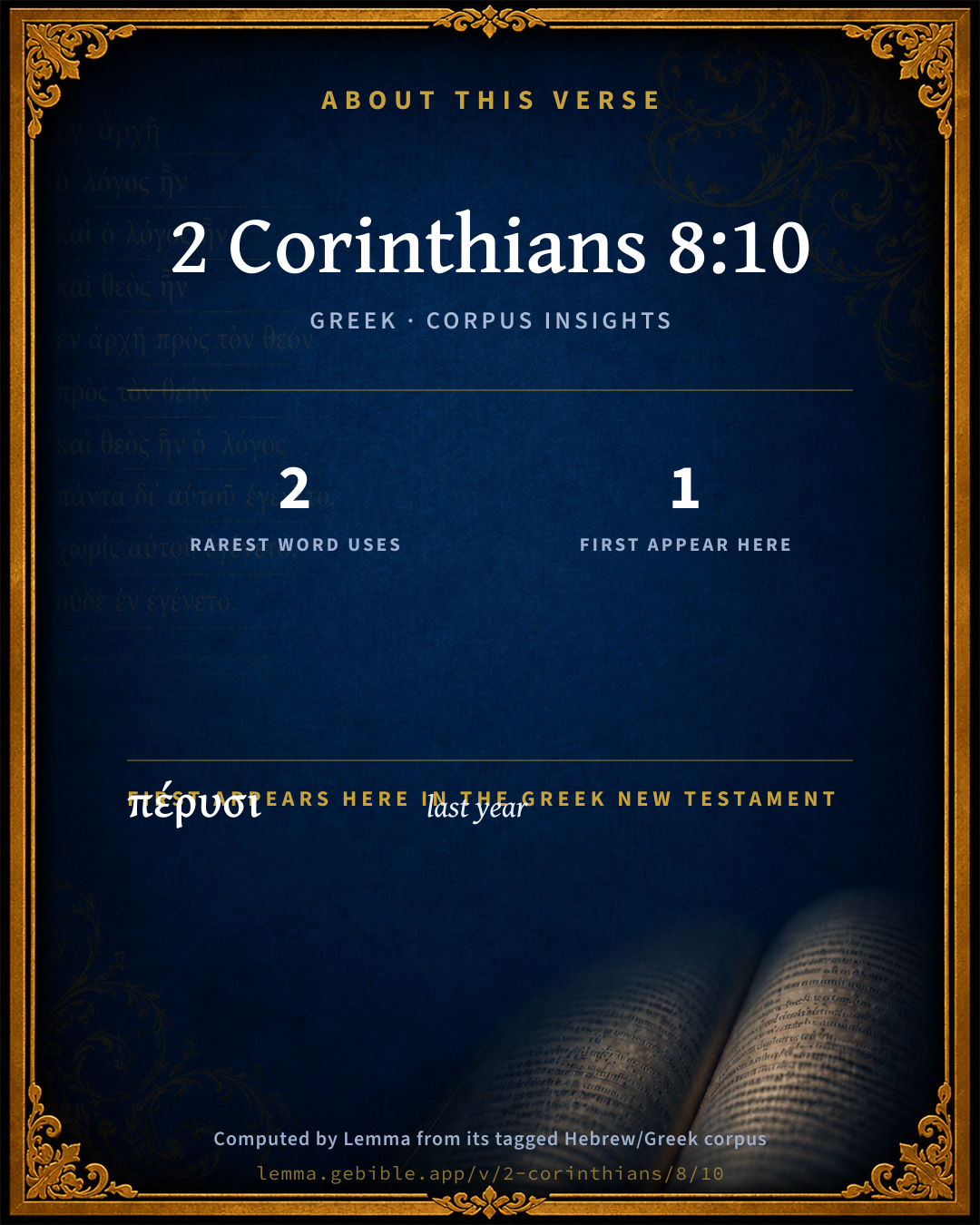
The rarest word here is προενήρξασθε to begin before G4278 — appearing just 2 times in the whole Greek New Testament.

First appearance in Scripture

This word makes its first canonical appearance in the Greek New Testament here:

  • πέρυσι last year G4070

Shared distinctive vocabulary

προενήρξασθε to begin before G4278 occurs in 2 verses of the Greek New Testament. Also found in:
Repetition

Words recur within this verse:

Cross-references

15

Topical passages linked to 2 Corinthians 8:10 in the Treasury of Scripture Knowledge — connected by theme and wording, ordered by reader-vote popularity; previews shown in the World English Bible.

  • 1 Timothy 6:18–19 that they do good, that they be rich in good works, that they be ready to distribute, willing to communicate;
  • Hebrews 13:16 But don't forget to be doing good and sharing, for with such sacrifices God is well pleased.
  • Proverbs 19:17 He who has pity on the poor lends to Yahweh; He will reward him.
  • 2 Corinthians 9:2 for I know your readiness, of which I boast on your behalf to them of Macedonia, that Achaia has been prepared for a year past. Your zeal has stirred up very many of them.
  • James 2:15–16 And if a brother or sister is naked and in lack of daily food,
  • 1 Corinthians 7:25 Now concerning virgins, I have no commandment from the Lord, but I give my judgment as one who has obtained mercy from the Lord to be trustworthy.
  • 1 Corinthians 7:40 But she is happier if she stays as she is, in my judgment, and I think that I also have God's Spirit.
  • 1 Corinthians 16:2 On the first day of the week, let each one of you save, as he may prosper, that no collections be made when I come.
  • Philippians 4:17 Not that I seek for the gift, but I seek for the fruit that increases to your account.
  • 2 Corinthians 8:8 I speak not by way of commandment, but as proving through the earnestness of others the sincerity also of your love.
  • Matthew 10:42 Whoever gives one of these little ones just a cup of cold water to drink in the name of a disciple, most assuredly I tell you he will in no way lose his reward."
  • John 11:50 nor do you consider that it is advantageous for us that one man should die for the people, and that the whole nation not perish."
  • 2 Corinthians 12:1 It is doubtless not profitable for me to boast. For I will come to visions and revelations of the Lord.
  • 1 Corinthians 6:12 "All things are lawful for me," but not all things are expedient. "All things are lawful for me," but I will not be brought under the power of anything.
  • 1 Corinthians 10:23 "All things are lawful for me," but not all things are profitable. "All things are lawful for me," but not all things build up.

Cross-references courtesy of OpenBible.info (CC BY 4.0).

Commentary

Notes on 2 Corinthians 8:10 from classic Christian and Jewish commentators (each source and its license shown beneath its notes). The classic Christian expositions comment on the surrounding passage and are grouped to its opening verse, so a note may address several verses; the Jewish commentaries on the Tanakh (Rashi and others) are per-verse, so they appear only where the commentator wrote on this verse.

Lemma curates 59 commentaries, every one of them public domain or Creative Commons licensed, each selected and text-cleaned for this edition rather than reprinted as found. About our sources →

Joseph Benson's Commentary

2Co 8:10-12. And herein — In this matter; I give my advice — That to finish your collection immediately is for your reputation, who have formerly begun, not only to make the collection, but also to manifest a remarkable willingness; even a year ago — When Titus was with you. Now, therefore, perform, &c. — Speedily finish the business, agreeably to your former resolution; that as there was a readiness to will — And undertake this charitable work; so there may be a performance, &c. — Or a readiness to finish; out of — Or according to, your ability, be it never so little. For if there be first a willing mind — A sincere readiness in any man to act according to his ability; it — Or he rather; is ευπροσδεκτος, well accepted — Of God; a little, in proportion to his abilities, is pleasing to God. If a person, being a true believer in Christ, and a lover of God and his people, act in any thing according to the best light he has, and with a single eye to God’s glory, his work, or his gift, be it ever so small, is graciously accepted of God. This rule holds universally: and whoever acknowledges himself to be a vile, guilty sinner, and, in consequence of this acknowledgment, flees for refuge to the wounds of a crucified Saviour, and relies on his merits alone for salvation, may, in every circumstance of life, apply this indulgent declaration to himself.

Joseph Benson's Commentary on the Old and New Testaments (1811–1818) — public domain. Text from a community e-Sword module.

Tyndale Open Study Notes

Tyndale Open Resources

8:10 What you started a year ago was the collection of an offering for Jerusalem, prompted by 1 Cor 16:1-2. So this letter is to be dated at least one year after 1 Corinthians.

Tyndale Open Study Notes — © Tyndale Open Resources, licensed CC BY-SA 4.0. Text via the HelloAO Bible API.

Bengel's Gnomon

Johann Albrecht Bengel

2Co 8:10. Καὶ, and)—συμφέρει, is expedient) An argument from the useful, moving them to give: So, 2Co 8:16, ὑπὲρ. A most pleasant paradox.—τὸ ποιῆσαι, to do) for the past year.—τὸ θέλειν, [to be forward] to be willing) for this year.

Bengel's Gnomon of the New Testament — English translation (T&T Clark, Edinburgh, 1860) — public domain. Text from a community e-Sword module.

Meyer's Critical & Exegetical Commentary

Heinrich August Wilhelm Meyer

2Co_8:10 After the parenthesis in 2Co_8:9, a continuation of the ἀλλὰ … δοκιμάζων, 2Co_8:8 : and an opinion I give in this affair. Γνώμην, opinion, has the emphasis, as contrasting with ἐπιταγήν in 2Co_8:8. Comp. on 1Co_7:25.

τοῦτο γὰρ ὑμῖν συμφέρει] συμφέρει does not mean decet (Vorstius, Emmerling, who appeals to LXX. Pro_19:10, where, however, the translation is inaccurate), but: it profits. And τοῦτο is not, with most, including Rückert, de Wette, Ewald, Neander, to be referred to the supplying of charitable gifts, in which case συμφέρει is either left without more precise definition (Rückert: like every good deed, bringing advantage), or is interpreted as pointing to the advantage of good repute (Grotius, comp. also Hofmann), of the divine recompense (Calovius) and the moral advantage (Flatt), or as useful for salvation (Bisping), and so on. Τοῦτο γὰρ ὑμ. συμφ. contains, in fact, the ground why Paul proceeds in this matter merely by way of advising; hence, with Billroth, Osiander, and Kling, τοῦτο is to be referred to the previous γνώμην … δίδωμι. It is no objection to this, that in ἐν τούτῳ immediately before the pronoun referred to the distribution. For in the previous clause γνώμην δίδωμι contained the whole thought, and ἐν τούτῳ had no stress laid on it, not even needing to be inserted. Accordingly: for thisthat I do not command you, but only give my opinion in the matteris serviceable to you, is fitted to operate in the way of moral improvement on you, as being persons who have already shown yourselves to be such as need not command, but only counsel. The emphasis lies primarily on τοῦτο and next on ὑμῖν. According to Hofmann, who does not take 2Co_8:9 parenthetically, in καὶ γνώμην κ.τ.λ. there is meant to follow something new and further, so that both ἐν τούτῳ and subsequently τοῦτο point to the advice, which Paul intends to give (with the following … what follows), and this advice is expressed in the imperative clause 2Co_8:11, to which οἵτινες κ.τ.λ. belongs as a protasis. Against this confusion it may be decisively urged, first, that the ἐν τούτῳ emphatically pointing forward must have been placed first; secondly, that after δίδωμι there would come not at all the announced γνώμη, but in the first instance an argumentative parenthetic clause, which would again begin with what follows,a course which could only lead the reader astray; thirdly, that if τοῦτο γ. ὑμῖν συμφέρει does not go with οἵτινες κ.τ.λ., and find its more precise explanation therein, it would interpolate a thought altogether indefinite and isolated; fourthly, that δέ after νυνί in 2Co_8:11 most naturally introduces a new sentence; lastly, that 2Co_8:11 has not in the least the form of a γνώμη, of an expression of opinion, but a form purely praeceptive, as, indeed, that which the apostle has put under the considerate point of view of a testing and a γνώμη in contrast to an ἐπιταγή, was already contained in 2Co_8:7 and has nothing more to do with the direct precept of 2Co_8:11.

οἵτινες] ut qui, includes the specifying of the reason. See on Eph_3:13. οὐ μόνον τὸ ποιῆσαι, ἀλλὰ καὶ τὸ θέλειν] Grotius, following the Peshito and Arabic of Erpenius, assumes here a loquendi genus inversum; but this is an irrational violence,[274] to which also the view of Emmerling (comp. Castalio in the Adnot.) ultimately comes: vos haud mora, uno momento facere et velle coepistis. The explanation of others (Chrysostom, Theodoret, Theophylact, Gregory, Erasmus, Calvin, Beza, Cornelius a Lapide, Clericus, Heumann, Bauer, Log. Paul. p. 334; Zachariae, Storr, Rosenmüller, Flatt, Billroth, Schrader, Olshausen, Rückert, Osiander, Ewald, and several others) is at least rational: not only the doing, but also the being willing, i.e. the doing willingly. But that θέλειν is not used in the sense of ΘΈΛΟΝΤΑς ΠΟΙΕῖΝ (see regarding this use of ΘΈΛΩΝ, Markl. ad Lys. Reisk. p. 616), or even θέλειν ποιῆσαι (Bremi, ad Dem. hil. 2Co_1:13, p. 121), is plain from 2Co_8:11, where Paul, if that meaning had been in his mind, must have continued: νυνὶ δὲ καὶ ἐπιτελέσατε τὸ π. But, in the form in which he has written 2Co_8:11, the emphasis lies not on ἘΠΙΤΕΛΈΣΑΤΕ, but on ΤῸ ΠΟΙῆΣΑΙ, which is thereby shown to be something not contemporaneous with the ΘΈΛΕΙΝ, but following upon it, something which is still to happen after that ΘΈΛΕΙΝ is already present, so that we have an advance (1) from the ΠΟΙῆΣΑΙ to the ΘΈΛΕΙΝ in 2Co_8:10; and (2) from the ΘΈΛΕΙΝ to the further ΠΟΙῆΣΑΙ in 2Co_8:11. Moreover, in opposition to the former interpretation, we may urge the change of tenses in 2Co_8:10; for, if the ΘΈΛΕΙΝ in 2Co_8:10 were to be something inherent in the previous ΠΟΙῆΣΑΙ (willingness), the aorist infinitive must likewise have been used. Lastly, there is opposed to this interpretation the ὅπως καθάπερ κ.τ.λ. in 2Co_8:11, where evidently the (future) actual accomplishment is compared with the inclination of the (present) willing; hence, in 2Co_8:10 also ΘΈΛΕΙΝ must be conceived of as something which subsists for itself, and not simply as a willingly doing. Others conceive that τὸ ποιῆσαι denotes the collection-gathering which had already actually taken place, and τὸ θέλειν the continuing wish to do still more. This is in the main the view of Hunnius, Hammond, Wetstein,[275] Mosheim, Bengel, Michaelis, Fritzsche. The latter says (Dissert. II. p. 9): hoc modo non solum τὸ θέλειν tanquam gravius τῷ ποιεῖν oppositum est (nam qui nova beneficia veteribus addere vult, plus illo agit, qui in eo quod praestitit, subsistit) sed etiam v. προενάρξασθαι utrique bene congruit, illi (τῷ ποιῆσαι), quoniam nondum tantum pecuniae erogaverant, quantum ad justam λογίαν sufficere videretur, huic (τῷ θέλειν) quoniam in hac nova, voluntate huc usque acquieverant. In this way the change of tenses in ποιῆσαι and ΘΈΛΕΙΝ would be quite appropriate; both would apply (this in opposition to Billroths objection) to the same fact, to the work of collecting begun in pursuance of 1 Corinthians 16, which, however, would be viewed not according to two different sides (Billroth), objective (ποιῆσαι) and subjective (ΘΈΛΕΙΝ), but according to two different stages, in respect of the first activity and of the further willing, so that now also the third stage, the execution of this further willing, must be added to complete the whole matter, 2Co_8:11. But since there is no indication whatever of the reference of τὸ θέλειν to a further willing (following on the ποιῆσαι), and that a willing arrested as to its realization; and since, on the other hand, the ΠΡΟ in ΠΡΟΕΝΉΡΞ. permits for the climactic relation Οὐ ΜΌΝΟΝ ΤῸ ΠΟΙῆΣΑΙ, ἈΛΛᾺ ΚΑῚ ΤῸ ΘΈΛΕΙΝ only the temporal reference, that the θέλειν must have been earlier than the ποιῆσαι, and consequently Οὐ ΜΌΝΟΝ … ἈΛΛᾺ ΚΑΊ is a climax of time pointing not forward, but backward: the view of Fritzsche is to be given up as not accordant with the context. There remains as the only correct view, that of Cajetanus and Estius, which de Wette (and after him Winer, p. 521 [E. T. 701 f.], also Wieseler, Chronol. d. apost. Zeitalt. p. 364) has defended, that προενήρξ. places the readers in comparison as to time with the Macedonians (2Co_8:1 ff.): not only the doing (the carrying out of the action of collecting), but also already the willing has begun earlier among you than among the Macedonians; you have anticipated them in both respects. With this view it is obvious that Paul could not but logically place ποιῆσαι before ΘΈΛΕΙΝ. The offence, which this arrangement would otherwise occasion, cannot be got over by the pregnant meaning, which Hofmann puts into the present θέλειν, viz. that it denotes the steady attitude of mind sustained up to the execution (comp. Billroth). This would, in fact, be a modal definition of the willing, which Paul would doubtless have known how to designate, but could not put into the bare present.[276] And such an attitude of mind would withal have already existed before the ποιῆσαι, and would not simply have come afterward.

ἈΠῸ ΠΈΡΥΣΙ] More precise definition of the ΠΡΟ in ΠΡΟΕΝΉΡΞ.: since the previous year. On πέρυσι, superiore anno, see Plato, Protag. p. 327 C; Gorg. p. 473 E; Aristoph. Vesp. 1044; Acharn. 348; Lucian, Tim. 59; Soloec. 7, al. Comp. ix. 2. Whether did Paul date the beginning of the year after the Greek (rather Attic and Olympic) reckoning (so Credner, Einl. I. 2, p. 372), i.e. about the time of the summer solstice, or after the Macedonian fashion (so, on account of 2Co_9:2, Wieseler, Chronol. d. apost. Zeitalt. p. 364), i.e. at the autumnal equinox, or from the month Nisan (Hofmann; see Grimm on 1Ma_10:21), or from the usual national standpoint of the Jewish reckoning, according to which the beginning of the civil year was the month Tisri (in Sept.)? The last is in itself the most natural, and also the most probable, considering the great variety as to the times of beginning the year, to which he would have had to accommodate himself in the various provinces, and considering not less the acquaintance with the Jewish calendar which he could take for granted in all his churches. Consequently there lies between the composition of our first and second Epistles the time from Easter till at least after the beginning of the new year in Tisri.

[274] This inversion is followed also by Luther, not in the translation, but in the gloss: You have been the first, who willed it and also did it.

[275] Who says: ποιῆσαι est dare; θέλειν ποιῆσαι, i.e. ποιήσειν vel δώσειν, daturum esse.

[276] The present denotes simply the being disposed as the habitus of readiness prevailing in the case, by way of distinction from the historical doing (ποιῆσαι), through which the θέλειν became active.

Meyer — Critical and Exegetical Commentary on the New Testament — English translation by Peter Christie, edited by Frederick Crombie (T&T Clark, 1880) — public domain. Text from a community e-Sword module.

Expositor's Greek Testament

ed. W. Robertson Nicoll

2Co 8:10 . καὶ γνώμην κ . τ . λ .: and herein I give my opinion, for this ( i.e. , that he should offer them an opinion rather than give a command in this matter, cf. 2Co 9:2 ) is better, i.e. , is morally profitable, for you, inasmuch as you (see Rom 1:25 ; Rom 1:32 , etc., for οἵτινες = quippe qui ) were the first to make a beginning last year, sc. , they began to make the collection before the Macedonian Churches did ( cf. 1Co 16:1 , chap. 2Co 9:2 ), not only to do but also to will, sc. , they were beforehand not only in act, but in intention. ἀπὸ πέρυσι is for ἐκ f1πέρυσι or πρὸ πέρυσι of classical Greek; Deissmann ( Neue Bibelstudien , p. 49) notes its occurrence in a papyrus of the second cent. B.C., of which the words run: ὅτι εἰσὶν ἐν τῷ κεραμεῖ ἀπὸ πέρυσι ιβ κ . τ . λ ., i.e. , “that twelve drachmae are in the pot from last year ”. This parallel is important, as showing that ἀπὸ πέρυσι does not necessarily mean “a year ago”. It must be borne in mind that St. Paul is writing from Macedonia and probably in the month of November. Now the Macedonian year, like the Jewish, began with October, so that the phrase would be strictly justifiable, according to the chronological scheme adopted in the Introd. (p. 13).

The Expositor's Greek Testament, edited by W. Robertson Nicoll (1897–1910) — public domain. Text from a community e-Sword module.

Geneva Bible (1599)

Geneva Bible translators

He taketh good heed that he seem not to wrest it out of them by constraint, for unless it be voluntary, God doth not accept it.

Not only to do, but also to do willingly: for he noteth out a ready willingness without any enforcement by any other men; much less came it of ambition and vainglory.

Geneva Bible (1599) marginal notes — public domain. Text via Bolls.life.

Jamieson, Fausset & Brown

Robert Jamieson, A. R. Fausset & David Brown

advice--Herein he does not (as some misinterpret the passage) disclaim inspiration for the advice he gives; but under the Spirit, states that it is his "opinion" [ALFORD] or "judgment" [ELLICOTT, and others], not a command, that so their offering might be free and spontaneous.

this--my giving you an advice, not a command.

who have begun before--"seeing that ye have begun before" the Macedonian churches; "a year ago" should be connected with this clause.

not only to do, but also to be forward--There were three steps: (1) the forwardness, more literally, "the will"; (2) the setting about it, literally, "doing it"; (3) completion of it [ALFORD]. In the two former, not only the act, but the intention, the Corinthians preceded the Macedonians. BENGEL explains, "Not only to do" FOR THE PAST YEAR, "but also to be forward" or willing FOR THIS YEAR. ELLICOTT translates, "already," instead of "before": "Ye began already a year ago, not only to do, but also to be forward." It appears hence, that something had been done in the matter a year before; other texts, however, show the collection was not yet paid (compare Co2 8:11 and Co2 9:5, Co2 9:7). This agrees with one, and only one supposition, namely, that every man had laid by in store the fund from which he was afterwards to contribute, the very case which is shown by Co1 16:2 to have existed [PALEY, Horæ Paulinæ].

Jamieson, Fausset & Brown — Commentary Critical and Explanatory on the Whole Bible (1871) — public domain (CC PDM 1.0). Text via the HelloAO Bible API.

Adam Clarke's Commentary

Verse 10. Herein I give my advice] For I speak not by way of commandment, 2Co 8:8.

For this is expedient for you] It is necessary you should do this to preserve a consistency of conduct; for ye began this work a year ago, and it is necessary that ye should complete it as soon as possible.

Not only to do, but also to be forward] το ποιησαι και το θελειν, literally, to do and to will; but as the will must be before the deed, θελειν, must be taken here in the sense of delight, as it frequently means in the Old and New Testaments. See several examples in Whitby.

Some MSS. transpose the words: allowing this, there is no difficulty.

A year ago.] απο περυσι. It was about a year before this that the apostle, in his first epistle, 1Co 16:2, had exhorted them to make this contribution and there is no doubt that they, in obedience to his directions, had begun to lay up in store for this charitable purpose; he therefore wishes them to complete this good work, and thus show that they were not led to it by the example of the Macedonians, seeing they themselves had been first movers in this business.

Adam Clarke's Commentary on the Bible (1810–1826) — public domain. Text from a community e-Sword/MySword module.

John Calvin's Commentaries

10. And in this I give my advice. The advice he places in contrast with the commandment of which he had spoken a little before. (2 Corinthians 8:8.) “I merely point out what is expedient in the way of advising or admonishing.” Now this advantage is not perceived by the judgment of the flesh; for where is the man to be found, who is persuaded that it is of advantage to deprive himself of something with the view of helping others? It is, indeed, the saying of a heathen — “What you have given away is the only riches that you will always have; but the reason is, that whatever is given to friends is placed beyond all risk.” The Lord, on the other hand, would not have us influenced by the hope of a reward, or of any remuneration in return, but, on the contrary, though men should be ungrateful, so that we may seem to have lost what we have given away, he would have us, not- withstanding, persevere in doing good. The advantage, however, arises from this — that

“He that giveth to the poor (as Solomon says in Proverbs 19:17) lendeth to the Lord,”

whose blessing, of itself, is to be regarded as a hundredfold more precious than all the treasures of the world. The word useful, however, is taken here to mean honorable, or at least Paul measures what is useful by what is honorable, because it would have been disgraceful to the Corinthians to draw back, or to stop short in the middle of the course, when they had already advanced so far. At the same time it would also have been useless, inasmuch as everything that they had attempted to do would have come short of acceptance in the sight of God.

Who had begun not only to do. As doing is more than willing, the expression may seem an improper one; but willing here is not taken simply, (as we commonly say,) but conveys the idea of spontaneous alacrity, that waits for no monitor. For there are three gradations, so to speak, as to acting. First, we sometimes act unwillingly, but it is from shame or fear. Secondly, we act willingly, but at the same time it is from being either impelled, or induced from influence, apart from our own minds. Thirdly, we act from the prompting of our own minds, when we of our own accord set ourselves to do what is becoming. Such cheerfulness of anticipation is better than the actual performance of the deed.

John Calvin's Commentaries (1540-1563) — public domain. Text from the Calvin Translation Society English edition (1840s-50s) via the Christian Classics Ethereal Library (ccel.org). Calvin's coverage is partial (roughly two-thirds of the Bible); uncommented books and verses are honest gaps, never fabricated. The 19th-century editor's footnotes and remarks are omitted so the notes are faithfully Calvin's own voice.

Ellicott's Commentary for English Readers

(10) And herein I give my advice.—We note the same careful distinction between command and counsel which we have seen in 1Co_7:25.

Who have begun before . . .—Better, who got the start, last year, not only as to the doing, but also as to the willing. At first, the words seem like an anti-climax, but what is meant is that the Corinthians had been before the Macedonian churches in both those stages. They had formed the purpose of giving, they had begun to lay by and to collect, before their rivals had started. They had, as it were, scored those two points in that game of honourable competition. It was “profitable for them” that he, as a by-stander watching the game, should give them a hint, so that they might not at last be ignominiously defeated. It is not easy to fix the exact limits of time indicated in the “year ago.” The First Epistle was written about Easter. Then, after remaining at Ephesus for a while, there came the journey to Troas; then that to Macedonia; then the coming of Titus, bringing word that the Corinthians had acted on the command of 1Co_16:1. This would bring us to the autumn months; and St. Paul, reckoning, as a Jew would, the year as beginning with Tisri (September or October), might speak of what had taken place in April or May as done “last year,” though there had not been an interval of twelve months.

A Bible Commentary for English Readers, edited by Charles John Ellicott (1878–1897) — public domain. Text from a community e-Sword module.

The Cambridge Bible for Schools and Colleges

gen. ed. J. J. S. Perowne

10. And herein I give my advice] See 2Co_8:8.

for this] Either (1) ‘that I advise and not command,’ or (2) ‘this proof of your love.’

expedient] Rather, profitable. The word expedient in the A.V. is never, as in modern English, opposed to right. See note on 1Co_6:12. Wiclif and the Rhemish Version render here by profitable. See Luk_16:9 and 1Ti_6:18-19.

begun before] i.e. before the Macedonian Churches. See ch. 2Co_9:2.

but also to be forward] Literally, to will (margin, be willing). There is much difference of opinion among the commentators concerning the apparent inversion of the natural order in this sentence. But it would seem that the Apostle, as we might expect from such passages as ch. 2Co_3:3; 2Co_3:6, Rom_7:6, &c., attaches more importance to the motive than to the action. They not only had begun to do the work, but they had resolved to do so upon a full persuasion that it was the right thing to do. Their conduct was due to no mere transitory impulse, but was the deliberate conviction of the heart. To this “readiness to will” (see next two verses) the Apostle appeals, and invites them to further action on the ground that the principle on which they acted was just as true now as it had been in the previous year. See note on ch. 2Co_9:7.

a year ago] Better, perhaps, last year (the former yeere. Wiclif; ab anno priore. Vulgate). St Paul probably speaks as a Jew. But it is uncertain whether he refers to the Jewish civil or ecclesiastical year, the former of which began with the month Tisri, answering to part of our September and October, the latter with the month Abib or Nisan. The former is more probable, for the Apostle must have been writing too near the commencement of the latter to give any force to his remark. See 1Co_16:5; 1Co_16:8, and ch. 2Co_2:12-13.

The Cambridge Bible for Schools and Colleges (gen. ed. J. J. S. Perowne; Cambridge University Press, 1878–1918) — public domain. Text from a community e-Sword module.

John Gill's Exposition

And herein I give my advice,.... As Daniel did to Nebuchadnezzar, Dan 4:27. The apostle did not choose to make use of his apostolical authority, or give orders, as he sometimes did in such cases; he did not think fit to speak by way of commandment, obliging them to what they ought to do willingly; looking upon this the most prudential step, and wisest method he could take in order to succeed, only to give his judgment in this matter, as what would be best for them, and most conducive to their real good:

for this is expedient for you; most versions read it, "profitable"; doing acts of beneficence is profitable to persons, as to things temporal, God usually blessing such with a greater affluence of the things of life, and which indeed is often promised; and is also profitable with respect to things spiritual, for if God does not make it up to them in temporal enjoyments, yet with his presence, the discoveries of his love, the joys of his salvation, and an increase of every grace; so Gaius, that hospitable man to the apostle, and all Christian strangers, was in much spiritual health, and a prosperous condition in his soul, when but in an ill state with respect to his body: yea, such a conduct is profitable in relation to things eternal; for as it springs from the grace of God, and men are assisted therein by it, and is exercised towards persons that have received it, it will be rewarded with a reward of grace; though it may be, the apostle here does not so much argue from the utility, as the decency of it in the Corinthians;

who, says he,

have began before, a year ago, not only to do, but also to be forward, or "willing": it is hard to say whether the apostle designs to commend or reprove them; and indeed, it seems as if there was a mixture of praise and dispraise in this passage; it was in their favour that they had begun before, even a year ago, and were willing and forward of themselves to this good work; yea, were the first that set it on foot, and so were an example to the Macedonian churches, and others; but then this was against them, that the other churches, which began later than they, had finished before them; whether this their charity was obstructed, as some have thought, through some affliction and persecution that befell them, which if it appeared would much excuse them; or rather it was neglected through lukewarmness and indolence; wherefore the apostle gives his sentiments, that to save their own credit, it was expedient for them to finish what they had begun; for otherwise, as their boasting of them would be in vain, so they would expose themselves to contempt and incur disgrace; and it was not only proper that they should do this, but do it willingly, and with much cheerfulness, for that is meant by being "forward" or "willing"; that they not only do it, but do it with a good will, which they at first discovered.

John Gill's Exposition of the Whole Bible (1746–1763) — public domain (CC PDM 1.0). Text via the HelloAO Bible API.

Trapp's Complete Commentary

John Trapp

10 And herein I give my advice: for this is expedient for you, who have begun before, not only to do, but also to be forward a year ago.

Ver. 10. But also to be forward] Gr. to be willing. This the apostle makes to be more than to do, that is, than to do with an ill will, or for by-respects. Virtus nolentium nulla est. Christ will enjoy his spouse’s love by a willing contract, not by a ravishment; the title of all converts is a willing people, Psa 110:3.

John Trapp, A Commentary or Exposition upon All the Books of the Old and New Testament (1647–1656) — public domain. Text from a community e-Sword module.

Albert Barnes' Notes on the Bible

And herein I give my advice - Not undertaking to command them, or to prescribe how much they should give. Advice will go much further than commands on the subject of charities.

For this is expedient for you - (συμφέρει sumpherei). That is, this will be of advantage to you; it will be profitable; it will be becoming. The idea is, that they were bound by a regard to consistency and to their own welfare, to perform what they had purposed. It became them; it was proper, and was demanded; and there would have been manifest disadvantages if it had not been done.

Who have begun before - Who commenced the collection a year before; see 2Co 8:6. It had been commenced with fair prospects of success, but had been interrupted probably by the dissensions which arose in the church there.

Not only to do - Not merely to accomplish it as if by constraint, or as a matter of compulsion and drudgery.

But also to be forward - Margin, “Willing.” So the Greek τὸ θέλειν to thelein. They were voluntary in this, and they set about it with vigorous and determined zeal and courage. There was a resolute determination in the thing, and a willingness and heartiness in it which showed that they were actuated by Christian principle. Consistency, and their own reputation and advantage, now demanded that they should complete what they had begun.

Albert Barnes' Notes on the Bible (1834–1885) — public domain. Text from a community e-Sword/MySword module.

Haydock's Catholic Bible Commentary

Begun not only to do, but also to be willing. The sense seems to be, that they not only began the last year to do it, to contribute, but that they were the first that had this will, and began it of their own accord, by a motion of their own will. And therefore in the next chapter (ver. 2.) he boasted of their ready mind to the Macedonians, and that their zeal or emulation had incited a great many. (Witham)

George Leo Haydock (1774–1849), Haydock's Catholic Family Bible and Commentary, 1859 edition — public domain. Excludes Psalms (Douay-Rheims chapter numbering differs from Protestant) and Deuterocanonical books (Catholic canon only).

Matthew Poole's English Annotations

Giving to those that were in want, was matter of precept (it being what the law of God and nature did require); but giving as the Macedonians had given, not only to, but beyond, their ability, was not so. Or, possibly, the apostle’s saying,

I give my advice, doth not suppose what he advised to be no commanded duty; friends may advise us to what is our duty to do.

For, saith the apostle, this is expedient for you; for your profit, or for your honour and reputation. A precept alone ought to oblige us to this doing of the thing commanded, but the profit, credit, and honour of the action adds an edge to the duty, and layeth us under a double obligation; the first, of obedience to God; the second, of being wise for ourselves.

Who have begun before, not only to do, but also to be forward a year ago: the apostle proveth the expediency of it from the concern of their reputation in it; that they might not be thought to have gone backward, or to become weary of well doing, in regard they had begun this charitable work some time before.

Objection. But how cometh he here to put doing before willing (for so it is in the Greek, not only to do, but also θελειν, to will)? Some tell us these hysterologies, or putting things after which should in order be before, are usual in holy writ; but possibly it is better answered by others, that θελειν here doth not signify the mere inclination of the will, but a forwardness, (thus our translators understood it, and therefore translate it to be forward), or a spontaneous willingness, without arguments used by others to persuade them to it. So as the sense is this: You not only began to do the thing a year ago, but you did it of your own accord, without our exhortations and arguments, of your own free mind and will; so as if you should now be behind hand, it would be a reproach to you. This sense is favoured by the next verse, what he here calls a willing, he there calls a readiness to will.

Matthew Poole's English Annotations on the Holy Bible (1683–1685) — public domain. Text from a community e-Sword/MySword module.

Whedon's Commentary on the Bible

Daniel D. Whedon

10. Advice—Not commandment, 2Co_8:8.

This—Advising and not commanding.

Expedient—Rather, befitting; befitting because they had, a year ago, begun not only to do, but to be determined in, the benefaction.

Daniel D. Whedon (gen. ed.), Commentary on the Old and New Testaments (1874–1909) — public domain. Text from a community e-Sword module.

The Pulpit Commentary

And herein I give my advice; and in this matter I offer an opinion (only). For this is expedient for you. It is more to your advantage that I should merely suggest and advise you about the matter than command you. Who have begun; rather, seeing that you formerly began. The verb is the same as in ver. 6. Not only to do, but also to be forward; rather, not only to do, but also to be willing. The "to do" is in the aorist, the "to be willing" in the present. We should naturally have expected a reversed order, "not only to be willing, but also to put in action." There must be a strong touch of irony in the words, unless we interpret it to mean "not only to make the collection, but to be willing to add yet more to it." Perhaps in the "to be willing" lies the notion of "the cheerful giver," "the willing mind" (2Co_9:7; 1Ti_6:17-19) A year ago; rather, since the previous year; i.e. last year. (2Co_9:2) They had probably begun to collect in the previous Easter, and it was now soon after Tisri, or September, the beginning of the Jewish civil year.

Vers. 10-15.

Genuine beneficence (2).

herein I give my advice," etc. In these verses there is a continuation of the subject presented in the preceding passage, viz. genuine beneficence. And there are three further remarks suggested concerning this all-important subject.

I IT IS THE EMBODYING OF THE BENEFICENT DESIRE IN CONTRIBUTIONS FOR THE GOOD OF OTHERS. "Herein I give my advice judgment: for this is expedient for you, who have begun before who were the first to make a beginning, not only to do, but also to be forward a year ago. Now therefore perform complete the doing of it; that as there was a readiness to will, so there may be a performance completion also out of that which ye have." They had shown the will to contribute, for they had "a year ago" commenced their subscriptions. Now Paul exhorts them to go on and complete the work. "As there was a readiness to will, so there may be a performance." The mere generous will is good in itself, but is not enough; it requires to be embodied in deeds. Every good desire requires embodiment:

1. For our own sake. It is only as our best desires are translated into deeds that they give solidity and strength to our character. In words and sighs they die away; they are like the morning dew. A good desire in itself is like the raindrop on the leaf of the tree; it may excite admiration as it glistens like a diamond in the sun, but it is soon exhaled, and probably does no good to the tree. But when embodied in a generous deed it is like the raindrop that penetrates the roots and contributes some portion of strength to all the fibres. A charity sermon delivered with the eloquence of a Chalmers may excite in the congregation the beneficent idea, almost to a passion, but, unless that passion takes the form of a self-denying act, it evaporates and leaves the congregation in a worse state than the preacher found it.

2. For the sake of others. It is generous deeds that bless the world. They go where ideas cannot penetrate, into the hearts and consciences of men; they work silently and salutarily as the sunbeam.

II THE CONTRIBUTIONS OF BENEFICENCE ARE ONLY VIRTUOUS AS THEY SPRING FROM A GENEROUS DESIRE. "For if there be first a willing mind, it is accepted according to that a man hath, and not according to that he hath not." The doctrine is this, that the disposition of the heart, not the doings of the hand, constitute the essence of moral character. This is the Divine method of estimating human conduct. "The Lord judgeth not as man judgeth," etc. The motive is the soul of the deed. "Though I bestow all my goods to feed the poor,.., and have not charity, it profiteth me nothing." Do not judge the desire by the effort, but judge the effort put forth by the desire. The poor widow would have made munificent contributions, but she could only give a "mite;" but in that mite there was more value than in all the amount in the temple exchequer. Some have the means to do good and not the heart, and some have the heart but not the means. The former are grubs in the universe, the latter are angels. There are deeds done in the body, seen of God, infinitely more numerous and essentially more valuable in most cases than deeds done by the body.

III THE CONTRIBUTION OF OTHERS CANNOT SUPERSEDE THE OBLIGATION OF OURS, BUT MAY SUPPLEMENT THEIR DEFICIENCIES.

1. It is not a substitute. "For I mean not that other men be eased, and ye burdened." It behoves every man to contribute to the extent of his riches, to the good of others. If one man gives a thousand it does not relieve me from my obligation to contribute what I can.

2. It is a supplement. "But by an equality, that now at this time your abundance may be a supply for their want." It is the duty of all to contribute. Some have the ability to contribute a hundred times the amount of others; let their large sums go to supplement the deficiencies of their poorer brethren, so that there may be "an equality." Thus the old Scripture will be illustrated, that "he that had gathered much had nothing over; and he that had gathered little had no lack.

Vers. 10-15.

Things that belong to charity.

I TO WILL.

1. Charity must be voluntary. No one can make us will. We can be made to give, but such giving is morally worthless. God loveth a cheerful giver, because a cheerful giver is in all certainty a voluntary giver. The "voluntary system" is not one form of charity; it is the only form. Unless we willingly give, the less said about our charity the better; for we have none!

2. The willing" must be rightly prompted. True charity means heart love. The coin is base unless it bears this stamp. Though it may pass current amongst men, God will arrest and condemn it. Motives in giving should be carefully studied; not others" motives, but ours!

II TO DO. Some are charitable in intention, not in action. Fruit trees are sometimes destitute of fruit, but to those thus symbolized there is but little encouragement in the fate of that barren tree which confronted Christ as he walked from Bethany to Jerusalem. Charity must be spiritual, but it must be practical also. Our love will never feed" the hungry nor clothe the naked; and if our love does not prompt us to do, it is of less value than a mote in the sunbeam. Faith without works is dead, and charity without works is dead, buried, and rotting in its grave.

III TO GIVE ACCORDING TO OUR ABILITY. (Ver. 12.) Not according to what others give. We are apt to give according to the ability of somebody else. Perhaps when we judge of our own ability we had better ask God to help us. There are two occasions when a man"s possessions are apt to dwindle the one when he makes out his income tax return, and the other when he is asked for a subscription. We need much grace rightly to estimate our own resources. Charitable appeals are apt to derange the laws of arithmetic and to lead to astonishing results.

IV TO GIVE JUDICIOUSLY.

1. The needs of any case should be carefully considered. Not to make them less than they are, but to know them as they are. To give to undeserving cases is not only to waste our substance, but to do a vast amount of mischief.

2. We are not required to impoverish ourselves that others may be enriched. (Ver. 13.) Though, if we had tendencies in this direction, perhaps we should not be travelling away from our Master"s example (ver. 9). Our danger probably lies in being content with the impoverished condition of others. But the object of charity is not that the poor should be made rich and the rich poor.

3. An equality is to be aimed at. (Ver. 14.) As to believers especially we should remember that they are members of the same faith, and should seek to make their condition equally healthy with our own. But our charity should not be restricted by the limits of "the household of faith." One has well said, "Our luxuries should yield to our neighbour"s comforts, and our comforts to his necessities." This seems Paul"s conception, who explains what he means by equality" in the expression following: "Your abundance being a supply at this present time for their want, that their abundance also may become a supply for your want" (ver. 14); and he illustrates it by reference to the manna given to Israel in the wilderness. (Exo_16:18) How far from approach to this equality is the giving of many!

4. We must not so give as to check the exertions of those whom we help. Paul does not apprehend that so undesirable a result will follow the charity which he recommends; he anticipates that the poor may become so rich as to help those now helping them. Unwise charity hinders, not helps, the recipient, Pauperism is a poor harvest to reap. Still we must see that this argument is not unduly pressed. It is to be a protector, it is not to be a murderer, of charity. H.

The Pulpit Commentary (1880–1919), ed. H.D.M. Spence-Jones & Joseph S. Exell — public domain. Text from a community e-Sword module.

Burkitt's Expository Notes on the New Testament

William Burkitt

Here the apostle proceeds to a fresh argument for the quickening and exciting the Corinthians charity, drawn from their own reputation. He had heard, that a year ago, upon writing his former epistle, they had made several collections, at several times, as their gains came in; his advice therefore is, that they perfect and complete the good work which they had undertaken; and that as there was a readiness and willingness of mind then, so there might be a performance of their good resolutions now: For whatsoever is given to God, is accepted according to what a man has, and it is not expected he should give according to what he has not.

Learn hence, That God interprets and accepts the charity of men according to the largeness of their hearts, and not according to the straitness of their fortunes. It is not so much the quantity of the gift, as the good will and cheerful mind of the giver, that God looks at: If there be first a willing mind, it is accepted.

Learn farther, That to do any good with a willing mind, be it little or much, is very acceptable to God; if there be little of the purse, and much of the heart in it, provided that little be what we can well spare, the Lord hath a great respect unto it.

Learn lastly, That as we must give, so God will accept what is given, according to what a man has, and not according to what he has not. What is due to another, either by debt or duty, in making provision for those of our own family, cannot be charitably given, as being not our own.

William Burkitt's Expository Notes on the New Testament (1700–1703) — public domain. Text from a community e-Sword module.

McGarvey & Pendleton's Commentaries

J. W. McGarvey

And herein I give my judgment: for this is expedient for you, who were the first to make a beginning a year ago, not only to do, but also to will . [I do not, as I have said, command you to give, but I think that, having undertaken the work, you should complete your collection. If it was a mere matter of doing, I would command you, but, as it is a matter of willing, I can only advise you, therefore I do advise you to willingly give ( 2Co_9:7 ). As Paul wrote soon after the beginning of the Jewish year, the phrase "a year ago" might mean only a few months. But the mention of this collection in Paul's first Epistle shows that the Corinthians had had it in mind for more than six months.]

J. W. McGarvey (with Philip Y. Pendleton), Commentaries on the New Testament (The Fourfold Gospel, 1914; Acts; and the epistles) — public domain. Text from a community e-Sword/MySword module.

The People's New Testament

B. W. Johnson

10–15. Herein I give my advice. Not a “commandment” (verse 8), but advice. That is, that it is expedient to complete the work begun “a year ago,” or as we would say, “last year.”

B. W. Johnson's The People's New Testament with Notes (1889–1891) — public domain. Electronic text from the Christian Classics Ethereal Library (CCEL) ThML edition.

unfoldingWord translationNotes

Door43 World Missions Community

In this matter

This refers to their collecting money to give to the believers in Jerusalem. AT: "With regard to the collection" (See: Assumed Knowledge and Implicit Information)

there was an eagerness and desire to do it

This can be stated with a verbal phrase. AT: "you were eager and desired to do it" (See: Abstract Nouns)

bring it to completion

"complete it" or "finish it"

a good and acceptable thing

Here the words "good" and "acceptable" share similar meanings and emphasize the goodness of the thing. AT: "a very good thing" (See: Doublet)

It must be based on what a person has

"Giving must be based on what a person has"

translationWords

advice

unfoldingWord translationNotes — © Distant Shores Media and the Door43 World Missions Community, licensed CC BY-SA 4.0. Source: git.door43.org/Door43/en_tn.

Cambridge Greek Testament for Schools and Colleges

10. καὶ γνώμην ἐν τούτῳ δίδωμι. And it is an opinion that I am giving in this; γνώμη in contrast to ἐπιταγή (2Co 8:8). See the same contrast 1Co 7:25; and for the value of his γνώμη 1Co 7:40.

τοῦτο γὰρ ὑμῖν συμφέρει. ‘To offer one’s judgment, and not give commands, is the right course in dealing with people like you, who (οἵτινες) made a beginning a year before the Macedonians, not only in doing, but also in willing.’ The Corinthians were willing to collect, and began to collect, a year before the Macedonians did either (see on 2Co 9:2). It remains for them to complete the work, and about that the Apostle’s judgment will suffice. It is people who as yet have done nothing, and are not even willing to do anything, who need commands. Note the change from aor. infin. to pres. infin.

ἀπὸ πέρυσι. Lit. ‘from last year,’ i.e. a year ago. These combinations of prepositions with adverbs of time and place are late Greek. This one, for which προπέρυσι and ἐκπέρυσι were used, occurs in papyri of c. 200 A.D. Deissmann, Bible Studies, p. 221. This seems to imply that 1Co 16:2 was written more than a year before this. In that case, can 1 Corinthians have been written in the spring, and 2 Corinthians in the autumn, of the same year, as is often supposed? Granted that S. Paul, following the reckoning by Olympiads, began his years at midsummer, would he in the autumn speak of the previous spring as ἀπὸ πέρυσι? A decisive example is a desideratum. The Macedonian year, like the Jewish civil year (Tisri), seems to have begun in the autumn; and S. Paul might reckon by either of these.

Cambridge Greek Testament for Schools and Colleges (Cambridge University Press, 1896; 21 vols, various authors incl. Carr, Maclear, Plummer, Farrar, Lumby, Moule, M. R. James, Simcox) — public domain. Text from a community e-Sword module.

Alford’s Greek Testament

Henry Alford

10.] ver. 9 was parenthetic: he now resumes the οὐ κατʼ ἐπιταγὴν λέγω … And I give my opinion [not ‘judgment,’ as rendered in the Version of the Five Clergymen, which is objectionable here, as conveying the very idea which the Apostle wishes to negative, that of an authoritative decision] in this matter, the stress being on γνώμην, as distinguished from ἐπιταγήν.

τοῦτο γὰρ.…] For this (viz. ‘my giving my opinion, and not commanding,’—as Billroth and Meyer. De Wette controverts this, and would make τοῦτο refer to the proof of their love in the act of charity, contending that τοῦτο must refer to the same as ἐν τούτῳ. But Meyer rightly answers that this need not be, for ἐν τούτῳ is altogether unemphatic and insignificant, and the whole sense of the clause is in the words γνώμην δίδωμι) is expedient for you (better than “befitting,” or “suitable,” as suggested by Bloomf. after the Schol. ἁρμόζει, συνᾴδει. This sense of συμφέρει is not found in the N. T., and is very doubtful elsewhere. See Palm and Rost’s Lex.), seeing that you (‘quippe qui;’ οἵτινες is decisive for the above meaning of τοῦτο. ‘My giving my opinion, rather than commanding, is expedient for you, who have already shewn yourselves so willing.’ A command from me would be a lowering of you, and depreciation of your zeal) began before them (the Macedonian churches, see below) not only the act, but also the mind to act, from a year ago: i.e. ‘not only were you before them in the deed itself, but also in the will to do it.’

The sense has been missed by many of the Commentators, from not observing the comparison implied in προενήρξασθε, and applying it only to the Corinthians themselves beginning. In that case, as the will comes before the deed, to say, you began not only to do, but also to will, would be unmeaning. Some, in consequence, as Grot., al., and the Peschito, have arbitrarily assumed an inversion of terms, so that ‘non solum facere, sed velle’ should = ‘non solum velle, sed facere.’ Others, as Chrys., Theodoret, al., Erasm., Calv., Beza., al., Billroth, Olsh., Rückert, al. m., have taken θέλειν = ‘to do with a good will,’ which is certainly not its sense in ver. 11. The above explanation is that of Cajetan, Estius, De Wette, Winer, Meyer, and Wieseler, and puts the climax in its right order, making it a backward one of comparison. For as Wieseler remarks (Chron. Apost. Zeit. p. 364, note), there are three steps in the collection for the saints,—the wishing it (θέλειν), the setting about it (ποιῆσαι), and the completion of it (ἐπιτελέσαι). And the Corinthians had begun not only the second, but even the first of these, before the Macedonians. Long employed as they had then been in the matter, it was more creditable to them to receive advice from the Apostle, than command.

“θέλειν is not a historic act like ποιῆσαι, but a permanent state: hence the pres. inf.” Meyer.

In saying ἀπὸ πέρυσι ‘from last year,’ it seems probable that Paul would speak as a Jew, regarding the year as beginning in Tisri.

Henry Alford, The Greek Testament (1849–1861) — public domain. Text from a community e-Sword module.

International Critical Commentary

10. καὶ γνώμην ἐν τούτῳ δίδωμι. ‘And it is an opinion that I am offering you in this,’ not a command. Here, as in 1Co 7:25, where γνωνμη is contrasted with ἐπιταγή, Vulg. has considium for the former. He has told them before (1Co 7:40) that he believes that his opinion is worth considering. Like τοῦτο in the next sentence, ἐν τούτῳ is ambiguous. It may mean either ‘in what I am saying’ or ‘in this matter of the relief fund.’

τοῦτο γὰρ ὑμῖν συμφέρει, οἵτινες κ.τ.λ. ‘For this is expedient for people like you, who, etc.’ Lit. ‘for you who are of such a character as, etc.’ Τοῦτο may mean simply ‘This giving liberally which I suggest to you’; and in that case συμφέρει means ‘is for your good morally.’ But τοῦτο may also mean (and with rather more point in connexion with the preceding sentence and v. 8), ‘To offer an opinion, and not give a command, is the method which is suitable to people like you, who were to the front, not only in doing something, but also in desiring to do something, as long ago as last year.’ People who have not even a wish to move are the kind of people to whom one issues commands. Herveius understands τοῦτο as meaning ‘To win the riches of Christ by imitating His poverty is well worth your doing.’ This is a more elaborate form of the first interpretation. The force of οἵτινες must in any case be preserved.

But why is doing placed in this position, as if it were inferior to willing? To say that in morals it is the will that is of value, and not what is accomplished, is not satisfying. It is not probable that St Paul had any such thought. Nor is it very satisfactory to suppose that in dictating he inadvertently transposed the two verbs. We get a better explanation if we suppose that he wished to say that the Corinthians were the very first in the field, not only in setting to work, but in intending to set to work. This explanation does not require us to give to the προ- in προενήρξασθε the meaning ‘before the Macedonians,’ which is perhaps too definite; but, if that is the force of the preposition, the explanation has all the more point. The change from the aor. ποιῆσαι to the pres. θέλειν is to be noted, indicating the difference between some particular action and the continual wishing to act. This may perhaps intimate that the acting has ceased, and that only the wishing remains. They had been first in both, but now others were before them in acting. There are two other explanations, ‘not only to do, but to do it willingly,’ and ‘not indeed with the doing, but at any rate with the willing.’ Both make good sense, but neither can be got out of the Greek as we have it. There must be conjectural emendation of the text in order to justify either; and if we are to make conjectures, the simplest is the transposition of the two verbs, as is done in the Peshitto Syriac.

ἀπὸ πέρυσι. ‘From last year,’ i.e. ‘as long ago as last year.’ Not ‘a year ago,’ as AV and RV., which implies twelve months ago. If, as is probable, 2 Cor. was written late in the year, and if St Paul is reckoning, either according to the Jewish civil year, or according to the Macedonian year, then ‘last year’ might mean the spring of the same year, according to our reckoning. If he is following the Olympiads, which he might do in writing to Corinthians, this way of expressing himself would be still more easy. The Macedonian year is said, like the Jewish civil year (Tisri), to have begun about October; and counting by Olympiads the year would begin in the summer. Therefore in all three cases a person writing in November might speak of the previous January—April as ‘last year.’ When 1 Cor. was written the collection of money at Corinth had hardly begun (1Co 16:1 f). On this point turns the interval between 1 Cor. and 2 Cor. Here we are told that ‘last year’ the collecting had begun. Does this imply an interval of much less than a year or of much more than a year? See Introduction; also K. Lake, Earlier Letters of St Paul. p. 140. The expression ἀπὸ πέρυσι is found in papyri, and the combination probably belongs to the language of the people; προπέρυσι and ἐκπέρυσι are also used in the like sense. Deissmann, Bib. St. p. 221.

προενήρζασθε (א B C K L P) rather than ἐνήρξασθε(D F G); cf. v. 6.

International Critical Commentary — older volumes (1896–1929), various authors — public domain. Text from a community e-Sword module.

Lesson kit

Teaching starters — assembled from the data on this page, not authored interpretation. Every prompt links to the verse data it draws on. Edit before teaching.

2 Corinthians, in the Pauline Epistles, opens this verse with 21 words (18 distinct Greek lemmas). Its most distinctive word is proenárchomai (“to begin before”). A historical commentator’s framing appears above. Read the whole chapter for the surrounding context.

Discussion questions

  1. The word proenárchomai carries the sense “to begin before.” How does it shape the verse?
  2. This is the first place “last year” appears in Scripture (first appears here). What does its debut here establish?
  3. How does 2 Corinthians 8:6, which shares the word «to begin before», read alongside this verse?
  4. What does the repetition of “and” (2× in this one verse) do in this verse?
  5. The translations on this page render this verse differently — a whole-verse word diff, not a word-by-word alignment. What might account for the different wordings?
  6. Compare how Joseph Benson's Commentary and Tyndale Open Study Notes read this verse. Where do they agree or differ?

Things to notice

  • 1 word makes its first canonical appearance in Scripture here.
  • These translations choose different wording for 15 words in this verse.
  • “and” occurs 2× in this single verse.
  • 18 distinct Greek lemmas span 21 words in this verse.

Reading settings

Reading text

Shown beneath each verse's original-language words.

Old Testament
Old Testament edition

Read the OT as the Masoretic Hebrew (MT) or the Greek Septuagint (LXX).

English shown for the Greek Septuagint (in the Hebrew ↔ Greek comparison).

Comparing translations? Open the Compare panel on any verse page to stack up to four side by side.