Hebrews 10:5

Greek (Tischendorf 8th ed.) Hebrews 10:5 appears in the Greek New Testament. The text above is from the Tischendorf 8th edition. Each word links to its Strong’s number and a concise gloss. Click any word for its full Thayer’s Greek Lexicon entry.
Download image
Cite this verse

Hebrews 10:5 (World English Bible). Public Domain. Lemma interlinear Bible study tool, https://lemma.gebible.app/v/hebrews/10/5.

Show BibTeX & RIS
BibTeX
RIS
English Translation
Therefore when he comes into the world, he says, "Sacrifice and offering you didn't desire, But a body did you prepare for me;
World English Bible · Public Domain
Download a study sheet

One document with this verse’s original text, its word-by-word gloss line, the meaning frame, cross-references with their text, attributed commentary, and full source and license credits — printable, and it pastes into notes with its structure intact.

This verse Autodidact and up

Study sheet (.html) Plain text (.txt)

A passage Seminary Student

Up to 50 verses in one chapter. A passage sheet keeps up to 6 commentary sources and 12 cross-references per verse, in the order this page ranks them, and says so on the sheet whenever that leaves anything out. Ask for a single verse and you get the Autodidact verse sheet above.

Everything on this page stays free to read, with no account — the sheet is a download of what is already on screen, not access to it.

Want to remove ads? Support Godless Engineer
Compare translations 3

The same verse in 3 English versions, stacked beneath the original-language interlinear above. Click any original word for its lexicon entry.

Each is an independent rendering of the whole verse — the interlinear is not word-aligned to these translations.

Highlighted words mark where these versions differ — a whole-verse word diff, not a word-by-word alignment.

  • World English Bible Public Domain
    Therefore when he comes into the world, he says, "Sacrifice and offering you didn't desire, But a body did you prepare for me;
  • King James Version Public Domain
    Wherefore when he cometh into the world, he saith, Sacrifice and offering thou wouldest not, but a body hast thou prepared me:
  • unfoldingWord Literal Text CC BY-SA 4.0
    Therefore, entering into the world, he says, “Sacrifice and offering you did not desire, but a body you prepared for me;

unfoldingWord Literal Text — © unfoldingWord, licensed CC BY-SA 4.0. Word-aligned USFM3 via Door43 (git.door43.org/unfoldingWord/en_ult).

Versions to compare (up to 4)

3 of 4 selected

Show all 19 translations

Every available English version of this verse, each an independent rendering of the whole verse.

  • World English Bible Public Domain
    Therefore when he comes into the world, he says, "Sacrifice and offering you didn't desire, But a body did you prepare for me;
  • Berean Standard Bible Public Domain
    Therefore, when Christ came into the world, He said: “Sacrifice and offering You did not desire, but a body You prepared for Me.
  • Majority Standard Bible Public Domain
    Therefore, when Christ came into the world, He said: “Sacrifice and offering You did not desire, but a body You prepared for Me.
  • King James Version Public Domain
    Wherefore when he cometh into the world, he saith, Sacrifice and offering thou wouldest not, but a body hast thou prepared me:
  • American Standard Version (1901) Public Domain
    Wherefore when he cometh into the world, he saith, Sacrifice and offering thou wouldest not, But a body didst thou prepare for me;
  • Revised Version (1885) Public Domain
    Wherefore when he cometh into the world, he saith, Sacrifice and offering thou wouldest not, But a body didst thou prepare for me;
  • Geneva Bible (1599) Public Domain
    Wherefore when he commeth into the world, he saith, Sacrifice and offring thou wouldest not: but a body hast thou ordeined me.
  • Douay-Rheims (1899) Public Domain
    Wherefore when he cometh into the world, he saith: Sacrifice and oblation thou wouldest not: but a body thou hast fitted to me:
  • Young's Literal Translation Public Domain
    Wherefore, coming into the world, he saith, `Sacrifice and offering Thou didst not will, and a body Thou didst prepare for me,
  • Literal Standard Version CC BY-SA 4.0
    For this reason, coming into the world, He says, “Sacrifice and offering You did not will, and a body You prepared for Me;
  • Unlocked Literal Bible CC BY-SA 4.0
    When Christ came into the world, he said, “Sacrifices and offerings you did not desire, but a body you have prepared for me;
  • unfoldingWord Literal Text CC BY-SA 4.0
    Therefore, entering into the world, he says, “Sacrifice and offering you did not desire, but a body you prepared for me;
  • Darby Bible Public Domain
    Wherefore coming into the world he says, Sacrifice and offering thou willedst not; but thou hast prepared me a body.
  • World Messianic Bible Public Domain
    Therefore when he comes into the world, he says, “You didn’t desire sacrifice and offering, but you prepared a body for me.
  • Webster's Bible Public Domain
    Wherefore, when he cometh into the world, he saith, Sacrifice and offering thou wouldst not, but a body hast thou prepared me:
  • Free Bible Version CC BY-SA 4.0
    That's why when Christ came into the world he said, “You didn't want sacrifices or offerings, but you did prepare a body for me.
  • Bible in Basic English Public Domain
    So that when he comes into the world, he says, You had no desire for offerings, but you made a body ready for me;
  • Text-Critical English NT CC BY 4.0
    Therefore, when Christ came into the world, he said, “Sacrifice and offering yoʋ did not desire, but a body yoʋ prepared for me;
  • Tyndale New Testament (1534) Public Domain
    Wherfore when he commeth into the worlde he sayth: Sacrifice and offeringe thou woldest not have: but a bodie hast thou ordeyned me.

Literal Standard Version (2020), Covenant Press — licensed CC BY-SA 4.0. Text via the HelloAO Bible API (eBible.org). Unlocked Literal Bible (unfoldingWord) — licensed CC BY-SA 4.0. Text via the HelloAO Bible API (eBible.org). unfoldingWord Literal Text — © unfoldingWord, licensed CC BY-SA 4.0. Word-aligned USFM3 via Door43 (git.door43.org/unfoldingWord/en_ult). Free Bible Version, Dr. Jonathan Gallagher — licensed CC BY-SA 4.0. Text via the HelloAO Bible API (eBible.org).

Word by word

More ways to search: Search by grammar → Find every occurrence → Compare this word →

Practice this passage: Drill this verse → Learn its vocabulary →

προσφορὰν
prosphorá
G4376
“offering”
Noun, Accusative, Singular, Feminine
Part of Speech
Noun
Case
Accusative
Number
Singular
Gender
Feminine
Full Thayer's Definition

Origin: from G4374

TDNT: 10:08,1

1. the act of offering, a bringing to 2. that which is offered, a gift, a present. In the NT a sacrifice, whether bloody or not: offering for sin, expiatory offering
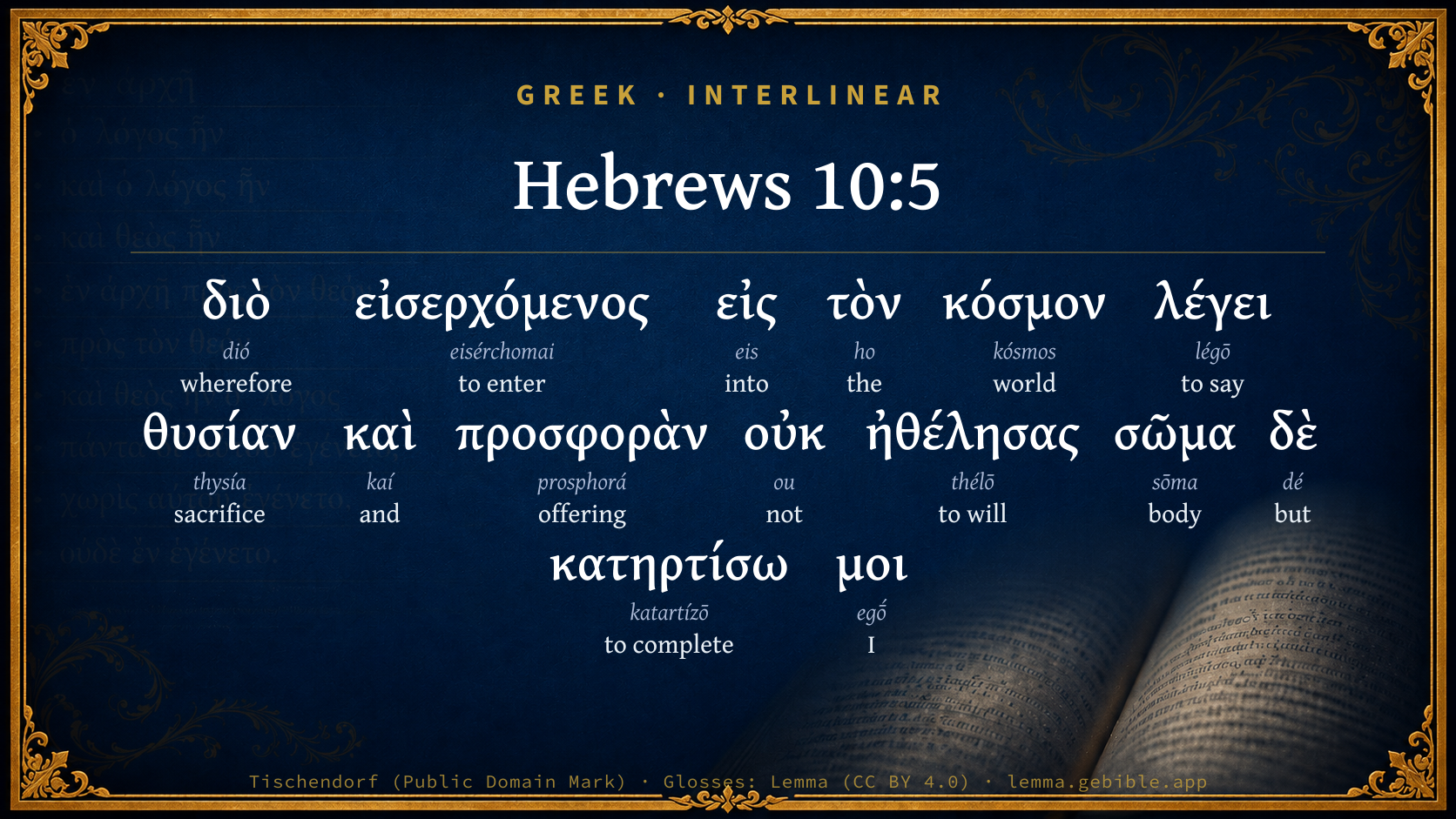
  1. διὸ dió G1352 “wherefore” Conjunction
  2. εἰσερχόμενος eisérchomai G1525 “to enter” Verb, Present, Middle or Passive deponent, Participle, Nominative, Singular, Masculine
  3. εἰς eis G1519 “into” Preposition
  4. τὸν ho G3588 “the” Article, Accusative, Singular, Masculine
  5. κόσμον kósmos G2889 “world” Noun, Accusative, Singular, Masculine
  6. λέγει légō G3004 “to say” Verb, Present, Active, Indicative, 3rd person, Singular
  7. θυσίαν thysía G2378 “sacrifice” Noun, Accusative, Singular, Feminine
  8. καὶ kaí G2532 “and” Conjunction
  9. οὐκ ou G3756 “not” Particle, Negative
  10. ἠθέλησας thélō G2309 “to will” Verb, Aorist, Active, Indicative, 2nd person, Singular
  11. σῶμα sōma G4983 “body” Noun, Accusative, Singular, Neuter
  12. δὲ dé G1161 “but” Conjunction
  13. κατηρτίσω katartízō G2675 “to complete” Verb, Aorist, Middle, Indicative, 2nd person, Singular
  14. μοι egṓ G1473 “I” Personal pronoun, 1st person, Dative, Singular

About this verse

These counts appear in no published source. They are computed here, from the morphology-tagged text and Lemma’s own curated glosses. What Lemma adds →

15
words
15
distinct lemmas
General Epistles
section

Notable vocabulary

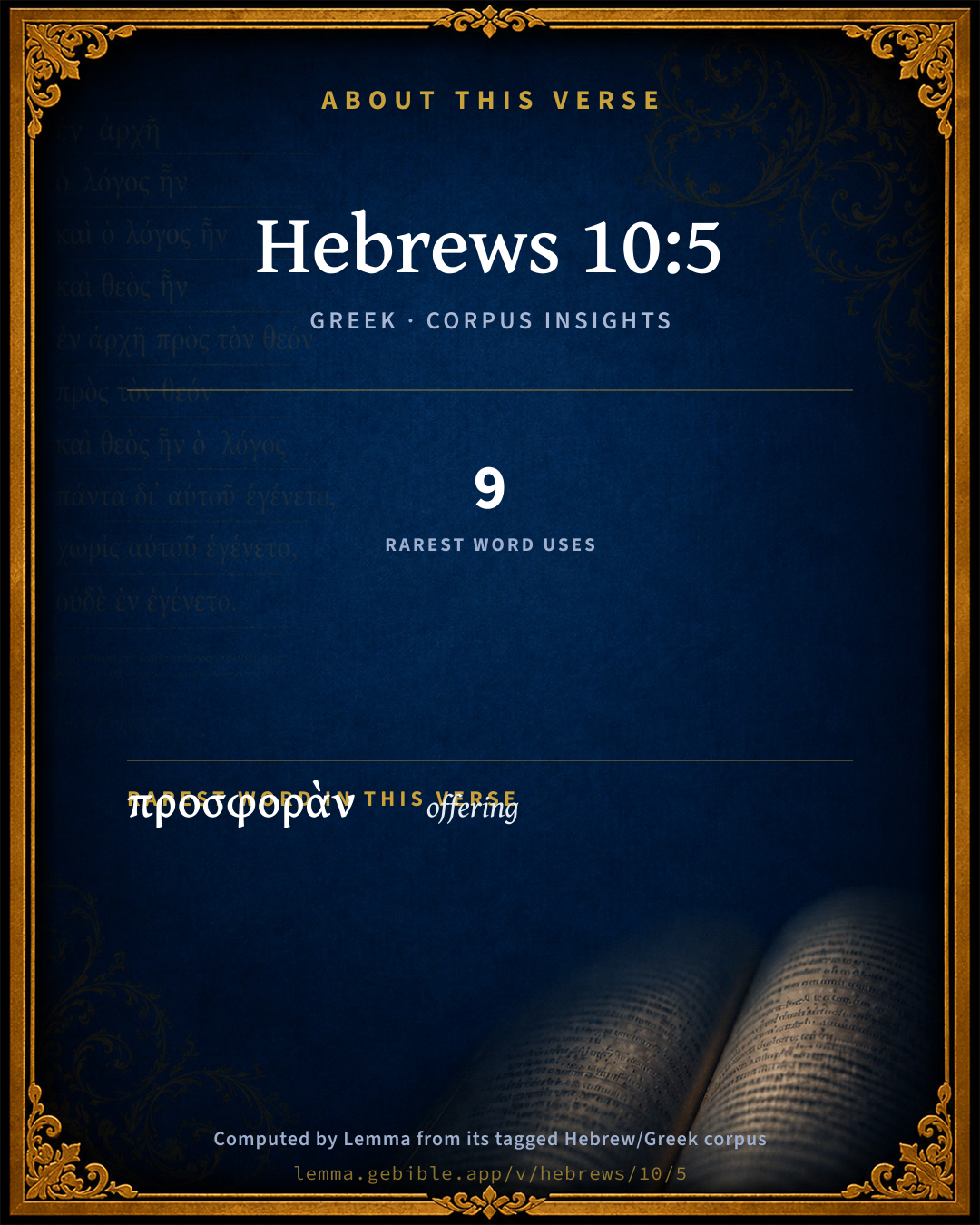
The rarest word here is προσφορὰν offering G4376 — appearing just 9 times in the whole Greek New Testament.

Shared distinctive vocabulary

προσφορὰν offering G4376 occurs in 9 verses of the Greek New Testament. Also found in:

Cross-references

23

Topical passages linked to Hebrews 10:5 in the Treasury of Scripture Knowledge — connected by theme and wording, ordered by reader-vote popularity; previews shown in the World English Bible.

  • Psalms 40:6–8 Sacrifice and offering you didn't desire. You have opened my ears: Burnt offering and sin offering you have not required.
  • Isaiah 1:11 "What are the multitude of your sacrifices to me?," says Yahweh. "I have had enough of the burnt offerings of rams, And the fat of fed animals. I don't delight in the blood of bulls, Or of lambs, Or of male goats.
  • Isaiah 7:14 Therefore the Lord himself will give you a sign. Behold, the virgin will conceive, and bear a son, and shall call his name Immanuel.
  • 1 Peter 2:24 who his own self bore our sins in his body on the tree, that we, having died to sins, might live to righteousness; by whose stripes you were healed.
  • Matthew 1:20–23 But when he thought about these things, behold, an angel of the Lord appeared to him in a dream, saying, "Joseph, son of David, don't be afraid to take to yourself Mary, your wife, for that which is conceived in her is of the Holy Spirit.
  • Galatians 4:4 But when the fullness of the time came, God sent out his Son, born to a woman, born under the law,
  • Hebrews 1:6 Again, when he brings in the firstborn into the world he says, "Let all the angels of God worship him."
  • Hebrews 2:14 Since then the children have shared in flesh and blood, he also himself in like manner partook of the same, that through death he might bring to nothing him who had the power of death, that is, the devil,
  • Hebrews 10:7 Then I said, 'Behold, I have come (In the scroll of the book it is written of me) To do your will, God.'"
  • Hebrews 10:10 by which will we have been sanctified through the offering of the body of Jesus Christ once for all.
  • Hebrews 8:3 For every high priest is appointed to offer both gifts and sacrifices. Therefore it is necessary that this high priest also have something to offer.
  • Psalms 50:8–23 I don't rebuke you for your sacrifices. Your burnt offerings are continually before me.
  • Jeremiah 6:20 To what purpose comes there to me frankincense from Sheba, and the sweet cane from a far country? your burnt offerings are not acceptable, nor your sacrifices pleasing to me.
  • Amos 5:21–22 I hate, I despise your feasts, And I can't stand your solemn assemblies.
  • Luke 1:35 The angel answered her, "The Holy Spirit will come on you, and the power of the Most High will overshadow you. Therefore also the holy one who is born from you will be called the Son of God.
  • John 1:14 The Word became flesh, and lived among us. We saw his glory, such glory as of the one and only Son of the Father, full of grace and truth.
  • 1 Timothy 3:16 Without controversy, the mystery of godliness is great: God was revealed in the flesh, Justified in the spirit, Seen by angels, Preached among the nations, Believed on in the world, And received up in glory.
  • 1 John 4:2–3 By this you know the Spirit of God: every spirit who confesses that Jesus Christ has come in the flesh is of God,
  • 2 John 1:7 For many deceivers have gone out into the world, those who don't confess that Jesus Christ came in the flesh. This is the deceiver and the Antichrist.
  • Genesis 3:15 I will put enmity between you and the woman, and between your offspring and her offspring. He will bruise your head, and you will bruise his heel."
  • Jeremiah 31:22 How long will you go here and there, you backsliding daughter? for Yahweh has created a new thing in the earth: a woman shall encompass a man.
  • Matthew 11:3 and said to him, "Are you he who comes, or should we look for another?"
  • Luke 7:19 John, calling to himself two of his disciples, sent them to Jesus, saying, "Are you the one who is coming, or should we look for another?"

Cross-references courtesy of OpenBible.info (CC BY 4.0).

Commentary

Notes on Hebrews 10:5 from classic Christian and Jewish commentators (each source and its license shown beneath its notes). The classic Christian expositions comment on the surrounding passage and are grouped to its opening verse, so a note may address several verses; the Jewish commentaries on the Tanakh (Rashi and others) are per-verse, so they appear only where the commentator wrote on this verse.

Lemma curates 59 commentaries, every one of them public domain or Creative Commons licensed, each selected and text-cleaned for this edition rather than reprinted as found. About our sources →

The Biblical Illustrator

Joseph S. Exell

Heb_10:5-7

A body hast Thou prepared Me

The body of Christ:

These words of the Psalmist are a prophecy of the Incarnation.

I. First, it plainly means THE NATURAL BODY, which He took of the substance of the Blessed Virgin. All that makes up the natural perfection of man as a moral and reasonable intelligence, together with a mortal body, He assumed into the unity of His person.

II. As there was a natural, so there is A SUPERNATURAL PRESENCE OF THE BODY OF OUR LORD JESUS CHRIST. He said, The bread that I will give is My flesh, &c.; Except ye eat the flesh of the Son of Man, &c. And when at the Last Supper He gave this great sacrament to His apostles, He said, This is My body, this is My blood. It is not for us to attempt to explain the secrets of this mystery. Who can reveal the manner of the resurrection of the body or the mystery of the Incarnation? Then here let us stay our thoughts. What He has said, that He will give, in spirit, substance, and reality. It is enough for us to know that as truly as the life and substance of the first creation are sustained and perpetuated until now, so in the second, which is the mystical Vine, He is root and trunk, branch and fruit; wholly in us, and we in Him.

III. There is yet another and A WIDER MYSTERY SPRINGING UP OUT OF THE LAST. The natural body of our Lord Jesus Christ is, as it were, the root out of which, by the power of the Holy Ghost, His mystical body is produced; and therefore He seems to take this title, I am the root and the offspring of David--the offspring according to the descent of the first creation, the root as the beginning of the new. This great work of the regeneration He began to fulfil when, at His descent into hell, He gathered to Himself the saints who of old were sanctified through the hope of His coming; and although they without us could not, when on earth, be made perfect, yet at His descent unto them they came behind in no gift, but were made equal to the saints of the kingdom. Then began the growth and expansion of the mystical Vine. Upon this unity of patriarchs, prophets, and saints of old were engrafted apostles and evangelists, and all the family of the regeneration. The body which, in its natural and local conditions, was enclosed in an upper chamber or wound in grave-clothes, has multiplied its life and substance as the first Adam in the family of mankind throughout the generations of Gods elect. Such is the mystical body of Christ.

IV. ARE THERE, THEN, THREE BODIES OF CHRIST? God forbid; but one only--one in nature, truth, and glory. But there are three manners, three miracles of Divine omnipotence, by which that one body has been and is present--the first as mortal and natural; the second supernatural, real, and substantial; the third mystical by our incorporation. (Archdeacon H. E. Manning.)

A body prepared:

It is one of the most striking things connected with our earthly existence that God sends no life into the world unclothed, bodiless. Every life has a body specially adapted for the service which that life has to render. The higher the life the more complex the organism; but in each case there is a wondrous harmony between every life and its embodiment and every body and its surroundings. If it be so, how much more when He will send His Son into the world will He prepare a body for Him--a body that shall be specially adapted for His great mission and for the accomplishment of His great design! The Incarnation is confessedly among the greatest of all mysteries. It is the Infinite One accepting a body. What does this mean? We cannot tell; we can only touch the fringe of the great subject. It means--it at least signifies this: that, for a time, the Infinite One

1. Accepts the limitations of finite existence. We know that as man He hungered, was tempted, wept human tears; we know that He prayed to His Father, and that His was the joy of receiving the Fathers approval. His acceptance of a finite existence made these things possible in His experience, and thus made Him an example to us. We are very, very far from seeing the full significance of the Incarnation, but we see enough to rejoice in it and glorify God for that Incarnation which, by virtue of the limitations it involved, made a gospel like ours possible. Again, by the Incarnation Christ accepts

2. The conditions of service, the submission of a servant: Lo, I come to do Thy will. How does the Apostle Paul put it? (Php_2:6-8). The Incarnation was the form in which the Lord Jesus could render the lowliest service. What a step in the path of obedience was that! Once we accept the story of the birth, and believe that the Christ has accepted a human body, Gethsemane and Calvary are perfectly intelligible and easily accepted. It is as man that Godward He has rendered the most perfect service, and that manward He has left a perfect example that we should follow His footsteps. Again, by the Incarnation He accepts

3. The highest possibility of self-sacrifice. By the which will we are sanctified through the offering of the body of Jesus Christ once for all This Man, after that He had offered one sacrifice for sins for ever, sat down on the right hand of God. The Incarnation finds its full significance in that sacrifice which was made possible by it. Without the Incarnation there could be no Cross. It is the manger that predicts Calvary. (D. Davies.)

A prepared body

Be careful to see clearly that Christ is the speaker, and that it is He who says to His Father. A body hast Thou prepared Me. It is the Deity of the Second Person in the Trinity--not yet become incarnate, but at the very point--addressing God, and declaring the great mystery of the passing away of all sacrifice and offering--that is, of the death of animals and the presenting of gifts--as utterly inadequate, and nothing worth for the atonement of the soul. He introduces Himself--Gods one great method with man, in the strange and inexpressible blending of the Divine and human, which was in Him. The God in our Emmanuel explains His own manhood, and traces it all up to the Fathers pre-arranging mind: A body hast Thou prepared Me. Let us look at the time of the preparation. In the mind and counsel of God that body was before all worlds (Pro_8:24-31). So was Christ ready before He came, and, or ever man sinned, the scheme was complete. Then came the Fall, and immediately the ready promise (Gen_3:15). As the ages rolled on, the plan developed. Then, as the time drew on, the preparation, which was in the bosom of the Father, began to take form and substance. The whole Roman world was stirred, that that body should appear at its destined spot. Through the purest channel which this earth could furnish, by miraculous operation, that body should come into the world, human but sinless, perfectly human but exquisitely immaculate. By what unfathomable processes I know not. Curiously wrought in this lower earth, that body--the prototype, before Adam was made, of all that ever should wear human form--that body came … But let us stand again by that little form laid in the manger outside the caravansaai, and let us reverently ask, For what is that body?

1. The text answers at once, For sacrifice. There is that dear Babe--lovely as no other babe was ever lovely--only a victim, a victim to be slaughtered upon an altar!… But let me ask, Is your body fulfilling the purpose for which it was prepared? Is it a consecrated body? Is it a ministering body? Ministering--to what? To usefulness, to mission, to truth, to the Church, to Christ?

2. And that body was prepared for sympathy. Therefore He took not on Him the nature of angels, but He became the Son of Man, that He might have human instincts; that His heart might throb to the same beat; that He might be true, even to every nerve and fibre of the physical constitution of every child of Adam. When you have an ache or feel a lassitude or depression, do not hesitate to claim and accept at once the fellowship of the man Christ Jesus. (J. Vaughan, M. A.)

Care for the body:

First of all, I shall name the sloven. We have all seen him at times, and a very objectionable fellow he is; clothes, gait, hair, hands, everything about him, denoting a lazy, indolent creature that is utterly without self-respect. If you keep in mind this little text, A body hast Thou prepared me, you will feel it a sacred duty to keep in proper condition your physical frame. Secondly, I name the boor. It is the greatest mistake in the world to suppose that it is a token of manliness to disregard the courtesies of polite society. Be courteous is a Scriptural admonition. Whatever you are, dont be a boor! As little would I like to see you a fop. Dandyism is one of the most contemptible developments of humanity, and always betokens extreme littleness of mind. But I cannot dismiss the text without pointing out how it bears upon the sensualist. There is no language in Scripture more startling in its awful solemnity than that which condemns the man who sinneth against his own body. The body, says St. Paul, is for the Lord, and the Lord for the body. Scripture speaks in many a place of a man sinning against his own soul. But there is something exceptionally terrible in the wickedness of those who sin against their own bodies. My subject compels me to warn you, in accents of earnest entreaty, against every form of impurity. Your body is Gods temple; no marble fane that ever was reared is so beautiful or so perfect. Shudder at the thought of its defilement. A body hast Thou prepared me, O God; it shall be kept stainless and immaculate for Thee--let this be your daily vow. And if it is to be kept, you must first of all guard your heart-purity. There is no fullers soap that will perfectly cleanse the imagination once it is defiled. If a harp be broken, skill may repair it; if a light be extinguished, the flame may be rekindled; but if a flower be crushed, what power can restore it to what it was before? Such a flower is purity. The first step on the down-grade taken, only a miracle of grace can bring you to the level again. The Scriptural doctrine of the resurrection invests this physical frame of mine with an infinite dignity and importance. Death is its temporary dissolution, not its destruction. With what magnitude of interest and importance does this invest these corporeal frames of ours! It confers upon them an awful indestructibility, at the thought of which even the perpetuity of mountains, of suns and stars, become as nothing. You have a bodily as well as a spiritual immortality. These bodies shall claim half of your individuality to all eternity. Can you, then, make them the instruments of sin, or defile them by unholy lusts? Must you not guard with utmost care the imperishable temple of the soul? (J. T. Davidson, D. D.)

Lo, I come … to do Thy will, O God

The beautiful life of Christ:

Our text presents an aspect of Christ of the highest charm. He is the great and only fulfiller of the will of God the world has ever seen. There was a book in which much concerning Him was written. At different times, in different measures, in different ways, of type in institute and incident, of promise, of comparison and contrast with other men and other doings, did that book perpetually speak of Him. But howsoever diverse its utterances were, they were all wonderfully harmonised in their ascription to Him of the spirit of delighted obedience to God.

I. THE LIFE OF OUR LORD JESUS CHRIST IS THE MOST BEAUTIFUL LIFE THAT HAS EVER BEEN LIVED IN THE WORLD. All sorts of beauty were bright in Him--the beauty of virtue, the beauty of godliness, the beauty of love, the beauty of sympathy, the beauty of obedience, and this without crack or flaw; the beauty of wise words, the beauty of holy action, the beauty of kind and gentle disposition; beauty which shone in the house, beauty which flamed in the temple, beauty which lighted up the cornfield and the wayside, beauty which graced alike the table of the publican and the Pharisee; beauty With smiles and tears, gifts and helps for men, women, and children as He found them.

II. ONE GREAT REASON WHY THAT BEAUTIFUL LIFE HAS BEEN LIVED AMONGST US MEN IS THAT WE MAY MAKE OUR LIVES BEAUTIFUL BY IT. He came to be an example. He bade men follow Him. He called for imitation of His spirit and character. His servants held Him up in the same light; they bade men put on the Lord Jesus Christ, follow in His steps, let the same mind be in them as was in Him. There is not a single virtue in Christ that should not have its place and power in you. The scale of its play, the special circumstances and relations which throw such grandeur into His career, must, of course, present a vast disparity between Him and us. But in essence, in spirit, we are bound to cultivate His worth; the actual outworking in our lot and relations of each excellence of His is an obligation on our heart and conscience.

III. THE SECRET OF THIS MOST BEAUTIFUL LIFE OF CHRIST IS TOLD US. Were you to see a rare and beautiful flower in anothers garden, you would naturally wish that it might adorn your own also. You would ask whence it came, what soil it liked, and a dozen other questions, so that its true treatment might be leaflet and your own garden enriched with it. And when you are truly roused to spiritual care you ask the like questions about a beautiful action that has struck you or a beautiful character that has crossed your path. Whence came it? What is its inspiration--its culture? Tell me the secret, Never were such queries more seemly than on the survey of Christs beautiful life. Is its great secret ascertainable? Is it within my reach? Well, Christs beauty all came from one thing--He did the will of God. He delighted to do it. Its law was in His heart.

IV. WHAT A BEAUTIFUL WILL THE WILL OF GOD MUST BE IF THE BEAUTIFUL LIFE OF CHRIST IS SIMPLY ITS OUTCOME! Few phrases are so inadequately welcomed by us as the will of God. We invest it, perhaps, with all the reverence we can, with sublimity, authority, rectitude, and power, but not with beauty. It is not a charm to us, a ravishing delight. We submit to it rather than accept it. We bow, but we do not sing. Oh! let us correct ourselves. The will of God is beautiful beyond all expression. Each commandment it gives is beautiful, holy, just, and good. The way of life it prescribes is as the shining light, that shineth more and more unto the perfect day. The character it forms and moulds is radiant with a lustre that never dies. The good it diffuses is boundless in worth and variety.

V. IF YOU WOULD MAKE YOUR LIFE BEAUTIFUL LIKE THE BEAUTIFUL LIFE OF CHRIST, YOU MUST DAILY STUDY THE WILL OF GOD, AND JUST BE AND DO WHAT THAT WILL ORDAINS. There is the philosophy of a high, noble, beautiful, glorious life--so simple that a child can understand it, so profound and far-reaching that no maturity of power, no elevation in lot, can ever carry you beyond it. It is the one grand law of time and eternity, of earth and heaven. (G. B. Johnson.)

Christ the substance of the ancient sacrifices of the Law

To take Jesus Christ for our Redeemer and for our Example is an abridgment of religion, and the only way to heaven. If Jesus Christ be not taken for our Redeemer, alas! how can we bear the looks of a God who is of purer eyes than to behold evil? If we do not take Jesus Christ for our Example, with what face can we take Him for our Redeemer? Should we wish that He who came into the world on purpose to destroy the works of the devil, would re-establish them in order to fill up by communion with this wicked spirit that void which communion with Christ leaves?

I. First, we will consider the text AS PROCEEDING FROM THE MOUTH OF JESUS CHRIST. We will show you Jesus substituting the sacrifice of His body instead of those of the Jewish economy.

1. Our text is a quotation, and it must be verified. It is taken from the fortieth psalm All that psalm, except one word, exactly applies to the Messiah. This inapplicable word, as it seems at first, is in the twelfth verse, Mine iniquities have taken hold upon Me. This expression does not seem proper in the mouth of Jesus Christ, who, the prophets foretold, should have no deceit in His mouth, and who, when He came, defied His enemies to convince Him of a single sin. There is the same difficulty in a parallel Psa_69:5), O God! Thou knowest My foolishness, and My sins are not hid from Thee. The same solution serves for both places. Jesus Christ on the Cross was the Substitute of sinners, like the scapegoat that was accursed under the Old Dispensation. The Scripture says in so many words, He bare our sins. Is the bearer of such a burden chargeable with any exaggeration when He cries, My iniquities have taken hold upon Me, so that I am not able to look up; they are more than the hairs of Mine head? Moreover, the fortieth psalm is parallel to other prophecies, which indisputably belong to the Messiah. I mean particularly the sixty-ninth psalm, and the fifty-third chapter of Isaiah.

2. A difficult passage, that needs elucidation. The principal difficulty is in these words, A body hast Thou prepared Me. The Hebrew has it, Thou hast digged, bored, or opened Mine ears. It is an allusion to a law recorded in the twenty-first chapter of Exodus, where they who had Hebrew slaves were ordered to release them in the Sabbatical year. A provision is made for such slaves as refused to accept of this privilege. Their masters were to bring them to the doors of their houses, to bore their ears through with an awl, and they were to engage to continue slaves for ever, that is to say, to the year of Jubilee, or till their death, if they happened to die before that festival. As this action was expressive of the most entire devotedness of a slave to his master, it was very natural for the prophet to make it an emblem of the perfect obedience of Jesus Christ to His Fathers will. But why did not St. Paul quote the words as they are in the psalm? The apostle followed the version commonly called that of the Seventy. But why did the Seventy render the original words in this manner?

(1) The word rendered prepared is one of the most vague terms in the Greek tongue, and signifies indifferently to dispose, to mark, to note, to render capable, and so on.

(2) Before the Septuagint version the Mosaic rites were very little known among the heathens, perhaps also among the dispersed Jews. Hence in the period of which I am speaking few people knew the custom of boring the ears of those slaves who refused to accept the privileges of the Sabbatical year.

(3) It was a general custom among the Pagans to make marks on the bodies of those persons in whom they claimed a property. They were made on soldiers and slaves, so that if they deserted they might be easily reclaimed. Sometimes they apposed marks on them who served an apprenticeship to a master, as well as on them who put themselves under the protection of a god. These marks were called stigmas (see Ga Eze_9:4; Rev_7:3-8). On these different observations I ground this opinion. The Seventy thought, if they translated the prophecy under consideration literally, it would be unintelligible to the Pagans and to the dispersed Jews, who, being ignorant of the custom to which the text refers, would not be able to comprehend the meaning of the words, Mine ears hast Thou bored. To prevent this inconvenience they translated the passage in that way which was most proper to convey its meaning to the readers. Now as this translation was well adapted to this end, St. Paul had a right to retain it.

3. Jesus Christ, we are very certain, is introduced in this place as accomplishing what the prophets had foretold; that is, that the sacrifice of the Messiah should be substituted in the place of the Levitical victims. On this account our text contains one of the most essential doctrines of the religion of Jesus Christ, and the establishment of this is our next article. In order to comprehend the sense in which the Messiah says to God, Sacrifice and offering Thou wouldst not; we must distinguish two sorts of volition in God--a willing of a mean, and a willing of an end. God may be said to will a mean when He appoints a ceremony or establisheth a rite which hath no intrinsic excellence in itself, but which prepares them on whom it is enjoined for some great events on which their felicity depends. By willing an end I mean a production of such events. If the word will be taken in the first sense, it cannot be truly said that God did not will or appoint sacrifices and burnt-offerings. Every one knows He instituted them, and regulated the whole ceremonial of them, even the most minute articles. But if we take the word will in the second sense, and by the will of God understand His willing an end, it is strictly true that God did not will or appoint sacrifices and burnt-offerings; because they were only instituted to prefigure the Messiah, and consequently as soon as the Messiah, the substance, appeared, all the ceremonies of the Law were intended to vanish.

II. To WHAT PURPOSE ARE LEVITICAL SACRIFICES, OF WHAT USE ARE JEWISH PRIESTS, WHAT OCCASION HAYS WE FOR HECATOMBS AND OFFERINGS AFTER THE SACRIFICE OF A VICTIM SO EXCELLENT? The text is not only the language of Jesus Christ, who substitutes Himself in the place of Old-Testament sacrifices; but it is the voice of David and of every believer who is, full of this just sentiment that a personal dedication to the service of God is the most acceptable sacrifice that men can offer to the Deity. Ye understand, then, in what sense God demands only the sacrifice of your persons. It is what He wills as the end; and He will accept neither offerings, nor sacrifices, nor all the ceremonies of religion, unless they contribute to the holiness of the person who offers them.

1. Observe the nature of this sacrifice. This offering includes our whole persons, and everything that Providence hath put in our power. Two sorts of things may be distinguished in the victim of which God requires the sacrifice; the one bad, the other good. We are engaged in vicious habits, we are slaves to criminal passions; all these are our bad things. We are capable of knowledge, meditation, and love; we possess riches, reputation, employments; these are our good things. God demands the sacrifice of both these.

2. Having observed the nature of that offering which God requires of you, consider next the necessity of it (1Sa_15:22; Psa_50:16-17, Isa_1:11; Isa_1:16; Jer_7:21-23). To what purpose do ye attend public worship in a church consecrated to the service of Almighty God, if ye refuse to make your bodies temples of the Holy Ghost, and persist in devoting them to impurity? To what purpose do ye send for your ministers when death seems to be approaching if, as soon as ye recover from sickness, ye return to the same kind of life, the remembrance of which caused you so much horror when ye were afraid of death?

3. The sacrifice required of us is difficult, say ye? I grant it. How extremely difficult when our reputation is attacked, when our morals, our very intentions, are misinterpreted; how extremely difficult when we are persecuted by cruel enemies; how hard is it to practice the laws of religion which require us to pardon injuries, and to exercise patience to our enemies! How difficult is it to sacrifice unjust gains to God, by restoring them to their owners; how hard to retrench expenses which we cannot honestly support, to reform a table that gratifies the senses! How difficult is it to eradicate an old criminal habit, and to renew ones self, to form, as it were, a different constitution, to create other eyes, other ears, another body!

4. But is this sacrifice the less necessary because it is difficult? Do the difficulties which accompany it invalidate the necessity of it? Let us add something of the comforts that belong to it, they will soften the yoke. What delight, after we have laboured hard at the reduction of our passions, and the reformation of our hearts; what delight to find that heaven crowns our wishes with success!

5. Such are the pleasures of this sacrifice: but what are its rewards? Let us only try to form an idea of the manner in which God gives Himself to a soul that devotes itself wholly to Him. O my God! how great is Thy goodness, which Thou hast laid up for them that fear Thee! My God! what will not the felicity of that creature be who gives himself wholly to Thee, as Thou givest Thyself to him! (J. Saurin.)

The Son incarnate to do the will of God

I. In the first place the text reminds us THAT INTELLIGENT CREATURES CAN FIND THEIR HAPPINESS AND PERFECTION ONLY IN THE HARMONY OF THEIR WILLS WITH THE WILL OF GOD. But what if the new-made man should abuse his freedom? Who can foresee the consequences? As to his body; what if its hand should pluck forbidden fruit--its tongue utter deceit--all its members become instruments of unrighteousness unto sin? As to the material universe around; what if he should take himself out of harmony with its laws--extracting poison from its plants, and maddening juices from its fruits, and forging its metals into weapons for the slaughter of his fellows? What if he should league with other self-willed beings like himself--league with them solely to augment his power for crushing others, andfor openly disowning his allegiance to heaven? Nay, what if, in the progress of mans history, he should come to think of setting up a god of his own? Or worse still--there is a rebel angel at large in the universe--a sworn enemy to the righteous government of God; what if a man should be led captive by Satan at his will? And what if he should complete his degradation and his guilt by calling the worship of his own vices, religion; the thraldom of Satan, liberty? What if here, where the will of God should be done as it is in heaven, the will of Satan should be done instead, as it is in hell?

II. I need not say THAT THIS IS HISTORY--THE HISTORY OF MAN. The hour of trial came; and he fell. A law was given him; and, oh, better had a star fallen from its sphere, and been falling still! he broke away from its sacred restraint--deranged the harmony of his own nature--disturbed the tranquillity of the universe--incurred the penalty of transgression. Mercy spared him, but he relented not; justice threatened him, but he quailed not. Generation followed generation, only to take up the quarrel and widen the breach. The Lord looked down from heaven to see if there were any that did understand, that did seek after God. Alas I they had all revolted: there was none that did good; no, not one.

III. But even then, WHEN TO ALL HUMAN EYES THE UNIVERSE WAS UTTERLY VOID OF AID, HELP WAS ON THE WAY. Even then, when infatuated man was saying, We will not have God to reign over us, and was vowing allegiance to Satan, that God was saying, As I live, I will not the death of the sinner. And even then a voice was heard replying to that purpose, I come to do it--lo! I come to do Thy will, O My God. Thy will is My will--I delight to do it--it is within My heart. And that voice came from nouncertain quarter--from no angel ranks--it came, if I may say so, from the centre of the Deity, from the mysterious depths of the Triune God. And the world was spared on the ground of that engagement, and the angels of God held themselves in readiness to behold its fulfilment; and Judaea was prepared to be the theatre of the great transaction, and unnumbered eyes were watching for His coming, and unnumbered interests depending on it. But when He comes, what laws will He obey?--what appearance will He assume? What laws? the very laws which man had broken. What appearance? that of the very nature which man had degraded. And when the fulness of time was come, a body was prepared Him--God sent forth His Son, made of a woman, made under the law. And you know what He proceeded to do. All the powers of that body He placed at the disposal of the will of God. Yes, by His obedience unto death, the will of God was done on earth, as it had never been done even in heaven--done in a manner which makes earth, from its centre to its surface, holy ground--done so as to secure the means of converting even this sin-worn world into a loyal province of the King of kings.

IV. And this brings us to the consideration of these MEANS. DO you ask how the will of the rebellious world is to be brought back into harmony with the will of God? Not by might, nor by power--not by coercion and force; but by My Spirit, saith the Lord--by My Spirit taking of the things of Christ--taking of His voluntary obedience; taking of His love, and showing how He wept over the infatuation of our disobedience; taking of His mediatorial glory, and showing that He is now seated on a throne to receive our submission, to place us once more in harmony with the will of God, and to assure us of His favour.

1. Now, do you not see that when the will of the penitent is secured, the whole man is secured?

2. Here, then, is a willing agent for God. Wonderful as was the creation of a finite will at first--wonderful as was the introduction into the universe of a second will--here is a greater wonder still--the recovery of a lost will to God-a will which had been led captive by Satan, set at liberty and restored, and once more moving in conformity with Gods will. What if he could prevail on other wills to unite with his will--how vastly would that increase his power of serving God!

V. The question naturally arises, then, How is it, if the Divine provision be all complete, and the sanctified human means so well understood--How is IT THAT THE WILL OF GOD IS NOT UNIVERSALLY OBEYED, AFTER THE EXAMPLE OF OUR SAVIOUR CHRIST? Eighteen hundred years have elapsed since He said, Lo, I come, and the redemption of the world was effected. How then, we repeat, is the present condition of the world to be accounted for? By the state of the Church. Whatever the doctrinal heresies of the day may be, the great practical heresy is that of a defective zeal. They seem to forget, that in praying that the will of God may be done in the world, they are presupposing that it is done already in the Church. We do not say that Christians have made no progress in learning this great lesson. All the success which they have achieved of late years, as a missionary Church, is owing to their partial obedience to the will of God. But partial obedience will only be followed by partial success. They have so far obeyed, that they are shut up to the necessity of obeying still further. God has quickened them; and they have given, and prayed, and laboured as the Church had long ceased to do. Let them copy the devotedness of their Lord, and the work will be done. Ask you for motives to such zeal

1. Need I remind you that one of these motives is the sublime truth--that the brightest example of obedience which heaven now contains is not an angel form, but He who learned obedience by the things which He suffered? He now reigns in the same spirit in which He suffered. Think what He is doing as your representative there, and say, what ought you to be doing as His representatives here? He is doing your will--answering your highest requests--what ought not you to be ready to do in obedience to His will?

2. Need I remind you, as another motive, what a theme it is we have to obey and to proclaim? The merest despot finds ready instruments to do his will.

3. Think, next, of the happy results of the reception of this message, as compared with mans present state.

4. Think, again, how some, influenced by these motives, have copied the devotedness of Christ.

5. And then one motive there is which adds force and solemnity to every other--the fact that He who is the subject and substance of our message, on leaving the world, hath said, Behold, I come quickly. (J. Harris, D. D.)

The Atonement

It must strike any person, as something that wants accounting for, how it is that a doctrine which has called forth the moral affections of man so strongly, and presented so transcendent an object for them, as that of the Atonement has, should of all criticisms in the world be specially subjected to the charge of being an immoral doctrine. It is based, it is said, upon injustice. What can be the reason of this extraordinary discord in the estimate of this doctrine? Is it not that the Christian body has taken the doctrine as a whole, with all the light which the different elements of it throw upon each other, while the objection has only fixed on one element in the doctrine, abstracted from the others? The point upon which the objector has fixed is the substitution of one man for another to suffer for sin; but he has not taken this point as it is represented and interpreted in the doctrine itself, but barely and nakedly, simply as the principle of vicarious punishment. It is to be observed that, according to this idea of sacrifice for sin, it is not in the least necessary the sacrifice should be voluntary, because the whole principle of sacrifice is swallowed up in the idea of vicarious punishment; and punishment, vicarious or other, does not require voluntary sufferer, but only a sufferer. The victim may be willing or unwilling; it matters not, so long as he is a victim; he endures agony or death in fact, and that is all that, upon the principle of mere substitution, is wanted. It was this low and degraded idea of sacrifice which had possession of the ancient world for so many ages, and which produced, as its natural fruit, human sacrifices, with all the revolting cruelties attending them. Such subtlety of cruelty was the issue of the idea that a mere substitution could be a sacrifice for sin; pain, due in justice to one, be escaped by simple transference to another. But this idea was totally extinguished by the gospel idea, when it was revealed that love was of the very essence of sacrifice, and that there could not be sacrifice without will. A victim then appeared who was the real sacrifice for sin. The circumstance, then, of the victim being a self-offered one, makes, in the first place, all the difference upon the question of injustice to the victim. In common life and most human affairs the rule is that no wrong in justice is done to one who volunteers to undertake a painful office, which he might refuse if he pleased. In accepting his offer this would not indeed always apply; for there might be reasons which would make it improper to allow him to sacrifice himself. But it cannot be said that it is itself contrary to justice to accept a volunteer offer of suffering. Is it in itself wrong that there should be suffering which is not deserved? Not if it is undertaken voluntarily, and for an important object. Upon the existence of pain and evil being presupposed and assumed there are other justifications of persons undergoing it besides ill-desert. The existence of pain or evil being supposed, there arises a special morality upon this fact, and in connection with it. It is the morality of sacrifice. Sacrifice then becomes, in the person who makes it, the most remarkable kind of manifestation of virtue; which ennobles the sufferer, and which it is no wrong-doing in the universe to accept. But this being the case with respect to voluntary sacrifice, the gospel sacrifice is, as has been said, specially a voluntary and self-offered one. It must be remembered that the supernaturalness of the sphere in which the doctrine of the Atonement is placed, affects the agency concerned in the work of the Atonement. He who is sent is one in being with Him who sends. His willing submission, therefore, is not the willing submission of a mere man to one who is in a human sense another; but it is the act of one who, in submitting to another, submits to himself. By virtue of His unity with the Father, the Son originates, carries on, and completes Himself the work of the Atonement. But now with regard to the effect of the act of the Atonement upon the sinner. It will be seen, then, that with respect to this effect -the willingness of a sacrifice changes the mode of the operation of the sacrifice, so that it acts on a totally different principle and law from that upon which a sacrifice of mere substitution acts. A sacrifice of mere substitution professes to act upon a principle of a literal fulfilment of justice, with one exception only, which is not thought to destroy but only to modify the literal fulfilment. It is true the sin is committed by one and the punishment is inflicted upon another; but there is sin, and there is punishment on account of sin, which is considered a sort of literal fulfilment of justice. But a voluntary sacrifice does not act upon the principle of & mock literal fulfilment of justice, but upon another and totally different principle, Its effect proceeds not from the substitution of one person for another in punishment, but from the influence of one person upon another for mercy--a mediator upon one who is mediated with. Let us see what it is which a man really means when he offers to substitute himself for another in undergoing punishment. He cannot possibly mean to fulfil the element of justice literally. What he wants to do is to stimulate the element of mercy in the judge. Justice is not everything in the world; there is such a thing as mercy. How is this mercy to be gained, enlisted on the side you want? By suffering yourself. It is undoubtedly a fact of our nature, however we may place or connect it, that the generous suffering of one person for another affects our regard for that other person. It is true that the sufferer for another, and he who is suffered for, are two distinct persons; that the goodness of one of these persons is not the property of the other; and that it does not affect our relations towards another upon the special principle of justice; that, upon that strict principle, each is what he is in himself and nothing more; that the suffering interceder has the merit of his own generosity, the criminal the merit of his crime; and that no connection can be formed between the two on the special principle of justice. And yet, upon whatever principle it is, it is a fact of our nature, of which we are plainly conscious, that one mans interceding suffering produces an alteration of regards toward the other man. But it will be said this is true as far as feeling goes, but it is a weakness, a confessed weakness; this impulse is not supported by the whole of the man. Can you carry it out? it may be said; can you put it into execution? We cannot, for very good reasons, that civil justice is for civil objects, and in the moral sphere final pardon is not in our province. But because this particular impulse to pardon cannot be carried out or put into execution, it is not therefore a weakness. It is something true and sincere which speaks in our nature, though it cannot be embraced in its full bearings and in its full issue. Even if it is a fragment, it is a genuine fragment. It exists in us as a true emotion of the mind, a fact of our true selves; it is a fact of nature, in the correct and high sense of the word. The whole law of association, e.g., is a law of mediation in the way of enlisting feelings for us, by means external to us. The laws of association do in fact plead for persons from the moment they are born; men have advocates in those they never knew, and succeed to pre-engaged affections, and have difficulties cleared away before them in their path. The air they breathe intercedes for them, the ground they have trod on, the same sights, the same neighbourhood. What is the tie of place, or what is even the tie of blood, to the essential moral being; it is a wholly extraneous circumstance; nevertheless these links and these associations, which are wholly external to the man, procure regards for him, and regards which are inspired with strong sentiment and affection. So good deeds of others, with which persons have nothing in reality to do, procure them love and attention. The son of a friend and benefactor shines in the light of others acts, and inspires, before he is known, a warm and approving feeling. This, that has been described, is the principle upon which the sacrifice of love acts, as distinguished from the sacrifice of mere substitution; it is a principle which is supported by the voice of nature and by the law of mediation in nature; and this is the principle which the gospel doctrine of the Atonement proclaims. The effect of Christs love for mankind, and suffering on their behalf, is described in Scripture as being the reconciliation of the Father to man, and the adoption of new regards toward him. The act of one, i.e., produces this result in the mind of God toward another; the act of a suffering Mediator reconciles God to the guilty. But neither in natural mediation nor in supernatural does the act of suffering love, in producing that change of regard to which it tends, dispense with the moral change in the criminal. We cannot, of course, because a good man suffers for a criminal, alter our regards to him if he obstinately remains a criminal. And if the gospel taught any such thing in the doctrine of the Atonement, it would certainly expose itself to the charge of immorality. But if there is no mediation in nature which brings out mercy for the criminal without a change in him, neither on the other hand, for the purpose of the parallel, do we want such. Undoubtedly there must be this change, but even with this, past crime is not yet pardoned. There is room for a mediator; room for some source of pardon which does not take its rise in a mans self, although it must act with conditions. But viewed as acting upon this mediatorial principle, the doctrine of the Atonement rises altogether to another level; it parts company with the gross and irrational conception of mere naked material substitution of one person for another in punishment, and it takes its stand upon the power of love, and points to the actual effect of the intervention of suffering love in nature, and to a parallel case of mediation as a pardoning power in nature. There is, however, undoubtedly contained in the Scriptural doctrine of the Atonement, a kind, and a true kind, of fulfilment of justice. It is a fulfilment in the sense of appeasing and satisfying justice; appeasing that appetite for punishment which is the characteristic of justice in relation to evil There is obviously an appetite in justice which is implied in that very anger which is occasioned by crime, by a wrong being: committed; we desire the punishment of the criminal as a kind of redress, and his punishment undoubtedly satisfies a natural craving of our mind. But let any one have exposed himself thus to the appetite for punishment in our nature, and it is undoubtedly the case, however we may account for it, that the real suffering of another for him, of a good person for a guilty one, wilt mollify the appetite for punishment, which was possibly up to that time in full possession of our minds; and this kind of satisfaction to justice and appeasing of it is involved in the Scriptural doctrine of the Atonement. And so, also, there is a kind of substitution involved in the Scripture doctrine of the Atonement, and a true kind; but it is not a literal but a moral kind of substitution. It is one person suffering in behalf of another, for the sake of another: in that sense he takes the place and acts in the stead of another, he suffers that another may escape suffering, he condemns himself to a burden that another may be relieved. But this is the moral substitution which is inherent in acts of love and labour for others; it is a totally different thing from the literal substitution of one person for another in punishment. The outspoken witness in the human heart, which has from the beginning embraced the doctrine of the Atonement with the warmth of religious affection, has been, indeed, a better judge on the moral question than particular formal schools of theological philosophy, The atoning act of the Son, as an act of love on behalf of sinful man, appealed to wonder and praise: the effect of the act in changing the regards of the Father towards the sinner, was only the representation, in the sublime and ineffable region of mystery, of an effect which men recognised in their own minds. The human heart accepts mediation. It does not understand it as a whole; but the fragment of which it is conscious is enough to defend the doctrine upon the score of morals. Undoubtedly the story of the Atonement can be so represented as to seem to follow in general type the poetical legends and romances of the infantine imagination of the world. In details--what we read in the four Gospels--not much resemblance can be charged, but a summary can be made so as to resemble them. And what if it can? What is it but to say that certain turning ideas, Divine and human, resemble each other; that there is an analogy? The old legends of mankind represent in their general scope not mere fancy, but a real longing of human nature, a desire of mens hearts for a real Deliverer under the evils under which life groans. The whole creation groaneth and travaileth in pain together until now. But more than this, do not they represent real facts too? These legends of deliverers would never have arisen had there not been deliverers in fact; the fabulous champions would not have appeared had there not been the real; it was truth which put it in mens heads to imagine. Doubtless, in all ages, there were men above the level, who interposed to put a stop to wrongs and grievances; for, indeed, the world would have been intolerable had it been completely given up to the bad: The romances of early times, then, reflect at the bottom what are facts; they reflect the action of real mediators in nature, who interposed from time to time for the succour of mankind in great emergencies. When, then, a heavenly mediation is found to resemble in general language an earthly one, what is it more than saying that earthly things are types of heavenly? So rooted is the great principle of mediation in nature, that the mediatorship of Christ cannot be revealed to us without reminding us of a whole world of analogous action, and of representation of action. How natural thus does the idea of a mediator turn out to be! Yet this is exactly the point at which many stumble; pardon they approve of; reconciliation they approve of; but reconciliation by means of mediation is what they cannot understand. Why not dispense with a superfluity? they say; and why not let these relieve us from what they consider the incumbrance of a mediator? But this is not the light in which a mediator is viewed by the great bulk of the human race. It has appeared to the great mass of Christians infinitely more natural to be saved with a mediator than without one. They have no desire to be spared a mediator, and cannot imagine the advantage of being saved a special source of love. They may be offered greater directness in forgiveness, but forgiveness by intervention is more like the truth to them. It is this rooted place of a mediator in the human heart which is so sublimely displayed in the sacred crowds of St. Johns Revelation. The multitude which no man can number are indeed there all holy, all kings and priests, all consecrated and elect. But the individual greatness of all is consummated in One who is in the centre of the whole, Him who is the head of the whole race, who leads it, who has saved it, its King and Representative, the First-born of the whole creation and the Redeemer of it. Toward Him all faces are turned; and it is as when a vast army fixes its look upon a great commander in whom it glories, who on some festival day is placed conspicuously the midst. Is there humiliation in that look because he commands them? there is pride and exaltation, because he represents them. Every one is greater for such a representative. So in that heavenly crowd all countenances reflect the exaltation of their Head. (J. B. Mozley, D. D.)

The coming Saviour and the responding sinner

Who said this? He who of all who ever walked this earth alone could say--I have done Thy bidding. And when did He say it? When all else had failed? When Sacrifice and offering and burnt offerings, and offering for sin, Thou wouldest not, neither hadst pleasure therein. Then, said He, Lo, I come to do Thy will, O God. It is the announcement of human weakness. It was the final and only way to harmonise the attributes of God, and to make it a just thing for a Holy God to pardon a sinner--to reconcile man to his Maker. And what was Gods will? In the first instance Gods will was to make a lovely creation, and a creature, man, who should be a free agent to occupy and enjoy it. So He made a happy world, and two persons to inhabit and enjoy it. Free agents! That free agency they broke, and so our whole world fell. Then, all praise to His glory and grace, God recalled this world to happiness, and the question was--How could that be done compatible with the truth and justice of His word? That was the problem Christ came to solve. In Him we have a Brother who is the sharer of our weaknesses and of our sorrows and of our temptations. But oh! at what a cost was all this done! With what intensity of anguish I This then is the lesson, Lo, I come. But the Greek word which we have translated I come is more than that; it is I am come. I am come. Observe, the expression denotes two things that He came, and that where He comes He stays. I am come implies the two facts--the Advent and His presence. I am come. He came to die, to be our Substitute. And now, having done that, He stays. I am come. He is with us still--our Companion, our Brother, our Guide, our Friend. Can you not offer up an echo to such words us these in your heart and say to God; Thou didst say I come. To Thee, Lord, I will say back, I come to Thee! I come to Thee! (J. Vaughan, M. A.)

The volume

In the volume of the book. In olden times books were not made out of sheets of paper folded into four, six, or eight, or twelve, and so forming one compact volume, with page following page from beginning to end, from left to right as now. A book was made of one very long strip of papyrus or parchment, rolled like a window blind on a roller; or rather, let me say, it was on two rollers, one roller was attached to the top of the strip, the other roller was fastened to the bottom. The strip of parchment paper-rush was many yards long. The book began at the very top of the long strip. There were no pages and no turning over of the leaf, but the reader read straight down the strip, his book was written all over the yards of material. As he read the top lines he turned the top roller, and it rolled them up, and unrolled some more of the material with the writing on it from off the bottom roller. And when the reader came to the end of the book, he had rolled it all off the bottom roller on to the top one. When he began his book it was all rolled on to the bottom roller. When the words volume of the book are used, it means the roll of the book. A long book of several volumes was a book in several rolls. Our word volume is a Latin word and means a roll, such as a roll of calico or cloth at the drapers. This word was used before books were made as they are now, in blocks; when the fashion of making books changed the old name remained on, though it really applied only to books in rolls. When it is said by Christ of His life, Lo, I come, in the volume of the book it is written of Me, to fulfil Thy will, O God, it really means, Lo, I come, to do Thy will, so it is written at the head of the scroll, At the head of every volume was written the title of the book. Now Christ is speaking of His life as if it were a book. As the title and heading of His life is this text, I am come to do Thy will, O my God! Many a book opens with a quotation which gives the key to the meaning of the book, just as a text stands at the head of a sermon. You may have seen how every chapter in Sir Walter Scotts stories begins with a piece of poetry, quotation from somewhere or other, and it has reference to all that follows. So the text, the heading of the chapter of our Lords life, is I am come to do Thy will, O God. That was why He was born of a Virgin--to fulfil the will of God. Why He was born at Bethlehem--to fulfil the will of God. Why He was circumcised--to fulfil the will of God. Why He fled into Egypt--to fulfil the will of God. (S. BaringGould, M. A.)

Voluntariness of Christs sacrifice

Who would say it was unjust of David, when Abigail took--voluntarily took--her husbands guilt on herself and said, Upon me, my lord, upon me let this iniquity be (1Sa_25:24)? Would it not have been unjust to refuse to her the privilege she asked of being allowed to take on herself a burden, that she might throw it off and secure Davids pacification? Still less can we complain of injustice when Jesus, touched with pity, flies down from the eternal throne, and says to His Father in heaven, Upon Me, My Father, upon Me let this iniquity be; let Me bear this burden, let Me set them free! (C. Clemance, D. D.)

Christ in the Old Testament Scriptures:

In all the Word of God there is not a page that does not testify of Him. Mr. Moody tells of a visit to Prangs chrome establishment in Boston. Mr. Prang showed him a stone on which was laid the colour for the making of the first impression toward producing the portrait of a distinguished public man; but he could see only the faintest possible line of tinting. The next stone that the paper was submitted to deepened the colour a little; but still no trace of the mans face was visible. Again and again was the sheet passed over the successive stones, until at last the outline of a mans face was dimly discerned. At last, after some twenty impressions, from as many different stones, were taken upon the paper, the portrait of the distinguished man stood forth, so perfect that it seemed only to lack the power of speech to make it living. Thus it is with Christ in the Scriptures, especially in the Old Testament. Many persons--even those who know Christ from the New Testament revelations of Him--read rapidly through and over the pages of the book, and declare that they do not see Christ in them. Well, read it again and again; look a little more intently upon these sacred pages; draw a little nearer into the light which the Holy Spirit gives to them that ask Him; read them on your knees, calling upon God to open your eyes, that you may see wondrous things out of His law, and presently the beauteous, glorious face of Him whom your soul loveth will shine forth upon you. Sometimes you will see that dear face in deep shadow, marred more than the face of any man: sometimes He will seem to you as a root out of dry ground; and, again, He will seem fair as the lily of the valley; and as we move toward the end He will rise upon us as the day-dawn and day-star, shining above the brightness of the sun. (G. F. Pentecost, D. D.)

The will of God

Socrates, when the tyrant did threaten death to him, told him he was willing. Nay, then, said the tyrant, you shall live against your will. Nay, but, said Socrates, whatever you do with me it shall be my will. And a certain Stoic, speaking of God, said, What God will, I will; what God nills, I will not; if He will that I live, I will live; if it be His pleasure that I die, I will die. Ah, how should the will of Christians stoop and lie down at the foot of Gods will; not my will, but Thine be done. (J. Venning.)

He taketh away the first

The first and the second:

The way of God is to go from good to better. This excites growing wonder and gratitude. This makes men desire, and pray, and believe, and expect. This aids man in his capacity to receive the best things. The first good thing is removed that the second may the more fitly come.

I. THE GRAND INSTANCE. First came the Jewish sacrifices, and then came Jesus to do the will of God.

1. The removal of instructive and consoling ordinances. While they lasted they were of great value, and they were removed because, when Jesus came-

(1) They were needless as types.

(2) They would have proved burdensome as services.

(3) They might have been dangerous as temptations to formalism.

(4) They would have taken off the mind from the substance which they had formerly shadowed forth.

2. The establishment of the real, perfect, everlasting atonement. This is a blessed advance, for

(1) No one who sees Jesus regrets Aaron.

(2) No one who knows the simplicity of the gospel wishes to be brought under the perplexities of the ceremonial law.

(3) No one who feels the liberty of Zion desires to return to the bondage of Sinai.

II. INSTANCES IN HISTORY.

1. The earthly paradise has been taken away by sin, but the Lord has given us salvation in Christ and heaven.

2. The first man has failed; behold the Second Adam.

3. The first covenant is broken, and the second gloriously takes its place.

4. The first temple with its transient glories has melted away; but the second and spiritual house rises beneath the eye and hand of the Great Architect.

III. INSTANCES IN EXPERIENCE.

1. Our first righteousness is taken away by conviction of sin; but the righteousness of Christ is established.

2. Our first peace has been blown down as a tottering fence; but we shelter in the Rock of Ages.

3. Our first strength has proved worse than weakness; but the Lord is our strength and our song, He also has become our salvation.

4. Our first guidance led us into darkness; now we give up self,. superstition, and philosophy, and trust in the Spirit of our God.

5. Our first joy died out like thorns which crackle under a pot; but now we joy in God.

IV. INSTANCES TO BE EXPECTED.

1. Our body decaying shall be renewed in the image of our risen Lord.

2. Our earth passing away and its elements being dissolved, there shall be new heavens and a new earth.

3. Our family removed one by one, we shall be charmed by the grand reunion in the Fathers house above.

4. Our all being taken away, we find more than all in God.

5. Our life ebbing out, the eternal life comes rolling up in a full tide of glory. (C. H. Spurgeon.)

The Mosaic dispensation abolished by the Christian dispensation

I. THAT THE MOSAIC DISPENSATION WAS ABROGATED BY THE GOSPEL.

1. The Mosaic dispensation was of such a nature that it might be abrogated. It was altogether a positive institution. It was founded on mutable and not immutable reasons.

2. It was predicted that the Mosaic dispensation should be abrogated by another and more perfect dispensation under the gospel.

3. The apostles assure us this did actually take place at the death of Christ.

II. HOW THE MOSAIC DISPENSATION WAS ABROGATED OR SET ASIDE BY THE GOSPEL. There are two ways in which human legislators abrogate their own laws. One way is to pass them for a limited time, and when that time is expired they cease of course; and another way is to pass new particular acts to repeal them. But we do not find that the Mosaic dispensation was abrogated in either of these ways. There was no period specified in the Mosaic laws how long they should continue in force; nor did Christ authoritatively declare that the legal dispensation should be no longer binding. But there were two ways by which He took away the first and established the second dispensation.

1. By completely fulfilling the legal dispensation, which was designed to be typical of Him as Mediator. Just so far as the law had a shadow of good things to come it was entirely abrogated by the incarnation, life and death of Christ.

2. By appointing new ordinances which superseded it.

III. WHAT THINGS UNDER THE LAW WERE ARROGATED BY THE GOSPEL. There is room for this inquiry, because the Mosaic laws were not individually and particularly repealed by anything that Christ did or said. They were only virtually abolished; which proved an occasion of a diversity of opinions on the subject in the days of the apostles, and indeed ever since. It is universally allowed by Christians that some part of the legal dispensation is abrogated, but still many imagine that some part of it continues to be binding.

1. All those things which were merely typical of Christ are undoubtedly abrogated.

2. All things of an ecclesiastical nature under the law are abrogated under the gospel.

3. All things of a political nature in the Jewish church were abrogated by the gospel.

4. All things which were designed to separate the Jews from other nations were abrogated by Christ.

5. The gospel abrogated every precept of a positive nature which was peculiar to the Mosaic dispensation.

Improvement:

1. If the Mosaic dispensation ceased when the gospel dispensation commenced, then the apostles had a right to disregard, and to teach others to disregard, all the Mosaic rites and ceremonies,

2. In the view of this subject we may clearly discover the absurdity of Dr. Tindals reasonings, who maintains that Christianity is as old as the creation.

3. If the Christian dispensation has superseded the Mosaic in the manner that has been represented, then there appears an entire harmony between the Old Testament and the New.

4. It appears from what has been said that the evidence of the truth and divinity of the Christian dispensation is constantly increasing by means of the Mosaic dispensation.

5. If the Christian dispensation has entirely superseded the Mosaic, then there is no propriety at this day in reasoning from the Mosaic dispensation to the Christian.

6. If the Christian dispensation has completely superseded and abolished the Mosaic, then it is a great favour to live under the Christian dispensation.

7. It appears from what has been said, that sinners are much more criminal for rejecting the gospel under the Christian dispensation than those were who rejected it under the Mosaic dispensation. The gospel was preached to Abraham, Isaac and Jacob, and to all the Jews under the law, but it was wrapt up in a multitude of mysterious ceremonies which it was difficult to explain and understand; and those who rejected it, generally rejected it through much ignorance. But those who live under the light of the gospel have no ground to plead ignorance. (N. Emmons, D. D.)

The superiority of Christs priesthood

I. The old was COMPLEX--the new SIMPLE.

II. The old was RESTRICTIVE--the new UNIVERSAL.

III. The old was TRANSIENT--the new ETERNAL.

IV. The old was SENSUOUS--the new SPIRITUAL.

The Biblical Illustrator, edited by Joseph S. Exell (c. 1880s–1900s) — public domain. Text from a community e-Sword module.

Joseph Benson's Commentary

Heb 10:5-10. Wherefore — As if he had said, Because the blood of bulls and goats could not take away sins, therefore Christ offered himself as a sacrifice to do it. When he cometh into the world — That is, when the Messiah is described by David as making his entrance into the world; he saith — He is represented by that inspired writer as saying, Sacrifice and offering thou wouldest not — Accept for a sufficient expiation and full satisfaction for sin; but thou hast provided something of another nature for this purpose; thou hast given me a body — Miraculously formed, and qualified to be an expiatory sacrifice for sin. The words, a body hast thou prepared me, are the translation of the LXX.; but in the Hebrew it is, Mine ears hast thou opened, or bored; an expression which signifies, I have devoted myself to thy perpetual service, and thou hast accepted of me as thy servant, and signified so much by the boring of mine ears. So that, though the words of the translation of the LXX., here used by the apostle, are not the same with those signified by the original Hebrew, the sense is the same; for the ears suppose a body to which they belong, and the preparing of a body implies the preparing of the ears, and the obligation of the person for whom a body was prepared, to serve him who prepared it; which the boring of the ear signified. How far the rest of the psalm is applicable to Christ, see the notes there. Then, &c. — That is, when the way appointed for the expiation of sin was not perfectly available for that purpose; I said, Lo, I come — To make expiation; in the volume of the book — That is, according to what is foretold of me in Scripture, even in this very psalm; to do thy will, O God — To suffer whatsoever thy justice shall require of me in order to the making of a complete atonement. Above when he said — That is, when the psalmist pronounced those words in his name; Sacrifice, &c., thou wouldest not — Or thou hast not chosen; then said he — In that very instant he subjoined; Lo, I come to do thy will —

By offering myself a sacrifice for sin. He taketh away the first, &c. — That is, by this very act he taketh away the legal, that he may establish the evangelical, dispensation. By which will — Namely, that he should become a sacrifice; we — Believers under the gospel; are sanctified — Are both delivered from the guilt of sin, and dedicated to God in heart and life; yea, are conformed to his image, and made truly holy; through the offering of the body of Christ — Which, while it expiates our sins, procures for us the sanctifying Spirit of God, and lays us under an indispensable obligation to die to those sins, the guilt of which required such an expiation, and to live to him who made it. “Here we learn it was by the express will of God that the sacrifice of Christ was appointed a propitiation for the sins of mankind; and it must ever be remembered, that the will of God is the true foundation on which any atonement of sin can be established. Wherefore, since the death of Christ is by God made the propitiation for men’s sins, it rests on the foundation of his will, secure from all the objections raised against it, either by erring Christians or by obstinate infidels, on account of our not being able to explain the reasons which determined God to save sinners in that method, rather than in any other.”

Joseph Benson's Commentary on the Old and New Testaments (1811–1818) — public domain. Text from a community e-Sword module.

Lange's Commentary on the Holy Scriptures

VI

Scriptural proof of the complete efficacy of the sanctification obtained on the basis of the obedience of Jesus Christ

Heb_10:5-18

5Wherefore, when he cometh [while coming, εἰσερχόμενος] into the world, he saith, Sacrifice and offering thou wouldest not, but a body hast thou prepared [didst thou form for, χατηρτίσω] me: 6In burnt offerings and sacrifices for sin thou hast had no 7[hadst not] pleasure5 Then said I, Lo, I come (in the volume of the book it is written of me) to do thy will, O God. 8Above when he said, Sacrifice and offering [sacrifices and offerings]6 and burnt offerings and offering for sin thou wouldest not, neither hadst pleasure therein; which are offered by [according to] the7 law; 9Then said he [he said], Lo, I come to do thy will, O God [om. O God].8 He taketh away the first, that he may establish the second. 10By the which [In which] will we are [have been] sanctified through the offering of the body of Jesus Christ once for all. 11And every priest9 [indeed, μέν] standeth daily ministering and offering oftentimes the same sacrifices, which can never take away sins: 12But this man [one]10 after he had offered one sacrificefor sins, for ever sat down on the right hand of God; 13From henceforth expecting. 14[awaiting] till his enemies be made his footstool. For by one offering he hath perfected 15for ever them that are sanctified. Whereof [And, δέ] the Holy Ghost also Isaiah 16 a witness to us: for after that he had said before, This is the covenant that I will make with them after those days; saith the Lord, I will put my laws into their hearts, 17and in [upon] their minds [understanding]11 will I write [inscribe, ἐπιγράψω] them; And 18their sins and their iniquities will I remember12 no more. Now [But] where remission of these is, there is no more [an] offering for sin.

[Heb_10:5.—εἰσερχόμενος, while coming into, i. e., historically, not specially at his birth; but not εἰσελθών, on entering, or, after entering.—κατηρτίσω, didst thou frame, fit out, perfect.

Heb_10:6.—περὶ ἁμαρτίας, offerings for sin.

Heb_10:7.—τοῦ ποιῆσαι, denoting purpose, i.e., in order to do.

Heb_10:8.—ἀνώτερον λέγων, above, further back, while saying.—αἵτινες, characteristic; such as are.—προσφέρονται, are offered, not, “were offered.”

Heb_10:9.—εἴρηκεν, he hath said (Heb_1:13; Heb_4:3).

Heb_10:10.—ἐν ᾧ θελήματι, in which will, not by which will. ἡγιασμένοι ἐσμέν, we have been sanctified; a completed act. We are sanctified might be that which habitually takes place, which would require ἁγιαζόμεθα.

Heb_10:11.—πᾶς μὲν ἱερεύς, every priest indeed=while every priest.

Heb_10:12.—οὗτος δέ, but this one, but he. Tisch. reads αὐτὸς δέ, but he himself, but against preponderating authority, including that of Sin.—προσενέγκας, after offering.

Heb_10:13.—τὸ λοιπόν, as to the rest, in future=τοῦ λοιποῦ scil. χρόνον, for the remaining time.—ἕως, with subj. τεθῶσιν., for the more classical ἕως ἂν τεθῶσιν—τοὺς ἁγιαζομένους, those who are being sanctified, or who are sanctified from time to time, τοὺς ἥι ιασμένους, would be those who have been sanctified.

Heb_10:15.—μαρτυρεῖ δὲ ἡμῖν καί, and testifies for us also.

Heb_10:16.—ἐπιγράψω, I will inscribe.

Heb_10:17.—καὶ-μνησθήσομαι, Alf., dissenting from nearly all the recent comm., makes the apodosis of the citation commence here instead of with λέγει κύριος, Heb_10:16; but although there are objections to the latter, the difficulties of his construction, I think, are still greater; and the examples of the use of καί which he cites as justifying this construction (Heb_1:6; Heb_2:13; Heb_4:5) present really no analogy to it.—K.].

EXEGETICAL AND CRITICAL

Heb_10:5. Therefore while entering into the world, etc.—The διό refers to the impossibility spoken of in Heb_10:4. The author is not adducing a proof of a doctrine perfectly evident and unquestioned; nor is he here—not until a little after—showing that even in the Old Covenant itself is expressed the consciousness of this state of things. He adduces, it is true, the words of Psa_40:7-9, in which David, after his anointing, but before ascending the throne, recognizes a relative fulfilment of the prophecy, that “the Prince is to spring forth from Judah,” and declares that he, in contrast with Saul, is ready, under the guidance of Samuel (1Sa_15:22), to accomplish the will of Jehovah, which lays stress, not on ritual sacrifices, but upon the offering of obedience, and the sacrifice of the will. But the form of the application is not that of citation; for the subject of λέγει is not David but Christ. And besides, since the present ἐρχόμενος is not=venturus (Erasm.), but is coincident in time with λέγει, the author clearly treats the words of the Psalm, not as a direct prophecy of Christ regarding himself. He rather puts into the mouth of Christ, on the basis of the typical relation of the Old and New Covenant, the words of David as his own, since they are fulfilled by him; and his special purpose is to render prominent the self-moved and voluntary act of the antitypal David in his entrance into the world for the sake of offering himself as an all-sufficient expiatory offering. As the part, is not εἰσελθών, we can refer it neither to the later entrance of Jesus on His public ministry (Bl., De W.), nor to the age of conscious choice and volition in man, indicated Isa_7:16 (Del.).

But a body didst thou form for me.—The Heb. text has: “Ears didst thou bore for me.” This is referred by Hengst., von Gerl., and others, with the ancient intpp. (who also translate erroneously “bore through, perforate”) to the custom mentioned Exo_21:6; Deu_15:17, of boring through the ear-lap of a servant who might become free, but preferred to remain in the voluntary and permanent service of his master. But we should rather refer the expression to our capacity of understanding by means of the ear, the expressed will of God, and thus of learning the way and means of acceptable sacrifice. Any arbitrary change of the text may not be charged upon our author. He found the reading σῶμα in the MSS. of the Sept., of which but few and inconsiderable ones have ὠτία or ὦτα, Bl., Lün., and others, assume that σῶμα is an old corruption in the text, sprung from ἠθέλησα ΣΩΤΙΑ. But neither is כָּרִיתָ literally rendered by ὤρυξας. We must, therefore, suppose a generalizing of the thought as early as the Greek translation, and the more so as the further rendering ἐν κεφαλίδι βιβλίου γέγραπται περὶ ἐμοῦ, favored the supposition that the one who is speaking here is He of whom Moses and the prophets testified, and for whose divinely decreed coming the Old Testament had prepared the way (Del.). Κεφαλίς=little head is originally the name of the knobs at the end of the staves about which the scroll or volume was wound, and then the volume itself, with or without the addition of βιβλίον, Eze_2:9; Eze_3:1-3; Ezr_6:2. Luther renders the word by chiefly, pre-eminently, inasmuch as some took it as=chief part or portion. Others translate “in the beginning,” as if having reference to a definite passage. In the Hebr. text the language is: “I come with the volume of the book which is written of me,” referring to the Prince’s code, Deu_17:14 ff., which the sovereign was always to keep at hand for his guidance. In the Heb. and in the Sept., the words “to do Thy will, O God,” are followed by, it was my pleasure, ἠβουλήθην. In dropping this word, our author throws the clause ἐν κεφαλίδι—ἐμοῦ into parenthesis, and makes τοῦ ποιῆσαι dependent on ἥκω, which Thol. takes in its classical use as Perf., I am come, I am present Εὐδοκεῖν takes in the classics the Dat., but in Hellenistic Gr. ἐν (Heb_10:38) or frequently, as here, Heb_10:6, the Acc. Also Lev_7:37; Num_8:8, the Sept. designates the sin offering by the bare περὶ ἁμαρτίας, the idea of sacrifice being supplied from the connection (Œc., Lün.).

Heb_10:10. In which will, etc—θέλημα is not the will and obedience of Christ (Calv., Justinian, Carpz., and others), but the purpose and counsel of God, which is to be regarded as a purpose of love conceived in eternity, carried out in time by means of the freewill offering of Christ, and in the Holy Scripture is to be recognized as an openly revealed plan. Ἐφάπαξ belongs not to προσφοράς (Œc., Schlicht., Stein, etc.), which construction would have required a repetition of the art., but to ἡγιασμένοι ἐσμέν, which expresses not one subjective sanctification, but one objective reception into true relationship to God, and into the actual fellowship of the members of the people of God as the ἅγιοι, Heb_6:10; Heb_13:24. The mediator of this relation is Christ, ὁ ἁγιάζων, Heb_2:11.

Heb_10:11. And while every priest, indeed, standeth, etc.—The καί introduces a new antithesis—to wit: that between the never-ceasing, yet ever-ineffectual and unavailing service of the Jewish priests, and the regal repose of the Messiah, who, after accomplishing an expiation of never-failing efficacy, exalted above the need of further sacrifice, sits enthroned at the right hand of God. In the inner forecourt none was permitted to sit; it was only to those who held watch without that this privilege was accorded, while the designation of the Levitical service by the words, “and he stood before the face of Jehovah,” is to be taken in its literal sense. A like contrast is expressed Heb_1:13 ff. in relation to the angels. Περιελεῖν, to take away round about, from every side, refers to the sin which begirts and encompasses man, Heb_5:2; Heb_12:1. Τὸ λοιπόν is the time still remaining until the Parousia. The parallelism of the clauses, and the progress of the thought, require our taking εἰς τὸ διηνεκές, Heb_10:12, not with the participial clause (Theophyl., Luth., Beng., Böhme, Lachm., etc.), but with ἐκάθισεν. The ἐφάπαξ of Christ’s offering is the burden and crown of the thought, Heb_10:1-10; in Heb_10:11-14 the ever-during throne after a once forever completed sacrifice, occupies the foreground (Del.). The Perf. τετελείωκν in connection with the Pres. Part. ἀγιαζομένους, shows that here the reference is not to the subjective perfection of Christians reaching the end of life, and kept after the example of Jesus, by obedience in suffering (Heb_5:9; Heb_12:2); but to the translation of those who have become subjects of the high-priestly work of Christ, into that condition of perfection objectively and eternally valid in the sight of God, which the law, with its numerous and perpetually recurring rites and offerings, was unable to secure (Heb_7:19; Heb_9:9; Heb_10:1). The Scripture proof consists in a selection from the passage, Jer_31:31-34, already cited Heb_8:8-12.

DOCTRINAL AND ETHICAL

1. The fact that the words of David, which, within the Old Testament itself, express not the legal, but the evangelical idea of sacrifice, are put into the mouth of Christ, as spoken on His entrance into the world, shows Christ in self-conscious pre-existence, destining Himself to be a free-will offering in perfect obedience to the will of the Father, whose will thus becomes identical with that of the Son.

2. The fact, still further, that even in the Old Testament obedience is put in place of animal sacrifices, and thus this also is declared to be a sacrifice, and, indeed, the true sacrifice, furnishes the Scripture proof of the doctrine, that Christ’s voluntary offering of Himself in perfect and loving obedience, is the genuine sacrifice, well pleasing to God, to which prophecies and types point.

3. In the fact, finally, that Christ’s offering of Himself has fulfilled the saving and loving will of God, not merely as expressed in Scripture, but as existing in His determinate counsel, the idea of sacrifice is realized; the purpose of God to institute an economy of salvation, based upon the expiation of sins by an efficacious sacrifice, is attained; and hence there is no further offering for sin, either, in the same, or any different form, as evinced also by the express testimony of the Holy Spirit in Jeremiah.

4. When God places His will—to wit: the performance, by His servants, of that which He wills, positively as a second requisition, it appears in contrast with the first, viz., the offering of external and symbolical sacrifices. But the offering of such sacrifices was itself a matter of express divine ordination; and thus a contradiction seems to emerge and an antagonism within the sphere of the divine counsels and purposes themselves. In truth, however, there is no contradiction between the two, but simply a taking away of the earlier system of the divine appointment first, and its replacement by the second. The transitory nature of the first is not merely prefigured by the symbolical character of the legal sacrifices themselves, but expressly declared within the very limits of the Old Testament revelation, partly by statements regarding the essential will of God, partly by the prediction of a new and perfect covenant. But in a merely outward offering God has never had pleasure. The fact of its being brought from the property of the worshipper, always had a reference to his personality and will. But even the voluntary offering of things stands in no equal or parallel relation to the entire person’s voluntary sacrifice of himself. Thus the Old Testament utterances are, as to the matter of fact, in no way self-contradictory.

5. Our transference into a true saving and peace-imparting fellowship with God, or our objective sanctification is brought about by the personal offering of Jesus Christ upon the cross (Eph_5:2); which offering is the fulfilment of the essential will and eternal saving purpose of God, and has once for all accomplished what was only shadowed forth by those typical sacrifices which year by year were offered by the priests who ministered before God, always the same, and of such quality that their impotence completely to take away sin was everywhere conspicuous.

6. The waiting of the Royal Priest, who is enthroned at the right hand of God, for the complete subjection of all His enemies, does not involve the idea of His personal inactivity until the time of His second coming, but expresses, in contrast with that activity of the earthly priests which never attains to its end, the exalted repose of the Mediator, who, in every relation, has reached the goal of perfection; who, after bringing to actual realization the ideal of propitiation which was typically announced in the Aaronic high-priesthood, now receives forever the position typically predicted in the royal priesthood of Melchisedek, a position exempted from future sacrifices, and fraught with unlimited homage, honor, and capacity for the bestowment of blessings.

HOMILETICAL AND PRACTICAL

The efficient cause of our salvation is the eternal gracious will of God; the meritorious cause is Jesus Christ with His personal sacrifice.—No creature had power to reconcile the world with God; but the atoning sacrifice of Jesus Christ has rendered possible a perfect taking away of sin, and a perfection of the sanctified.—We have nothing to fear from any hidden purpose of God; we should rather regulate ourselves and all things according to His revealed will.—In Jesus Christ’s offering of Himself for our redemption is evinced the perfect harmony of the righteous and the gracious will of God.—The cross is the altar on which Christ has offered, once for all, His blood for atonement, and His body for sanctification.—Obedience to the will of God not merely gives value to the sacrifice we bring, but is itself the best sacrifice.—How can the offering of sacrifices work the forgiveness of sin?

Starke:—Sin must be, in the eyes of God, an evil overwhelmingly great, since by no other means, whether work, obedience, or sacrifice, can it be atoned for and done away, but only by the all-holy sacrifice of Christ, 1Pe_1:19; 1 John 1:18.—Jesus Christ is the only object revealed in the entire Scriptures to whom they can be pointed who would obtain forgiveness of sins and eternal blessedness, Act_10:43.—The myriad sacrifices of the Old Testament could not have been, in the slightest degree, acceptable to God, except so far as they prefigured the perfect propitiatory offering of the Messiah, an offering of which He had long before smelled the sweet odor, Eph_5:2.—See how willingly thy Jesus suffered for thee; shouldest thou then not again somewhat willingly suffer for Him? Joh_18:4; 1Pe_2:21.—No worship of God can be acceptable to God otherwise than in Christ.—The Divine service of the Old Testament was burdensome and oppressive; we cannot sufficiently thank God, that in Christ we are free from it. He who now will not serve God shall have all the less excuse, and heavier condemnation, Gal_5:1.—We are under obligation to serve God every day, and can never serve Him sufficiently, Luk_17:10; Rev_7:15.—He who suffers with Christ, and conquers in Christ, will, with Christ, be gloriously exalted, 2Ti_2:11-12; Rev_3:21.—We may bid defiance to our enemies; in Christ shall we triumph; but they shall be overthrown and lie prostrate, Rom_8:34 ff.—Thou puttest faith in a trustworthy man; it were a shame not to believe the true God Himself, who has testified that the sacrifice of Christ alone suffices for our sins, 1Jn_5:9.—To have the law of the Lord in our mouth merely, and make our boast of it, is nothing; but whoever has it written on his heart, and retains it, he is pleasing to God.

Rieger.—What gave to the sacrifice of Jesus its everlasting value, is that in it all was executed according to the direction and will of God.—Sanctification comprehends all the different elements in the restoration of man, calling, justifying, glorifying.—The Holy Spirit also gladly interests and occupies himself with the gracious covenant of God on behalf of us poor sinners. He recognises with joy every forward step that we take therein.—The grace of Christ, the blessing of His single sacrifice, gives wide scope for the love of God, for His pleasure in us, the objects of His grace; and with the love of God comes a larger communion of the Holy Spirit.—The language of the Son has been, under the impulses of the Spirit of Christ, recorded in writing by holy men, and thus gradually grew up the whole Old Testament Scripture, together with the pledge and obligation therein recorded, of Him who was to come, and upon which, even on the cross, His attention was fixed, until He saw all had been accomplished.

Schleiermacher (Festival Discourses):—The death of the Redeemer, the end of all sacrifices: first, because there is needed no other remembrance of sin, which otherwise must have been renewed from day to day, and from year to year; but, secondly, because sin is now really taken away, and such insufficient provisional aids are no longer needed.

Heubner:—The value of our body, and of the whole sensible world, consists in their being means and instruments of the Holy Spirit.—God has had no pleasure in offerings which were made without repentance and faith; they could at best continue only till Christ; and finally, God regarded them merely as types.—The continued dominion of Christ amidst all the uprisings of His enemies, amidst all the endeavors against Him, His doctrine and His Church, is a pledge of our reconciliation, and of our ultimate completed blessedness.—Forgiveness of sins is the condition of our receiving the Holy Spirit.—Christ, with His holy suffering, love and perfect obedience is the one only thing wherein God can have infinite pleasure, and for the sake of which He can look graciously on the race of men.

Menken:—The divine majesty and universal dominion to which our perfected Mediator and High-Priest attained immediately on His entrance into the heavenly all-holy, stands in glorious contrast with the momentary and fearful waiting of the Levitical high-priest before the shadowy semblance of the divine throne; but it assures us, also, that we have in our eternal High-Priest in heaven all that we need for our salvation, and most complete perfection. He is all, and possesses all.

Footnotes:

[5]Heb_10:6.—ηὐδόκησας the form adopted (after A. C. D*.,) by Lachm. and Tisch., is to be preferred to εὐδόκησας.

[6]Heb_10:8.—The plur. θυσίας καὶ προσφοράς, is, according to Sin. A. C. D*., 17, 23, 57, to be read instead of the sing., which repeats the words, Heb_10:5, and in Sin. is substituted by the corrector.

[7]Heb_10:8.—The Art. before νόμον is wanting in Sin. A. C., 37, 46, 71, 73.

[8]Heb_10:8.—The reading ὁ θεός after τοῦ ποιῆσαι is interpolated from Heb_10:7, and, with Sin. A. C. D. E. K., 17, 39, 46, is to be expunged.

[9]Heb_10:11.—The authorities vary between ἰερεύς and ἀρχιερεύς. The sense demands the former word, which is also found in Sin.

[10]Heb_10:12.—The authority of Sin. A. C. D*. E., 67**, 80, 116, requires ον̓͂τος δέ instead of αὐτὸς δέ.

[11]Heb_10:16.—Instead of ἐπὶ τῶν διανοιῶν, as read by D***. E. J. K., and most minusc., ἐπὶ τὴν διάν., is to be preferred with Sin. A. C. D*., 17, 31, 47.

[12]Heb_10:17.—Instead of μνησθῶ, read with Sin. A. C. D*. E., 17, μνησθήσομαι. Sin. has the former reading as a correction.

Lange's Commentary on the Holy Scriptures (Critical, Doctrinal, and Homiletical), ed. John Peter Lange, English translation edited by Philip Schaff (1864–1880) — public domain. Text from a community e-Sword module.

Tyndale Open Study Notes

Tyndale Open Resources

10:5-7 These verses quote Ps 40:6-8. Psalm 40 is a hymn of praise to God in which the psalmist confesses his desire to do God’s will. The author of Hebrews understands Christ to be the speaker.

10:5 But you have given me a body to offer: God had prepared the psalmist to be obedient, ready to do God’s will; Hebrews now applies this idea to Christ. For Hebrews, the preparation of a human body, specifically Christ’s body, shows that God would use it as a superior sacrifice.

Tyndale Open Study Notes — © Tyndale Open Resources, licensed CC BY-SA 4.0. Text via the HelloAO Bible API.

Bengel's Gnomon

Johann Albrecht Bengel

Heb 10:5. Εἰσερχόμενος εἰς τὸν κόσμον, when He comes into the world) In the 40th Psalm, the entrance of the Messiah into the world is set before us. The tabernacle itself was part of the world, ch. Heb 9:1; and it is here called the world, because the sacrifice of the Messiah extends much more widely than the Levitical sacrifices, reaching, as through all times, so through all the world, which is claimed for Him as His, Psa 40:10, because He is its heir. The word, εἰσερχόμενος, entering, is elicited from ἥκω, I am come, and is represented by it, Heb 10:7.—θυσίαν—οὐκ εὐδόκησας.—τοῦ ποιῆσαι, ὁ Θεὸς, τὸ θέλημά σου) LXX., in the psalm now quoted, θυσίαν—οὐκ ἐζήτησας—τοῦ ποιῆσαι τὸ θέλημά σου, ὁ Θεός μου, ἠβουλήθην, καὶ τὸν νόμον σου ἐν μέσῳ τῆς κοιλίας μου. The apostle joins those words, τοῦ ποιῆσαι, ὁ Θεὸς, τὸ θέτημά σου, which had been separated from those following, with those going before, which relate to the same thing, as the words, “forty years, in the wilderness,” ch. Heb 3:9.—σῶμα δὲ κατηρτίσω μοι) Heb., thou hast bored my ears (comp. Exo 21:6), namely, that I may subserve Thy will with perfect love; comp. Isa 1:5. The slave, whose ears were bored, was claimed by the master whom he loved with his whole body as his property. Sam. Petitus, in var. lect. c. 28, ascribes the Greek translation of the Prophets and Psalms to the Essenes, and he ascribes to the Essenes this phrase, Thou hast fitted or prepared for me a body; for he says, that among the Essenes there was no slave, but that they had bodies or colleges, whose members served and obeyed one another. The favourers of liberty, however strong in that cause, might still retain the reading, ears; but the apostle maintains the proper (strict) acceptation of the term, body. The ears are a part: the body, as a whole, follows the example of their obedience. Thou hast prepared for me a body, viz. for the offering; Heb 10:10. The mentioning of the whole here is very suitable. There is an expression of Paul, concerning the body of Christ, very similar to this, Rom 7:4.

Bengel's Gnomon of the New Testament — English translation (T&T Clark, Edinburgh, 1860) — public domain. Text from a community e-Sword module.

Meyer's Critical & Exegetical Commentary

Heinrich August Wilhelm Meyer

Heb_10:5. Διό] Wherefore, i.e. in accordance with the impossibility declared at Heb_10:4.

λέγει] He saith. As subject thereto is naturally supplied Christ, although He was not mentioned again since Heb_9:28. This determination of the subject is already placed beyond doubt by the whole connection, but not less by the pointing back of τοῦ σώματος Ἰησοῦ Χριστοῦ, Heb_10:10, to σῶμα δὲ κατηρτίσω μοι, Heb_10:5. According to the view of our author, Christ is speaking[98] in the person of the psalmist. The psalm itself, indeed, as is almost universally acknowledged, refuses to admit of the Messianic interpretation (comp. especially Heb_10:13 [12]). The present λέγει, moreover, might be placed, because the utterance is one extending into the present, i.e. one which may still be daily read in the Scripture.

εἰσερχόμενος εἰς τὸν κόσμον] at His coming into the world, i.e. on the eve of coming (see Winer, Gramm., 7 Aufl. p. 249) into the world[99] (sc. by His incarnation). This determining of time is taken from the ἥκω, Heb_10:7. According to Bleek, who is preceded therein by Grotius, and followed by de Wette, as more recently by Maier and Beyschlag, die Christologie des Neuen Testaments, Berl. 1866, p. 192, the author in penning the words εἰσερχόμενος εἰς τὸν κόσμοΝ was thinking less of the moment of the incarnation and birth than of the public coming forth upon earth to the work assigned to Him by the Father, in connection with which His entrance into the world first became manifested to the world itself. But in that case ΕἸΣΕΛΘΏΝ must have been written, and the formula ΕἸΣΕΡΧΌΜΕΝΟς ΕἸς ΤῸΝ ΚΌΣΜΟΝ (Joh_1:9; Joh_6:14; Joh_11:27; Rom_5:12; 1Ti_1:15, al.) would lose its natural signification. The same applies against Delitzsch, who, bringing in that which lies very remote, will have the words explained: incarnate, and having entered upon the years of human self-determination, signified Isa_7:16,an exposition which is not any the more rendered acceptable, when Delitzsch adds, with a view to doing justice to the participle present: we need not regard the εἰσέρχεσθαι εἰς τὸν κόσμον as a point; we can also conceive of it as a line.[100] For the author cannot possibly have thought of Christs εἰσέρχεσθαι εἰς τὸν κόσμον, and His λέγειν temporally therewith coinciding, as something constantly repeated and only progressively developed.

θυσίαν καὶ προσφορὰν οὐκ ἠθέλησας] sacrifice and offering (bloody and un-bloody sacrifices) Thou didst not will. Kindred utterances in the O. T.: Psa_50:7-15; Psa_51:18 ff. [16 ff.]; Isa_1:11; Jer_6:20; Jer_7:21-23; Hos_6:6; Amo_5:21 ff.; 1Sa_15:22. That, however, the author founded his Scripture proof precisely upon Psalms 40, was occasioned principally by the addition, very important for his purpose: σῶμα δὲ κατηρτίσω μοι, which is found there.

σῶμα δὲ κατηρτίσω μοι] but a body hast Thou prepared me, sc. in order to be clothed with the same, and by the giving up of the same unto death to fulfil Thy will. Comp. Heb_10:7. Thus, without doubt, the author found in his copy of the LXX. But that the Hebrew words: אָזְנַיִם כָּרִיתָ לִּי (the ears hast Thou digged to me, i.e. by revelation opened up religious knowledge to me), were even originally rendered by the LXX. by ΣῶΜΑ ΔῈ ΚΑΤΗΡΤΊΣΩ ΜΟΙ, as is contended by Jac. Cappellus, Wolf, Carpzov, Tholuck, Ebrard, Delitzsch, Maier, Moll, and others, is a supposition hardly to be entertained. Probably the LXX. rendered the Hebrew words by ὨΤΊΑ ΔῈ ΚΑΤΗΡΤΊΣΩ ΜΟΙ, as they are still found in some ancient MSS. of that version, and ΣῶΜΑ ΔῈ ΚΑΤΗΡΤΊΣΩ ΜΟΙ arose, not from the translator being unable to attach any satisfactory meaning to the words the ears hast thou digged to me, and therefore altering them with his own hand (Kurtz); but only from an accidental corruption of the text, in that Σ, the final letter of the ἨΘΈΛΗΣΑς immediately preceding, was wrongly carried over to the following word, and instead of ΤΙ the letter Μ was erroneously read.

[98] Arbitrarily does Kurtz place in λέγει a double sense, in that he will have it understood on the part of the psalmist of a speaking in words, on the part of Christ of a speaking by deeds.

[99] Without reason do Delitzsch and Alford object against this interpretation, that the following σῶμα κατηρτίσω μοι is not in harmony therewith. See the exposition of the words.

[100] So, in accord with Delitzsch, also Alford, who observes: It expresses, I believe, the whole time during which the Lord, being ripened in human resolution, was in intent devoting Himself to the doing of His Fathers will: the time of which that youthful question, Wist ye not that I must be ἐν τοῖς τοῦ πατρός μου? was one of the opening announcements.

Heb_10:5-10. Scripture proof, from Psa_40:7-9 [68], that deliverance from sins is to be obtained, not by animal sacrifices, but only by the fulfilling of the will of God. On the ground of this fulfilment of Gods will by Christ are we Christians sanctified.

Meyer — Critical and Exegetical Commentary on the New Testament — English translation by Peter Christie, edited by Frederick Crombie (T&T Clark, 1880) — public domain. Text from a community e-Sword module.

Expositor's Greek Testament

ed. W. Robertson Nicoll

Heb 10:5-10 . The adequacy of Christ’s sacrifice as fulfilling God’s will. διὸ “wherefore,” “such being the ineffectiveness of the sacrifices of the law and the condition of conscience of those under them,” “when He that is ὁ Χριστός Heb 9:28 to whom alone εἰσερχόμ . is applicable comes into the world,” referring generally to His incarnate state, not to His entrance on his public ministry. λέγει , the words are quoted from Psa 40:6-8 and put in the mouth of Christ although the whole Psalm cannot be considered Messianic, cf. Heb 10:12 . In what sense can λέγει be used of Christ? It is not meant that He was present in the psalmist and so uttered what is here here referred to Him. This idea is negatived by εἰσερχόμ . It was when incarnate he used the words. Neither is it merely meant that by his conduct Christ showed that these words were a true expression of his mind. Rather, the words are considered prophetic, depicting beforehand the mind of Christ regarding O.T. sacrifice, and His own mission. In several O.T. passages God’s preference for obedience is affirmed (1Sa 15:22 , Psa 50:8 , Micah, Isa 1:11 , Hos 6:6 ) but this psalm is here selected because the phrase “a body hast thou prepared for me” lends itself to the writer’s purpose. In the Psalm, indeed, sacrifice is contrasted with obedience to the will of God. A body is prepared for Christ that in it He may obey God. But it is the offering of this body as a sacrifice in contrast to the animal sacrifices of the law, which this writer emphasises (Heb 10:10 ). “The contrast is between animal offerings and the offering of Himself by the Son. And what is said is that God did not will the former, but willed the other, and that the former are thereby abolished, and the other is established in their room, and as the will of God is effectual. The passage in the epistle is far from saying that the essence or worth of Christ’s offering of Himself lies simply in obedience to the will of God. It does not refer to the point wherein lies the intrinsic worth of the Son’s offering, or whether it may be resolved into obedience unto God. Its point is quite different. It argues that the Son’s offering of Himself is the true and final offering for sin, because it is the sacrifice, which, according to prophecy, God desired to be made” (Davidson).

The writer, in citing Psa 40 , follows the LXX, slightly altering the construction of the last clause by omitting ἠβουλήθην , and thus making τοῦ ποιῆσαι depend upon ἥκω , “I am come to do thy will”. Cf. Heb 10:9 .

θυσίαν καὶ προσφοράν representing זֶבַח וּמִנְחָה of the Psalm, animal sacrifice and meal offering. Cf. Eph 5:2 . οὐκ ἠθέλησας “thou didst not will,” a contrast is intended between this clause and τὸ θέλημά σου of the last clause of Heb 10:7 . σῶμα δὲ κατηρτίσω μοι “but a body didst Thou prepare for me,” implying that in this body God’s will would be accomplished. Cf. Heb 10:10 . The words are the LXX rendering of אָזְנַים כָּרִיתָ לּי , “ears didst Thou dig [or open] for me”. The meaning is the same. The opened ear as the medium through which the will of God was received, and the body by which it was accomplished, alike signify obedience to the will of God. ὁλοκαυτώματα καὶ περὶ ἁμαρτίας representing עוֹלָה וַחֲטָאָה of the psalm, whole burnt offering and sin-offering. περὶ ἁμαρτ . occurs frequently in Leviticus to denote sin offering, θυσία being omitted. οὐκ ηὐδόκησας “thou didst not take pleasure in”. τότε εἶπον . “Then,” that is, when it was apparent that not by animal sacrifices or material offerings could God be propitiated, “I said, Lo! I am come to do Thy will, O God,” to accomplish that purpose of Thine which the sacrifices of the O.T. could not accomplish. That this is the correct construction is shown by Heb 10:9 . For construction, cf. Burton, M. and T. , 397; and Prof. Votaw, Use of Infin. in N. T . ἐν κεφαλίδι βιβλίου γέγραπται περὶ ἐμοῦ “in a book [lit. in a roll of a book] it has been written concerning me”. κεφαλίς denoting “a little head” was first applied to the end of the stick on which the parchment was rolled, and from which in artistically finished books two cornua proceeded. [See Bleek, Rich’s Dict. of Antiq. , and Hatch’s Concordance ] In the Psalm the phrase is joined with the previous words and might be read, “Lo! I am come, with a roll of a book written for me,” in other words, with written instructions regarding the divine will as affecting me. The words can hardly mean that in Scripture predictions have been recorded regarding the writer of the Psalm. This, however, may be the meaning attached to the words as cited in the epistle, although it is quite as natural and legitimate to retain the original meaning and understand the words as a parenthetical explanation that Christ acknowledged as binding on Him all that had been written for the instruction of others in the will of God. But the likelihood is that if the writer was not merely transcribing the words as part of his quotation without attaching a definite meaning to them, he meant that the coming of the Messiah to do God’s will had been written in the book of God’s purpose. ( Cf. Psa 56:9 .)

The Expositor's Greek Testament, edited by W. Robertson Nicoll (1897–1910) — public domain. Text from a community e-Sword module.

Geneva Bible (1599)

Geneva Bible translators

A conclusion following of those things that went before, and comprehending also the other sacrifices. Seeing that the sacrifices of the Law could not do it, therefore Christ speaking of himself as of our high Priest manifested in the flesh, witnesseseth evidently that God resteth not in the sacrifices, but in the obedience of his Son our high Priest, in which obedience he offered up himself once to his Father for us.

The Son of God is said to come into the world, when he was made man.

It is word for word in the Hebrew text, Thou hast pierced mine ears through, that is, thou hast made me obedient, and willing to hear.

Geneva Bible (1599) marginal notes — public domain. Text via Bolls.life.

Jamieson, Fausset & Brown

Robert Jamieson, A. R. Fausset & David Brown

Christ's voluntary self offering, in contrast to those inefficient sacrifices, is shown to fulfill perfectly "the will of God" as to our redemption, by completely atoning "for (our) sins."

Wherefore--seeing that a nobler than animal sacrifices was needed to "take away sins."

when he cometh--Greek, "coming." The time referred to is the period before His entrance into the world, when the inefficiency of animal sacrifices for expiation had been proved [THOLUCK]. Or, the time is that between Jesus' first dawning of reason as a child, and the beginning of His public ministry, during which, being ripened in human resolution, He was intently devoting Himself to the doing of His Father's will [ALFORD]. But the time of "coming" is present; not "when He had come," but "when coming into the world"; so, in order to accord with ALFORD'S view, "the world" must mean His PUBLIC ministry: when coming, or about to come, into public. The Greek verbs are in the past: "sacrifice . . . Thou didst not wish, but a body Thou didst prepare for Me"; and, "Lo, I am come." Therefore, in order to harmonize these times, the present coming, or about to come, with the past, "A body Thou didst prepare for Me," we must either explain as ALFORD, or else, if we take the period to be before His actual arrival in the world (the earth) or incarnation, we must explain the past tenses to refer to God's purpose, which speaks of what He designed from eternity as though it were already fulfilled. "A body Thou didst prepare in Thy eternal counsel." This seems to me more likely than explaining "coming into the world," "coming into public," or entering on His public ministry. David, in the fortieth Psalm (here quoted), reviews his past troubles and God's having delivered him from them, and his consequent desire to render willing obedience to God as more acceptable than sacrifices; but the Spirit puts into his mouth language finding its partial application to David, and its full realization only in the divine Son of David. "The more any son of man approaches the incarnate Son of God in position, or office, or individual spiritual experience, the more directly may his holy breathings in the power of Christ's Spirit be taken as utterances of Christ Himself. Of all men, the prophet-king of Israel resembled and foreshadowed Him the most" [ALFORD].

a body hast thou prepared me--Greek, "Thou didst fit for Me a body." "In Thy counsels Thou didst determine to make for Me a body, to be given up to death as a sacrificial victim" [WAHL]. In the Hebrew, Psa 40:6, it is "mine ears hast thou opened," or "dug." Perhaps this alludes to the custom of boring the ear of a slave who volunteers to remain under his master when he might be free. Christ's assuming a human body, in obedience to the Father's will, in order to die the death of a slave (Heb 2:14), was virtually the same act of voluntary submission to service as that of a slave suffering his ear to be bored by his master. His willing obedience to the Father's will is what is dwelt on as giving especial virtue to His sacrifice (Heb 10:7, Heb 10:9-10). The preparing, or fitting of a body for Him, is not with a view to His mere incarnation, but to His expiatory sacrifice (Heb 10:10), as the contrast to "sacrifice and offering" requires; compare also Rom 7:4; Eph 2:16; Col 1:22. More probably "opened mine ears" means opened mine inward ear, so as to be attentively obedient to what God wills me to do, namely, to assume the body He has prepared for me for my sacrifice, so Job 33:16, Margin; Job 36:10 (doubtless the boring of a slave's "ear" was the symbol of such willing obedience); Isa 50:5, "The Lord God hath opened mine ear," that is, made me obediently attentive as a slave to his master. Others somewhat similarly explain, "Mine ears hast thou digged," or "fashioned," not with allusion to Exo 21:6, but to the true office of the ear--a willing, submissive attention to the voice of God (Isa 50:4-5). The forming of the ear implies the preparation of the body, that is, the incarnation; this secondary idea, really in the Hebrew, though less prominent, is the one which Paul uses for his argument. In either explanation the idea of Christ taking on Him the form, and becoming obedient as a servant, is implied. As He assumed a body in which to make His self-sacrifice, so ought we present our bodies a living sacrifice (Rom 12:1).

Jamieson, Fausset & Brown — Commentary Critical and Explanatory on the Whole Bible (1871) — public domain (CC PDM 1.0). Text via the HelloAO Bible API.

Adam Clarke's Commentary

Verse 5. When he (the Messiah) cometh into the world] Was about to be incarnated, He saith to God the Father, Sacrifice and offering thou wouldest not-it was never thy will and design that the sacrifices under thy own law should be considered as making atonement for sin, they were only designed to point out my incarnation and consequent sacrificial death, and therefore a body hast thou prepared me, by a miraculous conception in the womb of a virgin, according to thy word, The seed of the woman shall bruise the head of the serpent.

A body hast thou prepared me] The quotation in this and the two following verses is taken from Psalm xl., 6th, 7th, and 8th verses, as they stand now in the Septuagint, with scarcely any variety of reading; but, although the general meaning is the same, they are widely different in verbal expression in the Hebrew. David's words are, אזנים כרית לי oznayim caritha li, which we translate, My ears hast thou opened; but they might be more properly rendered, My ears hast thou bored, that is, thou hast made me thy servant for ever, to dwell in thine own house; for the allusion is evidently to the custom mentioned, Ex 21:2, c.: "If thou buy a Hebrew servant, six years he shall serve, and in the seventh he shall go out free but if the servant shall positively say, I love my master, c., I will not go out free, then his master shall bring him to the door post, and shall bore his ear through with an awl, and he shall serve him for ever."

But how is it possible that the Septuagint and the apostle should take a meaning so totally different from the sense of the Hebrew? Dr. Kennicott has a very ingenious conjecture here: he supposes that the Septuagint and apostle express the meaning of the words as they stood in the copy from which the Greek translation was made and that the present Hebrew text is corrupted in the word אזנים oznayim, ears, which has been written through carelessness for אז גוה az gevah, THEN A BODY. The first syllable אז, THEN, is the same in both; and the latter נים, which joined to אז, makes אזנים oznayim, might have been easily mistaken for גוה gevah, BODY; נ nun, being very like ג gimel; י yod, like ו vau; and ה he, like final ם mem; especially if the line on which the letters were written in the MS. happened to be blacker than ordinary, which has often been a cause of mistake, it might have been easily taken for the under stroke of the mem, and thus give rise to a corrupt reading: add to this the root כרה carah, signifies as well to prepare as to open, bore, c. On this supposition the ancient copy, translated by the Septuagint, and followed by the apostle, must have read the text thus: אז גוה כרית לי az gevah caritha li, σωμα δε κατηρτισω μοι, then a body thou hast prepared me: thus the Hebrew text, the version of the Septuagint, and the apostle, will agree in what is known to be an indisputable fact in Christianity, namely, that Christ was incarnated for the sin of the world.

The AEthiopic has nearly the same reading the Arabic has both, A body hast thou prepared me, and mine ears thou hast opened. But the Syriac, the Chaldee, and the Vulgate, agree with the present Hebrew text; and none of the MSS. collated by Kennicott and De Rossi have any various reading on the disputed words.

It is remarkable that all the offerings and sacrifices which were considered to be of an atoning or cleansing nature, offered under the law, are here enumerated by the psalmist and the apostle, to show that none of them nor all of them could take away sin, and that the grand sacrifice of Christ was that alone which could do it.

Four kinds are here specified, both by the psalmist and the apostle, viz.:

SACRIFICE, זבח zebach, θυσια.

OFFERING, מנחה minchah, προσφορα.

BURNT-OFFERING, עולה olah, ολοκαυτωμα.

SIN-OFFERING, חטאה chataah, περι αμαρτιας.

Of all these we may say, with the apostle, it was impossible that the blood of bulls and goats, &c., should take away sin.

Adam Clarke's Commentary on the Bible (1810–1826) — public domain. Text from a community e-Sword/MySword module.

John Calvin's Commentaries

5. Wherefore, when he cometh, etc. This entering into the world was the manifestation of Christ in the flesh; for when he put on man’s nature that he might be a Redeemer to the world and appeared to men, he is said to have then come into the world, as elsewhere he is said to have descended from heaven. (John 6:41.) And yet the fortieth Psalm, which he quotes, seems to be improperly applied to Christ, for what is found there by no means suits his character, such as, “My iniquities have laid hold on me,” except we consider that Christ willingly took on himself the sins of his members. The whole of what is said, no doubt, rightly accords with David; but as it is well known that David was a type of Christ, there is nothing unreasonable in transferring to Christ what David declared respecting himself, and especially when mention is made of abolishing the ceremonies of the Law, as the case is in this passage. Yet all do not consider that the words have this meaning, for they think that sacrifices are not here expressly repudiated, but that the superstitious notion which had generally prevailed, that the whole worship of God consisted in them, is what is condemned; and if it be so, it may be said that this testimony has little to do with the present question. It behoves us, then, to examine this passage more minutely, that it may appear evident whether the apostle has fitly adduced it.

Everywhere in the Prophets sentences of this kind occur, that sacrifices do not please God, that they are not required by him, that he sets no value on them; nay, on the contrary, that they are an abomination to him. But then the blame was not in the sacrifices themselves, but what was adventitious to them was referred to; for as hypocrites, while obstinate in their impiety, still sought to pacify God with sacrifices, they were in this manner reproved. The Prophets, then, rejected sacrifices, not as they were instituted by God, but as they were vitiated by wicked men, and profaned through unclean consciences. But here the reason is different, for he is not condemning sacrifices offered in hypocrisy, or otherwise not rightly performed through the depravity and wickedness of men; but he denies that they are required of the faithful and sincere worshippers of God; for he speaks of himself who offered them with a clean heart and pure hands, and yet he says that they did not please God.

Were any one to except and say that they were not accepted on their own account or for their own worthiness, but for the sake of something else, I should still say that unsuitable to this place is an argument of this kind; for then would men be called back to spiritual worship, when ascribing too much to external ceremonies; then the Holy Spirit would be considered as declaring that ceremonies are nothing with God, when by men’s error they are too highly exalted.

David, being under the Law, ought not surely to have neglected the rite of sacrificing. He ought, I allow, to have worshipped God with sincerity of heart; but it was not lawful for him to omit what God had commanded, and he had the command to sacrifice in common with all the rest. We hence conclude that he looked farther than to his own age, when he said, Sacrifice thou wouldest not. It was, indeed, in some respects true, even in David’s time, that God regarded not sacrifices; but as they were yet all held under the yoke of the schoolmaster, David could not perform the worship of God in a complete manner, unless when clothed, so to speak, in a form of this kind. We must, then, necessarily come to the kingdom of Christ, in order that the truth of God’s unwillingness to receive sacrifice may fully appear. There is a similar passage in Psalm 16:10, “Thou wilt not suffer thine holy one to see corruption;” for though God delivered David for a time from corruption, yet this was not fully accomplished except in Christ.

There is no small importance in this, that when he professes that he would do the will of God, he assigns no place to sacrifices; for we hence conclude that without them there may be a perfect obedience to God, which could not be true were not the Law annulled. I do not, however, deny but that David in this place, as well as in Psalm 51:16, so extenuated external sacrifices as to prefer to them that which is the main thing; but there is no doubt but that in both places he cast his eyes on the kingdom of Christ. And thus the Apostle is a witness, that Christ is justly introduced as the speaker in this Psalm, in which not even the lowest place among God’s commandments is allowed to sacrifices, which God had yet strictly required under the Law.

But a body hast thou prepared me, etc. The words of David are different, “An ear hast thou bored for me,” a phrase which some think has been borrowed from an ancient rite or custom of the Law, (Exodus 21:6;) for if any one set no value on the liberty granted at the jubilee, and wished to be under perpetual servitude, his ear was bored with an awl. The meaning, as they thinks was this, “Thou shalt have me, O Lord, as a servant forever.” I, however, take another view, regarding it as intimating docility and obedience; for we are deaf until God opens our ears, that is, until he corrects the stubbornness that cleaves to us. There is at the same time an implied contrast between the promiscuous and vulgar mass, (to whom the sacrifices were like phantoms without any power,) and David, to whom God had discovered their spiritual and legitimate use and application.

But the Apostle followed the Greek translators when he said, “A body hast thou prepared;” for in quoting these words the Apostles were not so scrupulous, provided they perverted not Scripture to their own purpose. We must always have a regard to the end for which they quote passages, for they are very careful as to the main object, so as not to turn Scripture to another meaning; but as to words and other things, which bear not on the subject in hand, they use great freedom.

John Calvin's Commentaries (1540-1563) — public domain. Text from the Calvin Translation Society English edition (1840s-50s) via the Christian Classics Ethereal Library (ccel.org). Calvin's coverage is partial (roughly two-thirds of the Bible); uncommented books and verses are honest gaps, never fabricated. The 19th-century editor's footnotes and remarks are omitted so the notes are faithfully Calvin's own voice.

Ellicott's Commentary for English Readers

(5) Wherefore.—That is, on account of this powerlessness of the sacrifices of the law.

He saith.—Christ, in the prophetic word of Scripture. Though not directly mentioned here, He has been the subject of the whole context (Heb_9:25-28). The words which follow are a quotation from Psa_40:6-8, and agree substantially with the LXX., except that in Heb_10:7 a word of some importance is omitted (see the Note there). The LXX., again, is on the whole a faithful representation of the Hebrew text: one clause only (the last in this verse) presents difficulty. Particular expressions will be noticed as they occur: the general meaning and application of the psalm must first receive attention. Like Ps. 1. and 51 (with some verses of Psalms 69), Psalms 40 is remarkable for its anticipation of the teaching of the prophets (Isa_1:11-17; Jer_7:21; Hos_6:6; Mic_6:6-8; et al.) on one point, the inferior worth of ceremonial observances when contrasted with moral duties. It seems probable that the psalm is David’s, as the inscription relates, and that its key-note is to be found in the words of Samuel to Saul (1Sa_15:22): “Hath the Lord as great delight in burnt offerings and sacrifices, as in obeying (literally, hearkening to) the voice of the Lord? Behold, to obey (literally, to hear) is better than sacrifice, and to hearken than the fat of rams.” The first part of the psalm is an expression of thanksgiving to God for deliverance from peril. David has learned the true mode of displaying gratitude, not by offerings of slain animals, but by the sacrifice of the will. So far does the latter excel the former, so truly is the sacrifice of will in accordance with the will of God, that the value of the legal offerings is in comparison as nothing. There is in all this no real slighting of the sacrificial ritual (see Jer_7:21-28), but there is a profound appreciation of the superiority of spiritual service to mere ritual observance. It can hardly be said that this quotation rests on the same principle as those of the first chapter. The psalm is certainly not Messianic, in the sense of being wholly predictive like Psalms 110, or directly typical like Psalms 2. In some respects, indeed, it resembles 2 Samuel 7 (See the Note on Heb_1:5.) As there, after words which are quoted in this Epistle in reference to Christ, we read of David’s son as committing iniquity and receiving punishment; so in this psalm we read, “Mine iniquities are more than the hairs of mine head.” David comes with a new perception of the true will of God, to offer Him the service in which He takes pleasure. And yet not so—for such service as he can offer is itself defective; his sins surround him yet in their results and penalties. Hence, in his understanding and his offering of himself he is a type, whilst his sinfulness and weakness render him but an imperfect type, of Him that was to come. Such passages as these constitute a distinct and very interesting division of Messianic prophecy. We may then thus trace the principle on which the psalm is here applied. Jesus came to His Father with that perfect offering of will and self which was foreshadowed in the best impulses of the best of the men of God, whose inspired utterances the Scriptures record. The words of David, but partially true of himself, are fulfilled in the Son of David. Since, then, these words describe the purpose of the Saviour’s life, we can have no difficulty in understanding the introductory words, “when He cometh into the world, He saith;” or the seventh verse, where we read, “Lo, I am come to do Thy will.” When David saw the true meaning of the law, he thus came before God; the purpose of Jesus, when He received the body which was the necessary instrument for human obedience, finds its full expression in these words.

Sacrifice and offering.—The corresponding Hebrew words denote the two divisions of offerings, as made with or without the shedding of blood.

But a body hast thou prepared me.—Rather, but a body didst Thou prepare for me. Few discrepancies between the LXX. and the Hebrew have attracted more notice than that which these words present. The words of the Psalmist are, “In sacrifice and offering Thou hast not delighted: ears hast Thou digged for me.” As in Samuel’s words, already referred to as containing the germ of the psalm, sacrifice is contrasted with hearing and with hearkening to the voice of the Lord, the meaning evidently is, Thou hast given me the power of hearing so as to obey. A channel of communication has been opened, through which the knowledge of God’s true will can reach the heart, and excite the desire to obey. All ancient Greek versions except the LXX. more or less clearly express the literal meaning. It has been supposed that the translators of the LXX. had before them a different reading of the Hebrew text, preferable to that which is found in our present copies. This is very unlikely. Considering the general principles of their translation, we may with greater probability suppose that they designed merely to express the general meaning, avoiding a literal rendering of a Hebrew metaphor which seemed harsh and abrupt. They seem to have understood the Psalmist as acknowledging that God had given him that which would produce obedience; and to this (they thought) would correspond the preparation of a body which might be the instrument of rendering willing service. If the present context be carefully examined, we shall see that, though the writer does afterwards make reference (Heb_10:10) to the new words here introduced, they are in no way necessary to his argument, nor does he lay on them any stress.

A Bible Commentary for English Readers, edited by Charles John Ellicott (1878–1897) — public domain. Text from a community e-Sword module.

The Cambridge Bible for Schools and Colleges

gen. ed. J. J. S. Perowne

5. when he cometh into the world, he saith] The quotation is from Psa_40:6-8. The words of the Psalmist are ideally and typologically transferred to the Son, in accordance with the universal conception of the O.T. Messianism which was prevalent among the Jews. It made no difference to their point of view that some parts of the Psalm (e.g. in Heb_10:12) could only have a primary and contemporary significance. The “coming into the world” is here regarded as having been long predetermined in the divine counsels; it is regarded, as Delitzsch says, “not as a point but as a line.”

Sacrifice and offering thou wouldest not] “Thou carest not for slain beast or bloodless oblation.” This is in accordance with the many magnificent declarations which in the midst of legal externalism declared its nullity except as a means to better things (Isa_1:11; Jer_6:20; Hos_6:6; Amo_5:21; 1Sa_15:22, &c.

but a body hast thou prepared me] This is the rendering of the LXX. In the Hebrew it is “But ears hast thou digged for me.” The text of the Hebrew does not admit of easy alteration, so that either (1) the reading of the Greek text in the LXX. must be a clerical error, e.g. ΚΑΤΗΡΤΙΣΑΣΩΜΑ for ΚΑΤΗΡΤΙΣΑΣΩΤΙΑ, or (2) the LXX. rendering must be a sort of Targum or explanation. They regarded “a body didst Thou prepare” as equivalent to “Ears didst thou dig.” The explanation is usually found in the Hebrew custom of boring a slave’s ear if he preferred to remain in servitude (Exo_21:6; Deu_15:17), so that the “bored ear” was a symbol of willing obedience. But the Hebrew verb means “to dig” rather than “to bore,” and the true explanation seems to be “thou hast caused me to hear and obey.” So in Isa_48:8 we have “thine ear was not opened,” and in Isa_50:5, “God hath opened my ear and I was not rebellious.” Thus in the two first clauses of each parallelism in the four lines we have the sacrifices which God does not desire; and in the second clause the obedience for which He does care. “The prepared body” is “the form of a servant,” which Christ took upon Him in order to “open His ears” to the voice of God (Php_2:7). See Rev_18:13, where “bodies” means “slaves.” St Paul says, “Ye are become dead to the law by the body of Christ” (Rom_7:4).

The Cambridge Bible for Schools and Colleges (gen. ed. J. J. S. Perowne; Cambridge University Press, 1878–1918) — public domain. Text from a community e-Sword module.

John Gill's Exposition

Wherefore, when he cometh into the world, he saith,.... In Psa 40:7. This was said by David, not of himself, and his own times, for sacrifice and offering were desired and required in his times; nor was he able to do the will of God; so as to fulfil the law, and make void legal sacrifices; nor did he engage as a surety to do this; nor was it written of him in the volume of the book that he should: besides, he speaks of one that was not yet come, though ready to come, when the fulness of time should be up; and who is here spoken of as coming into the world, and who is no other than Jesus Christ; and this is to be understood, not of his coming into Judea, or the temple at Jerusalem; or out of a private, into a public life; nor of his entrance into the world to come, into heaven, into life eternal, as the Targum on Psa 40:7 paraphrases it, after he had done his work on earth, for the other world is never expressed by the world only; nor did Christ go into that to do the will of God, but to sit down there, after he had done it; besides, Christ's entrance into heaven was a going out of the world, and not into it. To which may be added, that this phrase always signifies coming into this terrene world, and intends men's coming into it at their birth; See Gill on Joh 1:9 and must be understood of Christ's incarnation, which was an instance of great love, condescension, and grace; and the, reason of it was to do what the law, and the blood of bulls and goats, could not do. For it follows,

sacrifice and offering thou wouldest not; or didst not desire and delight in, as the word used in Psa 40:6 signifies; meaning not the sacrifices of wicked men, or such as were offered up without faith in Christ; but the ceremonial sacrifices God himself had instituted, and which were offered in the best manner; and that not merely in a comparative sense, as in Hos 6:6 but the meaning is, that God would not have these continue any longer, they being only imposed for a time, and this time being come; nor would he accept of them, as terms, conditions, and causes of righteousness, pardon, peace, and reconciliation; but he willed that his Son should offer himself an offering, and a sacrifice for a sweet smelting savour to him.

But a body hast thou prepared me; or "fitted for me"; a real natural body, which stands for the whole human nature; and is carefully expressed, to show that the human nature is not a person. This was prepared, in the book of God's purposes and decrees, and in the council and covenant of grace; and was curiously formed by the Holy Ghost in time, for the second Person, the Son of God, to clothe himself with, as the Syriac version renders it, "thou hast clothed me with a body"; and that he might dwell in, and in it do the will of God, and perform the work of man's redemption: in Psa 40:6 it is, "mine ears thou hast opened"; digged or bored, the ear being put for the whole body; for if he had not had a body prepared, he could not have had ears opened: besides; the phrase is expressive of Christ's assuming the form of a servant, which was done by his being found in fashion as a man, Phi 2:7 and of his being a voluntary servant, and of his cheerful obedience as such, the opening, or boring of the ear, was a sign, Exo 21:5. And thus by having a true body prepared for him, and a willing mind to offer it up, he became fit for sacrifice.

John Gill's Exposition of the Whole Bible (1746–1763) — public domain (CC PDM 1.0). Text via the HelloAO Bible API.

Trapp's Complete Commentary

John Trapp

5 Wherefore when he cometh into the world, he saith, Sacrifice and offering thou wouldest not, but a body hast thou prepared me:

Ver. 5. But a body hast thou prepared] A metaphor from mechanics, who do artificially fit one part of their work to another, and so finish the whole, κατηρτισω. God fitted his Son’s body to be joined with the Deity, and to be an expiatory sacrifice for sin.

John Trapp, A Commentary or Exposition upon All the Books of the Old and New Testament (1647–1656) — public domain. Text from a community e-Sword module.

Albert Barnes' Notes on the Bible

Wherefore - This word shows that the apostle means to sustain what he had said by a reference to the Old Testament itself. Nothing could be more opposite to the prevailing Jewish opinions about the efficacy of sacrifice, than what he had just said. It was, therefore, of the highest importance to defend the position which he had laid down by authority which they would not presume to call in question, and he therefore makes his appeal to their own Scriptures.

When he cometh into the world - When the Messiah came, for the passage evidently referred to him. The Greek is, “Wherefore coming into the world, he saith.” It has been made a question “when” this is to be understood as spoken - whether when he was born, or when he entered on the work of his ministry. Grotius understands it of the latter. But it is not material to a proper understanding of the passage to determine this. The simple idea is, that since it was impossible that the blood of bulls and goats should take away sin, Christ coming into the world made arrangements for a better sacrifice.

He saith - That is, this is the language denoted by his great undertaking; this is what his coming to make an atonement implies. We are not to suppose that Christ formally used these words on any occasion for we have no record that he did - but this language is what appropriately expresses the nature of his work. Perhaps also the apostle means to say that it was originally employed in the Psalm from which it is quoted in reference to him, or was indited by him with reference to his future advent.

Sacrifice and offering thou wouldest not - This is quoted from Psa 40:6, Psa 40:8. There has been much perplexity felt by expositorsin reference to this quotation, and after all which has been written, it is not entirely removed. The difficulty relates to these points.

(1) To the question whether the Psalm originally had any reference to the Messiah. The Psalm “appears” to have pertained merely to David, and it would probably occur to no one on reading it to suppose that it referred to the Messiah, unless it had been so applied by the apostle in this place.

(2) There are many parts of the Psalm, it has been said, which cannot, without a very forced interpretation, be applied to Christ; see Psa 40:2, Psa 40:12, Psa 40:14-16.

(3) The argument of the apostle in the expression “a body hast thou prepared me,” seems to be based on a false translation of the Septuagint, which he has adopted, and it is difficult to see on what principles he has done it. - It is not the design of these notes to go into an extended examination of questions of this nature. Such examination must be sought in more extended commentaries, and in treatises expressly relating to points of this kind.

On the design of Ps. 40, and its applicability to the Messiah, the reader may consult Prof. Stuart on the Hebrews, Excursus xx. and Kuinoel in loc. After the most attentive examination which I can give of the Psalm, it seems to me probable that it is one of the Psalms which had an original and exclusive reference to the Messiah, and that the apostle has quoted it just as it was meant to be understood by the Holy Spirit, as applicable to him. The reasons for this opinion are briefly these:

(1) There are such Psalms, as is admitted by all. The Messiah was the hope of the Jewish people; he was made the subject of their most sublime prophecies, and nothing was more natural than that he should be the subject of the songs of their sacred bards. By the spirit of inspiration they saw him in the distant future in the various circumstances in which he would be placed, and they dwelt with delight upon the vision; compare Introduction to Isaiah, section 7.iii.

(2) The fact that it is here applied to the Messiah, is a strong circumstance to demonstrate that it had an original applicability to him. This proof is of two kinds. “First,” that it is so applied by an inspired apostle, which with all who admit his inspiration seems decisive of the question. “Second,” the fact that he so applied it shows that this was an ancient and admitted interpretation. The apostle was writing to those who had been Jews, and whom he was desirous to convince of the truth of what he was alleging in regard to the nature of the Hebrew sacrifices. For this purpose it was necessary to appeal to the Scriptures of the Old Testament, but it cannot be supposed that he would adduce a passage for proof whose relevancy would not be admitted. The presumption is, that the passage was in fact commonly applied as here.

(3) The whole of the Psalm may be referred to the Messiah without anything forced or unnatural. The Psalm throughout seems to be made up of expressions used by a suffering person, who had indeed been delivered from some evils, but who was expecting many more. The principal difficulties in the way of such an interpretation, relate to the following points.

(a) In Psa 40:2, the speaker in the Psalm says, “He brought me up out of an horrible pit, out of the miry clay, and set my feet upon a rock,” and on the ground of this he gives thanks to God. But there is no real difficulty in supposing that this may refer to the Messiah. His enemies often plotted against his life; laid snares for him and endeavored to destroy him, and it may be that he refers to some deliverance from such machinations. If it is objected to this that it is spoken of as having been uttered” when he came into the world,” it may be replied that that phrase does not necessarily refer to the time of his birth, but that he uttered this sentiment sometime “during” the period of his incarnation. “He coming into the world for the purpose of redemption made use of this language.” In a similar manner we would say of Lafayette, that “he coming to the United States to aid in the cause of liberty, suffered a wound in battle.” That is, during the period in which he was engaged in this cause, he suffered in this manner.

(b) The next objection or difficulty relates to the application of Psa 40:12 to the Messiah. “Mine iniquities have taken hold upon me, so that I am not able to look up; they are more than the hairs of my head; therefore my heart faileth me.” To meet this some have suggested that he refers to the sins of people which he took upon himself, and which he here speaks of as “his own.” But it is not true that the Lord Jesus so took upon himself the sins of others that they could be his. They were “not” his, for he was in every sense “holy, harmless, and undefiled.” The true solution of this difficulty, probably is, that the word rendered “iniquity” - צון ̀awon - means “calamity, misfortune, trouble;” see Psa 31:10; 1Sa 28:10; 2Ki 7:9; Psa 28:6; compare Psa 49:5. The proper idea in the word is that of “turning away, curving, making crooked;” and it is thus applied to anything which is “perverted” or turned from the right way; as when one is turned from the path of rectitude, or commits sin; when one is turned from the way of prosperity or happiness, or is exposed to calamity. This seems to be the idea demanded by the scope of the Psalm, for it is not a penitential Psalm, in which the speaker is recounting his “sins,” but one in which he is enumerating his “sorrows;” praising God in the first part of the Psalm for some deliverance already experienced, and supplicating his interposition in view of calamities that he saw to be coming upon him. This interpretation also seems to be demanded in Psa 40:12 by the “parallelism.” In the former part of the verse, the word to which “iniquity” corresponds, is not “sin,” but “evil,” that is, calamity.

“For innumerable evils have compassed me about;

Mine iniquities (calamities) have taken hold upon me.”

If the word, therefore, be used here as it often is, and as the scope of the Psalm and the connection seem to demand, there is no solid objection against applying this verse to the Messiah.

(c) A third objection to this application of the Psalm to the Messiah is, that it cannot be supposed that he would utter such imprecations on his enemies as are found in Psa 40:14-15. “Let them be ashamed and confounded; let them be driven backward; let them be desolate.” To this it may be replied, that such imprecations are as proper in the mouth of the Messiah as of David; but particularly, it may be said also, that they are improper in the mouth of neither. Both David and the Messiah “did” in fact utter denunciations against the enemies of piety and of God. God does the same thing in his word and by his Providence. There is no evidence of any “malignant” feeling in this; nor is it inconsistent with the highest benevolence. The Lawgiver who says that the murderer shall die, may have a heart full of benevolence; the judge who sentences him to death, may do it with eyes filled with tears. The objections, then, are not of such a nature that it is improper to regard this Psalm as wholly applicable to the Messiah.

(4) The Psalm cannot be applied with propriety to David, nor do we know of anyone to whom it can be but to the Messiah. When was it true of David that he said that he “had come to do the will of God in view of the fact that God did not require sacrifice and offerings?” In what “volume of a book” was it written of him before his birth that he “delighted to do the will of God?” When was it true that he had” preached righteousness in the great congregation?” These expressions are such as can be applied properly only to the Messiah, as Paul does here; and taking all these circumstances together it will probably be regarded as the most proper interpretation to refer the whole Psalm at once to the Redeemer and to suppose that Paul has used it in strict accordance with its original design. The other difficulties referred to will be considered in the exposition of the passage. The difference between “sacrifice” and “offering” is, that the former refers to “bloody” sacrifices; the latter to “any” oblation made to God - as a thank-offering; an offering of flour, oil, etc.; see the notes on Isa 1:11.

When it is said “sacrifice and offering thou wouldest not,” the meaning is not that such oblations were “in no sense” acceptable to God - for as his appointment, and when offered with a sincere heart, they doubtless were; but that they were not as acceptable to him as obedience, and especially as the expression is used here that they could not avail to secure the forgiveness of sins. They were not in their own nature such as was demanded to make an expiation for sin, and hence, a body was prepared for the Messiah by which a more perfect sacrifice could be made. The sentiment here expressed occurs more than once in the Old Testament. Thus, 1Sa 15:22. “Behold, to obey is better than sacrifice, and to hearken than the fat of rams,” Hos 6:6, “For I desired mercy and not sacrifice; and the knowledge of God more than burnt-offerings;” compare Psa 51:16-17, “For thou desirest not sacrifice, else would I give it; thou delightest not in burnt-offering. The sacrifices of God are a broken spirit.” This was an indisputable principle of the Old Testament, though it was much obscured and forgotten in the common estimation among the Jews. In accordance with this principle the Messiah came to render obedience of the highest order, even to such an extent that he was willing to lay down his own life.

But a body hast thou prepared me - This is one of the passages which has caused a difficulty in understanding this quotation from the Psalm. The difficulty is, that it differs from the Hebrew, and that the apostle builds an argument upon it. It is not unusual indeed in the New Testament to make use of the language of the Septuagint even where it varies somewhat from the Hebrew; and where no “argument” is based on such a “passage,” there can be no difficulty in such a usage, since it is not uncommon to make use of the language of others to express our own thoughts. But the apostle does not appear to have made such a use of the passage here, but to have applied it in the way of “argument.” The argument, indeed, does not rest “wholly,” perhaps not “principally,” on the fact that a “body had been prepared” for the Messiah; but still this was evidently in the view of the apostle an important consideration, and this is the passage on which the proof of this is based.

The Hebrew Psa 40:6 “Mine ears hast thou opened,” or as it is in the margin, “digged.” The idea there is, that the ear had been, as it were, excavated, or dug out, so as to be made to hear distinctly; that is, certain truths had been clearly revealed to the speaker; or perhaps it may mean that he had been made “readily and attentively obedient.” Stuart; compare Isa 1:5. “The Lord God hath opened mine ear, and I was not rebellious.” In the Psalm, the proper connection would seem to be, that the speaker had been made obedient, or had been so led that he was disposed to do the will of God. This may be expressed by the fact that the ear had been opened so as to be quick to hear, since an indisposition to obey is often expressed by the fact that the ears are “stopped.” There is manifestly no allusion here, as has been sometimes supposed, to the custom of boring through the ear of a servant with an awl as a sign that he was willing to remain and serve his master; Exo 21:6; Deu 15:17.

In that case, the outer circle, or rim of the ear was bored through with an awl; here the idea is that of hollowing out, digging, or excavating - a process to make the passage clear, not to pierce the outward ear. The Hebrew in file Psalm the Septuagint translates, “a body hast thou prepared me,” and this rendering has been adopted by the apostle. Various ways have been resorted to of explaining the fact that the translators of the Septuagint rendered it in this manner, none of which are entirely free from difficulty. Some critics, as Cappell, Ernesti, and others have endeavored to show that it is probable that the Septuagint reading in Psa 40:6, was - ὠτίον κατηρτίσω μοι ōtion katērtisō moi - “my ear thou hast prepared;” that is, for obedience. But of this there is no proof, and indeed it is evident that the apostle quoted it as if it were σῶμα sōma, “body;” see Heb 10:10. It is probably altogether impossible now to explain the reason why the translators of the Septuagint rendered the phrase as they did; and this remark may be extended to many other places of their version. It is to be admitted here, beyond all doubt, whatever consequences may follow:

(1)That their version does not accord with the Hebrew;

(2)That the apostle has quoted their version as it stood, without attempting to correct it;

(3)That his use of the passage is designed, to some extent at least, as “proof” of what he was demonstrating.

The leading idea; the important and essential point in the argument, is, indeed, not that “a body was prepared,” but that “he came to do the will of God;” but still it is clear that the apostle meant to lay some stress on the fact that a body had been prepared for the Redeemer. Sacrifice and offering by the bodies of lambs and goats were not what was required, but instead of that the Messiah came to do the will of God by offering a more perfect sacrifice, and in accomplishing that it was necessary that he should be endowed with a body But on what principle the apostle has quoted a passage to prove this which differs from the Hebrew, I confess I cannot see, nor do any of the explanations offered commend themselves as satisfactory. The only circumstances which seem to furnish any relief to the difficulty are these two:

(1)That the “main point” in the argument of the apostle was not that “a body had been prepared,” but that the Messiah came to do the “will of God,” and that the preparation of a body for that was rather an incidental circumstance; and

(2)That the translation by the Septuagint was not a material departure from the “scope” of the whole Hebrew passage.

The “main” thought - that of doing the will of God in the place of offering sacrifice - was still retained; the opening of the ears, that is, rendering the person attentive and disposed to obey, and the preparing of a body in order to obedience, were not circumstances so unlike as to make it necessary for the apostle to re-translate the whole passage in order to the main end which he had in view. Still, I admit, that these considerations do not seem to me to be wholly satisfactory. Those who are disposed to examine the various opinions which have been entertained of this passage may find them in Kuinoel, in loc., Rosenmuller, Stuart on the Hebrews, Excursus xx., and Kennicott on Psa 40:6. Kennicott supposes that there has been a change in the Hebrew text, and that instead of the present reading - אזנים ‛aaznaayim - “ears,” the reading was אז גוף ‛aaz guwph - then a body;” and that these words became united by the error of transcribers, and by a slight change then became as the present copies of the Hebrew text stands. This conjecture is ingenious, and if it were ever allowable to follow a “mere” conjecture, I should be disposed to do it here. But there is no authority from mss. for any change, nor do any of the old versions justify it, or agree with this except the Arabic.

Albert Barnes' Notes on the Bible (1834–1885) — public domain. Text from a community e-Sword/MySword module.

Haydock's Catholic Bible Commentary

===============================

[BIBLIOGRAPHY]

Corpus autem aptasti mihi; Greek: soma de katartiso moi; i.e. according to the Septuagint but in the Hebrew aures perfodisti, or as in the Latin, (Psalm xxxix. 7.) perfecisti mihi. How these different expressions agree, see Estius, Cornelius a Lapide, &c.

Therefore, Christ as it were, coming into the world, he saith, by the psalmist, (Psalm xxxix. 7. 8.) Sacrifice and oblation thou didst not desire, &c. That is, such sacrifices as were offered in the former law, they could not please thee, appease thy anger, nor make a sufficient reparation for sin. --- But a [2] body thou hast fitted to me. Thou didst decree I should be made man, to suffer and die upon a cross to redeem mankind. And I as willingly understood the work of man’s redemption. --- Behold I come: in the head of the book it is written of me.[3] That is, in the volumes of the Scriptures. --- He taketh away the first, that he may establish the second. That is, he taketh away what I first mentioned, the imperfect sacrifices of the law of Moses, that to them might succeed the sacrifice of Christ. (Witham)

George Leo Haydock (1774–1849), Haydock's Catholic Family Bible and Commentary, 1859 edition — public domain. Excludes Psalms (Douay-Rheims chapter numbering differs from Protestant) and Deuterocanonical books (Catholic canon only).

Matthew Poole's English Annotations

Wherefore, Dio, introduceth the proof of the invalidity of legal sacrifices, and the efficacy of the one sacrifice of Christ, from Divine testimony about both of them.

He saith; God the Son, who existed before his incarnation, bespeaketh God the Father, when he was coming into this world, to become a part of it, by uniting a holy human nature to the Divine, as David voucheth by the Spirit of God, Psa 40:6.

Sacrifice and offering thou wouldest not: the bloody atoning sacrifices of bulls and goats, the peace-offerings, and thank-offerings, Lev 7:16, and offerings of every sort without blood, required by the law of Moses, God did neither desire, require, nor delight in as in themselves propitiatory; for he never intended them to take away sins, or perfect the worshippers: see 1Sa 15:22; Isa 1:11-15; Jer 6:20; Amo 5:21,22.

But a body hast thou prepared me: but, the Hebrew text reads, the ears hast thou bored for me. The apostle makes use here of the Greek paraphrase, a body hast thou fitted me; as giving in proper terms the sense of the former figurative expression, discovering thereby Christ’s enitre willingness to become God’s servant for ever, Exo 21:6; and that he might be so, which he could not as God the Son, simply, the Father by his Spirit did articulate him, and formed him joint by joint a body; that is, furnished him with a human nature, so as that he might perform that piece of service which God required, offering up himself a bloody sacrifice for sin, to which he was obedient, Phi 2:8. Thus were his ears bored, which could not be if he had not been clothed with a body.

Matthew Poole's English Annotations on the Holy Bible (1683–1685) — public domain. Text from a community e-Sword/MySword module.

Whedon's Commentary on the Bible

Daniel D. Whedon

b. So the decisive atonement is made by Christ’s submission to the demands for Heb_2:5-18.

5. Wherefore—In consequence of this demand for an adequate sacrifice.

He—The great unnamed, yet well-known.

Cometh into the world—The words of Psa_40:6-8 are adduced as illustrating the spirit and pure purpose of the Messiah’s entrance into our sublunary world. The psalm was probably written by David at the period when the troubles with Saul had terminated, and he was about to assume the open royalty. By experience he had learned that richest offerings were less acceptable to Jehovah than profound obedience to the divine commands. Submissively, therefore, he had waited the divine will; submissively he is now ready to come to the throne, there to perform the divine purposes. Our author sees in him a permanent type, and here, at least, a parallel, of the Son of God entering on his mediatorial office in our world. Perowne elegantly thus versifies the passage of the psalm:—

“In sacrifice and offering thou hast no delight,—

Mine ears hast thou opened,—

Burnt-offering and sin-offering hast thou not required.

Then said I, ‘Lo, I come,—

In the roll of the book it is prescribed to me:—

To do thy pleasure, O my God, I delight;

Yea, thy law is in my inmost heart.’”

Sacrifice… not—It was by an obedient heart and penitent soul that even under the Old Testament the sacrifice was made available. The offering was not the substitute of devout feeling, but the outward symbol and expression of it. When David wrote this, he doubtless knew that Samuel had lately said to Saul, “Hath the Lord as great delight in burnt offerings and sacrifices, as in obeying the voice of the Lord?”

A body hast thou prepared me—The Hebrew, as given by Perowne, is, “Mine ears hast thou opened.” More literally, Ears hast thou dug out for me. That is, thou hast framed me with a hearing ear-passage; so that I am a creature able to listen and obey. This the Septuagint version translated, or rather paraphrased, as quoted here by our author, a body hast thou fitted (or constructed) for me; namely, to be an obedient creature to thee. The ultimate thought is precisely the same: thou hast organized me for responsible obedience. The Hebrew makes God frame an ear-passage in order to the creature’s obedience; the Septuagint makes him frame the whole body for such obedience. The Hebrew puts a part for the whole; the Septuagint puts the whole. Such a whole, namely, a whole body, was truly framed for David at birth, and still more eminently for Christ at the incarnation. The Seventy thought that the mention of ears alone was too little intelligible, and so they explained, boldly but correctly, by substituting body.

It is often assumed that our author quotes the words as proof—or at least illustration—of the incarnation. That is not quite clearly the case. If, however, David’s obedient approach into the kingdom is type of Messiah’s coming into the world, then his being divinely framed with a physique for an obedient free-agent is a very fair illustration of Messiah’s incarnation.

Some critics hold that the words came into the Septuagint by a copyist’s mistake. They suppose that in the word for ears, ΩΤΙΑ, the letters ΤΙ were miswritten Μ; and that the last letter of the preceding word, which was a C=C, was repeated so as to make CΩΜΑ, body. This is, to say the least, ingenious. Supposing it to be a mis-writing, still, if found in the current Septuagint of the apostles’ day, our writer would properly quote as his text stood. But the above explanation of the translation by the Seventy makes the supposition as unnecessary as it is unprovable.

Daniel D. Whedon (gen. ed.), Commentary on the Old and New Testaments (1874–1909) — public domain. Text from a community e-Sword module.

The Pulpit Commentary

Vers. 5-7. Wherefore, when he cometh into the world, he saith, Sacrifice and offering thou wouldest not, but a body didst thou prepare me: In whole burnt offering and offerings for sin thou hadst no pleasure: Then said I, Lo, I am come (in the volume (i.e. roll) of the book it is written of me) to do thy will, O God. The quotation is from Psa_40:6, Psa_40:7, Psa_40:8. It is entitled "a psalm of David," nor is there anything in the psalm itself incompatible with his authorship. The question of authorship is, however, unimportant; all that is required for the purpose of the quotation being that it should have been the utterance of an inspired psalmist. The primary import of the passage quoted is that the psalmist, after deliverance from great affliction, for which he gives thanks, expresses his desire to act on the lesson learnt in his trouble by giving himself entirely to God"s service. And the service in which God delights he declares to be, not sacrifices of slain beasts, but the doing of his will, the ears being opened to his Worst, and his Law being within the heart. Now, bearing in mind what was said under Heb_1:5, of the principle on which words used in the Old Testament with a primary human reference are applied in the New Testament directly to Christ, we shall have no difficulty in understanding such application here. The psalmist, it may be allowed, spoke in his own person, and as expressing his own feelings and desires; but, writing under inspiration, he aspired to an ideal beyond his own attainment, the true ideal for humanity, to be realized only in Christ. The ideal is such perfect self-oblation of the human will to God"s as to supersede and render needless the existing sacrifices, which are acknowledged to be, in their own nature, valueless. That the psalmist did not really contemplate the fulfillment of this ideal in himself is evident from the penitential confessions of the latter verses of the psalm. It is but the yearning of inspired humanity for what was really needed for reconciliation with God, such yearning being in itself a prophecy. Hence what was thus spoken in the Spirit is adduced as expressing the mind and work of him who fulfilled all those prophetic yearnings, and effected, as Man and for man, what the holy men of old longed to do but could not. The expression, "when he cometh into the world," reminds us of Heb_1:6. The word eisercomenov , here used, is connected in thought with the hkw ("I am come") in the quotation. Idle are the inquiries of some commentators as to the precise time, either before or after the Incarnation, at which our Lord is to be conceived as so speaking. Enough to say that his purpose in coming into the world is in these significant words expressed. It is noteworthy, in regard to the attribution of this utterance to him, how frequently he is recorded to have spoken of having come into the world for the accomplishment of a purpose "genie, vel potius, vent, symbolum quasi Domini Jesu fuit" (Bengel). (See Mat_5:17 Mat_10:34, 35 18:11 Mar_1:38 Luk_9:56 Joh_9:39 Joh_10:10; and especially for close agreement with the language of the passage before us, Joh_6:38, "I came down from heaven, not to do mine own will, but the will of him that tent me;" and Joh_12:46, "I am come a light into the world. The psalm is quoted from the LXX, with slight variation, not worth considering, as it does not affect the sense of the passage. But the variation of the LXX from the Hebrew text requires notice.

(1) Instead of "a body didst thou prepare for me (swma kathrtisw moi)" of the LXX and the quotation from it, the Hebrew has "mine ears hast thou opened;" literally, "ears hast thou dug for me," meaning probably, "formed the cavity of my ears through which thy Word may penetrate," equivalent to "given me ears to hear," with reference, of course, to spiritual auscultation. If to the Hebrew verb hrk be assigned here the sense of piercing, rather than hollowing out, implying an entrance affected through the ears already formed, the general sense remains the same. In either case the word kathrtisw may be accounted for, as being a free rendering, intended to give the meaning of the figure. But the substitution of "body" for "ears" is not so easily accounted for. One conjecture is that some transcriber of the Alexandrian translation of the Hebrew had inadvertently joined the last letter of the preceding word, hyelhsav , to the following word, wtia , and that the TI of CWTIA was then changed into the M of OWMA , so as to make sense of the word thus formed. But this is only conjecture. That some copies of the LXX had wtia appears from the fact that the Vulgate, translated from the LXX, reads aures perfecisti mihi, and that some manuscripts of the LXX still have wtia , or wta . Thus there can be little doubt that swma was a wrong rendering of the Hebrew, however originating, which the writer of the Epistle found in the copies of the LXX which he used. For that he himself altered the word to suit his purpose, and that the alteration got into copies of the LXX from the Epistle, is highly improbable, considering the general accuracy of his quotations, and his purpose of proving his positions from the sacred documents to which his readers could refer. As to the unimportance of any such variations from the original Hebrew in the quotations of the Epistle from the LXX, as long as the argument is not affected, see what is said Heb_1:7 with respect to the quotation from Psalm 104. In this case the variation certainly does not affect the argument. For though the word swma is certainly taken up again in ver. 10 as applicable to Christ, yet the argument of the passage by no means rests on this word, but on yelhma . This is indeed a passage (as was observed under Heb_9:14) notable for the very fact that the essence of the atonement is in it represented as consisting, not so much in its physical accompaniments as in its being a spiritual act of perfect self-oblation.

(2) The more probable meaning of the phrase translated in the LXX and the quotation, "it is written of me (gegraptai peri emou)" is in the Hebrew," it is prescribed unto me," i.e. "laid on me as a duty;" this being also the sense in which the same words occur in 2Ki_22:13, "Great is the wrath of the Lord... because our fathers have not hearkened unto the words of this book, to do according unto all that which is prescribed to us;" where the LXX translates, ta gegrammena kay hmwn . The most obvious reference of the Hebrew psalm is to the Book of the Law generally, in which the duty of fulfilling the Divine will is enjoined, rather than to any prophecy, applied by the writer to himself individually. If so, it is not necessary to inquire what prophecy about himself David might have had in view; whether e.g. Gen_49:10 Num_24:17; or Deu_17:14, et seq. But the phrase, peri emou , does certainly rather suggest a prophecy, and such suggestion is peculiarly appropriate in the application to Christ. Well, then, if here again there is some variation from the original Hebrew text, it is still such as to leave the general argument intact.

HOMILIES BY W. JONES. Vers. 5-10. The imperfect sacrifices and the perfect Sacrifice.

"Wherefore when he cometh into the world," etc.

I THE IMPERFECT SACRIFICES. The imperfection of the legal sacrifices has been exhibited already with considerable fullness. In the preceding verses of this chapter it is pointed out that they were mere shadows of the true Sacrifice; they could not cleanse the offerers, or take away their sins. Another aspect of this imperfection is brought into view in our text. These sacrifices are spoken of as unacceptable to God. "Sacrifice and offering thou wouldest not... sacrifices and offerings and whole burnt offerings and sacrifices for sins thou wouldest not, neither hadst pleasure therein; the which are offered according to the Law." How are we to understand this? Were not these sacrifices and offerings instituted by him? When the Divine intention in them was realized, and they were offered in the true spirit, they were, undoubtedly, acceptable to him. When the sin offering was the manifestation of the offerer"s penitence for sin and desire for forgiveness; when the burnt offering symbolized the self-consecration of the offerer to God, and the meat offering was the spontaneous tribute of a thankful heart to the Giver of all good, then they were well pleasing to God. But when they were offered as though the offering of them were meritorious on the part of the offerers, or as substitutes for personal obedience and service, they were not acceptable unto God. This is the aspect in which they are introduced in our text the offering of sacrifices as contrasted with the rendering of willing obedience to the will of God. He has explicitly and repeatedly declared in the Scriptures that such sacrifices he will not accept. (cf. 1Sa_15:22 Psa 1:8-14 Psa_51:16 Pro_21:3 Isa_1:11-17 Jer_7:21-23 Mic_6:6-8 Mat_9:13 Mar_12:33) The principle is applicable still. God will not accept our professions, praises, prayers, or gifts as substitutes for faith, love, obedience, and self-consecration.

II THE PERFECT SACRIFICE. "Wherefore when he cometh into the world, he saith," etc. The perfection of the sacrifice of Jesus Christ is here seen in several particulars.

1. It originated with God the Father. "Sacrifice and offering thou wouldest not, but a body didst thou prepare for me He taketh away the first, that he may establish the second." Not only the sacrifice of the Christ, but his whole mission, was the outworking of the counsel and plan of God. The Savior himself was the great Gift of the heavenly Father to our lost world. All our blessings flow from the throne of God.

2. It expresses the most perfect obedience.

(1) Obedience in the highest spirit. With perfect voluntariness our Lord did the will of God the Father. Freely he entered upon and fulfilled his great redemptive mission. "Then said I, Lo, I am come to do thy will, O God." More forcibly is this aspect of Christ"s work expressed in the psalm from which our text is quoted: "I delight to do thy will, O my God; yea, thy Law is within my heart." "Jesus saith, My meat is to do the will of him that sent me, and to finish his work." "I came down from heaven, not to do mine own will, but the will of him that sent me." He found deepest and purest joy in doing the holy will of God. His own will, his entire being, was in beautiful and blessed accord with the will of his Father. His obedience was not in word and action only, but in thought, feeling, and volition. In the sight of God the obedience of a moral being is never true except it be voluntary.

(2) Obedience in the fullest extent. Our Lord "fulfilled all righteousness." But did his obedience include suffering and sacrifice? Our text returns a decisive reply. "A body didst thou prepare for me. I am come to do thy will, O God. In which wilt we have been sanctified through the offering of the body of Jesus Christ once for all." The will of the Father included the suffering and death of the Son as a sacrifice for the sins of the world. On this point the testimony of the sacred Scriptures is clear. (Mat_20:28; see also Mat_26:39, 42 Luk_24:26, Luk_24:27, Luk_24:44-47) He was "obedient even unto death, yea, the death of the cross." But even here it was not the intensity of the sufferings which made the sacrifice acceptable unto God, but the piety of the spirit in which they were endured. The sacrifice was perfect because it was offered in the fulfillment of the will of the Father." "It is monstrous to suppose," said Dr. Robert Vaughan, "that the Deity could be pleased with mere suffering. It is the spiritual essence in the atonement that makes it to be what it is to us. It may be accepted as certain, that in the gift of the Son of God we have the brightest manifestation of the love of the Father; and that in the willing humiliation and grief of the Redeemer we have the tenderest revelation of pity towards the evil and unthankful, and at the same time the noblest act of worship ever rendered to the good and the holy. In this sense it is truly by the sorrows, the death, the cross of Christ, that we have salvation. It has been his will to become thus acquainted with grief, and to die to die the death of the cross that we might be saved." The perfection of the Savior"s sacrifice was in the voluntary and entire surrender of himself to God.

3. It accomplishes its Divine design. "In the which will we have been sanctified through the offering of the body of Jesus Christ once for all." Ebrard interprets sanctification here as involving "both justification and sanctification." But the use of the perfect participle, "we have been sanctified," "expresses not our subjective sanctification, but our objective reception into true relationship to God, and into the actual fellowship of the members of the people of God as "the saints (Heb_6:10) (Lange). By his one great offering of himself our Lord has provided all that man needs for the forgiveness of his sins, for his acceptance with God, and for the purifying and perfecting of his being. Christ"s work is finished and perfect. To it nothing can be added; in it no improvement can be made. Man"s great business in relation to it is to accept of it, and become perfected (ver. 14) through it. W.J.

The Pulpit Commentary (1880–1919), ed. H.D.M. Spence-Jones & Joseph S. Exell — public domain. Text from a community e-Sword module.

John Wesley's Explanatory Notes

When he cometh into the world - In the fortieth Psalm the Messiah's coming into the world is represented. It is said, into the world, not into the tabernacle, chap. ix, 1; because all the world is interested in his sacrifice. A body hast thou prepared for me - That I may offer up myself. Psalm xl, 6, &c.

John Wesley, Explanatory Notes Upon the Whole Bible (1754–1765) — public domain. Text via the GEBible commentary corpus.

Scofield Reference Notes

C. I. Scofield

body

Cf Psa 40:6 the rule, applicable to all modifications of the modifications of the form of quotations in the N.T. from the O.T. writings, is that the divine Author of both Testaments is perfectly free, in using an earlier statement, to recast the mere literary form of it. the variant form will be found invariably to give the deeper meaning of the earlier statement.

The Scofield Reference Bible (1917 edition), notes by C. I. Scofield — public domain. Text from a community e-Sword module.

Kretzmann's Popular Commentary

Paul E. Kretzmann

The willing sacrifice of Christ:

v. 5. Wherefore, when he cometh into the world, he saith, Sacrifice and offering Thou wouldest not, but a body hast thou prepared Me;

v. 6. in burnt offerings and sacrifices for sin Thou hast had no pleasure.

v. 7. Then said I, Lo, I come (in the volume of the Book it is written of Me) to do Thy will, O God.

v. 8. Above, when He said, Sacrifice and offering and burnt offerings and offering for sin Thou wouldest not, neither hadst pleasure there in, which are offered by the Law,

v. 9. then said He, Lo, I come to do Thy will, O God. He taketh away the first that He may establish the second.

v. 10. By the which will we are sanctified through the offering of the body of Jesus Christ once for all.

The inadequacy of the Law, of the Old Testament worship with its sacrifices, having been demonstrated, the author immediately proceeds to point out that Christ’s offering was willing and fully adequate: Wherefore, on entering the world, He says, Sacrifice and offering Thou didst not want, but a body didst Thou prepare for Me; in burnt offerings and sin-offerings Thou hast no pleasure;—then I said, Behold, I come, in the roll of the Book it is written concerning Me, I come to do Thy mill, O God. The author quotes Psa 40:6-8, thus indicating that this is a Messianic psalm, and that the Messiah Himself expressed the scope of His work. Christ’s entrance into this world, His incarnation, suffering, and death, was made in full agreement with the gracious counsel of the Triune God concerning the salvation of mankind. It was the willingness of His vicarious work that gave it its wonderful value. Christ knew that with His entrance into the world the new and better covenant had begun, that the sacrifices and offerings, the whole burnt offerings and the sin-offerings of the Old Testament, had lost all their significance. God no longer wanted them, He no longer had any pleasure in them; the substance having appeared, there was no longer need of a shadow, of a type. See also Psa 50:7-15; Psa 51:18-19; Isa 1:11; Jer 6:20; Jer 7:21-23; Hos 6:6; Amo 5:21-23. Instead of that, the Lord had formed or prepared a body for the Messiah. The Hebrew text has, literally, Ears didst Thou bore for Me, which may refer to Exo 21:6; Deu 15:17, as indicating that Christ was the willing servant of His heavenly Father in the matter of His Passion and death. Or, if we adhere more strictly to the Greek text, it is evident that the Messiah states His willingness to have the will of God accomplished in His human body. This is brought out still more strongly in His cry: I come to do Thy will, O God, as it is written in the roll of the Book concerning Me. Christ’s entire ministry, during all of which time He fulfilled the Law of God for us, and especially His suffering and death, was not inevitable in the sense of His having submitted to it by force of necessity, but only in this sense, that He, of His own free will and in accordance with the gracious, eternal counsel of God, laid down His life for all mankind, Joh 10:17-18. Mark that He says "in the roll of the Book," thus referring to an accepted canon of Scripture, even in the Old Testament. The word "roll" originally designated the end of the rod on which the parchment making up a book was rolled, and finally the roll itself.

The sacred writer now explains the significance of the quotation: He says above (in the first part of the quotation), Sacrifices and gifts and burnt offerings and sin-offerings Thou didst not want, nor didst Thou take pleasure therein (yet these are offered according to the Law), then He added, Behold, I come to do Thy will, O God! He abolishes the first in order to establish the second. —It was true, indeed, that the Ceremonial Law of the Jews prescribed the offering of the various sacrifices, those for every day and for the Sabbath, as well as those for the great festivals and for the Day of Atonement. But these sacrifices had served their purpose in the old covenant. They have been done away with, abolished, repealed, by the coming of Christ, who willingly offered His body as the adequate offering to gain a perfect redemption for the sins of the whole world. Thus the old way of sacrifices and offerings was replaced by the one adequate, eternal sacrifice of Jesus Christ, all this in accordance with the gracious will of God. Of this will the author says: in which will we are sanctified through the offering of Christ once for all. In or by the gracious will of God, as expressed in the sacrifice of His only-begotten Son on the altar of the cross, as realized in the perfect atonement made by Christ, we are now sanctified, made holy and just in the sight of God, for the perfect righteousness of Christ, as established through His active and passive obedience, is imputed to us by faith. Thus we have now been brought into the one true fellowship with God through the offering of the body of Christ in accordance with the Father’s eternal will, a sacrifice so perfect that its adequacy lasts throughout eternity. The one perfect offering:

Paul E. Kretzmann, Popular Commentary of the Bible (1921–1924) — public domain. Text from a community e-Sword module.

Burkitt's Expository Notes on the New Testament

William Burkitt

Our apostle having showed the weakness and insufficiency of the Levitical sacrifices in the former verses, he comes now to declare the efficacy and sufficiency of Christ’s sacrifice, and of his blessed undertaking, to do, fulfil, perform, and suffer all things required by the will and wisdom, by the holiness and righteousness of God, unto the complete salvation of the church. And this he doth by a quotation out of the Old Testament, Psa 40:6-8. Where Christ is brought in, as newly made man, speaking to his Father, in and after this manner:

"Forasmuch as thy wisdom did institute, and formerly appoint sacrifices, as types to prefigure the sacrifice of thy Son, but thou didst not intend their longer continuance, when he shold once be offered up; persuant to this holy will and pleasure of thine, I am now come into the world: Thou hast prepared me a body, and holy and innocent human nature, fit to be united to my glorious Godhead, in which nature I will suffer, and, by my sufferings, satisfy thy justice for sin; and, by the sufficiency of my sacrifice, put a period to all the Levitical sacrifces that did precede me, and prefigure me."

Learn hence, 1. That in the fulness of God’s appointed time, Christ came into the world to accomplish that which the Levitical sacrfices did only prefigure, but could not effectuate.

2. That in order thereunto, Christ did assume the human nature, and offered in himself that nature willingly to his Father, as a sacrifice to atone divine displeasure.

3. That by this one sacrifice and oblation of Christ, which he performed in obedience to the will of God, all that believe in him are justified and saved, do obtain remission of sin, grace here, and glory hereafter; By which will we are sanctified, through the offering of the body of Jesus Christ, once for all.

William Burkitt's Expository Notes on the New Testament (1700–1703) — public domain. Text from a community e-Sword module.

The People's New Testament

B. W. Johnson

5–10. When he cometh into the world. Since the Levitical sacrifices could not cleanse from sin, Christ, the Redeemer from sin, said when he entered upon his mission, Sacrifice and offering thou wouldest not. Quoted from Ps. 40:6–8. Since the sacrifices and offerings of the Jewish altar did not meet God's will. A body hast thou prepared me for an offering. This is Christ's offering.

B. W. Johnson's The People's New Testament with Notes (1889–1891) — public domain. Electronic text from the Christian Classics Ethereal Library (CCEL) ThML edition.

unfoldingWord translationNotes

Door43 World Missions Community

General Information:

Christ's words when he was on earth were foretold in this quotation from a psalm of David.

you did not desire

Here "you" is singular and refers to God. (See: Forms of You)

a body you have prepared

"you have made a body ready"

Then I said

Here "I" refers to Christ.

as it is written about me in the scroll

This can be stated in active form. AT: "as the prophets wrote about me in the scroll" (See: Active or Passive)

the scroll

This means the scriptures or the holy writings.

translationWords

Christ

world

sacrifice

body

burnt offering

sin

written

scroll

will of God

unfoldingWord translationNotes — © Distant Shores Media and the Door43 World Missions Community, licensed CC BY-SA 4.0. Source: git.door43.org/Door43/en_tn.

Cambridge Greek Testament for Schools and Colleges

5. εἰσερχόμενος εἰς τὸν κόσμον λέγει. The quotation is from Psa 40:6-8. The words of the Psalmist are ideally and typologically transferred to the Son, in accordance with the universal conception of the O. T. Messianism which was prevalent among the Jews. It made no difference to their point of view that some parts of the Psalm (e.g. in Heb 10:12) could only have a primary and contemporary significance. The “coming into the world” is here regarded as having been long predetermined in the Divine counsels; it is regarded, as Delitzsch says, “not as a point but as a line.”

Θυσίαν καὶ προσφορὰν οὐκ ἠθέλησας. “Thou caredst not for slain beast or bloodless oblation.” This is in accordance with the many magnificent declarations which in the midst of legal externalism declares its nullity except as a means to better things (Isa 1:11; Jer 6:20; Hos 6:6; Amo 5:21; 1Sa 15:22, &c.).

σῶμα δὲ κατηρτίσω μοι. “But thou didst prepare a body for me.” This is the rendering of the LXX. In the Hebrew it is “But ears hast thou digged for me.” The text of the Hebrew does not admit of easy alteration, so that either (1) the reading of the Greek text in the LXX. must be a clerical error, e.g. ΚΑΤΗΡΤΙΣΑΣΩΜΑ for ΚΑΤΗΡΤΙΣΑΣΩΤΙΑ, or (2) the LXX. rendering must be a sort of Targum or explanation. They regarded “a body didst Thou prepare” as equivalent to “Ears didst thou dig.” The explanation is usually found in the Hebrew custom of boring a slave’s ear if he preferred to remain in servitude (Exo 21:6; Deu 15:17), so that the “bored ear” was a symbol of willing obedience. But the Hebrew verb means “to dig” rather than “to bore,” and the true explanation seems to be “thou hast caused me to hear and obey.” So in Isa 48:8 we have “thine ear was not opened,” and in Isa 50:5, “God hath opened my ear and I was not rebellious.” Thus in the two first clauses of each parallelism in the four lines we have the sacrifices which God does not desire; and in the second clause the obedience for which He does care. “The prepared body” is “the form of a servant,” which Christ took upon Him in order to “open His ears” to the voice of God (Php 2:7). See Rev 18:13, where “bodies” means “slaves,” St Paul says, “Ye are become dead to the law by the body of Christ” (Rom 7:4).

Cambridge Greek Testament for Schools and Colleges (Cambridge University Press, 1896; 21 vols, various authors incl. Carr, Maclear, Plummer, Farrar, Lumby, Moule, M. R. James, Simcox) — public domain. Text from a community e-Sword module.

Alford’s Greek Testament

Henry Alford

5-10.] Christ’s voluntary self-offering shewn to be the perfect fulfilment of the will of God.

5.] Wherefore (seeing that the animal sacrifices of the O. T. had no power to take away sin, and that for that end a nobler sacrifice was wanting) coming into the world he saith (first, on the citation from Psa_40. That Psalm, which is inscribed “A Psalm of David,” seems to be a general retrospect, in some time of trouble, of God’s former mercies to him, and of his own course of loving obedience as distinguished from mere expression of outward thankfulness by sacrifice and offering. Thus understood, there will be no difficulty in the direct application of its words to Him, of whose sufferings and of whose obedience all human experiences in suffering and obeying are but a faint resemblance. I have entered on this subject in speaking of the Messianic citation in ch. 2, and need not lay down again the principles there contended for, further than to say, that the more any son of man approaches, in position, or office, or individual spiritual experience, the incarnate Son of God, the more directly may his holy breathings in the power of Christ’s Spirit be taken as the utterances of Christ Himself. And of all men, the prophet-king of Israel thus resembled and out-shadowed Him the most. The Psalm itself seems to belong to the time of David’s persecution by Saul; and the sentiment of this portion of it is, as Delitzsch observes, an echo of Samuel’s saying to Saul in 1Sa 15:22, “Hath the Lord as great delight in burnt-offerings and sacrifices, as in obeying the voice of the Lord?”

Next, what is εἰσερχόμενος εἰς τὸν κόσμον? It expresses, I believe, the whole time during which the Lord, being ripened in human resolution, was in intent devoting himself to the doing of his Father’s will: the time of which that youthful question “Wist ye not that I must be ἐν τοῖς τοῦ πατρός μου?” was one of the opening announcements. See also Isa 7:16. To refer these words thus to his maturing purpose, seems far better than to understand them as Erasmus, “veluti mundum ingressurus,” from the O. T. point of time:—or as Grot., with whom are Bleek and De W., “cum e vita privata egrediens nomine Dei agere cœpit cum populo,” for that would more naturally require εἰσελθών, besides being liable to the objection, that it is not of Christ’s declaration before the world, but of his purpose as regards the Father, that our text treats:—or as Lünem., “in intent to enter into the world,” by becoming man: or “nascendo,” as Böhme, and similarly Hofmann: for thus it could hardly be said, σῶμα κατηρτίσω μοι), Sacrifice (of slain animals) and offering (of any kind: see reff.) thou wouldest not (similar declarations are found frequently in the O. T., and mostly in the Prophets: see Psa 50:7-15; Psa 51:16 f.: Isa 1:11: Jer 6:20; Jer 7:21-23: Hos 6:6: Amo 5:21 ff.: Mic 6:6-8), but a body didst thou prepare for me (אָזְנַיִם כָּרִיתָ לִּי, “mine ears hast thou opened,” “fodisti,” “concavas reddidisti,” i. e. to hear and obey Thee. The idea of there being any allusion to the custom of boring through the ear of a slave who voluntarily remained subject to his master, Exo 21:6 and Deu 15:17, seems to be a mistake. Neither the verb כָּרָה, nor the plural substantive אָזְנַיִם, will bear it without forcing: in Exod. l. c., the subst. is singular, and the verb is רָצַע. See Bleek, vol. ii. p. 633, note. The difficulty is, how such a clause can be rendered by σῶμα κατηρτίσω μοι, as it is in the LXX. Some (e. g. Bleek, Lünem., after Usher de LXX Int. Vers. p. 85 sq., Semler, Michaelis, Ernesti, al.) have supposed a misreading, owing to the last letter of the foregoing word ἠθέλησαΣ preceding ΩΤΙΑ, the ΤΙ being mistaken for M. The reading ὠτία is now found only in one ms. of the LXX (Holmes, 39), ὦτα in two (Holmes, 142, 156): it is the rendering of Theodotion, of the Quinta and Sexta in Origen, of Jerome (“aures autem perfecisti mihi”), of Eusebius (comm. in loc. Bleek, ii. p. 631, note, τὰ ὦτά μου καὶ τὴν ὑπακοὴν τῶν σῶν λογίων κατηρτίσω), of the Psalterium San-Germanense (in Sabatier: “aures perfecisti mihi”), and Irenæus (Interp. iv. 17. 1, p. 248), which two last Delitzsch suspects, but apparently without ground, of being corrections from the vulgate. Over against this hypothesis, of the present LXX text having sprung from a misreading, we may set the idea that the LXX have chosen this expression σῶμα κατηρτίσω μοι by which to render the Hebrew, as being more inteligible to the reader. This is the hypothesis adopted by Delitzsch, and that which was maintained with slight variation by Jac. Cappellus (“quia rem, ut alias sæpe, spectarunt magis quam verba”), Wolf (whose note gives all the literature of the passage at his own time. His view is that the σῶμα of our Lord was the μορφὴ δούλου, and thus answers to the “perfossio auris”), Carpzov, Tholuck, Ebrard, al. Others again suppose that the Writer of this Epistle has altered the expression to suit better the prophetical purpose. So an old Scholiast in the Lond. edn. of the LXX, 1653: τὸ ὠτία δὲ κατηρτίσω μοι ὁ μακάριος Παῦλος εἰς τὸ σῶμα μεταβαλὼν εἴρηκεν, οὐκ ἀγνοῶν τὸ Ἑβραϊκόν, ἀλλὰ πρὸς τὸν οἰκεῖον σκοπὸν τούτῳ χρησάμενος. I would leave the difficulty an unsolved one, not being satisfied by either of the above views, and having no other to propound. As Christian believers, our course is plain. How the word σῶμα came into the LXX, we cannot say: but being there, it is now sanctioned for us by the citation here: not as the, or even a proper rendering of the Hebrew, but as a prophetic utterance, equivalent to and representing that other):

Henry Alford, The Greek Testament (1849–1861) — public domain. Text from a community e-Sword module.

Vincent's Word Studies in the New Testament

Marvin R. Vincent

Confirming the assertion of ver. 4 by a citation, Psa 40:7 - 9, the theme of which is that deliverance from sin is not obtained by animal sacrifices, but by fulfilling God 's will. The quotation does not agree with either the Hebrew or the LXX, and the Hebrew and LXX do not agree. The writer supposes the words to be spoken by Messiah when he enters the world as Savior. The obedience to the divine will, which the Psalmist contrasts with sacrifices, our writer makes to consist in Christ 's offering once for all. According to him, the course of thought in the Psalm is as follows : "Thou, O God, desirest not the sacrifice of beasts, but thou hast prepared my body as a single sacrifice, and so I come to do thy will, as was predicted of me, by the sacrifice of myself." Christ did not yield to God 's will as authoritative constraint. The constraint lay in his own eternal spirit. His sacrifice was no less his own will than God 's will.

Sacrifice and offering [θυσιαν και προσφοραν] . The animal - offering and the meal - offering.

Marvin R. Vincent, Word Studies in the New Testament (1887–1900) — public domain. Text from a community e-Sword/MySword module.

Westcott on Hebrews & the Epistles of John

Brooke Foss Westcott

5. διὸ εἰσερχ. ele τὸν κόσμον] Wherefore.... Because the Levitical sacrifices were casentially ineffective the Christ speaking through the Psalmist or, to express the same idea otherwiso, the Penimist giving utterance to tho highest thought of man which Christ alone can realise, recognised the fact, and offered the reality of rational self-surrender which thoy reprosentod.

The words when He entereth into the world (Vulg. tngrediens mundum; 0. L. incedens in orbem) are not to bo confined to tho moment of the Incarnation though they found their complete fulfilment then. They apply to cach manifestation of Christ in the realm of human life (John i. 9; comp. vi. 14; xf. 27). The entrance of the divinely chosen King upon His earthly Kingdom corresponds with the ontrance of the Son of man upon the inheritanco of tho world.

The words, it will bo observed, assume the preexistence of the Christ. It is worthy of notice that Philo especially affirms of the Logos that ‘he came not in visible form’: de prof. § το (i. 561 m3 comp. Quis rer. div. har. ὃ 9 (i. 479 M.).

On the thought of “Christ entering into the world’ Primasius says: Quando, qui ubique priosons erat sed tamen invisibilis, factus postea homo visibilis mundo apparuit, quodammodo ubi orat illue ingroasns.

λέγει] Tho words of tho Psalmist

aro ideally tho words of tho Christ ; and they are not past only but present. Compare c. i. 6 f.; fil. 7; v. 6; vili. 8. No person is named. The thought of tho true speaker is present to the mind of every reader.

duc. καὶ προσφ... ὅὁλοκ. καὶ περὶ ἀμ.

The two pairs of words give a complete view of the Jewish sacrifices. The first pair describe them according to their material, the animal-offering

(N3}) and the meal-offering (FN)%). The socond pair give in the burntoffering (ndty) and the sin-offering

(ΠΕ Π), representative types of the two great classes of offerings, eucharistio offerings, which belonged to the life of tho Covonant, and oxpiatory offorings, which wore provided for the restoration of tho life of the Covenant.

In thomselves, this is laid down gonerally, the sacrifices gave no pleasure to God. Their value was in what they ropresented. Under this aspect that which corresponds to the first pair is distinctly stated (capa κατηρτίσω po). The aspirations and wants oxprosscd by tho sccond pair find their complete satisfaction in the fulfilment of the will of God by the Son of man through suffering and death (v. 7).

Several passages in the O. T. recognise the powerlessness of sacrifices in themselves: 1 Sam. xv. 22; Ps. 1. 8 ff.; li. 16 ff; Hos. vi.6; Is. i. r0ff.; Jer. vii. 21 f. But these words of Ps. xl. go farther: they point to a perfoct service, and perhaps to the sacrifice (death) of one who has sorved perfectly.

σῶμα κατηρτίσω μοι] a body didst thon prepare for me, Vulg. corpus aptasti mihi. The King, the representative of men, recognises in the manifold organs of His personal power— His body—the one fitting means for rendering service to God. Through this, in its fulness, He can do God's will. Not by anything outside

have to be duly brought togother in the Ohristian socioty (1 Cor. i 10; 2 Cor. xiii. 9, 11), through the work of the appointed ministry (Eph. iv. 12)

Brooke Foss Westcott (1825–1901), The Epistle to the Hebrews (1889) and The Epistles of St John (1883) — public domain (pre-1929). Text recovered from Internet Archive / Google Books OCR scans. Westcott’s Gospel of John commentary is not included (its OCR lost the chapter running-heads required for reliable verse-keying). Some Greek quoted in the Hebrews volume is imperfectly rendered by the OCR.

Lesson kit

Teaching starters — assembled from the data on this page, not authored interpretation. Every prompt links to the verse data it draws on. Edit before teaching.

Hebrews, in the General Epistles, opens this verse with 15 words (15 distinct Greek lemmas). Its most distinctive word is prosphorá (“offering”). A historical commentator’s framing appears above. Read the whole chapter for the surrounding context.

Discussion questions

  1. How does “offering” (prosphorá) shape what this verse is saying?
  2. Acts 21:26 shares the word «offering» with this verse. How do the two illuminate each other?
  3. The translations on this page render this verse differently — a whole-verse word diff, not a word-by-word alignment. What might account for the different wordings?
  4. Reading how The Biblical Illustrator and Joseph Benson's Commentary read this verse, where do the two commentators agree and where do they part?

Things to notice

Reading settings

Reading text

Shown beneath each verse's original-language words.

Old Testament
Old Testament edition

Read the OT as the Masoretic Hebrew (MT) or the Greek Septuagint (LXX).

English shown for the Greek Septuagint (in the Hebrew ↔ Greek comparison).

Comparing translations? Open the Compare panel on any verse page to stack up to four side by side.