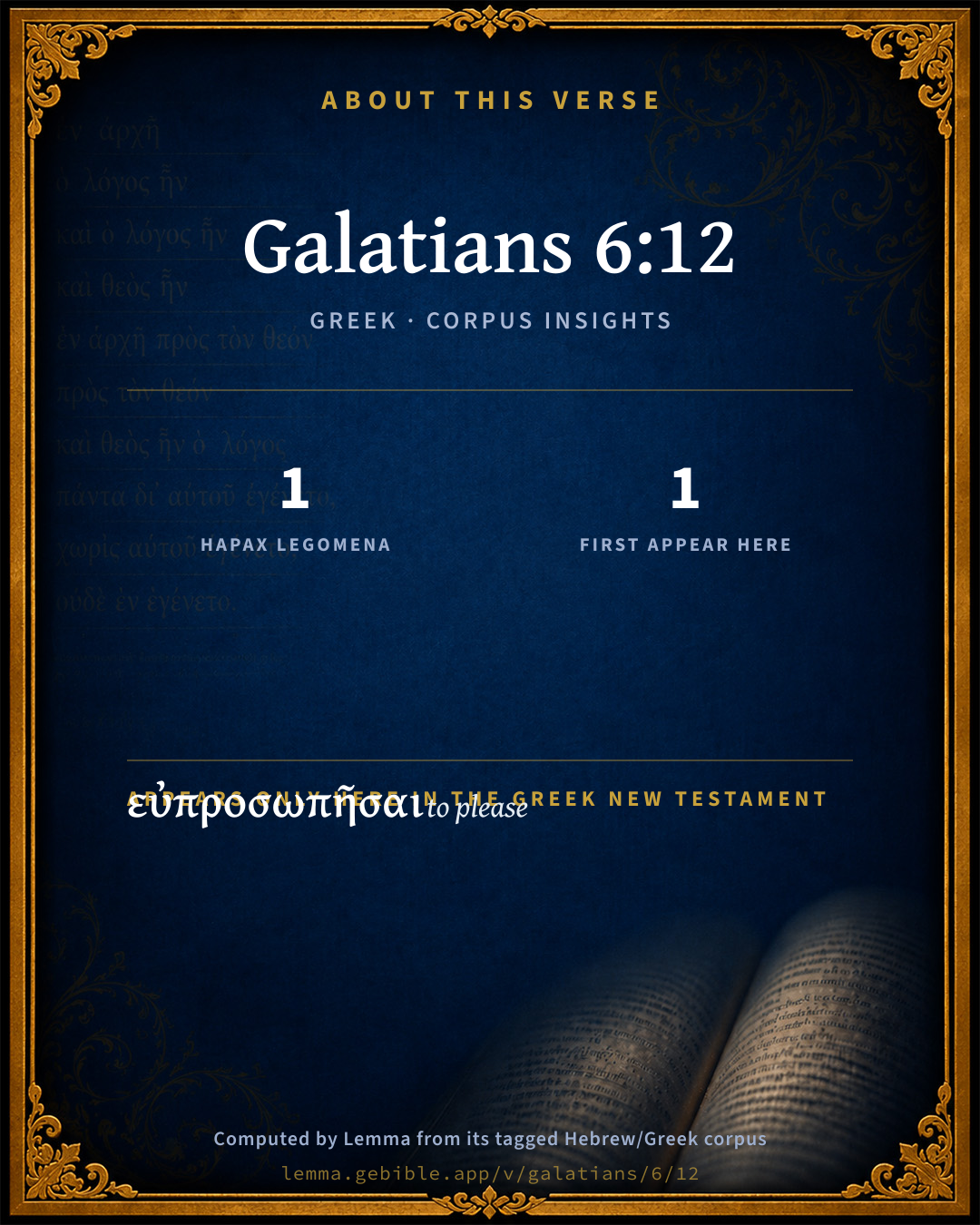
Galatians 6:12

Greek (Tischendorf 8th ed.) Galatians 6:12 appears in the Greek New Testament. The text above is from the Tischendorf 8th edition. Each word links to its Strong’s number and a concise gloss. Click any word for its full Thayer’s Greek Lexicon entry.
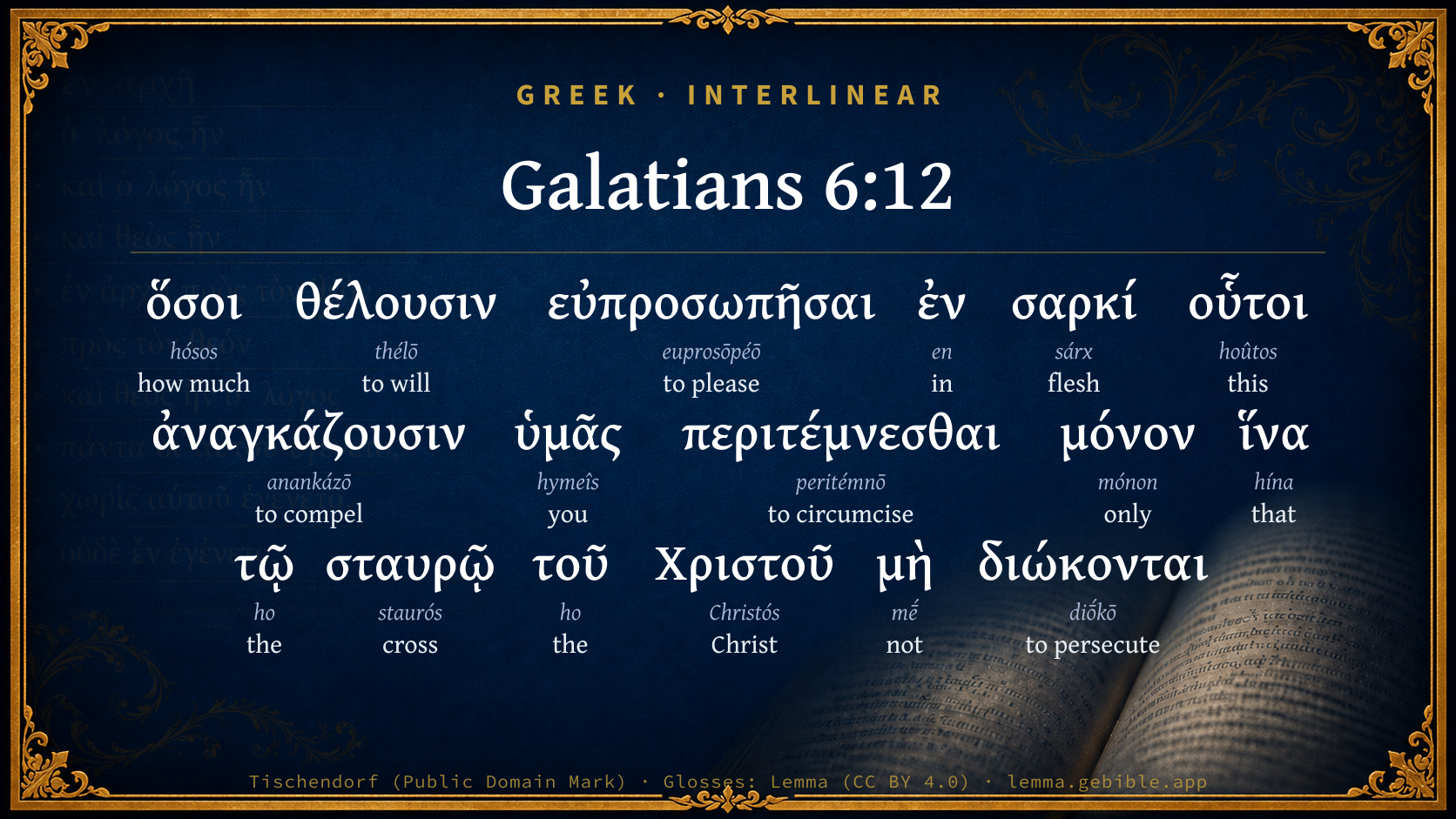
Download image
Cite this verse

Galatians 6:12 (World English Bible). Public Domain. Lemma interlinear Bible study tool, https://lemma.gebible.app/v/galatians/6/12.

Show BibTeX & RIS
BibTeX
RIS
English Translation
As many as desire to look good in the flesh, they compel you to be circumcised; only that they may not be persecuted for the cross of Christ.
World English Bible · Public Domain
Highlights
  • 1 hapax legomenon — only here in the Greek New Testament
  • 1 first appearance in the Greek New Testament
Full analysis ↓
Download a study sheet

One document with this verse’s original text, its word-by-word gloss line, the meaning frame, cross-references with their text, attributed commentary, and full source and license credits — printable, and it pastes into notes with its structure intact.

This verse Autodidact and up

Study sheet (.html) Plain text (.txt)

A passage Seminary Student

Up to 50 verses in one chapter. A passage sheet keeps up to 6 commentary sources and 12 cross-references per verse, in the order this page ranks them, and says so on the sheet whenever that leaves anything out. Ask for a single verse and you get the Autodidact verse sheet above.

Everything on this page stays free to read, with no account — the sheet is a download of what is already on screen, not access to it.

Want to remove ads? Support Godless Engineer
Compare translations 3

The same verse in 3 English versions, stacked beneath the original-language interlinear above. Click any original word for its lexicon entry.

Each is an independent rendering of the whole verse — the interlinear is not word-aligned to these translations.

Highlighted words mark where these versions differ — a whole-verse word diff, not a word-by-word alignment.

  • World English Bible Public Domain
    As many as desire to look good in the flesh, they compel you to be circumcised; only that they may not be persecuted for the cross of Christ.
  • King James Version Public Domain
    As many as desire to make a fair shew in the flesh, they constrain you to be circumcised; only lest they should suffer persecution for the cross of Christ.
  • unfoldingWord Literal Text CC BY-SA 4.0
    As many as desire to make a good impression in the flesh, they compel you to be circumcised, only so that they might not be persecuted for the cross of Christ Jesus.

unfoldingWord Literal Text — © unfoldingWord, licensed CC BY-SA 4.0. Word-aligned USFM3 via Door43 (git.door43.org/unfoldingWord/en_ult).

Versions to compare (up to 4)

3 of 4 selected

Show all 19 translations

Every available English version of this verse, each an independent rendering of the whole verse.

  • World English Bible Public Domain
    As many as desire to look good in the flesh, they compel you to be circumcised; only that they may not be persecuted for the cross of Christ.
  • Berean Standard Bible Public Domain
    Those who want to make a good impression outwardly are trying to compel you to be circumcised. They only do this to avoid persecution for the cross of Christ.
  • Majority Standard Bible Public Domain
    Those who want to make a good impression outwardly are trying to compel you to be circumcised. They only do this to avoid persecution for the cross of Christ.
  • King James Version Public Domain
    As many as desire to make a fair shew in the flesh, they constrain you to be circumcised; only lest they should suffer persecution for the cross of Christ.
  • American Standard Version (1901) Public Domain
    As many as desire to make a fair show in the flesh, they compel you to be circumcised; only that they may not be persecuted for the cross of Christ.
  • Revised Version (1885) Public Domain
    As many as desire to make a fair show in the flesh, they compel you to be circumcised; only that they may not be persecuted for the cross of Christ.
  • Geneva Bible (1599) Public Domain
    As many as desire to make a faire shewe in the flesh, they constraine you to be circumcised, onely because they would not suffer persecution for the crosse of Christ.
  • Douay-Rheims (1899) Public Domain
    For as many as desire to please in the flesh, they constrain you to be circumcised, only that they may not suffer the persecution of the cross of Christ.
  • Young's Literal Translation Public Domain
    as many as are willing to make a good appearance in the flesh, these constrain you to be circumcised -- only that for the cross of the Christ they may not be persecuted,
  • Literal Standard Version CC BY-SA 4.0
    as many as are willing to make a good appearance in the flesh, these constrain you to be circumcised—only that they may not be persecuted for the Cross of the Christ,
  • Unlocked Literal Bible CC BY-SA 4.0
    Those who want to make a good impression in the flesh are trying to compel you to be circumcised. They do this only to avoid being persecuted for the cross of Christ.
  • unfoldingWord Literal Text CC BY-SA 4.0
    As many as desire to make a good impression in the flesh, they compel you to be circumcised, only so that they might not be persecuted for the cross of Christ Jesus.
  • Darby Bible Public Domain
    As many as desire to have a fair appearance in [the] flesh, these compel you to be circumcised, only that they may not be persecuted because of the cross of Christ.
  • World Messianic Bible Public Domain
    As many as desire to make a good impression in the flesh compel you to be circumcised, just so they may not be persecuted for the cross of Messiah.
  • Webster's Bible Public Domain
    As many as desire to make a fair show in the flesh, they constrain you to be circumcised; only lest they should suffer persecution for the cross of Christ.
  • Free Bible Version CC BY-SA 4.0
    Those people who only want to make a good impression are forcing you to be circumcised just so they won't be persecuted for the cross of Christ.
  • Bible in Basic English Public Domain
    Those who have the desire to seem important in the flesh, put force on you to undergo circumcision; only that they may not be attacked because of the cross of Christ.
  • Text-Critical English NT CC BY 4.0
    It is those who want to make a good appearance in the flesh who compel you to be circumcised, but only so that they may not be persecuted for the cross of Christ.
  • Tyndale New Testament (1534) Public Domain
    As many as desyre with vtwarde apperauce to please carnally they constrayne you to be circumcised only be cause they wolde not suffre persecucion with the crosse of Christ.

Literal Standard Version (2020), Covenant Press — licensed CC BY-SA 4.0. Text via the HelloAO Bible API (eBible.org). Unlocked Literal Bible (unfoldingWord) — licensed CC BY-SA 4.0. Text via the HelloAO Bible API (eBible.org). unfoldingWord Literal Text — © unfoldingWord, licensed CC BY-SA 4.0. Word-aligned USFM3 via Door43 (git.door43.org/unfoldingWord/en_ult). Free Bible Version, Dr. Jonathan Gallagher — licensed CC BY-SA 4.0. Text via the HelloAO Bible API (eBible.org).

Word by word

More ways to search: Search by grammar → Find every occurrence → Compare this word →

Practice this passage: Drill this verse → Learn its vocabulary →

εὐπροσωπῆσαι
euprosōpéō
G2146
“to please”
Verb, Aorist, Active, Infinitive
Part of Speech
Verb
Tense
Aorist
Voice
Active
Mood
Infinitive
Full Thayer's Definition

Origin: from a compound of G2095 and G4383

TDNT: 19:00,0

1. to make a fair show 2. to please
  1. ὅσοι hósos G3745 “how much” Correlative pronoun, Nominative, Plural, Masculine
  2. θέλουσιν thélō G2309 “to will” Verb, Present, Active, Indicative, 3rd person, Plural
  3. ἐν en G1722 “in” Preposition
  4. σαρκί sárx G4561 “flesh” Noun, Dative, Singular, Feminine
  5. οὗτοι hoûtos G3778 “this” Demonstrative pronoun, Nominative, Plural, Masculine
  6. ἀναγκάζουσιν anankázō G315 “to compel” Verb, Present, Active, Indicative, 3rd person, Plural
  7. ὑμᾶς hymeîs G5210 “you” Personal pronoun, 2nd person, Accusative, Plural
  8. περιτέμνεσθαι peritémnō G4059 “to circumcise” Verb, Present, Passive, Infinitive
  9. μόνον mónon G3440 “only” Adverb
  10. ἵνα hína G2443 “that” Conjunction
  11. τῷ ho G3588 “the” Article, Dative, Singular, Masculine
  12. σταυρῷ staurós G4716 “cross” Noun, Dative, Singular, Masculine
  13. τοῦ ho G3588 “the” Article, Genitive, Singular, Masculine
  14. Χριστοῦ Christós G5547 “Christ” Noun, Genitive, Singular, Masculine
  15. μὴ mḗ G3361 “not” Particle, Negative
  16. διώκονται diṓkō G1377 “to persecute” Verb, Present, Passive, Indicative, 3rd person, Plural

About this verse

These counts appear in no published source. They are computed here, from the morphology-tagged text and Lemma’s own curated glosses. What Lemma adds →

17
words
16
distinct lemmas
Pauline Epistles
section

Notable vocabulary

1 hapax legomenon — a word that appears only here in the entire Greek New Testament:

  • εὐπροσωπῆσαι to please G2146

First appearance in Scripture

This word makes its first canonical appearance in the Greek New Testament here:

  • εὐπροσωπῆσαι to please G2146

Shared distinctive vocabulary

ἀναγκάζουσιν to compel G315 occurs in 9 verses of the Greek New Testament. Also found in:

Repetition

A word recurs within this verse:

Cross-references

20

Topical passages linked to Galatians 6:12 in the Treasury of Scripture Knowledge — connected by theme and wording, ordered by reader-vote popularity; previews shown in the World English Bible.

  • Galatians 5:11 But I, brothers, if I still preach circumcision, why am I still persecuted? Then the stumbling-block of the cross has been removed.
  • Acts 15:1 Some men came down from Judea and taught the brothers, "Unless you are circumcised after the custom of Moses, you can't be saved."
  • 2 Corinthians 11:13 For such men are false apostles, deceitful workers, masquerading as Christ's apostles.
  • Colossians 2:23 Which things indeed appear like wisdom in self-imposed worship, and humility, and severity to the body; but aren't of any value against the indulgence of the flesh.
  • Luke 16:15 He said to them, "You are those who justify yourselves in the sight of men, but God knows your hearts. For that which is exalted among men is an abomination in the sight of God.
  • Galatians 2:3 But not even Titus, who was with me, being a Greek, was compelled to be circumcised.
  • Matthew 6:2 Therefore when you do merciful deeds, don't sound a trumpet before yourself, as the hypocrites do in the synagogues and in the streets, that they may get glory from men. Most assuredly I tell you, they have received their reward.
  • Matthew 6:16 "Moreover when you fast, don't be like the hypocrites, with sad faces. For they disfigure their faces, that they may be seen by men to be fasting. Most assuredly I tell you, they have received their reward.
  • Matthew 23:5 But all their works they do to be seen by men. They make their phylacteries broad, enlarge the fringes of their garments,
  • Matthew 23:28 Even so you also outwardly appear righteous to men, but inwardly you are full of hypocrisy and iniquity.
  • Luke 20:47 who devour widows' houses, and for a pretense make long prayers: these will receive greater condemnation."
  • John 7:18 He who speaks from himself seeks his own glory, but he who seeks the glory of him who sent him, the same is true, and no unrighteousness is in him.
  • Acts 15:5 But some of the sect of the Pharisees who believed rose up, saying, "It is necessary to circumcise them, and to charge them to keep the law of Moses."
  • 2 Corinthians 10:12 For we are not bold to number or compare ourselves with some of those who commend themselves. But they themselves, measuring themselves by themselves, and comparing themselves with themselves, are without understanding.
  • Galatians 2:14 But when I saw that they didn't walk uprightly according to the truth of the Gospel, I said to Peter before them all, "If you, being a Jew, live as the Gentiles do, and not as the Jews do, why do you compel the Gentiles to live as the Jews do?
  • Galatians 6:13 For even they who receive circumcision don't keep the law themselves, but they desire to have you circumcised, that they may boast in your flesh.
  • Philippians 1:15 Some indeed preach Christ even out of envy and strife, and some also out of good will.
  • Philippians 2:4 each of you not just looking to his own things, but each of you also to the things of others.
  • Philippians 3:18 For many walk, of whom I told you often, and now tell you even weeping, as the enemies of the cross of Christ,
  • Matthew 6:5 "When you pray, you shall not be as the hypocrites, for they love to stand and pray in the synagogues and in the corners of the streets, that they may be seen by men. Most assuredly, I tell you, they have received their reward.

Cross-references courtesy of OpenBible.info (CC BY 4.0).

Where the printed editions differ

1 variant

Places in this verse where the major printed Greek editions disagree on the wording in a way that affects the translation — a comparison of editions, not a manuscript-by-manuscript collation. The editions are the modern critical texts (Nestlé-Aland 28/27, SBL, Westcott-Hort, Tregelles, Tyndale House) and the traditional texts behind the KJV (the Textus Receptus and the Byzantine/Majority text). It is not a claim about which reading is original.

  1. Extra text
    Ἰησοῦ

    “Jesus”

    In WH Not in NA28NA27TynSBLTregTRByz

    Ἰησοῦ (Iēsou) 'Jesus' is only in a few manuscripts (WH)

Textual data: Translators Amalgamated Greek New Testament (STEPBible TAGNT) · CC BY 4.0.

Commentary

Notes on Galatians 6:12 from classic Christian and Jewish commentators (each source and its license shown beneath its notes). The classic Christian expositions comment on the surrounding passage and are grouped to its opening verse, so a note may address several verses; the Jewish commentaries on the Tanakh (Rashi and others) are per-verse, so they appear only where the commentator wrote on this verse.

Lemma curates 59 commentaries, every one of them public domain or Creative Commons licensed, each selected and text-cleaned for this edition rather than reprinted as found. About our sources →

The Biblical Illustrator

Joseph S. Exell

Gal_6:12

As many as desire to make a fair show in the flesh, they constrain you to be circumcised; only lest they should suffer persecution for the cross of Christ.

The history and odium of Christs Cross

The Cross of Christ demands notice, calls for Christian feeling, sets before us a glorious object of contemplation.

I. the Cross of Christ in the history connected with it. A very affecting and astonishing history; the very angels bestow on it their attention and admiration.

1. A history of suffering;

(1) on the part of the Master;

(2) on the part of every true disciple.

2. A history of sin.

II. The odium connected with the Cross. If any man will live godly in Christ Jesus, leading a holy life, manifesting and setting forth Christian principle instead of depending on morality, avowing his conviction that there is no salvation but in the Cross of Christ--then shalt reproach, if not persecution fall upon him--hatred, ill-will, sarcasm, wit, ridicule, obloquy. (T. Mortimer, B. D.)

The impossibility of a divided service

The difficulties of the Church and the Christian life are much the same in all ages. Clothed in different forms, they embody the same spirit. The text speaks of those who seek to please God and the world at the same time; to secure for themselves the safety which Christ offers, without losing the ease and social comfort which they imagine to to be found in the world.

1. This is a temptation from which none are wholly free. When in the society of careless persons, how hard to maintain a high standard of life and conversation! How difficult to see where the line between what is and what is not consistent with a Christians position is to be drawn! How easy to let slip the opportunity of speaking for the right. How impossible to recover it when let slip! How easy to assent to the low tone around us; how hard to have to appear disagreeable if we feel compelled to protest against it!

2. To yield to this temptation is the symptom of a half-conversion. If any man is in Christ Jesus, he is a new creature. Where is the new creature in us, if we so easily forget Him, and fail to confess Him?

3. Consider how cowardly and cruel it is to allow Him to be insulted without a word spoken in His defence. Could we sit still and hear a friend abused, his dearest wishes ridiculed? Is not the least sin a direct insult to Jesus? Has He not entrusted His honour to our keeping? Are we not members of a thorn-crowned head? Shall we, then, leave Him to suffer alone?

4. Consider the harm which such an apparent acquiescence in evil may do to others.

5. The attempt to serve God and mammon will fail. Sooner or later the choice between the two must be made. The longer we delay choosing for God the more difficult we shall find it to do so even when we would.

6. How to meet the temptation. In the power of Christ all temptation maybe vanquished. In Him you are a new creature. (Canon Vernon Hutton.)

Shams

What multitudes of mahogany-handled drawers there are to be met with in daily life, labelled in black on a gold ground, with swelling and mysterious names of precious healing drugs; but alas! they are handles which do not pull out, or drawers that are full of nothing. What myriads of empty bottles make up yonder enormous stock in the universal emporium so largely advertised! What a noble army of canisters filled with air stand marshalled in shining ranks, as if they were fresh from China, and brimming with the fragrant leaf! Now in mere business such things may answer well enough; but bring them into your moral dealings, and you shall soon become contemptible. One smiles at the busy tradesman arranging the shams in his window, but we are indignant with men who exhibit unreal virtues and excellences; he thinks that he makes a fair show in the flesh, but when we have found him out once, even what may be genuine in him is subjected to suspicion, and the mans honour is hopelessly gone. (C. H. Spurgeon.)

Persecution a benefit to the Church

The cold water of persecution is often thrown on the Churchs face to fetch her to herself when she is in a swoon of indolence or pride. (C. H. Spurgeon.)

Persecution not to be feared

Do not fear the frown of the world. When a blind man comes against you in the street you are not angry at him; you say, He is blind, poor man, or he would not have hurt me. So you may say of the poor worldlings when they speak evil of Christians--they are blind. (McCheyne.)

The exposure of the tactics of the Judaizers

I. Their dogmatic attitude.

II. Their urgent zeal.

III. The true motive of their conduct.

1. Their conduct was cowardly.

2. Hypocritical.

3. Self-interested.

IV. It was just and necessary that the apostle should expose a policy so mean, so mercenary, so insincere. (Prof. Crosskery.)

The Biblical Illustrator, edited by Joseph S. Exell (c. 1880s–1900s) — public domain. Text from a community e-Sword module.

Joseph Benson's Commentary

Gal 6:12-13. The sum of all is this: As many as desire to make a fair show — Or appearance; that is, to preserve a fair character; in the flesh — In external things, or with respect to their observing the Jewish rites and ceremonies; these would constrain you — Gentile converts, both by their example and importunity; to be circumcised — And subject, with them, to the carnal ordinances of the law. The apostle’s meaning is, that the false teachers wished to appear well in the eyes of the Jews, on account of their attachment to the law of Moses, which in other passages he terms the flesh, in opposition to the spiritual dispensation of the gospel. Only lest, &c. — As if he had said, They do not act thus with a single eye to the glory of God, or from a principle of conscience, but only lest they should suffer persecution — From the unbelieving Jews; for the cross of Christ — For maintaining that faith in a crucified Saviour is alone sufficient for justification. It is well known that the Jewish chief priests and elders were great persecutors of the disciples of Christ, and began their persecution very early. See Joh 9:22; Joh 12:22; Joh 19:38. Now it seems the mandates of their council were received with implicit submission, even by the synagogues in the Gentile countries, Act 9:2. The false teachers, therefore, of whom the apostle speaks, to recommend themselves to these rulers at Jerusalem, who stirred up the unbelieving Jews every where against the Christians, fell upon the scheme of blending Judaism with the gospel; and, as the apostle informs us, urged the Gentiles to receive circumcision, merely that they themselves might not be persecuted for the gospel doctrine of salvation through a crucified Messiah. For neither they themselves — Who are circumcised, and so are solemnly obliged to observe the whole of it; keep the law — Namely, in other points of greater importance; so far are they from a real zeal for it, or from acting uprightly and conscientiously in this matter; but desire to have you circumcised, that they may glory in your flesh — May boast of you as their proselytes, and make a merit of this with the other Jews.

Joseph Benson's Commentary on the Old and New Testaments (1811–1818) — public domain. Text from a community e-Sword module.

Tyndale Open Study Notes

Tyndale Open Resources

6:12-13 For all of their theological reasoning, the false teachers’ motivation was self-serving: They felt pressure from non-Christian Jews and were more concerned with their own reputation than with honoring God.

Tyndale Open Study Notes — © Tyndale Open Resources, licensed CC BY-SA 4.0. Text via the HelloAO Bible API.

Bengel's Gnomon

Johann Albrecht Bengel

Gal 6:12. Ὅσοι) as many as.—εὐπροσωπῆσαι) to make a fair show before you: comp. 2Co 5:12.—ἀναγκάζουσιν, constrain) by their example, Gal 6:13, and importunity. The same word occurs, ch. Gal 2:3; Gal 2:14.—μόνον, only) Such persons therefore wished to be considered in other respects as Christians.—διώκωνται, they should suffer persecution) from the Jews, or even from the Gentiles, who now bore more easily with the antiquity [antiquated usages] of the Jews, than with the supernatural novelty [new doctrine and rule] of the Christian faith.

Bengel's Gnomon of the New Testament — English translation (T&T Clark, Edinburgh, 1860) — public domain. Text from a community e-Sword module.

Meyer's Critical & Exegetical Commentary

Heinrich August Wilhelm Meyer

Gal_6:12.[265] All those whose wish and will are directed to making a fair show in the flesh, that is, to the having a specious appearance, while they are involved in fleshly habits,this class of men force circumcision upon you, and they do so solely for the reason that they may not bring on themselves persecution on account of the cross of Christ. This persecution they would incur on the part of the Jews, if they preached the cross of Christ and at the same time rejected circumcision; whereas, by insisting on circumcision, they disarmed the zeal of the Jews for the law (comp. on Gal_5:11), and removed from the cross of Christ all occasion of their experiencing persecution for it (note the critically correct position of the μή). In order to understand the passage rightly, we must note that the emphasis is on ΕὐΠΡΟΣΩΠΉΣΑΙ (not on ἘΝ ΣΑΡΚΊ): they desire to combine a pleasing exterior with an unspiritual, carnal state of life, in which they really are. Thus is characterized the hypocritical conduct of these people, whose jesuitry makes them resemble the τάφοις κεκονιαμένοις (Mat_23:27; comp. Act_23:3). Comp. 2Co_5:12. So many as belong to this dissembling class, they constrain you to be circumcised!

εὐπρόσωπος] speciosus facie, sometimes applied to actual beauty of person (as Xen. Mem. i. 3. 10), and sometimes to a mere specious appearance (as Herod. vii. 168; commonly used among Greek authors (comp. Gen_12:11); but εὐπροσωπεῖν is not preserved elsewhere in the literary language. In Dion. Hal. Gal_3:11 we find ΕὐΠΡΟΣΩΠΊΑ; in Symmachus, Psa_141:6, ΕὐΠΡΟΣΩΠΊΣΘΗΣΑΝ. Comp. ΦΑΙΝΟΠΡΟΣΩΠΕῖΝ, Cic. Att. vii. 21, xiv. 21; σεμνοπροσωπεῖν, Arist. Nub. 363.

ἐν σαρκί] is the element of the sinful nature of man (Gal_6:8; Gal_3:3; Gal_5:17), in which, instead of being renewed and refined by the Holy Spirit, those hypocrites are found living, and at the same time endeavour to give to themselves a good colouring which would prepossess the opinion of others in their favour. The juxtaposition of the words, to look fair in the flesh reveals the moral contradiction in their nature, and delineates their whole portraiture, as if with one sharp touch, indignantly, vigorously, and appropriately. The words are usually explained: those who desire to be well-pleasing by means of outward carnal things, such as circumcision and the observance of the ceremonial law generally, Rückert; comp. Beza, Gomarus, Koppe, Rosenmüller, Winer, Usteri, Matthies, Schott, Olshausen, and others. Of course ἐν σαρκί might, ex adjuncto, obtain the sense, by means of circumcision and observance of the law (comp. Rom_2:28); but in this passage the context suggests no ground for thinking of anything else than that which was just shortly before meant by σάρξ, in the contrast drawn between ΣΆΡΞ and ΠΝΕῦΜΑ. Comp. Wieseler. And how feeble and inexpressive, when placed at the commencement of so energetic a passage, would be the description of the misleaders which this interpretation would yield! Holsten interprets in a similar way, but developes the sense more accurately, and takes ἘΝ ΣΑΡΚΊ as the sphere in which the ΕὐΠΡ. manifests itself, all who desire a fair show in the fleshly domain; this applies in the concrete to circumcision, which could have true significance only as a sign of inward righteousness (Rom_3:25 f.), but to which these persons adhered for its fair show of righteousness. But it is not until Gal_6:13 that σάρξ obtains its reference in harmony with the text to circumcision; in respect to which, moreover, the idea, that circumcision is the seal of righteousness, is not at all intimated in the connection of our passage. Lastly, Chrysostom and his successors, Erasmus, Calvin, Estius, Grotius, and others, have assigned to ἑν σαρκί the unmeaning sense ΠΑΡʼ ἈΝΘΡΏΠΟΙς; and Hofmann has arrived at the trifling interpretation, that the idea meant was a pleasing cheerfulness of outward appearance, springing from and testifying to a natural amiability, to which the opponents of the apostle aspired: they would fain appear with the expression of natural amiability. Thus the description of the opponents placed at the head of this final outburst, so full of holy severity and indignation, would simply amount to the assertion of an amiable bonhommie by which they were impelled. Holsten justly designates this view as inconceivable.

ἀναγκάζουσιν] they are occupied with, busy themselves in, forcing circumcision upon you. See Bernhardy, p. 370. As to the idea of ἈΝΑΓΚΆΖ. see on Mat_14:22. Comp. Gal_2:3; Gal_2:14.

ΜΌΝΟΝ ἽΝΑ] merely from the (self-interested) motive, that they, etc.

τῷ σταυρῷ τοῦ Χριστοῦ] that is, on account of the cross of Christ, because they preach Christ as crucified. The instrumental dative denotes the cause of the persecution. See Rom_11:20; 2Co_2:12; Bernhardy, p. 101 f.; Winer, p. 202 f. [E. T. 270]. So most expositors, including Rückert, Matthies, Usteri, Schott, Olshausen, Baumgarten-Crusius, Hilgenfeld, Wieseler, Hofmann. But others explain the words according to the idea of the παθήματα Χριστοῦ (see on 2Co_1:5; Col_1:24): ne participes fiant suppliciorum Christi, Winer; comp. Jerome, Luther, Grotius, Semler, Michaelis, Koppe, Morus, de Wette, Ewald. The evident reference to Gal_5:11[266] is decidedly opposed to this interpretation, even apart from the singular nature of the idea τῷ σταυρῷ διώκεσθαι (Paul would have written ταῖς θλίψεσι or the like).

[265] As to vv. 1216, see the excursus of Holsten, z. Evang. d. Paul u. Petr. 343 ff.

[266] Holsten holds the peculiar view, that what is in Gal_5:11 expressed objectively, receives here a subjective turn: in order that they (those who are offended) should no more be persecuted through (the offence at) the cross. The σταυρὸς τ. Χ. had, in his view, been to the Jewish Christians an obscure point, and in presence of the Pauline churches a painful wound, by the recollection of which they were, in a metaphorical sense, persecuted. But what plain reader would have been able to unriddle a sense so enigmatically wrapped upa sense which Paul might easily have expressed in clear words?

Meyer — Critical and Exegetical Commentary on the New Testament — English translation by Peter Christie, edited by Frederick Crombie (T&T Clark, 1880) — public domain. Text from a community e-Sword module.

Expositor's Greek Testament

ed. W. Robertson Nicoll

Gal 6:12-13 . Paul impugns the sincerity of the agitators: their affected zeal for the Law was a pretext with a view to disarming Jewish enmity: they urged the circumcision of Gentiles also to gratify their own vanity. They had probably, like the Jewish Christians at Antioch ( cf. Gal 2:13 ), been guilty of inconsistency in their practice: but Paul apparently relies also on his argument in Gal 2:16 that Jewish converts had by the mere act of embracing Christ confessed their own inability to keep the Law, and could not therefore be sincere in preaching to others obedience to its rules. τῷ σταυρῷ . This dative cannot surely mean for ( i.e., by reason of ) the cross . If this had been the meaning, it would have been expressed by διὰ τὸν σταυρόν . The correct translation seems to be, persecuted with the cross, i.e. , the cross of outward suffering which was in those days the lot of so many converted Jews, and notably of Paul himself. The Cross of Christ is here identified with persecution as it is in Phi 3:18 with self-denial.

The Expositor's Greek Testament, edited by W. Robertson Nicoll (1897–1910) — public domain. Text from a community e-Sword module.

Geneva Bible (1599)

Geneva Bible translators

In keeping of ceremonies.

He setteth a far show against the truth.

For the preaching of him that was crucified.

Geneva Bible (1599) marginal notes — public domain. Text via Bolls.life.

Jamieson, Fausset & Brown

Robert Jamieson, A. R. Fausset & David Brown

Contrast between his zeal in their behalf, implied in Gal 6:11, and the zeal for self on the part of the Judaizers.

make a fair show-- (Co2 5:12).

in the flesh--in outward things.

they--it is "these" who

constrain you--by example (Gal 6:13) and importuning.

only lest--"only that they may not," &c. (compare Gal 5:11).

suffer persecution--They escaped in a great degree the Jews' bitterness against Christianity and the offense of the cross of Christ, by making the Mosaic law a necessary preliminary; in fact, making Christian converts into Jewish proselytes.

Jamieson, Fausset & Brown — Commentary Critical and Explanatory on the Whole Bible (1871) — public domain (CC PDM 1.0). Text via the HelloAO Bible API.

Adam Clarke's Commentary

Verse 12. A fair show in the flesh.] The Jewish religion was general in the region of Galatia, and it was respectable, as it appears that the principal inhabitants were either Jews or proselytes. As it was then professed and practised among the Jews, this religion had nothing very grievous to the old man; an unrenewed nature might go through all its observances with little pain or cross-bearing. On the other hand, Christianity could not be very popular; it was too strict. A Jew made a fair show there, according to his carnal system, and it was a temptation to a weak Christian to swerve into Judaism, that he might be exempted from persecution, and be creditable among his countrymen. This is what the apostle intimates: "They constrain you to be circumcised, lest they should suffer persecution for the cross of Christ."

Adam Clarke's Commentary on the Bible (1810–1826) — public domain. Text from a community e-Sword/MySword module.

John Calvin's Commentaries

12. As many as desire to make a fair shew in the flesh. Such men pay no regard to edification, but are guided by an ambitious desire to hunt after popular applause. The Greek verb εὐπροσωπὢσαι, is highly expressive, and denotes the kind looks and address which were assumed for the purpose of pleasing. He charges the false apostles with ambition. As if he had said, “When those men lay circumcision upon you as a necessary burden, do you wish to know what sort of persons they are, what are the objects of their regard or pursuit? You are mistaken if you imagine that they are at all influenced by godly zeal. To gain or preserve the favor of men is the object they have in view in offering this bribe.” It was because they were Jews that they adopted this method of retaining the good-will, or at least allaying the resentment, of their own nation. It is the usual practice of ambitious men meanly to fawn on those from whose favor they hope to derive advantage, and to insinuate themselves into their good graces, that, when better men have been displaced, they may enjoy the undivided power. This wicked design he lays open to the Galatians, in order to put them on their guard.

Only lest they should suffer persecution. The pure preaching of the gospel is again designated the cross of Christ. But there is likewise an allusion to their favourite scheme of resolving to preach Christ without the cross. The deadly rage by which the Jews were animated against Paul, arose from their being unable to endure a neglect of ceremonies. To avoid persecution, those men flattered the Jews. Yet after all, if they had themselves kept the law, their conduct might have been suffered. On the contrary, they disturbed the whole church for the sake of their personal ease, and scrupled not to lay a tyrannical yoke on the consciences of men, that they might be entirely freed from bodily uneasiness. A dread of the cross led them to corrupt the true preaching of the cross.

John Calvin's Commentaries (1540-1563) — public domain. Text from the Calvin Translation Society English edition (1840s-50s) via the Christian Classics Ethereal Library (ccel.org). Calvin's coverage is partial (roughly two-thirds of the Bible); uncommented books and verses are honest gaps, never fabricated. The 19th-century editor's footnotes and remarks are omitted so the notes are faithfully Calvin's own voice.

Ellicott's Commentary for English Readers

(12) To make a fair shew in the flesh.—To obtain a reputation for religiousness in externals, like the hypocrites, who “love to pray standing in the synagogues and in the corners of the streets, that they may be seen of men” (Mat_6:5). The object of the Judaisers was by this means to keep in with their countrymen, the Jews, and even to gain favour amongst them by seeming to win over proselytes to the Mosaic law.

Only lest they should suffer persecution for the cross of Christ.—What aroused the antagonism of the Jews against the Christians was evidently not so much the confession of the Messiahship of Jesus as the declared abolition of the Law of Moses. By suppressing this side of Christian teaching, the Judaisers could easily obtain toleration for their other tenets. If, on the other hand, they were to emphasise it, the full weight of persecution would fall upon them—its ostensible ground being the doctrine of a crucified Messiah. Accordingly, they persuaded as many of the Galatians as they could to accept circumcision, and made the most of this propagandist zeal to their Jewish neighbours.

A Bible Commentary for English Readers, edited by Charles John Ellicott (1878–1897) — public domain. Text from a community e-Sword module.

The Cambridge Bible for Schools and Colleges

gen. ed. J. J. S. Perowne

12. Reverting to the error which had perhaps suggested, and which certainly occupies so prominent a place in the Epistle, St Paul unmasks those who were its authors and propagators; contrasting their conduct and motives with his own.

All who desire to make a fair shew in externals, these it is who constrain you to submit to the external rite of circumcision—and this, not because they are zealous for the law, but only that they may escape persecution for the Cross of Christ.

to make a fair shew] ‘to present a fair outside to the world’, like the scribes and Pharisees, who were compared by our Lord to ‘whited sepulchres, which outwardly are fair to look upon, but within are full of dead men’s bones and all uncleanness,’ Mat_23:27.

in the flesh] in that which is simply external, with close reference to the rite of circumcision, and in sharp contrast to that principle of faith of which a Crucified Saviour is the object and ‘a new creature’ the result. A careful consideration of Php_3:3-5, will help to the understanding of St Paul’s use of this phrase. “We are the circumcision, who worship God in Spirit, and glory in Christ Jesus, and have no confidence in the flesh: though I myself might even have confidence in the flesh … circumcised the eighth day, &c.” Comp. Rom_2:28-29 where ‘circumcision in the flesh’, the material rite, is contrasted with ‘circumcision of the heart, in spirit &c.’

constrain you] Make it morally obligatory on you. Comp. ch. Gal_2:14.

only lest] Not because they care for the Law, but solely because they lack courage to face the persecution which attends the doctrine of the Cross.

for the cross of Christ] Lit. ‘by’ i.e. because of the Cross of Christ. If the false teachers constrain you to be, ‘make it necessary’ that you be circumcised, it implies that Christ’s death on the Cross is not sufficient for your salvation. To believe in, and to proclaim that sufficiency, has in all ages constituted ‘the offence of the Cross,’ and has brought obloguy and ill-usage on those who so believe and confess it. This is to suffer persecution for the Cross of Christ.

The Cambridge Bible for Schools and Colleges (gen. ed. J. J. S. Perowne; Cambridge University Press, 1878–1918) — public domain. Text from a community e-Sword module.

John Gill's Exposition

But neither they themselves that are circumcised,.... That is, the pleaders for, and preachers of circumcision, whether they themselves were actually circumcised, or not; it means those that were of the circumcision, on that side of the question, whether heartily or not:

keep the law; of circumcision, as persons may preach up that, which they themselves do not practise; as did the Pharisees, the predecessors of these men; or if they did keep the law, and submit to it, yet this might be done, not out of regard unto it, and zeal for it, but for some other end; as Simon Magus submitted to baptism, and others preached Christ of envy and contention, and not of good will; or if they did do it in obedience to the law, yet this was not keeping the whole law, which circumcision obliged to; and which, unless they did so keep it, would signify nothing; and this no man is capable of keeping perfectly, and consequently no righteousness, life, and salvation, can be had hereby: besides, though these men were so zealous for the lighter matters of the law, the rites and ceremonies of it, as circumcision, &c. they disregarded the weightier and more material parts of it, as judgment, mercy, and faith; these they kept not, nor attended to: and many of them lived very dissolute lives and conversations, at least secretly, if not openly; which abundantly proved that they were far from keeping the law; and that their pleading for it, and submitting to some of the rituals of it, were not out of pure love and strict regard to it, but for some other end:

but desire to have you circumcised, that they may glory in your flesh; that is, in the circumcision of it; or, as the Ethiopic version, "in your bodies". Their view in bringing persons to submit to circumcision was, that they might have occasion to glory among the Jews, and boast to them of the numbers of proselytes they brought, and of the service they did to Judaism, and so increase their fame and glory among them.

John Gill's Exposition of the Whole Bible (1746–1763) — public domain (CC PDM 1.0). Text via the HelloAO Bible API.

Trapp's Complete Commentary

John Trapp

12 As many as desire to make a fair shew in the flesh, they constrain you to be circumcised; only lest they should suffer persecution for the cross of Christ.

Ver. 12. To make a fair show] Gr. ευπροσωπησαι, to set a good face on it, before the Jews especially, and to ingratiate with them.

For the cross of Christ] That is, for the doctrine of the cross, or of justification by the death of Christ crucified.

John Trapp, A Commentary or Exposition upon All the Books of the Old and New Testament (1647–1656) — public domain. Text from a community e-Sword module.

Albert Barnes' Notes on the Bible

As many as desire to make a fair show in the flesh - To be distinguished for their conformity to external rites and customs. To be known for their zeal in this cause. They sought to show their zeal by making converts, and by inducing others also to conform to those customs. Paul here refers, doubtless, to the Jewish teachers, and he says that their main object was to evince their zeal in the observance of rites and ceremonies.

They constrain you - You who are Gentiles. They insist on circumcision as indispensable to salvation.

Only lest they should suffer persecution - It is not from any true love for the cause of religion. It is, that they may avoid persecution from the Jews. If they should renounce the doctrine which taught that circumcision was indispensable, they would be exposed to the rage of the Jews, and would suffer persecution. Rather than do this, they make a show of great, zeal in inducing others to be circumcised.

For the cross of Christ - From attachment to the cause of a crucified Saviour. If they insisted on entire dependence on the merits of his blood, and renounced all dependence on rites and ceremonies, they would suffer persecution. This verse shows the true cause of the zeal which the Judaizing teachers evinced. It was the fear of persecution. It was the want of independence and boldness in maintaining the doctrine that people were to be saved only by the merits of the Lord Jesus. By attempting to blend together the doctrines of Judaism and Christianity; by maintaining that the observance of the Jewish rites was necessary, and yet that Jesus was the Messiah, they endeavored to keep in with both parties; and thus to escape the opposition of the Jews. It was an unhallowed compromise It was an attempt to blend things together which could not be united. One must really displace the other. If people depended on the rites of Moses, they had no need of dependence on the Messiah; if they professed to depend on him, then to rely on anything else was in fact to disown and reject him. Embracing the one system was in fact renouncing the other. Such is the argument of Paul; and such his solemn remonstrance against embracing any doctrine which would obscure the glory of simple dependence on the cross of Christ.

Albert Barnes' Notes on the Bible (1834–1885) — public domain. Text from a community e-Sword/MySword module.

Haydock's Catholic Bible Commentary

He tells them the false teachers would have them circumcised first, to avoid persecution from the Jewish party; and secondly to glory in having made them their proselytes. (Witham)

George Leo Haydock (1774–1849), Haydock's Catholic Family Bible and Commentary, 1859 edition — public domain. Excludes Psalms (Douay-Rheims chapter numbering differs from Protestant) and Deuterocanonical books (Catholic canon only).

Matthew Poole's English Annotations

The apostle here reflecteth upon those false teachers who had perverted this church, and discovereth their hypocrisy under all their pretences of good will to them. These are those who (he saith) desired

to make a fair show in the flesh; that is, to make a fair show to the world, as men very devout, which formalists and persons over zealous for rituals ordinarily do. These would

constrain, were very urgent to persuade, these believers

to be circumcised; not out of any love they had to the law of God, or to the souls of these Galatians, but

only to avoid persecution; for as the Jews were more favourable to such Christians, who, together with the doctrine of Christ, observed also their rites and legal ceremonies; so we are told by so of the ancients, that some of the Roman emperors, by their edicts, gave liberty to the Jews, in the provinces subject to them, to use their own religious rites: now all who were circumcised went under that notion, so had more liberty than those who were not circumcised, who were persecuted both by the Jewish and the heathen magistrates. The apostle saith, that these false teachers, who so zealously urged circumcision upon this Gentile church, did it for the avoiding the danger of persecution; which they saw would follow their standing fast in their gospel liberty, and not bringing themselves under the law: which persecution, he tacitly hinteth, ought not to be so industriously shunned and avoided, because it was for Christ’s sake, who had endured the cross for them.

Matthew Poole's English Annotations on the Holy Bible (1683–1685) — public domain. Text from a community e-Sword/MySword module.

Whedon's Commentary on the Bible

Daniel D. Whedon

12. Fair show—Literally, a good face.

In the flesh—As opposed to the spirit, in external and unspiritual matters.

Constrain—By persuasion, and perhaps menace.

Suffer… for the cross—The power of the Sanhedrin was great and extensive, (note Act_9:2,) and a large and powerful body of Jews lived in Galatia. Hence the Judaists sought to avoid persecution from Judaism by uniting circumcision with Christianity.

The cross—As the symbol of justification without the ritual.

12. For—Proof of the motive assigned above; the Judaists disregard that very law which circumcision is a pledge to keep.

Glory in your flesh— May make a merit with the Jewish powers of having converted you to circumcision. The Galatian Judaists were, therefore, courting the lenity of Judaism to escape persecution. To this cowardice St. Paul opposes his own fearless, uncompromising display of the cross.

Daniel D. Whedon (gen. ed.), Commentary on the Old and New Testaments (1874–1909) — public domain. Text from a community e-Sword module.

The Pulpit Commentary

As many as desire to make a fair show in the flesh (osoi qelousin eujproswphsai ejn sarki); all those who wish to make a fair show in the flesh. In this verse and the next the apostle singles out for especial animadversion certain Christians, Galatian Christians no doubt, who were actuated by the aim of standing fair with the religious world of Judaism. They were Gentile Christians and not Jews; this appears from their not themselves wishing to keep the Law; for if they had been Jews, the external observance of the Law, being natural to them from their infancy, would have been with them a matter of course: St. Paul himself would probably not have urged them to relinquish it. The verb eujproswpein is not found by the critics in any earlier Greek writer, though the adjective eujproswpov, fair-faced, is used of "specious" answers in Herodotus (vii. 168), and "specious words" conjoined with "fables" in Demosthenes ("De Corinthians," p. 277). Aristophanes uses the word semnoproswpein ("Nub.," 362) to carry a solemn and worshipful face." The notion of falsity, plainly hinted by eujproswphsai, reminds us, Bishop Lightfoot observes, of our Lord"s words respecting whited sepulchres, which "outwardly appear beautiful, but inwardly," etc. (Mat_23:27) Compare the use of proswpon, face, in 2Co_5:12, glory in appearance, and not in heart." As the aorist of verbs denoting a certain state frequently expresses an entrance upon such a state (see zh) above, (Gal_2:19 and note) it probably is intimated that the persons referred to were conscious that their outward appearance" was hitherto not acceptable to Jewish minds, but that they now were desirous of making it so. Time had been when they did not care so much about it. "In the flesh." This word "flesh" not unfrequently designates men"s condition as unmodified by the Spirit of God; as when the apostle speaks of being in the flesh": (Rom_7:5 Rom_8:8, Rom_8:9) thence also circumstances or relations pertaining to this unspiritual condition, as in Php_3:3, 4; where the apostle speaks of "having confidence in the flesh," and goes on, in vers. 5, 6, to enumerate some of those circumstances or relations. Thus, again, in Eph_2:11, "ye, the Gentiles in the flesh," that is, who in that state of things in which men lived before the spiritual economy intervened, were the "uncircumcision (ajkrobusri) while the Jews were the circumcision. " But as the distinction between these two classes was signalized by an external corporeal mark, the apostle in that passage immediately after uses the expression, "in the flesh," in a varied sense, with reference to this latter, "that which is called circumcision, in the flesh, made by hands." With similar variation of meaning the word flesh" is used here. The Christians spoken of, losing sight of the cross of Christ and the Spirit"s work, were becoming possessed by feelings belonging to the old carnal" relations between Jews and Gentiles, and so were making it their ambition to figure with advantage in the eyes of the circumcision, as well as to escape their enmity. And then, as in the passage just referred to, (Eph_2:11) the apostle passes from this sense of the phrase, "in the flesh," to another relating to corporeal flesh; for this he does in the next verse, in the words, "that they may glory in your flesh." They constrain you to be circumcised (outoi ajnagkazousin uJmav peritemnesqai); these compel you to be circumcised. "Compel;" the same verb as was used above (Gal_2:14) of St. Peter"s attitude towards the Gentile believers at Antioch. As here applied, it means advise," urge," argue for it as right and necessary for salvation, insist upon it as a condition of friendship. "These;" not, perhaps, meaning these only," none but these;" it appears enough to suppose that the apostle, from definite information which he had received, was persuaded that some of those who took the lead in urging onward the Judaizing movement were led to join in it by the cowardly motives here described. With indignant scorn, he says," As surely as a man wants to stand well with the world, so surely will he be found with these circumcisers. Only lest they should suffer persecution for the cross of Christ (monon ina tw staurw tou Cristou mhkwntai Textus Receptus, monon ina mhkwntai); only that they may not by means of the cross of Christ suffer persecution. "Only that;" that is, for no other reason than that. The mh is thrust out of its proper position in the sentence (which is that assigned to it in the Textus Receptus) by the fervent of the writer"s feelings. To himself the cross of Christ seemed the centre of all glory and blessedness; to be connected with it he would be well pleased to suffer martyrdom; but these men could be well content to shelve it out of sight, and, in fact, were doing so; and what for? because the Jews did not like it, and they did not wish to get into trouble by offending them! A grand disdain prompts the apostle, at the cost of impairing the smooth run of the sentence, to (as it were) balance against each other the "cross of Christ" and "not being persecuted." The construction of the dative to express "by means of," that by which a certain result is brought about, is not very common; but we have it in Rom_11:20, th ajpisti ejxeklasqhsan" and ibid., 30, hjlehqhte th toutwn ajpistia: 2Co_2:12, tw mh euJrein. Our attention is in this passage again drawn to the manner in which the Jews regarded "the word of the cross", (1Co_1:18) as that "word" was unfolded by St. Paul and received by his disciples among the Gentiles. The great point of offence (skandalon) in the apostle"s teaching respecting it lay in his presenting its pollution in the view of the Law, as inferring the abrogation of the ceremonial institute itself. On this account the Jews could not abide him nor those who attached themselves to him as their teacher, though in a degree able to put up with Christians not anti-Judaists. To the Galatians he had presented "Christ crucified". (Gal_3:1) as he saw him to be, and they had accepted the doctrine. But now some, at least, of them were beginning to feel uneasy at observing how the Jews in their neighbourhood regarded Paul and those who attached themselves closely to Paul. Had not the Jews (they felt) high claims to consideration? Were they not the original depositaries of the oracles of God? Was not their religion venerable for its antiquity, magnificent in its temple and ritual, and in origin Divine? To these new converts from the gross spiritual darkness and degradation of heathenism, some of them, perhaps, drawn from it originally by the teaching of non-Christian Jews, the adherents to the ancient faith would naturally appear entitled to high respect respect which they themselves were also not backward in claiming. (see Rom_2:19, Rom_2:20) When the personal influence exercised upon their minds by the holy love and fervour of the apostle had through his absence begun to wane, they also, we may imagine, began to get disheartened, by feeling that their Christian discipleship was viewed with disfavour by their Jewish neighbours, by reason of its Pauline complexion; that on this account the Jews looked upon themselves, though worshippers of the same God, as unworthy of notice; nay, were even disposed to point them out to the surrounding heathens, only too willing to follow up the hint, as proper objects of contempt and ill usage. (see for illustration, Act_13:14 Act_22:17; 1Th_2:14-16) And herewith we have to bear in mind also that Judaism was in Roman jurisprudence treated as a tolerated religion (religio licita); and that, as long as Christians were regarded as belonging to a sect or branch of Judaism, they might seem to be entitled, in the eyes of Roman law, to the same toleration as the Jews themselves enjoyed. But if the Jews cast them off or disowned them they might forfeit such immunity, and become liable to be treated, not only by mobs, but by the Roman law itself, as offenders. The persons, then, here censured by the apostle may be supposed to have pursued the course they did with the idea that, by making themselves acceptable to the Jews through the adoption to a limited extent of Jewish ceremonies, and especially through the acceptance in their own person and the urging upon others of circumcision, they would relieve themselves of "the offence of the cross" (ch. 5:4). Without ceasing to be Christians, they would wipe themselves clear of the odium which with the Jews attached to Paul and those who held with Paul. Such seems to be the situation to which St. Paul"s words allude. Bishop Lightfoot interprets it somewhat differently.

Vers. 12, 13.

Exposure of the tactics of his adversaries.

The apostle recapitulates in a few sentences the contents of the Epistle and exhibits the falseness of his Judaistic adversaries in a clear light. Mark

I THEIR DOGMATIC ATTITUDE. They "desire to make a fair show in the flesh." They made a pretentious display of religion by a zeal for external rites unrenewed nature cropping out under its more special aspect of sensuousness and externalism." Yet all the while they affected a peculiar concern for God and religion.

II THEIR URGENT ZEAL. "They are constraining you to be circumcised;" their delusive flatteries, (Gal_3:1) their arguments, their example, having all the stress of moral compulsion. The Judaizers had an immense and eager zeal for proselytism, and were sleepless in their efforts to undermine the gospel of liberty.

III THE TRUE MOTIVE OF THEIR CONDUCT. "Only lest they should suffer persecution for the cross of Christ.

1. Their conduct was cowardly. They would avoid persecution either by renouncing Christianity altogether or by shaping it into Judaistic forms. The last was the course they took. They had no true love for the cause of religion when they insisted upon the indispensableness of circumcision, for their real motive was to protect themselves from the fierce anger of their countrymen. The cross of Christ offered salvation without law of any kind, and welcomed the Gentiles without their becoming Jewish proselytes; but the Judaizers, by circumcising the Gentiles, desired to show their countrymen that, in attaching themselves to the gospel, they did not abandon the Mosaic Law or ritual.

1. Their conduct was hypocritical. "For neither they themselves who are circumcised keep the Law." They placed a burden on their Gentile converts which they were not themselves willing to bear. "Indifferent themselves, they make capital out of you." They make convenient selections out of the precepts of the Law; for they have no idea of obeying the whole Law, though it all rests upon Divine authority.

2. Their conduct was self-interested. "They desire to have you circumcised, that they may glory in your flesh." They wanted to swell the importance of their sect by a large array of proselytes, who were to bear in the flesh the mark of their instructions.

IV IT WAS JUST AND NECESSARY THAT THE APOSTLE SHOULD EXPOSE A POLICY SO MEAN, SO MERCENARY, SO INSINCERE. Love may prompt the covering of a neighbour"s faults, but it is right to expose religious seducers of all sorts.

The Pulpit Commentary (1880–1919), ed. H.D.M. Spence-Jones & Joseph S. Exell — public domain. Text from a community e-Sword module.

John Wesley's Explanatory Notes

As many as desire to make a fair appearance in the flesh - To preserve a fair character. These constrain you - Both by their example and importunity. To be circumcised - Not so much from a principle of conscience, as lest they should suffer persecution - From the unbelieving Jews. For the cross of Christ - For maintaining that faith in a crucified saviour is alone sufficient for justification.

John Wesley, Explanatory Notes Upon the Whole Bible (1754–1765) — public domain. Text via the GEBible commentary corpus.

Luther on Galatians

Martin Luther

VERSE 12. As many as desire to make a fair shew in the flesh, they constrain you to be circumcised; only lest they should suffer persecution for the cross of Christ.

Paul once more scores the false apostles in an effort to draw the Galatians away from their false doctrine. "The teachers you have now do not seek the glory of Christ and the salvation of your souls, but only their own glory. They avoid the Cross. They do not understand what they teach."

These three counts against the false apostles are of so serious a nature that no Christian could have fellowship with them. But not all the Galatians obeyed the warning of Paul.

The Apostle’s attack upon the false apostles was not unjustified. Neither are our attacks upon the papacy. When we call the Pope the Antichrist and his minions an evil brood, we do not slander them. We merely judge them by the touchstone of God’s Word recorded in the first chapter of this Epistle: "Though we, or an angel from heaven, preach any other gospel unto you than that which we have preached unto you, let him be accursed."

Martin Luther — Commentary on the Epistle to the Galatians (1535), English translation by Theodore Graebner (Zondervan, 1939) — public domain (U.S. copyright not renewed). Text from a community e-Sword module.

Scofield Reference Notes

C. I. Scofield

constrain you to be circumcised

"Circumcision" stands here for externality in religion -- form rather than spirit. Col 2:16-23.

The Scofield Reference Bible (1917 edition), notes by C. I. Scofield — public domain. Text from a community e-Sword module.

Burkitt's Expository Notes on the New Testament

William Burkitt

Here our apostle returns to the description which he had before given of the false apostles, who, though they urged the necessity of circumcision, yet it was not with any sincerity of intention: it was first to make a fair shew in the flesh; that is, to make a fair outward show of religion, an high pretence to holiness, by observing circumcision, and the other abrogated rites of the ceremonial law.

And secondly, this pretended zeal of theirs proceeded from cowardliness and fear, lest they should suffer persecution from the Jews for preaching the doctrine of the gospel, called here the cross of Christ, because it treats of a crucified Christ. Now the fury of these persecutors was abated towards those that preached up circumcision, but enraged abundantly against those who preached circumcision down.

Observe farther, How well the apostle makes good his charge against these false apostles, the judaizing doctors, that they urged the necessity of circumcision insincerely, and for base ends; namely, because they made no conscience to keep the law themselves, but could dispense with circumcision well enough, if they were amongst their friends, but pleaded for it when in fear of their persecuting enemies; thus they became all things to all men, but it was to save themselves.

And, lastly, he assures them that they urged circumcision upon them, that they might glory in their flesh; that is, might pride themselves that you were become their converts, by being circumcised at their persuasion, and be able to boast of the multitudes of their proselytes, who received circumcision at their instigation, and carried it as a mark of their instruction.

Learn hence, 1. That designing hypocrites do constantly pretend high to religion, but they evermore seek themselves, under a pretence of acting for God and his glory; they that constrain you to be circumcised, make a fair shew in the flesh.

Learn, 2. That though it is our duty to eschew persecution when we can fairly avoid it, yet we must not part with the least iota of truth, or espouse the smallest error, to avoid the sharpest persecution; They constrain you to be circumcised lest they should suffer persecution.

Learn, 3. That men who talk loud of religion, and pretend high to it, who preach it to and press it upon others, but do not conscientiously practice it themselves, it is an evident demonstration, that they are men of corrupt minds, of profligate consciences, that do not believe themselves; for he only believes what he says, that lives as he doth believe: Neither they themselves who are circumcised, says the apostle, keep the law.

Learn, 4. That there is nothing which false teachers and erroneous seducers do so much glory of, magnify themselves by, and pride themselves in, as in the number of their proselytes and converts, which they look upon as so many trophies of their victory, and speaking proofs of their unparalleled abilities; They constrain men to be circumcised, that they may glory in their flesh.

William Burkitt's Expository Notes on the New Testament (1700–1703) — public domain. Text from a community e-Sword module.

McGarvey & Pendleton's Commentaries

J. W. McGarvey

As many as desire to make a fair show in the flesh, they compel you to be circumcised; only that they may not be persecuted for the cross of Christ .

J. W. McGarvey (with Philip Y. Pendleton), Commentaries on the New Testament (The Fourfold Gospel, 1914; Acts; and the epistles) — public domain. Text from a community e-Sword/MySword module.

The People's New Testament

B. W. Johnson

12. As many as desire to make a fair shew in the flesh. To comply with the worldly demands. They desire to have you circumcised, because, if you are not, and they fellowship you, the Jews will persecute them.

B. W. Johnson's The People's New Testament with Notes (1889–1891) — public domain. Electronic text from the Christian Classics Ethereal Library (CCEL) ThML edition.

Cambridge Greek Testament for Schools and Colleges

12. The absence of a connecting particle indicates that this is the writing to which St Paul refers in Gal 6:11. It doubtless continues to the end of the Epistle.

ὅσοι (Gal 3:10; Gal 3:27, Gal 6:16) θέλουσιν (Gal 1:7) εὐπροσωπῆσαι[167]. Cf. εὐπροσωπίζεσθαι Psalms 140 (Psa 141:6[168]) in a Greek version in the Hexaplaric fragments; εὐπρόσωπος, LXX. Gen 12:11[169] of Sarah being “of fair appearance,” which is used also of fair external appearance in contrast to the reality within. So Wetstein quotes Aristaenetus I. 1 ἐνδεδυμένη μὲν εὐπροσωποτάτη, ἐκδῦσα δὲ ὅλη πρόσωπον φαίνεται. Thus here the verb means “to be of fair and specious appearance.” Bengel compares 2Co 5:12. It is used in a moral sense, as here, also in a papyrus of 114 B.C. (Moulton, Expositor, Febr. 1903, p. 114, referred to in Deissmann, Licht vom Osten, p. 63).

[167] Is affixed it means that all the passages are mentioned where the word occurs in the Greek Bible.

[168] Is affixed to a word it means that all the passages are mentioned where that word occurs in the New Testament.

[169] Is affixed to a word it means that all the passages are mentioned where that word occurs in the New Testament.

ἐν σαρκί “in earthly and visible things,” almost equivalent to ἐν κόσμῳ (cf. Gal 6:14), but σάρξ regards the individual and his mode and aim (Gal 6:8) of existence (cf. Gal 3:3, Gal 5:17), rather than the sphere in which he moves. It can hardly mean literal flesh, in the sense that they wish to be of fair and specious appearance in another person’s flesh, i.e. by getting him circumcised (cf. Gal 6:13; Rom 2:28), to which indeed the English “to make a fair show” lends itself.

οῦτοι ἀναγκάζουσιν, “these constrain.” ἀναγκ. is short of absolute compulsion, Luk 14:23. What they had failed to accomplish in the case of Tit 2:3, they are bringing to pass in yours.

ὑμᾶς περιτέμνεσθαι. Passive as in Gal 2:3.

μόνον, elliptical, Gal 2:10; not from any true love of the Law, but only etc.

ἵνα In Gal 2:10 the parallel is only verbal. Here ἵνα. has its full telic force.

τῷ σταυρῷ τοῦ χριστοῦ [Ἰησοῦ]. The dative is hard, and is probably best explained as the dative of the occasion (2Co 2:12) “for professing the cross of Christ” (Lightfoot). Otherwise perhaps as approximating to the force of διά with the accusative; see Madvig § 41 (255), who quotes Thuc III. 98, Δημοσθένης τοῖς πεπραγμένοις ἐφοβεῖτο τοὺς Ἀθηναίους. A. T. Robertson quotes this passage in evidence that the “instrumental” case sometimes expresses the idea of cause or ground (Short Grammar, p. 110).

—μὴ διώκωνται. The object of the dash in the text of W.H. is, as it seems, to call attention to the grossness of the purpose of the false leaders—not to be persecuted. For the various reading διώκονται (ACG) cf. Gal 2:4 (καταδουλεύσουσιν), Gal 4:17 (ζηλοῦτε), and the note on ἒχωμεν, Gal 6:10. The false leaders therefore are Jewish Christians, who fear persecution at the hands of Jews, or of Gentiles stirred up by Jews. For although Gentiles would normally reckon circumcised Christians as Jews (who had a religio licita, see Jerome), yet if urged on by Jews they would persecute all Christians, Jewish Christians included.

Cambridge Greek Testament for Schools and Colleges (Cambridge University Press, 1896; 21 vols, various authors incl. Carr, Maclear, Plummer, Farrar, Lumby, Moule, M. R. James, Simcox) — public domain. Text from a community e-Sword module.

Alford’s Greek Testament

Henry Alford

12.] As my Epistle, so my practice: I have no desire to make a fair show outwardly: my γράμματα are not εὐπρόσωπα (is there a further allusion to the same point in ὅσοι τῷ κανόνι τούτῳ στοιχήσουσιν, and even in στίγματα, below?) and I have no sympathy with these θέλοντες εὐπροσωπῆσαι ἐν σαρκί. The word εὐπροσωπεῖν occurs only here: but we have φαινοπροσωπεῖν, Cic. Att. vii. 21; xiv. 21: σεμνοπροσωπεῖν, Aristoph. Nub. 363.

ἐν σαρκί, not merely ‘in the flesh,’ but in outward things, which belong to man’s natural state: see ch. 5:19.

οὗτοι, it is these who: see ver. 7.

ἀναγκάζουσιν] are compelling:—go about to compel.

τῷ σταυρῷ] dative of the cause, see reff. Winer would understand ‘should be persecuted with the Cross (i.e. with sufferings like the Cross) of Christ.’ But apart from other objections which I do not feel, however, so strongly as Ellic.), surely this would have been otherwise expressed—by τοῖς παθήμασιν or the like.

Henry Alford, The Greek Testament (1849–1861) — public domain. Text from a community e-Sword module.

International Critical Commentary

12. Ὅσοι θέλουσιν εὐπροσωπῆσαι ἐν σαρκί, οὖτοι ἀναγκάζουσιν ὑμᾶς περιτέμνεσθαι, μόνον ἵνα τῷ σταυρῷ τοῦ χριστοῦ μὴ διώκωνται· “As many as wish to make a good showing in things pertaining to the flesh, these compel you to receive circumcision, only that they may not be persecuted because of the cross of the Christ.” Proceeding to the things which he desires by large letters written with his own hand to emphasise, the apostle alleges first the selfish motive of his opponents. It is trouble for themselves that they wish to avoid. Themselves members of the orthodox Jewish community, different from other Jews only in that they accepted Jesus as the expected Messiah, they wish to remain in good standing in the Jewish community, and to that end wish to be able to point to converts from the Gentile world who have not merely accepted Jesus as the Christ, but have also conformed to those physical requirements of the Jewish law which from the Jewish point of view were vital, but to Paul purely external and physical. If they can do this they will escape that persecution which the apostle had himself suffered (5:11), and to which they would be subject at the hands of their fellow-Jews as members of the Christian sect of the Jewish community, if they favoured or did not successfully oppose its anti-legalistic tendency. τῷ σταυρῷ is a dative of cause. The word is, of course, used by metonymy for the crucifixion of the Christ, or probably even more generally for the whole doctrine of salvation through the crucified Jesus as against that of justification by works of law. Cf. esp. 5:11, where Paul affirms that it is the anti-legalism of the Christian position only that makes it offensive and an occasion of persecution. The use of the present tense διώκωνται, denoting action in progress, suggests the possibility that they are already suffering persecution, in that case, doubtless, not because of their own attitude but because of the general tendency of the Christian movement.

Ἰησοῦ is added after Χριστοῦ by B 31 only. Eth. also has Jesu, but follows its usual custom of placing it before Christi, also prefixing domini to Jesu. There is a slight intrinsic probability in favour of τοῦ Χριστοῦ only after σταυρός (see detached note on Titles and Predicates of Jesus, III, p. 398, and cf. 1Co 1:17, Php 3:18). This fact, together with the absence of any strong transcriptional probability on either side favours the supposition that Ἰησοῦ in B 31 is the product of the scribal tendency to lengthen the titles of Jesus. Cf. on 2:16.

Διώκωνται is the reading of אBD al. plu. Chr. Thdrt. Dam. Following ACFGKLP 31, 234, 429, 1908 al. plus.10 Euthal., Tdf. reads ονται. The indicative is probably the result of itacism. Cf. the evidence on 6:10 above and on 6:9, 13 in Tdf. On the possibility of a present indicative after ἵνα, see BMT 198; Bl.-D. 91, 369 and the v. l. in. Joh 5:20, Tit 2:4.

Εὐπροσωπέω occurs here first in extant Greek literature, elsewhere only in Chrys. and still later writers. Its meaning is clear, however, from εὐπρόσωπος, “fair of face,” “specious,” in Aristoph. Plut. 976, εὐπρόσωπον καὶ καλόν, in Luc. Merced. Con. 711: οὐχ ὁρῶ τὴν ἀπολογίαν ἥτις εὐπροσωπός σοι γένοιτο, and in Lxx, Gen 12:11; from εὐπροσωπία, “fair of appearance,” Dion. Hal. etc.; from εὐπροσωπίζεσθαι, applied to words, and meaning “to be fair” in Psa 141:6; and from σεμνοπροσωπέω, “to assume a solemn face,” Aristoph. Nub. 363. See further in Cremer and Elsner. The term is evidently here used in a figurative sense. ἐν σαρκί means “in the sphere of things that have their basis in the body.” σάρξ is here fundamentally physical in its meaning, but is used by metonymy to include the whole sphere of life conditioned by the flesh; see detached note on Πνεῦμα and Σάρξ, II 5, and cf. 1Co 1:26, 1Co 1:7:28; also Php 3:3 ff., though the meaning is not quite the same there. The whole expression describes those to whom it refers as desiring to stand well in matters whose real basis is physical rather than spiritual. Chrys., ad loc., says that εὐροσωπεῖν ἐν σαρκί is equivalent to εὐδοκιμεῖν παρʼ ἀνθρώποις, “to be popular with men” —a paraphrastic interpretation. ἀναγκάζουσι is, of course, conative, as in 2:14.

Of the present infinitive περιτέμνεσθαι two explanations suggest themselves: (1) As over against the aor., which would express the circumcision as a simple fact, and the perfect, which would express an existing state the result of a past fact, either of which would be suitable in speaking of those who without their own will were circumcised in infancy, Paul employs a present form (cf. 5:2, 3, 6:13) in speaking of the circumcision of Gentiles in mature life. As in verbs of effort progressiveness becomes conativeness (cf. BMT 11), so in this verb the present is the appropriate form to suggest voluntariness which necessarily accompanies circumcision under the circumstances here in mind. This idea is suggested by the English translation “receive circumcision.” Cf. Moffatt’s translation, “get circumcised.” (2) There is some reason to believe that expressions of compulsion, consisting of a verb and dependent infinitive are thought of as constituting a unit, and as being as a whole either conative or resultative. It is true, at least, that the aorist of ἀναγκάζω is resultative and is in N. T. always followed by an aorist infinitive, and that the present and imperfect of ἀναγκάζω are conative and are followed by a present infinitive. Thus the present is found in Act 26:11, Gal 2:14, and here; the aorist in Mat 14:22, Mar 6:45, Luk 14:23, Acts 29:19, Gal 2:3.

WH. place a dash before μή, implying that the sentence is anacoluthic, Paul having intended when he wrote μόνον ἴνα to end the sentence with a positive expression. There is a certain basis for this punctuation in the fact that the apostle almost invariably places the μή of a negative ἵνα clause immediately after ἵνα, its absence from this position suggesting, therefore, that he intended to complete the clause with an unnegatived verb. Against this view, however, is the practical impossibility of supplying any such verb, of which τῷ σταυρῷ τοῦ Χριστοῦ could be the modifier. It is better, therefore, to suppose that Paul has in this case departed from his otherwise almost invariable custom and, as in 1Co 2:5, 2Co 13:10, interjected a phrase between ἵνα and μή.

International Critical Commentary — older volumes (1896–1929), various authors — public domain. Text from a community e-Sword module.

Vincent's Word Studies in the New Testament

Marvin R. Vincent

To make a fair show [ευπροσωπησαι] . N. T. o. o Class. o LXX In the flesh [εν σαρκι] . Qualifying the verb to make a fair show. The whole phrase is well explained by Ellicott : "To wear a specious exterior in the earthly, unspiritual element in which they move." 'En sraki is not = among men, nor being carnal, nor as regards fleshly things. The desire to make a good appearance irrespective of inward truth and righteousness, is prompted by the unrenewed, fleshly nature, and makes its fair showing in that sphere.

They constrain [ουτοι αναγκαζουσιν] . Neither A. V. nor Rev. gives the strong, definitive force of ou=toi. It is these - the Judaising emissaries, that constrain, etc. Comp. ch. Gal 3:7.

Only lest [μονον ινα - μη] . Or, that they may not. Having no other object, or only from the motive that, etc.

For the cross [τω σταυρω] . Better, by reason of the cross. Because of preaching a crucified Messiah. See on ch. Gal 5:11. The Judaisers attempted to cover with the law - the requirement of circumcision - the "offense" of a crucified Messiah.

Marvin R. Vincent, Word Studies in the New Testament (1887–1900) — public domain. Text from a community e-Sword/MySword module.

Lesson kit

Teaching starters — assembled from the data on this page, not authored interpretation. Every prompt links to the verse data it draws on. Edit before teaching.

Galatians, in the Pauline Epistles, opens this verse with 17 words (16 distinct Greek lemmas). Its most distinctive word is euprosōpéō (“to please”). A historical commentator’s framing appears above. Read the whole chapter for the surrounding context.

Discussion questions

  1. The word euprosōpéō carries the sense “to please.” How does it shape the verse?
  2. 1 word here appears nowhere else in the Greek New Testament. Why might the author reach for such rare wording?
  3. This is the first place “to please” appears in Scripture (first appears here). What does its debut here establish?
  4. How does Matthew 14:22, which shares the word «to compel», read alongside this verse?
  5. What does the repetition of “the” (2× in this one verse) do in this verse?
  6. These translations render this verse differently; the difference is in the English rendering, not the original. What questions does that raise?
  7. Compare how The Biblical Illustrator and Joseph Benson's Commentary read this verse. Where do they agree or differ?

Things to notice

  • 1 word in this verse appears nowhere else in the Greek New Testament.
  • 1 word makes its first canonical appearance in Scripture here.
  • These translations choose different wording for 16 words in this verse.
  • “the” occurs 2× in this single verse.
  • 16 distinct Greek lemmas span 17 words in this verse.

Reading settings

Reading text

Shown beneath each verse's original-language words.

Old Testament
Old Testament edition

Read the OT as the Masoretic Hebrew (MT) or the Greek Septuagint (LXX).

English shown for the Greek Septuagint (in the Hebrew ↔ Greek comparison).

Comparing translations? Open the Compare panel on any verse page to stack up to four side by side.