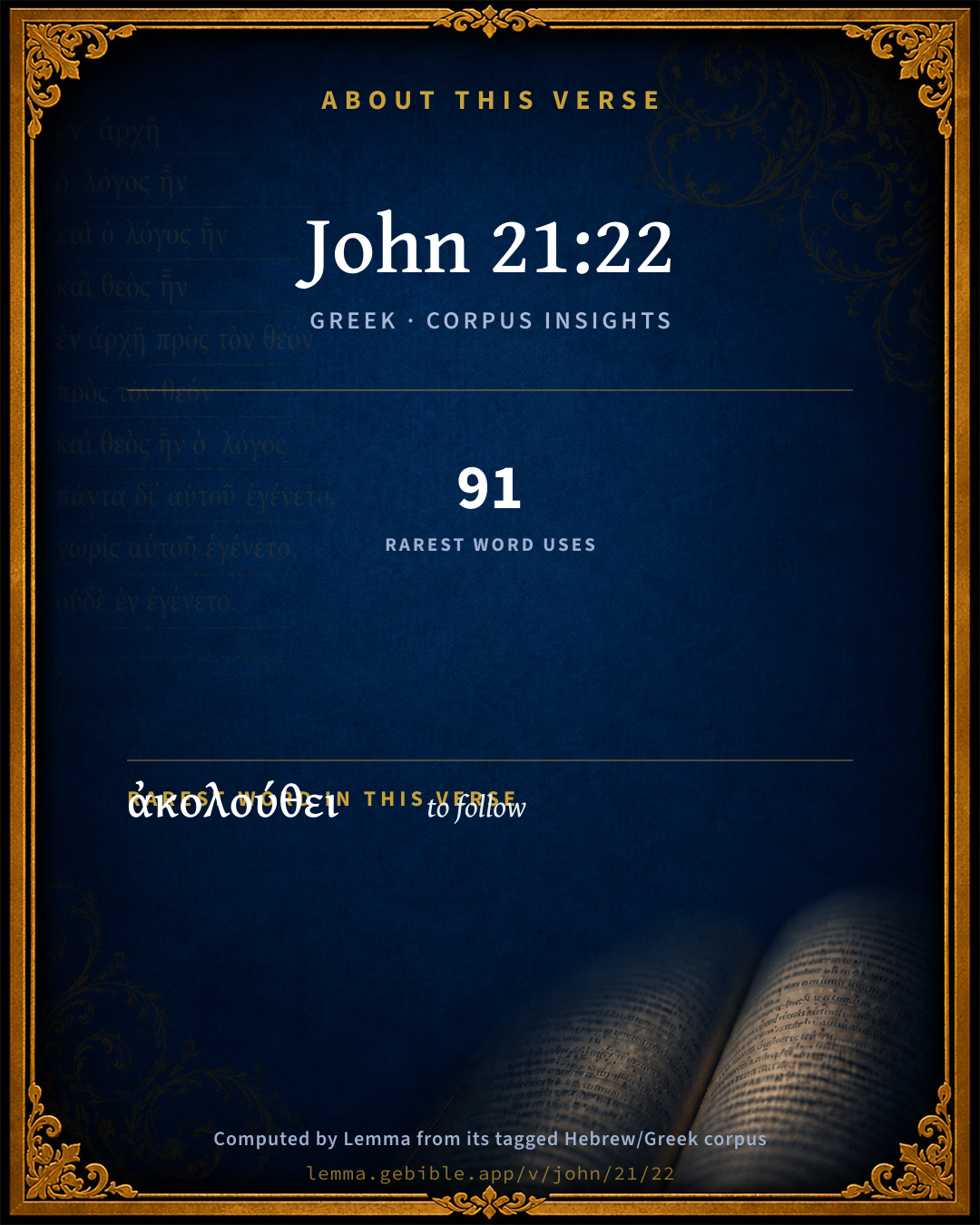
John 21:22

Greek (Tischendorf 8th ed.) John 21:22 appears in the Greek New Testament. The text above is from the Tischendorf 8th edition. Each word links to its Strong’s number and a concise gloss. Click any word for its full Thayer’s Greek Lexicon entry.
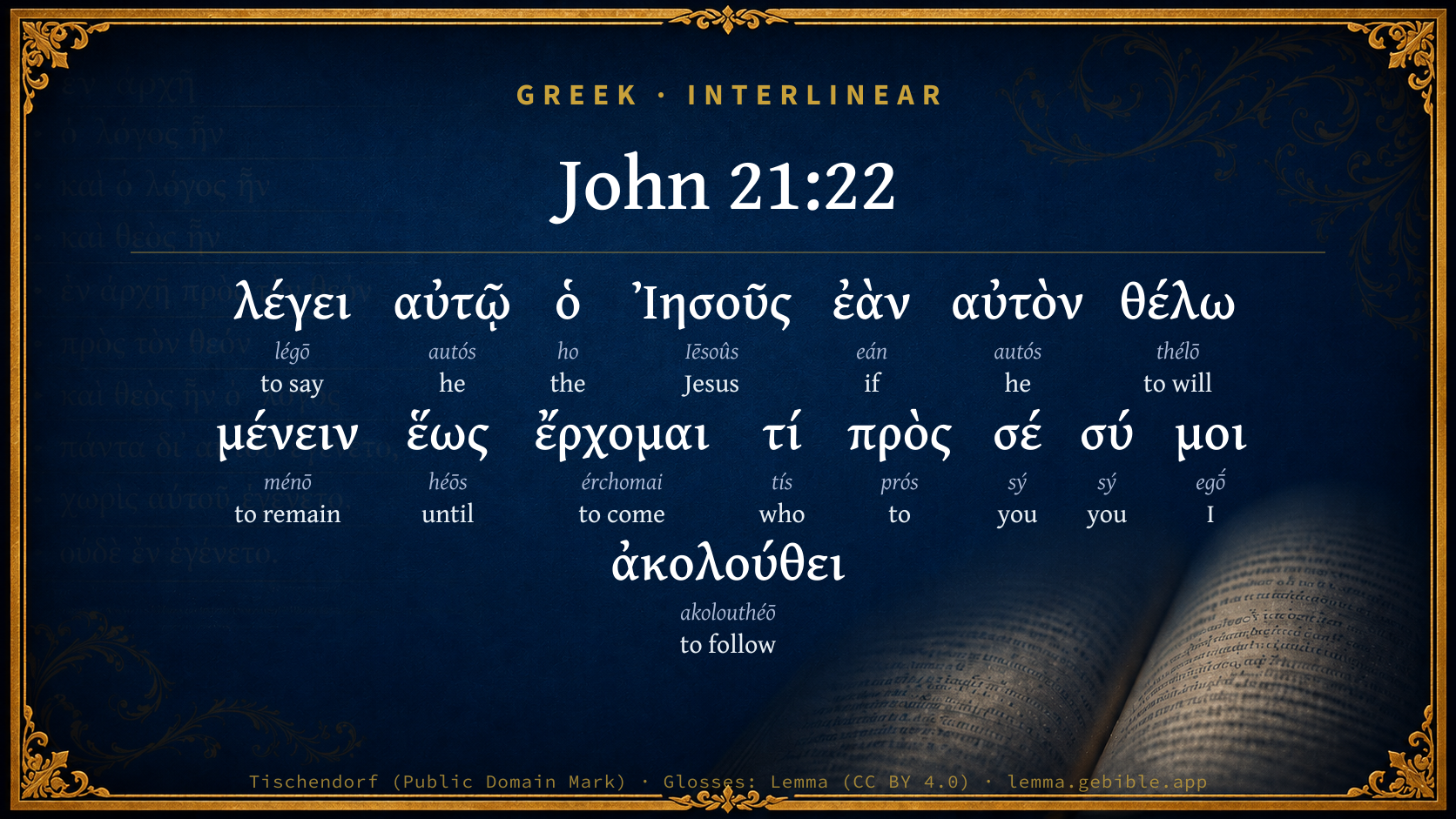
Download image
Cite this verse

John 21:22 (World English Bible). Public Domain. Lemma interlinear Bible study tool, https://lemma.gebible.app/v/john/21/22.

Show BibTeX & RIS
BibTeX
RIS
English Translation
Jesus said to him, "If I desire that he stay until I come, what is that to you? You follow me."
World English Bible · Public Domain
Download a study sheet

One document with this verse’s original text, its word-by-word gloss line, the meaning frame, cross-references with their text, attributed commentary, and full source and license credits — printable, and it pastes into notes with its structure intact.

This verse Autodidact and up

Study sheet (.html) Plain text (.txt)

A passage Seminary Student

Up to 50 verses in one chapter. A passage sheet keeps up to 6 commentary sources and 12 cross-references per verse, in the order this page ranks them, and says so on the sheet whenever that leaves anything out. Ask for a single verse and you get the Autodidact verse sheet above.

Everything on this page stays free to read, with no account — the sheet is a download of what is already on screen, not access to it.

Want to remove ads? Support Godless Engineer
Compare translations 3

The same verse in 3 English versions, stacked beneath the original-language interlinear above. Click any original word for its lexicon entry.

Each is an independent rendering of the whole verse — the interlinear is not word-aligned to these translations.

Highlighted words mark where these versions differ — a whole-verse word diff, not a word-by-word alignment.

  • World English Bible Public Domain
    Jesus said to him, "If I desire that he stay until I come, what is that to you? You follow me."
  • King James Version Public Domain
    Jesus saith unto him, If I will that he tarry till I come, what is that to thee? follow thou me.
  • unfoldingWord Literal Text CC BY-SA 4.0
    Jesus says to him, “If I want him to remain until I come, what to you? You follow me.”

unfoldingWord Literal Text — © unfoldingWord, licensed CC BY-SA 4.0. Word-aligned USFM3 via Door43 (git.door43.org/unfoldingWord/en_ult).

Versions to compare (up to 4)

3 of 4 selected

Show all 19 translations

Every available English version of this verse, each an independent rendering of the whole verse.

  • World English Bible Public Domain
    Jesus said to him, "If I desire that he stay until I come, what is that to you? You follow me."
  • Berean Standard Bible Public Domain
    Jesus answered, “If I want him to remain until I return, what is that to you? You follow Me!”
  • Majority Standard Bible Public Domain
    Jesus answered, “If I want him to remain until I return, what is that to you? You follow Me!”
  • King James Version Public Domain
    Jesus saith unto him, If I will that he tarry till I come, what is that to thee? follow thou me.
  • American Standard Version (1901) Public Domain
    Jesus saith unto him, If I will that he tarry till I come, what `is that' to thee? Follow thou me.
  • Revised Version (1885) Public Domain
    Jesus saith unto him, If I will that he tarry till I come, what is that to thee? follow thou me.
  • Geneva Bible (1599) Public Domain
    Iesus said vnto him, If I will that he tarie till I come, what is it to thee? follow thou me.
  • Douay-Rheims (1899) Public Domain
    Jesus saith to him: So I will have him to remain till I come, what is it to thee follow thou me.
  • Young's Literal Translation Public Domain
    Jesus saith to him, `If him I will to remain till I come, what -- to thee? be thou following me.' This word, therefore, went forth to the brethren that that disciple doth not die,
  • Literal Standard Version CC BY-SA 4.0
    Jesus says to him, “If I will him to remain until I come, what [is that] to you? Follow Me.”
  • Unlocked Literal Bible CC BY-SA 4.0
    Jesus said to him, “If I want him to stay until I come, what is that to you? Follow me.”
  • unfoldingWord Literal Text CC BY-SA 4.0
    Jesus says to him, “If I want him to remain until I come, what to you? You follow me.”
  • Darby Bible Public Domain
    Jesus says to him, If I will that he abide until I come, what [is that] to thee? Follow thou me.
  • World Messianic Bible Public Domain
    Yeshua said to him, “If I desire that he stay until I come, what is that to you? You follow me.”
  • Webster's Bible Public Domain
    Jesus saith to him, If I will that he shall tarry till I come, what is that to thee? Follow thou me.
  • Free Bible Version CC BY-SA 4.0
    Jesus told him, “If I want him to remain alive here until I return, why is that your concern? You follow me!”
  • Bible in Basic English Public Domain
    Jesus said to him, If it is my desire for him to be here till I come back, what is that to you? come yourself after me.
  • Text-Critical English NT CC BY 4.0
    Jesus said to him, “If I wish for him to remain until I come, what is that to yoʋ? Yoʋ follow me!”
  • Tyndale New Testament (1534) Public Domain
    Iesus sayd vnto him Yf I will have him to tary tyll I come what is that to the? folowe thou me.

Literal Standard Version (2020), Covenant Press — licensed CC BY-SA 4.0. Text via the HelloAO Bible API (eBible.org). Unlocked Literal Bible (unfoldingWord) — licensed CC BY-SA 4.0. Text via the HelloAO Bible API (eBible.org). unfoldingWord Literal Text — © unfoldingWord, licensed CC BY-SA 4.0. Word-aligned USFM3 via Door43 (git.door43.org/unfoldingWord/en_ult). Free Bible Version, Dr. Jonathan Gallagher — licensed CC BY-SA 4.0. Text via the HelloAO Bible API (eBible.org).

Word by word

More ways to search: Search by grammar → Find every occurrence → Compare this word →

Practice this passage: Drill this verse → Learn its vocabulary →

ἀκολούθει
akolouthéō
G190
“to follow”
Verb, Present, Active, Imperative, 2nd person, Singular
Part of Speech
Verb
Tense
Present
Voice
Active
Mood
Imperative
Person
2nd person
Number
Singular
Full Thayer's Definition

Origin: from G1 (as a particle of union) and keleuthos (a road)

TDNT: 04:30,3

1. to follow one who precedes, join him as his attendant, accompany him 2. to join one as a disciple, become or be his disciple a. side with his party
  1. λέγει légō G3004 “to say” Verb, Present, Active, Indicative, 3rd person, Singular
  2. αὐτῷ autós G846 “he” Personal pronoun, Dative, Singular, Masculine
  3. ὁ ho G3588 “the” Article, Nominative, Singular, Masculine
  4. Ἰησοῦς Iēsoûs G2424 “Jesus” Noun, Nominative, Singular, Masculine
  5. ἐὰν eán G1437 “if” Conditional
  6. αὐτὸν autós G846 “he” Personal pronoun, Accusative, Singular, Masculine
  7. θέλω thélō G2309 “to will” Verb, Present, Active, Subjunctive, 1st person, Singular
  8. μένειν ménō G3306 “to remain” Verb, Present, Active, Infinitive
  9. ἕως héōs G2193 “until” Adverb
  10. ἔρχομαι érchomai G2064 “to come” Verb, Present, Middle or Passive deponent, Indicative, 1st person, Singular
  11. τί tís G5101 “who” Interrogative pronoun, Nominative, Singular, Neuter
  12. πρὸς prós G4314 “to” Preposition
  13. σέ sý G4771 “you” Personal pronoun, 2nd person, Accusative, Singular
  14. σύ sý G4771 “you” Personal pronoun, 2nd person, Nominative, Singular
  15. μοι egṓ G1473 “I” Personal pronoun, 1st person, Dative, Singular

About this verse

These counts appear in no published source. They are computed here, from the morphology-tagged text and Lemma’s own curated glosses. What Lemma adds →

16
words
14
distinct lemmas
Gospels
section

Repetition

Words recur within this verse:

Cross-references

15

Topical passages linked to John 21:22 in the Treasury of Scripture Knowledge — connected by theme and wording, ordered by reader-vote popularity; previews shown in the World English Bible.

  • Revelation 2:25 Nevertheless, hold firmly that which you have, until I come.
  • Revelation 3:11 I am coming quickly! Hold firmly that which you have, so that no one takes your crown.
  • Mark 9:1 He said to them, "Most assuredly I tell you, there are some standing here who will in no way taste death until they see the Kingdom of God come with power."
  • Matthew 16:27–28 For the Son of Man will come in the glory of his Father with his angels, and then he will render to everyone according to his deeds.
  • 1 Corinthians 4:5 Therefore judge nothing before the time, until the Lord comes, who will both bring to light the hidden things of darkness, and reveal the counsels of the hearts. Then each man will get his praise from God.
  • Matthew 24:3 As he sat on the Mount of Olives, the disciples came to him privately, saying, "Tell us, when will these things be? What is the sign of your coming, and of the end of the age?"
  • Matthew 24:44 Therefore also be ready, for in an hour that you don't expect, the Son of Man will come.
  • John 21:19 Now he said this, signifying by what kind of death he would glorify God. When he had said this, he said to him, "Follow me."
  • 1 Corinthians 11:26 For as often as you eat this bread and drink this cup, you proclaim the Lord's death until he comes.
  • James 5:7 Be patient therefore, brothers, until the coming of the Lord. Behold, the farmer waits for the precious fruit of the earth, being patient over it, until it receives the early and late rain.
  • Matthew 24:27 For as the lightning comes forth from the east, and is seen even to the west, so will be the coming of the Son of Man.
  • Matthew 25:31 "But when the Son of Man comes in his glory, and all the holy angels with him, then he will sit on the throne of his glory.
  • Revelation 1:7 Behold, he is coming with the clouds, and every eye will see him, including those who pierced him. All the tribes of the earth will mourn over him. Even so, Amen.
  • Revelation 22:7 "Behold, I come quickly. Blessed is he who keeps the words of the prophecy of this book."
  • Revelation 22:20 He who testifies these things says, "Yes, I come quickly." Amen! Yes, come, Lord Jesus.

Cross-references courtesy of OpenBible.info (CC BY 4.0).

Commentary

Notes on John 21:22 from classic Christian and Jewish commentators (each source and its license shown beneath its notes). The classic Christian expositions comment on the surrounding passage and are grouped to its opening verse, so a note may address several verses; the Jewish commentaries on the Tanakh (Rashi and others) are per-verse, so they appear only where the commentator wrote on this verse.

Lemma curates 59 commentaries, every one of them public domain or Creative Commons licensed, each selected and text-cleaned for this edition rather than reprinted as found. About our sources →

Joseph Benson's Commentary

Joh 21:22-23. Jesus saith, If I will that he tarry — Without dying; till I come — With power and great glory, to execute the judgment I have threatened on mine enemies. Till then he certainly did tarry, and who can say when or how he died? What is that to thee — Or to any one else? Follow thou me — Mind thou thine own duty, and endeavour to prepare for thine own sufferings, and pry not, with a vain curiosity, into the secret events which may befall him or any other of thy brethren. Then — As this answer was not rightly understood; went this saying abroad among the brethren — That is, among the other followers of Christ; (our Lord himself taught them to use that appellation, Joh 20:17;) that that disciple should not die; and the advanced age to which he lived gave some further colour for it; yet Jesus said not unto him — Or of him; He shall not die — Not expressly. And St. John himself, at the time of writing his gospel, seems not to have known clearly whether he should die or not; but, If I will, &c. — He only said the words expressed before, which, if St. John understood, he did not think proper to explain.

Joseph Benson's Commentary on the Old and New Testaments (1811–1818) — public domain. Text from a community e-Sword module.

Bengel's Gnomon

Johann Albrecht Bengel

Joh 21:22. Λέγει, saith) The Divine counsels respecting believers are more concealed than respecting the ungodly. Comp. Joh 21:20, as to the traitor.—ἐὰν, if) Never did the Lord give an unmixed repulse to His friends, however unseasonable their question might be. For which reason, not even in this instance does He repress Peter with unmixed sternness, but intimates, under the exterior repulse, something of kindness: even as also the αὐτὸν, he or him, which is relative, is more gentle than if He had used τοῦτον, this person, which is demonstrative, in His reply to him. Therefore there is an ambiguity both weighty, and at the same time pleasing, in effect: For the conditional if does not affirm, if Jesus’ words are to be taken of the full completion of His second advent: His words hold good, even absolutely, if they are taken of the first beginnings of His advent. And, indeed, the brethren felt that the if was not altogether, in its rigid strictness, employed by the Lord: although they ought not to have set it aside wholly: Joh 21:23.—αὐτὸν, that He) So indicative of what was about to happen to Him is given to John, who was less forward to ask the question (for even on the former occasion he had not asked until he was prompted [by Peter] to do so [ch. Joh 13:24], Joh 21:20), but who, notwithstanding, wished to ask it. More is revealed to those who are less disposed to pry curiously.—θέλω, I will) Implying the power of Jesus as to the life or death of His people: Rom 14:9, “To this end Christ both died, and rose, and revived, that He might be Lord both of the dead and living.—μένειν, remain, tarry) ‘remain’ on earth. 1Co 15:6, “The greater part remain unto this present.” On the contrary, the dead are termed ἀπελθόντες, those who have departed. Augustine interprets it expectare, “to await:” expectation or awaiting no doubt follows as the consequence of remaining: but the notion of remaining continues without sacrifice of truth.—ἕως ἔρχομαι, until I come) i.e. until I shall in very deed be coming in glory, and so John will be able to testify of Me in this Present, Behold He cometh [Rev 1:7]. The time of the Lord’s coming succeeds immediately after the destruction of Jerusalem: Mat 23:39; Mat 24:29, note: which advent John obtained the privilege of describing in the Apocalypse. The principal apostles of the twelve were the two, Peter and John: the former, laid the foundation; the latter, the crowning topstone: if a third is to be added, it is James, the first martyr of them, who, moreover, was present also at this feast, rather than at the conversation. The cross was promised in this place, to Peter; to John was promised in an enigmatical manner, that great Apocalypse. And as it were the middle point between this discourse of the Lord and the death of John, was the martyrdom of Peter: the years 30, 67, and 98 of the received era, claiming to themselves respectively these three important events. It is only in this point of view that the antithesis is more fully to be perceived: Peter by death follows Jesus in His departure out of the world: Joh 21:19, note: but John remains in the world, until He, the same, comes. In truth, the ministry of John, in writing and sending the Apocalypse, is equal [in point of patient suffering] to the cross endured by Peter, by reason of the very severe ordeal of trials to be endured by the former in the meanwhile: Rev 1:17; Rev 10:9-10. Nor was the writing of the Apocalypse less profitable to the Church, than Peter’s martyrdom. John, according to the prophecy, was about to remain in life, after having outlived all dangers, until the fit time should arrive, when, almost all his colleagues being long ago dead, the Jewish state overthrown, and the Christian Church established, he was to be the minister of the Apocalypse, the beginning and ending of which is that constantly recurring and solemn expression, He cometh, I come, Come, ch. Rev 1:7, Rev 22:20, etc. For it was becoming that the Apocalypse should not be published sooner, and yet that it should be published by an apostle. Wherefore the promise which was formerly given to John, in conjunction with others, Mat 16:28, (where see the note on the different succession steps of the coming), is now in this passage confined to John alone, in a remarkable, preeminent, and unprecedented manner. Often a thing is said then to come to pass, when it is vividly presented before us as about to be: see note on Act 13:33. [God said this at the time that the Psalm was composed, speaking of it as a thing then present, because it was then represented as about to be]: for which reason the Lord is said to come in that most vivid, prophetical, and apocalyptical representation. And not only in vision, but in the eyes and feeling of John, and thenceforward after that most solemn denunciation, and most especially at the actual time of John’s death, and subsequently, He is in actual fact rather coming, than about to come. For whilst John remained, the fulfilment began to come to pass, the trumpet having been given even to the seventh angel himself, Rev 11:15, note. And just as all the forty days after the Resurrection were days of Ascension (Joh 20:17, note), so at a very brief interval after the Ascension is the time of the Coming to judgment, inasmuch as no other step interposed between, Act 1:11 [wherein the second coming is joined immediately with the Ascension]: For the sitting at God’s right hand does not differ from the Ascension, except in so far as the actual state differs from the act. Therefore Christ expects, and is ready, Heb 10:13; 1Pe 4:5. In the mention of His coming, all the events on this side of it which the Apocalypse contains, are included. There is one last hour, upon which also the coming of Antichrist falls, 1Jn 2:18. Immediately after the Apocalypse, John departed and died (Comp. Luk 2:26; Luk 2:29, Simeon), after great afflictions, by a natural death; as Daniel did, ch. Joh 12:13; with whom John had much in common. In fine, that sentiment, until John shall write the Apocalypse, could be put forward in these words with as much truth and literal strictness as characterized John at the time when, in writing the Apocalypse, he wrote that the Lord comes. Thus both the forerunners and messengers of the coming of the Lord, His first and His second, were of the one name, John the Baptist and John the Apostle. The history of the Old Testament is arranged by the lives of the patriarchs and kings, and by the weeks of Daniel: whilst the Apocalypse has predicted the periods of the New Testament history, which was about to follow after. The whole of the golden chain is completed in the middle, first by the life of Jesus Christ, then next by the remaining of John, who also alone of the Evangelists has recorded all the Passovers and the years intervening between the baptism of Christ and the time of this discourse: He alone of all has acted the part of a chronologer of all the times of the New Testament. See how great was the dignity conferred on the beloved disciple.—τί πρός σε; what is that to thee?) This brings back the curiosity of Peter to order; but at the same time it much more intimates, that his course would be already ended, whilst John was still doing his work, and was subserving the advent of the Lord. The martyrdom of Peter was consummated several years before the destruction of Jerusalem: that destruction had the Lord’s advent subsequent to it.—σὺ, thou) A weighty and merciful command.—ἀκολούθει μοι, follow Me) The future is contained in the Imperative: Give all thy attention to that which belongs to thee: leave to him (that disciple) what belongs to him. Similarly the Lord’s words concerning John, intimated not only what the Lord wishes to be done, but what is about to be.

Bengel's Gnomon of the New Testament — English translation (T&T Clark, Edinburgh, 1860) — public domain. Text from a community e-Sword module.

Meyer's Critical & Exegetical Commentary

Heinrich August Wilhelm Meyer

Joh_21:22. Jesus gives, in virtue of His personal sovereignty over the life and death of His own (comp. Rom_14:9), to the unwarranted question, put by Peter, too, not merely out of curiosity, but even from a certain jealousy (Chrysostom, Erasmus, Wetstein, and several others import: out of particular love to John),[289] the answer: that it does not at all concern him, if He have possibly allotted to John a more distant and happier goal, and leads him, who had again so soon turned away his gaze from himself, immediately back to the task of ἈΚΟΛΟΎΘΕΙ ΜΟΙ imposed upon him, Joh_21:19.

ΜΈΝΕΙΝ] Opposite of the ἈΚΟΛΟΥΘΕῖΝ, to be fulfilled by the death of martyrdom; hence: be preserved in life. Comp. Joh_12:34; Php_1:25; 1Co_15:6; Kypke, I. p. 415 f. Olshausen (and so substantially even Ewald) arbitrarily adds, after Augustine, the sense: to tarry in quiet and peaceful life.[290]

ἕως ἔρχομαι] By this Jesus means, as the solemn and absolute ἜΡΧΟΜΑΙ itself renders undoubted, His final historical Parousia, which He, according to the apprehension of all evangelists and apostles, has promised will take place even before the passing away of the generation (see note 3 after Matthew 24), not the destruction of Jerusalem, which, moreover, John far outlived (τινὲς in Theophylact, Wetstein, Lange, and several others, including Luthardt, who sees in this destruction the beginning of the Parousia, in opposition to the view of the N. T. generally, and to Joh_21:23); not the world historical conflict between Christ and Rome, which began under Domitian (Hengstenberg); not the carrying away by a gentle death (Olshausen, Lange, Ewald, after the older expositors, as Ruperti, Clarius, Zeger, Grotius, and several others); not the leading out from Galilee (where John in the meanwhile was to remain) to the scene of Apostolic activity (Theophylact); not the apocalyptic coming in the visions of Johns revelation (Ebrard); not the coming at any place, where John was to wait (Paulus)! See rather Joh_14:3; 1Jn_2:28; 1Jn_3:2. On ἕως ἔρχομαι (as 1Ti_4:13), as long as until I come, see Buttmann, Neut. Gr. p. 199 [E. T. p. 231]. In σύ μοι ἀκολ., σύ bears the emphasis, in opposition to the other disciples.

[289] Comp. Luthardt: only loving interest for his comrade, to which, however, the reproving τί πρὸς σέ, ver. 22, does not apply.

[290] Comp. Godet, who, strangely enough, finds here an allusion to the fact that John remained at rest in the boat, and with his comrades (except Peter) towed the full net to land, where Jesus was. This allusion again includes the other, that John, in the history of the development of the founding of the church, received a calm and collected part. And with this Godet finally connects: At the great gospel draught of fishes in the Gentile world, where Peter at the beginning stood foremost, John assisted thereat until the end of the first century, a type of the whole history of the church, and here begins the mysteryperhaps he is therewith associated in an incomprehensible manner until the end of the present economy, until the vessel touches the shore of eternity. Thus, if we depart from the clear and certain sense of the words, we fall into the habit of phantasy, so that we no longer expound, but invent and create.

Meyer — Critical and Exegetical Commentary on the New Testament — English translation by Peter Christie, edited by Frederick Crombie (T&T Clark, 1880) — public domain. Text from a community e-Sword module.

Expositor's Greek Testament

ed. W. Robertson Nicoll

Joh 21:22 . To which Jesus replies with a shade of rebuke, Ἐὰν … μοι . Peter, in seeking even to know the future of another disciple, was stepping beyond his province, τί πρός σε ; σύ ἀκολούθει μοι . Your business is to follow me, not to intermeddle with others. Cf. A Kempis’ description of the man who “neglects his duty, musing on all that other men are bound to do”. De Imit. Christi , ii. 3. Over-anxiety about any part of Christ’s Church is to forget that there is a chief Shepherd who arranges for all. This part of the conversation might not have been recorded, but for a misunderstanding which arose out of it.

The Expositor's Greek Testament, edited by W. Robertson Nicoll (1897–1910) — public domain. Text from a community e-Sword module.

Godet's Commentaries

Frédéric Louis Godet

Vv. 22, 23. “Jesus says to him, If I will that he tarry till I come, what is it to thee? Follow thou me! 23. The report spread abroad, therefore, among the brethren that this disciple should not die; but Jesus did not say to him that he should not die, but, If I will that he tarry till I come.”

This question of Peter, although springing from an affectionate feeling, had something indiscreet in it; this the Lord makes him feel by the words: What is it to thee? —The coming of the Lord, in the fourth Gospel (ch. 14-16), denotes His coming in the Spirit, from the day of Pentecost. This meaning is not applicable here, since Peter, as well as John, was present at that event. In the passage Joh 14:3, the expression “the coming” of Jesus includes, in addition to His return in the Spirit, the death of the apostles. This application has been attempted here, in the sense that Jesus would predict for John a gentle and natural death at the end of a long apostolic career, in contrast with the martyrdom of Peter. This, or nearly this, is the view of Grotius, Olshausen, Weitzel and Ewald. But could the Lord mean to say that He returns only for those of His followers who die by a natural death, and not for those who perish by a violent death? This would be a strange, even an absurd idea, and one which is contradicted by the story of the death of Stephen. As the coming of the Lord denotes in the Synoptics and with John himself (1Jn 2:28; 1Jn 3:2) the glorious return of Jesus at the end of the present economy, Meyer, Reuss, Weiss and others apply this sense here: “If I will that he tarry till my Parousia.” It was thus that the contemporaries of John interpreted this saying, until the time of his death; for it is only thus that we can understand the inference, which they drew from it, that he would not die—that is, that he would belong to that company of believers who, being alive at the moment of the Parousia, will not be raised, but translated (1Co 15:51).

This explanation was so much the more natural at that period, since there was a belief in the nearness of the Parousia. It continued even after the death of John, in the form of the popular legend, according to which John was said to have laid himself down in his grave and to be sleeping there until the return of Christ, or in that of the Greek legend, according to which John was said to have been raised immediately after his death, and was to reappear with the two witnesses of the Apocalypse in order to sustain the Church in its last struggle against Antichrist. But, setting aside these legends, if this view is accepted, it must be resolutely maintained, with Weiss, that Jesus shared the error of His contemporaries in relation to the nearness of His return, which would absolutely contradict the Synoptic documents (see my Commentary on the Gospel of Luke, Vol. II., pp. 325, 336), or fall back, with Meyer, upon the hypothetical form of Jesus’ words: If I will, which is no less inadmissible, for Jesus could not have presented as possible (on the condition of His good pleasure) a thing which was impossible.

He promised, according to others (Lange, Luthardt, etc.), the preservation of John’s life until the great judgment in the fall of Jerusalem, which may indeed be called the first act of the Coming of Christ; comp. Mat 10:23 : “I say to you that you shall not have gone over the cities of Israel, till the Son of man be come;” and Mat 26:64 : “Henceforth you shall see the Son of man seated at the right hand of power and coming on the clouds of heaven.” Peter did not see this great manifestation of the glorified Christ, but John survived it. Yes, objects Weiss, but far too long for this explanation. But the length of time that John still lived after this event is of little consequence. For the until has nothing exclusive in it. Of all these proposed views, this would seem to us the least improbable. The attempt has also been made to apply this saying to the Apocalyptic vision, which Jesus here promised to John (Bengel, Hengstenberg); or a proof has been sought in it in favor of the necessity of the apostleship even till the end of time (Thiersch); Schelling (comp. Bonnet) saw in it the promise of the Johannean period, which, succeeding that of Peter (the middle ages) and that of Paul (the Reformation), would close the earthly development of the Church.

I have already before this observed that, as the primitive epoch of humanity had its Enoch and the theocratic epoch its Elijah, the Christian epoch might well have also its leader freed from death. And I have asked whether John might not in a mysterious way accompany the progress of the Church on earth, as in the scene of the draught of fishes he accompanied to the shore the boat which was suddenly abandoned by Peter. One raises such a question evidently only when one is not completely satisfied with any of the solutions which more naturally present themselves.

From this point is discovered to us the unity of ch. 21. The foundation of the whole scene is the miraculous draught of fishes, which typifies the future of the Christian ministry, in general. On this foundation the two special narratives stand forth, having relation to the part and destiny of the two principal apostles—Peter, who will leave the boat of the Church suddenly by the violent death of martyrdom, and John, who will accompany it even to the shore.

After this saying relative to John, Jesus again invites Peter to follow Him in order to receive His orders, and to resume, from that moment, the active service of the ministry and of the direction of the apostolate, which had been temporarily interrupted. The σύ, thou, which Jesus makes prominent here (comp. the difference in Joh 21:19), contrasts Peter with John: “Thou —do thou think of what I command thee, and leave to God His own secrets.” The Alexandrian authorities place the μοι, me, before the verb, which would give it a special emphasis: “Occupy thyself with me and with no other!” This seems to me forced. The author, without indicating in Joh 21:23 the meaning of the saying of Jesus, which perhaps he does not himself know, contents himself with correcting the misapprehension which was connected with it.

The last words: what is it to thee? are not indispensable, and it is possible that the reading of the Sinaitic MS., which omits them, is the true one. The present οὐκ ἀποθνήσκει, he does not die, is that of the idea. We feel that the author reproduces this λόγος, this saying, just as it was repeated in the Church at the very moment when he was writing.

To whom are we to ascribe the redaction of this supplement? The stamp of the Johannean style and manner is so impressed upon it from one end to the other, that there are only two alternatives: either a man living in habitual association with the apostle drew up this narrative, after having often heard it from his lips, or John himself drew it up. Between these two suppositions, the choice is of little consequence. In favor of the second may be alleged: 1. The last place assigned to the two sons of Zebedee among the apostles named in Joh 21:1; John 2. The very delicate way in which the finest shades of the conversation between Jesus and Peter are given. For the former may be urged: 1. The use of some terms which are not found again in the writings of John 2. The relation between Joh 21:23 and Joh 21:24, which easily leads us to regard him who wrote Joh 21:23 as one of those who say: We know, in Joh 21:24; perhaps, also, as the one who speaks in the first person singular in Joh 21:25.

Baur and a part of his school have seen in the redaction and addition of this appendix a manoeuvre designed to exalt John, the apostle of Asia Minor, above Peter, the patron of the Church of Rome. But it is precisely Peter who is made prominent in this story (comp. Joh 21:1; Joh 21:11; Joh 21:15-17; Joh 21:19; Joh 21:22). So Koestlin and Volkmarhave made a complete turn, and claimed that, contrary to the intention of the whole Gospel, this chapter is a Roman addition designed to make Peter prominent, whom the author of the fourth Gospel had constantly tried to depreciate. Reuss expresses himself more circumspectly: the author desired to re-establish the consideration for Peter, compromised by his denial.

The first two suppositions counterbalance each other. The third would suit rather the end which Jesus proposed to Himself in the scene itself, than the design which presided over its redaction.

Frédéric Louis Godet — Commentaries on Luke, John, Romans, and 1 Corinthians — English translation (T&T Clark, Edinburgh, 1870s–1890s) — public domain. Text from a community e-Sword module.

Jamieson, Fausset & Brown

Robert Jamieson, A. R. Fausset & David Brown

Jesus saith to him, If I will that he tarry fill I come, what is that to thee? follow thou me--From the fact that John alone of the Twelve survived the destruction of Jerusalem, and so witnessed the commencement of that series of events which belongs to "the last days," many good interpreters think that this is a virtual prediction of fact, and not a mere supposition. But this is very doubtful, and it seems more natural to consider our Lord as intending to give no positive indication of John's fate at all, but to signify that this was a matter which belonged to the Master of both, who would disclose or conceal it as He thought proper, and that Peter's part was to mind his own affairs. Accordingly, in "follow thou Me," the word "thou" is emphatic. Observe the absolute disposal of human life which Christ claims: "If I will that he tarry till I come," &c.

Jamieson, Fausset & Brown — Commentary Critical and Explanatory on the Whole Bible (1871) — public domain (CC PDM 1.0). Text via the HelloAO Bible API.

Adam Clarke's Commentary

Verse 22. If I will that he tarry till I come] There are several opinions concerning this: the following are the principal.

1. Some have concluded from these words that John should never die. Many eminent men, ancients and moderns, have been and are of this opinion.

2. Others thought that our Lord intimated that John should live till Christ came to judge and destroy Jerusalem. On this opinion it is observed that Peter, who was the oldest of the apostles, died in the year 67, which, says Calmet, was six years before the destruction of Jerusalem; and that John survived the ruin of that city about thirty years, he being the only one of the twelve who was alive when the above desolation took place.

3. St. Augustin, Bede, and others, understood the passage thus: If I will that he remain till I come and take him away by a natural death, what is that to thee? follow thou me to thy crucifixion. On this it may be observed, that all antiquity agrees that John, if he did die, was the only disciple who was taken away by a natural death.

4. Others imagine that our Lord was only now taking Peter aside to speak something to him in private, and that Peter, seeing John following, wished to know whether he should come along with them; and that our Lord's answer stated that John should remain in that place till Christ and Peter returned to him; and to this meaning of the passage many eminent critics incline. For neatly eighteen hundred years, the greatest men in the world have been puzzled with this passage. It mould appear intolerable in me to attempt to decide, where so many eminent doctors have disagreed, and do still disagree. I rather lean to the fourth opinion. See the conclusion of the Preface to this Gospel.

Adam Clarke's Commentary on the Bible (1810–1826) — public domain. Text from a community e-Sword/MySword module.

John Calvin's Commentaries

22. If I will that he remain. It has been customary to take this sentence as detached, and to read the former clause affirmatively, I will that he tarry till I come; but this has been done through the ignorance of transcribers, not through the mistake of the translator; for he could not have been mistaken about the Greek word, but a single letter might easily creep into the Latin version, so as to alter the whole meaning. The whole sentence, therefore, is a question, and ought to be read in immediate connection; for Christ intended to put his hand on his disciple, in order to keep him within the limits of his calling. “It is no concern of yours,” says he, “and you have no right to inquire what becomes of your companion; leave that to my disposal; think only about yourself, and prepare to follow where you are called.” Not that all anxiety about brethren is uncalled for but it ought to have some limit, so that it may be anxiety, and not curiosity, that occupies our attention. Let every man, therefore, look to his neighbours, if by any means he may succeed in drawing them along with him to Christ, and let not the offenses of others retard his own progress.

John Calvin's Commentaries (1540-1563) — public domain. Text from the Calvin Translation Society English edition (1840s-50s) via the Christian Classics Ethereal Library (ccel.org). Calvin's coverage is partial (roughly two-thirds of the Bible); uncommented books and verses are honest gaps, never fabricated. The 19th-century editor's footnotes and remarks are omitted so the notes are faithfully Calvin's own voice.

Ellicott's Commentary for English Readers

(22) If I will that he tarry till I come, what is that to thee?—The answer must be taken as reproving the spirit which would inquire into another’s life and work, with the effect of weakening the force of its own. Here, as in all the earlier details of St. Peter’s life, his character is emotional, earnest, loving, but wanting in depth, and not without self-confidence. The words “Follow Me,” the meaning of which he has not missed, may well have led him to thoughts and questions of what that path should be, and the truth may well have sunk into the depth of his heart, there to germinate and burst forth in principle and act. But he is at once taken up with other thoughts. He is told to follow, but is ready to lead. He would know and guide his friend’s life rather than his own. To him, and to all, there comes the truth that the Father is the husbandman, and it is He who trains every branch of the vine. There is a spiritual companionship which strengthens and helps all who join in it; there is a spiritual guidance which is not without danger to the true strength of him that is led, nor yet to that of him who leads.

The word rendered “tarry” is that which we have before had for “abide” (see Joh_12:34, and comp. Php_1:25 and 1Co_15:6). It is here opposed to “Follow Me” (in the martyrdom), and means to abide in life.

The phrase, “If I will that he tarry till I come,” is one of those the meaning of which cannot be ascertained with certainty, and to which, therefore, every variety of meaning has been given. We have already seen that the Coming of the Lord was thought of in more than one sense. (Comp. especially Notes on Mat_16:28 and Matthew 24; and see also in this Gospel, Note on Joh_14:3.) The interpretation which has found most support is that which takes the “coming of the Lord” to mean the destruction of Jerusalem, which St. John, and perhaps he only of the Apostles, lived to see. But the context seems to exclude this meaning, for the mistake of Joh_21:23 would surely have been corrected by a reference to the fact that St. John had survived, and wrote the Gospel after, the “coming of the Lord.” The interpretation which the next verse itself suggests is that our Lord made no statement, but expressed a supposition, “If I will,” “If it even be that I will;” and this both gives the exact meaning of the Greek, and corresponds with the remainder of our Lord’s answer. He is directing St. Peter to think of his own future. and not of his friend’s; and He puts a supposition which, even if it were true, would not make that friend’s life a subject for him then to think of. Had our Lord told him that St. John should remain on earth until His coming, in any sense of the word, then He would have given an answer, which He clearly declined to give.

Follow thou me.—The pronoun “thou” is strongly emphatic. “Thy brother’s life is no matter for thy care. Thy work is for thyself to follow Me.”

A Bible Commentary for English Readers, edited by Charles John Ellicott (1878–1897) — public domain. Text from a community e-Sword module.

The Cambridge Bible for Schools and Colleges

gen. ed. J. J. S. Perowne

22. If I will] Christ died and rose again that He might become the Lord and Master both of the dead and the living (Rom_14:9). He speaks here in full consciousness of this sovereignty. For the use of ‘I will’ by Christ comp. Joh_17:24; Mat_8:3 and parallels, Mat_26:39. While the ‘I will’ asserts the Divine authority, the ‘if’ keeps the decision secret.

that he tarry] Better, that he abide; it is S. John’s favourite word which we have had so often (Joh_1:32-33; Joh_1:39-40, Joh_2:12, Joh_3:36, Joh_4:40, &c., and twelve times in chap. 15) [16]. S. Peter’s lot was to suffer, S. John’s to wait. For ‘abide’ in the sense of remain in life comp. Joh_12:34; Php_1:25; 1Co_15:6.

till I come] Literally, while I am coming. The words express rather the interval of waiting than the end of it. Comp. Joh_9:4; Mar_6:45. This at once seems to shew that it is unnecessary to enquire whether Pentecost, or the destruction of Jerusalem, or the apocalyptic visions recorded in the Revelation, or a natural death, or the Second Advent, is meant by Christ’s ‘coming’ in this verse. He is not giving an answer but refusing one. The reply is purposely hypothetical and perhaps purposely indefinite. But inasmuch as the longer the interval covered by the words, the greater the indefiniteness, the Second Advent is to be preferred as an interpretation, if a distinct meaning is given to the ‘coming.’

what is that to thee?] The words are evidently a rebuke. There is a sense in which ‘Am I my brother’s keeper?’ is a safeguard against curiosity and presumption rather than a shirking of responsibility.

follow thou me] ‘Thou’ is emphatic, contrasting with the preceding ‘he,’ which is emphatic also.

The Cambridge Bible for Schools and Colleges (gen. ed. J. J. S. Perowne; Cambridge University Press, 1878–1918) — public domain. Text from a community e-Sword module.

John Gill's Exposition

Jesus saith unto him,.... Christ vouchsafes an answer to Peter, but not a very clear one, nor such an one as he wished for, and not without a rebuke to him:

if I will that he tarry till I come, what is that to thee? meaning, that if it was his pleasure that he should live, not till his second coming to judge the quick and dead at the last day, but till he should come in his power and take vengeance on the Jewish nation, in the destruction of their city and temple by the Romans, and in dispersing them through the nations of the world; till which time John did live, and many years after; and was the only one of the disciples that lived till that time, and who did not die a violent death; what was that to Peter? it was no concern of his. The question was too curious, improper, and impertinent; it became him to attend only to what concerned himself, and he was bid to do:

follow thou me; whence it may be observed, that it becomes the saints to mind their duty in following Christ, and not concern themselves in things that do not belong to them. Christ is to be followed by his people as their leader and commander; as the shepherd of the flock; as a guide in the way, and the forerunner that is gone before; as the light of the world; as the pattern and example of the saints, and as their Lord and master; and that in the exercise of every grace, as humility and meekness, love, zeal, patience, and resignation to the will of God; and also in the discharge of duty, both with respect to moral life and conversation, and instituted worship, as attendance on public service, and submission to ordinances; and likewise in enduring sufferings patiently and cheerfully for his sake. Saints are under obligation to follow Christ; it is their interest so to do; it is honourable, safe, comfortable, and pleasant, and ends in happiness here and hereafter.

John Gill's Exposition of the Whole Bible (1746–1763) — public domain (CC PDM 1.0). Text via the HelloAO Bible API.

Trapp's Complete Commentary

John Trapp

22 Jesus saith unto him, If I will that he tarry till I come, what is that to thee? follow thou me.

Ver. 22. If I will that he tarry] Si eum volo manere. This the Vulgate corruptly reads, Sic eum volo manere. Ambrose, Austin, Bede, Lyra, Rupert, &c., retain this reading. Trapezuntius defends it, Bessarion opposeth it, the Greek text refutes it. Yet is the Vulgate translation so extolled and idolized by the Papists, that if the originals differ from it anywhere, they must be corrected by it, and not it by the originals. Sed Hebraei bibunt fontes, Graeci rivos, Latini paludes, saith Reuchlin.

John Trapp, A Commentary or Exposition upon All the Books of the Old and New Testament (1647–1656) — public domain. Text from a community e-Sword module.

Albert Barnes' Notes on the Bible

That he tarry - That he live. The same word is used to express life in Phi 1:24-25; 1Co 15:6.

Till I come - Some have supposed this to refer to the destruction of Jerusalem; others to the day of judgment; others to signify that he would not die a violent death; but the plain meaning is, “If I will that he should not die at all, it is nothing to thee.” In this way the apostles evidently understood it, and hence raised a report that he would not die. It is remarkable that John was the last of the apostles; that he lived to nearly the close of the first century, and then died a peaceful death at Ephesus, being the only one, as is supposed, of the apostles who did not suffer martyrdom. The testimony of antiquity is clear on this point; and though there have been many idle conjectures about this passage and about the fate of John, yet no fact of history is better attested than that John died and was buried at Ephesus.

What is that to thee? - From this passage we learn:

1.That our main business is to follow the Lord Jesus Christ.

2.That there are many subjects of religion on which a vain and impertinent curiosity is exercised. All such curiosity Jesus here reproves.

3.That Jesus will take care of all his true disciples, and that we should not be unduly solicitous about them.

4.That we should go forward to whatever he calls us to persecution or death - not envying the lot of any other man, and anxious only to do the will of God.

Albert Barnes' Notes on the Bible (1834–1885) — public domain. Text from a community e-Sword/MySword module.

Haydock's Catholic Bible Commentary

Jesus saith: so I will have him remain,[3] &c. That is, in case I will have him remain; or, as it is in the Greek, if I will have him remain, what is that to thee? It is thy duty, and thy concern, to follow me. (Witham) --- When Christ told St. Peter to follow him, he meant, that he should go like himself to the death of the cross; but when he says of St. John, So I will have him to remain till I come, he insinuates that his beloved disciple should not undergo a violent death; but remain in the world, till he should visit him by death, and conduct him to glory. It may likewise be understood of the Revelation, in which our Saviour manifested himself in his glory to this his beloved disciple. In the Greek, it is, if I will have him to remain; and this is the true reading, according to Estius, and Jansenius, bishop of Ghent, authorized by many Latin copies. Others refer these words of Christ to his coming to destroy Jerusalem: an epoch which St. John survived.

===============================

[BIBLIOGRAPHY]

Sic eum volo manere, Greek: ean auton thelo menein.

George Leo Haydock (1774–1849), Haydock's Catholic Family Bible and Commentary, 1859 edition — public domain. Excludes Psalms (Douay-Rheims chapter numbering differs from Protestant) and Deuterocanonical books (Catholic canon only).

Matthew Poole's English Annotations

Our Lord only checks the curiosity of Peter, and minds him to attend things which himself was concerned in; telling him, he was not concerned what became of John, whether he should die, or abide upon the earth until Christ’s second coming: it was Peter’s concern, without regarding what others did, or what became of them, himself to execute his Master’s command, and follow his example.

Matthew Poole's English Annotations on the Holy Bible (1683–1685) — public domain. Text from a community e-Sword/MySword module.

Whedon's Commentary on the Bible

Daniel D. Whedon

22. If I will—Our Lord here assumes to be Lord of man’s destiny. Though he permit, yet nothing can take place without his permissive will. Now the Lord’s answer to Peter’s question is purposely pregnant with two or three admissible meanings; nevertheless of the two or three possible meanings but one is the true one. Tarry [on earth] till I come–That is, remain living to the judgment day, be the same a longer or shorter period. If that were Christ’s will, what is that to Peter? Commentators of all ages falter and vibrate around, and then from, this plain meaning. Jesus does not say that John will live to the Second Advent; but he does most truly say that it is none of Peter’s business if he does. At the same time he intimates that if John’s future be not this, it is something so much like it that it may be shadowed under these words. If, firstly, the word come be taken in the sense of Joh_14:3, then the sentence is that John shall not, like Peter, be bound and violently slain; but shall quietly and peacefully tarry until the Lord shall please to come at the hour of death and take him to himself. Or, secondly, if the Lord shall in his own time vouchsafe to John individually a Christophany, that is, a special parousia or coming to him alone what had Peter to say to it? John did tarry until the Lord in that Christophany did come. Rev_1:12-20. And this last was, perhaps, the true meaning at which the Lord so enigmatically hinted, and which justifies the indicative I will in the Greek.

Follow thou me—In token of that future spiritual or historical following which the bodily act represented, Peter now follows his departing Lord. To what direction and result? No one knows; for John there leaves them; and the whole scene seems to vanish like a morning dream. But even at this late age of the world let us venture, from the nature of the symbol, to conjecture how our Lord finished this interview. If we may suppose, then, that, as Peter followed, Jesus suddenly vanished in an upward splendour, the symbolic action would then express a complete and required meaning. Follow me, Peter during thy whole future earthly life without swerving, historically as now corporeally, even through suffering and death, and thy path shall end, as mine now merges, in ascending GLORY. It will be seen by this view, that the rebuke of Peter’s sidelong question about John is less severe than commentators generally make it. It was a rebuke, in symbol, which signified that Peter’s future following his Lord ought to be unvarying, regardless of all incidental considerations.

Daniel D. Whedon (gen. ed.), Commentary on the Old and New Testaments (1874–1909) — public domain. Text from a community e-Sword module.

John Wesley's Explanatory Notes

If I will that he tarry - Without dying, till I come - To judgment. Certainly he did tarry, till Christ came to destroy Jerusalem. And who can tell, when or how he died? What is that to thee? - Who art to follow me long before.

John Wesley, Explanatory Notes Upon the Whole Bible (1754–1765) — public domain. Text via the GEBible commentary corpus.

The People's New Testament

B. W. Johnson

22. If I will that he tarry till I come. This is spoken of John, and the words have caused much discussion. They surely convey the idea that John would remain on the earth, after the other apostles depart, until the Lord came once more. He did linger long after all the other apostles were gone. It is the testimony of church history that he did not die until about the close of the first century, many years after the other apostles were at rest. He tarried; did the Lord come to him? At least sixty years after the Lord spoke these words John was an exile on the isle of Patmos. There on the Lord's day he writes: “I heard a great voice,” and “I saw one like the Son of man,” blazing in such glory that, filled with awe, he “fell at his feet as dead.” Then follow these words of the Savior, the seven letters, and the visions of Revelation. Here was a visible coming and John tarried until that coming. He alone of the Twelve saw the Lord, after his ascension, once more on the earth.

B. W. Johnson's The People's New Testament with Notes (1889–1891) — public domain. Electronic text from the Christian Classics Ethereal Library (CCEL) ThML edition.

unfoldingWord translationNotes

Door43 World Missions Community

Jesus said to him

"Jesus said to Peter"

If I want him to stay

Here "him" refers to the "disciple whom Jesus loved" in John 21:20.

I come

This refers to Jesus' second coming, his return to earth from heaven.

what is that to you?

This remark appears in the form of a question to express a mild rebuke. AT: "that is not your concern." or "you should not be concerned about that." (See: Rhetorical Question)

among the brothers

Here "the brothers" refers to all the followers of Jesus.

translationWords

brother

unfoldingWord translationNotes — © Distant Shores Media and the Door43 World Missions Community, licensed CC BY-SA 4.0. Source: git.door43.org/Door43/en_tn.

Cambridge Greek Testament for Schools and Colleges

22. ἐὰν αὐ. θ. μέν. Christ died and rose again that He might become the Lord and Master both of the dead and the living (Rom 13:9). He speaks here in full consciousness of this sovereignty. For the use of θέλω by Christ comp. Joh 17:24; Mat 8:3 (and parallels), Mat 26:39. While θέλω asserts the Divine authority, ἐάν keeps the decision secret. Μένειν should be rendered that he abide; it is S. John’s favourite word which we have had so often, and this important link with the rest of the Gospel must not be lost [25]: see on Joh 1:33. S. Peter’s lot was to suffer, S. John’s to wait. For ‘abide’ in the sense of remain in life comp. Joh 12:34; Php 1:26; 1Co 15:6. Ἕως ἔρχομαι is literally while I am coming. The words express rather the interval of waiting than the end of it. Comp. Joh 9:4; Mar 6:45; 1Ti 4:13. This at once seems to shew that it is unnecessary to enquire whether Pentecost, or the destruction of Jerusalem, or the apocalyptic visions recorded in the Revelation, or a natural death, or the Second Advent, is meant by Christ’s ‘coming’ in this verse. He is not giving an answer but refusing one. The reply is purposely hypothetical and perhaps purposely indefinite. But inasmuch as the longer the interval covered by the words, the greater the indefiniteness, the Second Advent is to be preferred as an interpretation, if a distinct meaning is given to the ‘coming.’ This agrees with τί πρός σε; which is evidently a rebuke. There is a sense in which ‘Am I my brother’s keeper?’ is a safeguard against curiosity and presumption rather than a shirking of responsibility. Σύ and αὐτόν are emphatic and opposed: ‘whatever I may will respecting him, thou must follow Me. This is what concerns thee.’

Cambridge Greek Testament for Schools and Colleges (Cambridge University Press, 1896; 21 vols, various authors incl. Carr, Maclear, Plummer, Farrar, Lumby, Moule, M. R. James, Simcox) — public domain. Text from a community e-Sword module.

Alford’s Greek Testament

Henry Alford

22.] The words τί πρὸς σέ; imply a rebuke;—not perhaps however so sharp a one as has been sometimes seen in them. They remind Peter of the distinctness of each man’s position and duty before the Lord; and the σύ μοι ἀκ., which follows, directs his view along that course of duty and suffering, which was appointed for him by his Divine Master. Notice the emphatic expression of σύ, and the emphatic position of μοι: q. d. ‘His appointed lot is no element in thy onward course: it is Me that thou must follow.’

On the ἐὰν θέλω …, three opinions have been held (for that which refers the words to John’s remaining where he then was, on the shore, till the Lord returned from His colloquy with Peter, is not worth more than cursory mention): (1) that of Aug., Maldon., Grot., Lampe, Olsh., &c. (it being allowed on all hands, that μένειν means to remain in this life: see reff. and ch. 12:34), “If I will that he remain till I fetch him,” i.e. by a natural death. But this is frigid, and besides inapplicable here. Peter’s death, although by the hands of an ἄλλος, was just as much the Lord’s ‘coming for him,’ as John’s, and there would thus be no contrast. (2) That that ‘coming of the Lord’ is meant which is so often in the three Gospels alluded to (see especially notes on Mat_24.), viz. the establishment in full of the dispensation of the Kingdom by the destruction of the nation and temple of the Jews. This is the view of some mentioned by Theophyl., of Bengel (see below), Stier, Dräseke, Jacobi, &c.—and is upheld by the similar place, Mat 16:28. (3) That the Lord here only puts a case,—“Even should I will that he remain upon earth till My last coming—what would that be to thee?” This view is upheld by Trench, Miracles, p. 466, edn. 2; but I think must be rejected on maturer consideration of the character of the words of our Lord, in whose mouth such a mere hypothetical saying would be strangely incongruous, especially in these last solemn days of his presence on earth.

The second view seems then to remain, and I adopt it with some qualification.

At the destruction of Jerusalem began that mighty series of events of which the Apocalypse is the prophetic record, and which is in the complex known as the ‘coming of the Lord,’ ending, as it shall, with His glorious and personal Advent. This the beloved Apostle alone lived to see, according to ancient and undoubted tradition (Euseb. H. E. iii. 23). When De Wette (whom Lücke in the main follows: see also Mr. Elliott, Apocal. Alf. p. 160) calls this interpretation ganz nichtig, and would interpret this answer by the current idea in apostolic times, that His coming was very near, he is assuming (1) that this was the idea of the Apostles themselves (see 2Th 2:2, 2Th 2:3: 2Pe 3:3, 2Pe 3:4, 2Pe 3:8, 2Pe 3:9); (2) that this answer is not that of our Lord, but apocryphal. If all that he says about the early expectations of the Church were granted, it would not follow that the view above taken is erroneous. And as to the chapter having been written after the death of John and the destruction of Jerusalem, see below.

Henry Alford, The Greek Testament (1849–1861) — public domain. Text from a community e-Sword module.

International Critical Commentary

22. Ἐὰν αὐτὸν θέλω κτλ. “If it is My will (θέλω is here the θέλω of masterful authority, cf. 17:24) that he should tarry (μένειν is used of survival, as at 1Co 15:6) until I come, what is that to thee?”

ἕως ἔρχομαι is literally “while I am coming” (see on 9:4 for ἕως with the pres. indic. in Jn.), but it means here, as at 1Ti 4:13, “until I come.”

The emphasis is on ἐὰν θέλω. Jesus is not represented as saying that it is His will that the Beloved Disciple would survive; but if it was His will, that was no concern of Peter’s.

That ἕως ἔρχομαι is meant to be interpreted by the Second Coming of Christ is not doubtful (cf. 14:3). To apply it to the coming of Christ at a disciple’s death is a desperate expedient of exegesis; and thus interpreted, the saying is meaningless, for every one “tarries” until Christ comes in that sense.

σύ μοι ἀκολούθει. “As for you (σύ is very emphatic), follow me,” repeated from v. 19. This is the last precept of Jesus recorded in the last Gospel; and it is the final and essential precept of the Christian life. See on v. 19.

International Critical Commentary — older volumes (1896–1929), various authors — public domain. Text from a community e-Sword module.

Vincent's Word Studies in the New Testament

Marvin R. Vincent

Till I come [εως ερχομαι] . Rather, while I am coming. Compare Joh 9:4; Joh 12:35, 36; 1Ti 4:13.

What is that to thee [τι προς σε; ] ? Literally, what as concerns thee?

Marvin R. Vincent, Word Studies in the New Testament (1887–1900) — public domain. Text from a community e-Sword/MySword module.

Lesson kit

Teaching starters — assembled from the data on this page, not authored interpretation. Every prompt links to the verse data it draws on. Edit before teaching.

John, in the Gospels, opens this verse with 16 words (14 distinct Greek lemmas). Its most distinctive word is akolouthéō (“to follow”). A historical commentator’s framing appears above. Read the whole chapter for the surrounding context.

Discussion questions

  1. What does “to follow” (akolouthéō) contribute to the verse as a whole?
  2. Revelation 2:25 shares this passage’s theme. How do the two illuminate each other?
  3. “he” occurs 2× in this one verse. What is the effect of the repetition?
  4. These translations render this verse differently; the difference is in the English rendering, not the original. What questions does that raise?
  5. Reading how Joseph Benson's Commentary and Bengel's Gnomon read this verse, where do the two commentators agree and where do they part?

Things to notice

Reading settings

Reading text

Shown beneath each verse's original-language words.

Old Testament
Old Testament edition

Read the OT as the Masoretic Hebrew (MT) or the Greek Septuagint (LXX).

English shown for the Greek Septuagint (in the Hebrew ↔ Greek comparison).

Comparing translations? Open the Compare panel on any verse page to stack up to four side by side.