Acts 26:5

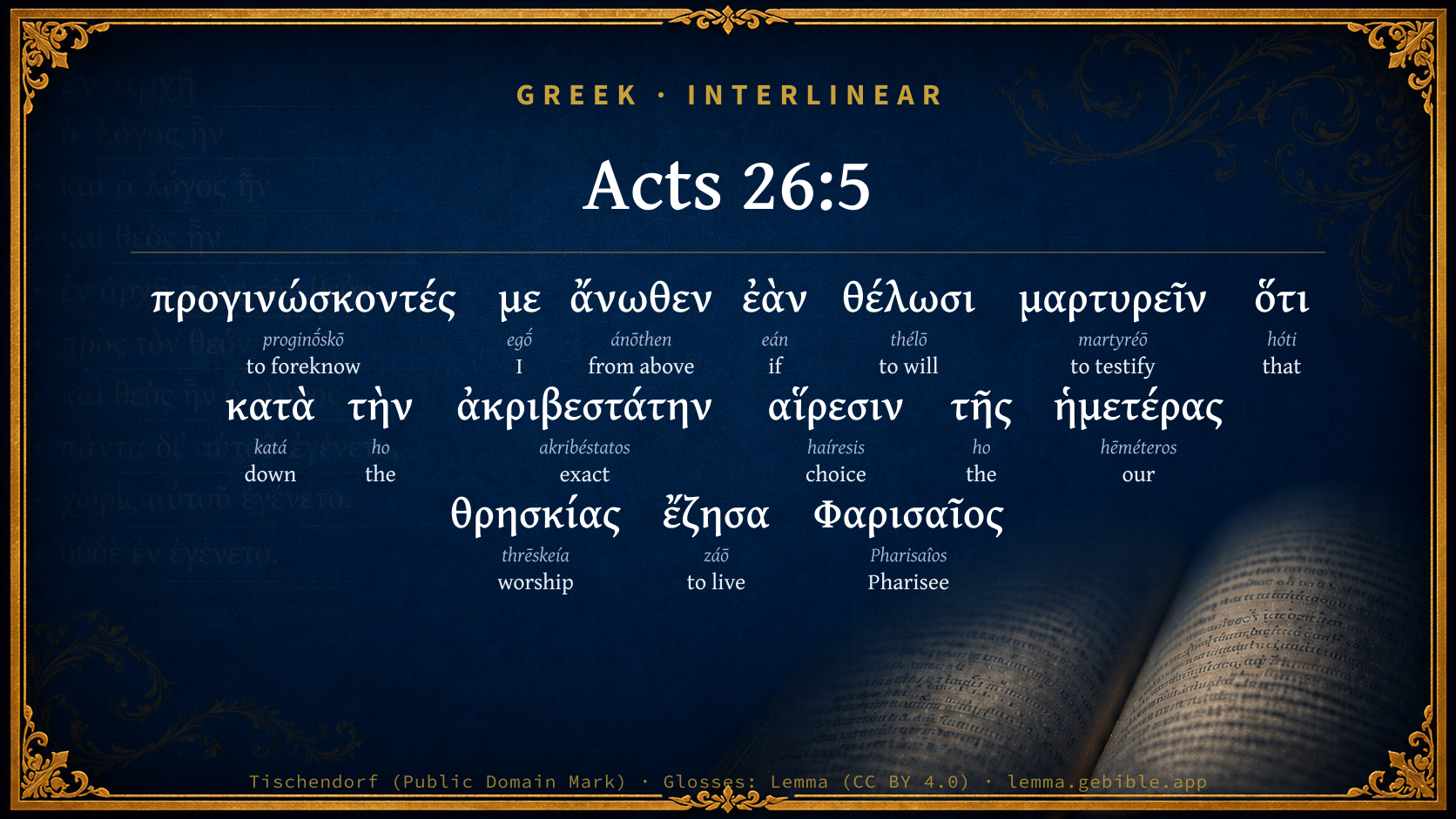
Greek (Tischendorf 8th ed.) Acts 26:5 appears in the Greek New Testament. The text above is from the Tischendorf 8th edition. Each word links to its Strong’s number and a concise gloss. Click any word for its full Thayer’s Greek Lexicon entry.
Download image
Cite this verse

Acts 26:5 (World English Bible). Public Domain. Lemma interlinear Bible study tool, https://lemma.gebible.app/v/acts/26/5.

Show BibTeX & RIS
BibTeX
RIS
English Translation
having known me from the first, if they are willing to testify, that after the strictest sect of our religion I lived a Pharisee.
World English Bible · Public Domain
Highlights
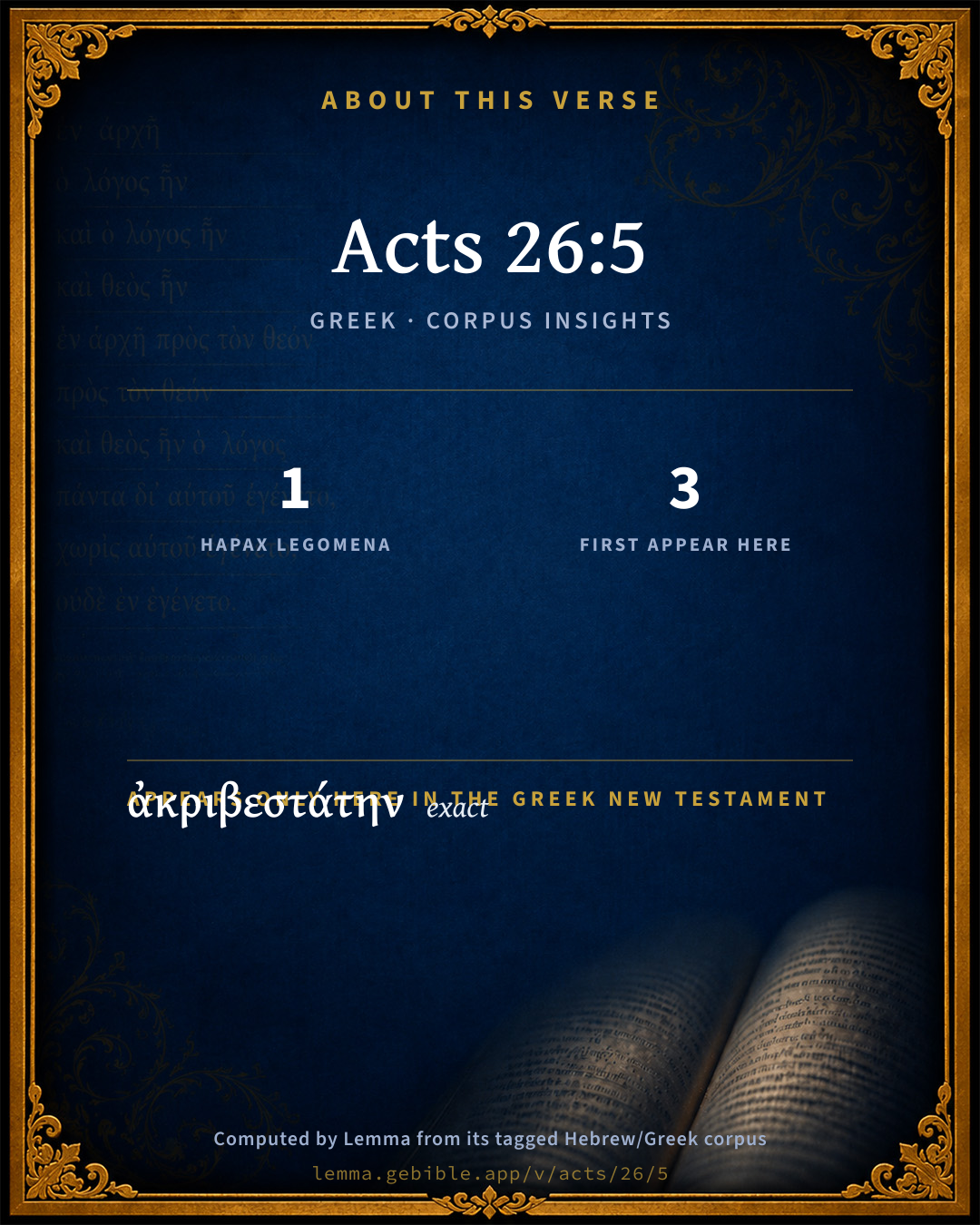
  • 1 hapax legomenon — only here in the Greek New Testament
  • 3 first appearances in the Greek New Testament
Full analysis ↓
Download a study sheet

One document with this verse’s original text, its word-by-word gloss line, the meaning frame, cross-references with their text, attributed commentary, and full source and license credits — printable, and it pastes into notes with its structure intact.

This verse Autodidact and up

Study sheet (.html) Plain text (.txt)

A passage Seminary Student

Up to 50 verses in one chapter. A passage sheet keeps up to 6 commentary sources and 12 cross-references per verse, in the order this page ranks them, and says so on the sheet whenever that leaves anything out. Ask for a single verse and you get the Autodidact verse sheet above.

Everything on this page stays free to read, with no account — the sheet is a download of what is already on screen, not access to it.

Want to remove ads? Support Godless Engineer
Compare translations 3

The same verse in 3 English versions, stacked beneath the original-language interlinear above. Click any original word for its lexicon entry.

Each is an independent rendering of the whole verse — the interlinear is not word-aligned to these translations.

Highlighted words mark where these versions differ — a whole-verse word diff, not a word-by-word alignment.

  • World English Bible Public Domain
    having known me from the first, if they are willing to testify, that after the strictest sect of our religion I lived a Pharisee.
  • King James Version Public Domain
    Which knew me from the beginning, if they would testify, that after the most straitest sect of our religion I lived a Pharisee.
  • unfoldingWord Literal Text CC BY-SA 4.0
    knowing me from the beginning, if they wished to testify, that according to the strictest sect of our religion I lived as a Pharisee.

unfoldingWord Literal Text — © unfoldingWord, licensed CC BY-SA 4.0. Word-aligned USFM3 via Door43 (git.door43.org/unfoldingWord/en_ult).

Versions to compare (up to 4)

3 of 4 selected

Show all 19 translations

Every available English version of this verse, each an independent rendering of the whole verse.

  • World English Bible Public Domain
    having known me from the first, if they are willing to testify, that after the strictest sect of our religion I lived a Pharisee.
  • Berean Standard Bible Public Domain
    They have known me for a long time and can testify, if they are willing, that I lived as a Pharisee, adhering to the strictest sect of our religion.
  • Majority Standard Bible Public Domain
    They have known me for a long time and can testify, if they are willing, that I lived as a Pharisee, adhering to the strictest sect of our religion.
  • King James Version Public Domain
    Which knew me from the beginning, if they would testify, that after the most straitest sect of our religion I lived a Pharisee.
  • American Standard Version (1901) Public Domain
    having knowledge of me from the first, if they be willing to testify, that after the straitest sect of our religion I lived a Pharisee.
  • Revised Version (1885) Public Domain
    having knowledge of me from the first, if they be willing to testify, how that after the straitest sect of our religion I lived a Pharisee.
  • Geneva Bible (1599) Public Domain
    Which knewe me heretofore, euen from my elders (if they would testifie) that after the most straite sect of our religion I liued a Pharise.
  • Douay-Rheims (1899) Public Domain
    Having known me from the beginning (if they will give testimony) that according to the most sure sect of our religion I lived a Pharisee.
  • Young's Literal Translation Public Domain
    knowing me before from the first, (if they may be willing to testify,) that after the most exact sect of our worship, I lived a Pharisee;
  • Literal Standard Version CC BY-SA 4.0
    knowing me before from the first (if they may be willing to testify), that after the most exact sect of our worship, I lived a Pharisee;
  • Unlocked Literal Bible CC BY-SA 4.0
    They knew me from the beginning and they should admit that I lived as a Pharisee, the strictest party of our religion.
  • unfoldingWord Literal Text CC BY-SA 4.0
    knowing me from the beginning, if they wished to testify, that according to the strictest sect of our religion I lived as a Pharisee.
  • Darby Bible Public Domain
    who knew me before from the outset [of my life], if they would bear witness, that according to the strictest sect of our religion I lived a Pharisee.
  • World Messianic Bible Public Domain
    having known me from the first, if they are willing to testify, that after the strictest sect of our religion I lived a Pharisee.
  • Webster's Bible Public Domain
    Who knew me from the beginning, (if they would testify) that after the strictest sect of our religion, I lived a Pharisee.
  • Free Bible Version CC BY-SA 4.0
    They have known me for a long time and can verify, if they choose to, that I have followed the religious school that observes our faith in the strictest way—I lived as a Pharisee.
  • Bible in Basic English Public Domain
    And they are able to say, if they would give witness, that I was living as a Pharisee, in that division of our religion which is most regular in the keeping of the law.
  • Text-Critical English NT CC BY 4.0
    They have known about me for a long time, if they are willing to testify, that according to the strictest sect of our religion I lived as a Pharisee.
  • Tyndale New Testament (1534) Public Domain
    which knew me from the beginnynge yf they wolde testifie it. For after the most straytest secte of oure laye lyved I a pharisaye.

Literal Standard Version (2020), Covenant Press — licensed CC BY-SA 4.0. Text via the HelloAO Bible API (eBible.org). Unlocked Literal Bible (unfoldingWord) — licensed CC BY-SA 4.0. Text via the HelloAO Bible API (eBible.org). unfoldingWord Literal Text — © unfoldingWord, licensed CC BY-SA 4.0. Word-aligned USFM3 via Door43 (git.door43.org/unfoldingWord/en_ult). Free Bible Version, Dr. Jonathan Gallagher — licensed CC BY-SA 4.0. Text via the HelloAO Bible API (eBible.org).

Word by word

More ways to search: Search by grammar → Find every occurrence → Compare this word →

Practice this passage: Drill this verse → Learn its vocabulary →

ἀκριβεστάτην
akribéstatos
G196
“exact”
Adjective, Accusative, Singular, Feminine, Superlative
Part of Speech
Adjective
Case
Accusative
Number
Singular
Gender
Feminine
Degree
Superlative
Full Thayer's Definition

Origin: superlative of akribes (a derivative of the same as G206 )

TDNT: None

1. exact, careful 2. of the strictest sect: the most precise and rigorous in interpreting the Mosaic law, and in observing even the more minute precepts of the law and tradition
  1. προγινώσκοντές proginṓskō G4267 “to foreknow” Verb, Present, Active, Participle, Nominative, Plural, Masculine
  2. με egṓ G1473 “I” Personal pronoun, 1st person, Accusative, Singular
  3. ἄνωθεν ánōthen G509 “from above” Adverb
  4. ἐὰν eán G1437 “if” Conditional
  5. θέλωσι thélō G2309 “to will” Verb, Present, Active, Subjunctive, 3rd person, Plural
  6. μαρτυρεῖν martyréō G3140 “to testify” Verb, Present, Active, Infinitive
  7. ὅτι hóti G3754 “that” Conjunction
  8. κατὰ katá G2596 “down” Preposition
  9. τὴν ho G3588 “the” Article, Accusative, Singular, Feminine
  10. αἵρεσιν haíresis G139 “choice” Noun, Accusative, Singular, Feminine
  11. τῆς ho G3588 “the” Article, Genitive, Singular, Feminine
  12. ἡμετέρας hēméteros G2251 “our” Possessive pronoun, 1st person, Genitive, Plural, Feminine
  13. θρησκίας thrēskeía G2356 “worship” Noun, Genitive, Singular, Feminine
  14. ἔζησα záō G2198 “to live” Verb, Aorist, Active, Indicative, 1st person, Singular
  15. Φαρισαῖος Pharisaîos G5330 “Pharisee” Noun, Nominative, Singular, Masculine

About this verse

These counts appear in no published source. They are computed here, from the morphology-tagged text and Lemma’s own curated glosses. What Lemma adds →

16
words
15
distinct lemmas
Acts
section

Notable vocabulary

1 hapax legomenon — a word that appears only here in the entire Greek New Testament:

  • ἀκριβεστάτην exact G196

First appearance in Scripture

These words make their first canonical appearance in the Greek New Testament here:

  • προγινώσκοντές to foreknow G4267
  • ἀκριβεστάτην exact G196
  • θρησκίας worship G2356

Shared distinctive vocabulary

θρησκίας worship G2356 occurs in 4 verses of the Greek New Testament. Also found in:

Repetition

A word recurs within this verse:

Cross-references

6

Topical passages linked to Acts 26:5 in the Treasury of Scripture Knowledge — connected by theme and wording, ordered by reader-vote popularity; previews shown in the World English Bible.

  • Acts 23:6 But when Paul perceived that the one part were Sadducees and the other Pharisees, he cried out in the council, "Men and brothers, I am a Pharisee, a son of Pharisees. Concerning the hope and resurrection of the dead I am being judged!"
  • Acts 22:3 "I am indeed a Jew, born in Tarsus of Cilicia, but brought up in this city at the feet of Gamaliel, instructed according to the strict manner of the law of our fathers, being zealous for God, even as you all are this day.
  • Acts 22:5 As also the high priest and all the council of the elders testify, from whom also I received letters to the brothers, and traveled to Damascus to bring them also who were there to Jerusalem in bonds to be punished.
  • Acts 24:5 For we have found this man to be a plague, an instigator of insurrections among all the Jews throughout the world, and a ringleader of the sect of the Nazarenes.
  • Acts 24:14 But this I confess to you, that after the Way, which they call a sect, so I serve the God of our fathers, believing all things which are according to the law, and which are written in the prophets;
  • Philippians 3:5–6 circumcised the eighth day, of the stock of Israel, of the tribe of Benjamin, a Hebrew of Hebrews; concerning the law, a Pharisee;

Cross-references courtesy of OpenBible.info (CC BY 4.0).

Commentary

Notes on Acts 26:5 from classic Christian and Jewish commentators (each source and its license shown beneath its notes). The classic Christian expositions comment on the surrounding passage and are grouped to its opening verse, so a note may address several verses; the Jewish commentaries on the Tanakh (Rashi and others) are per-verse, so they appear only where the commentator wrote on this verse.

Lemma curates 59 commentaries, every one of them public domain or Creative Commons licensed, each selected and text-cleaned for this edition rather than reprinted as found. About our sources →

Bengel's Gnomon

Johann Albrecht Bengel

Act 26:5. Προγινώσκοντες) knowing me, before that I speak.—ἐὰν θέλωσι, if they be willing) But they were unwilling [to testify], because they were sensible that in the conversion of Paul, even in respect to his previous life, there is the most effectual argument for the truth of the Christian faith.

Bengel's Gnomon of the New Testament — English translation (T&T Clark, Edinburgh, 1860) — public domain. Text from a community e-Sword module.

Expositor's Greek Testament

ed. W. Robertson Nicoll

Act 26:5 . προγιν . με : knowing me beforehand, i.e. , ἄνωθεν , from the beginning of my public education in Jerusalem. προγ .: twice elsewhere by Paul, Rom 8:29 ; Rom 11:2 , also in 1Pe 1:20 , 2Pe 3:17 . For ἀπʼ ἀρχῆς and ἅνωθεν cf. Luk 1:2-3 , and for the former also 2Th 2:13 . ἀκριβ .: “the straitest sect,” R.V., on the double accusative in A.V. see Humphry, Commentary on R.V. For this classical form, the only instance of a superlative in - τατος in N.T., see especially Blass, u. s. , cf. Act 26:4 ; on the term in its close connection with Pharisaism cf. Jos., B.J. , i., 5, 2; Ant. , xvii., 2, 4, and references above on Act 22:3 . Their “straitness” included not only observance and interpretation of the Mosaic law, but also of the whole παράδοσις τῶν πρεσβυτέρων . αἵρεσιγ , see on Act 5:17 , the word in the sense of “a sect” was rightly applied to the exclusiveness of Pharisaism as in the N.T., cf. Act 15:5 , and in Jos., cf. Vita , 38. θρησκείας : “ cultus religionis , potissimum externus ,” Grimm, so here and in the other places where it occurs in N.T., Col 2:18 , Jas 1:26-27 ; twice in Wisdom, Wis 14:18 ; Wis 14:27 , of the worship of idols; in Sir 22:5 the reading is doubtful; in 4Ma 5:6 ; 4Ma 5:13 , of the religion of the Jews. The instances of its use both in Philo and Josephus show that it was plainly, distinguished from εὐσεβεία and ὁσιότης . Thus it is contrasted with the latter by Philo, Quod det. potiori insid. , c. 7: θρησκείαν ἀντὶ ὁσιότητος ἡγούμενος ; and in Josephus it is frequently used of the public worship of God, worship in its external aspect, cf. Ant. , ix., 13, 3; xii., 5, 4; v., 10, 1; xii., 6, 2. It was therefore a very natural word for St. Paul to use, and it is not necessary to suppose that he did so merely for the sake of Festus and the Romans (Blass), although the word was used of one mode of worship when contrasted with another; see further Hatch, Essays in B.G. , p. 55; Trench, Synonyms , i., p. 200, and Mayor on Jas 1:26 . φαρισαῖος : emphatic at the end, expressing the “straitest sect” by name, cf. Gal 1:14 , Phi 3:5-6 .

The Expositor's Greek Testament, edited by W. Robertson Nicoll (1897–1910) — public domain. Text from a community e-Sword module.

Geneva Bible (1599)

Geneva Bible translators

That my parents were Pharisees.

What I was, and where, and how I lived.

The sect of the Pharisees was the most exquisite amongst all the sects of the Jews, for it was better than all the rest.

Geneva Bible (1599) marginal notes — public domain. Text via Bolls.life.

Jamieson, Fausset & Brown

Robert Jamieson, A. R. Fausset & David Brown

if they would--"were willing to"

testify--but this, of course, they were not, it being a strong point in his favor.

after the most straitest--"the strictest."

sect--as the Pharisees confessedly were. This was said to meet the charge, that as a Hellenistic Jew he had contracted among the heathen lax ideas of Jewish peculiarities.

Jamieson, Fausset & Brown — Commentary Critical and Explanatory on the Whole Bible (1871) — public domain (CC PDM 1.0). Text via the HelloAO Bible API.

Adam Clarke's Commentary

Verse 5. After the most straitest sect] That is, the Pharisees; who were reputed the strictest in their doctrines, and in their moral practices, of all the sects then among the Jews. The sects were the Pharisees, Sadducees, and Essenes.

Adam Clarke's Commentary on the Bible (1810–1826) — public domain. Text from a community e-Sword/MySword module.

Ellicott's Commentary for English Readers

(5) After the most straitest sect.—Better, most rigid, or most precise. The Greek does not contain anything answering to the double superlative of the English. The word for “sect” is the same as that used in Act_24:5, and translated “heresy” in Act_24:14.

A Bible Commentary for English Readers, edited by Charles John Ellicott (1878–1897) — public domain. Text from a community e-Sword module.

The Cambridge Bible for Schools and Colleges

gen. ed. J. J. S. Perowne

5. which knew me from the beginnings if they would testify] Better (with Rev. Ver.) “having knowledge of me from the first, if they be willing to testify.” The word for “from the first” is the same which St Luke uses (Luk_1:3) to indicate his perfect understanding of the Gospel story “from the very first.” When we remember that the early part of his Gospel can hardly have been gathered from anybody but the Virgin Mary, who alone could know many of the details, we may well think that the word implies that St Paul had been known from his very childhood. The rest of the sentence seems to intimate that there were some among those who were now his accusers who could give evidence about his previous years if they were so minded.

the most straitest] There is nothing in the Greek to warrant the double superlative. Read “straitest.”

sect] The word is that which is rendered “heresy” by the A. V. in Act_24:14. Everywhere else in the Acts it is sect. In the Epistles, where the plural only occurs, it is “heresies.”

our religion] The word refers more especially to the outward ceremonials of worship, such as those by which the Pharisees were specially distinguished.

The Cambridge Bible for Schools and Colleges (gen. ed. J. J. S. Perowne; Cambridge University Press, 1878–1918) — public domain. Text from a community e-Sword module.

John Gill's Exposition

Which knew me from the beginning,.... From his youth, from his first coming to Jerusalem:

if they would testify; what they know, and speak out the truth of things, they must say,

that after the most straitest sect of our religion I lived a Pharisee; there were three sects of religion among the Jews, the Pharisees, Sadducees, and Essenes; the first of these was the most exact, and came nearest to the truth of doctrine, and was the strictest as to outward holiness of life and conversation, and of this sect the apostle was; and according to it he lived, and that in such a manner, as not to be charged with any notorious crime; and indeed in his own, and very likely in the opinion of others, he was then blameless. See Gill on Mat 3:7.

(Essenes: A Jewish sect, who, according to the description of Josephus, combine the ascetic virtues of the Pythagoreans and the Stoics with a spiritual knowledge of the divine law. It seems probable that the same name signifies "seer", or "the silent, the mysterious". As a sect the Essenes were distinguished by an aspiration after the ideal purity rather than by any special code of doctrines. There were isolated communities of the Essenes, which were regulated by strict rules, and analogous to those of the monastic institutions of a later date. All things were held in common, without distinction of property; and special provision was made for the relief of the poor. Self-denial, temperance and labour--especially agricultural--were the marks of the outward life of the Essenes; purity and divine communication the objects of aspiration. Slavery, war and commerce were alike forbidden. Their best known settlements were on the north west shore of the Dead Sea. J.B. Smith one volume Bible Dictionary.)

John Gill's Exposition of the Whole Bible (1746–1763) — public domain (CC PDM 1.0). Text via the HelloAO Bible API.

Trapp's Complete Commentary

John Trapp

5 Which knew me from the beginning, if they would testify, that after the most straitest sect of our religion I lived a Pharisee.

Ver. 5. After the most straitest sect] There were three several sects among the Jews, Pharisees, Sadducees, and Essenes; which last lived a monastic kind of life, and besides the Bible, studied medicine: whence also they had their name of Asa, to heal. The Pharisees were most in request, professing extraordinary strictness, as those districtissimi Monachi, those puritan monks among the Papists (as one calleth them) that carried wooden crosses at their backs continually, and pretended for it Mat 10:38.

John Trapp, A Commentary or Exposition upon All the Books of the Old and New Testament (1647–1656) — public domain. Text from a community e-Sword module.

Albert Barnes' Notes on the Bible

Which knew me - Who were well acquainted with me.

From the beginning - ἄνωθεν anōthen. Formerly; or from the very commencement of my career. Who were perfectly apprised of my whole course.

If they would testify - If they would bear witness to what they know.

That after the most straitest - The most rigid; the most strict, not only in regard to the written Law of God, but to the traditions of the elders. Paul himself elsewhere testifies Phi 3:4-6 that he had enjoyed all the advantages of birth and training in the Jewish religion, and that he had early distinguished himself by his observance of its rites and customs.

Sect - Division or party.

I lived a Pharisee - I lived in accordance with the rules and doctrines of the Pharisees. See the notes on Mat 3:7. The reasons why Paul here refers to his early life are:

(1) As he had lived during the early period of his life without crime; as his principles had been settled by the instruction of the most able of their teachers, it was to be presumed that his subsequent life had been of a similar character.

(2) As he, at that period of his life, evinced the utmost zeal for the laws and customs of his country, it was to be presumed that he would not be found opposing or reviling them at any subsequent period. From the strictness and conscientiousness of his past life, he supposed that Agrippa might argue favorably respecting his subsequent conduct. A virtuous and religious course in early life is usually a sure pledge of virtue and integrity in subsequent years.

Albert Barnes' Notes on the Bible (1834–1885) — public domain. Text from a community e-Sword/MySword module.

Haydock's Catholic Bible Commentary

According to the most sure sect.[1] In the Greek, the most exact or approved: for such was esteemed that of the Pharisees. (Witham)

===============================

[BIBLIOGRAPHY]

Certissimam, Greek: akribestaten, accuratissimam.

George Leo Haydock (1774–1849), Haydock's Catholic Family Bible and Commentary, 1859 edition — public domain. Excludes Psalms (Douay-Rheims chapter numbering differs from Protestant) and Deuterocanonical books (Catholic canon only).

Matthew Poole's English Annotations

This heresy, sect, opinion, or way of the Pharisees, St. Paul rigthly commends, if we consider it comparatively with the other sects of the Sadducees and Essenes: he had called this before, Act 22:3, the most exact manner of the law of the fathers; for it is certain it was more learned and strict, and came nigher to the truth in many things, than the other did.

Matthew Poole's English Annotations on the Holy Bible (1683–1685) — public domain. Text from a community e-Sword/MySword module.

Whedon's Commentary on the Bible

Daniel D. Whedon

5. If they would testify—Which as enemies it is not certain that they would have the magnanimity to do.

Most straitest—A double superlative retained from the old English of the first translator, Tyndale.

Daniel D. Whedon (gen. ed.), Commentary on the Old and New Testaments (1874–1909) — public domain. Text from a community e-Sword module.

The Pulpit Commentary

Having knowledge of me from the first for which knew me from the beginning, A.V.; be willing to for would, A.V.; how that for that, A.V.; straitest for most straitest, A.V.. Straitest (ajkribestathn); see; Act_22:3 Act_18:26, etc. Sect (airesiv) see Act_24:14, note. He does not disclaim being still a Pharisee. On the contrary, in the next verse (ver. 6) he declares, as he had done in Act_23:6, that it was for the chief hope of the Pharisees that he was now accused. He tries to enlist all the good feeling that ye t remained among the Jews on his side.

HOMILIES BY R. TUCK Ver. 5. St. Paul a Pharisee.

Very remarkable is the skill shown by the apostle in the adaptation of his defenses before different rulers. This Agrippa prided himself upon his Jewish knowledge, and would be quite familiar with the Jewish sects. The offences charged against St. Paul related chiefly to Jewish ceremonial and rights, so the apostle could make no answer which would influence Agrippa so certainly as the answer given in the text, "After the most straitest sect of our religion I lived a Pharisee." Agrippa would know that a man born and brought up as a Pharisee was not in the least likely to offend against the customs and rites which that body so jealously preserved. Conybeare and Howson say, "Not only was Paul a Pharisee, but his fathers and teachers belonged to this sect. This is nearly all we know of St. Paul"s parents. We can conceive of the apostle as born in the Pharisaic family, and as brought up from his infancy in the "straitest sect" of the Jewish religion.

His childhood was nurtured in the strictest belief, as he had before him the example of his father who prayed and walked with broad phylacteries, and were scrupulous and exact in their legal observances. He had, moreover, the memory and tradition of ancestral piety, for he tells us that he served God "from his forefathers." Everything, therefore, tended to prepare him to be an eminent member of that theological party to which so many of the Jews were looking for the preservation of their natural life, and extension of their natural creed." Compare St. Paul"s account of himself as given in Gal_1:14; Php_3:5, 6. We dwell on the fact of St. Paul"s Pharisaic birth, education, and sympathies, in order to show

I HOW THESE AFFECTED HIS RELATIONS WITH THE JEWS. He ought to have been peculiarly acceptable to the Jews. The bias of his life was wholly in favor of ceremonial Judaism. He might have been looked to as one of the noblest champions of Mosaism. He did come out as a leader of the party which persecuted the followers of Jesus of Nazareth. He had never separated himself from the Jewish rites and ordinances. To the close of life he maintained his Pharisaism. He pleaded, indeed, for liberty from ritual bonds on behalf of the Gentile converts, but he did not take the liberty for himself; so that, if the Jews had not yielded to blinding prejudice, they might have found in this Christian Pharisee the conservator of all the essentials of Mosaism. It should be clearly seen that St. Paul at once admitted the new light that came from God, and jealously conserved the old, which had also come from him. No doubt the apostle saw that the Jewish system would fade away, and give place to a spiritual religion for which simpler forms would suffice; but it was no part of his mission to hurry on the time of the passing away. His point was this Jewish bonds must not be laid on Gentile converts. Judaism cannot be aggressive; it must keep well within its own lines and limits.

II How ST. PAUL"S PHARISAISM BORE UPON THE CHARGES MADE AGAINST HIM. It made those charges seem ridiculous. One brought up as a zealous Pharisee insultingly defiling the sacred temple was simply absurd. Such a man could not have done such a thing. And the assumption further was that the public teachings of such a man could not be out of harmony with true Judaism. Men are true to themselves: they do not make themselves ridiculous by such open inconsistencies. St. Paul may plead in answer to all their charges, "I was, I am, a Pharisee.

III How ST. PAUL"S PHARISAIC EDUCATION BECAME A PREPARATION FOR HIS CHRISTIAN FAITH AND LIFE. Such an education established a strong conviction concerning three things.

1. The direct ruling and intervention of Jehovah, so that, at any time, any of his servants might have direct and personal communications from him. The fathers and the prophets had received such revelations, and revelations and visions may come to men still.

2. The importance of Holy Scripture, as given by inspiration of God.

3. And the expectation of Messiah, as fulfilling Scripture prophecy and promise. It may easily be shown how those Pharisaic sentiments prepared fur

(1) the vision at Damascus;

(2) the key which that vision gave to Scripture, and especially to the figure of Messiah presented in the Scripture. Compare the difference of result if St. Paul had been by birth and education a doubting, skeptical Sadducee. True Christianity is the natural and proper outcome of true Pharisaism. Those who were loyal to the idea of the theocracy, and to the Scripture as the human expression of the Divine will and purpose, ought to have been led to a full acceptance of Jesus of Nazareth as Messiah, the Savior, the Son of God. Illustrate and impress that in a man"s early years is displayed the character that is to distinguish his whole life; and that we are all greatly dependent on the tone of the influences that surround our infancy and childhood. Manhood should not, indeed, witness the mere continuance of childhood"s prejudices, it should be the true and worthy development, adaptation, and application of childhood"s principles. R.T.

The Pulpit Commentary (1880–1919), ed. H.D.M. Spence-Jones & Joseph S. Exell — public domain. Text from a community e-Sword module.

John Wesley's Explanatory Notes

If they would testify - But they would not, for they well knew what weight his former life must add to his present testimony.

John Wesley, Explanatory Notes Upon the Whole Bible (1754–1765) — public domain. Text via the GEBible commentary corpus.

McGarvey & Pendleton's Commentaries

J. W. McGarvey

See notes on verse 4

J. W. McGarvey (with Philip Y. Pendleton), Commentaries on the New Testament (The Fourfold Gospel, 1914; Acts; and the epistles) — public domain. Text from a community e-Sword/MySword module.

Cambridge Greek Testament for Schools and Colleges

5. προγινώσκοντές με ἄνωθεν, ἐὰν θώλωσι μαρτυρεῖν, having knowledge of me from the first, if they be willing to testify. ἄνωθεν is found Luk 1:3, where the Evangelist is describing his perfect understanding of the Gospel story ‘from the very first.’ When we remember that the early part of his Gospel can hardly have been gathered from anybody but the Virgin Mary, who alone could know many of the details, we may well think that the word ἄνωθεν here implies that St Paul had been known from his very childhood. The rest of the sentence seems to intimate that there were some among those who were now his accusers who could give evidence about his previous years if they were so minded.

κατὰ τὴν ἀκριβεστάτην αἵρεσιν, after the straitest sect. αἵρεσις in the singular = sect, as it is rendered everywhere in the Acts (in A.V.) except Act 25:14. In the Epistles where the plural only occurs it is ‘heresies.’

τῆς ἡμετέρας θρησκείας, of our religion. θρησκεία refers more especially to the outward marks of religious observance or life. Thus it would describe well the ceremonial for which the Pharisees were specially distinguished. In the LXX. it is only used of the worship of idols. See Wis 14:18; Wis 14:27.

Cambridge Greek Testament for Schools and Colleges (Cambridge University Press, 1896; 21 vols, various authors incl. Carr, Maclear, Plummer, Farrar, Lumby, Moule, M. R. James, Simcox) — public domain. Text from a community e-Sword module.

Alford’s Greek Testament

Henry Alford

5. ἀκριβεστάτην] See ch. 22:3: κατὰ ἀκρίβειαν τοῦ πατρῴου νόμου. Jos. (B. J. i. 5. 2) calls the Pharisees σύνταγμά τι Ἰουδαίων δοκοῦν εὐσεβέστερον εἶναι τῶν ἄλλων, καὶ τοὺς νόμους ἀκριβέστερον ἀφηγεῖσθαι. The use of the term finds another example in Eph 5:15, βλέπετε πῶς ἀκριβῶς περιπατεῖτε, which command it illustrates.

θρησκεία] ἡ λατρεία· ὅθεν καὶ ἑτερόθρησκος, ἑτερόδοξος. Suidas.

We have an instance here of αἵρεσις used in an indifferent sense.

Henry Alford, The Greek Testament (1849–1861) — public domain. Text from a community e-Sword module.

Lesson kit

Teaching starters — assembled from the data on this page, not authored interpretation. Every prompt links to the verse data it draws on. Edit before teaching.

Acts, in the Acts, opens this verse with 16 words (15 distinct Greek lemmas). Its most distinctive word is akribéstatos (“exact”). A historical commentator’s framing appears above. Read the whole chapter for the surrounding context.

Discussion questions

  1. What does “exact” (akribéstatos) contribute to the verse as a whole?
  2. This verse holds 1 word here found nowhere else in the Greek New Testament. What might the rare word draw attention to?
  3. 3 words here appear for the first time in Scripture. What is being introduced at this debut?
  4. Colossians 2:18 shares the word «worship» with this verse. How do the two illuminate each other?
  5. “the” occurs 2× in this one verse. What is the effect of the repetition?
  6. These translations render this verse differently. What is at stake in choosing one wording over another?
  7. Reading how Bengel's Gnomon and Expositor's Greek Testament read this verse, where do the two commentators agree and where do they part?

Things to notice

  • 1 word in this verse appears nowhere else in the Greek New Testament.
  • 3 words make their first canonical appearance in Scripture here.
  • These translations choose different wording for 15 words in this verse.
  • “the” occurs 2× in this single verse.
  • 15 distinct Greek lemmas span 16 words in this verse.

Reading settings

Reading text

Shown beneath each verse's original-language words.

Old Testament
Old Testament edition

Read the OT as the Masoretic Hebrew (MT) or the Greek Septuagint (LXX).

English shown for the Greek Septuagint (in the Hebrew ↔ Greek comparison).

Comparing translations? Open the Compare panel on any verse page to stack up to four side by side.