
1 Timothy 5:11

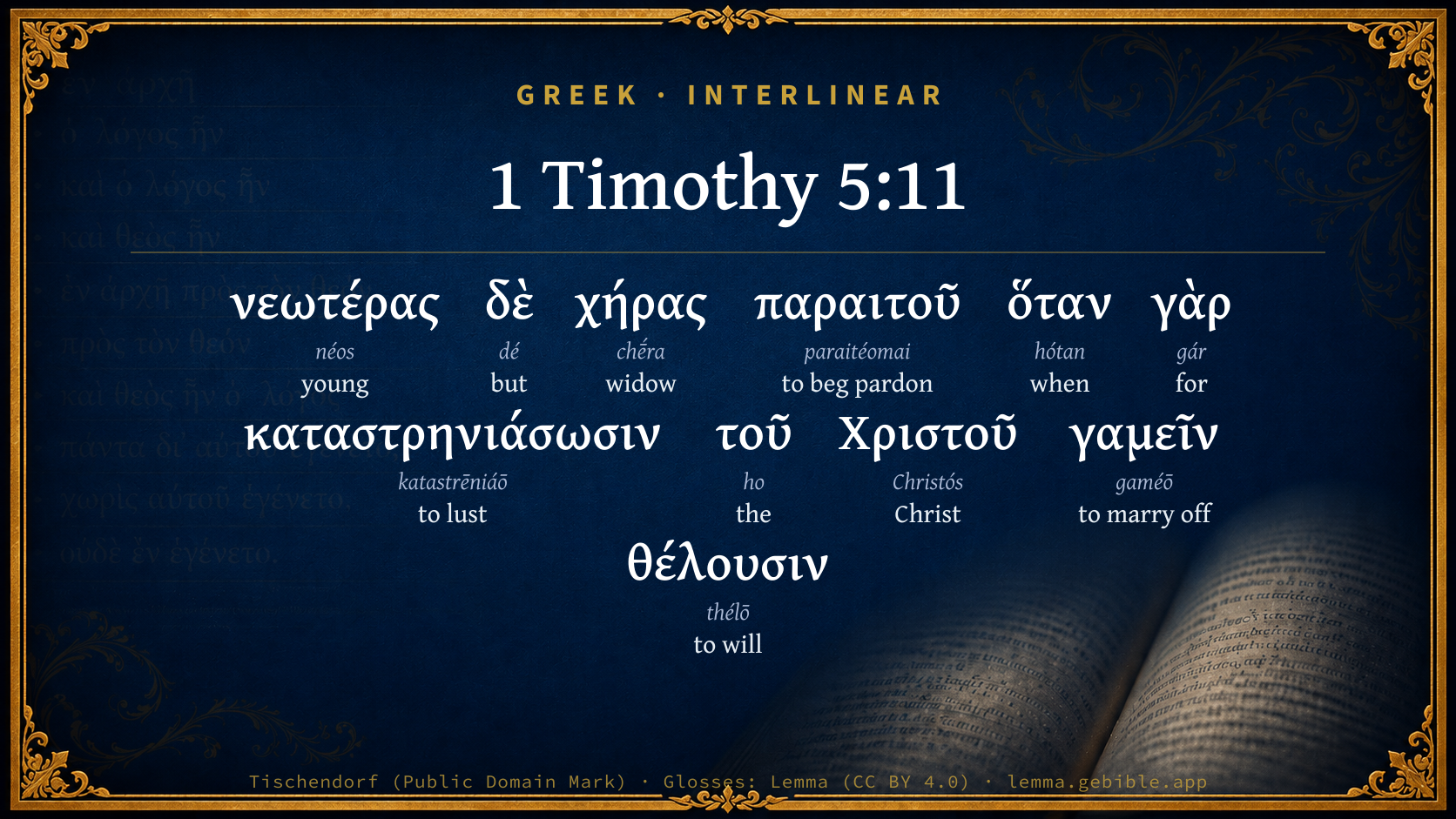
Greek (Tischendorf 8th ed.) 1 Timothy 5:11 appears in the Greek New Testament. The text above is from the Tischendorf 8th edition. Each word links to its Strong’s number and a concise gloss. Click any word for its full Thayer’s Greek Lexicon entry.
Download image
Cite this verse

1 Timothy 5:11 (World English Bible). Public Domain. Lemma interlinear Bible study tool, https://lemma.gebible.app/v/1-timothy/5/11.

Show BibTeX & RIS
BibTeX
RIS
English Translation
But refuse younger widows, for when they have grown wanton against Christ, they desire to marry;
World English Bible · Public Domain
Highlights
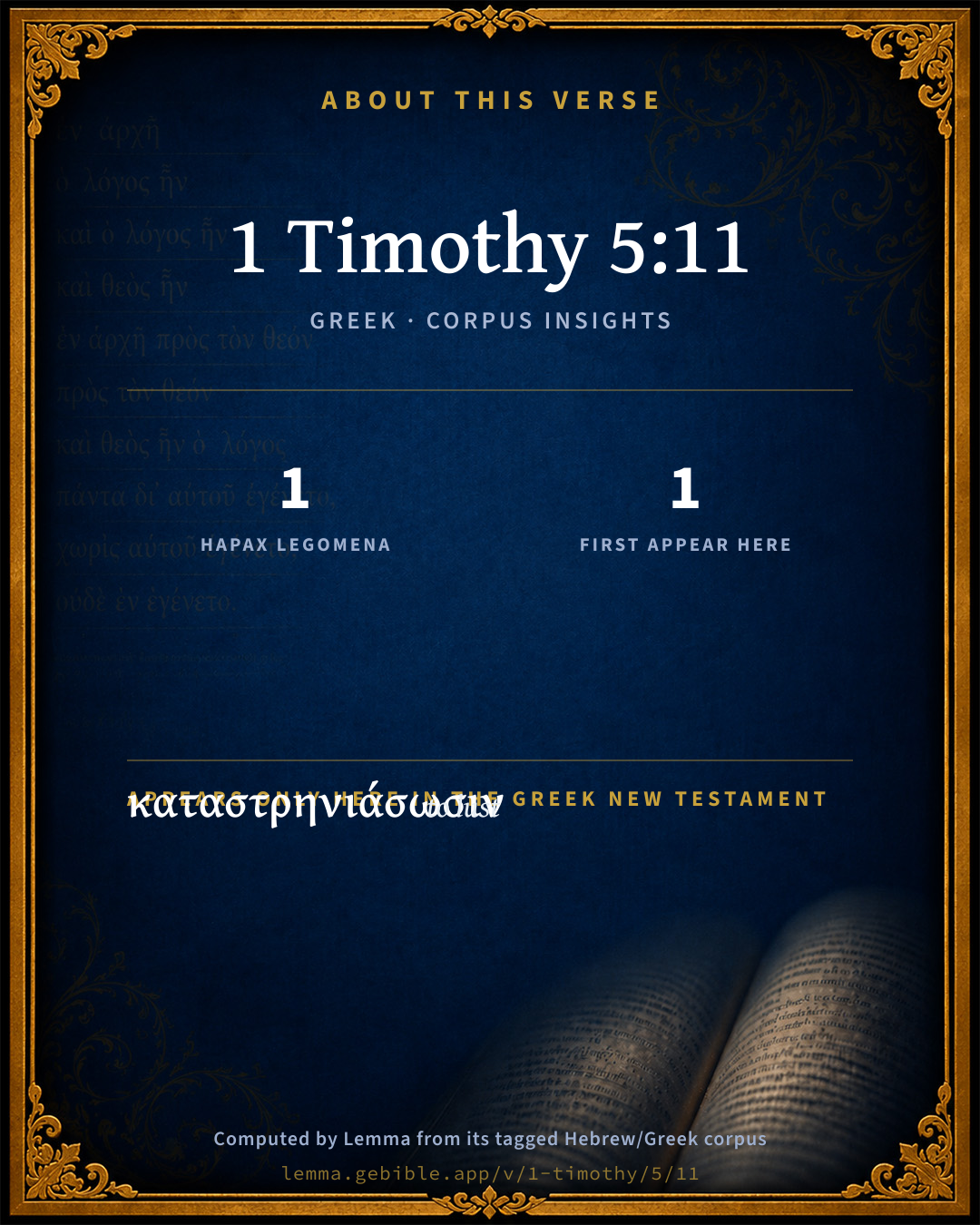
  • 1 hapax legomenon — only here in the Greek New Testament
  • 1 first appearance in the Greek New Testament
Full analysis ↓
Download a study sheet

One document with this verse’s original text, its word-by-word gloss line, the meaning frame, cross-references with their text, attributed commentary, and full source and license credits — printable, and it pastes into notes with its structure intact.

This verse Autodidact and up

Study sheet (.html) Plain text (.txt)

A passage Seminary Student

Up to 50 verses in one chapter. A passage sheet keeps up to 6 commentary sources and 12 cross-references per verse, in the order this page ranks them, and says so on the sheet whenever that leaves anything out. Ask for a single verse and you get the Autodidact verse sheet above.

Everything on this page stays free to read, with no account — the sheet is a download of what is already on screen, not access to it.

Want to remove ads? Support Godless Engineer
Compare translations 3

The same verse in 3 English versions, stacked beneath the original-language interlinear above. Click any original word for its lexicon entry.

Each is an independent rendering of the whole verse — the interlinear is not word-aligned to these translations.

Highlighted words mark where these versions differ — a whole-verse word diff, not a word-by-word alignment.

  • World English Bible Public Domain
    But refuse younger widows, for when they have grown wanton against Christ, they desire to marry;
  • King James Version Public Domain
    But the younger widows refuse: for when they have begun to wax wanton against Christ, they will marry;
  • unfoldingWord Literal Text CC BY-SA 4.0
    But reject younger widows, for when they indulge themselves against Christ, they want to marry,

unfoldingWord Literal Text — © unfoldingWord, licensed CC BY-SA 4.0. Word-aligned USFM3 via Door43 (git.door43.org/unfoldingWord/en_ult).

Versions to compare (up to 4)

3 of 4 selected

Show all 19 translations

Every available English version of this verse, each an independent rendering of the whole verse.

  • World English Bible Public Domain
    But refuse younger widows, for when they have grown wanton against Christ, they desire to marry;
  • Berean Standard Bible Public Domain
    But refuse to enroll younger widows. For when their passions draw them away from Christ, they will want to marry,
  • Majority Standard Bible Public Domain
    But refuse to enroll younger widows. For when their passions draw them away from Christ, they will want to marry,
  • King James Version Public Domain
    But the younger widows refuse: for when they have begun to wax wanton against Christ, they will marry;
  • American Standard Version (1901) Public Domain
    But younger widows refuse: for when they have waxed wanton against Christ, they desire to marry;
  • Revised Version (1885) Public Domain
    But younger widows refuse: for when they have waxed wanton against Christ, they desire to marry;
  • Geneva Bible (1599) Public Domain
    But refuse the yonger widowes: for when they haue begun to waxe wanton against Christ, they will marrie,
  • Douay-Rheims (1899) Public Domain
    But the younger widows avoid. For when they have grown wanton in Christ, they will marry:
  • Young's Literal Translation Public Domain
    and younger widows be refusing, for when they may revel against the Christ, they wish to marry,
  • Literal Standard Version CC BY-SA 4.0
    and be refusing younger widows, for when they may revel against the Christ, they wish to marry,
  • Unlocked Literal Bible CC BY-SA 4.0
    But as for younger widows, refuse to enroll them in the list. For when they give in to bodily desires against Christ, they want to marry.
  • unfoldingWord Literal Text CC BY-SA 4.0
    But reject younger widows, for when they indulge themselves against Christ, they want to marry,
  • Darby Bible Public Domain
    But younger widows decline; for when they grow wanton against Christ, they desire to marry,
  • World Messianic Bible Public Domain
    But refuse younger widows, for when they have grown wanton against Messiah, they desire to marry,
  • Webster's Bible Public Domain
    But the younger widows refuse: for when they have begun to grow wanton against Christ, they will marry;
  • Free Bible Version CC BY-SA 4.0
    Don't take on widows who are younger, because when their physical desires make them want to remarry they abandon their dedication to Christ.
  • Bible in Basic English Public Domain
    But to the younger widows say No: for when their love is turned away from Christ, they have a desire to be married;
  • Text-Critical English NT CC BY 4.0
    But reject younger widows, for when their sensual desires draw them away from Christ, they wish to marry,
  • Tyndale New Testament (1534) Public Domain
    The yonger widdowes refuse. For when they have begone to wexe wantone to the dishonoure of Christ then will they mary

Literal Standard Version (2020), Covenant Press — licensed CC BY-SA 4.0. Text via the HelloAO Bible API (eBible.org). Unlocked Literal Bible (unfoldingWord) — licensed CC BY-SA 4.0. Text via the HelloAO Bible API (eBible.org). unfoldingWord Literal Text — © unfoldingWord, licensed CC BY-SA 4.0. Word-aligned USFM3 via Door43 (git.door43.org/unfoldingWord/en_ult). Free Bible Version, Dr. Jonathan Gallagher — licensed CC BY-SA 4.0. Text via the HelloAO Bible API (eBible.org).

Word by word

More ways to search: Search by grammar → Find every occurrence → Compare this word →

Practice this passage: Drill this verse → Learn its vocabulary →

About this verse

These counts appear in no published source. They are computed here, from the morphology-tagged text and Lemma’s own curated glosses. What Lemma adds →

11
words
11
distinct lemmas
Pauline Epistles
section

Notable vocabulary

1 hapax legomenon — a word that appears only here in the entire Greek New Testament:

  • καταστρηνιάσωσιν to lust G2691

First appearance in Scripture

This word makes its first canonical appearance in the Greek New Testament here:

  • καταστρηνιάσωσιν to lust G2691

Shared distinctive vocabulary

παραιτοῦ to beg pardon G3868 occurs in 10 verses of the Greek New Testament. Also found in:
Cross-references

10

Topical passages linked to 1 Timothy 5:11 in the Treasury of Scripture Knowledge — connected by theme and wording, ordered by reader-vote popularity; previews shown in the World English Bible.

  • 1 Timothy 5:14 I desire therefore that the younger widows marry, bear children, rule the household, and give no occasion to the adversary for reviling.
  • Hosea 13:6 According to their pasture, so were they filled; They were filled, and their heart was exalted. Therefore they have forgotten me.
  • James 5:5 You have lived delicately on the earth, and taken your pleasure. You have nourished your hearts as in a day of slaughter.
  • Isaiah 3:16 Moreover Yahweh said, "Because the daughters of Zion are haughty, And walk with outstretched necks and flirting eyes, Walking to trip as they go, Jingling ornaments on their feet;
  • 1 Corinthians 7:39–40 A wife is bound by law for as long as her husband lives; but if the husband is dead, she is free to be married to whoever she desires, only in the Lord.
  • Deuteronomy 32:15 But Jeshurun grew fat, and kicked: You have grown fat, you are grown thick, you are become sleek; Then he forsook God who made him, Lightly esteemed the Rock of his salvation.
  • 1 Timothy 4:3 forbidding marriage and commanding to abstain from foods which God created to be received with thanksgiving by those who believe and know the truth.
  • 1 Timothy 5:9 Let no one be enrolled as a widow under sixty years old, having been the wife of one man,
  • 2 Peter 2:18 For, uttering great swelling words of emptiness, they entice in the lusts of the flesh, by licentiousness, those who are indeed escaping from those who live in error;
  • Revelation 18:7 However much she glorified herself, and grew wanton, so much give her of torment and mourning. For she says in her heart, 'I sit a queen, and am no widow, and will in no way see mourning.'

Cross-references courtesy of OpenBible.info (CC BY 4.0).

Commentary

Notes on 1 Timothy 5:11 from classic Christian and Jewish commentators (each source and its license shown beneath its notes). The classic Christian expositions comment on the surrounding passage and are grouped to its opening verse, so a note may address several verses; the Jewish commentaries on the Tanakh (Rashi and others) are per-verse, so they appear only where the commentator wrote on this verse.

Lemma curates 59 commentaries, every one of them public domain or Creative Commons licensed, each selected and text-cleaned for this edition rather than reprinted as found. About our sources →

Joseph Benson's Commentary

1Ti 5:11-13. But the younger widows refuse — Do not choose; for when they have begun to wax wanton against Christ — To whose more immediate service they had devoted themselves; they will marry — And, perhaps, to husbands who are strangers to Christianity, or at least not with a single eye to the glory of God, and so withdraw themselves from that service of Christ in the church which they were before engaged in. On the word καταστρηνιασωσι, rendered to wax wanton, Erasmus remarks, that it comes from στερειν, to pull away, and ηνια, reins, and that the metaphor is taken from high-fed brute animals, which, having pulled away the reins, run about at their pleasure. Le Clerc and some others translate the clause, who do not obey the rein. The apostle plainly means, that the younger widows, who had undertaken the office of teaching the young of their own sex, not being willing to continue under that restraint from marriage which they had laid on themselves by devoting themselves to the service of Christ, and which the nature of their office required, would marry, and desert his service. Having damnation — Condemnation rather, both from God and men; because they have cast off their first faith — Have deserted their trust in God, and have acted contrary to their first conviction, namely, that wholly to devote themselves to his service was the most excellent way; for their first faith here means that faithfulness to Christ which they had virtually plighted, when they took on them the office of teaching the younger women; for by marrying they put it out of their power to perform that office with the attention and assiduity which it required. And withal they learn to be idle — Slothful and negligent in the office they have undertaken, and instead of attending to the proper duty of their charge, wandering about, &c.; tattlers also — Greek, φλυαροι, triflers, foolish talkers, or talebearers; a vice to which women, who go about from house to house, are commonly much addicted; busy-bodies — Concerning themselves unnecessarily and impertinently in the affairs of others; speaking things which they ought not — Things very unbecoming.

Joseph Benson's Commentary on the Old and New Testaments (1811–1818) — public domain. Text from a community e-Sword module.

Tyndale Open Study Notes

Tyndale Open Resources

5:11-15 Young widows still in their childbearing years required a different approach. Paul was concerned that the false teachers were leading them astray.

5:11-12 If Paul was concerned about remarriage to unbelievers (cp. 5:14), their previous pledge would refer to their Christian faith, which they would surrender upon entering a pagan marriage; such a marriage would probably have alienated them from Christ. It is also possible that Paul and the church recognized a special category of “sacred widowhood” (see 5:5; cp. Acts 9:36-37), entered by a vow that Paul refers to as the previous pledge.

Tyndale Open Study Notes — © Tyndale Open Resources, licensed CC BY-SA 4.0. Text via the HelloAO Bible API.

Bengel's Gnomon

Johann Albrecht Bengel

1Ti 5:11. Παραιτοῦ, refuse) Do not take up their case. The same word occurs, Tit 3:10 (reject, παραιτοῦ).—ὅταν γὰρ καταστρηνιάσωσι τοῦ Χριστοῦ) when they have begun to wax wanton (to indulge in luxury) against Christ, viz. with regard to ecclesiastical benefits. The genitive is governed by κατὰ; what στρῆνος is, see Rev 18:3 (“The abundance,” or “power,” of her delicacies, στρήνους). Extravagance (wantonness) and Christ are by no means compatible.—τοῦ Χριστοῦ, Christ) to whom they had entirely devoted themselves.—θέλουσιν, they will) the matter being no longer undecided.

Bengel's Gnomon of the New Testament — English translation (T&T Clark, Edinburgh, 1860) — public domain. Text from a community e-Sword module.

Meyer's Critical & Exegetical Commentary

Heinrich August Wilhelm Meyer

1Ti_5:11. Νεωτέρας δὲ χήρας παραιτοῦ] νεωτέρας is not here strictly comparative in reference to 1Ti_5:9 (Wiesinger: widows under sixty years); it is rather a positive, as in 1Ti_5:1-2 (so, too, van Oosterzee).

παραιτοῦ] in opposition to καταλεγέσθω, 1Ti_5:9 (and in opposition to τίμα in 1Ti_5:3); yet in such a way that, according to the analogy of the passages, 1Ti_4:7, 2Ti_2:23, Tit_3:10, Heb_12:25, it denotes not only that they are to be omitted from the καταλέγεσθαι, but also that they are to be avoided personally. Luther: the young widows, however, get rid of.[181] The reason for this injunction is given by the apostle in the next words: ὅταν γὰρ καταστρηνιάσωσι τοῦ Χριστοῦ γαμεῖν θέλουσιν] The meaning of the verb is variously given by expositors. Several take it as equivalent to be voluptuous, lust after, and so refer it to sexual relation, appealing to Rev_18:9, where στρηνιᾷν is used along with πορνεύειν. But this collocation does not prove that the verbs are related in sense, all the less that in the passage πορνεύειν is not used literally. Even in Rev_18:3, στρῆνος has not the meaning of sexual desire, but more generally of wantonness. There is no justification, therefore, for de Wettes translation: to feel sexual desire, and that of Jerome (Ep. 123, al. 11, ad Agcrochiam al. Gerontiam): quae fornicatae sunt. Others maintain here the more general meaning of the word luxuriari (Wiesinger; van Oosterzee also translates: if they have become luxurious, but explains it of voluptuous desire, of the pruritus libidinosus). Since the word στρῆνος also occurs in the sense of violent desire for something (Lycophr. 438, see Pape, 5, s.v.), Plitt explains στρηνιᾷν as equivalent to go in pursuit of the satisfaction of ones desires, but without saying what desires are here meant. In Pape, the word is explained as equivalent to be insolent (στρῆνος = insolence); so, too, in Stephanus (καταστρηνιάω = insolentius et lascivius me gero adversum); similarly Theophylact: καθυπερηφανεύεσθαι. It will be most correct to adhere to the meaning be luxurious. In all these various explanations the prefix κατα is taken in the sense of hostile opposition, and the genitive τοῦ Χριστοῦ regarded as the object to which those widows are opposed by their στρηνιᾷν. This reference of κατα is in entire accordance with Greek usage; comp. in the N. T. the words: καταδυναστεύω, κατακαυχάομαι, καταναρκάω, κατασοφίζομαι. Hofmanns explanation completely diverges from these: After such widows have let the Saviour have their whole desire, after they have delighted in Him, they wish to marry. For this interpretation of καταστρηνιᾷν Χριστοῦ, Hofmann appeals to Psa_37:4, where the Hebrew הִתְעַנֵּג עַל־יְהֹוָה (rejoice in God, delight in God) is translated in the LXX. by καταστρυφᾷν τοῦ κυρίου. But to this there are three objections(1) This interpretation of καταστρυφᾷν in a good sense is quite singular in nature; (2) καταστρυφᾷν cannot without proof be considered identical with καταστρηνιᾷν; and (3) ὅταν is explained simply by after that, whereas it properly means: in case that, so soon as. ὍΤΑΝ may indeed be sometimes rendered by after that; but whereas the latter only expresses the relation of time, ὍΤΑΝ is only used in such cases of an inner relation. In the present case it shows that the ΘΈΛΕΙΝ ΓΑΜΕῖΝ is something which has its ground or presupposed condition in the ΚΑΤΑΣΤΡΗΝΙᾷΝ of the widows. But how can it be imagined that delight in the Lord gives any ground whatever for the desire of marriage?

Besides, the whole context compels us to take ΚΑΤΑΣΤΡ. in a bad sense.[182]

γαμεῖν θέλουσιν] We must not overlook the fact that Paul does not say simply γαμοῦσιν; he wishes here to bring out the direction in which their thoughts turn. If a widow received the honourable distinction of καταλέγεσθαι, she had to recognise it as her duty to devote her life henceforth to her office, to her works of love for the church. These she must regard as her life-vocation. But in young widows the worldly desire was roused only too easily, so that they put aside their life-vocation, and sought only their own satisfaction in forming a new marriage, thereby withdrawing themselves from the work for the church. Their thoughts were therefore turned to something else than the things to which their position in the church directed them.[183]

[181] Baur at an earlier period (Die Sog. Pastoralbriefe, p. 47) construed νεώτεραι χῆραι grammatically together, and onlyvery arbitrarily, it is truemaintained that these χῆραι are distinguished from those in ver. 9 by being only virgins (and not ὄντως χῆραι) bearing the name of χῆραι. Later (Paulus, d. Ap. J. Chr. p. 497) he expressed the opinion that νεωτέρας and χήρας are not to be taken together, that the one is the subject rather, the other the predicate, and that the words accordingly have the sense: Younger persons of the female sex do not receive into the list of the χῆραι. This only adds to the arbitrariness of the historian, the arbitrariness of the exegete.

[182] Even earlier expositors rejected the strange opinion which Heydenreich adopts, that στρηνιᾷν in its root-signification and origin παρὰ τῷ στερεῖν καὶ ἀποσπᾷν τὰς ἡνίας means, cast off the reins, he or become unbridled.Quite as wrong is the inversion of thought which Heinrichs takes up, saying: clarius mentem expressisset Ap. inverso ordine: ὅταν γὰρ γαμεῖν θέλωσιν, καταστρηνιῶσι τοῦ Χριστοῦ; for γαμεῖν θέλουσιν is a consequence of the καταστρηνιᾷν, not vice versâ.

[183] It is to be noted that Paul does not speak of the θέλειν γαμεῖν on the part of the widows as necessarily a καταστρηνιᾷν τοῦ Χριστοῦ. He is not uttering any general principle; he is dealing only with the actual circumstances which were occurring among the widows under discussion.

Meyer — Critical and Exegetical Commentary on the New Testament — English translation by Peter Christie, edited by Frederick Crombie (T&T Clark, 1880) — public domain. Text from a community e-Sword module.

Expositor's Greek Testament

ed. W. Robertson Nicoll

1Ti 5:11 . There are two main factors in the interpretation of this verse: (1) a general Church regulation not laid down by St. Paul but found in existence by him that a widow in receipt of relief should be ἑνὸς ἀνδρὸς γυνή ; and (2) his determination to make provision that no scandal should arise from broken vows. The notion was that there was a marriage tie between Christ and the Church widow. This would be her first faith, her earliest and still valid plighted troth. Cf. Rev 2:4 , τὴν ἀγάπην σου τὴν πρώτην ἀφῆκες (of the Church at Ephesus).

νεωτέρας may be rendered positively, young .

παραιτοῦ : reject . This verb is used of “profane and old wives’ fables” (1Ti 4:7 ), of “foolish and ignorant questionings” (2Ti 2:23 ), of “a man that is heretical” (Tit 3:10 ); so that, at first sight, it seems a harsh term to use in reference to “young widows”. But the harshness is explained when we remember that St. Paul is speaking, not of the widows in themselves, but as applicants for admission to the roll of specially privileged Church widows. In a Church still immature as to its organisation and morale the authorities would be only courting disaster were they to assume the control of young widows, a class whose condition gave them independence in the heathen society around them.

καταστρηνιάσωσιν : Cum enim luxuriatae fuerint [ in deliciis egerint , [280] 110 ] in Christo (Vulg.).

[280] Speculum

The word denotes the particular character of their restiveness. It was understood with this sexual reference in Pseud. Ignat. ad Antioch . 11, αἱ χῆραι μὴ σπαταλάτωσαν , ἵνα μὴ καταστρηνιάσωσι τοῦ λόγου . στρῆνος (over-strength), wantonness or luxury occurs Rev 18:3 ; στρηνιάω , Rev 18:7 ; Rev 18:9 , to wax wanton, live wantonly , or luxuriously . The preposition κατά , with the genitive, has the sense against, of opposition, as in καταβραβεύω , καταγελάω , καταδικάζω , κατακαυχάομαι , κατακρίνω , etc.

For ὅταν with the subjunctive or indicative, see Winer-Moulton, Grammar , p. 388. The subjunctive, as in the text, is the normally correct way of expressing a contemplated contingency.

τοῦ Χριστοῦ : Here only in the Pastorals.

γαμεῖν θέλουσι : θέλειν has here an emphatic sense, as in Joh 7:17 ; and its association here supports the view that it “designates the will which pro-deeds from inclination,” as contrasted with βούλομαι , “the will which follows deliberation” (Thayer’s Grimm, s.v .). γαμεῖν is used of the woman also, 1Ti 5:14 , Mar 10:12 ; 1Co 7:28 ; 1Co 7:34 .

The Expositor's Greek Testament, edited by W. Robertson Nicoll (1897–1910) — public domain. Text from a community e-Sword module.

Cambridge Greek Testament for Schools and Colleges

11. καταστρηνιάσωσιν. So (rightly) the text. rec. with אCD2KL; καταστρηνιάσουσιν is found in AGP. The indicative with ὅταν would, no doubt, be possible; but the weight of MS. evidence is against it here.

11. νεωτέρας δὲ κ.τ.λ., but younger widows refuse, sc. to put on the roll of χῆραι. νεωτέρας is used generally, as in 1Ti 5:2, and not merely of set reference to the age limit of 60: for the force of παραιτοῦ see on 1Ti 4:7. These young widows are not, of course, ineligible for relief; but they are to be refused admission to the ordo viduarum, and that for two reasons: (a) from the risk to which they are exposed of unfaithfulness to religious engagements (1Ti 5:11-12), and (b) because of the danger for them in the duties of the ecclesiastical χήρα (1Ti 5:13).

ὅταν γὰρ καταστρηνιάσωσιν τοῦ Χριστοῦ κ.τ.λ., for when they have come to wax wanton against Christ, they desire to marry. ὅταν with the aor. subj. (see crit. note and 1Co 15:24; 1Co 15:27; Tit 3:12 &c.) has reference to a particular, but undetermined, point of time. καταστρηνιᾷν is not found elsewhere; it may have been formed by St Paul on the analogy of κατακαυχᾶσθαί τινος (Rom 11:18) to direct attention to the yoke which imposes the restraint. The simple verb στρηνιᾷν ‘to wax wanton’ occurs in Rev 18:7; Rev 18:9; the metaphor is that of a young animal trying to free itself from the yoke, and becoming restive through its fulness of life.

τοῦ Χριστοῦ. Christ is the Heavenly Bridegroom, against whom the desire of remarriage (lawful in ordinary cases in the absence of religious engagements, 1Co 7:39) is an unfaithfulness; even the wish to marry another is to be false to the συνθήκη with Christ, which they made when they undertook the widow’s office as ἑνὸς ἀνδρὸς γυναῖκες.

Cambridge Greek Testament for Schools and Colleges (Cambridge University Press, 1896; 21 vols, various authors incl. Carr, Maclear, Plummer, Farrar, Lumby, Moule, M. R. James, Simcox) — public domain. Text from a community e-Sword module.

Geneva Bible (1599)

Geneva Bible translators

Take them not into the college of widows.

The first reason why younger widows are not to be admitted to this ministry, to wit, because for the lightness of their age, they will at length shake off the burden that Christ hath laid upon them, and think rather upon marrying again: and so will forsake the ministry whereunto they had bound themselves.

Geneva Bible (1599) marginal notes — public domain. Text via Bolls.life.

Jamieson, Fausset & Brown

Robert Jamieson, A. R. Fausset & David Brown

younger--than sixty years old (Ti1 5:9).

refuse--to take on the roll of presbyteress widows.

wax wanton--literally, "over-strong" (Ch2 26:16).

against Christ--rebelling against Christ, their proper Bridegroom [JEROME].

they will--Greek, "they wish"; their desire is to marry again.

Jamieson, Fausset & Brown — Commentary Critical and Explanatory on the Whole Bible (1871) — public domain (CC PDM 1.0). Text via the HelloAO Bible API.

Adam Clarke's Commentary

Verse 11. But the younger widows refuse] Do not admit those into this office who are under sixty years of age. Probably those who were received into such a list promised to abide in their widowhood. But as young or comparatively young women might have both occasion and temptations to remarry, and so break their engagement to Christ, they should not be admitted. Not that the apostle condemns their remarrying as a crime in itself, but because it was contrary to their engagement. See note on 1Ti 5:14.

Wax wanton] καταστρηνιασωσι. From κατα, intensive, and στρηνιαω, to act in a luxurious or wanton manner. The word is supposed to be derived from στερειν, to remove, and ηνια, the rein; and is a metaphor taken from a pampered horse, from whose mouth the rein has been removed, so that there is nothing to check or confine him. The metaphor is plain enough, and the application easy.

Adam Clarke's Commentary on the Bible (1810–1826) — public domain. Text from a community e-Sword/MySword module.

John Calvin's Commentaries

11 Refuse younger widows He does not enjoin that they be excommunicated from the Church, or have any mark of disgrace put upon them; but he only asserts that they must not be rewarded by obtaining that honor which he has already mentioned. And if the Spirit of God, by the mouth of Paul, declares that no woman under sixty years of age deserves to be admitted into that order, because at that age the unmarried state was dangerous; what effrontery was it, afterwards, to lay down a law of celibacy for young women in all the warmth of youthful years? Paul, I say, does not allow of abstaining from marriage till they are in extreme old age, and altogether beyond the danger of incontinence. They afterwards came to forty years as the age for putting the veil on virgins, and next to thirty; and at length they began to put the veil — indiscriminately, and without exception — on females of any age. They allege, that continence is much easier for virgins, who have never had a husband, than it is for widows. But they will never succeed in proving, that there is no reason to dread that danger against which Paul guards and commands others to guard. Accordingly, it is rash, and even cruel, to lay a snare for those who still are young girls, and who would have been fitter for the married state.

For when they have begun to be wanton against Christ He says that they are “wanton against Christ,” who, forgetting the condition to which they were called, indulge in unbecoming mirth; for they ought to have kept themselves under the yoke of modesty, as becomes grave and respectable females. Accordingly, a more luxurious and abandoned course of life is a sort of wantonness against Christ, to whom they had pledged their fidelity. As Paul had seen many instances of this kind, he meets it by a general remedy, that none should be admitted who were of an age that could ever induce them to desire to be married.

How many monsters of crimes are produced every day in Popery by that compulsory celibacy of nuns! What barriers does it not deliberately break through! And therefore, although this course had at first appeared to be commendable, yet, taught by experiments so many and so terrible, they ought to have somewhat complied with in the counsel of Paul. But they are so far from doing this, that they provoke the wrath of God more and more, from day to day, by their obstinacy. Nor do I speak of nuns only, but priests and monks are also compelled by them to observe perpetual celibacy. Yet disgraceful lusts rage amongst them, so that hardly one in ten lives chastely; and in monasteries, the least of the evils is ordinary fornication. If they would incline their heart to hear God speaking by the mouth of Paul, they would instantly have recourse to this remedy which he prescribes; but so great is their pride, that they furiously persecute all who remind them of it.

Some read the words thus: — “When they become wanton, they will marry in opposition to Christ.” Although this makes little difference as to Paul’s meaning, the former view is preferable.

John Calvin's Commentaries (1540-1563) — public domain. Text from the Calvin Translation Society English edition (1840s-50s) via the Christian Classics Ethereal Library (ccel.org). Calvin's coverage is partial (roughly two-thirds of the Bible); uncommented books and verses are honest gaps, never fabricated. The 19th-century editor's footnotes and remarks are omitted so the notes are faithfully Calvin's own voice.

Ellicott's Commentary for English Readers

(11) But the younger widows refuse.—The younger women—younger used in a general sense—must positively be excluded from, and held ineligible for, this presbyteral order.

This direction by no means shuts them out from participation in the alms of the Church, if they were in need and destitute; but it wisely excluded the younger women from a position and from duties which they might in their first days of grief and desolation covet, but of which, as time passed on—as experience had shown St. Paul—they not unfrequently wearied. Those who had put their hands to the plough and afterwards looked back, he proceeds to tell us, would be a hindrance to the Church’s work, and in some cases might prove a subject of scandal and reproach.

For when they have begun to wax wanton against Christ.—The Apostle was looking on to the time when, the first fervour excited by grief and sorrow being past, these younger sisters in many instances would begin again to long after their old pursuits and pleasures. The Greek word rendered “wax wanton” suggests especially the idea of restiveness. They will lose—to use Jerome’s well-known expression—their love for their own proper Bridegroom—Christ.

They will marry.—The sight of domestic happiness enjoyed by other women will affect them. They, too, will long in their poor hearts for home joys; they will weary for the prattle of their own little children.

How much untold misery would have been avoided—how many wasted lives would have been saved for good and useful service, had Churchmen in later times only obeyed the words and carried out the thoughts of Paul, and persistently refused, as did St. Paul and Timothy, to receive the proffered services of women still too young in years for such devoted work, but who, through a temporary pressure of sorrow, dreamed for a moment they would be able to carry out their purpose of a life-long renunciation of the world, its excitement and its joys.

St. Paul, writing under the inspiration of the Holy Spirit, saw how too often such renunciation, made under peculiar pressure of circumstances, undertaken with the hot fervour of youth, in later days would become weary and distasteful.

A Bible Commentary for English Readers, edited by Charles John Ellicott (1878–1897) — public domain. Text from a community e-Sword module.

The Cambridge Bible for Schools and Colleges

gen. ed. J. J. S. Perowne

11. But the younger widows refuse] There is no article, ‘younger’ than 60 years; but also more generally, ‘comparatively young.’ ‘Refuse,’ i.e. decline to put on the roll of maintenance.

when they have begun to wax wanton] Rather, when they have come to wax wanton. The aorist subjunctive which has the support of א should be retained, though Alford follows A in reading future indicative. The verb takes up the ‘prodigal living’ of 1Ti_5:6, seeming to be connected with strenuus, ‘strong,’ and so like ‘lusty’ and ‘lustful’ having the idea of wanton licence. The simple verb is used in Rev_18:7; Rev_18:9 of Babylon, ‘She glorified herself and waxed wanton,’ ‘the kings of the earth committed fornication and lived wantonly with her.’ With the compound form used here may be compared similar compounds, to laugh against, Mat_9:24, ‘and they laughed Him to scorn;’ to witness against, Mar_14:60, ‘what is it which these witness against thee?’

against Christ] The only place in the Pastoral Epistles where ‘Christ’ is used alone, ‘Christ Jesus’ being the most common title employed.

they will marry] Rather, they choose marrying. Their mind is set on husband hunting, with no limitation now of ‘only in the Lord.’

The Cambridge Bible for Schools and Colleges (gen. ed. J. J. S. Perowne; Cambridge University Press, 1878–1918) — public domain. Text from a community e-Sword module.

John Gill's Exposition

But the younger widows refuse,.... To admit them into the number of widows relieved by the church; partly because they are fit for labour, and so can take care of themselves; and partly because they may marry, as the apostle afterwards advises they should, and so would have husbands to take care of them:

for when they have begun to wax wanton against Christ; that is, being at ease, and without labour, live a wanton, loose, and licentious life, and in carnal lusts and pleasures, contrary to the commands of Christ, and to the reproach and dishonour of his name:

they will marry; not that it would be criminal for them to marry, or that second marriages are unlawful; for the apostle afterwards signifies that it was right, fit, and proper that such should marry; but his sense is, that marriage being the effect of wantonness, would not be so honourable in them, and especially after they had made application to the church for relief, and had declared themselves widows indeed, and desolate, and such as trusted in God, and gave themselves up to supplication and prayer; wherefore it would be much better for them, and more to the credit of religion, to marry first, than afterwards and it would be best not to apply at all to the church; and if they should, it would be most advisable to reject them for the said reasons.

John Gill's Exposition of the Whole Bible (1746–1763) — public domain (CC PDM 1.0). Text via the HelloAO Bible API.

Trapp's Complete Commentary

John Trapp

11 But the younger widows refuse: for when they have begun to wax wanton against Christ, they will marry;

Ver. 11. To wax wanton] To run away (as pampered palfreys) {a} with the bit between their teeth, and to play the jades, καταστρηνιαζειν.

{a} A saddle horse for ordinary riding as distinguished from a war horse; esp. a small saddle horse for ladies. ŒD

John Trapp, A Commentary or Exposition upon All the Books of the Old and New Testament (1647–1656) — public domain. Text from a community e-Sword module.

Albert Barnes' Notes on the Bible

But the younger widows refuse - That is, in respect to the matter under discussion. Do not admit them into the class of widows referred to. It cannot mean that he was to reject them as members of the church, or not to treat them with respect and kindness.

For when they have begun to wax wanton against Christ - There is probably a thought conveyed by these words to most minds which is by no means in the original, and which does injustice both to the apostle and to the “younger widows” referred to. In the Greek there is no idea of wantonness in the sense of lasciviousness or lewdness; nor was this, though now a common idea attached to the word, by any means essential to it when our translation wan made. The word “wanton” then meant “wandering” or “roving in gaiety or sport; moving or flying loosely; playing in the wind; then, wandering from moral rectitude, licentious, dissolute, libidinous” - Webster. The Greek word here used, καταστρηνιάζω katastrēniazō, occurs nowhere else in the New Testament. The word στρηνιάω strēniaō - however, is used twice, and is in both cases translated “lived deliciously;” Rev 18:7, Rev 18:9. The word is derived from στρῆνος strēnos (whence “strenuous”), properly meaning “rudeness, insolence, pride,” and hence, “revel, riot, luxury;” or from - streenees - , the adjective - “strong, stiff, hard, rough.” The verb then means “to live strenuously, rudely,” as in English, “to live hard;” also, to live wild, or without restraint; to run riot, to live luxuriously. The idea of strength is the essential one, and then of strength that is not subordinate to law; that is wild and riotous; see Pussow and Robinson, Lexicon. The sense here is, that they would not be subordinate to the restraints implied in that situation, they would become impatient, and would marry again. The idea is not that of wantonness or lewdness, but it is that of a mind not subdued by age and by trials, and that would be impatient under the necessary restraints of the condition which was contemplated. They could not be depended on with certainty, but they might be expected again to enter into the married relation.

They will marry - It is clear, from this, that the apostle did not contemplate any vows which would prevent their marrying again; nor does he say that it would be absolutely wrong for them to marry, even if they were admitted in to that rank; or as if there were any vows to restrain them from doing it. This passage, therefore, can never be adduced in favor of that practice of taking the veil in nunneries, and of a vow of perpetual seclusion from the world.

Albert Barnes' Notes on the Bible (1834–1885) — public domain. Text from a community e-Sword/MySword module.

Haydock's Catholic Bible Commentary

As for the younger widows,[4] admit them not into that number; for when they have grown wanton in Christ, which may signify in the Church of Christ, or as others translate, against Christ; when they have been nourished in plenty, indulging their appetite in eating and drinking, in company and conversation, in private familiarities, and even sometimes in sacrilegious fornications against Christ and their vows, they are for marrying again. See St. Jerome. (Witham)

===============================

[BIBLIOGRAPHY]

Cum luxuriatæ fuerint in Christo, Greek: otan gar katastreniasosi tou Christou. See Apocalypse xviii. 7, 9. It is a metaphor from horses not to be governed. See St. Jerome, Ep. ad Ageruchiam. tom. iv. part 2. p. 741. Greek: tou Christou, i.e. contra Christum, says Erasmus and Arius Montanus. In injuriam viri sui Christi, says St. Jerome.

George Leo Haydock (1774–1849), Haydock's Catholic Family Bible and Commentary, 1859 edition — public domain. Excludes Psalms (Douay-Rheims chapter numbering differs from Protestant) and Deuterocanonical books (Catholic canon only).

Matthew Poole's English Annotations

But the younger widows refuse: by the younger widows the apostle seems (by the last words of this verse) not to mean those that were under threescore, but the younger sort of widows, not past child-bearing; he would not have those (that is, being under no extraordinary circumstances of sickness, or lameness, or the want of their senses) be maintained at the charge of the church, because they were able to labour; nor yet to be taken into any employment relating to the church.

For when they have begun to wax wanton against Christ; καταστρηνιασωσι του χριστου. How the Vulgar Latin comes to translate this, wax wanton in Christ, I neither understand whether with respect to grammar or sense. Erasmus translates the verb, when they have committed whoredom; but Rev 18:9 confuteth this sense, where we translate it, lived deliciously, (being without the preposition κατα), which certainly better expresseth the sense, as also doth our translation, wax wanton; it properly signifies either the lustiness, or the headstrong temper, of beasts, that wax fat.

Against Christ, is against the rule of the gospel, and their profession of Christ; or they disdain the office of serving the saints, as too mean, and laborious, and sin against Christ, in whose name, and for whose glory, and to whose members, the service was to be performed. And then

they will marry, and so put themselves into an incapacity to serve the church in the place of widows.

Matthew Poole's English Annotations on the Holy Bible (1683–1685) — public domain. Text from a community e-Sword/MySword module.

Whedon's Commentary on the Bible

Daniel D. Whedon

11. Cases to be rejected as not widows indeed, and so not to be permanently enrolled.

Younger widows—As able, usually, to support themselves; or likely to get a husband to support them.

Refuse—Reject from the college of superannuated widows entitled to support.

For—It is of the first importance that the enrolled widowhood should possess the perfect veneration of the Church, since nothing would more surely arrest the contributions and break up the institution than a suspicion in the Church that its money went to a lot of wanton flirts.

When they… wax wanton—The verb wax wanton refers to the sexual impulse arising from vigorous middle life. Under its influences not apostasy, but a wandering from Christ, and (1Ti_5:13) idleness and dissipation, result.

They will marry—Rather, they will, or determine, to marry. The apostle does not say or mean that the marrying itself is against Christ. On the contrary, (1Ti_5:14,) he decides that it is the best thing they can do. But, first, the marriage, in such a case, results from an undevout mental state, scandalizing and endangering to the venerable college; and it results in an inroad by marriage upon the enrolment, indicating that it need not and should not have been made. It is, in general, better that the younger widows be turned over to matrimony, (1Ti_5:14,) possible or probable, than be enrolled.

Daniel D. Whedon (gen. ed.), Commentary on the Old and New Testaments (1874–1909) — public domain. Text from a community e-Sword module.

The Pulpit Commentary

Younger for the younger, A.V; waxed for began to wax, A.V; desire to for will, A.V Refuse. Note the wisdom of Paul, who will not have the young widows admitted into the roll of Church widows, lest, after the first grief for the loss of their husbands has subsided, they should change their minds, and wish to return to the world and its pleasures, and so incur the guilt of drawing back their hands from the plough. Would that the Church had always imitated this wisdom and this consideration for the young, whether young priests or young monks and nuns! Waxed wanton against (katastrhniaswsi). This word only occurs here, but the simple strhniaw is found in. Rev_18:7, Rev_18:9, and is used by the Greek poets of the new comedy in the sense of trufan, to be luxurious (Schleusner, "Lex. Trench ("Synonyms of New Testament"), comparing this word with trufan and spatalan, ascribes to it the sense of "petulance" from fullness, like the state of Jeshurun, who waxed fat and kicked; (Deu_32:15) and so Liddell and Scott give the sense of "to be over-strong." The sense, therefore, is that these young widows, in the wantonness and unsubdued worldliness of their hearts, reject the yoke of Christ, and kick against the widow"s life of prayer and supplication day and night. And so they return to the world and its pleasures, which they had renounced.

Vers. 11-15.

Directions with regard to young widows.

I THE YOUNGER WIDOWS WERE NOT TO BE ENROLLED ON THE LIST OF THE CHURCH"S PENSIONERS. "Younger widows decline." This did not imply that destitute widows, however young, would be excluded from occasional help from the Church"s funds, but they were not to be made a permanent charge upon the resources of the Church. They were young enough to labor for their own living, or, as the apostle advised, they might marry a second time, and thus obtain a provision for themselves.

II THE REASON FOR DECLINING- SUCH WIDOWS. "For when they shall wax wanton against Christ, they desire to marry.

1. This language does not imply that they had, to speak, taken Christ for their Bridegroom, and then proved shamelessly unfaithful to their vows. This thought belongs to the ascetic ideas of a later period, as if the widows in question had taken the irrevocable engagement of nuns or of other ecclesiastical persons. They might, indeed, have remarried not only without blame, but by the direct counsel of the apostle himself.

2. Neither does it imply that they had been untrue to the memory of their first husbands.

3. The case supposed is that of some young widows, who had taken their place among others of their world-renouncing class in the list of the Churchs widows, and had drawn back into a luxurious, pleasure-loving habit of life. There is no breach of the promise of widowhood either expressed or implied in the passage, and such a breach could not be interpreted by itself as equivalent to a renunciation of the Christian faith. The case supposed is that of a departure from the proprieties of widowed life, in connection with a Christian profession, which only too surely indicated a virtual repudiation of the faith.

4. The judgment that attached to their conduct implied this virtual renunciation of faith. "Having condemnation because they set at naught their first faith.

(1) Not their faith to their first husbands;

(2) not their vow or promise to remain in widowhood, which might be called their former faith, but not their first faith; but

(3) their simple faith in Christ, when they were baptized into his Name and devoted themselves to his service. They set it at nougat by not walking according to it, their conversation not becoming their profession of it. Their condemnation, or, rather, their judgment, is not to be regarded as eternal, because it might be removed by a timely repentance.

III THE INJURIOUS AND SCANDALOUS EFFECTS OF SUCH A LIFE. "And withal they learn also to be idle, going about from house to house; and not only idle, but talkers and busybodies, speaking things which they ought not." These young widows, being under no necessity to labor for their living for they were supported by the funds of the Church used their leisure badly.

1. They were idle.

(1) This habit of life is forbidden; for Christians are to be "not slothful in business.

(2) It leads to misdirected activity; for such widows "wander from house to house," because they have no resources within themselves.

1. They become loose talkers, babbling out whatever comes into their minds. From leisure springs that curiosity which is the mother of garrulity" (Calvin).

2. They become busybodies, with a perverted activity in the concerns of others which implies a neglect of their own. This meddling spirit leads to misunderstandings and mischiefs of many kinds.

3. They become talkers of scandal, "speaking things which they ought not things which may be false, or, if true, are not to be repeated from houseto house. T.C.

The Pulpit Commentary (1880–1919), ed. H.D.M. Spence-Jones & Joseph S. Exell — public domain. Text from a community e-Sword module.

John Wesley's Explanatory Notes

Refuse - Do not choose. For when they are waxed wanton against Christ - To whose more immediate service they had addicted themselves. They want to marry - And not with a single eye to the glory of God; and so withdraw themselves from that entire service of the church to which they were before engaged.

John Wesley, Explanatory Notes Upon the Whole Bible (1754–1765) — public domain. Text via the GEBible commentary corpus.

Fairbairn on Ezekiel, Jonah & the Pastoral Epistles

Patrick Fairbairn

Ver. 11. But younger widows decline—namely, to put on the list of widows entitled to special guardianship and sustenance on the part of the church. The reason follows: for when they shall become wanton (The future, καταστρηνιάσωσιν, seems the better reading, being that of א, C, D, K, L.) against Christ they desire to marry. The compound verb καταστρηνιάω is found only here, but in Rev 18:9 we have the simple verb στρηνιάω, which occurs also in the later Greek comedy, and in the sense of wantoning, or living deliciously; so that καταστρ. is to wanton against, to surrender oneself to a carnal and luxurious course of life, as antagonistic to the claims and calling of Christ. Though the apostle represents this as a general thing to be expected in the case of young widows, if they should be admitted to a place on the regular widow list, it is clear he can only be understood to mean that it is what would not be unlikely to happen; and even a few cases happening of a palpable drawing back into a vain, worldly, pleasure-seeking course of life, after being formally received among the desolate, world-renouncing, heart-stricken widows of the church, could not but bring great reproach and scandal upon the religion of the gospel. If any should actually fall into such a backsliding course, it would be at least a mitigation of the evil that the church had not formally numbered them among its orphaned household. As to the marrying, however, or desiring to marry again, which is given by the apostle as the evidence of a wanton disposition, it must plainly not be isolated, but viewed in connection with the circumstances. They might have re-married, as he presently states, without incurring any blame, yea, with his own approval and advice. But as contemplated by him, the re-marrying was the fruit of a growing insensibility to spiritual things, the result of a light, frivolous, sensual tone of mind, fretting under the yoke of Christ, and seeking to break loose from the restraints imposed by it upon the heart and conduct. So that nothing less than an utter shipwreck of the spiritual life was supposed to be involved in the new and backward direction taken by the parties in question.

Patrick Fairbairn — An Exposition of Ezekiel (1851), Jonah (1849), and The Pastoral Epistles (1874) — public domain. Text from a community e-Sword module.

Burkitt's Expository Notes on the New Testament

William Burkitt

Next he tells him what sort of widows he would have him refuse and reject, and by no means admit into the number of deaconesses, or the church’s servants; namely, the younger widows, who were not past child-bearing; and therefore waxing wanton against Christ, would marry; that is, growing weary of the church’s service, and despairing of marriage in the church, would revolt from the faith, and marry some infidel out of the church.

Having damnation; that is, committing a sin worthy of damnation, and bringing themselves into a damnable condition. Because they renounced their first faith, which they made profession of when they were baptized, turning apostates to please their infidel husbands, which the apostle calls a turning after Satan, 1Ti 5:15, to the great scandal of Christianity.

Observe next, Our apostle shows that such young widows are usually idle, wandering about from house to house, prying into and tattling about other folks’ matters; to avoid all which he advises the young women, and particularly the younger widows, to marry and serve God in a conjugal relation, bearing and bringing up their children, guiding their families, and giving no occasion to the enemies of religion to reproach either it or themselves.

From all which we may note, That celibacy, or a single life, is no such state of holiness and perfection as the church of Rome would persuade us: we see here it has its temptations and snares, and those not a few nor small; and that our apostle in some cases, and to some persons, recommends a married life before it.

Observe lastly, For a close of his discourse concerning widows, he advises, that if any Christian have any helpless widow of his own family, or amongst his relations, that he relieve and maintain her, if he be able, and not cast her upon the charity of the church, lest there be not a sufficiency to supply the wants of such as are widows indeed, aged and helpless; for any to eat the poor’s bread, who are not poor, and to whom it does not belong, is robbery.

William Burkitt's Expository Notes on the New Testament (1700–1703) — public domain. Text from a community e-Sword module.

The People's New Testament

B. W. Johnson

11–16. The younger widows refuse. Do not take them into this number for the reason that they in part will wish to marry again.

B. W. Johnson's The People's New Testament with Notes (1889–1891) — public domain. Electronic text from the Christian Classics Ethereal Library (CCEL) ThML edition.

unfoldingWord translationNotes

Door43 World Missions Community

But as for younger widows, refuse to enroll them in the list

"But do not include younger widows in the list." The list was of widows aged 60 years and older whom the Christian community would help.

For when they give in to bodily desires against Christ, they want to marry

"For when they prefer to fulfill their sensual desires and get married, they go against their promise to serve Christ as widows"

revoke their first commitment

"do not keep their prior commitment" or "do not do what they promised before to do"

commitment

The commitment of the widows was their agreement to serve the Christian community for the rest of their lives if the community would supply the widows' needs.

learn to be lazy

"get into the habit of doing nothing"

talk nonsense and are busybodies, saying things they should not say

These three phrases are probably three ways of speaking of the same activity. These people should not be looking into other people's private lives and telling about them to others who are no better off after hearing.

nonsense

words that do not help those who hear them

busybodies

people who look into other people's private lives for their own good and not for the good of the other people

translationWords

guilt

gossip

unfoldingWord translationNotes — © Distant Shores Media and the Door43 World Missions Community, licensed CC BY-SA 4.0. Source: git.door43.org/Door43/en_tn.

Alford’s Greek Testament

Henry Alford

11.] But younger widows decline (to place on the κατάλογος, see above on verse 9: not ‘avoid,’ for fear of scandal, as Chrys. in the homily above cited: nor both of these combined, as Huther: nor ‘decline as objects for the alms of the church,’ as some above. Baur’s idea (Paulus u. s. w. p. 497), that χήρας is the predicate,—‘the younger women decline as widows,’ refuse to put on the list of widows, is not justified by the construction, nor does it derive any support from the rendering given above of χήρα καταλεγέσθω, verse 9): for when they shall wax wanton (a very full account of the usage of ἐάν and ὅταν with the indic. is given in Klotz, Devar. ii. pp. 468 ff. Ellicott sums it up by saying that in such cases the whole conditional force is restricted to the particle, and there is no necessary internal connexion between the verb in the protasis and that in the apodosis. He does not hold this to be applicable here, and therefore prefers the rec. reading) against (στρηνιάω, and στρῆνος, see reff.—from στρηνής (strenuus), ‘strong,’—‘to be strong,’ whence κατα-στρ., to be strong against,—to rebel against (see Ellic. here): and in the particular matter here treated, ‘to become wanton against’) Christ (their proper bridegroom: Jerome’s expression, ep. 123 (11) ad Ageruchiam (Gerontiam) 3, vol. i. p. 901, which the Commentators blame as too strong, in fact gives the sense well,—“quæ fornicatæ sunt (-cantur?) in injuriam viri sui Christi.” Thl. similarly, but too vaguely,—ὅταν καθυπερηφανεύσονται τοῦ χριστοῦ, μὴ ἀποδεχόμεναι αὐτὸν νυμφίον), they desire to marry (again),—having (bearing on themselves, as a burden: see reff. and Gal 5:10) judgment (from God: and as the context necessarily implies, condemnation: but we must not so express it in a version: that which is left to be fixed by the context in the original, should be also left in a translation. The meaning ‘bringing on themselves the imputation of having,’ &c., given by De W. and upheld by Huther, al., appears to me to be ungrammatical), because they set at nought their first faith (i.e. broke, made void, their former promise. So Chrys., interpreting it, τὰς πρὸς τὸν χριστὸν καταπατῆσαι συνθήκας, Hom. var. ut supra: and again, πίστιν τὴν συνθήκην λέγει, Hom. in loc.: Thdrt. τῷ χριστῷ συνταξάμεναι σωφρόνως ζῇν ἐν χηρείᾳ, δευτέροις ὁμιλοῦσι γάμοις: Thl. ἐψεύσαντο τὴν συμφωνίαν τὴν πρὸς χριστόν. Tert. de monogam. 13, vol. ii. p. 948,—“quod primam fidem resciderunt, illam videlicet a qua in viduitate inventæ et professæ eam non perseverant.” Aug. in Ps. 75:12, § 16, vol. iv. p. 968: “Quid est ‘primam fidem irritam fecerunt?’ voverunt et non reddiderunt.” Having devoted themselves to widowhood as their state of life, and to the duties of the order of πρεσβύτιδες as their occupation, they will thus be guilty of a dereliction of their deliberate promise. Of the later vows of celibacy, and ascetic views with regard to second marriages, there is no trace: see below. Calv. (al.) interprets τὴν πρώτην πίστιν ἠθέτησαν of falling away from the faith,—‘quia a fide baptismi et Christianismo prorsus deficiant,’ and defends this view against that given above, calling it ‘nimis frigidum:’ but as it seems to me quite unsuccessfully. He expresses well, however, the difference between this addiction to single life and the later compulsory vows: ‘non ideo cœlibes se fore promittebant olim viduæ, ut sanctius agerent vitam quam in conjugio: sed quod non poterant marito et ecclesiæ simul esse addictæ:’—see the rest of his note).

Henry Alford, The Greek Testament (1849–1861) — public domain. Text from a community e-Sword module.

Vincent's Word Studies in the New Testament

Marvin R. Vincent

Younger [νεωτερας] . Almost in a positive sense,, young. Not, under sixty years of age.

Have begun to wax wanton [καταστρηνιασωσιν] . Not, have begun, but rather, whenever they shall come to wax wanton. Comp. 2Th 1:10. The compound verb, signifying to feel the sexual impulse, only here, and not in LXX or Class. The simple verb, strhnian to run riot, Rev 18:7, 9 and the kindred strhnov luxury, Rev 18:3. See note.

Against Christ [του χριστου] . Their unruly desire withdraws them from serving Christ in his church, and is, therefore, against him. 121 This is the only instance in the Pastorals in which the Christ is used without Jews either before or after. In Paul this is common, both with and without the article.

They will marry [γαμειν θελουσιν] . Better, they are bent on marrying, or determined to marry. The strong expression wax wanton makes it probable that qelein expresses more than a desire, as Rev. See on Mt 1:19. Gamein to marry, in the active voice, of the wife, as everywhere in N. T. except 1Co 7:39. 12 2

Marvin R. Vincent, Word Studies in the New Testament (1887–1900) — public domain. Text from a community e-Sword/MySword module.

Lesson kit

Teaching starters — assembled from the data on this page, not authored interpretation. Every prompt links to the verse data it draws on. Edit before teaching.

1 Timothy, in the Pauline Epistles, opens this verse with 11 words (11 distinct Greek lemmas). Its most distinctive word is katastrēniáō (“to lust”). A historical commentator’s framing appears above. Read the whole chapter for the surrounding context.

Discussion questions

  1. How does “to lust” (katastrēniáō) shape what this verse is saying?
  2. This verse holds 1 word here found nowhere else in the Greek New Testament. What might the rare word draw attention to?
  3. The word “to lust” first appears here in Scripture. What is being introduced at this debut?
  4. Mark 15:6 shares the word «to beg pardon» with this verse. How do the two illuminate each other?
  5. These translations render this verse differently; the difference is in the English rendering, not the original. What questions does that raise?
  6. Reading how Joseph Benson's Commentary and Tyndale Open Study Notes read this verse, where do the two commentators agree and where do they part?

Things to notice

  • 1 word in this verse appears nowhere else in the Greek New Testament.
  • 1 word makes its first canonical appearance in Scripture here.
  • These translations choose different wording for 12 words in this verse.
  • 11 distinct Greek lemmas span 11 words in this verse.

Reading settings

Reading text

Shown beneath each verse's original-language words.

Old Testament
Old Testament edition

Read the OT as the Masoretic Hebrew (MT) or the Greek Septuagint (LXX).

English shown for the Greek Septuagint (in the Hebrew ↔ Greek comparison).

Comparing translations? Open the Compare panel on any verse page to stack up to four side by side.