Romans 7:16

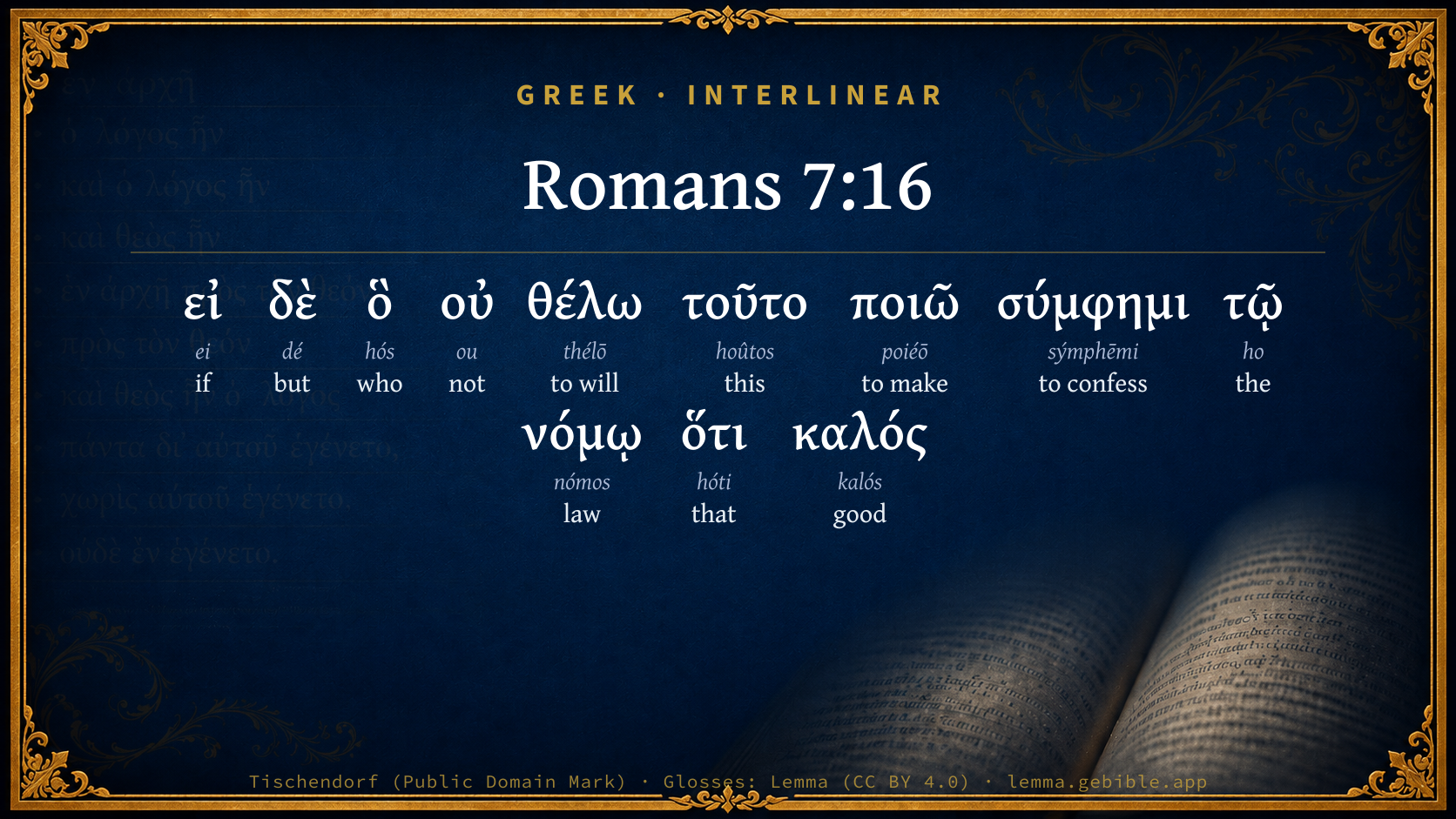
Greek (Tischendorf 8th ed.) Romans 7:16 appears in the Greek New Testament. The text above is from the Tischendorf 8th edition. Each word links to its Strong’s number and a concise gloss. Click any word for its full Thayer’s Greek Lexicon entry.
Download image
Cite this verse

Romans 7:16 (World English Bible). Public Domain. Lemma interlinear Bible study tool, https://lemma.gebible.app/v/romans/7/16.

Show BibTeX & RIS
BibTeX
RIS
English Translation
But if what I don't desire, that I do, I consent to the law that it is good.
World English Bible · Public Domain
Highlights
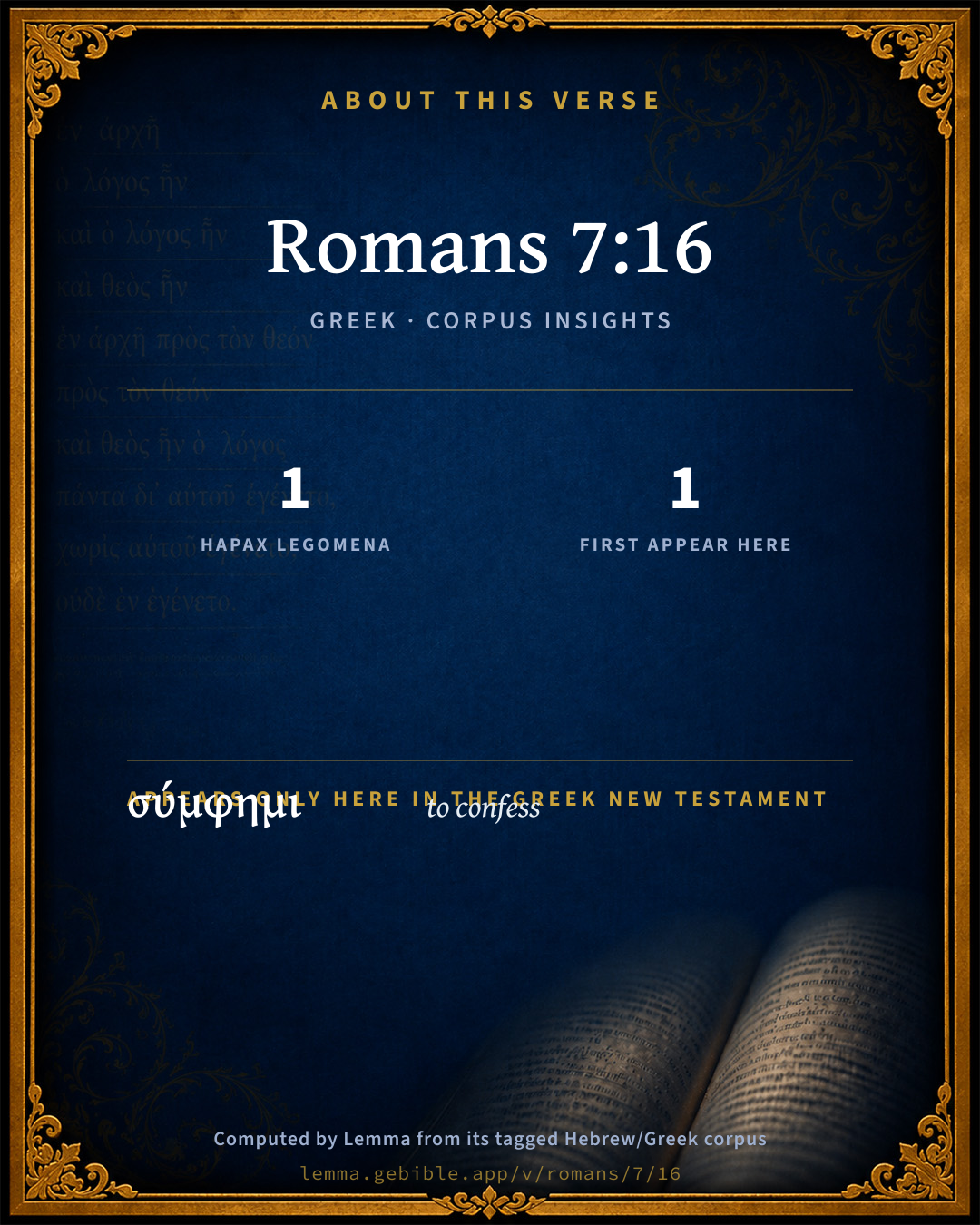
  • 1 hapax legomenon — only here in the Greek New Testament
  • 1 first appearance in the Greek New Testament
Full analysis ↓
Download a study sheet

One document with this verse’s original text, its word-by-word gloss line, the meaning frame, cross-references with their text, attributed commentary, and full source and license credits — printable, and it pastes into notes with its structure intact.

This verse Autodidact and up

Study sheet (.html) Plain text (.txt)

A passage Seminary Student

Up to 50 verses in one chapter. A passage sheet keeps up to 6 commentary sources and 12 cross-references per verse, in the order this page ranks them, and says so on the sheet whenever that leaves anything out. Ask for a single verse and you get the Autodidact verse sheet above.

Everything on this page stays free to read, with no account — the sheet is a download of what is already on screen, not access to it.

Want to remove ads? Support Godless Engineer
Compare translations 3

The same verse in 3 English versions, stacked beneath the original-language interlinear above. Click any original word for its lexicon entry.

Each is an independent rendering of the whole verse — the interlinear is not word-aligned to these translations.

Highlighted words mark where these versions differ — a whole-verse word diff, not a word-by-word alignment.

  • World English Bible Public Domain
    But if what I don't desire, that I do, I consent to the law that it is good.
  • King James Version Public Domain
    If then I do that which I would not, I consent unto the law that it is good.
  • unfoldingWord Literal Text CC BY-SA 4.0
    But if what I do not want, this I do, I agree with the law that good.

unfoldingWord Literal Text — © unfoldingWord, licensed CC BY-SA 4.0. Word-aligned USFM3 via Door43 (git.door43.org/unfoldingWord/en_ult).

Versions to compare (up to 4)

3 of 4 selected

Show all 19 translations

Every available English version of this verse, each an independent rendering of the whole verse.

  • World English Bible Public Domain
    But if what I don't desire, that I do, I consent to the law that it is good.
  • Berean Standard Bible Public Domain
    And if I do what I do not want to do, I admit that the law is good.
  • Majority Standard Bible Public Domain
    And if I do what I do not want to do, I admit that the law is good.
  • King James Version Public Domain
    If then I do that which I would not, I consent unto the law that it is good.
  • American Standard Version (1901) Public Domain
    But if what I would not, that I do, I consent unto the law that it is good.
  • Revised Version (1885) Public Domain
    But if what I would not, that I do, I consent unto the law that it is good.
  • Geneva Bible (1599) Public Domain
    If I doe then that which I woulde not, I consent to the Lawe, that it is good.
  • Douay-Rheims (1899) Public Domain
    If then I do that which I will not, I consent to the law, that it is good.
  • Young's Literal Translation Public Domain
    And if what I do not will, this I do, I consent to the law that `it is' good,
  • Literal Standard Version CC BY-SA 4.0
    And if what I do not will, this I do, I consent to the Law that [it is] good,
  • Unlocked Literal Bible CC BY-SA 4.0
    But if I do what I do not want, I agree with the law that the law is good.
  • unfoldingWord Literal Text CC BY-SA 4.0
    But if what I do not want, this I do, I agree with the law that good.
  • Darby Bible Public Domain
    But if what I do not will, this I practise, I consent to the law that [it is] right.
  • World Messianic Bible Public Domain
    But if what I don’t desire, that I do, I consent to the law that it is good.
  • Webster's Bible Public Domain
    If then I do that which I would not, I consent to the law that it is good.
  • Free Bible Version CC BY-SA 4.0
    But if I'm saying that I do what I don't want to, this shows that I admit the law is good and right.
  • Bible in Basic English Public Domain
    But, if I do that which I have no mind to do, I am in agreement with the law that the law is good.
  • Text-Critical English NT CC BY 4.0
    Now if I do the very thing I do not want to do, I agree that the law is good.
  • Tyndale New Testament (1534) Public Domain
    Yf I do now that which I wolde not I graute to the lawe that it is good.

Literal Standard Version (2020), Covenant Press — licensed CC BY-SA 4.0. Text via the HelloAO Bible API (eBible.org). Unlocked Literal Bible (unfoldingWord) — licensed CC BY-SA 4.0. Text via the HelloAO Bible API (eBible.org). unfoldingWord Literal Text — © unfoldingWord, licensed CC BY-SA 4.0. Word-aligned USFM3 via Door43 (git.door43.org/unfoldingWord/en_ult). Free Bible Version, Dr. Jonathan Gallagher — licensed CC BY-SA 4.0. Text via the HelloAO Bible API (eBible.org).

Word by word

More ways to search: Search by grammar → Find every occurrence → Compare this word →

Practice this passage: Drill this verse → Learn its vocabulary →

About this verse

These counts appear in no published source. They are computed here, from the morphology-tagged text and Lemma’s own curated glosses. What Lemma adds →

12
words
12
distinct lemmas
Pauline Epistles
section

Notable vocabulary

1 hapax legomenon — a word that appears only here in the entire Greek New Testament:

  • σύμφημι to confess G4852

First appearance in Scripture

This word makes its first canonical appearance in the Greek New Testament here:

  • σύμφημι to confess G4852

Cross-references

5

Topical passages linked to Romans 7:16 in the Treasury of Scripture Knowledge — connected by theme and wording, ordered by reader-vote popularity; previews shown in the World English Bible.

  • Romans 7:12 Therefore the law indeed is holy, and the commandment holy, and righteous, and good.
  • Romans 7:14 For we know that the law is spiritual, but I am fleshly, sold under sin.
  • 1 Timothy 1:8 But we know that the law is good, if a man uses it lawfully,
  • Psalms 119:127–128 Therefore I love your commandments more than gold, Yes, more than pure gold.
  • Romans 7:22 For I delight in God's law after the inward man,

Cross-references courtesy of OpenBible.info (CC BY 4.0).

Commentary

Notes on Romans 7:16 from classic Christian and Jewish commentators (each source and its license shown beneath its notes). The classic Christian expositions comment on the surrounding passage and are grouped to its opening verse, so a note may address several verses; the Jewish commentaries on the Tanakh (Rashi and others) are per-verse, so they appear only where the commentator wrote on this verse.

Lemma curates 59 commentaries, every one of them public domain or Creative Commons licensed, each selected and text-cleaned for this edition rather than reprinted as found. About our sources →

Joseph Benson's Commentary

Rom 7:16-17. If then I do that which I would not, &c. — In willing not to do it, I do so far, though to my own condemnation, consent to the law, and bear my testimony to it that it is good — And do indeed desire to fulfil it; though when temptations assault me, contrary to my resolution, I fail in my practice. This is an inference from the former verse, the obvious sense of which is, that men, even in an unconverted state, approve of the law of God: they see its propriety and equity, consequently their judgment approves of it as good, though their passions and inclinations oppose it. It is not supposed here that the person spoken of consents at all times to the whole of God’s law as good: this inference is limited by what he said in the former verse. Nor is it every evil which he hates, that he does; nor does he always feel that hatred which he mentions against the sins which he commits. He only mentions it as a thing which frequently happened, that the evils which he hated, and was inclined to avoid, were actually committed by him; and the good deeds which his conscience inclined him to do, were not performed. From this he infers, that this inclination implied the consent of his judgment unto the goodness of those laws, which under these circumstances he was in the habit of breaking. And, that the minds even of wicked men consent to the law of God as good, is obvious from their approbation of good actions in others. Now then it is no more I that can properly be said to do it, but rather sin that dwelleth in me — Which makes, as it were, another person, and tyrannises over me. “Here the apostle considers man as composed of two parts, flesh and spirit, each of which has distinct volitions, affections, and passions. And, because the influence of these on men’s actions is very powerful, he calls the one the law of the members, and the other, the law of the mind; (Rom 7:23;) and, like the ancient philosophers, he considers these two principles as distinct persons. And as in this discourse he personates mankind, he speaks of the former, which (Rom 7:22) he terms, ο εσω ανθρωπος, the inward man, or spiritual part of human nature, as his real self, and calls it, εγο, I, (Rom 7:17; Rom 7:19,) and αυτος εγω, I myself (Rom 7:25,) because it is the part in which man was made after the image of God. The other person he calls his flesh, or carnal part; and, ο εξω ανθρωπος, the outward man; (2Co 4:16;) and sin dwelling in him, in this verse; and the body of sin; (Rom 6:6;) and the body of death; (Rom 7:24;) and the old man; (Rom 6:6; Eph 4:21; Col 3:9;) and denies that this part is his self; (Rom 7:17;) and to prevent our confounding this with his real self, having said, (Rom 7:18,) I know that in me dwelleth no good thing, he immediately corrects himself by adding, that is, in my flesh. But notwithstanding the apostle considered the flesh and spirit as distinct persons, who have different affections and members, and though he ascribes to those persons different volitions and actions, and denies that the actions of the outward man, or flesh, are his actions, it does not follow that he thought himself no way concerned in, or accountable for, the actions of his flesh. For he told the very persons to whom he said those things, (Rom 8:13,) If ye live after the flesh ye shall die. But he thus spake to give a more lively idea of the struggle between reason and passion, [or rather, between grace and nature,] which subsists in the minds of those whose conscience is awakened by the operation of the law, but who are not completely converted.” Perhaps, as Doddridge conjectures, he might have read the passage in Xenophon’s Cyropedia, lib. 6., where Araspes complains of two souls contending within him.

But sin that dwelleth in me — “As the apostle had personified sin, he very properly represents it as dwelling in him; because this suggests to us the absolute and continued influence which sin hath in controlling the reason and conscience of the unregenerated, and in directing all their actions. By distinguishing his real self, that is, his spiritual part, from the self, or flesh, in which sin dwelt, and by observing that the evil actions which he committed were done, not by him, but by sin dwelling in him, the apostle did not mean to teach that wicked men are not accountable for their sins, but to make them sensible of the evil of their sins, by showing them that they are all committed in direct opposition to reason and conscience, the superior part of their nature, at the instigation of passion and lust, the lower part. Further, by appealing to the opposition which reason and conscience make to evil actions, he hath overturned the grand argument, by which the wicked justify themselves in indulging their lusts. Say they, since God hath given us passions and appetites, he certainly meant that we should gratify them. True, says the apostle; but God hath also given you reason and conscience, which oppose the excesses of lust, and condemn its gratification: and as reason and conscience are the superior part of man’s nature, a more certain indication of the will of God may be gathered from their operation, than from the impulses of the other.” — Macknight.

Joseph Benson's Commentary on the Old and New Testaments (1811–1818) — public domain. Text from a community e-Sword module.

Bengel's Gnomon

Johann Albrecht Bengel

Rom 7:16. Σύμφημι, I consent) Συνήδομαι, I delight is a stronger expression, Rom 7:22, note. The assent of a man, given to the law against himself, is an illustrious trait of true religion, a powerful testimony for God.—καλὸς, beautiful) The law, even apart from its legality, is beautiful: καλὸς, beautiful, suggests holiness, justice, and goodness, Rom 7:12.

Bengel's Gnomon of the New Testament — English translation (T&T Clark, Edinburgh, 1860) — public domain. Text from a community e-Sword module.

Meyer's Critical & Exegetical Commentary

Heinrich August Wilhelm Meyer

Rom_7:16. Not an incidental inference (Rückert), but an essential carrying on of the argument, from which then Rom_7:17 is further inferred. For the relation of the ἐγώ to the law is in fact the very aim of the section (see Rom_7:25).

ὃ οὐ θέλω] whereto I am unwilling, for in fact I hate it, Rom_7:15. By οὐ the θέλειν is turned into its opposite. Comp. Baeuml. Partik. p. 278; Ameis on Homer, Odys. iii. 274.

σύμφημι τῷ νόμῳ, ὅτι καλός] since indeed the law also desires not what I do. My conduct, therefore, so far as my desire is opposed to it, appears, according to this contradiction, as a proof that I concur with the law, that it is beautiful, i.e. morally good; the moral excellence which the law affirms of itself (e.g. Deu_4:8) I also agree with it in acknowledging; in point of fact, I say yes to it. Comp. also Philippi and Hofmann. The usual view: I grant to the law, that, etc., overlooks the συν, and the reference of the τῷ νόμῳ to συν (I say with). Comp. Plat. Rep. p. 608 B, Theaet. p. 199 C, Phaed. p. 64 B; Soph. Aj. 271, Oed. R. 553; Eur. Hippol. 265; Sturz, Lex. Xen. IV. p. 153. We may add that Chrysostom, in loc., has appropriately directed attention to the οἰκεία εὐγένεια of the moral nature of man.

Meyer — Critical and Exegetical Commentary on the New Testament — English translation by Peter Christie, edited by Frederick Crombie (T&T Clark, 1880) — public domain. Text from a community e-Sword module.

Expositor's Greek Testament

ed. W. Robertson Nicoll

Rom 7:16 . ὃ οὐ θέλω takes up ὃ μισῶ the negative expression is strong enough for the argument. In doing what he hates, i.e. , in doing evil against his will, his will agrees with the law, that it is good. καλός suggests the moral beauty or nobility of the law, not like ἀγαθή (Rom 7:12 ) its beneficial purpose.

The Expositor's Greek Testament, edited by W. Robertson Nicoll (1897–1910) — public domain. Text from a community e-Sword module.

Hodge's Commentary on Romans, Ephesians & First Corinthians

Charles Hodge

Rom_7:16

If then I do that which I would not, I consent unto the law that it is good. Paul here asserts that his acting contrary to the law was no evidence that he thought the law evil; for what he did he disapproved. But to disapprove and condemn what the law forbids, is to assent to the excellence of the law. There is a constant feeling of self-disapprobation, and a sense of the excellence of the law, in the Christians mind. He is, therefore, never disposed to blame the extent or severity of the law, but admits the fault to be in himself. I consent to, σύμφημι, I speak with, I say the same thing which the law says, when it pronounces itself good. There is no conflict between the law and the believer; it is between the law and what the believer himself condemns.

Charles Hodge — Commentary on Romans (1835), First Corinthians (1857), and Ephesians (1856) — public domain. Text from a community e-Sword module.

Jamieson, Fausset & Brown

Robert Jamieson, A. R. Fausset & David Brown

If then I do that which I would not--"But if what I would not that I do,"

I consent unto the law that it is good--"the judgment of my inner man going along with the law."

Jamieson, Fausset & Brown — Commentary Critical and Explanatory on the Whole Bible (1871) — public domain (CC PDM 1.0). Text via the HelloAO Bible API.

Adam Clarke's Commentary

Verse 16. If then I do that which I would not, c.] Knowing that the law condemns it, and that therefore it must be evil. I consent unto the law I show by this circumstance that I acknowledge the law to be good.

Adam Clarke's Commentary on the Bible (1810–1826) — public domain. Text from a community e-Sword/MySword module.

John Calvin's Commentaries

16. But if what I desire not, I do, I consent to the law, etc.; that is, “When my heart acquiesces in the law, and is delighted with its righteousness, (which certainly is the case when it hates the transgression of it,) it then perceives and acknowledges the goodness of the law, so that we are fully convinced, experience itself being our teacher, that no evil ought to be imputed to the law; nay, that it would be salutary to men, were it to meet with upright and pure hearts.” But this consent is not to be understood to be the same with what we have heard exists in the ungodly, who have expressed words of this kind, “I see better things and approve of them; I follow the worse.” Again, “What is hurtful I follow; I shun what I believe would be profitable.” For these act under a constraint when they subscribe to the righteousness of God, as their will is wholly alienated from it, but the godly man consents to the law with the real and most cheerful desire of his heart; for he wishes nothing more than to mount up to heaven.

John Calvin's Commentaries (1540-1563) — public domain. Text from the Calvin Translation Society English edition (1840s-50s) via the Christian Classics Ethereal Library (ccel.org). Calvin's coverage is partial (roughly two-thirds of the Bible); uncommented books and verses are honest gaps, never fabricated. The 19th-century editor's footnotes and remarks are omitted so the notes are faithfully Calvin's own voice.

Ellicott's Commentary for English Readers

(16) But the fact that I desire to do what is right is itself a witness to the excellence of the Law, which commands that which I desire.

A Bible Commentary for English Readers, edited by Charles John Ellicott (1878–1897) — public domain. Text from a community e-Sword module.

The Cambridge Bible for Schools and Colleges

gen. ed. J. J. S. Perowne

16. If then, &c.] The emphasis is obviously on “that which I would not:” q. d., “If my faulty course of action is contradicted by my will, I thereby consent to the goodness of the Law, which also contradicts it.”

The Cambridge Bible for Schools and Colleges (gen. ed. J. J. S. Perowne; Cambridge University Press, 1878–1918) — public domain. Text from a community e-Sword module.

John Gill's Exposition

If then I do that which I would not,.... This is a corollary, or an inference from what he had related of his own experience; that since what he did, though it was contrary to the law of God, yet was what he did not will nor allow of, but hated, it must be a clear point, that he

consented to the law, that it was good; lovely and amiable; that it forbad those things which were hateful, and commanded those things which were desirable to a good man; and so is acknowledged to be a very beautiful rule of obedience, walk, and conversation.

John Gill's Exposition of the Whole Bible (1746–1763) — public domain (CC PDM 1.0). Text via the HelloAO Bible API.

Trapp's Complete Commentary

John Trapp

16 If then I do that which I would not, I consent unto the law that it is good.

Ver. 16. I consent unto the law] I vote with it, and for it, as the rule of right; I wish also well to the observance of it, as David did, Psa 119:45.

John Trapp, A Commentary or Exposition upon All the Books of the Old and New Testament (1647–1656) — public domain. Text from a community e-Sword module.

Albert Barnes' Notes on the Bible

I consent unto the law - The very struggle with evil shows that it is not loved, or approved, but that the Law which condemns it is really loved. Christians may here find a test of their piety. The fact of struggling against evil, the desire to be free from it, and to overcome it, the anxiety and grief which it causes, is an evidence that we do not love it, and that there. fore we are the friends of God. Perhaps nothing can be a more decisive test of piety than a long-continued and painful struggle against evil passions and desires in every form, and a panting of the soul to be delivered from the power and dominion of sin.

Albert Barnes' Notes on the Bible (1834–1885) — public domain. Text from a community e-Sword/MySword module.

Matthew Poole's English Annotations

This very thing is an argument, that the law is such as I have before asserted, Rom 7:12,14. This shows my consent to the holiness and goodness of the law; I vote with it, and for it, as the only rule of right or righteousness.

Matthew Poole's English Annotations on the Holy Bible (1683–1685) — public domain. Text from a community e-Sword/MySword module.

John Wesley's Explanatory Notes

It is good - This single word implies all the three that were used before, ver. 12, "holy, just, and good."

John Wesley, Explanatory Notes Upon the Whole Bible (1754–1765) — public domain. Text via the GEBible commentary corpus.

Burkitt's Expository Notes on the New Testament

William Burkitt

Note, 1. How readily the apostle consented to the equity and holiness of God’s law; he did love the law of God, which made holiness his duty: I consent, says he, to the law, that it is good; he assented to it in his judgment, he complied with it in his will, he clave to it in his inward affections. So far as a person is regenerate, his heart doth correspond with God’s law: But may not a unregenerate person consent in his judgments approve, yet not in their hearts like and love the law of God: At the same time, that they commend it with their mouths, they cast it behind their backs.

Note, 2. How the apostle disclaims though not disowns, the evil done by him; It is no more I, but sin that dwelleth in me. As if he had said, "My corrupt affections sometimes overpower me against the approbation of my judgment, the inclination of my will: But it is not I, (according to my better part, from which I am denominated,) but sin dwelleth in me."

Learn hence, That if we disclaim the evil done by us, as being contrary to us, contrary to the habitual frame and disposition of our hearts, contrary to the deliberate purpose and settled resolution of our wills, Almighty God will not charge our failings upon us to our condemnation, but mercifully distinguish between the weakness of the flesh, and the willingness of the spirit; between us, and sin that dwelleth in us. Sin will remain and dwell, but it must not reign and rule: ’Tis a busy inmate in a gracious heart, but ’tis a lordly master, yea, an imperious tyrant in a sinner’s heart. Happy he that can in truth and sincerity say, It is not I, but sin that dwelleth in me.

William Burkitt's Expository Notes on the New Testament (1700–1703) — public domain. Text from a community e-Sword module.

Godbey's Commentary on the New Testament

William B. Godbey

16. “But if I do that which I do not wish, I consent to the law that it is good: now it is no longer I that do this, but sin that dwelleth in me.” You recognize the error in E. V., and see how Paul certifies that he commits neither known nor willing sin. Can you apply this statement to a sinner? I know not. The normal character of a sinner is to commit known and willing sin. You see positively that this is not only a justified man, but he is living in a very high state of justification, which may be said of few, i. e., that our people in the churches who claim justification could truthfully say that they commit neither known nor willing sin! Let those Christians who apply this chapter to the sinner make the application to themselves, and see whether they are living on a plane superior to Paul at this time in his experience when he certifies twice over that he commits neither known nor willing sin. This is truly the Bible standard of justification. Paul was a man of gigantic mentality and intense moral and spiritual acumen. Hence he thinks, speaks and acts in the superlative degree. In Rom 7:15 he positively certifies that he commits neither known or willing sin. In Rom 7:17 most unequivocally abnegates all personal identity with the sin-trouble in which he is involved.

William B. Godbey, Commentary on the New Testament (1896–1900) — public domain. Text from a community e-Sword module.

McGarvey & Pendleton's Commentaries

J. W. McGarvey

But if what I would not, that I do, I consent unto the law that it is good . [But the law can not be sin, for it is spiritual; i. e., it is of divine origin, contains divine principles, and is addressed to the divine in man; and if man were as he should be, there would be no fault found with the law. But, alas! we are not as we should be. The law indeed is spiritual, but I (speaking for myself, and also as fairly representative of all other Christians) am not wholly spiritual, but carnal, and sold unto sin; i. e.. I dwell in a fleshly body, but have all the weaknesses, passions and frailties that flesh is heir to, and am, consequently, so much the servant of sin that I am as one sold into permanent slavery unto it; so that as long as I am in the flesh I have no hope to be wholly free from it. So much is this the case--so much am I a slave to powers that control me--that I act as one distracted, not fully knowing nor being conscious of the thing that I do; for my actions and practise are not according to my own wishes, which follow the law; but, on the contrary, I do those things which I hate, and which are contrary to the law; my spiritual nature wishing to obey the spiritual law, but not being able, because blended with my flesh and weakened by it. But if I do the things contrary to the law, at the same time wishing to do as the law directs, I agree with the law that it is right, endorsing it by my wish, though failing to honor it in my conduct. My own consciousness, therefore, belies the accusation that the law is sin.]

J. W. McGarvey (with Philip Y. Pendleton), Commentaries on the New Testament (The Fourfold Gospel, 1914; Acts; and the epistles) — public domain. Text from a community e-Sword/MySword module.

The People's New Testament

B. W. Johnson

16. If then I do. Rather, “But if I do.” If he sins, against his purpose and inclination, he condemns his sin, and thus acknowledges the law, which he disobeyed, to be just and good.

B. W. Johnson's The People's New Testament with Notes (1889–1891) — public domain. Electronic text from the Christian Classics Ethereal Library (CCEL) ThML edition.

Alford’s Greek Testament

Henry Alford

16.] But if (= ‘now seeing that;’ takes up the foregoing and draws an inference from it) what I wish not, that I do, I agree with (bear witness to) the law that it is good (viz. ‘in that the law prohibits what I also dislike,—the law and I are as one in proscribing the thing,—the law, and my wish, tend the same way’).

Henry Alford, The Greek Testament (1849–1861) — public domain. Text from a community e-Sword module.

Vincent's Word Studies in the New Testament

Marvin R. Vincent

I consent [συμφημι] . Lit., speak together with; concur with, since the law also does not desire what I do. Only here in the New Testament.

Good [καλος] . See on Joh 10:11, 32; Mt 26:10; Jas 2:7. Morally excellent.

Marvin R. Vincent, Word Studies in the New Testament (1887–1900) — public domain. Text from a community e-Sword/MySword module.

Godet's Commentaries

Frédéric Louis Godet

Vv. 16, 17. “If then I do that which I would not, I consent with the law that it is good. And now it is no more I that perform it, but sin that dwelleth in me.”

These two verses draw the conclusion from the fact mentioned Rom 7:15, a conclusion which is the reaffirmation of the thesis laid down in Rom 7:14.

The reprobation with which Paul’s conscience visits his own work, is a solemn homage rendered by him to the law, for thereby he takes part with the law against himself. The preposition σύν, with, in the verb σύμφημι, I give testimony, I applaud with, can only bear on the regimen τῷ νομῷ, the law: “I declare, in concert with the law, that the contents of the law are good.” It is the reproduction of the assertion: “We know that the law is spiritual.”

Vv. 16 likewise reproduces the second part of Rom 7:14; it is, so to speak, the paraphrase of the words: sold to sin. It is not to be thought that Paul wishes to exculpate himself in the least when he says: “It is not I who do it, but sin.” On the contrary, he wishes to make the miserable state of bondage to which he is reduced the more palpable; he is not master even in his own house; there he finds a tyrant who forces him to act in opposition to his better wishes. What humiliation! What misery! It is the state of sin regarded from its painful rather than its culpable point of view.

The adverbs now, νυνί, and no more, οὐκέτι, cannot have a temporal meaning here; Paul states the moral conclusion drawn from the facts which he has just recorded. Their meaning is therefore logical. Now means: “Things being so;” no more: “not as if the normal state, that of full moral liberty, still existed in me.”

Frédéric Louis Godet — Commentaries on Luke, John, Romans, and 1 Corinthians — English translation (T&T Clark, Edinburgh, 1870s–1890s) — public domain. Text from a community e-Sword module.

Lesson kit

Teaching starters — assembled from the data on this page, not authored interpretation. Every prompt links to the verse data it draws on. Edit before teaching.

Romans, in the Pauline Epistles, opens this verse with 12 words (12 distinct Greek lemmas). Its most distinctive word is sýmphēmi (“to confess”). A historical commentator’s framing appears above. Read the whole chapter for the surrounding context.

Discussion questions

  1. How does “to confess” (sýmphēmi) shape what this verse is saying?
  2. This verse holds 1 word here found nowhere else in the Greek New Testament. What might the rare word draw attention to?
  3. The word “to confess” first appears here in Scripture. What is being introduced at this debut?
  4. Romans 7:12 shares this passage’s theme. How do the two illuminate each other?
  5. These translations render this verse differently; the difference is in the English rendering, not the original. What questions does that raise?
  6. Reading how Joseph Benson's Commentary and Bengel's Gnomon read this verse, where do the two commentators agree and where do they part?

Things to notice

  • 1 word in this verse appears nowhere else in the Greek New Testament.
  • 1 word makes its first canonical appearance in Scripture here.
  • These translations choose different wording for 8 words in this verse.
  • 12 distinct Greek lemmas span 12 words in this verse.

Reading settings

Reading text

Shown beneath each verse's original-language words.

Old Testament
Old Testament edition

Read the OT as the Masoretic Hebrew (MT) or the Greek Septuagint (LXX).

English shown for the Greek Septuagint (in the Hebrew ↔ Greek comparison).

Comparing translations? Open the Compare panel on any verse page to stack up to four side by side.