

Galatians 1:7
Greek (Tischendorf 8th ed.) Galatians 1:7 appears in the Greek New Testament. The text above is from the Tischendorf 8th edition. Each word links to its Strong’s number and a concise gloss. Click any word for its full Thayer’s Greek Lexicon entry.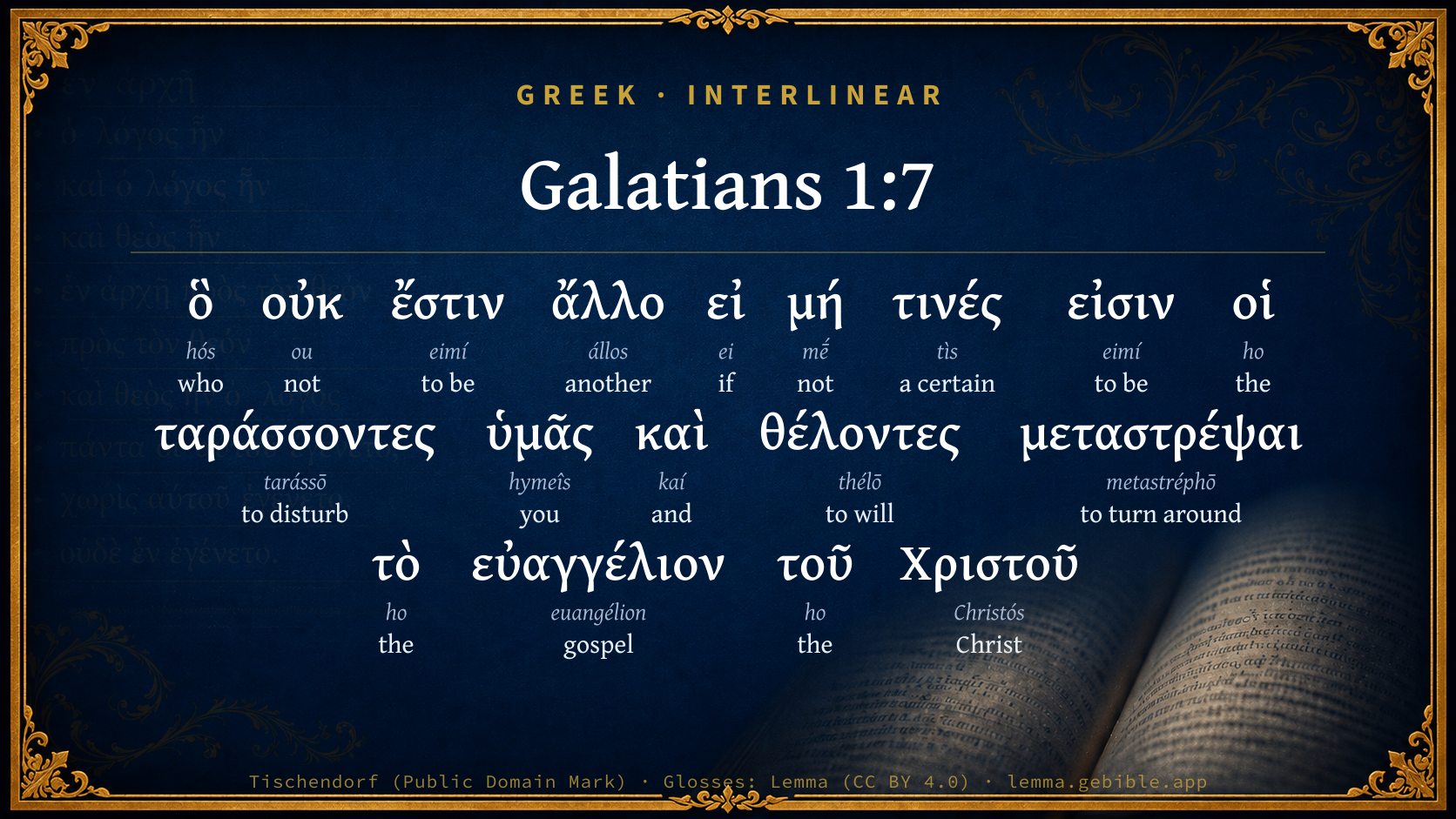
and there isn't another gospel. Only there are some who trouble you, and want to pervert the Gospel of Christ.
Download a study sheet
One document with this verse’s original text, its word-by-word gloss line, the meaning frame, cross-references with their text, attributed commentary, and full source and license credits — printable, and it pastes into notes with its structure intact.
This verse Autodidact and up
A passage Seminary Student
Up to 50 verses in one chapter. A passage sheet keeps up to 6 commentary sources and 12 cross-references per verse, in the order this page ranks them, and says so on the sheet whenever that leaves anything out. Ask for a single verse and you get the Autodidact verse sheet above.
Everything on this page stays free to read, with no account — the sheet is a download of what is already on screen, not access to it.
Compare translations 3
The same verse in 3 English versions, stacked beneath the original-language interlinear above. Click any original word for its lexicon entry.
Each is an independent rendering of the whole verse — the interlinear is not word-aligned to these translations.
Highlighted words mark where these versions differ — a whole-verse word diff, not a word-by-word alignment.
-
World English Bible Public Domain
and there isn't another gospel. Only there are some who trouble you, and want to pervert the Gospel of Christ.
-
King James Version Public Domain
Which is not another; but there be some that trouble you, and would pervert the gospel of Christ.
-
unfoldingWord Literal Text CC BY-SA 4.0
which is not another, except there are certain ones causing you trouble and wanting to pervert the gospel of Christ.
unfoldingWord Literal Text — © unfoldingWord, licensed CC BY-SA 4.0. Word-aligned USFM3 via Door43 (git.door43.org/unfoldingWord/en_ult).
Show all 19 translations
Every available English version of this verse, each an independent rendering of the whole verse.
-
World English Bible Public Domain
and there isn't another gospel. Only there are some who trouble you, and want to pervert the Gospel of Christ.
-
Berean Standard Bible Public Domain
which is not even a gospel. Evidently some people are troubling you and trying to distort the gospel of Christ.
-
Majority Standard Bible Public Domain
which is not even a gospel. Evidently some people are troubling you and trying to distort the gospel of Christ.
-
King James Version Public Domain
Which is not another; but there be some that trouble you, and would pervert the gospel of Christ.
-
American Standard Version (1901) Public Domain
which is not another `gospel' only there are some that trouble you, and would pervert the gospel of Christ.
-
Revised Version (1885) Public Domain
which is not another gospel: only there are some that trouble you, and would pervert the gospel of Christ.
-
Geneva Bible (1599) Public Domain
Which is not another Gospel, saue that there be some which trouble you, and intend to peruert the Gospel of Christ.
-
Douay-Rheims (1899) Public Domain
Which is not another, only there are some that trouble you, and would pervert the gospel of Christ.
-
Young's Literal Translation Public Domain
that is not another, except there be certain who are troubling you, and wishing to pervert the good news of the Christ;
-
Literal Standard Version CC BY-SA 4.0
not that there is another, except there are certain who are troubling you, and wishing to pervert the good news of the Christ;
-
Unlocked Literal Bible CC BY-SA 4.0
This is not to say that there is another gospel, but there are some men who cause you trouble and want to change the gospel of Christ.
-
unfoldingWord Literal Text CC BY-SA 4.0
which is not another, except there are certain ones causing you trouble and wanting to pervert the gospel of Christ.
-
Darby Bible Public Domain
which is not another [one]; but there are some that trouble you, and desire to pervert the glad tidings of the Christ.
-
World Messianic Bible Public Domain
but there isn’t another “good news.” Only there are some who trouble you and want to pervert the Good News of Messiah.
-
Webster's Bible Public Domain
Which is not another; but there are some that trouble you, and would pervert the gospel of Christ.
-
Free Bible Version CC BY-SA 4.0
that isn't good news at all! Some people there are confusing you, wanting to pervert the good news of Christ.
-
Bible in Basic English Public Domain
Which is not another sort: only there are some who give you trouble, desiring to make changes in the good news of Christ.
-
Text-Critical English NT CC BY 4.0
not that there is another gospel, but there are some who are troubling you and wish to pervert the gospel of Christ.
-
Tyndale New Testament (1534) Public Domain
which is nothinge els but that ther be some which trouble you and intende to pervert to gospell of Christ.
Literal Standard Version (2020), Covenant Press — licensed CC BY-SA 4.0. Text via the HelloAO Bible API (eBible.org). Unlocked Literal Bible (unfoldingWord) — licensed CC BY-SA 4.0. Text via the HelloAO Bible API (eBible.org). unfoldingWord Literal Text — © unfoldingWord, licensed CC BY-SA 4.0. Word-aligned USFM3 via Door43 (git.door43.org/unfoldingWord/en_ult). Free Bible Version, Dr. Jonathan Gallagher — licensed CC BY-SA 4.0. Text via the HelloAO Bible API (eBible.org).
Word by word
More ways to search: Search by grammar → Find every occurrence → Compare this word →
Practice this passage: Drill this verse → Learn its vocabulary →
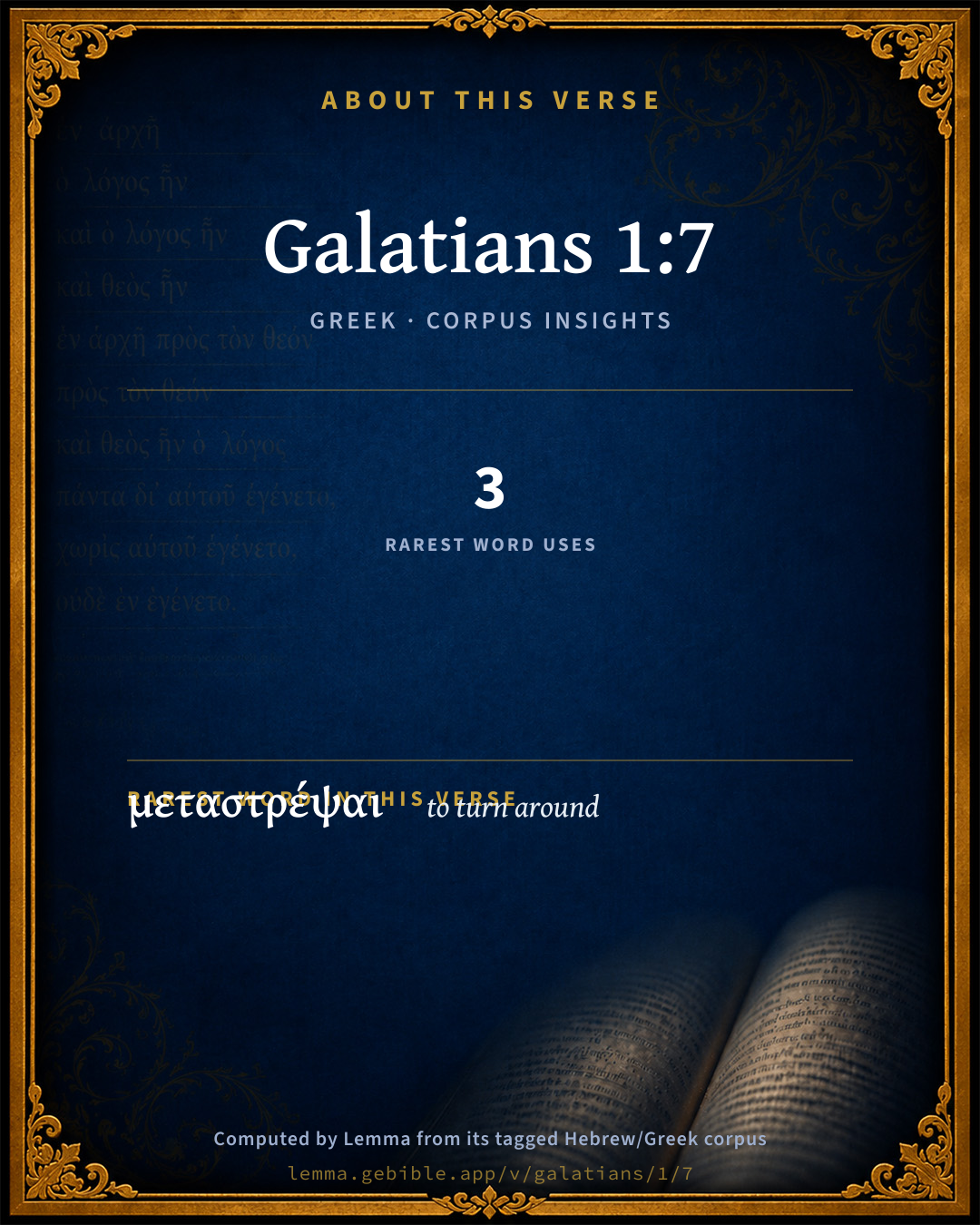
- Appears 3× in the Greek New Testament
- First appears at Acts 2:20
- Part of Speech
- Verb
- Tense
- Aorist
- Voice
- Active
- Mood
- Infinitive
Full Thayer's Definition
- ὃ hós G3739 “who” Relative pronoun, Nominative, Singular, Neuter
- οὐκ ou G3756 “not” Particle, Negative
- ἔστιν eimí G1510 “to be” Verb, Present, Active, Indicative, 3rd person, Singular
- ἄλλο állos G243 “another” Adjective, Nominative, Singular, Neuter
- εἰ ei G1487 “if” Conditional
- μή mḗ G3361 “not” Particle, Negative
- τινές tìs G5100 “a certain” Indefinite pronoun, Nominative, Plural, Masculine
- εἰσιν eimí G1510 “to be” Verb, Present, Active, Indicative, 3rd person, Plural
- οἱ ho G3588 “the” Article, Nominative, Plural, Masculine
- ταράσσοντες tarássō G5015 “to disturb” Verb, Present, Active, Participle, Nominative, Plural, Masculine
- ὑμᾶς hymeîs G5210 “you” Personal pronoun, 2nd person, Accusative, Plural
- καὶ kaí G2532 “and” Conjunction
- θέλοντες thélō G2309 “to will” Verb, Present, Active, Participle, Nominative, Plural, Masculine
- μεταστρέψαι metastréphō G3344 “to turn around” Verb, Aorist, Active, Infinitive
- τὸ ho G3588 “the” Article, Accusative, Singular, Neuter
- εὐαγγέλιον euangélion G2098 “gospel” Noun, Accusative, Singular, Neuter
- τοῦ ho G3588 “the” Article, Genitive, Singular, Masculine
- Χριστοῦ Christós G5547 “Christ” Noun, Genitive, Singular, Masculine
About this verse
These counts appear in no published source. They are computed here, from the morphology-tagged text and Lemma’s own curated glosses. What Lemma adds →
- 18
- words
- 15
- distinct lemmas
- Pauline Epistles
- section
Cross-references
36Topical passages linked to Galatians 1:7 in the Treasury of Scripture Knowledge — connected by theme and wording, ordered by reader-vote popularity; previews shown in the World English Bible.
- Acts 15:24 Because we have heard that some who went out from us have troubled you with words, unsettling your souls, saying, 'You must be circumcised and keep the law,' to whom we gave no commandment;
- Romans 16:17–18 Now I beg you, brothers, look out for those who are causing the divisions and occasions of stumbling, contrary to the doctrine which you learned, and turn away from them.
- Galatians 5:10 I have confidence toward you in the Lord that you will think no other way. But he who troubles you will bear his judgment, whoever he is.
- 2 Corinthians 11:13 For such men are false apostles, deceitful workers, masquerading as Christ's apostles.
- Acts 15:1–5 Some men came down from Judea and taught the brothers, "Unless you are circumcised after the custom of Moses, you can't be saved."
- 2 Corinthians 2:17 For we are not as so many, peddling the word of God. But as of sincerity, but as of God, in the sight of God, we speak in Christ.
- Galatians 5:12 I wish that those who disturb you would cut themselves off.
- 2 Timothy 4:3–4 For the time will come when they will not listen to the sound doctrine, but, having itching ears, will heap up for themselves teachers after their own lusts;
- 1 John 4:1 Beloved, don't believe every spirit, but test the spirits, whether they are of God, because many false prophets have gone out into the world.
- 2 John 1:10 If anyone comes to you, and doesn't bring this teaching, don't receive him into your house, and don't welcome him,
- Revelation 20:3 and cast him into the abyss, and shut it, and sealed it over him, that he should deceive the nations no more, until the thousand years were finished. After this, he must be freed for a short time.
- Titus 1:10–11 For there are also many unruly men, vain talkers and deceivers, especially those of the circumcision,
- 2 Peter 2:1–3 But there also arose false prophets among the people, as among you also there will be false teachers, who will secretly bring in destructive heresies, denying even the Master who bought them, bringing on themselves swift destruction.
- Jeremiah 23:26 How long shall this be in the heart of the prophets who prophesy lies, even the prophets of the deceit of their own heart?
- Matthew 24:24 For there will arise false christs, and false prophets, and they will show great signs and wonders, so as to lead astray, if possible, even the chosen ones.
- Acts 13:10 and said, "Full of all deceit and all cunning, you son of the devil, you enemy of all righteousness, will you not cease to pervert the right ways of the Lord?
- Acts 20:30 Men will arise from among your own selves, speaking perverse things, to draw away the disciples after them.
- 2 Corinthians 4:2 But we have renounced the hidden things of shame, not walking in craftiness, nor handling the word of God deceitfully; but by the manifestation of the truth commending ourselves to every man's conscience in the sight of God.
- Galatians 2:4 This was because of the false brothers secretly brought in, who stole in to spy out our liberty which we have in Christ Jesus, that they might bring us into bondage;
- Galatians 4:17 They zealously seek you in no good way. No, they desire to alienate you, that you may seek them.
- Galatians 6:12–13 As many as desire to look good in the flesh, they compel you to be circumcised; only that they may not be persecuted for the cross of Christ.
- Galatians 6:17 From now on, let no one cause me any trouble, for I bear the marks of the Lord Jesus branded on my body.
- 1 Timothy 4:1–3 But the Spirit says expressly that in later times some will fall away from the faith, paying attention to seducing spirits and doctrines of demons,
- 2 Timothy 2:18 men who have erred concerning the truth, saying that the resurrection is already past, and overthrowing the faith of some.
- 2 Timothy 3:8–9 Even as Jannes and Jambres opposed Moses, so do these also oppose the truth; men corrupted in mind, reprobate concerning the faith.
- 1 John 2:18–19 Little children, these are the end times, and as you heard that the Antichrist is coming, even now many antichrists have arisen. By this we know that it is the end times.
- 1 John 2:26 These things I have written to you concerning those who would lead you astray.
- 2 John 1:7 For many deceivers have gone out into the world, those who don't confess that Jesus Christ came in the flesh. This is the deceiver and the Antichrist.
- Jude 1:4 For there are certain men who crept in secretly, even those who were long ago written about for this condemnation: ungodly men, turning the grace of our God into lasciviousness, and denying our only Master, God, and Lord, Jesus Christ.
- Revelation 2:2 "I know your works, and your toil and perseverance, and that you can't tolerate evil men, and have tested those who call themselves apostles, and they are not, and found them false.
- Revelation 2:6 But this you have, that you hate the works of the Nicolaitans, which I also hate.
- Revelation 2:14–15 But I have a few things against you, because you have there some who hold the teaching of Balaam, who taught Balak to throw a stumbling block before the children of Israel, to eat things sacrificed to idols, and to commit sexual immorality.
- Revelation 2:20 But I have this against you, that you tolerate your woman, Jezebel, who calls herself a prophetess. She teaches and seduces my servants to commit sexual immorality, and to eat things sacrificed to idols.
- Revelation 12:9 The great dragon was thrown down, the old serpent, he who is called the devil and Satan, the deceiver of the whole world. He was thrown down to the earth, and his angels were thrown down with him.
- Revelation 13:14 He deceives my own people who dwell on the earth because of the signs he was granted to do in front of the beast; saying to those who dwell on the earth, that they should make an image to the beast who had the sword wound and lived.
- Revelation 19:20 The beast was taken, and with him the false prophet who worked the signs in his sight, with which he deceived those who had received the mark of the beast and those who worshiped his image. These two were thrown alive into the lake of fire that burns with sulfur.
Cross-references courtesy of OpenBible.info (CC BY 4.0).
Lesson kit
Teaching starters — assembled from the data on this page, not authored interpretation. Every prompt links to the verse data it draws on. Edit before teaching.
Galatians, in the Pauline Epistles, opens this verse with 18 words (15 distinct Greek lemmas). Its most distinctive word is metastréphō (“to turn around”). A historical commentator’s framing appears above. Read the whole chapter for the surrounding context.
Discussion questions
- What does “to turn around” (metastréphō) contribute to the verse as a whole?
- Acts 2:20 shares the word «to turn around» with this verse. How do the two illuminate each other?
- “to be” occurs 2× in this one verse. What is the effect of the repetition?
- These translations render this verse differently. What is at stake in choosing one wording over another?
- Reading how Tyndale Open Study Notes and Bengel's Gnomon read this verse, where do the two commentators agree and where do they part?
Things to notice
- These translations choose different wording for 12 words in this verse.
- “to be” occurs 2× in this single verse.
- 15 distinct Greek lemmas span 18 words in this verse.
Commentary
Notes on Galatians 1:7 from classic Christian and Jewish commentators (each source and its license shown beneath its notes). The classic Christian expositions comment on the surrounding passage and are grouped to its opening verse, so a note may address several verses; the Jewish commentaries on the Tanakh (Rashi and others) are per-verse, so they appear only where the commentator wrote on this verse.
Lemma curates 59 commentaries, every one of them public domain or Creative Commons licensed, each selected and text-cleaned for this edition rather than reprinted as found. About our sources →
Tyndale Open Study Notes
Tyndale Open Resources
Tyndale Open Study Notes — © Tyndale Open Resources, licensed CC BY-SA 4.0. Text via the HelloAO Bible API.
Bengel's Gnomon
Johann Albrecht Bengel
Bengel's Gnomon of the New Testament — English translation (T&T Clark, Edinburgh, 1860) — public domain. Text from a community e-Sword module.
Meyer's Critical & Exegetical Commentary
Heinrich August Wilhelm Meyer
Meyer — Critical and Exegetical Commentary on the New Testament — English translation by Peter Christie, edited by Frederick Crombie (T&T Clark, 1880) — public domain. Text from a community e-Sword module.
Expositor's Greek Testament
ed. W. Robertson Nicoll
The Expositor's Greek Testament, edited by W. Robertson Nicoll (1897–1910) — public domain. Text from a community e-Sword module.
Geneva Bible (1599)
Geneva Bible translators
Geneva Bible (1599) marginal notes — public domain. Text via Bolls.life.
Jamieson, Fausset & Brown
Robert Jamieson, A. R. Fausset & David Brown
Jamieson, Fausset & Brown — Commentary Critical and Explanatory on the Whole Bible (1871) — public domain (CC PDM 1.0). Text via the HelloAO Bible API.
Adam Clarke's Commentary
Adam Clarke's Commentary on the Bible (1810–1826) — public domain. Text from a community e-Sword/MySword module.
John Calvin's Commentaries
John Calvin's Commentaries (1540-1563) — public domain. Text from the Calvin Translation Society English edition (1840s-50s) via the Christian Classics Ethereal Library (ccel.org). Calvin's coverage is partial (roughly two-thirds of the Bible); uncommented books and verses are honest gaps, never fabricated. The 19th-century editor's footnotes and remarks are omitted so the notes are faithfully Calvin's own voice.
Ellicott's Commentary for English Readers
A Bible Commentary for English Readers, edited by Charles John Ellicott (1878–1897) — public domain. Text from a community e-Sword module.
The Cambridge Bible for Schools and Colleges
gen. ed. J. J. S. Perowne
The Cambridge Bible for Schools and Colleges (gen. ed. J. J. S. Perowne; Cambridge University Press, 1878–1918) — public domain. Text from a community e-Sword module.
John Gill's Exposition
John Gill's Exposition of the Whole Bible (1746–1763) — public domain (CC PDM 1.0). Text via the HelloAO Bible API.
Trapp's Complete Commentary
John Trapp
John Trapp, A Commentary or Exposition upon All the Books of the Old and New Testament (1647–1656) — public domain. Text from a community e-Sword module.
Albert Barnes' Notes on the Bible
Albert Barnes' Notes on the Bible (1834–1885) — public domain. Text from a community e-Sword/MySword module.
Haydock's Catholic Bible Commentary
George Leo Haydock (1774–1849), Haydock's Catholic Family Bible and Commentary, 1859 edition — public domain. Excludes Psalms (Douay-Rheims chapter numbering differs from Protestant) and Deuterocanonical books (Catholic canon only).
Matthew Poole's English Annotations
Matthew Poole's English Annotations on the Holy Bible (1683–1685) — public domain. Text from a community e-Sword/MySword module.
Whedon's Commentary on the Bible
Daniel D. Whedon
Daniel D. Whedon (gen. ed.), Commentary on the Old and New Testaments (1874–1909) — public domain. Text from a community e-Sword module.
The Pulpit Commentary
The Pulpit Commentary (1880–1919), ed. H.D.M. Spence-Jones & Joseph S. Exell — public domain. Text from a community e-Sword module.
John Wesley's Explanatory Notes
John Wesley, Explanatory Notes Upon the Whole Bible (1754–1765) — public domain. Text via the GEBible commentary corpus.
Luther on Galatians
Martin Luther
Martin Luther — Commentary on the Epistle to the Galatians (1535), English translation by Theodore Graebner (Zondervan, 1939) — public domain (U.S. copyright not renewed). Text from a community e-Sword module.
McGarvey & Pendleton's Commentaries
J. W. McGarvey
J. W. McGarvey (with Philip Y. Pendleton), Commentaries on the New Testament (The Fourfold Gospel, 1914; Acts; and the epistles) — public domain. Text from a community e-Sword/MySword module.
The People's New Testament
B. W. Johnson
B. W. Johnson's The People's New Testament with Notes (1889–1891) — public domain. Electronic text from the Christian Classics Ethereal Library (CCEL) ThML edition.
Cambridge Greek Testament for Schools and Colleges
Cambridge Greek Testament for Schools and Colleges (Cambridge University Press, 1896; 21 vols, various authors incl. Carr, Maclear, Plummer, Farrar, Lumby, Moule, M. R. James, Simcox) — public domain. Text from a community e-Sword module.
Alford’s Greek Testament
Henry Alford
Henry Alford, The Greek Testament (1849–1861) — public domain. Text from a community e-Sword module.
International Critical Commentary
International Critical Commentary — older volumes (1896–1929), various authors — public domain. Text from a community e-Sword module.
Vincent's Word Studies in the New Testament
Marvin R. Vincent
Marvin R. Vincent, Word Studies in the New Testament (1887–1900) — public domain. Text from a community e-Sword/MySword module.