1 Timothy 2:4

Greek (Tischendorf 8th ed.) 1 Timothy 2:4 appears in the Greek New Testament. The text above is from the Tischendorf 8th edition. Each word links to its Strong’s number and a concise gloss. Click any word for its full Thayer’s Greek Lexicon entry.

Download image
Cite this verse

1 Timothy 2:4 (World English Bible). Public Domain. Lemma interlinear Bible study tool, https://lemma.gebible.app/v/1-timothy/2/4.

Show BibTeX & RIS
BibTeX
RIS
English Translation
who desires all people to be saved and come to full knowledge of the truth.
World English Bible · Public Domain
Download a study sheet

One document with this verse’s original text, its word-by-word gloss line, the meaning frame, cross-references with their text, attributed commentary, and full source and license credits — printable, and it pastes into notes with its structure intact.

This verse Autodidact and up

Study sheet (.html) Plain text (.txt)

A passage Seminary Student

Up to 50 verses in one chapter. A passage sheet keeps up to 6 commentary sources and 12 cross-references per verse, in the order this page ranks them, and says so on the sheet whenever that leaves anything out. Ask for a single verse and you get the Autodidact verse sheet above.

Everything on this page stays free to read, with no account — the sheet is a download of what is already on screen, not access to it.

Want to remove ads? Support Godless Engineer
Compare translations 3

The same verse in 3 English versions, stacked beneath the original-language interlinear above. Click any original word for its lexicon entry.

Each is an independent rendering of the whole verse — the interlinear is not word-aligned to these translations.

Highlighted words mark where these versions differ — a whole-verse word diff, not a word-by-word alignment.

  • World English Bible Public Domain
    who desires all people to be saved and come to full knowledge of the truth.
  • King James Version Public Domain
    Who will have all men to be saved, and to come unto the knowledge of the truth.
  • unfoldingWord Literal Text CC BY-SA 4.0
    who desires all men to be saved and to come to knowledge of the truth.

unfoldingWord Literal Text — © unfoldingWord, licensed CC BY-SA 4.0. Word-aligned USFM3 via Door43 (git.door43.org/unfoldingWord/en_ult).

Versions to compare (up to 4)

3 of 4 selected

Show all 19 translations

Every available English version of this verse, each an independent rendering of the whole verse.

  • World English Bible Public Domain
    who desires all people to be saved and come to full knowledge of the truth.
  • Berean Standard Bible Public Domain
    who wants everyone to be saved and to come to the knowledge of the truth.
  • Majority Standard Bible Public Domain
    who wants everyone to be saved and to come to the knowledge of the truth.
  • King James Version Public Domain
    Who will have all men to be saved, and to come unto the knowledge of the truth.
  • American Standard Version (1901) Public Domain
    who would have all men to be saved, and come to the knowledge of the truth.
  • Revised Version (1885) Public Domain
    who willeth that all men should be saved, and come to the knowledge of the truth.
  • Geneva Bible (1599) Public Domain
    Who will that all men shalbe saued, and come vnto the acknowledging of the trueth.
  • Douay-Rheims (1899) Public Domain
    Who will have all men to be saved, and to come to the knowledge of the truth.
  • Young's Literal Translation Public Domain
    who doth will all men to be saved, and to come to the full knowledge of the truth;
  • Literal Standard Version CC BY-SA 4.0
    who wills all men to be saved, and to come to the full knowledge of the truth;
  • Unlocked Literal Bible CC BY-SA 4.0
    He desires all people to be saved and to come to the knowledge of the truth.
  • unfoldingWord Literal Text CC BY-SA 4.0
    who desires all men to be saved and to come to knowledge of the truth.
  • Darby Bible Public Domain
    who desires that all men should be saved and come to [the] knowledge of [the] truth.
  • World Messianic Bible Public Domain
    who desires all people to be saved and come to full knowledge of the truth.
  • Webster's Bible Public Domain
    Who will have all men to be saved, and to come to the knowledge of the truth.
  • Free Bible Version CC BY-SA 4.0
    He wants everyone to be saved, and come to understand what truth really is.
  • Bible in Basic English Public Domain
    Whose desire is that all men may have salvation and come to the knowledge of what is true.
  • Text-Critical English NT CC BY 4.0
    who wants all people to be saved and to come to the knowledge of the truth.
  • Tyndale New Testament (1534) Public Domain
    which will have all men saved and to come vnto the knowledge of the trueth.

Literal Standard Version (2020), Covenant Press — licensed CC BY-SA 4.0. Text via the HelloAO Bible API (eBible.org). Unlocked Literal Bible (unfoldingWord) — licensed CC BY-SA 4.0. Text via the HelloAO Bible API (eBible.org). unfoldingWord Literal Text — © unfoldingWord, licensed CC BY-SA 4.0. Word-aligned USFM3 via Door43 (git.door43.org/unfoldingWord/en_ult). Free Bible Version, Dr. Jonathan Gallagher — licensed CC BY-SA 4.0. Text via the HelloAO Bible API (eBible.org).

Word by word

More ways to search: Search by grammar → Find every occurrence → Compare this word →

Practice this passage: Drill this verse → Learn its vocabulary →

About this verse

These counts appear in no published source. They are computed here, from the morphology-tagged text and Lemma’s own curated glosses. What Lemma adds →

10
words
10
distinct lemmas
Pauline Epistles
section

Notable vocabulary

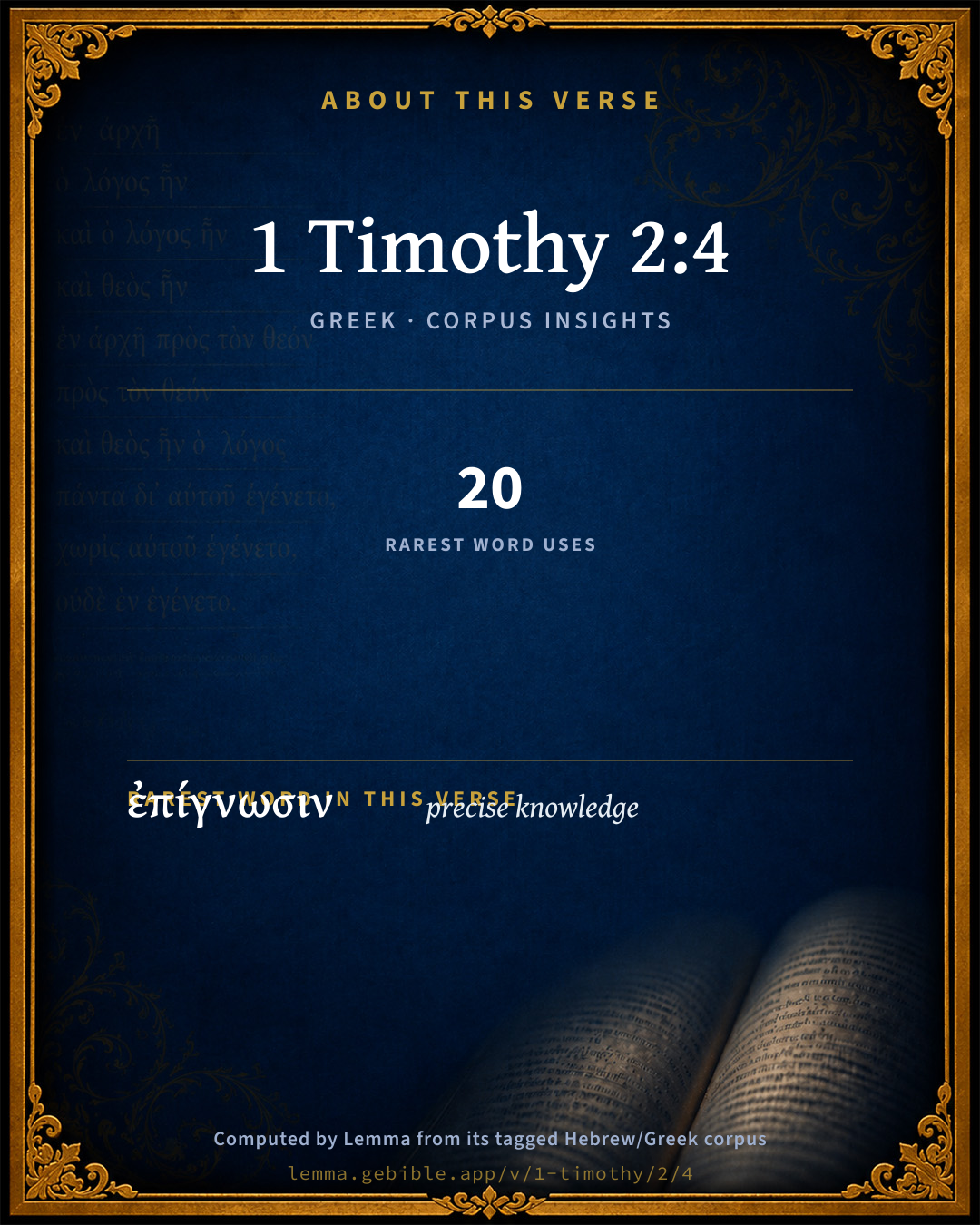
The rarest word here is ἐπίγνωσιν precise knowledge G1922 — appearing just 20 times in the whole Greek New Testament.

Shared distinctive vocabulary

ἐπίγνωσιν precise knowledge G1922 occurs in 20 verses of the Greek New Testament. Also found in:

Cross-references

28

Topical passages linked to 1 Timothy 2:4 in the Treasury of Scripture Knowledge — connected by theme and wording, ordered by reader-vote popularity; previews shown in the World English Bible.

  • Ezekiel 18:32 For I have no pleasure in the death of him who dies, says the Lord Yahweh: therefore turn yourselves, and live.
  • 2 Peter 3:9 The Lord is not slow concerning his promise, as some count slowness; but is patient with us, not wishing that any should perish, but that all should come to repentance.
  • Ezekiel 18:23 Have I any pleasure in the death of the wicked? says the Lord Yahweh; and not rather that he should return from his way, and live?
  • Titus 2:11 For the grace of God has appeared, bringing salvation to all men,
  • Ezekiel 33:11 Tell them, As I live, says the Lord Yahweh, I have no pleasure in the death of the wicked; but that the wicked turn from his way and live: turn you, turn you from your evil ways; for why will you die, house of Israel?
  • John 3:15–17 that whoever believes in him should not perish, but have eternal life.
  • 2 Timothy 2:25 in gentleness correcting those who oppose him: perhaps God may give them repentance leading to a full knowledge of the truth,
  • Romans 10:12–15 For there is no distinction between Jew and Greek; for the same Lord is Lord of all, and is rich to all who call on him.
  • Isaiah 45:22 Look to me, and be you saved, all the ends of the earth; for I am God, and there is none else.
  • 1 Timothy 4:10 For to this end we both labor and suffer reproach, because we have set our trust in the living God, who is the Savior of all men, especially of those who believe.
  • Luke 24:47 and that repentance and remission of sins should be preached in his name to all the nations, beginning at Jerusalem.
  • Revelation 14:6 I saw an angel flying in mid heaven, having an eternal Gospel to proclaim to those who dwell on the earth, and to every nation, tribe, language, and people.
  • Matthew 28:19 Therefore go, and make disciples of all nations, baptizing them in the name of the Father and of the Son and of the Holy Spirit,
  • John 14:6 Jesus said to him, "I am the way, the truth, and the life. No one comes to the Father, except through me.
  • Romans 3:29–30 Or is God the God of Jews only? Isn't he the God of Gentiles also? Yes, of Gentiles also,
  • 2 Corinthians 5:17–19 Therefore if anyone is in Christ, he is a new creation. The old things have passed away. Behold, all things have become new.
  • Isaiah 49:6 yes, he says, It is too light a thing that you should be my servant to raise up the tribes of Jacob, and to restore the preserved of Israel: I will also give you for a light to the Gentiles, that you may be my salvation to the end of the earth.
  • Isaiah 55:1 Ho, everyone who thirsts, come you to the waters, and he who has no money; come you, buy, and eat; yes, come, buy wine and milk without money and without price.
  • 2 Timothy 3:7 always learning, and never able to come to the knowledge of the truth.
  • Luke 1:77 To give knowledge of salvation to his people by the remission of their sins,
  • Luke 14:23 "The lord said to the servant, 'Go out into the highways and hedges, and compel them to come in, that my house may be filled.
  • John 6:37 All those who the Father gives me will come to me. Him who comes to me I will in no way throw out.
  • John 17:17 Sanctify them in your truth. Your word is truth.
  • Titus 1:1 Paul, a servant of God, and an apostle of Jesus Christ, according to the faith of God's chosen ones, and the knowledge of the truth which is according to godliness,
  • Mark 16:15 He said to them, "Go into all the world, and preach the Gospel to the whole creation.
  • Habakkuk 2:14 For the earth will be filled with the knowledge of the glory of Yahweh, as the waters cover the sea.
  • Hebrews 10:26 For if we sin willfully after we have received the knowledge of the truth, there remains no more a sacrifice for sins,
  • Isaiah 53:11 He shall see of the travail of his soul, [and] shall be satisfied: by the knowledge of himself shall my righteous servant justify many; and he shall bear their iniquities.

Cross-references courtesy of OpenBible.info (CC BY 4.0).

Commentary

Notes on 1 Timothy 2:4 from classic Christian and Jewish commentators (each source and its license shown beneath its notes). The classic Christian expositions comment on the surrounding passage and are grouped to its opening verse, so a note may address several verses; the Jewish commentaries on the Tanakh (Rashi and others) are per-verse, so they appear only where the commentator wrote on this verse.

Lemma curates 59 commentaries, every one of them public domain or Creative Commons licensed, each selected and text-cleaned for this edition rather than reprinted as found. About our sources →

The Preacher's Complete Homiletical Commentary

Joseph S. Exell (gen. ed.)

CRITICAL AND EXPLANATORY NOTES

1Ti_2:4. Who will have all men to be saved.—The emphatic word here is “all men.” The good purpose of God is as universal as it is good. It is not the will of the Father that any should perish; and if some will be punished with eternal destruction, they reach a doom that was never meant to be theirs. To come to the knowledge.—As we have seen elsewhere, it is the full or complete knowledge of which St. Paul thinks.

1Ti_2:5. For there is one God.—In his wide travels the apostle had met the beliefs in “gods many and lords many.” In contrast to these, of whatever name, he opposes the one God. And one Mediator between God and men, the Man Christ Jesus.—R.V. “Between God and men, Himself man, Christ Jesus.” “The human nature of Christ is specially mentioned as being the state in which His mediatorial office was visibly performed” (Ellicott).

1Ti_2:6. Who gave Himself a ransom for all.—There is no possibility of evading the vicariousness of the work of Christ as here stated. As the idea of Christ’s substitution comes out in the compound word for “ransom,’ so the benefit accruing therefrom is clear in “for all.” To be testified in due time.—R.V. “the testimony to be borne in its own times.” “The import of the testimony to be set forth in its proper seasons” (Ellicott).

1Ti_2:8. I will therefore.—R.V. “I desire therefore.” An active wish is implied. That men pray.—R.V. the men in contrast to women to whom St. Paul gives all honour in that which is purely womanly. Lifting up holy hands.—Compare Psa_134:2 (R.V. margin), “Lift up your hands in holiness”; and Isa_1:15, “When ye spread forth your hands.” The folding of the hands in prayer may be illustrated from the monuments, where captives approach the conqueror, or vassals draw near with tribute.

MAIN HOMILETICS OF THE PARAGRAPH.—1Ti_2:4-8

The Universality of Redemption—

I. Is in harmony with the Divine will.—“Who will have all men to be saved, and to come unto the knowledge of the truth” (1Ti_2:4). The provisions for the salvation of the race are the outcome of the Divine will; but while He wills the salvation of all, He also wills that that salvation should be obtained by coming to the knowledge of the truth. Hence our prayers for others, in order to their salvation, should be that their eyes may be opened to see the truth, and that they may be induced to embrace it. Because God wills salvation we should pray for it: had He willed the contrary, prayer for salvation would be useless. Our prayers should include all, as God’s grace includes all. Men cannot be forced into the truth; but they may be prayed into it. When Augustine was on the eve of his departure for Rome, where she knew he would have to encounter so many temptations, his mother Monica prayed for the prevention of his going. But he went, and was there converted.

1. The unity of God implies the comprehension of all His human offspring in the provision of redemption. “For there is one God” (1Ti_2:5).

2. Redemption was effected by the one Mediator who represented in His humanity the whole human race. “And one Mediator between God and men, the Man Christ Jesus; who gave Himself a ransom for all, to be testified in due time” (1Ti_2:5-6). The word “for” links the unity of God and Christ with the universality of the redemption of the race: prayer should therefore be offered to the one God on behalf of all men. The unity of God is here placed distinctly in the foreground to show how arbitrary is any limit of Christian intercession; the unity of the Mediator to prove that the Jew has not the least advantage over the heathen, since both must be saved in one and the same way. God’s unity in essence and purpose is a proof of His comprehending all His human children, created in His image, in His offer of grace. All mankind constitute, as it were, one man before God. They who have not this one God by one Mediator have no mediator at all. Christ’s mediation affects the whole race, since there is but the one Mediator, designed as the representative Man for all men alike. His being man was necessary to His being a mediator, sympathising with us through experimental knowledge of our nature. Even in nature almost all blessings are conveyed to us from God, not immediately, but through the mediation of various agents. The effectual intercession of Moses for Israel (Numbers 14; Deuteronomy 9), of Abraham for Abimelech (Gen_20:7), of Job for his friends (Job_42:10)—the mediation being prescribed by God whilst declaring His purpose of forgiveness—all prefigure the grand mediation for all by the one Mediator. Man was the captive of sin. He was unable to ransom himself, because absolute obedience is due to God, and therefore no act of ours can satisfy for the least offence. The Son of God therefore became man in order that, being made like unto us in all things, sin only excepted, as our elder brother He should redeem us by offering Himself as a ransom, a substituted or equivalent ransom. The oneness of the Mediator, involving the universality of redemption, which faith alone appropriates, was therefore the great subject of Christian testimony (1Co_1:6; 1Co_2:1; 2Th_1:10) (Fausset, Bengel, Alford).

II. Is authoritatively declared by a specially commissioned messenger.—“Whereof I am ordained a preacher and an apostle … a teacher of the Gentiles in faith and verity” (1Ti_2:7). None of the apostles obtained so clear an insight into the wide, far-reaching sweep of the doctrine of redemption as Paul, and no one has argued its universal application more ably than he. The breadth of the gospel as it expanded before his studious gaze effectually cured him of his Jewish prejudices and narrowness, and fitted him as the fearless champion of Gentile rights and privileges. The mixed and restricted gospel of the Judaisers was shrivelled up before the fire of his intensified zeal and the irresistible power of his logic. He refers to the universality of his calling as an evidence of the universality of Divine grace, and as a motive to pray for all men. The solemn protestation, “I speak the truth in Christ, I lie not,” indicates the importance he attached to his mission as a teacher of the Gentiles, notwithstanding the misrepresentations of others.

III. Is a reason for prayer everywhere.—

1. Prayer should be reverential. “I will therefore that men pray everywhere, lifting up holy hands” (1Ti_2:8). The early Christians turned up their palms towards heaven as those craving help do. “Holy hands” are hands which have committed no impiety and observed every sacred duty. This, or at least the contrite desire to be so, is a needful qualification for effectual prayer. It is a feeling which nature has implanted within us, when we ask God, to look upwards. Even idolaters retain the custom of lifting up their hands to heaven. The attitude is in accordance with true godliness, provided it be attended by the corresponding truth represented by it (Fausset, Calvin).

2. Prayer should be offered in a suitable spirit. “Without wrath and doubting” (1Ti_2:8). In peace and trust—putting away the spirit of anger and disputing, which is unfriendly to and destructive of the true spirit of prayer. Prayer does not consist in gifted expressions and volubility of speech, but in brokenness of heart. A hard heart cannot pray: a broken heart is made up of prayers. Prayer does not consist in elegance of phrase, but in the strength of the affection. Pray that you may pray.

Lessons.—

1. Redemption is provided for all.

2. It is a great honour to proclaim a gospel of universal blessing.

3. Prayer would be suppressed if all might not be saved.

GERM NOTES ON THE VERSES

1Ti_2:4. Salvation for All.

I. God shows His desire for the salvation of men in providence.

II. In conscience.

III. By the Holy Spirit.

IV. In the gift of Christ.—Preacher’s Magazine.

God would have All Men to be saved.

I. The appellation given to the gospel—“the truth.”

II. The knowledge of this truth is connected with salvation, as a means to an end, by no less an authority than the will of God.

III. The connection of the Divine will with the salvation of men.—

1. The object of this will is the salvation of man.

2. In the same sense God willeth all men to be saved.

3. He wills to save men according to the nature He has given them.—R. Watson.

1Ti_2:5. The Man Christ Jesus.

I. He is the true man—really and thoroughly man—the common man.

II. He is very man—simply man—as to His human nature and experience neither more nor less nor other than man.

III. He is the one man—the only man in whom the manhood is unbroken and entire—the man unfallen, and therefore unfragmentary.

IV. He is the man to mediate between God and man.

V. He is the man to give Himself a ransom for all.

VI. He is the man to be testified in due time.—R. S. Candlish.

1Ti_2:8. Conditions of Success in Prayer.

I. A holy life.—“Lifting up holy hands.”

II. A charitable, forgiving spirit.—“Without wrath.”

III. Faith.—Without “doubting.”—Olin.

The Preacher's Complete Homiletical Commentary (gen. ed. Joseph S. Exell; Funk & Wagnalls, c. 1892) — public domain (pre-1929). A full-Bible homiletical/sermon-outline anthology covering 65 of 66 books (2 John is absent from the source module). Text from a community e-Sword module.

Bengel's Gnomon

Johann Albrecht Bengel

1Ti 2:4. Πάντας) all, not merely a part, much less a very small part; 1Ti 2:3, note.—ἀνθρώπους, men) lost in themselves.—θέλει, [‘wills’] wishes) in serious earnestness of wish: ibid.—σωθῆναι, to be saved) This is treated of, at 1Ti 2:5-6.—Καὶ εἰς, and unto) This is treated of, at 1Ti 2:6-7.—ἀληθείας) of saving truth.—ἐλθεῖν, to come) They are not forced.

Bengel's Gnomon of the New Testament — English translation (T&T Clark, Edinburgh, 1860) — public domain. Text from a community e-Sword module.

Meyer's Critical & Exegetical Commentary

Heinrich August Wilhelm Meyer

1Ti_2:4. Ground of the previous thought. The general intercession is καλ. κ. ἀπόδ. before God, because He, etc. It is not unusual to give in a relative clause the grounds of a previous statement. Ὃς πάντας ἀνθρώπους θέλει σωθῆναι (comp. Tit_2:11)] The chief accent is laid on πάντας (corresponding with ὑπὲρ πάντων, 1Ti_2:1), which is therefore placed first. Gods purpose of salvation extends to all, and therefore the prayer of Christians must include all. Wiesinger, however, is right in remarking that the apostle in ὃς κ.τ.λ. does not mean specially to give a reason for prayer for the conversion of all men, but for prayer generally as a duty of universal love to men. Chrysostom puts it differently: μιμοῦ τὸν Θεόν· εἰ πάντας ἀνθρώπους θέλει σωθῆναι, θέλε καὶ σύ· εἰ δὲ θέλεις, εὔχου· τῶν γὰρ τοιούτων (τῶν θελόντων) ἐστὶ τὸ εὔχεσθαι.

The true connection of thought is obscured if we supply the intermediate thought, that prayer for all, and specially for kings, serves to maintain the peace without which the spread of Christianity would be hindered.[87]

καὶ εἰς ἐπίγνωσιν ἀληθείας ἐλθεῖν] The same connection of words is found elsewhere only in 2Ti_3:7; on the meaning of ἘΠΊΓΝΩΣΙς, see my Commentary on Colossians, pp. 74 f., Remark.

The connection of the two expressions σωθῆναι and ΕἸς ἘΠΊΓΝ. ἈΛ. ἘΛΘΕῖΝ may be regarded differently. Hofmann takes them to be in substance identical; Heydenreich takes the latter as an explanation of the former, showing how and by what means God wishes to effect the salvation of all; he therefore regards the ἘΠΊΓΝΩΣΙς Τ. ἈΛ. as the means of the σωτηρία. So, too, Winer (p. 514 [E. T. p. 692]): at first the general purpose is mentioned (ΚΑΊ, and in pursuance of this), then the immediate purpose (as a means of attaining the other). It is explained in the same way by Wiesinger, van Oosterzee, and others. But it seems more natural to regard the ἘΠΊΓΝΩΣΙς Τῆς ἈΛΗΘΕΊΑς as the goal to which the rescue (ΣΩΘῆΝΑΙ) leads (so, too, Plitt).[88]

[87] Mosheim (Instit. Hist. Eccles. maj. I. 36): Id sanctus homo tradit: nisi pax in orbe terrarum vigeat, fieri nullo modo posse, ut voluntati divinae, quae omnium hominum salutem cupit, satisfiat; bellis nimirum flagrantibus haud licuisset legatis Jesu Christi, secure ad omnes populos proficisei.

[88] In this verse the idea of the universality of Gods purpose of salvation is clearly and distinctly expressed. Calvin, in order to save his theory of predestination, has to take refuge in an exposition more than ingenious: de hominum generibus, non singulis personis, sermo est; nihil enim aliud intendit, quam principes et extraneos, populos in hoc numero includere.

Meyer — Critical and Exegetical Commentary on the New Testament — English translation by Peter Christie, edited by Frederick Crombie (T&T Clark, 1880) — public domain. Text from a community e-Sword module.

Expositor's Greek Testament

ed. W. Robertson Nicoll

1Ti 2:4 . “The grace of God hath appeared, bringing salvation to all men” (Tit 2:11 ) as was foreshadowed in the O.T.; e.g . Psa 67:2 , “Thy saving health among all nations”. God is, so far as His inclination or will is concerned, “the Saviour of all men,” but actually, so far as we can affirm with certainty, “of them that believe” (1Ti 4:10 ). These He saved , ἔσωσεν (2Ti 1:9 ; Tit 3:5 ), i.e., placed in a state of being saved . But here St. Paul does not say θέλει σῶσαι , but θέλει σωθῆναι ; for by His own limitation of His powers, so far as they are perceived by us, the salvation of men does not depend on God alone. It depends on the exercise of the free will of each individual in the acceptance or rejection of salvation (so Wiesinger, quoted by Alf.; and, as Bengel notes on ἐλθεῖν , non coguntur ), as well as on the cooperation of those who pray for all men; and, by so doing, generate a spiritual atmosphere in which the designs of God may grow.

It is also to be observed that since salvation means a state of being saved , there is no difficulty in the knowledge of the truth following it in the sentence, as though it were a consequence rather than a precedent condition. This is indeed the order indicated in the Last Commission: “baptising them … teaching them” (Mat 28:19-20 ). So that there is no need to suppose with Ell., that καὶ εἰς … ἐλθεῖν was “suggested by … the enunciation of the great truth which is contained in the following verse”.

εἰς ἐπίγνωσιν ἀληθείας ἐλθεῖν : This whole phrase recurs in 2Ti 3:7 . For ἐπίγνωσις ἀληθείας see reff. In Heb 10:26 both words have the article. It has been shown by Dean Armitage Robinson ( Ephesians , p. 248 sqq .) that ἐπίγνωσις is not maior exactiorque cognitio ; but, as distinguished from γνῶσις “which is the wider word and expresses ‘knowledge’ in the fullest sense, ἐπίγνωσις is knowledge directed towards a particular object, perceiving, discerning, recognising”. Cf. 2Ma 9:11 , ἤρξατο … εἰς ἐπίγνωσιν ἔρχεσθαι . ἀληθεία occurs fourteen times in the Pastorals; and often with a special Christian reference, like ὅδος and εὐσέβεια . See e.g . in addition to this place, 1Ti 3:15 ; 1Ti 4:3 ; 1Ti 6:5 , 2Ti 2:15 ; 2Ti 2:18 ; 2Ti 3:8 ; 2Ti 4:4 , Tit 1:14 . It is a term that belongs to the Johannine theology as well as to the Pauline.

The Expositor's Greek Testament, edited by W. Robertson Nicoll (1897–1910) — public domain. Text from a community e-Sword module.

Vincent's Word Studies in the New Testament

Marvin R. Vincent

Who will have all men to be saved [ος παντας ανθρωπους θελει σωθηναι] . Lit, who willeth all men, etc. As who, or seeing that he, giving the ground of the previous statement. Prayer to God for all is acceptable to him, because he wills the salvation of all. Thelei willeth, marking a determinate purpose.

Come to the knowledge of the truth [εις επιγνωσιν αληθειας ελθειν] . The phrase only here and 2Ti 3:7. Epignwsiv is a favorite Pauline word. See on Rom 3:20; Col 1:9; 1Ti 2:4; 1Ti 4:3. It signifies advanced or full knowledge. The difference between the simple gnwsiv and the compound word is illustrated in Rom 1:21, 28, and 1Co 13:12. In N. T. always of the knowledge of things ethical or divine, and never ascribed to God. For ajlh. qeia truth, see on sound doctrine, ch. 1 10. It appears 14 times in the Pastorals, and always without a defining genitive. So, often in Paul, but several times with a defining genitive, as truth of God, of Christ, of the gospel. The logical relation in the writer's mind between salvation and the knowledge of the truth is not quite clear. Knowledge of the truth may be regarded as the means of salvation, or it may be the ideal goal of the whole saving work. See 1Co 13:12; Phi 3:8; Jas 17:3. The latter is more in accord with the general drift of teaching in these Epistles.

Marvin R. Vincent, Word Studies in the New Testament (1887–1900) — public domain. Text from a community e-Sword/MySword module.

Geneva Bible (1599)

Geneva Bible translators

Another argument, why Churches or Congregations ought to pray for all men, without any difference of nation, kind, age, or order: to wit, because the Lord by calling of all sorts, yea, sometimes those that are greatest enemies to the Gospel, will have his Church gathered together after this sort, and therefore prayers to be made for all.

Geneva Bible (1599) marginal notes — public domain. Text via Bolls.life.

Jamieson, Fausset & Brown

Robert Jamieson, A. R. Fausset & David Brown

"Imitate God." Since He wishes that all should be saved, do you also wish it; and if you wish it, pray for it. For prayer is the instrument of effecting such things [CHRYSOSTOM]. Paul does not say, "He wishes to save all"; for then he would have saved all in matter of fact; but "will have all men to be saved," implies the possibility of man's accepting it (through God's prevenient grace) or rejecting it (through man's own perversity). Our prayers ought to include all, as God's grace included all.

to come--They are not forced.

unto the knowledge--Greek, "the full knowledge" or "recognition" (See on Co1 13:12; Phi 1:9).

the truth--the saving truth as it is in, and by, Jesus (Joh 17:3, Joh 17:17).

Jamieson, Fausset & Brown — Commentary Critical and Explanatory on the Whole Bible (1871) — public domain (CC PDM 1.0). Text via the HelloAO Bible API.

Adam Clarke's Commentary

Verse 4. Who will have all men to be saved] Because he wills the salvation of all men; therefore, he wills that all men should be prayed for. In the face of such a declaration, how can any Christian soul suppose that God ever unconditionally and eternally reprobated any man? Those who can believe so, one would suppose, can have little acquaintance either with the nature of GOD, or the bowels of Christ.

And to come unto the knowledge of the truth] The truth-the Gospel of Christ, should be proclaimed to them; and it is the duty of all who know it, to diffuse it far and wide, and when it is made known, then it is the duty of those who hear it to acknowledge and receive it. This is the proper import of the original word, that they may come, εις επιγνωσιν αληθειας, to the acknowledgment of the truth-that they may receive it as the truth, and make it the rule of their faith, the model and director of their life and actions.

Adam Clarke's Commentary on the Bible (1810–1826) — public domain. Text from a community e-Sword/MySword module.

John Calvin's Commentaries

4 Who wishes that all men may be saved. Here follows a confirmation of the second argument; and what is more reasonable than that all our prayers should be in conformity with this decree of God?

And may come to the acknowledgment of the truth. Lastly, he demonstrates that God has at heart the salvation of all, because he invites all to the acknowledgment of his truth. This belongs to that kind of argument in which the cause is proved from the effect; for, if

“the gospel is the power of God for salvation to every one that believeth,” (Romans 1:16,)

it is certain that all those to whom the gospel is addressed are invited to the hope of eternal life. In short, as the calling is a proof of the secret election, so they whom God makes partakers of his gospel are admitted by him to possess salvation; because the gospel reveals to us the righteousness of God, which is a sure entrance into life.

Hence we see the childish folly of those who represent this passage to be opposed to predestination. “If God” say they, “wishes all men indiscriminately to be saved, it is false that some are predestined by his eternal purpose to salvation, and others to perdition.” They might have had some ground for saying this, if Paul were speaking here about individual men; although even then we should not have wanted the means of replying to their argument; for, although the will of God ought not to be judged from his secret decrees, when he reveals them to us by outward signs, yet it does not therefore follow that he has not determined with himself what he intends to do as to every individual man.

But I say nothing on that subject, because it has nothing to do with this passage; for the Apostle simply means, that there is no people and no rank in the world that is excluded from salvation; because God wishes that the gospel should be proclaimed to all without exception. Now the preaching of the gospel gives life; and hence he justly concludes that God invites all equally to partake salvation. But the present discourse relates to classes of men, and not to individual persons; for his sole object is, to include in this number princes and foreign nations. That God wishes the doctrine of salvation to be enjoyed by them as well as others, is evident from the passages already quoted, and from other passages of a similar nature. Not without good reason was it said, “Now, kings, understand,” and again, in the same Psalm,

“I will give thee the Gentiles for an inheritance, and the ends of the earth for a possession.” (Psalm 2:8-10.)

In a word, Paul intended to shew that it is our duty to consider, not what kind of persons the princes at that time were, but what God wished them to be. Now the duty arising out of that love which we owe to our neighbor is, to be solicitous and to do our endeavor for the salvation of all whom God includes in his calling, and to testify this by godly prayers.

With the same view does he call God our Savior; for whence do we obtain salvation but from the undeserved kindness of God? Now the same God who has already made us partakers of salvation may sometime extend his grace to them also. He who hath already drawn us to him may draw them along with us. The Apostle takes for granted that God will do so, because it had been thus foretold by the predictions of the prophets, concerning all ranks and all nations.

John Calvin's Commentaries (1540-1563) — public domain. Text from the Calvin Translation Society English edition (1840s-50s) via the Christian Classics Ethereal Library (ccel.org). Calvin's coverage is partial (roughly two-thirds of the Bible); uncommented books and verses are honest gaps, never fabricated. The 19th-century editor's footnotes and remarks are omitted so the notes are faithfully Calvin's own voice.

Ellicott's Commentary for English Readers

(4) Who will have all men to be saved, and to come unto the knowledge of the truth.—Here St. Paul gives some explanation of his exhortation, that “the congregation should pray for all men.” Our prayers after all—for those far off, as well as for those near—will be in strict harmony with the will of God. “Imitate God,” writes St. Chrysostom;” if He wills that all men should be saved, it is surely natural that prayer should be offered for all; if He willed that all should be saved, do thou will it now; and if in earnest thou wiliest it, then pray.”

One or two points must ever be held in mind when this great statement of St. Paul’s is used as a proof of “Universal Redemption.” We must remember the position it occupies in the argument, it being only introduced as a reason for the exhortation to pray for all. Then the words must be looked at very carefully. God’s-will is not to save (sôsai) all—if that had been His sovereign will He would have saved all; but His will is that all should be saved—all should come to the knowledge of the truth; not to the knowledge of the mere theoretical, but of the practical and saving truth as revealed in the gospel. “In other words, through the sacrifice and the death of Christ all are rendered capable of salvation (salvabiles); that some are indisputably not saved, is not due to any outward circumscription or inefficacy of the divine will, but to man’s rejection of the special means of salvation which God has been pleased to appoint, and to which it is His divine will that man’s salvation should be limited. Redemption is universal, yet conditional—all may be saved, yet all will not be saved, because all will not conform to God’s appointed condition.”—Bishop Ellicott.

A Bible Commentary for English Readers, edited by Charles John Ellicott (1878–1897) — public domain. Text from a community e-Sword module.

The Cambridge Bible for Schools and Colleges

gen. ed. J. J. S. Perowne

4. who will have] The exact rendering is that of R.V. who willeth that all men should he saved—not the stronger word bouletai, ‘desireth,’ with a definite purpose. Chrysostom’s comment is “if He willed to save all, do thou will it also; and if thou willest, pray for it”: and Theod. Mops, in the Latin translation “evidens est quoniam omnes vult salvari, quia et omnes tuetur, quia est omnium Dominus.” Thus the Greek fathers accepted St Paul’s words in their prima facie sense. The Latin fathers seek to guard their application; and St Augustine actually says “by ‘all’ understand ‘all the predestined,’ because men of all sorts are among them.” The phrase is not “willeth to save all,” which would have been very near to universalism; but there is implied “the human acceptance of offered salvation on which even God’s predestination is contingent” Alford.

be saved, and to come unto the knowledge of the truth] Notice the order of the words; salvation is according to the N. T. usage, past, present and future.

Past, 2Ti_1:9, ‘God who saved us and called us.’

Tit_3:5, ‘he saved us through the laver of regeneration.’

Present, Rom_13:11, ‘work out your own salvation.’

Act_2:42, ‘The Lord added … those that were being saved.’

Future, 1Pe_1:5, ‘guarded unto a salvation ready to be revealed in the last time.’

2Ti_4:18, ‘will save me unto his heavenly kingdom.’

And here we are evidently to understand by the two clauses first a rescue from ignorance and sin, from life in untruth, and then an advance from this first knowledge of one’s true self as a sinner to the complete and perfect knowledge of the truth. So far then as the word ‘salvation’ and ‘saved’ are used to describe an experience of the first of these two stages, and are understood to be so limited, the language is Apostolic; and that indeed is a more incorrect usage which refers the word only to final safety, without guarding it as in our collect by a defining epithet “towards the attainment of everlasting salvation,” and without remembering the express statement of the Prayer-Book Catechism that by Baptism we have been now “called to a state of salvation.”

At the same time, so far as any teachers or evangelists regard all as finished and completed at conversion, they ignore and contradict the latter clause here; God willeth that all should come to the full knowledge of the truth, and not stay ever resting on a past acceptance of the message of forgiveness. The word for full knowledge, epignosis, is repeated four times in these Epistles, 2Ti_2:25; 2Ti_3:7; Tit_1:1, and is contrasted with the knowledge, falsely so called, of the heretical teachers, cf. 1Ti_6:20; Tit_1:16.

The simple verb is rendered by Westcott, Joh_3:10, to ‘perceive by the knowledge of progress, recognition.’ See also on Joh_2:24.

The force of the distinction between the simple and compound word is well seen in 1Co_13:12, “Now I am getting to know in part; but then I shall fully know, even as God knew me fully.”

The Cambridge Bible for Schools and Colleges (gen. ed. J. J. S. Perowne; Cambridge University Press, 1878–1918) — public domain. Text from a community e-Sword module.

John Gill's Exposition

For there is one God,.... This does not so much regard the unity of God, with respect to himself, or his divine essence, though that is a truth; but does not carry in it any apparent and forcible reason why all men should be prayed for, for which it is produced; but the unity of God with respect to men, as that there is but one God, who is the Creator of all men, and who, in a providential way, is the Saviour of all men; and in a way of special grace is the one God, the one covenant God of all sorts of men, of Jews and Gentiles; for he has taken of the latter into the covenant of his grace, as well as the former, and has loved them with a special and distinguishing love, has chosen them in Christ to salvation, and has sent his Son to redeem them; and of these he calls by his grace, regenerates, sanctifies, adopts, pardons, and justifies; see Rom 3:29 and therefore all sorts of men, Gentiles as well as Jews, are to be prayed for: another argument follows,

and one Mediator between God and men; a Mediator is of more than one, and has to do with two parties; and these at variance among themselves, between whom he stands as a middle person; his business is to bring them together, and make peace between them; and such an one is Christ: the two parties are God and his elect, who in their natural state are at a distance from God, and at enmity to him, and who have broken his law, and affronted his justice; Christ stands as a middle person, a daysman between them, and lays his hands upon them both; has to do with things pertaining to the glory of God, and makes reconciliation for the sins of the people; brings them that were afar off nigh to God, and makes peace for them by the blood of his cross, by fulfilling the law, and satisfying justice for them; in consequence of this he appears for them in the court of heaven, intercedes and pleads for them, is their advocate, and sees that all covenant blessings, of which he is the Mediator, are applied unto them, and preserves their persons, which are committed to his care and charge, safe to everlasting happiness; and this Mediator is

the man Christ Jesus; not that he is a mere man, for he is truly and properly God; or that he is a Mediator only according to the human nature: it was proper indeed that he should be man, that he might have something to offer, and that he might be capable of obeying, suffering, and dying, and so of making satisfaction in the nature that had sinned; but then, had he not been God, he could not have drawn nigh to God on the behalf of men, and undertook for them, and much less have performed; nor would his blood, righteousness, and sacrifice, have been available to cleanse from sin, to procure the pardon of it, justify from it, make atonement for it, or make peace with God: the reason why he is particularly mentioned as man, is, with a view to the argument in hand, praying for all men; since he who is the Mediator between God and man, has assumed a nature which is common to them all: and this Mediator is said to be one, not so much in opposition to other mediators, angels or saints departed, though it is a truth, and stands full against them, but with respect to men; there is but one Mediator between God and all sorts of men, through whom both Jews and Gentiles have an access to God, and peace with him; and therefore prayer through this Mediator should be made for all. So the Jews say of the Messiah (u), that he is , "a Mediator, God", a middle person between God and men. And they call him , "the Pillar of mediation" (w) or the middle Pillar; that is, the Mediator or Reconciler. And Philo (x) the Jew speaks of the word, as a "middle" person, and standing in the middle between the dead and the living, and between God and men. The Ethiopic version here renders it, "there is one elect of God"; which is one of the characters of the Messiah, Isa 42:1.

(u) R. Albo, Sepher Ikkarim, orat 2. c. 28. (w) Sepher Jetzira, p. 126. (x) Quis rerum divin. Hares, p. 508, 509, 510.

John Gill's Exposition of the Whole Bible (1746–1763) — public domain (CC PDM 1.0). Text via the HelloAO Bible API.

Trapp's Complete Commentary

John Trapp

4 Who will have all men to be saved, and to come unto the knowledge of the truth.

Ver. 4. Who will have all men, &c.] God willeth, to wit, with a will whereby he inviteth, and putteth no bar; not with a will whereby he effecteth it, taking away all impediments.

That all men] Not distributively taken, but collectively, as thrice in one verse, Col 1:28.

Should be saved] viz. If they do what he commandeth: God doth not tie himself to cause them to do what he commandeth, that they may be saved.

And to come to the knowledge] The only way to salvation. Pray therefore that their eyes may be opened, Act 26:18.

John Trapp, A Commentary or Exposition upon All the Books of the Old and New Testament (1647–1656) — public domain. Text from a community e-Sword module.

Albert Barnes' Notes on the Bible

Who will have all men to be saved - That is, it is in accordance with his nature, his feelings, his desires. The word “will” cannot be taken here in the absolute sense, denoting a decree like that by which he willed the creation of the world, for then it would certainly be done. But the word is often used to denote a desire, wish, or what is in accordance with the nature of anyone. Thus it may be said of God that he “wills” that his creatures may be happy - because it is in accordance with his nature, and because he has made abundant provision for their happiness - though it is not true that he wills it in the sense that he exerts his absolute power to make them happy. God wills that sickness should be relieved, and sorrow mitigated, and that the oppressed should go free, because it is agreeable to his nature; though it is not true that he wills it in the sense that he exerts his absolute power to produce it. A parent wills the welfare of his child. It is in accordance with his nature, his feelings, his desires; and he makes every needful arrangement for it. If the child is not virtuous and happy, it is his own fault. So God wills that all people should be saved. It would be in accordance with his benevolent nature. He has made ample provision for it. He uses all proper means to secure their salvation. He uses no positive means to prevent it, and if they are not saved it will be their own fault. For places in the New Testament where the word here translated “will” (θέλω thelō), means to desire or wish, see Luk 8:20; Luk 23:8; Joh 16:19; Gal 4:20; Mar 7:24; 1Co 7:7; 1Co 11:3; 1Co 14:5; Mat 15:28. This passage cannot mean, as many have supposed, that God wills that all kinds of people should be saved, or that some sinners of every rank and class may be saved, because:

(1) The natural and obvious interpretation of the language is opposed to such a sense. The language expresses the desire that “all men” should be saved, and we should not depart from the obvious sense of a passage unless necessity requires it.

(2) Prayer and thanksgiving 1Ti 2:1 are directed to be offered, not for some of all ranks and conditions, but for all mankind. No exception is made, and no direction is given that we should exclude any of the race from the expressions of our sympathy, and from an interest in our supplications. The reason given here for that prayer is, that God desires that all people should be saved. But how could this be a reason for praying for all, if it means that God desired only the salvation of some of all ranks?

(3) In 1Ti 2:5-6 the apostle gives reasons showing that God wished the salvation of all people, and those reasons are such as to prove that the language here is to be taken in the most unlimited sense. Those reasons are:

(a)That there is one God over all, and one Mediator between God and people - showing that God is the Father of all, and has the same interest in all; and,

(b)That Christ gave himself a ransom for all - showing that God desired their salvation.

This verse proves:

(1)That salvation is provided for all - for if God wished all people to be saved, he would undoubtedly make provision for their salvation; and if he had not made such provision, it could not be said that he desired their salvation, since no one can doubt that he has power to provide for the salvation of all;

(2)That salvation should be offered to all people - for if God desires it, it is right for his ministers to announce that desire, and if he desires it, it is not proper for them to announce anything contrary to this;

(3)That people are to blame if they are not saved.

If God did not wish their salvation, and if he had made no provision for it, they could not be to blame if they rejected the gospel. If God wishes it, and has made provision for it, and they are not saved, the sin must be their own - and it is a great sin, for there is no greater crime which a man can commit than to destroy his own soul, and to make himself the eternal enemy of his Maker.

And to come unto the knowledge of the truth - The truth which God has revealed; the “truth as it is in Jesus.” notes, Eph 4:21.

Albert Barnes' Notes on the Bible (1834–1885) — public domain. Text from a community e-Sword/MySword module.

Haydock's Catholic Bible Commentary

All men to be saved. They contradict this, and other places of the Scripture, as well as the tradition and doctrine of the Catholic Church, who teach that God willeth only the salvation of the predestinated, of the elect, and as they say, of the first-begotten only: and that he died only for them, and not for all mankind. But if it is the will of God that all and every one be saved, and no one resists, or can frustrate the will of the Almighty, whence comes it that every one is not saved? To understand and reconcile divers places in the holy Scriptures, we must needs distinguish in God a will that is absolute and effectual, accompanied with special graces and assistances, and with the gift of final perseverance, by which, through his pure mercy, he decreed to save the elect, without any prejudice to their free will and liberty; and a will, which by the order of Providence, is conditional, and this not a metaphorical and improper will only, but a true and proper will, by which he hath prepared and offered graces and means to all men, whereby they may work their salvation; and if they are not saved, it is by their own fault, by their not corresponding with the graces offered, it is because they resist the Holy Ghost. (Acts vii. 51.) If in this we meet with difficulties, which we cannot comprehend, the words of St. Paul, (Romans ix. 20.) O man, who art thou, who repliest against God? may be sufficient to make us work our salvation with fear and trembling. (Witham)

George Leo Haydock (1774–1849), Haydock's Catholic Family Bible and Commentary, 1859 edition — public domain. Excludes Psalms (Douay-Rheims chapter numbering differs from Protestant) and Deuterocanonical books (Catholic canon only).

Matthew Poole's English Annotations

The apostle produces a clear, convincing reason, that the duty of charity in praying for all men is pleasing to God, from his love extended to all, in his willing their salvation, and their knowledge and belief of the gospel, which is the only way of salvation. From hence our Saviour’s commission and command to the apostles was universal: Go and teach all nations, Mat 28:19; Preach the gospel to every creature, that is, to every man, Mar 16:15; he excludes no people, no person. And accordingly the apostles discharged their office to their utmost capacity, Col 1:24. But a question arises, how it can be said that God would

have all men saved, when that the most of men perish? For the resolving this difficulty, we must observe, that in the style of Scripture the will of God sometimes signifies his eternal counsel and decree; that things should be done either by his immediate efficiency, or by the intervention of means: or, secondly, his commands and invitations to men to do such things as are pleasing to him. The will of God in the first sense always infallibly obtains its effect, Psa 115:3; thus he declares: My counsel shall stand, I will do all my pleasure, Isa 46:10; for otherwise there must be a change of God’s will and counsel, or a defect of power, both which assertions are impious blasphemy. But those things which he commands and are pleasing to him, are often not performed without any reflection upon him, either as mutable or impotent. Thus he declares, that he wills things that are pleasing to him; as, I will not the death of a sinner, but that he should turn and live, Eze 33:11; and sometimes that he will not those things that are displeasing to him, as contrary to holiness, though he did not decree the hindering of them: thus he complains in Isa 55:12; Ye did evil before mine eyes, and did choose that wherein I delighted not. This distinction of the Divine will being clearly set down in Scripture, answers the objection; for when it is said in the text, that God

will have all men to be saved, and to come to the knowledge of the truth; and in the same sense by St. Peter, that God will have none perish, but come to repentance, 2Pe 3:9; we must understand it, not with respect to his decretive will, but his complacential will, that is, the repentance and life of a sinner is very pleasing to his holiness and mercy. And this love of God to men has been declared in opening the way of salvation to them by the Mediator, and by all the instructions, invitations, commands, and promises of the gospel, assuring them that whoever comes to Christ upon the terms of the gospel shall in no wise be cast off; that no repenting believer shall be excluded from saving mercy.

Matthew Poole's English Annotations on the Holy Bible (1683–1685) — public domain. Text from a community e-Sword/MySword module.

Whedon's Commentary on the Bible

Daniel D. Whedon

4. Will have—Rather, who wills. It is the divine ideal, willed by God to be accomplished.

All men—The same all as in 1Ti_2:1. The reason why prayer should be made for all is, that God wills the salvation of all. On the reason why all are not saved see note on Eph_1:10.

And to come—In order that they might be saved to the knowledge of the truth, by which they would be saved.

Daniel D. Whedon (gen. ed.), Commentary on the Old and New Testaments (1874–1909) — public domain. Text from a community e-Sword module.

The Pulpit Commentary

Willeth that all men should be saved for will have all men to be saved, A.V; come to for to come unto, A.V All men, etc.; to show that it is in accordance with God"s will to pray for "all men" (ver. 1). (For the doctrinal statement, comp. ver. 6; (Tit_2:11; 2Pe_3:9, etc.)

The Pulpit Commentary (1880–1919), ed. H.D.M. Spence-Jones & Joseph S. Exell — public domain. Text from a community e-Sword module.

John Wesley's Explanatory Notes

Who willeth seriously all men - Not a part only, much less the smallest part. To be saved - Eternally. This is treated of, ver. 5, 6. And, in order thereto, to come - They are not compelled. To the knowledge of the truth - Which brings salvation. This is treated of, ver. 6, 7.

John Wesley, Explanatory Notes Upon the Whole Bible (1754–1765) — public domain. Text via the GEBible commentary corpus.

Scofield Reference Notes

C. I. Scofield

saved

(See Scofield "Rom 1:16").

The Scofield Reference Bible (1917 edition), notes by C. I. Scofield — public domain. Text from a community e-Sword module.

The People's New Testament

B. W. Johnson

4. Who will have all men to be saved. The Scriptures uniformly represent it as the divine will that all should come to life. But he does not will to save men irrespective of the conditions of salvation. They must, in order to be saved, come to a knowledge of the truth. In other words, must hear, receive, and obey the gospel.

B. W. Johnson's The People's New Testament with Notes (1889–1891) — public domain. Electronic text from the Christian Classics Ethereal Library (CCEL) ThML edition.

Cambridge Greek Testament for Schools and Colleges

4. ὅς πάντας κ.τ.λ. whose will it is &c. ὅς is equivalent to quippe qui, and introduces a clause explanatory of what has preceded. θέλει, not βούλεται, is the word used; not a single Divine volition, but the general purpose of God, antecedent to man’s use of His grace, is here in the Apostle’s thought. Whatever be the ultimate issue in fact, the Divine intention is that all men shall be saved. That this Divine intention may be thwarted by man’s misuse of his free will, is part of the great mystery of evil, unexplained and inexplicable; but that its bounty is not confined to particular races or individuals but takes in the whole race of man, is of the very essence of the Gospel. Cp. Mat 5:45; Tit 2:11. It is possible that certain forms of Gnostic heresy, which held that certain classes of men, the uninitiated and unspiritual, are incapable of salvation, are here aimed at; but the introduction of the statement of the breadth of the Gospel is sufficiently explained by the context. See, however, Introd. p. liii.

καὶ εἰς ἐπίγνωσιν ἀληθείας ἐλθεῖν. This is inseparably connected with σωθῆναι; the Life is only reached through the Truth, Who is also the Way. Cp. αὔτη ἐστὶν ἡ αἰώνιος ζωή, ἵνα γινώσκωσίν σε τὸν μόνον ἀληθινὸν θεόν κ. τ. λ. (Joh 17:3). ἐπίγνωσις is a thoroughly Pauline word. (See Eph 1:17; Php 1:9; Col 1:9.) The phrase ἐπίγνωσις ἀληθείας occurs thrice again in the Pastorals (2Ti 2:25; 2Ti 3:7; Tit 1:1; cp. Heb 9:26, and Philo Quod omn. prob. 11), and is significant of that aspect of the Gospel, which naturally comes into prominence, when its mutilation or perversion has begun to lead souls astray into heresy.

Cambridge Greek Testament for Schools and Colleges (Cambridge University Press, 1896; 21 vols, various authors incl. Carr, Maclear, Plummer, Farrar, Lumby, Moule, M. R. James, Simcox) — public domain. Text from a community e-Sword module.

Alford’s Greek Testament

Henry Alford

4.] For this (viz. ποιεῖσθαι δεήσεις κ.τ.λ. ὑπὲρ πάντων ἀνθρώπων, &c. ver. 1: what has followed since being merely the continuation of this) is good and acceptable (both adjectives are to be taken with ἐνώπιον, &c., not as De W. and Ellic. ‘καλόν, good in and of itself:’ compare ref. 2 Cor., καλὰ οὐ μόνον ἐνώπιον κυρίου, ἀλλὰ καὶ ἐνώπιον ἀνθρώπων. I still hold, against Ellicott, to this connexion, shrinking from the crude and ill-balanced form of the sentence which the other would bring in.

ἀποδεκτόν, peculiar (cf. ἀποδοχή, ch. 1:15) to these Epistles. See 2Co 6:2) in the sight of our Saviour (a title manifestly chosen as belonging to the matter in hand, cf. next verse. On it, see ch. 1:1) God who (i.e. seeing that He) willeth all men to be saved (see ch. 4:10: Tit 2:11. πάντας ἀνθρώπους is repeated from verse 1. Chrys.’s comment is very noble: μιμοῦ τὸν θεόν. εἰ πάντας ἀνθρώπους θέλει σωθῆναι, εἰκότως ὑπὲρ ἁπάντων δεῖ εὔχεσθαι. εἰ πάντας αὐτὸς ἤθελε σωθῆναι, θέλε καὶ σύ. εἰ δὲ θέλεις, εὔχου. τῶν γὰρ τοιούτων ἐστὶ τὸ εὔχεσθαι. Huther rightly remarks, that Mosheim’s view, “nisi pax in orbe terrarum vigeat, fieri nullo modo posse ut voluntati divinæ quæ omnium hominum salutem cupit, satisfiat,” destroys the true context and train of thought: see more below. Wiesinger remarks σωθῆναι,—not σῶσαι, as in Tit 3:5, as adapted to the mediatorial effect of prayer, not direct divine agency: but we may go yet further, and say that by θέλει πάντας ἀνθρ. σωθῆναι is expressed human acceptance of offered salvation, on which even God’s predestination is contingent. θέλει σῶσαι πάντας could not have been said: if so, He would have saved all, in matter of fact. See the remarks, and references to English and other divines, in Ellicott’s note. Calvin most unworthily shuffles out of the decisive testimony borne by this passage to universal redemption. “Apostolus simpliciter intelligit nullum mundi vel populum vel ordinem salute excludi; quia omnibus sine exceptione evangelium proponi Deus velit.… De hominum generibus, non singulis personis sermo est; nihil enim aliud intendit, quam principes et extraneos populos in hoc numero includere.” As if kings and all in eminence were not in each case individual men), and to come to (the) certain knowledge (on ἐπίγνωσις, fuller and more assured than γνῶσις, see 1Co 13:12: Col 1:11; Col 2:2) of (the) truth (the expression is a favourite one in these Epistles, see reff. This realization of the truth is in fact identical with σωτηρία, not only (Huther) as that σωτηρία is a rescue from life in untruth, but in its deepest and widest sense of salvation, here and hereafter: cf. Joh 17:3, αὕτη ἐστὶν ἡ αἰώνιος ζωή, ἵνα γινώσκωσίν σε τὸν μόνον ἀληθινὸν θεόν … and ib. 17, ἁγίασον αὐτοὺς ἐν τῇ ἀληθείᾳ).

Henry Alford, The Greek Testament (1849–1861) — public domain. Text from a community e-Sword module.

International Critical Commentary

4. πάντας] With slight antithesis to ἡμῶν: he who has saved us, 3 including the chief of sinners (1:15), wills to save all, cf. 4:10, Wisd 16:7 διὰ σέ τὸν πάντων σωτῆρα. There is no limitation, such as Tertullian, “eorum quos adoptavit” (de Or. 4); Augustine, “omnes prædestinati, quia omne genus hominum in eis est” (de corr. et gr. 44). His will to save is as wide as His will to create and to protect, “omnes vult salvari quia et omnes tuetur” (Thd.-Mops. ad loc., with Swete’s note); cf. Eze 18:23, Wisd 1:13-16, Rom 5:18, and Epict. iii. 24, 2, θεοῦ ὃς πάντας ἀνθρώπους ἐπὶ τὸ εὐδαιμονεῖν, ἐπὶ τὸ εὐσταθεῖν ἐποίησεν. But Bengel’s non coguntur and Ambros. si et ipsi velint add the necessary limitation to the working of God’s will; cf. Herm. Sim. viii. 1; Hooker, Eccl. Pol v. 49.

ἐπίγνωσιν] Favourite word with St.Paul(10 times; see Armitage Robinson on Eph., detached note); elsewhere Heb. (1), 2 P (4)

ἐπίγν. ἀληθείας] Past. Epp. only 2Ti 2:25, 2Ti 3:7, Tit 1:1, but ἐπιγ τῆς ἀληθ., Heb 10:26. It has become a technical term for the intellectual acceptance of Christianity; cf. μεταναστὰς εἰς ἀληθείαν of the proselyte to Judaism, Philo, de Spec. Leg. 4:178 (Dibelius), κανόνας εἰς ἐπίγνωσιν τῆς ἀληθείας of philosophy, Epict. 11. xx. 21 (M.M. s.v.).

International Critical Commentary — older volumes (1896–1929), various authors — public domain. Text from a community e-Sword module.

Lesson kit

Teaching starters — assembled from the data on this page, not authored interpretation. Every prompt links to the verse data it draws on. Edit before teaching.

1 Timothy, in the Pauline Epistles, opens this verse with 10 words (10 distinct Greek lemmas). Its most distinctive word is epígnōsis (“precise knowledge”). A historical commentator’s framing appears above. Read the whole chapter for the surrounding context.

Discussion questions

  1. The word epígnōsis carries the sense “precise knowledge.” How does it shape the verse?
  2. How does Romans 1:28, which shares the word «precise knowledge», read alongside this verse?
  3. The translations on this page render this verse differently — a whole-verse word diff, not a word-by-word alignment. What might account for the different wordings?
  4. Compare how The Preacher's Complete Homiletical Commentary and Bengel's Gnomon read this verse. Where do they agree or differ?

Things to notice

Reading settings

Reading text

Shown beneath each verse's original-language words.

Old Testament
Old Testament edition

Read the OT as the Masoretic Hebrew (MT) or the Greek Septuagint (LXX).

English shown for the Greek Septuagint (in the Hebrew ↔ Greek comparison).

Comparing translations? Open the Compare panel on any verse page to stack up to four side by side.