Revelation 11:5

Greek (Tischendorf 8th ed.) Revelation 11:5 appears in the Greek New Testament. The text above is from the Tischendorf 8th edition. Each word links to its Strong’s number and a concise gloss. Click any word for its full Thayer’s Greek Lexicon entry.
Download image
Cite this verse

Revelation 11:5 (World English Bible). Public Domain. Lemma interlinear Bible study tool, https://lemma.gebible.app/v/revelation/11/5.

Show BibTeX & RIS
BibTeX
RIS
English Translation
If anyone desires to harm them, fire proceeds out of their mouth and devours their enemies. If anyone desires to harm them, he must be killed in this way.
World English Bible · Public Domain
Download a study sheet

One document with this verse’s original text, its word-by-word gloss line, the meaning frame, cross-references with their text, attributed commentary, and full source and license credits — printable, and it pastes into notes with its structure intact.

This verse Autodidact and up

Study sheet (.html) Plain text (.txt)

A passage Seminary Student

Up to 50 verses in one chapter. A passage sheet keeps up to 6 commentary sources and 12 cross-references per verse, in the order this page ranks them, and says so on the sheet whenever that leaves anything out. Ask for a single verse and you get the Autodidact verse sheet above.

Everything on this page stays free to read, with no account — the sheet is a download of what is already on screen, not access to it.

Want to remove ads? Support Godless Engineer
Compare translations 3

The same verse in 3 English versions, stacked beneath the original-language interlinear above. Click any original word for its lexicon entry.

Each is an independent rendering of the whole verse — the interlinear is not word-aligned to these translations.

Highlighted words mark where these versions differ — a whole-verse word diff, not a word-by-word alignment.

  • World English Bible Public Domain
    If anyone desires to harm them, fire proceeds out of their mouth and devours their enemies. If anyone desires to harm them, he must be killed in this way.
  • King James Version Public Domain
    And if any man will hurt them, fire proceedeth out of their mouth, and devoureth their enemies: and if any man will hurt them, he must in this manner be killed.
  • unfoldingWord Literal Text CC BY-SA 4.0
    And if anyone wishes to harm them, fire comes out from their mouth and devours their enemies, and if anyone should wish to harm them, he must be killed in this way.

unfoldingWord Literal Text — © unfoldingWord, licensed CC BY-SA 4.0. Word-aligned USFM3 via Door43 (git.door43.org/unfoldingWord/en_ult).

Versions to compare (up to 4)

3 of 4 selected

Show all 19 translations

Every available English version of this verse, each an independent rendering of the whole verse.

  • World English Bible Public Domain
    If anyone desires to harm them, fire proceeds out of their mouth and devours their enemies. If anyone desires to harm them, he must be killed in this way.
  • Berean Standard Bible Public Domain
    If anyone wants to harm them, fire proceeds from their mouths and devours their enemies. In this way, anyone who wants to harm them must be killed.
  • Majority Standard Bible Public Domain
    If anyone wants to harm them, fire proceeds from their mouths and devours their enemies. In this way, anyone who wants to harm them must be killed.
  • King James Version Public Domain
    And if any man will hurt them, fire proceedeth out of their mouth, and devoureth their enemies: and if any man will hurt them, he must in this manner be killed.
  • American Standard Version (1901) Public Domain
    And if any man desireth to hurt them, fire proceedeth out of their mouth and devoureth their enemies; and if any man shall desire to hurt them, in this manner must he be killed.
  • Revised Version (1885) Public Domain
    And if any man desireth to hurt them, fire proceedeth out of their mouth, and devoureth their enemies: and if any man shall desire to hurt them, in this manner must he be killed.
  • Geneva Bible (1599) Public Domain
    And if any man wil hurt them, fire proceedeth out of their mouthes, and deuoureth their enemies: for if any man would hurt the, thus must he be killed.
  • Douay-Rheims (1899) Public Domain
    And if any man will hurt them, fire shall come out of their mouths, and shall devour their enemies. And if any man will hurt them, in this manner must he be slain.
  • Young's Literal Translation Public Domain
    and if any one may will to injure them, fire doth proceed out of their mouth, and doth devour their enemies, and if any one may will to injure them, thus it behoveth him to be killed.
  • Literal Standard Version CC BY-SA 4.0
    and if anyone may will to injure them, fire proceeds out of their mouth, and devours their enemies, and if anyone may will to injure them, thus it is required of him to be killed.
  • Unlocked Literal Bible CC BY-SA 4.0
    If anyone chooses to harm them, fire comes out of their mouth and devours their enemies. Anyone who wishes to harm them must be killed in this way.
  • unfoldingWord Literal Text CC BY-SA 4.0
    And if anyone wishes to harm them, fire comes out from their mouth and devours their enemies, and if anyone should wish to harm them, he must be killed in this way.
  • Darby Bible Public Domain
    and if any one wills to injure them, fire goes out of their mouth, and devours their enemies. And if any one wills to injure them, thus must he be killed.
  • World Messianic Bible Public Domain
    If anyone desires to harm them, fire proceeds out of their mouth and devours their enemies. If anyone desires to harm them, he must be killed in this way.
  • Webster's Bible Public Domain
    And if any man will hurt them, fire proceedeth out of their mouth, and devoureth their enemies: and if any man will hurt them, he must in this manner be killed.
  • Free Bible Version CC BY-SA 4.0
    If anyone tries to harm them, fire comes out of their mouths and burns up their enemies. This is how anyone who tries to harm them will be killed.
  • Bible in Basic English Public Domain
    And if any man would do them damage, fire comes out of their mouth and puts an end to those who are working against them: and if any man has a desire to do them damage, in this way will he be put to death.
  • Text-Critical English NT CC BY 4.0
    If anyone wants to harm them, fire comes out of their mouth and devours their enemies. If anyone wants to harm them, he must be killed in this way.
  • Tyndale New Testament (1534) Public Domain
    And if eny man will hurt them fyre shall procede out of their mouthes and consume their ennemyes. And yf eny man will hurt the this wyse muste he be kylled.

Literal Standard Version (2020), Covenant Press — licensed CC BY-SA 4.0. Text via the HelloAO Bible API (eBible.org). Unlocked Literal Bible (unfoldingWord) — licensed CC BY-SA 4.0. Text via the HelloAO Bible API (eBible.org). unfoldingWord Literal Text — © unfoldingWord, licensed CC BY-SA 4.0. Word-aligned USFM3 via Door43 (git.door43.org/unfoldingWord/en_ult). Free Bible Version, Dr. Jonathan Gallagher — licensed CC BY-SA 4.0. Text via the HelloAO Bible API (eBible.org).

Word by word

More ways to search: Search by grammar → Find every occurrence → Compare this word →

Practice this passage: Drill this verse → Learn its vocabulary →

κατεσθίει
katesthíō
G2719
“to devour”
Verb, Present, Active, Indicative, 3rd person, Singular
Part of Speech
Verb
Tense
Present
Voice
Active
Mood
Indicative
Person
3rd person
Number
Singular
Full Thayer's Definition

Origin: from G2596 and G2068 (including its alternate)

TDNT: None

1. to consume by eating, to eat up, devour a. of birds b. of a dragon c. of a man eating up the little book 2. metaph. a. to devour i.e. squander, waste: substance b. to devour i.e. forcibly appropriate: widows' property c. to strip one of his goods 1. to ruin (by the infliction of injuries) d. by fire, to devour i.e. to utterly consume, destroy e. of the consumption of the strength of body and mind by strong emotions
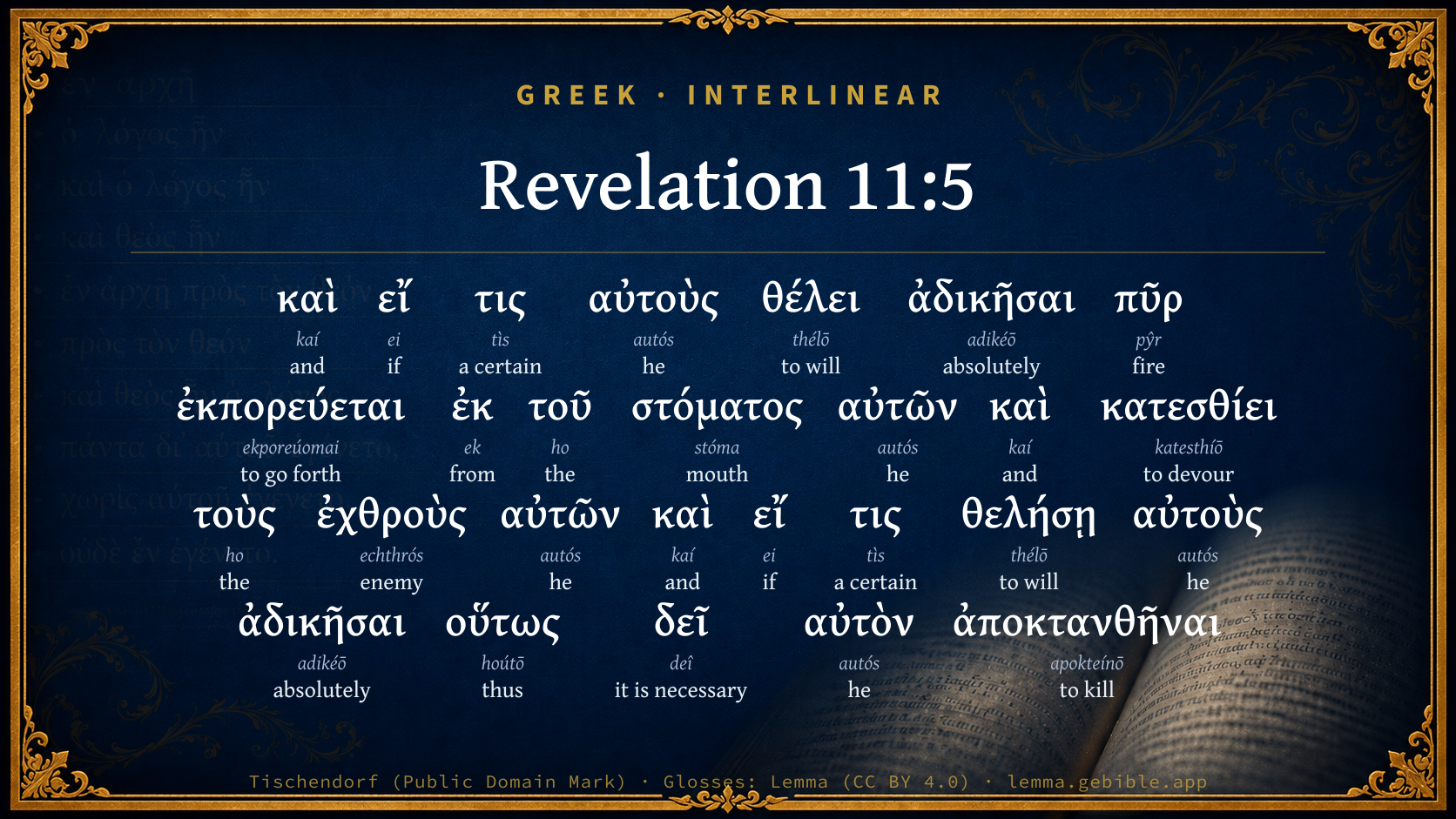
  1. καὶ kaí G2532 “and” Conjunction
  2. εἴ ei G1487 “if” Conditional
  3. τις tìs G5100 “a certain” Indefinite pronoun, Nominative, Singular, Masculine
  4. αὐτοὺς autós G846 “he” Personal pronoun, Accusative, Plural, Masculine
  5. θέλει thélō G2309 “to will” Verb, Present, Active, Indicative, 3rd person, Singular
  6. ἀδικῆσαι adikéō G91 “absolutely” Verb, Aorist, Active, Infinitive
  7. πῦρ pŷr G4442 “fire” Noun, Nominative, Singular, Neuter
  8. ἐκπορεύεται ekporeúomai G1607 “to go forth” Verb, Present, Middle or Passive deponent, Indicative, 3rd person, Singular
  9. ἐκ ek G1537 “from” Preposition
  10. τοῦ ho G3588 “the” Article, Genitive, Singular, Neuter
  11. στόματος stóma G4750 “mouth” Noun, Genitive, Singular, Neuter
  12. αὐτῶν autós G846 “he” Personal pronoun, Genitive, Plural, Masculine
  13. καὶ kaí G2532 “and” Conjunction
  14. τοὺς ho G3588 “the” Article, Accusative, Plural, Masculine
  15. ἐχθροὺς echthrós G2190 “enemy” Adjective, Accusative, Plural, Masculine
  16. αὐτῶν autós G846 “he” Personal pronoun, Genitive, Plural, Masculine
  17. καὶ kaí G2532 “and” Conjunction
  18. εἴ ei G1487 “if” Conditional
  19. τις tìs G5100 “a certain” Indefinite pronoun, Nominative, Singular, Masculine
  20. θελήσῃ thélō G2309 “to will” Verb, Aorist, Active, Subjunctive, 3rd person, Singular
  21. αὐτοὺς autós G846 “he” Personal pronoun, Accusative, Plural, Masculine
  22. ἀδικῆσαι adikéō G91 “absolutely” Verb, Aorist, Active, Infinitive
  23. οὕτως hoútō G3779 “thus” Adverb
  24. δεῖ deî G1163 “it is necessary” Verb, Present, Active, Indicative, 3rd person, Singular
  25. αὐτὸν autós G846 “he” Personal pronoun, Accusative, Singular, Masculine
  26. ἀποκτανθῆναι apokteínō G615 “to kill” Verb, Aorist, Passive, Infinitive

About this verse

These counts appear in no published source. They are computed here, from the morphology-tagged text and Lemma’s own curated glosses. What Lemma adds →

27
words
16
distinct lemmas
Revelation
section

Notable vocabulary

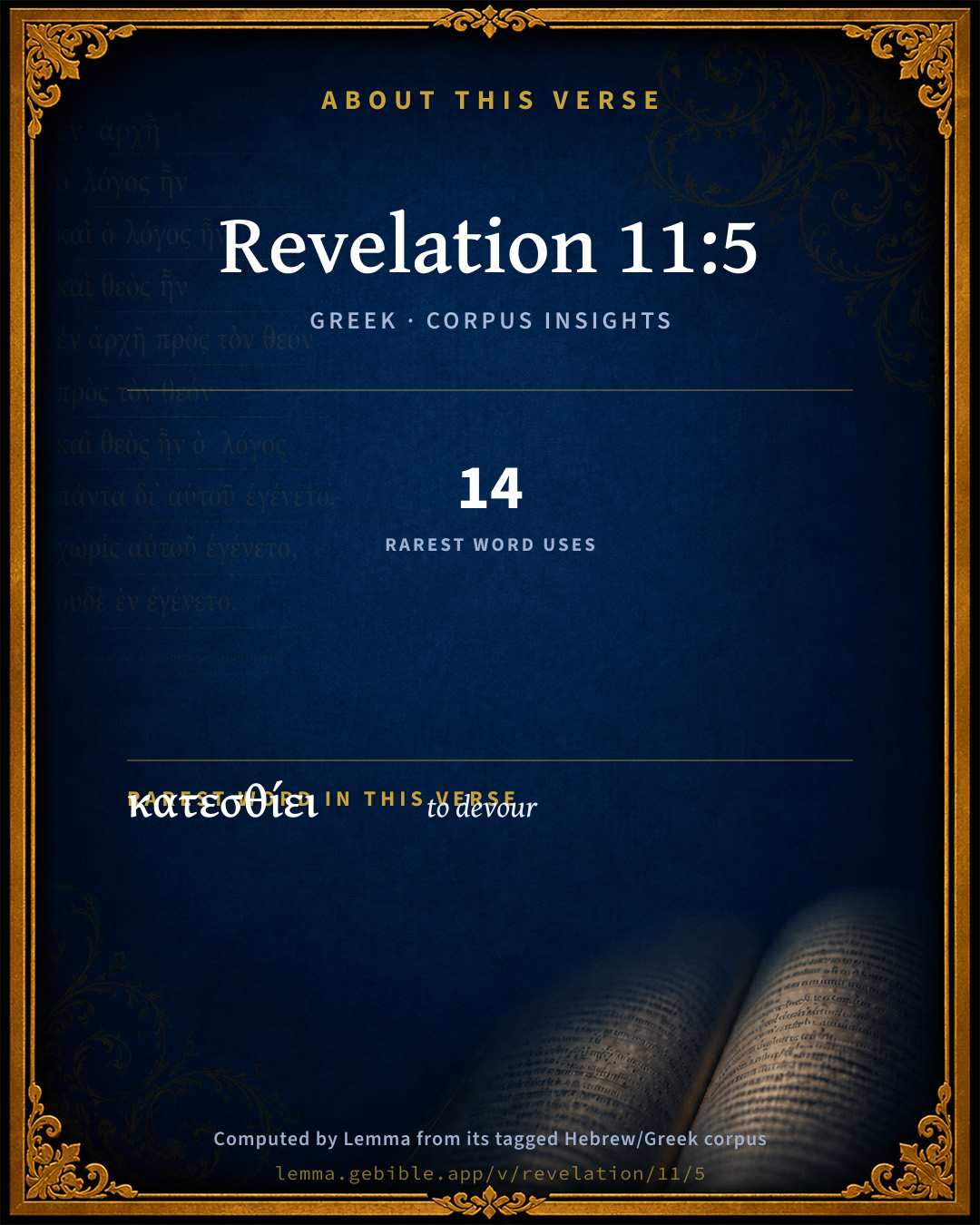
The rarest word here is κατεσθίει to devour G2719 — appearing just 14 times in the whole Greek New Testament.

Shared distinctive vocabulary

κατεσθίει to devour G2719 occurs in 14 verses of the Greek New Testament. Also found in:

Repetition

Words recur within this verse:

  • τις a certain G5100 ×2
  • θέλει to will G2309 ×2
  • ἀδικῆσαι absolutely G91 ×2
  • αὐτοὺς he G846 ×5
  • καὶ and G2532 ×3
  • εἴ if G1487 ×2
  • τοῦ the G3588 ×2

Cross-references

11

Topical passages linked to Revelation 11:5 in the Treasury of Scripture Knowledge — connected by theme and wording, ordered by reader-vote popularity; previews shown in the World English Bible.

  • Jeremiah 5:14 Therefore thus says Yahweh, the God of hosts, Because you speak this word, behold, I will make my words in your mouth fire, and this people wood, and it shall devour them.
  • 2 Kings 1:10–12 Elijah answered to the captain of fifty, If I be a man of God, let fire come down from the sky, and consume you and your fifty. Fire came down from the sky, and consumed him and his fifty.
  • Hosea 6:5 Therefore I have cut them to pieces with the prophets; I killed them with the words of my mouth. Your judgments are like a flash of lightning.
  • Numbers 16:28–35 Moses said, Hereby you shall know that Yahweh has sent me to do all these works; for [I have] not [done them] of my own mind.
  • Isaiah 11:4 but with righteousness shall he judge the poor, and decide with equity for the humble of the earth; and he shall strike the earth with the rod of his mouth; and with the breath of his lips shall he kill the wicked.
  • Psalms 18:8 Smoke went out of his nostrils. Consuming fire came out of his mouth. Coals were kindled by it.
  • Jeremiah 1:10 behold, I have this day set you over the nations and over the kingdoms, to pluck up and to break down and to destroy and to overthrow, to build and to plant.
  • Zechariah 2:8 For thus says Yahweh of hosts: 'For honor he has sent me to the nations which plundered you; for he who touches you touches the apple of his eye.
  • Zechariah 1:6 But my words and my decrees, which I commanded my servants the prophets, didn't they overtake your fathers? "Then they repented and said, 'Just as Yahweh of Hosts determined to do to us, according to our ways, and according to our practices, so he has dealt with us.'"
  • Ezekiel 43:3 It was according to the appearance of the vision which I saw, even according to the vision that I saw when I came to destroy the city; and the visions were like the vision that I saw by the river Chebar; and I fell on my face.
  • Acts 9:4–5 He fell on the earth, and heard a voice saying to him, "Saul, Saul, why do you persecute me?"

Cross-references courtesy of OpenBible.info (CC BY 4.0).

Commentary

Notes on Revelation 11:5 from classic Christian and Jewish commentators (each source and its license shown beneath its notes). The classic Christian expositions comment on the surrounding passage and are grouped to its opening verse, so a note may address several verses; the Jewish commentaries on the Tanakh (Rashi and others) are per-verse, so they appear only where the commentator wrote on this verse.

Lemma curates 59 commentaries, every one of them public domain or Creative Commons licensed, each selected and text-cleaned for this edition rather than reprinted as found. About our sources →

Tyndale Open Study Notes

Tyndale Open Resources

11:5 In one of the psalms, God is portrayed with fire coming from his mouth, a picture of judgment on his enemies (Ps 18:8; see also 2 Sam 22:9). Cp. Elijah, 2 Kgs 1:1-15.

Tyndale Open Study Notes — © Tyndale Open Resources, licensed CC BY-SA 4.0. Text via the HelloAO Bible API.

Meyer's Critical & Exegetical Commentary

Heinrich August Wilhelm Meyer

Rev_11:5 sq Description of the miraculous power with which the two witnesses are furnished in order, until their testimony is finished,[2843] to ward off their enemies, and to attest their divine commission. The particular features of the description, viz., Rev_11:6, are derived from the histories of Elias and Moses. Even this retrospective allusion, acknowledged by all expositors, to the miracles of those ancient prophets which are in no way understood allegorically, of itself renders it in the highest degree improbable that the description here is meant to be allegorical; but also the individual expressions of the text guard against the spiritual interpretation, as it has been applied from Primas and Beda to Hengstenb. and Ebrard.

Whether in Rev_11:5 (πῦρ ἐκπορεύεται ἐκ τοῦ στόματος αὐτῶν, κ.τ.λ.) there be an allusion to 2Ki_1:10 sqq., where Elijah calls down fire from heaven which consumes his enemies,[2844] remains uncertain; the parallel with Jer_5:14[2845] is more probable, but in connection with this the different character of the two passages dare not be overlooked. In Jeremiah the words of God are mentioned, and how when given in the mouth of the prophet they are like fire; just as it is said in Sir_48:1 : ἀνέστη Ἡλιας προφήτης ὡς πῦρ, καὶ ὁ λόγος αὐτοῦ ώς λαμπάς ἐκαίετο.[2846] In this passage, however, nothing is said of Gods words coming like fire from the mouth of the prophet,[2847] but only of fire which proceedeth from his mouth. What is said in Jer_5:14, by way of comparison, appears here, just as above, Rev_9:17, in dreadful reality; and that the words πὺρ ἐκπορ. ἐκ τ. στόμ. αὐτ. are, nevertheless, meant figuratively, follows from their deadly[2848] effect described immediately afterwards in the parallel clause, which, besides, is expressly referred by the οὕτως to the fire; for this οὕτως[2849] says: By the fire proceeding out of their mouth;[2850] and designates the punishment corresponding to the guilt of the θέλειν ἀδικῆσαι.[2851] But if the πῦρ is understood figuratively, the ἀποκτανθῆναι must then be referred to the fact that to unbelievers the gospel is a savor of death unto death; for the ἀδικῆσαι must also then be figurative no less than the entire succeeding statement. The allegorists are, also, mostly consistent in this, but they arrive at the most wonderful interpretations. In the power to shut heaven, that it rain not, Rev_11:6, the two witnesses are like Elijah;[2852] even the specification of time here corresponds, as the days of their prophetic employment during which it is not to rain,[2853] agree, according to Rev_11:3, with the three and a half years during which Elijah kept the heaven shut.[2854] The further power over the waters (ἘΠΊ)[2855] to turn them to blood, the two witnesses have in common with Moses;[2856] the last words also, ΚΑῚ ΠΑΤΆΞΑΙ ΤῊΝ ΓῆΝ ἘΝ ΠΆΣῌ ΠΛΗΓῇ, Κ.Τ.Λ., contain a retrospective view to the plagues with which Moses smote the Egyptians,[2857] although unlimited power is given both witnesses to smite the earth with all plagues as often as they will. These decided words once more make it manifest in the most definite way, that the issuing of fire from the mouth of the witnesses, the closing of the heaven, and the turning of water into blood,[2858] are clearly particular plagues of the kind inflicted by Elijah and Moses. If we are not to interpret 1 Kings 17, Jam_5:17, Exodus 7 sqq., allegorically, we must abide also in this passage by the literal sense, yet must not deduce therefrom that the power of the keys[2859] is here ascribed the two witnesses, in virtue of which they close the heaven spiritually, and hold back the spiritual rain of the gospel,[2860] cause bloodshed to come from the gospel,[2861] orif the ὝΔΑΤΑ which are turned into blood be understood as the waters out of which the antichristian beast (i.e., the papacy) arisescould excite the conflicts between popes and antipopes.[2862] This kind of consequent allegorizing was doubtful already to Grot., who, therefore, tries to escape with the vague explanation, There is nothing so great which they do not obtain on asking from God.[2863]

[2843] Cf. Rev_11:7 sqq.

[2844] Ewald, De Wette, etc.

[2845] Beng., Hengstenb., etc.

[2846] Then stood up Elias the prophet as fire, and his word burned like a lamp.

[2847] Against Beda, N. de Lyra, Aret., Par., Calov., Hengstenb., Ebrard. Cf. Grot.: Their prayers excite Gods wrath.

[2848] Cf. Rev_9:18.

[2849] Cf. Sir_48:3.

[2850] Ew., Züll.

[2851] Beng., De Wette, Hengstenb.

[2852] 1Ki_17:1.

[2853] Concerning the accus. τὰς ἡμέρας τ. πρ. αὑτ., cf. Winer, p. 215.

[2854] Jam_5:17.

[2855] Cf. Rev_6:8, where the accus. follows.

[2856] Exo_7:19.

[2857] Cf. Exo_8:2; Exo_8:16 sqq., Rev_9:15, Rev_11:1.

[2858] Cf. also Rev_8:8.

[2859] Beda.

[2860] N. de Lyra, Vitr., Calov., Hengstenb., Ebrard.

[2861] Vitr.

[2862] Cf. Calov.

[2863] See on Rev_11:13.

Meyer — Critical and Exegetical Commentary on the New Testament — English translation by Peter Christie, edited by Frederick Crombie (T&T Clark, 1880) — public domain. Text from a community e-Sword module.

Expositor's Greek Testament

ed. W. Robertson Nicoll

Rev 11:5-6 . In this description, borrowed from traditional features of Moses and Elijah (whose drought lasted for three and a half years, according to Luk 4:25 ; Jas 5:17 ), the metaphorical expressions of passages like Jer 5:14 and Sir 48:1 are translated into grim reality (see reff.), as in Slav. En. i. 5 and the thaumaturgic practices chronicled by Athen. iv. 129 D and Lucian ( Philopseud . 12). These are no meek apostles of the Christian faith. To stop rain was equivalent to a punishment for iniquity (Ps. Sol. 17:20 22, En. c. 11, etc.)

The Expositor's Greek Testament, edited by W. Robertson Nicoll (1897–1910) — public domain. Text from a community e-Sword module.

Geneva Bible (1599)

Geneva Bible translators

The power and efficacy of the holy ministry, and which is truly Evangelical, is declared both in earth and in heaven, protecting the administers thereof, and destroying the enemies in this verse, virtue indeed divine most mightily showing itself forth in heaven, earth and the sea, verse 6, as it described, 2 Cor. 10:4, according to the promise of Christ, Mark 16:17. And this is the second place (as I said before) of the combats which the servants of God must needs undergo in the executing of their calling, and of the things that follow the same combats. In the combats or conflicts are these things: to overcome, in these two verses: to be overcome and killed, verse 7. After the slaughter follow these things, that the carcasses of the godly are laid abroad, verse 8 being unburied, are made a matter of scorn together of cursing and bitter execrations, verse 9, and that therefore gratulations are publicly and privately made, verse 10.

Geneva Bible (1599) marginal notes — public domain. Text via Bolls.life.

Jamieson, Fausset & Brown

Robert Jamieson, A. R. Fausset & David Brown

will hurt--Greek, "wishes," or "desires to hurt them."

fire . . . devoureth--(Compare Jer 5:14; Jer 23:29).

out of their mouth--not literally, but God makes their inspired denunciations of judgment to come to pass and devour their enemies.

if any man will hurt them--twice repeated, to mark the immediate certainty of the accomplishment.

in this manner--so in like manner as he tries to hurt them (compare Rev 13:10). Retribution in kind.

Jamieson, Fausset & Brown — Commentary Critical and Explanatory on the Whole Bible (1871) — public domain (CC PDM 1.0). Text via the HelloAO Bible API.

Adam Clarke's Commentary

Verse 5. Fire proceedeth out of their mouth] That is, they are commissioned to denounce the judgments of God against all who would attempt to prevent them from proceeding in their ministry.

Adam Clarke's Commentary on the Bible (1810–1826) — public domain. Text from a community e-Sword/MySword module.

Ellicott's Commentary for English Readers

(5) And if any man . . .—Better, And if any one wills to injure them, fire goeth forth out of their mouths, and devoureth their enemies: and if any one wills to injure them, thus must he be slain. These have power to shut the heaven that the rain may not moisten (the earth) during the days of their prophesying; and they have power over the waters to turn them into blood, and to smite the earth with every plague as often as they will. Again the Old Testament basis becomes evident; the histories of Elijah and Moses supply the illustration. The fire devouring their foes seems to allude to 2Ki_1:10; like Elijah, they can close the heaven (1Ki_17:1); like Moses, they can turn water into blood and summon down every plague (Exo_7:20, et seq.). These last characteristics remind us of the spirit and power of Moses and Elias, but we must not forget what has gone before: the witnesses are like olive trees and lights. In them is concentrated grace, light, and power; their witness recalls the great features of various Old Testament teachers and leaders; they display the light of truth, and men may not oppose or injure them with impunity; they wield a power which it is not safe to provoke. As from the mouths of the great Sixth Trumpet host there went forth fire and smoke and brimstone to kill the third part of mankind, so out of the mouths of these witnesses there goes forth a purer, but mightier flame. (Comp. Psa_18:8.) We may compare the sword out of the mouth of Christ (Rev_1:16), and the promise to Jeremiah (Jer_5:14), “Behold I will make my words in thy mouth fire and this people wood, and it shall devour them.” The word which is like a sword to lay bare man to himself may become a consuming fire to those who resist or oppose it. The witnesses for God are thus armed with a spiritual might; for that word which, when accepted and lived by, brings peace, when rejected causes pain and danger. Thus often do the things which might have been for men’s peace become an occasion for falling; the stone which, used and built into the life, becomes a precious corner-stone and immovable foundation, grinds to powder those upon whom it falls. Thus is it with these witnesses: they come to witness for principles which go to make the world a Paradise once more. The world, which casts away their words, will find them come back with scorching force; just as the breath of God gives life and beauty to the world, and power to men’s hearts and lives (Psa_104:30; Joh_20:22), yet with that same breath of His lips does He slay the wicked (Isa_11:4). Some have thought that there will be a time when witnesses for God will be raised up who will work literal wonders such as these. It is not for us to say that this will not be the case: all prophecy may take a sharper and clearer meaning as the times of the end draw near; but, meanwhile, it is needful for us to remember that the very power of truth is such that, when rejected, it can and does avenge itself by shutting heaven over our head, and making all the fresh rivulets of life’s purest pleasures loathsome as blood to the sensualised and perverted heart.

A Bible Commentary for English Readers, edited by Charles John Ellicott (1878–1897) — public domain. Text from a community e-Sword module.

The Cambridge Bible for Schools and Colleges

gen. ed. J. J. S. Perowne

5. will hurt them] I.e. “wishes” or “means to hurt.”

fire proceedeth out of their mouth] Jer_5:14 is a precedent for the image, 2Ki_1:10, &c. for the sense.

The Cambridge Bible for Schools and Colleges (gen. ed. J. J. S. Perowne; Cambridge University Press, 1878–1918) — public domain. Text from a community e-Sword module.

John Gill's Exposition

And if any man will hurt them,.... Do any injury to their persons, or properties, oppose their writings, blaspheme their doctrines, and hinder their ministrations; whoever; they be, whether they be any that live among them, or in other parts; whether they be secret or open enemies; or whether they be of the outward court, or be really Gentiles or Papists; and especially if they do them any injustice, if they wrong, oppress, afflict, and distress them knowingly and willingly:

fire proceedeth out of their mouth; by which may be meant the word of God, which they preach and hold forth, which is comparable to fire, Jer 23:29, both for light, it being a means of enlightening sinners, who are darkness itself; and of directing saints in their walk and conversation; and of detecting the errors, immoralities, idolatry, and superstition of men, and particularly of the church of Rome, who cannot bear the light of this word, and therefore forbid the reading of it to the laity, and keep it locked up from them in the Latin tongue: and also for the heat of it, it being the means of quickening, or of conveying a vital heat to dead sinners; and of warming and comforting the saints, causing their hearts to burn within them, while they bear or read it, or meditate upon it; and of scorching and tormenting reprobate sinners, and filling them with wrath, pain, and anguish, especially the followers of antichrist; and this is greatly designed, for this has a particular reference to the pouring out of the fourth vial, Rev 16:9. Likewise, the word of God may be compared to fire for its purity in itself, for every word of his is pure; and for its purifying nature, when faithfully preached, and powerfully applied, it penetrates deep, it searches, and discovers, and purges from the dross of profaneness, false doctrine, and will worship; and for its consuming nature, as follows, it pronouncing damnation to unbelievers and impenitent sinners, and it being the savour of death unto death to such: or else the prayers of these witnesses are intended by the fire that proceeds out of their mouth, for vengeance on their enemies, who hinder their ministrations, blaspheme the truth, and shed their blood; which do not arise from a passionate and revengeful spirit, but from a pure zeal for the glory of God, and the honour of his name, and truth; and which prayers are heard by God, who will avenge his elect, that cry unto him day and night: the allusion is to the fire, which, at the request of Moses, came forth from the Lord, and destroyed two hundred and fifty persons, that opposed him and Aaron; and to the fire which Elias called for from heaven, upon the captains, and the fifties, that came to take him, who were types of these witnesses; see Num 16:3. And also this fire may denote the denunciations of God's wrath by them upon the antichristian party, these being as wood, and their words as fire, to consume them; see Jer 5:14.

And devoureth their enemies: whether open or secret; just as the fire devoured Nadab and Abihu, the offerers of strange fire, which the Lord commanded not; so the fire out of the mouth of God's faithful servants devours such who introduce divers and strange doctrines, and the inventions of men, into the church of God; the light of God's word convinces and confounds them, though it may not convert them; it flashes in their consciences, and distresses them, so that they gnaw their tongues for pain; there being nothing but a fearful looking for of judgment, and fiery indignation, which shall devour and destroy them, though not corporeally, yet spiritually and eternally; for even these shall afterwards make war against them, conquer them, and slay them, and shall see them ascend to heaven, Rev 11:7.

And if any man will hurt them, he must in this manner be killed; this is repeated, partly to show the certainty of this destruction; and partly to point out the manner of it, which will be not by the use of carnal weapons: these enemies of the witnesses will not be killed by the sword, or any other weapon, but by the word of God, and through the prayers of the saints, and by the denunciations of God's judgments on them. The Jews express the doctrines and traditions of their Rabbins, delivered from one to another, by fire, proceeding out of their mouths; who say (r),

"Rab sat before Rabbi, and "there went forth" , "sparks of fire from the mouth of Rab", into the mouth of Rabbi, and from the mouth of Rabbi, into the mouth of Rab;''

which the gloss explains of their communicating their doctrines and traditions to one another.

(r) T. Bab. Cholin, fol. 137. 2. Juchasin, fol. 113. 2.

John Gill's Exposition of the Whole Bible (1746–1763) — public domain (CC PDM 1.0). Text via the HelloAO Bible API.

Trapp's Complete Commentary

John Trapp

5 And if any man will hurt them, fire proceedeth out of their mouth, and devoureth their enemies: and if any man will hurt them, he must in this manner be killed.

Ver. 5. Fire proceedeth out of their mouths] So that a man were better anger all the witches in the world than God’s faithful witnesses; for they have ever vengeance in a readiness for the disobedient, 2Co 10:6. God inflicting what they either denounce or desire of him against their adversaries.

John Trapp, A Commentary or Exposition upon All the Books of the Old and New Testament (1647–1656) — public domain. Text from a community e-Sword module.

Albert Barnes' Notes on the Bible

And if any man will hurt them - This implies that there would be those who would be disposed to injure or wrong them; that is, that they would be liable to persecution. The word “will” is here more than the mere sign of the future; it denotes “intention, purpose, design,” θέλεὶ thelei - “if any man wills or purposes to injure them.” See a similar use of the word in 1Ti 6:9. The word “hurt” here means to do “injury” or “injustice” - ἀδικῆσαι adikēsai - and may refer to wrong in any form - whether in respect to their character, opinions, persons, or property. The general sense is, that there would be those who would be disposed to do them harm, and we should naturally look for the fulfillment of this in some form of persecution.

Fire proceedeth out of their mouth - It is, of course, not necessary that this should be taken literally. The meaning is, that they would have the power of destroying their enemies as if fire should proceed out of their mouth; that is, their words would be like burning coals or flames. There may possibly be an allusion here to 2Ki 1:10-14, where it is said that Elijah commanded the fire to descend from heaven to consume those who were sent to take him (compare Luk 9:54); but in that case Elijah commanded the fire to come “from heaven”; here it proceedeth “out of the mouth.” The allusion here, therefore, is to the denunciations which they would utter, or the doctrines which they would preach, and which would have the same effect on their enemies as if they breathed forth fire and flame. So Jer 5:14, “Because ye speak this word, Behold, I will make my words in thy mouth fire and this people wood, and it shall devour them.”

And devoureth their enemies - The word “devour” is often used with reference to fire, which seems to “eat up” or “consume” what is in its way, or to “feed on” what it destroys. This is the sense of the word here - κατεσθίει katesthiei - “to eat down, to swallow down, to devour.” Compare Rev 20:9; Septuagint Isa 29:6; Joe 2:5; Lev 10:2. As there is no reason to believe that there would be literal fire, so it is not necessary to suppose that their enemies would be literally devoured or consumed. The meaning is fulfilled if their words should in any way produce an effect on their enemies similar to what is produced by fire: that is, if it should destroy their influence; if it should overcome and subdue them; if it should annihilate their domination in the world.

And if any man will hurt them - This is repeated in order to make the declaration more intensive, and also to add another thought about the effect of persecuting and injuring them.

He must in this manner be killed - That is, in the manner specified - by fire. It does not mean that he would be killed in the same manner in which the “witnesses” were killed, but in the method specified before - by the fire that should proceed out of their mouth. The meaning is, undoubtedly, that they would have power to bring down on them divine vengeance or punishment, so that there would be a just retaliation for the wrongs done them.

Albert Barnes' Notes on the Bible (1834–1885) — public domain. Text from a community e-Sword/MySword module.

Haydock's Catholic Bible Commentary

And if any man would hurt them, &c. These two verses seem to signify both the miracles which God many times wrought by the prayers of his martyrs, as he had done frequently in the time of Elias [Elijah] and the exemplary punishments with which from time to time he chastised those by whom they were persecuted, and that he will do the like by Henoch [Enoch] and Elias, when they shall come. (Witham) --- In this and the following verse are expressed the miraculous powers with which the two witnesses will be invested. These powers will be necessary to enable them to prove the truth of their doctrine. Every messenger who appears with a commission from God, is always furnished with means to prove it. Thus our Saviour and his apostles worked miracles in testimony of the Christian religion. And in the Old Testament, Elias convicted the false prophets by a miracle. See 3 Kings xviii. Every new teacher consequently, who comes destitute of this sanction, can claim no credit, but is only to be considered as an imposter. (Pastorini)

George Leo Haydock (1774–1849), Haydock's Catholic Family Bible and Commentary, 1859 edition — public domain. Excludes Psalms (Douay-Rheims chapter numbering differs from Protestant) and Deuterocanonical books (Catholic canon only).

Matthew Poole's English Annotations

And if any man will hurt them; that is, my faithful ministers, the two olive branches before mentioned, which fill the candlesticks with oil.

Fire proceedeth out of their mouth, and devoureth their enemies: here is a plain allusion to the stories of Moses and Elijah, calling for fire from heaven; but God showeth, that the victory of his ministers under the gospel shall not be by a miraculous fire called for down from heaven, (as Elijah hurt the captains and their bands sent to apprehend him), but by fire out of their mouths; according to that, Jer 5:14, Behold, I will make my words in thy mouth fire, and this people wood, and it shall devour them: see also Jer 1:9,10. This also is according to Zechariah’s vision before mentioned, and the revelation of the will of God in it, Rev 11:6; Not by might, nor by power, but by my Spirit, saith the Lord of hosts. The meaning is, that they shall be too hard for them, either by their faithful, lively, and powerful preaching, or by their fervent prayers.

Matthew Poole's English Annotations on the Holy Bible (1683–1685) — public domain. Text from a community e-Sword/MySword module.

Whedon's Commentary on the Bible

Daniel D. Whedon

5. And—The imagery of these two verses seems to be based upon the history of Elijah.

Will—Rather, wills, or purposes to.

Fire—In 2Ki_1:10; 2Ki_1:12, fire came down from heaven, yet at the words of Elijah’s mouth. The powerful physical images under which the divine judgments following the rejected ministries of the evangelic witnesses need not perplex us. Physical miracles of far more gigantic figure are ascribed to the dragon Rev_12:4, and to the beast Rev_13:13-15. When even so sober a commentator as Alford is in profound doubt whether these two witnesses are not two literal men, who will in the future perform these physical miracles, and go through a martyrdom and miraculous resurrection after three days and a half, we are at once amazed and amused. Why not make the beast a real animal and his image a real automaton, by which physical miracles are wrought?

The sacred thought that underlies these physical images is easily disclosed by the ordinary laws of analogy. The fire that proceedeth out of the mouth of the evangelical prophet is forked. That is, it is alternative in its power; it must burn up the man’s sins or burn up his soul. He who hurts the prophets, by damaging the truth he represents, is devoured by that fire. It is the man, and not the sin, that dies. That the wages of rejecting the truth is death is so immutable a law that the speaker gives it an emphatically-repeated utterance.

Daniel D. Whedon (gen. ed.), Commentary on the Old and New Testaments (1874–1909) — public domain. Text from a community e-Sword module.

The Pulpit Commentary

And if any man will hurt them, fire proceedeth out of their mouth, and devoureth their enemies; if any one willeth to hurt them, etc. Most probably a reference to the act of Elijah. (2Ki_1:10) Perhaps there is a double reference in the fire proceeding out of their mouth; it is the fire of their witness, which refines and purifies and convinces some; it is also the fire of condemnation, which follows those who reject the testimony. The figure is found in Jer_5:14, "I will make my words in thy mouth fire, and this people wood, and it shall devour them". (see also Hos_6:5; Ecc 48:1) And if any man will hurt them, he must in this manner be killed; any one shall will (future) is read in the Revised Version, and is supported by a, A, 38; yelei , (present) is found in B, C, P, Andreas, Arethas. "In this manner;" that is, by fire. Such, throughout the Scriptures, is the form under which the final judgment of those who reject God"s message is shadowed forth. The description is not more opposed to a general interpretation than it is to an individual interpretation of the two witnesses.

The Pulpit Commentary (1880–1919), ed. H.D.M. Spence-Jones & Joseph S. Exell — public domain. Text from a community e-Sword module.

John Wesley's Explanatory Notes

If any would kill them - As the Israelites would have done Moses and Aaron, Num. xvi, 41. He must be killed thus - By that devouring fire.

John Wesley, Explanatory Notes Upon the Whole Bible (1754–1765) — public domain. Text via the GEBible commentary corpus.

Kretzmann's Popular Commentary

Paul E. Kretzmann

The fate of the two witnesses:

v. 5. And if any man will hurt them, fire proceedeth out of their mouth and devoureth their enemies; and if any man will hurt them, he must in this manner be killed.

v. 6. These have power to shut heaven, that it rain not in the days of their prophecy, and have power over waters to turn them to blood, and to smite the earth with all plagues as often as they will.

v. 7. And when they shall have finished their testimony, the beast that ascendeth out of the bottomless pit shall make war against them, and shall overcome them, and kill them.

v. 8. And their dead bodies shall lie in the street of the great city, which spiritually is called Sodom and Egypt, where also our Lord was crucified.

v. 9. And they of the people and kindreds and tongues and nations shall see their dead bodies three days and a half, and shall not suffer their dead bodies to be put in graves.

v. 10. And they that dwell upon the earth shall rejoice over them, and make merry, and shall send gifts one to another, because these two prophets tormented them that dwelt on the earth.

The first part of this description again reminds us of Moses and Elijah, Exo 7:1-25; Exo 8:1-32; Exo 9:1-35; Exo 10:1-29; 1Ki 17:1; 2Ki 1:1-18; And if anyone wants to injure them, fire issues out of their mouth and consumes their enemies; and if any should want to injure them, in this manner must he be killed. These have power to shut up the sky, that no rain map fall during the days of their prophecy, and they have power over the waters to turn them into blood, and to smite the earth with all manner of plagues as often as they choose. To prevent rain from falling was a punishment for iniquity as was the turning of water into blood. The entire description points to a divine power in the witness of the two prophets. All those that despise the true preachers of the Gospel and reject their message are doomed to eternal death, which is in a manner foreshadowed by the temporal plagues that occur on the earth from time to time, such as war, pestilence, and famine.

The temporary triumph of Anti-Christ’s power: And when they have finished their testimony, the beast that ascends out of the abyss will wage war with them, and will conquer them, and will kill them. When they have finished their testimony, when they have done their work as commanded them by the Lord, and not before, will Anti-Christ succeed in carrying out the purpose of his hatred. For the beast out of the abyss is no one but the man of sin, the abomination of desolation, the false Messiah, the Roman Anti-Christ, personified in the Pope of the Roman Church. God’s witnesses having performed their work, the enemy is given permission to slay them. With the power of hell Anti-Christ makes war upon the faithful servants of God, overcomes them, and finally puts them to death. That was the experience of all the teachers who, in the darkness of the Middle Ages, when the temporal and ecclesiastical power of popery was at its height, dared to bear witness to the truth.

All this caused great rejoicing in the kingdom of darkness: And their corpses will lie on the streets of the great city, which is allegorically called Sodom and Egypt, where also their Lord was crucified; and men of the peoples and tribes and tongues and nations will see their corpses three days and one half, and will not permit their corpses to be placed into sepulchers; and they that dwell upon the earth will rejoice over them and be very glad, and will send one another presents, because these two prophets tormented those that lived upon the earth. Sodom, to the Jews, was the essence of abominations, and Egypt was the country where their fathers had been kept in shameful slavery; both names therefore stood for the lowest and meanest on earth. The great city to which these names are applied is none other than the Church of Anti-Christ, a Sodom, on account of the sins that are committed under the mantle of holiness, and an Egypt on account of the suppression of the pure Gospel that is practiced in its midst. No political criminals were ever treated with such cruelty as the confessors of the Gospel that suffered martyrdom in the Church of Anti-Christ. Even after the true witnesses had been slain, they were often not permitted to rest in their graves, their very bones being made the object of fanatical attacks, as in the case of Wycliffe. And whenever a faithful servant of Christ had been put to death, it was a cause for great rejoicing in the ranks of Christ’s enemies, who congratulated one another and even went to the extent of having medals struck to commemorate the event, as in the case of the Massacre of St. Bartholomew.

Paul E. Kretzmann, Popular Commentary of the Bible (1921–1924) — public domain. Text from a community e-Sword module.

The People's New Testament

B. W. Johnson

5, 6. Fire proceedeth out of their mouth. Whatever is signified by these two witnesses, they have the power to destroy. In seeking for the two witnesses we must find agencies which can save life and can destroy it, can shut the heavens and open them, can prevent blessings from descending upon the earth, can inflict curses and plagues on the inhabitants of the earth. The witnesses have supernatural powers.

B. W. Johnson's The People's New Testament with Notes (1889–1891) — public domain. Electronic text from the Christian Classics Ethereal Library (CCEL) ThML edition.

Cambridge Greek Testament for Schools and Colleges

5. οὕτως. A omits.

5. πῦρ ἐκπορεύεται ἐκ τοῦ στόματος αὐτῶν. Jer 5:14 is a precedent for this image; 2Ki 1:10, &c. for the sense.

εἵ τις θελήσῃ. The irregularity, so far as there is one, is due to a common tendency of all Greek not consciously moulded on the early classics to use the conjunctive in conditional sentences even after εἰ, Winer, p. 568: hence the irregularity has presumption in its favour, apart from the balance of the authority.

Cambridge Greek Testament for Schools and Colleges (Cambridge University Press, 1896; 21 vols, various authors incl. Carr, Maclear, Plummer, Farrar, Lumby, Moule, M. R. James, Simcox) — public domain. Text from a community e-Sword module.

Vincent's Word Studies in the New Testament

Marvin R. Vincent

Fire proceedeth. Compare 2Ki 1:10; Jer 5:14.

Marvin R. Vincent, Word Studies in the New Testament (1887–1900) — public domain. Text from a community e-Sword/MySword module.

Lesson kit

Teaching starters — assembled from the data on this page, not authored interpretation. Every prompt links to the verse data it draws on. Edit before teaching.

Revelation, in the Revelation, opens this verse with 27 words (16 distinct Greek lemmas). Its most distinctive word is katesthíō (“to devour”). A historical commentator’s framing appears above. Read the whole chapter for the surrounding context.

Discussion questions

  1. What does “to devour” (katesthíō) contribute to the verse as a whole?
  2. Matthew 13:4 shares the word «to devour» with this verse. How do the two illuminate each other?
  3. “a certain” occurs 2× in this one verse. What is the effect of the repetition?
  4. The translations on this page render this verse differently — a whole-verse word diff, not a word-by-word alignment. What might account for the different wordings?
  5. Reading how Tyndale Open Study Notes and Meyer's Critical & Exegetical Commentary read this verse, where do the two commentators agree and where do they part?

Things to notice

  • These translations choose different wording for 17 words in this verse.
  • “a certain” occurs 2× in this single verse.
  • 16 distinct Greek lemmas span 27 words in this verse.

Reading settings

Reading text

Shown beneath each verse's original-language words.

Old Testament
Old Testament edition

Read the OT as the Masoretic Hebrew (MT) or the Greek Septuagint (LXX).

English shown for the Greek Septuagint (in the Hebrew ↔ Greek comparison).

Comparing translations? Open the Compare panel on any verse page to stack up to four side by side.