
Deuteronomy 21:14

Hebrew (Westminster Leningrad Codex) Deuteronomy 21:14 appears in the Hebrew Old Testament. The text above is from the Westminster Leningrad Codex. Each word links to its Strong’s number, a concise gloss, and parsing drawn from the Open Scriptures Hebrew Bible morphology. Click any word for its full Brown-Driver-Briggs (BDB) entry.
Download image
Cite this verse

Deuteronomy 21:14 (World English Bible). Public Domain. Lemma interlinear Bible study tool, https://lemma.gebible.app/v/deuteronomy/21/14.

Show BibTeX & RIS
BibTeX
RIS
English Translation
It shall be, if you have no delight in her, then you shall let her go where she will; but you shall not sell her at all for money, you shall not deal with her as a slave, because you have humbled her.
World English Bible · Public Domain
Highlights
  • 1 first appearance in the Hebrew Bible
Full analysis ↓
Download a study sheet

One document with this verse’s original text, its word-by-word gloss line, the meaning frame, cross-references with their text, attributed commentary, and full source and license credits — printable, and it pastes into notes with its structure intact.

This verse Autodidact and up

Study sheet (.html) Plain text (.txt)

A passage Seminary Student

Up to 50 verses in one chapter. A passage sheet keeps up to 6 commentary sources and 12 cross-references per verse, in the order this page ranks them, and says so on the sheet whenever that leaves anything out. Ask for a single verse and you get the Autodidact verse sheet above.

Everything on this page stays free to read, with no account — the sheet is a download of what is already on screen, not access to it.

Want to remove ads? Support Godless Engineer
Compare translations 3

The same verse in 3 English versions, stacked beneath the original-language interlinear above. Click any original word for its lexicon entry.

Each is an independent rendering of the whole verse — the interlinear is not word-aligned to these translations.

Highlighted words mark where these versions differ — a whole-verse word diff, not a word-by-word alignment.

  • World English Bible Public Domain
    It shall be, if you have no delight in her, then you shall let her go where she will; but you shall not sell her at all for money, you shall not deal with her as a slave, because you have humbled her.
  • King James Version Public Domain
    And it shall be, if thou have no delight in her, then thou shalt let her go whither she will; but thou shalt not sell her at all for money, thou shalt not make merchandise of her, because thou hast humbled her.
  • unfoldingWord Literal Text CC BY-SA 4.0
    And it will be, if you do not delight in her, then you shall send her to her desires, but you surely shall not sell her for money, you shall not mistreat her in return for humiliating her.

unfoldingWord Literal Text — © unfoldingWord, licensed CC BY-SA 4.0. Word-aligned USFM3 via Door43 (git.door43.org/unfoldingWord/en_ult).

Versions to compare (up to 4)

3 of 4 selected

Show all 18 translations

Every available English version of this verse, each an independent rendering of the whole verse.

  • World English Bible Public Domain
    It shall be, if you have no delight in her, then you shall let her go where she will; but you shall not sell her at all for money, you shall not deal with her as a slave, because you have humbled her.
  • Berean Standard Bible Public Domain
    And if you are not pleased with her, you are to let her go wherever she wishes. But you must not sell her for money or treat her as a slave, since you have dishonored her.
  • Majority Standard Bible Public Domain
    And if you are not pleased with her, you are to let her go wherever she wishes. But you must not sell her for money or treat her as a slave, since you have dishonored her.
  • King James Version Public Domain
    And it shall be, if thou have no delight in her, then thou shalt let her go whither she will; but thou shalt not sell her at all for money, thou shalt not make merchandise of her, because thou hast humbled her.
  • American Standard Version (1901) Public Domain
    And it shall be, if thou have no delight in her, then thou shalt let her go whither she will; but thou shalt not sell her at all for money, thou shalt not deal with her as a slave, because thou hast humbled her.
  • Revised Version (1885) Public Domain
    And it shall be, if thou have no delight in her, then thou shalt let her go whither she will; but thou shalt not sell her at all for money, thou shalt not deal with her as a slave, because thou hast humbled her.
  • Geneva Bible (1599) Public Domain
    And if thou haue no fauour vnto her, then thou mayest let her go whither she will, but thou shalt not sell her for money, nor make marchandise of her, because thou hast humbled her.
  • Douay-Rheims (1899) Public Domain
    Rut if afterwards she please thee not, thou shalt let her go free, but thou mayst not sell her for money nor oppress her by might because thou hast humbled her.
  • Young's Literal Translation Public Domain
    `And it hath been -- if thou hast not delighted in her, that thou hast sent her away at her desire, and thou dost not at all sell her for money; thou dost not tyrannize over her, because that thou hast humbled her.
  • Literal Standard Version CC BY-SA 4.0
    And it has been, if you have not delighted in her, that you have sent her away at her desire, and surely you do not sell her for money; you do not tyrannize over her, because that you have humbled her.
  • Unlocked Literal Bible CC BY-SA 4.0
    But if you take no delight in her, then you may let her go where she wishes. But you must not sell her at all for money, and you must not treat her like a slave, because you have humiliated her.
  • unfoldingWord Literal Text CC BY-SA 4.0
    And it will be, if you do not delight in her, then you shall send her to her desires, but you surely shall not sell her for money, you shall not mistreat her in return for humiliating her.
  • Darby Bible Public Domain
    And it shall be, if thou have no delight in her, then thou shalt let her go according to her desire; but thou shalt in no wise sell her for money; thou shalt not treat her as a slave, because thou hast humbled her.
  • World Messianic Bible Public Domain
    It shall be, if you have no delight in her, then you shall let her go where she desires; but you shall not sell her at all for money. You shall not deal with her as a slave, because you have humbled her.
  • Webster's Bible Public Domain
    And it shall be, if thou shalt have no delight in her, then thou shalt let her go whither she will; but thou shalt not sell her at all for money; thou shalt not make merchandise of her, because thou hast humbled her.
  • Free Bible Version CC BY-SA 4.0
    However, if you are not happy with her, you must let her leave and go wherever she wants. You are not allowed to sell her for money or treat her like a slave, because you have brought shame on her.
  • Bible in Basic English Public Domain
    But if you have no delight in her, you are to let her go wherever she will; you may not take a price for her as if she was your property, for you have made use of her for your pleasure.
  • JPS Tanakh (1917) Public Domain
    And it shall be, if thou have no delight in her, then thou shalt let her go whither she will; but thou shalt not sell her at all for money, thou shalt not deal with her as a slave, because thou hast humbled her.

Literal Standard Version (2020), Covenant Press — licensed CC BY-SA 4.0. Text via the HelloAO Bible API (eBible.org). Unlocked Literal Bible (unfoldingWord) — licensed CC BY-SA 4.0. Text via the HelloAO Bible API (eBible.org). unfoldingWord Literal Text — © unfoldingWord, licensed CC BY-SA 4.0. Word-aligned USFM3 via Door43 (git.door43.org/unfoldingWord/en_ult). Free Bible Version, Dr. Jonathan Gallagher — licensed CC BY-SA 4.0. Text via the HelloAO Bible API (eBible.org).

Word by word

More ways to search: Search by grammar → Find every occurrence → Compare this word →

Practice this passage: Drill this verse → Learn its vocabulary →

תִתְעַמֵּ֣ר
ʻâmar
H6014
“to bind sheaves”
Verb, Hithpael, Imperfect, 2nd Person, Masculine, Singular
Part of Speech
Verb
Stem
Hithpael
Form
Imperfect
Person
2nd Person
Gender
Masculine
Number
Singular
Full BDB Definition

Origin: a primitive root

TWOT: 1645 , 1646

to bind sheaves - (Piel) to gather - to manipulate, deal tyrannically with - (Hithpael) to treat as a slave
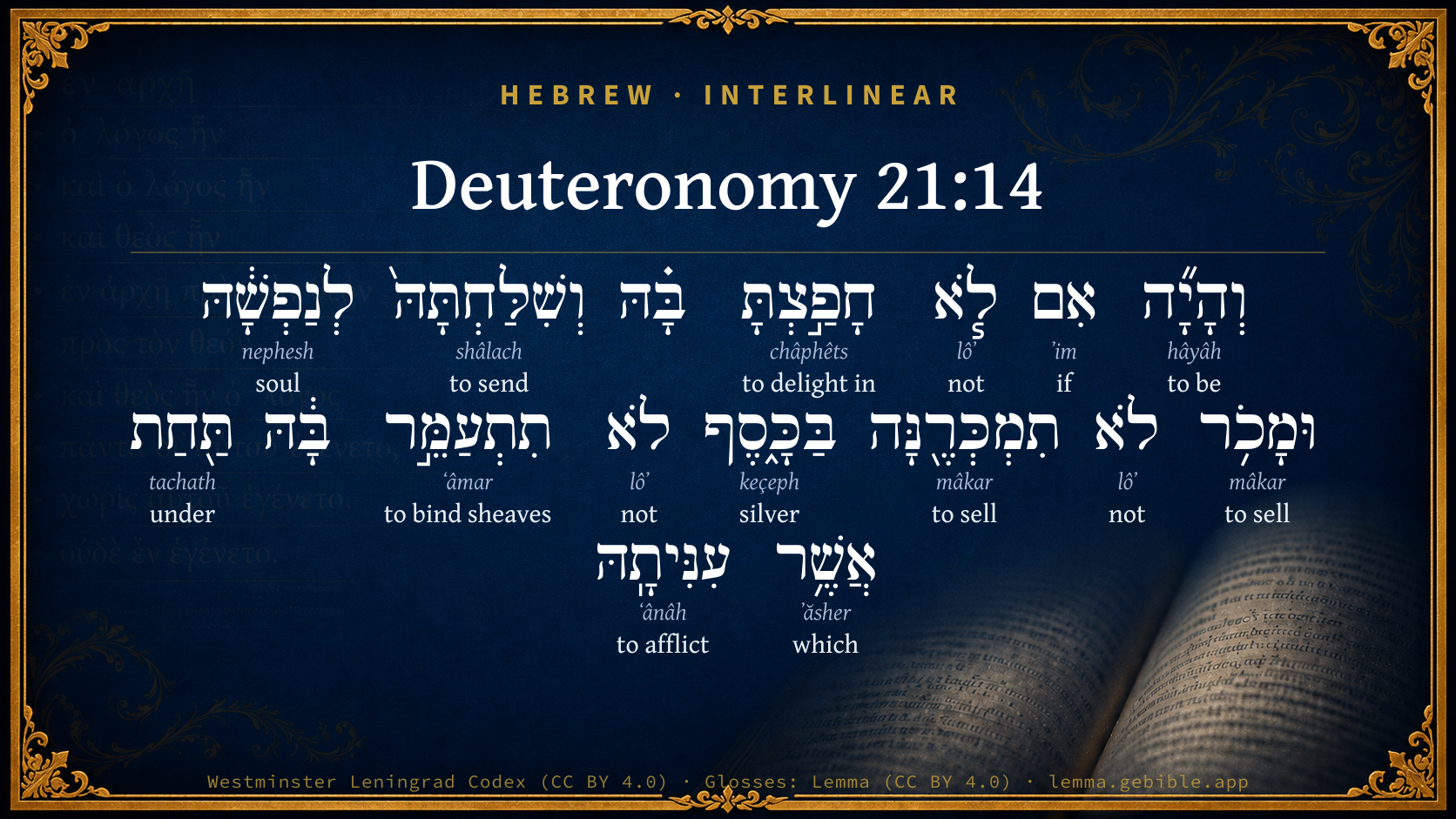
  1. וְהָיָ֞ה hâyâh H1961 “and · to be” Conjunction + Verb, Qal, Sequential Perfect, 3rd Person, Masculine, Singular
  2. אִם ʼim H518 “if” Conjunction
  3. לֹ֧א lôʼ H3808 “not” Particle, Negative
  4. חָפַ֣צְתָּ châphêts H2654 “to delight in” Verb, Qal, Perfect, 2nd Person, Masculine, Singular
  5. וְשִׁלַּחְתָּהּ֙ shâlach H7971 “and · to send · her” Conjunction + Verb, Piel, Sequential Perfect, 2nd Person, Masculine, Singular + Suffix, Personal, 3rd Person, Feminine, Singular
  6. לְנַפְשָׁ֔הּ nephesh H5315 “to/for · soul · her” Preposition + Noun, Common, Both, Singular, Construct + Suffix, Personal, 3rd Person, Feminine, Singular
  7. וּמָכֹ֥ר mâkar H4376 “and · to sell” Conjunction + Verb, Qal, Infinitive Absolute
  8. לֹא lôʼ H3808 “not” Particle, Negative
  9. תִמְכְּרֶ֖נָּה mâkar H4376 “to sell · her” Verb, Qal, Imperfect, 2nd Person, Masculine, Singular + Suffix, Personal, 3rd Person, Feminine, Singular
  10. בַּכָּ֑סֶף keçeph H3701 “in/at the · silver” Preposition, Determined + Noun, Common, Masculine, Singular, Absolute
  11. לֹא lôʼ H3808 “not” Particle, Negative
  12. תַּ֖חַת tachath H8478 “under” Preposition
  13. אֲשֶׁ֥ר ʼăsher H834 “which” Particle, Relative
  14. עִנִּיתָֽהּ ʻânâh H6031 “to afflict · her” Verb, Piel, Perfect, 2nd Person, Masculine, Singular + Suffix, Personal, 3rd Person, Feminine, Singular

About this verse

These counts appear in no published source. They are computed here, from the morphology-tagged text and Lemma’s own curated glosses. What Lemma adds →

17
words
12
distinct lemmas
Pentateuch
section

Notable vocabulary

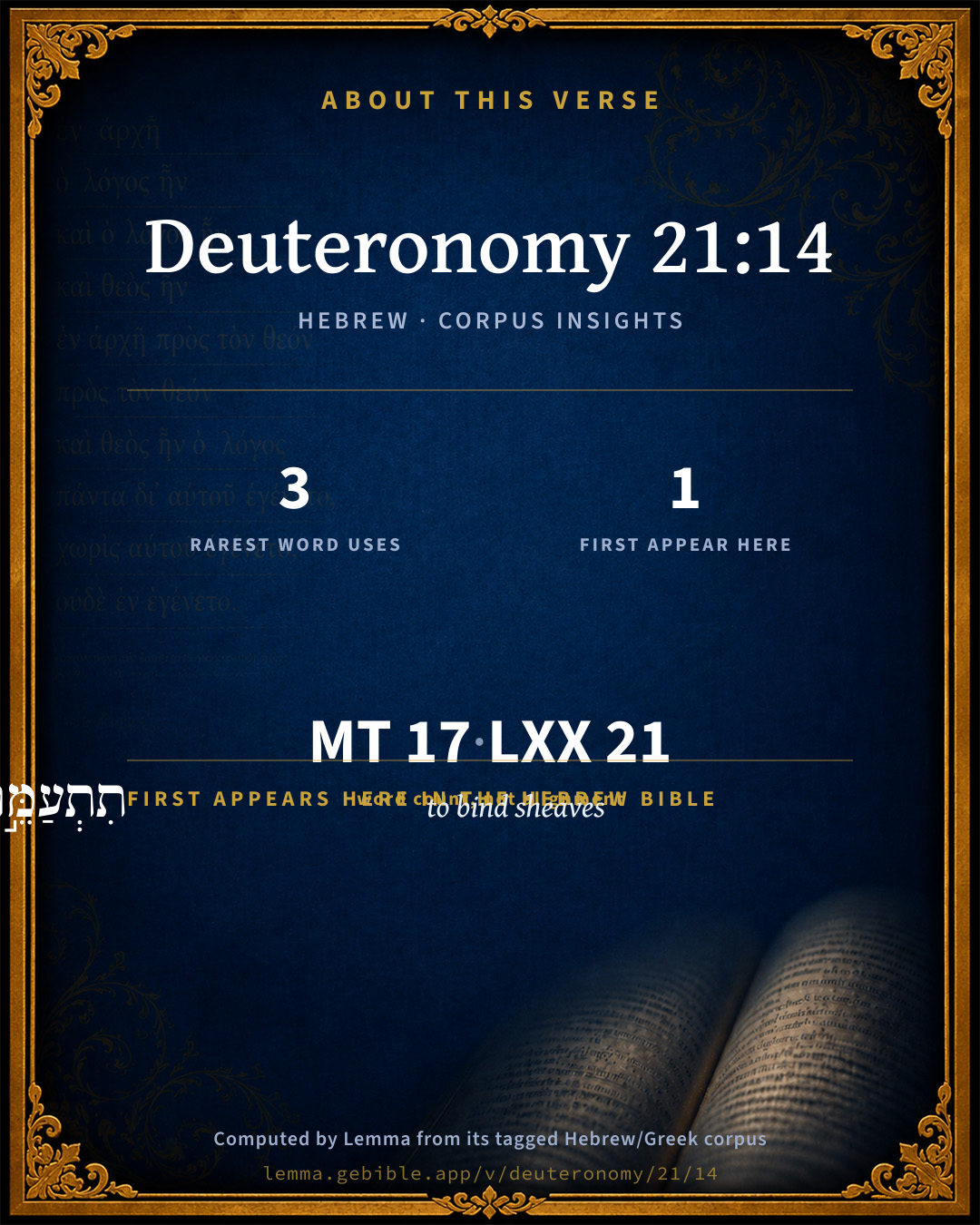
The rarest word here is תִתְעַמֵּ֣ר to bind sheaves H6014 — appearing just 3 times in the whole Hebrew Bible.

First appearance in Scripture

This word makes its first canonical appearance in the Hebrew Bible here:

  • תִתְעַמֵּ֣ר to bind sheaves H6014

Shared distinctive vocabulary

תִתְעַמֵּ֣ר to bind sheaves H6014 occurs in 3 verses of the Hebrew Bible. Also found in:

Grammatical profile

  • 7 verbs
  • 2 nouns
  • 3 prepositions
  • 1 conjunction
  • 4 particles

Verb forms

  • וְהָיָ֞ה Qal · Sequential Perfect
  • חָפַ֣צְתָּ Qal · Perfect
  • וְשִׁלַּחְתָּהּ֙ Piel · Sequential Perfect
  • וּמָכֹ֥ר Qal · Infinitive Absolute
  • תִמְכְּרֶ֖נָּה Qal · Imperfect
  • תִתְעַמֵּ֣ר Hithpael · Imperfect
  • עִנִּיתָֽהּ Piel · Perfect

Repetition

Words recur within this verse — often emphatic in Hebrew:

  • וּמָכֹ֥ר to sell H4376 ×2
  • לֹ֧א not H3808 ×3

Hebrew & Septuagint length

In English translation the verse runs 43 words from the Hebrew and 39 from the Septuagint (LXX English) — closely comparable.

A rough comparison of the two English renderings, which tokenize alike — not a word-level alignment.

Word counts can differ between the Hebrew and the Greek without any difference in meaning — e.g. the Hebrew direct-object marker אֵת has no separate Greek word, and Greek often adds the article ὁ.

In the original languages it is 17 Hebrew tokens and 21 Greek tokens — but the two are counted differently (Hebrew bundles its prefixes and suffixes into one token; the Greek is in lemma form), so that isn’t a like-for-like length.

Cross-references

6

Topical passages linked to Deuteronomy 21:14 in the Treasury of Scripture Knowledge — connected by theme and wording, ordered by reader-vote popularity; previews shown in the World English Bible.

  • Deuteronomy 22:29 then the man who lay with her shall give to the lady's father fifty [shekels] of silver, and she shall be his wife, because he has humbled her; he may not put her away all his days.
  • Genesis 34:2 Shechem the son of Hamor the Hivite, the prince of the land, saw her. He took her, lay with her, and humbled her.
  • Deuteronomy 22:19 and they shall fine him one hundred [shekels] of silver, and give them to the father of the young lady, because he has brought up an evil name on a virgin of Israel: and she shall be his wife; he may not put her away all his days.
  • Deuteronomy 22:24 then you shall bring them both out to the gate of that city, and you shall stone them to death with stones; the lady, because she didn't cry, being in the city; and the man, because he has humbled his neighbor's wife: so you shall put away the evil from the midst of you.
  • Exodus 21:7–11 "If a man sells his daughter to be a maid-servant, she shall not go out as the men-servants do.
  • Judges 19:24 Behold, here is my daughter a virgin, and his concubine; them I will bring out now, and humble you them, and do with them what seems good to you: but to this man don't do any such folly.

Cross-references courtesy of OpenBible.info (CC BY 4.0).

Hebrew and Greek witnesses Masoretic Hebrew ↔ Greek Septuagint

The same verse in the two great witnesses to the Old Testament, shown verse-for-verse.

These are two independent witnesses, not word-aligned to each other, and the Septuagint is shown in lemma (dictionary) form.

Hebrew Deuteronomy 21:14 Masoretic · Westminster Leningrad Codex

וְהָיָ֞ה אִם לֹ֧א חָפַ֣צְתָּ בָּ֗הּ וְשִׁלַּחְתָּהּ֙ לְנַפְשָׁ֔הּ וּמָכֹ֥ר לֹא תִמְכְּרֶ֖נָּה בַּכָּ֑סֶף לֹא תִתְעַמֵּ֣ר בָּ֔הּ תַּ֖חַת אֲשֶׁ֥ר עִנִּיתָֽהּ

It shall be, if you have no delight in her, then you shall let her go where she will; but you shall not sell her at all for money, you shall not deal with her as a slave, because you have humbled her.

World English Bible · Public Domain

Greek LXX Deuteronomy 21:14 Septuagint · lemma form

καί εἰμί ἐάν μή θέλω αὐτός ἐκ ἀποστέλλω αὐτός ἐλεύθερος καί πρᾶσις οὐ πιπράσκω ἀργύριον οὐ ἀθετέω αὐτός διότι ταπεινόω αὐτός

And it shall be if you do not delight in her, you shall send her out free; and she shall not by any means be sold for money, you shall not treat her contemptuously, because you have humbled her.

LXX2012 (modern English Septuagint) · Public Domain

Hebrew: Westminster Leningrad Codex (CC BY 4.0). Greek: Septuagint (public domain); English from LXX2012 (modern English Septuagint) (Public Domain). How the Septuagint differs from the Hebrew →

Targum (Aramaic paraphrase)

2

The Targum is the ancient Jewish Aramaic paraphrase of the Hebrew Scriptures — an interpretive translation, not the Hebrew text itself. Onkelos (literal) and Pseudo-Jonathan (expansive) render the Torah, and Jonathan the Prophets. Coverage is partial: where no permissively-licensed English translation exists for a verse, only the Aramaic is shown. This is verse-level text, not a word-by-word alignment to the Hebrew.

  1. Targum Onkelos Torah (Genesis–Deuteronomy)
    וִיהֵי אִם לָא תִתִּרְעֵי בַהּ וְתִפְטְּרִנַהּ לְנַפְשַׁהּ וְזַבָּנָא לָא תְזַבְּנִנַהּ בְּכַסְפָּא לָא תִתָּגַר בַּהּ חֳלַף דִי עִינִיתַהּ

    (no public-domain English translation for this verse)

    Targum Onkelos — Aramaic: “Onkelos Genesis” (public domain); “Onkelos Exodus” (public domain); “Onkelos Leviticus” (public domain); “Onkelos Numbers” (public domain); “Onkelos Deuteronomy” (public domain). English: “Sefaria Community Translation” (CC0 1.0 (public-domain dedication)); “J.W. Etheridge. The Targums of Onkelos and Jonathan Ben Uzziel on the Pentateuch. London: Longmans, Green, 1862” (public domain). Text via Sefaria.

  2. Targum Pseudo-Jonathan Torah (Genesis–Deuteronomy)
    וִיהֵי אִין לָא תִתְרְעֵי בָּהּ וְתִפְטְרִינָהּ לְבִלְחוֹדָהּ בְּגִיטָא וְזַבָּנָא לָא תְזַבְּנִינָהּ בְּכַסְפָּא לָא תִתְגָר בָּהּ בָּתַר דְּשַׁמַּשְׁתָּ עִמָּהּ

    But if thou hast no pleasure in her, then thou mayest send her away, only with a writing of divorce: but thou shalt in no wise sell her for money, nor make merchandise of her, after thou hast had intercourse with her.

    Targum Pseudo-Jonathan — Aramaic: “Targum Jonathan on Genesis” (public domain); “Targum Jonathan on Exodus” (public domain); “Targum Jonathan on Leviticus” (public domain); “Targum Jonathan on Numbers” (public domain); “Targum Jonathan on Deuteronomy” (public domain). English: “The Targum of Jonathan ben Uzziel, trans. J. W. Etheridge, London, 1862” (public domain). Text via Sefaria.

Commentary

Notes on Deuteronomy 21:14 from classic Christian and Jewish commentators (each source and its license shown beneath its notes). The classic Christian expositions comment on the surrounding passage and are grouped to its opening verse, so a note may address several verses; the Jewish commentaries on the Tanakh (Rashi and others) are per-verse, so they appear only where the commentator wrote on this verse.

Lemma curates 59 commentaries, every one of them public domain or Creative Commons licensed, each selected and text-cleaned for this edition rather than reprinted as found. About our sources →

Trapp's Complete Commentary

John Trapp

Deu 21:14 And it shall be, if thou have no delight in her, then thou shalt let her go whither she will; but thou shalt not sell her at all for money, thou shalt not make merchandise of her, because thou hast humbled her.

Ver. 14. Because thou hast humbled her.] This expression shows, that God approved not of his fact, which yet he tolerated. By "humbling" her is meant the taking away her honour of chastity; her credit was now gone. The body as a vessel should be "possessed in sanctification and honour." {1Th 4:4}

John Trapp, A Commentary or Exposition upon All the Books of the Old and New Testament (1647–1656) — public domain. Text from a community e-Sword module.

Joseph Benson's Commentary

Deu 21:14. If thou have no delight in her — The sense may either be, 1st, If, after he had afflicted her, by making her shave her head, change her garments, &c., and keeping her a full month in hope of marriage, he should change his mind and refuse to marry her: or, 2d, If, after he had married her, and she had been his wife some time, he should conceive a dislike to her, and resolve to part with her; in either of these cases it was not to be in his power to use her as a prisoner of war, by either selling her for money, or making her a slave, but he was to give her her liberty, and let her dispose or herself as she pleased. “The wisdom and humanity of Moses,” says Philo, “are very remarkable in this law, whereby the soldiers are forbidden to indulge a hasty and brutal passion, are kept a whole month in abstinence, and thereby have an opportunity given them of knowing the temper and disposition of the woman, for whose misfortune in captivity a compassionate provision is made, by allowing her so long a time of separation and mourning.”

Joseph Benson's Commentary on the Old and New Testaments (1811–1818) — public domain. Text from a community e-Sword module.

Tyndale Open Study Notes

Tyndale Open Resources

21:14 humiliated her: By first taking her prisoner and then divorcing her, a captive woman’s husband devalued her. To protect her from further disgrace, the law prohibited him from selling her as a slave or from using her as one. Instead, she must be allowed to go free.

Tyndale Open Study Notes — © Tyndale Open Resources, licensed CC BY-SA 4.0. Text via the HelloAO Bible API.

The Cambridge Bible for Schools and Colleges

gen. ed. J. J. S. Perowne

14. let her go] Lit. dismiss, the term for divorce, the right of which was the husband’s alone, but in this case is qualified by the following.

whither she will] Lit. according to her desire; therefore rather as she will, as full mistress of herself; cp. Jer_34:16 of freed slaves.

thou shalt not sell her, etc.] So in E, Exo_21:8, of the married slave whom her husband wishes to divorce.

deal with her as a slave] Only here and Deu_24:7. Although the Ar. forms of the root imply rancour or malice, the Heb. vb seems only to mean deal with her as her owner (Driver, ‘play the master over her’).

because, etc.] Cp Deu_22:24; Deu_22:29.

The Cambridge Bible for Schools and Colleges (gen. ed. J. J. S. Perowne; Cambridge University Press, 1878–1918) — public domain. Text from a community e-Sword module.

John Gill's Exposition

And it shall be, if thou have no delight in her;.... Either some time after marriage:

then thou shalt let her go whither she will; by a bill of divorce, as the Targum of Jonathan, who understands it in this sense, and as the connection of the words seems to require; or else before marriage, at the month's end, or any time before, that if his affections cooled towards her, and all the above methods tended to abate his love of her, then he was obliged to dismiss her, or to grant her her freedom, and let her go wherever she pleased; she was no longer his captive, nor his servant:

but thou shalt not sell her at all for money; as he might have done if he had not made such a proposal to her, and obliged her to the observance of such rites and ceremonies as he did, in order to make her his wife:

thou shalt not make merchandise of her; which seems to express the same thing, and therefore something else is rather intended; as that he should neither make any gain of her by selling her to another, nor retain her in his own service, nor make use of her as a slave; so Jarchi says, that in the Persian language they call service by this word, and which also he says he learnt from an eminent writer of theirs, R. Moses Hadarsan; with which Maimonides (s) agrees, who explains it, shall make no use of her service, or serve himself by her; he should have no profit by her, either by sale, or servitude:

because thou hast humbled her; which phrase it must be owned is often, used of unlawful commerce with a woman, of defiling her, or violating her chastity; and so may seem to confirm the notion of those who think that he lay with her before he took her to his house, and therefore, upon a refusal to marry her afterwards, was obliged to this loss; though the word signifies any kind of affliction, as this was a very great one, a great mortification to her, to be taken into his house, to have her head shaved, and her nails pared, or suffered to grow, and her fine clothes changed for sordid ones; and all this with a profession of a design to marry her, and yet after all is deceived and disappointed by him; wherefore for such a conduct toward her he was obliged to give her her freedom.

(s) Ut supra. (Hilchot Melachim, c. 8. sect. 2.)

John Gill's Exposition of the Whole Bible (1746–1763) — public domain (CC PDM 1.0). Text via the HelloAO Bible API.

Albert Barnes' Notes on the Bible

Thou shalt not make merchandise of her - Rather, thou shalt not constrain her: literally “treat her with constraint,” or “treat her as a slave.”

Albert Barnes' Notes on the Bible (1834–1885) — public domain. Text from a community e-Sword/MySword module.

Haydock's Catholic Bible Commentary

Her. Nothing shews the weakness of the Hebrews more than this liberty, which the law was in a manner forced to allow, to prevent greater evils. The soldier who has married a captive, may abandon her, if he set her free, (Calmet) which was but a slight punishment for his inconstancy.

George Leo Haydock (1774–1849), Haydock's Catholic Family Bible and Commentary, 1859 edition — public domain. Excludes Psalms (Douay-Rheims chapter numbering differs from Protestant) and Deuterocanonical books (Catholic canon only).

Matthew Poole's English Annotations

If thou have no delight in her; either,

1. After thou hast married her; and so this is a permission of a divorce, which being indulged towards an Israelitish woman, was not likely to be denied towards a stranger. Or rather,

2. Before thy marriage; for it is not probable, that God having given him competent time for the trial of his affections to her before he was permitted to marry her, would suffer him upon so slight an occasion, within a day or two after so solemn a contract, to send her away; nor is there a word spoken here of any divorce.

Thou shalt not make merchandise of her, i.e. make gain of her, either by using her to thy own servile works, or by prostituting her to the lusts or to the service of others.

Humbled her, i.e. lain with her, as this phrase is oft used, as Gen 34:2; Deu 22:24,29; Jdg 19:24; Eze 23:10,11.

Matthew Poole's English Annotations on the Holy Bible (1683–1685) — public domain. Text from a community e-Sword/MySword module.

Whedon's Commentary on the Bible

Daniel D. Whedon

14. Thou shalt not make merchandise of her — Better translated, thou shalt not lay hands upon her — that is, to treat her as a slave.

Daniel D. Whedon (gen. ed.), Commentary on the Old and New Testaments (1874–1909) — public domain. Text from a community e-Sword module.

The Pulpit Commentary

Should the man afterwards come no longer to have pleasure in her, he was to let her go whither she would, but he was not to sell her for money or use any violence to her. Thou shalt not make merchandise of her. The verb in the form here used occurs only hero and in Deu_24:7; derived from a root which signifies to gather or press, it properly means to press for one"s self, to lay hands on one, to use violence to one.

The Pulpit Commentary (1880–1919), ed. H.D.M. Spence-Jones & Joseph S. Exell — public domain. Text from a community e-Sword module.

John Wesley's Explanatory Notes

If thou have no delight in her - If thou dost not chuse to marry her. Thou shalt not make merchandise of her - Make gain of her, either by using her to thy own servile works, or by prostituting her to the lusts or to the service of others.

John Wesley, Explanatory Notes Upon the Whole Bible (1754–1765) — public domain. Text via the GEBible commentary corpus.

Rashi

Rabbi Shlomo Yitzchaki (Rashi)

והיה אם לא חפצת בה AND IT SHALL BE, IF THOU ART NOT PLEASED WITH HER — Scripture tell you that you will in the end hate her (Sifrei Devarim 214:1).

לא תתעמר בה means; THOU SHALT NOT USE HER AS A SLAVE. In the Persian language slavery and servitude is termed עימראה. I learned this from the work of R. Moses the Preacher.

Rashi on the Tanakh — English translations: “The Judaica Press complete Tanach with Rashi, translated by A. J. Rosenberg” (CC BY 4.0); “Pentateuch with Rashi's commentary by M. Rosenbaum and A.M. Silbermann, 1929-1934” (public domain); “The Metsudah Tanach series, Lakewood, N.J” (CC BY 4.0); and “The Book of Joshua, Metsudah Publications, 1997” (CC BY 4.0). Text via Sefaria.

Ramban (Nachmanides)

Rabbi Moshe ben Nachman (Ramban / Nachmanides)

[AND IT SHALL BE, IF THOU HAVE NO DESIRE FOR HER,] THEN THOU SHALT LET HER GO WHITHER SHE WILL. The Rabbis have said thereon in the Sifre: 214. “But not to her fathers’ house.” Now, I do not know whether the intent thereof is to state that she is a Jewess and that we do not allow her to leave the law of Israel and go back unto her people, and unto her gods, or whether it means to state that he is not to send her to her father’s house with attendants, for in that case he would be assisting those who commit a transgression. Instead he is to send her out of his house to sojourn wherever she could find a place, for perhaps she will remain in the Land and follow the young men and be married to one of them. Now, since Scripture states that he is to let her go where she pleases, and warns that he not sell her for money and that he not treat her as a slave, we deduce that she needs no divorce from him. Rather, Scripture considered her to be a married woman as long as she was with him; when he hates her he may send her away like a rape victim. It is possible that the sense of the verse is to state that, if he cohabits with her and desires her, she shall become his wife. If he cohabits with her, however, and she is not enticing to him and he does not desire her, similar to the affair of Amnon with Tamar, he must let her go where she pleases, everything depending upon this cohabitation. For, if after he cohabited with her [the first time] she tarried with him for days and he cohabited with her, and then changes his attitude and hates her, like a man who hates his wife, she had already become his wife, and thus she is Jewish and can be sent away only with a bill of divorce.

THOU SHALT NOT ‘THITH’AMEIR’ (DEAL AS A SLAVE) WITH HER. This is like the expression ‘v’hith’amer’ (and he deal with him as a slave), and sell him., Verse 7. Onkelos in both cases rendered it as an expression of “trading,” and our Rabbis in the Sifre 214. and in the Gemara explained it as a term of “serving.” Thus it is an express negative commandment against making any use of her as a bondmaid, and if he did put her to such service he is to be scourged.It appears to me in line with the simple meaning of Scripture that thou shalt not ‘thith’ameir’ [spelled with an a’yin] is like “thou shalt not thith’ameir” [spelled with an aleph], as in the expression, all the workers of iniquity ‘yith’amru’ (bear themselves loftily). is spelled with an aleph. So also, Thou hast ‘he’emarta’ (acknowledged) the Eternal this day; is written with an aleph. and in their splendor ‘thith’yamaru’ (you shall gain grandeur) — exchanging the aleph for a yod — are all expressions of exaltedness and greatness. ‘He’emarta’ the Eternal this day is written with an aleph. means that “you have exalted and magnified Him to be thy G-d.” is written with an aleph. And the Eternal ‘he’emircha’ this day is written with an aleph. means that “He exalted and magnified you above all peoples to be His own treasure.” is written with an aleph. All of these expressions are derived from the phrase in the top ‘amir’ (of the uppermost bough). is written with an aleph. Thus the verse here states, Do not exalt yourself nor magnify yourself, by acting as her master to sell her or to use her as a bondmaid. Similarly in Arabic they call a master amir. And the usage of the a’yin and the aleph is often identical in the [Sacred] Language. ‘Peda’eihu’ (deliver him) from going down the pit [the word peda’eihu spelled with an a’yin] is like peda’eihu [spelled with an aleph — “deliver him”], as I have explained with reference to the word petha (suddenly). So also, cherubim of ‘tza’atzuim’ work [written with an a’yin] is like [the same word spelled] with an aleph, from the word ‘hatze’etzaim v’hatzfioth’ meaning “the sons and the daughters,” for [Onkelos] translated the Hebrew word keruvim (cherubim) as k’ruvaya [“like children” — and hence cherubim of ‘tza’atzuim’ work written with an a’yin is identical to the same word written with an aleph, thus meaning “work in the image of children”]. And in the language of the Sages [the a’yin and aleph] are used interchangeably, such as: omdoth (appraised) written with an a’yin, and omdoth written with an aleph; beki’in (experts) written with an aleph, and beki’in written with an a’yin; adin (yet) written with an a’yin and adin written with an aleph;, Note 67. orchei (advocates) who advise their clients on how to plead before the judges, written with an a’yin and archi (a court) written with an aleph; aris (a share cropper) written with an a’yin and aris written with an aleph. And we are taught [in the Mishnah]: “Milk enough for gmiah [“a gulp” — if enough milk for one gulp was taken from one domain to another on the Sabbath, whoever took it is culpable]. And in the Gemara, 77a. they asked: “Is the word gmiah written with an a’yin or an aleph, and the Rabbis resolved it by quoting the verse, ‘hagmi’ini’ (give me to drink), I pray thee, a little water [the word hagmi’ini written with an aleph] and yet they use the same term m’gama (taking a drought) written with an a’yin, such as: “[If his teeth pain him he should not] quaff vinegar through his teeth and spit it out but m’gameia (he may take a quaff) and swallow it” [the word m’gameia written with an a’yin]. And in the Mishnah of Tractate Keilim in the Tosephta thereof we are taught concerning a mardeia (the handle of the plough) written with an aleph. in place of mardeia written with an a’yin. Thus the Rabbis were not at all concerned about interchanging these two letters [the aleph and the a’yin], and so also in many places.Now, Rashi wrote: “Thou shalt not ‘thith’ameir’ with her — you shall not use her as a slave. In the Persian language, work and service are termed amirah. I have learned this from the work of Rabbi Moshe the Preacher.” This is true, for I have seen in the Yerushalmi in [Tractate Shabbath] Chapter “Rabbi Akiba said” and in [Tractate Abodah Zarah] Chapter “All Images” the following text: “There [in Babylon] they call a good worker amira.” It is also commonly used in the Aramaic language, as is written in the Scroll of Susanna:, another of the books of the Apocrypha. In our version of the Apocrypha the text referred to here by Ramban is found, with changes, in Judith 1:8. “And the king of Assyria sent to all amira (servants) of Nineveh and to all d’amrin (who serve) on the sea coast, and to the servant of Carmel and Gilead [to come with him to the war], but all the servants of the land disregarded the commandment of Nebuchadnezzar and they were not afraid of him.” So also in many places of that book the inhabitants of a land are called “amurei of the land,” meaning those who are servants to the land and make use thereof. Or it may mean that the king of Assyria commanded the soldiers, these being called “the servants of the land,” for they are subject to the king to go with him in his wars, and they are his soldiers and his horsemen, similar to the expressions: they ‘served’ Chedorlaomer; and many nations shall ‘serve’ him.

BECAUSE THOU HAST HUMBLED HER. The Rabbis interpreted it in the Sifre: 214. “Even after a single act.” This coincides with what we have mentioned that the Rabbis are of the opinion that he is permitted to engage in the first cohabitation with her as soon as he brings her to his home. From that moment on he is admonished against using her [as a slave] and against selling her.

Ramban (Nachmanides) on the Tanakh — English translation: “Commentary on the Torah by Ramban (Nachmanides). Translated and annotated by Charles B. Chavel. New York, Shilo Pub. House, 1971-1976” (CC BY 4.0). Text via Sefaria.

Lesson kit

Teaching starters — assembled from the data on this page, not authored interpretation. Every prompt links to the verse data it draws on. Edit before teaching.

Deuteronomy, in the Pentateuch, opens this verse with 17 words (12 distinct Hebrew lemmas). Its most distinctive word is ʻâmar (“to bind sheaves”). A historical commentator’s framing appears above. Read the whole chapter for the surrounding context.

Discussion questions

  1. How does “to bind sheaves” (ʻâmar) shape what this verse is saying?
  2. This is the first place “to bind sheaves” appears in Scripture (first appears here). What does its debut here establish?
  3. How does Deuteronomy 24:7, which shares the word «to bind sheaves», read alongside this verse?
  4. What does the repetition of “to sell” (2× in this one verse) do in this verse?
  5. These translations render this verse differently. What is at stake in choosing one wording over another?
  6. «וְהָיָ֞ה» is a Qal Sequential Perfect verb. How does that grammatical form shape the action described?
  7. Compare how Trapp's Complete Commentary and Joseph Benson's Commentary read this verse. Where do they agree or differ?

Things to notice

Reading settings

Reading text

Shown beneath each verse's original-language words.

Old Testament
Old Testament edition

Read the OT as the Masoretic Hebrew (MT) or the Greek Septuagint (LXX).

English shown for the Greek Septuagint (in the Hebrew ↔ Greek comparison).

Comparing translations? Open the Compare panel on any verse page to stack up to four side by side.