Matthew 27:15

Greek (Tischendorf 8th ed.) Matthew 27:15 appears in the Greek New Testament. The text above is from the Tischendorf 8th edition. Each word links to its Strong’s number and a concise gloss. Click any word for its full Thayer’s Greek Lexicon entry.
Download image
Cite this verse

Matthew 27:15 (World English Bible). Public Domain. Lemma interlinear Bible study tool, https://lemma.gebible.app/v/matthew/27/15.

Show BibTeX & RIS
BibTeX
RIS
English Translation
Now at the feast the governor was accustomed to release to the multitude one prisoner, whom they desired.
World English Bible · Public Domain
Highlights
  • 2 first appearances in the Greek New Testament
Full analysis ↓
Download a study sheet

One document with this verse’s original text, its word-by-word gloss line, the meaning frame, cross-references with their text, attributed commentary, and full source and license credits — printable, and it pastes into notes with its structure intact.

This verse Autodidact and up

Study sheet (.html) Plain text (.txt)

A passage Seminary Student

Up to 50 verses in one chapter. A passage sheet keeps up to 6 commentary sources and 12 cross-references per verse, in the order this page ranks them, and says so on the sheet whenever that leaves anything out. Ask for a single verse and you get the Autodidact verse sheet above.

Everything on this page stays free to read, with no account — the sheet is a download of what is already on screen, not access to it.

Want to remove ads? Support Godless Engineer
Compare translations 3

The same verse in 3 English versions, stacked beneath the original-language interlinear above. Click any original word for its lexicon entry.

Each is an independent rendering of the whole verse — the interlinear is not word-aligned to these translations.

Highlighted words mark where these versions differ — a whole-verse word diff, not a word-by-word alignment.

  • World English Bible Public Domain
    Now at the feast the governor was accustomed to release to the multitude one prisoner, whom they desired.
  • King James Version Public Domain
    Now at that feast the governor was wont to release unto the people a prisoner, whom they would.
  • unfoldingWord Literal Text CC BY-SA 4.0
    Now at the festival the governor had been accustomed to release to the crowd one prisoner whom they were wishing.

unfoldingWord Literal Text — © unfoldingWord, licensed CC BY-SA 4.0. Word-aligned USFM3 via Door43 (git.door43.org/unfoldingWord/en_ult).

Versions to compare (up to 4)

3 of 4 selected

Show all 19 translations

Every available English version of this verse, each an independent rendering of the whole verse.

  • World English Bible Public Domain
    Now at the feast the governor was accustomed to release to the multitude one prisoner, whom they desired.
  • Berean Standard Bible Public Domain
    Now it was the governor’s custom at the feast to release to the crowd a prisoner of their choosing.
  • Majority Standard Bible Public Domain
    Now it was the governor’s custom at the feast to release to the crowd a prisoner of their choosing.
  • King James Version Public Domain
    Now at that feast the governor was wont to release unto the people a prisoner, whom they would.
  • American Standard Version (1901) Public Domain
    Now at the feast the governor was wont to release unto the multitude one prisoner, whom they would.
  • Revised Version (1885) Public Domain
    Now at the feast the governor was wont to release unto the multitude one prisoner, whom they would.
  • Geneva Bible (1599) Public Domain
    Nowe at the feast, the gouernour was wont to deliuer vnto the people a prisoner whom they would.
  • Douay-Rheims (1899) Public Domain
    Now upon the solemn day the governor was accustomed to release to the people one prisoner, whom they would.
  • Young's Literal Translation Public Domain
    And at the feast the governor had been accustomed to release one to the multitude, a prisoner, whom they willed,
  • Literal Standard Version CC BY-SA 4.0
    And at the celebration the governor had been accustomed to release one to the multitude, a prisoner, whom they willed,
  • Unlocked Literal Bible CC BY-SA 4.0
    Now at the feast it was the custom of the governor to release one prisoner chosen by the crowd.
  • unfoldingWord Literal Text CC BY-SA 4.0
    Now at the festival the governor had been accustomed to release to the crowd one prisoner whom they were wishing.
  • Darby Bible Public Domain
    Now at [the] feast the governor was accustomed to release one prisoner to the crowd, whom they would.
  • World Messianic Bible Public Domain
    Now at the feast the governor was accustomed to release to the multitude one prisoner whom they desired.
  • Webster's Bible Public Domain
    Now at that feast, the governor was wont to release to the people a prisoner, whom they would.
  • Free Bible Version CC BY-SA 4.0
    Now it was the custom of the governor to release to the crowd during the festival whichever prisoner they wanted.
  • Bible in Basic English Public Domain
    Now at the feast it was the way for the ruler to let free to the people one prisoner, at their selection.
  • Text-Critical English NT CC BY 4.0
    Now at the feast the governor was accustomed to release one prisoner for the crowd, whomever they wanted.
  • Tyndale New Testament (1534) Public Domain
    At that feest the debite was wonte to deliver vnto the people a presoner whom they wolde desyer.

Literal Standard Version (2020), Covenant Press — licensed CC BY-SA 4.0. Text via the HelloAO Bible API (eBible.org). Unlocked Literal Bible (unfoldingWord) — licensed CC BY-SA 4.0. Text via the HelloAO Bible API (eBible.org). unfoldingWord Literal Text — © unfoldingWord, licensed CC BY-SA 4.0. Word-aligned USFM3 via Door43 (git.door43.org/unfoldingWord/en_ult). Free Bible Version, Dr. Jonathan Gallagher — licensed CC BY-SA 4.0. Text via the HelloAO Bible API (eBible.org).

Word by word

More ways to search: Search by grammar → Find every occurrence → Compare this word →

Practice this passage: Drill this verse → Learn its vocabulary →

εἰώθει
éthō
G1486
“to be accustomed”
Verb, Pluperfect, Active, Indicative, 3rd person, Singular
Part of Speech
Verb
Tense
Pluperfect
Voice
Active
Mood
Indicative
Person
3rd person
Number
Singular
Full Thayer's Definition

Origin: a root word

TDNT: None

1. to be accustomed, used, wont 2. that which is wont 3. usage, custom
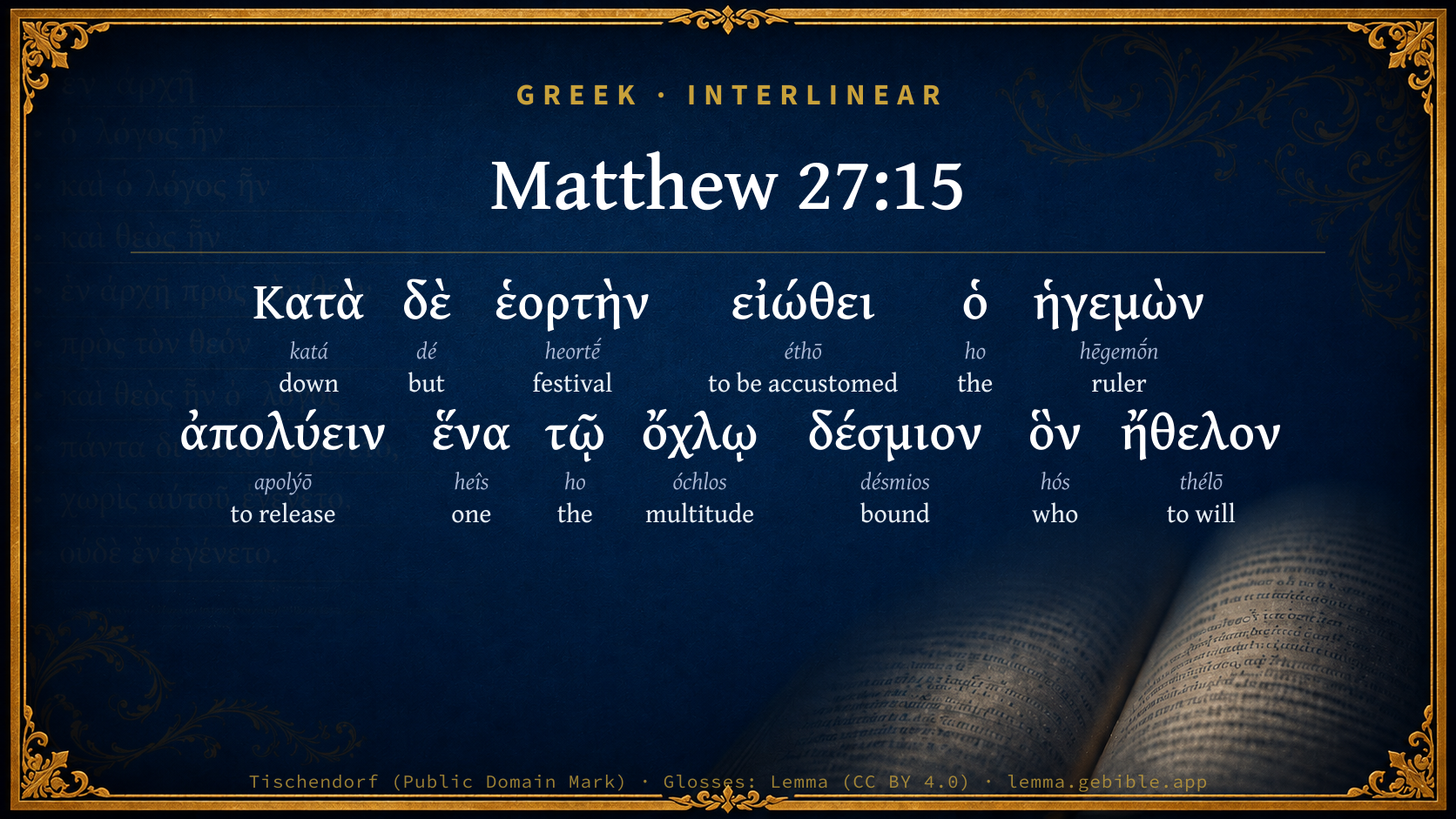
  1. Κατὰ katá G2596 “down” Preposition
  2. δὲ dé G1161 “but” Conjunction
  3. ἑορτὴν heortḗ G1859 “festival” Noun, Accusative, Singular, Feminine
  4. ὁ ho G3588 “the” Article, Nominative, Singular, Masculine
  5. ἡγεμὼν hēgemṓn G2232 “ruler” Noun, Nominative, Singular, Masculine
  6. ἀπολύειν apolýō G630 “to release” Verb, Present, Active, Infinitive
  7. ἕνα heîs G1520 “one” Adjective, Accusative, Singular, Masculine
  8. τῷ ho G3588 “the” Article, Dative, Singular, Masculine
  9. ὄχλῳ óchlos G3793 “multitude” Noun, Dative, Singular, Masculine
  10. δέσμιον désmios G1198 “bound” Noun, Accusative, Singular, Masculine
  11. ὃν hós G3739 “who” Relative pronoun, Accusative, Singular, Masculine
  12. ἤθελον thélō G2309 “to will” Verb, Imperfect, Active, Indicative, 3rd person, Plural

About this verse

These counts appear in no published source. They are computed here, from the morphology-tagged text and Lemma’s own curated glosses. What Lemma adds →

13
words
12
distinct lemmas
Gospels
section

Notable vocabulary

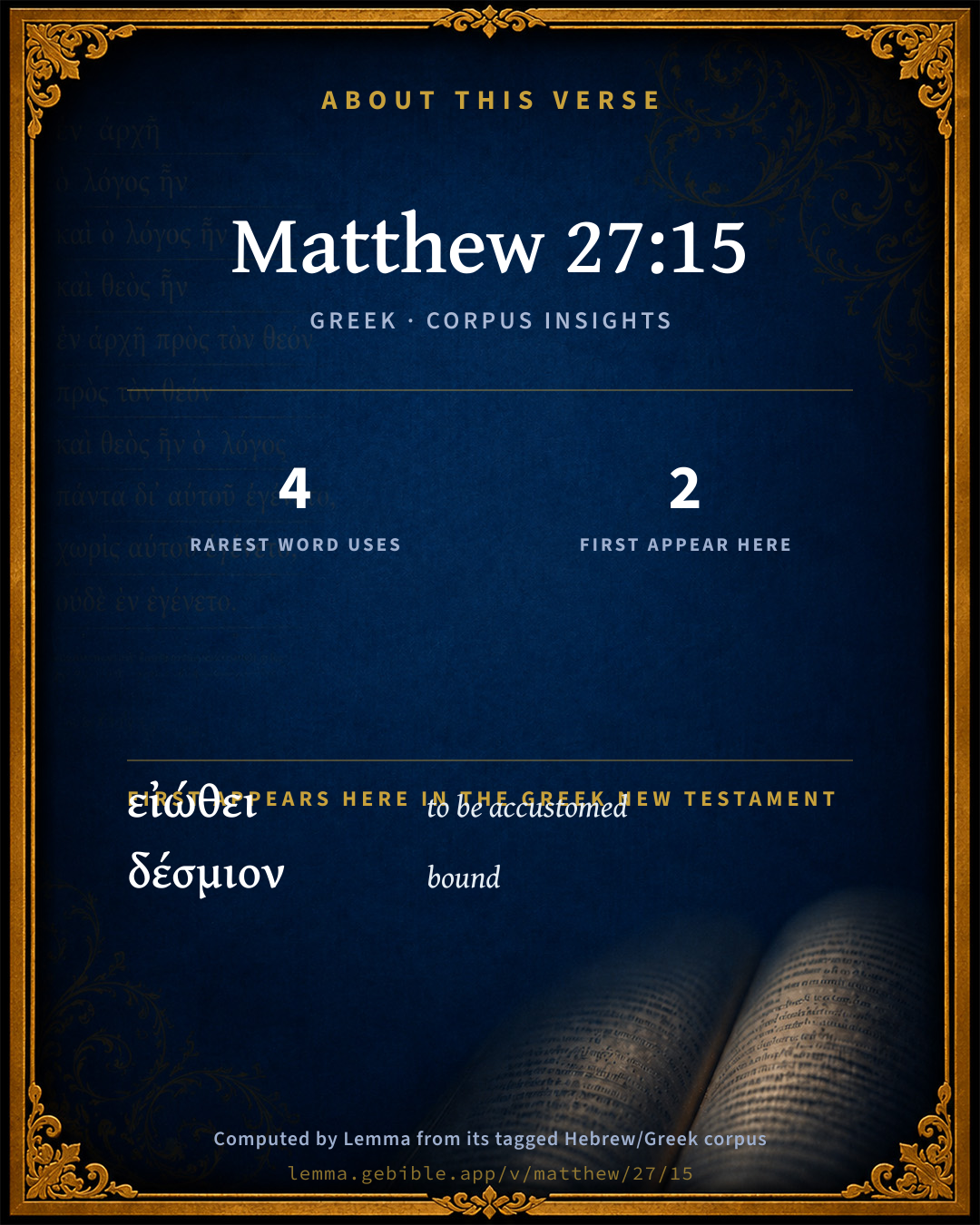
The rarest word here is εἰώθει to be accustomed G1486 — appearing just 4 times in the whole Greek New Testament.

First appearance in Scripture

These words make their first canonical appearance in the Greek New Testament here:

  • εἰώθει to be accustomed G1486
  • δέσμιον bound G1198

Shared distinctive vocabulary

εἰώθει to be accustomed G1486 occurs in 4 verses of the Greek New Testament. Also found in:

Repetition

A word recurs within this verse:

Cross-references

7

Topical passages linked to Matthew 27:15 in the Treasury of Scripture Knowledge — connected by theme and wording, ordered by reader-vote popularity; previews shown in the World English Bible.

  • Matthew 26:5 But they said, "Not during the feast, lest a riot occur among the people."
  • Mark 15:6–15 Now at the feast he used to release to them one prisoner, whom they asked of him.
  • Luke 23:16 I will therefore chastise him and release him."
  • John 18:38–40 Pilate said to him, "What is truth?" When he had said this, he went out again to the Jews, and said to them, "I find no basis for a charge against him.
  • John 19:16 So then he delivered him to them to be crucified. So they took Jesus and led him away.
  • Acts 24:27 But when two years were fulfilled, Felix was succeeded by Porcius Festus, and desiring to gain favor with the Jews, Felix left Paul in bonds.
  • Acts 25:9 But Festus, desiring to gain favor with the Jews, answered Paul and said, "Are you willing to go up to Jerusalem, and be judged by me there concerning these things?"

Cross-references courtesy of OpenBible.info (CC BY 4.0).

Commentary

Notes on Matthew 27:15 from classic Christian and Jewish commentators (each source and its license shown beneath its notes). The classic Christian expositions comment on the surrounding passage and are grouped to its opening verse, so a note may address several verses; the Jewish commentaries on the Tanakh (Rashi and others) are per-verse, so they appear only where the commentator wrote on this verse.

Lemma curates 59 commentaries, every one of them public domain or Creative Commons licensed, each selected and text-cleaned for this edition rather than reprinted as found. About our sources →

Albert Barnes' Notes on the Bible

See also the parallel places in Mar 15:6-14; Luk 23:17-23; Joh 18:39-40.

Mat 27:15

At that feast - The feast of the Passover.

The governor was wont to release ... - that is, was “accustomed” to release.

From what this custom arose, or by whom it was introduced, is not known. It was probably adopted to secure popularity among the Jews, and to render the government of the Romans less odious. Any little indulgence granted to the Jews during the heavy oppression of the Romans would serve to conciliate their favor, and to keep the nation from sedition. It might happen often that when persons were arraigned before the Romans on charge of sedition, some special favorite of the people, or some leader, might be among the number. It is evident that if they had the privilege of recovering such a person, it would serve much to allay their feelings, and make tolerable the yoke under which they groaned.

Mat 27:16

A notable prisoner - The word “notable” means one that is “distinguished” in any way either for great virtues or great crimes.

In this place it evidently means the latter He was perhaps the leader of a band who had been guilty of sedition, and had committed murder in an insurrection, Luk 23:19.

Mat 27:17

Whom will ye that I release ... - Pilate was satisfied of the innocence of Jesus, Luk 23:13-16

He was therefore desirous of releasing him. He expected to release one to the people. He knew that Jesus, though condemned by the chief priests, was yet popular among the people He therefore attempted in this manner to rescue him from the hands of the priests, and expected that the people would prefer Him to an odious and infamous robber and murderer. Had the people been left to themselves it would probably have been done.

Jesus, which is called Christ - That is, Jesus, who claims to be the Messiah. Pilate probably did not believe it, or care much for it. He used the name which Jesus had acquired among the people. Perhaps, also, he thought that they would be more likely to ask him to be released if he was presented to them as the Messiah. Mark Mar 15:9 adds that he asked them whether they would that he should release “the King of the Jews?” It is probable that he asked the question in both ways. Perhaps it was several times repeated, and Matthew has recorded one way in which it was asked, and Mark another. He asked them whether they would demand him who “was called the Christ,” expecting that they would be moved by the claims of the Messiah - claims which, when he entered Jerusalem in triumph, and in the temple, they had acknowledged. He asked them whether they would have the “King of the Jews” probably to ridicule the priests who had delivered him on that charge. He did it to show the people how absurd the accusation was. There Jesus stood, apparently a poor, inoffensive, unarmed, and despised man. Herod had set him at naught and scourged him, and sent him back. The charge, therefore, of the priests, that he was a “king” opposed to the Roman emperor, was supremely ridiculous; and Pilate, expecting that the people would see it so, hoped also that they would ask that he might be released.

Mat 27:18

For he knew that for envy ... - This was envy at his popularity.

He drew away the people from them. This Pilate understood, probably, from his knowledge of the pride and ambition of the rulers, and from the fact that no danger could arise from a person that appeared like Jesus. If Pilate knew this, he was bound to release him himself. As a governor and judge, he was under obligation to protect the innocent, and should, in spite of all the opposition of the Jews, at once have set him at liberty. But the Scriptures could not then have been fulfilled. It was necessary, in order that an atonement should be made. that Jesus should be condemned to die. At the same time. it shows the wisdom of the overruling providence of God, that he was condemned by a man who was satisfied of his innocence, and who proclaimed before his accusers his “full belief” that there was no fault in him.

Mat 27:19

When he was set down on the judgment-seat - Literally, “While he was sitting.” This message was probably received when he had resumed his place on the judgment-seat, after Jesus had been sent to Herod.

See the notes at Mat 27:14.

His wife sent unto him - The reason why she sent to him is immediately stated - that she had a dream respecting him. We know nothing more of her. We do not know whether she had ever seen the Saviour herself, but it would seem that she was apprised of what was taking place, and probably anticipated that the affair-would involve her husband in trouble.

Have thou nothing to do ... - That is, do not condemn him. Perhaps she was afraid that the vengeance of heaven would follow her husband and family if he condemned the innocent.

That just man - The word “just,” here, has the sense of “innocent,” or not guilty. She might have been satisfied of his innocence from other sources as well as from the dream.

I have suffered many things ... - Dreams were considered as indications of the divine will, and among the Romans and Greeks, as well as the Jews, great reliance was placed on them. Her mind was probably agitated with the subject. She was satisfied of the innocence of Jesus; and, knowing that the Jews would make every effort to secure his condemnation, it was not unnatural that her mind should be excited during her sleep, perhaps with a frightful prospect of the judgments that would descend on the family of Pilate if Jesus was condemned. She therefore sent to him to secure, if possible, his release.

This day - It was now early in the morning. The Jewish “day” began at sunset, and she employed the usual language of the Jews respecting time. The dream was, in fact, in the night.

Mat 27:20

Persuaded the multitude - The release of a prisoner was to be to the people, not to the rulers.

The rulers, therefore, in order to secure the condemnation of Jesus, urged on the people to demand Barabbas. The people were greatly under the influence of the priests. Galileans among the citizens of Jerusalem were held in contempt. The priests turned the pretensions of Jesus into ridicule. Hence, in a popular tumult, among a flexible and changing multitude, they easily excited those who, but a little before, had cried Hosanna, to cry, Crucify him.

Mat 27:21

Whether of the twain? - Which of the two, Jesus or Barabbas?

Mat 27:23

And the governor said, Why? - Luke informs us that Pilate put this question to them “three times,” so anxious was he to release him.

He affirmed that he had found no cause of death in him. He said, therefore, that he would chastise him and let him go. He expected, probably, by causing him to be publicly whipped, to excite their compassion, to satisfy “them,” and thus to evade the demands of the priests, and to set him at liberty with the consent of the people. So weak and irresolute was this Roman governor! Satisfied of his innocence, he should at once have preferred “justice to popularity,” and acted as became a magistrate in acquitting the innocent.

Let him be crucified - See the notes at Mat 27:39. Luke says they were instant with loud voices demanding this. They urged it. They demanded it with a popular clamor.

Albert Barnes' Notes on the Bible (1834–1885) — public domain. Text from a community e-Sword/MySword module.

The Biblical Illustrator

Joseph S. Exell

Mat_27:15-18

Barabbas, or Jesus which is called Christ.

The release of Barabbas

I. It illustrates the evasion of personal responsibility. We always admire courage in the abstract. Look at the position of Pilate! I must sentence, gentlemen, you choose the culprit. We may be doing this same thing. How often we allow others to determine our duty. If my wife would be religious I would. Will you go if I will? Alone you must die and give an account to God.

II. The controlling power of prejudice over moral approbation. They were to forget all the munificence of Jesus because He outraged their prejudices.

III. The choice of Barabbas in the end exalts the eternal principles which underlie the government of God. The eternal plan of God is carried out in the death of Jesus.

IV. The attitude of Barabbas. Suppose he had refused release on the ground that it was not possible for him to live by the death of another. Some reject the substitution of Christ for themselves. (R. Jeffery, D. D.)

Releasing prisoners

No trace of this custom is found in the Talmud. But the release of prisoners was usual at certain festivals at Rome, and at Athens during the Panathenaic festival prisoners enjoyed temporary liberty. It is not, therefore, improbable that Herod the Great, who certainly familiarized the Jews with other usages of Greece and Rome, introduced this custom, and that the Roman governor, finding the custom established and gratifying to the Jews, in accordance with Roman practice, retained the observance of it. (A. Carr, M. A.)

The Biblical Illustrator, edited by Joseph S. Exell (c. 1880s–1900s) — public domain. Text from a community e-Sword module.

Joseph Benson's Commentary

Mat 27:15-18. Now at that feast, &c. — It had become a custom with the Roman governors, at the feast of the passover, to gratify the people with the pardon and release of any one prisoner they pleased. There was no law to oblige them to do this, nor is it certain when or how this custom arose. But as acts of grace are generally popular things, it is probable it originated with the Romans themselves, and that they introduced and continued it to please their tributaries. It was, however, a bad custom, being an encouragement to wickedness, and an obstruction to justice. And they had then a notable, επισημον, a remarkable, or notorious prisoner — Who had really been guilty of the crime whereof they falsely accused Jesus; had made an insurrection, with accomplices, and committed murder in the insurrection; a crime which, though their impudence exceeded all bounds, they durst not lay to Christ’s charge. When they were gathered together — About Pilate’s tribunal, and began with great noise and clamour to demand of him that he would do, at this passover, as he had always done upon the like occasion, Mar 15:8; and would discharge a prisoner, Pilate asked, Whom will ye that I release unto you? Barabbas or Jesus? — Pilate, desiring to preserve the life of Jesus, of whose innocence he was fully convinced, in order to induce the people to ask for his release, proposes no other alternative than that scandalous and outrageous criminal who has just now been mentioned. For he knew that for envy, as well as from malice and revenge, they had delivered Jesus. That it was not his guilt, but his goodness that they were provoked at: and that they envied him because the people magnified him. Hence Pilate was willing to make the proposal to the people in such a form as might be most likely to secure his life.

Joseph Benson's Commentary on the Old and New Testaments (1811–1818) — public domain. Text from a community e-Sword module.

Godbey's Commentary on the New Testament

William B. Godbey

PILATE SEEKS TO RELEASE HIM IN LIEU OF BARABBAS

Mat 27:15-26; Mar 15:6-15; Joh 18:39-40; Luk 23:13-25. “And Pilate, having called together the high priests, rulers, and the people, said to them, You have brought to me this Man as revolutionizing the people; and, behold, I, having judged Him in your presence, found nothing in this Man criminal of those things which you accuse against Him; neither did Herod; for I sent you to him, and, behold, nothing worthy of death has been done by Him. Therefore, having scourged Him, I will release Him.” The cruelty of the Roman punishments actually beggars all description. This scourging which Pilate mentions was horrific in the extreme. Previously to the crucifixion of a man, they beat his naked body with thongs of rawhide, having in them steel points, which lacerated his flesh most excruciatingly, so that it was nothing uncommon for the poor victim to die during the scourging. Pilate, however, lights upon this as a dernier ressort to save the life of Jesus, thinking that a punishment so awful administered to an innocent man would certainly produce a reaction on the part of His enemies, constraining them to relax their apparently implacable animosity toward Him, so that they would consent to His release. Pilate, though a corrupt heathen ruler, in this matter underestimated the diabolical malice and hellish venom which was at that time the controlling principle of the big preachers and ruling elders, who were determined to have Him put to death. When the devil gets possession of religious people, they have in all ages proved more demoniacal than the wicked people of the world.

Mar 15:6-12. “But during the feast he was accustomed to release unto them one prisoner, whom they demanded. There was one called Barabbas, having been bound along with the insurrectionists, who had committed murder in the insurrection. The rabble, roaring, began to ask as he was always accused to do unto them. Pilate responded to them, saying, Do you wish that I shall release unto you the King of the Jews? For he knew that the high priests had delivered Him through envy.” It is said that Joseph’s brethren sold him to the Ishmaelites through envy. He was a beautiful type of Christ, sold for money, and suffered seven years in the loathsome State prison, thus vividly symbolizing Jesus, in His first coming, to suffer and to die. Finally, when promoted to the throne of Egypt, the ruling kingdom of the world, invested in royal robes, riding in a golden chariot, fifty couriers running before him, shouting, “Bow the knee for the king cometh,” how vividly does he emblematize our glorious King Jesus in His second advent, accompanied by the mighty angels, and crowned King of kings and Lord of Lords! Pilate is so anxious to release Jesus that he restricts their choice to the two — Jesus and Barabbas. Then, coming before them, he seeks to forestall their verdict by shouting aloud, “Shall I release unto you the King of the Jews?”

Mat 27:19. “He, sitting upon his tribunal, his wife sent to him, saying, Have thou nothing to do with that Righteous One; for I suffered many things this day in a dream on account of Him.” In common parlance, the day includes the night. Of course, the woman had the dream during the night. Tradition has given us the character of this dream. It is said that when the courier arrived from their suburban home at Bethany, bringing a letter from Lucia Metella, the governor’s wife, in the midst of this momentously exciting trial, Pilate took it hurriedly, and aiming to read inaudibly, was so excited that his tremulous utterances were overheard. “My Dear Husband, — Be sure that you have nothing to do with that Righteous One; for this very day I saw Him, in a vision seated on high Olympus, and all the gods and goddesses hurling their crowns at His feet! I tell you, my husband, He is one of the gods.” Of course, she and Pilate were Romans, believing in the many gods of the Roman Empire.

Luk 23:8-23. “And the whole: multitude cried out saying, Take Him away; but release unto us Barabbas, who , on account of a certain insurrection and murder in the city, had been cast into prison,” and Barabbas was a formidable robber chief, who had given them awful trouble, the Roman guards with difficulty having finally succeeded in arresting him, and thus breaking up his robber band. “Then Pilate again called to them, wishing to release Jesus. And they continued to cry out, saying, Crucify Him! crucify Him! And the third time he said to them, For what evil has He done? I have found nothing worthy of death in Him; therefore, having scourged Him, I will release Him.” You see Pilate’s plan was to move their sympathies and mitigate their cruel wrath by scourging Him, thinking they would then consent to His release.

“And they continued to lie on, with great voices demanding that He should be crucified; and the voices of them and the high priests continued to wax stronger and stronger.” As they were disappointed in their plan of killing Him in the night, and it is now eight o’clock, the news flying on the wings of the wind, and all who hear of it rushing to the scene of action, crowding the streets and alleys and the flat roofs of the houses all around Pilate’s judgment-hall, the high priests, Sanhedrin, and ruling elders feel that the crisis is on them, and if some-thing is not done quickly, the mob will rise and take Him out of their hands. Hence they roar and roar as if they would split their throats, demanding of the governor His crucifixion.

Mat 27:24-26. “And Pilate, seeing that he profits nothing, but the more is the uproar, taking water, washed his hands in presence of the multitude, saying, I am innocent, from the blood of this Just One; you shall see to it. And all the people, responding, said, His blood be upon us and our children. Then he released unto them Barabbas.”

Luk 23:24-25. “And Pilate decided that the request should be granted, and he released unto them the one who on account of sedition and murder had been cast into prison, and he delivered Jesus according to their choice.” Contemporary history says that Pilate had but few soldiers in Jerusalem at that time comparatively with the ordinary force which he kept on hand, having recently been under the necessity of sending away a large detachment to quell an insurrection in Syria. He was therefore apprehensive of a bloody revolution, surging like the waves of the stormy sea, and every moment threatening to break out, deluge the judgment-hall in blood, blockade the streets with the slain, and wrap Jerusalem in a terrible civil war. Consequently, resorting to a principle long rulable, especially in Oriental despotisms, that one innocent man would better die than for many to lose their lives, and having repeatedly pronounced Jesus innocent, he signs His death-warrant as a mere peace measure, in order to prevent a bloody conflict, in which many would certainly perish.

William B. Godbey, Commentary on the New Testament (1896–1900) — public domain. Text from a community e-Sword module.

Tyndale Open Study Notes

Tyndale Open Resources

27:15 Pilate’s custom seems out of character; he was not known for wanting to please his Jewish subjects. However, if Pilate’s position with Caesar was precarious at this point (see study note on John 19:12; see Philo, On the Embassy to Gaius 159–161), then this gesture may have been to keep the peace and thus avoid negative attention from Rome.

Tyndale Open Study Notes — © Tyndale Open Resources, licensed CC BY-SA 4.0. Text via the HelloAO Bible API.

Bengel's Gnomon

Johann Albrecht Bengel

Mat 27:15. Κατὰ δὲ ἑορτὴν, κ.τ.λ., But at the feast, etc.) This [custom of releasing a prisoner at the Feast] accorded with the deliverance from Egypt.—ἑορτὴν, feast) St John calls it expressly the Passover.—εἰώθει, had been wont) Even political customs subserve Divine Providence.—ἓνα, one) i.e., one, and not more than one.

Bengel's Gnomon of the New Testament — English translation (T&T Clark, Edinburgh, 1860) — public domain. Text from a community e-Sword module.

Meyer's Critical & Exegetical Commentary

Heinrich August Wilhelm Meyer

Mat_27:15 Κατὰ ἑορτήν] on the occasion of the feast, i.e. during the feast-time (Kühner, II. 1, p. 412; Winer, p. 374 [E. T. 500]); that the Passover is here meant is evident from the context.

As there is no allusion to this custom anywhere else (for an account of which, however, see Bynaeus, de morte Chr. III. p. 97 ff.), nothing whatever is known as to when it originated. But whether we date the custom back to the Maccabaean age or to an earlier period still (Ewald, Gesch. Chr. p. 570), or regard it as having been introduced[33] for the first time by the Romans (Grotius, Schleiermacher, Friedlieb) for the purpose of conciliating the Jews, we cannot fail to see in it a reference to that which is intended to be set forth by the Passover (sparing mercy), and applicable most probably to the 14th of Nisan (comp. on Joh_18:24; Joh_18:39).

[33] It may be mentioned as tending to favour this supposition, that while no trace of such a custom is met with in the Talmud, there is something to a certain modified extent analogous to it in the practice observed by the Romans at the feast of the lectisternia (Liv. Mat_5:14). Schoettgen detects an allusion to some such origin in Pesachim f. 91, 1, though this is very doubtful. Then, as for the statement of Josephus, Antt. xx. 9. 3, which is quoted by Keim, it cannot be said to imply the existence of any practice, and it refers besides to a case in which ten persons were liberated.

Meyer — Critical and Exegetical Commentary on the New Testament — English translation by Peter Christie, edited by Frederick Crombie (T&T Clark, 1880) — public domain. Text from a community e-Sword module.

Expositor's Greek Testament

ed. W. Robertson Nicoll

Mat 27:15-18 . Appeal to the people . Pilate, not inexperienced in Jewish affairs, nor without insight into the ways of the ruling class, suspects that there are two sides to this matter. The very accusation suggests that the accused may be innocently popular, and the accusers jealous. An existing custom gives the opportunity of putting this to the test.

Mat 27:15 . κατὰ ἑορτὴν , at feast time ( singulis festis , Hermann, Viger , p. 633), not all feasts, but the passover meant. εἰώθει , was accustomed; time and circumstances of the origin of this custom unknown; a custom likely to arise sooner or later, as it symbolised the nature of the passover as a passing over (Weiss-Meyer), and helped to make the governor’s presence at that season wear a gracious aspect; on that account probably originating under the Romans.

The Expositor's Greek Testament, edited by W. Robertson Nicoll (1897–1910) — public domain. Text from a community e-Sword module.

Geneva Bible (1599)

Geneva Bible translators

Christ is first quitted of the same Judge, before he be condemned, that we might see how the just died for the unjust.

Geneva Bible (1599) marginal notes — public domain. Text via Bolls.life.

Adam Clarke's Commentary

Verse 15. The governor was wont to release] Whence this custom originated among the Jews is not known, - probably it was introduced by the Romans themselves, or by Pilate, merely to oblige the Jews, by showing them this public token of respect; but if it originated with him, he must have had the authority of Augustus; for the Roman laws never gave such discretionary power to any governor.

Adam Clarke's Commentary on the Bible (1810–1826) — public domain. Text from a community e-Sword/MySword module.

Ellicott's Commentary for English Readers

(15) The governor was wont to release.—It is not known when the practice began, nor whether it was primarily a Jewish or a Roman one. The fact that the release of criminals was a common incident of a Latin lectisternium, or feast in honour of the gods, makes the latter the more probable. If introduced by Pilate (and this is the only recorded instance of the practice) it was, we may believe, a concession intended to conciliate those whom his previous severities had alienated. Before this stage of the proceedings we have to place (1) the second conference between Pilate and the priests after his dialogue with our Lord (Luk_23:4-5), and their definite charge of sedition, now urged for the first time; and (2) his attempt, catching at the word “Galilee” as the scene of our Lord’s work, to transfer the responsibility of judging to Herod (Luk_23:6-12).

A Bible Commentary for English Readers, edited by Charles John Ellicott (1878–1897) — public domain. Text from a community e-Sword module.

The Cambridge Bible for Schools and Colleges

gen. ed. J. J. S. Perowne

15. the governor was wont to release unto the people a prisoner] The origin of this custom is quite unknown; St Mark says, “as he had ever done unto them,” as if the custom originated with Pilate; St Luke has, “of necessity he must release;” St John, “Ye have a custom.”

No trace of this custom is found in the Talmud. But the release of prisoners was usual at certain festivals at Rome, and at Athens during the Panathenaic festival prisoners enjoyed temporary liberty. It is not, therefore, improbable that Herod the Great, who certainly familiarised the Jews with other usages of Greece and Rome, introduced this custom, and that the Roman governor, finding the custom established and gratifying to the Jews, in accordance with Roman practice (see Introd. p. 22 (3)) retained the observance of it.

The Cambridge Bible for Schools and Colleges (gen. ed. J. J. S. Perowne; Cambridge University Press, 1878–1918) — public domain. Text from a community e-Sword module.

John Gill's Exposition

Now at that feast,.... The Syriac, Arabic, and Ethiopic versions read, "at every feast": which looks as if the authors of these versions thought the sense was, that the following custom was used at each feast in the year, at the feasts of pentecost, and tabernacles, and passover; whereas it was only at the feast of the passover; and which is meant by the feast here, as is clear from Joh 18:39. It was but once a year that this was done; at every returning passover; and so the Persic version renders it, "every year on the day of the feast"; that is, of the passover, and which was frequently called by way of emphasis, "the feast":

the governor was wont to release unto the people a prisoner, whom they would. It was not a law, but a custom; it was not enjoined by the law of Moses; for they that sinned against that; died without mercy: nor is it agreeable to strict justice, that there should be such a release of criminals; nor was it a Jewish custom, as an emblem of their deliverance out of Egyptian bondage. I have not met with the least trace of any such custom of theirs at the time of the pass over in any of their writings; but it seems to be a Roman one: and from all the accounts of the evangelist, it appears to be peculiar to the Roman governor, who, either by the order of Caesar, or of himself, introduced such a custom to get the favour of the people; for it was to them the release was made, and the person, whom they pleased; and this being repeated annually for some time, was expected by them, and at last became necessary.

John Gill's Exposition of the Whole Bible (1746–1763) — public domain (CC PDM 1.0). Text via the HelloAO Bible API.

Trapp's Complete Commentary

John Trapp

15 Now at that feast the governor was wont to release unto the people a prisoner, whom they would.

Ver. 15. The governor was wont] In remembrance, say some, of their deliverance from the Egyptian bondage. A custom it was, and therefore obtained; but an evil custom, and therefore should better have been abrogated. Custom without truth is but hoariness or mouldiness of error, saith one. And custom without righteousness is but antiquity of iniquity, saith another. A custom they have in Rome to this day, that if a cardinal meet a condemned person going to execution, and put his hat on the malefactor’s head, he is thereby set free. I see no sense for such a pardon. But the inhabitants of Berne in Germany gave a general pardon to most of their prisoners, and called home their banished that same day wherein the Reformation was received and established among them. {a} And they gave this reason for it. {b} Should some confederate prince pass through our coasts, we should for his sake pardon our offenders, upon promise of amendment. Now shall the King of kings, the Son of God, and our dear Brother, who hath done and suffered so much for us, come graciously unto us; and we not honour him this way also? Saul, for joy of his victory over the Ammonites, would not suffer such to be put to death as had spoken treason against him; for "today," said he, "the Lord hath wrought salvation in Israel," 1Sa 11:13.

{a} Heidfeld

{b} Gravissimo hoc argumento usi. Scult. Annul.

John Trapp, A Commentary or Exposition upon All the Books of the Old and New Testament (1647–1656) — public domain. Text from a community e-Sword module.

Haydock's Catholic Bible Commentary

Upon the solemn day of the paschal feast, (which began the evening before) it was a custom for the governor to pardon and release to the people any one criminal whose life they should petition for: and to induce them to beg for Jesus, he put in the balance with him one Barabbas a famous malefactor, a seditious murderer, says St. Mark; a robber, or thief, says St. John. (Witham) --- Pilate, wishing to release the innocent Jesus, that he might not give the Jews a possibility, as he thought, of refusing his offer, puts the murderer Barabbas in competition with the innocent Lamb of God. (St. John Chrysostom)

George Leo Haydock (1774–1849), Haydock's Catholic Family Bible and Commentary, 1859 edition — public domain. Excludes Psalms (Douay-Rheims chapter numbering differs from Protestant) and Deuterocanonical books (Catholic canon only).

Matthew Poole's English Annotations

Mark saith, Mar 15:6-11, Now at that feast he released unto them, one prisoner, whomsoever they desired. And there was one named Barabbas, which lay bound with them that had made insurrection with him, who had committed murder in the insurrection. And the multitude crying aloud began to desire him to do as he had ever done unto them. But Pilate answered them, saying, Will ye that I release unto you the King of the Jews? For he knew that the chief priests had delivered him for envy. But the chief priests moved the people, that he should rather release Barabbas unto them.

Luke hath this passage of the history more fully, Luk 23:13-18; And Pilate, when he had called together the chief priests and the rulers and the people, said unto them, Ye have brought this man unto me, as one that perverteth the people: and behold, I, having examined him before you, have found no fault in this man touching those things whereof ye accuse him. No, nor yet Herod: for I sent you to him; and, lo, nothing worthy of death is done unto him. I will therefore chastise him, and release him. (For of necessity he must release one unto them at the feast.) And they cried out all at once, saying, Away with this man, and release unto us Barabbas: (who for a certain sedition made in the city, and for murder, was cast into prison.)

John saith, Joh 18:38-40, that when he went out he told them he found no fault in him at all. But ye have a custom, that I should release unto you one at the passover: will ye therefore that I release unto you the King of the Jews. Then cried they all again, saying, not this man, but Barabbas. Now Barabbas was a robber.

The history is plain: Pilate discerned, upon his before mentioned examination of Christ, that our Saviour had done nothing amiss, but was only loaded with the malice and envy of the chief priests and scribes; this made him resolve to do what in him lay to deliver him. He first tells them that they had brought him before him, accused him of many things, but had proved against him nothing criminal; that he had sent him to Herod, in whose jurisdiction he had lived, but neither did Herod find any fault in him. Now there was a custom, that ever at the passover the governor released a prisoner at the request of the people. The people desired he would keep their old custom in this particular. Pilate propounds to them to release the King of the Jews. The chief priests influence the people to declare their dissatisfaction at that, and to name one Barabbas, a prisoner who was a robber, and had been guilty of an insurrection, and of murder committed in the insurrection: accordingly the people cry out, Not this man, but Barabbas. This makes him again to return to the judgment seat.

Matthew Poole's English Annotations on the Holy Bible (1683–1685) — public domain. Text from a community e-Sword/MySword module.

Whedon's Commentary on the Bible

Daniel D. Whedon

15. Was wont — Was accustomed. The Jewish nation was under the Roman government, and there would often be men in prison whose crime was some attempt in favour of Jewish liberty, or some popular offence against the Roman power. Hence, when the governor came down from Cesarea to Jerusalem, it would be a popular act to grant pardon to some turbulent patriot in prison for sedition.

Daniel D. Whedon (gen. ed.), Commentary on the Old and New Testaments (1874–1909) — public domain. Text from a community e-Sword module.

The Pulpit Commentary

Vers. 15-26. Barabbas preferred to Jesus. (Mar_15:6-15 Luk_23:17-25 Joh_18:39, Joh_18:40)

Pilate now tries another expedient for delivering himself from the responsibility of condemning Jesus. At that feast (kata eorthn , at a feast, at feast time). Doubtless the Passover is meant, which was the feast especially of the Jews, and it is very improbable that the practice mentioned in the clause was allowed at any other of the feasts. The governor was wont to release unto the people (tw oclw , the multitude), etc. St. Luke says, "Of necessity he must release one unto them at the feast." The custom is not elsewhere mentioned. It was, however, most probably an institution established of old time in memory of the Exodus, (Joh_18:39) and continued by the Romans when they became masters of the country. A similar custom obtained at Rome and in Greece on certain great festivals. Whom they would. The governor usually left the priests and people unfettered in their choice; on the present occasion he desired Jesus to be selected.

Vers. 15-30. Christ before Pilate. No. 2.

The other evangelists tell us of Pilate"s first and fatal mistake, in offering, while convinced of his Prisoner"s innocence, to chastise him and let him go. He showed the Jews he was afraid of them; and from this point onwards we see him tossed between his own convictions and his fears a type of all who in their own souls have convictions about Christ and their duty to him, which they do not act out lest they thereby incur loss or abuse. Apparently, before the Jews have time to do more than utter a murmur of discontent at his proposal, another plan suggests itself, by which he may possibly extricate himself. The governors were in the habit of releasing some well known prisoner at the Feast of the Passover, and he offers to release Jesus. No sooner had he done so than his attention is called away by the extraordinary message from his wife. Nothing is more remarkable in the Roman history of the period than the strength of character developed by the women, their keen interest in public affairs, and the prominent part they play in them. A law forbidding the wives of the governors to accompany their husbands to the provinces had lately been repealed, and Claudia Procula was not only with Pilate, but apparently keenly interested in his work and tenderly solicitous for his honour and safety. And still God often thus speaks to men; and some woman"s anxious look or word, or some child"s innocent question, will give the conscience new strength or arm it with new weapons. The moments given to ponder this message are not neglected by the leaders. They wind through the crowd, and prompt the people to ask for Barabbas. By offering them the alternative between a Man whom both he and they knew to be innocent of sedition, and a man notoriously guilty of it, he put them into the very difficulty they sought to fix him in. But they have already seen that he has a deeper conviction than the innocence of Jesus, namely, a fear of them, and this they use. Pilate, therefore, having done, as he persuaded himself, all he could to save Jesus, gives him up to the scourging a barbarous punishment, under which many died. He may have interfered to prevent the full amount being inflicted. He did not interfere when the soldiers proceeded to mock their victim. In this mockery we have a concrete and visible representation of the manner in which Christ is continually used. We salute him as King; but what is the sceptre we put in his hands? Is it not in many cases a mere reed, in hands that are bound? Is it not as real a mockery for us to profess allegiance to him, and use the strongest language we can command to express our adoration, and then go and show that he has not the slightest control over our lives? In this would-be equitable Roman governor coming to the people and saying, "What shall I do then with Jesus which is called Christ?" we see:

1. The predicament of many among ourselves who would gladly be rid of the question. But it cannot be. There is this judgment to pronounce. Even if there were no blessedness in following Christ, the fact remains that he is presented to you, and that it is your duty to accept him.

2. We see how futile was the attempt of Pilate to transfer the guilt of this action to the Jews. They were willing to take the blood of Christ on their heads; but, though history shows how terrible has been their share in the vengeance they ignorantly invoked, Pilate was not necessarily exempt. Men frequently mistake the point at which their own power, and therefore their own responsibility, ends. They consent to iniquity, and say they were forced to it. How were you forced? Would every man in your circumstances do as you are doing? Or, men invite you to share their sin, persuading you that the guilt is theirs, if there is any; you will find that they cannot bear your share, and that you vainly seek to lay the guilt on them. The very fate Pilate feared, and to avoid which he sacrificed the life of our Lord, came upon him. Six years later he was deposed from his office, and died by his own hand. We are apt to say of him that he was weak rather than wicked, forgetting that moral weakness is that which makes a man capable of any wickedness. And who is the weak man but the one who is not single-minded, who attempts to gratify both his conscience and his evil or weak feelings, to secure his own selfish ends as well as the great ends of justice and righteousness? Such a man will often be in as great a perplexity as Pilate, and will come to as ruinous, if not so appalling, an end. D.

The Pulpit Commentary (1880–1919), ed. H.D.M. Spence-Jones & Joseph S. Exell — public domain. Text from a community e-Sword module.

John Wesley's Explanatory Notes

At every feast - Every year, at the feast of the passover. Mark xv, 6; Luke xxiii, 17; John xviii, 39.

John Wesley, Explanatory Notes Upon the Whole Bible (1754–1765) — public domain. Text via the GEBible commentary corpus.

Kretzmann's Popular Commentary

Paul E. Kretzmann

The offer to release Jesus:

v. 15. Now, at the feast the governor was wont to release unto the people a prisoner whom they would.

v. 16. And they had then a notable prisoner, called Barabbas.

v. 17. Therefore, when they were gathered together, Pilate said unto them, Whom will ye that I release unto you? Barabbas, or Jesus which is called Christ?

v. 18. For he knew that for envy they had delivered Him.

Pilate’s was a weak, vacillating, unreliable character. He did not have the courage of his convictions, nor was he a man to enforce respect for his opinions. Rulers of his kind are liable to be unduly lenient and yielding at one time, and correspondingly harsh and cruel at another. The custom had been established at Jerusalem to release to the people, at the time of the Passover, some prisoner whom they desired to set free. The weak governor bethought himself that this custom might come to his aid in solving this difficulty without antagonizing the Jews. He had in jail at that time a most notorious and infamous criminal by the name of Barabbas, a seditionist and murderer. Now Pilate reasoned: Surely they will prefer the gentle Jesus to this dangerous, murderous person. In that sense he put the matter before them, emphasizing the fact that Jesus is called the Christ, the Messiah. He thought the choice would be easy, not reckoning with mob psychology. He was shrewd enough to see, what must have been evident to the disinterested observer from the start, that the accusations named by the Jewish leaders were nothing but trumped-up charges, due to envy on their part, because the common people heard Jesus gladly, and many of them had come to the knowledge of the truth.

Paul E. Kretzmann, Popular Commentary of the Bible (1921–1924) — public domain. Text from a community e-Sword module.

Burkitt's Expository Notes on the New Testament

William Burkitt

Now at the feast, that is, the feast of the passover, which by way of eminency is called the feast, the governor used to release a prisoner (possibly by way of memorial of their deliverance out of Egypt); accordingly Pilate makes a motion to them, that Christ may be the prisoner set at liberty in honour of the feast; for he was sensible that what they did was out of envy and malice. As covetousness sold Christ, so envy delivered him. Envy is a killing and murdering passion: Envy slayeth the silly one, Job 5:2, that is, It slays the silly person who harbours this pestilent lust in his bosom, and is like a fire in his bones, continually preying upon him, causing him to pine away, and die miserably, because another lives happily.

To envy another man’s prosperity, is an argument of the worst simplicity: yea, farther, as envy slayeth the silly one, so it prompts and provokes the sinner to seek the slaying of simple and innocent ones. Envy wishes the envied person out of the way, yea, our of the world; and if need be, will not only wish it, but lend a lift towards it too; witness the chief priests here, whose envy was so conspicuous, that Pilate himself takes notice of it, and says, He knew that for envy they had delivered him.

William Burkitt's Expository Notes on the New Testament (1700–1703) — public domain. Text from a community e-Sword module.

McGarvey & Pendleton's Commentaries

J. W. McGarvey

J. W. McGarvey's The Fourfold Gospel [CXXXI. Third Stage of Roman Trial].

CXXXI. THIRD STAGE OF THE ROMAN TRIAL. PILATE RELUCTANTLY SENTENCES HIM TO CRUCIFIXION. (Friday. Toward sunrise.) aMATT. XXVII. 15-30; bMARK XV. 6-19; cLUKE XXIII. 13-25; dJOHN XVIII. 39-XIX 16.

a15 Now at the feast [the passover and unleavened bread] the governor was wont { bused to release unto them athe multitude one prisoner, whom they would. bwhom they asked of him. [No one knows when or by whom this custom was introduced, but similar customs were not unknown elsewhere, both the Greeks and Romans being wont to bestow special honor upon certain occasions by releasing prisoners.] a16 And they had then b7 And there was aa notable prisoner, bone called Barabbas, lying bound with them that had made insurrection, men who in the insurrection had committed murder. [710] [Josephus tells us that there had been an insurrection against Pilate's government about that time caused by his taking money from the temple treasury for the construction of an aqueduct. This may have been the affair here referred to, for in it many lost their lives.] 8 And the multitude went up and began to ask him i to do as he was wont to do unto them. [It was still early in the morning, and the vast majority of the city of Jerusalem did not know what was transpiring at Pilate's palace. But they came thither in throngs, demanding their annual gift of a prisoner. Pilate welcomed the demand as a possible escape from his difficulties.] c13 And Pilate called together the chief priests and the rulers and the people [He did not wish to seem to take advantage of our Lord's accusers by releasing him during their absence. Possibly he knew of the triumphal entry the Sunday previous, and thought that the popularity of Jesus would be such that his release would be overwhelmingly demanded, and so called the rulers that they might see that he had released Jesus in answer to popular clamor. If he had such expectations, they were misplaced], b9 And a17 When therefore they were gathered together, bPilate answered them, saying, c14 and said unto them, bWill ye that I release unto you the King of the Jews? cYe brought unto me this man, as one that perverteth the people: and behold, I having examined him before you, found no fault in this man touching those things whereof ye accuse him: 15 no, nor yet Herod: for he sent him back unto us; and behold, nothing worthy of death hath been done by him. d39 But ye have a custom, that I should release unto you one at the passover: c16 I will therefore chastise him, and release him. dWill ye therefore that I release unto you the King of the Jews? aWhom will ye that I release unto you? Barabbas, or Jesus who is called Christ? 18 For he knew bperceived athat for envy they bthe chief priests had delivered him up. [Though Jesus had been declared innocent on the joint finding of himself and Herod, [711] Pilate did not have the courage to deliberately release him. He sought to please the rulers by scourging him, and the multitude by delivering him to them as a popular favorite, and himself by an adroit escape from an unpleasant situation. But he pleased nobody.] c18 But they cried out all together, saying, Away with this man, and release unto us Barabbas:-- 19 one who for a certain insurrection made in the city, and for murder, was cast into prison. [We see from Matthew's account that though the people had a right to name their prisoner, Pilate took upon himself the liberty of choosing which one of two it should be. By doing so he complicated matters for the Jewish rulers, asking them to choose between Jesus, who was held on an unfounded charge of insurrection, and Barabbas, who was notoriously an insurrectionist and a murderer and a robber as well. But the rulers were not to be caught in so flimsy a net. Without regard to consistency, they raised their voice in full chorus for the release of Barabbas and the crucifixion of Jesus.] a19 And while he was sitting on the judgment-seat, his wife sent unto him, saying, Have thou nothing to do with that righteous man; for I have suffered many things this day in a dream because of him. [This message of Pilate's wife suggests that the name and face of Jesus were not unknown to Pilate's household. Pilate would be much influenced by such a message. The Romans generally were influenced by all presages, and Suetonius tells us that both Julius and Augustus Cæsar attached much importance to dreams.] b11 But a20 Now the chief priests and the elders persuaded bstirred up the multitude, amultitudes bthat he should rather release Barabbas unto them. athat they should ask for Barabbas, and destroy Jesus. 21 But the governor answered and said unto them, Which of the two will ye that I release unto you? And they said, Barabbas. d40 They cried out therefore again, saying, Not this man, but Barabbas. Now Barabbas was a robber. c20 And Pilate spake unto them again, desiring to release Jesus; [712] b12 And Pilate again answered and said asaith unto them, What then shall I do unto Jesus who is called Christ? bhim whom ye call the King of the Jews? c21 but b13 and they cried out cshouted bagain, csaying, Crucify, crucify him. aThey all say, Let him be crucified. b14 And Pilate said unto them, cthe third time, Why, what evil hath this man ahe done? cI have found no cause of death in him: I will therefore chastise him and release him. aBut they cried out exceedingly, saying, bCrucify him. aLet him be be crucified. [Finding the mob cruelly persistent, Pilate boldly declines to do its will and turns back into the Prætorium declaring his intention to release Jesus. But he retires with the demands of the multitude ringing in his ears.] d1 Then Pilate therefore took Jesus, and scourged him. [Carrying out the program which he proposed, Pilate had Jesus removed from the Prætorium to the place of scourging, and inflicted that punishment upon him. We learn from Josephus and others that the law required that those about to be crucified should first be scourged. But Pilate hoped that scourging would suffice. He believed that the more moderate would take pity upon Jesus when they viewed his scourged body, for scourging was so cruel a punishment that the condemned person often died under its infliction. The scourge was made of thongs loaded at the extremity with pieces of bone or metal. The condemned person was stripped and fastened to a low post, this bending the back so as to stretch the skin. Blood spurted at the first blow.] 2 And the soldiers platted a crown of thorns, and put it on his head, and arrayed him in a purple garment; 3 and they came unto him, and said, Hail, King of the Jews! and they struck him with their hands. [The soldiers had no special malice against Jesus, but the Roman military system made men hard of heart. The occasion gave to these foreign legionaries a much-enjoyed opportunity to show their contempt for the Jews by mocking Jesus as their King. It is not known which one of the many thorny plants of Palestine [713] was used to form the Lord's crown. See Act_22:24). If Pilate had found Jesus guilty, he would have condemned him at once. As it was, he sought to return Jesus to the Sanhedrin as having committed no crime of which the Roman law could take note.] 5 Jesus therefore came out, wearing the crown of thorns and the purple garment. And i Pilate saith unto them, Behold, the man! [It was Pilate's original proposition to scourge Jesus and let him go ( Luk_23:16). Having already scourged him, he now hoped to effect his release. Presenting our Lord in this state of abject humiliation, he feels that he has removed him from every suspicion of royalty. He speaks of Jesus as no longer a king, but a mere man. Pilate's words, however, have a prophetic color, somewhat like those uttered by Caiaphas. All those of subsequent ages have looked and must continue to look to Jesus as the ideal of manhood. The "Ecce Homo" of Pilate is in some sense an echo of the words of the Father when he said, "This is my Son, my chosen: hear ye him." In Jesus we behold the true man, the second Adam.] 6 When therefore the chief priests and the officers saw him, they cried out, saying, Crucify i him, crucify him! [Thus Pilate's expectation came to naught, for not one of the Jewish rulers ever wavered in their demand for crucifixion.] Pilate saith unto them, Take him yourselves, and crucify him: for I find no [714] crime in him. [In this sentence, "ye" and "I" are both emphatic; for Pilate wishes to draw a contrast between himself and the Jewish rulers. His words are not a permission to crucify, but a bit of taunting irony, as if he said: "I the judge have found him innocent, but ye seem to lack the wit to see that the case is ended. If ye are so much superior to the judge that ye can ignore his decision, proceed without him; crucify him yourselves."] 7 The Jews answered him, We have a law, and by that law he ought to die, because he made himself the Son of God. [Perceiving that Pilate was taunting them, and practically accusing them of attempting to put an innocent man to death, they defended themselves by revealing the fact that in addition to the charges that they had preferred against Jesus, they had found him clearly guilty and worthy of death on another charge; viz.: that of blasphemy ( Lev_24:16). They had made no mention of this fact because Pilate was under no obligation to enforce their law; but they mentioned it now to justify their course. They probably felt sure that Jesus himself would convince Pilate of the truth of this latter accusation if Pilate questioned him.] 8 When Pilate therefore heard this saying, he was the more afraid [The words of Jesus at John xviii. 37 (see Joh_18:2, Joh_18:5 (the same word being translated both "betrayed" and "delivered"), but Judas did not deliver to Pilate, so Caiaphas as the representative of the Sanhedrin is here meant; and Pilate's sin is contrasted with that of the rulers. Both of them sinned in abusing their office (the power derived from above-- Psa_75:6, Psa_75:7, Isa_44:28, Rom_13:1); but Pilate's sin stopped here. He had no acquaintance with Jesus to give him the possibility of other powers--those of love or hatred, worship or rejection. The members of the Sanhedrin had these powers which arose from a personal knowledge of Jesus, and they abused them by hating and rejecting him, thereby adding to their guilt. Pilate condemned the innocent when brought before him, but the Sanhedrin searched out and arrested the innocent that they might enjoy condemning him.] 12 Upon this Pilate sought to release him [As we have seen, Pilate had before this tried to win the consent of the rulers that Jesus be released, but that which John here indicates was probably an actual attempt to set Jesus free. He may have begun by unloosing the hands of Jesus, or some such demonstration]: but the Jews cried out, saying, If thou release this man, thou art not Caesar's friend: every one that maketh himself a king speaketh against Caesar. [716] [Whatever Pilate's demonstration was it was immediately met by a counter one on the part of the rulers. They raise a cry which the politic Pilate can not ignore. Taking up the political accusation (which they had never abandoned), they give it a new turn by prompting Pilate to view it from Cæsar's standpoint. Knowing the unreasoning jealousy, suspicion and cruelty of the emperor, Pilate saw at once that these unscrupulous Jews could make out of the present occasion a charge against him which would cost him his position, if not his life.] 13 When Pilate therefore heard these words, he brought Jesus out, and sat down on the judgment-seat at a place called The Pavement, but in Hebrew, Gabbatha. [Pilate had already again and again declared Jesus innocent. He now mounts the judgment-seat that he may formally reverse himself and condemn him. The apostle as an eye-witness fixes by its two names the exact spot where this awful decision was rendered.] 14 Now it was the Preparation of the passover [see 1Sa_12:12), their faithful prophet, Samuel, warned them what the king of their choice would do, and what they should suffer under him. Thus Jesus also foretold what this Cæsar of their choice would do to them ( Luk_19:41-44, Luk_23:27-31). They committed themselves to the [717] tender mercies of Rome, and one generation later Rome trod them in the wine-press of her wrath.] c23 But they were urgent with loud voices, asking that he might be crucified. And their voices prevailed. [They overcame Pilate's weak resistance by their clamor.] a24 So when Pilate saw that he prevailed nothing, but rather that a tumult was arising, he took water, and washed his hands before the multitude, saying, I am innocent of the blood of this righteous man; see ye to it. 25 And all the people answered and said, His blood be on us, and on our children. [Pilate's act was symbolic, intended to show that he regarded the crucifixion of Jesus as a murder, and therefore meant to wash his hands of the guilt thereof. The Jewish law made the act perfectly familiar to the Jews ( Deu_21:1-9). Had the Jewish rulers not been frenzied by hatred, the sight of Pilate washing his hands would have checked them; but in their rage they take upon themselves and their children all the responsibility. At the siege of Jerusalem they answer in part for the blood of Christ, but God alone determines the extent of their responsibility, and he alone can say when their punishment shall end. But we know that it ends for all when they repentantly seek his forgiveness. The punishments of God are not vindictive, they are the awards of Justice meted out by a merciful hand.] b15 And Pilate, wishing to content the multitude, cgave sentence that what they asked for should be done. a26 Then released he unto them Barabbas; chim that for insurrection and murder had been cast into prison, whom they asked for; but Jesus he delivered up to their will. d16 Then therefore bJesus, when he had scourged him, to be crucified [Mark mentions the scourging to show that it preceded the crucifixion, but we see from John's account that the scourging took place somewhat earlier in the proceeding], bhe delivered him unto them to be crucified. [Pilate delivered Jesus to their punishment, but not into their hands; he was led forth and crucified by Pilate's soldiers, who first mocked him, as the next paragraph shows.] b16 And [718] a27 Then the soldiers of the governor took Jesus, bled him away within ainto the court, which is the Praetorium; and they called together aand gathered unto him the whole band. 28 And they stripped him, and put on him a scarlet robe. b17 And they clothe him with purple, a29 And they platted bplatting a crown of thorns, [and] they put it on him; aupon his head, and a reed in his right hand; and they kneeled down before him, and mocked him, b18 and they began to salute him, asaying, Hail, King of the Jews! 30 And they spat upon him, and took the reed b19 And they smote his head aand smote him on the head. bwith a reed, and spat upon him, and bowing their knees worshipped him. [After the sentence of death the soldiers take Jesus back into the Prætorium, and renew the mockeries and indignities which had been interrupted that Pilate might exhibit Jesus to the people, as John shows us. Moreover, the whole band, or cohort, are now gathered, where at first but a few took part. It is likely that the mock robe and crown were removed when Jesus was brought before Pilate to be sentenced, for it is highly improbable that a Roman judge would pronounce the death sentence while the prisoner was clothed in such a manner.]

[FFG 710-719]

J. W. McGarvey (with Philip Y. Pendleton), Commentaries on the New Testament (The Fourfold Gospel, 1914; Acts; and the epistles) — public domain. Text from a community e-Sword/MySword module.

The People's New Testament

B. W. Johnson

15. At that feast. The passover. How the custom of releasing a prisoner at the passover arose is unknown, but such customs are common under arbitrary rule.

B. W. Johnson's The People's New Testament with Notes (1889–1891) — public domain. Electronic text from the Christian Classics Ethereal Library (CCEL) ThML edition.

unfoldingWord translationNotes

Door43 World Missions Community

Now

This word is used here to mark a break in the main story line so Matthew can give information to help the reader understand what happens beginning in Matthew 27:17. (See: Background Information)

the feast

This is the feast for the Passover celebration.

prisoner chosen by the crowd

This can be stated in active form. AT: "prisoner whom the crowd would choose" (See: Active or Passive)

they had a notorious prisoner

"there was a notorious prisoner"

notorious

well known for doing something bad

translationWords

feast

prison

Barabbas

unfoldingWord translationNotes — © Distant Shores Media and the Door43 World Missions Community, licensed CC BY-SA 4.0. Source: git.door43.org/Door43/en_tn.

Cambridge Greek Testament for Schools and Colleges

15. ἀπολύειν κ.τ.λ. The origin of this custom is quite unknown; St Mark says, ‘as he had ever done unto them,’ as if the custom originated with Pilate; St Luke has, ‘of necessity he must release;’ St John, ‘Ye have a custom.’

No trace of this custom is found in the Talmud. But the release of prisoners was usual at certain festivals at Rome, and at Athens during the Panathenaic festival prisoners enjoyed temporary liberty. It is not, therefore, improbable that Herod the Great, who certainly familiarised the Jews with other usages of Greece and Rome, introduced this custom, and that the Roman governor, finding the custom established and gratifying to the Jews, in accordance with Roman practice (see Introd. p. 22 (3)) retained the observance of it.

Cambridge Greek Testament for Schools and Colleges (Cambridge University Press, 1896; 21 vols, various authors incl. Carr, Maclear, Plummer, Farrar, Lumby, Moule, M. R. James, Simcox) — public domain. Text from a community e-Sword module.

Alford’s Greek Testament

Henry Alford

15-26.] Barabbas preferred to Him. He is delivered to be crucified. Mar 15:6-15.Luk 23:17-25Luk 23:17-25.Joh 18:39Joh 18:39, Joh 18:40. In the substance of this account the Four are in remarkable agreement. John gives merely a compendium, uniting in one these three attempts of Pilate to liberate Jesus, and omitting the statement of the fact of Barabbas being liberated, and Jesus delivered to them.

15. κατὰ ἑορτήν] feast by feast; i.e. at every feast. This distributive force of κατά is found both in local and temporal connexions: e.g. κατʼ οἶκον, house by house, κατʼ ἄνδρα, man by man, καθʼ ἡμέραν, day by day. See Bernhardy, Syntax, p. 240 f.

We have no other historic mention of this practice. Livy (v. 13) says of the feast of the Lectisternium, ‘vinctis quoque dempta in eos dies vincula.’

Henry Alford, The Greek Testament (1849–1861) — public domain. Text from a community e-Sword module.

International Critical Commentary

(M) 15. And at the feast the governor was wont to release to the multitude a prisoner whom they wished.] Mk. has: “And at the feast he was releasing to them a prisoner whom they were begging off.”—εἰώθει—ἀπολύειν] to emphasise the fact that this was a customary concession. Mk. uses his imperfects so indiscriminately that his ἀπέλυεν might mean nothing more than “released” on this occasion.—κατά] is not necessarily distributive, meaning “at each feast,” so S1, though this was probably the idea in the mind of Mk., as Mt. has rightly seen.

International Critical Commentary — older volumes (1896–1929), various authors — public domain. Text from a community e-Sword module.

Lesson kit

Teaching starters — assembled from the data on this page, not authored interpretation. Every prompt links to the verse data it draws on. Edit before teaching.

Matthew, in the Gospels, opens this verse with 13 words (12 distinct Greek lemmas). Its most distinctive word is éthō (“to be accustomed”). A historical commentator’s framing appears above. Read the whole chapter for the surrounding context.

Discussion questions

  1. How does “to be accustomed” (éthō) shape what this verse is saying?
  2. 2 words make their first appearance in Scripture here. What does this debut establish?
  3. How does Mark 10:1, which shares the word «to be accustomed», read alongside this verse?
  4. What does the repetition of “the” (2× in this one verse) do in this verse?
  5. These translations render this verse differently. What is at stake in choosing one wording over another?
  6. Compare how Albert Barnes' Notes on the Bible and The Biblical Illustrator read this verse. Where do they agree or differ?

Things to notice

  • 2 words make their first canonical appearance in Scripture here.
  • These translations choose different wording for 13 words in this verse.
  • “the” occurs 2× in this single verse.
  • 12 distinct Greek lemmas span 13 words in this verse.

Reading settings

Reading text

Shown beneath each verse's original-language words.

Old Testament
Old Testament edition

Read the OT as the Masoretic Hebrew (MT) or the Greek Septuagint (LXX).

English shown for the Greek Septuagint (in the Hebrew ↔ Greek comparison).

Comparing translations? Open the Compare panel on any verse page to stack up to four side by side.