3 John 1:13

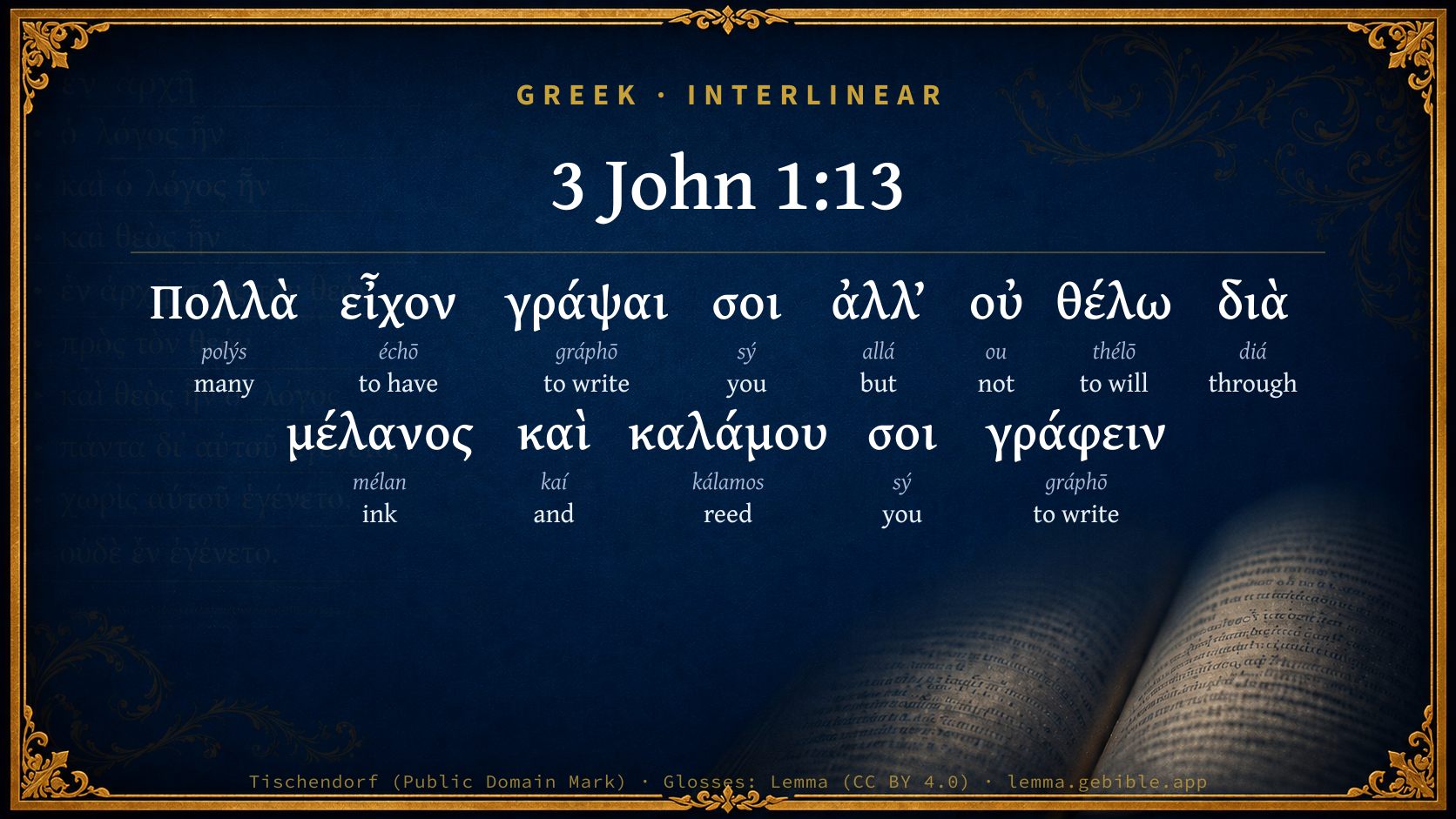
Greek (Tischendorf 8th ed.) 3 John 1:13 appears in the Greek New Testament. The text above is from the Tischendorf 8th edition. Each word links to its Strong’s number and a concise gloss. Click any word for its full Thayer’s Greek Lexicon entry.
Download image
Cite this verse

3 John 1:13 (World English Bible). Public Domain. Lemma interlinear Bible study tool, https://lemma.gebible.app/v/3-john/1/13.

Show BibTeX & RIS
BibTeX
RIS
English Translation
I had many things to write to you, but I am unwilling to write to you with ink and pen;
World English Bible · Public Domain
Download a study sheet

One document with this verse’s original text, its word-by-word gloss line, the meaning frame, cross-references with their text, attributed commentary, and full source and license credits — printable, and it pastes into notes with its structure intact.

This verse Autodidact and up

Study sheet (.html) Plain text (.txt)

A passage Seminary Student

Up to 50 verses in one chapter. A passage sheet keeps up to 6 commentary sources and 12 cross-references per verse, in the order this page ranks them, and says so on the sheet whenever that leaves anything out. Ask for a single verse and you get the Autodidact verse sheet above.

Everything on this page stays free to read, with no account — the sheet is a download of what is already on screen, not access to it.

Want to remove ads? Support Godless Engineer
Compare translations 3

The same verse in 3 English versions, stacked beneath the original-language interlinear above. Click any original word for its lexicon entry.

Each is an independent rendering of the whole verse — the interlinear is not word-aligned to these translations.

Highlighted words mark where these versions differ — a whole-verse word diff, not a word-by-word alignment.

  • World English Bible Public Domain
    I had many things to write to you, but I am unwilling to write to you with ink and pen;
  • King James Version Public Domain
    I had many things to write, but I will not with ink and pen write unto thee:
  • unfoldingWord Literal Text CC BY-SA 4.0
    I have many things to write to you, but I do not wish to write them to you with ink and pen.

unfoldingWord Literal Text — © unfoldingWord, licensed CC BY-SA 4.0. Word-aligned USFM3 via Door43 (git.door43.org/unfoldingWord/en_ult).

Versions to compare (up to 4)

3 of 4 selected

Show all 19 translations

Every available English version of this verse, each an independent rendering of the whole verse.

  • World English Bible Public Domain
    I had many things to write to you, but I am unwilling to write to you with ink and pen;
  • Berean Standard Bible Public Domain
    I have many things to write to you, but I would prefer not to do so with pen and ink.
  • Majority Standard Bible Public Domain
    I have many things to write, but I would prefer not to do so with pen and ink.
  • King James Version Public Domain
    I had many things to write, but I will not with ink and pen write unto thee:
  • American Standard Version (1901) Public Domain
    I had many things to write unto thee, but I am unwilling to write `them' to thee with ink and pen:
  • Revised Version (1885) Public Domain
    I had many things to write unto thee, but I am unwilling to write them to thee with ink and pen:
  • Geneva Bible (1599) Public Domain
    I haue many things to write: but I will not with yncke and pen write vnto thee:
  • Douay-Rheims (1899) Public Domain
    I had many things to write unto thee: but I would not by ink and pen write to thee.
  • Young's Literal Translation Public Domain
    Many things I had to write, but I do not wish through ink and pen to write to thee,
  • Literal Standard Version CC BY-SA 4.0
    Many things I had to write, but I do not wish to write to you through ink and pen,
  • Unlocked Literal Bible CC BY-SA 4.0
    I had many things to write to you, but I do not wish to write them to you with pen and ink.
  • unfoldingWord Literal Text CC BY-SA 4.0
    I have many things to write to you, but I do not wish to write them to you with ink and pen.
  • Darby Bible Public Domain
    I had many things to write to thee, but I will not with ink and pen write to thee;
  • World Messianic Bible Public Domain
    I had many things to write to you, but I am unwilling to write to you with ink and pen;
  • Webster's Bible Public Domain
    I had many things to write, but I will not with ink and pen write to thee:
  • Free Bible Version CC BY-SA 4.0
    I have so much to say to you, but I don't want to do it in writing with pen and ink.
  • Bible in Basic English Public Domain
    I had much to say to you, but it is not my purpose to put it all down with ink and pen:
  • Text-Critical English NT CC BY 4.0
    I have much to write, but I do not want to write to yoʋ with pen and ink.
  • Tyndale New Testament (1534) Public Domain
    I have many thinges to wryte: but I will not with ynke and penne wryte vnto the.

Literal Standard Version (2020), Covenant Press — licensed CC BY-SA 4.0. Text via the HelloAO Bible API (eBible.org). Unlocked Literal Bible (unfoldingWord) — licensed CC BY-SA 4.0. Text via the HelloAO Bible API (eBible.org). unfoldingWord Literal Text — © unfoldingWord, licensed CC BY-SA 4.0. Word-aligned USFM3 via Door43 (git.door43.org/unfoldingWord/en_ult). Free Bible Version, Dr. Jonathan Gallagher — licensed CC BY-SA 4.0. Text via the HelloAO Bible API (eBible.org).

Word by word

More ways to search: Search by grammar → Find every occurrence → Compare this word →

Practice this passage: Drill this verse → Learn its vocabulary →

About this verse

These counts appear in no published source. They are computed here, from the morphology-tagged text and Lemma’s own curated glosses. What Lemma adds →

13
words
11
distinct lemmas
General Epistles
section

Notable vocabulary

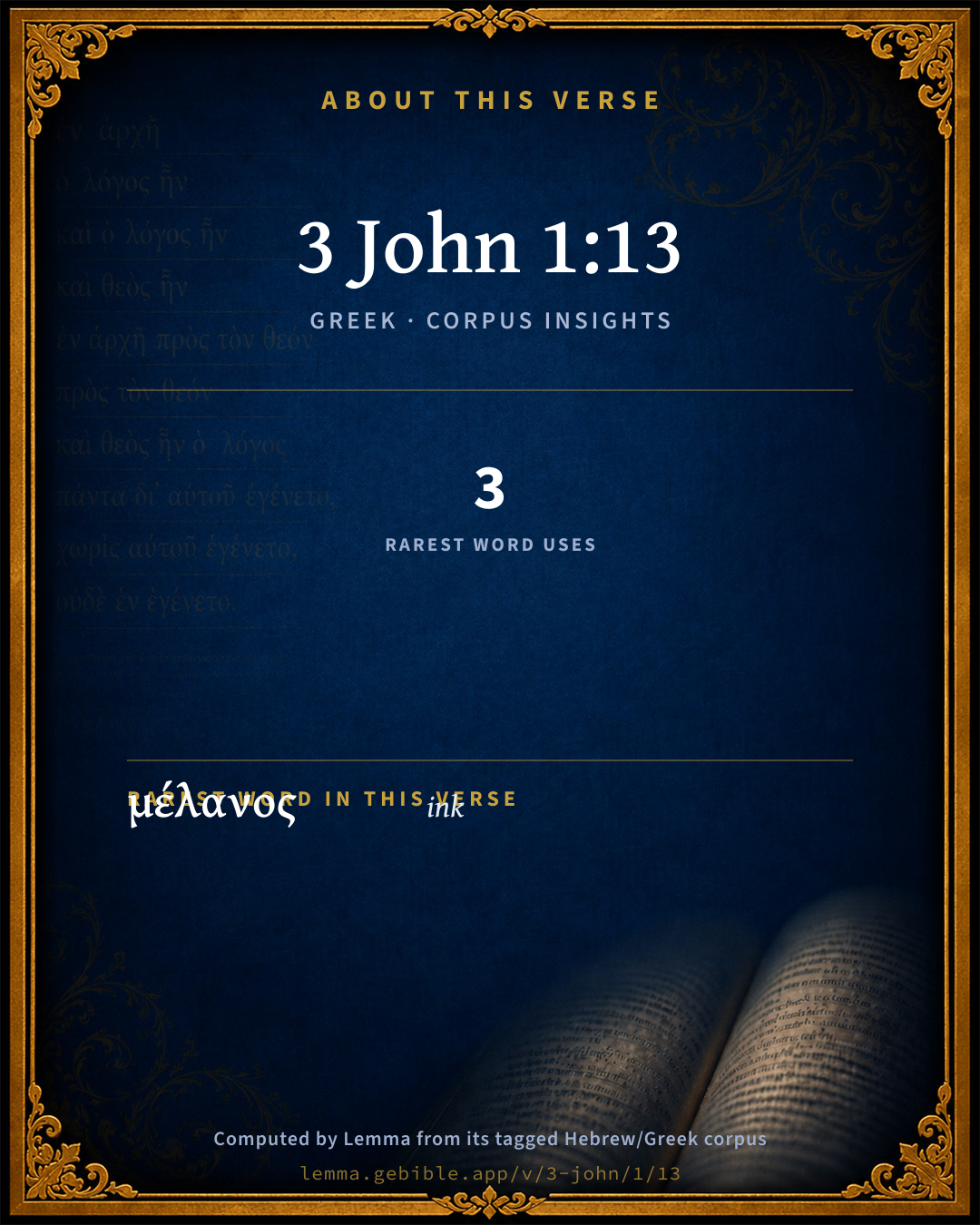
The rarest word here is μέλανος ink G3188 — appearing just 3 times in the whole Greek New Testament.

Shared distinctive vocabulary

μέλανος ink G3188 occurs in 3 verses of the Greek New Testament. Also found in:

Repetition

Words recur within this verse:

  • γράψαι to write G1125 ×2
  • σοι you G4771 ×2

Cross-references

1

Topical passages linked to 3 John 1:13 in the Treasury of Scripture Knowledge — connected by theme and wording, ordered by reader-vote popularity; previews shown in the World English Bible.

  • 2 John 1:12 Having many things to write to you, I don't want to do so with paper and ink, but I hope to come to you, and to speak face to face, that our joy may be made full.

Cross-references courtesy of OpenBible.info (CC BY 4.0).

Commentary

Notes on 3 John 1:13 from classic Christian and Jewish commentators (each source and its license shown beneath its notes). The classic Christian expositions comment on the surrounding passage and are grouped to its opening verse, so a note may address several verses; the Jewish commentaries on the Tanakh (Rashi and others) are per-verse, so they appear only where the commentator wrote on this verse.

Lemma curates 59 commentaries, every one of them public domain or Creative Commons licensed, each selected and text-cleaned for this edition rather than reprinted as found. About our sources →

The Biblical Illustrator

Joseph S. Exell

3Jn_1:13-14

I trust I shall shortly see thee.

The sweetness of Christian fellowship

1. Its foundation--peace. This is the bond of the Christian community. It cannot exist without concord. Divisions drive away the Spirit of God, and open the door for envy and malice.

2. Its sacredness--not with ink and pen. It is a hidden desire which can only be expressed in a manner suitable to its own nature. It may take many forms to show itself, but it cannot be fully realised without personal contact.

3. Its well-wishers--the friends greet thee. A sincere desire for the welfare of each other is a strong feature in Christian morals.

4. Its individual regard--greet the brethren by name. Each person received attention irrespective of wealth or position. (The Weekly Pulpit.)

Greet the friends by name.

The friends

The word friend does not often occur in the New Testament, being swallowed up in the more endearing one of brother. (J. Wesley.)

Greet the friends by name

The good pastor imitates that Good Shepherd who calleth His sheep by name. (C. Wordsworth.)

True friends scarce

The friendship of most men in these days is like some plants in the water, which have broad leaves on the surface of the water, but scarce any root at all; like drums and trumpets and ensigns in a battle, which make a noise and a show, but act nothing; mere friendships in pretence and compliment, that can bow handsomely, and promise emphatically, and speak plausibly, and forget all. (J. Spencer.).

The Biblical Illustrator, edited by Joseph S. Exell (c. 1880s–1900s) — public domain. Text from a community e-Sword module.

Joseph Benson's Commentary

3Jn 1:13-14. I had many other things to write — To communicate to thee concerning the affairs of your church, and concerning Diotrephes; but I will not — I am not minded; to write unto thee with ink and pen — Meaning, probably, lest this letter should fall into hands who might make an improper use of it. But I trust I shall shortly see thee — Lardner conjectures that John did actually visit Gaius; and adds, I please myself with the supposition that his journey was not in vain, but that Diotrephes submitted and acquiesced in the advices and admonitions of the apostle. Peace be to thee — And every desirable blessing, from God our Father, and Christ Jesus our Lord. Our friends salute thee — Our translators have inserted the word our in this clause without any authority. The apostle’s words are οι φιλοι, the friends, an expression nowhere else found in Scripture; but it applies excellently to the primitive Christians, as it denotes, in the strongest manner, the love which, in the first ages, subsisted among the true disciples of Christ. Greet the friends by name — That is, in the same manner as if I had named them one by one. The apostle, by sending a salutation to the faithful disciples of Christ, who were in the church of which Gaius was a member, and who were living together in great love, showed his paternal and affectionate regard for them, and encouraged them to be steadfast in their adherence to the truth and grace of the gospel, and to walk worthy of it.

Joseph Benson's Commentary on the Old and New Testaments (1811–1818) — public domain. Text from a community e-Sword module.

Lange's Commentary on the Holy Scriptures

THE CONCLUSION

3Jn_1:13-14

13I had many things to write,29 but I will30 not with ink and pen write31 unto thee:32 14But I trust I shall shortly see thee, and we shall speak face to face.33 Peace be to thee. Our friends34 salute thee. Greet the friends35 by name.36

EXEGETICAL AND CRITICAL

Close of the Epistle. 3Jn_1:13-14.

3Jn_1:13. I should have much to write to thee.—Πολλὰ, emphatic, placed first. The Imperfect εἶχον without ἄν, is idiomatic Greek and must be rendered in the Subjunctive in German. See Winer p. 283 sqq.; [The objection to the rendering of E. V. “I had many things to write” is that the Apostle does not advert to the past but to the present. So Huther 2d ed. “I should have much to write” brings out this shade of thought in English.—M.].

But I will not write unto thee with ink and pen.—Cf. 2Jn_1:12.

3Jn_1:14. But I hope, soon to see thee.—The contrast to writing, for which the Apostle has no further inclination (Düsterdieck), is oral intercourse which he hopes soon to realize.

And we shall speak mouth to mouth.—The Future λαλήσομεν denotes the assurance of hope. The object is πολλὰ 3Jn_1:13, and the particulars indicated in the Epistle.

Greetings 3Jn_1:14.

3Jn_1:14. Peace be to thee.—The greeting of the Apostle to the beloved Gaius. As at the beginning of the Epistle the simple χαίρειν is not sufficient for the fulness of the Christian greeting, so at the close the common ἔῤῥωσο (Act_23:30; Act_15:29) is displaced by richer and deeper forms. There the wish of peace is most appropriate (Gal_6:16; Eph_6:23; 1Pe_5:14; 2Th_3:16; Rom_15:33 and al.), because peace may be regarded as the sum-total of the Divine gifts of grace in Christ (Luk_2:4; Joh_14:27) as N. de Lyra correctly explains it: “Pax interna conscientiæ, pax fraterna amicitiæ, pax superna gloriæ” (Düsterdieck). [Alford: “Remember our Lord’s legacy, Joh_14:27; and His greeting after the resurrection, εἰρήνη ὑμῖν, Joh_20:19; Joh_20:26.”].—Joy moreover is health of the soul.

The friends salute thee.—Bengel: “Rara in N. T. appellatio, absorpta majori fraternitatis. Errant philosophi, qui putant amicitiam non instrui a fide.” Joh_15:15. The expression suits a purely private Epistle, written on purely personal relations (Lücke). Bede: “Amicis gratiam pacis mandat et salutis et per hæc Diotrephen ceterosque veritatis inimicos a salute et pace vestra monstrat extraneos.” Among the ἀδελφοί, which are generally saluted (Php_4:21; 1Co_16:20; Eph_6:23), John, according to 2Jn_1:9-11, probably included Diotrephes, because he acted only as an ambitiosus, but does not seem to have been wrong and erred in the doctrine of Christ’s incarnation; but he and his party were not φίλοι to the Apostle, like Gaius and Demetrius. Cf. Joh_11:11; Act_27:3.

Greet the friends by name.—Κατ’ ὄνομα=ὀνομαστί (Joh_10:3); Bengel: “Non secus ac si nomina eorum præscripta essent.” The greetings, and especially those by name, have so deep an import and so great a value, that Paul fills a whole chapter of his Epistle to the Romans (Rom_16:1-24) with them, and often adds a series.

HOMILETICAL AND PRACTICAL

Starke:—It is not advisable to confide every thing to the pen; many things may be better and more effectively stated orally than in writing.—It is not a small benefit, if the children of God may visit each other and delight in friendly conversation.—We are in the company of the holy men of God whenever we hear or read their writings.

Heubner:—We see, how even letters of friendship are hallowed by faith. Everything should have the impress of our evangelical frame of mind. A mind wholly penetrated by the spirit of Christianity will not deny itself even in unimportant letters of friendship. Examples may be seen in Sailer’s Christian letters of every century, in the letters of Luther, Tersteegen and John Newton.—The children of peace receive peace (Luk_10:5-6).

Besser:—John greets the friends by name; he carries them all in his heart, and every one in particular. This is presbyter-fidelity.—

[Wordsworth:—The good pastor imitates that Good Shepherd, who “calleth His sheep by name.” Joh_10:3.—M.].

Footnotes:

[29]3Jn_1:13. A. B. C. Cod. Sin. read: γράψαισοι.

[30]3Jn_1:13. B. C. Cod. Sin.: οὐ θέλω. The reading οὐκ ἐβουλήθην in A. originated from 2Jn_1:12, and like οὐκ ἤθελον formed alter it.

[31]3Jn_1:13. B. C. Cod. Sin.: σοιγράφειν; A: γράφεινσοι.

[32]3Jn_1:13. [German: “I should have much to write unto thee, but I will not write unto thee with ink and pen.”—M.]

[33]3Jn_1:14. [German: “But I hope soon to see thee, and we shall speak mouth to mouth.”—M.]

[34]3Jn_1:14. B. C. G. K. Cod. Sin. read: φίλοι; A. ἀδελφοί. [German: “The friends salute thee.”—M.]

[35]3Jn_1:14. Several unimportant Codd. read ἀδελφούς instead of φίλους.

[36]3Jn_1:14. G. inserts ἀμήν.—A. B. Cod. Sin. have the subscription: Ἰωάννου γ. The usual additions occur here and there, but are not sufficiently authenticated.

Lange's Commentary on the Holy Scriptures (Critical, Doctrinal, and Homiletical), ed. John Peter Lange, English translation edited by Philip Schaff (1864–1880) — public domain. Text from a community e-Sword module.

Tyndale Open Study Notes

Tyndale Open Resources

1:13-15 As in 2 John, the conclusion of 3 John shows John’s desire to make a personal visit and see to the instructions of this letter.

1:13 pen and ink (literally ink and reed): In antiquity, writing was typically done with a stylus shaped from a reed and black carbon ink (see also 2 Jn 1:12).

Tyndale Open Study Notes — © Tyndale Open Resources, licensed CC BY-SA 4.0. Text via the HelloAO Bible API.

Meyer's Critical & Exegetical Commentary

Heinrich August Wilhelm Meyer

3Jn_1:13-14. The same thoughts as in 2Jn_1:12; even the expression is little different; this agreement is most naturally explained by the contemporaneousness of the two Epistles.

πολλὰ εἶχον γράψαι] I would have many things to write to thee, but …; as in Act_25:22; comp. Winer, p. 253; VII. p. 265; A. Buttmann, p. 187 (de Wette); an ἄν is not omitted. Düsterdieck and Ebrard translate: I had much to write, unsuitably, because the apostle is not speaking of the past, but of the present.

Instead of paper (Second John), it is the κάλαμος, the writing-reed, that is mentioned as the writing material along with the ink.

On ἐλπίζω δὲ κ.τ.λ., see ἐὰν ἔλθω, 3Jn_1:10.

3 John 1:15. εἰρήνη σοι] The blessing at the end of the First Epistle of Peter runs similarly; comp. besides, Gal_6:16; Eph_6:23; 2Th_3:16 (also Rom_15:33; 2Co_13:11; 1Th_5:23; Heb_13:20).

ἀσπάζονταί σε οἱ φίλοι κ.τ.λ.] It is in harmony with the character of the Epistle, as a private communication, that John does not send greetings from the whole Church, but from the special friends of Caius, and so also commissions him with greetings only to his (the apostles) φίλοι. The latter was the more natural, as indeed a part of the Church was at enmity with John.

On κατʼ ὄνομα, comp. Joh_10:3; it belongs to ἀσπάζου, and is = ὀνομαστί (see Meyer on this passage); the personal relationship is thereby emphasized, as Caius is to greet every one of the friends specially (by name).

Meyer — Critical and Exegetical Commentary on the New Testament — English translation by Peter Christie, edited by Frederick Crombie (T&T Clark, 1880) — public domain. Text from a community e-Sword module.

Expositor's Greek Testament

ed. W. Robertson Nicoll

3Jn 1:13-14 . The Conclusion. “I had many things to write to thee, but I am not minded to be writing to thee by pen and ink. However, I hope presently to see thee, and we shall talk face to face. Peace to thee! The friends salute thee. Salute the friends by name.”

Cf. 2Jn 1:12-13 . The similarity of the conclusions suggests that the two epistles were written at the same time. The Apostle meditated a visitational circuit (see Introd. p. 155) in the course of which he would see both Kyria and Gaius.

3Jn 1:13 . γράψαι , aor. of the complete composition in the Apostle’s mind; γράφειν , pres. of the process of putting it on paper. κάλαμος (in full κάλαμος γραφεύς ), a reed-pen, as distinguished from γραφεῖον , a sharp-pointed stilus for writing on waxed tablets. Plutarch ( Dem. , 29, 3) says that Demosthenes, when meditating and writing, was accustomed to bite his κάλαμος .

The Expositor's Greek Testament, edited by W. Robertson Nicoll (1897–1910) — public domain. Text from a community e-Sword module.

Jamieson, Fausset & Brown

Robert Jamieson, A. R. Fausset & David Brown

I will not--rather as Greek, "I wish not . . . to write" more.

Jamieson, Fausset & Brown — Commentary Critical and Explanatory on the Whole Bible (1871) — public domain (CC PDM 1.0). Text via the HelloAO Bible API.

Adam Clarke's Commentary

Verse 13. I had many things to write] That is, I have many things that I might write; but having the hope of seeing thee shortly, I will not commit them to paper. Ink and pen are here mentioned; paper and ink in the preceding epistle.

Adam Clarke's Commentary on the Bible (1810–1826) — public domain. Text from a community e-Sword/MySword module.

Ellicott's Commentary for English Readers

(3) (13) I had many things to write.—Rather, There were many things which I wished to write.

But I will not.—Comp. 2Jn_1:12.

(14) Peace be to thee.—The best wish which the Apostle can form, instead of the usual Greek ending, “Be strong,” or “Farewell!” It was our Lord’s resurrection greeting; the internal peace of a good conscience, the external peace of universal friendship, the heavenly peace of future glory begun even in this life. (Comp. Joh_20:19; Joh_20:26; Rom. 5:33; Gal_6:16; Eph_6:23; 2Th_3:16; 1Pe_5:14.)

Our friends salute thee.—Rather, The friends. By this appellation, uncommon in the New Testament, St. John recalls our Lord’s words in Joh_15:13-15.

Greet the friends by name.—Each friend was to receive a personal message from the Apostle, and Caius would know who they were as well as if St. John wrote them down. In a short private Letter it would be unsuitable to have a long list of special messages as in a Pauline Epistle, especially as the Apostle hoped shortly to see them. John perhaps thinks of his Master’s ideal in Joh_10:3.

A Bible Commentary for English Readers, edited by Charles John Ellicott (1878–1897) — public domain. Text from a community e-Sword module.

The Cambridge Bible for Schools and Colleges

gen. ed. J. J. S. Perowne

13. I had many things to write] With R. V., following אABC and all ancient Versions, we must add to thee. ‘I had’ is imperfect: at the time of my writing there were many things which I had to communicate to thee.

but I will not] ‘Will’ is not the sign of the future tense auxiliary to ‘write,’ but the present of the verb ‘to will:’ but I will not to write to thee; I do not care to write. See on Joh_6:67; Joh_7:17; Joh_8:44.

with ink and pen] In the Second Epistle we had ‘with paper and ink.’ The word for ‘pen’ (κάλαμος) occurs in this sense nowhere else in N. T. It signifies the reed, calamus, commonly used for the purpose. In LXX. of Psa_44:2, ‘My tongue is the pen of a ready writer’, the same word is used; so also in Mat_11:7 and Rev_11:1, but in the sense of reed, not of pen.

13, 14. Conclusion

13, 14. The marked similarity to the Conclusion of the Second Epistle is strong evidence that the two letters were written about the same time. See notes on 2Jn_1:12-13.

The Cambridge Bible for Schools and Colleges (gen. ed. J. J. S. Perowne; Cambridge University Press, 1878–1918) — public domain. Text from a community e-Sword module.

John Gill's Exposition

I have many things to write,.... With regard to churches, and particular persons, and concerning hospitality to the poor brethren:

but I will not with ink and pen write unto thee; suggesting he should take another method of communicating his mind to him, which he next mentions.

John Gill's Exposition of the Whole Bible (1746–1763) — public domain (CC PDM 1.0). Text via the HelloAO Bible API.

Trapp's Complete Commentary

John Trapp

13 I had many things to write, but I will not with ink and pen write unto thee:

Ver. 13. I will not with ink] In vain is the word written in books, unless it be also written in our hearts, Jer 31:33.

With paper] Which was of old made of a certain plant of Nile called Papyrus, but now it is made of rags, miro ingenio, et utili rebus mortalium, to the great benefit of mankind. (Aretius.)

John Trapp, A Commentary or Exposition upon All the Books of the Old and New Testament (1647–1656) — public domain. Text from a community e-Sword module.

Albert Barnes' Notes on the Bible

I had many things to write ... - This Epistle closes, as the second does, with a statement that he had many things to say, but that he preferred waiting until he should see him rather than put them on paper. Perhaps there were some things which he wished to say which he would not like to have exposed to the possibility of being seen by the public eye.

But I will not with ink and pen ... - Notes at 2Jo 1:12.

Albert Barnes' Notes on the Bible (1834–1885) — public domain. Text from a community e-Sword/MySword module.

Matthew Poole's English Annotations

Having much more to say, as 2Jo 1:12, he resolved on a more immediate, grateful, and effectual way of imparting and even impressing his sense, as the term, writing, is used in a greater latitude, Pro 3:3, and elsewhere.

Matthew Poole's English Annotations on the Holy Bible (1683–1685) — public domain. Text from a community e-Sword/MySword module.

Whedon's Commentary on the Bible

Daniel D. Whedon

13. Many things to write—Compare note on 2Jn_1:12.

Pen—The calamus or reed.

Daniel D. Whedon (gen. ed.), Commentary on the Old and New Testaments (1874–1909) — public domain. Text from a community e-Sword module.

The Pulpit Commentary

CONCLUSION (see notes on 2Jn_1:12, 13). Here the pen or reed kalamov is mentioned instead of the paper, as a means of writing. The word is found nowhere else in the New Testament in this sense Note the ajlla and the de, each with its right force, the former expressing a strongcr opposition than the latter: "I had many things to write to thee; nevertheless, I do not care ajll ouj qelw with ink and pen to write to thee: but I hope ejlpizw de straightway to see thee, and we shall speak mouth to mouth." "The friends" are perhaps so called in contrast to the hostility of Diotrephes and his party. Instead of warfare, "peace be to thee;" instead of the wicked prating of enemies, the salutations of friends. The elder concludes with his own personal salutation to all the members of his flock who reside near to Gaius. (comp. Joh_10:3)

Vers. 13, 14.

Valediction.

had many things to write," etc. What a precious boon communication by writing is when communication by speech is unattainable! How valuable is writing also when accuracy and permanence are desired! Yet writing has its disadvantages as compared with speech, as St. John found at this time.

I THE APOSTLE"S HOPE. "I hope shortly to see thee, and we shall speak face to face." He hoped for communication by speech, which, as compared with writing, is:

1. More easy and rapid.

2. More expressive.

3. More pleasurable.

The sainted apostle mentions this in closing his former private Epistle. "That your joy may be fulfilled.

II THE APOSTLE"S BENEDICTION. "Peace be unto thee." A very comprehensive benediction. It comprises:

1. Peace in our relation to God. This peace is a consequence of the forgiveness of our sins and our reconciliation unto God. "Thy sins are forgiven go in peace." "Being justified by faith, let us have peace with God," etc. The peace also which flows from confidence in God as regards the possibilities of the future. (see Mat_6:25-34) "Thou wilt keep him in perfect peace, whose mind is stayed on thee, because he trusteth in thee.

2. Peace in our relation to men. The absence of jealousy, revenge, bitterness of spirit, etc. The practical recognition of the claims of others upon us. And the exercise of good will, kindness, etc.

3. Peace in our own being. The accusations of conscience silenced by the removal of our guilt through the mercy of God.

I feel within me A peace above all earthly dignities, A still and quiet conscience. (Shakespeare.)

The conflict between the flesh and the spirit ended in the victory of the spirit. The rebellion of passion against principle, and of appetites against aspirations, quelled by the power of the Divine life in the soul. By his grace God establishes order in a man"s own being, brings the faculties and propensities of his nature into harmony, and so gives to him inward peace. In this way the peace of the Christian soul is complete. Our Lord bequeathed this peace unto his disciples. "Peace I leave with you, my peace I give unto you," etc.. (Joh_14:27 Joh_20:19, Joh_20:26)

4. Perfect peace in heaven. Here our realization of this peace is variable. Doubts assail us; fears depress us; sickness and sorrow darken and disturb, if they do not distress us. Serenity of spirit is not always ours. But hereafter "God shall wipe away every tear from our eyes," etc.. (Rev_21:4)

III THE APOSTLE"S GREETING. "The friends salute thee. Salute the friends by name. W.J.

HOMILIES BY R. FINLAYSON Vers. 1-14.

The aged presbyter"s letter to a private Church-member.

eider unto Gaius the beloved, whom I love in truth." As in the Second Epistle, John takes the familiar official designation of "the elder." The receiver of the Epistle was regarded by John with more than ordinary affection; for he at once designates Gaius "the beloved," and three times in the course of the short Epistle be addresses him by this designation. He was widely beloved; for the addition here, while emphasizing the apostle"s own affection for Gains, widens the range of affection for him. "Whom I (for my part) love," he says; i.e., he along with many others, not he in opposition to some who withheld love or entertained hate. He loved Gaius as he loved "the elect lady and her children in truth. This Epistle contains no statement of the Incarnation; but we know that by the apostle the Incarnation was regarded as the vital part of the truth. (1Jn_4:1, 1Jn_4:2) It was the highest revelation of Godhead, which bound hearts to God, and hearts to hearts in the Christian circle. Attached to the truth himself, he could not love every one alike; but he loved Gains as a friend of the truth.

I GAIUS.

1. His well-being desired. "Beloved, I pray that in all things thou mayest prosper and be in health, even as thy soul prospereth." This is the salutation thrown into an unusual form. As the foundation of the good wish, Gaius is congratulated on his soul-prosperity. This soul-prosperity is brought out, in what follows, in connection with a satisfactory relation to the truth, and specially the practice of hospitality. In the form given to the good wish, it is implied that there is a relation between soul-prosperity and other prosperity. To wish a man success in business and good bodily health is to wish him well so far; only the wish does not go far enough. For every man has an eternal interest as well as a temporal interest, has a soul as well as a body; and, if we are his true well-wishers, we shall wish him well in the whole, and not merely in part, of his well-being. To wish him success in business and good bodily health alone is as though a friend were traveling from Edinburgh to London, and we wished him well as far as York not saying anything about the rest of the journey. The lower prosperity is not to be sought for a man apart from soul-prosperity. It might seem from the old translation that it is to be sought above all things; but there is a mistranslation, which has properly been corrected in the Revised translation. John expresses for Gains the wish that in all things relating to business and health it may be well with him; not, however, without regard to his spiritual condition. His soul was prospering; he was therefore a man for whom this might be safely sought. He was making a good use of his means in the interest of the truth, and so his health was precious. What, then, John wishes for Gains is in effect thismore means and better health, that he might have more to serve God with. The more that such a man as Gains had, the more good he would do. But we cannot safely wish for every man more means and better health. That might only mean more to serve the devil with. What some need is forget a severe check in business, to be laid down on a bed of sickness; and our wish for them may justly be that this should happen to them, rather than that they should lose their souls. From this it will be seen that a Christian may be justified in seeking the utmost success in business and the largest measure of health, provided his motive is to have more means and better health with which to serve God. This may be a greater spur to diligence than even the desire to amass wealth, being attended with the advantage that it leaves the mind free and buoyant. Let us learn the benefit of well-wishing. It was no small thing to have John as a well-wisher, both from the office which he held and his great spiritual experience; and the likelihood was that Caius would get more means and better health because of the aged apostle"s wish. Let us, in our letters or otherwise, wish our friends well in their worldly affairs and in their health, not without regard to the degree in which their souls prosper, and God will see to our wishes taking effect.

2. His relation to the truth rejoiced in.

(1) Truth appropriated. "For I rejoiced greatly, when brethren came and bare witness unto thy truth." The joy of John was great because of brethren arriving and testifying to the reception of the truth by Gains. It is mentioned here as that on which his soul-prosperity depended. One of the lessons taught by the open flower in the ornamentation of the temple was receptivity. "It lies open to catch the sunshine, and to drink the rain and the dew, shuts up when the sun departs, but expands itself again when the sun"s rays touch it. By reception the plant and the flower live; and by reception the soul of man lives and grows." We are to be careful to give the soul its proper nourishment, which is the truth: thoughts of God"s love, thoughts of his ends in our life. If we entertain false views of God and of life, we are really taking poison into our souls. Caius felt the need of the truth to nourish anti beautify him. "Behold, thou desirest truth in the inward parts." This Caius had; by assimilation, it had become part of his being.

(2) Truth carried out into conduct. "Even as thou walkest in truth." This was more than receiving the truth, being its proper consequent. The reception of the truth appeared (so that brethren could testify to it) in a higher style of conduct. It is under sunny skies that the finest colouring in nature is to be found. It is in good society that the finest accent is to be found. So it is those who move within the circle of the Divine thoughts, lie open to the Divine influences, that attain to the most attractive style of life. Brethren carry away a good report of them, which is cheering to the souls of veterans. Appended comment emphasizing the apostle"s joy. "Greater joy have I none than this, to hear of my children walking in the truth." The reception of the truth was implied in walking in the truth; therefore it was enough to note the latter. There were many to whom John stood in the relation of spiritual father (more than those who owed to him their spiritual birth); he was no stranger to fatherly joy. And what gave him joy?

To hear of his children, that they were prospering in their worldly affairs, that they were enjoying good health, that they were exempted from persecution. It did cheer him to hear of their lower prosperity; but what cheered him, with more refreshing influence, was to hear of their soul-prosperity, as evidence in their walking in the truth.

3. Practice of hospitality.

(1) Commended. "Beloved, thou doest a faithful work in whatsoever thou doest toward them that are brethren and strangers withal." The truth binds the whole walk; it specially bound Gains in the practice of hospitality. While just, he made a free use of his means. The objects of his hospitality were brethren, as it appears, missionary brethren, and missionary brethren who were strangers to him, and therefore had no claim on him beyond their Christian position and calling. He had opportunity of rendering them service beyond simply entertaining them; and, whatever service he rendered, he did it as the truth required, i.e., handsomely.

(2) Witnessed to. "Who bare witness to thy love before the Church." It was love that moved Caius to serve the missionary brethren; and they were mindful of services rendered. On their return to the Church over which John presided, in giving an account of their missionary labours, they told, in presence of the Church, how well they had been treated by Gains. Thus the things which were lovely became also the things of good report.

(3) Encouraged. "Whom thou wilt do well to set forward on their journey worthily of God." The missionary brethren were returning to their labours his way; the apostle, therefore, bespeaks for them a good reception. Let him follow up his former kindnesses, and set them forward on their journey, by providing the necessary rest, and also, as is suggested by what follows, by making some provision against their future needs, lie was to do this worthily of God, i.e., as representing to them the Divine solicitude. They were deserving. "Because that for the sake of the Name they went forth, taking nothing of the Gentiles." The Jews "besought Jesus earnestly for the centurion, saying, tie is worthy that thou shouldest do this for him: for he loveth our nation, and himself built us our synagogue." The missionary brethren were worthy that Gaius should assist them by setting them forward on their journey. It was for the sake of the Name that they went forth, i.e., " not for their own occasions and earthly interests," but that the Name of Christ might be magnified. They went forth from the home Church (which was limited in its resources) to convert the Gentiles. That they might not hinder their aim by the appearance of being mercenary, they chose (so far as it was necessary) to labour with their own hands, rather than take from the Gentiles. The accomplishment of their aim, in the formation of a Gentile Christian Church (to be cared for by others while they went further on), was work to which the building of a sacred house was secondary. It was work fitted to exalt the Name, showing the power of Divine love over the hardness of men"s hearts and the evils of Gentilism. They, then, whose missionary zeal was kindled by the Name must not be overlooked. They were representatives of the truth. "We therefore ought to welcome such, that we may be fellow-helpers with the truth." We are to think of Gains, in accordance with his known character, taking the burden (so we may translate) for these men making them happy while in his house, and contributing not only for the journey, but for the end of the journey, so that with disengaged hands they might begin their mission; and thus, while not proclaiming the truth himself, earning the praise of being a "fellow-helper with the truth." There is an obligation lying on us to take the burden for the missionaries. While, in the interest of the truth, they go forth as bearers of the truth to the heathen, we are, by our contributions, to leave their hands and minds free for their proper work; thus, while not bearers of the truth ourselves (from want of opportunity and qualifications), having an interest in the truth, and having the satisfaction and honour of being" fellow-helpers with the truth.

II DIOTREPHES.

1. H is resistance of John"s authority. "I wrote somewhat unto the Church: but Diotrephes, who loveth to have the pre-eminence among them, receiveth us not." The particular Church is not named; but we must understand it to be that to which Gaius belonged, so that we have a new element introduced. Gaius entertained the stranger missionaries in the face of opposition The opposition came from Diotrephes. The occasion was a letter from John. This letter has not been preserved; we must think of it as containing a request to the Church to give a favourable reception to the missionaries. The request was only reasonable; but Diotrephes opposed it, not because he disliked John"s teaching, or the teaching of the missionaries, but simply because he wished to assert his personal authority. He belonged to the class of these who love to have the pre-eminence; who are bent, not on the peace and prosperity of the Church, but on their being first in the Church, even at the expense of its peace and prosperity. And this ambitious member or office-bearer of the Church succeeded for a time; he tasted the sweets of ecclesiastical power, in getting a majority to agree with him against the apostle. We come here upon the design of this letter to Gaius.

2. His coming defeat, "Therefore, if I come, I will bring to remembrance his works which he doeth, prating against us with wicked words: and not content therewith, neither doth he himself receive the brethren, and them that would he forbiddeth, and casteth them out of the Church." Diotrephes did not gain his victory without working for it. His works, however, were not such as could bear to be remembered. His punishment would be, on the coming of John, to have his works brought to remembrance. Their true valuation would be his dethronement from power. What he did was to speak against John and his friends. While his words were null, they were mischievous. Not content with speaking, he had recourse to action. He set the example of shutting his door against the missionaries; and when some (one being Gaius) chose to be guided rather by the apostle"s letter, he at once vetoed them, and, on their non-submission to his authority, excommunicated them. But this working, meantime triumphant, would soon, and very simply, be put a stop to. "Knowest thou not this of old, since man was placed upon earth, that the triumphing of the wicked is short?

III DEMETRIUS.

1. His unlikeness to Diotrephes. "Beloved, imitate not that which is evil, but that which is good. He that doeth good is of God: he that doeth evil hath not seen God." While there is evil working in Churches, there is also good working. The evil is there for us to avoid; the good is there for us to imitate. We need to learn to "discern between the righteous and the wicked, between him that serveth God and him that serveth him not." The Johannine principle of discrimination is simple. He that is associated with the working of good has his life derived from God; he that is associated with the working of evil (whatever his profession) is not in the way of receiving first impressions of God in his true nature, or is not placed so as to make a commencement in the Divine life.

2. Threefold testimony to his excellence. "Demetrius hath the witness of all men, and of the truth itself: yea, we also bear witness; and thou knowest that our witness is true." Demetrius had the witness of all men. We are to regard the language as hyperbolical, not limiting the "all" to the Christian circle, nor to the few who in the strictest sense could be witnesses, but the many who spoke well of Demetrius are made" all," the more to impress us with their number. Demetrius had a witness greater than of numbers: he had the witness of the truth itself. Though there had been not a man to he a witness to him, the truth (to personify it) could have been produced as a witness. Though no man had owned him, the truth would have owned him. Apart from the personification, the idea is that there was a close corre spondence between what Demetrius was and what the truth demanded. But to judge of this correspondence requires a competent witness, with opportunity and also with correct intuitions of the truth; and so, in the third place, John comes forward to vouch for Demetrius a witness than whom none could be more satisfactory to Gaius. We are not told who this Demetrius was; but it is not an improbable conjecture that he was the bearer of the Epistle. If so, then it is to be noted how, by a happy turn, he supplies him with the necessary recommendation.

Conclusion.

1. R eason for not writing more. "I had many things to write unto thee, but I am unwilling to write them to thee with ink and pen: but I hope shortly to see thee, and we shall speak face to face." It is interesting to note how the writing materials are here, not "paper and ink", (2Jn_1:12) but "ink and pen." He could have put his pen to the writing of many things; for Gaius and he had much in common in their sympathies. He had written meantime to counteract, so far as he could by writing, the dangerous influence of Diotrephes. He hoped soon to see Gaius. When he saw him, and they spoke face to face, he would have more opportunity and freedom to disburden himself.

2. Salutations. "Peace be unto thee. The friends salute thee. Salute the friends by name." John was at peace with Gaius; he wished the whole world to be at peace with him. They had common friends. Friends with John (whom the bearer would name)saluted Gaius. Friends with Gaius, he (the receiver of the letter) was first to name singly, and then to salute in this form, "John sends his salutation to thee. R.F.

The Pulpit Commentary (1880–1919), ed. H.D.M. Spence-Jones & Joseph S. Exell — public domain. Text from a community e-Sword module.

Burkitt's Expository Notes on the New Testament

William Burkitt

Thus our apostle concludes his epistle with an apology for the brevity of it, hoping in a short time to see him, and to speak face to face unto him; he concludes with his apostolic valediction, Peace be to thee; unto which adding the brethren’s salutations, it teaches us, that kind remembrances and greetings are suitable to Christian friendship: Our friends salute thee. Greet the friends by name.

William Burkitt's Expository Notes on the New Testament (1700–1703) — public domain. Text from a community e-Sword module.

The People's New Testament

B. W. Johnson

13, 14. I had many things to write. These verses correspond with the 12th and 13th of the Second Epistle. See notes there.

B. W. Johnson's The People's New Testament with Notes (1889–1891) — public domain. Electronic text from the Christian Classics Ethereal Library (CCEL) ThML edition.

Cambridge Greek Testament for Schools and Colleges

13, 14. CONCLUSION

13, 14. The marked similarity to the Conclusion of the Second Epistle is strong evidence that the two letters were written about the same time. See notes on 2Jn 1:12-13.

13. For γράφειν ([1000][1001]) read γράψαι σοι ([1002][1003][1004][1005]): γράφειν is from 2Jn 1:12. Similarly [1006] and the Vulgate substitute ἐβουλήθην from 2Jn 1:12 for θέλω. For γράψαι ([1007][1008]) read γράφειν ([1009][1010][1011][1012]).

[1000] 9th century. All three Epistles.

[1001] 9th century. All three Epistles.

[1002] 4th century. Discovered by Tischendorf in 1859 at the monastery of S. Catherine on Mount Sinai, and now at Petersburg. All three Epistles.

[1003] 5th century. Brought by Cyril Lucar, Patriarch of Constantinople, from Alexandria, and afterwards presented by him to Charles I. in 1628. In the British Museum. All three Epistles.

[1004] 4th century. Brought to Rome about 1460. It is entered in the earliest catalogue of the Vatican Library, 1475. All three Epistles.

[1005] 5th century. A palimpsest: the original writing has been partially rubbed out and the works of Ephraem the Syrian have been written over it. In the National Library at Paris. Part of the First and Third Epistles; 1Jn 1:1 to 1Jn 4:2; 3Jn 1:3-14. Of the whole N.T. the only Books entirely missing are 2 John and 2 Thessalonians.

[1006] 5th century. Brought by Cyril Lucar, Patriarch of Constantinople, from Alexandria, and afterwards presented by him to Charles I. in 1628. In the British Museum. All three Epistles.

[1007] 9th century. All three Epistles.

[1008] 9th century. All three Epistles.

[1009] 4th century. Discovered by Tischendorf in 1859 at the monastery of S. Catherine on Mount Sinai, and now at Petersburg. All three Epistles.

[1010] 5th century. Brought by Cyril Lucar, Patriarch of Constantinople, from Alexandria, and afterwards presented by him to Charles I. in 1628. In the British Museum. All three Epistles.

[1011] 4th century. Brought to Rome about 1460. It is entered in the earliest catalogue of the Vatican Library, 1475. All three Epistles.

[1012] 5th century. A palimpsest: the original writing has been partially rubbed out and the works of Ephraem the Syrian have been written over it. In the National Library at Paris. Part of the First and Third Epistles; 1Jn 1:1 to 1Jn 4:2; 3Jn 1:3-14. Of the whole N.T. the only Books entirely missing are 2 John and 2 Thessalonians.

13. πολλὰ εἶχον. Imperfect; at the time of his writing there were many things which he had to communicate to Gaius. οὐ θέλω. ‘I do not care to.’ See on Joh 6:67; Joh 7:17; Joh 8:44.

διὰ μέλανος καὶ καλάμου. In 2Jn 1:12 it is διὰ χάρτου καὶ μέλανος. Κάλαμος occurs nowhere else in the sense of ‘reed for writing with, pen,’ but only in the general sense of ‘reed,’ calamus. Quills were not used as pens until the fifth century. The earliest certain evidence as to their use is in the writings of Isidore, early in the seventh century. In LXX. of Psa 44:1 κάλαμος is used of ‘the pen of a ready writer.’

Cambridge Greek Testament for Schools and Colleges (Cambridge University Press, 1896; 21 vols, various authors incl. Carr, Maclear, Plummer, Farrar, Lumby, Moule, M. R. James, Simcox) — public domain. Text from a community e-Sword module.

Alford’s Greek Testament

Henry Alford

13-15.] Close of the Epistle. I had (not, as Huther, for εἶχον ἄν: it is a pure imperfect, describing that which has not come to pass, but might have done so under certain conditions: cf. Act 25:22: Rom 9:3, also alleged by Düsterd. is not quite a case in point. He gives the meaning here well: “I had indeed much to write: that I have not written it is owing to this, that I wish not, &c.”) many things to write to thee, howbeit I will not to write (present, not only “to write them,” which would be aorist, but to write at all, to write any more) by means of ink and reed (see on 2Jn 1:12): but (on the other hand) I hope immediately to see thee, and (then) we shall speak mouth to mouth (see 2Jn 1:12). Peace be to thee (beautifully paraphrased by Lyra, “interna conscientiæ, pax fraterna amicitiæ, pax superna gloriæ.” Remember our Lord’s legacy, Joh 14:27, and His greeting after the Resurrection, εἰρήνη ὑμῖν, Joh 20:19, Joh 20:26). The friends salute thee. Salute the friends by name (“non secus ac si nomina eorum præscripta essent.” Bengel). The reason why St. John mentions φίλοι (see Joh 11:11, Joh 11:15:15; Act 27:3), and not ἀδελφοί (1Co 16:20; Php 4:21; Eph 6:23), is probably to be found in the personal character of the Epistle, not addressed as from an Apostle to a church, but as from a friend to his friend, in which mutual friends on both sides would be the senders and receivers of salutation.

Henry Alford, The Greek Testament (1849–1861) — public domain. Text from a community e-Sword module.

International Critical Commentary

13-15. The close of the Epistle

13. γράψαι… γράφειν] This is probably the true text, though the variants γράφειν—γράψαι are found. The use of the tenses is correct. The “much” which he has to communicate is naturally regarded as a whole, the aorist being used. But he does not wish to go on using pen and ink (γράφειν).

μέλανος] Cf. 2Jn 1:12.

καλάμου] The reed, the pen of the ancients, here takes the place of the writing material mentioned in 2 Jn. Cf. Psa_44. (45.):1, κάλαμος γραμμάτεως, Oxyrh. Pap. 2:326 (p. 306) παρατέθεικα

τῇ μητρὶ φιλουμένῃ τὸ βροχίον τοῦ μέλανος καὶ τοὺς καλάμους.

ειχον] η θελονIb 157 (29): habens boh-ed (?) | γραψαι σοι א A B C Rev_10 d vg. sah. cop. syrbodl et p arm. (uobis codd.) aeth. Thphyl.] γραφειν K L P al. pler. cat. Oec.: συγγραψαιIc δ 299 (—) | ου θελω] ουκ εβουληθηνA :ουκ ηθελον 27: nolui vg. | δια—καλαμου] per chartam et atramentum arm. | σοι γραφειν א B C 5. 27. 31. 33. 105] γραφειν σοιA 73: σοι γραψαι K L P al. pler. cat. Thphyl. Oec.: om. σοι4.16arm.

International Critical Commentary — older volumes (1896–1929), various authors — public domain. Text from a community e-Sword module.

Vincent's Word Studies in the New Testament

Marvin R. Vincent

I had [ειχον] . The imperfect tense : I was having, when I began to write.

Pen [καλαμου] . Lit., reed. See Mt 11:7. The staff or scepter placed in mockery in Jesus ' hand, Mt 27:29. A measuring - reed, Revelation 11 1

Marvin R. Vincent, Word Studies in the New Testament (1887–1900) — public domain. Text from a community e-Sword/MySword module.

Westcott on Hebrews & the Epistles of John

Brooke Foss Westcott

13. εἶχον] The writer goes back to the time when the letter was begun. See 2 John 12. The variations in form are worth notice: ἔχων οὐκ ἐβουλήθην, εἶχον ἀλλ᾽ οὐ θέλω---ὑμῖν γράφειν, γράψαι σοι---διὰ χάρτου καὶ μέλανος, διὰ μέλανος καὶ καλάμου----γενέσθαι πρὸς v., εὖὐθ. σε ἰδεῖν---λαλῆσαι, λαλήσομεν. If the second Epistle was addressed to a Church it would not be difficult to shew that there is a fitness in the subtle differences in tone,

Brooke Foss Westcott (1825–1901), The Epistle to the Hebrews (1889) and The Epistles of St John (1883) — public domain (pre-1929). Text recovered from Internet Archive / Google Books OCR scans. Westcott’s Gospel of John commentary is not included (its OCR lost the chapter running-heads required for reliable verse-keying). Some Greek quoted in the Hebrews volume is imperfectly rendered by the OCR.

Lesson kit

Teaching starters — assembled from the data on this page, not authored interpretation. Every prompt links to the verse data it draws on. Edit before teaching.

3 John, in the General Epistles, opens this verse with 13 words (11 distinct Greek lemmas). Its most distinctive word is mélan (“ink”). A historical commentator’s framing appears above. Read the whole chapter for the surrounding context.

Discussion questions

  1. The word mélan carries the sense “ink.” How does it shape the verse?
  2. How does 2 Corinthians 3:3, which shares the word «ink», read alongside this verse?
  3. What does the repetition of “to write” (2× in this one verse) do in this verse?
  4. These translations render this verse differently; the difference is in the English rendering, not the original. What questions does that raise?
  5. Compare how The Biblical Illustrator and Joseph Benson's Commentary read this verse. Where do they agree or differ?

Things to notice

  • These translations choose different wording for 8 words in this verse.
  • “to write” occurs 2× in this single verse.
  • 11 distinct Greek lemmas span 13 words in this verse.

Reading settings

Reading text

Shown beneath each verse's original-language words.

Old Testament
Old Testament edition

Read the OT as the Masoretic Hebrew (MT) or the Greek Septuagint (LXX).

English shown for the Greek Septuagint (in the Hebrew ↔ Greek comparison).

Comparing translations? Open the Compare panel on any verse page to stack up to four side by side.