
1 Kings 10:13

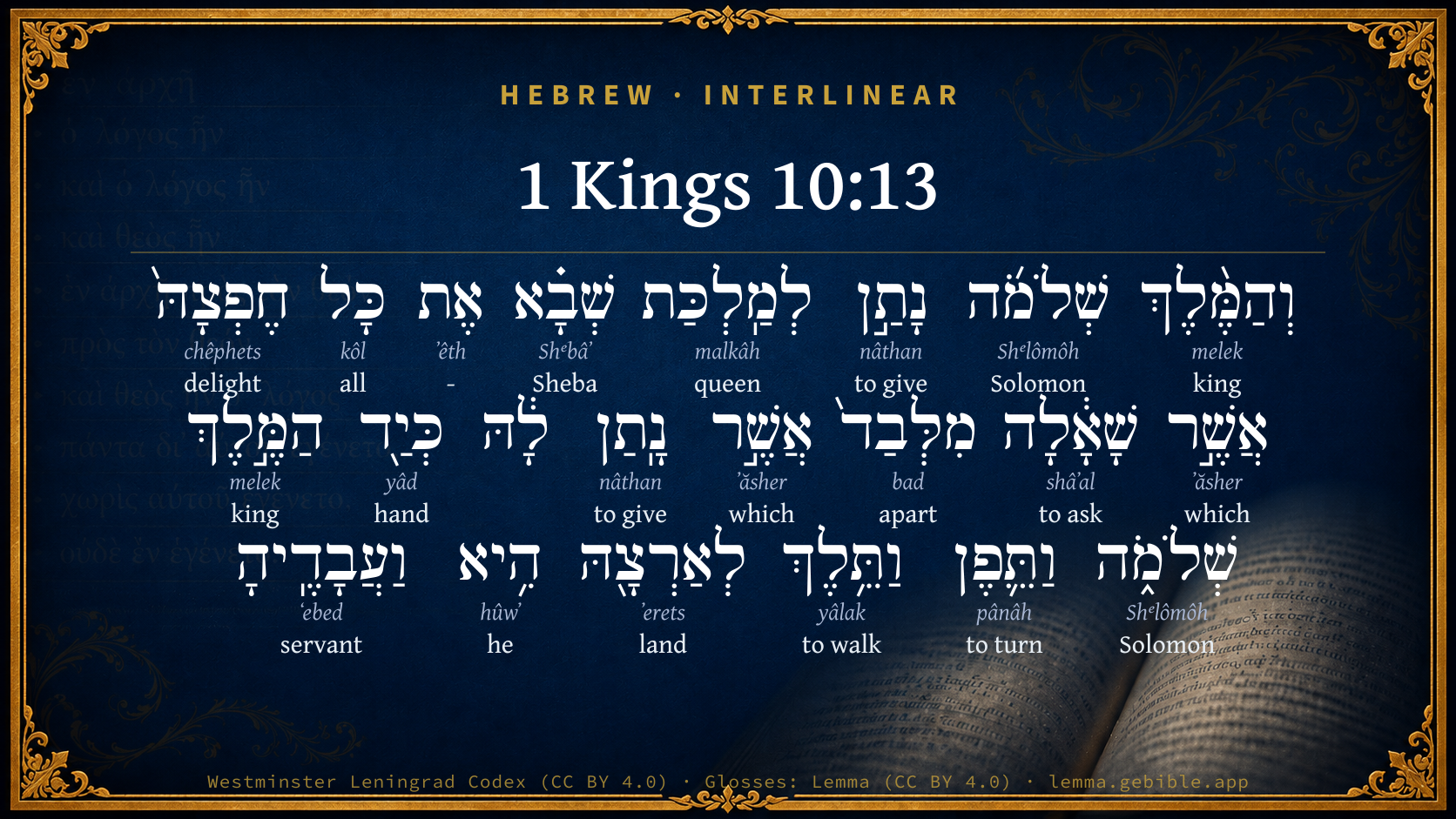
Hebrew (Westminster Leningrad Codex) 1 Kings 10:13 appears in the Hebrew Old Testament. The text above is from the Westminster Leningrad Codex. Each word links to its Strong’s number, a concise gloss, and parsing drawn from the Open Scriptures Hebrew Bible morphology. Click any word for its full Brown-Driver-Briggs (BDB) entry.
Download image
Cite this verse

1 Kings 10:13 (World English Bible). Public Domain. Lemma interlinear Bible study tool, https://lemma.gebible.app/v/1-kings/10/13.

Show BibTeX & RIS
BibTeX
RIS
English Translation
King Solomon gave to the queen of Sheba all her desire, whatever she asked, besides that which Solomon gave her of his royal bounty. So she turned, and went to her own land, she and her servants.
World English Bible · Public Domain
Download a study sheet

One document with this verse’s original text, its word-by-word gloss line, the meaning frame, cross-references with their text, attributed commentary, and full source and license credits — printable, and it pastes into notes with its structure intact.

This verse Autodidact and up

Study sheet (.html) Plain text (.txt)

A passage Seminary Student

Up to 50 verses in one chapter. A passage sheet keeps up to 6 commentary sources and 12 cross-references per verse, in the order this page ranks them, and says so on the sheet whenever that leaves anything out. Ask for a single verse and you get the Autodidact verse sheet above.

Everything on this page stays free to read, with no account — the sheet is a download of what is already on screen, not access to it.

Want to remove ads? Support Godless Engineer
Compare translations 3

The same verse in 3 English versions, stacked beneath the original-language interlinear above. Click any original word for its lexicon entry.

Each is an independent rendering of the whole verse — the interlinear is not word-aligned to these translations.

Highlighted words mark where these versions differ — a whole-verse word diff, not a word-by-word alignment.

  • World English Bible Public Domain
    King Solomon gave to the queen of Sheba all her desire, whatever she asked, besides that which Solomon gave her of his royal bounty. So she turned, and went to her own land, she and her servants.
  • King James Version Public Domain
    And king Solomon gave unto the queen of Sheba all her desire, whatsoever she asked, beside that which Solomon gave her of his royal bounty. So she turned and went to her own country, she and her servants.
  • unfoldingWord Literal Text CC BY-SA 4.0
    And King Solomon gave to the Queen of Sheba all of her delight, whatever she requested, besides what he gave to her according to the hand of King Solomon. And she turned and went to her land, she and her servants.

unfoldingWord Literal Text — © unfoldingWord, licensed CC BY-SA 4.0. Word-aligned USFM3 via Door43 (git.door43.org/unfoldingWord/en_ult).

Versions to compare (up to 4)

3 of 4 selected

Show all 18 translations

Every available English version of this verse, each an independent rendering of the whole verse.

  • World English Bible Public Domain
    King Solomon gave to the queen of Sheba all her desire, whatever she asked, besides that which Solomon gave her of his royal bounty. So she turned, and went to her own land, she and her servants.
  • Berean Standard Bible Public Domain
    King Solomon gave the queen of Sheba all she desired—whatever she asked—besides what he had given her out of his royal bounty. Then she left and returned to her own country, along with her servants.
  • Majority Standard Bible Public Domain
    King Solomon gave the queen of Sheba all she desired—whatever she asked—besides what he had given her out of his royal bounty. Then she left and returned to her own country, along with her servants.
  • King James Version Public Domain
    And king Solomon gave unto the queen of Sheba all her desire, whatsoever she asked, beside that which Solomon gave her of his royal bounty. So she turned and went to her own country, she and her servants.
  • American Standard Version (1901) Public Domain
    And king Solomon gave to the queen of Sheba all her desire, whatsoever she asked, besides that which Solomon gave her of his royal bounty. So she turned, and went to her own land, she and her servants.
  • Revised Version (1885) Public Domain
    And king Solomon gave to the queen of Sheba all her desire, whatsoever she asked, beside that which Solomon gave her of his royal bounty. So she turned, and went to her own land, she and her servants.
  • Geneva Bible (1599) Public Domain
    And King Salomon gaue vnto the Queene of Sheba, whatsoeuer she would aske, besides that, which Salomon gaue her of his kingly liberalitie: so she returned and went to her owne countrey, both shee, and her seruantes.
  • Douay-Rheims (1899) Public Domain
    And king Solomon gave the queen of Saba all that she desired, and asked of him: besides what he offered he himself of his royal bounty. And she returned, and went to her own country with her servants.
  • Young's Literal Translation Public Domain
    And king Solomon gave to the queen of Sheba all her desire that she asked, apart from that which he gave to her as a memorial of king Solomon, and she turneth and goeth to her land, she and her servants.
  • Literal Standard Version CC BY-SA 4.0
    And King Solomon gave to the queen of Sheba all her desire that she asked, apart from that which he gave to her as a memorial of King Solomon, and she turns and goes to her land, she and her servants.
  • Unlocked Literal Bible CC BY-SA 4.0
    King Solomon gave to the queen of Sheba everything she wished for, whatever she asked, in addition to what Solomon gave her of his royal bounty. So she returned to her own land with her servants.
  • unfoldingWord Literal Text CC BY-SA 4.0
    And King Solomon gave to the Queen of Sheba all of her delight, whatever she requested, besides what he gave to her according to the hand of King Solomon. And she turned and went to her land, she and her servants.
  • Darby Bible Public Domain
    And king Solomon gave to the queen of Sheba all her desire, whatever she asked, besides what he gave her of the bounty of king Solomon. And she turned and went to her own land, she and her servants.
  • World Messianic Bible Public Domain
    King Solomon gave to the queen of Sheba all her desire, whatever she asked, in addition to that which Solomon gave her of his royal bounty. So she turned and went to her own land, she and her servants.
  • Webster's Bible Public Domain
    And king Solomon gave to the queen of Sheba all her desire, whatever she asked, besides that which Solomon gave her of his royal bounty. So she turned and went to her own country, she and her servants.
  • Free Bible Version CC BY-SA 4.0
    King Solomon gave the queen of Sheba all she wanted, whatever she asked for. This was in addition to the usual gifts he had generously given her. Then she and her attendants returned home to her own country.
  • Bible in Basic English Public Domain
    And King Solomon gave the queen of Sheba all her desire, whatever she made request for, in addition to what he gave her freely from the impulse of his heart. So she went back to her country, she and her servants.
  • JPS Tanakh (1917) Public Domain
    And king Solomon gave to the queen of Sheba all her desire, whatsoever she asked, beside that which Solomon gave her of his royal bounty. So she turned, and went to her own land, she and her servants.

Literal Standard Version (2020), Covenant Press — licensed CC BY-SA 4.0. Text via the HelloAO Bible API (eBible.org). Unlocked Literal Bible (unfoldingWord) — licensed CC BY-SA 4.0. Text via the HelloAO Bible API (eBible.org). unfoldingWord Literal Text — © unfoldingWord, licensed CC BY-SA 4.0. Word-aligned USFM3 via Door43 (git.door43.org/unfoldingWord/en_ult). Free Bible Version, Dr. Jonathan Gallagher — licensed CC BY-SA 4.0. Text via the HelloAO Bible API (eBible.org).

Word by word

More ways to search: Search by grammar → Find every occurrence → Compare this word →

Practice this passage: Drill this verse → Learn its vocabulary →

שְׁבָ֗א
Shᵉbâʼ
H7614
“Sheba”
Noun, Proper
Part of Speech
Noun
Type
Proper
Full BDB Definition

Origin: of foreign origin

TWOT: None

Sheba = "seven" or " an oath" - son of Joktan and a descendant of Seth (noun proper masculine) - son of Raamah, grandson of Cush, and a descendant of Ham (noun proper masculine) - son of Jokshan, the son of Abraham by Keturah (noun proper masculine) - a nation in southern Arabia (noun proper locative)
  1. וְהַמֶּ֨לֶךְ melek H4428 “and · the · king” Conjunction + Particle, Definite Article + Noun, Common, Masculine, Singular, Absolute
  2. שְׁלֹמֹ֜ה Shᵉlômôh H8010 “Solomon” Noun, Proper
  3. נָתַ֣ן nâthan H5414 “to give” Verb, Qal, Perfect, 3rd Person, Masculine, Singular
  4. לְמַֽלְכַּת malkâh H4436 “to/for · queen of” Preposition + Noun, Common, Feminine, Singular, Construct
  5. אֶת ʼêth H853 “-” Particle, Direct Object
  6. כָּל kôl H3605 “all of” Noun, Common, Masculine, Singular, Construct
  7. חֶפְצָהּ֙ chêphets H2656 “delight · her” Noun, Common, Masculine, Singular, Construct + Suffix, Personal, 3rd Person, Feminine, Singular
  8. אֲשֶׁ֣ר ʼăsher H834 “which” Particle, Relative
  9. שָׁאָ֔לָה shâʼal H7592 “to ask” Verb, Qal, Perfect, 3rd Person, Feminine, Singular
  10. מִלְּבַד֙ bad H905 “from · to/for · apart” Preposition + Preposition + Noun, Common, Masculine, Singular, Absolute
  11. אֲשֶׁ֣ר ʼăsher H834 “which” Particle, Relative
  12. נָֽתַן nâthan H5414 “to give” Verb, Qal, Perfect, 3rd Person, Masculine, Singular
  13. כְּיַ֖ד yâd H3027 “like/as · hand of” Preposition + Noun, Common, Both, Singular, Construct
  14. הַמֶּ֣לֶךְ melek H4428 “the · king” Particle, Definite Article + Noun, Common, Masculine, Singular, Absolute
  15. שְׁלֹמֹ֑ה Shᵉlômôh H8010 “Solomon” Noun, Proper
  16. וַתֵּ֛פֶן pânâh H6437 “and · to turn” Conjunction + Verb, Qal, Sequential Imperfect, 3rd Person, Feminine, Singular
  17. וַתֵּ֥לֶךְ yâlak H3212 “and · to walk” Conjunction + Verb, Qal, Sequential Imperfect, 3rd Person, Feminine, Singular
  18. לְאַרְצָ֖הּ ʼerets H776 “to/for · land · her” Preposition + Noun, Common, Both, Singular, Construct + Suffix, Personal, 3rd Person, Feminine, Singular
  19. הִ֥יא hûwʼ H1931 “he” Pronoun, Personal, 3rd Person, Feminine, Singular
  20. וַעֲבָדֶֽיהָ ʻebed H5650 “and · servants · her” Conjunction + Noun, Common, Masculine, Plural, Construct + Suffix, Personal, 3rd Person, Feminine, Singular

About this verse

These counts appear in no published source. They are computed here, from the morphology-tagged text and Lemma’s own curated glosses. What Lemma adds →

22
words
17
distinct lemmas
Historical
section

Notable vocabulary

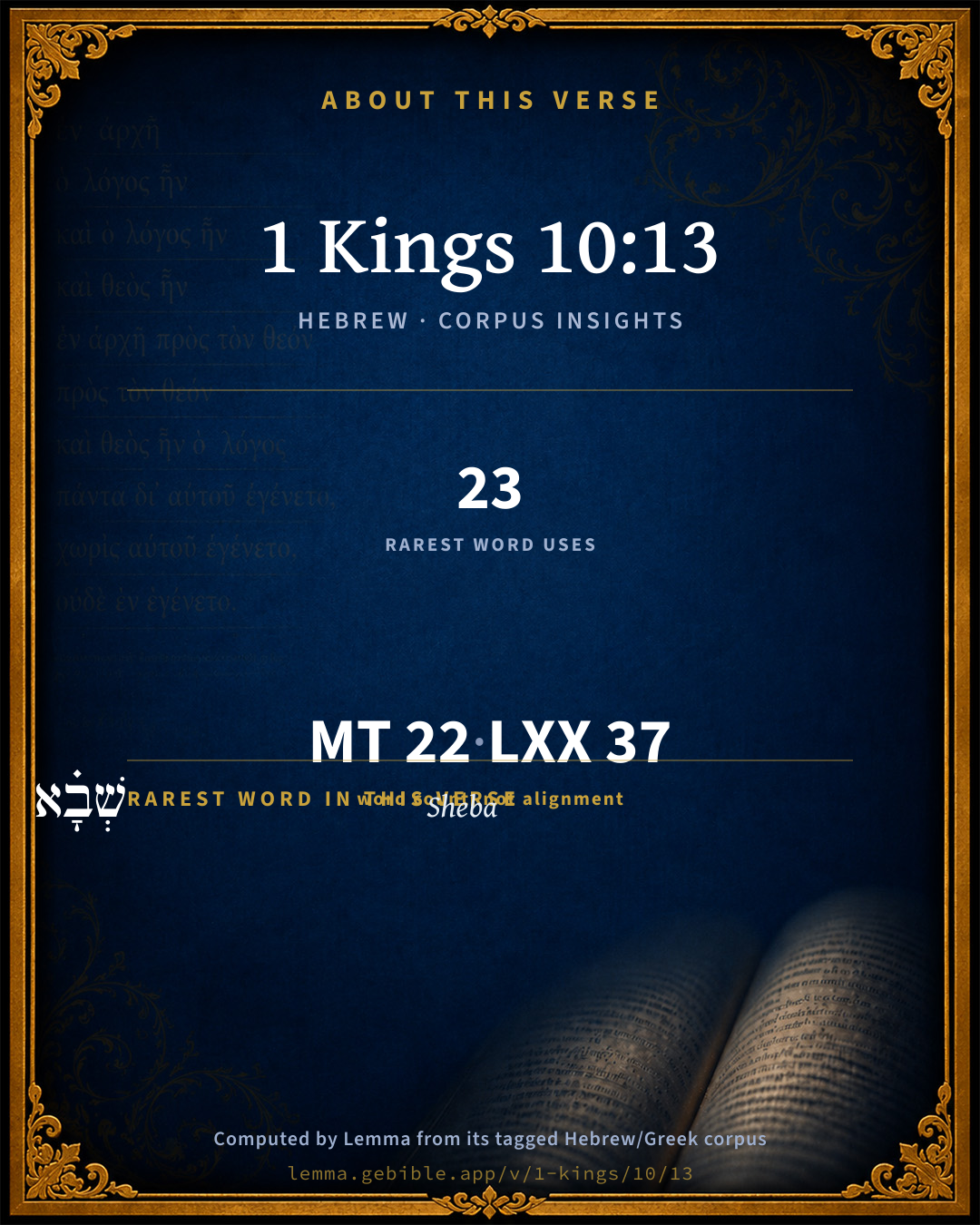
The rarest word here is שְׁבָ֗א Sheba H7614 — appearing just 23 times in the whole Hebrew Bible.

Shared distinctive vocabulary

שְׁבָ֗א Sheba H7614 occurs in 23 verses of the Hebrew Bible. Also found in:

Grammatical profile

  • 5 verbs
  • 12 nouns
  • 1 pronoun
  • 1 preposition
  • 3 particles

Verb forms

  • נָתַ֣ן Qal · Perfect
  • שָׁאָ֔לָה Qal · Perfect
  • נָֽתַן Qal · Perfect
  • וַתֵּ֛פֶן Qal · Sequential Imperfect
  • וַתֵּ֥לֶךְ Qal · Sequential Imperfect

Repetition

Words recur within this verse — often emphatic in Hebrew:

  • וְהַמֶּ֨לֶךְ king H4428 ×2
  • שְׁלֹמֹ֜ה Solomon H8010 ×2
  • נָתַ֣ן to give H5414 ×2
  • אֲשֶׁ֣ר which H834 ×2

Hebrew & Septuagint length

In English translation the verse runs 37 words from the Hebrew and 42 from the Septuagint (LXX English) — closely comparable.

A rough comparison of the two English renderings, which tokenize alike — not a word-level alignment.

Word counts can differ between the Hebrew and the Greek without any difference in meaning — e.g. the Hebrew direct-object marker אֵת has no separate Greek word, and Greek often adds the article ὁ.

In the original languages it is 22 Hebrew tokens and 37 Greek tokens — but the two are counted differently (Hebrew bundles its prefixes and suffixes into one token; the Greek is in lemma form), so that isn’t a like-for-like length.

Cross-references

7

Topical passages linked to 1 Kings 10:13 in the Treasury of Scripture Knowledge — connected by theme and wording, ordered by reader-vote popularity; previews shown in the World English Bible.

  • Psalms 20:4 May He grant you your heart's desire, And fulfill all your counsel.
  • Psalms 37:4 Also delight yourself in Yahweh, And he will give you the desires of your heart.
  • Matthew 15:28 Then Jesus answered her, "Woman, great is your faith! Be it done to you even as you desire." And her daughter was healed from that hour.
  • 1 Kings 9:1 It happened, when Solomon had finished the building of the house of Yahweh, and the king's house, and all Solomon's desire which he was pleased to do,
  • 1 Kings 10:2 She came to Jerusalem with a very great train, with camels that bore spices, and very much gold, and precious stones; and when she was come to Solomon, she talked with him of all that was in her heart.
  • John 14:13–14 Whatever you will ask in my name, that will I do, that the Father may be glorified in the Son.
  • Ephesians 3:20 Now to him who is able to do exceedingly abundantly above all that we ask or think, according to the power that works in us,

Cross-references courtesy of OpenBible.info (CC BY 4.0).

Hebrew and Greek witnesses Masoretic Hebrew ↔ Greek Septuagint

The same verse in the two great witnesses to the Old Testament, shown verse-for-verse.

These are two independent witnesses, not word-aligned to each other, and the Septuagint is shown in lemma (dictionary) form.

Hebrew 1 Kings 10:13 Masoretic · Westminster Leningrad Codex

וְהַמֶּ֨לֶךְ שְׁלֹמֹ֜ה נָתַ֣ן לְמַֽלְכַּת שְׁבָ֗א אֶת כָּל חֶפְצָהּ֙ אֲשֶׁ֣ר שָׁאָ֔לָה מִלְּבַד֙ אֲשֶׁ֣ר נָֽתַן לָ֔הּ כְּיַ֖ד הַמֶּ֣לֶךְ שְׁלֹמֹ֑ה וַתֵּ֛פֶן וַתֵּ֥לֶךְ לְאַרְצָ֖הּ הִ֥יא וַעֲבָדֶֽיהָ

King Solomon gave to the queen of Sheba all her desire, whatever she asked, besides that which Solomon gave her of his royal bounty. So she turned, and went to her own land, she and her servants.

World English Bible · Public Domain

Greek LXX 1 Kings 10:13 Septuagint · lemma form

καί ὁ βασιλεύς σαλωμών δίδωμι ὁ βασίλισσα σαβα πᾶς ὅσος θέλω ὅσος αἰτέω ἐκτός πᾶς ὅς δίδωμι αὐτός διά χείρ ὁ βασιλεύς σαλωμών καί ἀποστρέφω καί ἔρχομαι εἰς ὁ γῆ αὐτός αὐτός καί πᾶς ὁ παῖς αὐτός

And king Solomon gave to the queen of Saba all that she desired, whatever she asked, besides all that he had given her by the hand of king Solomon: and she returned, and came into her own land, she and her servants.

LXX2012 (modern English Septuagint) · Public Domain

Hebrew: Westminster Leningrad Codex (CC BY 4.0). Greek: Septuagint (public domain); English from LXX2012 (modern English Septuagint) (Public Domain). How the Septuagint differs from the Hebrew →

Targum (Aramaic paraphrase)

1

The Targum is the ancient Jewish Aramaic paraphrase of the Hebrew Scriptures — an interpretive translation, not the Hebrew text itself. Onkelos (literal) and Pseudo-Jonathan (expansive) render the Torah, and Jonathan the Prophets. Coverage is partial: where no permissively-licensed English translation exists for a verse, only the Aramaic is shown. This is verse-level text, not a word-by-word alignment to the Hebrew.

  1. Targum Jonathan Prophets (Joshua–Malachi)
    וּמַלְכָּא שְׁלֹמֹה יְהַב לְמַלְכַּת שְׁבָא יַת כָּל רְעוּתָהּ דִשְׁאֵלִית בַּר מִדְמַנֵי לָהּ כְּעוּתַר יְדָא דְמַלְכָּא שְׁלֹמֹה וְאִתְפְּנִיאַת וַאֲזַלַת לְאַרְעָהּ הִיא וְעַבְדָהָא:

    (no public-domain English translation for this verse)

    Targum Jonathan — Aramaic: “Mikraot Gedolot” (public domain). English: “Sefaria Community Translation” (CC0 1.0 (public-domain dedication)); “London "Chaldee Paraphrase," 1871” (public domain). Text via Sefaria.

Commentary

Notes on 1 Kings 10:13 from classic Christian and Jewish commentators (each source and its license shown beneath its notes). The classic Christian expositions comment on the surrounding passage and are grouped to its opening verse, so a note may address several verses; the Jewish commentaries on the Tanakh (Rashi and others) are per-verse, so they appear only where the commentator wrote on this verse.

Lemma curates 59 commentaries, every one of them public domain or Creative Commons licensed, each selected and text-cleaned for this edition rather than reprinted as found. About our sources →

Trapp's Complete Commentary

John Trapp

1Ki 10:13 And king Solomon gave unto the queen of Sheba all her desire, whatsoever she asked, beside [that] which Solomon gave her of his royal bounty. So she turned and went to her own country, she and her servants.

Ver. 13. All her desire, whatsoever she asked.] Some say she came to Solomon, as Thalestris queen of the amazons afterwards did to Alexander the Great, to have issue by him; and that he married her and sent her away to her own country great with a son, whom she called David, whose race continueth to this day. {a}

{a} Justin., lib. xii.

John Trapp, A Commentary or Exposition upon All the Books of the Old and New Testament (1647–1656) — public domain. Text from a community e-Sword module.

Joseph Benson's Commentary

1Ki 10:13. Solomon gave unto the queen all her desire — By their mutual presents they testified their friendship to each other; wishing by these things to be remembered. Whatsoever she asked, besides what Solomon gave her of his royal bounty — He desired to know what things would be acceptable to her among all the rarities she had seen, and those he bestowed upon her: besides which he added other things of value, which, it is likely, she had not in her own country. Thus they who apply to our Lord Jesus will find him not only greater and wiser than Solomon, but more kind. Whatsoever we ask, it shall be done for us; nay, he will, out of his divine bounty, which infinitely excels royal bounty, even that of Solomon, do for us more than we are able to ask or think. Reader, hast thou no wants? no desires? Wilt thou not apply to him? Ask, and it shall be given thee.

Joseph Benson's Commentary on the Old and New Testaments (1811–1818) — public domain. Text from a community e-Sword module.

Tyndale Open Study Notes

Tyndale Open Resources

10:13 whatever she asked for: As befitting a royal host, Solomon reciprocated with gifts. The amicable relationship between Solomon and the queen of Sheba may have culminated in a commercial agreement. Subsequent Jewish, Arabian, and Ethiopian tales of a romantic relationship between them have no foundation in fact.

Tyndale Open Study Notes — © Tyndale Open Resources, licensed CC BY-SA 4.0. Text via the HelloAO Bible API.

Geneva Bible (1599)

Geneva Bible translators

Hebrew, by the hand of the King.

Geneva Bible (1599) marginal notes — public domain. Text via Bolls.life.

Jamieson, Fausset & Brown

Robert Jamieson, A. R. Fausset & David Brown

King Solomon gave unto the queen of Sheba all her desire, whatsoever she asked, beside--that is, Solomon not only gave his illustrious guest all the insight and information she wanted; but, according to the Oriental fashion, he gave her ample remuneration for the presents she had brought.

Jamieson, Fausset & Brown — Commentary Critical and Explanatory on the Whole Bible (1871) — public domain (CC PDM 1.0). Text via the HelloAO Bible API.

Adam Clarke's Commentary

Verse 13. All her desire whatsoever she asked] Some imagine she desired progeny from the wise king of Israel; and all the traditions concerning her state that she had a son by Solomon called Menilek, who was brought up at the Israelitish court, succeeded his mother in the kingdom of Saba, and introduced among his subjects the Jewish religion. See at the end of the chapter. 1Kg 10:29.

Adam Clarke's Commentary on the Bible (1810–1826) — public domain. Text from a community e-Sword/MySword module.

Ellicott's Commentary for English Readers

(13) All her desire.—The terms here employed indicate a position of inferiority, although well graced and honoured, in the queen of Sheba. Her present is of the nature of tribute. Solomon gives her of “his bounty,” both what she asked for (probably by praising it) and what else he would.

A Bible Commentary for English Readers, edited by Charles John Ellicott (1878–1897) — public domain. Text from a community e-Sword module.

The Cambridge Bible for Schools and Colleges

gen. ed. J. J. S. Perowne

13. besides that which Solomon gave her of his royal bounty] The Hebrew is literally ‘beside that which he gave to her according to the hand of king Solomon.’ For the phrase ‘according to the hand’ signifying ‘after the liberality’ compare Est_1:7; Est_2:18, where the same Hebrew is translated ‘according to the state of the king,’ i.e. ‘according to his bounty’ where the narrative relates to a magnificent feast, and presents given to the guests. In the parallel passage (2Ch_9:12) we have ‘beside that which she had brought unto the king,’ which is very difficult to make any sense of.

The Cambridge Bible for Schools and Colleges (gen. ed. J. J. S. Perowne; Cambridge University Press, 1878–1918) — public domain. Text from a community e-Sword module.

John Gill's Exposition

And King Solomon gave unto the queen of Sheba all her desire,

whatsoever she asked,.... Some curious things she saw, and was desirous of, she asked for, and had them:

besides that which Solomon gave her of his royal bounty; of his own good will and pleasure, without asking:

so she turned and went to her own country: the country of Sheba in Arabia Felix:

she and her sergeants: the train or retinue she brought with her, which was large, Kg1 10:2.

John Gill's Exposition of the Whole Bible (1746–1763) — public domain (CC PDM 1.0). Text via the HelloAO Bible API.

Whedon's Commentary on the Bible

Daniel D. Whedon

13. All her desire — Whatever of a portable nature she desired to carry home with her as mementos of Solomon’s greatness and glory.

Besides that which Solomon gave her of his royal bounty — Or, as the margin has it, gave her according to the land of king Solomon. That is, besides giving her the things she asked for, he gave her presents becoming his vast wealth. As she had brought him presents of such great value, it was but a matter of kingly courtesy for him to respond by similar gifts.

Daniel D. Whedon (gen. ed.), Commentary on the Old and New Testaments (1874–1909) — public domain. Text from a community e-Sword module.

The Pulpit Commentary

And king Solomon gave unto the queen of Sheba on her desire, whatsoever she asked, beside that which Solomon gave her of his royal bounty. Heb. according to the hand of king Solomon. The chronicler has, "beside that which she had brought unto the king." That is to say, in addition to the fitting presents which he made in return for her gifts, he freely gave her whatsoever she asked for. To ask for a coveted thing is no breach of Oriental propriety. The Ethiopian Christians find in these words (and considering the character of Solomon and the license of that age, perhaps not altogether without reason) a basis for their belief that she bore Solomon a son, Melimelek by name, from whom, indeed, the present sovereigns of Abyssinia claim to derive their descent. So she turned and went to her own country, she and her servants.

Bishop Wordsworth has remarked (p. 44) that the record of this visit disappoints us. He says, "He (Solomon) answered her hard questions. He showed her his palace but we do not hear that he invited her to go up with him into the house of the Lord," etc. Again: "The visit of the queen of Sheba seem to have been without any spiritual result." "In like manner," he adds, "we hear nothing of any attempt on Solomon"s part to improve his friendship and commercial relations with Hiram into an occasion for communicating the better merchandise of Divine truth to the Sidonians." But surely this criticism overlooks the fact that Judaism was not a missionary religion, and that the chosen people had no sort of commission to convert the heathen, It is, no doubt, a mystery; but it is a fact, that for 2, 000 years the light of God"s truth was, by the counsel and purpose of God, restricted within the extremely narrow confines of Israel, and that the "fulness of the time," when the Gentiles should be "fellow heirs," was distant from Solomon"s day by a whole millennium.

The Pulpit Commentary (1880–1919), ed. H.D.M. Spence-Jones & Joseph S. Exell — public domain. Text from a community e-Sword module.

unfoldingWord translationNotes

Door43 World Missions Community

everything she wished for, whatever she asked

These two phrases mean basically the same thing and are combined for emphasis. (See: Parallelism)

of his royal bounty

"because as king he had so much"

translationWords

royal

servant

unfoldingWord translationNotes — © Distant Shores Media and the Door43 World Missions Community, licensed CC BY-SA 4.0. Source: git.door43.org/Door43/en_tn.

Rashi

Rabbi Shlomo Yitzchaki (Rashi)

Gave to the queen of Sheva. This giving refers only to the teaching of wisdom.

All that she desired. (He had relations with her and Nevuchadnetzar was born, and he later destroyed the Beis [Hamikdosh] that had stood 410 years in the territory of all the twelve tribes. Rabbi Yitzchok [Luria] of blessed memory) [He gave her more,] in addition to giving her gifts and delicacies that are found here but are not found in her place.

Rashi on the Tanakh — English translations: “The Judaica Press complete Tanach with Rashi, translated by A. J. Rosenberg” (CC BY 4.0); “Pentateuch with Rashi's commentary by M. Rosenbaum and A.M. Silbermann, 1929-1934” (public domain); “The Metsudah Tanach series, Lakewood, N.J” (CC BY 4.0); and “The Book of Joshua, Metsudah Publications, 1997” (CC BY 4.0). Text via Sefaria.

Lesson kit

Teaching starters — assembled from the data on this page, not authored interpretation. Every prompt links to the verse data it draws on. Edit before teaching.

1 Kings, in the Historical, opens this verse with 22 words (17 distinct Hebrew lemmas). Its most distinctive word is Shᵉbâʼ (“Sheba”). A historical commentator’s framing appears above. Read the whole chapter for the surrounding context.

Discussion questions

  1. The word Shᵉbâʼ carries the sense “Sheba.” How does it shape the verse?
  2. Genesis 10:7 shares the word «Sheba» with this verse. How do the two illuminate each other?
  3. “king” occurs 2× in this one verse. What is the effect of the repetition?
  4. These translations render this verse differently; the difference is in the English rendering, not the original. What questions does that raise?
  5. The verb «נָתַ֣ן» is Qal Perfect. How does its form color the action?
  6. Reading how Trapp's Complete Commentary and Joseph Benson's Commentary read this verse, where do the two commentators agree and where do they part?

Things to notice

Reading settings

Reading text

Shown beneath each verse's original-language words.

Old Testament
Old Testament edition

Read the OT as the Masoretic Hebrew (MT) or the Greek Septuagint (LXX).

English shown for the Greek Septuagint (in the Hebrew ↔ Greek comparison).

Comparing translations? Open the Compare panel on any verse page to stack up to four side by side.