Galatians 4:17

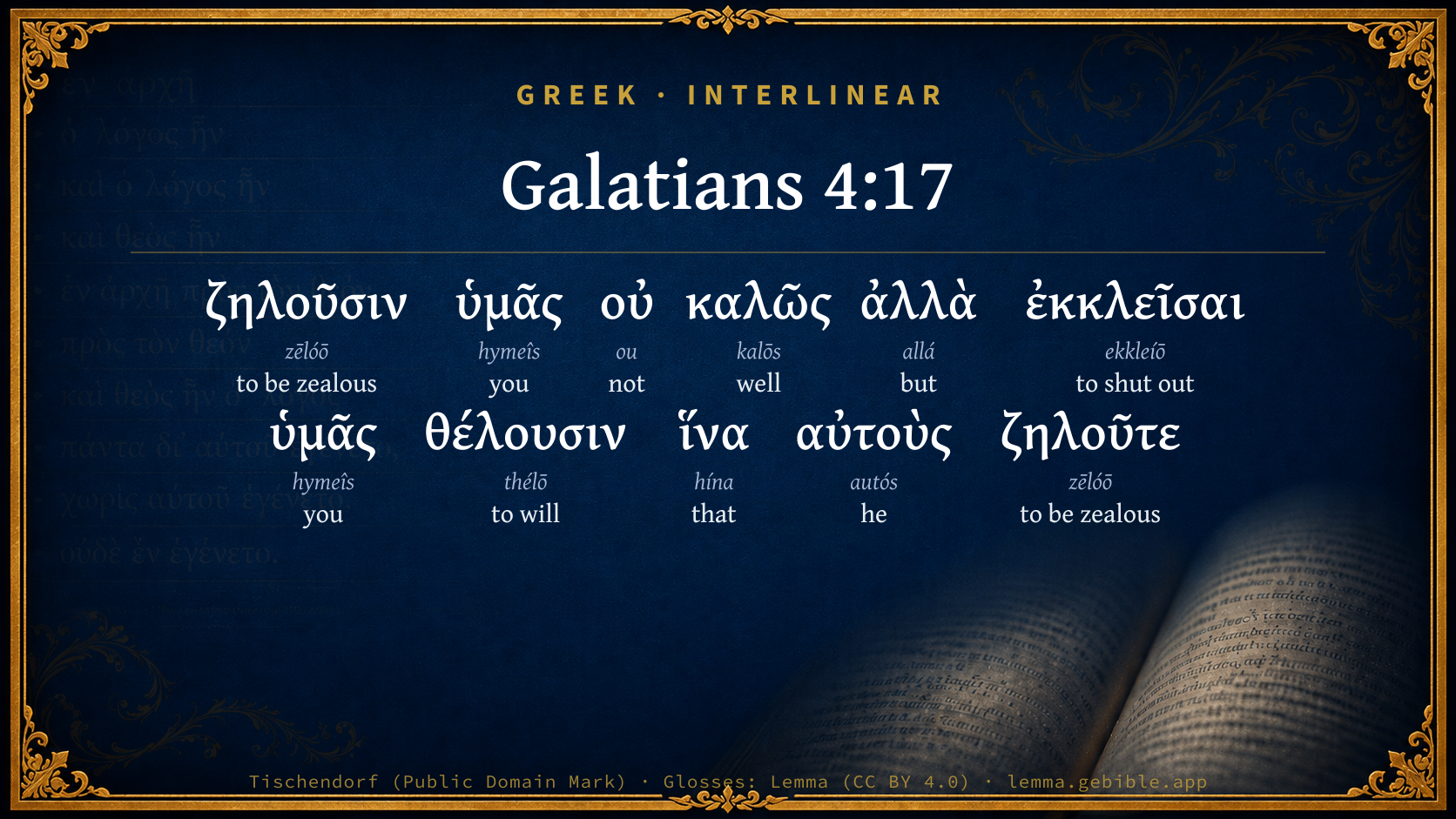
Greek (Tischendorf 8th ed.) Galatians 4:17 appears in the Greek New Testament. The text above is from the Tischendorf 8th edition. Each word links to its Strong’s number and a concise gloss. Click any word for its full Thayer’s Greek Lexicon entry.
Download image
Cite this verse

Galatians 4:17 (World English Bible). Public Domain. Lemma interlinear Bible study tool, https://lemma.gebible.app/v/galatians/4/17.

Show BibTeX & RIS
BibTeX
RIS
English Translation
They zealously seek you in no good way. No, they desire to alienate you, that you may seek them.
World English Bible · Public Domain
Download a study sheet

One document with this verse’s original text, its word-by-word gloss line, the meaning frame, cross-references with their text, attributed commentary, and full source and license credits — printable, and it pastes into notes with its structure intact.

This verse Autodidact and up

Study sheet (.html) Plain text (.txt)

A passage Seminary Student

Up to 50 verses in one chapter. A passage sheet keeps up to 6 commentary sources and 12 cross-references per verse, in the order this page ranks them, and says so on the sheet whenever that leaves anything out. Ask for a single verse and you get the Autodidact verse sheet above.

Everything on this page stays free to read, with no account — the sheet is a download of what is already on screen, not access to it.

Want to remove ads? Support Godless Engineer
Compare translations 3

The same verse in 3 English versions, stacked beneath the original-language interlinear above. Click any original word for its lexicon entry.

Each is an independent rendering of the whole verse — the interlinear is not word-aligned to these translations.

Highlighted words mark where these versions differ — a whole-verse word diff, not a word-by-word alignment.

  • World English Bible Public Domain
    They zealously seek you in no good way. No, they desire to alienate you, that you may seek them.
  • King James Version Public Domain
    They zealously affect you, but not well; yea, they would exclude you, that ye might affect them.
  • unfoldingWord Literal Text CC BY-SA 4.0
    They are zealous for you, not rightly, but they desire to separate you so that you would be zealous for them.

unfoldingWord Literal Text — © unfoldingWord, licensed CC BY-SA 4.0. Word-aligned USFM3 via Door43 (git.door43.org/unfoldingWord/en_ult).

Versions to compare (up to 4)

3 of 4 selected

Show all 19 translations

Every available English version of this verse, each an independent rendering of the whole verse.

  • World English Bible Public Domain
    They zealously seek you in no good way. No, they desire to alienate you, that you may seek them.
  • Berean Standard Bible Public Domain
    Those people are zealous for you, but not in a good way. Instead, they want to isolate you from us, so that you may be zealous for them.
  • Majority Standard Bible Public Domain
    Those people are zealous for you, but not in a good way. Instead, they want to isolate you from us, so that you may be zealous for them.
  • King James Version Public Domain
    They zealously affect you, but not well; yea, they would exclude you, that ye might affect them.
  • American Standard Version (1901) Public Domain
    They zealously seek you in no good way; nay, they desire to shut you out, that ye may seek them.
  • Revised Version (1885) Public Domain
    They zealously seek you in no good way; nay, they desire to shut you out, that ye may seek them.
  • Geneva Bible (1599) Public Domain
    They are ielous ouer you amisse: yea, they woulde exclude you, that ye shoulde altogether loue them.
  • Douay-Rheims (1899) Public Domain
    They are zealous in your regard not well: but they would exclude you, that you might be zealous for them.
  • Young's Literal Translation Public Domain
    they are zealous for you -- `yet' not well, but they wish to shut us out, that for them ye may be zealous;
  • Literal Standard Version CC BY-SA 4.0
    They are zealous for you—[yet] not well, but they wish to shut us out, that you may be zealous for them;
  • Unlocked Literal Bible CC BY-SA 4.0
    They are zealous to win you over, but for no good. They want to shut you out, so you may be zealous for them.
  • unfoldingWord Literal Text CC BY-SA 4.0
    They are zealous for you, not rightly, but they desire to separate you so that you would be zealous for them.
  • Darby Bible Public Domain
    They are not rightly zealous after you, but desire to shut you out [from us], that ye may be zealous after them.
  • World Messianic Bible Public Domain
    They zealously seek you in no good way. No, they desire to alienate you, that you may seek them.
  • Webster's Bible Public Domain
    They zealously affect you, but not well; for, they would exclude you, that ye may affect them.
  • Free Bible Version CC BY-SA 4.0
    These people are keen to gain your support, but not for any good reasons. On the contrary, they want to keep you away from us so that you will enthusiastically support them.
  • Bible in Basic English Public Domain
    Their interest in you is not good; but their desire is that you may be shut out, so that you may go after them.
  • Text-Critical English NT CC BY 4.0
    Those false teachers are not zealous for you in a good way, but rather they wish to shut you out so that you will be zealous for them.
  • Tyndale New Testament (1534) Public Domain
    They are gelous over you amysse. Ye they intede to exclude you that ye shuld be feruet to them warde.

Literal Standard Version (2020), Covenant Press — licensed CC BY-SA 4.0. Text via the HelloAO Bible API (eBible.org). Unlocked Literal Bible (unfoldingWord) — licensed CC BY-SA 4.0. Text via the HelloAO Bible API (eBible.org). unfoldingWord Literal Text — © unfoldingWord, licensed CC BY-SA 4.0. Word-aligned USFM3 via Door43 (git.door43.org/unfoldingWord/en_ult). Free Bible Version, Dr. Jonathan Gallagher — licensed CC BY-SA 4.0. Text via the HelloAO Bible API (eBible.org).

Word by word

More ways to search: Search by grammar → Find every occurrence → Compare this word →

Practice this passage: Drill this verse → Learn its vocabulary →

About this verse

These counts appear in no published source. They are computed here, from the morphology-tagged text and Lemma’s own curated glosses. What Lemma adds →

11
words
9
distinct lemmas
Pauline Epistles
section

Notable vocabulary

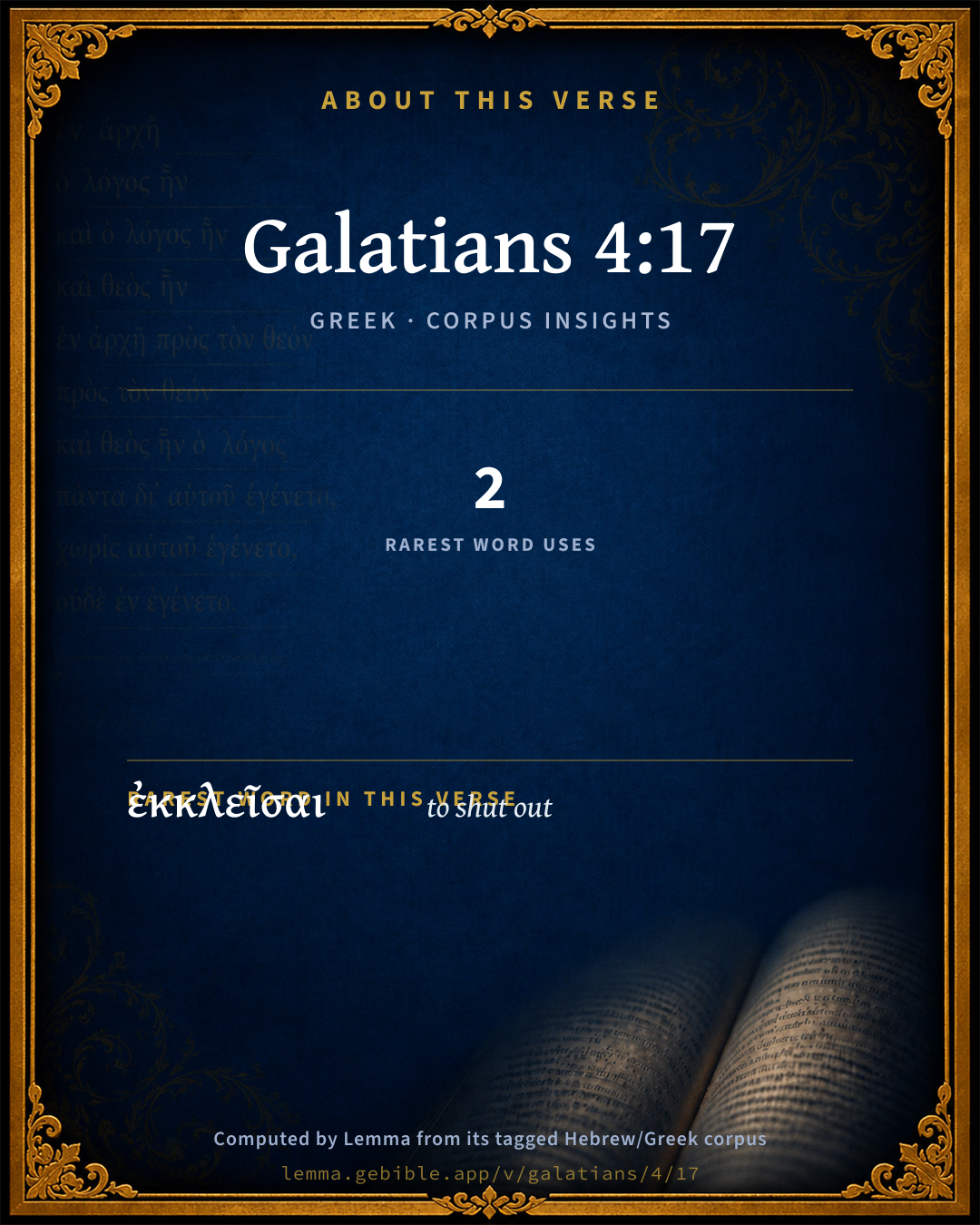
The rarest word here is ἐκκλεῖσαι to shut out G1576 — appearing just 2 times in the whole Greek New Testament.

Shared distinctive vocabulary

ἐκκλεῖσαι to shut out G1576 occurs in 2 verses of the Greek New Testament. Also found in:

Repetition

Words recur within this verse:

  • ζηλοῦσιν to be zealous G2206 ×2
  • ὑμᾶς you G5210 ×2

Cross-references

12

Topical passages linked to Galatians 4:17 in the Treasury of Scripture Knowledge — connected by theme and wording, ordered by reader-vote popularity; previews shown in the World English Bible.

  • Romans 16:18 For those who are such don't serve our Lord, Jesus Christ, but their own belly; and by their smooth and flattering speech, they deceive the hearts of the innocent.
  • 2 Corinthians 11:13–15 For such men are false apostles, deceitful workers, masquerading as Christ's apostles.
  • 2 Peter 2:3 In covetousness they will exploit you with deceptive words: whose sentence now from of old doesn't linger, and their destruction will not slumber.
  • Matthew 23:15 Woe to you, scribes and Pharisees, hypocrites! For you travel around by sea and land to make one proselyte; and when he becomes one, you make him twice as much of a son of Gehenna as yourselves.
  • 1 Corinthians 4:8 You are already filled. You have already become rich. You have come to reign without us. Yes, and I wish that you did reign, that we also might reign with you.
  • Romans 10:2 For I testify about them that they have a zeal for God, but not according to knowledge.
  • 1 Corinthians 4:18 Now some are puffed up, as though I were not coming to you.
  • 1 Corinthians 11:2 Now I praise you, brothers, that you remember me in all things, and hold firm the traditions, even as I delivered them to you.
  • 2 Corinthians 11:3 But I am afraid that somehow, as the serpent deceived Eve in his craftiness, so your minds might be corrupted from the simplicity that is in Christ.
  • Galatians 6:12–13 As many as desire to look good in the flesh, they compel you to be circumcised; only that they may not be persecuted for the cross of Christ.
  • Philippians 2:21 For they all seek their own, not the things of Jesus Christ.
  • 2 Peter 2:18 For, uttering great swelling words of emptiness, they entice in the lusts of the flesh, by licentiousness, those who are indeed escaping from those who live in error;

Cross-references courtesy of OpenBible.info (CC BY 4.0).

Commentary

Notes on Galatians 4:17 from classic Christian and Jewish commentators (each source and its license shown beneath its notes). The classic Christian expositions comment on the surrounding passage and are grouped to its opening verse, so a note may address several verses; the Jewish commentaries on the Tanakh (Rashi and others) are per-verse, so they appear only where the commentator wrote on this verse.

Lemma curates 59 commentaries, every one of them public domain or Creative Commons licensed, each selected and text-cleaned for this edition rather than reprinted as found. About our sources →

The Biblical Illustrator

Joseph S. Exell

Gal_4:17

They zealously affect you, but not well.

False zeal

Paul suggests--

I. That things which are good in their kind may be done for wrong ends.

1. In preaching,

(1) some do it for envy and strife;

(2) some to gain personal or pecuniary ends.

2. In embracing the gospel, some do it, not for its own sake, but for

(1) honour;

(2) profit.

3. This must teach us not only to do good, but to do it well. For which end--

(1) We must set before us the will of God as our main motive.

(2) The outward action must be conformable to the inward motion.

II. That nature can counterfeit grace. Thus men feign--

1. The experiences and life of religion.

2. The activities of religion. How hard to detect the hypocrite, and yet how easy to become one.

III. The envy and ambition of the deceivers. Paul must be excluded from the love of the Galatians that they alone may be loved. Thus Joshua (Num_11:29); Johns disciples (Joh_3:30); our Lords disciples (Luk_9:49).

IV. The divisions between pastors and people created by the false teachers. (W. Perkins.)

The spirit of religious faction

I. Its prominent characteristic. Clever imitation of religious zeal.

1. In its apparent motives What other end could they have in making the sacrifices their work involved.

2. In the deep interest it seems to take in its objects.

3. In the undoubted earnestness with which its work is done.

II. Its method of operation.

1. To create a schism between pastor and people. Pauls apostleship was denied; his character traduced; his motives impugned.

2. To create a schism between one Church and another. The Judaizers sought to divorce the Galatians from the fellowship of Gentile Churches which were based on liberty.

2. To create a schism between the believer and his Lord. How often is this effected, not precisely in this way, but by the passions engendered by religious strife.

III. Its object.

1. To gain personal ascendancy.

2. To secure the deference and zeal of the Galatians.

Schism

To separate from the Church in some one or few essential articles while you pretend to hold Christ the Head is heresy; to separate from it in spirit, by refusing holiness and not loving such as are holy, is ungodliness; to differ from it by any error of judgment or life is sin; to magnify any one church or party, so as to deny due love and communion to the rest, is schism. To limit all the Church to your party, and deny all or any of the rest to be Christians, and parts of the Universal Church, is schism by a dangerous breach of charity, and the principal schism that you should avoid. It is schism also to condemn unjustly any particular Church as no Church, and it is schism to withdraw your bodily communion from a Church that you were bound to hold that communion with; and it is schism to make divisions or parties in a Church, though you divide not from that Church. (R. Baxter.)

Zeal

I. Consider the nature of zeal in general. Zeal is a strong and ardent affection of the heart towards some distant and desirable object. It is not a simple, but complicated, emotion, which admits of different degrees of ardour and sensibility, accordingly as its object appears more or less agreeable, more or less distant, or more or less important. Zeal always supposes a fixed and steady attention to the object upon which it terminates. A slight and cursory view of any agreeable objects never excites in our breast the least degree of zeal to make them our own. But it is a law of our nature that a close and continued attention to any desirable object should draw all the affections of the heart towards it, and, of consequence, should produce the emotion of zeal Whatever agreeable subject seizes and absorbs the mind will naturally enkindle the fire of zeal. Zeal is one of the first and strongest emotions which we discover in children. The reason is, the smallest trifles are sufficient to fill their minds and engross their whole attention. And when greater trifles fill greater minds they produce the same effect. Even philosophers and politicians often suffer the most vain and imaginary schemes to take the entire possession of their thoughts, and to fill their minds with a flame of zeal, which is astonishing to all who have never paid the same attention to the same ideal or trifling subjects. But whatever be the object of zeal, it always appears to the person who feels this lively emotion to be a matter highly interesting, either on its own account, or on account of its supposed connection with some valuable end.

II. Distinguish false zeal from true. There is a zeal which forms a beautiful moral character. A strong and ardent desire to promote the public good justly commands universal approbation and esteem. This the apostle observes in the verse immediately succeeding the text. But it is good to be zealously affected always in a good thing. It is the goodness of its ultimate object which renders zeal virtuous and amiable. When it ultimately seeks the promotion of a good cause, it is according to knowledge, it is agreeable to the dictates of reason and conscience, it is of a godly sort, and it resembles the zeal of the Lord of Hosts. But false zeal has a diametrically opposite object, and ultimately seeks a selfish end.

III. How false zeal will dispose men to act. It is a powerful stimulus to action, and will dispose all men to act in the same manner, unless restrained by soma different passion, or by some insurmountable obstacle.

1. It will dispose them to combine together in carrying on their destructive designs. This false fervour, like electrical fire, will easily and instantaneously spread from breast to breast among those who are ardently engaged in the same cause.

2. False zeal will hurry men on to act without regarding or even consulting the sober dictates of their own reason. It will not suffer them to make a proper use of that noble faculty which God has implanted in their breasts to direct them in all their private and public conduct. Zealots who do not give a reason to themselves for their own opinions and conduct are still more averse to giving a reason to others.

3. While men are under the influence of false zeal they are prone to act, not only without consulting their own reason but without hearkening to the reason of others. They are inclined to shut their ears against the most plain and conclusive arguments which can be offered to their cool and candid consideration.

4. Those whom a false zeal has united together in a bad cause are extremely fond of increasing their strength by bringing over as many as possible to their views and feelings. A false zeal is no less a proselyting than an infatuating spirit. Those who are deceived, as are all who are actuated by a blind zeal, have a strong inclination to deceive others. The Scribes and Pharisees, whom our Saviour calls blind leaders of the blind, would compass sea and land to make proselytes to their own errors and delusions. But zealots are no less artful than indefatigable in their efforts to attach others to their persons and pursuits.

6. It is the nature of false zeal to embolden and stimulate men to acts of violence and cruelty in effecting their sinister and selfish purposes. A bear robbed of her whelps is not more fierce and cruel than those who are zealously engaged to accomplish a base and cruel design Their fiery zeal sears their consciences and hardens their hearts, which prepares them to sacrifice without remorse either friends or foes, who stand in their way and oppose their views.

It only remains to make a proper application of-this subject.

1. What has been said upon the nature and effects of false zeal may help us to determine who are under its governing influence at the present day.

2. It appears from the description which has been given of false zeal that these who feel it and act under its influence are altogether criminal.

3. False zeal is the most dangerous, as well as the most criminal, passion that can possibly reign in the human heart. It has been the primary source of innumerable murders, massacres, persecutions, conspiracies, revolutions, wars, and desolations among the nations of the earth. A single spark of false zeal may spread from the breast of one popular influential character through a whole nation, and involve them in the heaviest calamities. Of this we have a late and memorable instance. About a half-a-century ago the malignant heart of Voltaire swelled with impetuous zeal to crush Christianity and all its votaries. From him the flame spread among his learned friends; from these it spread among the French philosophers and nobility; and from these it spread among a vast number of secret societies in France, in Germany, and in several other parts of Europe. In this rapid progress it employed a thousand pens and ten thousand tongues to plead its cause and proselytize millions to atheistical and sceptical infidelity. Strengthened and encouraged by their numbers, these zealots pointed their virulence against the throne as well as the altar, which spread anarchy and destruction through France, and involved a great part of Europe, Egypt, and Syria in all the terrors and miseries of a long and cruel war. Such have been the genuine fruits of false zeal in our own day; and such we have reason to believe it will continue to produce wherever it rages without restraint. Let us therefore endeavour to undeceive those who are deceived, and in this way effectually check the further spread of false zeal.

4. In the next place, it is our immediate duty to cherish in ourselves and others the spirit of true zeal in opposition to false. Our cause is the best in which we can possibly be engaged. The defence of our religion and government calls for our most zealous exertions. (N. Emmons, D. D.)

Unchristian zeal

A false zeal in religion is always, in some respect or other, a misdirected zeal, or a zeal not according to knowledge; a zeal seeking some false end, or, while proposing to itself a good end, seeking its promotion in some unauthorized way. Jehu had a good zeal, which he called zeal for the Lord of Hosts. His fault was not that he was too zealous, but that his zeal was really directed to his own advancement. The Jews, in the days of Christ, had zeal for God, but it was so misdirected as to fire them with a frenzy to destroy the Son of God, and extinguish the Light of the world. There are countless forms of false zeal now at work, but, in all cases, they sin, not by excess, but by misdirection. Some are flaming with a zeal to spread some of the corruptions of Christianity, and to carry men away from its great and cardinal truths. Some are equally zealous to build up a sect or a party on other foundations than those which God has laid in Zion; and that which taints their zeal is the purpose to which they employ it, and not any excessive fervour of their zeal itself. (Bonar.)

True and false zeal

Let us take heed we do not sometimes call that zeal for God and His gospel which is nothing else but our own tempestuous and stormy passion. True zeal is a sweet, heavenly, and gentle flame, which makes us active for God, but always within the sphere of love it never calls for fire from heaven to consume those that differ a little from us in their apprehensions. It is like that kind of lightning (which philosophers speak of) that melts the sword within, but singeth not the scabbard; it strives to save the soul, but hurteth not the body. (Cudworth.)

The Biblical Illustrator, edited by Joseph S. Exell (c. 1880s–1900s) — public domain. Text from a community e-Sword module.

Joseph Benson's Commentary

Gal 4:17-18. They zealously affect you — The Judaizing teachers who are come among you express an extraordinary regard for you; but not well — Their zeal is not according to knowledge, neither have they a single eye to God’s glory, and your spiritual advantage. Yea, they would exclude you — From me and from the blessings of the gospel; that ye might effect — Might love and esteem them. Or, as some read this clause, they would exclude us, that is, me, your spiritual father, and my fellow-labourers in the gospel, from your affection, that ye may love them ardently, as the only faithful teachers of the gospel. But it is good — Καλον, comely, honourable, and commendable; to be zealously affected always in a good thing — In what is really worthy of our zeal: for as the beauty and excellence of zeal is to be estimated not by the degree of it, considered in itself, but by the object to which it is directed; so too the warmth of your affection toward an object truly worthy of it, should be, at all times, equally maintained; and the same fervent zeal which you have formerly expressed, ought to be manifested by you, not only when I am present with you, but in my absence also, if you really think me to deserve your regards, and have indeed received the truth in the love of it. It may be proper to observe, that the original expression “may refer either to a good person or a good thing, and may be understood of their continuing zealous in their affection, either to himself, or to the truth which he preached; but as he had been speaking of himself in the foregoing verses, he likewise seems to have still in view the warmth of their affection to him when he was present with them; though he expresses it in a graceful way, with such a latitude as may include their zeal for his doctrine as well as for his person.” — Doddridge.

Joseph Benson's Commentary on the Old and New Testaments (1811–1818) — public domain. Text from a community e-Sword module.

Tyndale Open Study Notes

Tyndale Open Resources

4:17 are so eager: The Greek word can have the positive meaning of zeal and eagerness or the negative meaning of jealousy and envy. The same word is also translated will pay attention and “is eager” (4:18). • They are trying to shut you off from me: Perhaps the Judaizers were so eager because they envied the Galatians’ devotion to Paul and wanted it for themselves (cp. 2 Corinthians; see also Luke 11:46-52). Another possibility is that the Judaizers wanted the Galatians to become dependent on them as interpreters of the law.

Tyndale Open Study Notes — © Tyndale Open Resources, licensed CC BY-SA 4.0. Text via the HelloAO Bible API.

Bengel's Gnomon

Johann Albrecht Bengel

Gal 4:17. Ζηλοῦσιν, they zealously affect) They zealously solicit [cajole] you. He does not name his rivals.—οὐ καλῶς, not well) not [being] in Christ, although they seem to do what is good [well]. The antithesis is, ἐν καλῷ, in a good thing, Gal 4:18. Neithe the cause in their case, he says, nor the manner is good.—ἐκκεῖσαι ὑμᾶς) exclude you from us, from me. They think, that we shall be excluded from you; but they would not exclude us from you, but you from us: ἐκκλεῖσαι, I am disposed to think, is not used in the sense, in which the Latins say that chickens are hatched (excludi, thrust forth from the shell).

Bengel's Gnomon of the New Testament — English translation (T&T Clark, Edinburgh, 1860) — public domain. Text from a community e-Sword module.

Meyer's Critical & Exegetical Commentary

Heinrich August Wilhelm Meyer

Gal_4:17. The self-seeking conduct of the Judaizing teachers (Gal_1:7), so entirely opposed to the ἀληθεύων ὑμῖν. The fact that they are not named is quite in keeping with the emotion and irritation of the moment; nam solemus suppresso nomine de iis loqui, quos nominare piget ac taedet, Calvin.

ζηλοῦσιν ὑμᾶς] that is, they exert themselves urgently to win you over to their side; they pay their court to you zealously. So, correctly, Erasmus, Castalio, Er. Schmid, Michaelis, and others, including Flatt, Winer, Usteri, Schott, Fritzsche, Olshausen, Baumgarten-Crusius, de Wette, Ewald, Wieseler, and Hofmann. For the contrast to the behaviour of the apostle harmonizes well with this sense; which is also accordant with linguistic usage, since ζηλόω with the accusative means to be zealous about a person or thing, and obtains in each case the more precise definition of its import from the context; Dem. 1402. 20. 500. 2; Pro_24:1; Wis_1:12; 1Co_12:31; and see Wetstein. Next to this interpretation comes that of Calvin, Beza, and others, including Rückert (comp. Vulgate: aemulantur): they are jealous of you (2Co_11:2; Sir_9:1). Taking it so, it would not be necessary to conceive of Paul and his opponents under the figure of wooers of the bride (the bridegroom being Christ; see on 2Co_11:2), of which nothing is suggested by the context; but it may be urged against this explanation, that ἵνα αὐτοὺς ζηλοῦτε is not appropriate in the same sense. This remark also applies to the interpretation of Koppe and Reithmayr, following Ambrose, Jerome, and Theodoret: they envy you (Act_7:9), are full of an envious jealousy of your freedom; and to that of Chrysostom and Theophylact: they vie with you (comp. Borger); ζῆλος μέν ἐστιν ἀγαθὸς ὅταν τις ἀρετὴν μιμῆταί τινος, ζῆλος δὲ οὐ καλὸς, ὅταν τις σπεύδῃ ἐκβαλεῖν τῆς ἀρετῆς τὸν κατορθοῦντα (Theophylact). The factitive explanation: they make you to be zealous (Matthias), is opposed to linguistic usage, which only sanctions παραζηλόω, and not the simple verb, in this sense.

οὐ καλῶς] not in a morally fair, honourable way, as would have been the case, if it had been done for your real good.

ἐκκλεῖσαι] To exclude;[199] they desire to debar you; in this lies the wickedness of their ζῆλος. The question which arises here, and cannot be set aside (as Hofmann thinks): Exclude from what? is answered by the emphatic αὐτούς which follows, namely, from other teachers, who do not belong to their clique.[200] These other teachers are naturally those of anti-Judaizing views, and consequently Paul himself and his followers; but the hypothesis that Paul only is referred to (a me meique communione, Winer; so also Luther, Calvin, Grotius, Bengel, Kypke, Michaelis, Rückert, Olshausen, Reiche, and others) is the less feasible, as the very idea of ἐκκλεῖσαι in itself most naturally points to a plurality, to an association. Since the αὐτούς which follows applies to the false teachers as teachers, we must not conceive the exclusion (with Borger and Flatt) as from the whole body of Christians, nor (with Schott) as from all Christians thinking differently; comp. Hilgenfeld: from the Pauline church-union. It is arbitrarily taken by Chrysostom, Oecumenius, and Theophylact, as exclusion from the state of true knowledge; by Erasmus and Cornelius a Lapide, from Christian freedom; by Luther (1519), a Christo et fiducia ejus; by Matthies, from the kingdom of truth (comp. Ewald: from genuine Christianity); by Wieseler and Reithmayr, from the kingdom of heaven; by Matthias, from salvation by faith. All Interpretations of This nature would have needed some more precise definition. Koppe falls into a peculiar error: a consuetudine et familiaritate sua arcere vos volunt (Gal_2:12).

ἵνα αὐτοὺς ζηλοῦτε] As ἵνα is used here with the present indicative, it cannot mean in order that;[201] but must be the particle of place, ubi (Valckenaer, ad Herod, ix. 27: ἵνα δοκέει κ.τ.λ.). This ubi may, however, mean either: in which position of things ye are zealous for them (my former explanation), as in 1Co_4:6 (see on that passage, and Ellendt, Lex. Soph. I. p. 839); or, in its purely local sense: they wish to debar you there, where you are zealous for them,namely, in the Judaistic circle, in which it is they themselves who are zealously courted by you, whose favour you have to seek, etc. The latter view, as the simplest, is to be preferred. On the usual explanation of ἵνα as a particle of design, recourse is had to the assumption of an abnormal construction of degenerate Greek (Winer, Olshausen, Hilgenfeld, Wieseler, Hofmann, Reithmayr, and others); or of a mistake on the part of the author or of the transcriber (Schott); or, with Fritzsche, to the reading ζηλῶτε (which only 113 and 219** have). But all these makeshifts are quite as arbitrary as the assumption of a faulty formation of mood (Rückert, Matthies). The interpretation of ἽΝΑ as ubi is based not on an exaggerated philological precision,[202] but on a linguistic necessity, to which the customary interpretation, yielding certainly a sense appropriate enough in itself, must give way, because the latter absolutely requires the subjunctive mood.

[199] Syr. translates includere, and consequently read ἐγκλεῖσαι. This would mean: they desire to include you in their circle, so that ye should not get free from them and come to associate with other teachers. Thus, in point of fact, the same sense would result as in the case of ἐκκλεῖσαι, only regarded from a different point of view. Fritzsches reference of ἐγκλ. to the legis Mos. carcerem is not suggested by the context. The reading is altogether so weakly attested, that it can only be looked upon as an ancient error of transcription.

[200] The wish expressed by Erasmus in his Annott.: Utinam hodie nulli sint apud Christianos in quos competat haec Pauli querimonia! is still but too applicable to the present day.

[201] ζηλοῦτε is not the Attic future (Jatho). See Winer, p. 72 [E. T. 88]; Buttmann, p. 33. In Thuc. ii. 8. 3, and iii. 58. 4, ἐλευθεροῦσι and ἐρημοῦτε are presents; see Krüger in loc.

[202] As Hilgenfeld thinks, who appeals in favour of ἵνα, ut, with the indicative to Clem. Hom. xi. 16: ἵνα μηδὲν τῶν προσκυνουμένων ὑπῆρχεν. This is certainly not philological precision, but inattention to linguistic fact; for in this Clementine passage the quite customary ἵνα, ut, is used with the indicative of the preterite, quod tum fit, quando ponitur aliquid, quod erat futurum, si aliud quid factum esset, sed jam non est factum, Klotz, ad Devar. p. 630 f.; Herm. ad Viger. p. 850 f.; Kühner, II. § 778. With regard to the respective passages from Barnabas and Ignatius, in support of ἵνα with the present indicative, see on 1Co_4:6.

Meyer — Critical and Exegetical Commentary on the New Testament — English translation by Peter Christie, edited by Frederick Crombie (T&T Clark, 1880) — public domain. Text from a community e-Sword module.

Expositor's Greek Testament

ed. W. Robertson Nicoll

Gal 4:17-18 . The substantive ζῆλος (probably derived from ζέειν , burn ) denotes some kind of passionate desire. Whether it was of good or evil tendency depended on the nature of its object and the spirit in which it was pursued: for the same term was used to designate zeal for God or for some noble object, personal passion, or an exclusive spirit of selfish jealousy. The verb ζηλοῦν partakes of the same neutral quality. Its figurative meaning is here borrowed from the efforts of a lover to win favour. The Pharisaic party affected ( i.e. , courted) the Galatians in a selfish spirit, being minded to shut them out of their rightful inheritance in Christ, that they might reduce them to dependence on their own Law. Paul also courted them, not for his own glory, but that he might join them to Christ, and he was glad that they should be courted at all times, even by others in his absence, if it was done in a right spirit. They affect you (he writes, i.e. , court you) not honourably, but are minded to shut you out that you may affect them. But it is good for you to be affected at all times and not only when I am present with you . ζηλοῦτε . As there are no other instances of ἵνα being followed by an indicative present in Pauline language, it is probable that this and φυσιοῦσθε in 1Co 4:6 are really forms of the subjunctive, though ζηλῶτε is the contracted form in general use.

The Expositor's Greek Testament, edited by W. Robertson Nicoll (1897–1910) — public domain. Text from a community e-Sword module.

Geneva Bible (1599)

Geneva Bible translators

For they are jealous over you for their own commodity.

That they may convey all your love from me to themselves.

Geneva Bible (1599) marginal notes — public domain. Text via Bolls.life.

Matthew Henry's Commentary

The apostle is still carrying on the same design as in the foregoing verse, which was, to convince the Galatians of their sin and folly in departing from the truth of the gospel: having just before been expostulating with them about the change of their behaviour towards him who endeavoured to establish them in it, he here gives them the character of those false teachers who made it their business to draw them away from it, which if they would attend to, they might soon see how little reason they had to hearken to them: whatever opinion they might have of them, he tells them they were designing men, who were aiming to set up themselves, and who, under their specious pretences, were more consulting their own interest than theirs: "They zealously affect you," says he; "they show a mighty respect for you, and pretend a great deal of affection to you, but not well; they do it not with any good design, they are not sincere and upright in it, for they would exclude you, that you might affect them. That which they are chiefly aiming at is to engage your affections to them; and, in order to this, they are doing all they can to draw off your affections from me and from the truth, that so they may engross you to themselves." This, he assures them, was their design, and therefore they must needs be very unwise in hearkening to them. Note, 1. There may appear to be a great deal of zeal where yet there is but little truth and sincerity. 2. It is the usual way of seducers to insinuate themselves into people's affections, and by that means to draw them into their opinions. 3. Whatever pretences such may make, they have usually more regard to their own interest than that of others, and will not stick at ruining the reputation of others, if by that means they can raise their own. On this occasion the apostle gives us that excellent rule which we have, Gal 4:18, It is good to be zealously affected always in a good thing. What our translation renders in a good man, and so consider the apostle as pointing to himself; this sense, they think, is favoured both by the preceding context and also by the words immediately following, and not only when I am present with you, which may be as if he had said, "Time was when you were zealously affected towards me; you once took me for a good man, and have now no reason to think otherwise of me; surely then it would become you to show the same regard to me, now that I am absent from you, which you did when I was present with you." But, if we adhere to our own translation, the apostle here furnishes us with a very good rule to direct and regulate us in the exercise of our zeal: there are two things which to this purpose he more especially recommends to us: - (1.) That it be exercised only upon that which is good; for zeal is then only good when it is in a good thing: those who are zealously affected to that which is evil will thereby only to do so much the more hurt. And, (2.) That herein it be constant and steady: it is good to be zealous always in a good thing; not for a time only, or now and then, like the heat of an ague-fit, but, like the natural heat of the body, constant. Happy would it be for the church of Christ if this rule were better observed among Christians!

Matthew Henry's Commentary on the Whole Bible (1708–1710) — public domain (CC PDM 1.0). Text via the HelloAO Bible API.

Jamieson, Fausset & Brown

Robert Jamieson, A. R. Fausset & David Brown

They--your flatterers: in contrast to Paul himself, who tells them the truth.

zealously--zeal in proselytism was characteristic especially of the Jews, and so of Judaizers (Gal 1:14; Mat 23:15; Rom 10:2).

affect you--that is, court you (Co2 11:2).

not well--not in a good way, or for a good end. Neither the cause of their zealous courting of you, nor the manner, is what it ought to be.

they would exclude you--"They wish to shut you out" from the kingdom of God (that is, they wish to persuade you that as uncircumcised Gentiles, you are shut out from it), "that ye may zealously court them," that is, become circumcised, as zealous followers of themselves. ALFORD explains it, that their wish was to shut out the Galatians from the general community, and attract them as a separate clique to their own party. So the English word "exclusive," is used.

Jamieson, Fausset & Brown — Commentary Critical and Explanatory on the Whole Bible (1871) — public domain (CC PDM 1.0). Text via the HelloAO Bible API.

Adam Clarke's Commentary

Verse 17. They zealously affect you, but not well] It is difficult for common readers to understand the meaning of these words: perhaps it would be better to translate Ζηλουσιν ὑμας ου καλως, these false teachers endeavour to conciliate your esteem, but not in honest or true principles; they work themselves into your good graces; they wish you to place all your affection upon themselves.

They would exclude you] They wish to shut you out from the affection of your apostle, that you might affect them, ἱνα αυτους ζηλουτε, that you might love them alone, hear them alone, abide by their directions only, and totally abandon him who called you into the grace of the Gospel of Christ. Some MSS. read ἡμας, us, instead of ὑμας, you; they wish to shut us entirely out from among you, that you may receive and believe them alone. The sense is nearly the same but the former appears to be the more authentic reading.

Adam Clarke's Commentary on the Bible (1810–1826) — public domain. Text from a community e-Sword/MySword module.

John Calvin's Commentaries

17. They are jealous of you. He comes at length to the false apostles, and does more by silence to make them odious, than if he had given their names; for we usually abstain from naming those whose very names produce in us dislike and aversion. He mentions the immoderate ambition of those men, and warns the Galatians not to be led astray by their appearance of zeal. The comparison is borrowed from honorable love, as contrasted with those professions of regard which arise from unhallowed desires. Jealousy, on the part of the false apostles, ought not to impose upon them; for it proceeded not from right zeal, but from an improper desire of obtaining reputation, — a desire most unlike that holy jealousy of which Paul speaks to the Corinthians.

“For I am jealous over you with godly jealousy; for I have espoused you to one husband, that I may present you as a chaste virgin to Christ. But I fear lest by any means, as the serpent beguiled Eve through his subtlety, so your minds should be corrupted from the simplicity that is in Christ.” (2 Corinthians 11:2, 3.)

To expose still more fully their base arts, he corrects his language. Yea, they would exclude you They not only endeavor to gain your affections, but, as they cannot obtain possession of you by any other means, they endeavor to kindle strife between us. When you have been thrown as it were destitute, they expect that you will yield yourselves up to them; for they perceive that, so long as there shall be maintained between us a religious harmony, they can have no influence. This stratagem is frequently resorted to by all the ministers of Satan. By producing in the people a dislike of their pastor, they hope afterwards to draw them to themselves; and, having disposed of the rival, to obtain quiet possession. A careful and judicious examination of their conduct will discover that in this way they always begin.

John Calvin's Commentaries (1540-1563) — public domain. Text from the Calvin Translation Society English edition (1840s-50s) via the Christian Classics Ethereal Library (ccel.org). Calvin's coverage is partial (roughly two-thirds of the Bible); uncommented books and verses are honest gaps, never fabricated. The 19th-century editor's footnotes and remarks are omitted so the notes are faithfully Calvin's own voice.

Ellicott's Commentary for English Readers

(17) They zealously affect you.—“Zealously affect” is a single word in the Greek, and means “to show zeal towards,” “to court,” “to curry favour with,” “to canvass eagerly, so as to win over to their side.” The subject of this verse is the Judaising teachers.

They would exclude you.—They desire to separate you from the rest of the Gentile churches, and to make a sect by itself, in which they themselves may bear rule. All the other Gentile churches had accepted the freer teaching of St. Paul; the Judaising party wished to make of Galatia an isolated centre of Judaism. They did this with personal motives, “not well”—i.e., from honest and honourable motives—but with a view to secure their own ascendancy.

That ye might affect them.—The same word as “zealously affect” above and in the next verse. They expect to have all this zeal on their part returned to them in kind. With them it is the proselytizing zeal of the faction leader; from you they expect the deferential zeal of devoted followers.

(17-20) All this eagerness to court your favour springs from an interested motive: they wish to make a sect of you, in which they shall be masters and courted in their turn. Not but that it is a good thing for teachers and taught—you and I—to seek favour with each other, so long as it is done disinterestedly, and that, too, when I am absent as well as when I am present. My heart yearns towards you. I cannot forget that you owe your life, as Christians, to me. Now, once more, it seems as if all that long travail has to be gone over again. You must be re-fashioned in the likeness of Christ, as the infant is fashioned in the form of man. Would that I could be with you and speak in a different tone, for how to deal with you I do not know.

A Bible Commentary for English Readers, edited by Charles John Ellicott (1878–1897) — public domain. Text from a community e-Sword module.

The Cambridge Bible for Schools and Colleges

gen. ed. J. J. S. Perowne

17, 18. In contrast to the simplicity of his own teaching, St Paul exposes the party spirit by which the false teachers were actuated.

They zealously affect you] The sentence is abrupt, no persons being named; though St Paul evidently had in his mind those alluded to ch. Gal_1:7. The expression ‘zealously affect’ is not very intelligible to the ordinary reader. The verb, which is rendered ‘affect’ in this same verse, is used frequently in N. T. with reference to both persons and things. Originally it meant to feel or shew zeal, jealousy or envy. From this sense the transition was easy to that of ‘desire earnestly’, ‘pay court to’, ‘seek to win or win over’. The word is used in a good and a bad sense by St Paul, e.g. 1Co_12:31 where it is rendered ‘covet’, i.e. desire, and 1Co_13:4 ‘Love envieth not’. Here the meaning is ‘They seek to win you over to their own party’. Error must be maintained and propagated by proselytising and partisanship.

The whole passage may be paraphrased—‘They seek to gain you to their own party, but not with right motives, nay, they would exclude you from my influence, in the hope of your reciprocating their desire for your adhesion. But let me remind you that a desire of this kind is only to be approved when the motives are pure and the object good. Under such conditions it is always good. Such were the conditions under which I sought to win you to Christ when I was present with you; such is still the case now that we are separated’. This leads up to the tender yet sad remonstrance which follows. In support of this view of the connexion and train of thought we may compare St Paul’s words, 2Co_11:2 “I am jealous over you (I would fain win you, not from party spirit or for personal ends, but) with a Godly jealousy (or longing desire)”. True love is always jealous.

they would exclude you] Some copies read ‘us’ for ‘you’. The sense is the same. There seems to be an allusion to some attempt on the part of the Judaizers to induce the Galatian converts formally to renounce their allegiance to St Paul.

The Cambridge Bible for Schools and Colleges (gen. ed. J. J. S. Perowne; Cambridge University Press, 1878–1918) — public domain. Text from a community e-Sword module.

John Gill's Exposition

But it is good to be zealously affected,.... A zealous affection when right is very commendable, as the instances of Phinehas, Elijah, John the Baptist, and our Lord Jesus Christ show, and a contrary spirit is very disagreeable. But then it must be expressed

in a good thing; in a good cause, for God, and the things of Christ; for the Gospel, and the ordinances of it, and for the discipline of God's house, and against immorality and profaneness, errors and heresies: and it should be "always"; not at certain times, and upon some particular accounts, but it should be constant, and always continue; it should be ever the same towards God, Christ, and his ministers:

and not only when I am present with you; by which the apostle suggests, that while he was with them they were zealously attached to him and truth; but no sooner was he gone from them, but their zealous affection abated, and was fixed on others, which discovered their weakness, fickleness, and inconstancy; whereas he was always the same to them, and bore the same love to them, as the following words show.

John Gill's Exposition of the Whole Bible (1746–1763) — public domain (CC PDM 1.0). Text via the HelloAO Bible API.

Trapp's Complete Commentary

John Trapp

17 They zealously affect you, but not well; yea, they would exclude you, that ye might affect them.

Ver. 17. They zealously affect you] Depereunt vos; as jealous woers they would have you whole to themselves without a co-rival, ερως and ερις are related.

They would exclude us] As standing in their way. This is the guise of all sectaries and seducers, they denigrate the true teachers that they may be the only men.

That you might affect them] Our Antinomians call upon their hearers to mark, it may be they shall hear that which they have not heard before, when the thing is either false, or if true, no more than ordinarily is taught by others.

" Quid dignum tanto ferat hic promissor hiatu?"

Her. de Art. Poet.

John Trapp, A Commentary or Exposition upon All the Books of the Old and New Testament (1647–1656) — public domain. Text from a community e-Sword module.

Albert Barnes' Notes on the Bible

They zealously affect you - See 1Co 12:31 (Greek); 1Co 14:39. The word used here (Ζηλόω Zēloō), means to be “zealous” toward, that is, for or against any person or thing; usually, in a good sense, to be eager for. Here it means, that the false teachers made a show of zeal toward the Galatians, or professed affection for them in order to gain them as their followers. They were full of ardor, and professed an extraordinary concern for their welfare - as people always do who are demagogues, or who seek to gain proselytes. The object of the apostle in this is, probably, to say, that it was not wholly owing to themselves that they had become alienated from the doctrines which he had taught. Great pains had been taken to do it; and there had been a show of zeal which would be likely to endanger any person.

But not well - Not with good motives, or with good designs.

Yea, they would exclude you - Margin, “Us.” A few printed editions of the New Testament have ἡμᾶς hēmas, “us,” instead of ὑμᾶς humas, “you” - Mill. The word “exclude” here probably means, that they endeavored to exclude the Galatians from the love and affection of Paul. They would shut them out from that, in order that they might secure them for their own purposes. If the reading in the margin, however, should be retained, the sense would be clearer. “They wish to exclude us, that is, me, the apostle, in order that they may have you wholly to themselves. If they can once get rid of your attachment to me, then they will have no difficulty in securing you for themselves.” This reading, says Rosenmuller, is found “in many of the best codices, and versions, and fathers.” It is adopted by Doddridge, Locke, and others. The main idea is clear: Paul stood in the way of their designs. The Galatians were truly attached to him, and it was necessary, in order to accomplish their ends, to withdraw their affections from him. When false teachers have designs on a people, they begin by alienating their confidence and affections from their pastors and teachers. They can hope for no success until this is done; and hence, the efforts of errorists, and of infidels, and of scorners, is to undermine the confidence of a people in the ministry, and when this is done there is little difficulty in drawing them over to their own purposes.

That ye might affect them - The same word as in the former part of the verse, “that ye might zealously affect them” - that is, that ye might show ardent attachment to them. Their first work is to manifest special interest for your welfare; their second, to alienate you from him who had first preached the gospel to you; their object, not your salvation, or your real good, but to secure your zealous love for themselves.

Albert Barnes' Notes on the Bible (1834–1885) — public domain. Text from a community e-Sword/MySword module.

Haydock's Catholic Bible Commentary

He tells them this change come from the false teachers among them, who with a false zeal would exclude them from a friendship and a submission to St. Paul, and deprive them again of that Christian liberty by which Christ, and the faith of Christ, had freed them from the yoke of the Mosaical law. On this account I must labor and travail, as it were to bring you forth a second time. How do I now wish to be with you, to change my voice, to exhort you, to reprehend you, to use all ways and means to regain you to Christ? --- I am in confusion about you,[2] I am perplexed, as the Greek signifies, as not knowing what to say or do. (Witham)

George Leo Haydock (1774–1849), Haydock's Catholic Family Bible and Commentary, 1859 edition — public domain. Excludes Psalms (Douay-Rheims chapter numbering differs from Protestant) and Deuterocanonical books (Catholic canon only).

Matthew Poole's English Annotations

They; the false teachers, that have perverted you as to the faith of the gospel.

Zealously affect you; pretend a great warmth of affection for you.

But not well; but in this they do not well, nor for a good end.

They would exclude you from our good opinion and affection.

That ye might affect them; that they might have all your love and respect; and so, by the ruin of our reputation with you, they might build up their own reputation.

Matthew Poole's English Annotations on the Holy Bible (1683–1685) — public domain. Text from a community e-Sword/MySword module.

Whedon's Commentary on the Bible

Daniel D. Whedon

17. They—The unnamed propagators of Judaism in the Galatian Church.

Affect you—Court you, flatter you, zealously cultivate you.

But not well—Not honourably for them, not beneficially to you. I am your enemy, for-sooth, for telling truth; they your friends, by telling untruth.

Exclude you—Shut you off from Christ, his Church, and me, to themselves alone.

Ye might affect—Court, be zealous partisans for them. St. Paul holds the cross of Christ as the true centre, from which these separatists wished to form a clique of followers.

Daniel D. Whedon (gen. ed.), Commentary on the Old and New Testaments (1874–1909) — public domain. Text from a community e-Sword module.

The Pulpit Commentary

They zealously affect you, but not well (zhlousin uJmav ouj kalwv); they admire you in no good way. Of the several senses of the verb zhloun, those of "envy," "emulate," "strive after," are plainly unsuitable in this verse and the one which follows. So also are the senses "to be zealous on one"s behalf, to be jealous of one," which in Hellenistic usage crept into it, apparently from its having been in other senses adopted to represent the Hebrew verb qinne , and borrowing these from this Hebrew verb. The only phase of its meaning which suits the present passage is that which it perhaps by far the most frequently presents in ordinary Greek, though not so commonly in the Septuagint and in the New Testa ment, namely, "to admire," "deem and pronounce highly fortunate and blessed." When used in this sense, it has properly for its object a person; but with a suitable qualification of meaning it may have for its object something inanimate. Very often is the accusative of the person accompanied with the genitive of the ground of gratulation, as Aristophanes, "Ach.," 972, Zhlwse thv eujbouliav "I congratulate, admire, you for your cleverness;" see also "Equit.," 834; "Thes moph.," 175; "Vesp.," 1450; but not always; thus Demosthenes, "Fals. Legat.," p. 424, "(Qaumazousi kai zhkousi) they admire and congratulate and would each one be himself the like;" "Adv. Lept.," p. 500 (respecting public funeral orations), "This is the custom of men admiring (zhloujntwn) virtue, not of men looking grudgingly upon those who on its account are being honoured;" Xenophon, "Mere.," 2:1, 19. "Thinking highly of themselves, and praised and admired (zhloumenouv) by others;" Josephus, "C. Ap.," 1:25, "(zhloumenouv) admired by many." It thus seems to be often just equivalent to ojlbizw or makarizw, with the sense of which latter verb it is brought into close neighbourhood in Aristophanes, "Nubes," 1188, "Blessed (makar), Strepsiades, are you, both for being so wise yourself and for having such a son as you have, thus will my friends and fellow-wardsmen say, in admiration of me (zhlountev)." Probably this is the sense in which the apostle uses the verb 2Co_11:2, Zhlw gar uJmav Qeou zhkw, "I rejoice in your felicity with an infinite joy;" referring to the intense admiration which he felt of their present felicity, in their having been betrothed a chaste maiden to Christ; not till the next verse introducing the mention of his fear lest this paradisaical happiness might be darkened by the wiles of Satan. It is in a modified shade of the same sense that the word is employee where it is rendered "covet earnestly" in our Authorized Version in 1Co_12:31 1Co_14:1, 1Co_14:39. In the passage now. before us, then, zhkiusin uJmav probably means "they admire you," that is, they tell you so. They were expressing strong admiration of the high Christian character and eminent gifts of these simple-minded believers; the charisms which had been bestowed upon them; (Gal_3:2) their virtues, in contrast especially with their heathen neighbours; their spiritual enlightenment. No doubt all this was said with the view of courting their favour; but zhloute can hardly itself mean "court favour," and no instance of its occurring in this sense has been adduced; and this rendering of the verb breaks down utterly in ver. 18. The persons referred to must, of course, be understood as those who were busy in instilling at once Judaizing sentiments and also feelings of antipathy to the apostle himself, as if he were their enemy (ver. 16). The Epistle furnishes no indication whatever that these persons were strangers coming among them from without, answering, for example, to those spoken of in Gal_2:12 as disturbing the Antiochian Church. It is quite supposable that the warning which, not long after the writing of this Epistle, the apostle addressed to the Ephesian elders at Miletus, (Act_20:29, Act_20:30) when putting them on their guard against those who "from among their own selves should rise up speaking perverse things to draw away disciples after them," was founded in part upon this experience of his in the Galatian Churches. Galatian Churchmen it may well have been, and no other, who now (as the apostle had just been apprised) were employing that crhstologia kaia, that "kind suave speech" and that "speech of compliment and laudation," which in Rom_16:18 he describes as a favourite device of this class of deceivers, to win the ear of their unwary brethren. "In no good way;" for they did it insincerely and with the purpose of drawing them into courses which, though these men themselves knew it not, were nevertheless fraught with ruin to their spiritual welfare. Yea, they would exclude you; or, us (ajllalousin) nay, rather, to shut you out is their wish. The reading "us," noticed in the margin of the Authorized Version, is probably a merely conjectural emendation made in the Greek text by Beza, wholly unsupported by manuscript authority. The ajlla is adversative to the ouj kalwv, the secondary thought of the preceding clause, in the same way as the ajlla in 1Co_2:7 is adversative to the secondary negative clauses of ver. 6. The verb "shut out," with no determinative qualification annexed, must have it supplied from the unexpressed ground for the "admiration" denoted by the verb zhlousin. The high eminence of spiritual condition and happiness on the possession of which these men were congratulating their brethren, they would be certainly excluded from if they listened to them. Compare the phrase, "who are unsettling you," driving you out of house and home, in Gal_5:12, where see note. That ye might affect them (ina aujtouv zhloute); that ye may admire themselves. The position of aujtouv makes it emphatic. We may paraphrase thus: that, being detached from regard to my teaching, and made to feel a certain grave deficiency on your own part in respect to acceptableness with God, ye may be led to look up as disciples to these kind-hearted sympathetic advisers for instruction and guidance. The construction of ina with zhloute, which in ordinary Greek is the present indicative, zhlwte being the form for the present subjunctive, is precisely similar to that of ina mh with fusiousqe in 1Co_4:6. When it is considered how punctually St. Paul is wont to comply with the syntactical rule with reference to ina, and that these two remarkable deflections therefrom are connected with contract forms of verbs in -o) Ruckert"s suggestion seems to be perfectly reasonable, that the solecism lies, not in the syntactical construction, but in the grammatical in flexion, contracting -oh into -ou instead of into -w. This form of contraction may have been a provincialism of Tarsus, or it may have been an idiotism of St. Paul himself. Other expedients of explanation which have been proposed are intolerably harsh and improbable.

Vers. 17, 18.

The tactics of the false teachers.

The apostle is naturally led from the thought of the Galatian alienation to speak of the seductive arts by which it was caused.

I THEIR ARTS OF SEDUCTION. "They are paying court to you, but not honestly." They manifested an anxious zeal to win over the Galatians to their own party. They tried with fair words and fine speeches to seduce them, professing, no doubt, a deep interest in their welfare, as well as great zeal for the glory of God; but their motives were not "honest.

II THE DESIGN OF THESE ARTS. "Nay, they desire to exclude you in order that ye may zealously affect them." They aimed at isolating their converts from the sounder portion of the Church that they might thus be led to throw themselves completely into the hands of their seducers. They wished to form them into a separate clique. The first object of errorists is usually to undermine the confidence of converts in their old teachers, and then to get themselves regarded as alone worthy to fill their place.

III THE CHARACTER AND AIM OF TRUE ZEAL. "But it is good to be courted fairly at all times, and not only when I am present along with you.

1. Christian zeal must spring from a Christian motive love to Christ, love to the truth, love to the souls of men. Zeal must be according to knowledge.

2. It must be exercised toward Christian ends. Not like the zeal of inquisitors, for the destruction of heretics, but for the glory of God and the advancement of truth.

3. It must be permanent, and not fitful, in its influence. "Always." There are many difficulties to check zeal, such as the perpetual antagonism between the Church and the world, the friction of human effort, and the law of the members in believers themselves. But the zeal of believers ought to be as lasting as the realities of religion are permanent.

4. It ought to be independent of external guidance or suggestion; whether faithful teachers are present or absent.

The Pulpit Commentary (1880–1919), ed. H.D.M. Spence-Jones & Joseph S. Exell — public domain. Text from a community e-Sword module.

John Wesley's Explanatory Notes

They - The judaizing teachers who are come among you. Zealously affect you - Express an extraordinary regard for you. But not well - Their zeal is not according to knowledge; neither have they a single eye to your spiritual advantage. Yea, they would exclude you - From me and from the blessings of the gospel. That ye might affect - Love and esteem them.

John Wesley, Explanatory Notes Upon the Whole Bible (1754–1765) — public domain. Text via the GEBible commentary corpus.

Luther on Galatians

Martin Luther

VERSE 17. They zealously affect you, but not well.

Paul takes the false apostles to task for their flattery. Satan’s satellites softsoap the people. Paul calls it "by good words and fair speeches to deceive the hearts of the simple." (Rom 16:18.)

They tell me that by my stubbornness in this doctrine of the Sacrament I am destroying the harmony of the church. They say it would be better if we would make some slight concession rather than cause such commotion and controversy in the Church regarding an article which is not even one of the fundamental doctrines. My reply is, cursed be any love or harmony which demands for its preservation that we place the Word of God in jeopardy!

VERSE 17. Yea, they would exclude you, that ye might affect them.

"Do you Galatians know why the false apostles are so zealous about you? They expect you to reciprocate. And that would leave me out. If their zeal were right they would not mind your loving me. But they hate my doctrine and want to stamp it out. In order to bring this to pass they go about to alienate your hearts from me and to make me obnoxious to you." In this way Paul brings the false apostles into suspicion. He questions their motives. He maintains that their zeal is mere pretense to deceive the Galatians. Our Savior Christ also warned us, saying: "Beware of false prophets, which come to you in sheep’s clothing." (Mat 7:15.)

Paul was considerably disturbed by the commissions and changes that followed in the wake of his preaching. He was accused of being "a pestilent fellow, a mover of sedition among all the Jews throughout the world." (Act 24:5.) In Philippi the townspeople cried that he troubled their city and taught customs which were not lawful for them to receive. (Act 16:20-21.)

All troubles, calamities, famines, wars were laid to the charge of the Gospel of the apostles. However, the apostles were not deterred by such calumnies from preaching the Gospel. They knew that they "ought to obey God rather than men," and that it was better for the world to be upset than to be ignorant of Christ.

Do you think for a moment that these reactions did not worry the apostles? They were not made of iron. They foresaw the revolutionary character of the Gospel. They also foresaw the dissensions that would creep into the Church. It was bad news for Paul when he heard that the Corinthians were denying the resurrection of the dead, that the churches he had planted were experiencing all kinds of difficulties, and that the Gospel was being supplanted by false doctrines.

But Paul also knew that the Gospel was not to blame. He did not resign his office because he knew that the Gospel he preached was the power of God unto salvation to every one that believes.

The same criticism which was leveled at the apostles is leveled at us. The doctrine of the Gospel, we are told, is the cause of all the present unrest in the world. There is no wrong that is not laid to our charge. But why? We do not spread wicked lies. We preach the glad tidings of Christ. Our opponents will bear us out when we say that we never fail to urge respect for the constituted authorities, because that is the will of God.

All of these vilifications cannot discourage us. We know that there is nothing the devil hates worse than the Gospel. It is one of his little tricks to blame the Gospel for every evil in the world. Formerly, when the traditions of the fathers were taught in the Church, the devil was not excited as he is now. It goes to show that our doctrine is of God, else "behemoth would lie under shady trees, in the covert of the reed, and fens." The fact that he is again walking about as a roaring lion to stir up riots and disorders is a sure sign that he has begun to feel the effect of our preaching.

Martin Luther — Commentary on the Epistle to the Galatians (1535), English translation by Theodore Graebner (Zondervan, 1939) — public domain (U.S. copyright not renewed). Text from a community e-Sword module.

Burkitt's Expository Notes on the New Testament

William Burkitt

They, that is, the false apostles, pretend great love to you, and a zealous affection for you; but not well, not upon honest and just grounds. There is often an ill cause, which is to be condemned and avoided; zeal is a mixed affection of love and anger working into a fervency of mind, in defending what we believe to be true and good, and in opposing what we judge to be false and bad; they zealously affect you, but not will. Nothing is more common, and consequently more dangerous, than for heretical teachers to pretend great zeal for the glory of God, and great love and affection to the people of God, whilst they are about to persuade them to embrace their pernicious errors and damnable heresies. He adds, Yea, they would exclude you, that you might affect them: Exclude you, that is, from the liberties and privileges of the gospel, say some; from depending upon me, or any faithful pastor, say others; they would ingratiate themselves, that they may ingross you, and you may affect them only. The old practice has ever been amongst seducers, first to alienate the people’s minds from their own teachers, and next get themselves looked upon as alone, and only worthy to have themselves looked upon as alone, and only worthy to have room in the people’s hearts and affections; They would exclude you from us, and us from you, only that you might affect them.

William Burkitt's Expository Notes on the New Testament (1700–1703) — public domain. Text from a community e-Sword module.

McGarvey & Pendleton's Commentaries

J. W. McGarvey

They zealously seek you in no good way; nay, they desire to shut you out, that ye may seek them.

J. W. McGarvey (with Philip Y. Pendleton), Commentaries on the New Testament (The Fourfold Gospel, 1914; Acts; and the epistles) — public domain. Text from a community e-Sword/MySword module.

The People's New Testament

B. W. Johnson

17–20. They zealously seek you. The false, Judaizing teachers are meant. They showed great zeal for them, but they were not seeking their good. They would exclude you. Exclude you from the great body of Gentile believers and bind you to their clique.

B. W. Johnson's The People's New Testament with Notes (1889–1891) — public domain. Electronic text from the Christian Classics Ethereal Library (CCEL) ThML edition.

unfoldingWord translationNotes

Door43 World Missions Community

to win you over

"to convince you to join them"

to shut you out

"to shut you out from us" or "to make you stop being loyal to us"

zealous for them

"zealous to do what they tell you to do"

translationWords

zeal

unfoldingWord translationNotes — © Distant Shores Media and the Door43 World Missions Community, licensed CC BY-SA 4.0. Source: git.door43.org/Door43/en_tn.

Cambridge Greek Testament for Schools and Colleges

17. ἐκκλεῖσαι ὑμᾶς אABCD etc. ἐκκλεῖσαι ἡμᾶς The editions of Beza and the Elzevirs, with only a few cursives.

17. ζηλοῦσιν ὑμᾶς οὐ καλῶς. In contrast to my plain speaking and apparent enmity, the false teachers pay court to you. The close connexion of thought with Gal 4:16 makes Ramsay’s otherwise attractive explanation improbable, i.e. that the Galatians had in a letter used the phrase “they take a keen interest in us,” to which St Paul replies, “Yes, but in no good way; they seek to mislead you to think that they are a superior class to you by right of birth” (cf. Gal. p. 429). For this sense of “pay court to,” “take warm interest in,” cf. 1Co 12:31; 1Co 14:1; 1Co 14:39. In 2Co 11:2 St Paul uses ζηλοῦν of his jealousy for his converts.

ἀλλὰ ἐκκλεῖσαι ὑμᾶς θέλουσιν. ἐκκλείω. Rom 3:27[128]. Contrast συνκλειόμενοι, Gal 3:23. “Shut out” from what? (a) Hardly “from us,” for that itself would be a comparatively unimportant matter. Nor (b) “in fact from salvation,” St Paul saying that this will be the effect of their teaching if the Galatians listen to them, cf. Gal 5:4. For θελουσιν then loses its force. But, as the context suggests, (c) “from salvation,” as the false teachers wished them to believe; they would be excluded from salvation unless they observed the Law.

[128] Is affixed to a word it means that all the passages are mentioned where that word occurs in the New Testament.

ἵνα αὐτοὺς ζηλοῦτε. Dependent on ἐκκλ. ὑμᾶς θέλ. They wish to exclude you (according to their teaching) from salvation in order that you may pay court to them (so as to be included). It is hardly possible that the words depend on ζηλοῦσιν ὑμᾶς, and ἀλλὰ … θέλουσιν form a parenthesis stating the fact (see last note).

ζηλοῦτε, probably conjunctive as though ζηλῶτε, cf. φυσιοῦσθε, 1Co 4:6; see Blass, Gram. § 22. 3, § 65. 2 note. Winer-Schm. § 5. 21 f. calls attention to the interchange of ου with ω and ο in the popular Egyptian dialect, making it uncertain whether ζηλοῦτε be conjunctive or indicative. The uncial MSS. of the LXX. do not appear to confuse these sounds to any great extent (see Thackeray, Grammar, § 6, 32–34). Compare Gal 2:4 notes on καταδουλεύσουσιν and Gal 6:10; Gal 6:12. See also Burton, Moods and Tenses, § 198, who takes ζηλοῦτε as indicative.

Cambridge Greek Testament for Schools and Colleges (Cambridge University Press, 1896; 21 vols, various authors incl. Carr, Maclear, Plummer, Farrar, Lumby, Moule, M. R. James, Simcox) — public domain. Text from a community e-Sword module.

Alford’s Greek Testament

Henry Alford

17.] ‘My telling you the truth may have made me seem your enemy: but I warn you that these men who court you so zealously (see ref. 2 Cor., and cf. Plut. vii. 762, cited by Fritz. ὑπὸ χρείας τὸ πρῶτον ἕπονται κ. ζηλοῦσιν, ὕστερον δὲ καὶ φιλοῦσιν) have no honourable purpose in so doing: it is only in order to get you away from the community as a separate clique, that you may court them.’ Thus the verse seems to fit best into the context. As regards particular words, ἐκκλείω must bear the meaning of exclusion from a larger and attraction to a smaller, viz. their own, party. (Our very word ‘exclusive’ conveys the same idea.) I have therefore not adopted Mey.’s rendering, ‘from all other teachers,’—nor that of Luther (1538), Calv., Grot., Beng., Rück., Olsh., Winer, al., ‘from me and my communion,’—nor that of Chrys., Œc., Thl., τῆς τελείας γνώσεως ἐκβαλεῖν,—nor that of Erasm., Corn.-a-lap., ‘from Christian freedom.’

The mood of ζηλοῦτε has been disputed: and it must remain uncertain here, as in 1Co 4:6, where see note. Here as there Meyer would give ἵνα the meaning of ‘in which case:’ but it is surely far better where the sentence so plainly requires ἵνα of the purpose, to suppose some peculiar usage or solœcism in formation of the subjunctive on the part of the Apostle.

Henry Alford, The Greek Testament (1849–1861) — public domain. Text from a community e-Sword module.

International Critical Commentary

17. ζηλοῦσιν ὑμᾶς οὐ καλῶς, ἀλλὰ ἐκκλεῖσαι ὑμᾶς θέλουσιν, ἵνα αὐτοὺς ζηλοῦτε. “They zealously seek you, not honestly, but wish to shut you out that ye may seek them.” In contrast with his own frank truthfulness by which he risked incurring and actually incurred the suspicion of hostility to the Galatians, the apostle declares that they—his opponents, unnamed by so much as a pronoun but clearly enough referred to—are courting the favour of the Galatians, not honourably (cf. Heb 13:18), i. e., not sincerely and unselfishly, but with selfish motive. That from which these opponents of Paul wish to exclude the Galatians is not stated; the context implies either (a) the privilege of the gospel, i. e., the sense of acceptance with God which those have who believe themselves to have fulfilled the divine requirements, or (b) the circle of those who hold the broader view, Paul and his companions and converts, who maintain that the Gentiles are accepted if they have faith and without fulfilling the requirements of the law. In either case, the effect of such exclusion would be that the Galatians would turn to the Jewish Christians for guidance and association, and the latter would be in the position of being sought after (ζηλοῦτε). The verb ἐκκλεῖσαι rather favours the former interpretation, since it is not natural to speak of one group of persons as shutting others out from another group; a verb meaning to alienate, or to cause separation from, would be more probable. On ζηλοῦτε, see Bl.-D. 93; BMT 198. Whether we have here an irregularity of form (ζηλοῦτε being thought of as subjunctive) or of syntax (ζηλοῦτε being an indicative after ἵνα) is not possible to determine with certainty.

International Critical Commentary — older volumes (1896–1929), various authors — public domain. Text from a community e-Sword module.

Vincent's Word Studies in the New Testament

Marvin R. Vincent

They zealously affect you (zhlousin uJmav). They are zealously paying you court in order to win you over to their side. Affect, in this sense, is obsolete. It is from affectare, to strive after, earnestly desire. So Shaks. Tam. of Shr. 1 1 40 :

"In brief, sir, study what you most affect." Ben Johnson, Alchem. 3 2 :

"Pray him aloud to name what dish he affects." As a noun, desire. So Chaucer, Troil. and Cress. 3 1391 : "As Crassus dide for his affectis wronge" (his wrong desires). Comp. 1Co 12:31; 1Co 14:1.

Not well [ου καλως] . Not in an honorable way.

Nay [αλλα] . So far from dealing honorably.

They would exclude you [εκκλεισαι υμας θελουσιν] . From other teachers who do not belong to their party - those of anti - Judaising views who formed the sounder part of the church.

That ye might affect them [ινα αυτους ζηλουτε] . So that in your isolation from others, you might be led to seek affiliation with them.

Marvin R. Vincent, Word Studies in the New Testament (1887–1900) — public domain. Text from a community e-Sword/MySword module.

Lesson kit

Teaching starters — assembled from the data on this page, not authored interpretation. Every prompt links to the verse data it draws on. Edit before teaching.

Galatians, in the Pauline Epistles, opens this verse with 11 words (9 distinct Greek lemmas). Its most distinctive word is ekkleíō (“to shut out”). A historical commentator’s framing appears above. Read the whole chapter for the surrounding context.

Discussion questions

  1. What does “to shut out” (ekkleíō) contribute to the verse as a whole?
  2. Romans 3:27 shares the word «to shut out» with this verse. How do the two illuminate each other?
  3. “to be zealous” occurs 2× in this one verse. What is the effect of the repetition?
  4. These translations render this verse differently. What is at stake in choosing one wording over another?
  5. Reading how The Biblical Illustrator and Joseph Benson's Commentary read this verse, where do the two commentators agree and where do they part?

Things to notice

  • These translations choose different wording for 16 words in this verse.
  • “to be zealous” occurs 2× in this single verse.
  • 9 distinct Greek lemmas span 11 words in this verse.

Reading settings

Reading text

Shown beneath each verse's original-language words.

Old Testament
Old Testament edition

Read the OT as the Masoretic Hebrew (MT) or the Greek Septuagint (LXX).

English shown for the Greek Septuagint (in the Hebrew ↔ Greek comparison).

Comparing translations? Open the Compare panel on any verse page to stack up to four side by side.