John 5:40

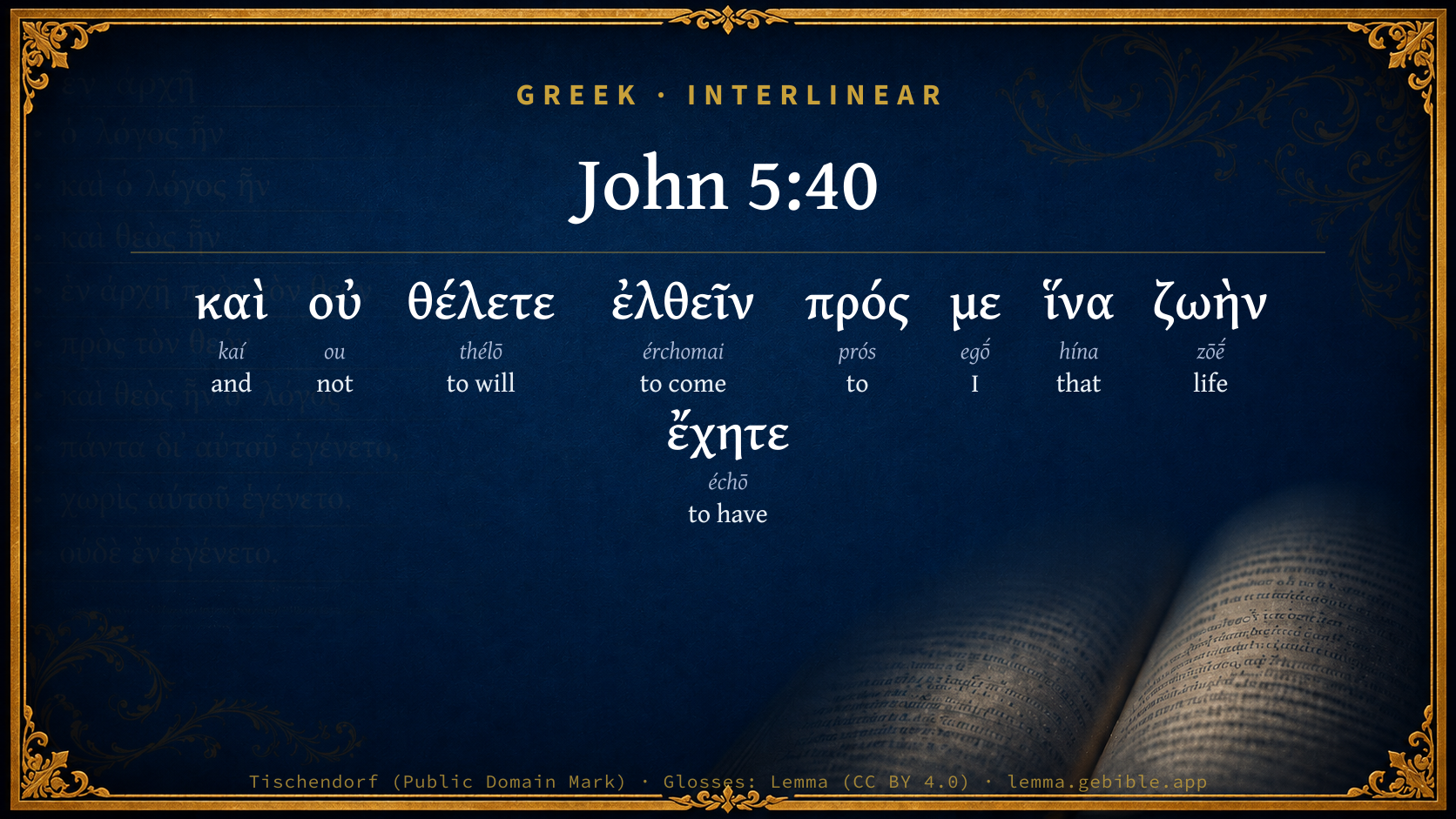
Greek (Tischendorf 8th ed.) John 5:40 appears in the Greek New Testament. The text above is from the Tischendorf 8th edition. Each word links to its Strong’s number and a concise gloss. Click any word for its full Thayer’s Greek Lexicon entry.
Download image
Cite this verse

John 5:40 (World English Bible). Public Domain. Lemma interlinear Bible study tool, https://lemma.gebible.app/v/john/5/40.

Show BibTeX & RIS
BibTeX
RIS
English Translation
Yet you will not come to me, that you may have life.
World English Bible · Public Domain
Download a study sheet

One document with this verse’s original text, its word-by-word gloss line, the meaning frame, cross-references with their text, attributed commentary, and full source and license credits — printable, and it pastes into notes with its structure intact.

This verse Autodidact and up

Study sheet (.html) Plain text (.txt)

A passage Seminary Student

Up to 50 verses in one chapter. A passage sheet keeps up to 6 commentary sources and 12 cross-references per verse, in the order this page ranks them, and says so on the sheet whenever that leaves anything out. Ask for a single verse and you get the Autodidact verse sheet above.

Everything on this page stays free to read, with no account — the sheet is a download of what is already on screen, not access to it.

Want to remove ads? Support Godless Engineer
Compare translations 3

The same verse in 3 English versions, stacked beneath the original-language interlinear above. Click any original word for its lexicon entry.

Each is an independent rendering of the whole verse — the interlinear is not word-aligned to these translations.

Highlighted words mark where these versions differ — a whole-verse word diff, not a word-by-word alignment.

  • World English Bible Public Domain
    Yet you will not come to me, that you may have life.
  • King James Version Public Domain
    And ye will not come to me, that ye might have life.
  • unfoldingWord Literal Text CC BY-SA 4.0
    and you are not willing to come to me so that you might have life.

unfoldingWord Literal Text — © unfoldingWord, licensed CC BY-SA 4.0. Word-aligned USFM3 via Door43 (git.door43.org/unfoldingWord/en_ult).

Versions to compare (up to 4)

3 of 4 selected

Show all 19 translations

Every available English version of this verse, each an independent rendering of the whole verse.

  • World English Bible Public Domain
    Yet you will not come to me, that you may have life.
  • Berean Standard Bible Public Domain
    yet you refuse to come to Me to have life.
  • Majority Standard Bible Public Domain
    yet you refuse to come to Me to have life.
  • King James Version Public Domain
    And ye will not come to me, that ye might have life.
  • American Standard Version (1901) Public Domain
    and ye will not come to me, that ye may have life.
  • Revised Version (1885) Public Domain
    and ye will not come to me, that ye may have life.
  • Geneva Bible (1599) Public Domain
    But ye will not come to me, that ye might haue life.
  • Douay-Rheims (1899) Public Domain
    And you will not come to me that you may have life.
  • Young's Literal Translation Public Domain
    and ye do not will to come unto me, that ye may have life;
  • Literal Standard Version CC BY-SA 4.0
    and you do not will to come to Me, that you may have life;
  • Unlocked Literal Bible CC BY-SA 4.0
    and you are not willing to come to me so that you may have life.
  • unfoldingWord Literal Text CC BY-SA 4.0
    and you are not willing to come to me so that you might have life.
  • Darby Bible Public Domain
    and ye will not come to me that ye might have life.
  • World Messianic Bible Public Domain
    Yet you will not come to me, that you may have life.
  • Webster's Bible Public Domain
    And ye will not come to me, that ye may have life.
  • Free Bible Version CC BY-SA 4.0
    And yet you don't want to come to me so that you might live.
  • Bible in Basic English Public Domain
    And still you have no desire to come to me so that you may have life.
  • Text-Critical English NT CC BY 4.0
    yet you are not willing to come to me so that you may have life.
  • Tyndale New Testament (1534) Public Domain
    And yet will ye not come to me that ye might have lyfe.

Literal Standard Version (2020), Covenant Press — licensed CC BY-SA 4.0. Text via the HelloAO Bible API (eBible.org). Unlocked Literal Bible (unfoldingWord) — licensed CC BY-SA 4.0. Text via the HelloAO Bible API (eBible.org). unfoldingWord Literal Text — © unfoldingWord, licensed CC BY-SA 4.0. Word-aligned USFM3 via Door43 (git.door43.org/unfoldingWord/en_ult). Free Bible Version, Dr. Jonathan Gallagher — licensed CC BY-SA 4.0. Text via the HelloAO Bible API (eBible.org).

Word by word

More ways to search: Search by grammar → Find every occurrence → Compare this word →

Practice this passage: Drill this verse → Learn its vocabulary →

ζωὴν
zōḗ
G2222
“life”
Noun, Accusative, Singular, Feminine
Part of Speech
Noun
Case
Accusative
Number
Singular
Gender
Feminine
Full Thayer's Definition

Origin: from G2198

TDNT: 15:52,3

1. life a. the state of one who is possessed of vitality or is animate b. every living soul 2. life a. of the absolute fulness of life, both essential and ethical, which belongs to God, and through him both to the hypostatic "logos" and to Christ in whom the "logos" put on human nature b. life real and genuine, a life active and vigorous, devoted to God, blessed, in the portion even in this world of those who put their trust in Christ, but after the resurrection to be consummated by new accessions (among them a more perfect body), and to last for ever.
  1. καὶ kaí G2532 “and” Conjunction
  2. οὐ ou G3756 “not” Particle, Negative
  3. θέλετε thélō G2309 “to will” Verb, Present, Active, Indicative, 2nd person, Plural
  4. ἐλθεῖν érchomai G2064 “to come” Verb, Aorist, Active, Infinitive
  5. πρός prós G4314 “to” Preposition
  6. με egṓ G1473 “I” Personal pronoun, 1st person, Accusative, Singular
  7. ἵνα hína G2443 “that” Conjunction
  8. ἔχητε échō G2192 “to have” Verb, Present, Active, Subjunctive, 2nd person, Plural

About this verse

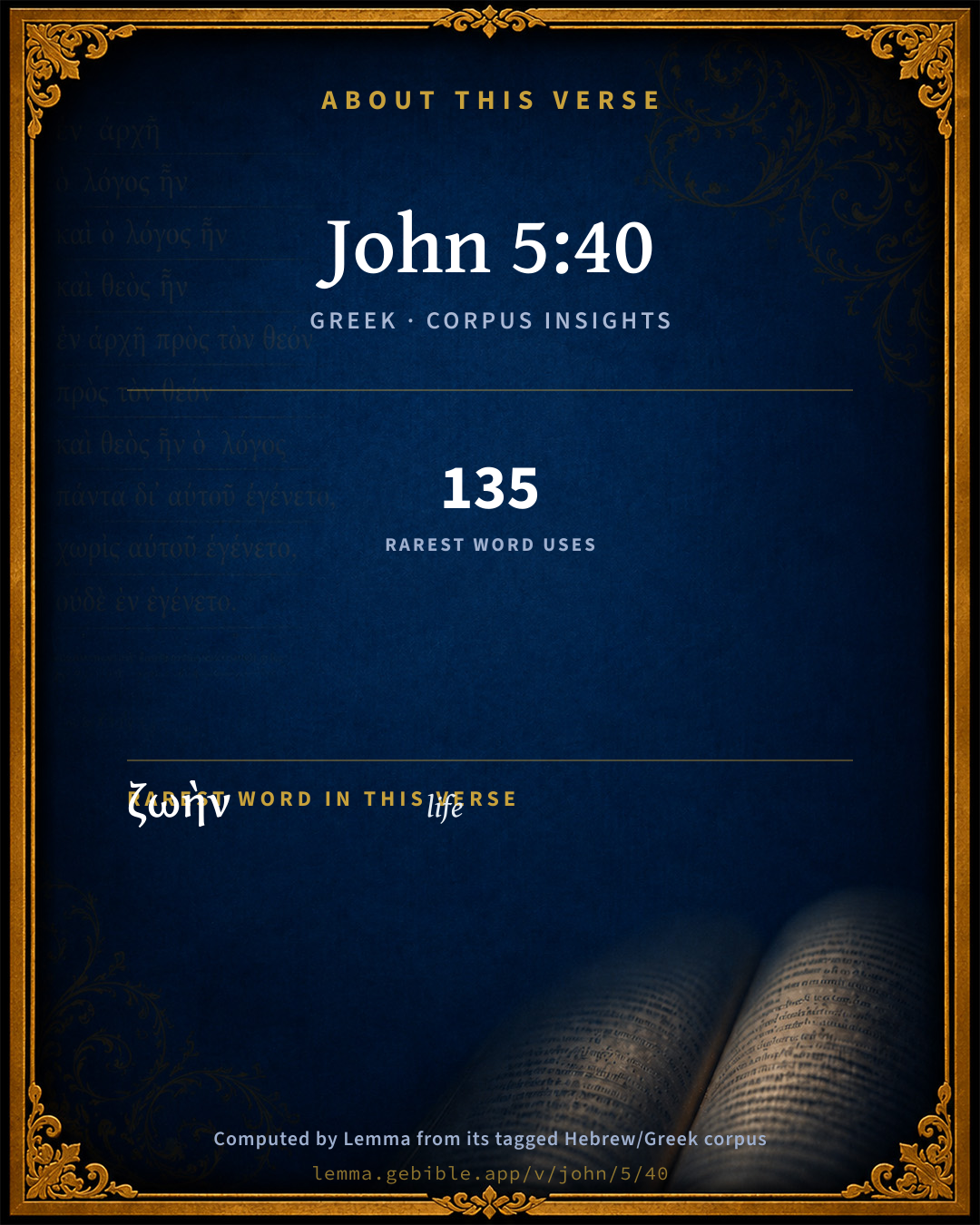
These counts appear in no published source. They are computed here, from the morphology-tagged text and Lemma’s own curated glosses. What Lemma adds →

9
words
9
distinct lemmas
Gospels
section

Cross-references

20

Topical passages linked to John 5:40 in the Treasury of Scripture Knowledge — connected by theme and wording, ordered by reader-vote popularity; previews shown in the World English Bible.

  • John 3:19 This is the judgment, that the light has come into the world, and men loved the darkness rather than the light; for their works were evil.
  • John 1:11 He came to his own, and those who were his own didn't receive him.
  • Psalms 81:11 But my people didn't listen to my voice. Israel desired none of me.
  • John 6:37 All those who the Father gives me will come to me. Him who comes to me I will in no way throw out.
  • Isaiah 49:7 Thus says Yahweh, the Redeemer of Israel, [and] his Holy One, to him whom man despises, to him whom the nation abhors, to a servant of rulers: Kings shall see and arise; princes, and they shall worship; because of Yahweh who is faithful, [even] the Holy One of Israel, who has chosen you.
  • Isaiah 50:2 Why, when I came, was there no man? when I called, was there none to answer? Is my hand shortened at all, that it can't redeem? or have I no power to deliver? Behold, at my rebuke I dry up the sea, I make the rivers a wilderness: their fish stink, because there is no water, and die for thirst.
  • Matthew 23:37 "Jerusalem, Jerusalem, who kills the prophets, and stones those who are sent to her! How often would I have gathered your children together, even as a hen gathers her chickens under her wings, and you would not!
  • John 6:40 This is the will of the one who sent me, that everyone who sees the Son, and believes in him, should have eternal life; and I will raise him up at the last day."
  • John 7:37–38 Now on the last and greatest day of the feast, Jesus stood and cried out, "If anyone is thirsty, let him come to me and drink!
  • John 8:45–46 But because I tell the truth, you don't believe me.
  • Romans 6:23 For the wages of sin is death, but the free gift of God is eternal life in Christ Jesus our Lord.
  • 1 John 5:11–13 The testimony is this, that God gave to us eternal life, and this life is in his Son.
  • Isaiah 53:1–3 Who has believed our message? and to whom has the arm of Yahweh been revealed?
  • Matthew 22:3 and sent out his servants to call those who were invited to the marriage feast, but they would not come.
  • John 6:27 Don't work for the food which perishes, but for the food which remains to eternal life, which the Son of Man will give to you. For God the Father has sealed him."
  • John 6:68–69 Simon Peter answered him, "Lord, to whom would we go? You have the words of eternal life.
  • John 12:37–41 But though he had done so many signs before them, yet they didn't believe in him,
  • Revelation 22:17 The Spirit and the bride say, "Come!" He who hears, let him say, "Come!" He who is thirsty, let him come. He who desires, let him take the water of life freely.
  • John 5:44 How can you believe, who receive glory from one another, and you don't seek the glory that comes from the only God?
  • John 11:25–26 Jesus said to her, "I am the resurrection and the life. He who believes in me, though he die, yet will he live.

Cross-references courtesy of OpenBible.info (CC BY 4.0).

Commentary

Notes on John 5:40 from classic Christian and Jewish commentators (each source and its license shown beneath its notes). The classic Christian expositions comment on the surrounding passage and are grouped to its opening verse, so a note may address several verses; the Jewish commentaries on the Tanakh (Rashi and others) are per-verse, so they appear only where the commentator wrote on this verse.

Lemma curates 59 commentaries, every one of them public domain or Creative Commons licensed, each selected and text-cleaned for this edition rather than reprinted as found. About our sources →

Bengel's Gnomon

Johann Albrecht Bengel

Joh 5:40. Ἐλθεῖν, come) in accordance with what the testimony of the Scriptures concerning Me demands.[109]

[109] ἵνα ζωἠν ἔχητε, that ye might have life) What follows below is more severe: If ye believe not that I am He, ye shall die in your sins, ch. Joh 8:24.—V. g.

Bengel's Gnomon of the New Testament — English translation (T&T Clark, Edinburgh, 1860) — public domain. Text from a community e-Sword module.

Expositor's Greek Testament

ed. W. Robertson Nicoll

Joh 5:40 . καὶ οὐ … ἔχητε . The true function of Scripture is expressed in the words, ἐκεῖναί εἰσιν αἱ μαρτυροῦσαι περὶ ἐμοῦ : they do not give life, as the Jews thought; they lead to the life-giver. God speaks in Scripture with a definite purpose in view, to testify to Christ; if Scripture does that, it does all. But to set it on a level with Christ is to do both it, Him, and ourselves grave injustice.

This closes the description of the threefold witness to Christ, and in Joh 5:41-47 , He exposes the source of their unbelief. This exposure is introduced by a disclaimer on His part of any chagrin at the want of homage and acceptance He received.

The Expositor's Greek Testament, edited by W. Robertson Nicoll (1897–1910) — public domain. Text from a community e-Sword module.

Adam Clarke's Commentary

Verse 40. And ye will not come to me] Though ye thus search the Scriptures, in hopes of finding the Messiah and eternal life in them, yet ye will not come unto me, believe in me, and be my disciples, though so clearly pointed out by them, that ye may have that eternal life which can only come through me.

Adam Clarke's Commentary on the Bible (1810–1826) — public domain. Text from a community e-Sword/MySword module.

John Calvin's Commentaries

40. And you will not come to me. He again reproaches them that it is nothing but their own malice that hinders them from becoming partakers of the life offered in the Scriptures; for when he says that they will not, he imputes the cause of their ignorance and blindness to wickedness and obstinacy. And, indeed, since he offered himself to them so graciously, they must have been willfully blind; but when they intentionally fled from the light, and even desired to extinguish the sun by the darkness of their unbelief, Christ justly reproves them with greater severity.

John Calvin's Commentaries (1540-1563) — public domain. Text from the Calvin Translation Society English edition (1840s-50s) via the Christian Classics Ethereal Library (ccel.org). Calvin's coverage is partial (roughly two-thirds of the Bible); uncommented books and verses are honest gaps, never fabricated. The 19th-century editor's footnotes and remarks are omitted so the notes are faithfully Calvin's own voice.

Ellicott's Commentary for English Readers

(40) And ye will not come to me.—The real hindrance is once more traced to the will. (See Note on Joh_3:9.) It is moral, not intellectual. The result of a true willingness to know the truth is certain, not problematic. “Ye search because ye think ye have: if ye were willing to come, ye should really have.”

The lesson is wide in its bearing. The Rabbinic spirit is not confined to Rabbis, nor is the merely literal study of the Scriptures limited to those of Judæa. Dictionaries, and grammars, and commentaries, are tools; but the precious ore is in the mine, and is to be extracted by every man for himself. He who wisely uses the best means will know most of God and His truth; but this knowledge no man can purchase, and the essentials of it none need lack. It is to be learned in the closet, rather than in the library; in action and trust, rather than in scholarship and thought. Religion is not philosophy, and the world by knowledge has never known God. For every humble heart that willeth to be a scholar, God Himself willeth to be the Teacher.

A Bible Commentary for English Readers, edited by Charles John Ellicott (1878–1897) — public domain. Text from a community e-Sword module.

The Cambridge Bible for Schools and Colleges

gen. ed. J. J. S. Perowne

40. ye will not come to me] Not the future of ‘to come,’ but the present of ‘to will:’ ye are not willing to come to Me. This is at the root of their failure to read Scripture aright, their hearts are estranged. They have no will to find the truth, and without that no intellectual searching will avail. Note that here again man’s will is shewn to be free; the truth is not forced upon him; he can reject it if he likes. Comp. Joh_3:19.

that ye might have life] ‘Ye fancy ye find life in your searching of the Scriptures, and ye refuse to come to Me in order to have it in reality.’

The Cambridge Bible for Schools and Colleges (gen. ed. J. J. S. Perowne; Cambridge University Press, 1878–1918) — public domain. Text from a community e-Sword module.

John Gill's Exposition

And ye will not come to me,.... Which is to be understood, not of a corporeal coming to him; for many of the Jews did come to him in this sense; some for one thing, and some for another; some for the loaves, that they might eat and be filled; some to see his miracles, and others to partake of the benefit of them; some to hear him preach, and others to catch and cavil at what they could: nor is bare coming to hear Christ preached, or an outward attendance on, and submission to his ordinances, such a coming to him as is here designed; for with these eternal life is not connected: bodily exercise profiteth not in this way; but a spiritual coming to Christ, or a coming to him by faith is here meant; in which sense the phrase is frequently used in this Gospel, especially in the next chapter; see Joh 6:35; and those who come aright to Christ, come to him as the alone, able, suitable, and sufficient Saviour; and in themselves as sinners, and ready to perish; and as such they are received by him with a welcome: but these men did not see themselves as such; nor did they see any need they had of coming to Christ; for they thought they had eternal life elsewhere: and such were their ignorance of themselves and Christ; and such their prejudices against him; and such the depravity, perverseness, and stubbornness of their wills, that they had no inclination, desire, and will to come to Christ, any more than power; which is an argument against, and not for the free will of man, unless it be to that which is evil: and this perverseness of their wills to come to Christ, when revealed in the external ministry of the word, was blameworthy in them, since this was not owing to any decree of God, but to the corruption and vitiosity of nature; which being blameworthy in them, that which follows upon it must be so too; and it was the greater aggravation of their sin, that they had the Scriptures which testified of Christ, and pointed at him as the way of life, and yet would not come to him for it:

that ye might have life; that is, eternal life, as is expressed in the foregoing verse, and is so read here in Beza's old copy, in the Syriac, Arabic, and Persic versions. This is in Christ, not only the purpose and promise of it, but that itself: he has the disposal of it, gives the right unto it, and a meetness for it, with all the comforts arising from it, and all the promises and blessings relating to it; and all that come to Christ by faith may, and shall have it: this is the will of the Father, the end of his giving of Christ, and of his mission and coming into the world, and is inseparably connected with believing in him.

John Gill's Exposition of the Whole Bible (1746–1763) — public domain (CC PDM 1.0). Text via the HelloAO Bible API.

Trapp's Complete Commentary

John Trapp

40 And ye will not come to me, that ye might have life.

Ver. 40. Ye will not come to me] Though clearly convinced by the Scriptures. See their obstinace and malice. Amos, Amo 6:12, compareth such untamable, untractable, masterless monsters, to horses running upon a rock, where first they break their hoofs and then their necks.

John Trapp, A Commentary or Exposition upon All the Books of the Old and New Testament (1647–1656) — public domain. Text from a community e-Sword module.

Albert Barnes' Notes on the Bible

And ye will not come ... - Though the Old Testament bears evidence that I am the Messiah; though you professedly search it to learn the way to life, and though my works prove it, yet you will not come to me to obtain life. From this we may learn:

1.That life is to be obtained in Christ. He is the way, the truth, and the life, and he only can save us.

2.That, in order to do that, we must “come to him” - that is, must come in the way appointed, as lost sinners, and be willing to be saved by him alone.

3.That the reason why sinners are not saved lies in the will. “The only reason why sinners die is because ‘they will not come’ to Christ for life and happiness: it is not because they ‘cannot,’ but because they ‘will not’” (Henry).

Sinners have a particular opposition to going to “Jesus Christ” for eternal life. They would prefer any other way, and it is commonly not until all other means are tried that they are willing to submit to him.

Albert Barnes' Notes on the Bible (1834–1885) — public domain. Text from a community e-Sword/MySword module.

Haydock's Catholic Bible Commentary

And you will not come to me. Christ now gives them reason why they do not receive him, and his doctrine, nor believe in him; because they are void of the love of God, full of self-love, envy, pride, seeking for praise and glory one from another. Hence you will not receive me, who come in the name of my Father, sent to redeem the world. But if another, such as false prophets, or even Antichrist himself, who will pretend to be the Messias, come in his own name, him you will receive. (Witham) --- It is proper to remark, that the testimonies here adduced all rise gradually one above another, and make a body of evidence that must leave the incredulous Jews without excuse: for they pay no regard to Jesus Christ himself, nor to John the Baptist, nor to the evidence of miracles, nor to the voice of God, nor to the Scriptures, nor even to Moses himself.

George Leo Haydock (1774–1849), Haydock's Catholic Family Bible and Commentary, 1859 edition — public domain. Excludes Psalms (Douay-Rheims chapter numbering differs from Protestant) and Deuterocanonical books (Catholic canon only).

Matthew Poole's English Annotations

You will not own, embrace, and receive me as the true Messiah and Saviour of the world, though that be the only means by which you can obtain that eternal life which you pretend to be seeking after, and rightly think that the Scripture alone can show you the way to. These two verses teach us,

1. That the Holy Scriptures are the only writings which show us the way to life eternal.

2. That not only the Scriptures of the New, but also of the Old Testament, are of use in order thereunto, though the Old Testament Scriptures show us it more darkly, and those of the New Testament show it to us more clearly.

3. That both the one and the other point us to Christ, and to the receiving and embracing of him, as our Saviour, if we would have life.

4. That it is not sufficient for us to search the Scriptures, to be versed in and acquainted with them, unless we, in obedience to them, come to Christ.

Matthew Poole's English Annotations on the Holy Bible (1683–1685) — public domain. Text from a community e-Sword/MySword module.

The Pulpit Commentary

And ye will not come to me, that ye may have life. This fearful conclusion of the whole matter is charged upon the responsibility of man. Doubtless, elsewhere, the will is described as itself made willing by the Divine attraction, by the grace of the Father. "He that hath seen and heard of the Father seen, i.e. his shape and heard his voice seen his shape and heard his voice in my ministry and manifestation, cometh unto me. " Yet the grace of God working directly on character or indirectly by other revelations, never obliterates the sense of responsibility. The appeal of God is made to the will of man, whether we consciously or unconsciously are made "willing in the day of his power". (cf. Joh_7:17 Joh_6:44, 67 8:44) The sad tone of this solemn charge corresponds with and does much to explain the pathetic cry, "O Jerusalem... how often would I have gathered thy children... and ye would not!" while the entire passage suggests that this appeal was only one specimen out of many such discourses, one hint of the numerous sayings and self-manifestations, one of many accumulated proofs of his Divine commission, out of which the belief of the evangelists and the invincible assent of the Church arose, that he was indeed "the Word made flesh," "the Only Begotten of the Father, full of grace and truth."

The Pulpit Commentary (1880–1919), ed. H.D.M. Spence-Jones & Joseph S. Exell — public domain. Text from a community e-Sword module.

John Wesley's Explanatory Notes

Yet ye will not come unto me - As they direct you.

John Wesley, Explanatory Notes Upon the Whole Bible (1754–1765) — public domain. Text via the GEBible commentary corpus.

Burkitt's Expository Notes on the New Testament

William Burkitt

Here our Saviour upbraids the Jews for thier obstinate infidelity; that notwithstanding God the Father by a voice from heaven, and John the Baptist by his testimony on earth, notwithstanding all the miracles which they had seen wrought by Christ himself, and notwithstanding the scriptures, which they pretended so highly to esteem, did prove him to be the Messias, and the author of eternal life, which they professed to seek: yet such was their obstinacy, that they would not come unto him, nor believe in him. Ye will not come unto me, that ye may have life.

Hence observe, 1. A choice and invaluable mercy, which Christ stands ready to bestow upon poor sinners, that is life, both spiritual and eternal. A life of grace, in order to a life of glory.

Observe, 2. The gracious condition upon which this invaluable blessing may be had; and that is, upon coming to Christ, believing on him, and receiving of him.

3. Here is the true reason declared why sinners do miss of life and salvation by Jesus Christ, when he has so dearly purchased it for them, and does so freely tender it unto them, and that lies in their own willfulness and obstinacy; Ye will not come unto me.

Learn hence, That the true reason why so many sinners miss of salvation and eternal life, after all that Christ has done and suffered for them, is their own obstinacy and unwillingness to come to him, that they may have life. Man, by nature, has not only an inability, but a fixed enmity in his will against Jesus Christ.

William Burkitt's Expository Notes on the New Testament (1700–1703) — public domain. Text from a community e-Sword module.

Cambridge Greek Testament for Schools and Colleges

40. οὐ θέλετε. Ye are not willing to come to Me. This is at the root of their failure to read Scripture aright; their hearts are estranged. They have no will to find the truth, and without that no intellectual searching will avail. Here again man’s will is shewn to be free; the truth is not forced upon him; he can reject if he likes: Joh 3:19, Joh 7:17, Joh 8:44.

Cambridge Greek Testament for Schools and Colleges (Cambridge University Press, 1896; 21 vols, various authors incl. Carr, Maclear, Plummer, Farrar, Lumby, Moule, M. R. James, Simcox) — public domain. Text from a community e-Sword module.

Alford’s Greek Testament

Henry Alford

40.] I would connect these words with the former, and regard them as describing the inconsistency of those who think that they ζωὴν ἔχειν in the Scriptures, and yet will not come to Him of whom they testify, ἵνα ζωὴν ἔχωσιν. So that καί will be spoken in a fine irony, And ye will not come to Me!

Observe, this command to the Jews to search their Scriptures, applies à fortiori to Christians; who are yet, like them, in danger of idolizing a mere written book, believing that in the Bible they have eternal life, and missing the personal knowledge of Him of whom the Scriptures testify.

The οὐ θέλετε here sets forth strikingly the freedom of the will, on which the unbeliever’s condemnation rests: see ch. 3:19.

Henry Alford, The Greek Testament (1849–1861) — public domain. Text from a community e-Sword module.

International Critical Commentary

40. οὐ θέλετε ἐλθεῖν πρός με. This is the tragedy of the rejection of Messiah by the Messianic race; cf. Mat 23:37, with the same sombre conclusion, οὐκ ἠθελήσατε. The use of καἰ (cf. v. 38), meaning “and yet,” before οὐ θέλετε is a feature of Jn.’s style. See on 1:10.

Explanation of the Unbelief of the Jews (Vv. 41-47)

International Critical Commentary — older volumes (1896–1929), various authors — public domain. Text from a community e-Sword module.

Vincent's Word Studies in the New Testament

Marvin R. Vincent

And. More than a simple copula. Rather and yet. See on Luk 18:7. Ye will not [ου θελετε] . Indicating stubborn determination. See on Mt 1:19.

Marvin R. Vincent, Word Studies in the New Testament (1887–1900) — public domain. Text from a community e-Sword/MySword module.

Lesson kit

Teaching starters — assembled from the data on this page, not authored interpretation. Every prompt links to the verse data it draws on. Edit before teaching.

John, in the Gospels, opens this verse with 9 words (9 distinct Greek lemmas). Its most distinctive word is zōḗ (“life”). A historical commentator’s framing appears above. Read the whole chapter for the surrounding context.

Discussion questions

  1. What does “life” (zōḗ) contribute to the verse as a whole?
  2. John 3:19 shares this passage’s theme. How do the two illuminate each other?
  3. The translations on this page render this verse differently — a whole-verse word diff, not a word-by-word alignment. What might account for the different wordings?
  4. Reading how Bengel's Gnomon and Expositor's Greek Testament read this verse, where do the two commentators agree and where do they part?

Things to notice

Reading settings

Reading text

Shown beneath each verse's original-language words.

Old Testament
Old Testament edition

Read the OT as the Masoretic Hebrew (MT) or the Greek Septuagint (LXX).

English shown for the Greek Septuagint (in the Hebrew ↔ Greek comparison).

Comparing translations? Open the Compare panel on any verse page to stack up to four side by side.