1 Corinthians 14:35

Greek (Tischendorf 8th ed.) 1 Corinthians 14:35 appears in the Greek New Testament. The text above is from the Tischendorf 8th edition. Each word links to its Strong’s number and a concise gloss. Click any word for its full Thayer’s Greek Lexicon entry.
Download image
Cite this verse

1 Corinthians 14:35 (World English Bible). Public Domain. Lemma interlinear Bible study tool, https://lemma.gebible.app/v/1-corinthians/14/35.

Show BibTeX & RIS
BibTeX
RIS
English Translation
If they desire to learn anything, let them ask their own husbands at home, for it is shameful for a woman to chatter in the assembly.
World English Bible · Public Domain
Download a study sheet

One document with this verse’s original text, its word-by-word gloss line, the meaning frame, cross-references with their text, attributed commentary, and full source and license credits — printable, and it pastes into notes with its structure intact.

This verse Autodidact and up

Study sheet (.html) Plain text (.txt)

A passage Seminary Student

Up to 50 verses in one chapter. A passage sheet keeps up to 6 commentary sources and 12 cross-references per verse, in the order this page ranks them, and says so on the sheet whenever that leaves anything out. Ask for a single verse and you get the Autodidact verse sheet above.

Everything on this page stays free to read, with no account — the sheet is a download of what is already on screen, not access to it.

Want to remove ads? Support Godless Engineer
Compare translations 3

The same verse in 3 English versions, stacked beneath the original-language interlinear above. Click any original word for its lexicon entry.

Each is an independent rendering of the whole verse — the interlinear is not word-aligned to these translations.

Highlighted words mark where these versions differ — a whole-verse word diff, not a word-by-word alignment.

  • World English Bible Public Domain
    If they desire to learn anything, let them ask their own husbands at home, for it is shameful for a woman to chatter in the assembly.
  • King James Version Public Domain
    And if they will learn any thing, let them ask their husbands at home: for it is a shame for women to speak in the church.
  • unfoldingWord Literal Text CC BY-SA 4.0
    But if they desire to learn anything, let them ask their own husbands at home, for it is disgraceful for a woman to speak in church.

unfoldingWord Literal Text — © unfoldingWord, licensed CC BY-SA 4.0. Word-aligned USFM3 via Door43 (git.door43.org/unfoldingWord/en_ult).

Versions to compare (up to 4)

3 of 4 selected

Show all 19 translations

Every available English version of this verse, each an independent rendering of the whole verse.

  • World English Bible Public Domain
    If they desire to learn anything, let them ask their own husbands at home, for it is shameful for a woman to chatter in the assembly.
  • Berean Standard Bible Public Domain
    If they wish to inquire about something, they are to ask their own husbands at home; for it is dishonorable for a woman to speak in the church.
  • Majority Standard Bible Public Domain
    If they wish to inquire about something, they are to ask their own husbands at home; for it is dishonorable for a woman to speak in the church.
  • King James Version Public Domain
    And if they will learn any thing, let them ask their husbands at home: for it is a shame for women to speak in the church.
  • American Standard Version (1901) Public Domain
    And if they would learn anything, let them ask their own husbands at home: for it is shameful for a woman to speak in the church.
  • Revised Version (1885) Public Domain
    And if they would learn anything, let them ask their own husbands at home: for it is shameful for a woman to speak in the church.
  • Geneva Bible (1599) Public Domain
    And if they will learne any thing, let them aske their husbands at home: for it is a shame for women to speake in the Church.
  • Douay-Rheims (1899) Public Domain
    But if they would learn any thing, let them ask their husbands at home. For it is a shame for a woman to speak in the church.
  • Young's Literal Translation Public Domain
    and if they wish to learn anything, at home their own husbands let them question, for it is a shame to women to speak in an assembly.
  • Literal Standard Version CC BY-SA 4.0
    and if they wish to learn anything, let them question their own husbands at home, for it is a shame to women to speak in an assembly.
  • Unlocked Literal Bible CC BY-SA 4.0
    If there is anything they desire to learn, let them ask their husbands at home. For it is disgraceful for a woman to speak in the church.
  • unfoldingWord Literal Text CC BY-SA 4.0
    But if they desire to learn anything, let them ask their own husbands at home, for it is disgraceful for a woman to speak in church.
  • Darby Bible Public Domain
    But if they wish to learn anything, let them ask their own husbands at home; for it is a shame for a woman to speak in assembly.
  • World Messianic Bible Public Domain
    if they desire to learn anything. “Let them ask their own husbands at home, for it is shameful for a wife to be talking in the assembly.”
  • Webster's Bible Public Domain
    And if they will learn any thing, let them ask their husbands at home; for it is a shame for women to speak in the church.
  • Free Bible Version CC BY-SA 4.0
    If they want to learn they can do so at home, asking their husbands. It is not proper for women to speak in church.”
  • Bible in Basic English Public Domain
    And if they have a desire for knowledge about anything, let them put questions to their husbands privately: for talking in the church puts shame on a woman.
  • Text-Critical English NT CC BY 4.0
    If they want to learn anything, they should ask their own husbands at home; for it is shameful for women to speak in church.
  • Tyndale New Testament (1534) Public Domain
    If they will learne enythinge let the axe their husbandes at home. For it is a shame for wemen to speake in the congregacion.

Literal Standard Version (2020), Covenant Press — licensed CC BY-SA 4.0. Text via the HelloAO Bible API (eBible.org). Unlocked Literal Bible (unfoldingWord) — licensed CC BY-SA 4.0. Text via the HelloAO Bible API (eBible.org). unfoldingWord Literal Text — © unfoldingWord, licensed CC BY-SA 4.0. Word-aligned USFM3 via Door43 (git.door43.org/unfoldingWord/en_ult). Free Bible Version, Dr. Jonathan Gallagher — licensed CC BY-SA 4.0. Text via the HelloAO Bible API (eBible.org).

Word by word

More ways to search: Search by grammar → Find every occurrence → Compare this word →

Practice this passage: Drill this verse → Learn its vocabulary →

αἰσχρὸν
aischrós
G150
“shame”
Adjective, Nominative, Singular, Neuter
Part of Speech
Adjective
Case
Nominative
Number
Singular
Gender
Neuter
Full Thayer's Definition

Origin: from the same as G153

TDNT: 04:09,3

1. filthy, baseness, dishonour
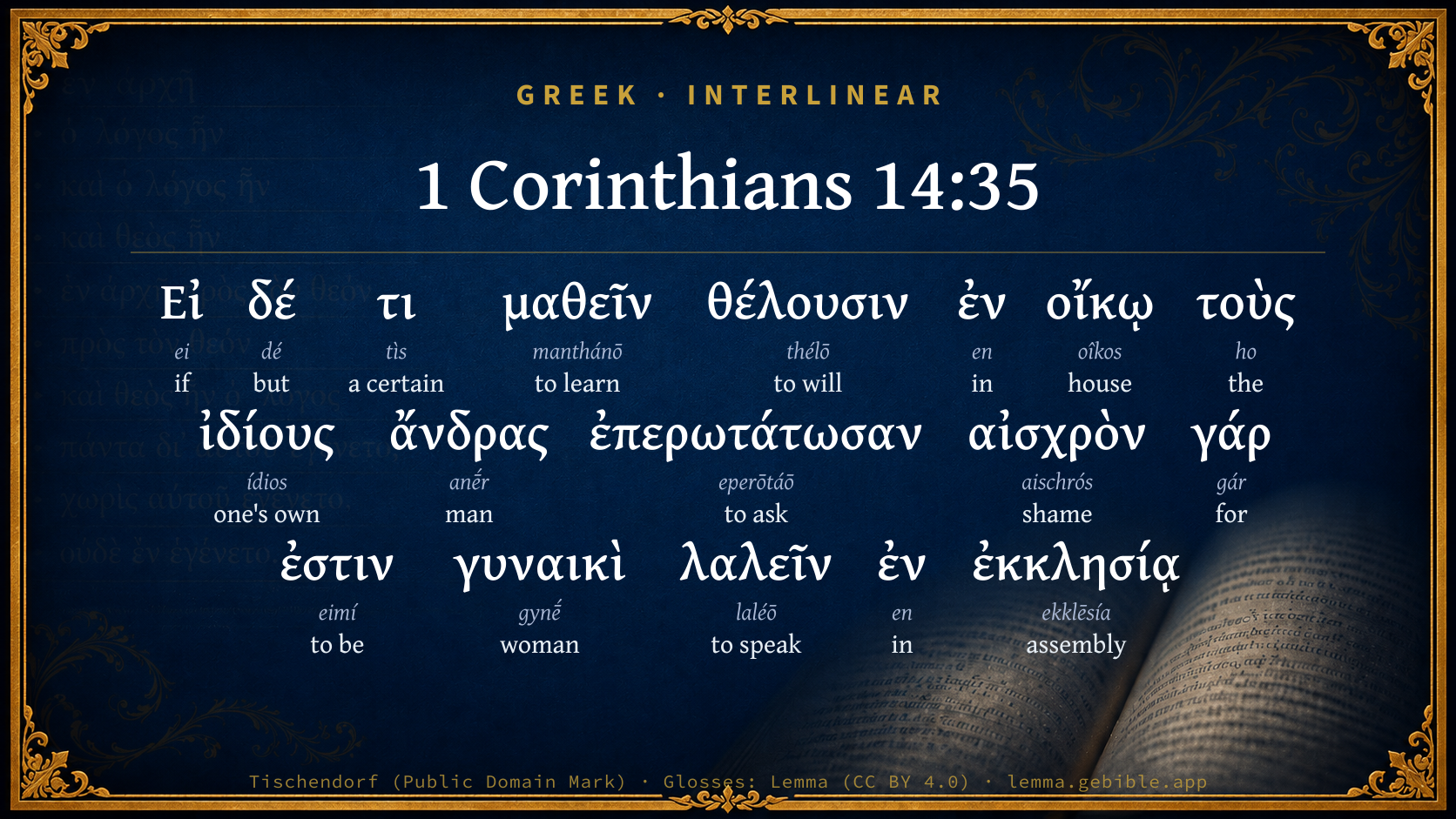
  1. Εἰ ei G1487 “if” Conditional
  2. δέ dé G1161 “but” Conjunction
  3. τι tìs G5100 “a certain” Indefinite pronoun, Nominative, Singular, Neuter
  4. μαθεῖν manthánō G3129 “to learn” Verb, Aorist, Active, Infinitive
  5. θέλουσιν thélō G2309 “to will” Verb, Present, Active, Indicative, 3rd person, Plural
  6. ἐν en G1722 “in” Preposition
  7. οἴκῳ oîkos G3624 “house” Noun, Dative, Singular, Masculine
  8. τοὺς ho G3588 “the” Article, Accusative, Plural, Masculine
  9. ἰδίους ídios G2398 “one's own” Adjective, Accusative, Plural, Masculine
  10. ἄνδρας anḗr G435 “man” Noun, Accusative, Plural, Masculine
  11. ἐπερωτάτωσαν eperōtáō G1905 “to ask” Verb, Present, Active, Imperative, 3rd person, Plural
  12. γάρ gár G1063 “for” Conjunction
  13. ἐστιν eimí G1510 “to be” Verb, Present, Active, Indicative, 3rd person, Singular
  14. γυναικὶ gynḗ G1135 “woman” Noun, Dative, Singular, Feminine
  15. λαλεῖν laléō G2980 “to speak” Verb, Present, Active, Infinitive
  16. ἐν en G1722 “in” Preposition
  17. ἐκκλησίᾳ ekklēsía G1577 “assembly” Noun, Dative, Singular, Feminine

About this verse

These counts appear in no published source. They are computed here, from the morphology-tagged text and Lemma’s own curated glosses. What Lemma adds →

18
words
17
distinct lemmas
Pauline Epistles
section

Notable vocabulary

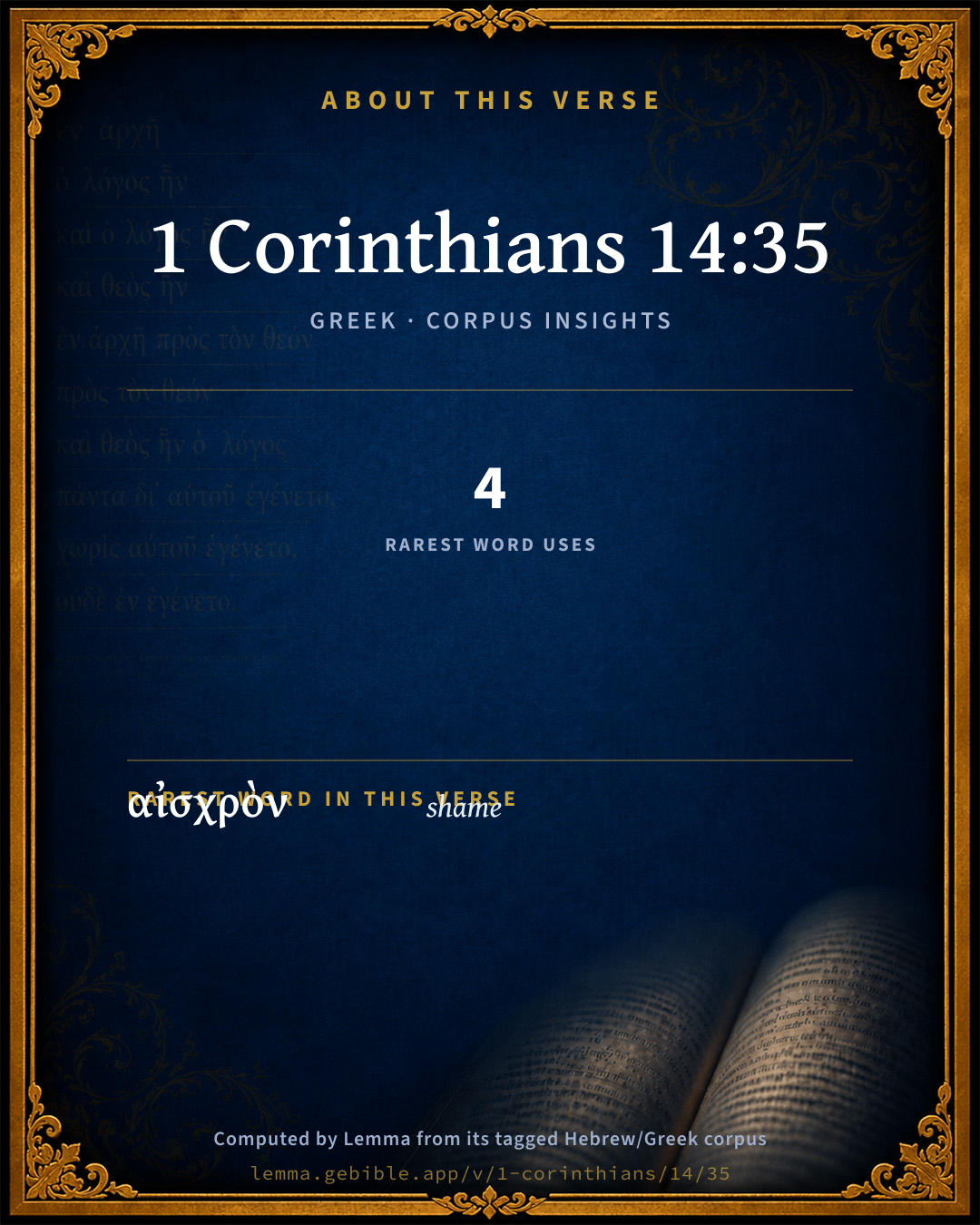
The rarest word here is αἰσχρὸν shame G150 — appearing just 4 times in the whole Greek New Testament.

Shared distinctive vocabulary

αἰσχρὸν shame G150 occurs in 4 verses of the Greek New Testament. Also found in:

Repetition

A word recurs within this verse:

Cross-references

6

Topical passages linked to 1 Corinthians 14:35 in the Treasury of Scripture Knowledge — connected by theme and wording, ordered by reader-vote popularity; previews shown in the World English Bible.

  • Ephesians 5:12 For the things which are done by them in secret, it is a shame even to speak of.
  • 1 Peter 3:7 You husbands, in like manner, live with your wives according to knowledge, giving honor to the woman, as to the weaker vessel, as being also joint heirs of the grace of life; that your prayers may not be hindered.
  • Ephesians 5:25–27 Husbands, love your wives, even as Christ also loved the assembly, and gave himself up for it;
  • 1 Corinthians 11:6 For if a woman is not covered, let her also be shorn. But if it is shameful for a woman to be shorn or shaved, let her be covered.
  • 1 Corinthians 11:14 Doesn't even nature itself teach you that if a man has long hair, it is a dishonor to him?
  • 1 Corinthians 14:34 let your wives keep silent in the assemblies, for it has not been permitted for them to speak; but let them be in subjection, as the law also says.

Cross-references courtesy of OpenBible.info (CC BY 4.0).

Where the printed editions differ

1 variant

Places in this verse where the major printed Greek editions disagree on the wording in a way that affects the translation — a comparison of editions, not a manuscript-by-manuscript collation. The editions are the modern critical texts (Nestlé-Aland 28/27, SBL, Westcott-Hort, Tregelles, Tyndale House) and the traditional texts behind the KJV (the Textus Receptus and the Byzantine/Majority text). It is not a claim about which reading is original.

  1. Different wording
    γυναικὶ

    “for a woman”

    In NA28NA27TynSBLWHTregByz Not in TR

    γυναιξὶν (gunaixin) 'women' occurs in traditional manuscripts (TR) instead of γυναικὶ (gunaiki) 'for a woman' in older manuscripts (NA28+NA27+Tyn+SBL+WH+Treg+Byz)

Textual data: Translators Amalgamated Greek New Testament (STEPBible TAGNT) · CC BY 4.0.

Commentary

Notes on 1 Corinthians 14:35 from classic Christian and Jewish commentators (each source and its license shown beneath its notes). The classic Christian expositions comment on the surrounding passage and are grouped to its opening verse, so a note may address several verses; the Jewish commentaries on the Tanakh (Rashi and others) are per-verse, so they appear only where the commentator wrote on this verse.

Lemma curates 59 commentaries, every one of them public domain or Creative Commons licensed, each selected and text-cleaned for this edition rather than reprinted as found. About our sources →

Godbey's Commentary on the New Testament

William B. Godbey

35. “But if they wish to learn something, let them ask their own husbands at home: for it is a disgrace for a woman to gabble in church.” This verse is exegetical of the preceding, as we have here an antithesis whose logical arms are always co-equal. Hence the prohibition in 1Co 14:34 is coordinate with the permission in 1Co 14:35, and, as you see, the permission in 1Co 14:35 is to ask their husbands at home in case they wish to learn something from them, showing clearly that the prohibition in the meetings was simply that of asking their husbands to give them explanations while the person is speaking. The popular idea that this is prohibitory of women taking part in public worship is utterly untenable, for the simple fact is that Paul is not on that subject at all, but that of order in the meetings; this entire paragraph being corrective of those disorders which had developed as the result of their incorrigible zeal and enthusiasm in the appropriation and exercise of the spiritual gifts and graces, really appertaining to men as pertinently as to the women.

William B. Godbey, Commentary on the New Testament (1896–1900) — public domain. Text from a community e-Sword module.

Bengel's Gnomon

Johann Albrecht Bengel

1Co 14:35. Μαθεῖν, to learn) by speaking.—θἑλουσιν, they wish) This is the figure[130] occupatio.—ἸΔΊΟΥς) their own, rather than others.—ἐπερωτάτωσαν) let them ask. It was the exclusive privilege of the men to put questions in the assembly.—ἐν ἐκκλησίᾳ) in the assembly either civil or sacred.—λαλεῖν, to speak) either in teaching or asking.

[130] See Append. Anticipating a reply or objection which might be made by a supposed opponent.—T.

Bengel's Gnomon of the New Testament — English translation (T&T Clark, Edinburgh, 1860) — public domain. Text from a community e-Sword module.

Meyer's Critical & Exegetical Commentary

Heinrich August Wilhelm Meyer

1Co_14:35. Even questions for their instruction should not be brought forward by the women in the assemblie.

ἐν οἴκῳ] has the emphasis. At home, not in the assembly, they are to obtain for themselves by inquiry the desired instruction, and that from those to whom they, as women, are naturally referred, from their own husbands.

Meyer — Critical and Exegetical Commentary on the New Testament — English translation by Peter Christie, edited by Frederick Crombie (T&T Clark, 1880) — public domain. Text from a community e-Sword module.

Expositor's Greek Testament

ed. W. Robertson Nicoll

1Co 14:35 . εἰ δέ τι θέλουσιν μανθάνειν : “But if they want to learn something” if this is the motive that prompts them to speak. This plea furnishes an excuse, consistent with the submission enjoined, for women raising their voices in the Church meetings; but even so P. deprecates the liberty. As between μανθάνειν and μαθεῖν after θέλω and the like, El [2198] thus distinguishes: “when attention is directed to the procedure of the action specified, the pr [2199] is commonly used; when simply to the action itself, the aor [2200] ” In bidding the Cor [2201] women of enquiring minds to “ask at home of their own husbands,” P. is laying down a general rule, not disposing of all cases that might arise; since the impv [2202] of 1Co 14:35 admits of exceptions, so may that of 1Co 14:34 : the utterances of Pentecost (Act 2:4 ) proceeded from “all,” both men and women ( cf. 18 f.); there is also the notable instance of Philip’s “four daughters which did prophesy” (Act 21:9 ). At Cor [2203] there was a disposition to put men and women on an equal footing in public speaking and Church leadership; this is stigmatized as αἰσχρὸν ( turpe, inhonestum ; cf. 1Co 11:6 ; 1Co 11:13 ff.); it shocks moral feeling. For ἐν ἐκκλησίᾳ , see 1Co 11:18 .

[2198] C. J. Ellicott’s St. Paul’s First Epistle to the Corinthians .

[2199] present tense.

[2200] aorist tense.

[2201] Corinth, Corinthian or Corinthians.

[2202] imperative mood.

[2203] Corinth, Corinthian or Corinthians.

The Expositor's Greek Testament, edited by W. Robertson Nicoll (1897–1910) — public domain. Text from a community e-Sword module.

Hodge's Commentary on Romans, Ephesians & First Corinthians

Charles Hodge

1Co_14:35

And if they will learn any thing, let them ask their husbands at home: for it is a shame for women to speak in the church.

The desire for knowledge in women is not to be repressed, and the facilities for its acquisition are not to be denied them. The refinement and delicacy of their sex, however, should be carefully preserved. They may learn all they wish to know without appearing before the public. For it is a shame for women to speak in the church. The word used is αἰσχρός which properly means ugly, deformed. It is spoken of any thing which excites disgust. As the peculiar power and usefulness of women depend on their being the objects of admiration and affection, any thing which tends to excite the opposite sentiments should for that reason be avoided.

Charles Hodge — Commentary on Romans (1835), First Corinthians (1857), and Ephesians (1856) — public domain. Text from a community e-Sword module.

Jamieson, Fausset & Brown

Robert Jamieson, A. R. Fausset & David Brown

Anticipation of an objection. Women may say, "But if we do not understand something, may we not 'ask' a question publicly so as to 'learn'? Nay, replies Paul, if you want information, 'ask' not in public, but 'at home'; ask not other men, but 'your own particular (so the Greek) husbands.'"

shame--indecorous.

Jamieson, Fausset & Brown — Commentary Critical and Explanatory on the Whole Bible (1871) — public domain (CC PDM 1.0). Text via the HelloAO Bible API.

Adam Clarke's Commentary

Verse 35. For it is a shame for women to speak in the church.] The Jews would not suffer a woman to read in the synagogue; though a servant or even a child, had this permission; but the apostle refers to irregular conduct, such conduct as proved that they were not under obedience, 1Co 14:34.

Adam Clarke's Commentary on the Bible (1810–1826) — public domain. Text from a community e-Sword/MySword module.

John Calvin's Commentaries

35. If they wish to learn any thing. That he may not seem, by this means, to shut out women from opportunities of learning, he desires them, if they are in doubt as to anything, to inquire in private, that they may not stir up any disputation in public. When he says, husbands, he does not prohibit them from consulting the Prophets themselves, if necessary. For all husbands are not competent to give an answer in such a case; but, as he is reasoning here as to external polity, he reckons it sufficient to point out what is unseemly, that the Corinthians may guard against it. In the meantime, it is the part of the prudent reader to consider, that the things of which he here treats are intermediate and indifferent, in which there is nothing unlawful, but what is at variance with propriety and edification.

John Calvin's Commentaries (1540-1563) — public domain. Text from the Calvin Translation Society English edition (1840s-50s) via the Christian Classics Ethereal Library (ccel.org). Calvin's coverage is partial (roughly two-thirds of the Bible); uncommented books and verses are honest gaps, never fabricated. The 19th-century editor's footnotes and remarks are omitted so the notes are faithfully Calvin's own voice.

Ellicott's Commentary for English Readers

(35) If they will learn any thing.—Better, if they are desirous to learn anything. They are not even to ask questions in public assemblies. They are to ask their husbands at home on every point on which they desire special instruction. (See 1 Corinthians 8.)

A Bible Commentary for English Readers, edited by Charles John Ellicott (1878–1897) — public domain. Text from a community e-Sword module.

The Cambridge Bible for Schools and Colleges

gen. ed. J. J. S. Perowne

35. let them ask their husbands at home] Rather, ‘their own husbands.’ The women were not only not permitted to teach (see 1Ti_2:11-14) but even to ask questions in Church, a privilege, says. Grotius, permitted to men, but denied to women, among the Jews. It seems to be assumed that the unmarried ones would not think of doing so. This rule applies in its strictness only to the East, where women were kept in strict seclusion, and only permitted to converse with their male relatives. Calvin remarks, “When he says husbands, he does not prohibit them, in case of need, from consulting the prophets themselves; for all husbands are not qualified to give information on such subjects.” Estius allows the right of women to consult pious and prudent men, so long as it be done without giving occasion of scandal.

for it is a shame] The original is even stronger. It is disgraceful.

The Cambridge Bible for Schools and Colleges (gen. ed. J. J. S. Perowne; Cambridge University Press, 1878–1918) — public domain. Text from a community e-Sword module.

John Gill's Exposition

If any man think himself to be a prophet,.... Or "seems to be a prophet", and is really one; for the apostle does not so much design to strike at the pride, vanity, and appearances of false prophets, as to observe, that those that are really prophets, have the gift of prophesy, either of foretelling future events, or a peculiar gift of preaching the Gospel, and explaining the Scriptures, will allow what he had said to be right:

or spiritual; not merely one that has the Spirit of God, is regenerated and sanctified by him, in opposition to a natural and carnal man; or one that has a larger knowledge of spiritual things, in distinction from a babe in Christ; but one that is endued with spiritual gifts, with the extraordinary gifts of the Spirit, with a discerning of spirits; as there were such among them no doubt, as well as prophets, and who were distinct from them, having the word of wisdom and knowledge:

let him acknowledge that the things that I write unto you are the commandments of the Lord; if he is a true prophet, and really a spiritual man, he will clearly see, and therefore ought to own, that the rules here prescribed concerning speaking with tongues and prophesying, and concerning the intolerableness, unlawfulness, and indecency of women's speaking in public assemblies, are perfectly agreeable to the commands of Christ, and are to be esteemed as such, being delivered under the influence and direction of his Spirit; and which the prophet and spiritual man must discern and allow, if they have the Spirit of God; for whatever was commanded by the apostles under divine inspiration, was all one as if immediately commanded by Christ himself.

John Gill's Exposition of the Whole Bible (1746–1763) — public domain (CC PDM 1.0). Text via the HelloAO Bible API.

Trapp's Complete Commentary

John Trapp

35 And if they will learn any thing, let them ask their husbands at home: for it is a shame for women to speak in the church.

Ver. 35. Ask their husbands] Who therefore must dwell with them according to knowledge, 1Pe 3:7, and be manly guides unto them in the way to heaven. The master’s breast must be the household’s treasury.

For it is a shame for women, &c.] She was a singular example that taught the Greek and Latin tongues at Heidelberg, A.D. 1554; her name was Olympia Fulvia Morata, an Italian, of the city of Ferrara. Ancient histories indeed make mention of one Aratha, who read openly in the schools at Athens 25 years, made 40 books, and a hundred philosophers to her scholars. Leoptia likewise wrote against Theophrastus; Corinna often contended with Pindarus in versifying.

John Trapp, A Commentary or Exposition upon All the Books of the Old and New Testament (1647–1656) — public domain. Text from a community e-Sword module.

Albert Barnes' Notes on the Bible

And if they will learn anything - If anything has been spoken which they do not understand; or if on any particular subject they desire more full information, let them inquire of their husbands in their own dwelling. They may there converse freely; and their inquiries will not be attended with the irregularity and disorder which would occur should they interrupt the order and solemnity of public worship.

For it is a shame - It is disreputable and shameful; it is a breach of propriety. Their station in life demands modesty, humility, and they should be free from the ostentation of appearing so much in public as to take part in the public services of teaching and praying. It does not become their rank in life; it is not fulfilling the object which God evidently intended them to fill. He has appointed people to rule; to hold offices; to instruct and govern the church; and it is improper that women should assume that office upon themselves. This evidently and obviously refers to the church assembled for public worship, in the ordinary and regular acts of devotion. There the assembly is made up of males and females, of old and young, and there it is improper for them to take part in conducting the exercises. But this cannot be interpreted as meaning that it is improper for females to speak or to pray in meetings of their own sex, assembled for prayer or for benevolence; nor that it is improper for a female to speak or to pray in a Sunday School. Neither of these come under the apostle’s idea of a church. And in such meetings, no rule of propriety or of the Scriptures is violated in their speaking for the edification of each other, or in leading in social prayer. It may be added here, that on this subject the Jews were very strenuous, and their laws were very strict. The Rabbis taught that a woman should know nothing but the use of the distaff, and they were specially prohibited from asking questions in the synagogue, or even from reading. See Lightfoot. The same rule is still observed by the Jews in the synagogues.

Albert Barnes' Notes on the Bible (1834–1885) — public domain. Text from a community e-Sword/MySword module.

Matthew Poole's English Annotations

This must be understood of speaking to the congregation, for the instructing them, or speaking in the congregation to the minister, or any of the people, for her own instruction, for the woman might, doubtless, say Amen to the public prayers, and also sing with the congregation to the honour and glory of God. But for her to speak in an ordinary course of prophecy to instruct people, or to call aloud to the minister, or any members in the assembly of the church, to be satisfied in any thing wherein she was in doubt, this she is forbidden.

Matthew Poole's English Annotations on the Holy Bible (1683–1685) — public domain. Text from a community e-Sword/MySword module.

Whedon's Commentary on the Bible

Daniel D. Whedon

35. Ask their husbands—With whom, according to the Jewish custom, all the education was. According to Schoettgen, women were allowed in the rabbinical schools; but only to hear, and never to speak, or ask a question.

Shame—Contrary to the existing views of propriety. Just as in 1Co_11:14, (where see note,) it is a shame for a man to wear long hair. When women are so cultured that it is not a shame, but a beauty, for a woman to speak, then the prohibition ceases because the reason for it ceases, just as the prohibition of long hair to a man ceases.

Daniel D. Whedon (gen. ed.), Commentary on the Old and New Testaments (1874–1909) — public domain. Text from a community e-Sword module.

The Pulpit Commentary

Let them ask their husbands. Here again St. Paul is dealing with general rules.

The Pulpit Commentary (1880–1919), ed. H.D.M. Spence-Jones & Joseph S. Exell — public domain. Text from a community e-Sword module.

John Wesley's Explanatory Notes

And even if they desire to learn anything - Still they are not to speak in public, but to ask their own husbands at home - That is the place, and those the persons to inquire of.

John Wesley, Explanatory Notes Upon the Whole Bible (1754–1765) — public domain. Text via the GEBible commentary corpus.

McGarvey & Pendleton's Commentaries

J. W. McGarvey

And if they would learn anything, let them ask their own husbands at home: for it is shameful for a woman to speak in the church . [This is usually regarded as a very difficult passage, but the difficulties are more seeming than real, if we regard it as a general rule. Paul gives two reasons why the women should keep silence: 1. The Old Testament law made her subject to her husband, and hence not a teacher, but a pupil. 2. The customs of the age made it a shameful thing for a woman to speak in public. Of these, of course, the first is the weightier, and yet we find exceptions to the rule in both dispensations. There were several prophetesses who exercised their gifts in public ( Exo_15:20 ; Jdg_4:4 ; 2Ki_22:14 ; Isa_8:3 ; Neh_6:14 ; Luk_1:41-42 ; Luk_2:36-38 ; Act_21:9 ). Moreover, the fullness of prophetic endowment granted to the New Testament church was matter of prophecy ( Act_2:17 ), and Paul himself gives directions as to the attire of women when exercising the prophetic office in the church ( 1Co_11:5 ). Paul's rule, then, admits of exceptions. Some would do away with the rule entirely as obsolete on the ground that in Christ there is neither male nor female ( Gal_3:28 ); but this is undoubtedly unwarranted, for while the gospel emancipated woman, it did not change her natural relation so as to make her the equal of man. The powers of woman have become so developed, and her privileges have been so extended in gospel lands, that it is no longer shameful for her to speak in public; but the failing of one reason is not the cessation of both. The Christian conscience has therefore interpreted Paul's rule rightly when it applies it generally, and admits of exceptions. The gift of prophecy no longer exists in the church, but, by the law of analogy, those women who have a marked ability, either for exhortation or instruction, are permitted to speak in the churches. Moreover, the apostle is speaking of the regular, formal meeting of the church; and it is doubtful if his law was ever intended to apply to informal gatherings such as prayer-meetings, etc. There is some weight to the comment that to understand the apostle we should know the ignorance, garrulity and degradation of Oriental women. Again, women are indeed subject to their husbands ( Eph_5:22 ; Col_2:18 ; Tit_2:5 ; 1Pe_3:1 ). The law is permanent, but the application of it may vary. If man universally gives the woman permission to speak, she is free from the law in this respect.]

J. W. McGarvey (with Philip Y. Pendleton), Commentaries on the New Testament (The Fourfold Gospel, 1914; Acts; and the epistles) — public domain. Text from a community e-Sword/MySword module.

Cambridge Greek Testament for Schools and Colleges

35. γυναικὶ אAB, Vulg. γυναιξίν DEFG, Peshito and most copies of the Vetus Lat.

35. θέλουσιν. The ‘will’ of the A.V. is here not the sign of the simple future. ‘If they want to learn anything, let them &c.’

τοὺς ἰδίους ἄνδρας. Their own husbands. The women were not only not permitted to teach (see 1Ti 2:11-14) but even to ask questions in Church, a privilege, says Grotius, permitted to men, but denied to women, among the Jews. It seems to be assumed that the unmarried ones would not think of doing so. This rule applies in its strictness only to the East, where women were kept in strict seclusion, and only permitted to converse with their male relatives. Calvin remarks, ‘When he says husbands, he does not prohibit them, in case of need, from consulting the prophets themselves; for all husbands are not qualified to give information on such subjects.’ Estius defends the right of women to consult pious and prudent men, so long as it be done without giving occasion of scandal.

αἰσχρόν. Disgraceful.

Cambridge Greek Testament for Schools and Colleges (Cambridge University Press, 1896; 21 vols, various authors incl. Carr, Maclear, Plummer, Farrar, Lumby, Moule, M. R. James, Simcox) — public domain. Text from a community e-Sword module.

Alford’s Greek Testament

Henry Alford

35.] Regulatian prohibiting women to speak publicly in the church, and its grounds. If ὡς … ἁγίων be placed at the beginning of this sentence, we must not, as Lachm. absurdly does, put a comma before τῶν ἁγίων, which would throw the emphasis on it and disturb the sense: and which besides would then be expressed ἁγίων γυναῖκες, or even ἁγίων αἱ γυναῖκες, but certainly not τῶν ἁγίων αἱ γυναῖκες.

35.] This prohibits another kindred irregularity—their asking questions publicly. They might say in answer to the former σιγάτωσαν, ‘But if we do not understand any thing, are we not to ask?’ The stress is on μαθεῖν.

ἰδίους, confining them to their own husbands, to the exclusion of other men.

αἰσχρόν] See ref.: indecent, bringing deserved reproach.

Henry Alford, The Greek Testament (1849–1861) — public domain. Text from a community e-Sword module.

International Critical Commentary

35. εἰ δέ τι μαθεῖν θέλουσιν, ἐν οἴκῳ κ.τ.λ. ‘And moreover, if they wish to learn anything, let them ask their own husbands at home.’ The women might urge that they did not always understand the prophesying: might they not ask for an explanation. Asking to be taught was not self-assertion but submissiveness. But the Apostle will not allow this: questions may be objections to what is preached, or even contradictions of it: ἐν οἴκῳ (in emphatic contrast to ἐν ταῖς ἐκκλησίαις) they can ask their own husbands, and if these do not know, they can ask in the assemblies. It is assumed that only married women would think of asking questions in public; unmarried women could get a question asked through the married. Origen quotes, πρὸς τὸν ἄνδρα σον ἡ ἀποστροφή σου (Gen 3:16). Perhaps husbands, by analogy, would cover brothers and sons. Compare Soph. Ajax 293, γύναι, γυναιξὶ κόσμον ἡ σιγὴ φέρει. Eur. Phoeniss. 200; Tro. 649. But ne videretur eas etiam discere prohibuisse, ostendit eas domi debere discere (Primasius).

αἰσχρόν. A strong word, used of women being clipped or shorn (11:6): comp. Eph 5:12; Tit 1:2—the only other instances in the N.T. It is really a scandalous thing for a woman to address the congregation or disturb it by speaking. What follows is still more severe, but it is put sarcastically.

γυναικὶ λαλεῖν ἐν ἐκκλησίᾳ (א A B 17, Vulg. Copt. Aeth.) rather than γυναιξιν ἐν ἐκκ. λαλεῖν (D E F G K L, Syrr.). A few authorities have γυναικὶ ἐν ἐκκ. λαλ. or γυναιξὶν λαλ. ἐν ἐκκ. The plural is an obvious correction to agree with the preceding plurals.

International Critical Commentary — older volumes (1896–1929), various authors — public domain. Text from a community e-Sword module.

Lesson kit

Teaching starters — assembled from the data on this page, not authored interpretation. Every prompt links to the verse data it draws on. Edit before teaching.

1 Corinthians, in the Pauline Epistles, opens this verse with 18 words (17 distinct Greek lemmas). Its most distinctive word is aischrós (“shame”). A historical commentator’s framing appears above. Read the whole chapter for the surrounding context.

Discussion questions

  1. The word aischrós carries the sense “shame.” How does it shape the verse?
  2. 1 Corinthians 11:6 shares the word «shame» with this verse. How do the two illuminate each other?
  3. “in” occurs 2× in this one verse. What is the effect of the repetition?
  4. These translations render this verse differently. What is at stake in choosing one wording over another?
  5. Reading how Godbey's Commentary on the New Testament and Bengel's Gnomon read this verse, where do the two commentators agree and where do they part?

Things to notice

Reading settings

Reading text

Shown beneath each verse's original-language words.

Old Testament
Old Testament edition

Read the OT as the Masoretic Hebrew (MT) or the Greek Septuagint (LXX).

English shown for the Greek Septuagint (in the Hebrew ↔ Greek comparison).

Comparing translations? Open the Compare panel on any verse page to stack up to four side by side.