
1 Kings 21:8

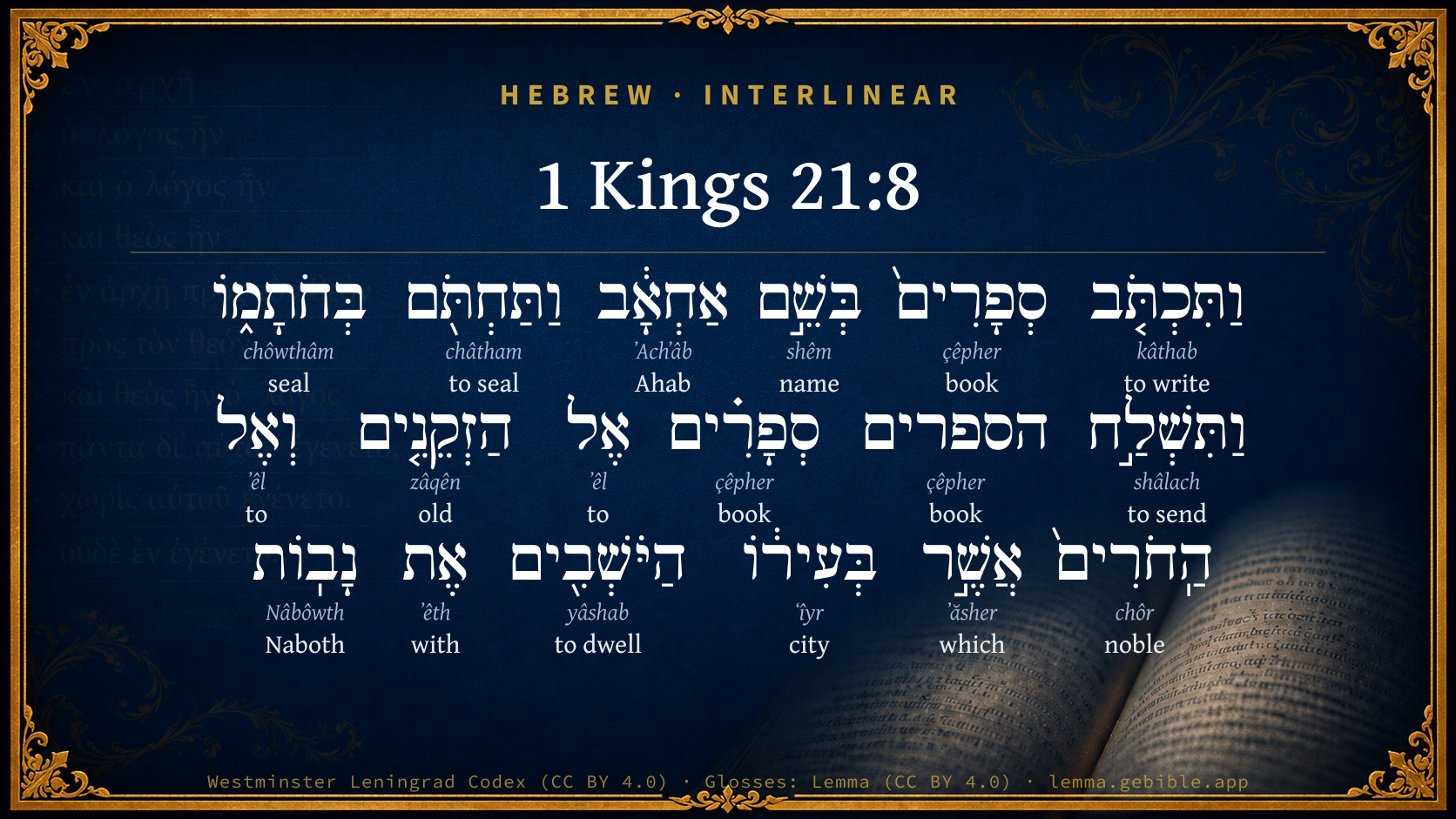
Hebrew (Westminster Leningrad Codex) 1 Kings 21:8 appears in the Hebrew Old Testament. The text above is from the Westminster Leningrad Codex. Each word links to its Strong’s number, a concise gloss, and parsing drawn from the Open Scriptures Hebrew Bible morphology. Click any word for its full Brown-Driver-Briggs (BDB) entry.
Download image
Cite this verse

1 Kings 21:8 (World English Bible). Public Domain. Lemma interlinear Bible study tool, https://lemma.gebible.app/v/1-kings/21/8.

Show BibTeX & RIS
BibTeX
RIS
English Translation
So she wrote letters in Ahab's name, and sealed them with his seal, and sent the letters to the elders and to the nobles who were in his city, [and] who lived with Naboth.
World English Bible · Public Domain
Highlights Full analysis ↓
Download a study sheet

One document with this verse’s original text, its word-by-word gloss line, the meaning frame, cross-references with their text, attributed commentary, and full source and license credits — printable, and it pastes into notes with its structure intact.

This verse Autodidact and up

Study sheet (.html) Plain text (.txt)

A passage Seminary Student

Up to 50 verses in one chapter. A passage sheet keeps up to 6 commentary sources and 12 cross-references per verse, in the order this page ranks them, and says so on the sheet whenever that leaves anything out. Ask for a single verse and you get the Autodidact verse sheet above.

Everything on this page stays free to read, with no account — the sheet is a download of what is already on screen, not access to it.

Want to remove ads? Support Godless Engineer
Compare translations 3

The same verse in 3 English versions, stacked beneath the original-language interlinear above. Click any original word for its lexicon entry.

Each is an independent rendering of the whole verse — the interlinear is not word-aligned to these translations.

Highlighted words mark where these versions differ — a whole-verse word diff, not a word-by-word alignment.

  • World English Bible Public Domain
    So she wrote letters in Ahab's name, and sealed them with his seal, and sent the letters to the elders and to the nobles who were in his city, [and] who lived with Naboth.
  • King James Version Public Domain
    So she wrote letters in Ahab's name, and sealed them with his seal, and sent the letters unto the elders and to the nobles that were in his city, dwelling with Naboth.
  • unfoldingWord Literal Text CC BY-SA 4.0
    And she wrote letters in the name of Ahab, and she sealed with his seal. And she sent the letters to the elders and to the nobles who in his city, the dwellers with Naboth.

unfoldingWord Literal Text — © unfoldingWord, licensed CC BY-SA 4.0. Word-aligned USFM3 via Door43 (git.door43.org/unfoldingWord/en_ult).

Versions to compare (up to 4)

3 of 4 selected

Show all 18 translations

Every available English version of this verse, each an independent rendering of the whole verse.

  • World English Bible Public Domain
    So she wrote letters in Ahab's name, and sealed them with his seal, and sent the letters to the elders and to the nobles who were in his city, [and] who lived with Naboth.
  • Berean Standard Bible Public Domain
    Then Jezebel wrote letters in Ahab’s name, sealed them with his seal, and sent them to the elders and nobles who lived with Naboth in his city.
  • Majority Standard Bible Public Domain
    Then Jezebel wrote letters in Ahab’s name, sealed them with his seal, and sent them to the elders and nobles who lived with Naboth in his city.
  • King James Version Public Domain
    So she wrote letters in Ahab's name, and sealed them with his seal, and sent the letters unto the elders and to the nobles that were in his city, dwelling with Naboth.
  • American Standard Version (1901) Public Domain
    So she wrote letters in Ahab's name, and sealed them with his seal, and sent the letters unto the elders and to the nobles that were in his city, `and' that dwelt with Naboth.
  • Revised Version (1885) Public Domain
    So she wrote letters in Ahab’s name, and sealed them with his seal, and sent the letters unto the elders and to the nobles that were in his city, and that dwelt with Naboth.
  • Geneva Bible (1599) Public Domain
    So she wrote letters in Ahabs name, and sealed them with his seale, and sent the letters vnto the Elders, and to the nobles that were in his citie dwelling with Naboth.
  • Douay-Rheims (1899) Public Domain
    So she wrote letter's in Achab's name, and sealed them with his ring, and sent them to the ancients, and the chief men that were in his city, and that dwelt with Naboth.
  • Young's Literal Translation Public Domain
    And she writeth letters in the name of Ahab, and sealeth with his seal, and sendeth the letters unto the elders, and unto the freemen, who are in his city, those dwelling with Naboth,
  • Literal Standard Version CC BY-SA 4.0
    And she writes letters in the name of Ahab, and seals with his seal, and sends the letters to the elderly and to the nobles who are in his city, those dwelling with Naboth,
  • Unlocked Literal Bible CC BY-SA 4.0
    So Jezebel wrote letters in Ahab's name, sealed them with his seal, and sent them to the elders and to the wealthy who sat with him in meetings, and who lived near Naboth.
  • unfoldingWord Literal Text CC BY-SA 4.0
    And she wrote letters in the name of Ahab, and she sealed with his seal. And she sent the letters to the elders and to the nobles who in his city, the dwellers with Naboth.
  • Darby Bible Public Domain
    And she wrote a letter in Ahab's name, and sealed it with his seal, and sent the letter to the elders and to the nobles that were in his city, dwelling with Naboth.
  • World Messianic Bible Public Domain
    So she wrote letters in Ahab’s name and sealed them with his seal, and sent the letters to the elders and to the nobles who were in his city, who lived with Naboth.
  • Webster's Bible Public Domain
    So she wrote letters in Ahab's name, and sealed them with his seal, and sent the letters to the elders and to the nobles that were in his city, dwelling with Naboth.
  • Free Bible Version CC BY-SA 4.0
    So she wrote some letters in Ahab's name and sealed them with his seal. She sent the letters to the elders and leaders in the town where Naboth lived.
  • Bible in Basic English Public Domain
    So she sent a letter in Ahab's name, stamped with his stamp, to the responsible men and the chiefs who were in authority with Naboth.
  • JPS Tanakh (1917) Public Domain
    So she wrote letters in Ahab's name, and sealed them with his seal, and sent the letters unto the elders and to the nobles that were in his city, and that dwelt with Naboth.

Literal Standard Version (2020), Covenant Press — licensed CC BY-SA 4.0. Text via the HelloAO Bible API (eBible.org). Unlocked Literal Bible (unfoldingWord) — licensed CC BY-SA 4.0. Text via the HelloAO Bible API (eBible.org). unfoldingWord Literal Text — © unfoldingWord, licensed CC BY-SA 4.0. Word-aligned USFM3 via Door43 (git.door43.org/unfoldingWord/en_ult). Free Bible Version, Dr. Jonathan Gallagher — licensed CC BY-SA 4.0. Text via the HelloAO Bible API (eBible.org).

Word by word

More ways to search: Search by grammar → Find every occurrence → Compare this word →

Practice this passage: Drill this verse → Learn its vocabulary →

הַֽחֹרִים֙
chôr
H2715
“the · nobles”
Particle, Definite Article + Noun, Common, Masculine, Plural, Absolute
Part of Speech
Particle + Noun
Type
Common
Gender
Masculine
Number
Plural
State
Absolute
Full BDB Definition

Origin: from H2787

TWOT: 757a

a noble, freeborn one
  1. וַתִּכְתֹּ֤ב kâthab H3789 “and · to write” Conjunction + Verb, Qal, Sequential Imperfect, 3rd Person, Feminine, Singular
  2. סְפָרִים֙ çêpher H5612 “books” Noun, Common, Masculine, Plural, Absolute
  3. בְּשֵׁ֣ם shêm H8034 “in/at · name of” Preposition + Noun, Common, Masculine, Singular, Construct
  4. אַחְאָ֔ב ʼAchʼâb H256 “Ahab” Noun, Proper
  5. וַתַּחְתֹּ֖ם châtham H2856 “and · to seal” Conjunction + Verb, Qal, Sequential Imperfect, 3rd Person, Feminine, Singular
  6. בְּחֹתָמ֑וֹ chôwthâm H2368 “in/at · seal · his” Preposition + Noun, Common, Masculine, Singular, Construct + Suffix, Personal, 3rd Person, Masculine, Singular
  7. וַתִּשְׁלַ֣ח shâlach H7971 “and · to send” Conjunction + Verb, Qal, Sequential Imperfect, 3rd Person, Feminine, Singular
  8. הספרים çêpher H5612 “the · books” Particle, Definite Article + Noun, Common, Masculine, Plural, Absolute
  9. סְפָרִ֗ים çêpher H5612 “books” Noun, Common, Masculine, Plural, Absolute
  10. אֶל ʼêl H413 “to” Preposition
  11. הַזְקֵנִ֤ים zâqên H2205 “the · old” Particle, Definite Article + Adjective, Adjective, Masculine, Plural, Absolute
  12. וְאֶל ʼêl H413 “and · to” Conjunction + Preposition
  13. אֲשֶׁ֣ר ʼăsher H834 “which” Particle, Relative
  14. בְּעִיר֔וֹ ʻîyr H5892 “in/at · city · his” Preposition + Noun, Common, Feminine, Singular, Construct + Suffix, Personal, 3rd Person, Masculine, Singular
  15. הַיֹּשְׁבִ֖ים yâshab H3427 “the · dwelling” Particle, Definite Article + Verb, Qal, Participle Active, Masculine, Plural, Absolute
  16. אֶת ʼêth H854 “with” Preposition
  17. נָבֽוֹת Nâbôwth H5022 “Naboth” Noun, Proper

About this verse

These counts appear in no published source. They are computed here, from the morphology-tagged text and Lemma’s own curated glosses. What Lemma adds →

18
words
15
distinct lemmas
Historical
section

Notable vocabulary

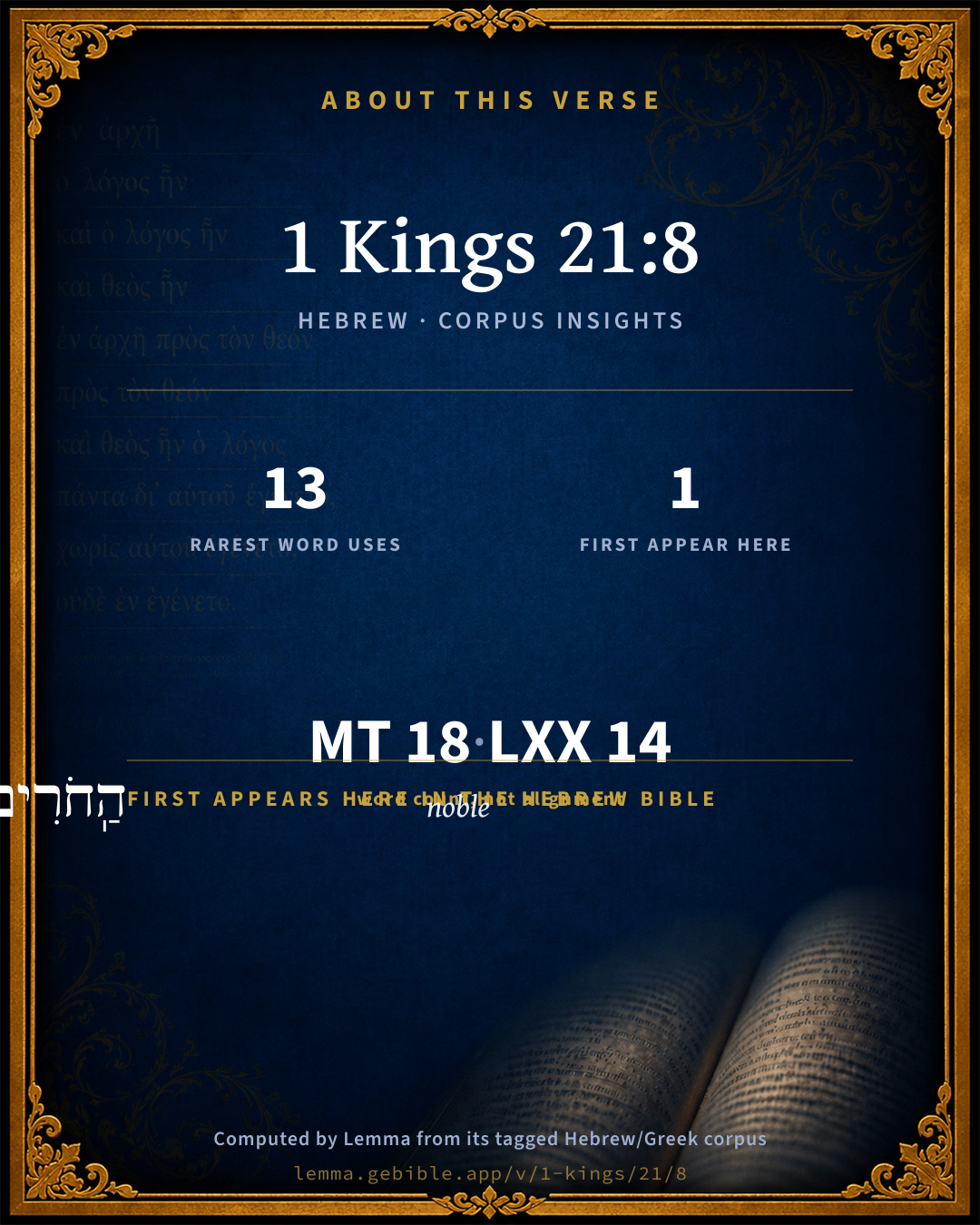
The rarest word here is הַֽחֹרִים֙ noble H2715 — appearing just 13 times in the whole Hebrew Bible.

First appearance in Scripture

This word makes its first canonical appearance in the Hebrew Bible here:

  • הַֽחֹרִים֙ noble H2715

Shared distinctive vocabulary

הַֽחֹרִים֙ noble H2715 occurs in 13 verses of the Hebrew Bible. Also found in:

Grammatical profile

  • 4 verbs
  • 9 nouns
  • 1 adjective
  • 3 prepositions
  • 1 particle

Verb forms

  • וַתִּכְתֹּ֤ב Qal · Sequential Imperfect
  • וַתַּחְתֹּ֖ם Qal · Sequential Imperfect
  • וַתִּשְׁלַ֣ח Qal · Sequential Imperfect
  • הַיֹּשְׁבִ֖ים Qal · Participle Active

Repetition

Words recur within this verse — often emphatic in Hebrew:

  • סְפָרִים֙ book H5612 ×3
  • אֶל to H413 ×2

Hebrew & Septuagint length

In English translation the verse runs 34 words from the Hebrew and 15 from the Septuagint (LXX English) — the Septuagint runs noticeably shorter here. See the side-by-side →

A rough comparison of the two English renderings, which tokenize alike — not a word-level alignment.

Word counts can differ between the Hebrew and the Greek without any difference in meaning — e.g. the Hebrew direct-object marker אֵת has no separate Greek word, and Greek often adds the article ὁ.

In the original languages it is 18 Hebrew tokens and 14 Greek tokens — but the two are counted differently (Hebrew bundles its prefixes and suffixes into one token; the Greek is in lemma form), so that isn’t a like-for-like length.

Cross-references

14

Topical passages linked to 1 Kings 21:8 in the Treasury of Scripture Knowledge — connected by theme and wording, ordered by reader-vote popularity; previews shown in the World English Bible.

  • Numbers 11:16 Yahweh said to Moses, Gather to me seventy men of the elders of Israel, whom you know to be the elders of the people, and officers over them; and bring them to the tent of meeting, that they may stand there with you.
  • Deuteronomy 16:18–19 Judges and officers shall you make you in all your gates, which Yahweh your God gives you, according to your tribes; and they shall judge the people with righteous judgment.
  • Deuteronomy 21:1–9 If one be found slain in the land which Yahweh your God gives you to possess it, lying in the field, and it isn't known who has struck him;
  • 2 Samuel 11:14–15 It happened in the morning, that David wrote a letter to Joab, and sent it by the hand of Uriah.
  • 1 Kings 20:7 Then the king of Israel called all the elders of the land, and said, Please notice how this man seeks mischief: for he sent to me for my wives, and for my children, and for my silver, and for my gold; and I didn't deny him.
  • 1 Kings 21:1 It happened after these things, that Naboth the Jezreelite had a vineyard, which was in Jezreel, hard by the palace of Ahab king of Samaria.
  • 2 Kings 10:1–7 Now Ahab had seventy sons in Samaria. Jehu wrote letters, and sent to Samaria, to the rulers of Jezreel, even the elders, and to those who brought up [the sons of] Ahab, saying,
  • 2 Kings 10:11 So Jehu struck all that remained of the house of Ahab in Jezreel, and all his great men, and his familiar friends, and his priests, until he left him none remaining.
  • 2 Chronicles 32:17 He wrote also letters, to rail on Yahweh, the God of Israel, and to speak against him, saying, As the gods of the nations of the lands, which have not delivered their people out of my hand, so shall the God of Hezekiah not deliver his people out of my hand.
  • Ezra 4:7–8 In the days of Artaxerxes wrote Bishlam, Mithredath, Tabeel, and the rest of his companions, to Artaxerxes king of Persia; and the writing of the letter was written in the Syrian [character], and set forth in the Syrian [language].
  • Ezra 4:11 This is the copy of the letter that they sent to Artaxerxes the king: Your servants the men beyond the River, and so forth.
  • Nehemiah 6:5 Then sent Sanballat his servant to me in like manner the fifth time with an open letter in his hand,
  • Esther 3:12–15 Then were the king's scribes called in the first month, on the thirteenth day of it; and there was written according to all that Haman commanded to the king's satraps, and to the governors who were over every province, and to the princes of every people, to every province according to the writing of it, and to every people after their language; in the name of king Ahasuerus was it written, and it was sealed with the king's ring.
  • Esther 8:8–13 Write you also to the Jews, as it pleases you, in the king's name, and seal it with the king's ring; for the writing which is written in the king's name, and sealed with the king's ring, may no man reverse.

Cross-references courtesy of OpenBible.info (CC BY 4.0).

Hebrew and Greek witnesses Masoretic Hebrew ↔ Greek Septuagint

The same verse in the two great witnesses to the Old Testament, shown verse-for-verse.

Here the Septuagint runs noticeably shorter than the Hebrew — LXX2012 (modern English Septuagint) 15 words vs World English Bible 34. A rough length comparison of the two English translations, not a word-level alignment — read both below.

These are two independent witnesses, not word-aligned to each other, and the Septuagint is shown in lemma (dictionary) form.

Hebrew 1 Kings 21:8 Masoretic · Westminster Leningrad Codex

וַתִּכְתֹּ֤ב סְפָרִים֙ בְּשֵׁ֣ם אַחְאָ֔ב וַתַּחְתֹּ֖ם בְּחֹתָמ֑וֹ וַתִּשְׁלַ֣ח הספרים סְפָרִ֗ים אֶל הַזְקֵנִ֤ים וְאֶל הַֽחֹרִים֙ אֲשֶׁ֣ר בְּעִיר֔וֹ הַיֹּשְׁבִ֖ים אֶת נָבֽוֹת

So she wrote letters in Ahab's name, and sealed them with his seal, and sent the letters to the elders and to the nobles who were in his city, [and] who lived with Naboth.

World English Bible · Public Domain

Greek LXX 1 Kings 21:8 Septuagint · lemma form

καί εἶπον αὐτός ὁ πρεσβύτερος καί πᾶς ὁ λαός μή ἀκούω καί μή θέλω

And the elders and all the people said to him, Listen not, and consent not.

LXX2012 (modern English Septuagint) · Public Domain

On this verse, The Cambridge Bible for Schools and Colleges discusses the Septuagint’s reading. Read the note in Commentary ↓

Hebrew: Westminster Leningrad Codex (CC BY 4.0). Greek: Septuagint (public domain); English from LXX2012 (modern English Septuagint) (Public Domain). How the Septuagint differs from the Hebrew →

Targum (Aramaic paraphrase)

1

The Targum is the ancient Jewish Aramaic paraphrase of the Hebrew Scriptures — an interpretive translation, not the Hebrew text itself. Onkelos (literal) and Pseudo-Jonathan (expansive) render the Torah, and Jonathan the Prophets. Coverage is partial: where no permissively-licensed English translation exists for a verse, only the Aramaic is shown. This is verse-level text, not a word-by-word alignment to the Hebrew.

  1. Targum Jonathan Prophets (Joshua–Malachi)
    וּכְתָבַת אִגַרְתָּא בִּשְׁמָא דְאַחְאָב וַחֲתָמַת בְּעִזְקְתֵיהּ וְשַׁדְרַת אִגְרָן לְסָבַיָא וּלְתוּרְבְּיָנֵי דִבְקַרְתָּא דְיַתְבִין עִם נָבוֹת:

    (no public-domain English translation for this verse)

    Targum Jonathan — Aramaic: “Mikraot Gedolot” (public domain). English: “Sefaria Community Translation” (CC0 1.0 (public-domain dedication)); “London "Chaldee Paraphrase," 1871” (public domain). Text via Sefaria.

Commentary

Notes on 1 Kings 21:8 from classic Christian and Jewish commentators (each source and its license shown beneath its notes). The classic Christian expositions comment on the surrounding passage and are grouped to its opening verse, so a note may address several verses; the Jewish commentaries on the Tanakh (Rashi and others) are per-verse, so they appear only where the commentator wrote on this verse.

Lemma curates 59 commentaries, every one of them public domain or Creative Commons licensed, each selected and text-cleaned for this edition rather than reprinted as found. About our sources →

Trapp's Complete Commentary

John Trapp

1Ki 21:8 So she wrote letters in Ahab’s name, and sealed [them] with his seal, and sent the letters unto the elders and to the nobles that [were] in his city, dwelling with Naboth.

Ver. 8. So she wrote letters in Ahab’s name, and sealed them with his seal.] She was king, and he queen, as was afore noted; she wrought upon his impotencies, and did what she listed. The he-viper putteth his head into the she-viper’s mouth, and she biteth it off: so the uxorious person parteth with his authority.

Unto the elders.] Who were her creatures likely, and therefore so morigerous.

John Trapp, A Commentary or Exposition upon All the Books of the Old and New Testament (1647–1656) — public domain. Text from a community e-Sword module.

Joseph Benson's Commentary

1Ki 21:8. She sent the letters unto the elders and nobles — Whom she very well knew to be fit for her purpose; that were in his city — In Jezreel. Thus she seeks to destroy him with a pretence of justice, and with as little reflection on Ahab as might be.

Joseph Benson's Commentary on the Old and New Testaments (1811–1818) — public domain. Text from a community e-Sword module.

Tyndale Open Study Notes

Tyndale Open Resources

21:8-9 Call the citizens together: This kind of assembly would normally address sin that could bring divine judgment against the people (see Deut 21:1-9; Josh 7:10-12; 1 Sam 7:1-6). Jezebel convened it to bring false charges against an innocent person.

Tyndale Open Study Notes — © Tyndale Open Resources, licensed CC BY-SA 4.0. Text via the HelloAO Bible API.

Jamieson, Fausset & Brown

Robert Jamieson, A. R. Fausset & David Brown

So she wrote letters in Ahab's name, and sealed them with his seal--The seal-ring contained the name of the king and gave validity to the documents to which it was affixed (Est 8:8; Dan 6:17). By allowing her the use of his signet-ring, Ahab passively consented to Jezebel's proceeding. Being written in the king's name, it had the character of a royal mandate.

sent the letters unto the elders and to the nobles that were in his city--They were the civic authorities of Jezreel, and would, in all likelihood, be the creatures and fit tools of Jezebel. It is evident that, though Ahab had recently been in Jezreel, when he made the offer to Naboth, both he and Jezebel were now in Samaria (Kg1 20:43).

Jamieson, Fausset & Brown — Commentary Critical and Explanatory on the Whole Bible (1871) — public domain (CC PDM 1.0). Text via the HelloAO Bible API.

Adam Clarke's Commentary

Verse 8. She wrote letters in Ahab's name] She counterfeited his authority by his own consent; and he lent his signet to stamp that authority.

Adam Clarke's Commentary on the Bible (1810–1826) — public domain. Text from a community e-Sword/MySword module.

Ellicott's Commentary for English Readers

(8) Sealed them with his seal—with the name, or token, of the king, engraved on stone, and impressed (see Job_38:14) on a lump of clay attached to the letter. The sealing (as the modern sense of “signature” implies) was the pledge of authenticity and authority. (See Gen_38:18; Neh_9:38; Neh_10:1; Est_3:10; Est_3:12, Dan_6:17, &c.) The use of the seal—ordinarily worn or carried on the person—implies Ahab’s knowledge that something is being done in his name, into which he takes care not to inquire.

In his city.—This would be most naturally interpreted as Jezreel; but if Naboth dwelt or sojourned at Samaria, it may be Samaria. Jezebel naturally desires that neither Ahab nor she herself, though close at hand, should appear in the matter; but gives the necessary authority in writing, because without it the deed could not be done.

A Bible Commentary for English Readers, edited by Charles John Ellicott (1878–1897) — public domain. Text from a community e-Sword module.

The Cambridge Bible for Schools and Colleges

gen. ed. J. J. S. Perowne

8. she wrote letters in Ahab’s name] She was the real ruler, he only king in name. The letters would be prepared for her by the royal secretaries. Jezebel’s part was to take the signet ring of her husband, and therewith affix the royal seal that the document might go forth with authority. Apparently Ahab asked no question about the means which his wife meant to employ.

the elders and to the nobles] The law ordered (Deu_16:18) that there should be judges appointed in every city, and we cannot doubt the existence of such a tribunal in a place so important as Jezreel, where the elders and nobles would form the bench of magistrates. The sequel shews that for such an offence as that charged against Naboth they had the power of life and death. But the whole proceeding is very Oriental. The royal letter dictates the sentence, and how it is to be obtained, and the persons to whom it is addressed make no scruple about obeying, although the last words of this verse increase the enormity of their proceeding by telling that they ‘were in his city, dwelling with Naboth’, and so it would seem well acquainted with his character.

The words ‘in his city’ are omitted in the LXX.

The Cambridge Bible for Schools and Colleges (gen. ed. J. J. S. Perowne; Cambridge University Press, 1878–1918) — public domain. Text from a community e-Sword module.

John Gill's Exposition

And set two men, sons of Belial, before him, to bear witness against him,.... Worthless wretches, that have cast off the yoke of the law, as Belial signifies, lawless abandoned creatures, that have no conscience of anything; "knights of the post", as we call them, that will swear anything; these were to be set before Naboth, right against him to confront him, and accuse him to his face, and charge him with crimes next mentioned:

saying, thou didst blaspheme God and the king: and so was guilty of death for the former, if not for both, and of confiscation of estate for the latter, which was the thing aimed at; and Jezebel was willing to make sure work of it, and therefore would have him accused of both:

and then carry him out, and stone him, that he die; immediately, without requiring the witnesses to give proof of their charge, and without giving Naboth leave to answer for himself.

John Gill's Exposition of the Whole Bible (1746–1763) — public domain (CC PDM 1.0). Text via the HelloAO Bible API.

Albert Barnes' Notes on the Bible

Seal - The seal is a very ancient invention. Judah’s signet and Pharaoh’s signet-ring are mentioned in Genesis Gen 38:18; Gen 41:42. Signets of Egyptian kings have been found which are referred to about 2000 B.C. Sennacherib’s signet, and an impression of Sargon’s, are still extant. There can be no doubt that in the East, from a very remote antiquity, kings had seals and appended them to all documents which they set forth under their authority. (Compare also Est 3:12; Est 8:8; Dan 6:17). The Hebrew mode of sealing seems to have been by attaching a lump of clay to the document, and impressing the seal thereupon Job 38:14.

His city - i. e., Jezreel 1Ki 21:1. The mode in which it is spoken of here, and in 1Ki 21:11, seems to imply that it was not the city from which Jezebel wrote. The court was evidently at this time residing at Samaria 1Ki 20:43; and Ahab may either have met Naboth there, or have gone down (compare 1Ki 21:16) to Jezreel to make his request, and then, on being refused, have returned to Samaria. The distance is not more than seven miles.

Albert Barnes' Notes on the Bible (1834–1885) — public domain. Text from a community e-Sword/MySword module.

Haydock's Catholic Bible Commentary

Chief men. Hebrew chorim, "those in white," the usual colour of magistrates and noblemen, Ecclesiastes ix. 8., and Daniel vii. 9. The angels generally appear arrayed in white. Among the Egyptians and the Greeks, the rich were remarkable for the whiteness of their robes. (Herodotus ii. 36.) (Homer, Odyssey z.)

George Leo Haydock (1774–1849), Haydock's Catholic Family Bible and Commentary, 1859 edition — public domain. Excludes Psalms (Douay-Rheims chapter numbering differs from Protestant) and Deuterocanonical books (Catholic canon only).

Matthew Poole's English Annotations

Whom she very well knew to be fit for her purpose.

In his city, i.e. in Jezreel. So she seeks to destroy him with a pretence of justice, and with as little reflection upon Ahab as might be.

Matthew Poole's English Annotations on the Holy Bible (1683–1685) — public domain. Text from a community e-Sword/MySword module.

Whedon's Commentary on the Bible

Daniel D. Whedon

8. Sealed them with his seal — “In giving validity to documents, names were not in those days, nor are they now in the East, signed by the hand in writing, but impressed by a seal on which the name is engraved. Hence the importance which is attached to the signet throughout the sacred books.” — Kitto.

Daniel D. Whedon (gen. ed.), Commentary on the Old and New Testaments (1874–1909) — public domain. Text from a community e-Sword module.

The Pulpit Commentary

So she wrote letters Heb. writings in Ahab"s name, and sealed them with his seal The use of the seal, for the purpose of authentication, is of great antiquity. Some of the Egyptian signets are more than 4, 000 years old. Their use in the age of the patriarchs is attested by Gen_38:15 and 41:42; their importance is proved by the text, by Est_3:10 Est_8:2, Est_8:8, 10 (cf. "Herod," 3:128); Dan_6:17; Jer_32:10; Hag_2:23, etc. Whether this seal which does not necessarily prove that those who used it could not write was impressed upon the writings themselves according to the modern practice of the East, or upon a piece of clay, (Job_38:14) which was then attached to the letter by strings, we have no means of knowing. The use of Ahab"s seal affords a strong presumption that he was privy to her designs (Bahr), but of this we cannot be absolutely certain, and sent the letters unto the elders see Deu_16:18 and to the nobles same Neh_2:16 Neh_4:13; Ecc_10:17 that were in his city, dwelling or inhabitants, as in ver. 11 with Naboth.

The Pulpit Commentary (1880–1919), ed. H.D.M. Spence-Jones & Joseph S. Exell — public domain. Text from a community e-Sword module.

unfoldingWord translationNotes

Door43 World Missions Community

wrote letters in Ahab's name

Possible meanings are 1) she wrote Ahab's name on the letters. AT: "wrote letters and signed them with Ahab's name" or 2) the word "name" is a metonym for authority. AT: "wrote letters on behalf of Ahab" (See: Metonymy)

the wealthy who sat with him

The word "wealthy" refers to wealthy people. AT: "the wealthy people who sat with Naboth" (See: Nominal Adjectives)

seat Naboth above the people

Having Naboth sit in a place of honor is spoken of as if it were having him sit above the rest of the people who were present. AT: "have Naboth sit in a place of honor among the people" (See: Metaphor)

let them testify against him

"have them accuse him"

translationWords

epistle

Ahab

name

seal

send

elder

life

preach

fast

testimony

curse

God

king

stone

die

unfoldingWord translationNotes — © Distant Shores Media and the Door43 World Missions Community, licensed CC BY-SA 4.0. Source: git.door43.org/Door43/en_tn.

Rashi

Rabbi Shlomo Yitzchaki (Rashi)

To the elders. Wicked elders, elders of shame.

Rashi on the Tanakh — English translations: “The Judaica Press complete Tanach with Rashi, translated by A. J. Rosenberg” (CC BY 4.0); “Pentateuch with Rashi's commentary by M. Rosenbaum and A.M. Silbermann, 1929-1934” (public domain); “The Metsudah Tanach series, Lakewood, N.J” (CC BY 4.0); and “The Book of Joshua, Metsudah Publications, 1997” (CC BY 4.0). Text via Sefaria.

Lesson kit

Teaching starters — assembled from the data on this page, not authored interpretation. Every prompt links to the verse data it draws on. Edit before teaching.

1 Kings, in the Historical, opens this verse with 18 words (15 distinct Hebrew lemmas). Its most distinctive word is chôr (“noble”). The Greek Septuagint runs shorter here. A historical commentator’s framing appears above. Read the whole chapter for the surrounding context.

Discussion questions

  1. The word chôr carries the sense “noble.” How does it shape the verse?
  2. The word “noble” first appears here in Scripture. What is being introduced at this debut?
  3. 1 Kings 21:11 shares the word «noble» with this verse. How do the two illuminate each other?
  4. “book” occurs 3× in this one verse. What is the effect of the repetition?
  5. Compared with the Hebrew, the Septuagint runs shorter here. What questions does that raise?
  6. The translations on this page render this verse differently — a whole-verse word diff, not a word-by-word alignment. What might account for the different wordings?
  7. The verb «וַתִּכְתֹּ֤ב» is Qal Sequential Imperfect. How does its form color the action?
  8. Reading how Trapp's Complete Commentary and Joseph Benson's Commentary read this verse, where do the two commentators agree and where do they part?

Things to notice

Reading settings

Reading text

Shown beneath each verse's original-language words.

Old Testament
Old Testament edition

Read the OT as the Masoretic Hebrew (MT) or the Greek Septuagint (LXX).

English shown for the Greek Septuagint (in the Hebrew ↔ Greek comparison).

Comparing translations? Open the Compare panel on any verse page to stack up to four side by side.