Romans 9:18

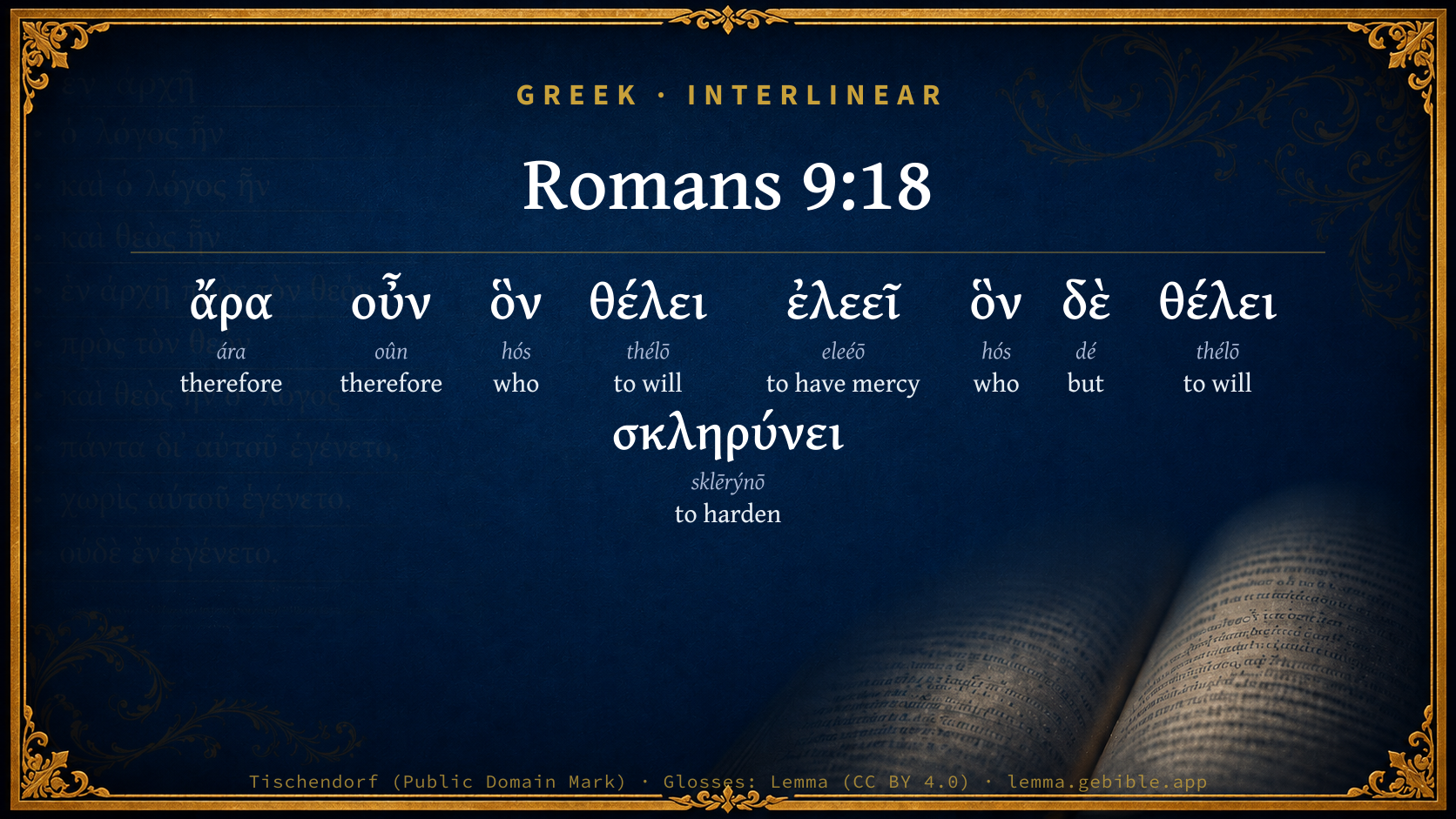
Greek (Tischendorf 8th ed.) Romans 9:18 appears in the Greek New Testament. The text above is from the Tischendorf 8th edition. Each word links to its Strong’s number and a concise gloss. Click any word for its full Thayer’s Greek Lexicon entry.
Download image
Cite this verse

Romans 9:18 (World English Bible). Public Domain. Lemma interlinear Bible study tool, https://lemma.gebible.app/v/romans/9/18.

Show BibTeX & RIS
BibTeX
RIS
English Translation
So then, he has mercy on whom he desires, and he hardens whom he desires.
World English Bible · Public Domain
Download a study sheet

One document with this verse’s original text, its word-by-word gloss line, the meaning frame, cross-references with their text, attributed commentary, and full source and license credits — printable, and it pastes into notes with its structure intact.

This verse Autodidact and up

Study sheet (.html) Plain text (.txt)

A passage Seminary Student

Up to 50 verses in one chapter. A passage sheet keeps up to 6 commentary sources and 12 cross-references per verse, in the order this page ranks them, and says so on the sheet whenever that leaves anything out. Ask for a single verse and you get the Autodidact verse sheet above.

Everything on this page stays free to read, with no account — the sheet is a download of what is already on screen, not access to it.

Want to remove ads? Support Godless Engineer
Compare translations 3

The same verse in 3 English versions, stacked beneath the original-language interlinear above. Click any original word for its lexicon entry.

Each is an independent rendering of the whole verse — the interlinear is not word-aligned to these translations.

Highlighted words mark where these versions differ — a whole-verse word diff, not a word-by-word alignment.

  • World English Bible Public Domain
    So then, he has mercy on whom he desires, and he hardens whom he desires.
  • King James Version Public Domain
    Therefore hath he mercy on whom he will have mercy, and whom he will he hardeneth.
  • unfoldingWord Literal Text CC BY-SA 4.0
    So then, he has mercy on whom he wills, but whom he wills, he hardens.

unfoldingWord Literal Text — © unfoldingWord, licensed CC BY-SA 4.0. Word-aligned USFM3 via Door43 (git.door43.org/unfoldingWord/en_ult).

Versions to compare (up to 4)

3 of 4 selected

Show all 19 translations

Every available English version of this verse, each an independent rendering of the whole verse.

  • World English Bible Public Domain
    So then, he has mercy on whom he desires, and he hardens whom he desires.
  • Berean Standard Bible Public Domain
    Therefore God has mercy on whom He wants to have mercy, and He hardens whom He wants to harden.
  • Majority Standard Bible Public Domain
    Therefore God has mercy on whom He wants to have mercy, and He hardens whom He wants to harden.
  • King James Version Public Domain
    Therefore hath he mercy on whom he will have mercy, and whom he will he hardeneth.
  • American Standard Version (1901) Public Domain
    So then he hath mercy on whom he will, and whom he will be hardeneth.
  • Revised Version (1885) Public Domain
    So then he hath mercy on whom he will, and whom he will he hardeneth.
  • Geneva Bible (1599) Public Domain
    Therefore he hath mercie on whome he will, and whom he will, he hardeneth.
  • Douay-Rheims (1899) Public Domain
    Therefore he hath mercy on whom he will; and whom he will, he hardeneth.
  • Young's Literal Translation Public Domain
    so, then, to whom He willeth, He doth kindness, and to whom He willeth, He doth harden.
  • Literal Standard Version CC BY-SA 4.0
    so then, to whom He wills, He does kindness, and to whom He wills, He hardens.
  • Unlocked Literal Bible CC BY-SA 4.0
    So then, God has mercy on whom he wishes, and whom he wishes, he makes stubborn.
  • unfoldingWord Literal Text CC BY-SA 4.0
    So then, he has mercy on whom he wills, but whom he wills, he hardens.
  • Darby Bible Public Domain
    So then, to whom he will he shews mercy, and whom he will he hardens.
  • World Messianic Bible Public Domain
    So then, he has mercy on whom he desires, and he hardens whom he desires.
  • Webster's Bible Public Domain
    Therefore he hath mercy on whom he will have mercy, and whom he will he hardeneth.
  • Free Bible Version CC BY-SA 4.0
    So God is merciful to those he wishes to be, and hardens the attitude of those he wants to.
  • Bible in Basic English Public Domain
    So then, at his pleasure he has mercy on a man, and at his pleasure he makes the heart hard.
  • Text-Critical English NT CC BY 4.0
    So then, God has mercy on whom he wants to have mercy, and he hardens whom he wants to harden.
  • Tyndale New Testament (1534) Public Domain
    So hath he mercye on whom he will and whom he will he maketh hearde herted.

Literal Standard Version (2020), Covenant Press — licensed CC BY-SA 4.0. Text via the HelloAO Bible API (eBible.org). Unlocked Literal Bible (unfoldingWord) — licensed CC BY-SA 4.0. Text via the HelloAO Bible API (eBible.org). unfoldingWord Literal Text — © unfoldingWord, licensed CC BY-SA 4.0. Word-aligned USFM3 via Door43 (git.door43.org/unfoldingWord/en_ult). Free Bible Version, Dr. Jonathan Gallagher — licensed CC BY-SA 4.0. Text via the HelloAO Bible API (eBible.org).

Word by word

More ways to search: Search by grammar → Find every occurrence → Compare this word →

Practice this passage: Drill this verse → Learn its vocabulary →

About this verse

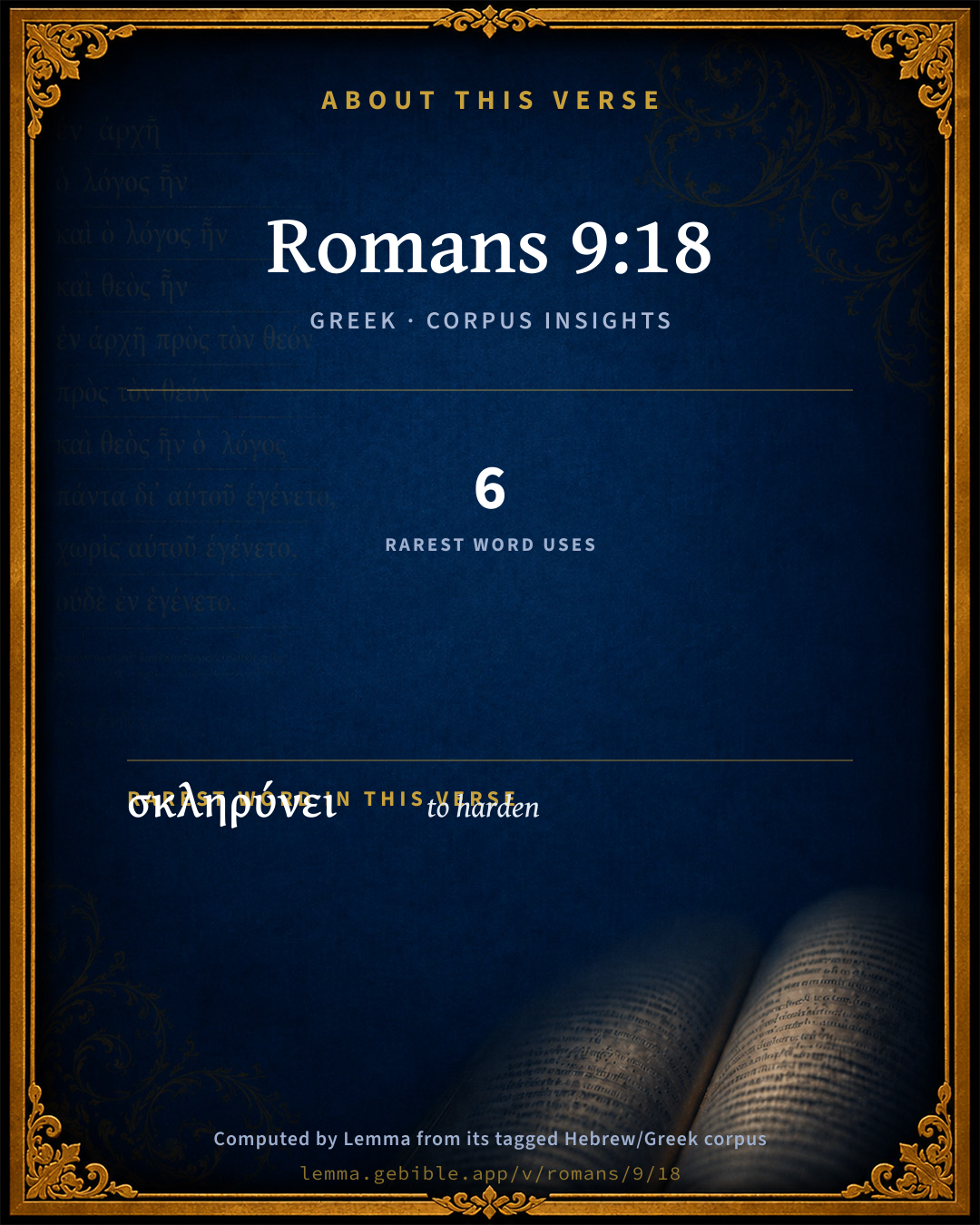
These counts appear in no published source. They are computed here, from the morphology-tagged text and Lemma’s own curated glosses. What Lemma adds →

9
words
7
distinct lemmas
Pauline Epistles
section

Notable vocabulary

The rarest word here is σκληρύνει to harden G4645 — appearing just 6 times in the whole Greek New Testament.

Shared distinctive vocabulary

σκληρύνει to harden G4645 occurs in 6 verses of the Greek New Testament. Also found in:

Repetition

Words recur within this verse:

  • θέλει to will G2309 ×2
  • ὃν who G3739 ×2

Cross-references

12

Topical passages linked to Romans 9:18 in the Treasury of Scripture Knowledge — connected by theme and wording, ordered by reader-vote popularity; previews shown in the World English Bible.

  • Exodus 4:21 Yahweh said to Moses, "When you go back into Egypt, see that you do before Pharaoh all the wonders which I have put in your hand, but I will harden his heart and he will not let the people go.
  • Joshua 11:20 For it was of Yahweh to harden their hearts, to come against Israel in battle, that he might utterly destroy them, that they might have no favor, but that he might destroy them, as Yahweh commanded Moses.
  • Romans 9:15–16 For he said to Moses, "I will have mercy on whom I have mercy, and I will have compassion on whom I have compassion."
  • Romans 11:7–8 What then? That which Israel seeks for, that he didn't obtain, but the chosen ones obtained it, and the rest were hardened.
  • 2 Thessalonians 2:10–12 and with all deception of wickedness for those who are being lost, because they didn't receive the love of the truth, that they might be saved.
  • Deuteronomy 2:30 But Sihon king of Heshbon would not let us pass by him; for Yahweh your God hardened his spirit, and made his heart obstinate, that he might deliver him into your hand, as at this day.
  • Romans 5:20–21 The law came in besides, that the trespass might abound; but where sin abounded, grace did abound more exceedingly;
  • Exodus 7:13 Pharaoh's heart was hardened, and he didn't listen to them; as Yahweh had spoken.
  • Isaiah 63:17 O Yahweh, why do you make us to err from your ways, and harden our heart from your fear? Return for your servants' sake, the tribes of your inheritance.
  • Acts 28:26–28 saying, 'Go to this people, and say, In hearing, you will hear, But will in no way understand. In seeing, you will see, But will in no way perceive.
  • Romans 1:24–28 Therefore God also gave them up in the lusts of their hearts to uncleanness, that their bodies should be dishonored among themselves,
  • Matthew 13:14–15 In them the prophecy of Isaiah is fulfilled, which says, 'By hearing you will hear, And will in no way understand; Seeing you will see, And will in no way perceive:

Cross-references courtesy of OpenBible.info (CC BY 4.0).

Commentary

Notes on Romans 9:18 from classic Christian and Jewish commentators (each source and its license shown beneath its notes). The classic Christian expositions comment on the surrounding passage and are grouped to its opening verse, so a note may address several verses; the Jewish commentaries on the Tanakh (Rashi and others) are per-verse, so they appear only where the commentator wrote on this verse.

Lemma curates 59 commentaries, every one of them public domain or Creative Commons licensed, each selected and text-cleaned for this edition rather than reprinted as found. About our sources →

Tyndale Open Study Notes

Tyndale Open Resources

9:18 he chooses to harden the hearts of others so they refuse to listen: Pharaoh refused to let Israel go because his heart was hardened. God hardened Pharaoh’s heart (Exod 9:12), and Pharaoh hardened his own heart (Exod 8:15).

Tyndale Open Study Notes — © Tyndale Open Resources, licensed CC BY-SA 4.0. Text via the HelloAO Bible API.

Bengel's Gnomon

Johann Albrecht Bengel

Rom 9:18. Ὃν θέλει) whom He will. Moreover, as regards the question, to whom God wills to show mercy, and whom He wills to harden; Paul shows that in other passages.—ἐλεεῖ, has mercy) as for example on Moses.—σκληρύνει, hardens) as He did Pharaoh. He uses, hardens, for, has not mercy, by metonymy of [substituting, for the antecedent,] the consequent, although not to have mercy has a somewhat harsher meaning: so, is sanctified, for, is not unclean, 1Co 7:14; and, you rescued from, [ἐῤῥύσασθε], instead of you did not deliver up. Jos 22:31.

Bengel's Gnomon of the New Testament — English translation (T&T Clark, Edinburgh, 1860) — public domain. Text from a community e-Sword module.

Meyer's Critical & Exegetical Commentary

Heinrich August Wilhelm Meyer

Rom_9:18. Result from Rom_9:15-17.

σκληρύνει] Opposite of ἐλεεῖ, not merely negative like οὐκ ἐλεεῖ (Bengel), but positive: He hardens him, makes him thereby incapable of being a σκεῦος ἐλέους (Rom_9:23). Such an one becomes σκληρός τε καὶ ἀμετάστροφος (Plato, Crat. p. 407 D), σκλ. καὶ ἀπειθής (Plato, Locr. p. 104 C), in a moral respect. Comp. Act_19:9; Heb_3:8; Heb_3:13; Heb_3:15; Heb_4:7; σκληροκαρδία, Mat_19:8; Mar_16:14; Rom_2:5; see also Soph. Aj. 1340, Trach. 1250; Lobeck, ad Aj. p. 384; from the O. T., Umbreit, d. Sünde, p. 113 ff. Rom_9:19 ff. prove that all warping or alteration of this sense of the word is erroneous; that the suggestion, e.g., in Origen and several Fathers, in Grotius, Koppe, Flatt, Klee, Maier, and others, that only the divine permission is intended (comp. Melancthon: Indurat, i. e. sinit esse durum, nec convertit eum), is erroneous; and equally erroneous is the interpretation duriter tractat (Carpzov, Semler, Cramer, Ernesti, Schulthess, Exeg. Forsch. II. p. 136; comp. Beck, p. 75 f.), which is contrary to the signification of the word (also in the LXX. Job_39:16). Evidence to the same effect is supplied by the twofold representation given of the hardening of Pharaoh in Exodus, where it appears partly as self-produced (Exo_8:15; Exo_8:32, Exo_9:34; comp. 1Sa_6:6), partly as effected by God (Rom_4:21, Rom_7:3, Rom_9:12, Rom_10:20-21, Rom_11:10). Of these two ways of regarding the matter, however, Paul, suitably to his object, has expressly adopted the latter; Pharaoh hardened by God is to him the type of all who obstinately withstand the divine counsel of salvation, as Israel does. In opposition to Becks evasive expedients, see Lamping. On the hardening itself Olshausen remarks:(1) That it presupposes already the beginnings of evil. But this is at variance with ὃν θέλει and ἐκ τοῦ αὐτοῦ φυράματος, Rom_9:21. (2) That it is not an aggravation of sin, but a means of preventing its aggravation. But Pharaohs history is against this. (3) That the total hardening is an expression of simple penal justice, when sin has become sin against the Holy Ghost. But in that case there could be no mention of a ὃν θέλει. The clear and simple sense of the apostle is, that it depends on the free determination of Gods will whether to bless with His saving mercy, or, on the other hand, to put into that spiritual condition, in which a man can be no object of His saving mercy (but rather of His ὀργή only). Accordingly, the will of God is here the absolute will, which is only in the ἘΛΕΕῖ a will of grace, and not also in the ΣΚΛΗΡΎΝΕΙ (in opposition to Th. Schott). Of the style and manner in which the older dogmatic interpreters have here introduced qualifying clauses in the interests of opposition to absolute predestination, the development of the matter by Calovius may serve as an example. He maintains, that when it is said that God hardens, this is not to be taken ἘΝΕΡΓΗΤΙΚῶς or effective, but (1) συγχωρητικῶς, propter permissionem; (2) ἈΦΟΡΜΗΤΙΚῶς, propter occasionem, quam ex iis, quae Deus agit, sumunt reprobi; (3) ἐγκαταλειπτικῶς, ob desertionem, quod gratia sua deserat reprobos; (4) ΠΑΡΑΔΟΤΙΚῶς, ob traditionem in sensum reprobum et in ulteriorem Satanae potestatem. But Philippis suggestion of the immanent law which the divine freedom carries within itself,according to which God will have mercy upon him who acknowledges His right to have mercy on whom He will, and to harden whom He will; and will harden him who denies to Him this right,will only then come into consideration by the side of what Paul here says, when (see remarks after Rom_9:33) we are in a position to judge of the relation of our passage and the connection that follows it to the moral self-determination of man, which the apostle teaches elsewhere; seeing that no further guiding hint is here given by Paul, and, moreover, that immanent law of the divine freedom, as Philippi himself frankly recognises, is not at all here expressed. For now the apostle has been most sedulously and exclusively urging nothing but the complete independence of the divine willing in ἐλεεῖν and σκληρύνειν, which the Form. Conc. p. 821 does not duly attend to, when it maintains that Paul desired to represent the hardening of Pharaoh as an example of divine penal justice. Not ut eo ipso Dei justitiam declararet, has Paul adduced this example, although it falls historically under this point of view, but as a proof of the completely free self-determination of God to harden whom He will. Accordingly, the hardening here appears by no means, as has been lately read between the lines, as a consequence of preceding conceited self-righteousness (Tholuck), or such as the man himself has willed it (Th. Schott), or conditioned by the divine standard of holiness confronting human sin (Weiss), or with an obvious presupposition of human self-determination (Beyschlag). Elsewhere the hardening may be adjudged as a punishment by God (Isa_6:9 ff.; Psa_69:28; see Umbreit, p. 310 f.), but not so here. The will of God, which in truth can be no arbitrary pleasure, is no doubt holy and just; but it is not here apprehended and set forth under this point of view and from this side, but in reference to its independence of all human assistance, consequently in accordance with its alsolute aseitas, which is to be retained in its clear precision and without any qualifying clause to the words ὃν θέλει ἐλεεῖ, and must not be obscured by ideas of mediate agency that are here foreign.

Meyer — Critical and Exegetical Commentary on the New Testament — English translation by Peter Christie, edited by Frederick Crombie (T&T Clark, 1880) — public domain. Text from a community e-Sword module.

Expositor's Greek Testament

ed. W. Robertson Nicoll

Rom 9:18 . From the two instances just quoted Paul draws the comprehensive conclusion: So then on whom He will He has mercy, and whom He will He hardens. The whole emphasis is on θέλει . The two modes in which God acts upon man are showing mercy and hardening, and it depends upon God’s will in which of these two modes He actually does act. The word σκληρύνει is borrowed from the history of Pharaoh, Exo 7:3 ; Exo 7:22 ; Exo 8:19 ; Exo 9:12 ; Exo 14:17 . What precisely the hardening means, and in what relation God’s hardening of Pharaoh’s heart stood to Pharaoh’s own hardening of it against God, are not unimportant questions, but they are questions which Paul does not here raise. He has one aim always in view here to show that man has no claim as of right against God; and he finds a decisive proof of this (at least for a Jew) in the opposite examples of Moses and Pharaoh, interpreted as these are by unmistakable words of God Himself. It was through God, in the last resort, that Moses and Pharaoh were what they were, signal instances of the Divine mercy and the Divine wrath.

The Expositor's Greek Testament, edited by W. Robertson Nicoll (1897–1910) — public domain. Text from a community e-Sword module.

Hodge's Commentary on Romans, Ephesians & First Corinthians

Charles Hodge

Rom_9:18

Therefore hath he mercy on upon he will have mercy, and whom he will he hardeneth. This is the conclusion, not merely from the preceding verse, but from the whole passage, Rom_9:14-17. This perfect sovereignty in the selection of the objects of his mercy and of his judgment, Paul had attributed to God in Rom_9:11, and, in the subsequent verses, had proved that he claims and exercises it, both in reference to the recipients of his favor, Rom_9:15, and the objects of his wrath, Rom_9:15. The doctrine therefore, is fully established.

The latter clause of this verse, whom he will he hardeneth, admits of various explanations. The word may be taken either in its ordinary meaning, or it may be understood in its secondary sense. According to the latter view, it means to treat harshly, to punish. This interpretation it must be admitted, is peculiarly suited to the context, He hath mercy on whom he will, and he punishes whom he will. Nor is it entirely destitute of philological support. In Job_39:16, it is said of the ostrich, she treateth hardly her young. But, on the other hand, it is liable to serious objections.

1. It is certain that it is a very unusual sense of the word, and opposed to the meaning in which it frequently occurs. There should be very strong reasons for departing from the usual meaning of an expression so common in the Scriptures.

2. It is inconsistent with those passages in the Old Testament which speak of the hardening of Pharaohs heart.

3. It removes no difficulty; for what, according to the usual sense of the word, is here said, is frequently said elsewhere.

1. The common sense of the word is, therefore, doubtless, to be preferred, whom he will he hardens. This is by many understood to express a direct and positive influence of God on the soul in rendering it obdurate, But, in the first place, this interpretation is by no means necessary, as will presently be shown; and, in the second, it can hardly be reconciled with our ideas of the divine character.

2. Others think that this phrase is to be explained by a reference to that scriptural usage, according to which God is said to do whatever indirectly and incidentally results from his agency; on the same principle that a father is said to ruin his children, or a master his servants, or that Christ is said to produce wars and divisions. Thus, Isa_6:10, the prophet is commanded to make the heart of the people fat, and their ears heavy, and shut their eyes, etc., as though to him were to be ascribed the incidental effects of his preaching. In the same way the gospel is the cause of death (not of misery only, but of insensibility also,) to those who hear and disregard it.

3. Nearly allied to this mode of explanation is that which rests on the assumption that God is said to do what he permits to be done. Reference is made to such passages as the following. 2Sa_12:11, I will give thy wives unto thy neighbor, i.e. I will permit him to take them. 2Sa_16:10, The Lord hath said unto him, curse David. Isa_63:17, O Lord, why hast thou caused us to err from thy ways, and hardened our heart from thy fear. Deu_2:30, For the Lord thy God hardened his spirit (Sihons,) that he might deliver him into thy hand. 1Ki_11:23, The Lord stirred up another adversary. Psa_105:25, He turned their heart to hate his people. In 2Sa_24:1, God is said to have moved David to number the people; but in 1Ch_21:1, Satan is said to have provoked David to number Israel. From these and similar passages, it is evident that it is a familiar scriptural usage, to ascribe to God effects which he allows in his wisdom to come to pass. Hence, almost everything is, at times, spoken of as if it was produced by divine agency, although, in a multitude of other places, these same results are referred, as in some of the examples cited above, to their immediate authors. According to this mode of representation, God is understood as merely permitting Pharaoh to harden his own heart, as the result is often expressly referred to Pharaoh himself, Exo_8:15, Exo_8:32, etc.

4. But there seems to be more expressed by the language of the text than mere permission, because it is evidently a punitive act that is here intended, and because this view does not suit the other passages in which God is said to give sinners up to the evil of their own hearts, Rom_1:24, Rom_1:28. It is probable, therefore, that the judicial abandonment of men to a reprobate mind, a punitive withdrawing of the influences of his Holy Spirit, and the giving them up to the uncounteracted operation of the hardening or perverting influences by which they are surrounded, are all expressed by the language of the apostle. In this God does no more than he constantly, threatens to do, or which the Scriptures declare he actually does, in the case of those: who forsake him; and nothing more than every righteous parent does in reference to a reprobate son. This, in connection with the principle referred to above, (in No. 2), seems as much as can fairly be considered as included in the expressions. De Wette here wisely says, that we are to exclude, on the one hand, the idea that God merely permits evil, and on the other, that he is its author, and to hold fast the doctrine, that evil is from man, and that God orders and directs it, and that to punishment. It is to be remembered that the hardening of the sinners heart is itself punitive. It supposes evil, and is its punishment. As a ruined constitution is at once the inevitable consequence and the punishment of intemperance, so insensibility, obduracy of conscience, and blindness of mind, are the penal consequences of a course of sin, and become themselves the just ground of further punishment, because they are in their own nature evil. This we instinctively recognize as true in our moral judgments of men. A man whom a long course of crime has rendered perfectly callous, is, on account of his callousness, justly the object of execration and abhorrence. It is therefore not only a doctrine of Scripture (Rom_1:24) that sin is the punishment of sin, but a fact of experience. Satis est, says Augustine, (Ad Sixtum Ep.,) interim Christiano ex fide adhuc viventi, et nondum cernenti quod perfectum est, sed ex parte scienti, nosse vel credere quod neminem Deus liberet nisi gratuitâ misericordiâ per Dominum nostrum Jesus Christum, et neminem damnet nisi aequissima veritate per eundem Dominum nostrum Jesum Christum. Cur autem illum potius quam illum liberet aut non liberet, scrutetur qui potest judiciorum ejus tam magnum profundum verumtamen caveat praecipitium. The Lutheran Church, after the days of Luther, endeavored to find a middle ground between the Augustinian and the semi Pelagian doctrine. In the Form of Concord it is taught that the choice of the vessels of mercy is to be referred to the good pleasure of God, but the passing by of the non-elect is to be referred to their voluntary resistance of his offered grace. Election is founded, according to this view, on the sovereignty of God, but preterition on the foresight of impenitence. This, however, seems to involve a contradiction; for if faith be the gift of God, the purpose to give it only to some, involves the purpose not to give it to others. Besides, it is the very object of the apostle in the whole context to teach the sovereignty of God in dealing with the vessels of wrath. This Olshausen admits. This reference, he says, to the foreknowledge of God, although not unfounded so far as evil is concerned, tends rather to pervert than to elucidate the passage, inasmuch as the precise object of the apostle is to render prominent the sovereignty of the divine will.

Charles Hodge — Commentary on Romans (1835), First Corinthians (1857), and Ephesians (1856) — public domain. Text from a community e-Sword module.

Geneva Bible (1599)

Geneva Bible translators

Whom it pleased him to appoint, to show his favor upon.

A conclusion of the full answer to the first objection: therefore seeing that God doth not save them whom he freely chose according to his good will and pleasure, but by justifying and sanctifying them by his grace, his counsel in saving them cannot seem unjust. And again, there is not injustice in the everlasting counsel of God touching the destruction of them whom he listeth to destroy, for that he hardeneth before he destroyeth: Therefore the third answer for the maintenance of God’s justice is the everlasting counsel of reprobation, consisteth in this word Hardening: which notwithstanding he concealed in the former verse, because the History of Pharaoh was well known. But the force of the word is great: for Hardening, which is set against Mercy, presupposeth the same things that mercy did, to wit, a voluntary corruption, wherein the reprobate are hardened: and again corruption presupposeth a perfect state of creation. Moreover, this hardening also is voluntary, for God so hardeneth being offended with corruption, that he useth their own will whom he hardeneth, to the executing of that judgment. Then follow the fruits of Hardening, to wit, unbelief and sin, which are the true and proper causes of the condemnation of the reprobate. Why doth he then appoint to destruction? because he will: why doth he harden? because they are corrupt: why doth he condemn? because they are sinners. Where is then unrighteousness? Nay, if he should destroy all after this same sort, to whom should he do injury?

Geneva Bible (1599) marginal notes — public domain. Text via Bolls.life.

Jamieson, Fausset & Brown

Robert Jamieson, A. R. Fausset & David Brown

Therefore hath he--"So then he hath." The result then is that He hath

mercy on whom he will have mercy, and whom he will he hardeneth--by judicially abandoning them to the hardening influence of sin itself (Psa 81:11-12; Rom 1:24, Rom 1:26, Rom 1:28; Heb 3:8, Heb 3:13), and of the surrounding incentives to it (Mat 24:12; Co1 15:38; Th2 2:17).

Second objection to the doctrine of Divine Sovereignty:

Jamieson, Fausset & Brown — Commentary Critical and Explanatory on the Whole Bible (1871) — public domain (CC PDM 1.0). Text via the HelloAO Bible API.

Adam Clarke's Commentary

Verse 18. Therefore hath he mercy on whom he will] This is the apostle's conclusion from the facts already laid down: that God, according to his own will and wisdom, in perfect righteousness, bestows mercy; that is to say, his blessings upon one part of mankind, (the Jews of old, and the Gentiles of the present time,) while he suffers another part (the Egyptians of old, and the Jews of the present day) to go on in the abuse of his goodness and forbearance, hardening themselves in sin, till he brings upon them a most just and exemplary punishment, unless this be prevented by their deep repentance and general return to God through Jesus the promised, the real Messiah.

Adam Clarke's Commentary on the Bible (1810–1826) — public domain. Text from a community e-Sword/MySword module.

John Calvin's Commentaries

18. To whom he wills then he showeth mercy, etc. Here follows the conclusion of both parts; which can by no means be understood as being the language of any other but of the Apostle; for he immediately addresses an opponent, and adduces what might have been objected by an opposite party. There is therefore no doubt but that Paul, as we have already reminded you, speaks these things in his own person, namely, that God, according to his own will, favors with mercy them whom he pleases, and unsheathes the severity of his judgment against whomsoever it seemeth him good. That our mind may be satisfied with the difference which exists between the elect and the reprobate, and may not inquire for any cause higher than the divine will, his purpose was to convince us of this — that it seems good to God to illuminate some that they may be saved, and to blind others that they may perish: for we ought particularly to notice these words, to whom he wills, and, whom he wills: beyond this he allows us not to proceed.

But the word hardens, when applied to God in Scripture, means not only permission, (as some washy moderators would have it,) but also the operation of the wrath of God: for all those external things, which lead to the blinding of the reprobate, are the instruments of his wrath; and Satan himself, who works inwardly with great power, is so far his minister, that he acts not, but by his command. Then that frivolous evasion, which the schoolmen have recourse to respecting foreknowledge, falls to the ground: for Paul teaches us, that the ruin of the wicked is not only foreseen by the Lord, but also ordained by his counsel and his will; and Solomon teaches as the same thing, — that not only the destruction of the wicked is foreknown, but that the wicked themselves have been created for this very end — that they may perish. (Proverbs 16:4.)

John Calvin's Commentaries (1540-1563) — public domain. Text from the Calvin Translation Society English edition (1840s-50s) via the Christian Classics Ethereal Library (ccel.org). Calvin's coverage is partial (roughly two-thirds of the Bible); uncommented books and verses are honest gaps, never fabricated. The 19th-century editor's footnotes and remarks are omitted so the notes are faithfully Calvin's own voice.

Ellicott's Commentary for English Readers

(18) Summary conclusion from the above.

He hardeneth.—The doctrine of the divine sovereignty is here expressed in its most trenchant and logical form. In Exo_8:32; Exo_9:34; Exo_13:15, &c., the hardening of Pharaoh’s heart is attributed to his own act. That act may, however, be regarded as a part of the design of Providence. God’s decrees include human free-will, without destroying it. But how they do this we cannot say.

A Bible Commentary for English Readers, edited by Charles John Ellicott (1878–1897) — public domain. Text from a community e-Sword module.

The Cambridge Bible for Schools and Colleges

gen. ed. J. J. S. Perowne

18. whom he will] The emphasis is of course on these words, in each clause: to us, the only account of the differences of His action is His Will. The following verses prove beyond fair question that St Paul means fully to enforce this truth, intensely trying as it is to the human heart. He lays it down without mitigation or counterpoise: not that there is no mitigation; but mitigation is far from his purpose here.—The deepest relief to thought in the matter is just this, that this sovereign and unaccountable will is His Will; the Will of the living God, the Father of our Lord. But it is none the less sovereign; and that is the point here.—Observe that the Gr. pronoun rendered “whom” throughout this verse is singular. The application is to individuals.

hardeneth] Judicially; by “giving up to the heart’s lusts.”

The Cambridge Bible for Schools and Colleges (gen. ed. J. J. S. Perowne; Cambridge University Press, 1878–1918) — public domain. Text from a community e-Sword module.

John Gill's Exposition

Thou wilt say then unto me,.... That is, thou wilt object to me; for this is another objection of the adversary, against the doctrine the apostle was advancing: and it is an objection of a mere natural man, of one given up to a reprobate mind, of an insolent hardened sinner; it discovers the enmity of the carnal mind to God; if is one of the high things that exalts itself against the knowledge of him; it is with a witness a stretching out of the hand against God, and strengthening a man's self against the Almighty; it is a running upon him, even upon the thick bosses of his bucklers; it carries in it the marks of ill nature, surliness, and rudeness, to the last degree:

why doth he yet find fault? The objector does not think fit to name the name of "God", or "the Lord", but calls him "he"; and a considerable emphasis lies upon the word "yet": what as if he should say, is he not content with the injustice he has already exercised, in passing by some, when he chose others; in leaving them to themselves, and hardening their hearts against him, and to go on in their own ways, which must unavoidably end in destruction; but after all this, is angry with them, finds fault with them, blames, accuses, and condemns them, for that which they cannot help; nay, for that which he himself wills? this is downright cruelty and tyranny. The objector seems to have a particular regard to the case of Pharaoh, the apostle had instanced in, when after God had declared that he had raised him up for this very purpose, to make known his power, and show forth his glory in all the world, still finds fault with him and says, "as yet exaltest thou thyself against my people, that thou wilt not let them go?" Exo 9:17; and yet he himself had hardened his heart, and continued to harden his heart, that he might not let them go as yet; and when he had let them go, hardened his heart again to pursue after them, when he drowned him and his host in the Red sea; all which in this objection, is represented as unparalleled cruelty and unmercifulness; though it is not restrained to this particular case, but is designed to be applied to all other hardened persons; and to expose the unreasonableness of the divine proceedings, in hardening men at his pleasure; and then blaming them for acting as hardened ones, when he himself has made them so, and wills they should act in this manner:

for who hath resisted his will? This is said in support of the former, and means not God's will of command, which is always resisted more or less, by wicked men and devils; but his will of purpose, his counsels and decrees, which stand firm and sure, and can never be resisted, so as to be frustrated and made void. This the objector takes up, and improves against God; that since he hardens whom he will, and there is no resisting his will, the fault then can never lie in them who are hardened, and who act as such, but in God; and therefore it must be unreasonable in him to be angry with, blame, accuse, and condemn persons for being and doing that, which he himself wills them to be and do. Let the disputers of this world, the reasoners of the present age, come and see their own faces, and read the whole strength of their objections, in this wicked man's; and from whence we may be assured, that since the objections are the same, the doctrine must be the same that is objected to: and this we gain however by it, that the doctrines of particular and personal election and reprobation, were the doctrines of the apostle; since against no other, with any face, or under any pretence, could such an objection be formed: next follows the apostle's answer.

John Gill's Exposition of the Whole Bible (1746–1763) — public domain (CC PDM 1.0). Text via the HelloAO Bible API.

Trapp's Complete Commentary

John Trapp

18 Therefore hath he mercy on whom he will have mercy, and whom he will he hardeneth.

Ver. 18. Therefore] God being a free agent, cannot be unjust; he is bound to none.

Whom he will, he hardeneth] There is a threefold hardness of the heart: 1. Natural and hereditary, whereby all men are by nature not only averse from, but also adverse to, the motions of grace; this is called a neck possessed with an iron sinew, Isa 48:4; Isa 2:1-22. Actual, adventitious, voluntary; which is, when, by often choking good motions, a man hath quit his heart of them; being arrived at that dead and dedolent disposition, Eph 4:18, past feeling, and ripe for destruction. This is called a brow of brass in the above named text, Isa 48:4; Isa 3:1-26. Judiciary, penal hardness; happens when God, for a punishment of the former, withholds his graces, and delivers a man up to Satan to be further hardened, and to his own heart’s lusts, which is worse. The incestuous person was delivered up to Satan, and yet repented; but he that is delivered up to his own heart, to a reprobate mind, cannot be renewed by repentance; but is in the ready road to that unpardonable sin. And this last is here meant.

John Trapp, A Commentary or Exposition upon All the Books of the Old and New Testament (1647–1656) — public domain. Text from a community e-Sword module.

Albert Barnes' Notes on the Bible

Therefore hath he mercy ... - This is a conclusion stated by the apostle as the result of all the argument.

Whom he will he hardeneth - This is not stated in what the Scripture said to Pharaoh, but is a conclusion to which the apostle had arrived, in view of the case of Pharaoh. The word “hardeneth” means only to harden in the manner specified in the case of Pharaoh. It does not mean to exert a positive influence, but to leave a sinner to his own course, and to place him in circumstances where the character will be more and more developed; see the note at Joh 12:40. It implies, however, an act of sovereignty on the part of God in thus leaving him to his chosen course, and in not putting forth that influence by which he could be saved from death. Why this is, the apostle does not state. We should, however, not dispute a fact everywhere prevalent; and should have sufficient confidence in God to believe that it is in accordance with infinite wisdom and rectitude.

Albert Barnes' Notes on the Bible (1834–1885) — public domain. Text from a community e-Sword/MySword module.

Haydock's Catholic Bible Commentary

And whom he will, he hardeneth.[3] That is, permits to be hardened by their own malice, as it is divers times said in Exodus, that Pharao hardened his heart. God, says St. Augustine, is said to harden men’s hearts, not by causing their malice, but by not giving them the free gift of his grace, by which they become hardened by their own perverse will. (Witham) --- Not by being the cause, or author of his sin, but by withholding his grace, and so leaving him in his sin, in punishment of his past demerits. (Challoner)

===============================

[BIBLIOGRAPHY]

Et quem vult indurat. &c. St. Augustine, lib. de Gra. & Lib. Arb. chap. 23. Deus induravit cor Pharaonis, & ipse Pharao per Liberum Arbitrium. Quærimus meritum obdurationis & invenimus: merito namque peccati, universa massa damnata est: nec obdurat Deus impertiendo malitiam, sed non impertiendo misericordiam:....quærimus autem meritum misericordiæ, nec invenimus: quia nullum est, ne gratia evacuetur, si non gratis donetur, sed meritis redditur. Obduratio Dei est, nolle miserere, &c. Pharao, says St. John Chrysostom, was a vessel of anger, but his was from himself; Greek: kai par eautou.

George Leo Haydock (1774–1849), Haydock's Catholic Family Bible and Commentary, 1859 edition — public domain. Excludes Psalms (Douay-Rheims chapter numbering differs from Protestant) and Deuterocanonical books (Catholic canon only).

Matthew Poole's English Annotations

This verse is a short repetition of the foregoing argument.

Therefore hath he mercy on whom he will have mercy: see Rom 9:15, and the notes there.

And whom he will he hardeneth; i.e. in a judicial way. Besides natural hardness, which is in all men, and is hereditary to them; and habitual hardness, which is contracted by a custom in sin, as a path is hardened by the continual trampling of passengers; there is judicial or judiciary hardness, which is inflicted by God as a punishment. Men harden their own hearts sinfully, (so it is thrice said of Pharaoh in Exodus, that he hardened his own heart, Exo 8:15,32; 9:34), and then God hardens their hearts judicially: so it is often said of God in Exodus, that he hardened Pharaoh’s heart, Exo 7:13; Exo 9:12; 10:1,20,27; 14:8. God is not said properly to harden the hearts of men; i.e. he doth not make their soft hearts hard, nor doth he put hardness into the hearts of men, (as our adversaries slanderously report us to affirm), nor doth he barely permit or suffer them to be hardened (which is the opinion of the papists about this matter); but two ways may he be said to harden sinners:

1. By forsaking them, and not softening their hearts: as darkness follows upon the sun’s withdrawing of his light, so doth hardness upon God’s withholding his softening influence.

2. By punishing them; he inflicts further hardness, as a punishment of former hardness; and this he infuseth not, but it is effected either:

a) By Satan, to whom hardened sinners are delivered up; or,

b) By themselves, they being given over to their own hearts’ lusts; or,

c) By God’s word and works, which accidentally harden the hearts of men, as might be shown. {see Rom 9:19}

See Poole on "Rom 9:19".

Matthew Poole's English Annotations on the Holy Bible (1683–1685) — public domain. Text from a community e-Sword/MySword module.

Whedon's Commentary on the Bible

Daniel D. Whedon

18. Hardeneth—It is surprising how anxiously the very commentators who teach that from all eternity God decreed the sin and hardening of Pharaoh endeavour to soften this word, and maintain that the hardening is by no direct act of God, but by indirect effect. Surely, if God may predestinate Pharaoh’s hardness, then he may as well produce it by a direct touch of his hand. A true view, in its proper place, of God’s clearness from the sin of the creature enables us to assert, in its proper place, the full force of the divine sentence upon the sinner. And when we consider that this hardening, being the opposite of showing mercy, is a judicial act, performed upon one already past probation, it impeaches not God’s perfect rectitude to suppose that he executes it, according to the words, by direct act. It may have been God’s turning the key of mercy’s door upon him who had, without God’s decree or concurrence, forever closed it against himself. It may have been confirmatorily glazing with God’s own finger the surface of that heart already callous by its own act. This is just as righteous as it is for God to bar the gates of hell upon the finally damned, or for Jesus to say, Depart, ye cursed, etc.

The Jew now understands of Paul that the hardened Pharaoh is but a type of his own hardening self. The condemnation of Israel, for whom Moses prayed in vain, the overthrow of Pharaoh, whom Moses warned in vain, are figures of his own downfall, for whom Paul weeps in vain. And all because Supreme Righteousness will have its own way. It next follows that,

Daniel D. Whedon (gen. ed.), Commentary on the Old and New Testaments (1874–1909) — public domain. Text from a community e-Sword module.

John Wesley's Explanatory Notes

So then - That is, accordingly he does show mercy on his own terms, namely, on them that believe. And whom he willeth - Namely, them that believe not. He hardeneth - Leaves to the hardness of their hearts.

John Wesley, Explanatory Notes Upon the Whole Bible (1754–1765) — public domain. Text via the GEBible commentary corpus.

Burkitt's Expository Notes on the New Testament

William Burkitt

As if he had said, "From these scripture instances we may gather and conclude, that God may without the least injustice magnify his mercy, in sparing and pardoning some sinners, and render his justice glorious in punishing others; yea, in punishing sin with sin, hardening them judicially, who had hardened themselves obstinately."

Here observe, That God did not harden Pharaoh’s heart by any positive act or influx upon it, by infusing any evil into it; for this would make God the author of sin; but he was hardened by way of judiciary tradition, after he had long hardened himself.

First, He was delivered up into the hand of Satan, who deluded him by the magicians counterfeiting the same miracle that Moses wrought; and this hardened him against the belief of any thing that Moses either did or said.

Secondly, He was delivered up to his own lusts, particularly idolatry, ambition, and covetousness; and these hardened Pharaoh’s heart. As an idolater, he was loath to receive a message from the God of Israel, whom he knew not: Who is the Lord, says he, that I should obey him? I know not the Lord.

As an ambitious prince, it went to his very heart, to hear so mean a man as Moses control him in his own dominions, saying, Let the people go, that they may serve the Lord. This enraged him, to hear of any lord over that people but himself; and as a covetous man, he was loath to hear of parting with a people, by whose pains, in making brick, he had so great an income. Thus Pharaoh’s affected hardness was followed with inflicted hardness.

Learn hence, That God doth justly deliver that man up to hardness of heart by way of punishment, who has often hardened his own heart against God by repeated acts of sin.

Juste toties cor ejus obduratur in paenam, Quoties ipse cor suum obduravit in culpam. Lightfoot.

William Burkitt's Expository Notes on the New Testament (1700–1703) — public domain. Text from a community e-Sword module.

McGarvey & Pendleton's Commentaries

J. W. McGarvey

So then [see Rom_9:16 ] he hath mercy on whom he will, and whom he will he hardeneth. [This does not mean that God arbitrarily chooses the worst people upon whom to shower his mercies, and chooses those who are trying hard to serve him and hardens them that he may punish them. The point is that, in the absence of any promise or other self-imposed limitation. God is free to choose whom he will for what he will. As applicable to Paul's argument, it means that God's freedom of choice is not bound by man's judgment or estimation, for he may prefer the publican to the Pharisee ( Luk_18:9-14 ) and may choose rather to be known as the friend of sinners than the companion of the rulers and chief priests, and he may elect the hedge-row Gentile to the exclusion of invited but indifferent Jews ( Luk_14:23-24 ). God is bound by his nature to choose justly and righteously, but all history shows that man can not depend upon his sin-debased judgment when he attempts to specify what or whom God approves or rejects. Here we must be guided wholly by his word, and must also be prayerfully careful not to wrest it. In short, it is safer to say that God chooses absolutely, than to say that God chooses according to my judgment, for human judgment must rarely square with the divine mind. Had the Jew accepted Paul's proposition, he might centuries ago have seen the obvious fact that God has chosen the Gentiles and rejected him; but, persisting in his erroneous theory that God's judgment and choice must follow his own petty notions and whims, he is blind to that liberty of God's of which the apostle wrote, and naturally--

"For, Och! mankind are unco weak,

An' little to be trusted;

If self the wavering balance shake,

It's rarely right adjusted!"]

J. W. McGarvey (with Philip Y. Pendleton), Commentaries on the New Testament (The Fourfold Gospel, 1914; Acts; and the epistles) — public domain. Text from a community e-Sword/MySword module.

The People's New Testament

B. W. Johnson

18. Therefore hath he mercy. Verse 15 has shown that he hath mercy according to his own sense of right, not according to any human code. The case of Pharaoh shows, in addition, that whom he will, he hardeneth. “What must not be forgotten, and what appears distinctly, from the whole narrative in Exodus, is that Pharaoh's hardening was at first his own act. Five times it is said of him that he himself hardened, or made heavy his heart (Exod. 7:13; 7:22; 8:15; 8:32; 9:7), before the time when it is at last said that God hardened him (Exod. 9:12), and even after that it is said that he hardened himself (Exod. 9:34). Thus he at first closed his own heart to God's appeals; grew harder by stubborn resistance under God's judgments, until at last God, as a punishment for his obstinate rejection of right, gave him over to his mad folly and took away his judgment.”—Godet. At first Pharaoh hardened his own heart; God's judgments only made it harder, and then God “gave him over.” God only made harder, by his judgments and by leaving him to his folly, one who had already hardened his own heart. That he was given over to madness is shown in the record. Even his magician said, “This is the finger of God” (Exod. 8:19). He himself once said, “I have sinned; the Lord is righteous” (Exod. 9:27). Had he not hardened himself again, the result would have been different. Then God gave him up to his own folly, “to hardness of heart and reprobacy of mind.” The Jews approved of all this in the case of Pharaoh, but held that God could never abandon them on account of their sinful course. Paul's argument is, that if they, the favored people, should pursue Pharaoh's course, they might experience Pharaoh's fate. They, also, hardening themselves, might be “delivered over to hardness,” for God is not limited by race, or by any limitation, but hardens whom he wills. He wills to harden those who harden themselves. I have dwelt upon this passage at greater length than usual because it is so little understood. Godet well says that in this whole passage Paul is not writing theology, but answering the arrogant pretensions of Jewish Pharisaism, and hence he asserts the Divine liberty. Had he been replying to those who have exaggerated this liberty into a purely arbitrary and tyrannical will, he would have brought out the opposite side of truth.

B. W. Johnson's The People's New Testament with Notes (1889–1891) — public domain. Electronic text from the Christian Classics Ethereal Library (CCEL) ThML edition.

Cambridge Greek Testament for Schools and Colleges

18. σκληρύνει. Cf. Exo 7:3; Exo 7:22 alibi: the only place in N.T. where the hardening is directly attributed to GOD. Cf. Act 19:9; Heb 3:8 alibi The ‘hardening,’ which is immediately the result of man’s own attitude, is so by reason of the conditions imposed in creation on man’s nature and consequently is an act of GOD; cf. Rom 1:24, Rom 11:8.

Cambridge Greek Testament for Schools and Colleges (Cambridge University Press, 1896; 21 vols, various authors incl. Carr, Maclear, Plummer, Farrar, Lumby, Moule, M. R. James, Simcox) — public domain. Text from a community e-Sword module.

Alford’s Greek Testament

Henry Alford

18.] Therefore He hath mercy on whom He will (ref. to ver. 15, where see note), and whom He will, He hardeneth.

The frequent recurrence of the expression σκληρύνειν τὴν καρδίαν in the history of Pharaoh should have kept Commentators (Carpzov, Ernesti, al., and of Lexicographers, Wahl and Bretschneider) from attempting to give to σκληρύνω the sense of ‘treating hardly,’ against which the next verse would be decisive, if there were no other reason for rejecting it. But it is very doubtful whether the word can ever bear the meaning. The only passage which appears to justify it (for in 2Ch 10:4 it clearly has the import of hardening, making severe) is Job 39:16, where ἀπεσκλήρυνε τὰ τέκνα ἑαυτῆς (αὑτῆς A) the LXX version of the Heb. הִקְשִׁיחַ, is supposed to mean, ‘treats her offspring hardly.’ But the LXX by this compound seem to have intended, ‘casts off her offspring in her hardness;’ the E. V. has, ‘She is hardened against her young ones.’

Whatever difficulty there lies in this assertion, that God hardeneth whom He will, lies also in the daily course of His Providence, in which we see this hardening process going on in the case of the prosperous ungodly man. The fact is patent, whether declared by revelation or read in history: but to the solution of it, and its reconciliation with the equally certain fact of human responsibility, we shall never attain in this imperfect state, however we may strive to do so by subtle refinements and distinctions. The following is the admirable advice of Augustine (ad Sixtum, Ep. 194:6. 23, vol. ii. p. 882), from whom in this case it comes with double weight: “Satis sit interim Christiano ex fide adhuc viventi, et nondum cernenti quod perfectum est, sed ex parte scienti, nosse vel credere quod neminem Deus liberet nisi gratuitâ misericordiâ per Dominum nostrum Jesum Christum, et neminem damnet nisi æquissimâ veritate per eundem Dominum nostrum Jesum Christum. Cur autem illum potius quam ilium liberet aut non liberet, scrutetur qui potest judiciorum ejus tam magnum profundum,—verumtamen caveat præcipitium.”

Henry Alford, The Greek Testament (1849–1861) — public domain. Text from a community e-Sword module.

International Critical Commentary

18. ἄρα οὖν. Just as ver. 16 sums up the argument of the first part of this paragraph, so this verse sums up the argument as it has been amplified and expounded by the additional example.

σκληρύνει: ‘hardens’; the word is suggested by the narrative of Exodus from which the former quotation is taken (Exo 4:21; Exo 7:3; Exo 9:12; Exo 10:20, Exo 10:27; Exo 11:10; Exo 14:4, Exo 14:8, Exo 14:17) and it must be translated in accordance with the O. T. usage, without any attempt at softening or evading its natural meaning.

The Divine Sovereignty in the Old Testament

A second objection is answered and a second step in the argument laid down. God is not unjust if He select one man or one nation for a high purpose and another for a low purpose, one man for His mercy and another for His anger. As is shown by the Scriptures, He has absolute freedom in the exercise of His Divine sovereignty. St. Paul is arguing against a definite opponent, a typical Jew, and he argues from premises the validity of which that Jew must admit, namely, the conception of God contained in the O. T. There this is clearly laid down—the absolute sovereignty of God, that is to say, His power and His right to dispose the course of human actions as He will. He might select Israel for a high office, and Edom for a degraded part: He might select Moses as an example of His mercy, Pharaoh as an example of His anger. If this be granted He may (on grounds which the Jew must admit), if He will, select some Jews and some Gentiles for the high purpose of being members of His Messianic kingdom, while He rejects to an inferior part the mass of the chosen people.

This is St. Paul’s argument. Hence there is no necessity for softening (as some have attempted to do) the apparently harsh expression of ver. 18, ‘whom He will He hardeneth.’ St. Paul says no more than he had said in 1:20-28, where he described the final wickedness of the world as in a sense the result of the Divine action. In both passages he is isolating one side of the Divine action; and in making theological deductions from his language these passages must be balanced by others which imply the Divine love and human freedom. It will be necessary to do this at the close of the discussion. At present we must be content with St. Paul’s conclusion, that God as sovereign has the absolute right and power of disposing of men’s lives as He will.

We must not soften the passage. On the other hand, we must not read into it more than it contains: as, for example, Calvin does. He imports various extraneous ideas, that St. Paul speaks of election to salvation and of reprobation to death, that men were created that they might perish, that God’s action not only might be but was arbitrary: Hoc enim vult efficere apud nos, ut in ea quae apparet inter electos et reprobos diversitate, mens nostra contenta sit quod ita visum fuerit Deo, alios illuminare in salutem, alios in mortem excaecare … Corruit ergo frivolum illud effugium quod de praescientia Scholastici habent. Neque enim praevideri ruinam impiorum a Domino Paulus tradit, sed eius consilio et voluntate ordinari, quemadmodum et Solomo docet, non modo praecognitum fuisse impiorum interitum, sed impios ipsos fuisse destinato creatos ut perirent.

The Apostle says nothing about eternal life or death. He says nothing about the principles upon which God does act; he never says that His action is arbitrary (he will prove eventually that it is not so), but only that if it be no Jew who accepts the Scripture has any right to complain. He never says or implies that God has created man for the purpose of his damnation. What he does say is that in His government of the world God reserves to Himself perfect freedom of dealing with man on His own conditions and not on man’s. So Gore, op. cit. p. 40, sums up the argument: ‘God always revealed Himself as retaining His liberty of choice, as refusing to tie Himself, as selecting the historic examples of His hardening judgement and His compassionate good will, so as to baffle all attempts on our part to create His vocations by our own efforts, or anticipate the persons whom He will use for His purposes of mercy or of judgement.’

International Critical Commentary — older volumes (1896–1929), various authors — public domain. Text from a community e-Sword module.

Vincent's Word Studies in the New Testament

Marvin R. Vincent

He will [θελει] . In a decretory sense. See on Mt 1:19.

Hardeneth [σκληρυνει] . Only here by Paul. See on hard, Mt 25:24; Jude 1:14; Jas 3:4. Three words are used in the Hebrew to describe the hardening of Pharaoh 's heart. The one which occurs most frequently, properly means to be strong, and therefore represents the hardness as foolhardiness, infatuated insensibility to danger. See Exodus 14. The word is used in its positive sense, hardens, not merely permits to become hard. In Exodus the hardening is represented as self - produced (Exo 15:32; Exo 9:34), and as produced by God (Exo 4:21; Exo 7:3; Exo 9:12; Exo 10:20, 27; Exo 11:10). Paul here chooses the latter representation.

Marvin R. Vincent, Word Studies in the New Testament (1887–1900) — public domain. Text from a community e-Sword/MySword module.

Godet's Commentaries

Frédéric Louis Godet

Vv. 18. From this particular example Paul deduces, as in Rom 9:16, the general principle, while reproducing by way of antithesis the maxim of Rom 9:16, so as to combine the two aspects in which he wishes here to present divine liberty: “No man can say either: I am, whatever I may do, safe from the judgment of God, or such another, whatever he may do, is unworthy of the divine favor.”

The repetition of the words: him that willeth, as well as their position at the head of the two sentences, shows that the emphasis is on this idea. To a son who should complain of the favors granted to one of his brothers, and of the severe treatment to which he is himself subjected, might it not be said: “Thy father is free both to show favor and to chastise;” it being understood that the man who answers thus does not confound liberty with caprice, and assumes that the father’s character sufficiently secures the wise and just exercise of his liberty? We must here cite the observation of Bengel, fixing the antithesis Paul has in view, and explaining his words: “The Jews thought that in no case could they be abandoned by God, and in no case could the Gentiles be received by God.” The apostle breaks the iron circle within which this people claimed to confine the divine conduct toward themselves and the Gentiles, saying: to the Gentiles wrath; to us, the only elect, clemency!

What is meant by the term hardening, and what leads the apostle to use the expression here? The notion of hardening was not contained in the term raised up, but in its relation to the conjunction that which follows (see Meyer); besides, the narrative of Exodus was in the memory of every reader. God, in raising up Pharaoh, foresaw his proud resistance, and had in reserve to chastise it afterward by a complete blindness which was to be the means of reaching the desired result.

To harden signifies: to take from a man the sense of the true, the just, and even the useful, so that he is no longer open to the wise admonitions and significant circumstances which should turn him aside from the evil way on which he has entered. We need not therefore seek to weaken the force of the term, as Origen and Grotius do, who regard it as only a simple permission on the part of God (leaving the sinner to harden himself), or like Carpzov, Semler, etc., who explain it in the sense of treating harshly. The word harden cannot signify, in the account Exodus 4-14, anything else, as God’s act, than it signifies as the act of Pharaoh, when it is said that he hardened himself. But what must not be forgotten, and what appears distinctly from the whole narrative, is, that Pharaoh’s hardening was at first his own act. Five times it is said of him that he himself hardened or made heavy his heart (Exo 7:13-14, Exo 7:22, Exo 8:15, Exo 8:32, Exo 9:7; we do not speak here of Exo 4:21 and Exo 7:3, which are a prophecy), before the time when it is at last said that God hardened him (Exo 9:12); and even after that, as if a remnant of liberty still remained to him, it is said for a last time that he hardened himself (Exo 9:34-35). It was a parallel act to that of Judas closing his heart to the last appeal. Then at length, as if by way of a terrible retribution, God hardened him five times (Exo 10:1; Exo 10:20, Exo 10:27, Exo 11:10, and Exo 14:8). Thus he at first closed his heart obstinately against the influence exercised on him by the summonses of Moses and the first chastisements which overtook him; that was his sin. And thereafter, but still within limits, God rendered him deaf not merely to the voice of justice, but to that of sound sense and simple prudence: that was his punishment.

Far, then, from its having been God who urged him to evil, God punished him with the most terrible chastisements, for the evil to which he voluntarily gave himself up. In this expression hardening we find the same idea as in the παραδιδόναι (“God gave them up”), by which the apostle expressed God’s judgment on the Gentiles for their refusal to welcome the revelation which He gave of Himself in nature and conscience (Rom 1:24; Rom 1:26; Rom 1:28). When man has wilfully quenched the light he has received and the first rebukes of divine mercy, and when he persists in giving himself up to his evil instincts, there comes a time when God withdraws from him the beneficent action of His grace. Then the man becomes insensible even to the counsels of prudence. He is thenceforth like a horse with the bit in his teeth, running blindly to his destruction. He has rejected salvation for himself, he was free to do so; but he cannot prevent God from now making use of him and of his ruin to advance the salvation of others. From being the end, he is degraded to the rank of means. Such was the lot of Pharaoh. Everybody in Egypt saw clearly whither his mad resistance tended. His magicians told him (Exo 8:19): “This is the finger of God.” His servants told him (Exo 10:7): “Let these people go.” He himself, after every plague, felt his heart relent. He once went the length of crying out (Exo 9:27): “I have sinned this time; the Lord is righteous.” Now was the decisive instant...for the last time after this moment of softening he hardened himself (Exo 9:33). Then the righteousness of God took hold of him. He had refused to glorify God actively, he must glorify Him passively. The Jews did not at all disapprove of this conduct on God’s part as long as it concerned only Pharaoh or the Gentiles; but what they affirmed, in virtue of their divine election, was, that never, and on no condition, could they themselves be the objects of such a judgment. They restricted the liberty of divine judgment on themselves, as they restricted the liberty of grace toward the Gentiles. Paul in our verse re-establishes both liberties, vindicating God’s sole right to judge whether this or that man possesses the conditions on which He will think fit to show him favor, or those which will make it suitable for Him to punish by hardening him.

Thus understood—and we do not think that either the context of the apostle, or that of Exodus allows it to be understood otherwise—it offers nothing to shock the conscience; it is entirely to the glory of the divine character, and Holsten has no right to paraphrase or rather to caricature the view of Paul by saying: “God shows grace, pure arbitrariness; God hardens, pure arbitrariness.”

Perhaps we shall be charged with introducing into the explanation of the apostolic text clauses which are not found in it. This charge is just; only it is not against us that it comes. The reserves indicated in our interpretation arose of themselves, we think, from the special case the apostle had in view. For he was not here writing a philosophy or a system of Christian dogmatics; he was combating a determined adversary, Jewish Pharisaism with its lofty pretensions both in relation to the Gentiles, and relatively to God Himself. Paul, therefore, only unveils the side of the truth overlooked by this adversary, that of divine liberty. Certainly if Paul had been disputing with an opponent who started from the opposite point of view, and who exaggerated divine liberty so as to make it a purely arbitrary and tyrannical will, he would have brought out the opposite side of the truth, that of the moral conditions which are taken into account by a wise and good sovereignty, like that of God.

This occasional character of the apostle’s teaching in this chapter has not always been considered; men have sought in it a general and complete exposition of the doctrine of the divine decrees; and so they have completely mistaken its meaning. And hence we have been forced to put ourselves at the general standpoint by supplying the clauses which the apostle took for granted, and the statement of which was not required by the particular application he had in view.

The apostle has proved from Scripture God’s liberty to show grace when He thinks right, as well as His liberty to chastise by hardening when He thinks right. On this point the adversary can make no reply; he is forced to accept the apostle’s demonstration. But here is his rejoinder: “Granted! says he, God has the right to harden me. But at least let Him not claim to complain of me after having hardened me.” To this new rejoinder the apostle answers first by a figure, which he will afterward apply to the case in question. The figure of the potter:

Frédéric Louis Godet — Commentaries on Luke, John, Romans, and 1 Corinthians — English translation (T&T Clark, Edinburgh, 1870s–1890s) — public domain. Text from a community e-Sword module.

Lesson kit

Teaching starters — assembled from the data on this page, not authored interpretation. Every prompt links to the verse data it draws on. Edit before teaching.

Romans, in the Pauline Epistles, opens this verse with 9 words (7 distinct Greek lemmas). Its most distinctive word is sklērýnō (“to harden”). A historical commentator’s framing appears above. Read the whole chapter for the surrounding context.

Discussion questions

  1. How does “to harden” (sklērýnō) shape what this verse is saying?
  2. Acts 19:9 shares the word «to harden» with this verse. How do the two illuminate each other?
  3. “to will” occurs 2× in this one verse. What is the effect of the repetition?
  4. These translations render this verse differently; the difference is in the English rendering, not the original. What questions does that raise?
  5. Reading how Tyndale Open Study Notes and Bengel's Gnomon read this verse, where do the two commentators agree and where do they part?

Things to notice

  • These translations choose different wording for 8 words in this verse.
  • “to will” occurs 2× in this single verse.
  • 7 distinct Greek lemmas span 9 words in this verse.

Reading settings

Reading text

Shown beneath each verse's original-language words.

Old Testament
Old Testament edition

Read the OT as the Masoretic Hebrew (MT) or the Greek Septuagint (LXX).

English shown for the Greek Septuagint (in the Hebrew ↔ Greek comparison).

Comparing translations? Open the Compare panel on any verse page to stack up to four side by side.