
2 Timothy 3:12

Greek (Tischendorf 8th ed.) 2 Timothy 3:12 appears in the Greek New Testament. The text above is from the Tischendorf 8th edition. Each word links to its Strong’s number and a concise gloss. Click any word for its full Thayer’s Greek Lexicon entry.
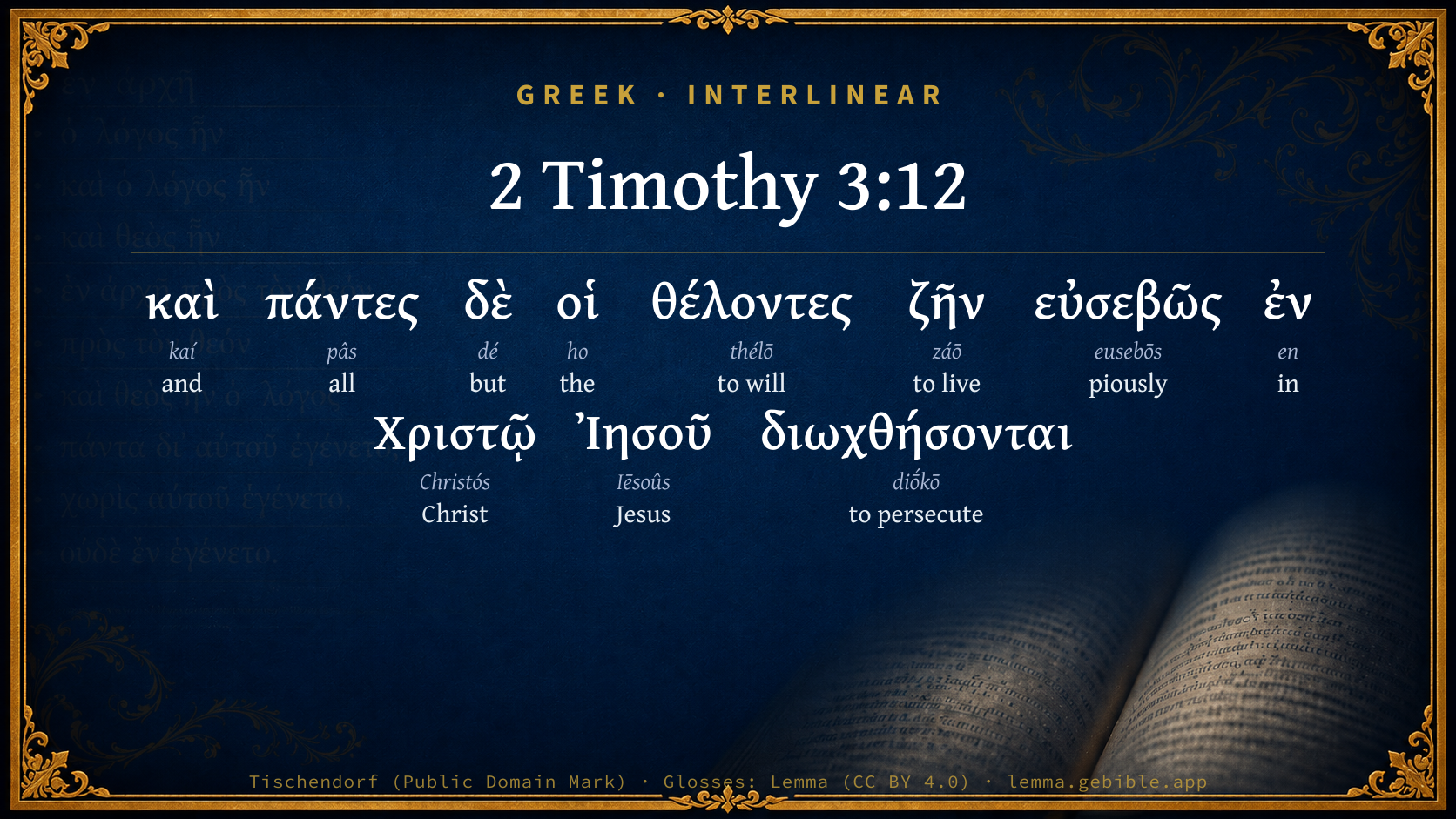
Download image
Cite this verse

2 Timothy 3:12 (World English Bible). Public Domain. Lemma interlinear Bible study tool, https://lemma.gebible.app/v/2-timothy/3/12.

Show BibTeX & RIS
BibTeX
RIS
English Translation
Yes, and all who desire to live godly in Christ Jesus will suffer persecution.
World English Bible · Public Domain
Highlights
  • 1 first appearance in the Greek New Testament
Full analysis ↓
Download a study sheet

One document with this verse’s original text, its word-by-word gloss line, the meaning frame, cross-references with their text, attributed commentary, and full source and license credits — printable, and it pastes into notes with its structure intact.

This verse Autodidact and up

Study sheet (.html) Plain text (.txt)

A passage Seminary Student

Up to 50 verses in one chapter. A passage sheet keeps up to 6 commentary sources and 12 cross-references per verse, in the order this page ranks them, and says so on the sheet whenever that leaves anything out. Ask for a single verse and you get the Autodidact verse sheet above.

Everything on this page stays free to read, with no account — the sheet is a download of what is already on screen, not access to it.

Want to remove ads? Support Godless Engineer
Compare translations 3

The same verse in 3 English versions, stacked beneath the original-language interlinear above. Click any original word for its lexicon entry.

Each is an independent rendering of the whole verse — the interlinear is not word-aligned to these translations.

Highlighted words mark where these versions differ — a whole-verse word diff, not a word-by-word alignment.

  • World English Bible Public Domain
    Yes, and all who desire to live godly in Christ Jesus will suffer persecution.
  • King James Version Public Domain
    Yea, and all that will live godly in Christ Jesus shall suffer persecution.
  • unfoldingWord Literal Text CC BY-SA 4.0
    But also, all the ones wanting to live godly in Christ Jesus will be persecuted.

unfoldingWord Literal Text — © unfoldingWord, licensed CC BY-SA 4.0. Word-aligned USFM3 via Door43 (git.door43.org/unfoldingWord/en_ult).

Versions to compare (up to 4)

3 of 4 selected

Show all 19 translations

Every available English version of this verse, each an independent rendering of the whole verse.

  • World English Bible Public Domain
    Yes, and all who desire to live godly in Christ Jesus will suffer persecution.
  • Berean Standard Bible Public Domain
    Indeed, all who desire to live godly lives in Christ Jesus will be persecuted,
  • Majority Standard Bible Public Domain
    Indeed, all who desire to live godly lives in Christ Jesus will be persecuted,
  • King James Version Public Domain
    Yea, and all that will live godly in Christ Jesus shall suffer persecution.
  • American Standard Version (1901) Public Domain
    Yea, and all that would live godly in Christ Jesus shall suffer persecution.
  • Revised Version (1885) Public Domain
    Yea, and all that would live godly in Christ Jesus shall suffer persecution.
  • Geneva Bible (1599) Public Domain
    Yea, and all that will liue godly in Christ Iesus, shall suffer persecution.
  • Douay-Rheims (1899) Public Domain
    And all that will live godly in Christ Jesus, shall suffer persecution.
  • Young's Literal Translation Public Domain
    and all also who will to live piously in Christ Jesus shall be persecuted,
  • Literal Standard Version CC BY-SA 4.0
    And all who will to live piously in Christ Jesus will also be persecuted,
  • Unlocked Literal Bible CC BY-SA 4.0
    All those who want to live in a godly manner in Christ Jesus will be persecuted.
  • unfoldingWord Literal Text CC BY-SA 4.0
    But also, all the ones wanting to live godly in Christ Jesus will be persecuted.
  • Darby Bible Public Domain
    And all indeed who desire to live piously in Christ Jesus will be persecuted.
  • World Messianic Bible Public Domain
    Yes, and all who desire to live godly in Messiah Yeshua will suffer persecution.
  • Webster's Bible Public Domain
    And all indeed that will live godly in Christ Jesus will suffer persecution.
  • Free Bible Version CC BY-SA 4.0
    Of course it's true that everyone who wants to live a life devoted to God in Christ Jesus will experience persecution,
  • Bible in Basic English Public Domain
    Yes, and all whose purpose is to be living in the knowledge of God in Christ Jesus, will be cruelly attacked.
  • Text-Critical English NT CC BY 4.0
    Indeed, everyone who wants to live a godly life in Christ Jesus will be persecuted.
  • Tyndale New Testament (1534) Public Domain
    Ye and all that will live godly in Christ Iesu must suffre persecucions.

Literal Standard Version (2020), Covenant Press — licensed CC BY-SA 4.0. Text via the HelloAO Bible API (eBible.org). Unlocked Literal Bible (unfoldingWord) — licensed CC BY-SA 4.0. Text via the HelloAO Bible API (eBible.org). unfoldingWord Literal Text — © unfoldingWord, licensed CC BY-SA 4.0. Word-aligned USFM3 via Door43 (git.door43.org/unfoldingWord/en_ult). Free Bible Version, Dr. Jonathan Gallagher — licensed CC BY-SA 4.0. Text via the HelloAO Bible API (eBible.org).

Word by word

More ways to search: Search by grammar → Find every occurrence → Compare this word →

Practice this passage: Drill this verse → Learn its vocabulary →

About this verse

These counts appear in no published source. They are computed here, from the morphology-tagged text and Lemma’s own curated glosses. What Lemma adds →

11
words
11
distinct lemmas
Pauline Epistles
section

Notable vocabulary

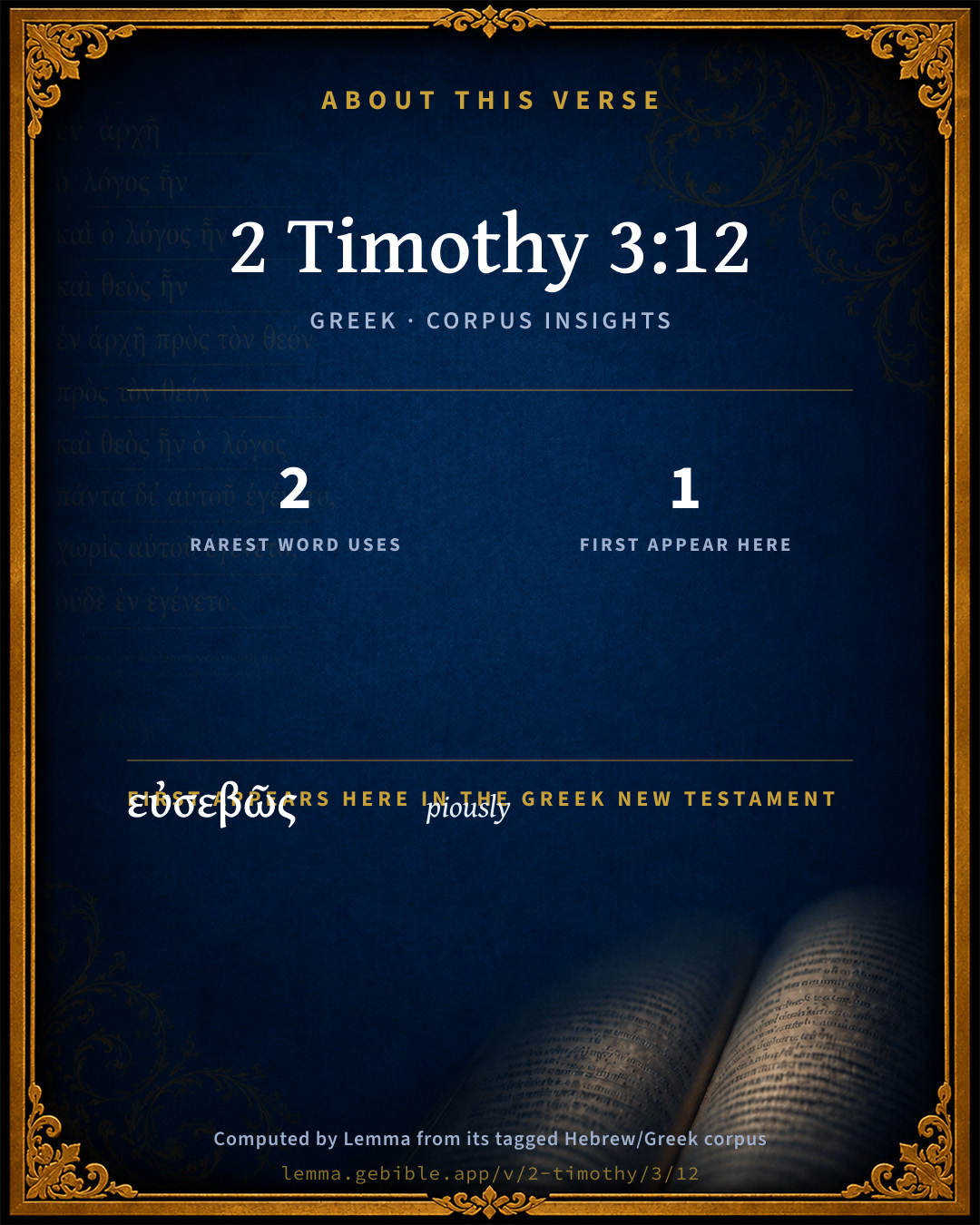
The rarest word here is εὐσεβῶς piously G2153 — appearing just 2 times in the whole Greek New Testament.

First appearance in Scripture

This word makes its first canonical appearance in the Greek New Testament here:

  • εὐσεβῶς piously G2153

Shared distinctive vocabulary

εὐσεβῶς piously G2153 occurs in 2 verses of the Greek New Testament. Also found in:
Cross-references

31

Topical passages linked to 2 Timothy 3:12 in the Treasury of Scripture Knowledge — connected by theme and wording, ordered by reader-vote popularity; previews shown in the World English Bible.

  • 1 Peter 3:14 But even if you should suffer for righteousness' sake, you are blessed. "Don't fear what they fear, neither be troubled."
  • 1 Peter 4:12–16 Beloved, don't be astonished at the fiery trial which has come upon you, to test you, as though a strange thing happened to you.
  • 1 Peter 2:20–21 For what glory is it if, when you sin, you patiently endure beating? But if, when you do well, you patiently endure suffering, this is commendable with God.
  • Acts 14:22 confirming the souls of the disciples, exhorting them to continue in the faith, and that through many afflictions we must enter into the Kingdom of God.
  • Matthew 5:10–12 Blessed are those who have been persecuted for righteousness' sake, For theirs is the Kingdom of Heaven.
  • Matthew 16:24 Then Jesus said to his disciples, "If anyone desires to come after me, let him deny himself, and take up his cross, and follow me.
  • John 16:2 They will put you out of the synagogues. Yes, the time comes that whoever kills you will think that he offers service to God.
  • 1 Peter 5:9–10 Withstand him steadfast in your faith, knowing that your brothers who are in the world are undergoing the same sufferings.
  • John 15:19–21 If you were of the world, the world would love its own. But because you are not of the world, since I chose you out of the world, therefore the world hates you.
  • Psalms 37:12–15 The wicked plots against the just, And gnashes at him with his teeth.
  • Mark 10:30 but he will receive one hundred times more now in this time, houses, brothers, sisters, mothers, children, and land, with persecutions; and in the age to come eternal life.
  • John 16:33 I have told you these things, that in me you may have peace. In the world you have oppression; but cheer up! I have overcome the world."
  • Titus 2:12 instructing us to the intent that, denying ungodliness and worldly lusts, we would live soberly, righteously, and godly in this present world;
  • Matthew 10:22–25 You will be hated by all men for my name's sake, but he who endures to the end will be saved.
  • Joshua 17:14 The children of Joseph spoke to Joshua, saying, Why have you given me but one lot and one part for an inheritance, seeing I am a great people, because hitherto Yahweh has blessed me?
  • Matthew 23:34 Therefore, behold, I send to you prophets, wise men, and scribes. Some of them you will kill and crucify; and some of them you will scourge in your synagogues, and persecute from city to city;
  • Luke 14:26–27 "If anyone comes to me, and doesn't hate his own father, mother, wife, children, brothers, and sisters, yes, and his own life also, he can't be my disciple.
  • John 17:14 I have given them your word. The world hated them, because they are not of the world, even as I am not of the world.
  • 1 Corinthians 15:19 If we have only hoped in Christ in this life, we are of all men most pitiable.
  • 2 Corinthians 1:12 For our boasting is this: the testimony of our conscience, that in holiness and sincerity of God, not in fleshly wisdom but in the grace of God we behaved ourselves in the world, and more abundantly toward you.
  • 1 Thessalonians 3:3–4 that no one be moved by these afflictions. For you know that we are appointed to this task.
  • 1 Timothy 2:2 for kings and all who are in high places; that we may lead a tranquil and quiet life in all godliness and reverence.
  • 1 Timothy 3:16 Without controversy, the mystery of godliness is great: God was revealed in the flesh, Justified in the spirit, Seen by angels, Preached among the nations, Believed on in the world, And received up in glory.
  • 1 Timothy 6:3 If anyone teaches a different doctrine, and doesn't consent to sound words, the words of our Lord Jesus Christ, and to the doctrine which is according to godliness,
  • Titus 1:1 Paul, a servant of God, and an apostle of Jesus Christ, according to the faith of God's chosen ones, and the knowledge of the truth which is according to godliness,
  • Hebrews 11:32–38 What more shall I say? For the time would fail me if I told of Gideon, Barak, Samson, Jephthah, David, Samuel, and the prophets;
  • 2 Peter 3:11 Therefore since all these things are thus to be destroyed, what manner of persons ought you to be in holy living and godliness,
  • Revelation 1:9–10 I John, your brother and partner with you in oppression, Kingdom, and perseverance in Christ Jesus, was on the isle that is called Patmos because of God's Word and the testimony of Jesus Christ.
  • Revelation 7:14 I told him, "My lord, you know." He said to me, "These are those who came out of the great tribulation. They washed their robes, and made them white in the Lamb's blood.
  • Revelation 12:4 His tail drew one third of the stars of the sky, and threw them to the earth. The dragon stood before the woman who was about to give birth, so that when she gave birth he might devour her child.
  • Revelation 12:7–10 There was war in the sky. Michael and his angels made war on the dragon. The dragon and his angels made war.

Cross-references courtesy of OpenBible.info (CC BY 4.0).

Commentary

Notes on 2 Timothy 3:12 from classic Christian and Jewish commentators (each source and its license shown beneath its notes). The classic Christian expositions comment on the surrounding passage and are grouped to its opening verse, so a note may address several verses; the Jewish commentaries on the Tanakh (Rashi and others) are per-verse, so they appear only where the commentator wrote on this verse.

Lemma curates 59 commentaries, every one of them public domain or Creative Commons licensed, each selected and text-cleaned for this edition rather than reprinted as found. About our sources →

The Biblical Illustrator

Joseph S. Exell

2Ti_3:12

All that will live godly in Christ Jesus shall suffer persecution.

A Christian is not a favourite with the world

Who can help admiring the frankness of Scripture? It shows us the difficulties as well as the enjoyments of religion; the sacrifices it requires, as well as the rewards it insures. This is perfectly just, and in every way profitable.

I. The life described. It may be taken with two distinctions.

1. It is not merely a moral life, but a godly one. We by no means depreciate morality. A man cannot be religious without being moral, but he may be moral without being religious. It is well to be a good master, a good neighbour, a good subject--but how are you disposed towards God?

2. It is not merely a godly life, but a Christian one. We are not only to live godly, but to live godly in Christ Jesus; i.e., in all our religious concerns--To be governed by the revelation of Jesus Christ--To be conformed to the example of Jesus Christ--To be actuated by the grace of Jesus Christ--And to depend on the mediation of Jesus Christ.

II. The condition announced as the consequence of the life described. Shall suffer persecution.

1. That ever since the Fall there has been an irreconcilable enmity between the seed of the woman and the seed of the serpent; that man being alienated from the life of God, loves nothing that reminds him of God; that the tempers and actions of the righteous necessarily reprove and upbraid the wicked; that their endeavours to save disturb them in their sins; that the gospel condemns the worldly as well as the vicious, and the formal as well as the negligent; that, as there is nothing in Christianity that flatters sin, so there is nothing that flatters self; and that every man is naturally as self-righteous as he is depraved.

2. To this we may add another source of the inevitableness of persecution. It is taken from the Christian himself. Suffering is necessary for his trial and his triumph. Without this how could he prove that he loves God better than friendship, reputation, wealth, or life? How could he overcome evil with good? It is warfare that makes a good soldier. A Christian is like the firmament, and it is the darkness of affliction that makes his starry graces to shine out. He is like those herbs and plants that best effuse their odours when bruised.

Concluding reflections:--

1. There are some who suffer persecution that do not live godly in Christ Jesus. The people of the world cannot easily distinguish between the form of godliness and the power, and therefore the pretending and the sincere frequently fare alike. The hypocrite loses heaven for the sake of earth, and earth for the sake of heaven, and is of all creatures the most miserable.

2. With what caution and prayer should we assume a profession of religion!

3. If any man suffer as a Christian, let him not be ashamed, but let him glorify God on this behalf. It gives you an opportunity to prove your thankfulness for His goodness, and your adherence to His gospel.

4. But what shall we say to persecutors? If you feel enmity against the godly, and would injure them were it in your power, it is a token of perdition. You may now be placed above them in circumstances; and may love to misrepresent and to vilify them. But their Redeemer is mighty. He is near that justifieth them. He will plead their cause. He that toucheth them, toucheth the apple of His eye. (W. Jay.)

Persecution of Christians by the world

The greater part of our sufferings are not distinguishable from the common afflictions of life; and many of the trials that some foolish professors frequently charge on religion, religion would teach them to avoid, if its admonitions were regarded. But, on the other hand, it must be allowed--

1. That human nature is essentially the same in every age; and that a tiger may be chained and not changed. Under every form of government the heart is deceitful above all things, and desperately wicked. And where there is a strong active propensity against anything (as, in this case, there must be against real godliness), it will show itself as opportunity offers; and such opportunity there must be in a world like this.

2. That persecution admits of various degrees. It includes every kind of injury or vexation, from a fiery stake to a scornful sneer. How often has genuine religion produced the loss of friendship, or chilled the warmth of attachment into cold civility! Where power is possessed, it is frequently exerted as far as safety or a regard to appearances will allow. This is seen in the attempts of husbands, parents, and masters, to restrain from following their religious convictions their wives, their children, and their servants. With regard to relations, a Christian will sometimes find a greater trim in their affections than in their frowns. Here is a mother, in all other respects tender and kind; she takes her daughter aside, and weeps to think she should favour a doctrine everywhere spoken against.

3. If modern Christians frequently escape persecution, may it not be asked whether, in many instances, it does not arise from their less fully exemplifying the spirit of their religion than the primitive Christians did?

(1) The one is concealment. This is dastardly and mean. We should never be drawn out of a corner by the praise of man, nor be driven into a corner by the fear of man.

(2) The other is accommodation. And it is awful to think how one doctrine and usage after another has been given up! Christianity, says one, will never be received by Jews and Mahometans, while you honour the Son as you honour the Father. It will never be acceptable, says another, to men of taste and learning, till you abandon the barbarous notion of the atonement and of original sin. Now, upon this plan, what would be left after all the objectors were satisfied? Christianity allows of no alteration. It needs none. The change required therefore is, where it ought to be in the world. (W. Jay.)

A good man a good mark for the arrow

The better the man, the sooner persecuted; the devil shoots his arrows at the whitest marks. (T. Hall, B. D.)

A good man a miracle of preservation

It is a miracle of mercy to consider how the lily subsists in the midst of so many briars and thorns, how the Lords wheat grows in the midst of so many tares, how His doves live in the midst of so many birds of prey, and His lambs in the midst of so many roaring lions. Were not the Almighty her defence, those bands of ungodliness would soon destroy her. (T. Hall, B. D.)

God honoured by His suffering servants

Hereby we honour God, and so bring honour to ourselves. God hath much honour by His suffering servants, when out of love to Him they can sacrifice their lives and estates for Him. God glories in such; as He suffers in their sufferings so He triumphs in their conquests. (T. Hall, B. D.)

Best when worst

God is pleased to reserve the sweetest manifestations from the bitterest afflictions. The fountain runs most sweetly when the cistern is broken. When comforts are most needed they will be most prized. The traveller in summer, when the sun shines, casts off his cloak, but in winter, or when the wind blows hard, he wraps it closer to him. So when we bathe ourselves in creature comforts we value not the promises of God, but when we are stripped of all then we look after God. When the salt waters are dried up, then there are fresh springs in God. (T. Hall, B. D.)

The good man happy in adversity, the bad man miserable in prosperity

See the happiness of a child of God. Take him at worst, and he is better than a wicked man at best. The one in prosperity hath no joy, the other in adversity is full of joy. (T. Hall, B. D.)

Brave martyrdom

At Perth, in 1554, there were three male prisoners and one woman--Helen Stirk--put to death for their adherence to the gospel of Jesus. The latter was taken to see her husband suffer before she followed him. They embraced under the gallows. Husband, she said, we have lived together many joyful days; but this day in which we must die ought to be most joyful to us both, because we must have joy for ever. Therefore I will not bid you good-night. Certainly we shall meet again in the kingdom of heaven. The executioners seized their prey, and she, too, was then led away to be drowned. When she reached the waters edge she gave the child to a nurse, she was hurled in, and the justice of the Church was satisfied.

The Biblical Illustrator, edited by Joseph S. Exell (c. 1880s–1900s) — public domain. Text from a community e-Sword module.

Bengel's Gnomon

Johann Albrecht Bengel

2Ti 3:12. Καὶ πάντες δὲ, yea and all) all, and they alone. The third mark, to have persecutors; so far should persecution be from being a stumbling-block to any one. At the beginning of persecution, it does not yet appear that that is the mark of an apostle: it at length appears from the help that is afforded, and from the endurance of them. In this, however, is the third mark of an apostle: ὑπομονὴ, patience, is a great thing in the eyes of the apostle; he prefers it to all the others. All other things may be taken from a man, so that he may suffer their utter loss and he himself fall away; but when he has ὑπομονὴ, all things are preserved. Hence Timothy might at the same time gather that he would also suffer persecution. There is a similar transition from Paul to all godly men, ch. 2Ti 4:8.—οὶ θέλοντες, those wishing or willing) Consider therefore whether you are willing; comp. the word wishing (intending), Luk 14:28. Even a persevering will has a beginning.—εὐσεβῶς ζῇν) to live godly; the whole energy of their life being devoted to Christian piety, Php 1:21.—ζῇν, to live) to pass life, Gal 2:14.—ἐν Χριστῷ in Christ) There is no godliness out of Christ Jesus. [And indeed the world easily wears that mask of religion which depends on itself; but the piety which flourishes directly from Jesus Christ is very hateful, as it was to the old Jews, so to the modern Christians, who are without any token of good.—V. g.]—διωχθήσονται, shall suffer persecution) Nor will they indeed refuse it, Gal 5:11. They shall proceed to worse and worse, 2Ti 3:13, stands in opposition to this future.

Bengel's Gnomon of the New Testament — English translation (T&T Clark, Edinburgh, 1860) — public domain. Text from a community e-Sword module.

Meyer's Critical & Exegetical Commentary

Heinrich August Wilhelm Meyer

2Ti_3:12. The principle here laid down is intended, like the mention of Timothys conduct in 2Ti_3:11, to incite Timothy to willing endurance of suffering.

καὶ πάντες δέ] καὶ … δέ, see 1Ti_3:10.

οἱ θέλοντες] is here emphatic: they whose thoughts are thus directed.

ζῆν εὐσεβῶς] the adverb εὐσεβῶς only here and in Tit_2:12.

ἐν Χριστῷ Ἰησοῦ] denotes the pious life as Christian in its nature; but it is to be observed that, according to the apostolic view, true εὐσέβεια is possible only in communion with Christ. Bengel: extra Jesum Christum nulla pietas. Hofmann unsuitably remarks that the emphasis should not be on ἐν Χρ. Ἰησ., but on εὐσεβῶς, for ζῆν εὐσεβῶς ἐν Χρ. Ἰησ. forms only one idea: that of the Christian life of piety.

διωχθήσονται] expresses the certainty: Christian piety cannot continue without persecution, because the world is hostile to the kingdom of God; comp. Joh_15:19-20; Mat_10:22; Mat_10:38, and other passages. Wiesinger rightly remarks: Not to comfort himself does the apostle say this, but to show that his experience was a universal one, as something necessarily bound up with εὐσεβῶς ζῆν, and, it should be added, to give encouragement to Timothy.

Meyer — Critical and Exegetical Commentary on the New Testament — English translation by Peter Christie, edited by Frederick Crombie (T&T Clark, 1880) — public domain. Text from a community e-Sword module.

Expositor's Greek Testament

ed. W. Robertson Nicoll

2Ti 3:12 . This verse is an interesting example of the effect of association of ideas. St. Paul’s teaching after his persecutions at Antioch, etc., had strongly emphasised this topic. St. Luke (Act 14:22 ) actually repeats the very words used by the preachers, “Through many tribulations we must enter into the kingdom of God”. Consistency in the life in Christ must necessarily be always opposed by the world. θέλοντες is emphatic, as Ell. notes, “whose will is”. Cf. Luk 14:28 , Joh 7:17 .

εὐσεβῶς of course qualifies ζῇν , as in Tit 2:12 . There is a similar extension of thought, from self to all, in 2Ti 4:8 .

The Expositor's Greek Testament, edited by W. Robertson Nicoll (1897–1910) — public domain. Text from a community e-Sword module.

Jamieson, Fausset & Brown

Robert Jamieson, A. R. Fausset & David Brown

Yea, and--an additional consideration for Timothy: if he wishes to live godly in Christ, he must make up his mind to encounter persecution.

that will, &c.--Greek, "all whose will is to live," &c. So far should persecution be from being a stumbling-block to Timothy, he should consider it a mark of the pious. So the same Greek is used of the same thing, Luk 14:28, Luk 14:33, "intending (Greek, 'wishing') to build a tower . . . counteth the cost."

live godly in Christ-- (Gal 2:20; Phi 1:21). There is no godliness (Greek, "piously") or piety out of Christ. The world easily puts up with the mask of a religion which depends on itself, but the piety which derives its vigor directly from Christ is as odious to modern Christians as it was to the ancient Jews [BENGEL].

shall suffer persecution--and will not decline it (Gal 5:11). BISHOP PEARSON proves the divine origination of Christianity from its success being inexplicable on the supposition of its being of human origin. The nature of its doctrine was no way likely to command success: (1) it condemns all other religions, some established for ages; (2) it enjoins precepts ungrateful to flesh and blood, the mortifying of the flesh, the love of enemies, and the bearing of the cross; (3) it enforces these seemingly unreasonable precepts by promises seemingly incredible; not good things such as afford complacency to our senses, but such as cannot be obtained till after this life, and presuppose what then seemed impossible, the resurrection; (4) it predicts to its followers what would seem sure to keep most of the world from embracing it, persecutions.

Jamieson, Fausset & Brown — Commentary Critical and Explanatory on the Whole Bible (1871) — public domain (CC PDM 1.0). Text via the HelloAO Bible API.

Adam Clarke's Commentary

Verse 12. All that will live godly] So opposite to the spirit and practice of the world is the whole of Christianity, that he who gives himself entirely up to God, making the Holy Scriptures the rule of his words and actions, will be less or more reviled and persecuted. "If religion gives no quarter to vice, the vicious will give no quarter to religion and its professors."

Adam Clarke's Commentary on the Bible (1810–1826) — public domain. Text from a community e-Sword/MySword module.

John Calvin's Commentaries

12 And all who wish to live a godly life Having mentioned his own persecutions, he likewise adds now, that nothing has happened to him which does not await all the godly. And he says this, partly that believers may prepare themselves for submitting to this condition, and partly that good men may not view him with suspicion on account of the persecutions which he endures from wicked persons; as it frequently happens that the distresses to which men are subjected lead to unfavorable opinions concerning them; for he whom men regard with aversion is immediately declared by the common people to be hated by God.

By this general statement, therefore, Paul classes himself with the children of God, and, at the same time, exhorts all the children of God to prepare for enduring persecutions; for, if this condition is laid down for “all who wish to live a godly life in Christ,” they who wish to be exempt from persecutions must necessarily renounce Christ. In vain shall we endeavor to detach Christ from his cross; for it may be said to be natural that the world should hate Christ even in his members. Now hatred is attended by cruelty, and hence arise persecutions. In short, let us know that we are Christians on this condition, that we shall be liable to many tribulations and various contests.

But it is asked, Must all men be martyrs? for it is evident that there have been many godly persons who have never suffered banishment, or imprisonment, or flight, or any kind of persecution. I reply, it is not always in one way that Satan persecutes the servants of Christ. But yet it is absolutely unavoidable that all of them shall have the world for their enemy in some form or other, that their faith may be tried and their steadfastness proved; for Satan, who is the continual enemy of Christ, will never suffer any one to be at peace during his whole life; and there will always be wicked men that are thorns in our sides. Moreover, as soon as zeal for God is manifested by a believer, it kindles the rage of all ungodly men; and, although they have not a drawn sword, yet they vomit out their venom, either by murmuring, or by slander, or by raising a disturbance, or by other methods. Accordingly, although they are not exposed to the same assaults, and do not engage in the same battles, yet they have a warfare in common, and shall never be wholly at peace and exempt from persecutions.

John Calvin's Commentaries (1540-1563) — public domain. Text from the Calvin Translation Society English edition (1840s-50s) via the Christian Classics Ethereal Library (ccel.org). Calvin's coverage is partial (roughly two-thirds of the Bible); uncommented books and verses are honest gaps, never fabricated. The 19th-century editor's footnotes and remarks are omitted so the notes are faithfully Calvin's own voice.

Ellicott's Commentary for English Readers

(12) Yea, and all that will live godly.—But St. Paul would not allow it to be thought for a moment that in the fact of his enduring persecution and suffering there was anything remarkable or singular; so he adds the words of this verse, which repeat in a peculiarly solemn way the great Christian truth that eternal glory was only to be reached by man through an avenue of sufferings. “No cross, no crown,” is one of the watchwords of the faith. To the statement, “all that will live godly,” it is noticeable that the Apostle adds “in Christ Jesus:” thus telling us there can be no true piety except in communion with Him. So Bengel: “Extra Jesum Christum nulla pietas.” And piety, adds St. Paul, will ever suffer persecution; for the world is at enmity with the kingdom of God. “Because ye are not of the world . . . therefore the world hateth you” (Joh_15:19; so, too, Mat_10:22; Mat_10:38-39).

A Bible Commentary for English Readers, edited by Charles John Ellicott (1878–1897) — public domain. Text from a community e-Sword module.

The Cambridge Bible for Schools and Colleges

gen. ed. J. J. S. Perowne

12. Yea, and all] The force of the two conjunctions is shewn in note on 1Ti_3:10.

that will live godly] Whose will is, compare Luk_16:26, ‘they whose will is to pass from hence to you.’ ‘In Christ Jesus.’ The whole phrase is nearly the equivalent of ‘to lead a godly and a Christian life’ (Baptismal Service, Pr.-Bk.).

The Cambridge Bible for Schools and Colleges (gen. ed. J. J. S. Perowne; Cambridge University Press, 1878–1918) — public domain. Text from a community e-Sword module.

John Gill's Exposition

But evil men and seducers shall wax worse and worse,.... By "evil men" are meant, not sinful men in common, as all are by nature and practice; nor only open profane sinners but rather wicked men under a form of godliness, as before; and who are full of wickedness and malice against truly godly persons, even as the devil himself, of whom the same word is used, when he is called the wicked one; and this is a reason why true professors of religion must expect persecution, seeing as there ever were, so there ever will be such sort of men, who will not grow better, but worse and worse. The word for "seducers", signifies sorcerers, enchanters, a sort of jugglers; and as the other, it well suits with the ecclesiastics of the church of Rome, who pretend to miracles, and do lying wonders, and by their sorceries deceive all nations, Rev 18:23 and these "shall wax worse and worse"; in principle and in practice, in ungodliness, and in error, in wickedness and malice against the saints, and in the arts of deceiving; so the church of Rome is never to be expected to be better, but worse; at the time of the fall of Babylon she will be an habitation of devils, the hold of every foul spirit, and the cage of every unclean and hateful bird, Rev 18:2

deceiving: not God, but themselves and others even all nations, excepting the elect of God; which they do by their good words and fair speeches, and by their show of devotion and religion, and by their pretended miracles and lying wonders:

and deceived by the old serpent, the devil, under whose power and influence they are, in whose snare they are taken, and by whom they are led captive, and will at last share the same fate with himself, and be cast into the same lake of fire and brimstone.

John Gill's Exposition of the Whole Bible (1746–1763) — public domain (CC PDM 1.0). Text via the HelloAO Bible API.

Trapp's Complete Commentary

John Trapp

12 Yea, and all that will live godly in Christ Jesus shall suffer persecution.

Ver. 12. Yea, and all that will live] Carry they the matter never so discreetly, they must suffer. Many dream of a delicacy, they conceit a godly life without persecution. These would pull a rose without pricks. Armat spina rosas, mella tegunt apes. (Boetius.) Thucydides complains of his countrymen, that none of them would ταλαιπωρειν δια το καλον, suffer aught for goodness’ sake. Too few there are that today will do so.

John Trapp, A Commentary or Exposition upon All the Books of the Old and New Testament (1647–1656) — public domain. Text from a community e-Sword module.

Albert Barnes' Notes on the Bible

Yea, and all that will live godly in Christ Jesus shall suffer persecution - Paul takes occasion from the reference to his own persecutions, to say that his case was not unique. It was the common lot of all who endeavored to serve their Redeemer faithfully; and Timothy himself, therefore, must not hope to escape from it. The apostle had a particular reference, doubtless, to his own times; but he has put his remark into the most general form, as applicable to all periods. It is undoubtedly true at all times, and will ever be, that they who are devoted Christians - who live as the Saviour did - and who carry out his principles always, will experience some form of persecution. The “essence” of persecution consists in “subjecting a person to injury or disadvantage on account of his opinions.” It is something more than meeting his opinions by argument, which is always right and proper; it is inflicting some injury on him; depriving him of some privilege, or right; subjecting him to some disadvantage, or placing him in less favorable circumstances, on account of his sentiments.

This may be either an injury done to his feelings, his family, his reputation, his property, his liberty, his influence; it may be by depriving him of an office which he held, or preventing him from obtaining one to which he is eligible; it may be by subjecting him to fine or imprisonment, to banishment, torture, or death. If, in any manner, or in any way, he is subjected to disadvantage on account of his religious opinions, and deprived of any immunities and rights to which he would be otherwise entitled, this is persecution. Now, it is doubtless as true as it ever was, that a man who will live as the Saviour did, will, like him, be subjected to some such injury or disadvantage. On account of his opinions, he may be held up to ridicule, or treated with neglect, or excluded from society to which his attainments and manners would otherwise introduce him, or shunned by those who might otherwise value his friendship. These things may be expected in the best times, and under the most favorable circumstances; and it is known that a large part of the history of the world, in its relation to the church, is nothing more than a history of persecution. It follows from this:

(1) That they who make a profession of religion, should come prepared to be persecuted. It should be considered as one of the proper qualifications for membership in the church, to be willing to bear persecution, and to resolve not to shrink from any duty in order to avoid it.

(2) They who are persecuted for their opinions, should consider that this may be one evidence that they have the spirit of Christ, and are his true friends. They should remember that, in this respect, they are treated as the Master was, and are in the goodly company of the prophets, apostles, and martyrs; for they were all persecuted. Yet,

(3) If we are persecuted, we should carefully inquire, before we avail ourselves of this consolation, whether we are persecuted because we “live godly in Christ Jesus,” or for some other reason. A man may embrace some absurd opinion, and call it religion; he may adopt some mode of dress irresistibly ludicrous, from the mere love of singularity, and may call it “conscience;” or he may be boorish in his manners, and uncivil in his deportment, outraging all the laws of social life, and may call this “deadness to the world;” and for these, and similar things, he may be contemned, ridiculed, and despised. But let him not infer, “therefore,” that he is to be enrolled among the martyrs, and that he is certainly a real Christian. That persecution which will properly furnish any evidence that we are the friends of Christ, must be only that which is “for righteousness sake” Mat 5:10, and must be brought upon us in an honest effort to obey the commands of God.

(4) Let those who have never been persecuted in any way, inquire whether it is not an evidence that they have no religion. If they had been more faithful, and more like their Master, would they have always escaped? And may not their freedom from it prove that they have surrendered the principles of their religion, where they should have stood firm, though the world were arrayed against them? It is easy for a professed Christian to avoid persecution, if he yields every point in which religion is opposed to the world. But let not a man who will do this, suppose that he has any claim to be numbered among the martyrs, or even entitled to the Christian name.

Albert Barnes' Notes on the Bible (1834–1885) — public domain. Text from a community e-Sword/MySword module.

Matthew Poole's English Annotations

Such is the disposal of Divine Providence, such the malice of the men in the world, that though not every individual person, yet it is the usual lot of them who will keep a pure faith and a good conscience, to suffer persecution in some kind or other, either in their persons, or reputation, or estates. Men may live profanely, or may be morally honest men, and be safe enough; but if they will profess faith in Christ, or love to him in keeping his commandments, they will be exposed to troubles: the world will not endure men to live in peace, that will not live as they live, and believe as they believe.

Matthew Poole's English Annotations on the Holy Bible (1683–1685) — public domain. Text from a community e-Sword/MySword module.

Whedon's Commentary on the Bible

Daniel D. Whedon

12. Yea—What Paul has suffered Timothy must, more or less, expect to suffer. The apostle does not invite his pupil to ease and fortune, but to trial and persecution.

All—Explicity affirmed only of the apostle’s own age, but in a greater or less degree applicable, in fact or in spirit, to all ages. Yet we are not to consider persecution a test of our piety.

Shall suffer—The simple future will suffer.

Daniel D. Whedon (gen. ed.), Commentary on the Old and New Testaments (1874–1909) — public domain. Text from a community e-Sword module.

The Pulpit Commentary

Would for will, A.V Yea and all (kaintev de). As though he had said. "Mine is not a solitary example of a servant of God being persecuted; it is the common lot of all who will live godly in Christ Jesus". (comp. Joh_15:20 and. (1Pe_4:1, 1Pe_4:12, 1Pe_4:13)

The Pulpit Commentary (1880–1919), ed. H.D.M. Spence-Jones & Joseph S. Exell — public domain. Text from a community e-Sword module.

John Wesley's Explanatory Notes

All that are resolved to live godly - Therefore count the cost. Art thou resolved? In Christ - Out of Christ there is no godliness. Shall suffer persecution - More or less. There is no exception. Either the truth of scripture fails, or those that think they are religious, and are not persecuted, in some shape or other, on that very account, deceive themselves.

John Wesley, Explanatory Notes Upon the Whole Bible (1754–1765) — public domain. Text via the GEBible commentary corpus.

Fairbairn on Ezekiel, Jonah & the Pastoral Epistles

Patrick Fairbairn

Ver. 12. Yea, and all (καὶ πάντες δὲ, or, and all too) who are minded to live piously in Christ Jesus, shall be persecuted. The apostle had spoken of his own persecutions, how he himself bore them, and how God delivered him out of them; but he now generalizes, in a manner, his own experience: others may look for a measure of the same. None, indeed, are excepted; all who are minded (οἱ θέλοντες, having their will set) to live piously in Christ Jesus—in Him, or in union with Him, as the one true source of living godliness—shall be persecuted. He does not say how or to what extent; but merely states the fact, that persecution in some form or another shall be their portion. And even this general announcement obviously presupposes as its ground, the existence in the world around of a spirit of alienation and hostility with respect to vital godliness. But that might not be always and everywhere the same; it could not but vary as Christianity itself rose to power, or the reverse; and so, as regards quantity and force, a certain conditional element necessarily enters into the statement, which may be put thus: In so far as the world retains its native character, those who are bent on leading in it lives of piety shall have to meet persecution. If through the diffusion of the gospel the old has to a considerable extent passed away, and a better order of things taken its place, then the persecution may narrow itself to taunts, reproaches, spiteful or contemptuous treatment, when at the behest of holy principle a stand is made against worldly compliances or fashionable vices. In these, however, the persecuting spirit breathes, only less coarsely and vehemently than when fire and sword are its weapons (Gal 4:29). So that the apostolic utterance still has its application to the Christian life; and they who would prosecute this life must be ready to brave such persecution. But they should never court it; they are as much bound to avoid provoking it by indiscretions, as to bear it meekly when excited by their virtues.

Patrick Fairbairn — An Exposition of Ezekiel (1851), Jonah (1849), and The Pastoral Epistles (1874) — public domain. Text from a community e-Sword module.

The People's New Testament

B. W. Johnson

12. All that will live godly. In that age persecution was inseparable from a devoted Christian life. The same has been true, to a certain extent, in all ages. If the church was less worldly it would be more persecuted.

B. W. Johnson's The People's New Testament with Notes (1889–1891) — public domain. Electronic text from the Christian Classics Ethereal Library (CCEL) ThML edition.

Cambridge Greek Testament for Schools and Colleges

12. ζῆν εὐσεβῶς. This is the order of אAP, the Bohairic and the Harclean; the rec. text has εὐσεβῶς ζῆν with CD2EGKL, the Peshito, the Latin versions &c., perhaps from confusion with Tit 2:12.

12. καὶ πάντες δέ, and, moreover, all. For καὶ … δέ cp. Rom 11:23; 1Ti 3:10.

οἱ θέλοντες, who are minded, expressing not a mere passing desire, but the continual bent of the will.

ζῆν εὐσεβῶς. For the order of words see the critical note. εὐσεβῶς only occurs again in the Greek Bible at Tit 2:12 (which see) and 4Ma 7:21. See on 1Ti 2:2 for the meaning of εὐσέβεια and its cognates.

ἐν Χριστῷ Ἰησοῦ, in Christ Jesus, the sphere of the godly life. ‘Life in Christ’ is the perpetual theme of St Paul’s Epistles, and, however difficult the phrase may be to interpret, it is impossible to doubt that he meant more by it than life lived in obedience to the precepts of Christ, or under the influence of the Gospel of Christ. There is a deep sense in which the baptized believer is in Christ, who as the Incarnate Word took human nature into Himself.

διωχθήσονται, shall be persecuted. And in such moments of persecution the promise will be recalled, μακάριοι οἱ δεδιωγμένοι ἕνεκεν δικαιοσύνης, ὅτι αὐτῶν ἐστὶν ἡ βασιλεία τῶν οὐρανῶν (Mat 5:10); cp. Joh 15:20.

Cambridge Greek Testament for Schools and Colleges (Cambridge University Press, 1896; 21 vols, various authors incl. Carr, Maclear, Plummer, Farrar, Lumby, Moule, M. R. James, Simcox) — public domain. Text from a community e-Sword module.

Alford’s Greek Testament

Henry Alford

12.] Yea, and (or, and moreover. I have explained this καὶ … δέ on 1Ti 3:10. ‘They who will, &c., must make up their minds to this additional circumstance,’ viz. persecution) all who are minded (purpose: see reff.: ‘whose will is to,’ Ellic.: hardly so strong as ‘who determine,’ Conyb. Nor can it be said that θέλοντες is emphatic, as Huth. It requires its meaning of ‘purpose’ to be clearly expressed, not slurred over: but that meaning is not especially prominent) to live piously (ref.) in Christ Jesus (‘extra Jesum Christum nulla pietas,’ Beng.: and this peculiar reference of εὐσέβεια (cf. 1Ti 3:16) should always be borne in mind in these Epistles) shall be persecuted.

Henry Alford, The Greek Testament (1849–1861) — public domain. Text from a community e-Sword module.

International Critical Commentary

12. Cf. 1Th 3:4 μέλλομεν θλίβεσθαι, Act 14:22 διὰ πολλῶν θλίψεων δεῖ ἡμᾶς εἰσελθεῖν εἰς τὴν βασιλείαν τοῦ θεοῦ—words which Timothy probably heard when spoken (Hillard). Probably in each case there is a reminiscence of Mat 5:10, Mat 5:11 or some similar saying of the Lord: Prochorus (Acta Joh., p. 83) quotes the words of Act 14:22 as a saying of the Lord; cf. Resch, Agrapha, pp. l00, 148, 278; Paulinismus und die Logia, p. 452. Pelagius makes the testing comment: “Timendum ergo nobis est ne non pie vivamus, qui nihil patimur propter Deum.”

13 πονηροί] “mali,” Vulg.; “nequam,” Ambros.; but better “maligni,” Bengel. The thought is more of malignant harmfulness, willing to persecute, than of moral evil; cf. 4:18, 2Th 3:2, 2Th 3:3, Mat 6:13.

γόητες] “seductores,” Vulg.; impostors, as often in Hellenistic Greek (cf. Wetstein): so γοητεία, “crafty guile,” 2 Mac 12:24; but it may also imply the use of magical arts; cf. 8 and 15 notes.

προκόψουσιν] not of external influence as in 9, but of internal downgrade development as in 2:16 q.u.

πλανώμενοι] probably passive: deceived by ὁ πονηρός, Mat 6:13, or by other teachers, the phrase being almost proverbial; cf. Philo, de migratione Abraham, c. 15 (cf. the Egyptian magicians), ἀπατᾶν δοκοῦντες ἀπατῶνται: Ovid, Met. xiv. 81, “deceptaque decipit omnes”; Aug. Confess. vii. 2, “deceptos illos et deceptores” (v. Wetstein, Dibelius, for these and other illustrations); cf. 2Th 2:11.

International Critical Commentary — older volumes (1896–1929), various authors — public domain. Text from a community e-Sword module.

Vincent's Word Studies in the New Testament

Marvin R. Vincent

Who will live [οι θελοντες ζην] . Whose will is to live, or who are bent on living.

Godly [ευσεβως] . Only here and Tit 2:12. Comp. kat' eujsebeian according to godliness, 1Ti 6:3; Tit 1:1; and ejn pash eujsebeia in all godliness, 1Ti 2:2. See also 1Ti 4:7; 1Ti 6:11, and on godliness, 1Ti 2:2.

Shall suffer persecution [διωχθησονται] . In this sense only here in Pastorals.

Marvin R. Vincent, Word Studies in the New Testament (1887–1900) — public domain. Text from a community e-Sword/MySword module.

Lesson kit

Teaching starters — assembled from the data on this page, not authored interpretation. Every prompt links to the verse data it draws on. Edit before teaching.

2 Timothy, in the Pauline Epistles, opens this verse with 11 words (11 distinct Greek lemmas). Its most distinctive word is eusebōs (“piously”). A historical commentator’s framing appears above. Read the whole chapter for the surrounding context.

Discussion questions

  1. What does “piously” (eusebōs) contribute to the verse as a whole?
  2. The word “piously” first appears here in Scripture. What is being introduced at this debut?
  3. Titus 2:12 shares the word «piously» with this verse. How do the two illuminate each other?
  4. The translations on this page render this verse differently — a whole-verse word diff, not a word-by-word alignment. What might account for the different wordings?
  5. Reading how The Biblical Illustrator and Bengel's Gnomon read this verse, where do the two commentators agree and where do they part?

Things to notice

  • 1 word makes its first canonical appearance in Scripture here.
  • These translations choose different wording for 11 words in this verse.
  • 11 distinct Greek lemmas span 11 words in this verse.

Reading settings

Reading text

Shown beneath each verse's original-language words.

Old Testament
Old Testament edition

Read the OT as the Masoretic Hebrew (MT) or the Greek Septuagint (LXX).

English shown for the Greek Septuagint (in the Hebrew ↔ Greek comparison).

Comparing translations? Open the Compare panel on any verse page to stack up to four side by side.