1 Thessalonians 2:18

Greek (Tischendorf 8th ed.) 1 Thessalonians 2:18 appears in the Greek New Testament. The text above is from the Tischendorf 8th edition. Each word links to its Strong’s number and a concise gloss. Click any word for its full Thayer’s Greek Lexicon entry.
Download image
Cite this verse

1 Thessalonians 2:18 (World English Bible). Public Domain. Lemma interlinear Bible study tool, https://lemma.gebible.app/v/1-thessalonians/2/18.

Show BibTeX & RIS
BibTeX
RIS
English Translation
because we wanted to come to you--indeed, I, Paul, once and again-- but Satan hindered us.
World English Bible · Public Domain
Download a study sheet

One document with this verse’s original text, its word-by-word gloss line, the meaning frame, cross-references with their text, attributed commentary, and full source and license credits — printable, and it pastes into notes with its structure intact.

This verse Autodidact and up

Study sheet (.html) Plain text (.txt)

A passage Seminary Student

Up to 50 verses in one chapter. A passage sheet keeps up to 6 commentary sources and 12 cross-references per verse, in the order this page ranks them, and says so on the sheet whenever that leaves anything out. Ask for a single verse and you get the Autodidact verse sheet above.

Everything on this page stays free to read, with no account — the sheet is a download of what is already on screen, not access to it.

Want to remove ads? Support Godless Engineer
Compare translations 3

The same verse in 3 English versions, stacked beneath the original-language interlinear above. Click any original word for its lexicon entry.

Each is an independent rendering of the whole verse — the interlinear is not word-aligned to these translations.

Highlighted words mark where these versions differ — a whole-verse word diff, not a word-by-word alignment.

  • World English Bible Public Domain
    because we wanted to come to you--indeed, I, Paul, once and again-- but Satan hindered us.
  • King James Version Public Domain
    Wherefore we would have come unto you, even I Paul, once and again; but Satan hindered us.
  • unfoldingWord Literal Text CC BY-SA 4.0
    For we desired to come to you—indeed I, Paul, both once and twice—but Satan hindered us.

unfoldingWord Literal Text — © unfoldingWord, licensed CC BY-SA 4.0. Word-aligned USFM3 via Door43 (git.door43.org/unfoldingWord/en_ult).

Versions to compare (up to 4)

3 of 4 selected

Show all 19 translations

Every available English version of this verse, each an independent rendering of the whole verse.

  • World English Bible Public Domain
    because we wanted to come to you--indeed, I, Paul, once and again-- but Satan hindered us.
  • Berean Standard Bible Public Domain
    For we wanted to come to you—indeed I, Paul, tried again and again—but Satan obstructed us.
  • Majority Standard Bible Public Domain
    Therefore we wanted to come to you—indeed I, Paul, tried again and again—but Satan obstructed us.
  • King James Version Public Domain
    Wherefore we would have come unto you, even I Paul, once and again; but Satan hindered us.
  • American Standard Version (1901) Public Domain
    because we would fain have come unto you, I Paul once and again; and Satan hindered us.
  • Revised Version (1885) Public Domain
    because we would fain have come unto you, I Paul once and again; and Satan hindered us.
  • Geneva Bible (1599) Public Domain
    Therefore we would haue come vnto you (I Paul, at least once or twise) but Satan hindered vs.
  • Douay-Rheims (1899) Public Domain
    For we would have come unto you, I Paul indeed, once and again: but Satan hath hindered us.
  • Young's Literal Translation Public Domain
    wherefore we wished to come unto you, (I indeed Paul,) both once and again, and the Adversary did hinder us;
  • Literal Standard Version CC BY-SA 4.0
    for this reason we wished to come to you (I, indeed, Paul), both once and again, and Satan hindered us;
  • Unlocked Literal Bible CC BY-SA 4.0
    For we wished to come to you—I, Paul, wished to come to you once and again—but Satan stopped us.
  • unfoldingWord Literal Text CC BY-SA 4.0
    For we desired to come to you—indeed I, Paul, both once and twice—but Satan hindered us.
  • Darby Bible Public Domain
    wherefore we have desired to come to you, even I Paul, both once and twice, and Satan has hindered us.
  • World Messianic Bible Public Domain
    because we wanted to come to you—indeed, I, Paul, once and again—but Satan hindered us.
  • Webster's Bible Public Domain
    Wherefore we would have come to you, even I Paul, once and again; but Satan hindered us.
  • Free Bible Version CC BY-SA 4.0
    We really wanted to come and visit you, and I, Paul, tried again and again—but Satan stopped us.
  • Bible in Basic English Public Domain
    For which reason we made attempts to come to you, even I, Paul, once and again; but Satan kept us from coming.
  • Text-Critical English NT CC BY 4.0
    Therefore we wanted to come to you—certainly I, Paul, tried to do so again and again—but Satan hindered us.
  • Tyndale New Testament (1534) Public Domain
    And therfore we wolde have come vnto you I paul once and agayne: but Satan with stode vs.

Literal Standard Version (2020), Covenant Press — licensed CC BY-SA 4.0. Text via the HelloAO Bible API (eBible.org). Unlocked Literal Bible (unfoldingWord) — licensed CC BY-SA 4.0. Text via the HelloAO Bible API (eBible.org). unfoldingWord Literal Text — © unfoldingWord, licensed CC BY-SA 4.0. Word-aligned USFM3 via Door43 (git.door43.org/unfoldingWord/en_ult). Free Bible Version, Dr. Jonathan Gallagher — licensed CC BY-SA 4.0. Text via the HelloAO Bible API (eBible.org).

Word by word

More ways to search: Search by grammar → Find every occurrence → Compare this word →

Practice this passage: Drill this verse → Learn its vocabulary →

ἐνέκοψεν
enkóptō
G1465
“to hinder”
Verb, Aorist, Active, Indicative, 3rd person, Singular
Part of Speech
Verb
Tense
Aorist
Voice
Active
Mood
Indicative
Person
3rd person
Number
Singular
Full Thayer's Definition

Origin: from G1722 and G2875

TDNT: 17:15,5

1. to cut into, to impede one's course by cutting off his way 2. hinder
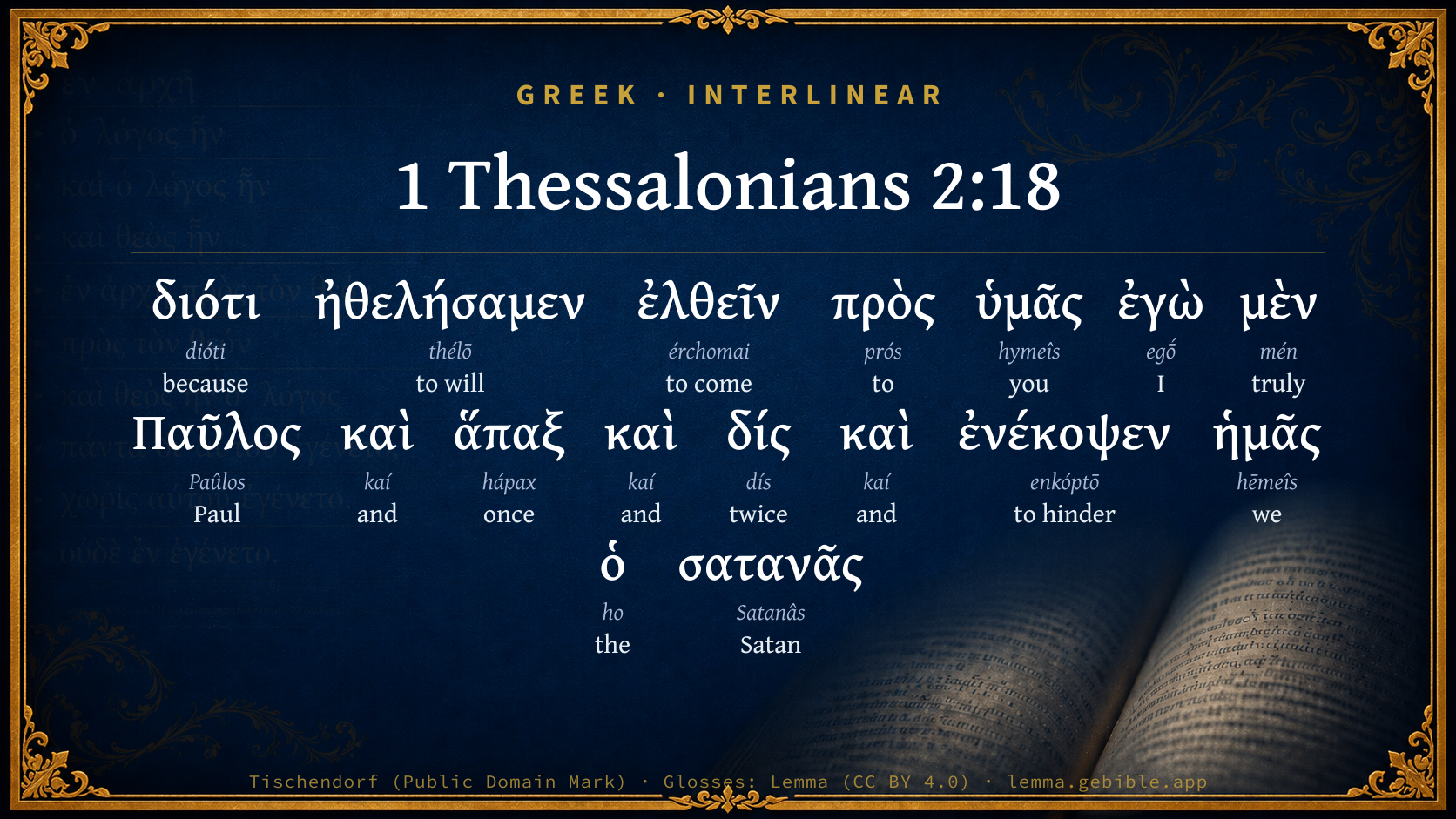
  1. διότι dióti G1360 “because” Conjunction
  2. ἠθελήσαμεν thélō G2309 “to will” Verb, Aorist, Active, Indicative, 1st person, Plural
  3. ἐλθεῖν érchomai G2064 “to come” Verb, Aorist, Active, Infinitive
  4. πρὸς prós G4314 “to” Preposition
  5. ὑμᾶς hymeîs G5210 “you” Personal pronoun, 2nd person, Accusative, Plural
  6. ἐγὼ egṓ G1473 “I” Personal pronoun, 1st person, Nominative, Singular
  7. μὲν mén G3303 “truly” Particle
  8. Παῦλος Paûlos G3972 “Paul” Noun, Nominative, Singular, Masculine
  9. καὶ kaí G2532 “and” Conjunction
  10. ἅπαξ hápax G530 “once” Adverb
  11. καὶ kaí G2532 “and” Conjunction
  12. δίς dís G1364 “twice” Adverb
  13. καὶ kaí G2532 “and” Conjunction
  14. ἡμᾶς hēmeîs G2249 “we” Personal pronoun, 1st person, Accusative, Plural
  15. ὁ ho G3588 “the” Article, Nominative, Singular, Masculine
  16. σατανᾶς Satanâs G4567 “Satan” Noun, Nominative, Singular, Masculine

About this verse

These counts appear in no published source. They are computed here, from the morphology-tagged text and Lemma’s own curated glosses. What Lemma adds →

17
words
15
distinct lemmas
Pauline Epistles
section

Notable vocabulary

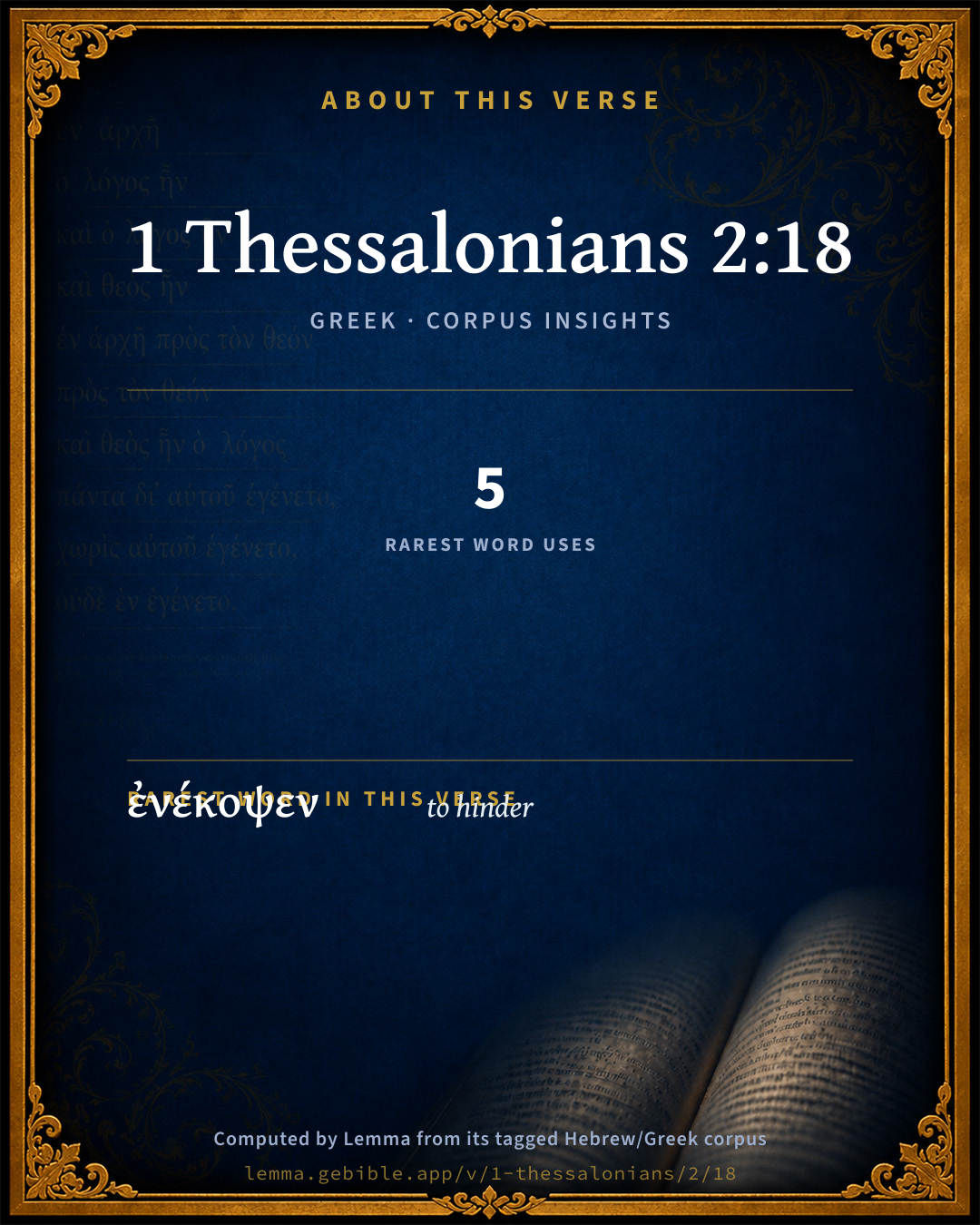
The rarest word here is ἐνέκοψεν to hinder G1465 — appearing just 5 times in the whole Greek New Testament.

Shared distinctive vocabulary

ἐνέκοψεν to hinder G1465 occurs in 5 verses of the Greek New Testament. Also found in:

Repetition

A word recurs within this verse:

Cross-references

9

Topical passages linked to 1 Thessalonians 2:18 in the Treasury of Scripture Knowledge — connected by theme and wording, ordered by reader-vote popularity; previews shown in the World English Bible.

  • Romans 15:22 Therefore also I was hindered these many times from coming to you,
  • Romans 1:13 Now I don't desire to have you unaware, brothers, that I often planned to come to you, and was hindered so far, that I might have some fruit among you also, even as among the rest of the Gentiles.
  • Revelation 2:10 Don't be afraid of the things which you are about to suffer. Behold, the devil is about to throw some of you into prison, that you may be tested; and you will have oppression for ten days. Be faithful to death, and I will give you the crown of life.
  • 2 Corinthians 11:12–14 But what I do, that I will do, that I may cut off occasion from them that desire an occasion, that in which they boast, they may be found even as we.
  • Zechariah 3:1–2 He showed me Joshua the high priest standing before the angel of Yahweh, and Satan standing at his right hand to be his adversary.
  • Job 33:14 For God speaks once, Yes twice, though man pays no attention.
  • Matthew 4:10 Then Jesus said to him, "Get behind me, Satan! For it is written, 'You shall worship the Lord your God, and him only shall you serve.'"
  • Revelation 12:9–12 The great dragon was thrown down, the old serpent, he who is called the devil and Satan, the deceiver of the whole world. He was thrown down to the earth, and his angels were thrown down with him.
  • Colossians 4:18 The salutation of me, Paul, with my own hand: remember my bonds. Grace be with you. Amen.

Cross-references courtesy of OpenBible.info (CC BY 4.0).

Commentary

Notes on 1 Thessalonians 2:18 from classic Christian and Jewish commentators (each source and its license shown beneath its notes). The classic Christian expositions comment on the surrounding passage and are grouped to its opening verse, so a note may address several verses; the Jewish commentaries on the Tanakh (Rashi and others) are per-verse, so they appear only where the commentator wrote on this verse.

Lemma curates 59 commentaries, every one of them public domain or Creative Commons licensed, each selected and text-cleaned for this edition rather than reprinted as found. About our sources →

The Biblical Illustrator

Joseph S. Exell

1Th_2:18

Satan hindered us

Satan the hinderer

It may he profitable to remind ourselves of two or three things bearing upon the nonfulfilment of our best purposes.

We have schemes which come to nothing; wishes which perish in disappointment vows which fall so far short of realization as to afflict our hearts with a sense of self-perjury and self-contempt. What is that malign power which hinders us when we start on any holy errand? Why is there not a clear path to the souls feet, so that we may run the way of the Lord? The question is all-important. If we know the hinderer we may address ourselves to the speciality of his power; but if we misconceive his individuality or resources we may exhaust our strength in profitless labour.

I. There is a hinderer. Not only are there hindrances; there is a personal hinderer. He is not visible. He is not persuadable; resist is the right word, not persuade. Is the tiger ever persuaded to spare the prey? God can be entreated the devil must be resisted. One man says there is no devil. Who is that one man? Where does he live? What has he done for the race? Jesus I know, Paul I know, but who is this? The devil tempted Jesus, entered into Judas, desired to have Peter, hindered Paul. I prefer that my faith should run in the line of these statements, notwithstanding their mystery, than that it should espouse the suggestions of speculators who have not yet established their claim to the confidence of souls.

II. The hinderer assails the most eminent workers in the Church--The Saviour even, and here Paul. We are apt to think that the greatest escape the temptations which fall to the lot of others. But the greater the man, the greater the temptation. It is so in other things. The more refined the taste, the more sensitive to vulgarities. Our temptations--

1. Show our unity as members of a common race.

2. Should awaken our sympathy as partakers of a common suffering.

III. This hinderer seeks to foil the aggressive intentions of the Christian.

1. In being a hinderer the enemy has the decided advantage.

(1) It is easy to hinder, i.e., easy to do mischief, suggest difficulties, magnify obstacles.

(2) It is easier to hinder than to counteract. Once let the seed be sown, etc. Once let a good impression be produced, etc.

2. Did Satan ever hinder a man from doing a bad action? When we were about to give a pound to a good cause, did Satan ever say, Give two.

3. Remember the enemy deals with the purposes as well as the performances. He fights battles in the mind. What a wreck is the inner life of some of us!

Application--

1. Satan comes to us sometimes through the medium of bad men.

2. Sometimes through the gratification of apparently harmless wishes (There is no harm in it).

3. Sometimes through friendly but incapable advisers--men who are so far below our level, as utterly to miscalculate us. But there is hope. There is a helper. The Holy Spirit alone can overcome the spirit of evil. (J. Parker, D. D.)

The hinderer

All agree about the hindrances, but some deny that there is a personal hinderer. They hoot at the idea that a God of infinite power and beneficence would permit so malignant a rebel to exist. But where have such people lived? There are thousands of visible devils, why not one invisible? The devil hinders--

I. By suggesting doubts. The terrible catastrophe of the fall was accomplished by a doubt. One of his greatest achievements is to create the doubt of his own existence. We live in an age in which nearly everything that is necessary to be believed is doubted. Depravity is seen in nothing more clearly than the manner in which people act when in doubt religiously. Instead of wisely protecting our own interests, we often give Satan the benefit of our doubts. Nothing pleases Satan so well as to get people in doubt as to the Atonement, the Bible, Judgment, Hell, etc. If he can do this, he will soon have them acting in accordance with their doubts.

II. By magnifying difficulties. By this me as he hinders multitudes, young and old, from giving their hearts to God. He is not honest enough to tell people that this life is one of difficulty, whether they are good or bad; but insinuates that the most crushing difficulties are in the paths of righteousness. But he is a liar. We are not at home yet, only at school. Our work is to master the hard curriculum; but Gods cheering promise is, All things work together for good, etc.

III. By distractions. He dislikes a fixed purpose for the right, and loves to disincline the mind to think on eternal realities. He does not mind men being piously inclined, and purposing to do better. If he can keep them from immediate surrender, he knows that all the rest will be of no avail in the final issue. Conclusion:

1. As a hinderer Satan is the cause of two things--

(1) Much that we would do but cannot. Pauls visit to Thessalonica was frustrated.

(2) Much that we could do if we would: as our sins of commission.

2. Our helper is greater than our hinderer. (T. Kelly.)

Satan as a hinderer

Satan bears a threefold character--tempter, accuser, hinderer. As a hinderer he is obstructive, while as a tempter and accuser, he is destructive.

1. He inspires indifferentism where there ought to be enthusiasm.

2. He influences men to oppose inertia to advancement.

3. He fosters extraconservatism. They used to say of Lord Eldon, that he prevented more good than any other man ever did. Wilberforce breasted opposition for forty six years, in fighting for abolition of the slave trade. William Carey for fifteen years faced the opposition of his own brethren in furthering missions.

4. He leads to criticism and ridicule of what is good.

5. He moves men to determined and open antagonism to what is good--under every pretext. (Homiletic Review.)

Satanic power

I. That there is a personal hinderer in the spiritual life of men. Both the tenor and history, and the assignment of personal attributes prove it. He is mighty, malignant, spiritual, invisible, and impersuadable.

II. This hinderer assails the most eminent personages and workers in the Church. This shows the unity of the race, and suggests a common sympathy.

III. This hinderer seeks to foil every aggressive Christian intention. Easier to hinder than counteract: to suggest difficulties and magnify obstacles. Satan hinders the cause of religion in the world by creating, and then pointing to the foibles and sins of professors.

1. Their inconsistencies--pride, worldliness, divisions, selfishness, covetousness, gloominess.

2. Their crimes--drunkenness, fraud, etc.

3. Lukewarmness. (J. M. McNulty, D. D.)

Satanic hindrance

s:--Paul and his companions were unable to revisit Thessalonica.

1. Not from want of will.

2. Not through the interpositions of Providence.

3. But because Satan hindered them. The hindrance was perhaps--

(1) the persecution which made it prudent for them to stay away.

(2) Or the Athenian philosophers and Corinthian heretics, which made it necessary that they should stay and defend and strengthen the young Churches.

(3) Or dissensions which Satan fomented in the Churches they were visiting, which rendered their prolonged stay imperative. Anyhow, Satan was the prime mover. But why should he take so much interest in these three poor missionaries? That he might weaken the young Church at Thessalonica and destroy it; that he might thwart a powerful ministry; that he might keep Christians apart, and thus weaken that unity which is the strength of Gods people. Note--

I. It has been Satans practice of old to hinder, whenever he could, the work of God. Satan hindered us is the testimony which every saint will bear against the arch enemy. He endeavours to hinder--

1. The completeness of the personal character of individual saints. Take the case of Job.

2. The emancipation of Gods redeemed ones.

(1) Jannes and Jambres withstood Moses, imitating his wonders by their enchantments, Romanism is an ingenious imitation of, and a Satanic hindrance to the Gospel.

(2) Korah and his company hindered Israel by their assumption of the priesthood. Satan hinders now by conspiring to deprive Christ of His sole right to the priesthood.

(3) Achan hindered Israel seriously; so do Satans traitors in the camp today.

(4) When Ezra and Nehemiah were found to build the waste places, the devil was sure to stir up Sanballat and Tobiah to cast down. There never was a revival of religion without a revival of the old enmity.

3. The history of the New Testament Church no less than that of the Old is a history of Satans hinderings. When Christ was on earth, Satan hindered Him personally, and through the Pharisees, etc. When the apostles began their ministry, Herod and the Jews sought to hinder them, and when persecution prevailed not, all sorts of heresies and schisms broke out. When the reformation dawned, if God raised up Luther, Satan brought out Loyala to hinder him. If God had His Wycliffes and Latimers, Satan had his Gardiners and Bonners.

II. The ways in which Satan has hindered us. He is very busy in hindering--

1. Coming to Christ: perplexing with the guilt of past sins, or with the doctrine of election. But you must surmount both, feeling that your great business is to believe in the Lord Jesus Christ.

2. Prayer.

(1) Tempting to abstain from it.

(2) To relax importunity in it.

3. Christian work.

(1) When we are prompted to work, e.g., to speak to one about his soul, to visit the sick and relieve them, to contribute to missions, to teach in the ragged school, then Satan hinders.

(2) When we are embarked on the work, we never ought to expect success unless we have the devil making a noise. We are doing little good when the devil is quiet.

4. Christian union.

5. Communion with Christ: distracting us in our most sacred ordinance.

III. The rules by which we may detect Satanic hindrances. I do not believe that Satan generally hinders people from getting rich. He delights to see Gods servants set upon the pinnacle of the temple, for he knows the position is dangerous. You may tell when Satan hinders.

1. By the object. Satans object is to prevent our glorifying God. If anything has happened to prevent your growing holy, useful, humble, you may trace it to Satan.

2. By the method. God employs good motives, Satan bad ones.

3. By their nature. Whenever an impediment to usefulness is pleasing it comes from Satan. He never brushes the feathers of his birds the wrong way; he generally deals with us according to our tastes and likings.

4. By their season. They come in prayer and while engaged in Gods work. But we ought carefully to watch that we do not put the saddle on the wrong horse. Do not blame the devil when it is yourself. On the other hand, when the Lord puts a bar in your way, do not say, That is Satan, and so go against the providence of God.

IV. Supposing that we have ascertained that our hindrance comes from Satan, what then? Go on, hindrance or no hindrance.

1. If Satan hinders opposition should cheer you. It is your duty to show that Satan is your enemy; rejoice when a prospect of overcoming him transpires.

2. Stand out against him, because you have now an opportunity of making a greater gain than if he had been quiet.

3. Consider what you lose if you do not resist and overcome him. It will be eternal ruin; or at the very least the ruin of Christian usefulness.

4. Feed your courage with the recollection that Christ has overcome.

5. Remember the promise, Resist the devil and he will flee from you. (C. H. Spurgeon.)

Satan hindering Paul

The word hinder is a metaphor taken from military operations--the breaking up of reads, the destroying of bridges, and the interposing of varied obstacles, to cut off the enemies approach or retreat. Or the figure may be that of the racecourse, the upsetting of a chariot by being brought into violent contact with another. Either way we have a graphic description of the obstructions in the way of the apostles advance. Just as an angel stood in the evil way of Balaam, the apostate prophet, to intercept him, so is Satan here represented as standing in the good way of Paul. It is worthy of note that the personal spirit of evil is mentioned by his Hebrew name in this, Pauls earliest epistle--an epistle, too, addressed to a Gentile Church, and containing no direct quotation of Scripture. How, then, had these Gentile believers come to know his name and nature? By Pauls oral teaching, and probably also by a written Gospel. Now, of all the Gospels there is none which speaks so clearly concerning the personality and operations of the tempter under the name of Satan than that written by St. Pauls fellow traveller, Luke. Here we have, therefore, another incidental confirmation of the view that that Gospel may have been entrusted to the Church of Thessalonica to disseminate. However, such an allusion to the adversary of souls points very strongly to the doctrine of his personality. But to what form of hindrance does the apostle allude? It was not, we may be sure, to any pressure of labour; Paul would regard this as a burden of honour laid upon him by the Master. It may have been the danger to which he would be ex!nosed, as he had been previously, if he repaired to Thessalonica; but this cannot have bulked very largely in his view at the time; he is so sympathetically alive to the same danger as besetting his much loved friends. It is more likely that the restraint arose from trials befalling believers in the districts where Paul himself was; but this has no support from the context, for it would seem from that to have been one in which Paul preeminently was concerned--Even I, Paul. He makes something like a severance of himself from his companion in regard to it, and the once and again seems to point not to habitual or prolonged hindrance such as arose from dangers besetting the Church, but rather to some sudden, unexpected, and powerful obstacle such as bodily sickness, which, after passing away, had come upon him once more. These considerations seem to point to the thorn in the flesh, the messenger of Satan sent to buffet him. Like the mysterious agony which now and again seized King Alfred in the midst of intensest activity, this thorn in the flesh was an interruption for the time being to all apostolic plans. This hindrance, however, sent of Satan, as it was declared to be, was yet blessed of God to Paul himself, doubtless for the increase of his patience, the purifying of his desires, the quickening of his zeal, and his growth in grace. It was also blessed of God to others. To the apostles enforced absence from Thessalonica we owe this Epistle, fraught with its words of warning, comfort, and direction for all time. (J. Hutchison, D. D.)

Satan a hinderer

I remember standing in the front of the Cathedral of Notre Dame, in Paris, admiring its beautiful statuary. As I did so a Parisian approached me and said, Do you not see something amusing up there? No! I said, it seems to be all religious. Inwardly I was asking myself, Is this an Atheist, or is he making a fool of me? Do you see those figures? he inquired, pointing to a group representing a soul being weighed to see if it should be found wanting. You observe that there is an angel standing on the one side and Satan on the other. Satan seems as if he were just watching to see that there was fair play Yes, I answered, but I fail to see anything amusing in that. Just look under the scales! he replied. I looked, and there underneath was a little imp pulling down the scale. That is the way Satan gives fair play. A man says, I will reform. Ill mend my life. Ill give up drink. All right, says Satan, and he seems to stand aside and give fair play. Do not trust him. He has some unseen imp hanging on against you. If it be not strong drink, it will be some other sin. The only way to get clear of all these is to get Christ beside you; His power and grace will outweigh all the evil influences of Satan. (Christian Herald.)

The Biblical Illustrator, edited by Joseph S. Exell (c. 1880s–1900s) — public domain. Text from a community e-Sword module.

Tyndale Open Study Notes

Tyndale Open Resources

2:18 again and again: Paul made repeated attempts to return to the Thessalonian church. Despite the opposition of Satan (see Rom 16:20; 2 Cor 2:11; Eph 6:10-12), both Timothy (1 Thes 3:2, 5) and Paul (Acts 20:1-3) were eventually able to visit the church again.

Tyndale Open Study Notes — © Tyndale Open Resources, licensed CC BY-SA 4.0. Text via the HelloAO Bible API.

Bengel's Gnomon

Johann Albrecht Bengel

1Th 2:18. Ἅπαξ καὶ δὶς) So the LXX. Neh 13:20.—ὁ Σατανᾶς, Satan) Paul wisely considered that there lurked beneath this the first cause of evil—a cause, of which we should have had no suspicion otherwise, when reading the history in Act 17:13-14. Satan acted by means of wicked men.

Bengel's Gnomon of the New Testament — English translation (T&T Clark, Edinburgh, 1860) — public domain. Text from a community e-Sword module.

Meyer's Critical & Exegetical Commentary

Heinrich August Wilhelm Meyer

1Th_2:18. Διότι] on which account, that is, on account of this great longing for you (διὰ τὸ ἐν πολλῇ ἐπιθυμίᾳ σπουδάζειν τὸ πρόσωπον ὑμ. ἰδεῖν).

ἠθελήσαμεν] Paul uses θέλειν in agreement with ἐσπουδάσαμεν (1Th_2:17), not βούλεσθαι, as the latter word expresses only the wish, the inclination to something; but the former the active will, the definite purpose. See Meyer on Phm_1:13 f., and Tittm. Synon. p. 124 ff. But whether this purpose was already formed at Berea (Fromond., Baumgarten-Crusius), or elsewhere, cannot be determined.

ἐγὼ μὲν Παῦλος] a restriction of the subject contained in ἠθελήσαμεν, as the apostle in this section intends only to speak of himself. But that he considered the addition ἐγὼ μὲν Παῦλος here necessary, whilst he omitted it in what preceded, is a proof that he there regarded what was said as spoken likewise in the name of his two associates. Moreover, ἐγὼ μὲν Παῦλος is an actual parenthesis, and is not to be connected with καὶ ἅπαξ καὶ δίς, as Hofmann thinks, from the insufficient reason, because otherwise ἐγὼ μὲν Παῦλος must have stood after ἠθελήσαμεν (!); and as we find also with Grotius, who makes a suppressed δέ correspond to the μέν, in the sense: nempe Timotheus et Silas semel.[41]

ΜΈΝ] serves only to bring the subject into prominence. See Hartung, Partikell. II. p. 413.

καὶ ἅπαξ καὶ δίς] both once and twice, a definite expression for twice (comp. Php_4:16); not in the general sense of saepius (Grotius, Joachim Lange, Turretin, Koppe, Pelt), for then ἅπαξ καὶ δίς would have been written. Calvin: Quum dicit semel et bis voluimus, testatur non subitum fuisse fervorem, qui statim refrixerit, sed hujus propositi se fuisse tenacem. A longer continuance of the church (Baur) is not to be assumed from this expression, as the interval of probably half a year, which is to be assumed between the departure of Paul from Thessalonica and the composition of this Epistle (see Introd. § 3), was a period sufficiently long to give rise to the twice formed resolution to return.

καὶ ἐνέκοψεν ἡμᾶς ὁ σατανᾶς] and Satan hindered us. καί, not equivalent with ΔΈ, by which certainly this new sentence might have been introduced (Vorstius, Grotius, Benson, Koppe, Schott, Olshausen, de Wette, Koch, Bloomfield), mentions simply the result of the apostles resolution in the form of juxtaposition. In an unnatural and forced manner Hofmann subordinates ἨΘΕΛΉΣΑΜΕΝ ἘΛΘΕῖΝ ΠΡῸς ὙΜᾶς as the antecedent to ΚΑῚ ἘΝΈΚΟΨΕΝ ἩΜᾶς Ὁ ΣΑΤΑΝᾶς as the principal sentence, whilst ΔΙΌΤΙ denotes while, and ἐν πολλῇ ἐπιθυμίᾳ (1Th_2:17) is in intention added to the sentence introduced by ΔΙΌΤΙ. Accordingly the sense would be: Therefore the anxiety to visit the church became so strong, that when it came to the intention to go to Thessalonica, Satan hindering prevented it (!).

On ἘΓΚΌΠΤΕΙΝ, comp. Rom_15:22; Gal_5:7; 1Pe_3:7.

Ὁ ΣΑΤΑΝᾶς] denotes not the opponents of Christianity, the enemies of God and men (Schrader), but, according to the Pauline view, the personal author of evil, the devil, who, as he is the author of all hindrances in the kingdom of God, has brought about the circumstances which prevented the apostle from carrying out his purpose. But whether, under these preventive circumstances occasioned by the devil, are to be understood the wickedness of the Thessalonian Jews (Fromond., Schott, de Wette, Bisping), qui insidias apostolo in itinere struebant (Quistorp and, though wavering, Zanchius), or the contentions of the church where Paul was, and which prevented his leaving them (Musculus), or even the injecta ei necessitas disputandi saepius cum Stoicis et Epicureis, qui Athenis erant (Grotius), or what else, must be left unexplained, as Paul himself has given no explanation.

[41] Comp. also Wurm, Tüb. Zeitschr. 1833, 1, p. 75 f., ἐγὼ καὶ Παῦλος is to be united directly with καὶ ἅπαξ καὶ δίς. All three had resolved to visit the Thessalonians, but Paul particularly more than once.

Meyer — Critical and Exegetical Commentary on the New Testament — English translation by Peter Christie, edited by Frederick Crombie (T&T Clark, 1880) — public domain. Text from a community e-Sword module.

Expositor's Greek Testament

ed. W. Robertson Nicoll

1Th 2:18 . “We did crave to reach you,” διότι (= because) not being required with the English stress on did . The whole verse is parenthetical, syntactically. καὶ … Σατανᾶς . The mysterious obstacle, which Paul traced back to the ultimate malice of Satan, may have been either ( a ) an illness ( cf. 2Co 12:7 , so Simon, die Psychologie des Apostels Paulus , 63, 64), ( b ) local troubles, ( c ) the exigencies of his mission at the time being (Grotius), or ( d ) a move on the part of the Thessalonian politarchs who may have bound over Jason and other leading Christians to keep the peace by pledging themselves to prevent Paul’s return (Ramsay’s St. Paul the Traveller , 230 f., Woodhouse, E. Bi [32] , 5047, Findlay). Early Christian thought referred all such hindrances to the devil as the opponent of God and of God’s cause. The words ἐν Ἀθήναις (1Th 3:1 ) rule out Zimmer’s application of ( b ) to the emergency at Corinth, while the silence of Acts makes any of the other hypotheses quite possible, though ( d ) hardly fits in with the ordinary view of the Empire in II. 2Th 2:2 f. and renders it difficult to see why the Thessalonians did not understand at once how Paul could not return. The choice really lies between ( a ) and ( c ). Kabisch (27 29), by a forced exegesis, takes 1Th 2:20 as the explanation of this satanic manœuvre. Satan prevented us from coming, in order to rob us of our glory and praise on the last day, by wrecking your Christian faith; he was jealous of our success among you.

[32] Encyclopædia Biblica

The Expositor's Greek Testament, edited by W. Robertson Nicoll (1897–1910) — public domain. Text from a community e-Sword module.

Cambridge Greek Testament for Schools and Colleges

18. διοτι: so in all pre-Syrian uncials.

18. διότι ἠθελήσαμεν ἐλθεῖν πρὸς ὑμᾶς, because we had resolved to come to you: place a colon only at the end of 1Th 2:17. The A.V.—“Wherefore we would have come”—confounds διότι with διό (cf. 1Th 3:1, &c.): for διότι, which regularly introduces an antecedent ground, not a consequence, see 1Th 2:8, 1Th 4:6, Rom 1:19, 1Co 15:9, &c.; it is an emphasized causal ὅτι. The R.V. also fails to do justice to θέλω here, which signifies will rather than wish (see Buttmann’s Lexilogus, Lidd. and Scott’s Lexicon, Tittmann’s Synonyms, sub voce: Grimm in his Lexicon seems to be at fault); had St Paul meant “we would fain have come” (R.V.), or “were fain to come,” he would presumably have written ἐβουλόμεθα, as in 2Co 1:15 or Phm 1:13. This rendering, moreover, makes ἠθελήσαμεν but a weakened repetition of ἐσπουδάσαμεν … ἐν πολλῇ ἐπιθυμίᾳ. The Apostles had “made up their minds to come”—they were resolved and bent upon it; hence their strenuous effort (1Th 2:17). Θέλω (ἐθέλω), with θέλημα, in the N.T. as in classical Greek, always implies, more or less distinctly, active volition,—even in Mat 1:19; “auf das entschiedene Wollen, den festen, bestimmten Vorsatz und Entschluss geht” (Bornemann ad loc.).

ἐγὼ μὲν Παῦλος καὶ ἄπαξ καὶ δίς. I, Paul, indeed both once and twice. The plural of 1Th 2:17-18 a shows that the three writers—at any rate more than one of them (see 1Th 3:1)—shared in this strong desire and determined attempt; St Paul, on his part, had “twice” definitely “resolved to come.” Perhaps the former of these plans to revisit Thessalonica was formed at Berœa, while Paul and Silas were together (Act 17:10-14); and the second at Athens, which Paul reached alone (1Th 2:15), or on the way from Berœa to Athens. The phrase καὶ ἅπαξ καὶ δίς is found in Php 4:16, where it is rendered as here, “once and again (you sent to relieve my need)”: cf. Neh 13:20, 1Ma 3:30 (LXX), where ἅπαξ κ. δίς, like our “once or twice,” means “several times” indefinitely; but the definite numerical sense is appropriate here and in Phil., and with repeated καί—“not once only, but twice,” “as often as twice.” For the double καί, cf. Mat 10:28; 1Co 10:32. The μέν solitarium connotes a tacit contrast, scil. “but the others once”; see Blass’ Grammar of N.T. Greek, p. 267.

καὶ ἐνέκοψεν ἡμᾶς ὁ Σατανᾶς. This clause coordinates itself by καί (not δέ) quite appropriately to 1Th 2:17, 1Th 2:18 a being subordinate and parenthetical; the entire sentence reads thus: “But we, brothers, … made extraordinary efforts to see your face, in our great longing (for we had set our minds on coming to you,—I Paul, for my own part, not once but twice); and Satan hindered us.” The “hindering” did not obstruct the “willing” (ἠθελήσαμεν, 1Th 2:18 a), but the “endeavouring” (ἐσπουδάσαμεν, 1Th 2:17). If this interpretation be right (see Bornemann at length ad loc.), the punctuation both of A.V. and R.V. is misleading; cf. the two foregoing notes.

Ἐνκόπτω (see Gal 5:7, and Lightfoot’s note; Rom 15:22) is a military term of later Greek, signifying “to make a break in (the enemy’s way),” to “cut up (the road).” Ὁ Σατανᾶς (Heb. הַשָּׂטָן, Aramaic סָטָנָא), “the Adversary,” is the Captain of the powers of evil,—undoubtedly a personality, not a personification, to St Paul; the same as ὁ πειράζων of 1Th 3:5, ὁ πονηρός of 2Th 3:3. This O.T. name recurs in 2Th 2:9 (see note); it is frequent in St Paul, along with ὁ διάβολος, and is used by most N.T. writers as the proper name of the great spiritual Enemy of God and man. What form the hindrance took is not stated; Jewish malice probably supplied a chief element in it (see 1Th 2:16, κωλυόντων ἡμᾶς κ.τ.λ.); most likely an order had been procured from the magistrates of Thessalonica forbidding the return of the missionaries. For similar references by Paul to the personal hostility of Satan, see 2Co 2:11; 2Co 12:7.

1Th 2:19-20 go to explain the great eagerness of St Paul and his companions, and the repeated attempt of the former, to get back to Thessalonica.

1Th 2:19 is best punctuated—after WH, Lightfoot, Nestle, and others—by reading ἤ οὐχὶ καὶ ὑμεῖς; as a parenthesis: For what is our hope or joy or glorying’s crown (or is it not you indeed?) before our Lord Jesus in His coming?” as much as to say, “What else than you?” Not that other Churches fail to afford such hope; “alios non excludit, hos maxime numerat” (Bengel): cf. Php 2:16; Php 4:1; Joh 15:11; Joh 17:10; 3Jn 1:4. The Apostles’ “hope,” like that of their readers (1Th 1:4; 1Th 1:10, 1Th 3:13), is fixed on the glorious return of the Lord Jesus; then their work will be appraised (see 1Co 4:1-5; 2Co 5:9 f.), and “joy” or “grief” (Heb 13:17), “glorying” or shame, will be theirs, as the objects of their care prove worthy or unworthy (cf. 2Th 1:11 f.). Hence all their prayers and efforts look to this end, as in 1Th 3:13, 1Th 5:23 f.; Col 1:28 to Col 2:2; 2Co 11:2. At Christ’s coming St Paul expects his “crown” (2Ti 4:8; cf. 1Co 9:25; Jas 1:12; 1Pe 5:4, &c.).

στέφανος καυχήσεως—corona gloriationis (Calvin, Bengel), not gloriœ (Vulg.)—renders צֲטֶרֶת תִּפְאֶרֶת in Isa 62:3; Eze 16:12; Eze 23:42; Pro 16:31—the crown which a king or hero wears on some day of festal triumph; cf. Sophocles, Ajax 465. St Paul anticipates a consummation of the καύχησις which he already enjoys: see 2Th 1:4; Rom 15:17; 1Co 15:31; 2Co 7:4, &c. The appealing interrogative (ἢ οὐχὶ καὶ ὑμεῖς;) is characteristic: cf. Rom 9:21; 1Co 6:2; 1Co 6:19, &c.

Note the first appearance here of the word παρουσία, which plays so large a part in the two Epistles: see 1Th 3:13, 1Th 4:15, 1Th 5:23; 2Th 2:1; 2Th 2:8-9; once besides, in 1Co 15:23; also in 1Jn 2:28. It stood for the “coming,” or “presence,” of the expected (Jewish) Messiah, His advent and accession to power and glory. Since Jesus had claimed to be this Messiah, but had not in the first instance “come in power” or “in His kingdom” or “in the glory of His Father” (Mat 16:28; Mat 24:30; Mar 8:38; Mar 9:1, &c.), this remained to be realized at His future παρουσία, to which the term thus came to be specifically applied (Mat 24:3, &c.); it is synonymous in this sense with ἐπιφάνεια (1Ti 6:14, &c.), and ἀποκάλυψις (1Co 1:7).

Cambridge Greek Testament for Schools and Colleges (Cambridge University Press, 1896; 21 vols, various authors incl. Carr, Maclear, Plummer, Farrar, Lumby, Moule, M. R. James, Simcox) — public domain. Text from a community e-Sword module.

Jamieson, Fausset & Brown

Robert Jamieson, A. R. Fausset & David Brown

Wherefore--The oldest manuscripts read, "Because," or "Inasmuch as."

we would--Greek, "we wished to come"; we intended to come.

even I Paul--My fellow missionaries as well as myself wished to come; I can answer for myself that I intended it more than once. His slightly distinguishing himself here from his fellow missionaries, whom throughout this Epistle he associates with himself in the plural, accords with the fact that Silvanus and Timothy stayed at Berea when Paul went on to Athens; where subsequently Timothy joined him, and was thence sent by Paul alone to Thessalonica (Th1 3:1).

Satan hindered us--On a different occasion "the Holy Ghost, the Spirit of Jesus" (so the oldest manuscripts read), Act 16:6-7, forbad or hindered them in a missionary design; here it is Satan, acting perhaps by wicked men, some of whom had already driven him out of Thessalonica (Act 17:13-14; compare Joh 13:27), or else by some more direct "messenger of Satan--a thorn in the flesh" (Co2 12:7; compare Co2 11:14). In any event, the Holy Ghost and the providence of God overruled Satan's opposition to further His own purpose. We cannot, in each case, define whence hindrances in good undertakings arise; Paul in this case, by inspiration, was enabled to say; the hindrance was from Satan. GROTIUS thinks Satan's mode of hindering Paul's journey to Thessalonica was by instigating the Stoic and Epicurean philosophers to cavil, which entailed on Paul the necessity of replying, and so detained him; but he seems to have left Athens leisurely (Act 17:33-34; Act 18:1). The Greek for "hindered" is literally, "to cut a trench between one's self and an advancing foe, to prevent his progress"; so Satan opposing the progress of the missionaries.

Jamieson, Fausset & Brown — Commentary Critical and Explanatory on the Whole Bible (1871) — public domain (CC PDM 1.0). Text via the HelloAO Bible API.

Adam Clarke's Commentary

Verse 18. Even I Paul] He had already sent Timothy and Silas to them; but he himself was anxious to see them, and had purposed this once and again, but Satan hindered; i.e., some adversary, as the word means, whether the devil himself, or some of his children. There was, however, such a storm of persecution raised up against him, that his friends did not think it prudent to permit him to go till the storm had been somewhat allayed.

Adam Clarke's Commentary on the Bible (1810–1826) — public domain. Text from a community e-Sword/MySword module.

John Calvin's Commentaries

18 Satan hindered us. Luke relates that Paul was in one instance hindered, (Acts 20:3) inasmuch as the Jews laid an ambush for him in the way. The same thing, or something similar, may have occurred frequently. It is not without good reason, however, that Paul ascribes the whole of this to Satan, for, as he teaches elsewhere, (Ephesians 6:12) we have to

wrestle not with flesh and blood, but with principalities of the air, and spiritual wickednesses, etc.

For, whenever the wicked molest us, they fight under Satan’s banner, and are his instruments for harassing us. More especially, when our endeavors are directed to the work of the Lord, it is certain that everything that hinders proceeds from Satan; and would to God that this sentiment were deeply impressed upon the minds of all pious persons — that Satan is continually contriving, by every means, in what way he may hinder or obstruct the edification of the Church! We would assuredly be more careful to resist him; we would take more care to maintain sound doctrine, of which that enemy strives so keenly to deprive us. We would also, whenever the course of the gospel is retarded, know whence the hindrance proceeds. He says elsewhere, (Romans 1:13) that God had not permitted him, but both are true: for although Satan does his part, yet God retains supreme authority, so as to open up a way for us, as often as he sees good, against Satan’s will, and in spite of his opposition. Paul accordingly says truly that God does not permit, although the hindrance comes from Satan.

John Calvin's Commentaries (1540-1563) — public domain. Text from the Calvin Translation Society English edition (1840s-50s) via the Christian Classics Ethereal Library (ccel.org). Calvin's coverage is partial (roughly two-thirds of the Bible); uncommented books and verses are honest gaps, never fabricated. The 19th-century editor's footnotes and remarks are omitted so the notes are faithfully Calvin's own voice.

Ellicott's Commentary for English Readers

(18) We would.—Not merely a conditional tense, but “we were ready to come—meant to come.”

Even I Paul.—Rather, that is to say, I; Paul, not as if it were a great thing that one like him should have such a wish, but showing that Silas and Timothy had not shared his intention. Why had they not? The answer shows the minute truthfulness of the Acts. Timothy, apparently, did not at first leave Thessalonica with St. Paul (Act_17:10, where the Greek seems definitely to exclude him). Both Silas and Timothy were left at Berœa (Act_17:14). It was during this period that St. Paul felt so eager a desire to return to his persecuted children. We cannot tell on what two definite occasions the desire was almost taking shape; but possibly his longing may have been stimulated by seeing his messengers start for the north, first when he sent for his two companions (Act_17:15), and secondly when he despatched Timothy himself to Thessalonica (1Th_3:2).

But Satan hindered.—How, cannot be decided; but St. Paul has no doubt that his disappointment was a direct manifestation of the work of evil, not a leading of God to stay where he was. Elsewhere he is quite as clear that the obstruction of his own plans is owing to God. (See Act_16:6-7; 1Co_16:12, where the will spoken of is not Apollos’ will, but God’s.) The difficulty is to tell in each case whether God is directly saving us from a worse course, in spite of ourselves, or permitting a momentary, and yet if rightly used a disciplinary, triumph of evil.

Satan.—The Thessalonians, though originally Gentiles, had doubtless been taught enough at their conversion to recognise the word. Though it is quite clear from other passages (e.g., 1Co_7:5; 2Th_2:9; 1Ti_3:7) that St. Paul believed in the existence of personal fallen spirits, it cannot be positively affirmed that he here means anything more than a personification of all that is opposed to God—the hostility of wicked men, &c.

A Bible Commentary for English Readers, edited by Charles John Ellicott (1878–1897) — public domain. Text from a community e-Sword module.

The Cambridge Bible for Schools and Colleges

gen. ed. J. J. S. Perowne

18. Wherefore we would have come unto you] The true reading is because—not “wherefore,” due probably to a misunderstanding of the following verb, which is not removed by the rendering of the R. V., “because we would fain have come.” This but repeats the “great desire” just expressed; whereas the Greek verb implies resolution rather than inclination. The Apostle, as we understand him, is giving the explanation of his strenuous endeavours (1Th_2:17), lying behind them in his determined will—because we had resolved to come to you: “we had set our minds upon it.”

even I Paul] Better, I Paul, for my part. He speaks for himself: Timothy did return after a time (ch. 1Th_3:1-2); and Silas had been left behind in Macedonia (Act_17:14; Act_18:5). Paul had not come at all; but it was not for want of will.

And the Apostle had made up his mind to this more than once—both once and twice. Silas had, no doubt, shared in the wish and endeavour to return from Berœa; the second attempt, likewise frustrated, was made by the Apostle alone, from Athens (ch. 1Th_3:1). The expression recurs in Php_4:16. Compare with the whole statement Rom_1:13 : “Many times I purposed to come to you, and have been hindered hitherto.” The Apostle’s prophetic gift did not save him from the discipline of disappointment.

but Satan hindered us] Properly, and Satan, &c.: “but” would be the regular conjunction here; there is a slight dislocation of structure in the sentence, due to excited feeling. We may paraphrase the sentence thus: We strove eagerly to find means of coming to see you; indeed, for my part, I had made up my mind to do it more than once; and our way was blocked, by Satan! What form the hindrance took we can only guess. Jewish malice doubtless had much to do with it. But behind this baffling and unforeseen combination of circumstances the Apostle discerned the craft of the Arch-enemy.

Satan] i.e. “the Adversary,” is the O.T. name of the Leader of evil spirits, the great enemy of God and man—called also “the Devil” (Slanderer), “the Evil One” (2Th_3:3), and “the Tempter” (ch. 1Th_3:5). Satan is, throughout the New Testament, a real personality, and no figure of speech. See note on 2Th_2:9; and comp. Rev_12:9.

To account for his intense longing to see the Thessalonians, St Paul describes his interest in them in the glowing terms that follow:—

The Cambridge Bible for Schools and Colleges (gen. ed. J. J. S. Perowne; Cambridge University Press, 1878–1918) — public domain. Text from a community e-Sword module.

John Gill's Exposition

Wherefore we would have come unto you,.... They not only had a will, and purposed in themselves, and entered into some resolutions to come unto them, but endeavoured to put them into execution:

even I Paul: as well as Silas and Timothy; the latter of which had been with them, and the others had as good a will, and especially Paul: and that

once and again: or "once and twice" so the Jews used (h) to speak , "one time and a second"; that is, several times:

but Satan hindered us. The Syriac and Ethiopic versions read, "hindered me"; by moving the mob which rose at Thessalonica, to go to Berea, and disturb the apostle there; which obliged him, contrary to his will, to go to Athens instead of returning to Thessalonica, as he intended; and when at Athens, from whence also he might purpose to return thither, he was hindered by the disputes the Jews and the Stoics, and Epicurean philosophers, had with him; and after that, might be prevented by the lying in wait of the Jews for him, of which he might be informed; or by disturbances raised in the church, or churches where he was, by the false teachers; which required his stay with them, to oppose and refute error and heresy and to make up differences that arose among true Christians, fomented by Satan and his emissaries; see Rom 1:13. Satan does all he can to hinder the preaching of the Gospel, the hearing of the word, the profession of religion, and the saints coming together, and having spiritual conversation with each other; being, as his name "Satan" signifies, an enemy to Christ and his interest, and to the souls of men: indeed he can do nothing but by divine permission, nor can he hinder the will of God, and the execution of that, though he often hinders the will of man, or man from doing his will; he hindered the apostle from doing what he willed and purposed, but he did not hinder the will of God, which was that Paul should be employed in other work elsewhere.

(h) Maimon. in Hilch. Chobel, c. 5. sect. 10.

John Gill's Exposition of the Whole Bible (1746–1763) — public domain (CC PDM 1.0). Text via the HelloAO Bible API.

Trapp's Complete Commentary

John Trapp

18 Wherefore we would have come unto you, even I Paul, once and again; but Satan hindered us.

Ver. 18. But Satan hindered us] He still doth his utmost to hinder the communion of saints, and to keep them asunder. He knows two are better than one; and therefore he stirred up the primitive persecutors to banish the Christians, and to confine them to isles and mines. Where they could not have access one to another: whether Satan hindered Paul by sickness, or by imprisonments, or tempests at sea, who can resolve saith one. (Cyprian. Epist.) He hindered him by casting a necessity upon him of disputing often with the Stoics and Epicures which were at Athens, saith another interpreter. Satan-Hindering

John Trapp, A Commentary or Exposition upon All the Books of the Old and New Testament (1647–1656) — public domain. Text from a community e-Sword module.

Albert Barnes' Notes on the Bible

Wherefore we would have come unto you, even I Paul - The phrase “even I Paul,” seems to be used by way of emphasis. He had a special desire to go himself. He had sent Timothy to them 1Th 3:2, 1Th 3:5, and perhaps, some might have been disposed to allege that Paul was afraid to go himself, or that he did not feel interest enough in them to go, though he was willing to send one to visit them. Paul, therefore, is at much pains to assure them that his long separation from them was unavoidable.

But Satan hindered us - Compare the notes on 2Co 12:7. In what way this was done is unknown, and conjecture would be useless. The apostle recognized the hand of Satan in frustrating his attempt to do good, and preventing the accomplishment of his strong desire to see his Christian friends. In the obstacles, therefore, to the performance of our duty, and in the hindrances of our enjoyment, it is not improper to trace the hand of the great enemy of good. The agency of Satan may, for aught we can tell, often be employed in the embarrassments that we meet with in life. The hindrances which we meet with in our efforts to do good, when the providence of God seems to favor us, and his word and Spirit seem to call us to a particular duty, often look very much like the work of Satan. They are just such obstructions as a very wicked being would be glad to throw in our way.

Albert Barnes' Notes on the Bible (1834–1885) — public domain. Text from a community e-Sword/MySword module.

Haydock's Catholic Bible Commentary

Satan hindered us. That is, has raised such an aversion to me among the pagans and Jews of Thessalonica, that my friends do not think it safe I should come among you. I am now detained from you by violence; but when this life is past, you shall form my joy and my crown. I will present you at the tribunal of my Saviour, and say: Behold me and my children; behold the fruits of my labours, the proofs of my fidelity, and my claims for a recompense. (Calmet) --- If the apostle here calls his disciples his hope, joy, glory, why may we not call the blessed Virgin Mary, or other saints, their joy and hope, for the special confidence they have in their prayers?

George Leo Haydock (1774–1849), Haydock's Catholic Family Bible and Commentary, 1859 edition — public domain. Excludes Psalms (Douay-Rheims chapter numbering differs from Protestant) and Deuterocanonical books (Catholic canon only).

Matthew Poole's English Annotations

This he adds further to satisfy them of his real affection to them, that he attempted to come to them

once and again, that is, often, as Neh 13:20; Phi 4:16. And that they might be assured it was not his fellow ministers’ desire only to come, therefore he expresseth his own name particularly in a parenthesis (even I Paul). Or by his saying, even I Paul, he assures them concerning his own desire to come to them; at least I Paul, though others did not so; as the French Bible reads it. And he had come to them had not

Satan hindered him, either by raising up disputes against the gospel at Athens by the philosophers there, which he was concerned to stay and answer, Act 17:18; or else by stirring up wicked men to lie in wait for him in the way: or by raising tumults, as the Jews did at Berea, whereby he was constrained to go as it were to the sea, Act 17:14; or by sowing dissensions in other churches, which detained him to end them. Or by what way it was, is somewhat uncertain; but being thus hindered it made his desire the more fervent by the opposition. And hereby we see Satan’s enmity to the gospel, especially to churches newly planted, that they might not take rooting.

Matthew Poole's English Annotations on the Holy Bible (1683–1685) — public domain. Text from a community e-Sword/MySword module.

Whedon's Commentary on the Bible

Daniel D. Whedon

18. Come unto you—He was driven from Thessalonica to Berea. He would have gone back again from Berea to Thessalonica, but Satan inspired the Thessalonian Jews to track him to Berea, and he was driven from Berea seaward to Athens. 1Th_3:1.

I Paul—An intimation that his we in this connexion means I, and that the language represents his own personal feeling.

Satan—The personal devil, (comp. 1Th_3:5,) in whose existence, therefore, Paul not merely believes, but refers to his agency even such comparatively trifling and external matters, because therein there lies prepared a hinderance to the kingdom of God, (compare Eph_6:12; otherwise Rom_1:13; Rom_15:22; Act_16:6, sq.) The apostle, then, does not everywhere, and as a matter of course, speak of Satan, but he knows how, with testing insight, to distinguish. In what this Satanic hinderance consisted we know not; but it must have been something of evil, either on the side of the Thessalonians, or on that of Paul. In the first case, we should have to think of the enemies of the gospel at Thessalonica, whose hatred had been a source of danger to the apostle on his arrival at Thessalonica. In the other case, perhaps of trials in the Churches, where Paul had since been, which rendered a removal from them impossible for him. Or, perhaps, of some sickness of the apostle. And in connexion with this we might think of Satan’s messenger, (2Co_12:7,) a topic, it is true, on which we know nothing certain. (Comp. also 1Th_3:7.) It is even very possible that both kinds of reasons concurred: that the first time, for example, (and this would best agree with 1Th_2:17,) Paul desired to turn back again to Thessalonica from Berea, but was hindered in that by the Thessalonian Jews. Act_17:13.

Wordsworth notes that the Hebrew name Satan is remarkable in this first of St. Paul’s epistles.

Daniel D. Whedon (gen. ed.), Commentary on the Old and New Testaments (1874–1909) — public domain. Text from a community e-Sword module.

The Pulpit Commentary

Wherefore we would have come unto you, even I Paul. Paul distinguishes himself, because in all probability his companions, Silas and Timothy, had been at Thessalonica after he had left it. Once and again. Not used indefinitely, but referring to two separate attempts which Paul made to revisit the Thessalonians. But Satan hindered us; denoting, not the enemies of Christianity, but the devil, the author of all the hindrances in the kingdom of God. Paul here recognizes the personality of Satan, as the author of all evil, the great opponent of God and Christ. We are not informed by what instrumentality this hindrance of Satan took place. It may refer to the various persecutions against Paul, which prevented him returning to Thessalonica, and especially to that persecution raised against him in Beraea by the Jews of Thessalonica. (Act_17:13) In one sense, indeed, the hindrances arose in the way of God"s providence, for under its direction all the journeys of Paul were placed, and Satan could not have hindered him from preaching the gospel in any quarter, unless by the Divine permission. (comp. Act_16:7; Rom_1:13)

The opposition of Satan to the gospel.

"Satan hindered us.

I THE PERSONALITY OF SATAN. Christ and Satan, the heads of two opposite empires the one the kingdom of light, and the other the kingdom of darkness; the one the source of all that is good, and the other the source of all that is evil.

II THE AGENCY OF SATAN. He hindereth the spread of the gospel. He worketh in the children of disobedience. Mode of his operation; the instruments which he employs.

III THE FINAL VICTORY OF CHRIST OVER SATAN. Though Satan hindereth the gospel, yet it is only for a season. "The God of peace shall bruise Satan under our feet shortly". (Rom_16:20) Hindered by Satan.

St. Paul tells his friends at Thessalonica that he was anxious to revisit them, and that he made the attempt to do so more than once, but that he was hindered by Satan. The direct impediment may have been the opposition of his enemies; (Act_17:13, Act_17:14) or it may have been bodily sickness thorn in the flesh, a messenger of Satan." Whatever this immediate and visible hindrance was, the point of interest to us is that St. Paul attributed it to Satan. Let us consider the hindrance thrown in the way of good work by Satan.

I SATAN HINDERS THE WORK OF THE GOSPEL.

1. The hindrance is to be seen in all times. Doors are shut; enemies are raised up; misunderstandings throw mission work into confusion.

1. The source of the hindrance may be discovered by its character. "By their fruits they shall know them." The excuse may be the preservation of order, the restraint of excesses, or conservative respect for old ways. That the real source of opposition is Satanic may be known when

1. bad men are the agents,

2. a good moral reformation is frustrated.

3. This hindrance converts mission work into a warfare. The Church becomes an army. The forces of light and darkness are drawn up in battle array. New territory cannot simply be claimed by planting the standard of the cross upon it. It must be fought for and won in conquest.

II SATAN"S HINDRANCE IS INDEPENDENT OF THE CHARACTER OF THE CHRISTIAN LABORERS. Of course, if these men receive Satan into their hearts, so much the more effectually will their mission be frustrated. They become traitors who destroy their own cause by opening the gates of the citadel to the foe. Sin indulged by the servant of Christ is treason. This is a certain and fearful hindrance to success. But the Christian laborer may be faithful and may stilt be hindered by Satan. In the old tradition Satan dared to oppose the archangel Michael Shall we be surprised that he opposes a man? Satan resisted and tempted Christ. He hindered St. Paul. Therefore do not let us think that all difficulties will vanish if only we are true and faithful. Satan may hinder us, though we are innocent, through the wickedness of other men.

III SATAN"S HINDRANCE IS OVERRULED BY GOD"S PROVIDENCE. Here St. Paul writes of Satan hindering him. In the Acts St. Luke tells us how, when the apostle and his friends assayed to go into Bithynia... the Spirit of Jesus suffered them not". (Act_16:7) Is it not possible that sometimes the two influences may have concurred in effecting the same results though originating in the very opposite sources and prompted by contradictory motives? Thus the messenger of Satan that was sent to buffet St. Paul was the means of applying a wholesome discipline and of saving him from undue self-exaltation. Thus, too, though Satan troubled Job, with the object of showing him to be a hypocrite; the great trial proved to be for the glory of God as well as for the honor of his servant. Satan tempted Christ, and so made him the better High Priest for us. Satan compassed the death of Christ, and thereby led to the redemption of the world. Satan"s hindrance to our work may be overruled for its more full accomplishment in the end, just as the east winds of early spring help to secure a good fruit harvest by checking the too-early development of bud and blossom. Moreover, all this hindrance is but temporary. Satan"s reign is for a season only. And when the hindrance is removed the final result will not have suffered for the delay. Perhaps it will even come the quicker for the temporary hindrance, as, when once it bursts its bounds, the stream rushes out with the more vehemence for having been dammed up. Let us not be impatient. Remember that God has all eternity to work with. W.F.A.

The Pulpit Commentary (1880–1919), ed. H.D.M. Spence-Jones & Joseph S. Exell — public domain. Text from a community e-Sword module.

John Wesley's Explanatory Notes

Satan - By those persecuting Jews, Acts xvii, 13.

John Wesley, Explanatory Notes Upon the Whole Bible (1754–1765) — public domain. Text via the GEBible commentary corpus.

McGarvey & Pendleton's Commentaries

J. W. McGarvey

because we would fain have come unto you, I Paul once and again [emphatic way of saying twice] ; and Satan hindered us . [How Satan hindered, we are not told, but we find that his emissaries had so little disposition to let Paul return that they drove him from Beroea onward to Athens.]

J. W. McGarvey (with Philip Y. Pendleton), Commentaries on the New Testament (The Fourfold Gospel, 1914; Acts; and the epistles) — public domain. Text from a community e-Sword/MySword module.

The People's New Testament

B. W. Johnson

18. We would have come. Once and again, twice, he had purposed to return to them, but Satan hindered. How, is not stated, but some difficulties intervened that Paul attributed to Satan. His agency is often manifest when we do not recognize it; sometimes in wicked opposition, sometimes even “as an angel of light.”

B. W. Johnson's The People's New Testament with Notes (1889–1891) — public domain. Electronic text from the Christian Classics Ethereal Library (CCEL) ThML edition.

Alford’s Greek Testament

Henry Alford

18.] Wherefore (as following up this earnest endeavour) we would have come (had a plan to come: “not ἐβουλόμεθα, which would indicate merely the disposition: see Phm 1:13, Phm 1:14” (Lün.)) to you, even I Paul (the introduction of these words here, where he is about to speak of himself alone, is a strong confirmation of the view upheld above (on ch. 1:9) that he has hitherto been speaking of himself and his companions. The μέν answers to a suppressed δέ, q. d. περὶ δὲ τῶν ἄλλων οὐ νῦν ὁ λόγος, or the like. Grot., al., think the suppressed δέ refers to the rest having intended it once only, but the Apostle more times, taking κ. ἅπ. κ. δίς with ἐγ. μ. Παῦ.), not once only but twice (literally, ‘both once and twice:’ not used widely (ἅπ. κ. δίς), but meaning that on two special occasions he had such a plan: see ref. The words refer to ἐσπουδάσ., not to ἐγὼ μ. Π.,—see above), and (not ‘but:’ the simple copula, as in Rom 1:13, gives the matter of fact, without raising the contrast between the intention and the hindrance) Satan (i.e. the devil: not any human adversary or set of adversaries, as De W., al.; whether Satan acted by the Thessalonian Jews or not, is unknown to us, but by whomsoever acting, the agency was his) hindered us (reff.).

Henry Alford, The Greek Testament (1849–1861) — public domain. Text from a community e-Sword module.

International Critical Commentary

18. διότι ἠθελήσαμεν κτλ “For we did wish to come to you.” ἐσπουδάσαμε becomes ἠθελήσαμε and τὸ πρόσωπον ἰδεῖ becomes ἐλθεῖν πρὸς ὑμᾶ; the parallel expressions are virtually synonymous. The repetition is purposed, for he is defending himself and his associates; hence also he adds, “and Satan stopped us.” Inasmuch, however, as the Jews had singled out Paul as the chief offender, he interjects ἐγὼ μὲν Παῦλος, καὶ ἅπαξ καὶ δί In the light of ἅπαξ καὶ δί (Deu 9:13, Deu 9:1 Reg. 17:39, Neh 13:20, Neh 13:1 Mac. 3:30), the first και may be ascensive, and the interjected phrase as a whole be translated: “Certainly I Paul did (ἠθέλησα ἐλθεῖ) wish to come, and that too repeatedly.”

διότ here as v. 8 is not “wherefore” (διο; so DcEKL) but “because”; a comma suffices after ἐπιθυμίᾳ. θέλει (cf. 4:13, II 3:10, 1Co 16:7) occurs in Paul about twelve times as often as βούλεσθα In Paul it is difficult to distinguish between them, though θέλει seems to pass into “wish,” while βούλεσθα remains in the realm of “deliberate plan.” Had Paul here intended to emphasise distinct deliberation, be would probably have used βούλεσθα as in 2Co 1:15. The actual resolve following σπουδάζει and θέλει comes first in ηὐδοκήσαμε (3:1).—μέ occurs in every letter of Paul except II and Phile.; in about one-third of the instances it is solitarium.—Apart from the superscriptions and the ἀσπασμό (II 3:17, 1Co 16:21, Col 4:18; cf. Phm 1:19), Παῦλο appears in every letter of Paul except Rom. and Phil.—For ἐγὼ μέ, cf. 1Co 5:3; for ἐγὼ Παῦλο, 2Co 10:1, Gal 5:2, Eph 3:1, Col 1:23, Phm 1:19.

The meaning of καὶ ἅπαξ καὶ δί, a collocation found in Gk. Bib. only here, Php 4:16 and Neh 13:20 (אc. a; the correct reading is ἅπαξ καὶ δί), is uncertain. Usually the four words are taken together to mean an indefinite succession of occurrences, “often,” “repeatedly” (e. g. Grot., Pelt, Lft,; Wohl., Dob.), or else, definitely (cf. Herod. II, 121, III, 148, cited by Wetstein on Php 4:16 and Plato, Phaed. 63 E init.: καὶ δὶς καὶ τρί= “both twice and thrice”), “both once and twice, that is, twice” (Mill.). Zahn, indeed (Introd. I, 204 f.; cf. Find.), conjectures that Paul attempted to return first when in Berœa and a second time when waiting in Athens for Silvanus and Timothy. In the Lxx, however, we have simply ἅπαξ καὶ δί which in Deu 9:13, Deu 9:1 Reg. 17:39 and Neh 13:20 invites the translation “often,” “repeatedly,” and which in 1 Mac. 3:30 (ὡς ἅπαξ καὶ δί) appears to mean καθὼς ἀει, “as usual.” Similar is the recurring phrase ὡς ἅπαξ καὶ ἅπα (1 Reg. 3:10, 20:25, Jdg 16:20, Jdg 16:20:30, Jdg 16:31) which seems to mean καθὼς ἀει (Jdg 16:20 A) or κατὰ τὸ εἰωθό (Num 24:1). If the phrase in our passage is not καὶ ἅπαξ καὶ δί but ἅπαξ καὶ δί, then the first και is ascensive: “and (και) what is more, repeatedly (ἅπαξ καὶ δί)”; and light is thrown on Php 4:16: ὅτι καὶ ἐν θεσσαλονίκῃ καὶ ἅπαξ καὶ δὶς εἰς τὴν χρείαν μοι ἐπέμψατ, which is to be rendered not, “for even in Thessalonica ye sent once and again unto my need,” but, taking και … και correlatively (cf. Ewald, ad loc., in Zahn’s Komm.), “for both (when I was) in Thessalonica and (και) repeatedly (ἅπαξ καὶ δί) (when I was in other places) you sent to my need.” The point of Php 4:16 is thus not that the Philippians sent help frequently to Paul in Thessalonica but simply sent help to him there (probably on their own initiative) and frequently elsewhere.

καὶ ἐνέκοψεν ἡμᾶς ὁ Σατανᾶ. “We were anxious to see you, we did wish to come to you, and yet Satan stopped us” (ἡμᾶ, that is, Paul and his two associates). The contest gives an adversative turn to the copula (Vulg sed). What particular obstacle Satan put in the way of their return, Paul does not tell us. Satan, however, did not thwart all of them permanently; they are able to send one of their number, Timothy, from Athens; and they are confident that God and Christ, to whom they pray (3:11) will direct their way to Thessalonica.

The reference to the work of Satan has been variously interpreted. (1) The illness of Paul is thought of as in 2Co 12:7 (so Simon, Die Psychologie des Apostels Paulus, 1897, 63). But as Everling remarks (Die paulinische Angelologie und Dämonologie,1888, 74), the theory of illness does not fit Silvanus and Timothy. (2) Satan prevented them from returning inorder to destroy the spiritual life of the converts and thus rob Paul of his joy in their chaplet of victory at the Parousia (so Kabisch, Die Eschatologie des Paulus, 1893, 27 f.) But as Dibelius (Die Geisterwelt im Glauben des Paulus, 1909, 56) observes, the chaplet of victory will be theirs if they continue steadfast under persecution; and furthermore, to make the victory sure, Paul himself need not return to Thessalonica (cf. 3:11-13). (3) Satan inspired the Politarchs to compel Jason and his friends to give bonds for the continued absence of Paul (so Ramsay, St. Paul the Traveller, 240; McGiffert, Apostolic Age, 249; Find. and others). This explanation, however, “renders it difficult to see why the Thessalonians did not understand at once how Paul could not return” (Moff.), and takes the force out of the insinuations of the Jews. (4) Hence it is safer to leave the reference indefinite as Paul does (Everling, Dibelius, Mill.), or at most to think of “the exigencies of his mission at the time being” (Moff.).

ἐνκόπτει occurs in Gk. Bib. elsewhere only Gal 5:3, Act 24:4; ἐνκόπτεσθα only Rom 15:22, 1Pe 3:1. GF here and some minuscules in Gal 5:7 read ἀνέκοψε (Sap. 18:23, 4 Mac. 13:6; cf. 1:35 א). The Satan of Job, Zech. and 1Ch 21:1 is rendered in Lxx by (ο) διάβολο except Job 2:3 (A) which like Sir. 21:27 has ὁ Σατανᾶ For Σατά, cf. 3 Reg. 11:14, 23. In Paul, ὁ Σατανᾶ (II 2:9; always with article except 2Co 12:7) is ὁ πειράζω (3:5), ὁ πονηρό (II 3:3), ὁ θεὸς τοῦ αἰῶνος τούτο (2Co 4:4), ὁ ἄρχων τῆς ἐξουσίας, τοῦ ἀέρος τοῦ πνεύματος τοῦ νῦν ἐνεργοῦντος ἐν τοῖς υἱοῖς τῆς ἀπειθία (Eph 2:2). On demonology in general, cf. Bousset, Relig.2 381 ff. and J. Weiss. in PRE IV, 408 ff.; in Paul, the works of Everling and Dibelius noted above.

International Critical Commentary — older volumes (1896–1929), various authors — public domain. Text from a community e-Sword module.

Vincent's Word Studies in the New Testament

Marvin R. Vincent

We would [ηθελησαμεν] . Implying more than a mere inclination or desire. It was our will to come. See on Mt 1:19.

I Paul. Not implying any less desire on the part of his associates, but emphasising his own. See on the use of the epistolary plural, ch. 1 2. Satan [σατανας] . From the Aramaic Satana, adversary. In the canonical LXX the name appears only three times, 1Ki 11:14, 23, 25, and in each case is applied to a man. In LXX diabolov is used, almost without exception, as the translation of the Hebrews Satan. Of 22 instances of diabolov only 9 are outside of the book of Job. From the more general conception of an adversary, there is, in the O. T., a gradual development toward that of an evil personality. For instance, in 2Sa 24:1, the numbering of the people is ascribed to the anger of the Lord. The later historian, in 1Ch 21:1, ascribes the act to Satan. See also Job, Wisd. 2 24; Zec 2:1. The specialising of the conception was due, in part, to the contact of the Jews with the religions of Babylon and Persia. In N. T. Satan appears as the personal spirit of evil - the same who is called the devil, the wicked one, the prince of the power of the air, the prince of this world, the serpent, the God of this world, the tempter. He tempts to evil, opposes God 's work, inspires evil dispositions, torments God 's people. The word Satan occurs only once in the Fourth Gospel, not in the Epistles, but often in Revelation. Mark never uses diabolov, Matthew never Satan. Paul seldom diabolov, often Satan. Satan alone in Pastorals. Luke uses both. It is clear that Paul here as elsewhere employs the word in a personal sense; but any attempt to base the doctrine of a personal devil on this and similar passages is unsafe.

Hindered [ενεκοψεν] . See on 1Pe 3:7.

Marvin R. Vincent, Word Studies in the New Testament (1887–1900) — public domain. Text from a community e-Sword/MySword module.

Lesson kit

Teaching starters — assembled from the data on this page, not authored interpretation. Every prompt links to the verse data it draws on. Edit before teaching.

1 Thessalonians, in the Pauline Epistles, opens this verse with 17 words (15 distinct Greek lemmas). Its most distinctive word is enkóptō (“to hinder”). A historical commentator’s framing appears above. Read the whole chapter for the surrounding context.

Discussion questions

  1. The word enkóptō carries the sense “to hinder.” How does it shape the verse?
  2. Acts 24:4 shares the word «to hinder» with this verse. How do the two illuminate each other?
  3. “and” occurs 3× in this one verse. What is the effect of the repetition?
  4. These translations render this verse differently; the difference is in the English rendering, not the original. What questions does that raise?
  5. Reading how The Biblical Illustrator and Tyndale Open Study Notes read this verse, where do the two commentators agree and where do they part?

Things to notice

Reading settings

Reading text

Shown beneath each verse's original-language words.

Old Testament
Old Testament edition

Read the OT as the Masoretic Hebrew (MT) or the Greek Septuagint (LXX).

English shown for the Greek Septuagint (in the Hebrew ↔ Greek comparison).

Comparing translations? Open the Compare panel on any verse page to stack up to four side by side.