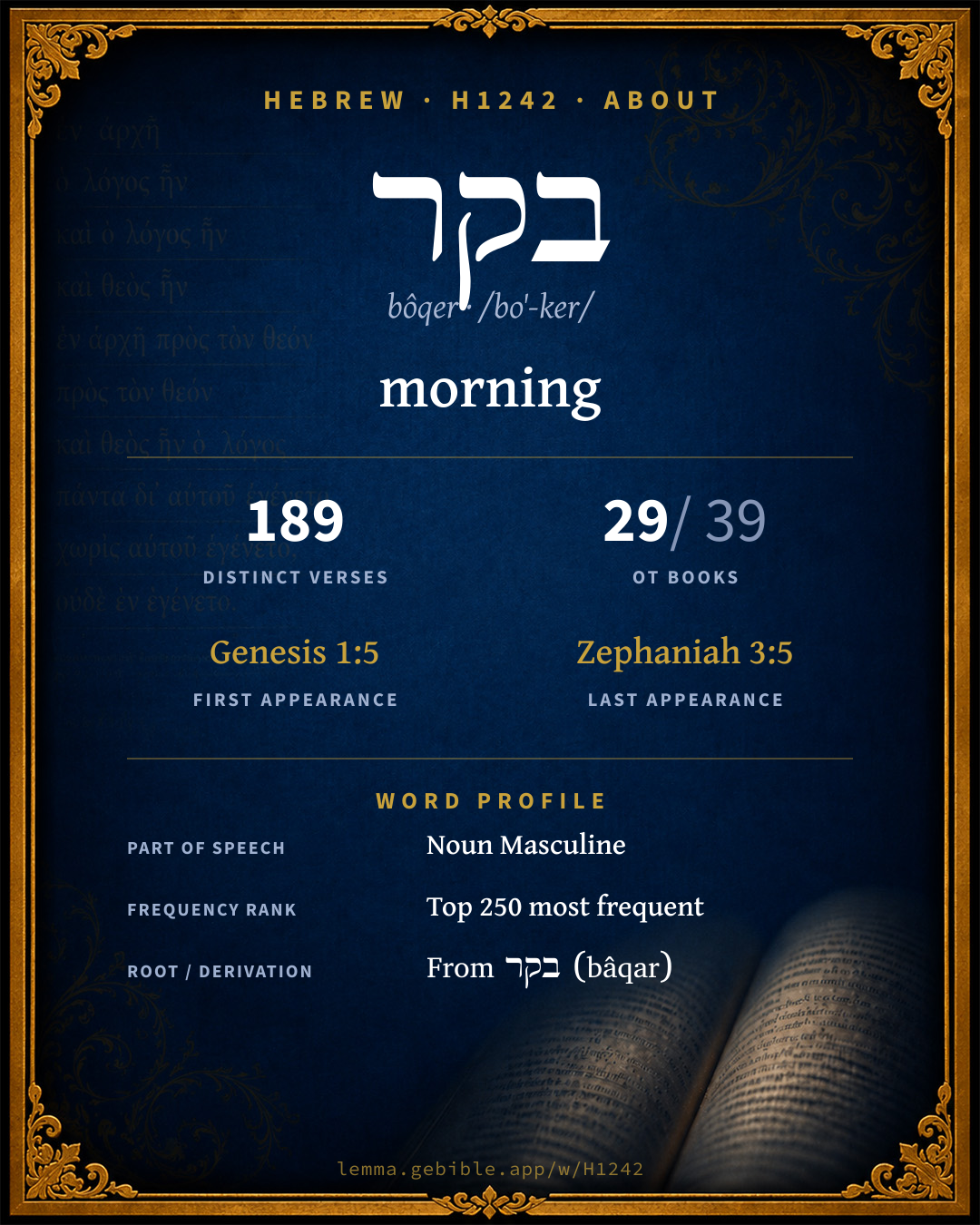
בֹּ֫קֶר
morning
‘morning’ is one of 3 main senses fuller range ↓
Full lexicon entry — Brown-Driver-Briggs (BDB)
From Brown-Driver-Briggs (BDB)
Where this word appears
Grammar key — what these labels mean
Part of speech
- Noun
- A naming word — a person, place, thing, or idea.
Noun type
- Common
- A common noun — a general class of person, place, or thing (“king,” “city,” “water”), not a specific name.
State
- Absolute
- The independent form of a noun, not bound to a following word.
Gender
- Masculine
- Grammatically masculine.
Number
- Singular
- One.
- Plural
- More than one (in Hebrew, generally three or more).
Grammatical forms
- Noun, Common, Masculine, Singular, Absolute 209 times (98%)
- Noun, Common, Masculine, Plural, Absolute 5 times (2%)
Parsed forms decoded from the imported morphology (morphhb / Westminster Leningrad Codex — WLC text public domain, morphhb tagging CC BY 4.0), counted across 214 parsed occurrences — not distinct verses.
Every verse where H1242 appears — 189 distinct verses across 29 books. Click any verse to open its interlinear word-by-word view. Verse text shown in the World English Bible for context — . Each verse’s Hebrew form is shown with its reference; the English is not keyword-highlighted, since the data carries no word-level English alignment. Use “Compare translations” on any verse to read it across multiple English versions. This concordance covers the Hebrew Bible; Septuagint (Greek Old Testament) occurrences are not indexed here.
Genesis 19 verses
- Genesis 1:5 בֹ֖קֶר n c ms God called the light Day, and the darkness he called Night. There was evening and there was morning, one day.
- Genesis 1:8 בֹ֖קֶר n c ms God called the expanse sky. There was evening and there was morning, a second day.
- Genesis 1:13 בֹ֖קֶר n c ms There was evening and there was morning, a third day.
- Genesis 1:19 בֹ֖קֶר n c ms There was evening and there was morning, a fourth day.
- Genesis 1:23 בֹ֖קֶר n c ms There was evening and there was morning, a fifth day.
- Genesis 1:31 בֹ֖קֶר n c ms God saw everything that he had made, and, behold, it was very good. There was evening and there was morning, the sixth day.
- Genesis 19:27 בַּ/בֹּ֑קֶר prep det + n c ms Abraham got up early in the morning to the place where he had stood before Yahweh.
- Genesis 20:8 בַּ/בֹּ֗קֶר prep det + n c ms Abimelech rose early in the morning, and called all his servants, and told all these things in their ear. The men were very scared.
- Genesis 21:14 בַּ/בֹּ֡קֶר prep det + n c ms Abraham rose up early in the morning, and took bread and a bottle of water, and gave it to Hagar, putting it on her shoulder, and gave her the child, and sent her away. She departed, and wandered in the wilderness of Beersheba.
- Genesis 22:3 בַּ/בֹּ֗קֶר prep det + n c ms Abraham rose early in the morning, and saddled his donkey, and took two of his young men with him, and Isaac his son. He split the wood for the burnt offering, and rose up, and went to the place of which God had told him.
- Genesis 24:54 בַ/בֹּ֔קֶר prep det + n c ms They ate and drank, he and the men who were with him, and stayed all night. They rose up in the morning, and he said, "Send me away to my master."
- Genesis 26:31 בַ/בֹּ֔קֶר prep det + n c ms They rose up some time in the morning, and swore one to another. Isaac sent them away, and they departed from him in peace.
- Genesis 28:18 בַּ/בֹּ֗קֶר prep det + n c ms Jacob rose up early in the morning, and took the stone that he had put under his head, and set it up for a pillar, and poured oil on the top of it.
- Genesis 29:25 בַ/בֹּ֔קֶר prep det + n c ms It happened in the morning that, behold, it was Leah. He said to Laban, "What is this you have done to me? Didn't I serve with you for Rachel? Why then have you deceived me?"
- Genesis 31:55 בַּ/בֹּ֗קֶר prep det + n c ms Early in the morning, Laban rose up, and kissed his sons and his daughters, and blessed them. Laban departed and returned to his place.
- Genesis 40:6 בַּ/בֹּ֑קֶר prep det + n c ms Joseph came in to them in the morning, and saw them, and saw that they were sad.
- Genesis 41:8 בַ/בֹּ֨קֶר֙ prep det + n c ms It happened in the morning that his spirit was troubled, and he sent and called for all the magicians of Egypt, and all the wise men of it. Pharaoh told them his dream, but there was no one who could interpret them to Pharaoh.
- Genesis 44:3 הַ/בֹּ֖קֶר ptcl def.art + n c ms As soon as the morning was light, the men were sent away, they and their donkeys.
- Genesis 49:27 בַּ/בֹּ֖קֶר prep det + n c ms "Benjamin is a ravenous wolf. In the morning he will devour the prey. At evening he will divide the spoil."
Exodus 31 verses
- Exodus 7:15 בַּ/בֹּ֗קֶר prep det + n c ms Go to Pharaoh in the morning. Behold, he goes out to the water; and you shall stand by the river's bank to meet him; and the rod which was turned to a serpent you shall take in your hand.
- Exodus 8:20 בַּ/בֹּ֨קֶר֙ prep det + n c ms Yahweh said to Moses, "Rise up early in the morning, and stand before Pharaoh; behold, he comes forth to the water; and tell him, 'This is what Yahweh says, "Let my people go, that they may serve me.
- Exodus 9:13 בַּ/בֹּ֔קֶר prep det + n c ms Yahweh said to Moses, "Rise up early in the morning, and stand before Pharaoh, and tell him, 'This is what Yahweh, the God of the Hebrews, says: "Let my people go, that they may serve me.
- Exodus 10:13 הַ/בֹּ֣קֶר ptcl def.art + n c ms Moses stretched forth his rod over the land of Egypt, and Yahweh brought an east wind on the land all that day, and all the night; and when it was morning, the east wind brought the locusts.
- Exodus 12:10 בֹּ֑קֶר בֹּ֖קֶר n c ms n c ms You shall let nothing of it remain until the morning; but that which remains of it until the morning you shall burn with fire.
- Exodus 12:22 בֹּֽקֶר n c ms You shall take a bunch of hyssop, and dip it in the blood that is in the basin, and strike the lintel and the two side-posts with the blood that is in the basin; and none of you shall go out of the door of his house until the morning.
- Exodus 14:24 הַ/בֹּ֔קֶר ptcl def.art + n c ms It happened in the morning watch, that Yahweh looked out on the host of the Egyptians through the pillar of fire and of cloud, and confused the Egyptian army.
- Exodus 14:27 בֹּ֨קֶר֙ n c ms Moses stretched out his hand over the sea, and the sea returned to its strength when the morning appeared; and the Egyptians fled against it. Yahweh overthrew the Egyptians in the midst of the sea.
- Exodus 16:7 וּ/בֹ֗קֶר conj + n c ms and in the morning, then you shall see the glory of Yahweh; because he hears your murmurings against Yahweh. Who are we, that you murmur against us?"
- Exodus 16:8 בַּ/בֹּ֨קֶר֙ prep det + n c ms Moses said, "Now Yahweh shall give you meat to eat in the evening, and in the morning bread to satisfy you; because Yahweh hears your murmurings which you murmur against him. And who are we? Your murmurings are not against us, but against Yahweh."
- Exodus 16:12 וּ/בַ/בֹּ֖קֶר conj + prep det + n c ms "I have heard the murmurings of the children of Israel. Speak to them, saying, 'At evening you shall eat meat, and in the morning you shall be filled with bread: and you shall know that I am Yahweh your God.'"
- Exodus 16:13 וּ/בַ/בֹּ֗קֶר conj + prep det + n c ms It happened at evening that quail came up and covered the camp; and in the morning the dew lay around the camp.
- Exodus 16:19 בֹּֽקֶר n c ms Moses said to them, "Let no one leave of it until the morning."
- Exodus 16:20 בֹּ֔קֶר n c ms Notwithstanding they didn't listen to Moses, but some of them left of it until the morning, and it bred worms, and became foul: and Moses was angry with them.
- Exodus 16:21 בַּ/בֹּ֣קֶר בַּ/בֹּ֔קֶר prep det + n c ms prep det + n c ms They gathered it morning by morning, everyone according to his eating. When the sun grew hot, it melted.
- Exodus 16:23 הַ/בֹּֽקֶר ptcl def.art + n c ms He said to them, "This is that which Yahweh has spoken, 'Tomorrow is a solemn rest, a holy Sabbath to Yahweh. Bake that which you want to bake, and boil that which you want to boil; and all that remains over lay up for yourselves to be kept until the morning."
- Exodus 16:24 הַ/בֹּ֔קֶר ptcl def.art + n c ms They laid it up until the morning, as Moses asked, and it didn't become foul, neither was there any worm in it.
- Exodus 18:13 הַ/בֹּ֖קֶר ptcl def.art + n c ms It happened on the next day, that Moses sat to judge the people, and the people stood around Moses from the morning to the evening.
- Exodus 18:14 בֹּ֥קֶר n c ms When Moses' father-in-law saw all that he did to the people, he said, "What is this thing that you do for the people? Why do you sit alone, and all the people stand around you from morning to evening?"
- Exodus 19:16 הַ/בֹּ֗קֶר ptcl def.art + n c ms It happened on the third day, when it was morning, that there were thunders and lightnings, and a thick cloud on the mountain, and the sound of an exceedingly loud trumpet; and all the people who were in the camp trembled.
- Exodus 23:18 בֹּֽקֶר n c ms "You shall not offer the blood of my sacrifice with leavened bread, neither shall the fat of my feast remain all night until the morning.
- Exodus 24:4 בַּ/בֹּ֔קֶר prep det + n c ms Moses wrote all the words of Yahweh, and rose up early in the morning, and built an altar under the mountain, and twelve pillars for the twelve tribes of Israel.
- Exodus 27:21 בֹּ֖קֶר n c ms In the tent of meeting, outside the veil which is before the testimony, Aaron and his sons shall keep it in order from evening to morning before Yahweh: it shall be a statute forever throughout their generations on the behalf of the children of Israel.
- Exodus 29:34 הַ/בֹּ֑קֶר ptcl def.art + n c ms If anything of the flesh of the consecration, or of the bread, remains to the morning, then you shall burn the remainder with fire: it shall not be eaten, because it is holy.
- Exodus 29:39 בַ/בֹּ֑קֶר prep det + n c ms The one lamb you shall offer in the morning; and the other lamb you shall offer at evening:
- Exodus 29:41 הַ/בֹּ֤קֶר ptcl def.art + n c ms The other lamb you shall offer at evening, and shall do to it according to the meal-offering of the morning, and according to its drink-offering, for a sweet savor, an offering made by fire to Yahweh.
- Exodus 30:7 בַּ/בֹּ֣קֶר בַּ/בֹּ֗קֶר prep det + n c ms prep det + n c ms Aaron shall burn incense of sweet spices on it every morning. When he tends the lamps, he shall burn it.
- Exodus 34:2 לַ/בֹּ֑קֶר בַ/בֹּ֨קֶר֙ prep det + n c ms prep det + n c ms Be ready by the morning, and come up in the morning to Mount Sinai, and present yourself there to me on the top of the mountain.
- Exodus 34:4 בַ/בֹּ֨קֶר֙ prep det + n c ms He chiseled two tablets of stone like the first; and Moses rose up early in the morning, and went up to Mount Sinai, as Yahweh had commanded him, and took in his hand two stone tablets.
- Exodus 34:25 לַ/בֹּ֔קֶר prep det + n c ms "You shall not offer the blood of my sacrifice with leavened bread; neither shall the sacrifice of the feast of the Passover be left to the morning.
- Exodus 36:3 בַּ/בֹּ֥קֶר בַּ/בֹּֽקֶר prep det + n c ms prep det + n c ms and they received from Moses all the offering which the children of Israel had brought for the work of the service of the sanctuary, with which to make it. They brought yet to him freewill-offerings every morning.
Leviticus 8 verses
- Leviticus 6:9 הַ/בֹּ֔קֶר ptcl def.art + n c ms "Command Aaron and his sons, saying, 'This is the law of the burnt offering: the burnt offering shall be on the hearth on the altar all night until the morning; and the fire of the altar shall be kept burning on it.
- Leviticus 6:12 בַּ/בֹּ֣קֶר בַּ/בֹּ֑קֶר prep det + n c ms prep det + n c ms The fire on the altar shall be kept burning on it, it shall not go out; and the priest shall burn wood on it every morning: and he shall lay the burnt offering in order upon it, and shall burn on it the fat of the peace offerings.
- Leviticus 6:20 בַּ/בֹּ֔קֶר prep det + n c ms "This is the offering of Aaron and of his sons, which they shall offer to Yahweh in the day when he is anointed: the tenth part of an ephah of fine flour for a meal offering perpetually, half of it in the morning, and half of it in the evening.
- Leviticus 7:15 בֹּֽקֶר n c ms The flesh of the sacrifice of his peace offerings for thanksgiving shall be eaten on the day of his offering. He shall not leave any of it until the morning.
- Leviticus 9:17 הַ/בֹּֽקֶר ptcl def.art + n c ms He presented the meal offering, and filled his hand from there, and burned it upon the altar, besides the burnt offering of the morning.
- Leviticus 19:13 בֹּֽקֶר n c ms "'You shall not oppress your neighbor, nor rob him. The wages of a hired servant shall not remain with you all night until the morning.
- Leviticus 22:30 בֹּ֑קֶר n c ms It shall be eaten on the same day; you shall leave none of it until the morning. I am Yahweh.
- Leviticus 24:3 בֹּ֛קֶר n c ms Outside of the veil of the Testimony, in the Tent of Meeting, shall Aaron keep it in order from evening to morning before Yahweh continually: it shall be a statute forever throughout your generations.
Numbers 11 verses
- Numbers 9:12 בֹּ֔קֶר n c ms They shall leave none of it until the morning, nor break a bone of it. According to all the statute of the Passover they shall keep it.
- Numbers 9:15 בֹּֽקֶר n c ms On the day that the tabernacle was raised up, the cloud covered the tabernacle, even the Tent of the Testimony: and at evening it was over the tabernacle as it were the appearance of fire, until morning.
- Numbers 9:21 בֹּ֔קֶר בַּ/בֹּ֖קֶר n c ms prep det + n c ms Sometimes the cloud was from evening until morning; and when the cloud was taken up in the morning, they traveled: or by day and by night, when the cloud was taken up, they traveled.
- Numbers 14:40 בַ/בֹּ֔קֶר prep det + n c ms They rose up early in the morning, and got them up to the top of the mountain, saying, Behold, we are here, and will go up to the place which Yahweh has promised: for we have sinned.
- Numbers 16:5 בֹּ֠קֶר n c ms and he spoke to Korah and to all his company, saying, In the morning Yahweh will show who are his, and who is holy, and will cause him to come near to him: even him whom he shall choose will he cause to come near to him.
- Numbers 22:13 בַּ/בֹּ֔קֶר prep det + n c ms Balaam rose up in the morning, and said to the princes of Balak, Get you into your land; for Yahweh refuses to give me leave to go with you.
- Numbers 22:21 בַּ/בֹּ֔קֶר prep det + n c ms Balaam rose up in the morning, and saddled his donkey, and went with the princes of Moab.
- Numbers 22:41 בַ/בֹּ֔קֶר prep det + n c ms It happened in the morning, that Balak took Balaam, and brought him up into the high places of Baal; and he saw from there the utmost part of the people.
- Numbers 28:4 בַ/בֹּ֑קֶר prep det + n c ms The one lamb shall you offer in the morning, and the other lamb shall you offer at even;
- Numbers 28:8 הַ/בֹּ֤קֶר ptcl def.art + n c ms The other lamb shall you offer at even: as the meal-offering of the morning, and as the drink-offering of it, you shall offer it, an offering made by fire, of a sweet savor to Yahweh.
- Numbers 28:23 הַ/בֹּ֔קֶר ptcl def.art + n c ms You shall offer these besides the burnt offering of the morning, which is for a continual burnt offering.
Deuteronomy 3 verses
- Deuteronomy 16:4 לַ/בֹּֽקֶר prep det + n c ms There shall be no yeast seen with you in all your borders seven days; neither shall any of the flesh, which you sacrifice the first day at even, remain all night until the morning.
- Deuteronomy 16:7 בַ/בֹּ֔קֶר prep det + n c ms You shall roast and eat it in the place which Yahweh your God shall choose: and you shall turn in the morning, and go to your tents.
- Deuteronomy 28:67 בַּ/בֹּ֤קֶר בֹּ֑קֶר prep det + n c ms n c ms In the morning you shall say, Would it were even! and at even you shall say, Would it were morning! for the fear of your heart which you shall fear, and for the sight of your eyes which you shall see.
Joshua 5 verses
- Joshua 3:1 בַּ/בֹּ֜קֶר prep det + n c ms Joshua rose up early in the morning; and they removed from Shittim, and came to the Jordan, he and all the children of Israel; and they lodged there before they passed over.
- Joshua 6:12 בַּ/בֹּ֑קֶר prep det + n c ms Joshua rose early in the morning, and the priests took up the ark of Yahweh.
- Joshua 7:14 בַּ/בֹּ֖קֶר prep det + n c ms In the morning therefore you shall be brought near by your tribes: and it shall be, that the tribe which Yahweh takes shall come near by families; and the family which Yahweh shall take shall come near by households; and the household which Yahweh shall take shall come near man by man.
- Joshua 7:16 בַּ/בֹּ֔קֶר prep det + n c ms So Joshua rose up early in the morning, and brought Israel near by their tribes; and the tribe of Judah was taken:
- Joshua 8:10 בַּ/בֹּ֔קֶר prep det + n c ms Joshua arose up early in the morning, and mustered the people, and went up, he and the elders of Israel, before the people to Ai.
Judges 10 verses
- Judges 6:28 בַּ/בֹּ֔קֶר prep det + n c ms When the men of the city arose early in the morning, behold, the altar of Baal was broken down, and the Asherah was cut down that was by it, and the second bull was offered on the altar that was built.
- Judges 6:31 הַ/בֹּ֑קֶר ptcl def.art + n c ms Joash said to all who stood against him, Will you contend for Baal? Or will you save him? he who will contend for him, let him be put to death while [it is yet] morning: if he be a god, let him contend for himself, because one has broken down his altar.
- Judges 9:33 בַ/בֹּ֨קֶר֙ prep det + n c ms and it shall be, that in the morning, as soon as the sun is up, you shall rise early, and rush on the city; and, behold, when he and the people who are with him come out against you, then may you do to them as you shall find occasion.
- Judges 16:2 הַ/בֹּ֖קֶר ptcl def.art + n c ms [It was told] the Gazites, saying, Samson is come here. They compassed him in, and laid wait for him all night in the gate of the city, and were quiet all the night, saying, [Let be] until morning light, then we will kill him.
- Judges 19:5 בַ/בֹּ֖קֶר prep det + n c ms It happened on the fourth day, that they arose early in the morning, and he rose up to depart: and the young lady's father said to his son-in-law, Strengthen your heart with a morsel of bread, and afterward you shall go your way.
- Judges 19:8 בַּ/בֹּ֜קֶר prep det + n c ms He arose early in the morning on the fifth day to depart; and the young lady's father said, Please strengthen your heart and stay until the day declines; and they ate, both of them.
- Judges 19:25 הַ/בֹּ֔קֶר ptcl def.art + n c ms But the men wouldn't listen to him: so the man laid hold on his concubine, and brought her forth to them; and they knew her, and abused her all the night until the morning: and when the day began to spring, they let her go.
- Judges 19:26 הַ/בֹּ֑קֶר ptcl def.art + n c ms Then came the woman in the dawning of the day, and fell down at the door of the man's house where her lord was, until it was light.
- Judges 19:27 בַּ/בֹּ֗קֶר prep det + n c ms Her lord rose up in the morning, and opened the doors of the house, and went out to go his way; and, behold, the woman his concubine was fallen down at the door of the house, with her hands on the threshold.
- Judges 20:19 בַּ/בֹּ֑קֶר prep det + n c ms The children of Israel rose up in the morning, and encamped against Gibeah.
Ruth 3 verses
- Ruth 2:7 הַ/בֹּ֨קֶר֙ ptcl def.art + n c ms She said, Please let me glean and gather after the reapers among the sheaves. So she came, and has continued even from the morning until now, except that she stayed a little in the house.
- Ruth 3:13 בַ/בֹּ֨קֶר֙ הַ/בֹּֽקֶר prep det + n c ms ptcl def.art + n c ms Stay this night, and it shall be in the morning, that if he will perform to you the part of a kinsman, well; let him do the kinsman's part: but if he will not do the part of a kinsman to you, then will I do the part of a kinsman to you, as Yahweh lives: lie down until the morning.
- Ruth 3:14 הַ/בֹּ֔קֶר ptcl def.art + n c ms She lay at his feet until the morning. She rose up before one could discern another. For he said, Let it not be known that the woman came to the threshing floor.
1 Samuel 17 verses
- 1 Samuel 1:19 בַ/בֹּ֗קֶר prep det + n c ms They rose up in the morning early, and worshiped before Yahweh, and returned, and came to their house to Ramah: and Elkanah knew Hannah his wife; and Yahweh remembered her.
- 1 Samuel 3:15 הַ/בֹּ֔קֶר ptcl def.art + n c ms Samuel lay until the morning, and opened the doors of the house of Yahweh. Samuel feared to show Eli the vision.
- 1 Samuel 5:4 בַ/בֹּקֶר֮ prep det + n c ms When they arose early on the next day morning, behold, Dagon was fallen on his face to the ground before the ark of Yahweh; and the head of Dagon and both the palms of his hands [lay] cut off on the threshold; only [the stump of] Dagon was left to him.
- 1 Samuel 9:19 בַ/בֹּ֔קֶר prep det + n c ms Samuel answered Saul, and said, I am the seer; go up before me to the high place, for you shall eat with me today: and in the morning I will let you go, and will tell you all that is in your heart.
- 1 Samuel 11:11 הַ/בֹּ֔קֶר ptcl def.art + n c ms It was so on the next day, that Saul put the people in three companies; and they came into the midst of the camp in the morning watch, and struck the Ammonites until the heat of the day: and it happened, that those who remained were scattered, so that no two of them were left together.
- 1 Samuel 14:36 הַ/בֹּ֗קֶר ptcl def.art + n c ms Saul said, Let us go down after the Philistines by night, and take spoil among them until the morning light, and let us not leave a man of them. They said, Do whatever seems good to you. Then said the priest, Let us draw near here to God.
- 1 Samuel 15:12 בַּ/בֹּ֑קֶר prep det + n c ms Samuel rose early to meet Saul in the morning; and it was told Samuel, saying, Saul came to Carmel, and, behold, he set him up a monument, and turned, and passed on, and went down to Gilgal.
- 1 Samuel 17:20 בַּ/בֹּ֗קֶר prep det + n c ms David rose up early in the morning, and left the sheep with a keeper, and took, and went, as Jesse had commanded him; and he came to the place of the wagons, as the host which was going forth to the fight shouted for the battle.
- 1 Samuel 19:2 בַ/בֹּ֔קֶר prep det + n c ms Jonathan told David, saying, Saul my father seeks to kill you: now therefore, please take care of yourself in the morning, and live in a secret place, and hide yourself:
- 1 Samuel 19:11 בַּ/בֹּ֑קֶר prep det + n c ms Saul sent messengers to David's house, to watch him, and to kill him in the morning: and Michal, David's wife, told him, saying, If you don't save your life tonight, tomorrow you will be slain.
- 1 Samuel 20:35 בַ/בֹּ֔קֶר prep det + n c ms It happened in the morning, that Jonathan went out into the field at the time appointed with David, and a little boy with him.
- 1 Samuel 25:22 הַ/בֹּ֖קֶר ptcl def.art + n c ms God do so to the enemies of David, and more also, if I leave of all that belongs to him by the morning light so much as one man-child.
- 1 Samuel 25:34 הַ/בֹּ֖קֶר ptcl def.art + n c ms For in very deed, as Yahweh, the God of Israel, lives, who has withheld me from hurting you, except you had hurried and come to meet me, surely there wouldn't have been left to Nabal by the morning light so much as one man-child.
- 1 Samuel 25:36 הַ/בֹּֽקֶר ptcl def.art + n c ms Abigail came to Nabal; and, behold, he held a feast in his house, like the feast of a king; and Nabal's heart was merry within him, for he was very drunken: therefore she told him nothing, less or more, until the morning light.
- 1 Samuel 25:37 בַ/בֹּ֗קֶר prep det + n c ms It happened in the morning, when the wine was gone out of Nabal, that his wife told him these things, and his heart died within him, and he became as a stone.
- 1 Samuel 29:10 בַּ/בֹּ֔קֶר בַּ/בֹּ֔קֶר prep det + n c ms prep det + n c ms Therefore now rise up early in the morning with the servants of your lord who have come with you; and as soon as you are up early in the morning, and have light, depart.
- 1 Samuel 29:11 בַּ/בֹּ֔קֶר prep det + n c ms So David rose up early, he and his men, to depart in the morning, to return into the land of the Philistines. The Philistines went up to Jezreel.
2 Samuel 7 verses
- 2 Samuel 2:27 מֵֽ/הַ/בֹּ֨קֶר֙ prep + ptcl def.art + n c ms Joab said, As God lives, if you had not spoken, surely then in the morning the people had gone away, nor followed everyone his brother.
- 2 Samuel 11:14 בַ/בֹּ֔קֶר prep det + n c ms It happened in the morning, that David wrote a letter to Joab, and sent it by the hand of Uriah.
- 2 Samuel 13:4 בַּ/בֹּ֣קֶר בַּ/בֹּ֔קֶר prep det + n c ms prep det + n c ms He said to him, Why, son of the king, are you thus lean from day to day? Won't you tell me? Amnon said to him, I love Tamar, my brother Absalom's sister.
- 2 Samuel 17:22 הַ/בֹּ֗קֶר ptcl def.art + n c ms Then David arose, and all the people who were with him, and they passed over the Jordan: by the morning light there lacked not one of them who had not gone over the Jordan.
- 2 Samuel 23:4 בֹּ֖קֶר בֹּ֚קֶר n c ms n c ms [He shall be] as the light of the morning, when the sun rises, A morning without clouds, [When] the tender grass [springs] out of the earth, Through clear shining after rain.
- 2 Samuel 24:11 בַּ/בֹּ֑קֶר prep det + n c ms When David rose up in the morning, the word of Yahweh came to the prophet Gad, David's seer, saying,
- 2 Samuel 24:15 מֵ/הַ/בֹּ֖קֶר prep + ptcl def.art + n c ms So Yahweh sent a pestilence on Israel from the morning even to the time appointed; and there died of the people from Dan even to Beersheba seventy thousand men.
1 Kings 3 verses
- 1 Kings 3:21 בַּ/בֹּ֛קֶר בַּ/בֹּ֔קֶר prep det + n c ms prep det + n c ms When I rose in the morning to give my child suck, behold, it was dead; but when I had looked at it in the morning, behold, it was not my son, whom I bore.
- 1 Kings 17:6 בַּ/בֹּ֔קֶר prep det + n c ms The ravens brought him bread and flesh in the morning, and bread and flesh in the evening; and he drank of the brook.
- 1 Kings 18:26 מֵ/הַ/בֹּ֨קֶר prep + ptcl def.art + n c ms They took the bull which was given them, and they dressed it, and called on the name of Baal from morning even until noon, saying, Baal, hear us. But there was no voice, nor any who answered. They leaped about the altar which was made.
2 Kings 7 verses
- 2 Kings 3:20 בַ/בֹּ֨קֶר֙ prep det + n c ms It happened in the morning, about the time of offering the offering, that behold, there came water by the way of Edom, and the country was filled with water.
- 2 Kings 3:22 בַ/בֹּ֔קֶר prep det + n c ms They rose up early in the morning, and the sun shone on the water, and the Moabites saw the water over against them as red as blood:
- 2 Kings 7:9 הַ/בֹּ֖קֶר ptcl def.art + n c ms Then they said one to another, We aren't doing right. This day is a day of good news, and we hold our peace: if we wait until the morning light, punishment will overtake us; now therefore come, let us go and tell the king's household.
- 2 Kings 10:8 הַ/בֹּֽקֶר ptcl def.art + n c ms There came a messenger, and told him, saying, They have brought the heads of the king's sons. He said, Lay you them in two heaps at the entrance of the gate until the morning.
- 2 Kings 10:9 בַ/בֹּ֨קֶר֙ prep det + n c ms It happened in the morning, that he went out, and stood, and said to all the people, You are righteous: behold, I conspired against my master, and killed him; but who struck all these?
- 2 Kings 16:15 הַ/בֹּקֶר֩ ptcl def.art + n c ms King Ahaz commanded Urijah the priest, saying, On the great altar burn the morning burnt offering, and the evening meal-offering, and the king's burnt offering, and his meal-offering, with the burnt offering of all the people of the land, and their meal-offering, and their drink-offerings; and sprinkle on it all the blood of the burnt offering, and all the blood of the sacrifice: but the brazen altar shall be for me to inquire by.
- 2 Kings 19:35 בַ/בֹּ֔קֶר prep det + n c ms It happened that night, that the angel of Yahweh went forth, and struck in the camp of the Assyrians one hundred eighty-five thousand: and when men arose early in the morning, behold, these were all dead bodies.
1 Chronicles 3 verses
- 1 Chronicles 9:27 וְ/לַ/בֹּ֥קֶר לַ/בֹּֽקֶר conj + prep det + n c ms prep det + n c ms They lodged round about the house of God, because the charge [of it] was on them; and to them pertained the opening of it morning by morning.
- 1 Chronicles 16:40 לַ/בֹּ֣קֶר prep det + n c ms to offer burnt offerings to Yahweh on the altar of burnt offering continually morning and evening, even according to all that is written in the law of Yahweh, which he commanded to Israel;
- 1 Chronicles 23:30 בַּ/בֹּ֣קֶר בַּ/בֹּ֔קֶר prep det + n c ms prep det + n c ms and to stand every morning to thank and praise Yahweh, and likewise in the evening;
2 Chronicles 4 verses
- 2 Chronicles 2:4 לַ/בֹּ֣קֶר prep det + n c ms Behold, I am about to build a house for the name of Yahweh my God, to dedicate it to him, and to burn before him incense of sweet spices, and for the continual show bread, and for the burnt offerings morning and evening, on the Sabbaths, and on the new moons, and on the set feasts of Yahweh our God. This is [an ordinance] forever to Israel.
- 2 Chronicles 13:11 בַּ/בֹּֽקֶר בַּ/בֹּ֣קֶר prep det + n c ms prep det + n c ms and they burn to Yahweh every morning and every evening burnt offerings and sweet incense: the show bread also [set they] in order on the pure table; and the lampstand of gold with the lamps of it, to burn every evening: for we keep the charge of Yahweh our God; but you have forsaken him.
- 2 Chronicles 20:20 בַ/בֹּ֔קֶר prep det + n c ms They rose early in the morning, and went forth into the wilderness of Tekoa: and as they went forth, Jehoshaphat stood and said, Hear me, Judah, and you inhabitants of Jerusalem: believe in Yahweh your God, so shall you be established; believe his prophets, so shall you prosper.
- 2 Chronicles 31:3 הַ/בֹּ֣קֶר ptcl def.art + n c ms [He appointed] also the king's portion of his substance for the burnt-offerings, [to wit], for the morning and evening burnt offerings, and the burnt offerings for the Sabbaths, and for the new moons, and for the set feasts, as it is written in the law of Yahweh.
Ezra 1 verse
Esther 2 verses
- Esther 2:14 וּ֠/בַ/בֹּקֶר conj + prep det + n c ms In the evening she went, and on the next day she returned into the second house of the women, to the custody of Shaashgaz, the king's chamberlain, who kept the concubines: she came in to the king no more, except the king delighted in her, and she were called by name.
- Esther 5:14 וּ/בַ/בֹּ֣קֶר conj + prep det + n c ms Then said Zeresh his wife and all his friends to him, Let a gallows be made fifty cubits high, and in the morning speak you to the king that Mordecai may be hanged thereon: then go you in merrily with the king to the banquet. The thing pleased Haman; and he caused the gallows to be made.
Job 7 verses
- Job 1:5 בַּ/בֹּקֶר֮ prep det + n c ms It was so, when the days of their feasting had run their course, that Job sent and sanctified them, and rose up early in the morning, and offered burnt offerings according to the number of them all. For Job said, "It may be that my sons have sinned, and renounced God in their hearts." Thus did Job continually.
- Job 4:20 מִ/בֹּ֣קֶר prep + n c ms Between morning and evening they are destroyed. They perish forever without any regarding it.
- Job 7:18 לִ/בְקָרִ֑ים prep + n c mp That you should visit him every morning, And test him every moment?
- Job 11:17 כַּ/בֹּ֥קֶר prep det + n c ms Life shall be clearer than the noonday; Though there is darkness, it shall be as the morning.
- Job 24:17 בֹּ֣קֶר n c ms For the morning is to all of them like thick darkness, For they know the terrors of the thick darkness.
- Job 38:7 בֹ֑קֶר n c ms When the morning stars sang together, And all the sons of God shouted for joy?
- Job 38:12 בֹּ֑קֶר n c ms "Have you commanded the morning in your days, And caused the dawn to know its place;
Psalms 16 verses
- Psalms 5:3 בֹּ֭קֶר בֹּ֥קֶר n c ms n c ms Yahweh, in the morning you shall hear my voice. In the morning I will lay my requests before you, and will watch expectantly.
- Psalms 30:5 וְ/לַ/בֹּ֥קֶר conj + prep det + n c ms For his anger is but for a moment; His favor is for a lifetime. Weeping may stay for the night, But joy comes in the morning.
- Psalms 46:5 בֹּֽקֶר n c ms God is in her midst. She shall not be moved. God will help her at dawn.
- Psalms 49:14 לַ/בֹּ֗קֶר prep det + n c ms They are appointed as a flock for Sheol. Death shall be their shepherd. The upright shall have dominion over them in the morning. Their beauty shall decay in Sheol, Far from their mansion.
- Psalms 55:17 וָ/בֹ֣קֶר conj + n c ms Evening, morning, and at noon, I will cry out in distress. He will hear my voice.
- Psalms 59:16 לַ/בֹּ֗קֶר prep det + n c ms But I will sing of your strength. Yes, I will sing aloud of your loving kindness in the morning. For you have been my high tower, A refuge in the day of my distress.
- Psalms 65:8 בֹ֖קֶר n c ms They also who dwell in far-away places are afraid at your wonders. You call the morning's dawn and the evening with songs of joy.
- Psalms 73:14 לַ/בְּקָרִֽים prep det + n c mp For all day long have I been plagued, And punished every morning.
- Psalms 88:13 וּ֝/בַ/בֹּ֗קֶר conj + prep det + n c ms But to you, Yahweh, I have cried. In the morning, my prayer comes before you.
- Psalms 90:5 בַּ֝/בֹּ֗קֶר prep det + n c ms You sweep them away as they sleep. In the morning they sprout like new grass.
- Psalms 90:6 בַּ֭/בֹּקֶר prep det + n c ms In the morning it sprouts and springs up. By evening, it is withered and dry.
- Psalms 90:14 בַ/בֹּ֣קֶר prep det + n c ms Satisfy us in the morning with your loving kindness, That we may rejoice and be glad all our days.
- Psalms 92:2 בַּ/בֹּ֣קֶר prep det + n c ms To proclaim your loving kindness in the morning, And your faithfulness every night,
- Psalms 101:8 לַ/בְּקָרִ֗ים prep det + n c mp Morning by morning, I will destroy all the wicked of the land; To cut off all the workers of iniquity from Yahweh's city.
- Psalms 130:6 לַ֝/בֹּ֗קֶר לַ/בֹּֽקֶר prep det + n c ms prep det + n c ms My soul longs for the Lord more than watchmen long for the morning; More than watchmen for the morning.
- Psalms 143:8 בַ/בֹּ֨קֶר prep det + n c ms Cause me to hear your loving kindness in the morning, For I trust in you. Cause me to know the way in which I should walk, For I lift up my soul to you.
Proverbs 2 verses
Ecclesiastes 2 verses
- Ecclesiastes 10:16 בַּ/בֹּ֥קֶר prep det + n c ms Woe to you, land, when your king is a child, And your princes eat in the morning!
- Ecclesiastes 11:6 בַּ/בֹּ֨קֶר֙ prep det + n c ms In the morning sow your seed, And in the evening don't withhold your hand; For you don't know which will prosper, whether this or that, Or whether they both will be equally good.
Isaiah 9 verses
- Isaiah 5:11 בַ/בֹּ֖קֶר prep det + n c ms Woe to those who rise up early in the morning, that they may follow strong drink; Who stay late into the night, until wine inflames them!
- Isaiah 17:11 וּ/בַ/בֹּ֖קֶר conj + prep det + n c ms In the day of your planting you hedge it in, and in the morning you make your seed to blossom; but the harvest flees away in the day of grief and of desperate sorrow.
- Isaiah 17:14 בֹּ֖קֶר n c ms At evening, behold, terror; [and] before the morning they are no more. This is the portion of those who despoil us, and the lot of those who rob us.
- Isaiah 21:12 בֹ֖קֶר n c ms The watchman said, "The morning comes, and also the night. If you will inquire, inquire. Come back again."
- Isaiah 28:19 בַ/בֹּ֧קֶר בַּ/בֹּ֛קֶר prep det + n c ms prep det + n c ms As often as it passes though, it shall take you; for morning by morning shall it pass through, by day and by night: and it shall be nothing but terror to understand the message.
- Isaiah 33:2 לַ/בְּקָרִ֔ים prep det + n c mp Yahweh, be gracious to us; we have waited for you: be our arm every morning, our salvation also in the time of trouble.
- Isaiah 37:36 בַ/בֹּ֔קֶר prep det + n c ms The angel of Yahweh went forth, and struck in the camp of the Assyrians one hundred and eighty-five thousand; and when men arose early in the morning, behold, these were all dead bodies.
- Isaiah 38:13 בֹּ֨קֶר֙ n c ms I quieted [myself] until morning; as a lion, so he breaks all my bones: From day even to night will you make an end of me.
- Isaiah 50:4 בַּ/בֹּ֣קֶר בַּ/בֹּ֗קֶר prep det + n c ms prep det + n c ms The Lord Yahweh has given me the tongue of those who are taught, that I may know how to sustain with words him who is weary: he wakens morning by morning, he wakens my ear to hear as those who are taught.
Jeremiah 2 verses
- Jeremiah 20:16 בַּ/בֹּ֔קֶר prep det + n c ms Let that man be as the cities which Yahweh overthrew, and didn't repent: and let him hear a cry in the morning, and shouting at noontime;
- Jeremiah 21:12 לַ/בֹּ֨קֶר֙ prep det + n c ms House of David, thus says Yahweh, Execute justice in the morning, and deliver him who is robbed out of the hand of the oppressor, lest my wrath go forth like fire, and burn so that none can quench it, because of the evil of your doings.
Lamentations 1 verse
Ezekiel 6 verses
- Ezekiel 12:8 בַּ/בֹּ֥קֶר prep det + n c ms In the morning came the word of Yahweh to me, saying,
- Ezekiel 24:18 בַּ/בֹּ֔קֶר בַּ/בֹּ֖קֶר prep det + n c ms prep det + n c ms So I spoke to the people in the morning; and at even my wife died; and I did in the morning as I was commanded.
- Ezekiel 33:22 בַּ/בֹּ֑קֶר prep det + n c ms Now the hand of Yahweh had been on me in the evening, before he who was escaped came; and he had opened my mouth, until he came to me in the morning; and my mouth was opened, and I was no more mute.
- Ezekiel 46:13 בַּ/בֹּ֥קֶר בַּ/בֹּ֖קֶר prep det + n c ms prep det + n c ms You shall prepare a lamb a year old without blemish for a burnt offering to Yahweh daily: morning by morning shall you prepare it.
- Ezekiel 46:14 בַּ/בֹּ֤קֶר בַּ/בֹּ֨קֶר֙ prep det + n c ms prep det + n c ms You shall prepare a meal-offering with it morning by morning, the sixth part of an ephah, and the third part of a hin of oil, to moisten the fine flour; a meal-offering to Yahweh continually by a perpetual ordinance.
- Ezekiel 46:15 בַּ/בֹּ֣קֶר בַּ/בֹּ֑קֶר prep det + n c ms prep det + n c ms Thus shall they prepare the lamb, and the meal-offering, and the oil, morning by morning, for a continual burnt offering.
Daniel 2 verses
- Daniel 8:14 בֹּ֔קֶר n c ms He said to me, To two thousand and three hundred evenings [and] mornings; then shall the sanctuary be cleansed.
- Daniel 8:26 וְ/הַ/בֹּ֛קֶר conj + ptcl def.art + n c ms The vision of the evenings and mornings which has been told is true: but seal up the vision; for it belongs to many days [to come].
Hosea 3 verses
- Hosea 6:4 בֹּ֔קֶר n c ms "Ephraim, what shall I do to you? Judah, what shall I do to you? For your love is like a morning cloud, And like the dew that disappears early.
- Hosea 7:6 בֹּ֕קֶר n c ms For they have made ready their heart like an oven, While they lie in wait. Their baker sleeps all the night. In the morning it burns as a flaming fire.
- Hosea 13:3 בֹּ֔קֶר n c ms Therefore they will be like the morning cloud, And like the dew that passes away early, Like the chaff that is driven with the whirlwind out of the threshing floor, And like the smoke out of the chimney.
Amos 2 verses
- Amos 4:4 לַ/בֹּ֨קֶר֙ prep det + n c ms "Go to Bethel, and sin; To Gilgal, and sin more. Bring your sacrifices every morning, Your tithes every three days,
- Amos 5:8 לַ/בֹּ֨קֶר֙ prep det + n c ms Seek him who made the Pleiades and Orion, And turns the shadow of death into the morning, And makes the day dark with night; Who calls for the waters of the sea, And pours them out on the surface of the earth, Yahweh is his name,
Micah 1 verse
Zephaniah 2 verses
- Zephaniah 3:3 לַ/בֹּֽקֶר prep det + n c ms Her princes in the midst of her are roaring lions. Her judges are evening wolves. They leave nothing until the next day.
- Zephaniah 3:5 בַּ/בֹּ֨קֶר בַּ/בֹּ֜קֶר prep det + n c ms prep det + n c ms Yahweh, in the midst of her, is righteous. He will do no wrong. Every morning he brings his justice to light. He doesn't fail, but the unjust know no shame.
About this entry
At a glance — auto-summarized from this page’s data, not written by a person. Every figure links to its source below. This summary describes the numbers; it doesn’t interpret them.
“morning” is the headline sense of the Hebrew noun בקר (bôqer). Its earliest occurrence is Genesis 1:5. It turns up in 189 verses across 29 books, a common footprint. Its meaning spans more than one sense — see its full sense range. It clusters with בקר, בוקר and בקר under a shared root. See the sense tree, 189-verse concordance, and the renderings breakdown below.
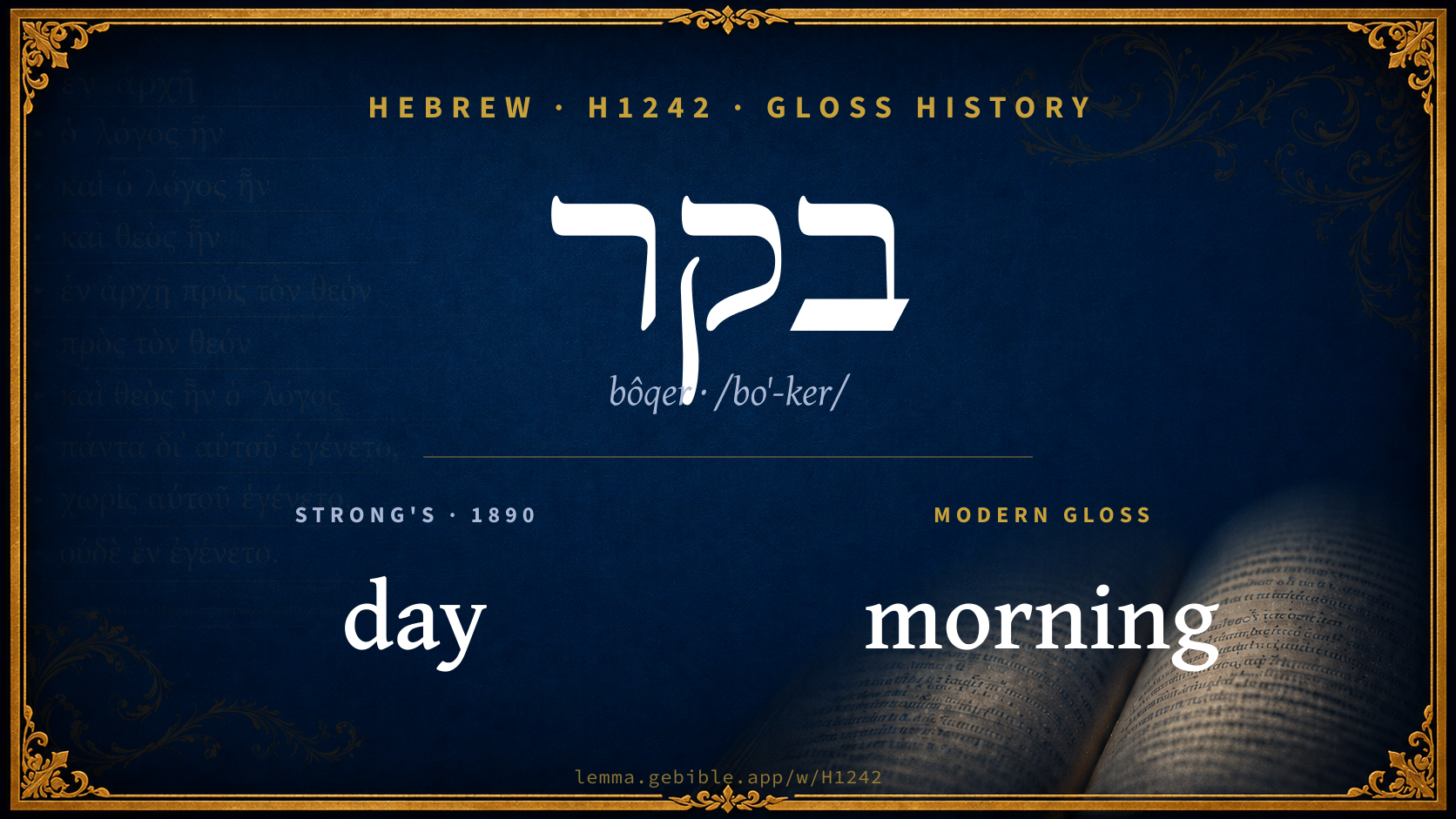
Gloss history
Strong's 1890 vs modern scholarship
About this word
Strong's H1242 catalogs a Hebrew word from the Hebrew Old Testament.
These counts are not copied from any lexicon or concordance. They are computed here, from the morphology-tagged Hebrew Old Testament. What Lemma adds →
- 189
- distinct verses
- The word appears in 189 distinct verses.
- 29 / 39
- OT books
- The word appears in 29 of 39 Old Testament books.
- #224
- by frequency
- Top 250 most frequent Hebrew words (rank 224 of 8,640 Hebrew words by occurrence).
View all 189 occurrences in the concordance →
By section of the Old Testament
By traditional corpus
Conventional, traditional groupings — biblical authorship is debated, so this is a traditional corpus grouping, not an authorship claim. Each share is this word’s portion of its verses in that division of the Hebrew canon. Each figure is a share of the word’s 189 distinct verses.
- Prophets (Nevi'im) 74 verses · 39%
- Torah (Pentateuch) 72 verses · 38%
- Writings (Ketuvim) 43 verses · 23%
How translations render this word
Counts come from each version’s own published word-to-Strong’s tagging or interlinear alignment — an approximate guide to how each version renders this word, not a word-level alignment the data otherwise carries. Because each total is that version’s own tagged count, the per-version totals vary from one another and need not match the appearance or distinct-verse counts above. These counts may also differ from a printed concordance because Lemma counts each distinctly tagged rendering and does not collapse phrase taggings into a single head-word total. This is a fixed set of word-tagged versions (KJV, ASV, BSB, ULT) and does not change with the reading translation you choose elsewhere. Each version’s license is shown beside its name below (and on Sources).
- King James Version: Morning 128×, Until the morning 15×, Every morning 13×
- American Standard Version: Morning 118×, Until the morning 12×, Came to pass in the morning 9×
- Berean Standard Bible: Morning 129×, Next morning 18×, Every morning 14×
- unfoldingWord Literal Text: Morning 196×, Mornings 6×, Morning after 3×
King James Version Public Domain
Renders H1242 across 204 tagged occurrences — most commonly:
Plus 26 renderings that appear only once — usually multi-word phrases or single function words the recovered tagging swept in, not distinct renderings. Not rendered by a distinct English word in 1 further occurrence.
American Standard Version Public Domain
Renders H1242 across 205 tagged occurrences — most commonly:
Plus 37 renderings that appear only once — usually multi-word phrases or single function words the recovered tagging swept in, not distinct renderings.
Berean Standard Bible Public Domain
Renders H1242 across 192 tagged occurrences — most commonly:
Plus 5 renderings that appear only once — usually multi-word phrases or single function words the recovered tagging swept in, not distinct renderings. Not rendered by a distinct English word in 22 further occurrences.
unfoldingWord Literal Text CC BY-SA 4.0
Renders H1242 across 217 tagged occurrences — most commonly:
Plus 6 renderings that appear only once — usually multi-word phrases or single function words the recovered tagging swept in, not distinct renderings.
10 senses and sub-senses in the full BDB
What do BDB’s symbols mean?
BDB uses these scholarly abbreviations:
| Symbol | Meaning |
|---|---|
| 𝔊 | the Septuagint (the ancient Greek translation, LXX) |
| 𝔙 | the Vulgate (the Latin translation) |
| 𝔖 | the Syriac version (the Peshitta) |
| 𝔗 | the Targum (the Aramaic translation) |
| ψ | the Psalms |
| √ | root (the underlying root or stem) |
| ‖ | parallel passage (a synonymous or contrasted parallel) |
| † | the dagger: every passage where the word occurs is cited |
The 10 senses and sub-senses the full Brown-Driver-Briggs lexicon distinguishes for this word, in lexicon order (not ranked by frequency), with BDB’s own verbatim wording and sub-sense lettering. Shown in Hebrew script with BDB’s own scholarly abbreviations. The condensed entry is in the Lexicon Entry tab. See also the Forms in the corpus table below.
- 1. morning (of point of time, time at which, never during which, Eng. morning = forenoon):—
- a. of end of night (opp. לַיְלָה) Ex 10:13 (J) Lv 6:2 (P) Ju 19:25 Ru 3:13(×2) Is 21:12 cf. 1 S 19:11 (‖ מחר, opp. לילה); opp. לֵילוֹת ψ 92:3; also (opp. לוּן) Ex 23:18; 34:25 (both JE) Lv 19:13 (H) Dt 16:4; opp. צלמות Am 5:8; cf. further Gn 40:6; 41:8 (both E) Ex 12:22; 34:2(×2) (both JE) 1 S 3:15 +. e.g. Exodus 10:13
- b. implying the coming of dawn, and even daylight Gn 29:25 (E) 44:3 (J) 1 K 3:21 (but Klo here for 2nd בַּבֹּקֶר, reads לְבַקֵּר by looking at it v. בָּקַר) Jb 24:17; 38:12 (‖ שַׁחַר); לִפְנוֹת הַבּ׳ Ex 14:27 (JE) at the turn of the morning, so Ju 19:26 (‖ בַּעֲלוֹת הַשָּׁ֑חַר v 25; sq. עַד־הָאוֹר, as something later, v 26); vid. Ru 3:14 (‖ בטרו֯ם יכיר אישׁ את רעהו before men could recognise each other); cf. כּוֹכְבֵי בֹקֶר Jb 38:7 stars of morning; but also c. אוֹר vb. Gn 44:3 (J) הבקר אור; c. אור noun, באור הבקר Mi 2:1; & especially עד אור הבקר Ju 16:2 (opp. לילה) so 1 S 14:36; also 1 S 25:22, 34, 36 2 S 17:22 2 K 7:9; cf. 1 S 29:10 (‖ וְאוֹר לָכֶם). e.g. Genesis 29:25
- c. of coming of sunrise Ju 9:33 2 S 23:4(×2) 2 K 3:22 cf. מוֹצָאֵי ב׳ וערב ψ 65:9 i.e. places of sunrise and sunset (‖ קְצוֹת i.e. ends of earth). e.g. Judges 9:33
- d. of beginning of day, מֵאָז הַבּ׳ וְעַד־עַתָּה Ru 2:7 (cf. v 14) vid. 2 S 24:15 (but del. WeDr); time of prayer, & praise ψ 5:4(×2) (v Hu) 50:17; 88:14; 92:3; ‖ צהרים noon 1 K 18:26 Je 20:16; of three hours of prayer, ערב ובקר וצהרים ψ 55:18 (cf. Dn 6:10, 13); cf. also c. עֶרֶב infr. e.g. Ruth 2:7
- e. opp. עֶרֶב Gn 49:27 (poem in J) Ex 16:7, 8, 12, 13 Lv 6:13 Nu 9:21 (all P) Dt 28:67(×2) 2 S 11:14 1 K 17:6 Is 17:14 Zp 3:3 Ez 24:18(×2); 33:22 Dn 8:26 ψ 30:6; 90:5, 6 Ec 11:6 1 Ch 16:40 2 Ch 2:3; 13:11; 31:3 Ezr 3:3 Est 2:14 opp. בֵּין הערבים Ex 29:39, 41 Nu 28:4, 8 (all P); especially מן־הבקר עד־הערב = all day Ex 18:13 & (without art.) v 14 (both E); מבקר לָעֶרֶב Jb 4:20 = between morning and evening; also מֵעֶרֶב עַד־בֹּקֶר = all night, Ex 27:21 (P) Lv 24:3 (H) Nu 9:21 & בָּעֶרֶב עַד־בּ׳ Nu 9:15 (both P); note also the formula וַיְהִי ערב ויהי בקר and evening came and then morning Gn 1:5, 8, 13, 19, 23, 31 (all P), i.e. the day ended with evening, and the night with morning; peculiar is Dn 8:14 of om. of daily sacrif. עַד עֶרֶב בֹּקֶר אַלְפַּיִם וּשְׁלשׁ מֵאוֹת, until 2300 evening-mornings, prob. = 2300 half-days (Ew Hi Meinh Bev DrIntr. 464, cf. v 26 & 3½ times (years) 7:25; 12:11, 17). e.g. Genesis 49:27
- f. often (above & elsewhere) c. prep. (+ art. except Jb 7:18); in the morning, בַּבֹּקֶר Gn 19:27 + 110 times, cf. also בִּהְיֹת הַבּ׳ Ex 19:16; in (or at) the morning, לַבּ׳ Am 4:4 + 7 times; for (against or by) the morning, לַבּ׳ Ex 34:2 cf. ψ 130:6 (cf. Che crit. n.); nearly = until (עַד־) Ex 34:25 Dt 16:4 Zp 3:3; further בַּבּ׳ בַּבּ׳ morning by morning, every morning† Ex 16:21; 30:7; 36:3 Lv 6:5 (all P) 2 S 13:4 1 Ch 23:30 2 Ch 13:11 Is 28:19; 50:4 Ez 46:13, 14, 15 Zp 3:5 also לַבּ׳ לַבּ׳, same sense, †1 Ch 9:27; †pl. לַבְּקָרִים every m. afresh ψ 73:14 Is 33:2 cf. La 3:23; alm. = continually ψ 101:8 (cf. Je 21:12); v. לִבְקָרִים † Jb 7:18 (‖ לִרְגָעִים every moment; also without prep. or art. in the morning Ho 7:6 cf. ψ 5:4(×2) ψ 55:18, d. supr., & sub 2 e.g. Job 7:18
- g. fig. of bright joy after night of distress (poet.) Jb 11:17; cf. ψ 30:6; 46:6 (לִפְנוֹת בּ׳) 49:15; 59:17; 90:14; 143:8. e.g. Job 11:17
- h. in phrases, הִשְׁכִּים בַּבּ׳ (וַיַּשְׁכֵּם etc.) he rose early in the morning †Gn 19:27; 20:8; 21:14; 22:3; 26:31; 28:18; 32:1 Ex 8:16; 9:13; 24:4; 34:4 Nu 14:40 Jos 3:1; 6:12; 7:16; 8:10 (all JE) Ju 6:28; 19:5, 8 1 S 1:19; 5:4 cf. 15:12, 17:20; 29:10(×2) cf. v 11, 2 K 3:22; 19:35 = Is 37:36, 2 Ch 20:20 Jb 1:5 Pr 27:14 Is 5:11; (ויקומו etc.) ויקם בַּבּ׳ †Gn 24:54 Nu 22:13, 21 (all JE) Ju 19:27; 20:19 2 S 24:11 1 K 3:21; אַשְׁמֹרֶת הַבּ׳ morning watch †Ex 14:24 1 S 11:11. e.g. Genesis 19:27
- 2. morrow, next day (cf. Germ. Morgen, morgen) without art. Ex 16:19, 20 Lv 7:15; 22:30 (opp. הַיּוֹם הַהוּא) Nu 16:5 (‖ מָחָר v 7, 16) cf. Ex 12:10(×2) Nu 9:12; with art. Ex 16:23, 24; 29:34; לַבּ׳ Ex 34:25 Nu 22:41 Zp 3:3; בַּבּ׳ 1 S 9:19 (opp. הַיּוֹם to-day) cf. 20:35; to-morrow morning הַבּ׳ Ju 6:31 (Stu); בַּבּ׳ Ex 7:15 Jos 7:14 Est 5:14; definitely בַּבּ׳ מִמָּֽחֳרָת 1 S 5:4; מֵהַבּ׳ 2 S 2:27; adverb. use in this sense (without prep. or art.) Ex 16:7 Nu 16:5. e.g. Exodus 16:19
Senses from the full Brown-Driver-Briggs lexicon (Brown, Driver, Briggs; Oxford 1906 — public domain), digitized via Sefaria, supplemented by the OpenScriptures HebrewLexicon (CC BY 4.0). Full attribution on Sources.
Word origin
n.m. Ex 10:13 morning (NH id.; from split, penetrate, as the dawn the darkness, light through cloud-rifts, etc.)—ב׳ Gn 1:5 + (always abs.); pl. בְּקָרִים Jb 7:18 + 4 times;—
— Brown-Driver-Briggs (Oxford 1906, public domain), digitized via Sefaria, supplemented by the OpenScriptures HebrewLexicon (CC BY 4.0). See Sources.
Derived from בקר (bâqar) (H1239) — to seek.
Jastrow Dictionary
A second Hebrew/Aramaic lexicon for comparison, covering Aramaic and post-biblical (Talmudic, Targumic, Midrashic) usage that the biblical-Hebrew BDB does not. Matched by lemma rather than by Strong’s number, so a lemma may carry more than one Jastrow headword (shown separately below), and the entries cover usage well beyond the Bible.
בָּקַר
- , v. בקע) to enter into, to clear, split; whence
- 1. (= בער) to eat up. Denom. בָּקָר (= בְּעִיר).
- 2. (= בער) to break forth, shine. Denom. בֹּקֶר.
- (b. h.)
- 1. to enter into, examine, search, distinguish (cmp. בִּין). Keth. 106ᵃ מְבַקְּרֵי מומין those entrusted with the examination of sacrificial animals. Y. Bets. II, 61ᶜ top ובִיקְּרָן ממומן and had them examined (and declared free) from bodily defects. Ḥag. 9ᵇ אין אומרים בַּקְּרוּ וכ׳ we do not say, Examine ye a camel, a swine &c. (i.e. only the deeds of distinguished persons are scrutinized); a. fr.—Part. pass. מְבוּקָּר examined and found fit. Y. Ber. IV, 7ᵇ top טליים מְבוּקָּרִים lambs which passed examination.
- 2. to inquire after one’s health, to visit the sick. Ned. IV, 4 (38ᵇ). ונכנס לְבַקְּרוֹ and comes to see him. Snh. 68ᵃ; a. v. fr. [Ruth. R. to II, 15, v. infra.]
- , Nithpa. נִתְבַּקֵּר
- 1. to be examined. Gen. R. s. 81 פנקסו נִתְבַּקְּרָה his account is examined (his sins visited); Tanḥ. Vayishlaḥ 8 מִתְבַּקֶּרֶת. Gen. R. s. 84, read with Yalk. Gen. 141 נתב׳ פנקסי my account &c.
- 2. to be visited, attended to. Num. R. s. 18 as all sick persons מִתְבַּקְּרִין are tended (by physicians).
- (Y. Dial. for הִפְקִיר, v. פָּקַר; v. next w.) to give free, to resign ownership, to declare a property ownerless. Y. Ned. IV, 38ᵈ; Y. Peah V, beg. 19ᵇ [read:] כיון שאדם מַבְקִיר דבר יצא מרשותו as soon as one declares a thing to be free, it has gone out of his control; Y. Dem. III, 23ᵇ bot. כיון שאדם מ׳ … ויצא … הבקירו הבקר as soon as one gives a thing free and it has left his possession, his act is valid; a. fr. [Ruth. R. to II, 15 מבקר, מבדר, prob. מבקיר; v. בָּדַר.]
- to be declared free, to be free. Y. Peah VI, 19ᶜ top.—Part. מוּבְקָר Ib. 19ᵇ bot. שדי מוּבְקֶרֶת וכ׳ (Tosef. Maasr. III, 11. הרי … מופ׳) my field shall be free for one day &c.; a. e.
בְּקַר
- —Pa. בַּקַּר
- 1. to search, examine. Targ. O. Lev. XIII, 36; a. fr.
- 2. to clear, glean. Targ. Y. I Deut. XXIV, 20 (II תתב׳, read תבקרון, h. text תפאר).
- 3. to let the herd graze (cmp. בער), to drive unmuzzled animals. Targ. Y. Gen. XIII, 7.
- 4. to visit the sick. Targ. Y. Ex. XVIII, 20; a. e.—Y. Sabb. VI, 8ᶜ bot.; a. fr.
- 5. (= preced. Hif.) to abandon, leave unclaimed, declare free. Targ. Y. Ex. XXIII, 11 Ar. (some ed. ותפקד, read ותפקר). Y. Shebi. IX, 39ᵃ top וַאֲבַקְּרָה קומיהון and I will declare it free goods in their presense. Ib. ומְבַקְּרִין ליה and declare ye it free property.
בֹּקֶר
- v. בָּקַר) morning, early day; metaph. light, salvation. Y. Taan. I, 64ᵃ top ב׳ לצדיקים וכ׳ a morning for the righteous, a night for the wicked. Ruth. R. to III, 13 בַּבּ׳ בעולם וכ׳ ‘in the morning’—that means in the world which is all-good. Esth. R., introd. (ref. to Deut. XXVIII, 67) בבָקְרָהּ של בבל וכ׳ in the morning (ascendancy) of Babel thou shalt say, Oh that her evening (downfall) would come! Gen. R. s. 21 (ref. to Dan. VIII, 14) לִכְשֶׁיֵּעָשֶׂה בָּקְרָן וכ׳ when the morning of the (persecuting) nations shall become evening, and the evening of Israel morning; Tanḥ. ed. Bub. B’resh. 23. Mekh. Bo, s. 6 in order to define it: לבָקְרוֹ של ב׳ at the very break of morning; Y. Ber. I, 2ᶜ top.—Pl. בְּקָרִים. Yoma 33ᵇ חלקהו לשני ב׳ divide the acts prescribed into two mornings, i.e. let another act be inserted between. Ber. 27ᵃ חלקהו לשני ב׳ take only one half of the morning hours. Y. Pes. V, 31ᵈ top אית לך מימר תמן בין הַבְּקָרַיִם then it ought to have read there ben hab-b’karaim (as you read בין הערבים, Du.). e.g. Deuteronomy 28:67
בָּקָר
- v. בָּקַר) a beef; (collect.) oxen, cattle. Sifra Vayikra ch. II, Par. 2 אין לך בבהמה אלא ב׳ וכ׳ under b’hemah for offerings (Lev. I, 2) are meant only beeves and sheep; a. fr. בן ב׳ young cattle, calf. Ib.; a. fr.—רועי ב׳ herders (suspected of feeding upon other people’s fields). Snh. III, 2 נאמנין עלי שלשה ר׳ ב׳ (if one says) I have faith in (the arbitration of) three herders. e.g. Leviticus 1:2
בַּקָּר
- (preced.) neat-herd, cow-herd; cattle-driver. Y. Bets. V, 63ᵇ, v. רֶגֶל.
קַר
- to be cold, v. קָרַר II, קְרַר II.—[Erub. X, 14, a. e. באר (בור) הקר, v. הָקֵר.]
A Dictionary of the Targumim, the Talmud Babli and Yerushalmi, and the Midrashic Literature (Marcus Jastrow; London, Luzac, 1903) — Public Domain. Digitized via Sefaria. Digitized via Sefaria. Full attribution on Sources.
Forms in the corpus
The 74 distinct written forms H1242 takes in the Hebrew Bible, most frequent first — each parse links to that state’s occurrences in the concordance. Hebrew forms include their vowel points and cantillation, so a single lemma takes many written forms.
| Form | Parsing | Example | Uses |
|---|---|---|---|
| בַּ/בֹּ֔קֶר | Noun, Common, Masculine, Singular, Absolute | Exodus 9:13 | 18 |
| בַ/בֹּ֔קֶר | Noun, Common, Masculine, Singular, Absolute | Deuteronomy 16:7 | 14 |
| בַּ/בֹּ֑קֶר | Noun, Common, Masculine, Singular, Absolute | Ezekiel 33:22 | 10 |
| בַּ/בֹּ֣קֶר | Noun, Common, Masculine, Singular, Absolute | Exodus 16:21 | 10 |
| בַּ/בֹּ֗קֶר | Noun, Common, Masculine, Singular, Absolute | Exodus 7:15 | 9 |
| בֹ֖קֶר | Noun, Common, Masculine, Singular, Absolute | Genesis 1:5 | 8 |
| הַ/בֹּ֔קֶר | Noun, Common, Masculine, Singular, Absolute | Exodus 14:24 | 8 |
| בַ/בֹּ֨קֶר֙ | Noun, Common, Masculine, Singular, Absolute | Exodus 34:2 | 7 |
| בֹּֽקֶר | Noun, Common, Masculine, Singular, Absolute | Exodus 12:22 | 7 |
| בֹּ֔קֶר | Noun, Common, Masculine, Singular, Absolute | Daniel 8:14 | 6 |
| הַ/בֹּ֖קֶר | Noun, Common, Masculine, Singular, Absolute | Exodus 18:13 | 6 |
| בַּ/בֹּ֖קֶר | Noun, Common, Masculine, Singular, Absolute | Ezekiel 24:18 | 5 |
| הַ/בֹּֽקֶר | Noun, Common, Masculine, Singular, Absolute | Exodus 16:23 | 5 |
| בַּ/בֹּ֥קֶר | Noun, Common, Masculine, Singular, Absolute | Ecclesiastes 10:16 | 4 |
| בַּ/בֹּ֨קֶר֙ | Noun, Common, Masculine, Singular, Absolute | Ecclesiastes 11:6 | 4 |
| בֹּ֑קֶר | Noun, Common, Masculine, Singular, Absolute | Deuteronomy 28:67 | 4 |
| בֹּ֖קֶר | Noun, Common, Masculine, Singular, Absolute | Exodus 12:10 | 4 |
| הַ/בֹּ֑קֶר | Noun, Common, Masculine, Singular, Absolute | Exodus 29:34 | 4 |
| לַ/בֹּֽקֶר | Noun, Common, Masculine, Singular, Absolute | Deuteronomy 16:4 | 4 |
| בַּ/בֹּ֜קֶר | Noun, Common, Masculine, Singular, Absolute | Joshua 3:1 | 3 |
| הַ/בֹּ֗קֶר | Noun, Common, Masculine, Singular, Absolute | Exodus 19:16 | 3 |
| לַ/בֹּ֨קֶר֙ | Noun, Common, Masculine, Singular, Absolute | Amos 4:4 | 3 |
| בַ/בֹּ֑קֶר | Noun, Common, Masculine, Singular, Absolute | Exodus 29:39 | 2 |
| בַ/בֹּ֖קֶר | Noun, Common, Masculine, Singular, Absolute | Isaiah 5:11 | 2 |
| בַ/בֹּ֗קֶר | Noun, Common, Masculine, Singular, Absolute | 1 Samuel 1:19 | 2 |
| בַּ/בֹּ֛קֶר | Noun, Common, Masculine, Singular, Absolute | 1 Kings 3:21 | 2 |
| בַּ/בֹּ֤קֶר | Noun, Common, Masculine, Singular, Absolute | Deuteronomy 28:67 | 2 |
| בַּ/בֹּֽקֶר | Noun, Common, Masculine, Singular, Absolute | Exodus 36:3 | 2 |
| בֹּ֥קֶר | Noun, Common, Masculine, Singular, Absolute | Exodus 18:14 | 2 |
| בֹּ֨קֶר֙ | Noun, Common, Masculine, Singular, Absolute | Exodus 14:27 | 2 |
| הַ/בֹּ֣קֶר | Noun, Common, Masculine, Singular, Absolute | Exodus 10:13 | 2 |
| הַ/בֹּ֤קֶר | Noun, Common, Masculine, Singular, Absolute | Exodus 29:41 | 2 |
| הַ/בֹּ֨קֶר֙ | Noun, Common, Masculine, Singular, Absolute | Micah 2:1 | 2 |
| וְ/לַ/בֹּ֥קֶר | Noun, Common, Masculine, Singular, Absolute | 1 Chronicles 9:27 | 2 |
| וּ/בַ/בֹּ֖קֶר | Noun, Common, Masculine, Singular, Absolute | Exodus 16:12 | 2 |
| לַ/בְּקָרִ֔ים | Noun, Common, Masculine, Plural, Absolute | Isaiah 33:2 | 2 |
| לַ/בֹּ֗קֶר | Noun, Common, Masculine, Singular, Absolute | Psalms 49:14 | 2 |
| לַ/בֹּ֣קֶר | Noun, Common, Masculine, Singular, Absolute | 1 Chronicles 16:40 | 2 |
| בַ/בֹּ֣קֶר | Noun, Common, Masculine, Singular, Absolute | Psalms 90:14 | 1 |
| בַ/בֹּ֧קֶר | Noun, Common, Masculine, Singular, Absolute | Isaiah 28:19 | 1 |
| בַ/בֹּ֨קֶר | Noun, Common, Masculine, Singular, Absolute | Psalms 143:8 | 1 |
| בַ/בֹּקֶר֮ | Noun, Common, Masculine, Singular, Absolute | 1 Samuel 5:4 | 1 |
| בֹ֑קֶר | Noun, Common, Masculine, Singular, Absolute | Job 38:7 | 1 |
| בַּ/בֹּ֡קֶר | Noun, Common, Masculine, Singular, Absolute | Genesis 21:14 | 1 |
| בַּ/בֹּ֨קֶר | Noun, Common, Masculine, Singular, Absolute | Zephaniah 3:5 | 1 |
| בַּ/בֹּקֶר֮ | Noun, Common, Masculine, Singular, Absolute | Job 1:5 | 1 |
| בַּ֝/בֹּ֗קֶר | Noun, Common, Masculine, Singular, Absolute | Psalms 90:5 | 1 |
| בַּ֭/בֹּקֶר | Noun, Common, Masculine, Singular, Absolute | Psalms 90:6 | 1 |
| בֹּ֕קֶר | Noun, Common, Masculine, Singular, Absolute | Hosea 7:6 | 1 |
| בֹּ֚קֶר | Noun, Common, Masculine, Singular, Absolute | 2 Samuel 23:4 | 1 |
| בֹּ֛קֶר | Noun, Common, Masculine, Singular, Absolute | Leviticus 24:3 | 1 |
| בֹּ֠קֶר | Noun, Common, Masculine, Singular, Absolute | Numbers 16:5 | 1 |
| בֹּ֣קֶר | Noun, Common, Masculine, Singular, Absolute | Job 24:17 | 1 |
| בֹּ֭קֶר | Noun, Common, Masculine, Singular, Absolute | Psalms 5:3 | 1 |
| הַ/בֹּקֶר֩ | Noun, Common, Masculine, Singular, Absolute | 2 Kings 16:15 | 1 |
| וְ/הַ/בֹּ֛קֶר | Noun, Common, Masculine, Singular, Absolute | Daniel 8:26 | 1 |
| וָ/בֹ֣קֶר | Noun, Common, Masculine, Singular, Absolute | Psalms 55:17 | 1 |
| וּ/בַ/בֹּ֗קֶר | Noun, Common, Masculine, Singular, Absolute | Exodus 16:13 | 1 |
| וּ/בַ/בֹּ֣קֶר | Noun, Common, Masculine, Singular, Absolute | Esther 5:14 | 1 |
| וּ/בֹ֗קֶר | Noun, Common, Masculine, Singular, Absolute | Exodus 16:7 | 1 |
The 60 most common forms are shown; 14 rarer forms follow in the full concordance.
Same root — word family
Other BDB entries built from the same root as H1242, grouped by Strong’s listed origin. These share a root / origin per the lexicon — not necessarily a shared meaning. Each links to that word’s own entry.
Derives from
Shares the same root
- בוקר bôwqêr H951 herdsman
- בקר bᵉqar H1240 to seek
- בקר bâqâr H1241 cattle
- בקרה baqqârâh H1243 seeking
- בקרת biqqôreth H1244 punishment
Proper names from this root
People and places named from this root — a name, not an additional meaning of the word.
Compare all same-root words → Showing 4 of 8 — not the complete family. 1 of the same-root words is a proper name (a person or place). They share a root, not necessarily a meaning.
Septuagint verse parallels
This word appears in 183 verses that also exist in the Greek Old Testament (Septuagint), out of the 189 Hebrew verses it occurs in. You can read those verses in Greek by switching the Old Testament edition to the Septuagint.
Read these verses in the Septuagint
- Genesis 1:5
- Exodus 7:15
- Leviticus 6:9
- Numbers 9:12
- Deuteronomy 16:4
- Joshua 3:1
- Judges 6:28
- Ruth 2:7
- 1 Samuel 1:19
- 2 Samuel 2:27
- 1 Kings 3:21
- 2 Kings 3:20
This is a verse-level parallel only — the same verses exist in both the Hebrew and Greek Old Testaments. No word-level Hebrew↔Greek correspondence is claimed: the data carries no such alignment, so no Greek word is shown as this Hebrew word’s translation. Coverage is not total — the Septuagint omits the deuterocanon and renumbers the Psalms, so some Hebrew verses have no direct Greek parallel.