
Isaiah 28:19

Hebrew (Westminster Leningrad Codex) Isaiah 28:19 appears in the Hebrew Old Testament. The text above is from the Westminster Leningrad Codex. Each word links to its Strong’s number, a concise gloss, and parsing drawn from the Open Scriptures Hebrew Bible morphology. Click any word for its full Brown-Driver-Briggs (BDB) entry.
Download image
Cite this verse

Isaiah 28:19 (World English Bible). Public Domain. Lemma interlinear Bible study tool, https://lemma.gebible.app/v/isaiah/28/19.

Show BibTeX & RIS
BibTeX
RIS
English Translation
As often as it passes though, it shall take you; for morning by morning shall it pass through, by day and by night: and it shall be nothing but terror to understand the message.
World English Bible · Public Domain
Download a study sheet

One document with this verse’s original text, its word-by-word gloss line, the meaning frame, cross-references with their text, attributed commentary, and full source and license credits — printable, and it pastes into notes with its structure intact.

This verse Autodidact and up

Study sheet (.html) Plain text (.txt)

A passage Seminary Student

Up to 50 verses in one chapter. A passage sheet keeps up to 6 commentary sources and 12 cross-references per verse, in the order this page ranks them, and says so on the sheet whenever that leaves anything out. Ask for a single verse and you get the Autodidact verse sheet above.

Everything on this page stays free to read, with no account — the sheet is a download of what is already on screen, not access to it.

Want to remove ads? Support Godless Engineer
Compare translations 3

The same verse in 3 English versions, stacked beneath the original-language interlinear above. Click any original word for its lexicon entry.

Each is an independent rendering of the whole verse — the interlinear is not word-aligned to these translations.

Highlighted words mark where these versions differ — a whole-verse word diff, not a word-by-word alignment.

  • World English Bible Public Domain
    As often as it passes though, it shall take you; for morning by morning shall it pass through, by day and by night: and it shall be nothing but terror to understand the message.
  • King James Version Public Domain
    From the time that it goeth forth it shall take you: for morning by morning shall it pass over, by day and by night: and it shall be a vexation only to understand the report.
  • unfoldingWord Literal Text CC BY-SA 4.0
    As often as it passes through, it will take you, for by morning, by morning it will pass through, by day and by night. And it will be only terror to understand the report.”

unfoldingWord Literal Text — © unfoldingWord, licensed CC BY-SA 4.0. Word-aligned USFM3 via Door43 (git.door43.org/unfoldingWord/en_ult).

Versions to compare (up to 4)

3 of 4 selected

Show all 18 translations

Every available English version of this verse, each an independent rendering of the whole verse.

  • World English Bible Public Domain
    As often as it passes though, it shall take you; for morning by morning shall it pass through, by day and by night: and it shall be nothing but terror to understand the message.
  • Berean Standard Bible Public Domain
    As often as it passes through, it will carry you away; it will sweep through morning after morning, by day and by night.” The understanding of this message will bring sheer terror.
  • Majority Standard Bible Public Domain
    As often as it passes through, it will carry you away; it will sweep through morning after morning, by day and by night.” The understanding of this message will bring sheer terror.
  • King James Version Public Domain
    From the time that it goeth forth it shall take you: for morning by morning shall it pass over, by day and by night: and it shall be a vexation only to understand the report.
  • American Standard Version (1901) Public Domain
    As often as it passeth though, it shall take you; for morning by morning shall it pass through, by day and by night: and it shall be nought but terror to understand the message.
  • Revised Version (1885) Public Domain
    As often as it passeth through, it shall take you; for morning by morning shall it pass through, by day and by night: and it shall be nought but terror to understand the message.
  • Geneva Bible (1599) Public Domain
    When it passeth ouer, it shall take you away: for it shall passe through euery morning in the day, and in the night, and there shalbe onely feare to make you to vnderstand the hearing.
  • Douay-Rheims (1899) Public Domain
    Whensoever it shall pass through, it shall take you away: because in the morning early it shall pass through, in the day and in the night, and vexation alone shall make you understand what you hear.
  • Young's Literal Translation Public Domain
    From the fulness of its passing over it taketh you, For morning by morning it passeth over, By day and by night, And it hath been only a trembling to consider the report.
  • Literal Standard Version CC BY-SA 4.0
    From the fullness of its passing over it takes you, || For it passes over morning by morning, || By day and by night, || And it has been only a trembling to consider the report.
  • Unlocked Literal Bible CC BY-SA 4.0
    Whenever it passes through, it will overwhelm you, and morning by morning it will pass through and by day and night it will come. When the message is understood, it will cause terror.
  • unfoldingWord Literal Text CC BY-SA 4.0
    As often as it passes through, it will take you, for by morning, by morning it will pass through, by day and by night. And it will be only terror to understand the report.”
  • Darby Bible Public Domain
    As it passeth through it shall take you; for morning by morning shall it pass through, by day and by night; and it shall be terror only to understand the report.
  • World Messianic Bible Public Domain
    As often as it passes through, it will seize you; for morning by morning it will pass through, by day and by night; and it will be nothing but terror to understand the message.”
  • Webster's Bible Public Domain
    From the time that it goeth forth it shall take you: for morning by morning shall it pass over, by day and by night: and it shall be a vexation only to understand the report.
  • Free Bible Version CC BY-SA 4.0
    It will rush by time after time, dragging you away morning upon morning, day and night, rushing on and on. Once you understand this message you will be absolutely terrified.
  • Bible in Basic English Public Domain
    Whenever they come through they will overtake you; for they will come through morning after morning, by day and by night: and the news will be nothing but fear.
  • JPS Tanakh (1917) Public Domain
    As often as it passeth through, it shall take you; for morning by morning shall it pass through, by day and by night; and it shall be sheer terror to understand the message.

Literal Standard Version (2020), Covenant Press — licensed CC BY-SA 4.0. Text via the HelloAO Bible API (eBible.org). Unlocked Literal Bible (unfoldingWord) — licensed CC BY-SA 4.0. Text via the HelloAO Bible API (eBible.org). unfoldingWord Literal Text — © unfoldingWord, licensed CC BY-SA 4.0. Word-aligned USFM3 via Door43 (git.door43.org/unfoldingWord/en_ult). Free Bible Version, Dr. Jonathan Gallagher — licensed CC BY-SA 4.0. Text via the HelloAO Bible API (eBible.org).

Word by word

More ways to search: Search by grammar → Find every occurrence → Compare this word →

Practice this passage: Drill this verse → Learn its vocabulary →

זְוָעָ֖ה
zᵉvâʻâh
H2113
“terror”
Noun, Common, Feminine, Singular, Absolute
Part of Speech
Noun
Type
Common
Gender
Feminine
Number
Singular
State
Absolute
Full BDB Definition

Origin: from H2111

TWOT: 540a

a horror, an object of terror, a trembling, an object of trembling
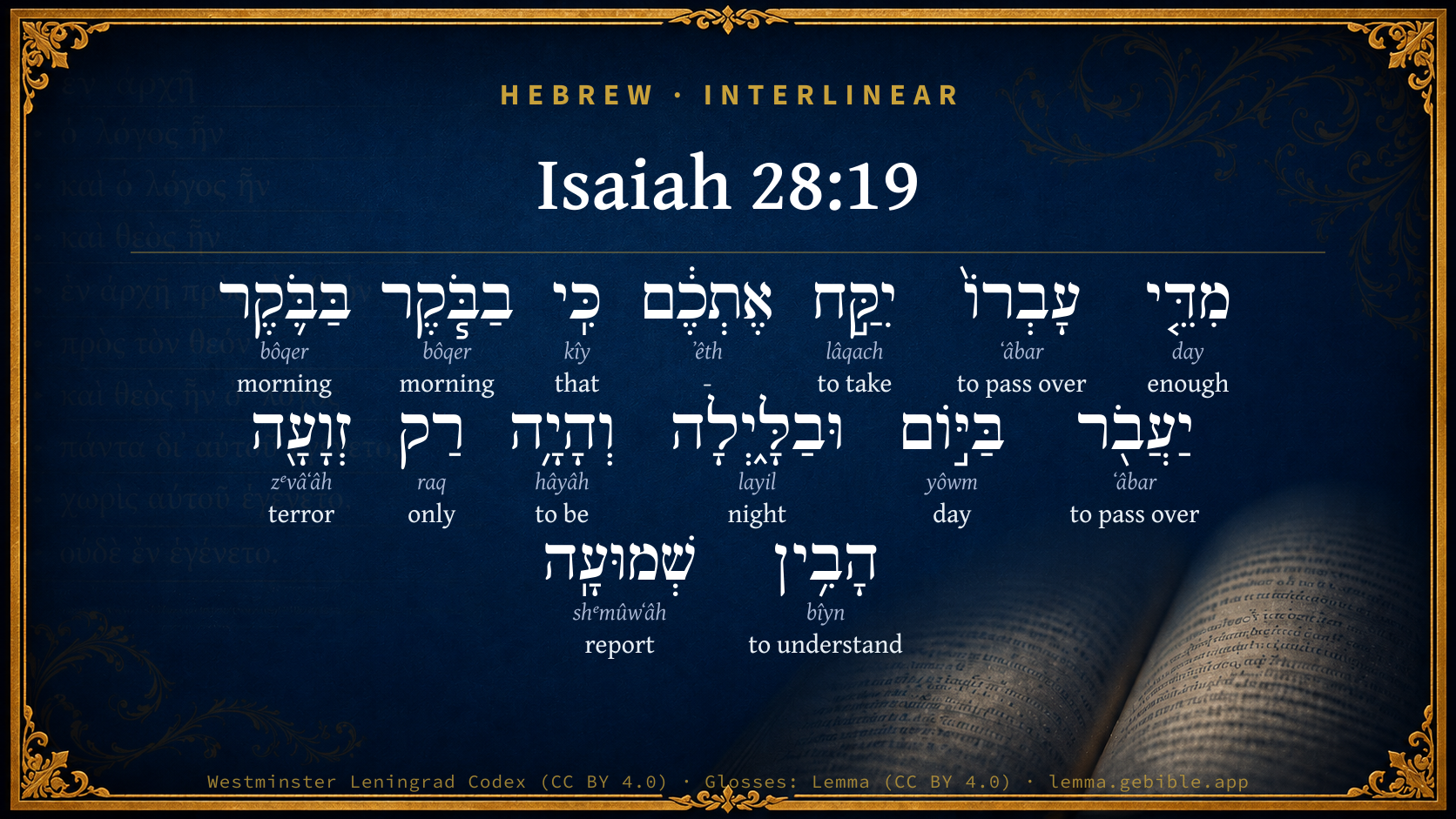
  1. מִדֵּ֤י day H1767 “from · enough of” Preposition + Noun, Common, Masculine, Singular, Construct
  2. עָבְרוֹ֙ ʻâbar H5674 “to pass over · him” Verb, Qal, Infinitive Construct + Suffix, Personal, 3rd Person, Masculine, Singular
  3. יִקַּ֣ח lâqach H3947 “to take” Verb, Qal, Imperfect, 3rd Person, Masculine, Singular
  4. אֶתְכֶ֔ם ʼêth H853 “- · you” Particle, Direct Object + Suffix, Personal, 2nd Person, Masculine, Plural
  5. כִּֽי kîy H3588 “that” Conjunction
  6. בַבֹּ֧קֶר bôqer H1242 “in/at the · morning” Preposition, Determined + Noun, Common, Masculine, Singular, Absolute
  7. בַּבֹּ֛קֶר bôqer H1242 “in/at the · morning” Preposition, Determined + Noun, Common, Masculine, Singular, Absolute
  8. יַעֲבֹ֖ר ʻâbar H5674 “to pass over” Verb, Qal, Imperfect, 3rd Person, Masculine, Singular
  9. בַּיּ֣וֹם yôwm H3117 “in/at the · day” Preposition, Determined + Noun, Common, Masculine, Singular, Absolute
  10. וּבַלָּ֑יְלָה layil H3915 “and · in/at the · night” Conjunction + Preposition, Determined + Noun, Common, Masculine, Singular, Absolute
  11. וְהָיָ֥ה hâyâh H1961 “and · to be” Conjunction + Verb, Qal, Sequential Perfect, 3rd Person, Masculine, Singular
  12. רַק raq H7535 “only” Particle, Accusative
  13. הָבִ֥ין bîyn H995 “to understand” Verb, Hiphil, Infinitive Construct
  14. שְׁמוּעָֽה shᵉmûwʻâh H8052 “report” Noun, Common, Feminine, Singular, Absolute

About this verse

These counts appear in no published source. They are computed here, from the morphology-tagged text and Lemma’s own curated glosses. What Lemma adds →

15
words
13
distinct lemmas
Prophets
section

Notable vocabulary

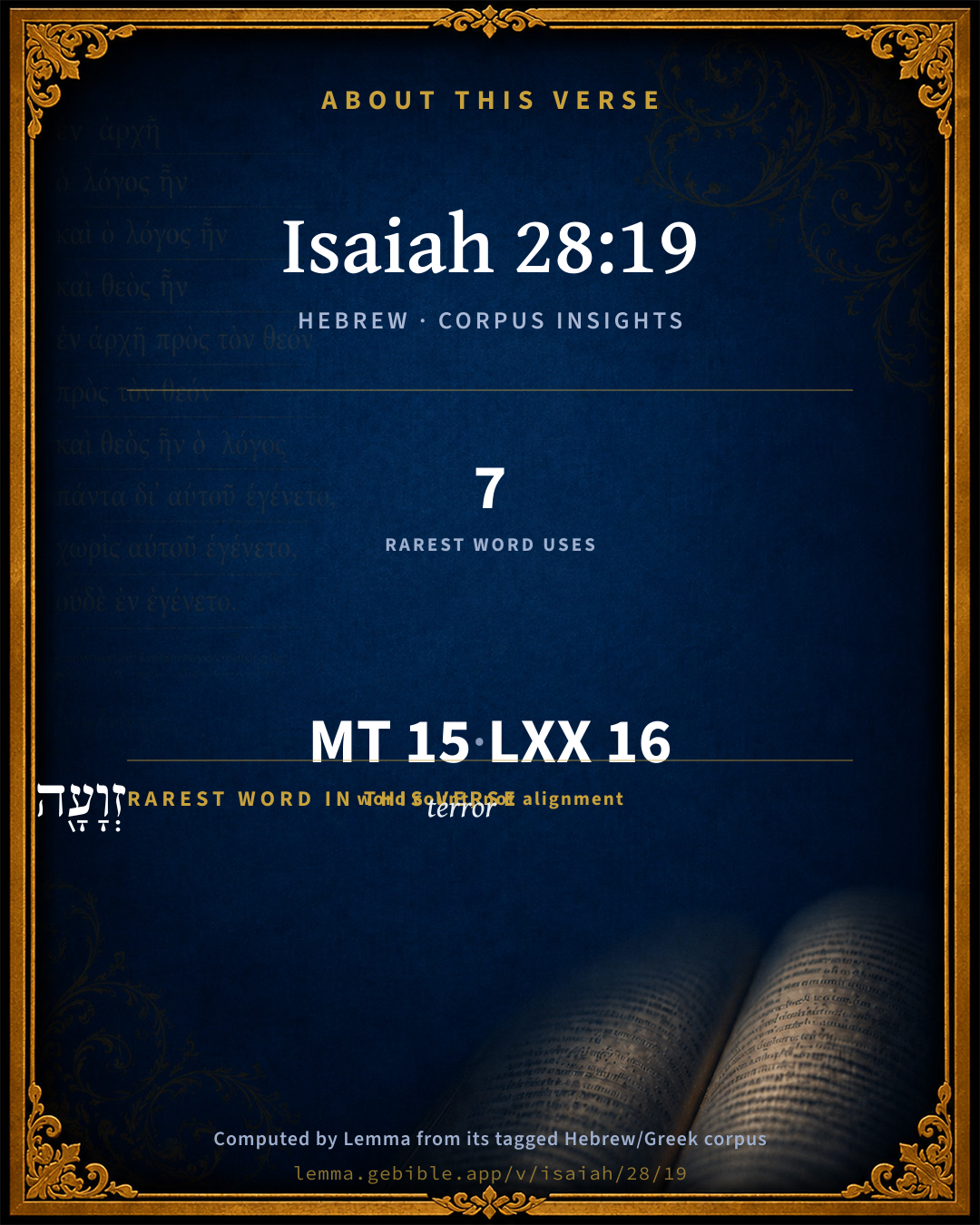
The rarest word here is זְוָעָ֖ה terror H2113 — appearing just 7 times in the whole Hebrew Bible.

Shared distinctive vocabulary

זְוָעָ֖ה terror H2113 occurs in 6 verses of the Hebrew Bible. Also found in:

Grammatical profile

  • 5 verbs
  • 7 nouns
  • 1 conjunction
  • 2 particles

Verb forms

  • עָבְרוֹ֙ Qal · Infinitive Construct
  • יִקַּ֣ח Qal · Imperfect
  • יַעֲבֹ֖ר Qal · Imperfect
  • וְהָיָ֥ה Qal · Sequential Perfect
  • הָבִ֥ין Hiphil · Infinitive Construct

Repetition

Words recur within this verse — often emphatic in Hebrew:

  • עָבְרוֹ֙ to pass over H5674 ×2
  • בַבֹּ֧קֶר morning H1242 ×2

Hebrew & Septuagint length

In English translation the verse runs 34 words from the Hebrew and 32 from the Septuagint (LXX English) — closely comparable.

A rough comparison of the two English renderings, which tokenize alike — not a word-level alignment.

Word counts can differ between the Hebrew and the Greek without any difference in meaning — e.g. the Hebrew direct-object marker אֵת has no separate Greek word, and Greek often adds the article ὁ.

In the original languages it is 15 Hebrew tokens and 16 Greek tokens — but the two are counted differently (Hebrew bundles its prefixes and suffixes into one token; the Greek is in lemma form), so that isn’t a like-for-like length.

Cross-references

17

Topical passages linked to Isaiah 28:19 in the Treasury of Scripture Knowledge — connected by theme and wording, ordered by reader-vote popularity; previews shown in the World English Bible.

  • Habakkuk 3:16 I heard, and my body trembled. My lips quivered at the voice. Rottenness enters into my bones, and I tremble in my place, Because I must wait quietly for the day of trouble, For the coming up of the people who invade us.
  • 2 Kings 24:2 Yahweh sent against him bands of the Chaldeans, and bands of the Syrians, and bands of the Moabites, and bands of the children of Ammon, and sent them against Judah to destroy it, according to the word of Yahweh, which he spoke by his servants the prophets.
  • Isaiah 10:5–6 Ho Assyrian, the rod of my anger, the staff in whose hand is my indignation!
  • Isaiah 33:7 Behold, their valiant ones cry outside; the ambassadors of peace weep bitterly.
  • Isaiah 36:22 Then came Eliakim the son of Hilkiah, who was over the household, and Shebna the scribe, and Joah, the son of Asaph, the recorder, to Hezekiah with their clothes torn, and told him the words of Rabshakeh.
  • Isaiah 37:3 They said to him, Thus says Hezekiah, This day is a day of trouble, and of rebuke, and of rejection; for the children have come to the birth, and there is no strength to bring forth.
  • Isaiah 50:4 The Lord Yahweh has given me the tongue of those who are taught, that I may know how to sustain with words him who is weary: he wakens morning by morning, he wakens my ear to hear as those who are taught.
  • Jeremiah 19:3 and say, Hear you the word of Yahweh, kings of Judah, and inhabitants of Jerusalem: thus says Yahweh of Hosts, the God of Israel, Behold, I will bring evil on this place, which whoever hears, his ears shall tingle.
  • Daniel 7:28 Here is the end of the matter. As for me, Daniel, my thoughts much troubled me, and my face was changed in me: but I kept the matter in my heart.
  • Daniel 8:27 I, Daniel, fainted, and was sick certain days; then I rose up, and did the king's business: and I wondered at the vision, but none understood it.
  • Luke 21:25–26 There will be signs in the sun, moon, and stars; and on the earth anxiety of nations, in perplexity for the roaring of the sea and the waves;
  • 1 Samuel 3:11 Yahweh said to Samuel, Behold, I will do a thing in Israel, at which both the ears of everyone who hears it shall tingle.
  • 2 Kings 17:6 In the ninth year of Hoshea the king of Assyria took Samaria, and carried Israel away to Assyria, and placed them in Halah, and on the Habor, the river of Gozan, and in the cities of the Medes.
  • 2 Kings 18:13 Now in the fourteenth year of king Hezekiah did Sennacherib king of Assyria come up against all the fortified cities of Judah, and took them.
  • 2 Kings 21:12 therefore thus says Yahweh, the God of Israel, Behold, I bring such evil on Jerusalem and Judah, that whoever hears of it, both his ears shall tingle.
  • Job 18:11 Terrors shall make him afraid on every side, And shall chase him at his heels.
  • Ezekiel 21:19–23 Also, you son of man, appoint two ways, that the sword of the king of Babylon may come; they both shall come forth out of one land: and mark out a place, mark it out at the head of the way to the city.

Cross-references courtesy of OpenBible.info (CC BY 4.0).

Hebrew and Greek witnesses Masoretic Hebrew ↔ Greek Septuagint

The same verse in the two great witnesses to the Old Testament, shown verse-for-verse.

These are two independent witnesses, not word-aligned to each other, and the Septuagint is shown in lemma (dictionary) form.

Hebrew Isaiah 28:19 Masoretic · Westminster Leningrad Codex

מִדֵּ֤י עָבְרוֹ֙ יִקַּ֣ח אֶתְכֶ֔ם כִּֽי בַבֹּ֧קֶר בַּבֹּ֛קֶר יַעֲבֹ֖ר בַּיּ֣וֹם וּבַלָּ֑יְלָה וְהָיָ֥ה רַק זְוָעָ֖ה הָבִ֥ין שְׁמוּעָֽה

As often as it passes though, it shall take you; for morning by morning shall it pass through, by day and by night: and it shall be nothing but terror to understand the message.

World English Bible · Public Domain

Greek LXX Isaiah 28:19 Septuagint · lemma form

ὅταν παραἔρχομαι λαμβάνω σύ πρωί πρωί παραἔρχομαι ἡμέρα καί ἐν νύξ εἰμί ἐλπίς πονηρός μανθάνω ἀκούω

Whenever it shall pass by, it shall take you; morning by morning it shall pass by in the day, and in the night there shall be an evil hope. Learn to hear,

LXX2012 (modern English Septuagint) · Public Domain

Hebrew: Westminster Leningrad Codex (CC BY 4.0). Greek: Septuagint (public domain); English from LXX2012 (modern English Septuagint) (Public Domain). How the Septuagint differs from the Hebrew →

Targum (Aramaic paraphrase)

1

The Targum is the ancient Jewish Aramaic paraphrase of the Hebrew Scriptures — an interpretive translation, not the Hebrew text itself. Onkelos (literal) and Pseudo-Jonathan (expansive) render the Torah, and Jonathan the Prophets. Coverage is partial: where no permissively-licensed English translation exists for a verse, only the Aramaic is shown. This is verse-level text, not a word-by-word alignment to the Hebrew.

  1. Targum Jonathan Prophets (Joshua–Malachi)
    בִּזְמַן מֶעֱדוֹהִי יְגַלֵי יַתְכוֹן אֲרֵי בִּצְפָר בִּצְפָר יֶעֱדִי בִּימָם וּבְלֵילִי וִיהֵי עַד לָא יִמְטֵי זְמַן לְוָטָא תִּסְתַּכְּלוּן בְּמִלֵי נְבִיַיָא:

    At the time of its passing by, it shall lead you captive, because each morning it shall pass by, by day and by night: and it shall come to pass before the time of the curse shall have come, that ye shall consider the words of the prophets.

    Targum Jonathan — Aramaic: “Mikraot Gedolot” (public domain). English: “Sefaria Community Translation” (CC0 1.0 (public-domain dedication)); “London "Chaldee Paraphrase," 1871” (public domain). Text via Sefaria.

Commentary

Notes on Isaiah 28:19 from classic Christian and Jewish commentators (each source and its license shown beneath its notes). The classic Christian expositions comment on the surrounding passage and are grouped to its opening verse, so a note may address several verses; the Jewish commentaries on the Tanakh (Rashi and others) are per-verse, so they appear only where the commentator wrote on this verse.

Lemma curates 59 commentaries, every one of them public domain or Creative Commons licensed, each selected and text-cleaned for this edition rather than reprinted as found. About our sources →

Trapp's Complete Commentary

John Trapp

Isa 28:19 From the time that it goeth forth it shall take you: for morning by morning shall it pass over, by day and by night: and it shall be a vexation only [to] understand the report.

Ver. 19. From the time that it goeth forth it shall take you.] This was opposed to their fond conceit of impunity, or at least immunity, for a long season; {Isa 28:15} the most secure are soonest surprised.

And it shall be a vexation, &c.] Vexatio dabit intellectum, Luther, after the Vulgate, rendereth it, sententiam prophetae non male exprimens. See Isa 26:9. The cross is the best tutor.

John Trapp, A Commentary or Exposition upon All the Books of the Old and New Testament (1647–1656) — public domain. Text from a community e-Sword module.

Geneva Bible (1599)

Geneva Bible translators

Terror and destruction shall make you to learn that, which exhortations and gentleness could not bring you unto.

Geneva Bible (1599) marginal notes — public domain. Text via Bolls.life.

Jamieson, Fausset & Brown

Robert Jamieson, A. R. Fausset & David Brown

From the time, &c.--rather, "As often as it comes over (that is, passes through), it shall overtake you" [HORSLEY]; like a flood returning from time to time, frequent hostile invasions shall assail Judah, after the deportation of the ten tribes.

vexation . . . understand . . . report--rather, "It shall be a terror even to hear the mere report of it" [MAURER], (Sa1 3:11). But G. V. SMITH, "Hard treatment (HORSLEY, 'dispersion') only shall make you to understand instruction"; they scorned at the simple way in which the prophet offered it (Isa 28:9); therefore, they must be taught by the severe teachings of adversity.

Jamieson, Fausset & Brown — Commentary Critical and Explanatory on the Whole Bible (1871) — public domain (CC PDM 1.0). Text via the HelloAO Bible API.

Ellicott's Commentary for English Readers

(19) From the time that it goeth forth it shall take you.—The words that follow remind us of Deu_28:66-67. Day by day would come the dread rumours of the Assyrian march. Then the “report” would no longer be unintelligible. Instead of the “line upon line, precept upon precept,” there would be “mourning upon mourning,” “day and night,” each with its sad burden of alarming tidings. To understand those tidings would be a vexation and a terror. The word for “report” is the same as the “doctrine” of Isa_28:9, and stands, in each case, for the deride “message” of the prophet.

A Bible Commentary for English Readers, edited by Charles John Ellicott (1878–1897) — public domain. Text from a community e-Sword module.

The Cambridge Bible for Schools and Colleges

gen. ed. J. J. S. Perowne

19. From the time that it goeth forth] Render as R.V. As often as it passeth through (1Sa_18:30). it shall take you away] The judgment will be a protracted visitation (like the repeated blows of a “scourge”) and will continue till ever yone of the conspirators has been carried away.

it shall be a vexation … report] Perhaps: it shall be sheer vexation to interpret audition (the same word as Isa_28:9). That is, all prophetic oracles shall then be so uniformly and unambiguously terrible, that the prophet will shrink from the unwelcome task of communicating their import.

The Cambridge Bible for Schools and Colleges (gen. ed. J. J. S. Perowne; Cambridge University Press, 1878–1918) — public domain. Text from a community e-Sword module.

John Gill's Exposition

For the bed is shorter than that a man can stretch himself on it,.... When a bed is short, a man cannot lie at his full length, and at ease:

and the covering narrower than that he can wrap himself in it; when the bedclothes are narrow a man cannot cover himself with them, so as to be warm and comfortable. These proverbial expressions are interpreted by Kimchi of Jerusalem, when besieged by the Assyrian army, when the inhabitants of it were much straitened, distressed, and made uncomfortable; perhaps it may be better understood of the same city when besieged by the Romans, to which the Jews flocked from all parts, in such numbers, for shelter, that there was not room enough for them, at least not provision, and which was the cause of that great distress and miserable condition they were reduced to: in general, the design of the words may be to show that all refuges and shelters, all means made use of for safety and protection, by which they endeavoured to cover and secure themselves, would be insufficient; and particularly such that laid themselves at ease on the bed of their own righteousness, not submitting to Christ and his righteousness, and covered themselves with the rags of their own doings, and not with the garments of his salvation, would find themselves in a very uncomfortable and unsafe state.

John Gill's Exposition of the Whole Bible (1746–1763) — public domain (CC PDM 1.0). Text via the HelloAO Bible API.

Albert Barnes' Notes on the Bible

From the time that it goeth forth it shall take you - It shall not delay, or be hindered, or put back. As soon as the judgment is sent forth from God it shall come upon you.

For morning by morning - Continually; without intermission. It shall be like floods and tempests that have no intermission; that are repeated every day, and continued every night, until everything is swept before them.

And it shall be a vexation - It shall be an object of alarm, of agitation, of distress - זועה zevâ‛âh from זוע zûa‛, “to move oneself;” to tremble with alarm; to be troubled Ecc 12:3; Dan 5:19; Dan 6:27; Heb 2:7. Here it means that the calamity would be so great that it would fill the mind with horror only to hear of it. For similar expressions denoting the effect of hearing a report of the judgments of God, see 1Sa 3:11; 2Ki 21:12; Jer 19:3.

The report - Margin, ‘Doctrine’ (see the note at Isa 28:9).

Albert Barnes' Notes on the Bible (1834–1885) — public domain. Text from a community e-Sword/MySword module.

Haydock's Catholic Bible Commentary

Hear. Under the last kings of Juda, the misery was continual. Captivity opened the eyes of the people, and they were afterwards more docile. The murder of Christ, and the subsequent evils which befell the nation, seem to have had a quite different effect. They will at last submit to his yoke. (Calmet)

George Leo Haydock (1774–1849), Haydock's Catholic Family Bible and Commentary, 1859 edition — public domain. Excludes Psalms (Douay-Rheims chapter numbering differs from Protestant) and Deuterocanonical books (Catholic canon only).

Matthew Poole's English Annotations

From the time that it goeth forth it shall take you; as soon as this overflowing scourge or judgment shall go forth from me into the land, it shall assuredly, and with the first, take or seize upon you scoffers, or carry you away, which agrees well, both with the Hebrew word, which is frequently taken in that sense, and with the metaphor of a flood, which is here used. Morning by morning it shall pass over; it shall not only come to you, contrary to your presumption, Isa 28:15, but it shall abide upon you; and when it hath passed over you, it shall return again to you, morning after morning; and shall follow you day and night, without giving you the least respite.

It shall be a vexation only to understand the report; so dreadful shall the judgment be, that it shall strike you with great honor when you only hear the rumour of its approach, or of the sad effects of it upon other persons or parts of the land.

Matthew Poole's English Annotations on the Holy Bible (1683–1685) — public domain. Text from a community e-Sword/MySword module.

Whedon's Commentary on the Bible

Daniel D. Whedon

19. From the time — Or, as often as it sweeps along, it shall bear you, false Jews, away.

Morning by morning — Literally, morning, morning; a Hebraism for every morning, continually.

Vexation — Alarm, consternation.

Report — The thing heard or the meaning of what is said and heard. A thing of awful import. Some terrible calamity announced. The marginal note has “doctrine” — denoting some smiting truth.

Daniel D. Whedon (gen. ed.), Commentary on the Old and New Testaments (1874–1909) — public domain. Text from a community e-Sword module.

The Pulpit Commentary

From the time that it goeth forth it shall take you; rather, as often as it passes along, it shall take you away; i.e. as often as the flood of Assyrian invasion sweeps through Palestine, it shall thin the population by death and captivity. We know of at least eight passages of the flood through Judaea one under Sargon, two under Sennacherib, three or four under Esarhaddon, and two under Asshur-bani-pal. There may have been more. Morning by morning; i.e. frequently time after time. Shall it pass over; rather, pass along, or pass through. It shall be a vexation only to understand the report; rather, it will be sheer terror to understand the doctrine. There is an allusion to ver. 9. They had thought scorn of Isaiah"s "doctrine," when he taught it them by word of mouth; they will understand it but too well, and find it" nothing but a terror," when it is impressed on them by the preaching of facts.

The Pulpit Commentary (1880–1919), ed. H.D.M. Spence-Jones & Joseph S. Exell — public domain. Text from a community e-Sword module.

John Wesley's Explanatory Notes

Pass over - It shall not only come to you, but it shall abide upon you; and when it hath passed over you, it shall return again to you, morning after morning; and shall follow you day and night, without giving you the least respite. The report - So dreadful shall the judgment be, that it shall strike you with horror, when you only hear the rumour of it.

John Wesley, Explanatory Notes Upon the Whole Bible (1754–1765) — public domain. Text via the GEBible commentary corpus.

J. A. Alexander on Isaiah

Joseph Addison Alexander

“As soon (or as often) as to passes through, it shall take you (or carry you away); for in the morning, in the morning (i.e., every morning), it shall pass through, in the day and in the night, and only vexation (or distress) shall be the understanding of the thing heard.” The meaning may be that the threatened visitation shall come soon and be frequently repeated. There are three interpretations of the last clause, one of which supposes it to mean, that the mere report of the approaching scourge should fill them with distress; another, that the effect of the report should be unmixed distress; a third, that nothing but a painful experience would enable them to understand the lesson which the Prophet was commissioned to teach them. The last words may of course denote either rumor or revelation. The latter seems to be the meaning in v. 9, where the noun stands connected with the same verb as here. Whether this verb ever means simply to perceive or hear, may be considered doubtful; if not, the preference is due to the third interpretation above given, viz. that nothing but distress or suffering could make them understand or even attend to the message from Jehovah.

Joseph Addison Alexander, The Prophecies of Isaiah (1846–1847; New York: Scribner, 1870–1878) — public domain. Text from a community e-Sword module.

Rashi

Rabbi Shlomo Yitzchaki (Rashi)

every morning I.e., I will always bring decrees upon you.

and it shall be sheer terror to understand the message Terror for all those who hear, to understand the messages of the harsh retributions that I will bring upon you. All who hear shall quake.

Rashi on the Tanakh — English translations: “The Judaica Press complete Tanach with Rashi, translated by A. J. Rosenberg” (CC BY 4.0); “Pentateuch with Rashi's commentary by M. Rosenbaum and A.M. Silbermann, 1929-1934” (public domain); “The Metsudah Tanach series, Lakewood, N.J” (CC BY 4.0); and “The Book of Joshua, Metsudah Publications, 1997” (CC BY 4.0). Text via Sefaria.

Ibn Ezra

Rabbi Abraham ibn Ezra

That it goeth forth. That the overflowing river goeth forth.

זועה Vexation. It is not the same as זעוה (Deut. 28:25), with transposition of letters, as many think; but it is derived from זוע to tremble, to move; comp. ולא זע and he moved not (Est. 5:9); the ו in the middle is analogous to the ו of מָוֶת death. The meaning of the whole phrase is: Whoever hears of you, of what has befallen you, will be afraid.

Ibn Ezra on the Tanakh — English translations: “Sefaria Community Translation” (CC0 1.0 (public-domain dedication)); “Yalkut, Sifsei Chachomim Chumash, Metsudah Publications, 2009” (CC BY 4.0); and “Commentary of Ibn Ezra on Isaiah - trans. by M. Friedlander, 1873” (public domain). Text via Sefaria.

Lesson kit

Teaching starters — assembled from the data on this page, not authored interpretation. Every prompt links to the verse data it draws on. Edit before teaching.

Isaiah, in the Prophets, opens this verse with 15 words (13 distinct Hebrew lemmas). Its most distinctive word is zᵉvâʻâh (“terror”). A historical commentator’s framing appears above. Read the whole chapter for the surrounding context.

Discussion questions

  1. What does “terror” (zᵉvâʻâh) contribute to the verse as a whole?
  2. How does 2 Chronicles 29:8, which shares the word «terror», read alongside this verse?
  3. What does the repetition of “to pass over” (2× in this one verse) do in this verse?
  4. These translations render this verse differently; the difference is in the English rendering, not the original. What questions does that raise?
  5. «עָבְרוֹ֙» is a Qal Infinitive Construct verb. How does that grammatical form shape the action described?
  6. Compare how Trapp's Complete Commentary and Geneva Bible (1599) read this verse. Where do they agree or differ?

Things to notice

Reading settings

Reading text

Shown beneath each verse's original-language words.

Old Testament
Old Testament edition

Read the OT as the Masoretic Hebrew (MT) or the Greek Septuagint (LXX).

English shown for the Greek Septuagint (in the Hebrew ↔ Greek comparison).

Comparing translations? Open the Compare panel on any verse page to stack up to four side by side.