Numbers 9:12

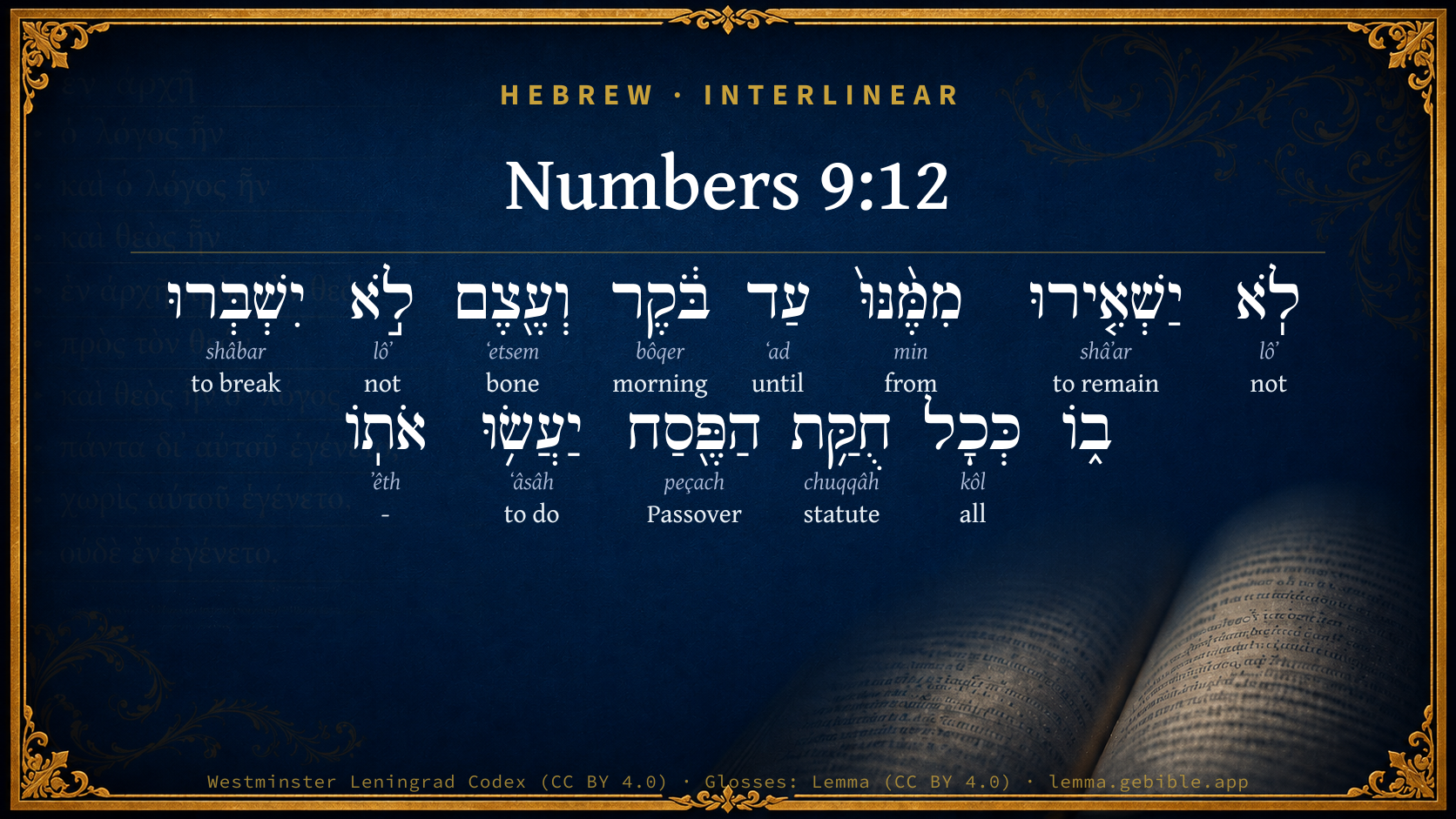
Hebrew (Westminster Leningrad Codex) Numbers 9:12 appears in the Hebrew Old Testament. The text above is from the Westminster Leningrad Codex. Each word links to its Strong’s number, a concise gloss, and parsing drawn from the Open Scriptures Hebrew Bible morphology. Click any word for its full Brown-Driver-Briggs (BDB) entry.
Download image
Cite this verse

Numbers 9:12 (World English Bible). Public Domain. Lemma interlinear Bible study tool, https://lemma.gebible.app/v/numbers/9/12.

Show BibTeX & RIS
BibTeX
RIS
English Translation
They shall leave none of it until the morning, nor break a bone of it. According to all the statute of the Passover they shall keep it.
World English Bible · Public Domain
Download a study sheet

One document with this verse’s original text, its word-by-word gloss line, the meaning frame, cross-references with their text, attributed commentary, and full source and license credits — printable, and it pastes into notes with its structure intact.

This verse Autodidact and up

Study sheet (.html) Plain text (.txt)

A passage Seminary Student

Up to 50 verses in one chapter. A passage sheet keeps up to 6 commentary sources and 12 cross-references per verse, in the order this page ranks them, and says so on the sheet whenever that leaves anything out. Ask for a single verse and you get the Autodidact verse sheet above.

Everything on this page stays free to read, with no account — the sheet is a download of what is already on screen, not access to it.

Want to remove ads? Support Godless Engineer
Compare translations 3

The same verse in 3 English versions, stacked beneath the original-language interlinear above. Click any original word for its lexicon entry.

Each is an independent rendering of the whole verse — the interlinear is not word-aligned to these translations.

Highlighted words mark where these versions differ — a whole-verse word diff, not a word-by-word alignment.

  • World English Bible Public Domain
    They shall leave none of it until the morning, nor break a bone of it. According to all the statute of the Passover they shall keep it.
  • King James Version Public Domain
    They shall leave none of it unto the morning, nor break any bone of it: according to all the ordinances of the passover they shall keep it.
  • unfoldingWord Literal Text CC BY-SA 4.0
    They shall not leave from it until morning, and a bone they shall not break in it. According to every statute of the Passover they shall do it.

unfoldingWord Literal Text — © unfoldingWord, licensed CC BY-SA 4.0. Word-aligned USFM3 via Door43 (git.door43.org/unfoldingWord/en_ult).

Versions to compare (up to 4)

3 of 4 selected

Show all 18 translations

Every available English version of this verse, each an independent rendering of the whole verse.

  • World English Bible Public Domain
    They shall leave none of it until the morning, nor break a bone of it. According to all the statute of the Passover they shall keep it.
  • Berean Standard Bible Public Domain
    they may not leave any of it until morning or break any of its bones. They must observe the Passover according to all its statutes.
  • Majority Standard Bible Public Domain
    they may not leave any of it until morning or break any of its bones. They must observe the Passover according to all its statutes.
  • King James Version Public Domain
    They shall leave none of it unto the morning, nor break any bone of it: according to all the ordinances of the passover they shall keep it.
  • American Standard Version (1901) Public Domain
    they shall leave none of it unto the morning, nor break a bone thereof: according to all the statute of the passover they shall keep it.
  • Revised Version (1885) Public Domain
    they shall leave none of it unto the morning, nor break a bone thereof: according to all the statute of the passover they shall keep it.
  • Geneva Bible (1599) Public Domain
    They shall leaue none of it vnto the morning, nor breake any bone of it: according to all the ordinance of the Passeouer shall they keepe it.
  • Douay-Rheims (1899) Public Domain
    They shall not leave any thing thereof until morning, a nor break a bone thereof, they shall observe all the ceremonies of the phase.
  • Young's Literal Translation Public Domain
    they do not leave of till morning; and a bone they do not break in it: according to all the statute of the passover they prepare it.
  • Literal Standard Version CC BY-SA 4.0
    they do not leave of [it] until morning; and they do not break a bone in it; they prepare it according to all the statute of the Passover.
  • Unlocked Literal Bible CC BY-SA 4.0
    They must not leave any of it until the morning, or break any of its bones. They must follow all the regulations for the Passover.
  • unfoldingWord Literal Text CC BY-SA 4.0
    They shall not leave from it until morning, and a bone they shall not break in it. According to every statute of the Passover they shall do it.
  • Darby Bible Public Domain
    They shall leave none of it until the morning, nor break a bone thereof: according to every ordinance of the passover shall they hold it.
  • World Messianic Bible Public Domain
    They shall leave none of it until the morning, nor break a bone of it. According to all the statute of the Passover they shall keep it.
  • Webster's Bible Public Domain
    They shall leave none of it to the morning, nor break any bone of it: according to all the ordinances of the passover they shall keep it.
  • Free Bible Version CC BY-SA 4.0
    You must not leave any of it until the following morning and you must not break any of its bones. You must observe the Passover according to all the regulations.
  • Bible in Basic English Public Domain
    Nothing of it is to be kept till the morning, and no bone of it is to be broken: they are to keep it by the rules of the Passover.
  • JPS Tanakh (1917) Public Domain
    they shall leave none of it unto the morning, nor break a bone thereof; according to all the statute of the passover they shall keep it.

Literal Standard Version (2020), Covenant Press — licensed CC BY-SA 4.0. Text via the HelloAO Bible API (eBible.org). Unlocked Literal Bible (unfoldingWord) — licensed CC BY-SA 4.0. Text via the HelloAO Bible API (eBible.org). unfoldingWord Literal Text — © unfoldingWord, licensed CC BY-SA 4.0. Word-aligned USFM3 via Door43 (git.door43.org/unfoldingWord/en_ult). Free Bible Version, Dr. Jonathan Gallagher — licensed CC BY-SA 4.0. Text via the HelloAO Bible API (eBible.org).

Word by word

More ways to search: Search by grammar → Find every occurrence → Compare this word →

Practice this passage: Drill this verse → Learn its vocabulary →

הַפֶּ֖סַח
peçach
H6453
“the · Passover”
Particle, Definite Article + Noun, Common, Masculine, Singular, Absolute
Part of Speech
Particle + Noun
Type
Common
Gender
Masculine
Number
Singular
State
Absolute
Full BDB Definition

Origin: from H6452

TWOT: 1786a

passover - sacrifice of passover - animal victim of the passover - festival of the passover
  1. לֹֽא lôʼ H3808 “not” Particle, Negative
  2. יַשְׁאִ֤ירוּ shâʼar H7604 “to remain” Verb, Hiphil, Imperfect, 3rd Person, Masculine, Plural
  3. מִמֶּ֨נּוּ֙ min H4480 “from · us” Preposition + Suffix, Personal, 1st Person, Common, Plural
  4. עַד ʻad H5704 “until” Preposition
  5. בֹּ֔קֶר bôqer H1242 “morning” Noun, Common, Masculine, Singular, Absolute
  6. וְעֶ֖צֶם ʻetsem H6106 “and · bone” Conjunction + Noun, Common, Feminine, Singular, Absolute
  7. לֹ֣א lôʼ H3808 “not” Particle, Negative
  8. יִשְׁבְּרוּ shâbar H7665 “to break” Verb, Qal, Imperfect, 3rd Person, Masculine, Plural
  9. כְּכָל kôl H3605 “like/as · all of” Preposition + Noun, Common, Masculine, Singular, Construct
  10. חֻקַּ֥ת chuqqâh H2708 “statute of” Noun, Common, Both, Singular, Construct
  11. יַעֲשׂ֥וּ ʻâsâh H6213 “to do” Verb, Qal, Imperfect, 3rd Person, Masculine, Plural
  12. אֹתֽוֹ ʼêth H853 “- · him” Particle, Direct Object + Suffix, Personal, 3rd Person, Masculine, Singular

About this verse

These counts appear in no published source. They are computed here, from the morphology-tagged text and Lemma’s own curated glosses. What Lemma adds →

14
words
12
distinct lemmas
Pentateuch
section

Shared distinctive vocabulary

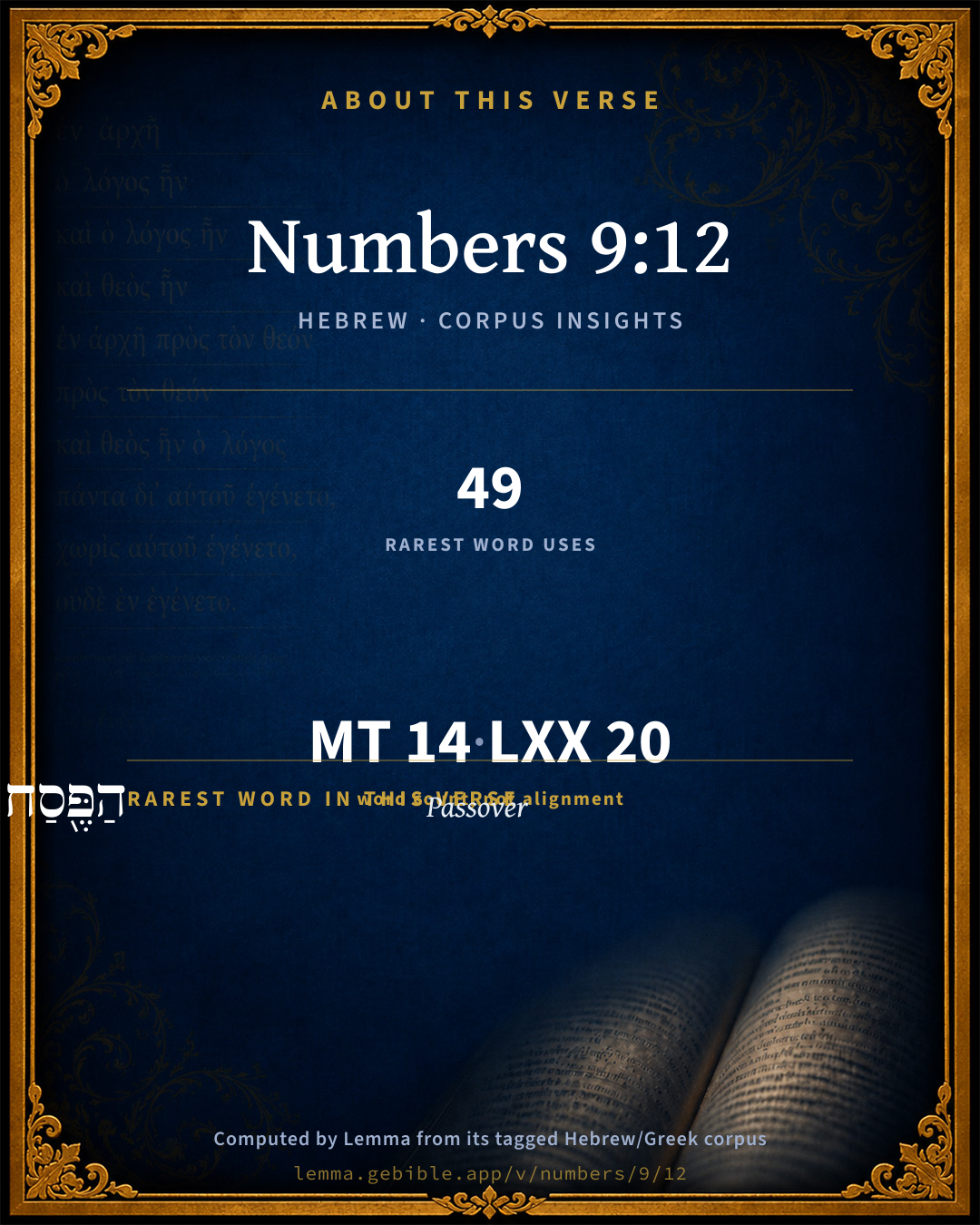
הַפֶּ֖סַח Passover H6453 occurs in 46 verses of the Hebrew Bible. Also found in:

Grammatical profile

  • 3 verbs
  • 5 nouns
  • 3 prepositions
  • 3 particles

Verb forms

  • יַשְׁאִ֤ירוּ Hiphil · Imperfect
  • יִשְׁבְּרוּ Qal · Imperfect
  • יַעֲשׂ֥וּ Qal · Imperfect

Repetition

A word recurs within this verse — often emphatic in Hebrew:

Hebrew & Septuagint length

In English translation the verse runs 27 words from the Hebrew and 29 from the Septuagint (LXX English) — closely comparable.

A rough comparison of the two English renderings, which tokenize alike — not a word-level alignment.

Word counts can differ between the Hebrew and the Greek without any difference in meaning — e.g. the Hebrew direct-object marker אֵת has no separate Greek word, and Greek often adds the article ὁ.

In the original languages it is 14 Hebrew tokens and 20 Greek tokens — but the two are counted differently (Hebrew bundles its prefixes and suffixes into one token; the Greek is in lemma form), so that isn’t a like-for-like length.

Cross-references

5

Topical passages linked to Numbers 9:12 in the Treasury of Scripture Knowledge — connected by theme and wording, ordered by reader-vote popularity; previews shown in the World English Bible.

  • John 19:36 For these things happened, that the Scripture might be fulfilled, "A bone of him will not be broken."
  • Exodus 12:46 In one house shall it be eaten; you shall not carry forth anything of the flesh abroad out of the house; neither shall you break a bone of it.
  • Exodus 12:10 You shall let nothing of it remain until the morning; but that which remains of it until the morning you shall burn with fire.
  • Exodus 12:43 Yahweh said to Moses and Aaron, "This is the ordinance of the Passover. There shall no foreigner eat of it,
  • Numbers 9:3 On the fourteenth day of this month, at evening, you shall keep it in its appointed season-- according to all its statutes, and according to all its ordinances, you shall keep it."

Cross-references courtesy of OpenBible.info (CC BY 4.0).

Hebrew and Greek witnesses Masoretic Hebrew ↔ Greek Septuagint

The same verse in the two great witnesses to the Old Testament, shown verse-for-verse.

These are two independent witnesses, not word-aligned to each other, and the Septuagint is shown in lemma (dictionary) form.

Hebrew Numbers 9:12 Masoretic · Westminster Leningrad Codex

לֹֽא יַשְׁאִ֤ירוּ מִמֶּ֨נּוּ֙ עַד בֹּ֔קֶר וְעֶ֖צֶם לֹ֣א יִשְׁבְּרוּ ב֑וֹ כְּכָל חֻקַּ֥ת הַפֶּ֖סַח יַעֲשׂ֥וּ אֹתֽוֹ

They shall leave none of it until the morning, nor break a bone of it. According to all the statute of the Passover they shall keep it.

World English Bible · Public Domain

Greek LXX Numbers 9:12 Septuagint · lemma form

οὐ καταλείπω ἀπό αὐτός εἰς ὁ πρωΐ καί ὀστέον οὐ συντρίβω ἀπό αὐτός κατά ὁ νόμος ὁ πασχα ποιέω αὐτός

They shall not leave of it until the morrow, and they shall not break a bone of it; they shall sacrifice it according to the ordinance of the passover.

LXX2012 (modern English Septuagint) · Public Domain

Hebrew: Westminster Leningrad Codex (CC BY 4.0). Greek: Septuagint (public domain); English from LXX2012 (modern English Septuagint) (Public Domain). How the Septuagint differs from the Hebrew →

Targum (Aramaic paraphrase)

2

The Targum is the ancient Jewish Aramaic paraphrase of the Hebrew Scriptures — an interpretive translation, not the Hebrew text itself. Onkelos (literal) and Pseudo-Jonathan (expansive) render the Torah, and Jonathan the Prophets. Coverage is partial: where no permissively-licensed English translation exists for a verse, only the Aramaic is shown. This is verse-level text, not a word-by-word alignment to the Hebrew.

  1. Targum Onkelos Torah (Genesis–Deuteronomy)
    לָא יַשְׁאֲרוּן מִנֵהּ עַד צַפְרָא וְגַרְמָא לָא יִתְבְּרוּן בֵּהּ כְּכָל גְזֵרַת פִּסְחָא יַעְבְּדוּן יָתֵהּ

    (no public-domain English translation for this verse)

    Targum Onkelos — Aramaic: “Onkelos Genesis” (public domain); “Onkelos Exodus” (public domain); “Onkelos Leviticus” (public domain); “Onkelos Numbers” (public domain); “Onkelos Deuteronomy” (public domain). English: “Sefaria Community Translation” (CC0 1.0 (public-domain dedication)); “J.W. Etheridge. The Targums of Onkelos and Jonathan Ben Uzziel on the Pentateuch. London: Longmans, Green, 1862” (public domain). Text via Sefaria.

  2. Targum Pseudo-Jonathan Torah (Genesis–Deuteronomy)
    לָא יְשַׁיְירוּן מִנֵיהּ עַד צַפְרָא וְגַרְמָא לָא יִתְבְּרוּן בֵּיהּ כְּכָל אַחְוָיַית גְזֵירַת פִּסְחָא דְנִיסָן יַעַבְדוּן יָתֵיהּ בְּרַם בְּפִסְחָא דְנִיסָן הִינוּן יֵיכְלוּן פַּטִירֵי וְקוּרְבַּן פִּסְחָא לָא יַעַבְדוּן מְטוֹל דְסוֹאָבוּתְהוֹן בְּהוֹן וּבְפִסְחָא דְאִיָיר יִידְכּוּן וְיִקְרְבוּן יָתֵיהּ

    They shall not leave of it till the morning, and a bone in it shall not be broken; according to every instruction in the decree of the Pascha in Nisan, they shall perform it. In the Pascha of Nisan (such persons) may eat unleavened bread, but not perform the oblation of the Pascha on account of their defilement; but in the Pascha of Ijar being purified they shall offer it.

    Targum Pseudo-Jonathan — Aramaic: “Targum Jonathan on Genesis” (public domain); “Targum Jonathan on Exodus” (public domain); “Targum Jonathan on Leviticus” (public domain); “Targum Jonathan on Numbers” (public domain); “Targum Jonathan on Deuteronomy” (public domain). English: “The Targum of Jonathan ben Uzziel, trans. J. W. Etheridge, London, 1862” (public domain). Text via Sefaria.

Commentary

Notes on Numbers 9:12 from classic Christian and Jewish commentators (each source and its license shown beneath its notes). The classic Christian expositions comment on the surrounding passage and are grouped to its opening verse, so a note may address several verses; the Jewish commentaries on the Tanakh (Rashi and others) are per-verse, so they appear only where the commentator wrote on this verse.

Lemma curates 59 commentaries, every one of them public domain or Creative Commons licensed, each selected and text-cleaned for this edition rather than reprinted as found. About our sources →

Trapp's Complete Commentary

John Trapp

Num 9:12 They shall leave none of it unto the morning, nor break any bone of it: according to all the ordinances of the passover they shall keep it.

Ver. 12. They shall leave none.] The Lord in his infinite wisdom would hereby prevent all occasions of idolatry, which is easily admitted in the reservations of holy things, as in Popery at this day.

John Trapp, A Commentary or Exposition upon All the Books of the Old and New Testament (1647–1656) — public domain. Text from a community e-Sword module.

Tyndale Open Study Notes

Tyndale Open Resources

9:12 The bones of the Passover lamb were not to be broken (see Exod 12:46; Ps 34:20; John 19:32-36; cp. John 1:29; 1 Cor 5:7). The apostle John made reference to this instruction when reporting that Jesus’ legs were not broken on the cross (John 19:36).

Tyndale Open Study Notes — © Tyndale Open Resources, licensed CC BY-SA 4.0. Text via the HelloAO Bible API.

Ellicott's Commentary for English Readers

(12) According to all the ordinances.—The word rendered ordinances is in the singular number: according to all the ordinance (or statute). The primary reference is probably to the law respecting the Paschal Lamb. According to Jewish tradition the feast was only observed for one day instead of seven, and it was not necessary to put away leaven.

A Bible Commentary for English Readers, edited by Charles John Ellicott (1878–1897) — public domain. Text from a community e-Sword module.

The Cambridge Bible for Schools and Colleges

gen. ed. J. J. S. Perowne

12. nor break a bone thereof] Cf. Joh_19:36.

The Cambridge Bible for Schools and Colleges (gen. ed. J. J. S. Perowne; Cambridge University Press, 1878–1918) — public domain. Text from a community e-Sword module.

John Gill's Exposition

But the man that is clean,.... Free from any pollution by a dead body, or the like:

and is not in a journey; in a distant country; for if he was on a journey in his own nation, he ought to return and attend the passover, which all the males from the several parts of the land were obliged unto; wherefore the Vulgate Latin version of Num 9:10; is a wrong one; "or in a way afar off in your nation"; for at whatsoever distance they were in their own nation, they were bound to appear:

and forbeareth to keep the passover; the first passover in the first month, the month Nisan, wilfully, through negligence, or not caring to be at the expense and trouble of it, or on any pretence whatsoever: Ben Gersom interprets it of one that will not keep neither the first nor the second passover:

even the same soul shall be cut off from his people; either be excommunicated from them, or cut off by death by the immediate hand of God:

because he brought not the offering of the Lord in his appointed season: this is the ground and reason of the resentment; it was a breach of the divine command, which required this offering; ingratitude to God, being a thank offering for a singular deliverance; and this aggravated by its not being brought at the appointed time, which was the fit ti me for it:

that man shall bear his sin; be chargeable with the guilt of it, and bear the punishment of it; he on himself, as Aben Ezra notes, he, and he only; not his wife and family, for he being the head and master of the family, it lay upon him to provide the passover lamb for himself and his house.

John Gill's Exposition of the Whole Bible (1746–1763) — public domain (CC PDM 1.0). Text via the HelloAO Bible API.

Albert Barnes' Notes on the Bible

According to all the ordinances - i. e. those relating to the Passover lamb, not those concerning the feast, for the Little Passover lasted, according to the Jews, only one day; nor was it held to be needful that at it leaven should be put away out of the houses.

Albert Barnes' Notes on the Bible (1834–1885) — public domain. Text from a community e-Sword/MySword module.

Matthew Poole's English Annotations

Leave none of it unto the morning, but either eat or burn it before that time.

Matthew Poole's English Annotations on the Holy Bible (1683–1685) — public domain. Text from a community e-Sword/MySword module.

The Pulpit Commentary

According to all the ordinances of the passover. The later Jews held that this passover need only be kept for one day, and that leaven need not be put away from the house. But this was a clear departure from the original rule, for it was evidently intended that it should be in all respects a true passover, and in this case six clear days were allowed for the keeping of it. (see on Num_10:11)

The Pulpit Commentary (1880–1919), ed. H.D.M. Spence-Jones & Joseph S. Exell — public domain. Text from a community e-Sword module.

Lesson kit

Teaching starters — assembled from the data on this page, not authored interpretation. Every prompt links to the verse data it draws on. Edit before teaching.

Numbers, in the Pentateuch, opens this verse with 14 words (12 distinct Hebrew lemmas). Its most distinctive word is peçach (“Passover”). A historical commentator’s framing appears above. Read the whole chapter for the surrounding context.

Discussion questions

  1. The word peçach carries the sense “Passover.” How does it shape the verse?
  2. Exodus 12:11 shares the word «Passover» with this verse. How do the two illuminate each other?
  3. “not” occurs 2× in this one verse. What is the effect of the repetition?
  4. These translations render this verse differently; the difference is in the English rendering, not the original. What questions does that raise?
  5. The verb «יַשְׁאִ֤ירוּ» is Hiphil Imperfect. How does its form color the action?
  6. Reading how Trapp's Complete Commentary and Tyndale Open Study Notes read this verse, where do the two commentators agree and where do they part?

Things to notice

Reading settings

Reading text

Shown beneath each verse's original-language words.

Old Testament
Old Testament edition

Read the OT as the Masoretic Hebrew (MT) or the Greek Septuagint (LXX).

English shown for the Greek Septuagint (in the Hebrew ↔ Greek comparison).

Comparing translations? Open the Compare panel on any verse page to stack up to four side by side.