
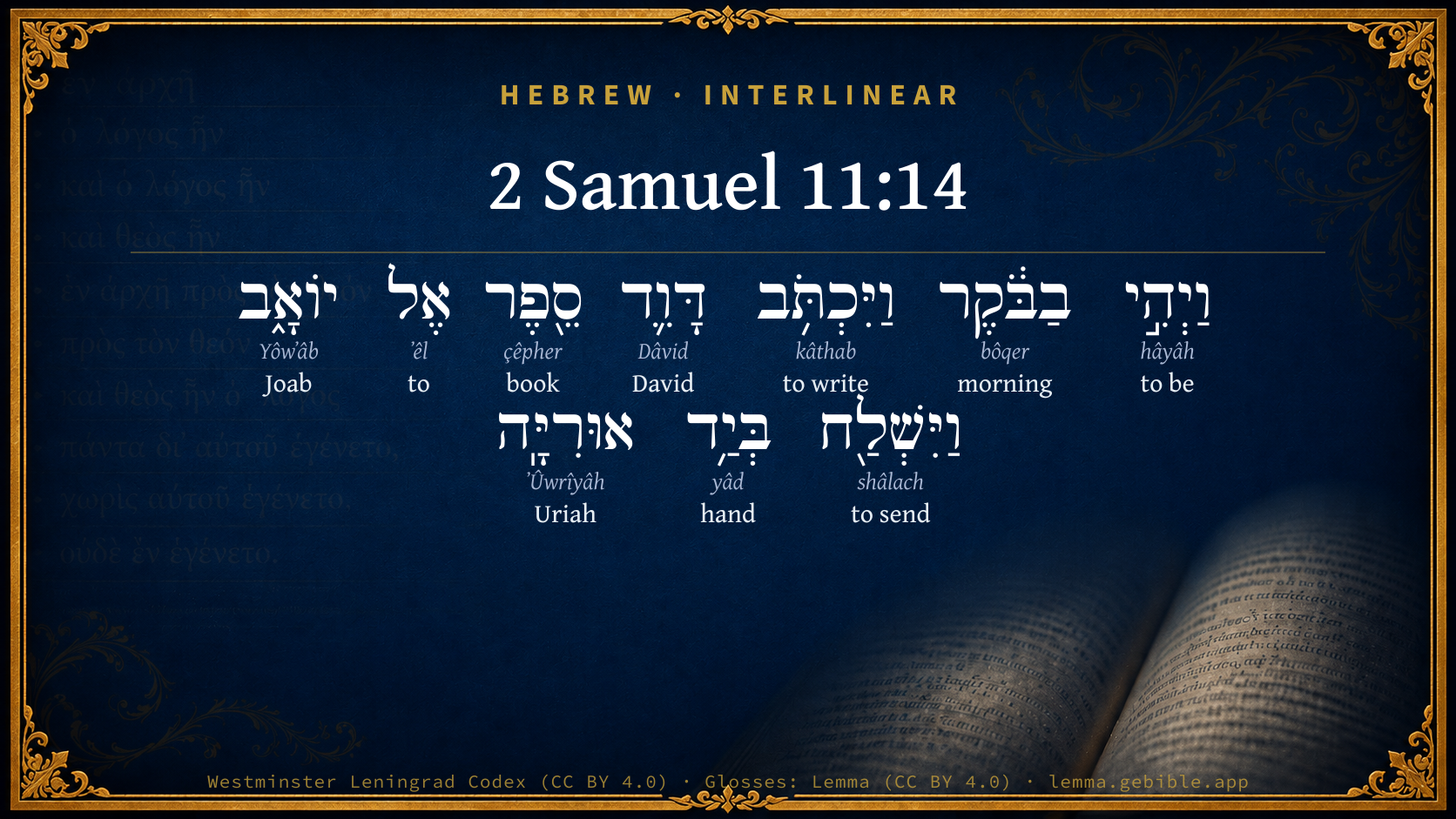
2 Samuel 11:14

Hebrew (Westminster Leningrad Codex) 2 Samuel 11:14 appears in the Hebrew Old Testament. The text above is from the Westminster Leningrad Codex. Each word links to its Strong’s number, a concise gloss, and parsing drawn from the Open Scriptures Hebrew Bible morphology. Click any word for its full Brown-Driver-Briggs (BDB) entry.
Download image
Cite this verse

2 Samuel 11:14 (World English Bible). Public Domain. Lemma interlinear Bible study tool, https://lemma.gebible.app/v/2-samuel/11/14.

Show BibTeX & RIS
BibTeX
RIS
English Translation
It happened in the morning, that David wrote a letter to Joab, and sent it by the hand of Uriah.
World English Bible · Public Domain
Download a study sheet

One document with this verse’s original text, its word-by-word gloss line, the meaning frame, cross-references with their text, attributed commentary, and full source and license credits — printable, and it pastes into notes with its structure intact.

This verse Autodidact and up

Study sheet (.html) Plain text (.txt)

A passage Seminary Student

Up to 50 verses in one chapter. A passage sheet keeps up to 6 commentary sources and 12 cross-references per verse, in the order this page ranks them, and says so on the sheet whenever that leaves anything out. Ask for a single verse and you get the Autodidact verse sheet above.

Everything on this page stays free to read, with no account — the sheet is a download of what is already on screen, not access to it.

Want to remove ads? Support Godless Engineer
Compare translations 3

The same verse in 3 English versions, stacked beneath the original-language interlinear above. Click any original word for its lexicon entry.

Each is an independent rendering of the whole verse — the interlinear is not word-aligned to these translations.

Highlighted words mark where these versions differ — a whole-verse word diff, not a word-by-word alignment.

  • World English Bible Public Domain
    It happened in the morning, that David wrote a letter to Joab, and sent it by the hand of Uriah.
  • King James Version Public Domain
    And it came to pass in the morning, that David wrote a letter to Joab, and sent it by the hand of Uriah.
  • unfoldingWord Literal Text CC BY-SA 4.0
    And it happened in the morning that David wrote a letter to Joab, and he sent by the hand of Uriah.

unfoldingWord Literal Text — © unfoldingWord, licensed CC BY-SA 4.0. Word-aligned USFM3 via Door43 (git.door43.org/unfoldingWord/en_ult).

Versions to compare (up to 4)

3 of 4 selected

Show all 18 translations

Every available English version of this verse, each an independent rendering of the whole verse.

  • World English Bible Public Domain
    It happened in the morning, that David wrote a letter to Joab, and sent it by the hand of Uriah.
  • Berean Standard Bible Public Domain
    The next morning David wrote a letter to Joab and sent it with Uriah.
  • Majority Standard Bible Public Domain
    The next morning David wrote a letter to Joab and sent it with Uriah.
  • King James Version Public Domain
    And it came to pass in the morning, that David wrote a letter to Joab, and sent it by the hand of Uriah.
  • American Standard Version (1901) Public Domain
    And it came to pass in the morning, that David wrote a letter to Joab, and sent it by the hand of Uriah.
  • Revised Version (1885) Public Domain
    And it came to pass in the morning, that David wrote a letter to Joab, and sent it by the hand of Uriah.
  • Geneva Bible (1599) Public Domain
    And on the morowe Dauid wrote a letter to Ioab, and sent it by the hand of Vriah.
  • Douay-Rheims (1899) Public Domain
    And when the morning was come, David wrote a letter to Joab: and sent it by the hand of Urias,
  • Young's Literal Translation Public Domain
    And it cometh to pass in the morning, that David writeth a letter unto Joab, and sendeth by the hand of Uriah;
  • Literal Standard Version CC BY-SA 4.0
    And it comes to pass in the morning that David writes a letter to Joab and sends [it] by the hand of Uriah;
  • Unlocked Literal Bible CC BY-SA 4.0
    So in the morning David wrote a letter to Joab, and sent it by the hand of Uriah.
  • unfoldingWord Literal Text CC BY-SA 4.0
    And it happened in the morning that David wrote a letter to Joab, and he sent by the hand of Uriah.
  • Darby Bible Public Domain
    And it came to pass in the morning, that David wrote a letter to Joab, and sent it by Urijah.
  • World Messianic Bible Public Domain
    In the morning, David wrote a letter to Joab and sent it by the hand of Uriah.
  • Webster's Bible Public Domain
    And it came to pass in the morning, that David wrote a letter to Joab, and sent it by the hand of Uriah.
  • Free Bible Version CC BY-SA 4.0
    In the morning David wrote Joab a letter, and gave it to Uriah to take to him.
  • Bible in Basic English Public Domain
    Now in the morning, David gave Uriah a letter to take to Joab.
  • JPS Tanakh (1917) Public Domain
    And it came to pass in the morning, that David wrote a letter to Joab, and sent it by the hand of Uriah.

Literal Standard Version (2020), Covenant Press — licensed CC BY-SA 4.0. Text via the HelloAO Bible API (eBible.org). Unlocked Literal Bible (unfoldingWord) — licensed CC BY-SA 4.0. Text via the HelloAO Bible API (eBible.org). unfoldingWord Literal Text — © unfoldingWord, licensed CC BY-SA 4.0. Word-aligned USFM3 via Door43 (git.door43.org/unfoldingWord/en_ult). Free Bible Version, Dr. Jonathan Gallagher — licensed CC BY-SA 4.0. Text via the HelloAO Bible API (eBible.org).

Word by word

More ways to search: Search by grammar → Find every occurrence → Compare this word →

Practice this passage: Drill this verse → Learn its vocabulary →

אוּרִיָּֽה
ʼÛwrîyâh
H223
“Uriah”
Noun, Proper
Part of Speech
Noun
Type
Proper
Full BDB Definition

Origin: from H217 and H3050

TWOT: None

Uriah or Urijah = "Jehovah (Yahweh) is my light (flame)" - Hittite husband of Bathsheba - a priest who built king Ahaz' heathen altar - a priest who rebuilt Jerusalem's wall - a prophet slain by Jehoiakim
  1. וַיְהִ֣י hâyâh H1961 “and · to be” Conjunction + Verb, Qal, Sequential Imperfect, 3rd Person, Masculine, Singular
  2. בַבֹּ֔קֶר bôqer H1242 “in/at the · morning” Preposition, Determined + Noun, Common, Masculine, Singular, Absolute
  3. וַיִּכְתֹּ֥ב kâthab H3789 “and · to write” Conjunction + Verb, Qal, Sequential Imperfect, 3rd Person, Masculine, Singular
  4. דָּוִ֛ד Dâvid H1732 “David” Noun, Proper
  5. סֵ֖פֶר çêpher H5612 “book” Noun, Common, Masculine, Singular, Absolute
  6. אֶל ʼêl H413 “to” Preposition
  7. יוֹאָ֑ב Yôwʼâb H3097 “Joab” Noun, Proper
  8. וַיִּשְׁלַ֖ח shâlach H7971 “and · to send” Conjunction + Verb, Qal, Sequential Imperfect, 3rd Person, Masculine, Singular
  9. בְּיַ֥ד yâd H3027 “in/at · hand of” Preposition + Noun, Common, Both, Singular, Construct

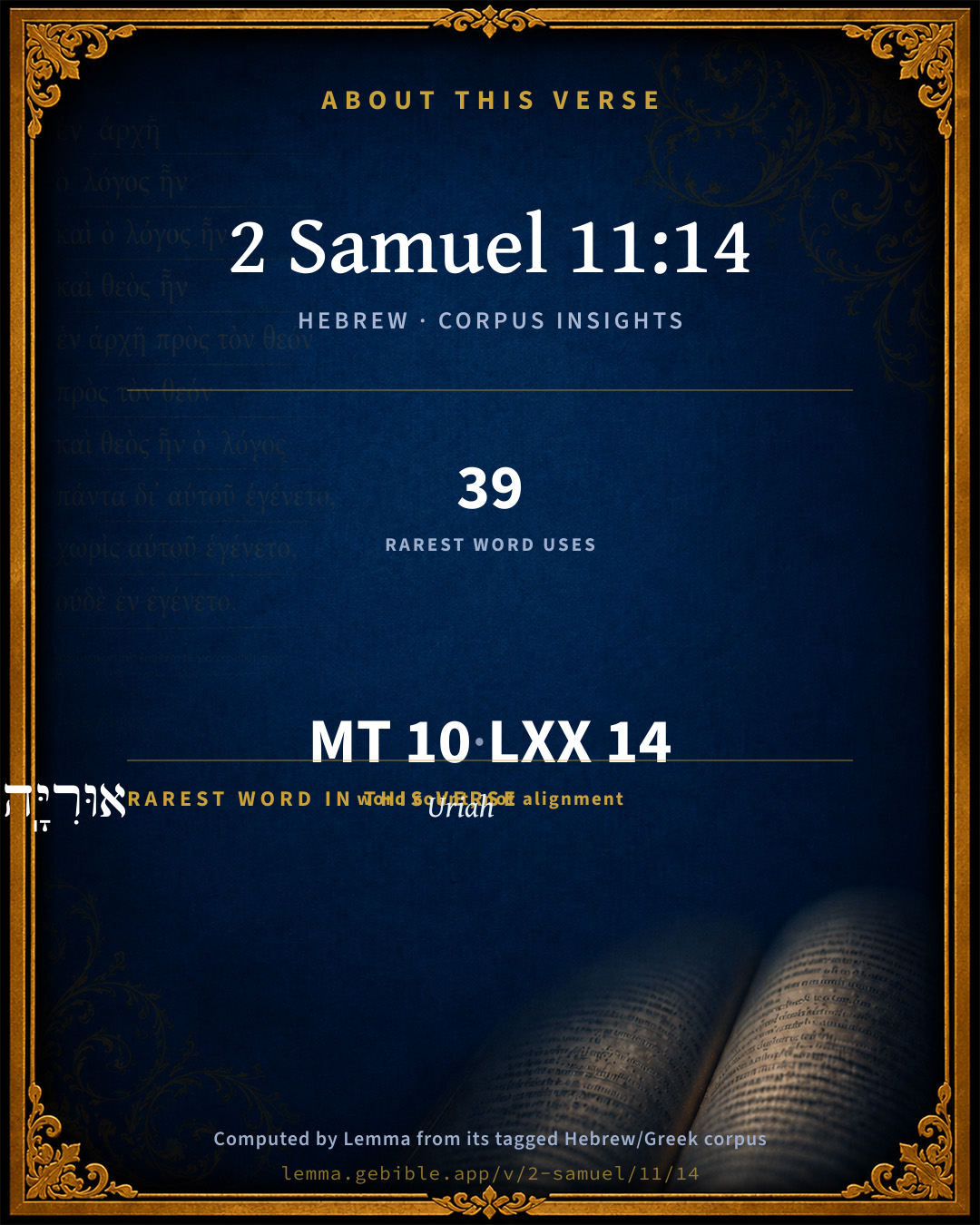
About this verse

These counts appear in no published source. They are computed here, from the morphology-tagged text and Lemma’s own curated glosses. What Lemma adds →

10
words
10
distinct lemmas
Historical
section

Shared distinctive vocabulary

אוּרִיָּֽה Uriah H223 occurs in 33 verses of the Hebrew Bible. Also found in:

Grammatical profile

  • 3 verbs
  • 6 nouns
  • 1 preposition

Verb forms

  • וַיְהִ֣י Qal · Sequential Imperfect
  • וַיִּכְתֹּ֥ב Qal · Sequential Imperfect
  • וַיִּשְׁלַ֖ח Qal · Sequential Imperfect

Hebrew & Septuagint length

In English translation the verse runs 20 words from the Hebrew and 19 from the Septuagint (LXX English) — closely comparable.

A rough comparison of the two English renderings, which tokenize alike — not a word-level alignment.

Word counts can differ between the Hebrew and the Greek without any difference in meaning — e.g. the Hebrew direct-object marker אֵת has no separate Greek word, and Greek often adds the article ὁ.

In the original languages it is 10 Hebrew tokens and 14 Greek tokens — but the two are counted differently (Hebrew bundles its prefixes and suffixes into one token; the Greek is in lemma form), so that isn’t a like-for-like length.

Cross-references

7

Topical passages linked to 2 Samuel 11:14 in the Treasury of Scripture Knowledge — connected by theme and wording, ordered by reader-vote popularity; previews shown in the World English Bible.

  • 1 Kings 21:8–10 So she wrote letters in Ahab's name, and sealed them with his seal, and sent the letters to the elders and to the nobles who were in his city, [and] who lived with Naboth.
  • Jeremiah 17:9 The heart is deceitful above all things, and it is exceedingly corrupt: who can know it?
  • Psalms 19:13 Keep back your servant also from presumptuous sins. Let them not have dominion over me. Then I will be upright, I will be blameless and innocent of great transgression.
  • Psalms 52:2 Your tongue plots destruction, Like a sharp razor, working deceitfully.
  • Psalms 62:9 Surely men of low degree are just a breath, And men of high degree are a lie. In the balances they will go up. They are together lighter than a breath.
  • Jeremiah 9:1–4 Oh that my head were waters, and my eyes a spring of tears, that I might weep day and night for the slain of the daughter of my people!
  • Micah 7:3–5 Their hands are on that which is evil to do it diligently. The ruler and judge ask for a bribe; And the powerful man dictates the evil desire of his soul. Thus they conspire together.

Cross-references courtesy of OpenBible.info (CC BY 4.0).

Hebrew and Greek witnesses Masoretic Hebrew ↔ Greek Septuagint

The same verse in the two great witnesses to the Old Testament, shown verse-for-verse.

These are two independent witnesses, not word-aligned to each other, and the Septuagint is shown in lemma (dictionary) form.

Hebrew 2 Samuel 11:14 Masoretic · Westminster Leningrad Codex

וַיְהִ֣י בַבֹּ֔קֶר וַיִּכְתֹּ֥ב דָּוִ֛ד סֵ֖פֶר אֶל יוֹאָ֑ב וַיִּשְׁלַ֖ח בְּיַ֥ד אוּרִיָּֽה

It happened in the morning, that David wrote a letter to Joab, and sent it by the hand of Uriah.

World English Bible · Public Domain

Greek LXX 2 Samuel 11:14 Septuagint · lemma form

καί γίγνομαι πρωί καί γράφω δαυίδ βιβλίον πρός ιωαβ καί ἀποστέλλω ἐν χείρ ουριας

And the morning came, and David wrote a letter to Joab, and sent it by the hand of Urias.

LXX2012 (modern English Septuagint) · Public Domain

Hebrew: Westminster Leningrad Codex (CC BY 4.0). Greek: Septuagint (public domain); English from LXX2012 (modern English Septuagint) (Public Domain). How the Septuagint differs from the Hebrew →

Targum (Aramaic paraphrase)

1

The Targum is the ancient Jewish Aramaic paraphrase of the Hebrew Scriptures — an interpretive translation, not the Hebrew text itself. Onkelos (literal) and Pseudo-Jonathan (expansive) render the Torah, and Jonathan the Prophets. Coverage is partial: where no permissively-licensed English translation exists for a verse, only the Aramaic is shown. This is verse-level text, not a word-by-word alignment to the Hebrew.

  1. Targum Jonathan Prophets (Joshua–Malachi)
    וַהֲוָה בְּצַפְרָא וּכְתַב דָוִד אִגַרְתָּא לְוַת יוֹאָב וְשַׁדָר בְּיַד אוּרִיָה:

    (no public-domain English translation for this verse)

    Targum Jonathan — Aramaic: “Mikraot Gedolot” (public domain). English: “Sefaria Community Translation” (CC0 1.0 (public-domain dedication)); “London "Chaldee Paraphrase," 1871” (public domain). Text via Sefaria.

Commentary

Notes on 2 Samuel 11:14 from classic Christian and Jewish commentators (each source and its license shown beneath its notes). The classic Christian expositions comment on the surrounding passage and are grouped to its opening verse, so a note may address several verses; the Jewish commentaries on the Tanakh (Rashi and others) are per-verse, so they appear only where the commentator wrote on this verse.

Lemma curates 59 commentaries, every one of them public domain or Creative Commons licensed, each selected and text-cleaned for this edition rather than reprinted as found. About our sources →

Matthew Henry's Commentary

When David's project of fathering the child upon Uriah himself failed, so that, in process of time, Uriah would certainly know the wrong that had been done him, to prevent the fruits of his revenge, the devil put it into David's heart to take him off, and then neither he nor Bath-sheba would be in any danger (what prosecution could there be when there was no prosecutor?), suggesting further that, when Uriah was out of the way, Bath-sheba might, if he pleased, be his own for ever. Adulteries have often occasioned murders, and one wickedness must be covered and secured with another. The beginnings of sin are therefore to be dreaded; for who knows where they will end? It is resolved in David's breast (which one would think could never possibly have harboured so vile a thought) that Uriah must die. That innocent, valiant, gallant man, who was ready to die for his prince's honour, must die by his prince's hand. David has sinned, and Bath-sheba has sinned, and both against him, and therefore he must die; David determines he must. Is this the man whose heart smote him because he had cut off Saul's skirt? Quantum mutatus ab illo! - But ah, how changed! Is this he that executed judgment and justice to all his people? How can he now do so unjust a thing? See how fleshly lusts war against the soul, and what devastations they make in that war; how they blink the eyes, harden the heart, sear the conscience, and deprive men of all sense of honour and justice. Whoso committeth adultery with a woman lacketh understanding and quite loses it; he that doth it destroys his own soul, Pro 6:32. But, as the eye of the adulterer, so the hand of the murderer seeks concealment, Job 24:14, Job 24:15. Works of darkness hate the light. When David bravely slew Goliath it was done publicly, and he gloried in it; but, when he basely slew Uriah, it must be done clandestinely, for he is ashamed of it, and well he may. Who would do a thing that he dare not own? The devil, having as a poisonous serpent, put it into David's heart to murder Uriah, as a subtle serpent he puts it into his head how to do it. Not as Absalom slew Amnon, by commanding his servants to assassinate him, nor as Ahab slew Naboth by suborning witnesses to accuse him, but by exposing him to the enemy, a way of doing it which, perhaps, would not seem so odious to conscience and the world, because soldiers expose themselves of course. If Uriah had not been in that dangerous post, another must; he has (as we say) a chance for his life; if he fight stoutly, he may perhaps come off; and, if he die, it is in the field of honour, where a soldier would choose to die; and yet all this will not save it from being a wilful murder, of malice prepense.

I. Orders are sent to Joab to set Uriah in the front of the hottest battle, and then to desert him, and abandon him to the enemy, Sa2 11:14, Sa2 11:15. This was David's project to take off Uriah, and it succeeded, as he designed. Many were the aggravations of this murder. 1. It was deliberate. He took time to consider of it; and though he had time to consider of it, for he wrote a letter about it, and though he had time to have countermanded the order afterwards before it could be put in execution, yet he persisted in it. 2. He sent the letter by Uriah himself, than which nothing could be more base and barbarous, to make him accessory to his own death. And what a paradox was it that he could bear such a malice against him in whom yet he could repose such a confidence as that he would carry letters which he must not know the purport of. 3. Advantage must be taken of Uriah's own courage and zeal for his king and country, which deserve the greatest praise and recompence, to betray him the more easily to his fate. If he had not been forward to expose himself, perhaps he was a man of such importance that Joab could not have exposed him; and that this noble fire should be designedly turned upon himself was a most detestable instance of ingratitude. 4. Many must be involved in the guilt. Joab, the general, to whom the blood of his soldiers, especially the worthies, ought to be precious, must do it; he, and all that retire from Uriah when they ought in conscience to support and second him, become guilty of his death. 5. Uriah cannot thus die alone: the party he commands is in danger of being cut off with him; and it proved so: some of the people, even the servants of David (so they are called, to aggravate David's sin in being so prodigal of their lives), fell with him, Sa2 11:17. Nay, this wilful misconduct by which Uriah must be betrayed might be of fatal consequence to the whole army, and might oblige them to raise the siege. 6. It will be the triumph and joy of the Ammonites, the sworn enemies of God and Israel; it will gratify them exceedingly. David prayed for himself, that he might not fall into the hands of man, nor flee from his enemies (Sa2 24:13, Sa2 24:14); yet he sells his servant Uriah to the Ammonites, and not for any iniquity in his hand.

II. Joab executes these orders. In the next assault that is made upon the city Uriah has the most dangerous post assigned him, is encouraged to hope that if he be repulsed by the besieged he shall be relieved by Joab, in dependence on which he marches on with resolution, but, succours not coming on, the service proves too hot, and he is slain in it, Sa2 11:16, Sa2 11:17. It was strange that Joab would do such a thing merely upon a letter, without knowing the reason. But, 1. Perhaps he supposed Uriah had been guilty of some great crime, to enquire into which David had sent for him, and that, because he would not punish him openly, he took this course with him to put him to death. 2. Joab had been guilty of blood, and we may suppose it pleased him very well to see David himself falling into the same guilt, and he was willing enough to serve him in it, that he might continue to be favourable to him. It is common for those who have done ill themselves to desire to be countenanced therein by others doing ill likewise, especially by the sins of those that are eminent in the profession of religion. Or, perhaps, David knew that Joab had a pique against Uriah, and would gladly be avenged on him; otherwise Joab, when he saw cause, knew how to dispute the king's orders, as Sa2 19:5; Sa2 24:3.

III. He sends an account of it to David. An express is despatched away immediately with a report of this last disgrace and loss which they had sustained, Sa2 11:18. And, to disguise the affair, 1. He supposes that David would appear to be angry at his bad conduct, would ask why they came so near the wall (Sa2 11:20), did they not know that Abimelech lost his life by doing do? Sa2 11:21. We had the story (Jdg 9:53), which book, it is likely, was published as a part of the sacred history in Samuel's time; and (be it noted to their praise, and for imitation) even the soldiers were conversant with their bibles, and could readily quote the scripture-story, and make use of it for admonition to themselves not to run upon the same attempts which they found had been fatal. 2. He slyly orders the messenger to soothe it with telling him that Uriah the Hittite was dead also, which gave too broad an intimation to the messenger, and by him to others, that David would be secretly pleased to hear that; for murder will out. And, when men do such base things, they must expect to be bantered and upbraided with them, even by their inferiors. The messenger delivered his message agreeably to orders, Sa2 11:22-24. He makes the besieged to sally out first upon the besiegers (they came out unto us into the field), represents the besiegers as doing their part with great bravery (we were upon them even to the entering of the gate - we forced them to retire into the city with precipitation), and so concludes with a slight mention of the slaughter made among them by some shot from the wall: Some of the king's servants are dead, and particularly Uriah the Hittite, an officer of note, stood first in the list of the slain.

IV. David receives the account with a secret satisfaction, Sa2 11:25. Let not Joab be displeased, for David is not. He blames not his conduct, nor thinks they did wrong in approaching so near the wall; all is well now that Uriah is put out of the way. This point being gained, he can make light of the loss, and turn it off easily with an excuse: The sword devours one as well as another; it was a chance of war, nothing more common. He orders Joab to make the battle more strong next time, while he, by his sin, was weakening it, and provoking God to blast the undertaking.

V. He marries the widow in a little time. She submitted to the ceremony of mourning for her husband as short a time as custom would admit (Sa2 11:26), and then David took her to his house as his wife, and she bore him a son. Uriah's revenge was prevented by his death, but the birth of the child so soon after the marriage published the crime. Sin will have shame. Yet that was not the worst of it: The thing that David had done displeased the Lord. The whole matter of Uriah (as it is called, Kg1 15:5), the adultery, falsehood, murder, and this marriage at last, it was all displeasing to the Lord. He had pleased himself, but displeased God. Note, God sees and hates sin in his own people. Nay, the nearer any are to God in profession the more displeasing to him their sins are; for in them there is more ingratitude, treachery, and reproach, than in the sins of others. Let none therefore encourage themselves in sin by the example of David; for those that sin as he did will fall under the displeasure of God as he did. Let us therefore stand in awe and sin not, not sin after the similitude of his transgression.

Matthew Henry's Commentary on the Whole Bible (1708–1710) — public domain (CC PDM 1.0). Text via the HelloAO Bible API.

Jamieson, Fausset & Brown

Robert Jamieson, A. R. Fausset & David Brown

URIAH SLAIN. (Sa2 11:14-27)

David wrote a letter to Joab, and sent it by the hand of Uriah . . . Set ye Uriah in the forefront of the hottest battle--The various arts and stratagems by which the king tried to cajole Uriah, till at last he resorted to the horrid crime of murder--the cold-blooded cruelty of despatching the letter by the hands of the gallant but much-wronged soldier himself, the enlistment of Joab to be a partaker of his sin, the heartless affectation of mourning, and the indecent haste of his marriage with Bath-sheba--have left an indelible stain upon the character of David, and exhibit a painfully humiliating proof of the awful lengths to which the best of men may go when they forfeit the restraining grace of God.

Next: 2 Samuel Chapter 12

Jamieson, Fausset & Brown — Commentary Critical and Explanatory on the Whole Bible (1871) — public domain (CC PDM 1.0). Text via the HelloAO Bible API.

Trapp's Complete Commentary

John Trapp

2Sa 11:14 And it came to pass in the morning, that David wrote a letter to Joab, and sent [it] by the hand of Uriah.

Ver. 14. David wrote a letter.] Not with black, but with blood. Sic ex vitio vitium gignitur. {a} This is the last but worst link in that woeful chain of David’s lust: non evitavit adulteriam, perpetravit et homicidium, saith Isidor; to palliate his adultery he committeth murder. This was to do worse than that non-such, Ahab, who only coveted Naboth’s vineyard, and then took away his life: but David coveted first the wife, and then the life of this valiant Uriah; yea, and of many more that fell with him by like treachery, Joab also being involved in the same guilt. Well might Gregory say, David rectior fuit in servitio quam in regno: servus enim adversarium retire timuit, Rex factus luxuriae, persunsione Uriam fraude extinxit: David was better while a servant than when a king; for being a servant, he feared to kill Saul his adversary, but becoming a king, he basely slew his most faithful friend and dutiful subject.

And sent it by the hand of Uriah.] Qui abiit ferens gladium suae caedis, saith Theodoret, who went his way carrying a sword to Joab to cut his own throat. So did Bellerophon to Jobata by the command of King Praetus; unless that fable were feigned by Satan’s subtlety out of this true story, to elude it. Lysander carried letters to Lacedemon from Pharnabarus against himself. And the like do all those, saith Aquinas, {b} qui sciunt et docent, et non faciunt, who know and teach others the will of God, but practise it not themselves. Knowledge without virtue draweth a greater judgment, and oftentimes condemneth the bearer.

{a} Isidor.

{b} Praef., in Epist. Canon.

John Trapp, A Commentary or Exposition upon All the Books of the Old and New Testament (1647–1656) — public domain. Text from a community e-Sword module.

The Biblical Illustrator

Joseph S. Exell

2Sa_11:14

David wrote a letter to Joab.

--So in the Greek story, Proetus sent Bellerophon to Jobates with his own death warrant. (Cp. Hom. II. 6:168, 169.) Slay him he would not, that his soul abhorred; but to the father of his wife, the King of Lycia, sent him forth, with tokens charged of dire import, on folded tablets traced, poisoning, the monarchs mind to work his death. (A. F. Kirkpatrick, M. A.)

The Biblical Illustrator, edited by Joseph S. Exell (c. 1880s–1900s) — public domain. Text from a community e-Sword module.

Adam Clarke's Commentary

Verse 14. David wrote a letter] This was the sum of treachery and villany. He made this most noble man the carrier of letters which prescribed the mode in which he was to be murdered. This case some have likened to that of Bellerophon, son of Glaucus, king of Ephyra, who being in the court of Proetus, king of the Argives, his queen Antia, or as others Sthenoboea, fell violently in love with him; but he, refusing to gratify her criminal passions, was in revenge accused by her to Proetus her husband, as having attempted to corrupt her. Proetus not willing to violate the laws of hospitality by slaying him in his own house, wrote letters to Jobates, king of Lycia, the father of Sthenoboea, and sent them by the hand of Bellerophon, stating his crime, and desiring Jobates to put him to death. To meet the wishes of his son-in-law, and keep his own hands innocent of blood, he sent him with a small force against a very warlike people called the Solymi; but, contrary to all expectation, he not only escaped with his life, but gained a complete victory over them. He was afterwards sent upon several equally dangerous and hopeless expeditions, but still came off with success; and to reward him Jobates gave him one of his daughters to wife, and a part of his kingdom. Sthenoboea, hearing this, through rage and despair killed herself.

I have given this history at large, because many have thought it not only to be parallel to that of Uriah, but to be a fabulous formation from the Scripture fact: for my own part, I scarcely see in them any correspondence, but in the simple circumstance that both carried those letters which contained their own condemnation. From the fable of Bellerophon came the proverb, Bellerophontis literas portare, "to carry one's own condemnation."

Adam Clarke's Commentary on the Bible (1810–1826) — public domain. Text from a community e-Sword/MySword module.

Ellicott's Commentary for English Readers

(14) Sent it by the hand of Uriah.—The brave soldier is made the bearer of his own death-warrant, and his well-known valour for his king is to be the means of accomplishing his destruction, to relieve that king of the consequences of his crime, which also involved a great wrong to himself. No reason is given to Joab for this order, but as a loyal and somewhat unscrupulous general he obeys without question.

A Bible Commentary for English Readers, edited by Charles John Ellicott (1878–1897) — public domain. Text from a community e-Sword module.

The Cambridge Bible for Schools and Colleges

gen. ed. J. J. S. Perowne

14–17. David’s letter to Joab. Uriah’s death

14. sent it by the hand of Uriah] So in the Greek story Proetus sent Bellerophon to Jobates with his own death-warrant. Cp. Hom. Il. VI. 168, 169.

“Slay him he would not, that his soul abhorred;

But to the father of his wife, the king

Of Lycia, sent him forth, with tokens charged

Of dire import, on folded tablets traced,

Poisoning the monarch’s mind to work his death.”

The Cambridge Bible for Schools and Colleges (gen. ed. J. J. S. Perowne; Cambridge University Press, 1878–1918) — public domain. Text from a community e-Sword module.

John Gill's Exposition

And it came to pass in the morning,.... When David was informed that Uriah did not go to his own house, but slept with his servants, Satan put it into his head and heart to take the following wicked and cruel method:

that David wrote a letter to Joab, and sent it by the hand of Uriah; to have him cut off by the sword of the enemy. If Uriah suspected David's criminal conversation with his wife, he was so true and trusted a servant to him, that he would not open his letter to Joab, which had he, it would have betrayed the base design. No one that knows the story of Bellerophon can read this without thinking of that, they are so much alike; and indeed that seems to be founded upon this, and taken from it with a little alteration. Bellerophon rejecting the solicitations of Sthenobaea, who was in love with him, she prevailed upon her husband Praetus to send letters by him to Jobates (a name similar to Joab), the general of his army, which contained instructions to take care that he was killed; who sent him upon an expedition for that purpose (m).

(m) Apollodorus de Deorum Orig. l. 2. p. 70.

John Gill's Exposition of the Whole Bible (1746–1763) — public domain (CC PDM 1.0). Text via the HelloAO Bible API.

Haydock's Catholic Bible Commentary

Morning of the fourth day, as Urias staid three nights at Jerusalem. It is not clear that he was intoxicated the last of them. On that night David permitted him to act as he should think proper; and finding that he obstinately persisted in the resolution of not going to sleep with his wife, he had recourse to the last and most barbarous expedient of making way for his own marriage with the woman, as he saw this was the only method left for him to save her honour. The utmost expedition was requisition, as many days must have elapsed before she perceived her situation; (Haydock) and if many more should pass over, it would be manifest to the world that she had been guilty of adultery, and must either be stoned, or, if David spared her, he must bear the blame. (Salien) --- Urias. The fable of Bellerophon being sent by Prœtus to Jobates, king of Syria, with a letter, desiring the king to put the bearer to death, seems to have been copied from this history. Their letters have become proverbial. (St. Chrysostom) Aha Bellerophontem jam tuus me fecit filius,

Egomet tabellas detuli ut vincirer. (Plaut. Bacchide.)

George Leo Haydock (1774–1849), Haydock's Catholic Family Bible and Commentary, 1859 edition — public domain. Excludes Psalms (Douay-Rheims chapter numbering differs from Protestant) and Deuterocanonical books (Catholic canon only).

Whedon's Commentary on the Bible

Daniel D. Whedon

14. David wrote a letter — Having been frustrated in his efforts thus far, his fallen soul conceives another dark and deadly crime. He knows that if Uriah lives, his own sin and Bathsheba’s unfaithfulness and disgrace will be blazed before the nation’s eye. He therefore deliberately seeks, and successfully accomplishes, Uriah’s death. Grotius and others compare Uriah with Bellerophon, of classic fable.

Daniel D. Whedon (gen. ed.), Commentary on the Old and New Testaments (1874–1909) — public domain. Text from a community e-Sword module.

The Pulpit Commentary

David wrote a letter. David now uses the knowledge he had acquired in the schools of the prophets for vicious purposes. For it to be a blessing, knowledge must be sanctified to holy use. The letter would conceal from Joab the truth, and only let him know that Uriah, during his visit to Jerusalem, had incurred the king"s serious displeasure; and we may be quite sure that Joab would be very indignant when he learned, as he certainly soon would, that David had made him his tool, and caused him to murder one of "the mighties" in order to cover the shame of his adultery. The only fair side of the picture is that it shews the high state of morality among the people. The crimes of kings and great men are usually lightly pardoned, and especially that of adultery. Even in our own and other Christian countries this is the case; but David has to resort to extreme measures rather than face the indignation of his subjects. Unfortunately, the shedding of blood was not looked upon with equal horror. Possibly the leaving it to the relatives to requite it made the suppression of murder the business, not of the state, but of "the avenger of blood." At all events, Joab without much compunction carries out David"s orders, caring to know no more than that Uriah was out of favour. And what is more extraordinary, David remains utterly callous for a whole twelvemonth, (see 2Sa_12:15) and his conscience does not even smite him for the additional meanness of sending the order for Uriah"s murder by the hand of the injured man himself.

The Pulpit Commentary (1880–1919), ed. H.D.M. Spence-Jones & Joseph S. Exell — public domain. Text from a community e-Sword module.

Kretzmann's Popular Commentary

Paul E. Kretzmann

David’s Murder of Uriah

v. 14. And it came to pass in the morning that David wrote a letter to Joab and sent it by the hand of Uriah. His first plan having failed, his sin-darkened heart now made ready to add murder to adultery.

v. 15. And he wrote in the letter, saying, set ye Uriah in the forefront of the hottest battle, opposite the place where the most bitter attack might be expected, and retire ye from him, falling away from behind him while he was busily engaged in warding off the blows of the attacking enemies, that he may be smitten and die. His own bravery being of a kind to he relied upon at all times, and his retreat cut off, the supposition was that Uriah would surely fall.

v. 16. And it came to pass, when Joab observed the city, literally, "watched, found out the place where the fiercest sallies might be expected," that he assigned Uriah unto a place where he knew that valiant men were, namely, on the part of the enemy.

v. 17. And the men of the city, accepting the challenge, went out and fought with Joab; and there fell some of the people of the servants of David; and Uriah, the Hittite, died also. Thus Joab carried out the command of the king in permitting a man to be killed whose seemingly accidental death was desired for some special reason.

v. 18. Then Joab sent and told David all the things concerning the war, with a report of this special engagement;

v. 19. and charged the messenger, saying, When thou hast made an end of telling the matters of the war unto the king, the general circumstantial report,

v. 20. and if so be that the kings wrath arise and he say unto thee, Wherefore approached ye so nigh unto the city when ye did fight? Knew ye not that they would shoot from the wall? Joab felt that such a real or simulated outburst of anger on the part of the king might be expected.

v. 21. Who smote Abimelech, the son of Jerubbesheth? Did not a woman cast a piece of a millstone upon him from the wall that he died in Thebez? Cf Jdg 6:32; Jdg 9:53. Why went ye nigh the wall? Then say thou, thy servant Uriah, the Hittite, is dead also. Joab was sure that this information would have the desired effect in taking away the king’s anger.

v. 22. So the messenger went, and came and showed David all that Joab had sent him for, his report being even briefer than that outlined by Joab.

v. 23. And the messenger said unto David, Surely The men prevailed against us, proved too mighty at the point of attack, and came out unto us into the field, in a sharp sally, and we were upon them even unto the entering of the gate, in repulsing the sally.

v. 24. And the shooters, the archers stationed on the ramparts, shot from off the wall upon thy servants, as the pressed so near the gate; and some of the king’s servants be dead, and thy servant Uriah, the Hittite, is dead also.

v. 25. Then David said unto the messenger, apparently with the quiet of a commander whom such evil news could not disturb in his equanimity and in his certainty of eventual victory, Thus shalt thou say unto Joab, Let not this thing displease thee, for the sword devoureth one as well as another, literally, "so and so devours the sword," that is the fortune of war: make thy battle more strong against the city and overthrow it, the siege should be pressed until the city was taken; and encourage thou him, for the messenger evidently himself was one of the officers in the army. He indicated his confidence that the courage and ability of the soldiers of Joab would surely bring the campaign to a successful close.

v. 26. And when the wife of Uriah heard that Uriah, her husband, was dead, she mourned for her husband, probably the usual seven days, Gen 50:10; 1Sa 31:13.

v. 27. And when the mourning was past, David, still with the same passionate desire for the woman as before, sent and fetched her to his house, and she became his wife, and bare him a son, the child begotten in adultery. The two guilty ones wanted it to appear that the interval between their marriage and the birth of Bathsheba’s child was long enough to make its birth in wedlock seem possible, an evil plan still resorted to by fornicators or adulterers to hide their sin. But the thing that David had done displeased the Lord. He took note of the transgression and prepared to punish it in due time. Sins of adultery and murder are of a nature to take faith out of the hearts of the believers and to make them children of wrath and damnation.

Paul E. Kretzmann, Popular Commentary of the Bible (1921–1924) — public domain. Text from a community e-Sword module.

unfoldingWord translationNotes

Door43 World Missions Community

sent it by the hand of Uriah

The phrase "the hand of Uriah" refers to Uriah himself. AT: "sent Uriah himself to deliver it to him" (See: Synecdoche)

very front of the most intense battle

"very front of the battle line where the fighting is the worst"

withdraw from him

"command the soldiers to back away from him"

he may be hit and killed

"he may be wounded and killed"

translationWords

hand

unfoldingWord translationNotes — © Distant Shores Media and the Door43 World Missions Community, licensed CC BY-SA 4.0. Source: git.door43.org/Door43/en_tn.

Lesson kit

Teaching starters — assembled from the data on this page, not authored interpretation. Every prompt links to the verse data it draws on. Edit before teaching.

2 Samuel, in the Historical, opens this verse with 10 words (10 distinct Hebrew lemmas). Its most distinctive word is ʼÛwrîyâh (“Uriah”). A historical commentator’s framing appears above. Read the whole chapter for the surrounding context.

Discussion questions

  1. What does “Uriah” (ʼÛwrîyâh) contribute to the verse as a whole?
  2. 2 Samuel 11:3 shares the word «Uriah» with this verse. How do the two illuminate each other?
  3. These translations render this verse differently; the difference is in the English rendering, not the original. What questions does that raise?
  4. The verb «וַיְהִ֣י» is Qal Sequential Imperfect. How does its form color the action?
  5. Reading how Matthew Henry's Commentary and Jamieson, Fausset & Brown read this verse, where do the two commentators agree and where do they part?

Things to notice

Reading settings

Reading text

Shown beneath each verse's original-language words.

Old Testament
Old Testament edition

Read the OT as the Masoretic Hebrew (MT) or the Greek Septuagint (LXX).

English shown for the Greek Septuagint (in the Hebrew ↔ Greek comparison).

Comparing translations? Open the Compare panel on any verse page to stack up to four side by side.