
1 Samuel 15:12

Hebrew (Westminster Leningrad Codex) 1 Samuel 15:12 appears in the Hebrew Old Testament. The text above is from the Westminster Leningrad Codex. Each word links to its Strong’s number, a concise gloss, and parsing drawn from the Open Scriptures Hebrew Bible morphology. Click any word for its full Brown-Driver-Briggs (BDB) entry.
Download image
Cite this verse

1 Samuel 15:12 (World English Bible). Public Domain. Lemma interlinear Bible study tool, https://lemma.gebible.app/v/1-samuel/15/12.

Show BibTeX & RIS
BibTeX
RIS
English Translation
Samuel rose early to meet Saul in the morning; and it was told Samuel, saying, Saul came to Carmel, and, behold, he set him up a monument, and turned, and passed on, and went down to Gilgal.
World English Bible · Public Domain
Download a study sheet

One document with this verse’s original text, its word-by-word gloss line, the meaning frame, cross-references with their text, attributed commentary, and full source and license credits — printable, and it pastes into notes with its structure intact.

This verse Autodidact and up

Study sheet (.html) Plain text (.txt)

A passage Seminary Student

Up to 50 verses in one chapter. A passage sheet keeps up to 6 commentary sources and 12 cross-references per verse, in the order this page ranks them, and says so on the sheet whenever that leaves anything out. Ask for a single verse and you get the Autodidact verse sheet above.

Everything on this page stays free to read, with no account — the sheet is a download of what is already on screen, not access to it.

Want to remove ads? Support Godless Engineer
Compare translations 3

The same verse in 3 English versions, stacked beneath the original-language interlinear above. Click any original word for its lexicon entry.

Each is an independent rendering of the whole verse — the interlinear is not word-aligned to these translations.

Highlighted words mark where these versions differ — a whole-verse word diff, not a word-by-word alignment.

  • World English Bible Public Domain
    Samuel rose early to meet Saul in the morning; and it was told Samuel, saying, Saul came to Carmel, and, behold, he set him up a monument, and turned, and passed on, and went down to Gilgal.
  • King James Version Public Domain
    And when Samuel rose early to meet Saul in the morning, it was told Samuel, saying, Saul came to Carmel, and, behold, he set him up a place, and is gone about, and passed on, and gone down to Gilgal.
  • unfoldingWord Literal Text CC BY-SA 4.0
    And Samuel arose early in the morning to meet Saul. And it was declared to Samuel, saying, “Saul came to Carmel, and behold, he was setting up a hand for himself, then he turned and passed on and went down Gilgal.”

unfoldingWord Literal Text — © unfoldingWord, licensed CC BY-SA 4.0. Word-aligned USFM3 via Door43 (git.door43.org/unfoldingWord/en_ult).

Versions to compare (up to 4)

3 of 4 selected

Show all 18 translations

Every available English version of this verse, each an independent rendering of the whole verse.

  • World English Bible Public Domain
    Samuel rose early to meet Saul in the morning; and it was told Samuel, saying, Saul came to Carmel, and, behold, he set him up a monument, and turned, and passed on, and went down to Gilgal.
  • Berean Standard Bible Public Domain
    Early in the morning Samuel got up to confront Saul, but he was told, “Saul has gone to Carmel, and behold, he has set up a monument for himself and has turned and gone down to Gilgal.”
  • Majority Standard Bible Public Domain
    Early in the morning Samuel got up to confront Saul, but he was told, “Saul has gone to Carmel, and behold, he has set up a monument for himself and has turned and gone down to Gilgal.”
  • King James Version Public Domain
    And when Samuel rose early to meet Saul in the morning, it was told Samuel, saying, Saul came to Carmel, and, behold, he set him up a place, and is gone about, and passed on, and gone down to Gilgal.
  • American Standard Version (1901) Public Domain
    And Samuel rose early to meet Saul in the morning; and it was told Samuel, saying, Saul came to Carmel, and, behold, he set him up a monument, and turned, and passed on, and went down to Gilgal.
  • Revised Version (1885) Public Domain
    And Samuel rose early to meet Saul in the morning; and it was told Samuel, saying, Saul came to Carmel, and, behold, he set him up a monument, and is gone about, and passed on, and gone down to Gilgal.
  • Geneva Bible (1599) Public Domain
    And when Samuel arose early to meete Saul in the morning, one tolde Samuel, saying, Saul is gone to Carmel: and beholde, he hath made him there a place, from whence he returned, and departed, and is gone downe to Gilgal.
  • Douay-Rheims (1899) Public Domain
    And when Samuel rose early, to go to Saul in the morning, it was told Samuel, that Saul was come to Carmel, and had erected for himself a triumphant arch, and returning had passed on, and gone down to Galgal. And Samuel came to Saul, and Saul was offering a holocaust to the Lord out of the choicest of the spoils which he had brought from Amalec.
  • Young's Literal Translation Public Domain
    And Samuel riseth early to meet Saul in the morning, and it is declared to Samuel, saying, `Saul hath come in to Carmel, and lo, he is setting up to himself a monument, and goeth round, and passeth over, and goeth down to Gilgal.'
  • Literal Standard Version CC BY-SA 4.0
    And Samuel rises early to meet Saul in the morning, and it is declared to Samuel, saying, “Saul has come to Carmel, and behold, he is setting up a monument to himself, and goes around, and passes over, and goes down to Gilgal.”
  • Unlocked Literal Bible CC BY-SA 4.0
    Samuel got up early to meet Saul in the morning. Samuel was told, “Saul came to Carmel and he set up a monument to himself, then turned and proceeded on down to Gilgal.”
  • unfoldingWord Literal Text CC BY-SA 4.0
    And Samuel arose early in the morning to meet Saul. And it was declared to Samuel, saying, “Saul came to Carmel, and behold, he was setting up a hand for himself, then he turned and passed on and went down Gilgal.”
  • Darby Bible Public Domain
    And Samuel rose early to meet Saul in the morning. And it was told Samuel, saying, Saul came to Carmel, and behold, he set him up a monument, and has turned about, and passed on, and gone down to Gilgal.
  • World Messianic Bible Public Domain
    Samuel rose early to meet Saul in the morning; and Samuel was told, saying, “Saul came to Carmel, and behold, he set up a monument for himself, turned, passed on, and went down to Gilgal.”
  • Webster's Bible Public Domain
    And when Samuel rose early to meet Saul in the morning, it was told Samuel, saying, Saul came to Carmel, and behold, he set him up a place, and has gone about, and passed on, and gone down to Gilgal.
  • Free Bible Version CC BY-SA 4.0
    Samuel got up early in the morning and went to meet Saul, but he was told, “Saul's gone to Carmel. There he's even erected a monument to honor himself, and now he's left and gone down to Gilgal.”
  • Bible in Basic English Public Domain
    And early in the morning he got up and went to Saul; and word was given to Samuel that Saul had come to Carmel and put up a pillar, and had gone from there down to Gilgal.
  • JPS Tanakh (1917) Public Domain
    And Samuel rose early to meet Saul in the morning; and it was told Samuel, saying: 'Saul came to Carmel, and, behold, he is setting him up a monument, and is gone about, and passed on, and gone down to Gilgal.'

Literal Standard Version (2020), Covenant Press — licensed CC BY-SA 4.0. Text via the HelloAO Bible API (eBible.org). Unlocked Literal Bible (unfoldingWord) — licensed CC BY-SA 4.0. Text via the HelloAO Bible API (eBible.org). unfoldingWord Literal Text — © unfoldingWord, licensed CC BY-SA 4.0. Word-aligned USFM3 via Door43 (git.door43.org/unfoldingWord/en_ult). Free Bible Version, Dr. Jonathan Gallagher — licensed CC BY-SA 4.0. Text via the HelloAO Bible API (eBible.org).

Word by word

More ways to search: Search by grammar → Find every occurrence → Compare this word →

Practice this passage: Drill this verse → Learn its vocabulary →

הַכַּרְמֶ֨לָה֙
Karmel
H3760
“the · Carmel · toward”
Particle, Definite Article + Noun, Proper + Suffix, Demonstrative
Part of Speech
Particle + Noun
Type
Proper
Full BDB Definition

Origin: the same as H3759

TWOT: 1042

Carmel = "garden-land" - a mountain on the Mediterranean coast of northern Israel, just below Haifa - a town in the mountains on the west side of the Dead Sea and south of Hebron
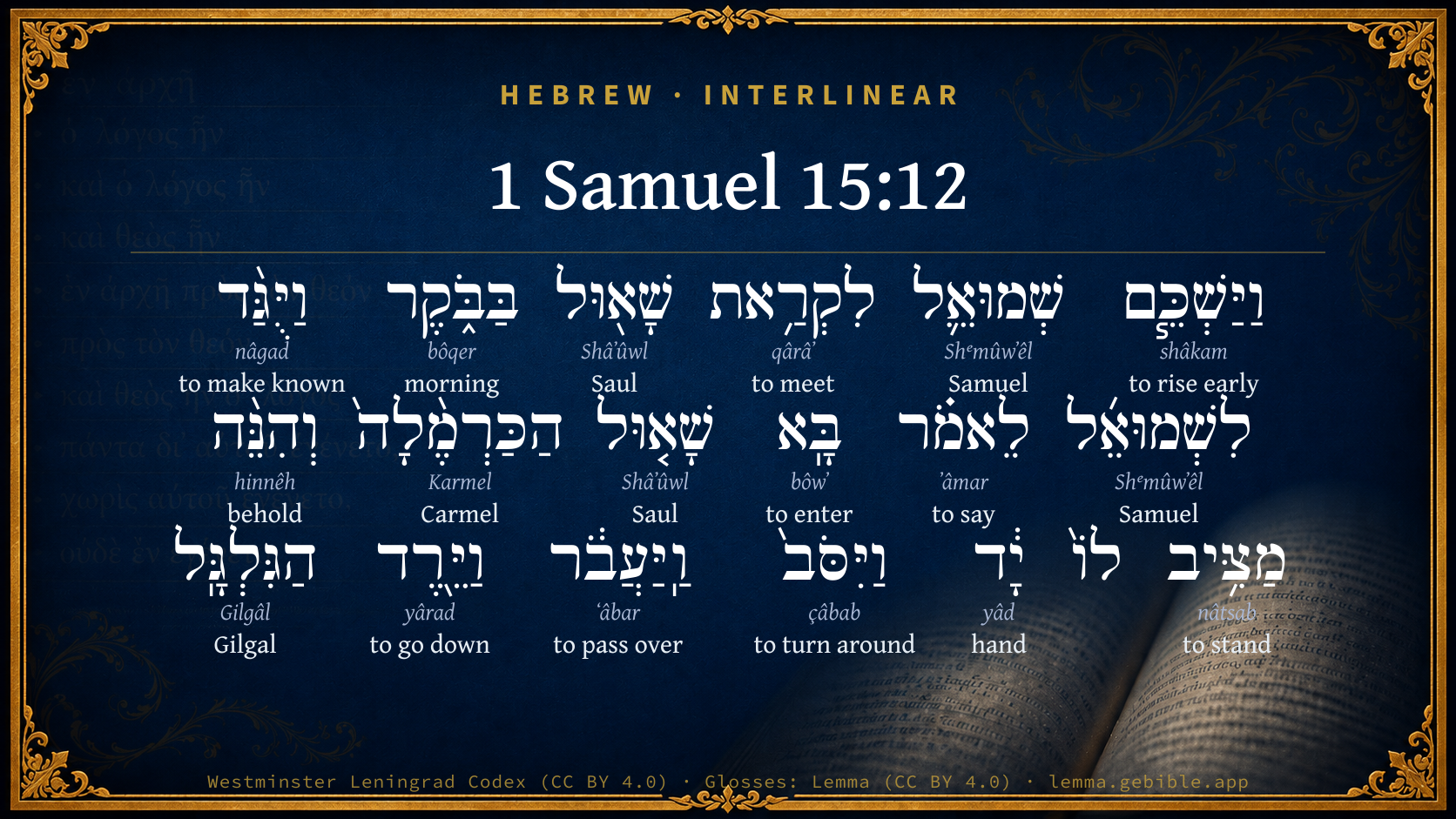
  1. וַיַּשְׁכֵּ֧ם shâkam H7925 “and · to rise early” Conjunction + Verb, Hiphil, Sequential Imperfect, 3rd Person, Masculine, Singular
  2. שְׁמוּאֵ֛ל Shᵉmûwʼêl H8050 “Samuel” Noun, Proper
  3. לִקְרַ֥את qârâʼ H7122 “to meet” Preposition + Verb, Qal, Infinitive Construct
  4. שָׁא֖וּל Shâʼûwl H7586 “Saul” Noun, Proper
  5. בַּבֹּ֑קֶר bôqer H1242 “in/at the · morning” Preposition, Determined + Noun, Common, Masculine, Singular, Absolute
  6. וַיֻּגַּ֨ד nâgad H5046 “and · to make known” Conjunction + Verb, Hophal, Sequential Imperfect, 3rd Person, Masculine, Singular
  7. לִשְׁמוּאֵ֜ל Shᵉmûwʼêl H8050 “to/for · Samuel” Preposition + Noun, Proper
  8. לֵאמֹ֗ר ʼâmar H559 “to say” Preposition + Verb, Qal, Infinitive Construct
  9. בָּֽא bôwʼ H935 “to enter” Verb, Qal, Perfect, 3rd Person, Masculine, Singular
  10. שָׁא֤וּל Shâʼûwl H7586 “Saul” Noun, Proper
  11. וְהִנֵּ֨ה hinnêh H2009 “and · behold” Conjunction + Particle, Demonstrative
  12. מַצִּ֥יב nâtsab H5324 “standing” Verb, Hiphil, Participle Active, Masculine, Singular, Absolute
  13. יָ֔ד yâd H3027 “hand” Noun, Common, Both, Singular, Absolute
  14. וַיִּסֹּב֙ çâbab H5437 “and · to turn around” Conjunction + Verb, Qal, Sequential Imperfect, 3rd Person, Masculine, Singular
  15. וַֽיַּעֲבֹ֔ר ʻâbar H5674 “and · to pass over” Conjunction + Verb, Qal, Sequential Imperfect, 3rd Person, Masculine, Singular
  16. וַיֵּ֖רֶד yârad H3381 “and · to go down” Conjunction + Verb, Qal, Sequential Imperfect, 3rd Person, Masculine, Singular
  17. הַגִּלְגָּֽל Gilgâl H1537 “the · Gilgal” Particle, Definite Article + Noun, Proper

About this verse

These counts appear in no published source. They are computed here, from the morphology-tagged text and Lemma’s own curated glosses. What Lemma adds →

19
words
16
distinct lemmas
Historical
section

Notable vocabulary

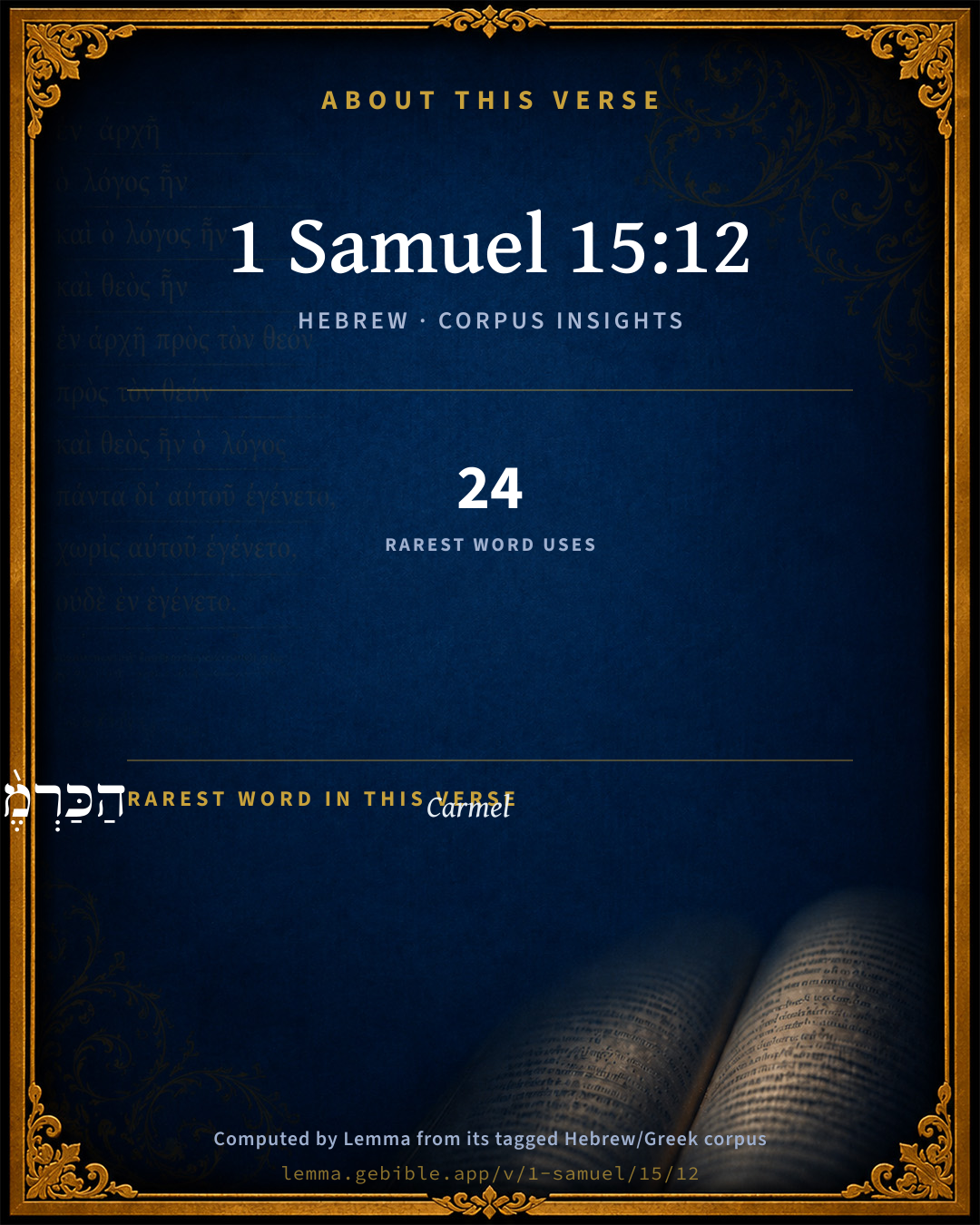
The rarest word here is הַכַּרְמֶ֨לָה֙ Carmel H3760 — appearing just 24 times in the whole Hebrew Bible.

Shared distinctive vocabulary

הַכַּרְמֶ֨לָה֙ Carmel H3760 occurs in 23 verses of the Hebrew Bible. Also found in:

Grammatical profile

  • 9 verbs
  • 8 nouns
  • 1 preposition
  • 1 particle

Verb forms

  • וַיַּשְׁכֵּ֧ם Hiphil · Sequential Imperfect
  • לִקְרַ֥את Qal · Infinitive Construct
  • וַיֻּגַּ֨ד Hophal · Sequential Imperfect
  • לֵאמֹ֗ר Qal · Infinitive Construct
  • בָּֽא Qal · Perfect
  • מַצִּ֥יב Hiphil · Participle Active
  • וַיִּסֹּב֙ Qal · Sequential Imperfect
  • וַֽיַּעֲבֹ֔ר Qal · Sequential Imperfect
  • וַיֵּ֖רֶד Qal · Sequential Imperfect

Repetition

Words recur within this verse — often emphatic in Hebrew:

  • שְׁמוּאֵ֛ל Samuel H8050 ×2
  • שָׁא֖וּל Saul H7586 ×2

Hebrew & Septuagint length

In English translation the verse runs 37 words from the Hebrew and 67 from the Septuagint (LXX English) — the Septuagint runs noticeably longer here. See the side-by-side →

A rough comparison of the two English renderings, which tokenize alike — not a word-level alignment.

Word counts can differ between the Hebrew and the Greek without any difference in meaning — e.g. the Hebrew direct-object marker אֵת has no separate Greek word, and Greek often adds the article ὁ.

Cross-references

6

Topical passages linked to 1 Samuel 15:12 in the Treasury of Scripture Knowledge — connected by theme and wording, ordered by reader-vote popularity; previews shown in the World English Bible.

  • Joshua 15:55 Maon, Carmel, and Ziph, and Jutah,
  • 1 Samuel 25:2 There was a man in Maon, whose possessions were in Carmel; and the man was very great, and he had three thousand sheep, and a thousand goats: and he was shearing his sheep in Carmel.
  • 2 Samuel 18:18 Now Absalom in his lifetime had taken and reared up for himself the pillar, which is in the king's dale; for he said, I have no son to keep my name in memory: and he called the pillar after his own name; and it is called Absalom's monument, to this day.
  • Joshua 4:8–9 The children of Israel did so as Joshua commanded, and took up twelve stones out of the midst of the Jordan, as Yahweh spoke to Joshua, according to the number of the tribes of the children of Israel; and they carried them over with them to the place where they lodged, and laid them down there.
  • 1 Samuel 7:12 Then Samuel took a stone, and set it between Mizpah and Shen, and called the name of it Ebenezer, saying, Hitherto has Yahweh helped us.
  • 1 Kings 18:42 So Ahab went up to eat and to drink. Elijah went up to the top of Carmel; and he bowed himself down on the earth, and put his face between his knees.

Cross-references courtesy of OpenBible.info (CC BY 4.0).

Hebrew and Greek witnesses Masoretic Hebrew ↔ Greek Septuagint

The same verse in the two great witnesses to the Old Testament, shown verse-for-verse.

Here the Septuagint runs noticeably longer than the Hebrew — LXX2012 (modern English Septuagint) 67 words vs World English Bible 37. A rough length comparison of the two English translations, not a word-level alignment — read both below.

These are two independent witnesses, not word-aligned to each other, and the Septuagint is shown in lemma (dictionary) form.

Hebrew 1 Samuel 15:12 Masoretic · Westminster Leningrad Codex

וַיַּשְׁכֵּ֧ם שְׁמוּאֵ֛ל לִקְרַ֥את שָׁא֖וּל בַּבֹּ֑קֶר וַיֻּגַּ֨ד לִשְׁמוּאֵ֜ל לֵאמֹ֗ר בָּֽא שָׁא֤וּל הַכַּרְמֶ֨לָה֙ וְהִנֵּ֨ה מַצִּ֥יב לוֹ֙ יָ֔ד וַיִּסֹּב֙ וַֽיַּעֲבֹ֔ר וַיֵּ֖רֶד הַגִּלְגָּֽל

Samuel rose early to meet Saul in the morning; and it was told Samuel, saying, Saul came to Carmel, and, behold, he set him up a monument, and turned, and passed on, and went down to Gilgal.

World English Bible · Public Domain

Greek LXX 1 Samuel 15:12 Septuagint · lemma form

καί ὀρθρίζω σαμουηλ καί πορεύομαι εἰς ἀπάντησις ἰσραήλ πρωΐ καί ἀποἀγγέλλω ὁ σαμουηλ λέγω ἥκω σαούλ εἰς κάρμηλον καί ἀναἵστημι αὐτός χείρ καί ἐπιστρέφω ὁ ἅρμα καί καταβαίνω εἰς γάλγαλα πρός σαούλ καί ἰδού αὐτός ἀναφέρω ὁλοκαύτωσις ὁ κύριος ὁ πρῶτος ὁ σκῦλον ὅς φέρω ἐκ αμαληκ

And Samuel rose early and went to meet Israel in the morning, and it was told Saul, saying, Samuel has come to Carmel, and he has raised up help for himself: and he turned his chariot, and came down to Galgala to Saul; and, behold, he was offering up a whole burnt offering to the Lord, the chief of the spoils which he brought out of Amalec.

LXX2012 (modern English Septuagint) · Public Domain

Hebrew: Westminster Leningrad Codex (CC BY 4.0). Greek: Septuagint (public domain); English from LXX2012 (modern English Septuagint) (Public Domain). How the Septuagint differs from the Hebrew →

Targum (Aramaic paraphrase)

1

The Targum is the ancient Jewish Aramaic paraphrase of the Hebrew Scriptures — an interpretive translation, not the Hebrew text itself. Onkelos (literal) and Pseudo-Jonathan (expansive) render the Torah, and Jonathan the Prophets. Coverage is partial: where no permissively-licensed English translation exists for a verse, only the Aramaic is shown. This is verse-level text, not a word-by-word alignment to the Hebrew.

  1. Targum Jonathan Prophets (Joshua–Malachi)
    וְאַקְדִים שְׁמוּאֵל לָקֳדָמוּת שָׁאוּל בְּצַפְרָא וְאִתְחַוָא לִשְׁמוּאֵל לְמֵימַר אָתָא שָׁאוּל לְכַרְמֶלָא וְהָא מְתַקֵן לֵיהּ תַּמָן אֲתַר לְפַלְגָא בֵיהּ בִּיזְתָא וְאִסְתְּחַר וַעֲבַד וּנְחַת לְגִלְגָלָא:

    (no public-domain English translation for this verse)

    Targum Jonathan — Aramaic: “Mikraot Gedolot” (public domain). English: “Sefaria Community Translation” (CC0 1.0 (public-domain dedication)); “London "Chaldee Paraphrase," 1871” (public domain). Text via Sefaria.

Commentary

Notes on 1 Samuel 15:12 from classic Christian and Jewish commentators (each source and its license shown beneath its notes). The classic Christian expositions comment on the surrounding passage and are grouped to its opening verse, so a note may address several verses; the Jewish commentaries on the Tanakh (Rashi and others) are per-verse, so they appear only where the commentator wrote on this verse.

Lemma curates 59 commentaries, every one of them public domain or Creative Commons licensed, each selected and text-cleaned for this edition rather than reprinted as found. About our sources →

Trapp's Complete Commentary

John Trapp

1Sa 15:12 And when Samuel rose early to meet Saul in the morning, it was told Samuel, saying, Saul came to Carmel, and, behold, he set him up a place, and is gone about, and passed on, and gone down to Gilgal.

Ver. 12. Saul came to Carmel.] A town of Judah that was in his way as he returned from Amalek. {Jos 15:55}

And, behold, he set him up a place.] Heb., A hand: that is, say some, a trophy or monument of triumph like a hand; as who should say, By mine own hand have I achieved this victory. So Sesostris, king of Egypt, not long before Saul’s days, when he had conquered any country, was wont to set up pillars there; and thereon to engrave these words, Tηνδε την χωρην ωμοισιν τοις εμοισιν οκτησαμην; With mine own hands did I get this land. This is taken for a vain glorious vaunt of Saul’s, and an aggravation of his sin. He goeth on to boast in the next.

John Trapp, A Commentary or Exposition upon All the Books of the Old and New Testament (1647–1656) — public domain. Text from a community e-Sword module.

Joseph Benson's Commentary

1Sa 15:12-13. Behold, he set him up a place — That is, a monument or trophy of his victory; perhaps a column, or barely a large heap of stones, as was the custom of those early ages. I have performed the commandment of the Lord — He makes so little account of the fault he had committed, that he even boasts of his performance.

Joseph Benson's Commentary on the Old and New Testaments (1811–1818) — public domain. Text from a community e-Sword module.

Tyndale Open Study Notes

Tyndale Open Resources

15:12 Carmel was a town near Hebron in southern Judah. • Saul commemorated his own accomplishments by erecting a monument to himself. In reality, he had earned shame (15:16-19). • Gilgal: See 13:4.

Tyndale Open Study Notes — © Tyndale Open Resources, licensed CC BY-SA 4.0. Text via the HelloAO Bible API.

Jamieson, Fausset & Brown

Robert Jamieson, A. R. Fausset & David Brown

Saul came to Carmel--in the south of Judah (Jos 15:55; Sa1 25:2).

he set him up a place--that is, a pillar (Sa2 18:18); literally, a hand, indicating that whatever was the form of the monument, it was surmounted, according to the ancient fashion, by the figure of a hand, the symbol of power and energy. The erection of this vainglorious trophy was an additional act of disobedience. His pride had overborne his sense of duty in first raising this monument to his own honor, and then going to Gilgal to offer sacrifice to God.

Jamieson, Fausset & Brown — Commentary Critical and Explanatory on the Whole Bible (1871) — public domain (CC PDM 1.0). Text via the HelloAO Bible API.

Adam Clarke's Commentary

Verse 12. He set him up a place] Literally, a hand, יד yad. Some say it was a monument; others, a triumphal arch: probably it was no more than a hand, pointing out the place where Saul had gained the victory. Absalom's pillar is called the hand of Absalom, 2Sa 18:18.

Adam Clarke's Commentary on the Bible (1810–1826) — public domain. Text from a community e-Sword/MySword module.

Ellicott's Commentary for English Readers

(12) And when Samuel rose early . . .—After the revelations of that sad night, the prophet rose, and at once went to seek the guilty king. He was told Saul was come to Carmel, identical with Kurmul in Judah, to the south-east of Hebron; there the victorious monarch had erected a monument of his victory, literally, a hand. In 2Sa_18:18, Absalom’s Pillar is styled Absalom’s Hand (yad), not “place,” as in the English Version. It has been suggested that very likely these victory cairns or columns erected by the Hebrews had a hand engraved upon them.

A Bible Commentary for English Readers, edited by Charles John Ellicott (1878–1897) — public domain. Text from a community e-Sword module.

The Cambridge Bible for Schools and Colleges

gen. ed. J. J. S. Perowne

12. to Carmel] Carmel (= “park” or “garden”) was a city in the mountainous country of Judah, about seven miles S.S.E. of Hebron. Saul would naturally pass through it in returning from the war. The site is marked by the ruins of a large town bearing the name Kurmul (Robinson, Bibl. Res. I. 495 ff). Here dwelt Nabal (ch. 25), and in its neighbourhood much of David’s outlaw life was spent.

he set him up a place] He erected for himself a monument, or trophy of his victory. The Vulg. has “fornicem triumphalem;” and according to Jerome it was an arch of myrtles, palms, and olives. The Heb. word, literally meaning “hand,” is applied to Absalom’s pillar, which was called “Absalom’s place” or “monument” (2Sa_18:18).

The Sept. has some doubtful additions, which partly appear in the ordinary text of the Vulgate. “And Samuel rose early and went to meet Israel in the morning. And it was told [Samuel] saying, [Saul] came to Carmel, and hath set him up a monument, and he turned his chariot and went down to Gilgal. [And Samuel came to Saul], and behold he was offering a burnt-offering to the Lord, the first-fruits of the spoil, which he brought from Amalek.” The names Saul and Samuel have been confused in the text of B, and the clause “And Samuel came to Saul” must be transposed to make sense.

to Gilgal] In the same place where Saul’s kingdom had been confirmed it was to be taken from him: and where the warning of the consequences of disobedience had been uttered (1Sa_13:13-14), the sentence on disobedience was to be pronounced.

The Cambridge Bible for Schools and Colleges (gen. ed. J. J. S. Perowne; Cambridge University Press, 1878–1918) — public domain. Text from a community e-Sword module.

John Gill's Exposition

And when Samuel rose early to meet Saul in the morning,.... Having had no sleep since the revelation of the will of God was made unto him, and therefore rose early, being in haste to converse with Saul about it:

it was told Samuel, saying, Saul came to Carmel; not to Carmel where Elijah offered sacrifice, for that was very remote from hence; but to Carmel, a city in the tribe of Judah, which lay in the way of Saul's return from Amalek, Jos 15:55.

and, behold, he set him up a place; to divide his spoil in, as the Targum; or to encamp in, as Kimchi; or to build an altar on, as Jarchi, who takes it to be the same that Elisha after repaired; but, as before observed, this place was at a great distance from Mount Carmel where Elijah sacrificed. The word for a "place" signifies a hand; and, according to the Vulgate Latin version, it was a triumphal arch, and was perhaps an obelisk or pillar, a trophy or monument erected in memory of the victory he had obtained over the Amalekites. So Jerom says (a), when a victory was obtained, they used to make an arch of myrtle, palm, and olive branches, a sign of it; these trophies were sometimes of brass, sometimes of marble; some were only heaps of stones, others a remarkable tree with the branches cut off (b) so the pillar Absalom erected is called his hand, Sa2 18:18.

and is gone about, and passed on, and gone down to Gilgal; he took a circuit, and moved in great pomp and parade, carrying the king of the Amalekites in triumph with him, and the spoil he had taken and reserves. To Gilgal be went, expecting to meet Samuel there, and offer up peace offerings to the Lord for the victory he had got.

(a) Heb. Trad. in lib. Reg. fol. 76. B. (b) Vid. Alex. ab. Alex. Genial. Dier. l. 1. c. 22.

John Gill's Exposition of the Whole Bible (1746–1763) — public domain (CC PDM 1.0). Text via the HelloAO Bible API.

Albert Barnes' Notes on the Bible

A place - Rather, “a monument.” The Hebrew word יד yâd means a “hand,” but is used in the sense of “monument,” or “trophy,” in 2Sa 18:18, where we are told that the marble pillar which Absalom set up in his lifetime, was called “Yad Absalom.”

Carmel - (see the marginal reference) would be on Saul’s line of march on his return from the country of the Amalekites, more especially if he came from the neighborhood of Akaba.

Albert Barnes' Notes on the Bible (1834–1885) — public domain. Text from a community e-Sword/MySword module.

Haydock's Catholic Bible Commentary

Arch. Here we behold what a change prosperity makes in the manners of those who before shewed the greatest humility. Saul erects a monument to his own vanity. Hebrew, "he has set him up a hand," (as Absalom did, 2 Kings xviii. 18.) or "a place" to divide the booty, (Jonathan) or "a garrison," to keep the country in subjection. (Calmet) --- Perhaps he erected the figure of "a hand," as an emblem of strength, and in honour of Benjamin, "the son of the right hand," of whose tribe he was. (Haydock)

George Leo Haydock (1774–1849), Haydock's Catholic Family Bible and Commentary, 1859 edition — public domain. Excludes Psalms (Douay-Rheims chapter numbering differs from Protestant) and Deuterocanonical books (Catholic canon only).

Matthew Poole's English Annotations

Carmel; not Mount Carmel, of which Jos 12:22, but another mountain or town in the tribe of Judah, of which see Jos 15:55. A place, i.e. a monument or trophy of his victory, as the same Hebrew word is used, 2Sa 18:18. And this may be here noted by way of censure, that he set it not to God’s honour, but to himself, i.e. to his own praise; which he minded in the first place, and afterwards went to Gilgal, as it here follows, to offer sacrifice to God.

Matthew Poole's English Annotations on the Holy Bible (1683–1685) — public domain. Text from a community e-Sword/MySword module.

Whedon's Commentary on the Bible

Daniel D. Whedon

12. Carmel — This was one of the cities of Judah, (see on Jos_15:55,) and has been identified with the modern Kurmul, six miles south of Hebron.

Set him up a place — That is, say some, for the purpose of giving his army rest and dividing the spoils. The Vulgate translates, He erected for himself a triumphal arch. But the word translated place means a hand, (יד,) and is used of Absalom’s pillar. 2Sa_18:18. Such is its meaning here. Saul erected at Carmel a monument as a memorial of his victory over the Amalekites. It may have been an elevated hand, serving as an index to attract the attention of the passing traveller.

Gilgal — Here Samuel had before solemnly announced to the disobedient king his fall. 1Sa_13:14.

Daniel D. Whedon (gen. ed.), Commentary on the Old and New Testaments (1874–1909) — public domain. Text from a community e-Sword module.

The Pulpit Commentary

Samuel rose early. If Samuel was at home at Ramah, he would have a journey of several days before reaching Carmel, the city mentioned in Jos_15:55, on the road from Arad, on the borders of the wilderness of Judah, about ten miles southeast of Hebron. The words in the morning should be joined with rose early. Before setting out, however, Samuel learned that Saul had already marched northward towards Gilgal, having first set him up a place Hebrew, "a hand," i.e. a monument, something to call attention to his victory. In 2Sa_18:18 Absalom"s pillar is styled "Absalom"s hand." A Hebrew trophy in honour of a victory possibly had a hand carved upon it. Gilgal was the city in the Jordan valley near Jericho, whither Samuel now followed Saul.

Vers. 12-23.

The sin of rebellion.

The facts are

1. Saul, having raised a monument in honour of his victory, meets Samuelwith a pious salutation, as though all were well.

2. On being reminded of the presence of spoil, Saul explains by saying thatit was spared for the worship of God in sacrifice.

3. Samuel, referring to the instructions received from God, presses homeupon him the fact of his guilt in disobeying the Lord.

4. Saul, in response, maintains that substantially he has obeyed the voice ofthe Lord, but that the people spared the spoil for a religious purpose.

5. Samuel, therefore, urges the great truth that rigid obedience to God isthe primary and essential duty, without which all else is sinful, and that rebellion is a sin as heinous as those which men admit to be most vile.

6. Samuel declares to Saul his rejection of God. The important interviewbetween the disobedient king and the prophet of God brings out several great truths.

I MAN"S PREFERENCE OF HIS OWN WILL TO THE CLEARLY DECLARED WILL OF GOD IS POSITIVE REBELLION AGAINST THE SUPREME AUTHORITY. Saul"s sin was known to himself as a preference of his own course in dealing with the Amalekites. He thought it best to modify the command in its detailed execution. No doubt there were reasons which seemed to render such a course useful. It is clear that he did not realise all that it involved, though that was his own fault. To him as a king, whose word was supposed to be law to his subjects, there is something very appropriate in the prophet assuring him that this preference of his own will, however plausible the reasons for it, was not a simple weakness or fault, but nothing less than rebellion a term of fearful significance under a properly constituted government. The preference was virtually a setting up a counter authority, impeaching the wisdom of God. Saul is not the only one to whom God has plainly declared his will. More or less he has spoken to all men. (Rom_1:20) To those blessed with the revealed will as contained in the Scriptures he has given commandments as precise and emphatic as that to Saul to destroy the Amalekites. Every believer in Christianity knows as well as he knows anything that God commands him to repent of sin; (Act_17:30) to believe in the Lord Jesus Christ for salvation from the curse of sin (Joh_20:31; Act_16:30, Act_16:31; 1Jn_5:10-13) to exterminate all evil all Amalekites from the soul (Rom_8:13; 1Th_4:3; 1Pe_1:16) and to submit heart, will, and intellect to the authority of Christ (Mat_11:29; Joh_5:23; Acts. Php_2:10, 11) Now is it not a fact that men often prefer not to do this? They do not dispute in formal terms the authority of God, any more than did Saul; yet for reasons known to themselves they prefer not to repent of sin, not to commit themselves to Christ, not to cast out sinful desires, not to bow in all things to the yoke of the Saviour. It is possible that reasons may be forthcoming to, at least, show that there is no violent antagonism. But when carefully looked at it is nothing but the positive setting up of man"s will as a better, more to be desired will than God"s; it is positive rebellion of a subject against a king a setting at nought of the supreme authority of the universe.

II MAN"S ESTIMATE OF THE SIN OF REBELLION IS IN STRIKING CONTRAST WITH GOD"S. Whether Saul was self-persuaded that he had not committed any sin (ver. 13) is, as we shall yet see, doubtful. The probability is that he was conscious of uneasiness, but had no true conception of the enormity of his sin. His feeling was that he had no wish to disown the authority of God, that it was a mere matter of detail, that his general conduct was exemplary, and that he followed the inner light which seemed just then to indicate another way of ultimately and substantially carrying out the command. So do men tone down their sins and regard them as venial. The prophet"s words reveal God"s estimate of the sin of disobedience. It is the cardinal sin (vers. 22, 23). It cuts at the root of all authority. It is the assertion of a power and a wisdom over against the power and wisdom of the Eternal. It makes man a worshipper of himself rather than of God. It ignores the solemn truth that we "cannot serve two masters." It does dishonour to him whose commandments are holy, just, and good. It sows in the moral sphere seeds of evil, which, taking root, must widen the aberration of man from God. It claims for the desires and dim light of a sinful creature a higher value in the determination of actions than is to be attached to the purposes of the All-Perfect. To render its heinous character more clear, the prophet asserts that it renders useless and even wicked the most solemn acts of worship (ver. 22; cf. Isa_1:11-15) No profession of religion; no self-denial in surrender of choice property; no conformity with venerable customs, or obedience in other particulars, will for a moment be accepted in lieu of full and implicit obedience to the clear commands which God lays on man both in relation to himself and mankind. God will have no reserve of our will. Again, to make it more impressive, the prophet assures Saul that this rebellion is in its evil nature equal to the sins which men are led by education and custom to regard as the most abominable and indefensible. "As the sin of witchcraft, as iniquity and idolatry." There are men still who shrink in horror at heathenism and vile arts. Are they prepared to believe that not to obey the clear command to repent, to believe on Christ, to become pure, and to submit in all things to the yoke of Christ, is as dreadful in the sight of God as being an idolater or a vile deceiver? It is this Divine estimate of sin which alone explains the." many stripes" with which they will be punished who, knowing the Lord"s will with respect to these matters, nevertheless prefer their own. It will be more tolerable in the day of judgment for Sodom than for some of our day. (Mat_11:20-24)

III MAN"S CONDITION AND CONDUCT AFTER DELIBERATE REBELLION IS A REVELATION OF ITS EVIL NATURE. All sin degrades and debases; it prevents clear vision of one"s own condition and a true estimate of conduct. Sin is always self-apologetic. It enslaves its victims. The opinion of a morally fallen being on matters of high spiritual import must always be discounted. Men in internal opposition to God are not safe guides in dealing with the loftiest problems of human existence. This general effect of sin is more manifest when a man has, after enjoying great advantages, deliberately preferred his own will to the clear will of God. He then enters into darkness most dense, and the fountain of moral thought and feeling becomes more corrupt. We see this in Saul"s subsequent conduct and perverse reasoning with Samuel (vers. 20, 21). Even when conscience began to he aroused by the impressive language of the prophet, he found a subtle evasion in that, as a king, he had done his part in placing Agag at the disposal of Samuel, but that the people were to blame in the matter of the spoil. Thus it is ever. Sin does not end in itself. It by its evil power induces self-complacency, creates ingenious excuses, prompts to observance of outward religious acts, throws blame on circumstances over which there is no control, and even emboldens the soul to argue with the messengers of God.

IV ONE SERIOUS CONSEQUENCE OF REBELLION IS TO DISQUALIFY FOR SERVICE IN THE KINGDOM OF GOD. Apart from the personal effects of Saul"s sin, the relative effect was to unfit him for performing the part to which he had been called in the service of God.

He was rejected from being king (ver. 23). God"s sanction and blessing were henceforth to be withheld. He was to be king in name only. The life once promising good to Israel was to be unblest and fruitful in sorrows. This result follows from every preference of our own will. We cease to hold the position and exercise the influence of God-made kings (Rev_1:4, Rev_1:5) in so far as we fail in perfect execution of the will of the King of kings. It is possible for a man to proceed from step to step in deliberate rebellion till, both on account of his inward moral decay and his pernicious influence, God"sets him aside altogether. A pastor, a parent, a professed Christian may thus be practically disowned by Providence. However he may continue to labour in some lower departments, the higher spiritual service of God will cease to be his.

General lessons.

1. It is very dangerous to begin to compare our wishes and plans, with. theclear will of God; every thought should at once be brought into subjection.

2. Sudden and unusual outbursts of pious zeal may be a sign of an uneasyconscience; steady growth is the proof of reality.

3. The folly of excuses for sin is seen by all except the sinner himself.

4. Sin, when we are exalted to privileges, is doubly base (ver. 17).

5. We must never subordinate what we may call genera/ obedience foractual literal obedience to God"s will (ver. 20).

6. Participation of others in our sin is no palliation of ours (ver. 21).

7. Property obtained by unholy means is not acceptable to God when laidon his altar for professedly religious purposes (ver. 22).

8. Obedience in matters outside acts of worship is a condition of acceptableworship, but not the ground of our salvation.

9. Deceitfulness, depravity, and idolatry are the true and ruinouscharacteristics of every act of doing our own pleasure when professedly engaged in doing only the will of God (ver. 23).

Vers. 12-21. (GILGAL.)

Excuses for disobedience.

1. Samuel met Saul at Gilgal. It was a sacred spot, and a well known scene of important events in former time and in more recent years. There the kingdom had been established, (1Sa_11:15) and Saul "had solemnly pledged him and the people to unconditional obedience." There also he had been previously rebuked and warned. (1Sa_13:13) And thither he repaired ostensibly to offer the sacrifices of thanksgiving for victory, really to make a boastful display and confirm his worldly power. How strangely and intimately are particular places associated with the moral life of individuals and nations!

2. The interview (like the former) appears to have been held in private. The sentence of rejection was heard by Saul alone, and long kept by him as a dreadful secret. Yet it was probably surmised by many from his breach with Samuel, and was gradually revealed by the course of events. The sacred history was written from a theocratic point of view, and indicates the principles of which those events were the outcome.

3. The appearance of Samuel was an arraignment of the disobedient king before the tribunal of Divine justice. Blinded in part and self-deceived, he made an ostentatious profession of regard for the prophet (ver. 13), and with the assumption of perfect innocence and praiseworthy obedience uttered "the Pharisee"s boast have performed the commandment of Jehovah." His subsequent confession proved the insincerity of his declaration. His disobedience was crowned with falsehood and hypocrisy. When formally called to account (ver. 14), he forthwith began to justify himself and make excuses for his conduct, such as transgressors are commonly accustomed to make. They were

I EXCEEDINGLY VARIED. He

1. Attributes to other persons what cannot be denied to have occurred, and seeks to transfer to them the blame which is due to himself. They have brought them from the Amalekites: for the people spared the best of the sheep and of the oxen" (ver. 15). So spoke Adam and Eve at the commencement of human transgression and human excuses. (Gen_3:13) On a former occasion, when desirous of having his own way, he had

2. not been so considerate of their wishes or so compliant. (1Sa_14:24, 1Sa_14:39, 1Sa_14:45) "If this excuse were false, where was the integrity and honour of the monarch? If it were true, where was his devotion and obedience? And whether true or false, how utterly unworthy did it prove him of continuing the servant and viceroy of the King of Israel" (Le Bas).

3. Protests good intentions, and even religious and commendable motives. "The people spared the best to sacrifice unto the Lord thy God;" whereby he seeks to gain the approval of the prophet, but betrays his own inward alienation from the Lord, for he cannot truly say "my God"; (Mat_23:14) and whilst he has regard to the outward ceremonies of the law, he knows not (or wilfully disregards it) that by the law the sacrifices of "devoted" things were altogether prohibited (Deu_13:15; Num_31:48)

1. Professes his faithful obedience. "And the rest we have utterly destroyed." Agam and again he declares his innocence (vers. 20, 21), and insinuates, that instead of being reproved by the prophet, he ought to be commended by him for his zeal.

2. Asserts complete readiness to meet whatever charge may be preferred against him. "Say on" (ver. 16). "See how sin is multiplied by sin. The transgressor of God"s command stands forth as the accuser of the people, the speaker of gross falsehood. The spirit of disobedience evoked as with the rod of an enchanter those other agents of iniquity from their lurking place; and lo! they sprang forth to do his bidding. Verily their name was legion, for they were many" (Anderson, "Cloud of Witnesses," 2:350).

II FAITHFULLY EXPOSED. Samuel"s fidelity, moral courage, and dignity, mingled with something of bitter disappointment and sorrowful resentment, are specially noteworthy. He

1. Points to incontestable fact. "What is this bleating of sheep in mine ears, and the lowing of oxen which I hear?" (ver. 14). It flatly contradicts thy statement, reveals thy sin, and exposes thy excuses. Between it and thy duty there is a contradiction which no explanation can remove. Sin cannot be wholly concealed. "God knows how to bring it to light, however great the care with which it may be cloaked." He was convicted of it by the voices of the animals which he had spared. And "it is no new thing for the plausible pretensions and protestations of hypocrites to be contradicted and disproved by the most plain and undeniable evidences.

2. Checks the multiplication of vain excuses. Stay (ver. 16); proceed no further in thy endeavour to justify thyself. "And I will tell thee," etc. When the voice of truth, of conscience, and of God speaks, it must perforce silence all other voices.

3. Recalls the requirements of the Divine commission (ver. 18), which had been kept out of sight and evaded in the attempts made in self-defence. "Go and utterly destroy the sinners the Amalekites" (see ver. 3).

4 . Reveals the motives of outward conduct (ver. 19), viz. self-will, pride, (1Sa_9:21) avarice, rapacity, "love of the world" (Colossians, 2Ti_4:10) rebellious opposition to the will of Jehovah, and daring ambition to reign independently of him. In all this Samuel sought to rouse the slumbering conscience of the king, and lead him to see his sin and repent. If even yet he had fallen upon his face and given glory to God, there might have been hope. But the reiteration of his previous assertions, his repudiation of what was laid to his charge, and his blindly pointing to his main offence ("and have brought Agag the king of Amalek") as an evidence of his fidelity and zeal, showed that he was insensible to reproof. What should have humbled him served only to harden him in rebellion and obstinacy. And nothing was left but his rejection. His excuses were

III UTTERLY FUTILE, sinful, and injurious. They

1. Failed of their intended effect.

2. Increased his delusion, and prevented the light of truth from shining intohis mind.

3. Deepened his guilt in the sight of Heaven.

4. Brought upon him heavier condemnation. "As he returned with hisvictorious troops the prophet met him. That sorrow stricken countenance, round which hung the long Nazarite locks, now whitened by the snows of ninety years, pale and worn with the long night"s unbroken but ungranted intercession, might have told all. Now the thundercloud, which began to gather fourteen years before, breaks and peals over the sinner"s head. "Stay," is the sad and terrible voice as it breaks through the cobweb limits of self-deception and excuse, "and I will tell thee what the Lord said to me this night," etc "The people took of the spoil," etc. the very utterance of dark superstition and mean equivocation. Then the lightning came. The prophet"s voice, gathering itself up into one of those magnificent utterances which, belonging to another and a later dispensation, antedate the coming revelation, and are evidently launched forth from the open ark of the testimony of the Highest, said, "Hath the Lord, etc. ("Heroes of Hebrews Hist."). D.

The Pulpit Commentary (1880–1919), ed. H.D.M. Spence-Jones & Joseph S. Exell — public domain. Text from a community e-Sword module.

John Wesley's Explanatory Notes

A place - That is, a monument or trophy of his victory.

John Wesley, Explanatory Notes Upon the Whole Bible (1754–1765) — public domain. Text via the GEBible commentary corpus.

Keil & Delitzsch

C. F. Keil & F. Delitzsch

The next morning, after receiving the revelation from God (Sa1 15:11), Samuel rose up early, to go and meet Saul as he was returning from the war. On the way it was told him, "Saul has come to Carmel" - i.e., Kurmul, upon the mountains of Judah to the south-east of Hebron (see at Jos 15:55) - "setting himself a memorial" (יד, a hand, then a memorial or monument, inasmuch as the hand calls attention to anything: see Sa2 18:18), "and has turned and proceeded farther, and gone down to Gilgal" (in the valley of the Jordan, as in Sa1 13:4).

Keil & Delitzsch — Biblical Commentary on the Old Testament (1861–1891) — public domain (CC PDM 1.0). Text via the HelloAO Bible API. (Old Testament only.)

unfoldingWord translationNotes

Door43 World Missions Community

Samuel was told

"Someone told Samuel"

he set up a monument to himself

Saul was full of pride.

down to Gilgal

Gilgal was lower in elevation than Carmel.

I have fulfilled the command of Yahweh

It is not clear if Saul understood that he had not fully obeyed God's command to completely destroy the Amalekites.

translationWords

Carmel

Gilgal

bless

fulfill

command

unfoldingWord translationNotes — © Distant Shores Media and the Door43 World Missions Community, licensed CC BY-SA 4.0. Source: git.door43.org/Door43/en_tn.

Rashi

Rabbi Shlomo Yitzchaki (Rashi)

And is setting up a place for himself. He is building an altar for himself. That is the altar referred to concerning Eliyohu, 'he repaired the ruined altar of Adonoy.' Targum Yonoson renders, 'and he is making room there for himself to divide the spoils.'

Rashi on the Tanakh — English translations: “The Judaica Press complete Tanach with Rashi, translated by A. J. Rosenberg” (CC BY 4.0); “Pentateuch with Rashi's commentary by M. Rosenbaum and A.M. Silbermann, 1929-1934” (public domain); “The Metsudah Tanach series, Lakewood, N.J” (CC BY 4.0); and “The Book of Joshua, Metsudah Publications, 1997” (CC BY 4.0). Text via Sefaria.

Lesson kit

Teaching starters — assembled from the data on this page, not authored interpretation. Every prompt links to the verse data it draws on. Edit before teaching.

1 Samuel, in the Historical, opens this verse with 19 words (16 distinct Hebrew lemmas). Its most distinctive word is Karmel (“Carmel”). The Greek Septuagint runs longer here. A historical commentator’s framing appears above. Read the whole chapter for the surrounding context.

Discussion questions

  1. What does “Carmel” (Karmel) contribute to the verse as a whole?
  2. How does Joshua 12:22, which shares the word «Carmel», read alongside this verse?
  3. What does the repetition of “Samuel” (2× in this one verse) do in this verse?
  4. The Septuagint runs longer here than the Hebrew. What might account for the difference?
  5. These translations render this verse differently. What is at stake in choosing one wording over another?
  6. «וַיַּשְׁכֵּ֧ם» is a Hiphil Sequential Imperfect verb. How does that grammatical form shape the action described?
  7. Compare how Trapp's Complete Commentary and Joseph Benson's Commentary read this verse. Where do they agree or differ?

Things to notice

Reading settings

Reading text

Shown beneath each verse's original-language words.

Old Testament
Old Testament edition

Read the OT as the Masoretic Hebrew (MT) or the Greek Septuagint (LXX).

English shown for the Greek Septuagint (in the Hebrew ↔ Greek comparison).

Comparing translations? Open the Compare panel on any verse page to stack up to four side by side.