
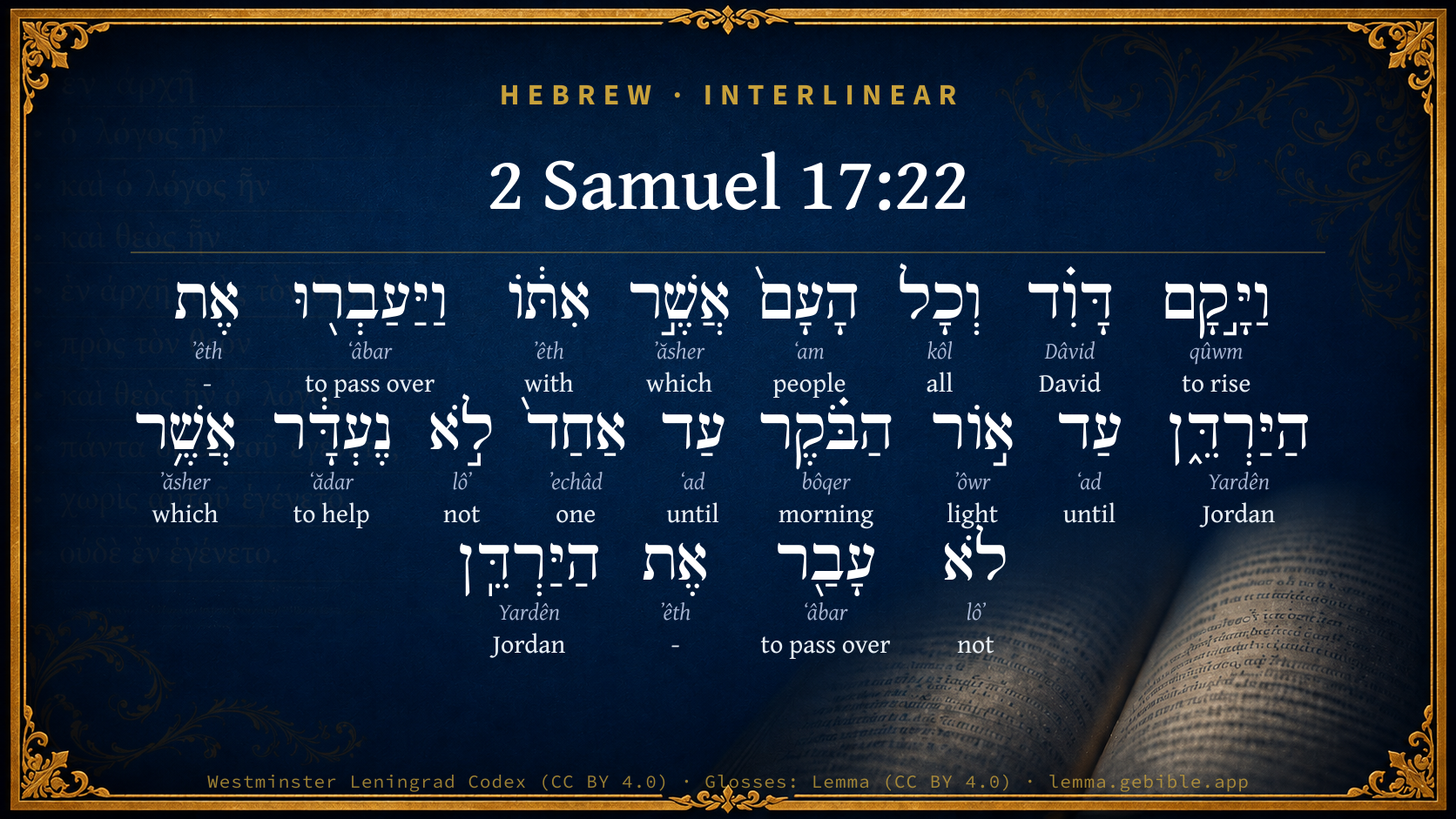
2 Samuel 17:22

Hebrew (Westminster Leningrad Codex) 2 Samuel 17:22 appears in the Hebrew Old Testament. The text above is from the Westminster Leningrad Codex. Each word links to its Strong’s number, a concise gloss, and parsing drawn from the Open Scriptures Hebrew Bible morphology. Click any word for its full Brown-Driver-Briggs (BDB) entry.
Download image
Cite this verse

2 Samuel 17:22 (World English Bible). Public Domain. Lemma interlinear Bible study tool, https://lemma.gebible.app/v/2-samuel/17/22.

Show BibTeX & RIS
BibTeX
RIS
English Translation
Then David arose, and all the people who were with him, and they passed over the Jordan: by the morning light there lacked not one of them who had not gone over the Jordan.
World English Bible · Public Domain
Download a study sheet

One document with this verse’s original text, its word-by-word gloss line, the meaning frame, cross-references with their text, attributed commentary, and full source and license credits — printable, and it pastes into notes with its structure intact.

This verse Autodidact and up

Study sheet (.html) Plain text (.txt)

A passage Seminary Student

Up to 50 verses in one chapter. A passage sheet keeps up to 6 commentary sources and 12 cross-references per verse, in the order this page ranks them, and says so on the sheet whenever that leaves anything out. Ask for a single verse and you get the Autodidact verse sheet above.

Everything on this page stays free to read, with no account — the sheet is a download of what is already on screen, not access to it.

Want to remove ads? Support Godless Engineer
Compare translations 3

The same verse in 3 English versions, stacked beneath the original-language interlinear above. Click any original word for its lexicon entry.

Each is an independent rendering of the whole verse — the interlinear is not word-aligned to these translations.

Highlighted words mark where these versions differ — a whole-verse word diff, not a word-by-word alignment.

  • World English Bible Public Domain
    Then David arose, and all the people who were with him, and they passed over the Jordan: by the morning light there lacked not one of them who had not gone over the Jordan.
  • King James Version Public Domain
    Then David arose, and all the people that were with him, and they passed over Jordan: by the morning light there lacked not one of them that was not gone over Jordan.
  • unfoldingWord Literal Text CC BY-SA 4.0
    So David and all of the people who with him arose and crossed the Jordan until the light of dawn, until not one was missing who had not crossed the Jordan.

unfoldingWord Literal Text — © unfoldingWord, licensed CC BY-SA 4.0. Word-aligned USFM3 via Door43 (git.door43.org/unfoldingWord/en_ult).

Versions to compare (up to 4)

3 of 4 selected

Show all 18 translations

Every available English version of this verse, each an independent rendering of the whole verse.

  • World English Bible Public Domain
    Then David arose, and all the people who were with him, and they passed over the Jordan: by the morning light there lacked not one of them who had not gone over the Jordan.
  • Berean Standard Bible Public Domain
    So David and all the people with him got up and crossed the Jordan. By daybreak, there was no one left who had not crossed the Jordan.
  • Majority Standard Bible Public Domain
    So David and all the people with him got up and crossed the Jordan. By daybreak, there was no one left who had not crossed the Jordan.
  • King James Version Public Domain
    Then David arose, and all the people that were with him, and they passed over Jordan: by the morning light there lacked not one of them that was not gone over Jordan.
  • American Standard Version (1901) Public Domain
    Then David arose, and all the people that were with him, and they passed over the Jordan: by the morning light there lacked not one of them that was not gone over the Jordan.
  • Revised Version (1885) Public Domain
    Then David arose, and all the people that were with him, and they passed over Jordan: by the morning light there lacked not one of them that was not gone over Jordan.
  • Geneva Bible (1599) Public Domain
    Then Dauid arose, and all the people that were with him, and they went ouer Iorden vntil the dawning of the day, so that there lacked not one of them, that was not come ouer Iorden.
  • Douay-Rheims (1899) Public Domain
    So David arose, and all the people that were with him, and they passed over the Jordan, until it grew light, and not one of them was left that was not gone over the river.
  • Young's Literal Translation Public Domain
    And David riseth, and all the people who `are' with him, and they pass over the Jordan, till the light of the morning, till one hath not been lacking who hath not passed over the Jordan.
  • Literal Standard Version CC BY-SA 4.0
    And David rises, and all the people who [are] with him, and they pass over the Jordan, until the morning light, until not one has been lacking who has not passed over the Jordan.
  • Unlocked Literal Bible CC BY-SA 4.0
    Then David arose and all the people who were with him, and they crossed over the Jordan. By morning daylight not one of them had failed to cross over the Jordan.
  • unfoldingWord Literal Text CC BY-SA 4.0
    So David and all of the people who with him arose and crossed the Jordan until the light of dawn, until not one was missing who had not crossed the Jordan.
  • Darby Bible Public Domain
    Then David arose, and all the people that were with him, and they passed over the Jordan; by the morning light there was not one of them missing that had not gone over the Jordan.
  • World Messianic Bible Public Domain
    Then David arose, and all the people who were with him, and they passed over the Jordan. By the morning light there lacked not one of them who had not gone over the Jordan.
  • Webster's Bible Public Domain
    Then David arose, and all the people that were with him, and they passed over Jordan: by the morning light there lacked not one of them that had not gone over Jordan.
  • Free Bible Version CC BY-SA 4.0
    David and everybody with him got up and crossed the Jordan. By the time it got light there wasn't anybody who hadn't crossed over.
  • Bible in Basic English Public Domain
    So David and all the people who were with him went up over Jordan: when dawn came, every one of them had gone over Jordan.
  • JPS Tanakh (1917) Public Domain
    Then David arose, and all the people that were with him, and they passed over the Jordan; by the morning light there lacked not one of them that was not gone over the Jordan.

Literal Standard Version (2020), Covenant Press — licensed CC BY-SA 4.0. Text via the HelloAO Bible API (eBible.org). Unlocked Literal Bible (unfoldingWord) — licensed CC BY-SA 4.0. Text via the HelloAO Bible API (eBible.org). unfoldingWord Literal Text — © unfoldingWord, licensed CC BY-SA 4.0. Word-aligned USFM3 via Door43 (git.door43.org/unfoldingWord/en_ult). Free Bible Version, Dr. Jonathan Gallagher — licensed CC BY-SA 4.0. Text via the HelloAO Bible API (eBible.org).

Word by word

More ways to search: Search by grammar → Find every occurrence → Compare this word →

Practice this passage: Drill this verse → Learn its vocabulary →

נֶעְדָּ֔ר
ʻădar
H5737
“to help”
Verb, Niphal, Perfect, 3rd Person, Masculine, Singular
Part of Speech
Verb
Stem
Niphal
Form
Perfect
Person
3rd Person
Gender
Masculine
Number
Singular
Full BDB Definition

Origin: a primitive root

TWOT: 1570 , 1571 , 1572

to help - (Qal) to help - to hoe - (Niphal) to be hoed - to be lacking, fail - (Niphal) - to be lacking - to leave lacking - (Piel) to leave lacking
  1. וַיָּ֣קָם qûwm H6965 “and · to rise” Conjunction + Verb, Qal, Sequential Imperfect, 3rd Person, Masculine, Singular
  2. דָּוִ֗ד Dâvid H1732 “David” Noun, Proper
  3. וְכָל kôl H3605 “and · all of” Conjunction + Noun, Common, Masculine, Singular, Construct
  4. הָעָם֙ ʻam H5971 “the · people” Particle, Definite Article + Noun, Common, Masculine, Singular, Absolute
  5. אֲשֶׁ֣ר ʼăsher H834 “which” Particle, Relative
  6. אִתּ֔וֹ ʼêth H854 “with · him” Preposition + Suffix, Personal, 3rd Person, Masculine, Singular
  7. וַיַּעַבְר֖וּ ʻâbar H5674 “and · to pass over” Conjunction + Verb, Qal, Sequential Imperfect, 3rd Person, Masculine, Plural
  8. אֶת ʼêth H853 “-” Particle, Direct Object
  9. הַיַּרְדֵּ֑ן Yardên H3383 “the · Jordan” Particle, Definite Article + Noun, Proper
  10. עַד ʻad H5704 “until” Preposition
  11. א֣וֹר ʼôwr H216 “light of” Noun, Common, Both, Singular, Construct
  12. הַבֹּ֗קֶר bôqer H1242 “the · morning” Particle, Definite Article + Noun, Common, Masculine, Singular, Absolute
  13. עַד ʻad H5704 “until” Preposition
  14. אַחַד֙ ʼechâd H259 “one” Adjective, Cardinal number, Masculine, Singular, Absolute
  15. לֹ֣א lôʼ H3808 “not” Particle, Negative
  16. אֲשֶׁ֥ר ʼăsher H834 “which” Particle, Relative
  17. לֹא lôʼ H3808 “not” Particle, Negative
  18. עָבַ֖ר ʻâbar H5674 “to pass over” Verb, Qal, Perfect, 3rd Person, Masculine, Singular
  19. אֶת ʼêth H853 “-” Particle, Direct Object
  20. הַיַּרְדֵּֽן Yardên H3383 “the · Jordan” Particle, Definite Article + Noun, Proper

About this verse

These counts appear in no published source. They are computed here, from the morphology-tagged text and Lemma’s own curated glosses. What Lemma adds →

21
words
15
distinct lemmas
Historical
section

Notable vocabulary

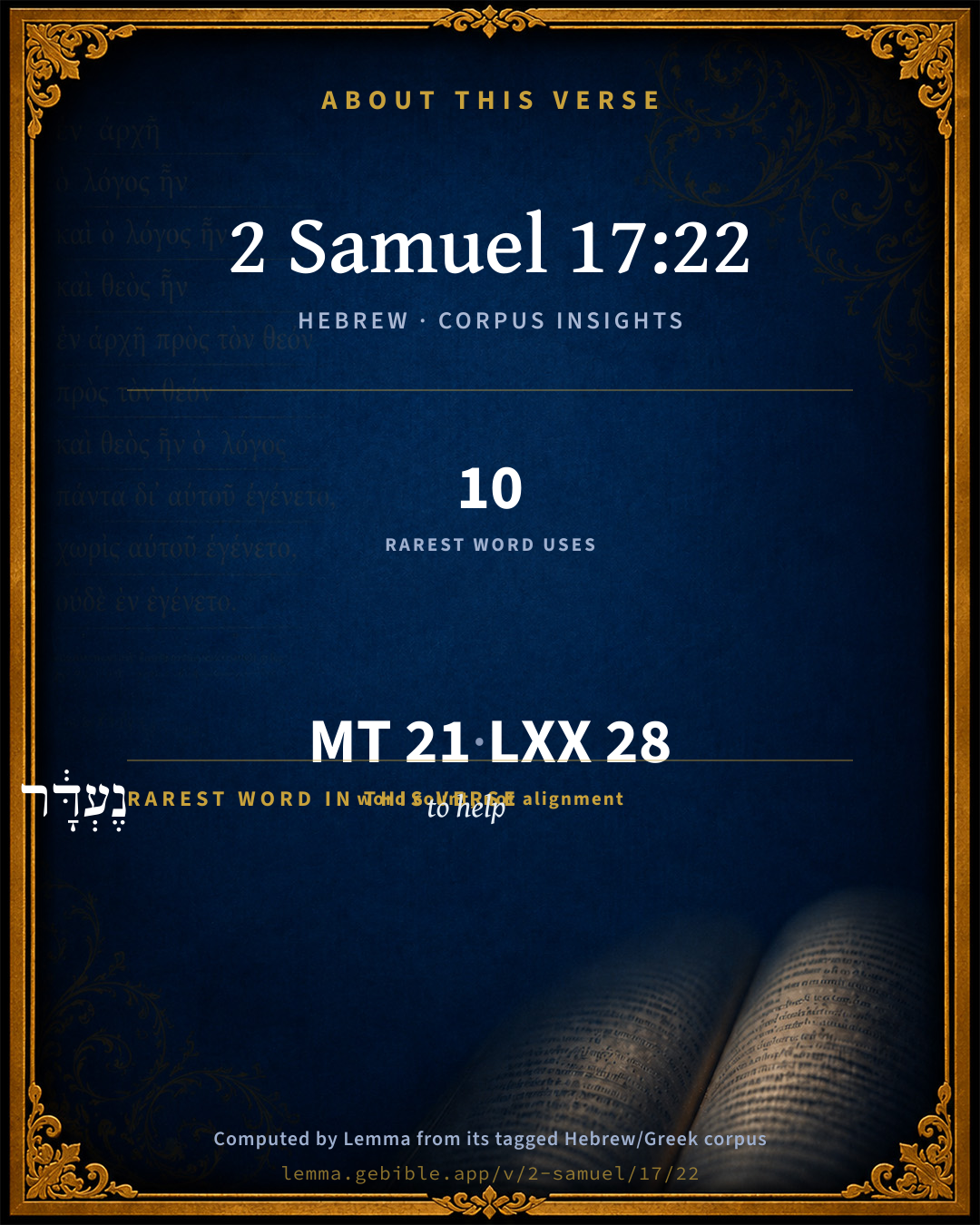
The rarest word here is נֶעְדָּ֔ר to help H5737 — appearing just 10 times in the whole Hebrew Bible.

Shared distinctive vocabulary

נֶעְדָּ֔ר to help H5737 occurs in 10 verses of the Hebrew Bible. Also found in:

Grammatical profile

  • 4 verbs
  • 7 nouns
  • 1 adjective
  • 3 prepositions
  • 6 particles

Verb forms

  • וַיָּ֣קָם Qal · Sequential Imperfect
  • וַיַּעַבְר֖וּ Qal · Sequential Imperfect
  • נֶעְדָּ֔ר Niphal · Perfect
  • עָבַ֖ר Qal · Perfect

Repetition

Words recur within this verse — often emphatic in Hebrew:

  • וַיַּעַבְר֖וּ to pass over H5674 ×2
  • הַיַּרְדֵּ֑ן Jordan H3383 ×2
  • עַד until H5704 ×2
  • אֲשֶׁ֣ר which H834 ×2
  • לֹ֣א not H3808 ×2

Hebrew & Septuagint length

In English translation the verse runs 34 words from the Hebrew and 30 from the Septuagint (LXX English) — closely comparable.

A rough comparison of the two English renderings, which tokenize alike — not a word-level alignment.

Word counts can differ between the Hebrew and the Greek without any difference in meaning — e.g. the Hebrew direct-object marker אֵת has no separate Greek word, and Greek often adds the article ὁ.

In the original languages it is 21 Hebrew tokens and 28 Greek tokens — but the two are counted differently (Hebrew bundles its prefixes and suffixes into one token; the Greek is in lemma form), so that isn’t a like-for-like length.

Cross-references

5

Topical passages linked to 2 Samuel 17:22 in the Treasury of Scripture Knowledge — connected by theme and wording, ordered by reader-vote popularity; previews shown in the World English Bible.

  • Proverbs 27:12 A prudent man sees danger and takes refuge; But the simple pass on, and suffer for it:
  • Matthew 10:16 "Behold, I send you out as sheep in the midst of wolves. Therefore be wise as serpents, and harmless as doves.
  • John 18:9 that the word might be fulfilled which he spoke, "Of those whom you have given me, I have lost none."
  • Numbers 31:49 and they said to Moses, Your servants have taken the sum of the men of war who are under our charge, and there lacks not one man of us.
  • 2 Samuel 17:24 Then David came to Mahanaim. Absalom passed over the Jordan, he and all the men of Israel with him.

Cross-references courtesy of OpenBible.info (CC BY 4.0).

Hebrew and Greek witnesses Masoretic Hebrew ↔ Greek Septuagint

The same verse in the two great witnesses to the Old Testament, shown verse-for-verse.

These are two independent witnesses, not word-aligned to each other, and the Septuagint is shown in lemma (dictionary) form.

Hebrew 2 Samuel 17:22 Masoretic · Westminster Leningrad Codex

וַיָּ֣קָם דָּוִ֗ד וְכָל הָעָם֙ אֲשֶׁ֣ר אִתּ֔וֹ וַיַּעַבְר֖וּ אֶת הַיַּרְדֵּ֑ן עַד א֣וֹר הַבֹּ֗קֶר עַד אַחַד֙ לֹ֣א נֶעְדָּ֔ר אֲשֶׁ֥ר לֹא עָבַ֖ר אֶת הַיַּרְדֵּֽן

Then David arose, and all the people who were with him, and they passed over the Jordan: by the morning light there lacked not one of them who had not gone over the Jordan.

World English Bible · Public Domain

Greek LXX 2 Samuel 17:22 Septuagint · lemma form

καί ἀναἵστημι δαυίδ καί πᾶς ὁ λαός ὁ μετά αὐτός καί διαβαίνω ὁ ἰορδάνης ἕως ὁ φῶς ὁ πρωί ἕως εἷς οὐ λανθάνω ὅς οὐ διαἔρχομαι ὁ ἰορδάνης

And David rose up and all the people with him, and they passed over Jordan till the morning light; there was not one missing who did not pass over Jordan.

LXX2012 (modern English Septuagint) · Public Domain

Hebrew: Westminster Leningrad Codex (CC BY 4.0). Greek: Septuagint (public domain); English from LXX2012 (modern English Septuagint) (Public Domain). How the Septuagint differs from the Hebrew →

Targum (Aramaic paraphrase)

1

The Targum is the ancient Jewish Aramaic paraphrase of the Hebrew Scriptures — an interpretive translation, not the Hebrew text itself. Onkelos (literal) and Pseudo-Jonathan (expansive) render the Torah, and Jonathan the Prophets. Coverage is partial: where no permissively-licensed English translation exists for a verse, only the Aramaic is shown. This is verse-level text, not a word-by-word alignment to the Hebrew.

  1. Targum Jonathan Prophets (Joshua–Malachi)
    וְקָם דָוִד וְכָל עַמָא דִי עִמֵיהּ וַעֲבַרוּ יַת יַרְדְנָא עַד מַנְהַר צַפְרָא עַד חַד לָא שְׁגָא דְלָא עֲבַר יַת יַרְדְנָא:

    (no public-domain English translation for this verse)

    Targum Jonathan — Aramaic: “Mikraot Gedolot” (public domain). English: “Sefaria Community Translation” (CC0 1.0 (public-domain dedication)); “London "Chaldee Paraphrase," 1871” (public domain). Text via Sefaria.

Commentary

Notes on 2 Samuel 17:22 from classic Christian and Jewish commentators (each source and its license shown beneath its notes). The classic Christian expositions comment on the surrounding passage and are grouped to its opening verse, so a note may address several verses; the Jewish commentaries on the Tanakh (Rashi and others) are per-verse, so they appear only where the commentator wrote on this verse.

Lemma curates 59 commentaries, every one of them public domain or Creative Commons licensed, each selected and text-cleaned for this edition rather than reprinted as found. About our sources →

Matthew Henry's Commentary

Here is, I. The transporting of David and his forces over Jordan, pursuant to the advice he had received from his friends at Jerusalem, Sa2 17:22. He, and all that were with him, went over in the night, whether in ferryboats, which probably always plied there, or through the fords, does not appear. But special notice is taken of this, that there lacked not one of them: none deserted him, though his distress was great, none staid behind sick or weary, nor were any lost or cast away in passing the river. Herein some make him a type of the Messiah, who said, in a difficult day, Of all that thou hast given me have I lost none. Having got over Jordan, he marched many miles forward to Mahanaim, a Levites' city in the tribe of Gad, in the utmost border of that tribe, and not far from Rabbah, the chief city of the Ammonites. This city, which Ishbosheth had made his royal city (Sa2 2:8), David now made his head-quarters, Sa2 17:24. And now he had time to raise an army wherewith to oppose the rebels and give them a warm reception.

II. The death of Ahithophel, Sa2 17:23. He died by his own hands, felo de se - a suicide. He hanged himself for vexation that his counsel was not followed; for thereby, 1. He thought himself slighted, and an intolerable slur cast upon his reputation for wisdom. His judgment always used to sway at the counsel-board, but now another's opinion is thought wiser and better than his. His proud heart cannot bear the affront; it rises and swells, and the more he thinks of it the more violent his resentments grow, till they bring him at last to this desperate resolve not to live to see another preferred before him. All men think him a wise man, but he thinks himself the only wise man; and therefore to be avenged upon mankind for not thinking so too, he will die, that wisdom may die with him. The world is not worthy of such an oracle as he is, and therefore he will make them know the want of him. See what real enemies those are to themselves that think too well of themselves, and what mischiefs those run upon that are impatient of contempt. That will break a proud man's heart that will not break a humble man's sleep. 2. He thought himself endangered and his life exposed. He concluded that, because his counsel was not followed, Absalom's cause would certainly miscarry, and then, whoever would find David's mercy, he concluded that he, who was the greatest criminal, and had particularly advised him to lie with his father's concubines, must be sacrificed to justice. To prevent therefore the shame and terror of a public and solemn execution, he does justice upon himself, and, after his reputation for wisdom, by this last act puts a far greater disgrace upon himself than Absalom's privy-council had put upon him, and answers his name Ahithophel, which signifies, the brother of a fool. Nothing indicates so much folly as self-murder. Observe, How deliberately he did it, and of malice prepense against himself; not in a heat, but he went home to his city, to his house, to do it; and, which is strange, took time to consider of it, and yet did it. And, to prove himself compos mentis - in his senses, when he did it, he first put his household in order, made his will as a man of sane memory and understanding, settled his estate, balanced his accounts; yet he that had sense and prudence enough to do this had not consideration enough to revoke the sentence his pride and passion had passed upon his own neck, nor so much as to suspend the execution of it till he saw the event of Absalom's rebellion. Now herein we may see, (1.) Contempt poured upon the wisdom of man. He that was more renowned for policy than any man played the fool with himself more abundantly. Let not the wise man glory in his wisdom, when he sees him that was so great an oracle dying as a fool dies. (2.) Honour done to the justice of God. When the wicked are thus snared in the work of their own hands, and sunk in a pit of their own digging, the Lord is known by the judgment which he executeth, and we must say, Higgaion, Selah; it is a thing to be marked and meditated upon, Psa 7:15, Psa 7:16. (3.) Prayer answered, and an honest cause served even by its enemies. Now, as David had prayed, Ahithophel's counsel was turned into foolishness to himself. Dr. Lightfoot supposes that David penned the 55th Psalm upon occasion of Ahithophel's being in the plot against him, and that he is the man complained of (Sa2 17:13) that had been his equal, his guide, and his acquaintance; and, if so, this was an immediate answer to his prayer there (Sa2 17:15): Let death seize upon them, and let them go down quickly into hell. Ahithophel's death was an advantage to David's interest; for had he digested that affront (as those must resolve often to do that will live in this world), and continued his post at Absalom's elbow, he might have given him counsel afterwards that might have been of pernicious consequence to David. It is well that that breath is stopped and that head laid from which nothing could be expected but mischief. It seems, it was not then usual to disgrace the dead bodies of self-murderers, for Ahithophel was buried, we may suppose honourably buried, in the sepulchre of his father, though he deserved no better than the burial of an ass. See Ecc 8:10.

III. Absalom's pursuit of his father. He had now got all the men of Israel with him, as Hushai advised, and he himself, at the head of them, passed over Jordan, Sa2 17:24. Not content that he had driven his good father to the utmost corner of his kingdom, he resolved to chase him out of the world. He pitched in the land of Gilead with all his forces, ready to give David battle, Sa2 17:26. Absalom made one Amasa his general (Sa2 17:25), whose father was by birth Jether, an Ishmaelite (Ch1 2:17), but by religion Ithra (as he is here called), an Israelite; probably he was not only proselyted, but, having married a near relation of David's, was, by some act of the state, naturalized, and is therefore called an Israelite. His wife, Amasa's mother, was Abigail, David's sister, whose other sister, Zeruiah, was Joab's mother (Ch1 2:16), so that Amasa was in the same relation to David that Joab was. In honour to his family, even while he was in arms against his father, Absalom made him commander-in-chief of all his forces. Jesse is here called Nahash, for many had two names; or perhaps this was his wife's name.

IV. The friends David met with in this distant country. Even Shobi, a younger brother of the royal family of the Ammonites, was kind to him, Sa2 17:27. It is probable that he had detested the indignity which his brother Hanun had done to David's ambassadors, and for that had received favours from David, which he now returned. Those that think their prosperity most confirmed know not but, some time or other, they may stand in need of the kindness of those that now lie at their mercy, and may be glad to be beholden to them, which is a reason why we should, as we have opportunity, do good to all men, for he that watereth shall be watered also himself, when there is occasion. Machir, the son of Ammiel, was he that maintained Mephibosheth (Sa2 9:4), till David eased him of that charge, and is now repaid for it by that generous man, who, it seems, was the common patron of distressed princes. Barzillai we shall hear of again. These, compassionating David and his men, now that they were weary with a long march, brought him furniture for his house, beds and basins, and provision for his table, wheat and barley, etc., Sa2 17:28, Sa2 17:29. He did not put them under contribution, did not compel them to supply him, much less plunder them; but in token of their dutiful affection to him, and their sincere concern for him in his present straits, of their own good will they brought in plenty of all that which he had occasion for. Let us learn hence to be generous and open-handed, according as our ability is, to all in distress, especially great men, to whom it is most grievous, and good men, who deserve better treatment; and see how God sometimes makes up to his people that comfort from strangers which they are disappointed of in their own families.

Matthew Henry's Commentary on the Whole Bible (1708–1710) — public domain (CC PDM 1.0). Text via the HelloAO Bible API.

Trapp's Complete Commentary

John Trapp

2Sa 17:22 Then David arose, and all the people that [were] with him, and they passed over Jordan: by the morning light there lacked not one of them that was not gone over Jordan.

Ver. 22. Then David arose, and all the people that were with him.] This was a hard task to those that had tired themselves all day before with a long and tedious march: but there was a necessity of doing so. Perquam durum est, sed lex ita scripta est, saith the civilian. Soldiers must suffer hardship.

There lacked not one of them.] This was comfortable: "Unto the righteous there ariseth light in darkness." Christ likewise loseth not any of his. {Joh 17:12} Baptism, figured out by Jordan, sayeth us. {1Pe 3:21}

John Trapp, A Commentary or Exposition upon All the Books of the Old and New Testament (1647–1656) — public domain. Text from a community e-Sword module.

Joseph Benson's Commentary

2Sa 17:22. David arose — He instantly obeyed the friendly counsel given him, with such diligence and despatch that before the next morning he and all his people were safe on the other side Jordan, which they passed over either at the fords or in boats; and in such a manner, it appears, that none of them perished in the passage. Doubtless David took as much care to retard the passage of his enemies, in case they pursued him, as he had before done to hasten his own.

Joseph Benson's Commentary on the Old and New Testaments (1811–1818) — public domain. Text from a community e-Sword module.

Geneva Bible (1599)

Geneva Bible translators

They traveled all night, and by morning had all their company passed over.

Geneva Bible (1599) marginal notes — public domain. Text via Bolls.life.

John Gill's Exposition

And when Ahithophel saw that his counsel was not followed,.... But that of Hushai:

he saddled his ass; or ordered it to be saddled:

and arose, and gat him home to his house, to his city; which was Giloh in the tribe of Judah, Sa2 15:12,

and put his household in order; made his will, and disposed of his estates, see Isa 38:1; or "commanded his house" or "household" (t); gave orders and instructions, both relating to himself when dead, where and how he should be buried, and to his family, how they should behave to one another and among their neighbours, and towards their superiors; and particularly, the Jews say (u), he gave them this charge, not to rebel against the government of the house of David:

and hanged himself; so to his other sins added that of suicide, which was done deliberately, as the preceding clause shows; this he did, partly because his proud spirit could not bear it that his counsel should be slighted, and that of another be preferred to it; and partly because he plainly foresaw that the cause of Absalom would be ruined by neglecting his counsel and following that of Hushai's, whereby he himself would fall into the hands of David, and be put to death by him as a traitor; and he chose to die by his own hand, and not his; and the rather, to prevent the confiscation of his goods and estates as a traitor, and his heirs being deprived of them; though some think he died of a disease, by strangling or suffocation in the throat, was choked through grief and trouble; so R. Elias observes (w), that some say that this disease came upon him through the greatness of his grief of mind and trouble of soul, because his counsel was not taken, and he died of strangling; and they say this, because they reckon it an absurdity for so wise and understanding a man as he was to hang himself; but the case seems very clear that he did kill himself; the Jews say (x) he was but thirty three years of age when he died; for being a bloody and deceitful man, he did not live out half his days, Psa 55:23; which psalm was penned on his account; but one so young could hardly be a counsellor of David, and so famous for his wise counsel; and besides, if so young, could not be the grandfather of Bathsheba, as the Jews say:

and died, and was buried in the sepulchre of his father; though he died an ignominious death, he had an honourable burial; it perhaps not being usual in those times to put any mark of infamy on those that killed themselves, by refusing them interment in the common burying places of their friends and neighbours.

(t) "praecepit ad domum suam", Montanus. (u) T. Hieros. Sanhedrin, fol. 29. 1. (w) In Tishbi, p. 129. & David de Pomis, Lexic. fol. 148. 2. (x) T. Bab. Sanhedrin, fol. 106. 2.

John Gill's Exposition of the Whole Bible (1746–1763) — public domain (CC PDM 1.0). Text via the HelloAO Bible API.

Haydock's Catholic Bible Commentary

River. Hebrew, "Jordan." (Haydock) --- They had travelled twenty leagues in the day and night after their departure from Jerusalem. (Calmet)

George Leo Haydock (1774–1849), Haydock's Catholic Family Bible and Commentary, 1859 edition — public domain. Excludes Psalms (Douay-Rheims chapter numbering differs from Protestant) and Deuterocanonical books (Catholic canon only).

Matthew Poole's English Annotations

They passed over Jordan; either at the ford, or in boats.

Matthew Poole's English Annotations on the Holy Bible (1683–1685) — public domain. Text from a community e-Sword/MySword module.

Lesson kit

Teaching starters — assembled from the data on this page, not authored interpretation. Every prompt links to the verse data it draws on. Edit before teaching.

2 Samuel, in the Historical, opens this verse with 21 words (15 distinct Hebrew lemmas). Its most distinctive word is ʻădar (“to help”). A historical commentator’s framing appears above. Read the whole chapter for the surrounding context.

Discussion questions

  1. What does “to help” (ʻădar) contribute to the verse as a whole?
  2. How does 1 Samuel 30:19, which shares the word «to help», read alongside this verse?
  3. What does the repetition of “to pass over” (2× in this one verse) do in this verse?
  4. The translations on this page render this verse differently — a whole-verse word diff, not a word-by-word alignment. What might account for the different wordings?
  5. «וַיָּ֣קָם» is a Qal Sequential Imperfect verb. How does that grammatical form shape the action described?
  6. Compare how Matthew Henry's Commentary and Trapp's Complete Commentary read this verse. Where do they agree or differ?

Things to notice

Reading settings

Reading text

Shown beneath each verse's original-language words.

Old Testament
Old Testament edition

Read the OT as the Masoretic Hebrew (MT) or the Greek Septuagint (LXX).

English shown for the Greek Septuagint (in the Hebrew ↔ Greek comparison).

Comparing translations? Open the Compare panel on any verse page to stack up to four side by side.