Psalms 65:8

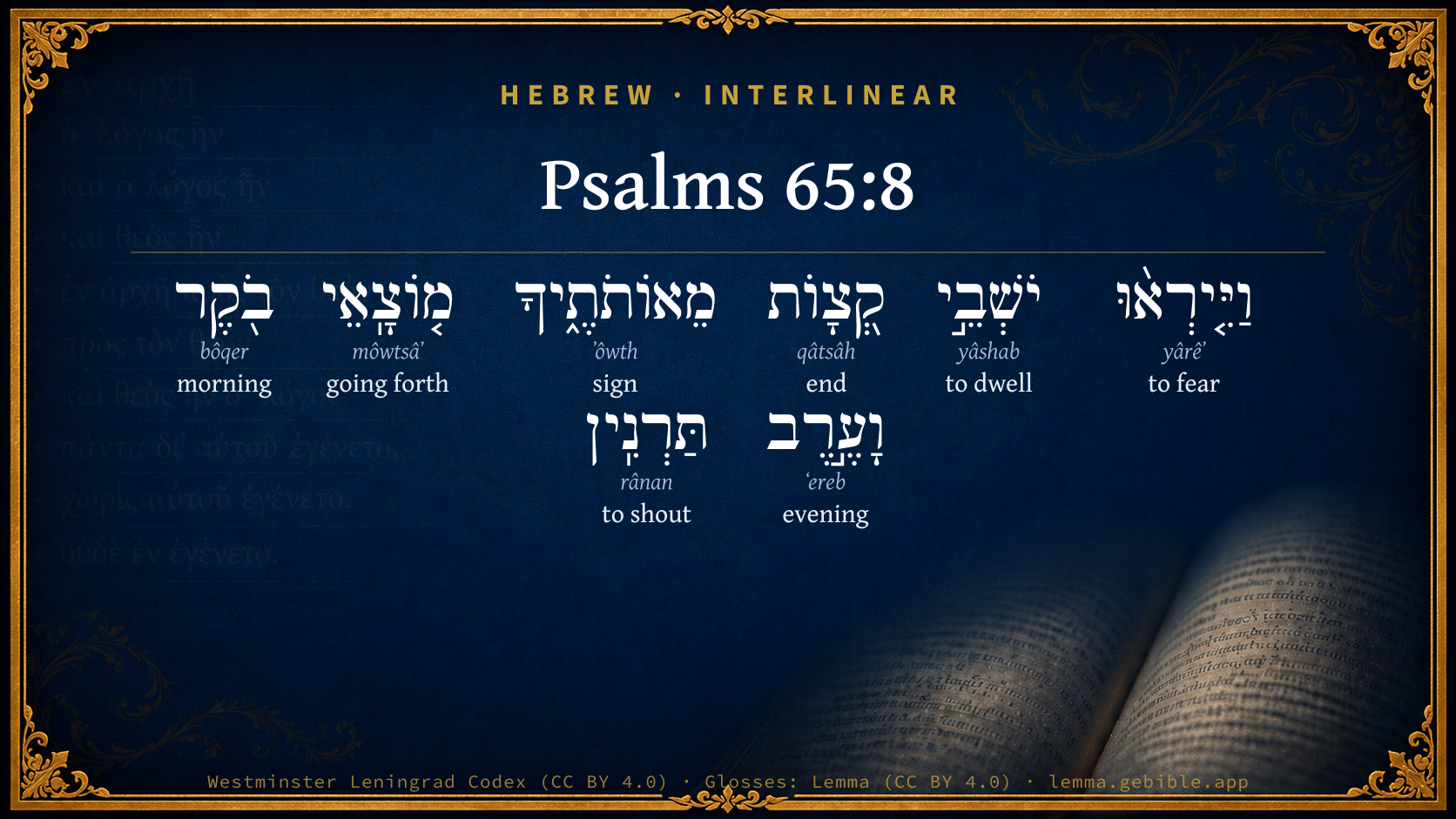
Hebrew (Westminster Leningrad Codex) Psalms 65:8 appears in the Hebrew Old Testament. The text above is from the Westminster Leningrad Codex. Each word links to its Strong’s number, a concise gloss, and parsing drawn from the Open Scriptures Hebrew Bible morphology. Click any word for its full Brown-Driver-Briggs (BDB) entry.
Download image
Cite this verse

Psalms 65:8 (World English Bible). Public Domain. Lemma interlinear Bible study tool, https://lemma.gebible.app/v/psalms/65/8.

Show BibTeX & RIS
BibTeX
RIS
English Translation
They also who dwell in far-away places are afraid at your wonders. You call the morning's dawn and the evening with songs of joy.
World English Bible · Public Domain
Download a study sheet

One document with this verse’s original text, its word-by-word gloss line, the meaning frame, cross-references with their text, attributed commentary, and full source and license credits — printable, and it pastes into notes with its structure intact.

This verse Autodidact and up

Study sheet (.html) Plain text (.txt)

A passage Seminary Student

Up to 50 verses in one chapter. A passage sheet keeps up to 6 commentary sources and 12 cross-references per verse, in the order this page ranks them, and says so on the sheet whenever that leaves anything out. Ask for a single verse and you get the Autodidact verse sheet above.

Everything on this page stays free to read, with no account — the sheet is a download of what is already on screen, not access to it.

Want to remove ads? Support Godless Engineer
Compare translations 3

The same verse in 3 English versions, stacked beneath the original-language interlinear above. Click any original word for its lexicon entry.

Each is an independent rendering of the whole verse — the interlinear is not word-aligned to these translations.

Highlighted words mark where these versions differ — a whole-verse word diff, not a word-by-word alignment.

  • World English Bible Public Domain
    They also who dwell in far-away places are afraid at your wonders. You call the morning's dawn and the evening with songs of joy.
  • King James Version Public Domain
    They also that dwell in the uttermost parts are afraid at thy tokens: thou makest the outgoings of the morning and evening to rejoice.
  • unfoldingWord Literal Text CC BY-SA 4.0
    And the dwellers of the ends fear at your signs; you make the goings forth of the morning and the evening shout joyfully.

unfoldingWord Literal Text — © unfoldingWord, licensed CC BY-SA 4.0. Word-aligned USFM3 via Door43 (git.door43.org/unfoldingWord/en_ult).

Versions to compare (up to 4)

3 of 4 selected

Show all 18 translations

Every available English version of this verse, each an independent rendering of the whole verse.

  • World English Bible Public Domain
    They also who dwell in far-away places are afraid at your wonders. You call the morning's dawn and the evening with songs of joy.
  • Berean Standard Bible Public Domain
    Those who live far away fear Your wonders; You make the dawn and sunset shout for joy.
  • Majority Standard Bible Public Domain
    Those who live far away fear Your wonders; You make the dawn and sunset shout for joy.
  • King James Version Public Domain
    They also that dwell in the uttermost parts are afraid at thy tokens: thou makest the outgoings of the morning and evening to rejoice.
  • American Standard Version (1901) Public Domain
    They also that dwell in the uttermost parts are afraid at thy tokens: Thou makest the outgoings of the morning and evening to rejoice.
  • Revised Version (1885) Public Domain
    They also that dwell in the uttermost parts are afraid at thy tokens: thou makest the outgoings of the morning and evening to rejoice.
  • Geneva Bible (1599) Public Domain
    They also, that dwell in the vttermost parts of the earth, shalbe afraide of thy signes: thou shalt make the East and the West to reioyce.
  • Douay-Rheims (1899) Public Domain
    who troublest the depth of the sea, the noise of its waves. The Gentiles shall be troubled,
  • Young's Literal Translation Public Domain
    And the inhabitants of the uttermost parts From Thy signs are afraid, The outgoings of morning and evening Thou causest to sing.
  • Literal Standard Version CC BY-SA 4.0
    And the inhabitants of the uttermost parts || Are afraid from Your signs, || You cause the outgoings of morning and evening to sing.
  • Unlocked Literal Bible CC BY-SA 4.0
    Those who live in the uttermost parts of the earth are afraid of the evidence of your deeds; you make the east and the west rejoice.
  • unfoldingWord Literal Text CC BY-SA 4.0
    And the dwellers of the ends fear at your signs; you make the goings forth of the morning and the evening shout joyfully.
  • Darby Bible Public Domain
    And they that dwell in the uttermost parts are afraid at thy tokens; thou makest the outgoings of the morning and evening to rejoice.
  • World Messianic Bible Public Domain
    They also who dwell in faraway places are afraid at your wonders. You call the morning’s dawn and the evening with songs of joy.
  • Webster's Bible Public Domain
    \\65:7\\Who stilleth the noise of the seas, the noise of their waves, and the tumult of the people.
  • Free Bible Version CC BY-SA 4.0
    Everyone, even those in distant lands, are amazed by the wonderful things you do, from the east to the west they sing for joy.
  • Bible in Basic English Public Domain
    Those in the farthest parts of the earth have fear when they see your signs: the outgoings of the morning and evening are glad because of you.
  • JPS Tanakh (1917) Public Domain
    (65-9) So that they that dwell in the uttermost parts stand in awe of Thy signs; Thou makest the outgoings of the morning and evening to rejoice.

Literal Standard Version (2020), Covenant Press — licensed CC BY-SA 4.0. Text via the HelloAO Bible API (eBible.org). Unlocked Literal Bible (unfoldingWord) — licensed CC BY-SA 4.0. Text via the HelloAO Bible API (eBible.org). unfoldingWord Literal Text — © unfoldingWord, licensed CC BY-SA 4.0. Word-aligned USFM3 via Door43 (git.door43.org/unfoldingWord/en_ult). Free Bible Version, Dr. Jonathan Gallagher — licensed CC BY-SA 4.0. Text via the HelloAO Bible API (eBible.org).

Word by word

More ways to search: Search by grammar → Find every occurrence → Compare this word →

Practice this passage: Drill this verse → Learn its vocabulary →

מ֤וֹצָֽאֵי
môwtsâʼ
H4161
“goings forth of”
Noun, Common, Masculine, Plural, Construct
Part of Speech
Noun
Type
Common
Gender
Masculine
Number
Plural
State
Construct
Full BDB Definition

Origin: from H3318

TWOT: 893c

act or place of going out or forth, issue, export, source, spring - a going forth - rising (sun), going forth of a command - goings forth, those going forth - way out, exit - that which goes forth - utterance - export - place of going forth - source or spring (of water) - place of departure - east (of sun) - mine (of silver)
  1. וַיִּ֤ירְא֨וּ yârêʼ H3372 “and · to fear” Conjunction + Verb, Qal, Sequential Imperfect, 3rd Person, Masculine, Plural
  2. יֹשְׁבֵ֣י yâshab H3427 “dwelling” Verb, Qal, Participle Active, Masculine, Plural, Construct
  3. קְ֭צָוֺת qâtsâh H7098 “ends” Noun, Common, Both, Plural, Absolute
  4. מֵאוֹתֹתֶ֑יךָ ʼôwth H226 “from · signs · your” Preposition + Noun, Common, Both, Plural, Construct + Suffix, Personal, 2nd Person, Masculine, Singular
  5. בֹ֖קֶר bôqer H1242 “morning” Noun, Common, Masculine, Singular, Absolute
  6. וָעֶ֣רֶב ʻereb H6153 “and · evening” Conjunction + Noun, Common, Masculine, Singular, Absolute
  7. תַּרְנִֽין rânan H7442 “to shout” Verb, Hiphil, Imperfect, 2nd Person, Masculine, Singular

About this verse

These counts appear in no published source. They are computed here, from the morphology-tagged text and Lemma’s own curated glosses. What Lemma adds →

8
words
8
distinct lemmas
Wisdom
section

Shared distinctive vocabulary

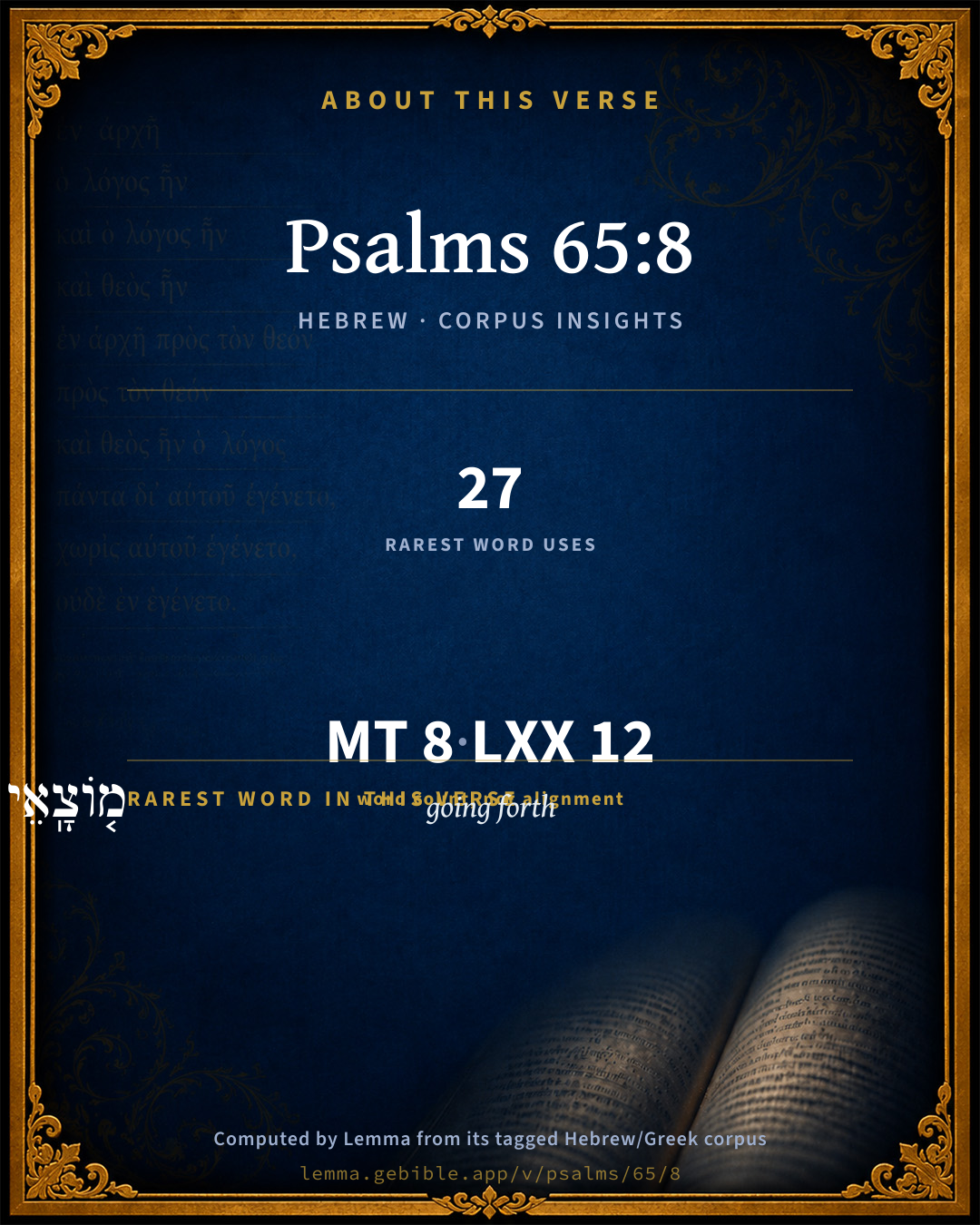
מ֤וֹצָֽאֵי going forth H4161 occurs in 26 verses of the Hebrew Bible. Also found in:

Grammatical profile

  • 3 verbs
  • 5 nouns

Verb forms

  • וַיִּ֤ירְא֨וּ Qal · Sequential Imperfect
  • יֹשְׁבֵ֣י Qal · Participle Active
  • תַּרְנִֽין Hiphil · Imperfect

Hebrew & Septuagint length

In English translation the verse runs 24 words from the Hebrew and 31 from the Septuagint (LXX English) — closely comparable.

A rough comparison of the two English renderings, which tokenize alike — not a word-level alignment.

Word counts can differ between the Hebrew and the Greek without any difference in meaning — e.g. the Hebrew direct-object marker אֵת has no separate Greek word, and Greek often adds the article ὁ.

In the original languages it is 8 Hebrew tokens and 12 Greek tokens — but the two are counted differently (Hebrew bundles its prefixes and suffixes into one token; the Greek is in lemma form), so that isn’t a like-for-like length.

Cross-references

19

Topical passages linked to Psalms 65:8 in the Treasury of Scripture Knowledge — connected by theme and wording, ordered by reader-vote popularity; previews shown in the World English Bible.

  • Psalms 148:3 Praise him, sun and moon! Praise him, all you shining stars!
  • Psalms 104:20–23 You make darkness, and it is night, In which all the animals of the forest prowl.
  • Psalms 136:8 The sun to rule by day; For his loving kindness endures forever;
  • Psalms 74:16 The day is yours, the night is also yours. You have prepared the light and the sun.
  • Deuteronomy 4:19 and lest you lift up your eyes to the sky, and when you see the sun and the moon and the stars, even all the host of the sky, you are drawn away and worship them, and serve them, which Yahweh your God has allotted to all the peoples under the whole sky.
  • Psalms 48:5–6 They saw it, then they were amazed. They were dismayed, They hurried away.
  • Psalms 126:2 Then our mouth was filled with laughter, And our tongue with singing. Then they said among the nations, "Yahweh has done great things for them."
  • Habakkuk 3:3–19 God came from Teman, The Holy One from Mount Paran. Selah. His glory covered the heavens, And his praise filled the earth.
  • Genesis 8:22 While the earth remains, seed time and harvest, and cold and heat, and summer and winter, and day and night shall not cease."
  • Exodus 15:14–16 The peoples have heard. They tremble. Pangs have taken hold on the inhabitants of Philistia.
  • Joshua 2:9–11 and she said to the men, I know that Yahweh has given you the land, and that the fear of you is fallen on us, and that all the inhabitants of the land melt away before you.
  • Psalms 2:8 Ask of me, and I will give the nations for your inheritance, The uttermost parts of the earth for your possession.
  • Psalms 19:5 Which is as a bridegroom coming out of his chamber, Like a strong man rejoicing to run his course.
  • Psalms 66:3 Tell God, "How awesome are your deeds! Through the greatness of your power, your enemies submit themselves to you.
  • Psalms 135:9 Who sent signs and wonders into the midst of you, Egypt, On Pharaoh, and on all his servants;
  • Acts 5:38–39 Now I tell you, withdraw from these men, and leave them alone. For if this counsel or this work is of men, it will be overthrown.
  • Revelation 11:13 In that day there was a great earthquake, and a tenth of the city fell. Seven thousand people were killed in the earthquake, and the rest were terrified, and gave glory to the God of heaven.
  • Job 38:12 "Have you commanded the morning in your days, And caused the dawn to know its place;
  • Psalms 65:13 The pastures are covered with flocks. The valleys also are clothed with grain. They shout for joy! They also sing.

Cross-references courtesy of OpenBible.info (CC BY 4.0).

Hebrew and Greek witnesses Masoretic Hebrew ↔ Greek Septuagint

The same verse in the two great witnesses to the Old Testament, shown verse-for-verse.

You’re reading Greek Psalm 64 (Hebrew Psalm 65). The Septuagint counts the superscription, so verse numbers can differ from the Hebrew — chapter-level alignment, not verse-by-verse. Numbering follows Rahlfs.

These are two independent witnesses, not word-aligned to each other, and the Septuagint is shown in lemma (dictionary) form.

Hebrew Psalms 65:8 Masoretic · Westminster Leningrad Codex

וַיִּ֤ירְא֨וּ יֹשְׁבֵ֣י קְ֭צָוֺת מֵאוֹתֹתֶ֑יךָ מ֤וֹצָֽאֵי בֹ֖קֶר וָעֶ֣רֶב תַּרְנִֽין

They also who dwell in far-away places are afraid at your wonders. You call the morning's dawn and the evening with songs of joy.

World English Bible · Public Domain

Greek LXX Greek Psalm 64:8 Septuagint · lemma form

ὁ συνταράσσω ὁ κύτος ὁ θάλασσα ἦχος κῦμα αὐτός ταράσσω ὁ ἔθνος

The nations shall be troubled, and they that inhabit the ends of the earth shall be afraid of your signs; you will cause the outgoings of morning and evening to rejoice.

LXX2012 (modern English Septuagint) · Public Domain

Hebrew: Westminster Leningrad Codex (CC BY 4.0). Greek: Septuagint (public domain); English from LXX2012 (modern English Septuagint) (Public Domain). How the Septuagint differs from the Hebrew →

Commentary

Notes on Psalms 65:8 from classic Christian and Jewish commentators (each source and its license shown beneath its notes). The classic Christian expositions comment on the surrounding passage and are grouped to its opening verse, so a note may address several verses; the Jewish commentaries on the Tanakh (Rashi and others) are per-verse, so they appear only where the commentator wrote on this verse.

Lemma curates 59 commentaries, every one of them public domain or Creative Commons licensed, each selected and text-cleaned for this edition rather than reprinted as found. About our sources →

Trapp's Complete Commentary

John Trapp

Psa 65:8 They also that dwell in the uttermost parts are afraid at thy tokens: thou makest the outgoings of the morning and evening to rejoice.

Ver. 8. They also that dwell in the uttermost parts, &c.] And are, therefore, Duri, horridi, immanes, latrociniis dediti, omnium denique pessimi, not farther distant from the sun than from all humanity, except the Sun of righteousness shine upon them, as he hath done upon us here in England.

Are afraid at thy tokens] Thy notable works, thine executions.

Thou makest the outgoings of the morning, &c.] That is, the inhabitants of east and west, or the vicissitudes of day and night, whereby men are occasioned to praise and glorify God. See Jer 31:35. The Jews at this day, as they are bound to say over a hundred benedictions every day, so these two among the rest: when they go forth in a morning they say, Blessed be he who hath created the greater lights; and in the evening they say, Blessed be he who causeth the darkness of the night (R. Solom. in loc.).

John Trapp, A Commentary or Exposition upon All the Books of the Old and New Testament (1647–1656) — public domain. Text from a community e-Sword module.

The Biblical Illustrator

Joseph S. Exell

Psa_65:8

Thou makest the outgoings of the morning and evening to rejoice.

Gods favours

The psalmist recognized a close relation between nature and natures God. He saw all the beauty and blessedness of nature as divine.

I. The incomparableness of Gods favours. The matchless phenomena of the dawn and sunset are unique in nature. When God sows the earth with orient pearl, and the fragrance of a thousand flowers exhales upon the morning air; or when eve, all clad in sober grey, comes forth, the firmament with living sapphire glowing. We have a hint, too, of the kingdom of grace in our text. There is probably an allusion to the morning and evening sacrifice, a God-appointed ordinance, and therefore an allusion to Christ and His atonement.

II. The freshness of Gods favours. Each new morning and evening is as much a new thing as if just created. The beauty of dawn and sunset never pale. It is not only our lives that He crowns with lovingkindness and tender mercies, not only the year that He crowneth with goodness, but each morning and each evening He visiteth us. Day unto day uttereth speech. Night publisheth to night His mercies.

III. The fitness of Gods favours. Thou makest the outgoings of the morning and evening to rejoice. Just the time when we most need a fresh supply. The issues of the day are taken at their fount and the results of the day are blessed at their fruition. Some of the outgoings of the morning are--

1. Forebodings. Bright mornings often usher in sad thoughts, tis well to be met at the threshold of the day by Gods benison and smile.

2. Duty lies before us every morning. The law of duty transformed to blessed personal service, if we meet Jesus at the door of the day, His statutes then shall be our songs in the house of our pilgrimage, and the joy of the Lord shall be our strength.

3. Uncertainty. We never know what a day may bring forth, but if God bless its outgoings we shall not be afraid of evil tidings nor of sudden fear, our heart is fixed.

IV. The fulness of His favours. From outgoing to outgoing, He fills up the whole day with the light that comes ix the dawn, and the whole night with the sweet peace and protection that comes at eve.

V. The universality of Gods favours. Once in twenty-four hours each hemisphere of the world is alternately bathed in light, or rests in the peaceful shadow of night. This is true also of His grace and Gospel.

VI. The immutability of Gods favours. The covenant of day and night was made with Noah. Every dawn and sunset is a pledge of His unchangeable fidelity to His promise (Gen_8:22; Jer_33:20-21). The morning fails not by the thousandth part of a second, nor shall Gods Word ever fail. (F. A. Trotter.)

Blithe childhood, and blither old age

I. Life both in prospect and retrospect is beautiful. To look on at the start, to look back at the close, are both a delight. Old age corroborates childhood, evening renews the morning; and whoever fails to enjoy life, both these succeed.

1. First, the glorious days of childhood, the sweet hours of early life. We often speak of youths power of prophecy, of the young souls anticipation of the future, the expectation of what life is going to be; oh, enchanting first days! But that is not what I mean. I speak of a time that comes before even that--of youths pure enjoyment of life. You believe in life; you open out your souls trustfully to it; you have not begun yet to be suspicious; you do not imagine every cup which life sets to your lips to be poisoned; you dare smell every fragrant flower; you believe in to-day as well as yesterday, and you are not afraid of to-morrow with any fresh truth which it may bring. You never feel inclined to suspect every new prophet to be a traitor, and every new book to have the inspiration of the evil one in it. You are willing to hear every new call that comes; the charm has not disappeared for you from the work of the Lord, and you could know no shame so great as to be dismissed from His service. No prophecy has ever failed to you--the Word of the Lord standeth sure; you discount nothing which God has promised, and the fulfilment will be richer than the promise itself. Welcome, life! Hail, blessed future! The outgoings of the morning . . . rejoice.

2. The retrospect will be blither still. Believe me, the brightest season is yet to be. And the evening to rejoice. The surging process through which your faith may be passing will be over, and your faith will be richer than ever. The scares which many of us have through criticism; through the testing fires into which the Word of God is cast; through the rapid succession of books that crime questioning the authority of the Bible, absolutely denying its right to the deference it has always received; through the breaking up of old forms of thought, the recasting of old theories, the new terms in which we have got to speak of the Atonement and future retribution;--this scare will have ceased. The confusion and uncertainty in which you feel as if everything were breaking up and you were losing every truth you had treasured most, will have passed into a firm hold of all absolute verities.

II. The prospect and the retrospect are both made beautiful by God. Youth and old age--it is God touches both into beauty. Not one word of what I have said is true apart from God. Youth possesses no power of icy but in Him, old age is ugly severed from Him; the morning opens with the mutterings of a storm, evening closes in blackness and hopelessness God puts into both the lines that constitute their charm. You have climbed through a narrow mountain-pass. Morning was radiant when you started, and every foot you climbed the scene became more enchanting, and your spirits rose with every step. But presently the prospect narrows, the mountains close in upon you, the sun is hidden, and a cold wind sweeps through the defile; your spirits droop, and you can only doggedly plod along. But by and by the mountains open out again, the pass is over, and far away under your feet stretches a fairer scene than that which thrilled you in the early morning. Many of you, perhaps, are to-day in the pass. Youth is a memory which you find it hard to realize; you have left it far behind you. But you will be out of the pass soon. The prospect will open out again, and the sun will set upon a fairer world than you have ever seen. The best of life is yet to come. Thou makest the outgoings of the morning and evening to rejoice. (J. Morlais Jones.)

The song of morning and evening

Nature is here conceived of as rejoicing before her God, and uttering her joy, in glad and grateful song, praising Him whose power sustains her, and whose wisdom guides. It is not strange, if the psalmist found song in nature at all, that he should have found it in the phenomena of the days dawn and decline, The breezy call of incense-breathing morn, and the balmy sigh which vernal zephyrs breathe in evenings ear; for of all that is impressive, inspiring and suggestive of high thought in natures scenic effects, surely it is the phenomena of morn and even; and whatever else is such in itself the light of opening and closing day gives it most transcendent revelation. Thus should it be with man. Our best performance, our highest reaches of thought, and our noblest forms of expression should be divine worship, and the song of our life be evermore a psalm of praise to God. The text conveys a hint also as to the seasons for prayer. This song of dawning and declining day is natures matin and vesper service of worship to her God. That which is a sentiment in natures heart, all day and all the night, attains the tuneful gladness of a song at morn and even. Thus should it be with man. When morning calls him from the realm of slumber to the world of conscious life, and the activities of the day are about to begin, he should make his first business worship. Before he opens the door to the world and gives it audience he should open the window that looks heavenward, and himself seek audience with his God, nor let the worlds cares and toils descend again upon him until he has refreshed himself by communion with the Father of lights. Each new dawn lights man to a new life, which should be hallowed in its inception by prayer and praise. And so when the daylight hours have sped, and the days toils are over, in the still hour when hopes and memories meet and join, and in the light of suns gone down we wait the unveiling of the quiet stars, those suns which shine upon us from afar, the human spirit should again uplift itself to God, and the day close, even as it began, with prayer and praise. But the text has yet deeper suggestiveness. Morning and evening may fitly represent the beginnings and ends of things, and in this construction what great truths the text brings to our thought. It is in the beginnings and ends of things that we see most of God. He is the Alpha and the Omega, the first and the last, the beginning and the end. His presence pervades even as His power sustains all things. He fills all time as all space. But we recognize Him most in the inception and culmination of fact and event. In the intermediate stages we see more of law and less of God. We trace a development in which we note the play of finite agencies, and the factorship of finite force and will. But in the beginnings and ends of things the finite is less apparent, and the infinite absorbs the view. Thus He maketh the outgoings of the morning and evening to sing. Creation as it sprang from the forming hand of God and stood in its unsullied beauty, unstained by human sin, was very good. And not less so shall be that new creation, the new heavens and the new earth, which shall appear when the first heaven and the first earth are done away. At creations dawn the morning stars sang together and all the sons of God shouted for joy. Nor shall creations evening song be wanting; for oer the final consummation ten thousand times ten thousand tongues, untuned when the creation was being celebrated, shall blend in song with those who raised the earlier strain. (J. W. Earnshaw.)

The Biblical Illustrator, edited by Joseph S. Exell (c. 1880s–1900s) — public domain. Text from a community e-Sword module.

Joseph Benson's Commentary

Psa 65:8. They also that dwell in the uttermost parts — Namely, of the earth; are afraid at thy tokens — Hebrew, מאותתיךְ, meothotheicha, at thy signs, at the great and terrible judgments which thou inflictest upon wicked men, and particularly on the enemies of thy people. Or rather, at such occurrences as extraordinary thunders, lightnings, and meteors in the air, comets in the heavens, or volcanic eruptions and earthquakes on the earth; all which are the works of God, whatever secondary causes he may use to produce them. As if he had said, The remotest and most barbarous people are struck with the dread of thee, when thou alarmest them with any unusual tokens of thy power. Thou makest the out goings of the morning and evening to rejoice — The successive courses of the morning and evening, or of the sun and moon, which go forth at those times, the one bringing the light of the morning, and the other the shades of the evening, and both which are said poetically to rejoice, because they give men occasion of rejoicing. For as it is God that scatters the light of the morning, and draws the curtains of the evening, so he does both in favour to man. And how contrary soever light and darkness are to each other, or how inviolable soever the partition between them may be, both are equally welcome to the world in their season. And it is hard to say which is more welcome to us, the light of the morning, which befriends the business of the day, or the shadows of the evening, which befriend the repose of the night. Doth the watchman wait for the morning? So doth the hireling earnestly desire the shadow. Thus, this whole verse speaks of the natural works of God; the former clause of such as are extraordinary and terrible, the latter of such as are ordinary and delightful.

Joseph Benson's Commentary on the Old and New Testaments (1811–1818) — public domain. Text from a community e-Sword module.

J. A. Alexander on Psalms

Joseph Addison Alexander

9. (Psa 65:8). Then were afraid those inhabiting the ends (or most distant parts) of thy signs; the outgoings of morning and evening thou wilt make to shout (or sing). Then is not expressed in Hebrew, but employed in the translation to shew the dependence of the verb on that of the preceding sentence. The sense is, that whenever God thus stills the tumult of the nations, even the remotest are affected by his signs, i. e. the sensible indications of his presence and immediate agency. Outgoings is a local noun in Hebrew, and denotes the places where the evening and the morning come forth or begin, i.e. the points at which the sun sets and rises, the east and west, here put for eastern and western lands, and these for their inhabitants. That the fear mentioned in the first clause is not mere slavish dread, but an affection perfectly compatible with joy, is clear from the remainder of the sentence.

Joseph Addison Alexander, The Psalms Translated and Explained (1850) — public domain. Text from a community e-Sword module.

Tyndale Open Study Notes

Tyndale Open Resources

65:8 All over the world (Job 38:13; see Ps 50:1-3), people should stand in awe of the Lord.

Tyndale Open Study Notes — © Tyndale Open Resources, licensed CC BY-SA 4.0. Text via the HelloAO Bible API.

Geneva Bible (1599)

Geneva Bible translators

Hebrew, the going forth of the morning and of the evening.

Geneva Bible (1599) marginal notes — public domain. Text via Bolls.life.

Jamieson, Fausset & Brown

Robert Jamieson, A. R. Fausset & David Brown

outgoings of . . . rejoice--all people from east to west.

Jamieson, Fausset & Brown — Commentary Critical and Explanatory on the Whole Bible (1871) — public domain (CC PDM 1.0). Text via the HelloAO Bible API.

Adam Clarke's Commentary

Verse 8. Are afraid at thy tokens] Thunder and lightning, storms and tempests, eclipses and meteors, tornadoes and earthquakes, are proofs to all who dwell even in the remotest parts of the earth, that there is a Supreme Being who is wonderful and terrible in his acts. By these things an eternal power and Godhead become manifest even to the most barbarous. From this verse to the end of the Psalm there is a series of the finest poetic imagery in the world.

The outgoings of the morning, &c.] The rising and setting sun, the morning and evening twilight, the invariable succession of day and night, are all ordained by thee, and contribute to the happiness and continuance of man and beast. Or, All that fear thee praise thee in the morning, when they go to their work, and in the evening, when they return home, for thy great goodness manifested in the continuance of their strength, and the success of their labour.

Adam Clarke's Commentary on the Bible (1810–1826) — public domain. Text from a community e-Sword/MySword module.

John Calvin's Commentaries

8 They also that dwell, etc. By the signs referred to, we must evidently understand those signal and memorable works of the Lord which bear the impress of his glorious hand. It is true, that the minutest and meanest objects, whether in the heavens or upon the earth, reflect to some extent the glory of God; but the name mentioned emphatically applies to miracles, as affording a better display of the divine majesty. So striking would be the proofs of God’s favor to his Church, that, as the Psalmist here intimates to us, they would constrain the homage and wonder of the most distant and barbarous nations. In the latter part of the verse, if we take the interpretation suggested by some, nothing more is meant, than that when the sun rises in the morning, men are refreshed by its light; and again, that when the moon and stars appear at night, they are relieved from the gloom into which they must otherwise have been sunk. Were this interpretation adopted, a preposition must be understood; as if it had been said, Thou makest men to rejoice on account of, or by the rising of the sun, of the moon, and of the stars. But the words, as they stand, convey a sense which is sufficiently appropriate without having recourse to any addition. It was said, that in consequence of the wonders done by the Lord, fear would spread itself over the uttermost parts of the earth; and the same thing is now asserted of the joy which they would shed abroad: from the rising to the setting sun, men would rejoice in the Lord, as well as fear him.

John Calvin's Commentaries (1540-1563) — public domain. Text from the Calvin Translation Society English edition (1840s-50s) via the Christian Classics Ethereal Library (ccel.org). Calvin's coverage is partial (roughly two-thirds of the Bible); uncommented books and verses are honest gaps, never fabricated. The 19th-century editor's footnotes and remarks are omitted so the notes are faithfully Calvin's own voice.

Ellicott's Commentary for English Readers

(8) They also . . .—Or, So they.

The outgoings . . .—A pregnant expression for the rising of the morning and setting of the evening sun. East and west.

To rejoice.—Better, to sing for joy. The whole earth from one utmost bound to the other is vocal with praise of the Creator and Ruler of the universe. So the morning stars sang together at the creation (Job_38:7).

A Bible Commentary for English Readers, edited by Charles John Ellicott (1878–1897) — public domain. Text from a community e-Sword module.

The Cambridge Bible for Schools and Colleges

gen. ed. J. J. S. Perowne

8. They also &c.] Better, So that they who dwell in the ends of the earth are afraid at thy signs. These mighty works impress them with awe, as ‘signs’ of the irresistible power of God.

the outgoings of the morning and evening] The term outgoings which strictly speaking is appropriate to the east only (Psa_19:5 f.) is applied, by a kind of zeugma, to the west also. From the furthest east to the furthest west He makes earth with all its inhabitants to shout for joy (Psa_5:11; Psa_67:4). Awe gives place to triumph as they watch the downfall of their tyrants and welcome the establishment of God’s kingdom of peace (Psa_46:9 f), and all nature sympathises with them.

The Cambridge Bible for Schools and Colleges (gen. ed. J. J. S. Perowne; Cambridge University Press, 1878–1918) — public domain. Text from a community e-Sword module.

John Gill's Exposition

They also that dwell in the uttermost parts are afraid at thy tokens,.... The tokens of his wrath and displeasure at wicked men, seen in the punishments inflicted on them, which cause them to fear and tremble. Some interpret them of the sun, moon, and stars, which are set for "signs", as the word (m) used signifies; and which declare the glory of God to the uttermost parts of the earth, and strike men with awe and reverence of him; and others of thunder and lightning, which are sometimes very dreadful and terrible. Moreover, the word (n) signifies signs and wonders, marvellous things, miraculous operations; and may be understood of those that were wrought in the first times of the Gospel, for the confirmation of it; some of which were wrought in the uttermost parts of the earth; or, however, were heard of there, and believed; which caused them to receive the Gospel with all reverence, not as the word of man, but as the word of God;

thou makest the outgoings of the morning and of the evening to rejoice; some interpret this of the morning and evening sacrifices; others of the sun that goes forth in the morning, and rejoices as a strong man to run his race, and of the moon and stars that appear in the evening, and both give pleasure and delight to the inhabitants of the earth; others of men who go forth in the morning cheerfully to their labour, and of the beasts that go out in the evening to seek their prey, Psa 19:5; but it seems better to understand it of the rising of the stars before the sun in the morning, and the appearance of them after the moon is up in the evening; or of the rising and setting sun; of the east and west, which include the whole world, and the inhabitants of it; who are made to rejoice at the coming of the Gospel among them, which rings the good news and glad tidings of peace, pardon, righteousness, and salvation, by Christ, whereby his name becomes great, and is praised among the Gentiles; see Mal 1:11.

(m) "a signis tuis", Pagninus, Montanus, &c. (n) "A signis et prodigiis tuis", Michaelis.

John Gill's Exposition of the Whole Bible (1746–1763) — public domain (CC PDM 1.0). Text via the HelloAO Bible API.

Albert Barnes' Notes on the Bible

They also that dwell in the utter-most parts - That is, Those who dwell in the remotest regions; far from civilized lands; far from those places where people are instructed as to the causes of the events which occur, and as to the being and character of the great God who performs these wonders. The idea is, that even they see enough of the evidences of the divine presence and power to fill their minds with awe. In other words, there are in all lands evidences of the Divine existence and might. There is enough to fill the minds of people with awe, and to make them solemn.

Are afraid - Thus the thunder, the storm, the tempest, the earthquake, the eclipse of the sun or the moon, fill the minds of barbarous nations with terror.

At thy tokens - Or signs. That is, the signs which really indicate the existence, the presence, and the power of God.

Thou makest the outgoings - The word rendered outgoings means properly a going forth, as of the rising of the sun Psa 19:7; and then, a place of going forth, or from which anything goes forth, as a gate or door Eze 42:11, or fountains from which water issues Isa 41:18; and hence, the east, where the sun seems to come forth from his hiding-place. The representation here is that the morning seems to come forth, or that the rays of light stream out from the east; and, in like manner, that the fading light of the evening - the twilight - seems to come from the west.

Of the morning and evening to rejoice - The allusion is to the east and the west. The sun in his rising and his setting seems to rejoice; that is, he appears happy, bright, cheerful. The margin is to sing - a poetic expression indicating exultation and joy.

Albert Barnes' Notes on the Bible (1834–1885) — public domain. Text from a community e-Sword/MySword module.

Matthew Poole's English Annotations

The uttermost parts, to wit, of the earth, which is added to this word, Psa 65:5.

Thy tokens, or signs; either,

1. At the sun, and moon, and stars, which are called signs, Gen 1:14. But these are not matter of terror, but of delight to men; and the commonness and constancy of their courses makes most men neither fear nor much regard them. Or,

2. At the great and terrible judgments which God inflicts upon wicked men, and particularly upon the enemies of his people. Or rather,

3. At those terrible thunders, and lightnings, and earthquakes, and comets, or other strange meteors or works of God in the air; for he is here speaking of the natural works of God.

The outgoings of the morning and evening; by which he understands, either,

1. The east, from whence the morning, or the sun, the cause of it, goeth forth, as it is expressed, Psa 19:6; and the west, from whence the evening or night is poetically supposed to come forth. So the meaning is, that God gives all the people of the world, from east to west, occasion to rejoice in the effects of his bounty and goodness to them. But if the psalmist had meant this, it is not probable that he would have expressed it in such a dark and doubtful phrase, which is never used in that sense; but rather by those known and usual expressions, from east to west, or, from the rising of the sun to the going down thereof, which phrase he useth Psa 1:1; 113:3. Or rather,

2. The successive courses of the morning and evening; or of the sun and moon, which go forth at those times, thereby making the morning and evening; both which are said to rejoice poetically, because they give men occasion of rejoicing, which the sun or the morning doth, because it gives them opportunity for the despatch of business, and for the enjoyment of manifold recreations and delights; and the moon or evening doth so, because it invites men to that rest and sleep which is both refreshing and necessary for them. Thus this whole verse speaks of the natural works of God; the former clause of such as are extraordinary and terrible, the latter of such as are ordinary and delightful.

Matthew Poole's English Annotations on the Holy Bible (1683–1685) — public domain. Text from a community e-Sword/MySword module.

The Treasury of David

Charles H. Spurgeon

Ver. 8. They also that dwell in the uttermost parts are afraid of thy tokens. Signs of God's presence are not few, nor confined to any one region. Zembla sees them as well as Zion, and Terra del Fuego as surely as the Terra Sacra. These tokens are sometimes terrible phenomena in nature--such as earthquakes, pestilence, tornado, or storm; and when these are seen, even the most barbarous people tremble before God. At other times they are dread works of providence-- such as the overthrow of Sodom, and the destruction of Pharaoh. The rumour of these judgments travels to earth's utmost verge, and impresses all people with a fear and trembling at such a just and holy God. We bless God that we are not afraid but rejoice at his tokens; with solemn awe we are glad when we behold his mighty acts. We fear, but not with slavish fear.

Thou makest the outgoings of the morning and evening to rejoice. East and west are made happy by God's favour to the dwellers therein. Our rising hours are bright with hope, and our evening moments mellow with thanksgiving. Whether the sun go forth or come in we bless God and rejoice in the gates of the day. When the fair morning blushes with the rosy dawn we rejoice; and when the calm evening smiles restfully we rejoice still. We do not believe that the dew weeps the death of the day; we only see jewels bequeathed by the departing day for its successor to gather up from the earth. Faith, when she sees God, rounds the day with joy. She cannot fast, because the bridegroom is with her. Night and day are alike to her, for the same God made them and blessed them. She would have no rejoicing if God did not make her glad; but, blessed be his name, he never ceases to make joy for those who find their joy in him.

Ver. 8. Thou makest the outgoings of the morning and evening to rejoice. That is, thou makest men to rejoice, they are glad, they rejoice in, or at, the outgoings in the morning. And at the evening men rejoice too, for then they go to their rest, being wearied with the labour of the day. Or, we may thus expound it: Thou makest men who live at the outgoings of the morning, and at the outgoings of the evening, to rejoice. As if it had been said, Thou makest the eastern people and the western people, all people from east to west, rejoice. And that which makes all people to rejoice, naturally, is the rising of light with them in the east, and the coming of light towards them in the west. Joseph Caryl.

Ver. 8. Thou makest the outgoings of the morning and evening to rejoice. How contrary soever light and darkness are to each other, and how inviolable soever the partition between them (Ge 1:4), both are equally welcome to the world in their season; it is hard to say which is more welcome to us, the light of the morning which befriends the business of the day, or the shadows of the evening which befriend the repose of the night. Doth the watchman wait for the morning? so doth the hireling earnestly desire the shadow. Some understand it of the morning and evening sacrifice, which good people greatly rejoiced in, and in which God was constantly honoured. Thou makest them to sing, so the word is; for every morning and every evening songs of praise were sung by the Levites; it was that which the duty of every day required. And we are to look upon our daily worship alone, and with our families, to be both the most needful of our daily business, and the most delightful of our daily comforts; and if therein we keep up our communion with God, the outgoings both of the morning and of the evening are thereby made truly to rejoice. Matthew Henry.

Ver. 8. Lyranus, Dionysius Carthusianus, Cajetanus, Placidus Parmensis, (who treads in the footsteps of Cajetanus though he does not mention him) take the first clause to refer to the wonder of all mankind at the wonderful works of God on the land and the sea; and explain the second respecting the sacrifices which were wont to be offered in the morning and evening; that God made these acceptable to himself and delightful to those who offered them, especially after the return from captivity. In the beginning of the Psalm sacrifices are hinted at by praise and vows, as we have seen, and in the history of Esdra it is recorded, that the morning and evening sacrifice were offered unto the Lord by those who had returned; and that those who approached, when they entered, and others who had made their offerings, when they departed, gave praises to God. Hence it is here said, that the outgoings of the morning and of the evening, that is to say, when they who praise God go forth from either sacrifice, God will be well pleased, he will receive delight from that praise, and it will be grateful to him. Lorinus.

Ver. 8. Figuratively, the outgoings of the morning, or dawn, is the light of grace in the beginning of conversion; "the outgoing of the evening" is the final light of grace in the hour of death. Thomas Le Blanc.

Ver. 8. Tokens of God's presence; those causing terror, and those inspiring joy.

Ver. 8. (last clause). The peculiar joys of morning and evening.

Psalms 65:9*

Charles H. Spurgeon's The Treasury of David (1869–1885) — public domain. Psalms only. Text from a community e-Sword/MySword module.

Whedon's Commentary on the Bible

Daniel D. Whedon

8. Uttermost parts—The boundaries, the whole compass. The full phrase occurs Isa_40:28, “The ends,” or compass, “of the earth.” So Job_28:24.

Afraid at thy tokens—The “terrible things” (Psa_65:5) which God shall perform in the redemption of his people, by his judgments upon guilty men and nations, shall cause all dwellers upon earth to fear him. See Rev_14:7.

Outgoings of… morning… evening—The breaking forth, or place of going forth; that is, the portals of morning and evening. These shall sing. That is, all creatures within the compass of the earth, from the gates of the east to those of the west, shall be made to rejoice. Such shall be the benign reign of the one only God and Jesus Christ his Son.

Daniel D. Whedon (gen. ed.), Commentary on the Old and New Testaments (1874–1909) — public domain. Text from a community e-Sword module.

The Pulpit Commentary

They also that dwell in the uttermost parts are afraid of thy tokens; i.e. they see thy tokens indications of thy mighty power and are filled with awe. Thou makest the outgoings of the morning and evening (or, the portals of morn and eve the gateways through which the sun comes forth each morning and retires each evening) to rejoice; to gladden mankind, to spread joy and gladness over the earth. The splendour of sunrise and sunset are in the poet"s mind.

The Pulpit Commentary (1880–1919), ed. H.D.M. Spence-Jones & Joseph S. Exell — public domain. Text from a community e-Sword module.

John Wesley's Explanatory Notes

Thy tokens - Terrible thunders and lightnings, and earthquakes, and comets or other strange meteors, or works of God in the air. Morning - The successive courses of the morning and evening; or of the sun and moon which go forth at those times. Thus the whole verse speaks of the natural works of God, the former clause, of such as are extraordinary and terrible, the latter of such as are ordinary and delightful.

John Wesley, Explanatory Notes Upon the Whole Bible (1754–1765) — public domain. Text via the GEBible commentary corpus.

unfoldingWord translationNotes

Door43 World Missions Community

evidence

proof or something that shows that another thing is true

you make the east and the west rejoice

The phrase "the east and the west" refers to the people who live all over the earth. AT: "you cause people everywhere to shout joyfully" (See: Metonymy and Merism)

help the earth

This refers to the soil of the earth.

you greatly enrich it

"you make the soil very good so that good things will grow in it"

the river of God is full of water

This refers to the supply of water in the sky that God sends to water the earth and fill the streams. AT: "you fill the streams with water" (See: Metonymy)

translationWords

fear

works

earth

joy

grain

unfoldingWord translationNotes — © Distant Shores Media and the Door43 World Missions Community, licensed CC BY-SA 4.0. Source: git.door43.org/Door43/en_tn.

Rashi

Rabbi Shlomo Yitzchaki (Rashi)

Who humbles Heb. משביח, He humbles. Similarly (Prov. 29:11): “but afterwards, a wise man will quiet it (ישבחנה); (below 89:10), “When it raises its waves, You humble them (תשבחם).”

Rashi on the Tanakh — English translations: “The Judaica Press complete Tanach with Rashi, translated by A. J. Rosenberg” (CC BY 4.0); “Pentateuch with Rashi's commentary by M. Rosenbaum and A.M. Silbermann, 1929-1934” (public domain); “The Metsudah Tanach series, Lakewood, N.J” (CC BY 4.0); and “The Book of Joshua, Metsudah Publications, 1997” (CC BY 4.0). Text via Sefaria.

Lesson kit

Teaching starters — assembled from the data on this page, not authored interpretation. Every prompt links to the verse data it draws on. Edit before teaching.

Psalms, in the Wisdom, opens this verse with 8 words (8 distinct Hebrew lemmas). Its most distinctive word is môwtsâʼ (“going forth”). A historical commentator’s framing appears above. Read the whole chapter for the surrounding context.

Discussion questions

  1. How does “going forth” (môwtsâʼ) shape what this verse is saying?
  2. How does Numbers 30:12, which shares the word «going forth», read alongside this verse?
  3. The translations on this page render this verse differently — a whole-verse word diff, not a word-by-word alignment. What might account for the different wordings?
  4. «וַיִּ֤ירְא֨וּ» is a Qal Sequential Imperfect verb. How does that grammatical form shape the action described?
  5. Compare how Trapp's Complete Commentary and The Biblical Illustrator read this verse. Where do they agree or differ?

Things to notice

Reading settings

Reading text

Shown beneath each verse's original-language words.

Old Testament
Old Testament edition

Read the OT as the Masoretic Hebrew (MT) or the Greek Septuagint (LXX).

English shown for the Greek Septuagint (in the Hebrew ↔ Greek comparison).

Comparing translations? Open the Compare panel on any verse page to stack up to four side by side.