
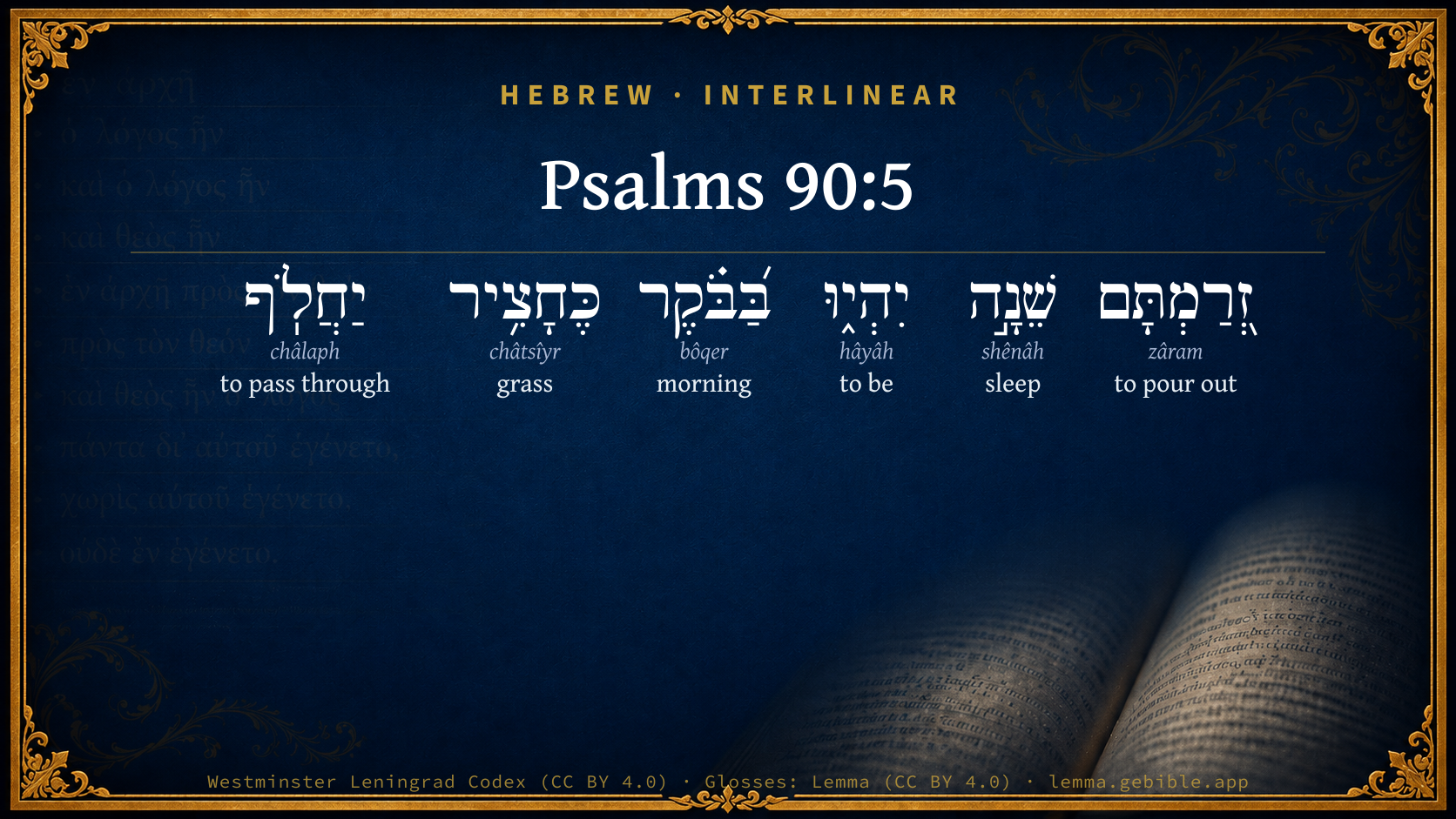
Psalms 90:5

Hebrew (Westminster Leningrad Codex) Psalms 90:5 appears in the Hebrew Old Testament. The text above is from the Westminster Leningrad Codex. Each word links to its Strong’s number, a concise gloss, and parsing drawn from the Open Scriptures Hebrew Bible morphology. Click any word for its full Brown-Driver-Briggs (BDB) entry.
Download image
Cite this verse

Psalms 90:5 (World English Bible). Public Domain. Lemma interlinear Bible study tool, https://lemma.gebible.app/v/psalms/90/5.

Show BibTeX & RIS
BibTeX
RIS
English Translation
You sweep them away as they sleep. In the morning they sprout like new grass.
World English Bible · Public Domain
Download a study sheet

One document with this verse’s original text, its word-by-word gloss line, the meaning frame, cross-references with their text, attributed commentary, and full source and license credits — printable, and it pastes into notes with its structure intact.

This verse Autodidact and up

Study sheet (.html) Plain text (.txt)

A passage Seminary Student

Up to 50 verses in one chapter. A passage sheet keeps up to 6 commentary sources and 12 cross-references per verse, in the order this page ranks them, and says so on the sheet whenever that leaves anything out. Ask for a single verse and you get the Autodidact verse sheet above.

Everything on this page stays free to read, with no account — the sheet is a download of what is already on screen, not access to it.

Want to remove ads? Support Godless Engineer
Compare translations 3

The same verse in 3 English versions, stacked beneath the original-language interlinear above. Click any original word for its lexicon entry.

Each is an independent rendering of the whole verse — the interlinear is not word-aligned to these translations.

Highlighted words mark where these versions differ — a whole-verse word diff, not a word-by-word alignment.

  • World English Bible Public Domain
    You sweep them away as they sleep. In the morning they sprout like new grass.
  • King James Version Public Domain
    Thou carriest them away as with a flood; they are as a sleep: in the morning they are like grass which groweth up.
  • unfoldingWord Literal Text CC BY-SA 4.0
    You flood them away—they are sleep; in the morning, like grass, it passes along.

unfoldingWord Literal Text — © unfoldingWord, licensed CC BY-SA 4.0. Word-aligned USFM3 via Door43 (git.door43.org/unfoldingWord/en_ult).

Versions to compare (up to 4)

3 of 4 selected

Show all 18 translations

Every available English version of this verse, each an independent rendering of the whole verse.

  • World English Bible Public Domain
    You sweep them away as they sleep. In the morning they sprout like new grass.
  • Berean Standard Bible Public Domain
    You whisk them away in their sleep; they are like the new grass of the morning—
  • Majority Standard Bible Public Domain
    You sweep them away in their sleep; they are like the new grass of the morning—
  • King James Version Public Domain
    Thou carriest them away as with a flood; they are as a sleep: in the morning they are like grass which groweth up.
  • American Standard Version (1901) Public Domain
    Thou carriest them away as with a flood; they are as a sleep: In the morning they are like grass which groweth up.
  • Revised Version (1885) Public Domain
    Thou carriest them away as with a flood; they are as a sleep: in the morning they are like grass which groweth up.
  • Geneva Bible (1599) Public Domain
    Thou hast ouerflowed them: they are as a sleepe: in the morning he groweth like the grasse:
  • Douay-Rheims (1899) Public Domain
    things that are counted nothing, shall their years be.
  • Young's Literal Translation Public Domain
    Thou hast inundated them, they are asleep, In the morning as grass he changeth.
  • Literal Standard Version CC BY-SA 4.0
    You have inundated them, they are asleep, || In the morning he changes as grass.
  • Unlocked Literal Bible CC BY-SA 4.0
    You sweep them away as with a flood and they sleep; in the morning they are like the grass that sprouts up.
  • unfoldingWord Literal Text CC BY-SA 4.0
    You flood them away—they are sleep; in the morning, like grass, it passes along.
  • Darby Bible Public Domain
    Thou carriest them away as with a flood; they are [as] a sleep: in the morning they are like grass [that] groweth up:
  • World Messianic Bible Public Domain
    You sweep them away as they sleep. In the morning they sprout like new grass.
  • Webster's Bible Public Domain
    Thou carriest them away as with a flood; they are as a sleep; in the morning they are like grass which groweth.
  • Free Bible Version CC BY-SA 4.0
    You bring people's lives to a sudden end, like dreams that vanish. They are like grass that grows up in the morning—
  • Bible in Basic English Public Domain
    ...
  • JPS Tanakh (1917) Public Domain
    Thou carriest them away as with a flood; they are as a sleep; in the morning they are like grass which groweth up.

Literal Standard Version (2020), Covenant Press — licensed CC BY-SA 4.0. Text via the HelloAO Bible API (eBible.org). Unlocked Literal Bible (unfoldingWord) — licensed CC BY-SA 4.0. Text via the HelloAO Bible API (eBible.org). unfoldingWord Literal Text — © unfoldingWord, licensed CC BY-SA 4.0. Word-aligned USFM3 via Door43 (git.door43.org/unfoldingWord/en_ult). Free Bible Version, Dr. Jonathan Gallagher — licensed CC BY-SA 4.0. Text via the HelloAO Bible API (eBible.org).

Word by word

More ways to search: Search by grammar → Find every occurrence → Compare this word →

Practice this passage: Drill this verse → Learn its vocabulary →

About this verse

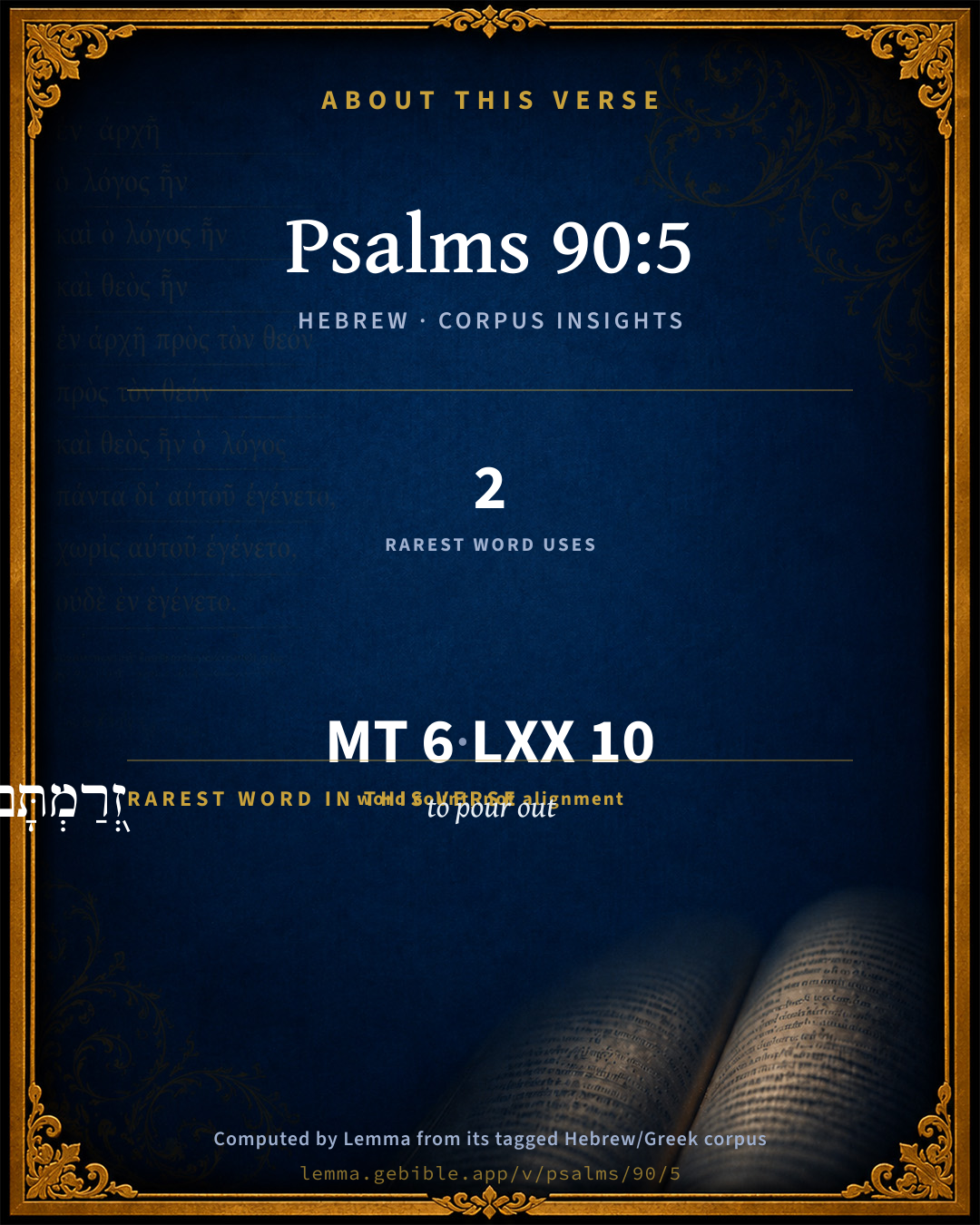
These counts appear in no published source. They are computed here, from the morphology-tagged text and Lemma’s own curated glosses. What Lemma adds →

6
words
6
distinct lemmas
Wisdom
section

Notable vocabulary

The rarest word here is זְ֭רַמְתָּם to pour out H2229 — appearing just 2 times in the whole Hebrew Bible.

Shared distinctive vocabulary

זְ֭רַמְתָּם to pour out H2229 occurs in 2 verses of the Hebrew Bible. Also found in:

Grammatical profile

  • 3 verbs
  • 3 nouns

Verb forms

  • זְ֭רַמְתָּם Qal · Perfect
  • יִהְי֑וּ Qal · Imperfect
  • יַחֲלֹֽף Qal · Imperfect

Hebrew & Septuagint length

In English translation the verse runs 15 words from the Hebrew and 13 from the Septuagint (LXX English) — closely comparable.

A rough comparison of the two English renderings, which tokenize alike — not a word-level alignment.

Word counts can differ between the Hebrew and the Greek without any difference in meaning — e.g. the Hebrew direct-object marker אֵת has no separate Greek word, and Greek often adds the article ὁ.

In the original languages it is 6 Hebrew tokens and 10 Greek tokens — but the two are counted differently (Hebrew bundles its prefixes and suffixes into one token; the Greek is in lemma form), so that isn’t a like-for-like length.

Cross-references

12

Topical passages linked to Psalms 90:5 in the Treasury of Scripture Knowledge — connected by theme and wording, ordered by reader-vote popularity; previews shown in the World English Bible.

  • Isaiah 40:6 The voice of one saying, Cry. One said, What shall I cry? All flesh is grass, and all the glory of it is as the flower of the field.
  • Job 22:16 Who were snatched away before their time, Whose foundation was poured out as a stream,
  • Psalms 73:20 As a dream when one wakes up, So, Lord, when you awake, you will despise their fantasies.
  • Psalms 103:15–16 As for man, his days are like grass. As a flower of the field, so he flourishes.
  • 1 Peter 1:24 For, "All flesh is like grass, And all of man's glory like the flower in the grass. The grass withers, and its flower falls;
  • Job 27:20–21 Terrors overtake him like waters; A tempest steals him away in the night.
  • Job 9:26 They have passed away as the swift ships, As the eagle that swoops on the prey.
  • Job 20:8 He shall fly away as a dream, and shall not be found: Yes, he shall be chased away like a vision of the night.
  • Isaiah 8:7–8 now therefore, behold, the Lord brings up on them the waters of the River, strong and many, [even] the king of Assyria and all his glory: and it shall come up over all its channels, and go over all its banks;
  • Isaiah 29:7–8 The multitude of all the nations that fight against Ariel, even all who fight against her and her stronghold, and who distress her, shall be as a dream, a vision of the night.
  • James 1:10–11 and the rich, in that he is made humble, because like the flower in the grass, he will pass away.
  • Jeremiah 46:7–8 Who is this who rises up like the Nile, whose waters toss themselves like the rivers?

Cross-references courtesy of OpenBible.info (CC BY 4.0).

Hebrew and Greek witnesses Masoretic Hebrew ↔ Greek Septuagint

The same verse in the two great witnesses to the Old Testament, shown verse-for-verse.

You’re reading Greek Psalm 89 (Hebrew Psalm 90). The Septuagint counts the superscription, so verse numbers can differ from the Hebrew — chapter-level alignment, not verse-by-verse. Numbering follows Rahlfs.

These are two independent witnesses, not word-aligned to each other, and the Septuagint is shown in lemma (dictionary) form.

Hebrew Psalms 90:5 Masoretic · Westminster Leningrad Codex

זְ֭רַמְתָּם שֵׁנָ֣ה יִהְי֑וּ בַּ֝בֹּ֗קֶר כֶּחָצִ֥יר יַחֲלֹֽף

You sweep them away as they sleep. In the morning they sprout like new grass.

World English Bible · Public Domain

Greek LXX Greek Psalm 89:5 Septuagint · lemma form

ὁ ἐξουδένωμα αὐτός ἔτος εἰμί ὁ πρωΐ ὡσεί χλόη παραἔρχομαι

Years shall be vanity to them: let the morning pass away as grass.

LXX2012 (modern English Septuagint) · Public Domain

On this verse, Keil & Delitzsch discusses the Septuagint’s reading. Read the note in Commentary ↓

Hebrew: Westminster Leningrad Codex (CC BY 4.0). Greek: Septuagint (public domain); English from LXX2012 (modern English Septuagint) (Public Domain). How the Septuagint differs from the Hebrew →

Commentary

Notes on Psalms 90:5 from classic Christian and Jewish commentators (each source and its license shown beneath its notes). The classic Christian expositions comment on the surrounding passage and are grouped to its opening verse, so a note may address several verses; the Jewish commentaries on the Tanakh (Rashi and others) are per-verse, so they appear only where the commentator wrote on this verse.

Lemma curates 59 commentaries, every one of them public domain or Creative Commons licensed, each selected and text-cleaned for this edition rather than reprinted as found. About our sources →

Trapp's Complete Commentary

John Trapp

Psa 90:5 Thou carriest them away as with a flood; they are [as] a sleep: in the morning [they are] like grass [which] groweth up.

Ver. 5. Thou carriest them away as with a flood] Suddenly, violently, irresistibly, by particular judgments, besides that general necessity of dying once, Heb 9:27. This is set forth by a treble comparison, of floods, sleep, and flowers here; and indeed the vanity and misery of man’s life is such, as cannot sufficiently be set forth by any similitudes. See Psa 90:9-10.

They are as a sleep] Or dream; the dream of a shadow (σκιας οναρ), saith Pindarus, the shadow of smoke, saith another.

They are like grass] An ordinary comparison, Isa 40:6 Jas 1:10-11

John Trapp, A Commentary or Exposition upon All the Books of the Old and New Testament (1647–1656) — public domain. Text from a community e-Sword module.

The Biblical Illustrator

Joseph S. Exell

Psa_90:5

Thou carriest them away as with a flood.

The devastating ravages of death

The Israelites had not yet witnessed the swellings of Jordan, through which, by their Makers presence and power, they were to pass dry-shod; but they had witnessed--and never could they forget,--the watery ramparts of the Red Sea, where, rejoicing in their God, they walked through the flood on foot, which the Egyptians essaying to do, were drowned. And while standing safe and victorious on the opposite shore, full of recollections of the country which they had left, they can contrast the regular, pacific, fertilizing flood of Egypts river with the sudden and overwhelming inundation their eyes now behold, that awful flood which carries away their foes, when Pharaoh and his chosen captains, and their chariots and horsemen, and all their multitude are, in a moment, covered by the depths, and sink into the bottom like a stone; yea, the flood covers them, they sink as lead in the mighty waters.

1. The general idea intended to be conveyed by the phraseology before us is--destruction, fell, certain destruction, for such is the invariable consequence of a flood like that which is here supposed.

2. Such is the general idea intended by the phraseology before us; but connected with this, there are several special and subordinate ideas, which seem descriptive of some of the accompaniments of that visitation of Providence which is here referred to.

(1) The destruction caused by a flood is sudden. And this is a circumstance which adds, in no small degree, to the terrors of such a scene.

(2) The destruction which is caused by a flood is as indiscriminate as it is sudden. Wherever the flood spreads, it leaves some traces of its ravages. Like death, it has no respect of persons or property. It will enter kings palaces as readily as the hovels of the poor; it will assail the crowded streets and densely-peopled lanes of a city equally with the lonely tenants of the sequestered vale. And it is no less indiscriminating as to the victims whom it engulphs. On it rushes with undistinguishing and resistless speed, passing by none upon its course, pitying none, sparing none.

(3) There is this other peculiarity in the ravages of a flood, like that which is here supposed, viz. that in its progress it is irresistibly powerful. So long as the fury of the torrent lasts, human skill and human prudence are altogether futile.

3. Now, if you combine together these different ideas, viz. that a flood presents the imago of certain destruction--that in its approach it is sudden--in its ravages indiscriminate--in its progress irresistible, you will perceive with what propriety it is here employed as an emblem of death. (N. Morren, M.A.)

Like grass which groweth up.--

Like grass which groweth up

1. It is in vain to seek for a paradise or a home in this poor, delusive world.

2. After all, we ought not to weep too much over the vanity of life. Human life answers the purpose for which it was given. What Christian would consent to take up with earth and be for ever exiled from heaven? It is an infinite privilege that a good man may die.

3. It ought not to be a ground of despondency to good men that they are growing old and beginning to decay, and drawing rapidly towards a termination of their course. Death will not swallow up all. There is a land above the stars and joys above his power.

4. The delusive and fleeting nature of all terrestrial things, and the afflictions which are largely mingled with them, ought to make us long more earnestly after heaven. When we cannot find here a place on which to rest the sole of our foot, it ought to endear to us the thought of our eternal home.

5. The shortness of life and the unsatisfying and perplexing nature of all that it has to bestow, ought to stir us up to diligence in the proper business for which it was given us. (E. D. Griffin, D.D.)

The Biblical Illustrator, edited by Joseph S. Exell (c. 1880s–1900s) — public domain. Text from a community e-Sword module.

Joseph Benson's Commentary

Psa 90:5-6. Thou carriest them away — Namely, mankind, of whom he spake Psa 90:3. As with a flood — Unexpectedly, violently, and irresistibly. They are as a sleep — Short and vain as sleep is, and not minded till it be past. Or, like a dream, when a man sleepeth, wherein there may be some real pleasure, but never any satisfaction; or some real trouble, but never considerable, and seldom pernicious. Even such an idle and insignificant thing is human life, considered in itself, and without respect to a future state. They are like grass which groweth up — Which sprouteth out of the earth, and becometh more apparent, green, and flourishing. In the evening it is cut down, and withereth — Here the whole space of man’s life is compared to one day, and his prosperity to a part of that day, and ended in the close of it. Thus, in these verses, “the shortness of life, and the suddenness of our departure hence, are illustrated by three similitudes: 1st, That of a flood or torrent pouring unexpectedly and impetuously from the mountains, and sweeping all before it in an instant. 2d, That of sleep, from which when a man awakes, he thinks the time passed in it to have been nothing. 3d, That of the grass grown up in the morning, and cut down and withered in the evening. In the morning of youth, fair and beautiful, man groweth up and flourisheth; in the evening of age (and how often before that evening!) he is cut down by the stroke of death; all his juices, to the circulation of which he stood indebted for life, health, and strength, are dried up; he withereth, and turneth again to his earth.” — Horne.

Joseph Benson's Commentary on the Old and New Testaments (1811–1818) — public domain. Text from a community e-Sword module.

Keil & Delitzsch

C. F. Keil & F. Delitzsch

Psa 90:5-6 tell us how great is the distance between men and this eternal selfsameness of God. The suffix of זרמתּם, referred to the thousand years, produces a synallage (since שׁנה is feminine), which is to be avoided whenever it is possible to do so; the reference to בני־אדם, as being the principal object pointed to in what has gone before, is the more natural, to say the very least. In connection with both ways of applying it, זרם does not signify: to cause to rattle down like sudden heavy showers of rain; for the figure that God makes years, or that He makes men (Hitzig: the germs of their coming into being), to rain down from above, is fanciful and strange. זרם may also mean to sweep or wash away as with heavy rains, abripere instar nimbi, as the old expositors take it. So too Luther at one time: Du reyssest sie dahyn (Thou carriest them away), for which he substituted later: Du lessest sie dahin faren wie einen Strom (Thou causest them to pass away as a river); but זרם always signifies rain pouring down from above. As a sudden and heavy shower of rain, becoming a flood, washes everything away, so God's omnipotence sweeps men away. There is now no transition to another alien figure when the poet continues: שׁנה יהיוּ. What is meant is the sleep of death, Psa 76:6, שׁנת עולם, Jer 51:39, Jer 51:57, cf. ישׁן Psa 13:4. He whom a flood carries away is actually brought into a state of unconsciousness, he goes entirely to sleep, i.e., he dies.

From this point the poet certainly does pass on to another figure. The one generation is carried away as by a flood in the night season, and in the morning another grows up. Men are the subject of יחלף, as of יהיוּ. The collective singular alternates with the plural, just as in Psa 90:3 the collective אנושׁ alternates with בני־אדם. The two members of Psa 90:5 stand in contrast. The poet describes the succession of the generations. One generation perishes as it were in a flood, and another grows up, and this also passes on to the same fate. The meaning in both verses of the חלף, which has been for the most part, after the lxx, Vulgate, and Luther, erroneously taken to be praeterire = interire, is determined in accordance with this idea. The general signification of this verb, which corresponds to the Arabic chlf, is "to follow or move after, to go into the place of another, and in general, of passing over from one place or state into another." Accordingly the Hiphil signifies to put into a new condition, Psa 102:27, to set a new thing on the place of an old one, Isa 9:9 [10], to gain new strength, to take fresh courage, Isa 40:31; Isa 41:1; and of plants: to send forth new shoots, Job 14:7; consequently the Kal, which frequently furnishes the perfect for the future Hiphil (Ew. 127, b, and Hitzig on this passage), of plants signifies: to gain new shoots, not: to sprout (Targum, Syriac), but to sprout again or afresh, regerminare; cf. Arab. chilf, an aftergrowth, new wood. Perishing humanity renews its youth in ever new generations. Psa 90:6 again takes up this thought: in the morning it grows up and shoots afresh, viz., the grass to which men are likened (a figure appropriated by Isa. 40), in the evening it is cut down and it dries up. Others translate מולל to wither (root מל, properly to be long and lax, to allow to hang down long, cf. אמלל, אמל with Arab. 'ml, to hope, i.e., to look forth into the distance); but (1) this Pilel of מוּל or Poēl of מלל is not favourable to this intransitive way of taking it; (2) the reflexive in Psa 58:8 proves that מלל signifies to cut off in the front or above, after which perhaps even Psa 37:2, Job 14:2; Job 18:16, by comparison with Job 24:24, are to be explained. In the last passage it runs: as the top of the stalk they are cut off (fut. Niph. of מלל). Such a cut or plucked ear of corn is called in Deu 23:25 מלילה, a Deuteronomic hapaxlegomenon which favours our way of taking the ימולל (with a most general subject = ימולל). Thus, too, ויבשׁ is better attached to what precedes: the cut grass becomes parched hay. Just such an alternation of morning springing froth and evening drying up is the alternation of the generations of men.

The poet substantiates this in Psa 90:7. from the experience of those amongst whom he comprehended himself in the לנוּ of Psa 90:1, Hengstenberg takes Psa 90:7 to be a statement of the cause of the transitoriness set forth: its cause is the wrath of God; but the poet does not begin כי באפך but כי כלינו. The chief emphasis therefore lies upon the perishing, and כי is not argumentative but explicative. If the subject of כלינוּ were men in general (Olshausen), then it would be elucidating idem per idem. But, according to Psa 90:1, those who speak here are those whose refuge the Eternal One is. The poet therefore speaks in the name of the church, and confirms the lot of men from that which his people have experienced even down to the present time. Israel is able out of its own experience to corroborate what all men pass through; it has to pass through the very same experience as a special decree of God's wrath on account of its sins. Therefore in Psa 90:7-8 we stand altogether upon historical ground. The testimony of the inscription is here verified in the contents of the Psalm. The older generation that came out of Egypt fell a prey to the sentence of punishment, that they should gradually die off during the forty years' journey through the desert; and even Moses and Aaron, Joshua and Caleb only excepted, were included in this punishment on special grounds, Num 14:26., Deu 1:34-39. This it is over which Moses here laments. God's wrath is here called אף and חמה; just as the Book of Deuteronomy (in distinction from the other books of the Pentateuch) is fond of combining these two synonyms (Deu 9:19; Deu 29:22, Deu 29:27, cf. Gen 27:44.). The breaking forth of the infinitely great opposition of the holy nature of God against sin has swept away the church in the person of its members, even down to the present moment; נבהל as in Psa 104:29, cf. בּחלה, Lev 26:16. It is the consequence of their sins. עון signifies sin as the perversion of the right standing and conduct; עלוּם, that which is veiled in distinction from manifest sins, is the sum-total of hidden moral, and that sinful, conduct. There is no necessity to regard עלמנוּ as a defective plural; עלמים signifies youth (from a radically distinct word, עלם); secret sins would therefore be called עלמות according to Psa 19:13. God sets transgressions before Him when, because the measure is full and forgiveness is inadmissible, He makes them an object of punishment. שׁתּ (Ker, as in Psa 8:7 : שׁתּה, cf. Psa 6:4 ואתּ, Psa 74:6 ועתּ) has the accent upon the ultima before an initial guttural. The parallel to לנגדּך is למאור פּניך. עור is light, and מאור is either a body of light, as the sun and moon, or, as in this passage, the circle of light which the light forms. The countenance of God (פני ה) is God's nature in its inclination towards the world, and מאור פני ה is the doxa of His nature that is turned towards the world, which penetrates everything that is conformed to God as a gracious light (Num 6:25), and makes manifest to the bottom everything that is opposed to God and consumes it as a wrathful fire.

Keil & Delitzsch — Biblical Commentary on the Old Testament (1861–1891) — public domain (CC PDM 1.0). Text via the HelloAO Bible API. (Old Testament only.)

J. A. Alexander on Psalms

Joseph Addison Alexander

5. (Psa 90:5) Thou sweepest them away—a sleep are they—in the morning, like thegrass, they pass away. The first Hebrew verb has no equivalent in English; it means to sweep away or carry off, as by a driving rain. The supposition of a reference to the flood is not necessary, though admissible. A derivative form of the same verb occurs above, Psa 77:17. The comparison of human life to a sleep or dream is common in all languages. The morning is mentioned as the time of waking, the time when we are most impressed with the unsubstantial nature of our dreams. See above, Psa 73:20, and compare Psa 39:6. The grass is an additional but obvious emblem of caducity. The last verb is not a plural form in Hebrew, but agrees with sleep, or rather with man, in the generic sense, whose life is here compared to sleep.

Joseph Addison Alexander, The Psalms Translated and Explained (1850) — public domain. Text from a community e-Sword module.

Geneva Bible (1599)

Geneva Bible translators

Thou takest them away suddenly as with a flood.

Geneva Bible (1599) marginal notes — public domain. Text via Bolls.life.

Adam Clarke's Commentary

Verse 5. Thou carriest them away as with a flood] Life is compared to a stream, ever gliding away; but sometimes it is as a mighty torrent, when by reason of plague, famine, or war, thousands are swept away daily. In particular cases it is a rapid stream, when the young are suddenly carried off by consumptions, fevers, c. this is the flower that flourisheth in the morning, and in the evening is cut down and withered. The whole of life is like a sleep or as a dream. The eternal world is real; all here is either shadowy or representative. On the whole, life is represented as a stream; youth, as morning; decline of life, or old age, as evening; death, as sleep; and the resurrection as the return of the flowers in spring. All these images appear in these curious and striking verses, Ps 90:3-6.

Adam Clarke's Commentary on the Bible (1810–1826) — public domain. Text from a community e-Sword/MySword module.

John Calvin's Commentaries

5 Thou carriest them away as with a flood. Moses confirms what he had previously said, That men, so long as they are sojourners in this world, perform, as it were, a revolution which lasts only for a moment. I do not limit the expression to carry away as with a flood to calamities of a more grievous kind, but consider that death is simply compared in general to a flood; for when we have staid a little while in the world, we forthwith fall into the grave and are covered with earth. Thus death, which is common to all, is with propriety called an inundation. While we are breathing the breath of life, the Lord overflows us by death, just as those who perish in a shipwreck are engulfed in the ocean; so that death may be fitly called an invisible deluge. And Moses affirms, that it is then evidently seen that men who flatter themselves that they are possessed of wonderful vigor in their earthly course, are only as a sleep. The comparison of grass which is added, amounts to this, That men come forth in the morning as grass springs up, that they become green, or pass away within a short time, when being cut down, they wither and decay. The verbs in the 6th verse being in the singular number, it is better to connect them with the word grass. But they may also be appropriately referred to each man; and as it makes little difference as to the sense of the text, whether we make grass or each man the nominative to the verbs, I am not disposed to expend much labor upon the matter. This doctrine requires to be continually meditated upon; for although we all confess that nothing is more transitory than our life, yet each of us is soon carried away, as it were, by a frantic impulse to picture to his own imagination an earthly immortality. Whoever bears in mind that he is mortal, restrains himself, that instead of having his attention and affections engrossed beyond measure with earthly objects, he may advance with haste to his mark. When we set no limit to our cares, we require to be urged forward by continual goadings, that we may not dream of a thousand lives instead of one, which is but as a shadow that quickly vanishes away.

John Calvin's Commentaries (1540-1563) — public domain. Text from the Calvin Translation Society English edition (1840s-50s) via the Christian Classics Ethereal Library (ccel.org). Calvin's coverage is partial (roughly two-thirds of the Bible); uncommented books and verses are honest gaps, never fabricated. The 19th-century editor's footnotes and remarks are omitted so the notes are faithfully Calvin's own voice.

Ellicott's Commentary for English Readers

(5, 6) The following is suggested as the most satisfactory rendering of these verses: Time (literally, a year; but the root-idea is the repetition or change of the seasons) carries them away with its flood; they are in the morning like grass sprouting; in the morning it flourishes and sprouts, in the evening it is cut down and withered.

This is obtained by taking the verb as third feminine instead of second masculine, and slightly changing the vowels of the noun rendered in Authorised Version sleep. The confusion of the metaphor is thus avoided, and immediately on the mention of the stream of time is suggested the image of the vegetation springing into life at the first touch of rain, and dying in a day—an image so natural to an Oriental. The verb, carries away with its floods is found only here and in Psa_77:17 (“the clouds poured out water”), but the cognate noun is frequent for a heavy rainfall (Isa_4:6, &c.), such as in the East in a few moments causes a flood. This interpretation is partly supported by the LXX. and Vulg.: “Their years shall be nothingness;” and many commentators have felt that the image of the “stream of time” was required here. For the rendering cut down, comp. Job_24:24. Some prefer “fades.” The general force of the figure is the same whether we think of the generations dropping away like withered grass or cut down and dried like hay.

A Bible Commentary for English Readers, edited by Charles John Ellicott (1878–1897) — public domain. Text from a community e-Sword module.

The Cambridge Bible for Schools and Colleges

gen. ed. J. J. S. Perowne

5. Thou carriest them away as with a flood] A single word in the Heb. suffices to draw the picture. Man is compared to a building swept away by a sudden burst of rain such as is common in the East. Cp. Isa_28:2; Isa_30:30; Mat_7:25; Mat_7:27.

they are as a sleep] As those who are asleep. Or, they fall asleep, in the sleep of death. Cp. Psa_76:6; Jer_51:39; Jer_51:57; Nah_3:18.

in the morning &c.] Another figure for the transitoriness of human life, developed in Psa_90:6. Cp. Psa_103:15-16; Job_14:2; Isa_40:6 ff. Its significance depends on the peculiar character of some of the grasses in Palestine. “The grasses of the Jordan valley and the Dead Sea basin are very peculiar, seldom becoming turf-like, or compact in growth, shooting up in early spring with the greatest luxuriance, and then as rapidly seeding and dying down, scorched and burnt up at once, and leaving for the rest of the year no other trace of their existence than the straggling stems from which the seeds and their sheath have long been shaken.” Tristram, Nat. Hist. of Bible, p. 453.

The P.B.V. follows the LXX, Vulg., and Jer. in its rendering, and fade away suddenly like the grass. The verb may mean to pass away as well as to grow or shoot up, but it must clearly have the same meaning in both verses, and Psa_90:6 appears to be decisive for the latter meaning. Some commentators indeed render passes away in both verses, but the sense in the morning it flourishes and passes away is unsatisfactory. The double rendering dried up and withered in P.B.V. comes down through the Vulg. from the LXX.

The Cambridge Bible for Schools and Colleges (gen. ed. J. J. S. Perowne; Cambridge University Press, 1878–1918) — public domain. Text from a community e-Sword module.

John Gill's Exposition

Thou carriest them away as with a flood,.... As the whole world of the ungodly were with the deluge, to which perhaps the allusion is; the phrase is expressive of death; so the Targum,

"if they are not converted, thou wilt bring death upon them;''

the swiftness of time is aptly signified by the flowing gliding stream of a flood, by the rolling billows and waves of it; so one hour, one day, one month, one year, roll on after another: moreover, the suddenness of death may be here intended, which comes in an hour unlooked for, and unaware of, as a flood comes suddenly, occasioned by hasty showers of rain; as also the irresistible force and power of it, which none can withstand; of which the rapidity of a flood is a lively emblem, and which carries all before it, and sweeps away everything that stands in its course; as death, by an epidemic and infectious disease, or in a battle, carries off thousands and ten thousands in a very little time; nor does it spare any, as a flood does not, of any age or sex, of any rank or condition of life; and, like a flood, makes sad destruction and devastation where it comes, and especially where it takes off great numbers; it not only turns beauty to ashes, and strength into weakness and corruption, but depopulates towns, and cities, and kingdoms; and as the flowing flood and gliding stream can never be fetched back again, so neither can life when past, not one moment of time when gone; see Sa2 14:14, besides this phrase may denote the turbulent and tempestuous manner in which, sometimes, wicked men go out of the world, a storm being within and without, as in Job 27:20, "they are as a sleep"; or dream, which soon passeth away; in a sound sleep, time is insensibly gone; and a dream, before it can be well known what it is, is over and lost in oblivion; and so short is human life, Job 20:8 there may be, sometimes, a seeming pleasure enjoyed, as in dreams, but no satisfaction; as a man in sleep may dream that he is eating and drinking, and please himself with it; but, when he awakes, he is hungry and empty, and unsatisfied; and so is man with everything in this life, Isa 29:8, and all things in life are a mere dream, as the honours, riches, and pleasures of it; a man rather dreams of honour, substance, and pleasure, than really enjoys them. Wicked men, while they live, are "as those that sleep"; as the Targum renders it; they have no spiritual senses, cannot see, hear, smell, taste, nor feel; they are without strength to everything that is spiritually good; inactive, and do none; are subject to illusions and mistakes; are in imminent danger, and unconcerned about it; and do not care to be jogged or awaked, and sleep on till they sleep the sleep of death, unless awaked by powerful and efficacious grace; and men when dead are asleep, not in their souls, but in their bodies; death is often in Scripture signified by a sleep, under which men continue until the resurrection, which is an awaking out of it:

in the morning they are like grass, which groweth up or "passeth away", or "changeth" (d); or is changed; some understand this of the morning of the resurrection, when there will be a change for the better, a renovation, as Kimchi interprets the word; and which, from the use of it in the Arabic language, as Schultens observes (e), signifies to be green and flourishing, as grass in the morning is; and so intends a recovery of rigour and strength, as a man after sleep, and as the saints will have when raised from the dead. The Targum refers it to the world to come,

"and in the world to come, as grass is cut down, they shall be changed or renewed;''

but it is rather to be understood of the flourishing of men in the morning of youth, as the next verse shows, where it is repeated, and where the change of grass is beautifully illustrated and explained.

(d) "quae mutatur", Pagninus; "mutabitur", Montanus; "immutatur", Tigurine version; "transiens", Junius & Tremellius; "quae transit", Musculus, Gejerus, Michaelis. (e) Animadv. in Job, p. 34.

John Gill's Exposition of the Whole Bible (1746–1763) — public domain (CC PDM 1.0). Text via the HelloAO Bible API.

Albert Barnes' Notes on the Bible

Thou carriest them away as with a flood - The original here is a single verb with the suffix - זרמתם zerametâm. The verb - זרם zâram - means, to flow, to pour; then, to pour upon, to overwhelm, to wash away. The idea is, that they were swept off as if a torrent bore them from the earth, carrying them away without regard to order, rank, age, or condition. So death makes no discrimination. Every day that passes, multitudes of every age, sex, condition, rank, are swept away and consigned to the grave - as they would be if a raging flood should sweep over a land.

They are as a sleep - The original here is, “a sleep they are.” The whole sentence is exceedingly graphic and abrupt: “Thou sweepest them away; a sleep they are - in the morning - like grass - it passes away.” The idea is that human life resembles a sleep, because it seems to pass so swiftly; to accomplish so little; to be so filled with dreams and visions, none of which remain or become permanent.

In the morning they are like grass which groweth up - A better translation of this would be to attach the words “in the morning to the previous member of the sentence, “They are like sleep in the morning;” that is, They are as sleep appears to us in the morning, when we wake from it - rapid, unreal, full of empty dreams. The other part of the sentence then would be, “Like grass, it passeth away.” The word rendered “groweth up,” is in the margin translated “is changed.” The Hebrew word - חלף châlaph - means to pass, to pass along, to pass by; to pass on, to come on; also, to revive or flourish as a plant; and then, to change. It may be rendered here, “pass away;” and the idea then would be that they are like grass in the fields, or like flowers, which soon “change” by passing away. There is nothing more permanent in man than there is in the grass or in the flowers of the field.

Albert Barnes' Notes on the Bible (1834–1885) — public domain. Text from a community e-Sword/MySword module.

Matthew Poole's English Annotations

Them, i.e. mankind, of whom he spake, Psa 90:8.

As with a flood; unexpectedly, violently and irresistibly, universally, without exception or distinction.

As a sleep; short and vain, as sleep is, and not minded till it be past. Or like a dream, when a man sleepeth, wherein there may be some real pleasure, but never any satisfaction; or some real trouble, but very inconsiderable, and seldom or never pernicious. Even such an idle and insignificant thing is human life considered in itself, without respect to a future state, in which there is but a mere shadow or dream of felicity, only the calamities attending upon it are more real and weighty.

Which groweth up, Heb. which is changed, either, first, for the worse, which passeth away, as some render the word; which having generally affirmed here, he may seem more particularly to explain in the next verse: or rather, secondly, for the better, as this word is sometimes used, as Job 14:7; Isa 40:31, which sprouteth out of the earth, and groweth more apparent, and green, and flourishing. And this interpretation is confirmed from the next verse, where this same word is used in this sense; where also

the morning is again mentioned, and that as the time, not of its decay, but of its flourishing.

Matthew Poole's English Annotations on the Holy Bible (1683–1685) — public domain. Text from a community e-Sword/MySword module.

The Treasury of David

Charles H. Spurgeon

Ver. 5. Thou carriest them away as with a flood. As when a torrent rushes down the river bed and bears all before it, so does the Lord bear away by death the succeeding generations of men. As the hurricane sweeps the clouds from the sky, so time removes the children of men.

They are as a sleep. Before God men must appear as unreal as the dreams of the night, the phantoms of sleep. Not only are our plans and devices like a sleep, but we ourselves are such. "We are such stuff as dreams are made of."

In the morning they are like grass which groweth up. As grass is green in the morning and hay at night, so men are changed from health to corruption in a few hours. We are not cedars, or oaks, but only poor grass, which is vigorous in the spring, but lasts not a summer through. What is there upon earth more frail than we!

Ver. 5. Thou carriest them away as with a flood. Mtmrz (zeram-tam) thou hast inundated them, namely, the years of man, i.e., thou hast hurried them away with a flood, thou hast made them to glide away as water, they will be sleep. —Bythner's "Lyre of David."

Ver. 5. Thou carriest them away as with a flood. Let us meditate seriously upon the swift passage of our days, how our life runs away like a stream of waters, and carrieth us with it. Our condition in the eyes of God in regard of our life in this world is as if a man that knows not how to swim, should be cast into a great stream of water, and be carried down with it, so that he may sometimes lift up his head or his hands, and cry for help, or catch hold of this thing and that, for a time, but his end will be drowning, and it is but a small time that he can hold out, for the flood which carries him away will soon swallow him up. And surely our life here if it be rightly considered, is but like the life of a person thus violently carried down a stream. All the actions and motions of our life are but like unto the strivings and struggles of a man in that case: our eating, our drinking, our physic, our sports, and all other actions are but like the motions of the sinking man. When we have done all that we can, die we must, and be drowned in this deluge. —William Bradshaw.

Ver. 5. Away as with a flood. "A man is a bubble", said the Greek proverb, which Lucian represents to this purpose, saying, "All the world is a storm, and men rise up in their several generations like bubbles. Some of these instantly sink into the deluge of their first parent, and are hidden in a sheet of water, having no other business in the world but to be born, that they might be able to die; others float up and down two or three turns, and suddenly disappear, and give their place to others: and they that live longest upon the face of the waters are in perpetual motion, restless and uneasy, and being crushed in by a great drop from a cloud, sink into flatness and a froth; the change not being great; it being hardly possible that a bubble should be more a nothing than it was before." —Jeremy Taylor.

Ver. 5. (first clause). The most ancient mode of measuring small portions of time was by water flowing out of a vessel the clepsydra of the Greeks and Romans; and Ovid has compared the lapse of time to the flowing of a river (Metam. 15, 180.) —Stephen Street.

Ver. 5. They are as a sleep. For as in the visions of sleep, we seeing, see not, hearing we hear not, tasting or touching we neither taste nor touch, speaking we speak not, walking we walk not; but when we seem to employ movements and gestures, in no respect do we employ them, since the mind vainly forms without any real objects images of things that exist not, as if they existed. In this very way, the imaginations of those who are awake closely resemble dreams; they come, they go, they confront us and flee from us; before they are seized, they fly away. —Philo, in Le Blanc.

Ver. 5. They are as a sleep. Our life may be compared to sleep in four respects.

1. In regard of the shortness of it.

2. In regard of the easiness of being put out of it.

3. In regard of the many means to disquiet and break it off.

4. With regard to the many errors in it.

For the first three. Sleep is but short, and the sweeter it is, the shorter it seems to be. And as it is but short of itself, though it should last the full swing of nature; so the soundest sleep is easily broken; the least knock, the lowest call puts men out of it; and a number of means and occasions there be to interrupt and break it off. And is it not so with the life of man? Is not the longest life short? Is it not the shorter, the sweeter and fuller of contents it is? And is it not easily taken away? Are there not many means to bring us unto our end? even as many as there are to waken us out of sleep.

For the fourth. How many errors are we subject to in sleep? In sleep the prisoner many times dreams that he is at liberty; he that is at liberty, that he is in prison; he that is hungry, that he is feeding daintily; he that is in want, that he is in great abundance; he that abounds, that he is in great want. How many in their sleep have thought they have gotten that which they shall be better for for ever, and when they are even in the hope of present possessing some such goodly matter, or beginning to enjoy it, or in the midst of their joy, they are suddenly awaked, and then all is gone with them, and their golden fancies vanish away in an instant. So for evil and sorrow as well. And is it not just so in the life of man? —William Bradshaw.

Ver. 5. They are like grass. In this last similitude, the prophet compares men to grass, that as grass hath a time of growing and a time of withering, even so has man. In the morning it flourisheth, and groweth up. In which words Moses compares the former part of man's life, which is the space of thirty-three years, to the time of growing of grass, and that is accounted the time of the perfection of man's strength and age; at which age, according to the course of nature, man flourisheth as grass doth; that is the time of a man's prime and flourishing estate.

But in the evening; that is, when the grass is ripe, and ready to be cut down, it withereth. Even so man, being once at his strength, and ripest age, doth not stand at a stay, nor continueth long so; but presently begins to decay, and to wither away, till old age comes, and he is cut down by the scythe of death.

Now, in that Moses useth so many similitudes, and all to show how frail this life of man is, we are taught, that the frailty, vanity, and shortness of man's life is such, that examples will scarcely shew it. Death comes as a flood, violently and suddenly; we are as a sleep; we are as grass; our life is like a dream; we spend our days as a tale that is told, Ps 90:9. All these similitudes Moses hath in this Psalm, as if he wanted words and examples, how to express the vanity, frailty, and shortness thereof. —Samuel Smith.

Ver. 5. Comparison of mortal life to sleep. See William Bradshaw's remarks in our Notes on this verse.

Ver. 5-6. —The lesson of the Meadows.

1. Grass growing the emblem of youth.

2. Grass flowering—or man in his prime.

3. The scythe.

4. Grass mown—or man at death.

Psalms 90:6*

Charles H. Spurgeon's The Treasury of David (1869–1885) — public domain. Psalms only. Text from a community e-Sword/MySword module.

Whedon's Commentary on the Bible

Daniel D. Whedon

5. Thou carriest them away as with a flood—Our years are poured forth as a [winter] torrent—quickly gone and cannot be recalled.

As a sleep—When one makes no reckoning of time.

Like grass which groweth up—Like grass which shall change; that is, quickly pass from one stage to another.

Daniel D. Whedon (gen. ed.), Commentary on the Old and New Testaments (1874–1909) — public domain. Text from a community e-Sword module.

The Pulpit Commentary

Thou carriest them away as with a flood. This verse is to be connected with ver. 3, "Thou sweepest mankind away;" i.e. removest them from the earth, when it pleases thee. They are as a sleep. Fantastic, vague, forgotten as soon as it is over. In the morning they are like grass which groweth up. (comp. Psa_37:2 Psa_72:16 Psa_92:7 Psa_103:15 Isa_40:7)

The lesson of the grass.

"And fade away suddenly as the grass." The strength of this poetical figure can only be fully recognized, by those who, know the. peculiarities of grass in the hot Eastern countries. "In the East one night"s rain works a change as if by magic. The field at evening was brown, parched, and as a desert; in the morning it is green with the blades of grass. The scorching hot wind blows upon it, and again before evening it is withered.

I A LESSON FROM THE FRAILTY OF THE GRASS, It is little more than a blade. Compare with plant, shrub, or tree. A delicate trembling thing. It comes too suddenly, and grows too quickly, to give us any impression of strength. So the apostle reminds us that "all flesh" is as frail as grass. We are here today, tremble today, and are gone tomorrow. "Surely every man"s life is but a vanity.

II A LESSON FROM THE PERILS OF THE GRASS. From insect, from flood, from drought, from wind, from the scythe of the mower. So are the perils that attend human life many and varied. Hereditary tendencies, diseases, results of vice, unhealthy situations and occupation, accidents. Well did the hymn writer say"Strange that a harp of thousand strings Should keep in tune so long.

A considerable proportion of a population die in infancy or in youth; a vast proportion die of preventible disease; an alarming proportion die of Divine judgments on sinful indulgence; and a considerable proportion die through the uncertainty that attaches to the working of man-made machinery. "In the midst of life we are in death." "Be ye also ready; for in such an hour as ye think not, the Son of man cometh.

III A LESSON FROM THE BRIEF LIFE OF THE GRASS. Growing up in the morning, and withered by night, it has but its little day in which to do its work. There can be no wasting of the few moments, the "little while," which represent the human life of even the longest lived. The brevity of our life puts supreme importance into the passing moment. "Now is the accepted time.

IV A LESSON FROM THE MISSION OF THE GRASS. Frail as it is, brief as is its life, the grass has its work; and it has but to be faithful to the measure of power it has, and the length of time it abides. It has a mission to the soil, to the atmosphere, to the cattle, and to man. So we have our mission; it is precise to our powers; it is limited to the time of our sojourn. And, however little, it fits into the great plan of God for the well being of the race. R.T.

The Pulpit Commentary (1880–1919), ed. H.D.M. Spence-Jones & Joseph S. Exell — public domain. Text from a community e-Sword module.

John Wesley's Explanatory Notes

Them - Mankind. Away - Universally, without exception or distinction. A sleep - Short and vain, as sleep is, and not minded 'till it be past.

John Wesley, Explanatory Notes Upon the Whole Bible (1754–1765) — public domain. Text via the GEBible commentary corpus.

unfoldingWord translationNotes

Door43 World Missions Community

You sweep them away as with a flood and they sleep

God causing people to die suddenly is spoken of as if he swept them away with a broom. This sweeping is also spoken of as if it were a flood that carried people away. AT: "Lord, you destroy the people as with a flood and they die" (See: Metaphor and Simile)

they sleep

This is a polite way of speaking of people dying. (See: Euphemism)

in the morning they are like the grass ... in the evening it withers and dries up

The people are being compared to grass to emphasize that people do not live a very long time. (See: Simile)

it blooms and grows up

Both of these phrases refer to how the grass grows. AT: "it begins to grow and develop" (See: Doublet)

it withers and dries up

Both of these phrases refer to how the grass dies. AT: "it fades and dries up" (See: Doublet)

translationWords

sweep

flood

asleep

unfoldingWord translationNotes — © Distant Shores Media and the Door43 World Missions Community, licensed CC BY-SA 4.0. Source: git.door43.org/Door43/en_tn.

Rashi

Rabbi Shlomo Yitzchaki (Rashi)

You carry them away as a flood; they are like a sleep Now you have seized those years and had them become a few days, which are merely like a sleep of slumber, for the years of the generations are seventy years, as is explained at the end of the chapter: “The days of our years because of them are seventy years,” and they are regarded as one sleep. As the matter that is said (below 126:1) “When the Lord returns the returnees to Zion, we shall be like dreamers.” This was stated regarding the Babylonian exile, which lasted seventy years.

You carry them away as a flood Heb. זרמתם, an expression of flooding, as (Hab. 3:10): “A stream (זרם) of water.”

in the morning, like grass it passes away If one is born at night, he dies in the morning at the end of his sleep. And if,...

Rashi on the Tanakh — English translations: “The Judaica Press complete Tanach with Rashi, translated by A. J. Rosenberg” (CC BY 4.0); “Pentateuch with Rashi's commentary by M. Rosenbaum and A.M. Silbermann, 1929-1934” (public domain); “The Metsudah Tanach series, Lakewood, N.J” (CC BY 4.0); and “The Book of Joshua, Metsudah Publications, 1997” (CC BY 4.0). Text via Sefaria.

Lesson kit

Teaching starters — assembled from the data on this page, not authored interpretation. Every prompt links to the verse data it draws on. Edit before teaching.

Psalms, in the Wisdom, opens this verse with 6 words (6 distinct Hebrew lemmas). Its most distinctive word is zâram (“to pour out”). A historical commentator’s framing appears above. Read the whole chapter for the surrounding context.

Discussion questions

  1. How does “to pour out” (zâram) shape what this verse is saying?
  2. Psalms 77:17 shares the word «to pour out» with this verse. How do the two illuminate each other?
  3. These translations render this verse differently; the difference is in the English rendering, not the original. What questions does that raise?
  4. The verb «זְ֭רַמְתָּם» is Qal Perfect. How does its form color the action?
  5. Reading how Trapp's Complete Commentary and The Biblical Illustrator read this verse, where do the two commentators agree and where do they part?

Things to notice

Reading settings

Reading text

Shown beneath each verse's original-language words.

Old Testament
Old Testament edition

Read the OT as the Masoretic Hebrew (MT) or the Greek Septuagint (LXX).

English shown for the Greek Septuagint (in the Hebrew ↔ Greek comparison).

Comparing translations? Open the Compare panel on any verse page to stack up to four side by side.