
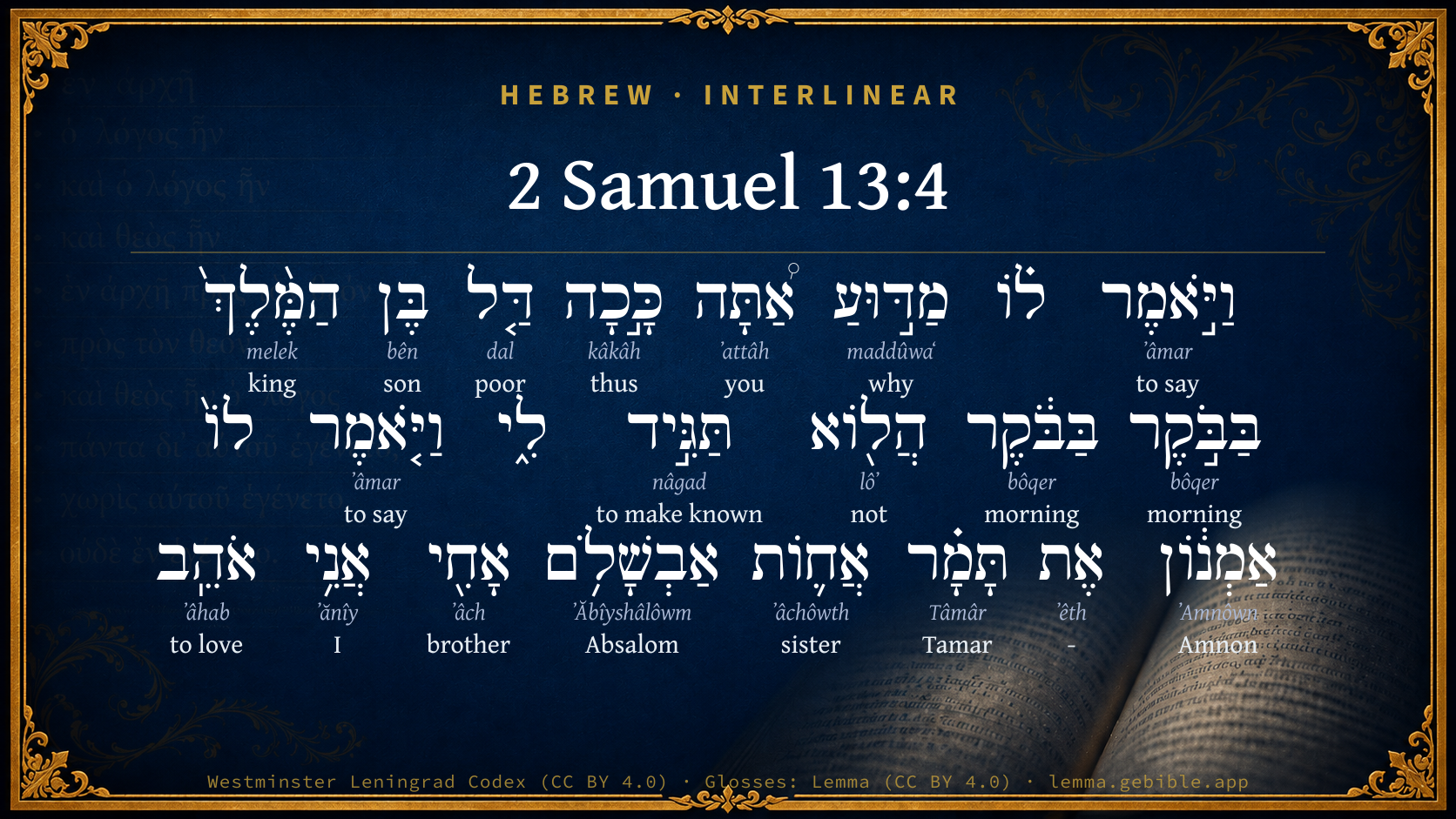
2 Samuel 13:4

Hebrew (Westminster Leningrad Codex) 2 Samuel 13:4 appears in the Hebrew Old Testament. The text above is from the Westminster Leningrad Codex. Each word links to its Strong’s number, a concise gloss, and parsing drawn from the Open Scriptures Hebrew Bible morphology. Click any word for its full Brown-Driver-Briggs (BDB) entry.
Download image
Cite this verse

2 Samuel 13:4 (World English Bible). Public Domain. Lemma interlinear Bible study tool, https://lemma.gebible.app/v/2-samuel/13/4.

Show BibTeX & RIS
BibTeX
RIS
English Translation
He said to him, Why, son of the king, are you thus lean from day to day? Won't you tell me? Amnon said to him, I love Tamar, my brother Absalom's sister.
World English Bible · Public Domain
Download a study sheet

One document with this verse’s original text, its word-by-word gloss line, the meaning frame, cross-references with their text, attributed commentary, and full source and license credits — printable, and it pastes into notes with its structure intact.

This verse Autodidact and up

Study sheet (.html) Plain text (.txt)

A passage Seminary Student

Up to 50 verses in one chapter. A passage sheet keeps up to 6 commentary sources and 12 cross-references per verse, in the order this page ranks them, and says so on the sheet whenever that leaves anything out. Ask for a single verse and you get the Autodidact verse sheet above.

Everything on this page stays free to read, with no account — the sheet is a download of what is already on screen, not access to it.

Want to remove ads? Support Godless Engineer
Compare translations 3

The same verse in 3 English versions, stacked beneath the original-language interlinear above. Click any original word for its lexicon entry.

Each is an independent rendering of the whole verse — the interlinear is not word-aligned to these translations.

Highlighted words mark where these versions differ — a whole-verse word diff, not a word-by-word alignment.

  • World English Bible Public Domain
    He said to him, Why, son of the king, are you thus lean from day to day? Won't you tell me? Amnon said to him, I love Tamar, my brother Absalom's sister.
  • King James Version Public Domain
    And he said unto him, Why art thou, being the king's son, lean from day to day? wilt thou not tell me? And Amnon said unto him, I love Tamar, my brother Absalom's sister.
  • unfoldingWord Literal Text CC BY-SA 4.0
    And he said to him, “Why you so weak, son of the king, by morning, by morning? Will you not declare to me?” And Amnon said to him, “I am loving Tamar, the sister of Absalom my brother.”

unfoldingWord Literal Text — © unfoldingWord, licensed CC BY-SA 4.0. Word-aligned USFM3 via Door43 (git.door43.org/unfoldingWord/en_ult).

Versions to compare (up to 4)

3 of 4 selected

Show all 18 translations

Every available English version of this verse, each an independent rendering of the whole verse.

  • World English Bible Public Domain
    He said to him, Why, son of the king, are you thus lean from day to day? Won't you tell me? Amnon said to him, I love Tamar, my brother Absalom's sister.
  • Berean Standard Bible Public Domain
    so he asked Amnon, “Why are you, the son of the king, so depressed morning after morning? Won’t you tell me?” Amnon replied, “I am in love with Tamar, my brother Absalom’s sister.”
  • Majority Standard Bible Public Domain
    and he asked Amnon, “Why are you, the son of the king, so depressed morning after morning? Won’t you tell me?” Amnon replied, “I am in love with Tamar, my brother Absalom’s sister.”
  • King James Version Public Domain
    And he said unto him, Why art thou, being the king's son, lean from day to day? wilt thou not tell me? And Amnon said unto him, I love Tamar, my brother Absalom's sister.
  • American Standard Version (1901) Public Domain
    And he said unto him, Why, O son of the king, art thou thus lean from day to day? wilt thou not tell me? And Amnon said unto him, I love Tamar, my brother Absalom's sister.
  • Revised Version (1885) Public Domain
    And he said unto him, Why, O son of the king, art thou thus lean from day to day? wilt thou not tell me? And Amnon said unto him, I love Tamar, my brother Absalom’s sister.
  • Geneva Bible (1599) Public Domain
    Who sayde vnto him, Why art thou the Kings sonne so leane from day to day? wilt thou not tell me? Then Amnon answered him, I loue Tamar my brother Absaloms sister.
  • Douay-Rheims (1899) Public Domain
    And he said to him: Why dost thou grow so lean from day to day, O son of the king? why dost thou not tell me the reason of it? And Amnon said to him: I am in love with Thamar the sister of my brother Absalom.
  • Young's Literal Translation Public Domain
    and saith to him, `Wherefore `art' thou thus lean, O king's son, morning by morning? dost thou not declare to me?' And Amnon saith to him, `Tamar -- sister of Absalom my brother -- I am loving.'
  • Literal Standard Version CC BY-SA 4.0
    and says to him, “Why [are] you thus lean, O king’s son, morning by morning? Do you not declare [it] to me?” And Amnon says to him, “Tamar—sister of my brother Absalom—I am loving.”
  • Unlocked Literal Bible CC BY-SA 4.0
    Jonadab said to Amnon, “Why, son of the king, are you depressed every morning? Will you not tell me?” So Amnon answered him, “I love Tamar, my brother Absalom's sister.”
  • unfoldingWord Literal Text CC BY-SA 4.0
    And he said to him, “Why you so weak, son of the king, by morning, by morning? Will you not declare to me?” And Amnon said to him, “I am loving Tamar, the sister of Absalom my brother.”
  • Darby Bible Public Domain
    And he said to him, Why dost thou, the king's son, get thinner from morning to morning? Wilt thou not tell me? And Amnon said to him, I love Tamar, my brother Absalom's sister.
  • World Messianic Bible Public Domain
    He said to him, “Why, son of the king, are you so sad from day to day? Won’t you tell me?” Amnon said to him, “I love Tamar, my brother Absalom’s sister.”
  • Webster's Bible Public Domain
    And he said to him, Why art thou, being the king's son, pining from day to day? wilt thou not tell me? And Amnon said to him, I love Tamar, my brother Absalom's sister.
  • Free Bible Version CC BY-SA 4.0
    He asked Amnon, “Why are you, the king's son, so down every morning? Why don't you tell me what's wrong?” “I'm in love with Tamar, my brother Absalom's sister,” Amnon replied.
  • Bible in Basic English Public Domain
    And he said to him, O son of the king, why are you getting thinner day by day? will you not say what your trouble is? And Amnon said to him, I am in love with Tamar, my brother Absalom's sister.
  • JPS Tanakh (1917) Public Domain
    And he said unto him: 'Why, O son of the king, art thou thus becoming leaner from day to day? wilt thou not tell me?' And Amnon said unto him: 'I love Tamar, my brother Absalom's sister.'

Literal Standard Version (2020), Covenant Press — licensed CC BY-SA 4.0. Text via the HelloAO Bible API (eBible.org). Unlocked Literal Bible (unfoldingWord) — licensed CC BY-SA 4.0. Text via the HelloAO Bible API (eBible.org). unfoldingWord Literal Text — © unfoldingWord, licensed CC BY-SA 4.0. Word-aligned USFM3 via Door43 (git.door43.org/unfoldingWord/en_ult). Free Bible Version, Dr. Jonathan Gallagher — licensed CC BY-SA 4.0. Text via the HelloAO Bible API (eBible.org).

Word by word

More ways to search: Search by grammar → Find every occurrence → Compare this word →

Practice this passage: Drill this verse → Learn its vocabulary →

תָּמָ֗ר
Tâmâr
H8559
“Tamar”
Noun, Proper
Part of Speech
Noun
Type
Proper
Full BDB Definition

Origin: the same as H8558

TWOT: None

Tamar = "palm-tree" - widow of Er, the son of Judah; fiancee of Shelah, another son of Judah; wife of Judah and mother of Pharez and Zerah (noun proper feminine) - daughter of David by Maacah, sister of Absalom, and rape victim of Amnon her half brother, another son of David (noun proper feminine) - daughter of Absalom (noun proper feminine) - a place on the southern border of Gad (noun proper locative)
  1. וַיֹּ֣אמֶר ʼâmar H559 “and · to say” Conjunction + Verb, Qal, Sequential Imperfect, 3rd Person, Masculine, Singular
  2. מַדּ֣וּעַ maddûwaʻ H4069 “why” Particle, Interrogative
  3. אַ֠תָּה ʼattâh H859 “you” Pronoun, Personal, 2nd Person, Masculine, Singular
  4. כָּ֣כָה kâkâh H3602 “thus” Adverb
  5. דַּ֤ל dal H1800 “poor” Adjective, Adjective, Masculine, Singular, Absolute
  6. בֶּן bên H1121 “son of” Noun, Common, Masculine, Singular, Construct
  7. הַמֶּ֨לֶךְ֙ melek H4428 “the · king” Particle, Definite Article + Noun, Common, Masculine, Singular, Absolute
  8. בַּבֹּ֣קֶר bôqer H1242 “in/at the · morning” Preposition, Determined + Noun, Common, Masculine, Singular, Absolute
  9. בַּבֹּ֔קֶר bôqer H1242 “in/at the · morning” Preposition, Determined + Noun, Common, Masculine, Singular, Absolute
  10. הֲל֖וֹא lôʼ H3808 “not” Particle, Interrogative + Particle, Negative
  11. תַּגִּ֣יד nâgad H5046 “to make known” Verb, Hiphil, Imperfect, 2nd Person, Masculine, Singular
  12. וַיֹּ֤אמֶר ʼâmar H559 “and · to say” Conjunction + Verb, Qal, Sequential Imperfect, 3rd Person, Masculine, Singular
  13. אַמְנ֔וֹן ʼAmnôwn H550 “Amnon” Noun, Proper
  14. אֶת ʼêth H853 “-” Particle, Direct Object
  15. אֲח֛וֹת ʼâchôwth H269 “sister of” Noun, Common, Feminine, Singular, Construct
  16. אַבְשָׁלֹ֥ם ʼĂbîyshâlôwm H53 “Absalom” Noun, Proper
  17. אָחִ֖י ʼâch H251 “brother · my” Noun, Common, Masculine, Singular, Construct + Suffix, Personal, 1st Person, Common, Singular
  18. אֲנִ֥י ʼănîy H589 “I” Pronoun, Personal, 1st Person, Common, Singular
  19. אֹהֵֽב ʼâhab H157 “loving” Verb, Qal, Participle Active, Masculine, Singular, Absolute

About this verse

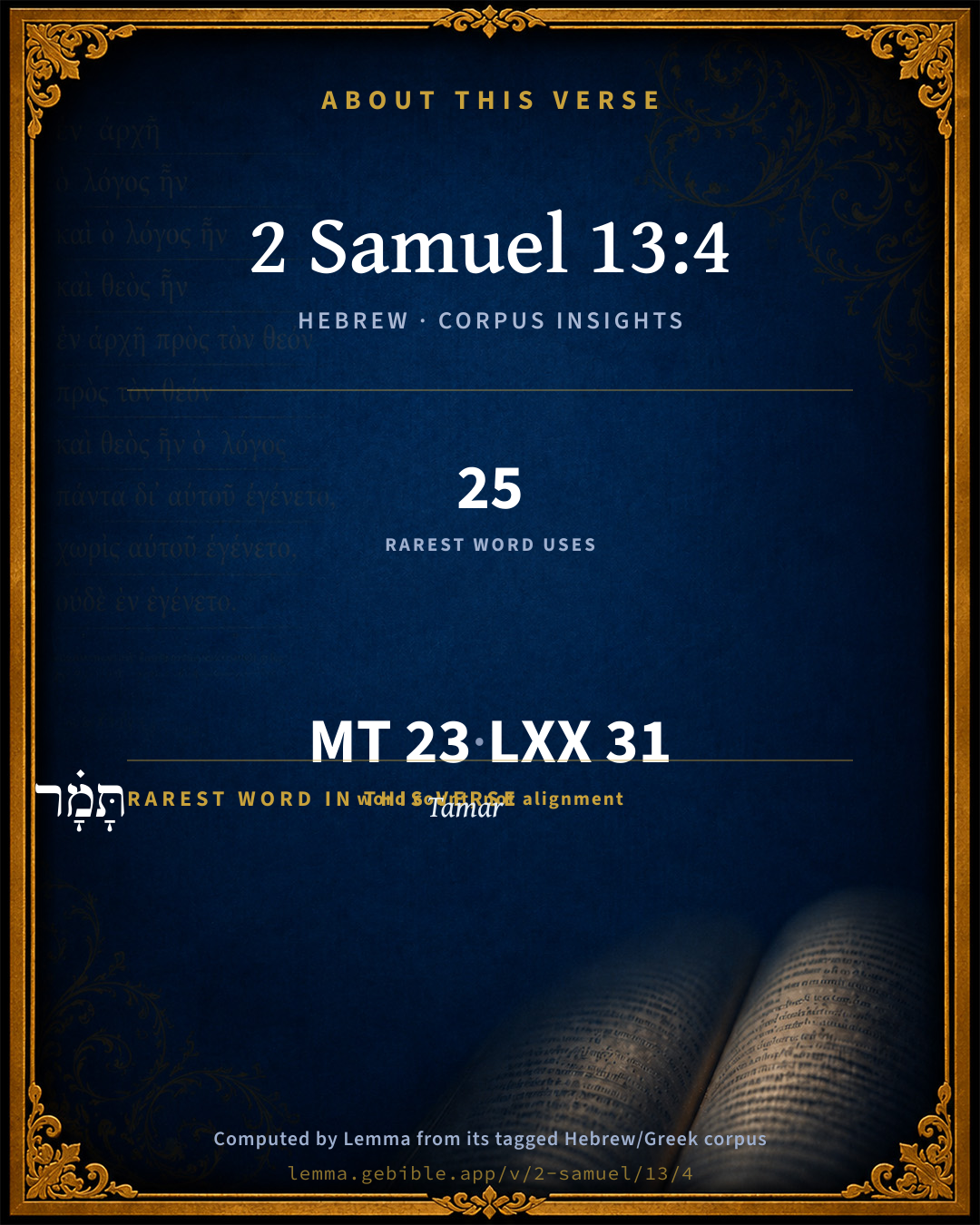
These counts appear in no published source. They are computed here, from the morphology-tagged text and Lemma’s own curated glosses. What Lemma adds →

23
words
18
distinct lemmas
Historical
section

Notable vocabulary

The rarest word here is תָּמָ֗ר Tamar H8559 — appearing just 25 times in the whole Hebrew Bible.

Shared distinctive vocabulary

תָּמָ֗ר Tamar H8559 occurs in 23 verses of the Hebrew Bible. Also found in:

Grammatical profile

  • 4 verbs
  • 9 nouns
  • 1 adjective
  • 2 pronouns
  • 3 prepositions
  • 1 adverb
  • 3 particles

Verb forms

  • וַיֹּ֣אמֶר Qal · Sequential Imperfect
  • תַּגִּ֣יד Hiphil · Imperfect
  • וַיֹּ֤אמֶר Qal · Sequential Imperfect
  • אֹהֵֽב Qal · Participle Active

Repetition

Words recur within this verse — often emphatic in Hebrew:

  • וַיֹּ֣אמֶר to say H559 ×2
  • בַּבֹּ֣קֶר morning H1242 ×2

Hebrew & Septuagint length

In English translation the verse runs 32 words from the Hebrew and 38 from the Septuagint (LXX English) — closely comparable.

A rough comparison of the two English renderings, which tokenize alike — not a word-level alignment.

Word counts can differ between the Hebrew and the Greek without any difference in meaning — e.g. the Hebrew direct-object marker אֵת has no separate Greek word, and Greek often adds the article ὁ.

In the original languages it is 23 Hebrew tokens and 31 Greek tokens — but the two are counted differently (Hebrew bundles its prefixes and suffixes into one token; the Greek is in lemma form), so that isn’t a like-for-like length.

Cross-references

8

Topical passages linked to 2 Samuel 13:4 in the Treasury of Scripture Knowledge — connected by theme and wording, ordered by reader-vote popularity; previews shown in the World English Bible.

  • Leviticus 18:9 "'You shall not uncover the nakedness of your sister, the daughter of your father, or the daughter of your mother, whether born at home, or born abroad.
  • Leviticus 20:17 "'If a man takes his sister, his father's daughter, or his mother's daughter, and sees her nakedness, and she sees his nakedness; it is a shameful thing; and they shall be cut off in the sight of the children of their people: he has uncovered his sister's nakedness; he shall bear his iniquity.
  • Esther 5:13–14 Yet all this avails me nothing, so long as I see Mordecai the Jew sitting at the king's gate.
  • Isaiah 3:9 The look of their faces testify against them. They parade their sin like Sodom. They don't hide it. Woe to their soul! For they have brought disaster upon themselves.
  • Jeremiah 8:12 Were they ashamed when they had committed abomination? nay, they were not at all ashamed, neither could they blush: therefore shall they fall among those who fall; in the time of their visitation they shall be cast down, says Yahweh.
  • Micah 7:3 Their hands are on that which is evil to do it diligently. The ruler and judge ask for a bribe; And the powerful man dictates the evil desire of his soul. Thus they conspire together.
  • Luke 12:32 Don't be afraid, little flock, for it is your Father's good pleasure to give you the Kingdom.
  • 1 Kings 21:7 Jezebel his wife said to him, Do you now govern the kingdom of Israel? arise, and eat bread, and let your heart be merry: I will give you the vineyard of Naboth the Jezreelite.

Cross-references courtesy of OpenBible.info (CC BY 4.0).

Hebrew and Greek witnesses Masoretic Hebrew ↔ Greek Septuagint

The same verse in the two great witnesses to the Old Testament, shown verse-for-verse.

These are two independent witnesses, not word-aligned to each other, and the Septuagint is shown in lemma (dictionary) form.

Hebrew 2 Samuel 13:4 Masoretic · Westminster Leningrad Codex

וַיֹּ֣אמֶר ל֗וֹ מַדּ֣וּעַ אַ֠תָּה כָּ֣כָה דַּ֤ל בֶּן הַמֶּ֨לֶךְ֙ בַּבֹּ֣קֶר בַּבֹּ֔קֶר הֲל֖וֹא תַּגִּ֣יד לִ֑י וַיֹּ֤אמֶר לוֹ֙ אַמְנ֔וֹן אֶת תָּמָ֗ר אֲח֛וֹת אַבְשָׁלֹ֥ם אָחִ֖י אֲנִ֥י אֹהֵֽב

He said to him, Why, son of the king, are you thus lean from day to day? Won't you tell me? Amnon said to him, I love Tamar, my brother Absalom's sister.

World English Bible · Public Domain

Greek LXX 2 Samuel 13:4 Septuagint · lemma form

καί εἶπον αὐτός τίς σύ ὅτι σύ οὕτως ἀσθενής υἱός ὁ βασιλεύς ὁ πρωί πρωί οὐ ἀποἀγγέλλω ἐγώ καί εἶπον αὐτός αμνων θημαρ ὁ ἀδελφή αβεσσαλωμ ὁ ἀδελφός ἐγώ ἐγώ ἀγαπάω

And he said to him, What ails you that you are thus weak? O son of the king, morning by morning? will you not tell me? and Ammon said, I love Themar the sister of my brother Abessalom.

LXX2012 (modern English Septuagint) · Public Domain

Hebrew: Westminster Leningrad Codex (CC BY 4.0). Greek: Septuagint (public domain); English from LXX2012 (modern English Septuagint) (Public Domain). How the Septuagint differs from the Hebrew →

Targum (Aramaic paraphrase)

1

The Targum is the ancient Jewish Aramaic paraphrase of the Hebrew Scriptures — an interpretive translation, not the Hebrew text itself. Onkelos (literal) and Pseudo-Jonathan (expansive) render the Torah, and Jonathan the Prophets. Coverage is partial: where no permissively-licensed English translation exists for a verse, only the Aramaic is shown. This is verse-level text, not a word-by-word alignment to the Hebrew.

  1. Targum Jonathan Prophets (Joshua–Malachi)
    וַאֲמַר לֵיהּ מָה דֵין אַתְּ כְּדֵין חֲשׁוֹךְ בַּר מַלְכָּא בִּצְפַר בִּצְפַר הֲלָא תְּחַוֵי לִי וַאֲמַר לֵיהּ אַמְנוֹן יַת תָּמָר אַחְתֵיהּ דְאַבְשָׁלוֹם אֲחִי אֲנָא רָחֵם:

    (no public-domain English translation for this verse)

    Targum Jonathan — Aramaic: “Mikraot Gedolot” (public domain). English: “Sefaria Community Translation” (CC0 1.0 (public-domain dedication)); “London "Chaldee Paraphrase," 1871” (public domain). Text via Sefaria.

Commentary

Notes on 2 Samuel 13:4 from classic Christian and Jewish commentators (each source and its license shown beneath its notes). The classic Christian expositions comment on the surrounding passage and are grouped to its opening verse, so a note may address several verses; the Jewish commentaries on the Tanakh (Rashi and others) are per-verse, so they appear only where the commentator wrote on this verse.

Lemma curates 59 commentaries, every one of them public domain or Creative Commons licensed, each selected and text-cleaned for this edition rather than reprinted as found. About our sources →

Trapp's Complete Commentary

John Trapp

2Sa 13:4 And he said unto him, Why [art] thou, [being] the king’s son, lean from day to day? wilt thou not tell me? And Amnon said unto him, I love Tamar, my brother Absalom’s sister.

Ver. 4. Why art thou, being the king’s son?] And therefore needest not want for anything. But in addition Amnon should have considered, that in maxima libertate minima licentia, that although the king’s son, yet he should not have desired or done anything unbeseeming his dignity; and Jonadab, had he been a friend indeed, would have told him as much. Antigonus, being invited to a place where a notable harlot was to be present, asked counsel of Menedemus what he should do: he bade him only remember that he was a king’s son.

Lean from day to day.] Heb., Thin every morning; sc., For want of sleep, through thoughtful anxieties by night.

“ Invidia vel amore vigil torquebere. ” - Horat.

Plato saith, He that is in love liveth in the body of another, but dieth in his own; whilst the whole man macrescit, marcescit et contabescit ex amoris vehementia. Hence Apollonius Tyanaeus the philosopher, when the king of Babylon - devising how to punish a certain young courtier who had lain with a concubine of his - asked him what was the greatest of all tortures, answered, that he could not punish him worse than by suffering him to live in the fire of lust, which would secretly but certainly devour him. {a} Hence that of the poet,

“ Tristatur, pallet, non dormit, nil edit, ardet,

Nec tamen aegrotat Calliodorus: amat. ”

Wilt thou not tell me?] Who can both keep counsel and give counsel. But what counsel gave he other than what Julia gave Caracalla, her son-in-law, when he said, O si liceret Oh that I might lie with thee! She impudently answered, Si libet licet: imperator dat leges, non aceipit, You may if you will: for an emperor giveth laws to others, he taketh none himself.

I love Tamar, my brother Absalom’s sister.] He saith not, My sister, for shame. Sin is a blushful business. This filthy love is the disease which the physicians call Eρων, and is by one not unfitly compared to that shirt which Clytemnestra put upon her husband Agamemnon; or to those asps {b} which Cleopatra applied to her body to suck out her lifeblood; or to those Charonean ditches, mortiferum spiritum exhalantes, that send out a deadly air. Good, therefore, is the tragedian’s counsel,

“ Recedat a te, temere ne credas, Amor:

Florem decoris singuli ne carpent dies. ”

- Sen. in Octav.

{a} Agnus curio, apud Plaut. Macilentus, quasi curis confectus. Spec. Hum Vit., p. 125.

{b} Plin., lib. ii. cap. 93.

John Trapp, A Commentary or Exposition upon All the Books of the Old and New Testament (1647–1656) — public domain. Text from a community e-Sword module.

Tyndale Open Study Notes

Tyndale Open Resources

13:4 morning after morning: Amnon’s obsession was all-consuming and ongoing.

Tyndale Open Study Notes — © Tyndale Open Resources, licensed CC BY-SA 4.0. Text via the HelloAO Bible API.

Jamieson, Fausset & Brown

Robert Jamieson, A. R. Fausset & David Brown

my brother Absalom's sister--In Eastern countries, where polygamy prevails, the girls are considered to be under the special care and protection of their uterine brother, who is the guardian of their interests and their honor, even more than their father himself (see on Gen. 34:6-25).

Jamieson, Fausset & Brown — Commentary Critical and Explanatory on the Whole Bible (1871) — public domain (CC PDM 1.0). Text via the HelloAO Bible API.

The Cambridge Bible for Schools and Colleges

gen. ed. J. J. S. Perowne

4. Why, &c.] Why art thou so wasted, O king’s son, morning by morning? His cousin Jonadab either lived in the same house with Amnon as his companion, or noticed his worn looks when he came to visit him at his morning levee.

The Cambridge Bible for Schools and Colleges (gen. ed. J. J. S. Perowne; Cambridge University Press, 1878–1918) — public domain. Text from a community e-Sword module.

John Gill's Exposition

And he said unto him, why art thou, being the king's son,

lean from day today?.... Or "morning by morning", (w); he was the king's eldest son, heir to the crown, fed at his table, had everything to make him gay and cheerful, and yet pined away; his flesh wasted (x), his countenance waxed wan and pale, and especially in the mornings; in the daytime he met with diversions which, in some measure, took off his thoughts from the object his mind was impressed with, but in the night season they were continually employed about it; so that he could have no rest and sleep, which made him look ruefully in the morning; and this man had a suspicion of his case, and therefore put this and the following question to him:

wilt thou not tell me? who am so nearly related to thee, and who have such a particular value and affection for thee:

and Amnon said unto him, I love Tamar, my brother Absalom's sister; he does not call her his sister, but Absalom's sister, to lessen his sin of unlawful love to her, which, being thus closely pressed, and by a friend, he could not conceal.

(w) , "in mane in mane", Montanus. (x) "Fecit amor maciem -----". Ovid Metamorph. l. 11. Fab. 11. v. 793.

John Gill's Exposition of the Whole Bible (1746–1763) — public domain (CC PDM 1.0). Text via the HelloAO Bible API.

Haydock's Catholic Bible Commentary

King? to whom every indulgence must be allowed. (Menochius)

George Leo Haydock (1774–1849), Haydock's Catholic Family Bible and Commentary, 1859 edition — public domain. Excludes Psalms (Douay-Rheims chapter numbering differs from Protestant) and Deuterocanonical books (Catholic canon only).

Matthew Poole's English Annotations

From day to day, Heb. from morning to morning; for whereas in the day he had many diversions and refreshments, in the night he was pestered with tormenting thoughts and passions; the effects whereof appeared in his countenance in the morning.

Wilt thou not tell me, thy sure friend and faithful servant, who am ready to advise and assist thee?

Matthew Poole's English Annotations on the Holy Bible (1683–1685) — public domain. Text from a community e-Sword/MySword module.

The Pulpit Commentary

Why art thou, being the king"s son, lean? The Hebrew is, Why, O son of the king, dost thou pine away morning by morning? There was probably a gathering of friends every morning at the young prince"s house, and his cousin, attending this levee, noticed Amnon"s melancholy, and, having forced a confession from him, is unscrupulous enough to suggest a plan that would make Tamar her brother"s victim.

The Pulpit Commentary (1880–1919), ed. H.D.M. Spence-Jones & Joseph S. Exell — public domain. Text from a community e-Sword module.

Rashi

Rabbi Shlomo Yitzchaki (Rashi)

Weak. Weak as [we find] "weak and bad [in] appearance".

Rashi on the Tanakh — English translations: “The Judaica Press complete Tanach with Rashi, translated by A. J. Rosenberg” (CC BY 4.0); “Pentateuch with Rashi's commentary by M. Rosenbaum and A.M. Silbermann, 1929-1934” (public domain); “The Metsudah Tanach series, Lakewood, N.J” (CC BY 4.0); and “The Book of Joshua, Metsudah Publications, 1997” (CC BY 4.0). Text via Sefaria.

Lesson kit

Teaching starters — assembled from the data on this page, not authored interpretation. Every prompt links to the verse data it draws on. Edit before teaching.

2 Samuel, in the Historical, opens this verse with 23 words (18 distinct Hebrew lemmas). Its most distinctive word is Tâmâr (“Tamar”). A historical commentator’s framing appears above. Read the whole chapter for the surrounding context.

Discussion questions

  1. What does “Tamar” (Tâmâr) contribute to the verse as a whole?
  2. How does Genesis 38:6, which shares the word «Tamar», read alongside this verse?
  3. What does the repetition of “to say” (2× in this one verse) do in this verse?
  4. The translations on this page render this verse differently — a whole-verse word diff, not a word-by-word alignment. What might account for the different wordings?
  5. «וַיֹּ֣אמֶר» is a Qal Sequential Imperfect verb. How does that grammatical form shape the action described?
  6. Compare how Trapp's Complete Commentary and Tyndale Open Study Notes read this verse. Where do they agree or differ?

Things to notice

Reading settings

Reading text

Shown beneath each verse's original-language words.

Old Testament
Old Testament edition

Read the OT as the Masoretic Hebrew (MT) or the Greek Septuagint (LXX).

English shown for the Greek Septuagint (in the Hebrew ↔ Greek comparison).

Comparing translations? Open the Compare panel on any verse page to stack up to four side by side.