Hosea 7:6

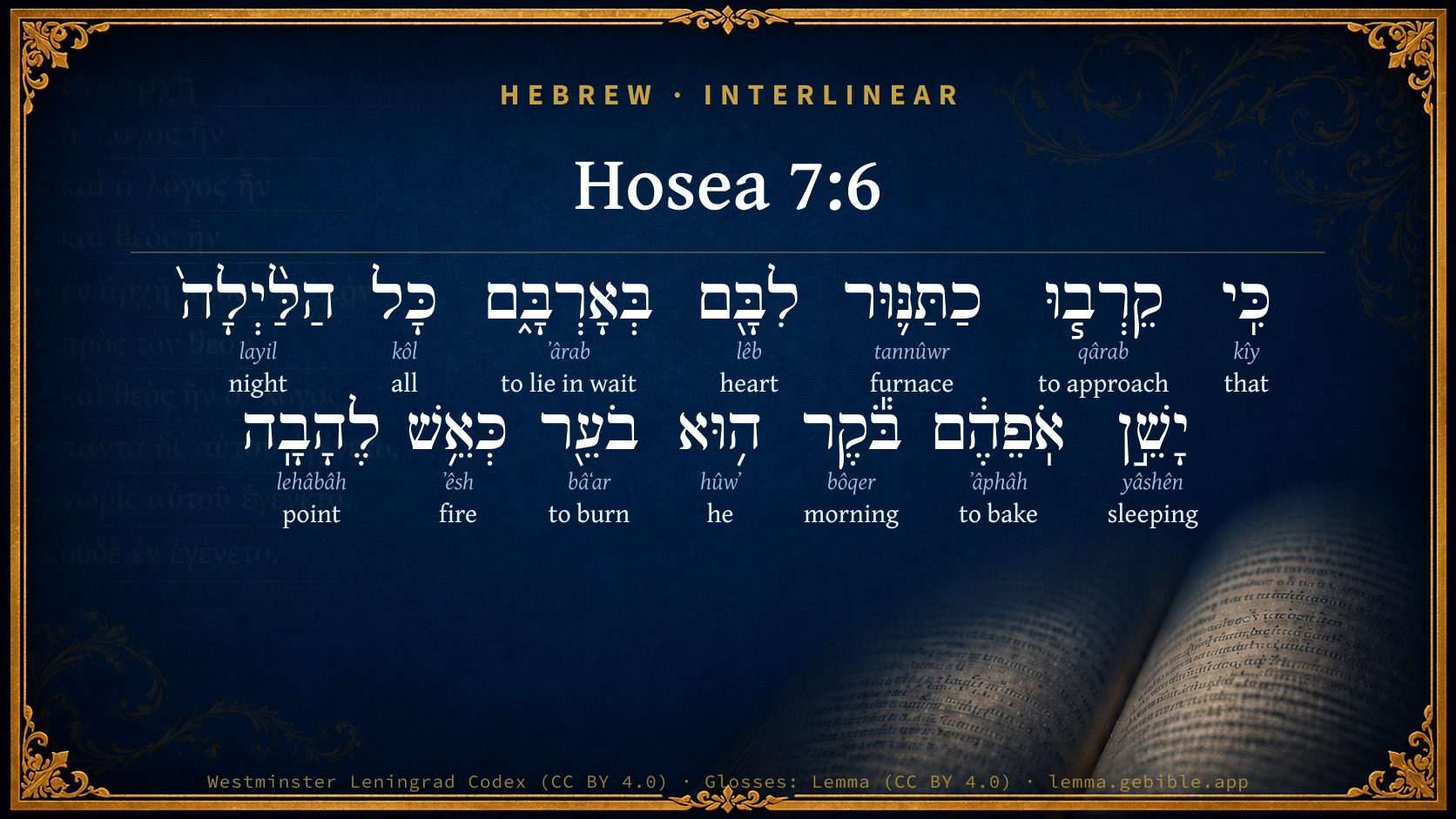
Hebrew (Westminster Leningrad Codex) Hosea 7:6 appears in the Hebrew Old Testament. The text above is from the Westminster Leningrad Codex. Each word links to its Strong’s number, a concise gloss, and parsing drawn from the Open Scriptures Hebrew Bible morphology. Click any word for its full Brown-Driver-Briggs (BDB) entry.
Download image
Cite this verse

Hosea 7:6 (World English Bible). Public Domain. Lemma interlinear Bible study tool, https://lemma.gebible.app/v/hosea/7/6.

Show BibTeX & RIS
BibTeX
RIS
English Translation
For they have made ready their heart like an oven, While they lie in wait. Their baker sleeps all the night. In the morning it burns as a flaming fire.
World English Bible · Public Domain
Download a study sheet

One document with this verse’s original text, its word-by-word gloss line, the meaning frame, cross-references with their text, attributed commentary, and full source and license credits — printable, and it pastes into notes with its structure intact.

This verse Autodidact and up

Study sheet (.html) Plain text (.txt)

A passage Seminary Student

Up to 50 verses in one chapter. A passage sheet keeps up to 6 commentary sources and 12 cross-references per verse, in the order this page ranks them, and says so on the sheet whenever that leaves anything out. Ask for a single verse and you get the Autodidact verse sheet above.

Everything on this page stays free to read, with no account — the sheet is a download of what is already on screen, not access to it.

Want to remove ads? Support Godless Engineer
Compare translations 3

The same verse in 3 English versions, stacked beneath the original-language interlinear above. Click any original word for its lexicon entry.

Each is an independent rendering of the whole verse — the interlinear is not word-aligned to these translations.

Highlighted words mark where these versions differ — a whole-verse word diff, not a word-by-word alignment.

  • World English Bible Public Domain
    For they have made ready their heart like an oven, While they lie in wait. Their baker sleeps all the night. In the morning it burns as a flaming fire.
  • King James Version Public Domain
    For they have made ready their heart like an oven, whiles they lie in wait: their baker sleepeth all the night; in the morning it burneth as a flaming fire.
  • unfoldingWord Literal Text CC BY-SA 4.0
    For they have brought near their heart like an oven in their ambush. All the night their baker asleep; the morning it is burning like a fire of flame.

unfoldingWord Literal Text — © unfoldingWord, licensed CC BY-SA 4.0. Word-aligned USFM3 via Door43 (git.door43.org/unfoldingWord/en_ult).

Versions to compare (up to 4)

3 of 4 selected

Show all 18 translations

Every available English version of this verse, each an independent rendering of the whole verse.

  • World English Bible Public Domain
    For they have made ready their heart like an oven, While they lie in wait. Their baker sleeps all the night. In the morning it burns as a flaming fire.
  • Berean Standard Bible Public Domain
    For they prepare their heart like an oven while they lie in wait; all night their anger smolders; in the morning it blazes like a flaming fire.
  • Majority Standard Bible Public Domain
    For they prepare their heart like an oven while they lie in wait; all night their anger smolders; in the morning it blazes like a flaming fire.
  • King James Version Public Domain
    For they have made ready their heart like an oven, whiles they lie in wait: their baker sleepeth all the night; in the morning it burneth as a flaming fire.
  • American Standard Version (1901) Public Domain
    For they have made ready their heart like an oven, while they lie in wait: their baker sleepeth all the night; in the morning it burneth as a flaming fire.
  • Revised Version (1885) Public Domain
    For they have made ready their heart like an oven, whiles they lie in wait: their baker sleepeth all the night; in the morning it burneth as a flaming fire.
  • Geneva Bible (1599) Public Domain
    For they haue made ready their heart like an ouen whiles they lie in waite: their baker sleepeth all the night: in the morning it burneth as a flame of fire.
  • Douay-Rheims (1899) Public Domain
    Because they have applied their heart like an oven, when he laid snares for them: he slept all the night baking them, in the morning he himself was heated as a flaming fire.
  • Young's Literal Translation Public Domain
    For they have drawn near, As an oven `is' their heart, In their lying in wait all the night sleep doth their baker, Morning! he is burning as a flaming fire.
  • Literal Standard Version CC BY-SA 4.0
    For they have drawn near, || Their heart [is] as an oven || In their lying in wait—their baker sleeps all night, || Morning! He is burning as a flaming fire.
  • Unlocked Literal Bible CC BY-SA 4.0
    For with hearts like an oven, they devise their deceitful plans. Their anger smolders all night; in the morning it burns high like a flaming fire.
  • unfoldingWord Literal Text CC BY-SA 4.0
    For they have brought near their heart like an oven in their ambush. All the night their baker asleep; the morning it is burning like a fire of flame.
  • Darby Bible Public Domain
    For they have applied their heart like an oven to their lying in wait: their baker sleepeth all the night; in the morning it burneth like a flaming fire.
  • World Messianic Bible Public Domain
    For they have prepared their heart like an oven, while they lie in wait. Their anger smolders all night. In the morning it burns as a flaming fire.
  • Webster's Bible Public Domain
    For they have made ready their heart like an oven, while they lie in wait: their baker sleepeth all the night; in the morning it burneth as a flaming fire.
  • Free Bible Version CC BY-SA 4.0
    Their minds are fired up like an oven; they go to him with their plots. All through the night their anger burns; in the morning it blazes out uncontrollably.
  • Bible in Basic English Public Domain
    For they have made their hearts ready like an oven, while they are waiting secretly; their wrath is sleeping all night; in the morning it is burning like a flaming fire.
  • JPS Tanakh (1917) Public Domain
    For they have made ready their heart like an oven, while they lie in wait; their baker sleepeth all the night, in the morning it burneth as a flaming fire.

Literal Standard Version (2020), Covenant Press — licensed CC BY-SA 4.0. Text via the HelloAO Bible API (eBible.org). Unlocked Literal Bible (unfoldingWord) — licensed CC BY-SA 4.0. Text via the HelloAO Bible API (eBible.org). unfoldingWord Literal Text — © unfoldingWord, licensed CC BY-SA 4.0. Word-aligned USFM3 via Door43 (git.door43.org/unfoldingWord/en_ult). Free Bible Version, Dr. Jonathan Gallagher — licensed CC BY-SA 4.0. Text via the HelloAO Bible API (eBible.org).

Word by word

More ways to search: Search by grammar → Find every occurrence → Compare this word →

Practice this passage: Drill this verse → Learn its vocabulary →

יָשֵׁ֣ן
yâshên
H3463
“sleeping”
Adjective, Adjective, Masculine, Singular, Absolute
Part of Speech
Adjective
Type
Adjective
Gender
Masculine
Number
Singular
State
Absolute
Full BDB Definition

Origin: from H3462

TWOT: 928a

sleeping
  1. כִּֽי kîy H3588 “that” Conjunction
  2. קֵרְב֧וּ qârab H7126 “to approach” Verb, Piel, Perfect, 3rd Person, Common, Plural
  3. כַתַּנּ֛וּר tannûwr H8574 “like/as the · furnace” Preposition, Determined + Noun, Common, Masculine, Singular, Absolute
  4. לִבָּ֖ם lêb H3820 “heart · their” Noun, Common, Masculine, Singular, Construct + Suffix, Personal, 3rd Person, Masculine, Plural
  5. בְּאָרְבָּ֑ם ʼârab H693 “in/at · ambush · their” Preposition + Noun, Common, Masculine, Singular, Construct + Suffix, Personal, 3rd Person, Masculine, Plural
  6. כָּל kôl H3605 “all of” Noun, Common, Masculine, Singular, Construct
  7. הַלַּ֨יְלָה֙ layil H3915 “the · night” Particle, Definite Article + Noun, Common, Masculine, Singular, Absolute
  8. אֹֽפֵהֶ֔ם ʼâphâh H644 “baking · them” Verb, Qal, Participle Active, Masculine, Singular, Construct + Suffix, Personal, 3rd Person, Masculine, Plural
  9. בֹּ֕קֶר bôqer H1242 “morning” Noun, Common, Masculine, Singular, Absolute
  10. ה֥וּא hûwʼ H1931 “he” Pronoun, Personal, 3rd Person, Masculine, Singular
  11. בֹעֵ֖ר bâʻar H1197 “burning” Verb, Qal, Participle Active, Masculine, Singular, Absolute
  12. כְּאֵ֥שׁ ʼêsh H784 “like/as · fire of” Preposition + Noun, Common, Both, Singular, Construct
  13. לֶהָבָֽה lehâbâh H3852 “point” Noun, Common, Feminine, Singular, Absolute

About this verse

These counts appear in no published source. They are computed here, from the morphology-tagged text and Lemma’s own curated glosses. What Lemma adds →

14
words
14
distinct lemmas
Prophets
section

Notable vocabulary

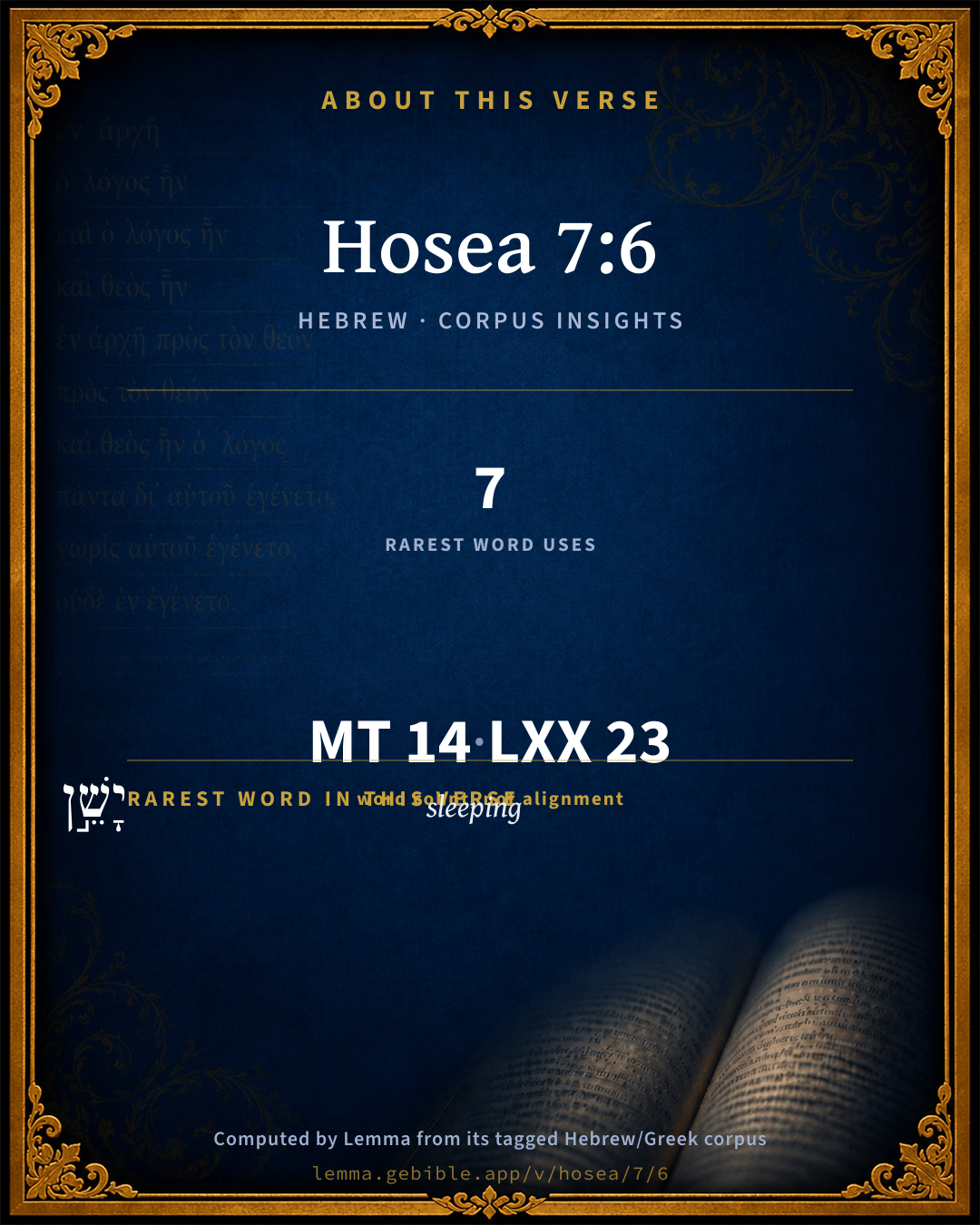
The rarest word here is יָשֵׁ֣ן sleeping H3463 — appearing just 7 times in the whole Hebrew Bible.

Shared distinctive vocabulary

יָשֵׁ֣ן sleeping H3463 occurs in 7 verses of the Hebrew Bible. Also found in:

Grammatical profile

  • 3 verbs
  • 8 nouns
  • 1 adjective
  • 1 pronoun
  • 1 conjunction

Verb forms

  • קֵרְב֧וּ Piel · Perfect
  • אֹֽפֵהֶ֔ם Qal · Participle Active
  • בֹעֵ֖ר Qal · Participle Active

Hebrew & Septuagint length

In English translation the verse runs 30 words from the Hebrew and 32 from the Septuagint (LXX English) — closely comparable.

A rough comparison of the two English renderings, which tokenize alike — not a word-level alignment.

Word counts can differ between the Hebrew and the Greek without any difference in meaning — e.g. the Hebrew direct-object marker אֵת has no separate Greek word, and Greek often adds the article ὁ.

In the original languages it is 14 Hebrew tokens and 23 Greek tokens — but the two are counted differently (Hebrew bundles its prefixes and suffixes into one token; the Greek is in lemma form), so that isn’t a like-for-like length.

Cross-references

8

Topical passages linked to Hosea 7:6 in the Treasury of Scripture Knowledge — connected by theme and wording, ordered by reader-vote popularity; previews shown in the World English Bible.

  • Psalms 10:8–9 He lies in wait near the villages. From ambushes, he murders the innocent. His eyes are secretly set against the helpless.
  • Micah 2:1 Woe to those who devise iniquity And work evil on their beds! When the morning is light, they practice it, Because it is in the power of their hand.
  • 1 Samuel 19:11–15 Saul sent messengers to David's house, to watch him, and to kill him in the morning: and Michal, David's wife, told him, saying, If you don't save your life tonight, tomorrow you will be slain.
  • 2 Samuel 13:28–29 Absalom commanded his servants, saying, Mark you now, when Amnon's heart is merry with wine; and when I tell you, Smite Amnon, then kill him; don't be afraid; haven't I commanded you? be courageous, and be valiant.
  • Proverbs 4:16 For they don't sleep, unless they do evil. Their sleep is taken away, unless they make someone fall.
  • Hosea 7:4 They are all adulterers. They are burning like an oven that the baker stops stirring, From the kneading of the dough, until it is leavened.
  • Hosea 7:7 They are all hot as an oven, And devour their judges. All their kings have fallen. There is no one among them who calls to me.
  • Psalms 21:9 You will make them as a fiery furnace in the time of your anger. Yahweh will swallow them up in his wrath. The fire shall devour them.

Cross-references courtesy of OpenBible.info (CC BY 4.0).

Hebrew and Greek witnesses Masoretic Hebrew ↔ Greek Septuagint

The same verse in the two great witnesses to the Old Testament, shown verse-for-verse.

These are two independent witnesses, not word-aligned to each other, and the Septuagint is shown in lemma (dictionary) form.

Hebrew Hosea 7:6 Masoretic · Westminster Leningrad Codex

כִּֽי קֵרְב֧וּ כַתַּנּ֛וּר לִבָּ֖ם בְּאָרְבָּ֑ם כָּל הַלַּ֨יְלָה֙ יָשֵׁ֣ן אֹֽפֵהֶ֔ם בֹּ֕קֶר ה֥וּא בֹעֵ֖ר כְּאֵ֥שׁ לֶהָבָֽה

For they have made ready their heart like an oven, While they lie in wait. Their baker sleeps all the night. In the morning it burns as a flaming fire.

World English Bible · Public Domain

Greek LXX Hosea 7:6 Septuagint · lemma form

διότι ἀνακαίω ὡς κλίβανος ὁ καρδία αὐτός ἐν ὁ καταῥάσσω αὐτός ὅλος ὁ νύξ ὕπνος ἐφράιμ ἐνπίμπλημι πρωΐ γίγνομαι ἀνακαίω ὡς πῦρ φέγγος

Therefore their hearts are inflamed as an oven, while they rage all the night: Ephraim is satisfied with sleep; the morning is come; he is burnt up as a flame of fire.

LXX2012 (modern English Septuagint) · Public Domain

On this verse, The Pulpit Commentary discusses the Septuagint’s reading. Read the note in Commentary ↓

Hebrew: Westminster Leningrad Codex (CC BY 4.0). Greek: Septuagint (public domain); English from LXX2012 (modern English Septuagint) (Public Domain). How the Septuagint differs from the Hebrew →

Targum (Aramaic paraphrase)

1

The Targum is the ancient Jewish Aramaic paraphrase of the Hebrew Scriptures — an interpretive translation, not the Hebrew text itself. Onkelos (literal) and Pseudo-Jonathan (expansive) render the Torah, and Jonathan the Prophets. Coverage is partial: where no permissively-licensed English translation exists for a verse, only the Aramaic is shown. This is verse-level text, not a word-by-word alignment to the Hebrew.

  1. Targum Jonathan Prophets (Joshua–Malachi)
    אֲרֵי אִתְקְרִיבוּ לַעֲצַת חֶטְאִין וְלָא עַכִּיבוּ כְּתַנוּרָא בָּעֵר לִבְּהוֹן בְּאִתְכְּמוֹנֵיהוֹן כָּל לֵילְיָא מוֹרִיךְ רוּגְזְהוֹן עַל צַפְרָא הוּא דָלֵיק בְּאָשָׁא שַׁלְהוֹבַי:

    (no public-domain English translation for this verse)

    Targum Jonathan — Aramaic: “Mikraot Gedolot” (public domain). English: “Sefaria Community Translation” (CC0 1.0 (public-domain dedication)); “London "Chaldee Paraphrase," 1871” (public domain). Text via Sefaria.

Commentary

Notes on Hosea 7:6 from classic Christian and Jewish commentators (each source and its license shown beneath its notes). The classic Christian expositions comment on the surrounding passage and are grouped to its opening verse, so a note may address several verses; the Jewish commentaries on the Tanakh (Rashi and others) are per-verse, so they appear only where the commentator wrote on this verse.

Lemma curates 59 commentaries, every one of them public domain or Creative Commons licensed, each selected and text-cleaned for this edition rather than reprinted as found. About our sources →

Trapp's Complete Commentary

John Trapp

Hos 7:6 For they have made ready their heart like an oven, whiles they lie in wait: their baker sleepeth all the night; in the morning it burneth as a flaming fire.

Ver. 6. For they have made ready their hearts like an oven] As an oven red-hot is ready to bake whatsoever is cast into it, so are wicked men’s hearts, heated from hell, prepared for any evil purpose or practice that the devil shall suggest ( ad male cogitandum, Pagnin., ad pessima facinora, Tigur.); but especially to lie in wait for blood, and to hunt every man his brother with a net, Mic 7:2. David complains of some that lay in wait for his soul, Psa 59:8, that Satanically hated him, Psa 38:20; Psa 7:13; Psa 109:4; Psa 109:6; Psa 109:20; Psa 109:29; that sought his soul to destroy it; not his life only, but his soul too; as that monster of Milan did, that made his adversary first forswear Christ in hope of life, and then, stabbing him to the heart, said, Now go thy ways soul and body to the devil; and as the Papists dealt by John Huss and Jerome of Prague, to whom they denied a confessor, which he required, after the manner of those times, to fit him for heaven; and for John Huss, after they had burnt him, how despitefully did they beat his heart (which was left untouched by the fire) with their staves! Besides that the bishops, when they put the triple crown of paper (painted with ugly devils on it) on his head, they said, Now we commit thy soul to the devil. Did not these men’s hearts burn like an oven with hellish rage and cruelty?

Their baker sleepeth all the night] Concoquens illa, scilicet corda, so Vatabius. He that concocteth or worketh their hearts, that is, the devil, as some interpret it, or evil concupiscence, as others; tota nocte protrahitur furor eorum, so the Chaldee; their rage is deferred, or drawn out to the length all night long, till in the morning, i.e. at a convenient season, it break out and bestir itself. A metaphor from a baker, who casting fire into the oven with good store of lasting fuel, lets it burn all night and sleeps securely; as knowing that he shall find it thoroughly hot in the morning. Those scorners in the former verse, by being overly familiar with their drunken king, came not only to fight him for his base behaviours, but also to conspire against him, and to plot his death; wherein their heart is the oven, ambition the fire, treason the flame of that fire, Satan, that old manslayer, the baker; who, though he make as if he slept all night, yet by the morning he hath set his agents, the traitors, to work (either by secret treacheries or open seditions) to do as in the next verse, and as is to be seen, 2Ki 15:10; 2Ki 15:14; 2Ki 15:25; 2Ki 15:30.

John Trapp, A Commentary or Exposition upon All the Books of the Old and New Testament (1647–1656) — public domain. Text from a community e-Sword module.

Tyndale Open Study Notes

Tyndale Open Resources

7:6 A simile aptly compares the plots and political intrigue during this turbulent time to a red-hot oven that breaks out to ignite the entire land.

Tyndale Open Study Notes — © Tyndale Open Resources, licensed CC BY-SA 4.0. Text via the HelloAO Bible API.

Jamieson, Fausset & Brown

Robert Jamieson, A. R. Fausset & David Brown

they have made ready--rather, "they make their heart approach," namely their king, in going to drink with him.

like an oven--following out the image in Hos 7:4. As it conceals the lighted fire all night while the baker sleeps but in the morning burns as a flaming fire, so they brood mischief in their hearts while conscience is lulled asleep, and their wicked designs wait only for a fair occasion to break forth [HORSLEY]. Their heart is the oven, their baker the ringleader of the plot. In Hos 7:7 their plots appear, namely, the intestine disturbances and murders of one king after another, after Jeroboam II.

Jamieson, Fausset & Brown — Commentary Critical and Explanatory on the Whole Bible (1871) — public domain (CC PDM 1.0). Text via the HelloAO Bible API.

John Calvin's Commentaries

Here the Prophet says, that the Israelites did secretly, and by hidden means, prepare their hearts for deeds of evil; and he takes up nearly the same similitude as he did a little while before, though for a different purpose; for he says that they had prepared their hearts secretly, as the baker puts fire in the night in his oven, and then rests, and in the morning the oven is well heated, having attained heat sufficient to bake the bread. The oven becomes hot in the morning, though the baker sleeps. How so? Because an abundance of fuel had been put together, so that it is heated by the morning. Hence nocturnal rest does not prevent the fire from making hot the oven, when it has a sufficient quantity of fuel, when the baker has so filled his oven, that the fire cannot be extinguished, nor be gradually smothered. When the baker has thus set in order an heap of wood, he then securely rests, for the fire can continue until the morning. We now then see the design of the Prophet.

They have prepared, he says, their hearts insidiously; that is, though they have not at first made evident their wickedness, they have yet previously prepared their hearts, as the oven is lighted up, or as the furnace is heated before the bread is prepared; nay, there is no need of much bustle, — there is no need of much noise when the baker lights up his oven, for he prepares the wood, and then he goes to rest; and, in the meantime, while he sleeps all the night, the fire is burning. So also they, though all do not perceive their wickedness, they have yet, in the meantime, heated their hearts like an oven; that is, evil deeds have, by degrees and during a long period of time, been conceived by them, before they came forth into open acts of wickedness.

We hence see that the similitude of an oven is set forth here by the Prophet in a sense different from what it had been before; and this ought to be noticed, because interpreters heedlessly pass over this wholly, as if the Prophet meant in both places the same thing. But the meaning, as it is evident, is far different. For he intended only, in the first instance, to reprove the mad lust with which they were burning; but he now speaks of their plots and concealed frauds; that is, that the Israelites before openly showed themselves to be ungodly and wicked, but that they were now wicked before God. How so? Because they were now like an oven lighted up in the night; for as the baker, having closed the door of his house, puts in fire, while none perceive that the furnace or the oven is being heated; so also the people fed and nourished their wickedness before God; and afterwards, in course of time, it broke forth openly, whenever an opportunity was offered.

John Calvin's Commentaries (1540-1563) — public domain. Text from the Calvin Translation Society English edition (1840s-50s) via the Christian Classics Ethereal Library (ccel.org). Calvin's coverage is partial (roughly two-thirds of the Bible); uncommented books and verses are honest gaps, never fabricated. The 19th-century editor's footnotes and remarks are omitted so the notes are faithfully Calvin's own voice.

Ellicott's Commentary for English Readers

(6) Render, Yea, they draw nigh together. Like an oven in their heart with their wiles. Their baker sleepeth all the night, &c. The metaphor of Hos_7:4 is resumed. The baker, having left his dough to become leavened and his fire to smoulder, can afford to sleep. The baker may mean the evil passion which has been raging. Indeed, Wünsche and Schmoller, by a slight change of punctuation, obtain the rendering “their anger,” instead of “their baker,” which is supported by the Targum and Syriac version. After the murderous plots and carousal, the conspiracy ripens with the day; then will come the outburst of violence.

A Bible Commentary for English Readers, edited by Charles John Ellicott (1878–1897) — public domain. Text from a community e-Sword module.

The Cambridge Bible for Schools and Colleges

gen. ed. J. J. S. Perowne

6. For they have made ready their heart like an oven, whiles they lie in wait] Better, with Ewald, ‘Yea, almost like the oven have they made their heart in their intrigue’, if there were only sufficient justification for the rendering. This view of the verse makes it a climax to Hos_7:5. Better still, by self-evident corrections of the text, For their inward part is like an oven, their heart burneth in them (the reason for the strong expression ‘scorners’).

their baker] Better, to follow the vocalizing of Targum and Peshito, and render, their anger, viz. against the destined victims of their intrigue.

sleepeth all the night] Rather, still retaining the consonants of the text, smoketh all the night (for the phrase, comp Deu_29:20). The night is mentioned as the time when evil devices are matured.

The Cambridge Bible for Schools and Colleges (gen. ed. J. J. S. Perowne; Cambridge University Press, 1878–1918) — public domain. Text from a community e-Sword module.

John Gill's Exposition

For they have made ready their heart like an oven, whiles they lie in wait,.... The prince, people, and scorners before mentioned, being heated with wine, and their lust enraged, they were ready for any wickedness; for the commission of adultery, lying in wait for their neighbours' wives to debauch them; or for rebellion and treason against their king, and even the murder of him, made drunk by them, whom they now despised, and waited for an opportunity to dispatch him:

their baker sleepeth all the night; in the morning it burneth as a flaming fire; as a baker having put wood into his oven, and kindled it, leaves it, and sleeps all night, and in the morning it is all burning, and in a flame, and his oven is thoroughly heated, and fit for his purpose; so the evil concupiscence in these men's hearts, made hot like an oven, rests all night, devising mischief on their beds, either against the chastity of their neighbours' wives, or against the lives of others, they bear an ill will to, particularly against their judges and their kings, as Hos 7:7; seems to intimate; and in the morning this lust of uncleanness or revenge is all in a flame, and ready to execute the wicked designs contrived; see Mic 2:1. Some by "their baker" understand Satan; others, their king asleep and secure; others Shallum, the head of the conspiracy against Zachariah.

John Gill's Exposition of the Whole Bible (1746–1763) — public domain (CC PDM 1.0). Text via the HelloAO Bible API.

Albert Barnes' Notes on the Bible

For they have made ready their heart like an oven - He gives the reason old their bursting out into open mischief; it was ever stored up within. They “made ready,” (literally, “brought near”) “their heart.” Their heart was ever brought near to sin, even while the occasion was removed at a distance from it. “The “oven” is their heart; the fuel, their corrupt affections, and inclinations, and evil concupiscence, with which it is filled; “their baker,” their own evil will and imagination, which stirs up whatever is evil in them.” The prophet then pictures how, while they seem for a while to rest from sin, it is but “while they lie in wait;” still, all the while, they made and kept their hearts ready, full of fire for sin and passion; any breathing-time from actual sin was no real rest; the heart was still all on fire; “in the morning,” right early, as soon as the occasion came, it burst forth.

The same truth is seen where the tempter is without. Such, whether Satan or his agents, having lodged the evil thought or desire in the soul, often feign themselves asleep, as it were, “letting the fire and the fuel which they had inserted, work together,” that so the fire pent-in might kindle more thoroughly and fatally, and, the heart being filled and penetrated with it, might burst out of itself, as soon as the occasion should come.

Albert Barnes' Notes on the Bible (1834–1885) — public domain. Text from a community e-Sword/MySword module.

Haydock's Catholic Bible Commentary

Them. Jeroboam seduces the subjects of the house of David, by indulging the passions of the great and small. He may then sleep; the poison gains ground. (Calmet) --- But soon his own family will feel the direful effects of his policy. (Haydock)

George Leo Haydock (1774–1849), Haydock's Catholic Family Bible and Commentary, 1859 edition — public domain. Excludes Psalms (Douay-Rheims chapter numbering differs from Protestant) and Deuterocanonical books (Catholic canon only).

Matthew Poole's English Annotations

For; surely.

They; those luxurious and drinking princes, Hos 7:5.

Have made ready their heart like an oven; do keep close some fire of ambition, revenge, or covetousness, like as a baker keeps a hot fire within his oven.

Whiles they lie in wait, either against the life or estate of some of their fellow subjects, or it may be, as appears Hos 7:7, against the life which they seemed in their cups to pray for.

Their baker sleepeth all the night; he who should watch and prevent mischief is swallowed up in the day with feasting and drunkenness, and sleeps in security all the night, never suspecting the projects of conspirators.

In the morning it burneth as a flaming fire; but when he awakes too late, he seeth all in flames, and past quenching. Sedition and rebellion is among these a sin as hateful to God as dangerous to the public, yet frequently acted by the usurpers of those dissolute times.

Matthew Poole's English Annotations on the Holy Bible (1683–1685) — public domain. Text from a community e-Sword/MySword module.

The Pulpit Commentary

For they have made ready their heart like an oven, whiles they lie in wait: their baker sleepeth all the night; in the morning it burneth as a flaming fire. Their heart is the oven, as the comparison here teaches us; the fire by which it is inflamed is the fire of sinful passion, and the fuel that feeds the flame is the murderous machination on which they are at present so intent; the baker is either the original contrivers and prompters of their wickedness, or their own wicked spirit, or the evil one himself at the head of all. But, though there is a temporary suspension, there is no real cessation of their evil purpose; they are only biding their time, lying in wait; the baker sleeps, but it is only whilst the dough is leavening. Soon as the suitable time has come, soon as the occasion has arrived, and all circumstances in readiness, in the morning the baker rouses from his nocturnal slumber, stirs up the fire, and sets the oven ablaze Now that the dough is sufficiently leavened, and the oven thoroughly heated, the bread is put in the meditated assassination is accomplishedit burneth as a flaming fire. This is the second and last stage of the proceeding, the last scene of the last act of the tragic drama,

This verse, Wunsche thinks, is probably the most difficult in the whole book.

1. The translation of the first clause in the Authorized Version is susceptible of a more literal and improved rendering.

(1) "For they bring near as an oven their heart, whilst they lie in wait;" that is, they approach the king with loyalty on their lips, but hatred in their heart. Their heart (which is the fact) is heated with evil passion, as an oven (which is the figure) is heated for baking purposes; while they are secretly set for wickedness.

(2) Wunsche, after enumerating a great variety of renderings and expositions, with none of which he is satisfied, gives the following: "For they press close together; like an oven is their heart in their artifice (cunning)." The meaning, according to the same author, is that all, scoffers and king alike, press near each other, being of one heart and disposition; cunning makes them one single society.

(3) Keil translates more simply as follows: "For they have brought their heart into their ambush, as into the oven." In this rendering he combines the explanation of Ewald and Hitzig.

2. In the second clause which Keil translates in the same sense as

(1) the Authorized Version, Wunsche

(2) changes the common reading into equivalent to their anger, and translates accordingly, "All night their anger sleeps, in the morning it burns like flaming fire." That the reading here is somewhat doubtful may be inferred from the fact that the LXX has Efraim : while the Chaldee and Syrian rugzehon, their fury; still, as it is only a conjectural emendation, we prefer abiding by the ordinary reading and rendering, at least in this instance. The following explanation of the whole verse by Aben Ezra gives a consistent sense: "By are meant their evil purposes, which they devise all night long. And their heart is like an oven, only with the difference that there the baker sleeps the whole night, and only in the morning kindles the oven; but their heart does not sleep at all, but devises evil the whole night." It is curious how Rashi and Kimchi, while giving in the main the same explanation with Aben Ezra, differ from him about the meaning of the sleeping. The former has the following brief comment: "Their baker lights the oven. After they have prepared their heart and thought out the consummation of their wickedness, how they could carry the same into effect, then their baker sleeps, that is, they sleep till morning; at the break of day, however, they burn like fire, until they have brought their wickedness fully to an end." Kimchi goes into the matter a little more fully, as is usual with him; he comments as follows: "The heart is the instrument of the thought, and the power that works therein is the baker by way of figure. And as the baker lights the oven at night, and in the morning finds that the pieces of wood have burnt out, and he baketh therein the bread, which is the chief end of the work of heating; and lo, the baker sleeps in the night after he has put the pieces of wood into the oven, because he has nothing more to do till the morning. Just so the baker in this figurative sense, which is the power of thought he sleeps in the night; as if he said he lies there and rests, because the project comes not forth into execution until the morning; and the prophet calls him who thinks sleeping, because that there is no effort of the body in thought, In the morning he burneth, as if he said that they are in flame in the morning to execute the evil which they have devised at night."

The Pulpit Commentary (1880–1919), ed. H.D.M. Spence-Jones & Joseph S. Exell — public domain. Text from a community e-Sword module.

John Wesley's Explanatory Notes

They - Those luxurious and drinking princes. Like an oven - Hot with ambition, revenge, or covetousness. Lie in wait - Against the life or estate of some of their subjects. As the baker, having kindled a fire in his oven, goes to bed and sleeps all night, and in the morning finds his oven well heated and ready for his purpose; so these when they have laid some wicked plot, tho' they may seem to sleep for a while, yet the fire is glowing within, and flames out as soon as ever there is opportunity for it.

John Wesley, Explanatory Notes Upon the Whole Bible (1754–1765) — public domain. Text via the GEBible commentary corpus.

unfoldingWord translationNotes

Door43 World Missions Community

General Information:

The court officials' plotting is described. Their anger is what motivates them to kill their king.

For with hearts like an oven

This means like a fire burns in an oven, these people have strong evil desires within them. The people's desires are represented by their "hearts." (See: Simile and Metonymy)

Their anger smolders

The word "smolders" means something is burning slowly without a flame. AT: "Their anger grows slowly and quietly" (See: Metaphor)

it burns high like a flaming fire

The intensity of their anger is spoken of as if it was a very hot fire. AT: "it gets very intense" (See: Simile)

They all are as hot as an oven

This compares their anger to the heat that comes from an oven. (See: Simile)

they devour those who rule over them

This seems to mean that the court officials kill their kings. (See: Metaphor)

translationWords

heart

unfoldingWord translationNotes — © Distant Shores Media and the Door43 World Missions Community, licensed CC BY-SA 4.0. Source: git.door43.org/Door43/en_tn.

Rashi

Rabbi Shlomo Yitzchaki (Rashi)

For they have made ready their heart like an oven with their ambush They prepared and readied their heart with their ambush, like an oven which they prepare and heat in order to bake.

all night their baker sleeps Their baker, who heats the oven after they have prepared their heart and have thought of the execution of the evil, how they would do it.

their baker sleeps i.e., until morning they sleep, and in the morning they burn like fire until they consummate their evil.

Rashi on the Tanakh — English translations: “The Judaica Press complete Tanach with Rashi, translated by A. J. Rosenberg” (CC BY 4.0); “Pentateuch with Rashi's commentary by M. Rosenbaum and A.M. Silbermann, 1929-1934” (public domain); “The Metsudah Tanach series, Lakewood, N.J” (CC BY 4.0); and “The Book of Joshua, Metsudah Publications, 1997” (CC BY 4.0). Text via Sefaria.

Lesson kit

Teaching starters — assembled from the data on this page, not authored interpretation. Every prompt links to the verse data it draws on. Edit before teaching.

Hosea, in the Prophets, opens this verse with 14 words (14 distinct Hebrew lemmas). Its most distinctive word is yâshên (“sleeping”). A historical commentator’s framing appears above. Read the whole chapter for the surrounding context.

Discussion questions

  1. The word yâshên carries the sense “sleeping.” How does it shape the verse?
  2. How does 1 Samuel 26:7, which shares the word «sleeping», read alongside this verse?
  3. These translations render this verse differently; the difference is in the English rendering, not the original. What questions does that raise?
  4. «קֵרְב֧וּ» is a Piel Perfect verb. How does that grammatical form shape the action described?
  5. Compare how Trapp's Complete Commentary and Tyndale Open Study Notes read this verse. Where do they agree or differ?

Things to notice

Reading settings

Reading text

Shown beneath each verse's original-language words.

Old Testament
Old Testament edition

Read the OT as the Masoretic Hebrew (MT) or the Greek Septuagint (LXX).

English shown for the Greek Septuagint (in the Hebrew ↔ Greek comparison).

Comparing translations? Open the Compare panel on any verse page to stack up to four side by side.