
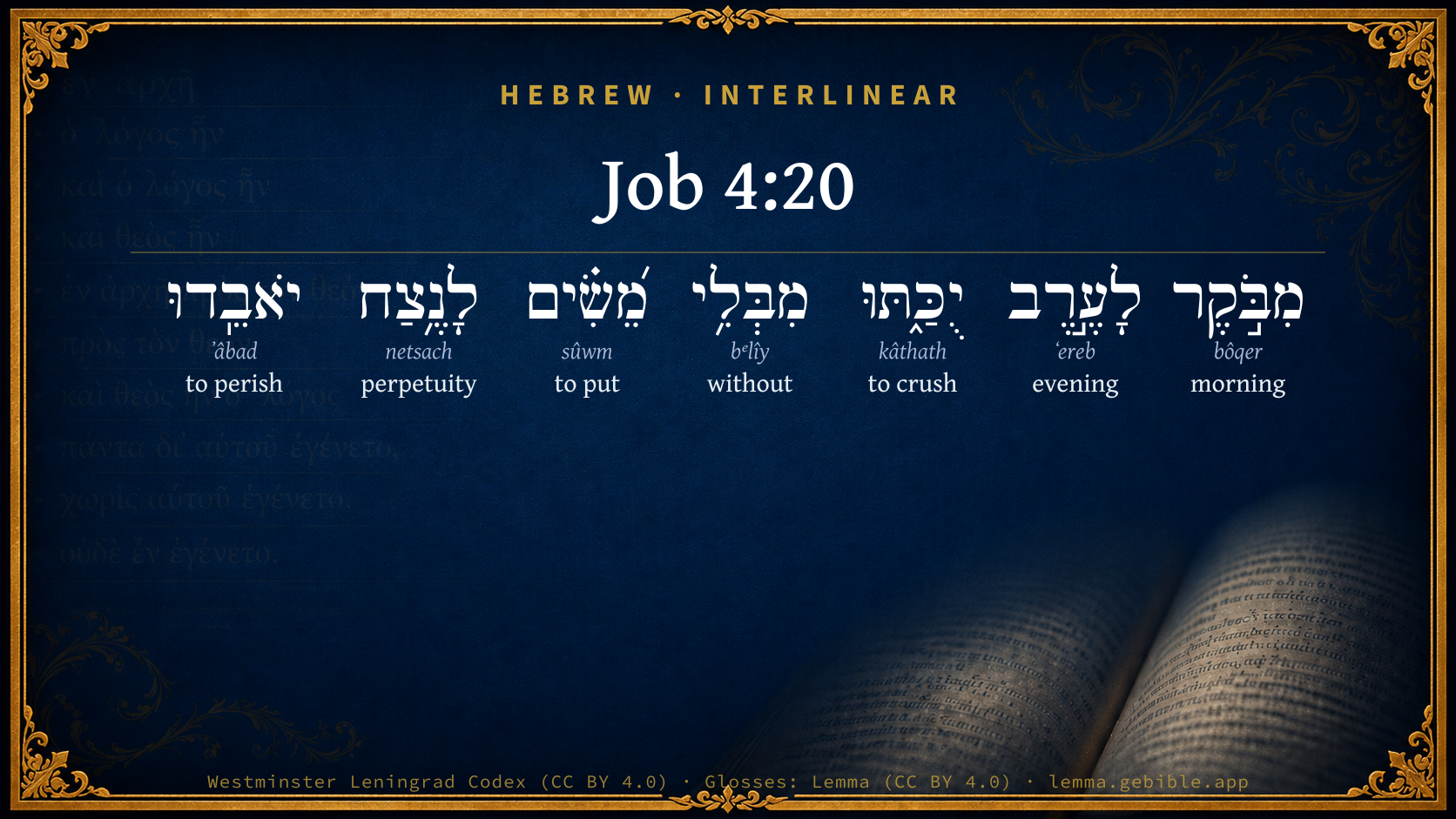
Job 4:20

Hebrew (Westminster Leningrad Codex) Job 4:20 appears in the Hebrew Old Testament. The text above is from the Westminster Leningrad Codex. Each word links to its Strong’s number, a concise gloss, and parsing drawn from the Open Scriptures Hebrew Bible morphology. Click any word for its full Brown-Driver-Briggs (BDB) entry.
Download image
Cite this verse

Job 4:20 (World English Bible). Public Domain. Lemma interlinear Bible study tool, https://lemma.gebible.app/v/job/4/20.

Show BibTeX & RIS
BibTeX
RIS
English Translation
Between morning and evening they are destroyed. They perish forever without any regarding it.
World English Bible · Public Domain
Download a study sheet

One document with this verse’s original text, its word-by-word gloss line, the meaning frame, cross-references with their text, attributed commentary, and full source and license credits — printable, and it pastes into notes with its structure intact.

This verse Autodidact and up

Study sheet (.html) Plain text (.txt)

A passage Seminary Student

Up to 50 verses in one chapter. A passage sheet keeps up to 6 commentary sources and 12 cross-references per verse, in the order this page ranks them, and says so on the sheet whenever that leaves anything out. Ask for a single verse and you get the Autodidact verse sheet above.

Everything on this page stays free to read, with no account — the sheet is a download of what is already on screen, not access to it.

Want to remove ads? Support Godless Engineer
Compare translations 3

The same verse in 3 English versions, stacked beneath the original-language interlinear above. Click any original word for its lexicon entry.

Each is an independent rendering of the whole verse — the interlinear is not word-aligned to these translations.

Highlighted words mark where these versions differ — a whole-verse word diff, not a word-by-word alignment.

  • World English Bible Public Domain
    Between morning and evening they are destroyed. They perish forever without any regarding it.
  • King James Version Public Domain
    They are destroyed from morning to evening: they perish for ever without any regarding it.
  • unfoldingWord Literal Text CC BY-SA 4.0
    From morning to evening they are destroyed; they perish forever without noticing.

unfoldingWord Literal Text — © unfoldingWord, licensed CC BY-SA 4.0. Word-aligned USFM3 via Door43 (git.door43.org/unfoldingWord/en_ult).

Versions to compare (up to 4)

3 of 4 selected

Show all 18 translations

Every available English version of this verse, each an independent rendering of the whole verse.

  • World English Bible Public Domain
    Between morning and evening they are destroyed. They perish forever without any regarding it.
  • Berean Standard Bible Public Domain
    They are smashed to pieces from dawn to dusk; unnoticed, they perish forever.
  • Majority Standard Bible Public Domain
    They are smashed to pieces from dawn to dusk; unnoticed, they perish forever.
  • King James Version Public Domain
    They are destroyed from morning to evening: they perish for ever without any regarding it.
  • American Standard Version (1901) Public Domain
    Betwixt morning and evening they are destroyed: They perish for ever without any regarding it.
  • Revised Version (1885) Public Domain
    Betwixt morning and evening they are destroyed: they perish for ever without any regarding it.
  • Geneva Bible (1599) Public Domain
    They be destroyed from the morning vnto the euening: they perish for euer, without regarde.
  • Douay-Rheims (1899) Public Domain
    From morning till evening they shall be cut down: and because no one understandeth, they shall perish for ever.
  • Young's Literal Translation Public Domain
    From morning to evening are beaten down, Without any regarding, for ever they perish.
  • Literal Standard Version CC BY-SA 4.0
    From morning to evening are beaten down, || Without any regarding, they perish forever.
  • Unlocked Literal Bible CC BY-SA 4.0
    Between morning and evening they are destroyed; they perish forever without anyone noticing them.
  • unfoldingWord Literal Text CC BY-SA 4.0
    From morning to evening they are destroyed; they perish forever without noticing.
  • Darby Bible Public Domain
    From morning to evening are they smitten: without any heeding it, they perish for ever.
  • World Messianic Bible Public Domain
    Between morning and evening they are destroyed. They perish forever without any regarding it.
  • Webster's Bible Public Domain
    They are destroyed from morning to evening: they perish for ever without any regarding it.
  • Free Bible Version CC BY-SA 4.0
    Alive in the morning, they are dead by evening. They die, unnoticed.
  • Bible in Basic English Public Domain
    Between morning and evening they are completely broken; they come to an end for ever, and no one takes note.
  • JPS Tanakh (1917) Public Domain
    Betwixt morning and evening they are shattered; they perish for ever without any regarding it.

Literal Standard Version (2020), Covenant Press — licensed CC BY-SA 4.0. Text via the HelloAO Bible API (eBible.org). Unlocked Literal Bible (unfoldingWord) — licensed CC BY-SA 4.0. Text via the HelloAO Bible API (eBible.org). unfoldingWord Literal Text — © unfoldingWord, licensed CC BY-SA 4.0. Word-aligned USFM3 via Door43 (git.door43.org/unfoldingWord/en_ult). Free Bible Version, Dr. Jonathan Gallagher — licensed CC BY-SA 4.0. Text via the HelloAO Bible API (eBible.org).

Word by word

More ways to search: Search by grammar → Find every occurrence → Compare this word →

Practice this passage: Drill this verse → Learn its vocabulary →

יֻכַּ֑תּוּ
kâthath
H3807
“to crush”
Verb, Hophal, Imperfect, 3rd Person, Masculine, Plural
Part of Speech
Verb
Stem
Hophal
Form
Imperfect
Person
3rd Person
Gender
Masculine
Number
Plural
Full BDB Definition

Origin: a primitive root

TWOT: 1062

to beat, crush by beating, crush to pieces, crush fine - (Qal) - to beat or crush fine - to beat, hammer - (Piel) - to beat or crush fine - to beat, hammer - (Pual) to be beaten - (Hiphil) to beat in pieces, shatter - (Hophal) to be beaten, be crushed
  1. מִבֹּ֣קֶר bôqer H1242 “from · morning” Preposition + Noun, Common, Masculine, Singular, Absolute
  2. לָעֶ֣רֶב ʻereb H6153 “to/for the · evening” Preposition, Determined + Noun, Common, Masculine, Singular, Absolute
  3. מִבְּלִ֥י bᵉlîy H1097 “from · without of” Preposition + Noun, Common, Masculine, Singular, Construct
  4. מֵ֝שִׂ֗ים sûwm H7760 “putting” Verb, Hiphil, Participle Active, Masculine, Singular, Absolute
  5. לָנֶ֥צַח netsach H5331 “to/for · perpetuity” Preposition + Noun, Common, Masculine, Singular, Absolute
  6. יֹאבֵֽדוּ ʼâbad H6 “to perish” Verb, Qal, Imperfect, 3rd Person, Masculine, Plural

About this verse

These counts appear in no published source. They are computed here, from the morphology-tagged text and Lemma’s own curated glosses. What Lemma adds →

7
words
7
distinct lemmas
Wisdom
section

Notable vocabulary

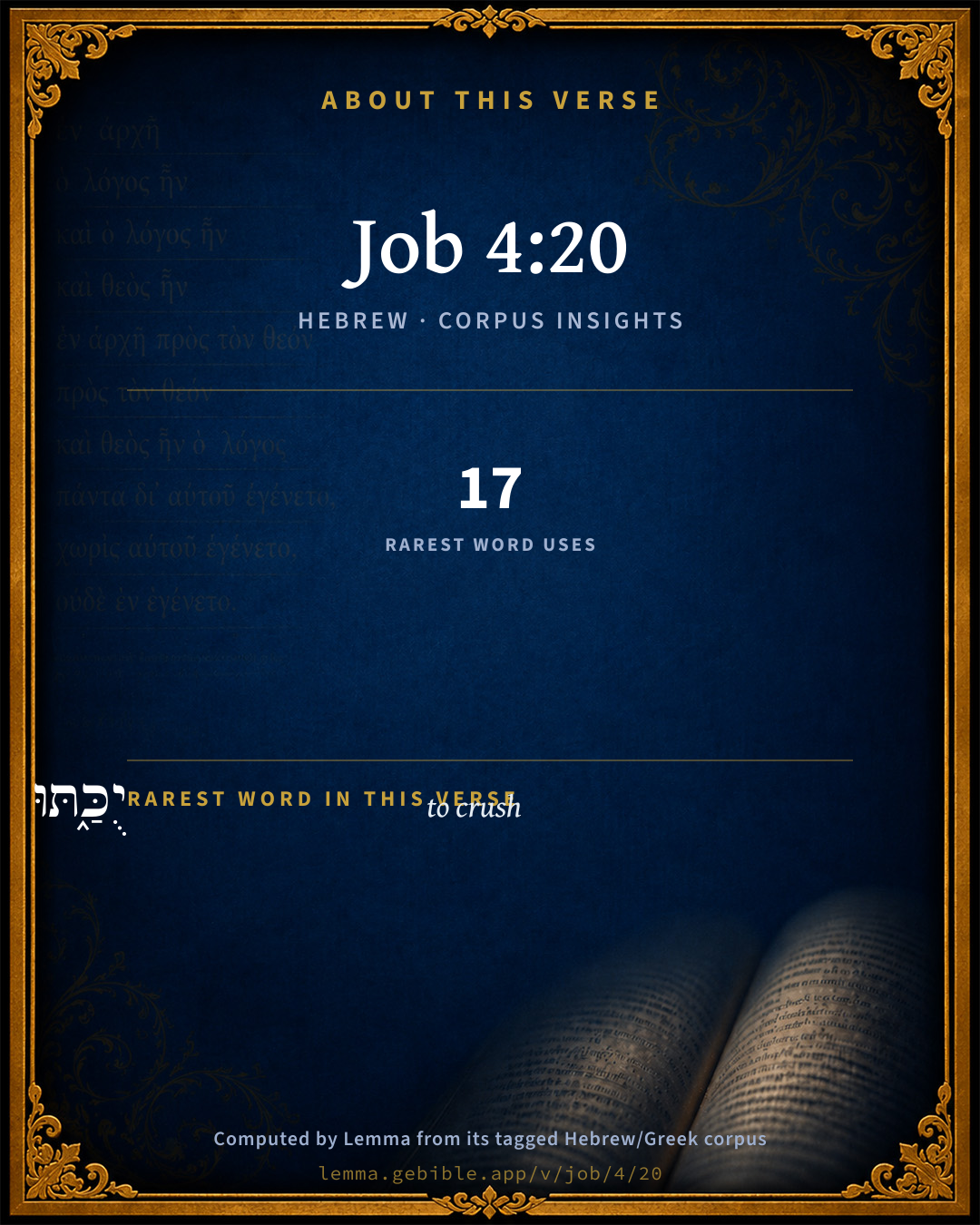
The rarest word here is יֻכַּ֑תּוּ to crush H3807 — appearing just 17 times in the whole Hebrew Bible.

Shared distinctive vocabulary

יֻכַּ֑תּוּ to crush H3807 occurs in 17 verses of the Hebrew Bible. Also found in:

Grammatical profile

  • 3 verbs
  • 4 nouns

Verb forms

  • יֻכַּ֑תּוּ Hophal · Imperfect
  • מֵ֝שִׂ֗ים Hiphil · Participle Active
  • יֹאבֵֽדוּ Qal · Imperfect

Hebrew & Septuagint length

In English translation the verse runs 14 words from the Hebrew and 18 from the Septuagint (LXX English) — closely comparable.

A rough comparison of the two English renderings, which tokenize alike — not a word-level alignment.

Word counts can differ between the Hebrew and the Greek without any difference in meaning — e.g. the Hebrew direct-object marker אֵת has no separate Greek word, and Greek often adds the article ὁ.

Cross-references

14

Topical passages linked to Job 4:20 in the Treasury of Scripture Knowledge — connected by theme and wording, ordered by reader-vote popularity; previews shown in the World English Bible.

  • Job 20:7 Yet he shall perish forever like his own dung, Those who have seen him shall say, 'Where is he?'
  • 2 Chronicles 15:6 They were broken in pieces, nation against nation, and city against city; for God did vex them with all adversity.
  • 2 Chronicles 21:20 Thirty-two years old was he when he began to reign, and he reigned in Jerusalem eight years: and he departed without being desired; and they buried him in the city of David, but not in the tombs of the kings.
  • Job 14:2 He comes forth like a flower, and is cut down. He also flees like a shadow, and doesn't continue.
  • Job 14:14 If a man dies, shall he live again? All the days of my warfare would I wait, Until my release should come.
  • Job 14:20 You forever prevail against him, and he passes; You change his face, and send him away.
  • Job 16:22 For when a few years are come, I shall go the way from whence I shall not return.
  • Job 18:17 His memory shall perish from the earth. He shall have no name in the street.
  • Psalms 37:36 But he passed away, and, behold, he was not. Yes, I sought him, but he could not be found.
  • Psalms 39:13 Oh spare me, that I may recover strength, Before I go away, and be no more."
  • Psalms 90:5–6 You sweep them away as they sleep. In the morning they sprout like new grass.
  • Psalms 92:7 Though the wicked spring up as the grass, And all the evil-doers flourish, They will be destroyed forever.
  • Proverbs 10:7 The memory of the righteous is blessed, But the name of the wicked will rot.
  • Isaiah 38:12–13 My dwelling is removed, and is carried away from me as a shepherd's tent: I have rolled up, like a weaver, my life; he will cut me off from the loom: From day even to night will you make an end of me.

Cross-references courtesy of OpenBible.info (CC BY 4.0).

Hebrew and Greek witnesses Masoretic Hebrew ↔ Greek Septuagint

The same verse in the two great witnesses to the Old Testament, shown verse-for-verse.

These are two independent witnesses, not word-aligned to each other, and the Septuagint is shown in lemma (dictionary) form.

Hebrew Job 4:20 Masoretic · Westminster Leningrad Codex

מִבֹּ֣קֶר לָעֶ֣רֶב יֻכַּ֑תּוּ מִבְּלִ֥י מֵ֝שִׂ֗ים לָנֶ֥צַח יֹאבֵֽדוּ

Between morning and evening they are destroyed. They perish forever without any regarding it.

World English Bible · Public Domain

Greek LXX Job 4:20 Septuagint · lemma form

καί ἀπό πρωίθεν ἕως ἑσπέρα οὐκέτι εἰμί παρά ὁ μή δύναμαι αὐτός ἑαυτοῦ βοηθέω ἀποὀλλύω

And from the morning to evening they no longer exist: they have perished, because they can’t help themselves.

LXX2012 (modern English Septuagint) · Public Domain

On this verse, Haydock's Catholic Bible Commentary discusses the Septuagint’s reading. Read the note in Commentary ↓

Hebrew: Westminster Leningrad Codex (CC BY 4.0). Greek: Septuagint (public domain); English from LXX2012 (modern English Septuagint) (Public Domain). How the Septuagint differs from the Hebrew →

Commentary

Notes on Job 4:20 from classic Christian and Jewish commentators (each source and its license shown beneath its notes). The classic Christian expositions comment on the surrounding passage and are grouped to its opening verse, so a note may address several verses; the Jewish commentaries on the Tanakh (Rashi and others) are per-verse, so they appear only where the commentator wrote on this verse.

Lemma curates 59 commentaries, every one of them public domain or Creative Commons licensed, each selected and text-cleaned for this edition rather than reprinted as found. About our sources →

Ellicott's Commentary for English Readers

(20) From morning to evening.—The process is continual and unceasing, and when we consider the ravages of time on history, we may well say, as in Job_4:20, that “none regardeth it.”

The next verse, however, may seem to imply that they themselves are unmindful of their decay, it is so insidious and so complete.

A Bible Commentary for English Readers, edited by Charles John Ellicott (1878–1897) — public domain. Text from a community e-Sword module.

Trapp's Complete Commentary

John Trapp

Job 4:20 They are destroyed from morning to evening: they perish for ever without any regarding [it].

Ver. 20. They are destroyed from morning to evening] Heb. They are beaten to pieces, as in a mortar, with one sorrow upon another, till the very breath be beaten out of their bodies at length; and all this from morning to evening, all the day long, or all their life long, which is here set forth (for the brevity of it) by an artificial day, and such also as no man can be sure he shall have twelve hours to his day ( Per totum diem, through the entire day, Drus.), for how many are there whose sun hath set at high noon! in the prime and pride of their days have they been suddenly snatched away by the hand of death; yea, how many see we whose sun setteth in the very rising, so that they are carried from the birth to the burial! Every hour, surely, we all yield somewhat unto death, and a very short cut hath the longest liver of all, from the grave of the womb to the womb of the grave. Eliphaz here seemeth to compare us to those creatures called Ephemerobii, which are young in the morning, middle aged at noon, and dead ere night; they begin and end their lives in a day (Aristot.). Man’s life is a vapour, saith St James, a bubble, say the heathens, a blast, a dream, a shadow, a dream of a shadow, &c.

They perish for ever] That is, they die once for all. For "if a man die, shall he live again?" Job 14:14. No such matter. In this war, as there is no discharge, Ecc 8:8, so neither is it granted to any man to err twice; therefore Austin said that he would not for the gain of a million worlds be an atheist for half an hour; because he knew not but God might in that time call for him, and cut him off from all time of repentance, acceptation, and grace for ever, since he could die but once only, and after death judgment: every man’s death’s day is his doom’s day, Heb 9:27.

Without any regarding it] Heb. Putting, sc. his heart to it, or laying it upon his heart, as every man living should do, Ecc 7:2, but that few or none so do, see Isa 57:1. David did, when hearing of his child’s decease, he said, "I shall go to him," 2Sa 12:23. And Moses, seeing the people’s carcases fall so fast in the wilderness, prayed for himself and the rest, "So teach us to number our days, that we may apply our hearts to wisdom," Psa 90:12. Every dead corpse is a monitor, a dumb preacher, Etiam muta clamant cadavera. Abel, though dead, speaketh; but how few hearken to him! Dives thought that if one came from the dead to forewarn his brethren, great matters would be done. Petrus Sutorius telleth of one that, preaching a funeral sermon on a religious man, as he calleth him, and giving him large commendations, heard at the same time a voice in the church, Mortuus sum, iudicatus sum, damnatus sum, I am dead, I am judged, I am damned (Pet. Sutor. de Vita Carth.). This very much wrought upon the heart of Bruno, saith he, and occasioned him to found the Carthusian order. Waldus, a French merchant, was so affected with the death of one that died suddenly in his presence, that he thenceforth became a right godly man, and the father of the Waldenses, those ancient Protestants in France, called also, The poor men of Lyons. But oh, the dead lethargy, the spirit of fornication, that hath so besotted the minds of the most, that they can see death, and yet not think of it! They can look into the dark chamber of the grave, and never make the least preparation for it: if for present they be somewhat affected, and have some good impressions, yet they soon vanish; as the water, circled by a stone cast into it, soon returns to its former smoothness; as chickens run under the wings of the hen, while the kite is over them, or in a storm, but soon after get abroad again, and dust themselves in the sun. As Nebuchadnezzar had seen a vision, but it was gone from him; so here, if men at the house of mourning have some good motions, they improve them not to resolutions, or draw not forth their resolutions into executions, &c.

John Trapp, A Commentary or Exposition upon All the Books of the Old and New Testament (1647–1656) — public domain. Text from a community e-Sword module.

Joseph Benson's Commentary

Job 4:20. They are destroyed — Bruised, or broken, as the same word, יכתו, juccattu, is rendered, Mic 1:7, where we read, The graven images shall be broken to pieces; from morning to evening — That is, either speedily, between the morning and evening, like the grass, Psa 90:5-6. They flourish in the morning, and in the evening are cut down: or rather, all the day long; there is not a moment wherein man is not sinking toward death and corruption. If these words were considered as being connected with the latter clause of the preceding verse, as Dr. Grey thinks they ought to be, the sense would be, they are crushed and destroyed all the day long, as moths are, which, being an insect hurtful and injurious, every one is ready to destroy. They perish for ever — In reference to the present worldly life, which when once lost is never recovered; without any regarding it — Or laying it to heart, say most commentators. But the literal interpretation of the Hebrew, מבלי משׂים, mibbeli meesim, Chappelow thinks, is preferable, namely, absque imponente, without any one’s adding to their misery; or, according to Junius and Tremellius, nemine disponente, without any one’s ordering or appointing it. That is, they are continually perishing and going to destruction, of their own accord, through the mere frailty of their nature, even if no external violence be offered to them. Our translation, however, conveys an important and instructive truth, namely, that few or none that survive, lay to heart, as they ought to do, the death of those that are taken away. For it is so common a thing for all men, though ever so high and great, to perish in this manner, that no man regards it, but all pass it by, as a general accident not worthy of observation.

Joseph Benson's Commentary on the Old and New Testaments (1811–1818) — public domain. Text from a community e-Sword module.

Geneva Bible (1599)

Geneva Bible translators

They see death continually before their eyes, and daily approaching toward them.

No man for all this doth consider it.

Geneva Bible (1599) marginal notes — public domain. Text via Bolls.life.

Jamieson, Fausset & Brown

Robert Jamieson, A. R. Fausset & David Brown

from morning to evening--unceasingly; or, better, between the morning and evening of one short day (so Exo 18:14; Isa 38:12).

They are destroyed--better, "they would be destroyed," if God withdrew His loving protection. Therefore man must not think to be holy before God, but to draw holiness and all things else from God (Job 4:17).

Jamieson, Fausset & Brown — Commentary Critical and Explanatory on the Whole Bible (1871) — public domain (CC PDM 1.0). Text via the HelloAO Bible API.

Adam Clarke's Commentary

Verse 20. They are destroyed from morning to evening] In almost every moment of time some human being comes into the world, and some one departs from it. Thus are they "destroyed from morning to evening."

They perish for ever] יאבדו yobedu; peribunt, they pass by; they go out of sight; they moulder with the dust, and are soon forgotten. Who regards the past generation now among the dead?

Isaiah has a similar thought, Isa 57:1: "The righteous perisheth, and No MAN LAYETH IT TO HEART: and merciful men are taken away, none considering that the righteous is taken away from the evil to come." Some think that Isaiah borrowed from Job; this will appear possible when it has been proved, which has never yet been done, that the writer of this book flourished before Isaiah. If, however, he borrowed the above thought, it must be allowed that it has been wondrously improved by coming through his hands.

Adam Clarke's Commentary on the Bible (1810–1826) — public domain. Text from a community e-Sword/MySword module.

The Cambridge Bible for Schools and Colleges

gen. ed. J. J. S. Perowne

20. from morning to evening] i. e. from a morning to an evening, in the course of a single day, cf. Isa_38:12. They are short-lived as ephemerids.

without any regarding] i. e. without any one noticing it; so insignificant and of no account are they, that they pass away unobserved, like ephemeral insects. The words might mean, without any of them laying to heart; they are thoughtless in their sinful levity, an idea parallel to “without wisdom” in the next verse. Job_4:19 described how easily men are destroyed, this verse describes how soon. All is meant to widen the chasm between men and God, and by giving Job right thoughts of God, and of himself a man, to bring back his mind to a becoming attitude towards Heaven.

The Cambridge Bible for Schools and Colleges (gen. ed. J. J. S. Perowne; Cambridge University Press, 1878–1918) — public domain. Text from a community e-Sword module.

John Gill's Exposition

Doth not their excellency which is in them go away?.... Either the soul which is in them, and is the most excellent part of them; this, though it dies not, yet it goes away and departs from the body at death; and so do all the powers and faculties of it, the thoughts, the affections, the mind, and memory, yea, all the endowments of the mind, wisdom, learning, knowledge of languages, arts, and sciences, all fail at death, Co1 13:8; and so likewise all that is excellent in the body, the strength and beauty of it depart, its strength is weakened in the way, and its comeliness turned into corruption: or, as it may be rendered, "which is with them" (l); and so may likewise denote all outward enjoyments, as wealth and riches, glory and honour, which a man cannot carry with him, do not descend into the grave with him, but then go away: a learned man (m) renders the words, "is not their excellency removed which was in them?" and thinks it refers to the corruption of nature, the loss of original righteousness, and of the image of God in man, which formerly was his excellency in his state of innocence, but now, through sin and the fall, is removed from him; and this, indeed, is the cause, the source and spring, of his frailty, mortality, and death; hence it follows:

they die even without wisdom; that dies with them, or whatsoever of that they have goes away from them at death; wise men die as well as fools, yea, they die as fools do, and multitudes without true wisdom, not being wise enough to consider their latter end; they die without the wisdom which some are made to know, in the hidden part, without the fear of God, which is real wisdom, or without the knowledge of Christ, and of God in Christ, which is the beginning, earnest, and pledge of life eternal. Now then since man is such a frail, mortal, foolish, and sinful creature, how can he be just before God, or pure in the sight of his Maker? which, is the thing designed to be proved and illustrated by all this; and here ends the divine oracle, or the revelation made to Eliphaz, when he had the vision before related.

(l) "cum ipsis", Piscator; so some in Mercerus and Drusius, and Mr. Broughton. (m) Schmidt; "quae fuerat", Beza.

Next: Job Chapter 5

John Gill's Exposition of the Whole Bible (1746–1763) — public domain (CC PDM 1.0). Text via the HelloAO Bible API.

Albert Barnes' Notes on the Bible

They are destroyed from morning to evening - Margin, “beaten in pieces.” This is nearer to the Hebrew. The phrase “from morning to evening” means between the morning and the evening; that is, they live scarcely a single day; see the notes at Isa 38:12. The idea is, not the continuance of the work of destruction from morning to evening; but that man’s life is excecdingly short, so short that he scarce seems to live from morning to night. What a beautiful expression, and how true! How little qualified is such a being to sit in judgment on the doings of the Most High!

They perish forever - Without being restored to life. They pass away, and nothing is ever seen of them again!

Without any regarding it - Without its being noticed. How strikingly true is this! What a narrow circle is affected by the death of a man, and how soon does even that circle cease to be affected! A few relatives and friends feel it and weep over the loss; but the mass of men are unconcerned. It is like taking a grain of sand from the sea-shore, or a drop of water from the ocean. There is indeed one less, but the place is soon supplied, and the ocean rolls on its tumultuous billows as though none had been taken away. So with human life. The affairs of people will roll on; the world will be as busy, and active, and thoughtless as though we had not been; and soon, O how painfully soon to human pride, will our names be forgotten! The circle of friends will cease to weep, and then cease to remember us. The last memorial that we lived, will be gone. The house that we built, the bed on which we slept, the counting-room that we occupied, the monuments that we raised, the books that we made, the stone that we directed to be placed over our graves, will all be gone; and the last memento that we ever lived, will have faded away! How vain is man! How vain is pride! How foolish is ambition! How important the announcement that there is another world, where we may live on forever!

Albert Barnes' Notes on the Bible (1834–1885) — public domain. Text from a community e-Sword/MySword module.

Haydock's Catholic Bible Commentary

Understandeth. Hebrew, "regardeth." Septuagint, "can help himself." (Haydock) --- Man is justly punished because he does not reflect on what he ought. (Calmet)

George Leo Haydock (1774–1849), Haydock's Catholic Family Bible and Commentary, 1859 edition — public domain. Excludes Psalms (Douay-Rheims chapter numbering differs from Protestant) and Deuterocanonical books (Catholic canon only).

Matthew Poole's English Annotations

From morning to evening; either,

1. Speedily, between morning and evening, like the grass; they flourish in the morning, and in the evening are cut off, Psa 90:5,6. Or rather,

2. All the day long, as the phrase is, 2Co 11:25. There is not a moment wherein man is not sinking and drawing on towards death and corruption.

For ever; as to human appearance and the course of nature, as many such like passages are to be understood in this book; or in reference to this present. and worldly life, which when once lost is never recovered, Job 16:22; Psa 39:13.

Without any regarding it, Heb. without putting the heart to it; the word heart being understood there, as also Job 23:6; 34:23; Isa 41:20, as may appear by comparing 1Sa 9:20; 2Sa 18:3; Isa 41:22; 57:1, where the same phrase is used, and the word heart expressed. The meaning is either,

1. Yet few or no men that survive them lay it to heart as they should do. Or,

2. They perish beside the expectation of all men, when both themselves and others thought their mountain was so strong that it could not be removed. Or rather,

3. This is so common a thing for all men, though never so high and great, to perish in this manner, that no man heeds it, but passeth it by as a general accident not worthy of observation. Otherwise, no man procuring or furthering it, Heb. without any man’s putting the hand to it, i.e. they perish of themselves, without any violent hand.

Matthew Poole's English Annotations on the Holy Bible (1683–1685) — public domain. Text from a community e-Sword/MySword module.

Whedon's Commentary on the Bible

Daniel D. Whedon

20. From morning to evening — So short is their life that they may be called ephemeral.

They perish forever — That is, from this present life.

Without any regarding it — So insignificant is man, that though thousands perish, the face of society remains the same. The landscape shines no less brightly though many a blade of grass may have withered; and the ocean rolls no less majestically after it has dashed its long line of surf against the shore. Of as little account in the estimate of man is man himself. It is of infinite moment to man how he shall have lived, not so much what others shall think of him (if they think of him at all) when once he is dead. This verse has such a human look that we might imagine the spirit that speaks to have once been of our race, one of life’s great actors, his name already blotted out from human remembrance. It is more profitable to reflect that the oft-recurring event of death has so little power to affect the human heart. Its visitations, really more ghastly than those of a ghost, elicit this strange feature of the heart, that the frequent repetition of that which is most terrible renders us correspondingly indifferent if not insensible. The shafts of death are for the most part powerless to turn the infatuated children of men from the pursuit of folly. The subject shows in its true light the desperate perverseness of the heart of man.

Daniel D. Whedon (gen. ed.), Commentary on the Old and New Testaments (1874–1909) — public domain. Text from a community e-Sword module.

The Pulpit Commentary

They are destroyed from morning to evening. Human bodies undergo a continuous destruction. From the moment that we are born we begin to die. Decay of powers is coeval with their first exercise. Our insidious foe, Death, marks us as his own from the very first breath that we draw. Our bodies are machines wound up to go for a certain time. The moment that we begin to use them we begin to wear them out. They perish for ever. The final result is that Our" houses of clay "perish, crumble to dust, disappear, and come to nothing. They "perish for ever," says Eliphaz, repeating what he believed the spirit of ver. 15 to have said to him; but it is not clear that he understood more by this than that they perish and disappear for ever, so far as this life and this world are concerned. Without any regarding it. No one is surprised or thinks it hard. It is the lot of man, and every one"s mind is prepared for it.

The Pulpit Commentary (1880–1919), ed. H.D.M. Spence-Jones & Joseph S. Exell — public domain. Text from a community e-Sword module.

John Wesley's Explanatory Notes

Destroyed - All the day long, there is not a moment wherein man is not sinking towards death and corruption. Perish - In reference to this present worldly life, which when once lost is never recovered. Regarding - Hebrew. without putting the heart to it, this is so common a thing for all men, though never so high and great, to perish in this manner, that no man heeds it, but passes it by as a general accident not worthy of observation.

John Wesley, Explanatory Notes Upon the Whole Bible (1754–1765) — public domain. Text via the GEBible commentary corpus.

unfoldingWord translationNotes

Door43 World Missions Community

General Information:

These verses continue the earlier use of parallelism, here emphasizing in different ways the idea that people die suddenly without having achieved wisdom and without concern from others. (See: Parallelism)

Between morning and evening they are destroyed

This refers to the idea of something happening quickly. (See: Metaphor)

they are destroyed

This may also be put into active form. AT: "they die" (See: Active or Passive)

Are not their tent cords plucked up among them?

This may be put into active form. AT: "Have not their enemies plucked up their tent cords from among them?" (See: Rhetorical Question)

their tent cords

Here tent cords represent a tent. Sometimes a person's home and family are pictured as his tent, which can also represent all his possessions. (See: Synecdoche and Metaphor)

translationWords

perish

eternity

tent

die

wise

unfoldingWord translationNotes — © Distant Shores Media and the Door43 World Missions Community, licensed CC BY-SA 4.0. Source: git.door43.org/Door43/en_tn.

Rashi

Rabbi Shlomo Yitzchaki (Rashi)

From morning to evening they are crushed in one day, they are crushed and subdued.

without giving [a thought] lit. without putting it upon their heart to return to their Maker.

they perish to eternity This too is an elliptical verse.

Rashi on the Tanakh — English translations: “The Judaica Press complete Tanach with Rashi, translated by A. J. Rosenberg” (CC BY 4.0); “Pentateuch with Rashi's commentary by M. Rosenbaum and A.M. Silbermann, 1929-1934” (public domain); “The Metsudah Tanach series, Lakewood, N.J” (CC BY 4.0); and “The Book of Joshua, Metsudah Publications, 1997” (CC BY 4.0). Text via Sefaria.

Lesson kit

Teaching starters — assembled from the data on this page, not authored interpretation. Every prompt links to the verse data it draws on. Edit before teaching.

Job, in the Wisdom, opens this verse with 7 words (7 distinct Hebrew lemmas). Its most distinctive word is kâthath (“to crush”). A historical commentator’s framing appears above. Read the whole chapter for the surrounding context.

Discussion questions

  1. How does “to crush” (kâthath) shape what this verse is saying?
  2. How does Leviticus 22:24, which shares the word «to crush», read alongside this verse?
  3. The translations on this page render this verse differently — a whole-verse word diff, not a word-by-word alignment. What might account for the different wordings?
  4. «יֻכַּ֑תּוּ» is a Hophal Imperfect verb. How does that grammatical form shape the action described?
  5. Compare how Ellicott's Commentary for English Readers and Trapp's Complete Commentary read this verse. Where do they agree or differ?

Things to notice

Reading settings

Reading text

Shown beneath each verse's original-language words.

Old Testament
Old Testament edition

Read the OT as the Masoretic Hebrew (MT) or the Greek Septuagint (LXX).

English shown for the Greek Septuagint (in the Hebrew ↔ Greek comparison).

Comparing translations? Open the Compare panel on any verse page to stack up to four side by side.