
1 Samuel 25:34

Hebrew (Westminster Leningrad Codex) 1 Samuel 25:34 appears in the Hebrew Old Testament. The text above is from the Westminster Leningrad Codex. Each word links to its Strong’s number, a concise gloss, and parsing drawn from the Open Scriptures Hebrew Bible morphology. Click any word for its full Brown-Driver-Briggs (BDB) entry.
Download image
Cite this verse

1 Samuel 25:34 (World English Bible). Public Domain. Lemma interlinear Bible study tool, https://lemma.gebible.app/v/1-samuel/25/34.

Show BibTeX & RIS
BibTeX
RIS
English Translation
For in very deed, as Yahweh, the God of Israel, lives, who has withheld me from hurting you, except you had hurried and come to meet me, surely there wouldn't have been left to Nabal by the morning light so much as one man-child.
World English Bible · Public Domain
Download a study sheet

One document with this verse’s original text, its word-by-word gloss line, the meaning frame, cross-references with their text, attributed commentary, and full source and license credits — printable, and it pastes into notes with its structure intact.

This verse Autodidact and up

Study sheet (.html) Plain text (.txt)

A passage Seminary Student

Up to 50 verses in one chapter. A passage sheet keeps up to 6 commentary sources and 12 cross-references per verse, in the order this page ranks them, and says so on the sheet whenever that leaves anything out. Ask for a single verse and you get the Autodidact verse sheet above.

Everything on this page stays free to read, with no account — the sheet is a download of what is already on screen, not access to it.

Want to remove ads? Support Godless Engineer
Compare translations 3

The same verse in 3 English versions, stacked beneath the original-language interlinear above. Click any original word for its lexicon entry.

Each is an independent rendering of the whole verse — the interlinear is not word-aligned to these translations.

Highlighted words mark where these versions differ — a whole-verse word diff, not a word-by-word alignment.

  • World English Bible Public Domain
    For in very deed, as Yahweh, the God of Israel, lives, who has withheld me from hurting you, except you had hurried and come to meet me, surely there wouldn't have been left to Nabal by the morning light so much as one man-child.
  • King James Version Public Domain
    For in very deed, as the LORD God of Israel liveth, which hath kept me back from hurting thee, except thou hadst hasted and come to meet me, surely there had not been left unto Nabal by the morning light any that pisseth against the wall.
  • unfoldingWord Literal Text CC BY-SA 4.0
    For indeed, the life of Yahweh, the God of Israel, who has retrained me from harming you, that lest you had hurried and come to meet me, that if one pissing against the wall had been left to Nabal until the light of the morning!”

unfoldingWord Literal Text — © unfoldingWord, licensed CC BY-SA 4.0. Word-aligned USFM3 via Door43 (git.door43.org/unfoldingWord/en_ult).

Versions to compare (up to 4)

3 of 4 selected

Show all 18 translations

Every available English version of this verse, each an independent rendering of the whole verse.

  • World English Bible Public Domain
    For in very deed, as Yahweh, the God of Israel, lives, who has withheld me from hurting you, except you had hurried and come to meet me, surely there wouldn't have been left to Nabal by the morning light so much as one man-child.
  • Berean Standard Bible Public Domain
    Otherwise, as surely as the LORD, the God of Israel, lives, who has restrained me from harming you, if you had not come quickly to meet me, then surely no male belonging to Nabal would have been left alive by morning light.”
  • Majority Standard Bible Public Domain
    Otherwise, as surely as the LORD, the God of Israel, lives, who has restrained me from harming you, if you had not come quickly to meet me, then surely no male belonging to Nabal would have been left alive by morning light.”
  • King James Version Public Domain
    For in very deed, as the LORD God of Israel liveth, which hath kept me back from hurting thee, except thou hadst hasted and come to meet me, surely there had not been left unto Nabal by the morning light any that pisseth against the wall.
  • American Standard Version (1901) Public Domain
    For in very deed, as Jehovah, the God of Israel, liveth, who hath withholden me from hurting thee, except thou hadst hasted and come to meet me, surely there had not been left unto Nabal by the morning light so much as one man-child.
  • Revised Version (1885) Public Domain
    For in very deed, as the LORD, the God of Israel, liveth, which hath withholden me from hurting thee, except thou hadst hasted and come to meet me, surely there had not been left unto Nabal by the morning light so much as one man child.
  • Geneva Bible (1599) Public Domain
    For in deede, as the Lord God of Israel liueth, who hath kept me backe from hurting thee, except thou haddest hasted and met mee, surely there had not bene left vnto Nabal by the dawning of the day, any that pisseth against the wall.
  • Douay-Rheims (1899) Public Domain
    Otherwise as the Lord liveth the God of Israel, who hath withholden me from doing thee any evil: if thou hadst not quickly come to meet me, there had not been left to Nabal by the morning light any that pisseth against the wall.
  • Young's Literal Translation Public Domain
    And yet, Jehovah liveth, God of Israel, who hath kept me back from doing evil with thee, for unless thou hadst hasted, and dost come to meet me, surely there had not been left to Nabal till the light of the morning, of those sitting on the wall.'
  • Literal Standard Version CC BY-SA 4.0
    And yet, YHWH lives, God of Israel, who has kept me back from doing evil with you, for unless you had hurried, and come to meet me, surely there had not been left to Nabal until the morning light, of those sitting on the wall.”
  • Unlocked Literal Bible CC BY-SA 4.0
    For in truth, as Yahweh, the God of Israel, lives, he who has kept me from hurting you, unless you had hurried to come meet me, there would certainly have not been left to Nabal so much as one male baby by morning.”
  • unfoldingWord Literal Text CC BY-SA 4.0
    For indeed, the life of Yahweh, the God of Israel, who has retrained me from harming you, that lest you had hurried and come to meet me, that if one pissing against the wall had been left to Nabal until the light of the morning!”
  • Darby Bible Public Domain
    But indeed, as Jehovah the God of Israel liveth, who has restrained me from hurting thee, except thou hadst hasted and come to meet me, there had not been left to Nabal by the morning light any male.
  • World Messianic Bible Public Domain
    For indeed, as the LORD the God of Israel lives, who has withheld me from harming you, unless you had hurried and come to meet me, surely there wouldn’t have been left to Nabal by the morning light so much as one who urinates on a wall.”
  • Webster's Bible Public Domain
    For in very deed, as the LORD God of Israel liveth, who hath kept me back from hurting thee, except thou hadst hasted and come to meet me, surely there had not been left to Nabal by the morning light any male person.
  • Free Bible Version CC BY-SA 4.0
    On the contrary, as the Lord, the God of Israel, lives, who has kept me from harming you, if you hadn't rushed to meet me, then definitely not a single one of Nabal's men would have been left alive by dawn.”
  • Bible in Basic English Public Domain
    For truly, by the living Lord, the God of Israel, who has kept me from doing you evil, if you had not been so quick in coming to me and meeting me, by dawn there would not have been in Nabal's house so much as one male living.
  • JPS Tanakh (1917) Public Domain
    For in very deed, as the LORD, the God of Israel, liveth, who hath withholden me from hurting thee, except thou hadst made haste and come to meet me, surely there had not been left unto Nabal by the morning light so much as one male.'

Literal Standard Version (2020), Covenant Press — licensed CC BY-SA 4.0. Text via the HelloAO Bible API (eBible.org). Unlocked Literal Bible (unfoldingWord) — licensed CC BY-SA 4.0. Text via the HelloAO Bible API (eBible.org). unfoldingWord Literal Text — © unfoldingWord, licensed CC BY-SA 4.0. Word-aligned USFM3 via Door43 (git.door43.org/unfoldingWord/en_ult). Free Bible Version, Dr. Jonathan Gallagher — licensed CC BY-SA 4.0. Text via the HelloAO Bible API (eBible.org).

Word by word

More ways to search: Search by grammar → Find every occurrence → Compare this word →

Practice this passage: Drill this verse → Learn its vocabulary →

מַשְׁתִּ֥ין
shâthan
H8366
“urinating”
Verb, Hiphil, Participle Active, Masculine, Singular, Absolute
Part of Speech
Verb
Stem
Hiphil
Form
Participle Active
Gender
Masculine
Number
Singular
State
Absolute
Full BDB Definition

Origin: a primitive root

TWOT: 2377

(Hiphil) to urinate - one who urinates (used as a designation of a male)
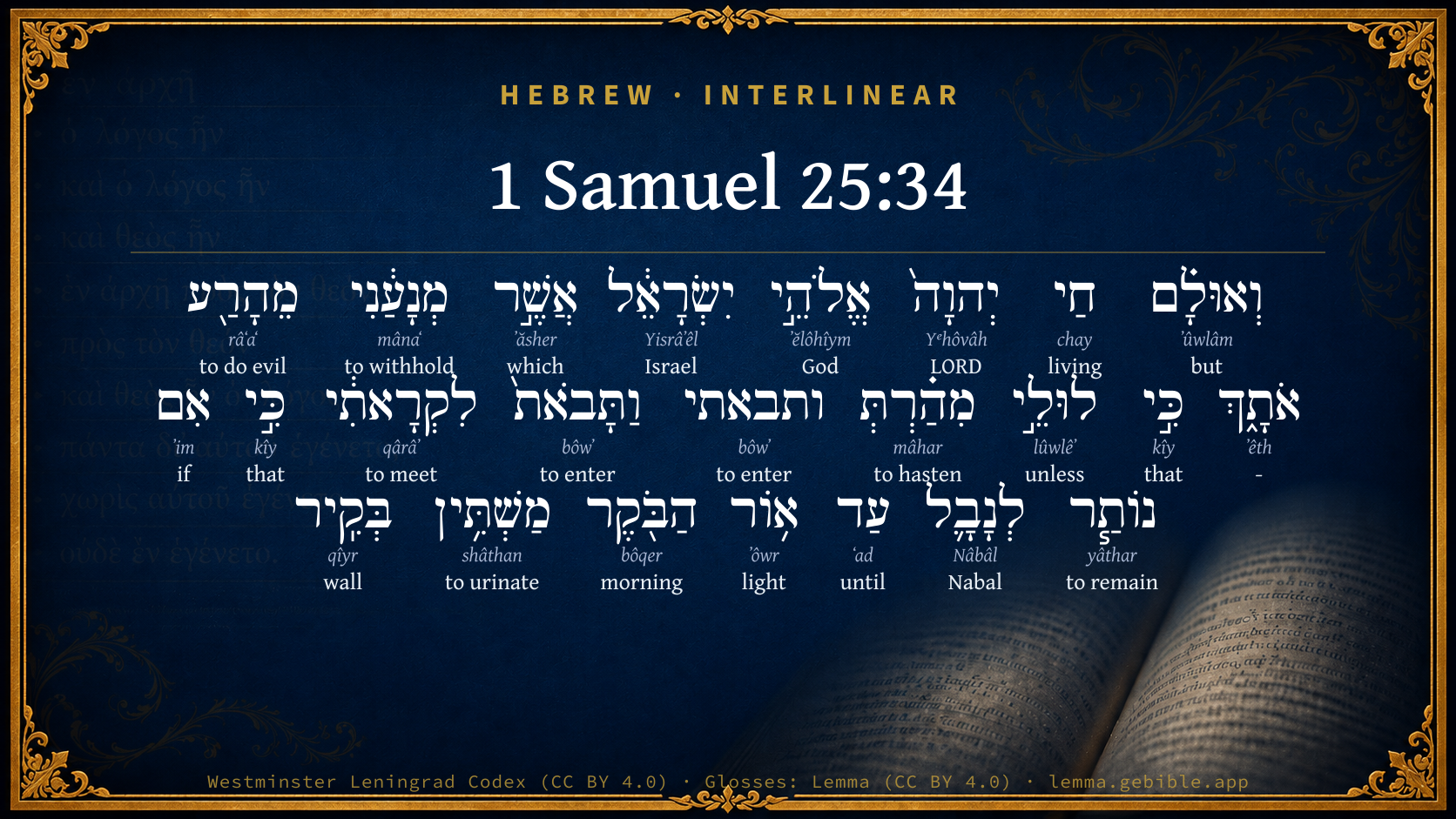
  1. וְאוּלָ֗ם ʼûwlâm H199 “and · but” Conjunction + Adverb
  2. חַי chay H2416 “living” Adjective, Adjective, Masculine, Singular, Absolute
  3. יְהוָה֙ Yᵉhôvâh H3068 “LORD” Noun, Proper
  4. אֱלֹהֵ֣י ʼĕlôhîym H430 “God(s) of” Noun, Common, Masculine, Plural, Construct
  5. יִשְׂרָאֵ֔ל Yisrâʼêl H3478 “Israel” Noun, Proper
  6. אֲשֶׁ֣ר ʼăsher H834 “which” Particle, Relative
  7. מְנָעַ֔נִי mânaʻ H4513 “to withhold · me” Verb, Qal, Perfect, 3rd Person, Masculine, Singular + Suffix, Personal, 1st Person, Common, Singular
  8. מֵהָרַ֖ע râʻaʻ H7489 “from · to do evil” Preposition + Verb, Hiphil, Infinitive Construct
  9. אֹתָ֑ךְ ʼêth H853 “- · you” Particle, Direct Object + Suffix, Personal, 2nd Person, Feminine, Singular
  10. כִּ֣י kîy H3588 “that” Conjunction
  11. לוּלֵ֣י lûwlêʼ H3884 “unless” Conjunction
  12. מִהַ֗רְתְּ mâhar H4116 “to hasten” Verb, Piel, Perfect, 2nd Person, Feminine, Singular
  13. ותבאתי bôwʼ H935 “and · to enter” Conjunction + Verb, Qal, Sequential Imperfect, 2nd Person, Feminine, Singular
  14. וַתָּבֹאת֙ bôwʼ H935 “and · to enter” Conjunction + Verb, Qal, Sequential Imperfect, 2nd Person, Feminine, Singular
  15. לִקְרָאתִ֔י qârâʼ H7122 “to meet · me” Preposition + Verb, Qal, Infinitive Construct + Suffix, Personal, 1st Person, Common, Singular
  16. כִּ֣י kîy H3588 “that” Conjunction
  17. אִם ʼim H518 “if” Conjunction
  18. נוֹתַ֧ר yâthar H3498 “to remain” Verb, Niphal, Perfect, 3rd Person, Masculine, Singular
  19. לְנָבָ֛ל Nâbâl H5037 “to/for · Nabal” Preposition + Noun, Proper
  20. עַד ʻad H5704 “until” Preposition
  21. א֥וֹר ʼôwr H216 “light of” Noun, Common, Both, Singular, Construct
  22. הַבֹּ֖קֶר bôqer H1242 “the · morning” Particle, Definite Article + Noun, Common, Masculine, Singular, Absolute
  23. בְּקִֽיר qîyr H7023 “in/at · wall” Preposition + Noun, Common, Masculine, Singular, Absolute

About this verse

These counts appear in no published source. They are computed here, from the morphology-tagged text and Lemma’s own curated glosses. What Lemma adds →

24
words
22
distinct lemmas
Historical
section

Notable vocabulary

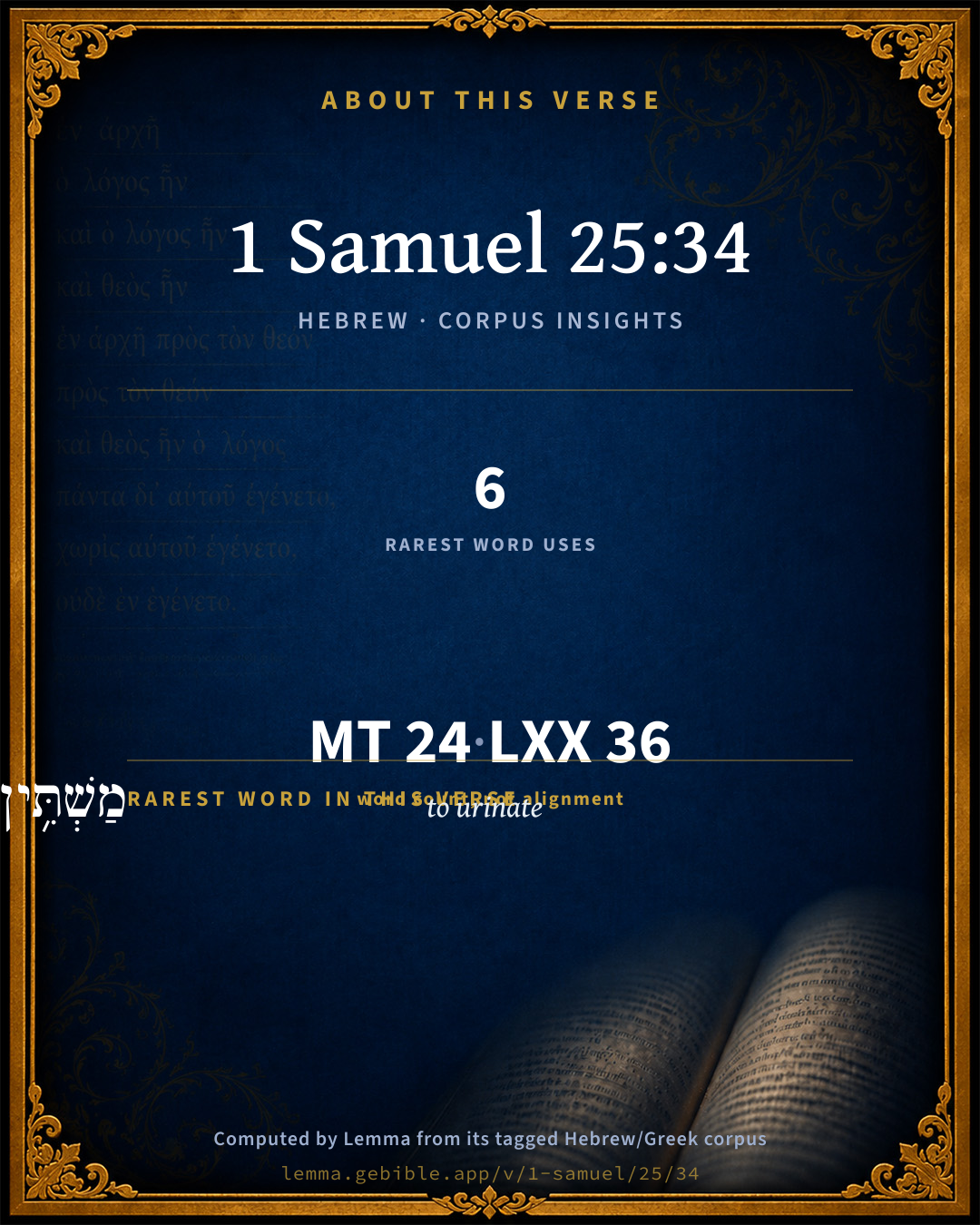
The rarest word here is מַשְׁתִּ֥ין to urinate H8366 — appearing just 6 times in the whole Hebrew Bible.

Shared distinctive vocabulary

מַשְׁתִּ֥ין to urinate H8366 occurs in 6 verses of the Hebrew Bible. Also found in:

Grammatical profile

  • 8 verbs
  • 7 nouns
  • 1 adjective
  • 1 preposition
  • 4 conjunctions
  • 1 adverb
  • 2 particles

Verb forms

  • מְנָעַ֔נִי Qal · Perfect
  • מֵהָרַ֖ע Hiphil · Infinitive Construct
  • מִהַ֗רְתְּ Piel · Perfect
  • ותבאתי Qal · Sequential Imperfect
  • וַתָּבֹאת֙ Qal · Sequential Imperfect
  • לִקְרָאתִ֔י Qal · Infinitive Construct
  • נוֹתַ֧ר Niphal · Perfect
  • מַשְׁתִּ֥ין Hiphil · Participle Active

Repetition

Words recur within this verse — often emphatic in Hebrew:

  • ותבאתי to enter H935 ×2
  • כִּ֣י that H3588 ×2

Hebrew & Septuagint length

In English translation the verse runs 44 words from the Hebrew and 44 from the Septuagint (LXX English) — the same length.

A rough comparison of the two English renderings, which tokenize alike — not a word-level alignment.

Word counts can differ between the Hebrew and the Greek without any difference in meaning — e.g. the Hebrew direct-object marker אֵת has no separate Greek word, and Greek often adds the article ὁ.

In the original languages it is 24 Hebrew tokens and 36 Greek tokens — but the two are counted differently (Hebrew bundles its prefixes and suffixes into one token; the Greek is in lemma form), so that isn’t a like-for-like length.

Cross-references

5

Topical passages linked to 1 Samuel 25:34 in the Treasury of Scripture Knowledge — connected by theme and wording, ordered by reader-vote popularity; previews shown in the World English Bible.

  • Joshua 10:6 The men of Gibeon sent to Joshua to the camp to Gilgal, saying, Don't slack your hand from your servants; come up to us quickly, and save us, and help us: for all the kings of the Amorites that dwell in the hill-country are gathered together against us.
  • Joshua 10:9 Joshua therefore came on them suddenly; [for] he went up from Gilgal all the night.
  • 1 Samuel 11:11 It was so on the next day, that Saul put the people in three companies; and they came into the midst of the camp in the morning watch, and struck the Ammonites until the heat of the day: and it happened, that those who remained were scattered, so that no two of them were left together.
  • 1 Samuel 25:18 Then Abigail made haste, and took two hundred loaves, and two bottles of wine, and five sheep ready dressed, and five measures of parched grain, and one hundred clusters of raisins, and two hundred cakes of figs, and laid them on donkeys.
  • 1 Samuel 25:26 Now therefore, my lord, as Yahweh lives, and as your soul lives, seeing Yahweh has withheld you from blood guiltiness, and from avenging yourself with your own hand, now therefore let your enemies, and those who seek evil to my lord, be as Nabal.

Cross-references courtesy of OpenBible.info (CC BY 4.0).

Hebrew and Greek witnesses Masoretic Hebrew ↔ Greek Septuagint

The same verse in the two great witnesses to the Old Testament, shown verse-for-verse.

These are two independent witnesses, not word-aligned to each other, and the Septuagint is shown in lemma (dictionary) form.

Hebrew 1 Samuel 25:34 Masoretic · Westminster Leningrad Codex

וְאוּלָ֗ם חַי יְהוָה֙ אֱלֹהֵ֣י יִשְׂרָאֵ֔ל אֲשֶׁ֣ר מְנָעַ֔נִי מֵהָרַ֖ע אֹתָ֑ךְ כִּ֣י לוּלֵ֣י מִהַ֗רְתְּ ותבאתי וַתָּבֹאת֙ לִקְרָאתִ֔י כִּ֣י אִם נוֹתַ֧ר לְנָבָ֛ל עַד א֥וֹר הַבֹּ֖קֶר מַשְׁתִּ֥ין בְּקִֽיר

For in very deed, as Yahweh, the God of Israel, lives, who has withheld me from hurting you, except you had hurried and come to meet me, surely there wouldn't have been left to Nabal by the morning light so much as one man-child.

World English Bible · Public Domain

Greek LXX 1 Samuel 25:34 Septuagint · lemma form

πλήν ὅτι ζάω κύριος ὁ θεός ἰσραήλ ὅς ἀποκωλύω ἐγώ σήμερον ὁ κακοποιέω σύ ὅτι εἰ μή σπεύδω καί παραγίγνομαι εἰς ἀπάντησις ἐγώ τότε εἶπον εἰ ὑπολείπω ὁ ναβαλ ἕως φῶς ὁ πρωΐ οὐρά πρός τοῖχος

But surely as the Lord God of Israel lives, who hindered me this day from doing you harm, if you had not hasted and come to meet me, then I said, There shall surely not be left to Nabal till the morning one male.

LXX2012 (modern English Septuagint) · Public Domain

Hebrew: Westminster Leningrad Codex (CC BY 4.0). Greek: Septuagint (public domain); English from LXX2012 (modern English Septuagint) (Public Domain). How the Septuagint differs from the Hebrew →

Targum (Aramaic paraphrase)

1

The Targum is the ancient Jewish Aramaic paraphrase of the Hebrew Scriptures — an interpretive translation, not the Hebrew text itself. Onkelos (literal) and Pseudo-Jonathan (expansive) render the Torah, and Jonathan the Prophets. Coverage is partial: where no permissively-licensed English translation exists for a verse, only the Aramaic is shown. This is verse-level text, not a word-by-word alignment to the Hebrew.

  1. Targum Jonathan Prophets (Joshua–Malachi)
    וּבְרַם קַיָם הוּא יְיָ אֱלָהָא דְיִשְׂרָאֵל דִמְנָעַנִי מִלְאַבְאָשָׁא לִיךְ אֲרֵי אִלוּלָא פוֹן אוֹחִית וְאָתֵית לָקֳדָמוּתִי אֱלָהֵין אִשְׁתְּאַר לְנָבָל עַד מַנְהָר צַפְרָא יְדַע מַדָע:

    (no public-domain English translation for this verse)

    Targum Jonathan — Aramaic: “Mikraot Gedolot” (public domain). English: “Sefaria Community Translation” (CC0 1.0 (public-domain dedication)); “London "Chaldee Paraphrase," 1871” (public domain). Text via Sefaria.

Commentary

Notes on 1 Samuel 25:34 from classic Christian and Jewish commentators (each source and its license shown beneath its notes). The classic Christian expositions comment on the surrounding passage and are grouped to its opening verse, so a note may address several verses; the Jewish commentaries on the Tanakh (Rashi and others) are per-verse, so they appear only where the commentator wrote on this verse.

Lemma curates 59 commentaries, every one of them public domain or Creative Commons licensed, each selected and text-cleaned for this edition rather than reprinted as found. About our sources →

Trapp's Complete Commentary

John Trapp

1Sa 25:34 For in very deed, [as] the LORD God of Israel liveth, which hath kept me back from hurting thee, except thou hadst hasted and come to meet me, surely there had not been left unto Nabal by the morning light any that pisseth against the wall.

Ver. 34. Which hath kept me back from hurting thee.] The females also therefore had perished, and not the males only, as some have gathered from that proverbial expression, any that pisseth against the wall.

Except thou hadst hasted and come to meet me.] That was a worthy saying of Alphonsus, king of Arragon, a valiant and wise warrior, Decet ducem invictum, habere animum, si res sit iusta; at ubi conatus est iniustus, praestat regredi quam progredi. A general in a good cause should be unalterable, unvanquishable; but if he and it to be otherwise, he had better stop or step backward, than to go on further with it.

John Trapp, A Commentary or Exposition upon All the Books of the Old and New Testament (1647–1656) — public domain. Text from a community e-Sword module.

Geneva Bible (1599)

Geneva Bible translators

He attributeth it to the Lord’s mercy, and not to himself that he was stayed.

Geneva Bible (1599) marginal notes — public domain. Text via Bolls.life.

John Gill's Exposition

For in very deed, as the Lord God of Israel liveth,.... An oath for the confirmation of what he was about to say:

which hath kept me back from hurting thee: from doing any ill to her family, as he intended, though not to her person, his resolution being only to slay the males; but that would have been an hurt, an evil, an affliction to Abigail, from which the Lord in his providence restrained him, and that through her good advice:

except thou hadst hasted, and come to meet me: if she had not made quick dispatch in preparing her present, or had stayed to persuade her husband into her measures; if she had delayed a little longer, David would have been at Nabal's house, executing his vengeance on him and his:

surely there had not been left unto Nabal, by the morning light, any that pisseth against the wall: See Gill on Sa1 25:22.

John Gill's Exposition of the Whole Bible (1746–1763) — public domain (CC PDM 1.0). Text via the HelloAO Bible API.

Matthew Poole's English Annotations

Hath kept me back from hurting thee; not that he intended to kill her, but the males only; as was noted in 1Sa 25:22. But their destruction was a dreadful affliction and damage to her.

Matthew Poole's English Annotations on the Holy Bible (1683–1685) — public domain. Text from a community e-Sword/MySword module.

unfoldingWord translationNotes

Door43 World Missions Community

General Information:

David accepts Abigail's gifts and agrees to do as she has advised him.

there would certainly have not been left to Nabal so much as one male baby

This can be translated in active form. AT: "I would not have left to Nabal even one male baby" (See: Active or Passive)

received from her hand

This is an idiom. Abigail did not unload all gifts from the donkeys herself. AT: "accepted all the gifts that she had brought" (See: Idiom)

have listened to your voice

The word "voice" is a metonym for the message the person speaks and a synecdoche for the person who speaks. AT: "have listened to what you have told me" or "will do as you have advised me" (See: Metonymy and Synecdoche)

translationWords

true

Yahweh

God

Israel

David

receive

peace

house

voice

unfoldingWord translationNotes — © Distant Shores Media and the Door43 World Missions Community, licensed CC BY-SA 4.0. Source: git.door43.org/Door43/en_tn.

Lesson kit

Teaching starters — assembled from the data on this page, not authored interpretation. Every prompt links to the verse data it draws on. Edit before teaching.

1 Samuel, in the Historical, opens this verse with 24 words (22 distinct Hebrew lemmas). Its most distinctive word is shâthan (“to urinate”). A historical commentator’s framing appears above. Read the whole chapter for the surrounding context.

Discussion questions

  1. How does “to urinate” (shâthan) shape what this verse is saying?
  2. 1 Samuel 25:22 shares the word «to urinate» with this verse. How do the two illuminate each other?
  3. “to enter” occurs 2× in this one verse. What is the effect of the repetition?
  4. These translations render this verse differently; the difference is in the English rendering, not the original. What questions does that raise?
  5. The verb «מְנָעַ֔נִי» is Qal Perfect. How does its form color the action?
  6. Reading how Trapp's Complete Commentary and Geneva Bible (1599) read this verse, where do the two commentators agree and where do they part?

Things to notice

Reading settings

Reading text

Shown beneath each verse's original-language words.

Old Testament
Old Testament edition

Read the OT as the Masoretic Hebrew (MT) or the Greek Septuagint (LXX).

English shown for the Greek Septuagint (in the Hebrew ↔ Greek comparison).

Comparing translations? Open the Compare panel on any verse page to stack up to four side by side.