Ezekiel 46:15

Hebrew (Westminster Leningrad Codex) Ezekiel 46:15 appears in the Hebrew Old Testament. The text above is from the Westminster Leningrad Codex. Each word links to its Strong’s number, a concise gloss, and parsing drawn from the Open Scriptures Hebrew Bible morphology. Click any word for its full Brown-Driver-Briggs (BDB) entry.
Download image
Cite this verse

Ezekiel 46:15 (World English Bible). Public Domain. Lemma interlinear Bible study tool, https://lemma.gebible.app/v/ezekiel/46/15.

Show BibTeX & RIS
BibTeX
RIS
English Translation
Thus shall they prepare the lamb, and the meal-offering, and the oil, morning by morning, for a continual burnt offering.
World English Bible · Public Domain
Download a study sheet

One document with this verse’s original text, its word-by-word gloss line, the meaning frame, cross-references with their text, attributed commentary, and full source and license credits — printable, and it pastes into notes with its structure intact.

This verse Autodidact and up

Study sheet (.html) Plain text (.txt)

A passage Seminary Student

Up to 50 verses in one chapter. A passage sheet keeps up to 6 commentary sources and 12 cross-references per verse, in the order this page ranks them, and says so on the sheet whenever that leaves anything out. Ask for a single verse and you get the Autodidact verse sheet above.

Everything on this page stays free to read, with no account — the sheet is a download of what is already on screen, not access to it.

Want to remove ads? Support Godless Engineer
Compare translations 3

The same verse in 3 English versions, stacked beneath the original-language interlinear above. Click any original word for its lexicon entry.

Each is an independent rendering of the whole verse — the interlinear is not word-aligned to these translations.

Highlighted words mark where these versions differ — a whole-verse word diff, not a word-by-word alignment.

  • World English Bible Public Domain
    Thus shall they prepare the lamb, and the meal-offering, and the oil, morning by morning, for a continual burnt offering.
  • King James Version Public Domain
    Thus shall they prepare the lamb, and the meat offering, and the oil, every morning for a continual burnt offering.
  • unfoldingWord Literal Text CC BY-SA 4.0
    They will prepare the lamb, the grain offering, and the oil morning after morning, a permanent burnt offering.

unfoldingWord Literal Text — © unfoldingWord, licensed CC BY-SA 4.0. Word-aligned USFM3 via Door43 (git.door43.org/unfoldingWord/en_ult).

Versions to compare (up to 4)

3 of 4 selected

Show all 18 translations

Every available English version of this verse, each an independent rendering of the whole verse.

  • World English Bible Public Domain
    Thus shall they prepare the lamb, and the meal-offering, and the oil, morning by morning, for a continual burnt offering.
  • Berean Standard Bible Public Domain
    Thus they shall provide the lamb, the grain offering, and the oil every morning as a regular burnt offering.’
  • Majority Standard Bible Public Domain
    Thus they shall provide the lamb, the grain offering, and the oil every morning as a regular burnt offering.’
  • King James Version Public Domain
    Thus shall they prepare the lamb, and the meat offering, and the oil, every morning for a continual burnt offering.
  • American Standard Version (1901) Public Domain
    Thus shall they prepare the lamb, and the meal-offering, and the oil, morning by morning, for a continual burnt-offering.
  • Revised Version (1885) Public Domain
    Thus shall they prepare the lamb, and the meal offering, and the oil, morning by morning, for a continual burnt offering.
  • Geneva Bible (1599) Public Domain
    Thus shall they prepare the lambe, and the meate offring and the oyle euery morning, for a continual burnt offring.
  • Douay-Rheims (1899) Public Domain
    He shall offer the lamb, and the sacrifice, and the oil morning by morning: an everlasting holocaust.
  • Young's Literal Translation Public Domain
    and prepare ye the lamb, and the present, and the oil, morning by morning, a continual burnt-offering.
  • Literal Standard Version CC BY-SA 4.0
    and they prepare the lamb, and the present, and the oil, morning by morning—a continual burnt-offering.”
  • Unlocked Literal Bible CC BY-SA 4.0
    They will prepare the lamb, the grain offering, and the oil morning after morning, a permanent burnt offering.
  • unfoldingWord Literal Text CC BY-SA 4.0
    They will prepare the lamb, the grain offering, and the oil morning after morning, a permanent burnt offering.
  • Darby Bible Public Domain
    They shall offer the lamb, and the oblation, and the oil, every morning for a continual burnt-offering.
  • World Messianic Bible Public Domain
    Thus they shall prepare the lamb, the meal offering, and the oil, morning by morning, for a continual burnt offering.”
  • Webster's Bible Public Domain
    Thus shall they prepare the lamb, and the meat-offering, and the oil, every morning for a continual burnt-offering.
  • Free Bible Version CC BY-SA 4.0
    Make sure the lamb, the grain offering, and the olive oil is presented every morning as a regular burnt offering.
  • Bible in Basic English Public Domain
    And they are to give the lamb and the meal offering and the oil, morning by morning, for a burned offering at all times.
  • JPS Tanakh (1917) Public Domain
    Thus shall they prepare the lamb, and the meal-offering, and the oil, morning by morning, for a continual burnt-offering.

Literal Standard Version (2020), Covenant Press — licensed CC BY-SA 4.0. Text via the HelloAO Bible API (eBible.org). Unlocked Literal Bible (unfoldingWord) — licensed CC BY-SA 4.0. Text via the HelloAO Bible API (eBible.org). unfoldingWord Literal Text — © unfoldingWord, licensed CC BY-SA 4.0. Word-aligned USFM3 via Door43 (git.door43.org/unfoldingWord/en_ult). Free Bible Version, Dr. Jonathan Gallagher — licensed CC BY-SA 4.0. Text via the HelloAO Bible API (eBible.org).

Word by word

More ways to search: Search by grammar → Find every occurrence → Compare this word →

Practice this passage: Drill this verse → Learn its vocabulary →

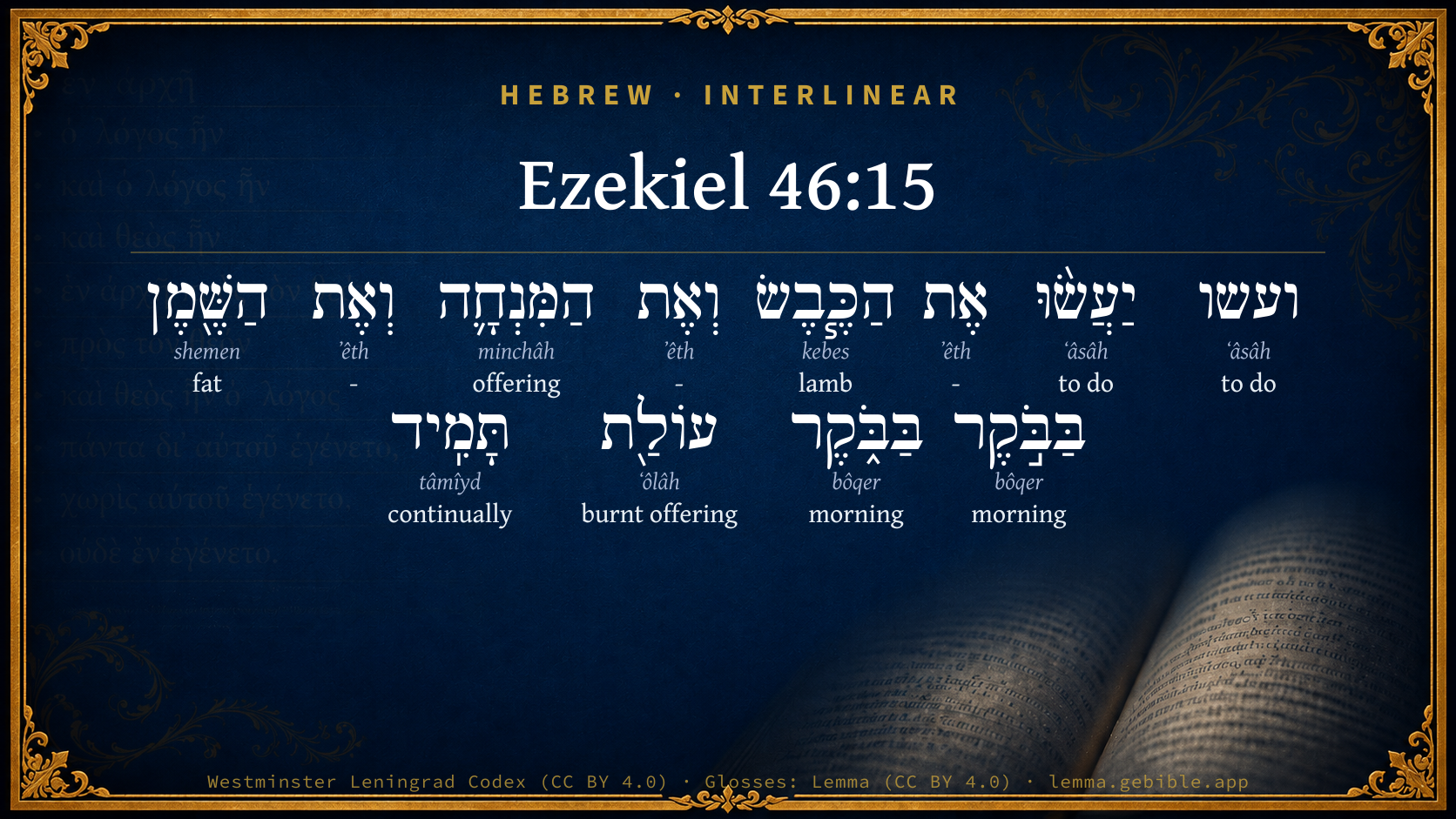
תָּמִֽיד
tâmîyd
H8548
“continually”
Noun, Common, Masculine, Singular, Absolute
Part of Speech
Noun
Type
Common
Gender
Masculine
Number
Singular
State
Absolute
Full BDB Definition

Origin: from an unused root meaning to stretch

TWOT: 1157a

continuity, perpetuity, to stretch - continually, continuously (as adverb) - continuity (substantive)
  1. ועשו ʻâsâh H6213 “and · to do” Conjunction + Verb, Qal, Sequential Perfect, 3rd Person, Common, Plural
  2. יַעֲשׂ֨וּ ʻâsâh H6213 “to do” Verb, Qal, Imperfect, 3rd Person, Masculine, Plural
  3. אֶת ʼêth H853 “-” Particle, Direct Object
  4. הַכֶּ֧בֶשׂ kebes H3532 “the · lamb” Particle, Definite Article + Noun, Common, Masculine, Singular, Absolute
  5. וְאֶת ʼêth H853 “and · -” Conjunction + Particle, Direct Object
  6. הַמִּנְחָ֛ה minchâh H4503 “the · offering” Particle, Definite Article + Noun, Common, Feminine, Singular, Absolute
  7. וְאֶת ʼêth H853 “and · -” Conjunction + Particle, Direct Object
  8. הַשֶּׁ֖מֶן shemen H8081 “the · fat” Particle, Definite Article + Noun, Common, Masculine, Singular, Absolute
  9. בַּבֹּ֣קֶר bôqer H1242 “in/at the · morning” Preposition, Determined + Noun, Common, Masculine, Singular, Absolute
  10. בַּבֹּ֑קֶר bôqer H1242 “in/at the · morning” Preposition, Determined + Noun, Common, Masculine, Singular, Absolute
  11. עוֹלַ֖ת ʻôlâh H5930 “burnt offering of” Noun, Common, Feminine, Singular, Construct

About this verse

These counts appear in no published source. They are computed here, from the morphology-tagged text and Lemma’s own curated glosses. What Lemma adds →

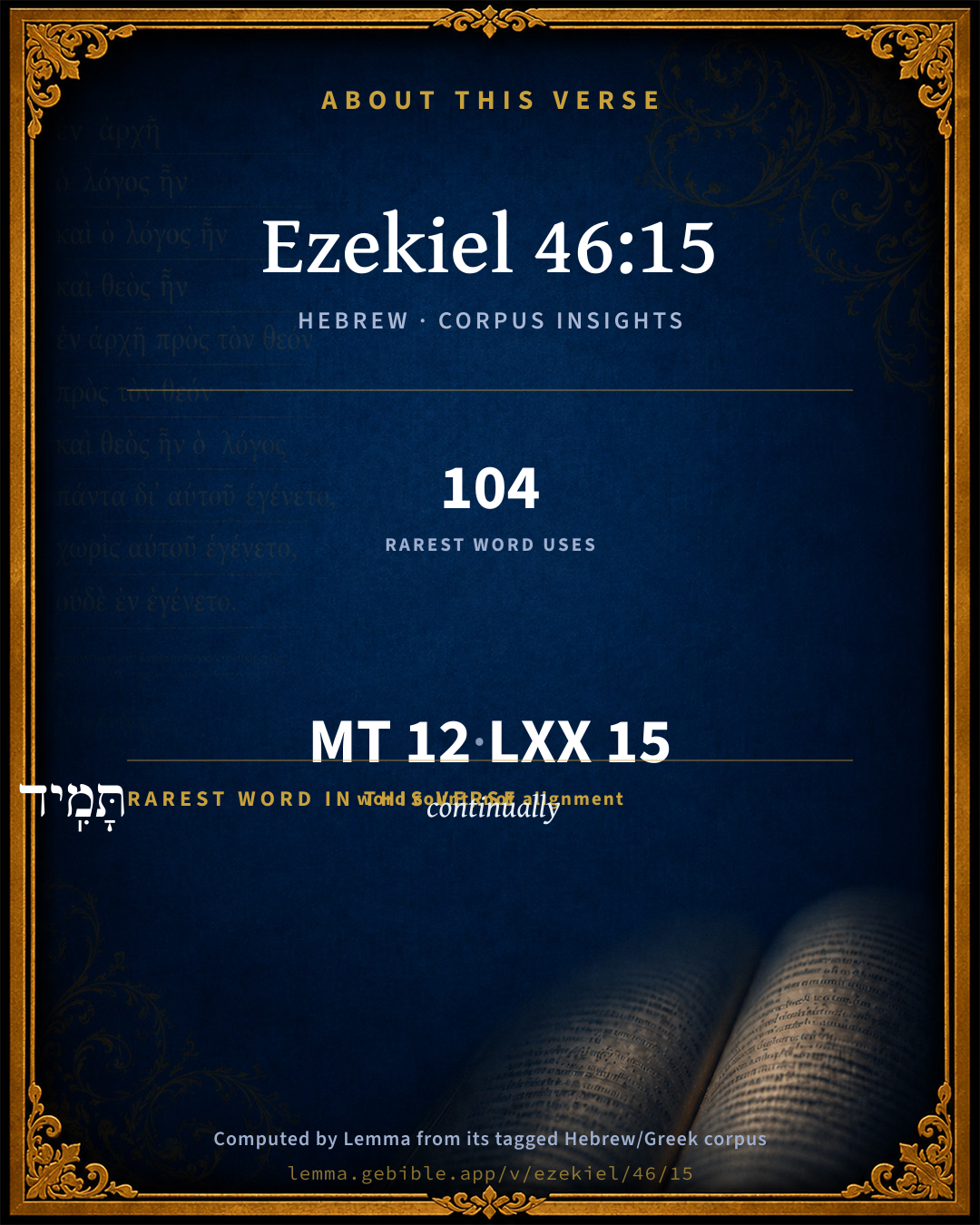
12
words
8
distinct lemmas
Prophets
section

Grammatical profile

  • 2 verbs
  • 7 nouns
  • 3 particles

Verb forms

  • ועשו Qal · Sequential Perfect
  • יַעֲשׂ֨וּ Qal · Imperfect

Repetition

Words recur within this verse — often emphatic in Hebrew:

  • ועשו to do H6213 ×2
  • בַּבֹּ֣קֶר morning H1242 ×2

Hebrew & Septuagint length

In English translation the verse runs 20 words from the Hebrew and 22 from the Septuagint (LXX English) — closely comparable.

A rough comparison of the two English renderings, which tokenize alike — not a word-level alignment.

Word counts can differ between the Hebrew and the Greek without any difference in meaning — e.g. the Hebrew direct-object marker אֵת has no separate Greek word, and Greek often adds the article ὁ.

In the original languages it is 12 Hebrew tokens and 15 Greek tokens — but the two are counted differently (Hebrew bundles its prefixes and suffixes into one token; the Greek is in lemma form), so that isn’t a like-for-like length.

Cross-references

5

Topical passages linked to Ezekiel 46:15 in the Treasury of Scripture Knowledge — connected by theme and wording, ordered by reader-vote popularity; previews shown in the World English Bible.

  • Hebrews 10:1–10 For the law, having a shadow of the good to come, not the very image of the things, can never with the same sacrifices year by year, which they offer continually, make perfect those who draw near.
  • Exodus 29:42 It shall be a continual burnt offering throughout your generations at the door of the tent of meeting before Yahweh, where I will meet with you, to speak there to you.
  • Numbers 28:6 It is a continual burnt offering, which was ordained in Mount Sinai for a sweet savor, an offering made by fire to Yahweh.
  • Hebrews 7:27 who doesn't need, like those high priests, to daily offer up sacrifices, first for his own sins, and then for the sins of the people. For this he did once for all, when he offered up himself.
  • Hebrews 9:26 or else he must have suffered often since the foundation of the world. But now once at the end of the ages, he has been revealed to put away sin by the sacrifice of himself.

Cross-references courtesy of OpenBible.info (CC BY 4.0).

Hebrew and Greek witnesses Masoretic Hebrew ↔ Greek Septuagint

The same verse in the two great witnesses to the Old Testament, shown verse-for-verse.

These are two independent witnesses, not word-aligned to each other, and the Septuagint is shown in lemma (dictionary) form.

Hebrew Ezekiel 46:15 Masoretic · Westminster Leningrad Codex

ועשו יַעֲשׂ֨וּ אֶת הַכֶּ֧בֶשׂ וְאֶת הַמִּנְחָ֛ה וְאֶת הַשֶּׁ֖מֶן בַּבֹּ֣קֶר בַּבֹּ֑קֶר עוֹלַ֖ת תָּמִֽיד

Thus shall they prepare the lamb, and the meal-offering, and the oil, morning by morning, for a continual burnt offering.

World English Bible · Public Domain

Greek LXX Ezekiel 46:15 Septuagint · lemma form

ποιέω ὁ ἀμνός καί ὁ μαναα καί ὁ ἔλαιον ποιέω ὁ πρωΐ ὁλοκαύτωμα διά πᾶς

You⌃ shall prepare the lamb, and the free will offering, and the oil in the morning, for a perpetual whole burnt sacrifice.

LXX2012 (modern English Septuagint) · Public Domain

Hebrew: Westminster Leningrad Codex (CC BY 4.0). Greek: Septuagint (public domain); English from LXX2012 (modern English Septuagint) (Public Domain). How the Septuagint differs from the Hebrew →

Targum (Aramaic paraphrase)

1

The Targum is the ancient Jewish Aramaic paraphrase of the Hebrew Scriptures — an interpretive translation, not the Hebrew text itself. Onkelos (literal) and Pseudo-Jonathan (expansive) render the Torah, and Jonathan the Prophets. Coverage is partial: where no permissively-licensed English translation exists for a verse, only the Aramaic is shown. This is verse-level text, not a word-by-word alignment to the Hebrew.

  1. Targum Jonathan Prophets (Joshua–Malachi)
    יַעְבְדוּן יַת אִימְרָא וְיַת מִנְחֲתָא וְיַת מִשְׁחָתָא בִּצְפַר בִּצְפַר עֲלָתָא תְּדִירָא:

    (no public-domain English translation for this verse)

    Targum Jonathan — Aramaic: “Mikraot Gedolot” (public domain). English: “Sefaria Community Translation” (CC0 1.0 (public-domain dedication)); “London "Chaldee Paraphrase," 1871” (public domain). Text via Sefaria.

Commentary

Notes on Ezekiel 46:15 from classic Christian and Jewish commentators (each source and its license shown beneath its notes). The classic Christian expositions comment on the surrounding passage and are grouped to its opening verse, so a note may address several verses; the Jewish commentaries on the Tanakh (Rashi and others) are per-verse, so they appear only where the commentator wrote on this verse.

Lemma curates 59 commentaries, every one of them public domain or Creative Commons licensed, each selected and text-cleaned for this edition rather than reprinted as found. About our sources →

Trapp's Complete Commentary

John Trapp

Eze 46:15 Thus shall they prepare the lamb, and the meat offering, and the oil, every morning [for] a continual burnt offering.

Ver. 15. Every morning.] Understand it of every evening also. {as Exo 29:38}

John Trapp, A Commentary or Exposition upon All the Books of the Old and New Testament (1647–1656) — public domain. Text from a community e-Sword module.

John Gill's Exposition

Thus saith the Lord God,.... Having finished the account of the sacrifices of the prince and people, the monthly, weekly, and daily ones; here his gifts are treated of, which are two fold; some given to his sons, others to his servants:

if the prince give a gift to any of his sons; Christ, the Prince, has sons; he that is the Prince, of peace is the everlasting Father; he has children given unto him, whom he preserves; a seed promised him in covenant, which shall always endure; a family he is master of, and cares for; for whose sake he became incarnate, suffered, and died: they are sons by adopting grace, and in their adoption he has a great concern; they are predestinated to it by him; they receive it through him; he gives them power to become the sons of God, and they are manifestatively so through faith in him; they appear to be his sons, or are evidenced as such by their regeneration, which also is of him: it is by his Spirit they are regenerated; it is his grace that is implanted in them; it is he himself that is formed in them, and his image that is stamped upon them; it is owing to his word and Gospel as the means and to his resurrection as the virtual cause of it; it is in his church they are born, yea, of her, to whom he stands in the relation of a husband, and so they are sons brought forth to him by her; and these are princes by birth, have a free and princely spirit, and are brought up and provided for as such: now to these Christ gives gifts; gifts of special grace, all sorts of grace; sanctifying grace, faith, hope, love, repentance, &c.; justifying grace, the gift of righteousness; pardoning grace; adopting grace; all supplies of grace; spiritual strength, peace, joy and comfort; and persevering grace, to hold out to the end: and he also gives glory or eternal life; this is with him, in his hands; he has a power to give and he does give it, to all his sons; all which, being once given, ever continue.

The inheritance thereof shall be his sons', it shall be their possession by inheritance; that is, it shall ever remain with them, shall never be taken away from them; these are gifts and calling without repentance, irreversible blessings, which are for ever: sanctifying grace is a well of living water, springing up unto eternal life; faith, hope, and love, always abide; Christ's justifying righteousness is an everlasting one; pardon of sin is of all sin, past, present, and to come, and is never made void or called in; once children of God, and always such; and the inheritance of heaven is incorruptible, never fading, and eternal; and all this flows from the unchangeable love of God and Christ to these sons of the prince.

John Gill's Exposition of the Whole Bible (1746–1763) — public domain (CC PDM 1.0). Text via the HelloAO Bible API.

Matthew Poole's English Annotations

This verse is a ratifying of all prescribed in Eze 46:13,14. These three verses direct the daily sacrifice; and because they mention only the morning sacrifice and one lamb, some think that here less is required than in Num 28:3,4; but they forget that there is a parity of reason for the evening sacrifice, and that this is included. They were to do in the evening oblation as they did in the morning.

Matthew Poole's English Annotations on the Holy Bible (1683–1685) — public domain. Text from a community e-Sword/MySword module.

Lesson kit

Teaching starters — assembled from the data on this page, not authored interpretation. Every prompt links to the verse data it draws on. Edit before teaching.

Ezekiel, in the Prophets, opens this verse with 12 words (8 distinct Hebrew lemmas). Its most distinctive word is tâmîyd (“continually”). A historical commentator’s framing appears above. Read the whole chapter for the surrounding context.

Discussion questions

  1. How does “continually” (tâmîyd) shape what this verse is saying?
  2. How does Hebrews 10:1–10, which shares this passage’s theme, read alongside this verse?
  3. What does the repetition of “to do” (2× in this one verse) do in this verse?
  4. These translations render this verse differently; the difference is in the English rendering, not the original. What questions does that raise?
  5. «ועשו» is a Qal Sequential Perfect verb. How does that grammatical form shape the action described?
  6. Compare how Trapp's Complete Commentary and John Gill's Exposition read this verse. Where do they agree or differ?

Things to notice

Reading settings

Reading text

Shown beneath each verse's original-language words.

Old Testament
Old Testament edition

Read the OT as the Masoretic Hebrew (MT) or the Greek Septuagint (LXX).

English shown for the Greek Septuagint (in the Hebrew ↔ Greek comparison).

Comparing translations? Open the Compare panel on any verse page to stack up to four side by side.