Isaiah 38:13

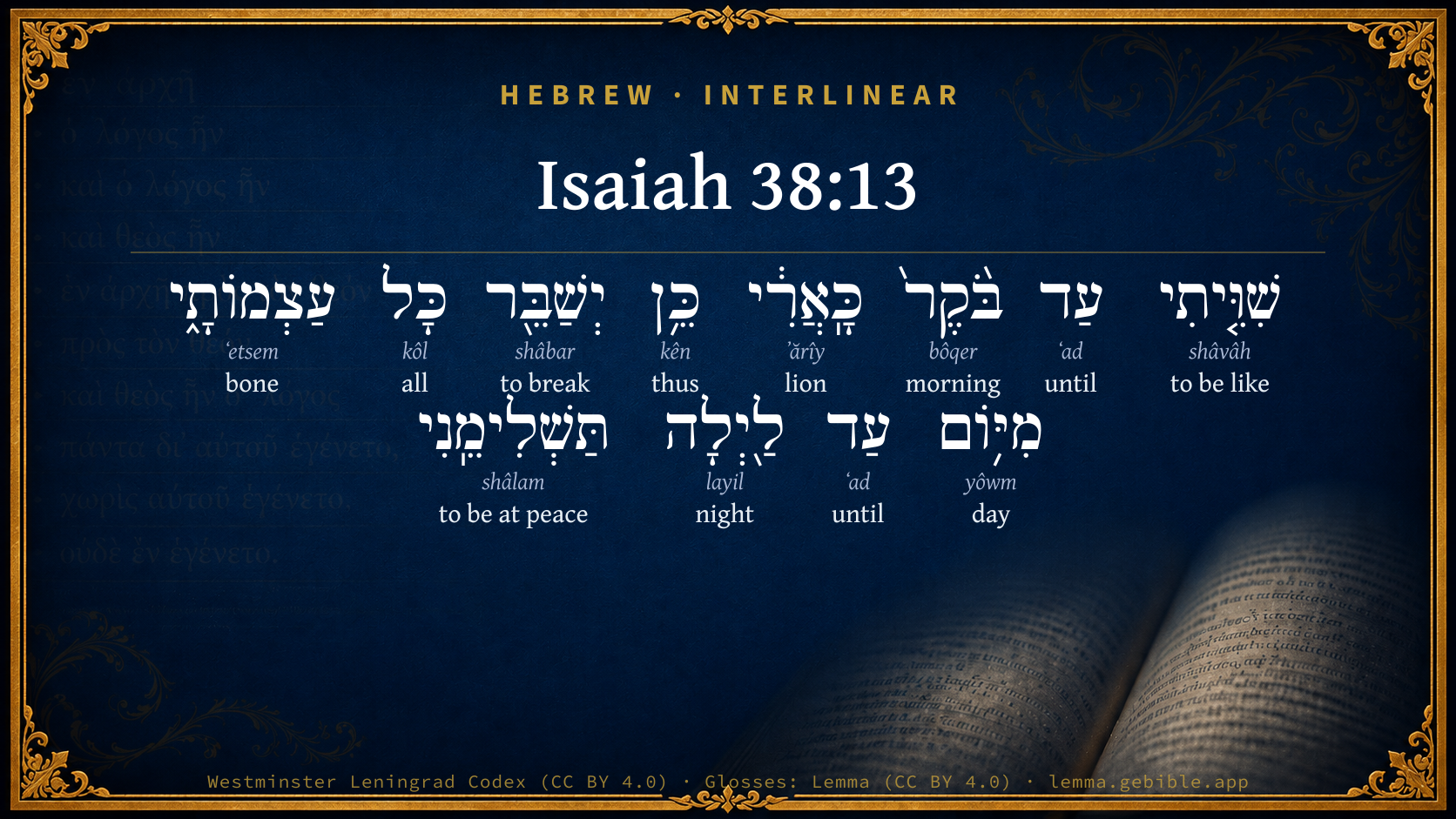
Hebrew (Westminster Leningrad Codex) Isaiah 38:13 appears in the Hebrew Old Testament. The text above is from the Westminster Leningrad Codex. Each word links to its Strong’s number, a concise gloss, and parsing drawn from the Open Scriptures Hebrew Bible morphology. Click any word for its full Brown-Driver-Briggs (BDB) entry.
Download image
Cite this verse

Isaiah 38:13 (World English Bible). Public Domain. Lemma interlinear Bible study tool, https://lemma.gebible.app/v/isaiah/38/13.

Show BibTeX & RIS
BibTeX
RIS
English Translation
I quieted [myself] until morning; as a lion, so he breaks all my bones: From day even to night will you make an end of me.
World English Bible · Public Domain
Download a study sheet

One document with this verse’s original text, its word-by-word gloss line, the meaning frame, cross-references with their text, attributed commentary, and full source and license credits — printable, and it pastes into notes with its structure intact.

This verse Autodidact and up

Study sheet (.html) Plain text (.txt)

A passage Seminary Student

Up to 50 verses in one chapter. A passage sheet keeps up to 6 commentary sources and 12 cross-references per verse, in the order this page ranks them, and says so on the sheet whenever that leaves anything out. Ask for a single verse and you get the Autodidact verse sheet above.

Everything on this page stays free to read, with no account — the sheet is a download of what is already on screen, not access to it.

Want to remove ads? Support Godless Engineer
Compare translations 3

The same verse in 3 English versions, stacked beneath the original-language interlinear above. Click any original word for its lexicon entry.

Each is an independent rendering of the whole verse — the interlinear is not word-aligned to these translations.

Highlighted words mark where these versions differ — a whole-verse word diff, not a word-by-word alignment.

  • World English Bible Public Domain
    I quieted [myself] until morning; as a lion, so he breaks all my bones: From day even to night will you make an end of me.
  • King James Version Public Domain
    I reckoned till morning, that, as a lion, so will he break all my bones: from day even to night wilt thou make an end of me.
  • unfoldingWord Literal Text CC BY-SA 4.0
    I lie down until the morning; like a lion, thus he breaks all of my bones. From day to night you are finishing me.

unfoldingWord Literal Text — © unfoldingWord, licensed CC BY-SA 4.0. Word-aligned USFM3 via Door43 (git.door43.org/unfoldingWord/en_ult).

Versions to compare (up to 4)

3 of 4 selected

Show all 18 translations

Every available English version of this verse, each an independent rendering of the whole verse.

  • World English Bible Public Domain
    I quieted [myself] until morning; as a lion, so he breaks all my bones: From day even to night will you make an end of me.
  • Berean Standard Bible Public Domain
    I composed myself until the morning. Like a lion He breaks all my bones; from day until night You make an end of me.
  • Majority Standard Bible Public Domain
    I composed myself until the morning. Like a lion He breaks all my bones; from day until night You make an end of me.
  • King James Version Public Domain
    I reckoned till morning, that, as a lion, so will he break all my bones: from day even to night wilt thou make an end of me.
  • American Standard Version (1901) Public Domain
    I quieted `myself' until morning; as a lion, so he breaketh all my bones: From day even to night wilt thou make an end of me.
  • Revised Version (1885) Public Domain
    I quieted myself until morning; as a lion, so he breaketh all my bones: from day even to night wilt thou make an end of me.
  • Geneva Bible (1599) Public Domain
    I rekoned to the morning: but he brake all my bones, like a lion: from day to night wilt thou make an ende of me.
  • Douay-Rheims (1899) Public Domain
    I hoped till morning, as a lion so hath he broken all my bones: from morning even to night thou wilt make an end of me.
  • Young's Literal Translation Public Domain
    I have set `Him' till morning as a lion, So doth He break all my bones, From day unto night Thou dost end me.
  • Literal Standard Version CC BY-SA 4.0
    I have set [Him] as a lion until morning, || So He breaks all my bones, || From day to night You end me.
  • Unlocked Literal Bible CC BY-SA 4.0
    I cried out until the morning; like a lion he breaks all my bones. Between day and night you are ending my life.
  • unfoldingWord Literal Text CC BY-SA 4.0
    I lie down until the morning; like a lion, thus he breaks all of my bones. From day to night you are finishing me.
  • Darby Bible Public Domain
    I kept still until the morning;... as a lion, so doth he break all my bones. From day to night thou wilt make an end of me.
  • World Messianic Bible Public Domain
    I waited patiently until morning. He breaks all my bones like a lion. From day even to night you will make an end of me.
  • Webster's Bible Public Domain
    I reckoned till morning, that, as a lion, so will he break all my bones: from day even to night wilt thou make an end of me.
  • Free Bible Version CC BY-SA 4.0
    I lie there patiently until the morning, but I feel like there's a lion breaking every bone in my body. Day and night you bring me to an end.
  • Bible in Basic English Public Domain
    I am crying out with pain till the morning; it is as if a lion was crushing all my bones.
  • JPS Tanakh (1917) Public Domain
    The more I make myself like unto a lion until morning, the more it breaketh all my bones; from day even to night wilt Thou make an end of me.

Literal Standard Version (2020), Covenant Press — licensed CC BY-SA 4.0. Text via the HelloAO Bible API (eBible.org). Unlocked Literal Bible (unfoldingWord) — licensed CC BY-SA 4.0. Text via the HelloAO Bible API (eBible.org). unfoldingWord Literal Text — © unfoldingWord, licensed CC BY-SA 4.0. Word-aligned USFM3 via Door43 (git.door43.org/unfoldingWord/en_ult). Free Bible Version, Dr. Jonathan Gallagher — licensed CC BY-SA 4.0. Text via the HelloAO Bible API (eBible.org).

Word by word

More ways to search: Search by grammar → Find every occurrence → Compare this word →

Practice this passage: Drill this verse → Learn its vocabulary →

שִׁוִּ֤יתִי
shâvâh
H7737
“to be like”
Verb, Piel, Perfect, 1st Person, Common, Singular
Part of Speech
Verb
Stem
Piel
Form
Perfect
Person
1st Person
Gender
Common
Number
Singular
Full BDB Definition

Origin: a primitive root

TWOT: 2342 , 2343

to agree with, be or become like, level, resemble - (Qal) - to be like - equivalent (participle) - to set, place - setting (participle) - (Piel) to level, smooth, still - (Hiphil) to make like - (Nithpael) to be alike - (Piel) to set, place
  1. עַד ʻad H5704 “until” Preposition
  2. בֹּ֨קֶר֙ bôqer H1242 “morning” Noun, Common, Masculine, Singular, Absolute
  3. כָּֽאֲרִ֔י ʼărîy H738 “like/as the · lion” Preposition, Determined + Noun, Common, Masculine, Singular, Absolute
  4. כֵּ֥ן kên H3651 “thus” Particle, Demonstrative
  5. יְשַׁבֵּ֖ר shâbar H7665 “to break” Verb, Piel, Imperfect, 3rd Person, Masculine, Singular
  6. כָּל kôl H3605 “all of” Noun, Common, Masculine, Singular, Construct
  7. עַצְמוֹתָ֑י ʻetsem H6106 “bones · my” Noun, Common, Feminine, Plural, Construct + Suffix, Personal, 1st Person, Common, Singular
  8. מִיּ֥וֹם yôwm H3117 “from · day” Preposition + Noun, Common, Masculine, Singular, Absolute
  9. עַד ʻad H5704 “until” Preposition
  10. לַ֖יְלָה layil H3915 “night” Noun, Common, Masculine, Singular, Absolute
  11. תַּשְׁלִימֵֽנִי shâlam H7999 “to be at peace · me” Verb, Hiphil, Imperfect, 2nd Person, Masculine, Singular + Suffix, Personal, 1st Person, Common, Singular

About this verse

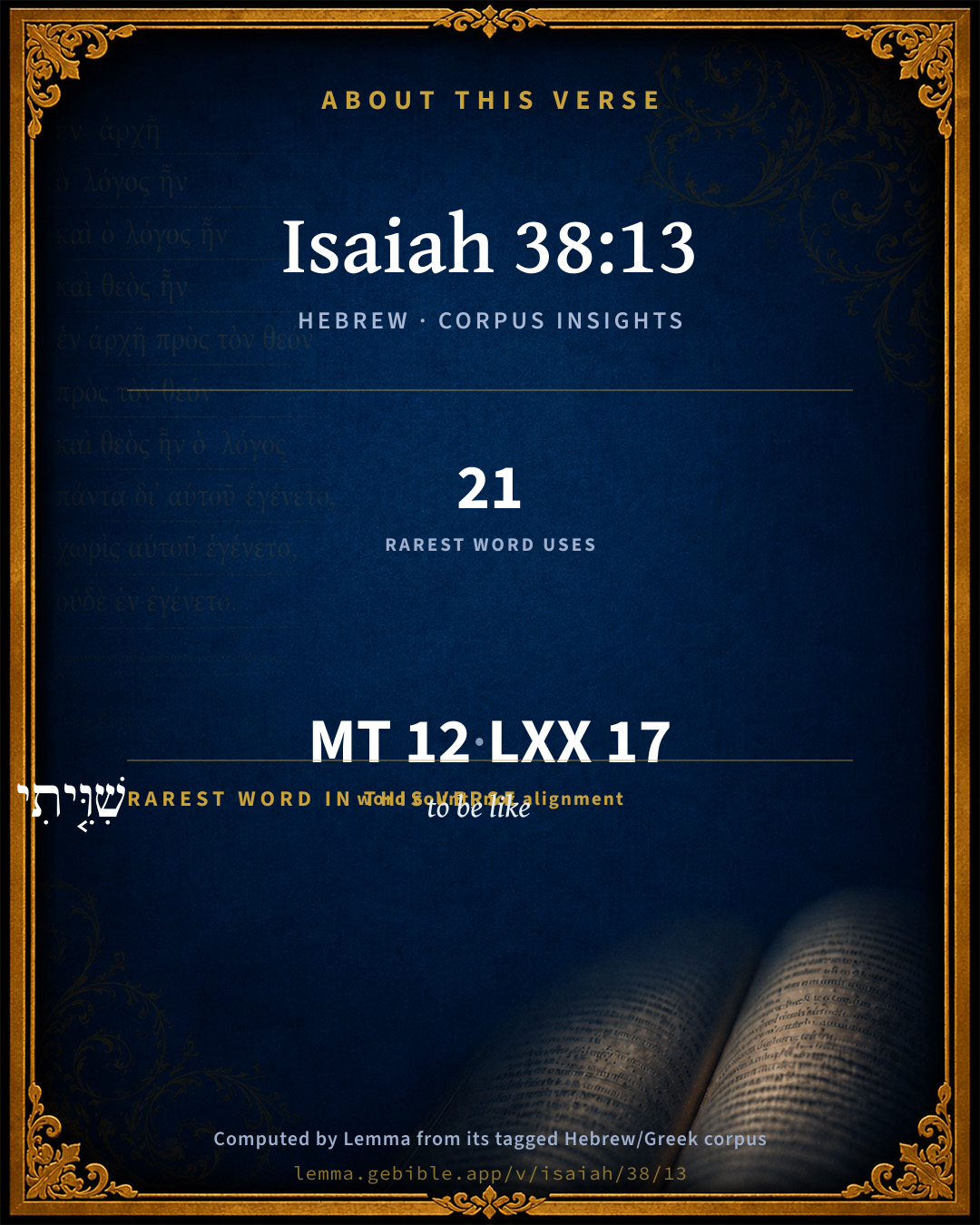
These counts appear in no published source. They are computed here, from the morphology-tagged text and Lemma’s own curated glosses. What Lemma adds →

12
words
11
distinct lemmas
Prophets
section

Notable vocabulary

The rarest word here is שִׁוִּ֤יתִי to be like H7737 — appearing just 21 times in the whole Hebrew Bible.

Shared distinctive vocabulary

שִׁוִּ֤יתִי to be like H7737 occurs in 21 verses of the Hebrew Bible. Also found in:

Grammatical profile

  • 3 verbs
  • 6 nouns
  • 2 prepositions
  • 1 particle

Verb forms

  • שִׁוִּ֤יתִי Piel · Perfect
  • יְשַׁבֵּ֖ר Piel · Imperfect
  • תַּשְׁלִימֵֽנִי Hiphil · Imperfect

Repetition

A word recurs within this verse — often emphatic in Hebrew:

Hebrew & Septuagint length

In English translation the verse runs 26 words from the Hebrew and 32 from the Septuagint (LXX English) — closely comparable.

A rough comparison of the two English renderings, which tokenize alike — not a word-level alignment.

Word counts can differ between the Hebrew and the Greek without any difference in meaning — e.g. the Hebrew direct-object marker אֵת has no separate Greek word, and Greek often adds the article ὁ.

In the original languages it is 12 Hebrew tokens and 17 Greek tokens — but the two are counted differently (Hebrew bundles its prefixes and suffixes into one token; the Greek is in lemma form), so that isn’t a like-for-like length.

Cross-references

10

Topical passages linked to Isaiah 38:13 in the Treasury of Scripture Knowledge — connected by theme and wording, ordered by reader-vote popularity; previews shown in the World English Bible.

  • Psalms 51:8 Let me hear joy and gladness, That the bones which you have broken may rejoice.
  • Daniel 6:24 The king commanded, and they brought those men who had accused Daniel, and they cast them into the den of lions, them, their children, and their wives; and the lions had the mastery of them, and broke all their bones in pieces, before they came to the bottom of the den.
  • 1 Kings 13:24–26 When he was gone, a lion met him by the way, and killed him: and his body was cast in the way, and the donkey stood by it; the lion also stood by the body.
  • Job 10:16–17 If my head is held high, you hunt me like a lion. Again you show yourself powerful to me.
  • Job 16:12–14 I was at ease, and he broke me apart. Yes, he has taken me by the neck, and dashed me to pieces. He has also set me up for his target.
  • Psalms 39:10 Remove your scourge away from me. I am overcome by the blow of your hand.
  • Psalms 50:22 "Now consider this, you who forget God, Lest I tear you into pieces, and there be none to deliver.
  • Hosea 5:14 For I will be to Ephraim like a lion, And like a young lion to the house of Judah. I myself will tear in pieces and go away. I will carry off, and there will be no one to deliver.
  • 1 Corinthians 11:30–32 For this cause many among you are weak and sickly, and not a few sleep.
  • 1 Kings 20:36 Then said he to him, Because you have not obeyed the voice of Yahweh, behold, as soon as you are departed from me, a lion shall kill you. As soon as he was departed from him, a lion found him, and killed him.

Cross-references courtesy of OpenBible.info (CC BY 4.0).

Hebrew and Greek witnesses Masoretic Hebrew ↔ Greek Septuagint

The same verse in the two great witnesses to the Old Testament, shown verse-for-verse.

These are two independent witnesses, not word-aligned to each other, and the Septuagint is shown in lemma (dictionary) form.

Hebrew Isaiah 38:13 Masoretic · Westminster Leningrad Codex

שִׁוִּ֤יתִי עַד בֹּ֨קֶר֙ כָּֽאֲרִ֔י כֵּ֥ן יְשַׁבֵּ֖ר כָּל עַצְמוֹתָ֑י מִיּ֥וֹם עַד לַ֖יְלָה תַּשְׁלִימֵֽנִי

I quieted [myself] until morning; as a lion, so he breaks all my bones: From day even to night will you make an end of me.

World English Bible · Public Domain

Greek LXX Isaiah 38:13 Septuagint · lemma form

ἕως πρωί ὡς λέων οὕτως ὁ ὀστέον ἐγώ συντρίβω ἀπό γάρ ὁ ἡμέρα ἕως ὁ νύξ παραδίδωμι

In that day I was given up as to a lion until the morning: so has he broken all my bones: for I was so given up from day even to night.

LXX2012 (modern English Septuagint) · Public Domain

On this verse, Adam Clarke's Commentary discusses the Septuagint’s reading. Read the note in Commentary ↓

Hebrew: Westminster Leningrad Codex (CC BY 4.0). Greek: Septuagint (public domain); English from LXX2012 (modern English Septuagint) (Public Domain). How the Septuagint differs from the Hebrew →

Targum (Aramaic paraphrase)

1

The Targum is the ancient Jewish Aramaic paraphrase of the Hebrew Scriptures — an interpretive translation, not the Hebrew text itself. Onkelos (literal) and Pseudo-Jonathan (expansive) render the Torah, and Jonathan the Prophets. Coverage is partial: where no permissively-licensed English translation exists for a verse, only the Aramaic is shown. This is verse-level text, not a word-by-word alignment to the Hebrew.

  1. Targum Jonathan Prophets (Joshua–Malachi)
    נַהֲמִית עַד צַפְרָא כְּאַרְיָא דְנָהֵים וְתָבַר גַרְמַי חֵיוָתָא כֵּן מִתַּבְּרִין מִן קֳדָם דְוָנָא כָּל גַרְמֵי יְמָמַי וְלֵילְוָתִי שְׁלִימוּ:

    I roar until the morning like a lion that roareth when he breaketh the bones of a beast; thus on account of my sorrow all my bones are broken; my days and my nights are come to an end.

    Targum Jonathan — Aramaic: “Mikraot Gedolot” (public domain). English: “Sefaria Community Translation” (CC0 1.0 (public-domain dedication)); “London "Chaldee Paraphrase," 1871” (public domain). Text via Sefaria.

Commentary

Notes on Isaiah 38:13 from classic Christian and Jewish commentators (each source and its license shown beneath its notes). The classic Christian expositions comment on the surrounding passage and are grouped to its opening verse, so a note may address several verses; the Jewish commentaries on the Tanakh (Rashi and others) are per-verse, so they appear only where the commentator wrote on this verse.

Lemma curates 59 commentaries, every one of them public domain or Creative Commons licensed, each selected and text-cleaned for this edition rather than reprinted as found. About our sources →

Trapp's Complete Commentary

John Trapp

Isa 38:13 I reckoned till morning, [that], as a lion, so will he break all my bones: from day [even] to night wilt thou make an end of me.

Ver. 13. I reckoned until morning.] And then, at utmost, I thought there would be an end of my life and pain together; for what through troubles without and terrors within, he was in a woe case, even as if a lion had broke all his bones. Hoc sentinnt qui magnis febribus aestuant, saith an interpreter. Now, whereas some say all die of a fever, let us take care we die not of a cold shaking fit of fear.

John Trapp, A Commentary or Exposition upon All the Books of the Old and New Testament (1647–1656) — public domain. Text from a community e-Sword module.

Joseph Benson's Commentary

Isa 38:13-14. I reckoned till morning, &c. — When night came I reckoned I should die before the next morning, my pains being as great as if my bones had been broken, and the whole frame of my body crushed by a lion. Bishop Lowth reads: I roared until the morning like the lion; so did he break to pieces all my bones. Like a crane or a swallow, &c. — “My pains were sometimes so violent that they forced me to cry aloud; at other times my strength was so exhausted that I could only groan inwardly, and bemoan my unhappy condition in sighs.” I did mourn as a dove — Whose mournful tone is observed Isa 59:11, and elsewhere; mine eyes fail with looking upward — While I lift up my eyes and heart to God for relief in vain; O Lord, I am oppressed — Namely, by my disease, which, like a sergeant, hath seized upon me, and is haling me to the prison of the grave; undertake for me — Stop the execution, and rescue me out of his hands.

Joseph Benson's Commentary on the Old and New Testaments (1811–1818) — public domain. Text from a community e-Sword module.

Geneva Bible (1599)

Geneva Bible translators

Over night I thought that I should live till morning, but my pangs in the night persuaded me the contrary: he showeth the horror that the faithful have when they apprehend God’s judgment against their sin.

Geneva Bible (1599) marginal notes — public domain. Text via Bolls.life.

Jamieson, Fausset & Brown

Robert Jamieson, A. R. Fausset & David Brown

I reckoned . . . that--rather, I composed (my mind, during the night, expecting relief in the "morning," so Job 7:4): for ("that" is not, as in the English Version, to be supplied) as a lion He was breaking all my bones [VITRINGA] (Job 10:16; Lam 3:10-11). The Hebrew, in Psa 131:2, is rendered, "I quieted." Or else, "I made myself like a lion (namely, in roaring, through pain), He was so breaking my bones!" Poets often compare great groaning to a lion's roaring, so, Isa 38:14, he compares his groans to the sounds of other animals (Psa 22:1) [MAURER].

Jamieson, Fausset & Brown — Commentary Critical and Explanatory on the Whole Bible (1871) — public domain (CC PDM 1.0). Text via the HelloAO Bible API.

Adam Clarke's Commentary

Verse 13. The last line of the foregoing verse מיום עד לילה תשלימני migom ad layelah tashlimeni, "In the course of the day thou wilt finish my web;" or, as the common version has it, "From day even to night wilt thou make an end of me," is not repeated at the end of this verse in the Syriac version; and a MS. omits it. It seems to have been inserted a second time in the Hebrew text by mistake.

I reckoned till morning, c. - "I roared until the morning like the lion"] For שויתי shivvithi, the Chaldee has נהמית nihameith: he read שאגתי shaagti, the proper term for the roaring of a lion often applied to the deep groaning of men in sickness. See Ps 22:1; Ps 32:3; Ps 38:9; Job 3:24. The Masoretes divide the sentence, as I have done; taking כארי caari, like a lion, into the first member; and so likewise the Septuagint.

Adam Clarke's Commentary on the Bible (1810–1826) — public domain. Text from a community e-Sword/MySword module.

Ellicott's Commentary for English Readers

(13) I reckoned till morning . . .—Better, I quieted myself, as in Psa_131:2. He threw himself into the calm submission of the weaned child; yet when the morning came there was a fresh access of suffering. Life had been prolonged, contrary to his expectations; but it was only for renewed agony. Surely that would end his sufferings.

A Bible Commentary for English Readers, edited by Charles John Ellicott (1878–1897) — public domain. Text from a community e-Sword module.

The Cambridge Bible for Schools and Colleges

gen. ed. J. J. S. Perowne

13. I reckoned till morning] R.V. has “I quieted myself until morning.” It is better to amend the text slightly and read I cried until morning.

so will he break (better, he breaketh) all my bones] the crushing effect of pain. Cf. Lam_3:4.

The Cambridge Bible for Schools and Colleges (gen. ed. J. J. S. Perowne; Cambridge University Press, 1878–1918) — public domain. Text from a community e-Sword module.

John Gill's Exposition

Like a crane, or a swallow, so did I chatter,.... Rather, "like a crane and a swallow", like both; sometimes loud and clamorous, like a crane (o), when the pain was very acute and grievous; and sometimes very low, through weakness of body, like the twittering of a swallow; or the moan he made under his affliction was like the mournful voices of these birds at certain times. Some think he refers to his prayers, which were quick and short, and expressed not with articulate words, but in groans and cries; at least were not regular and orderly, but interrupted, and scarce intelligible, like the chattering of the birds mentioned:

I did mourn as a dove; silently and patiently, within himself, for his sins and transgressions; and because of his afflictions, the fruit of them:

mine eyes fail with looking upwards; or, "on high"; or, as the Septuagint and Arabic versions express it, "to the height of heaven"; to the Lord there, whose Shechinah, as the Targum, is in the highest heavens: in his distress he looked up to heaven for help, but none came; he looked and waited till his eyes were weak with looking, and he could look no longer; both his eyes and his heart failed him, and he despaired of relief; and the prayer he put up was as follows:

O Lord, I am oppressed; undertake for me; or, "it oppresseth me (p)"; that is, the disease; it lay so heavy upon him, it bore him down with the weight of it, he could not stand up under it; it had seized him, and crushed him; it held him fast, and he could not get clear of it; and therefore entreats the Lord to "undertake" for him, to be his surety for good, as in Psa 119:122, he represents his disease as a bailiff that had arrested him, and was carrying him to the prison of the grave; and therefore prays that the Lord would bail him, or rescue him out of his hands, that he might not go down to the gates of the grave. So souls oppressed with the guilt of sin, and having fearful apprehensions of divine justice, should apply to Christ their surety, and take refuge in his undertakings, where only peace and safety are to be enjoyed. So Gussetius renders the words, "I have unrighteousness, be surety for me" (q); and takes them to be a confession of Hezekiah, acknowledging himself guilty of unrighteousness, praying and looking to Christ the Son of God, and to his suretyship engagements, who, though not yet come to fulfil them, certainly would.

(o) So it is said in the Talmud, "Resh-Lakish cried like a crane", T. Bab. Kiddushin, col. 42. 1. (p) "Opprimit me, sub.infirmitas, vel morbus", Munster. (q) "njustitia est mihi hoc est, habeo injustitiam, reus suro injustitia, sponde pro me", Ebr. Comment, p. 654.

John Gill's Exposition of the Whole Bible (1746–1763) — public domain (CC PDM 1.0). Text via the HelloAO Bible API.

Albert Barnes' Notes on the Bible

I reckoned - There has been considerable variety in interpreting this expression. The Septuagint renders it, ‘I was given up in the morning as to a lion.’ The Vulgate renders it, ‘I hoped until morning;’ and in his commentary, Jerome says it means, that as Job in his trouble and anguish Isa 7:4 sustained himself at night expecting the day, and in the daytime waiting for the night, expecting a change for the better, so Hezekiah waited during the night expecting relief in the morning. He knew, says he, that the violence of a burning fever would very soon subside, and he thus composed himself, and calmly waited. So Vitringa renders it, ‘I composed my mind until the morning.’ Others suppose that the word used here (שׁוּיתי shı̂vı̂ythı̂y), means, ‘I made myself like a lion,’ that is, in roaring. But the more probable and generally adopted interpretation is, ‘I looked to God, hoping that the disease would soon subside, but as a lion he crushed my bones. The disease increased in violence, and became past endurance. Then I chattered like a swallow, and mourned like a dove, over the certainty that I must die.’ Our translators, by inserting the word ‘that,’ have greatly marred the sense, as if he had reckoned or calculated through the night that God would break his bones, or increase the violence of the disease, whereas the reverse was true. He hoped and expected that it would be otherwise, and with that view he composed his mind.

As a lion so will he break all my bones - This should be in the past tense. ‘He (God) did crush all my bones.’ The connection requires this construction. The idea is, that as a lion crushes the bones of his prey, producing great pain and sudden death, so it was with God in producing great pain and the prospect of sudden death.

From day even to night ... - (See the note at Isa 38:12) Between morning and night. That is, his pain so resembled the crushing of all the bones of an animal by the lion, that he could not hope to survive the day.

Albert Barnes' Notes on the Bible (1834–1885) — public domain. Text from a community e-Sword/MySword module.

Matthew Poole's English Annotations

When I was filled with pain, and could not rest all the night long, even till morning, my thoughts were working and presaging that God would instantly break me to pieces, and that every moment would be my last; and the like restless and dismal thoughts followed me from morning till evening. But he mentions only the time before morning, to aggravate his misery, that he was so grievously tormented, when others had sweet rest and repose.

Matthew Poole's English Annotations on the Holy Bible (1683–1685) — public domain. Text from a community e-Sword/MySword module.

Whedon's Commentary on the Bible

Daniel D. Whedon

13. Night came, but no relief.

Till morning — The disease wrought hard, like a lion, to break all my bones — To kill outright. Then all the following day.

From day… to night — Pain was so great, so resembling a lion crushing all my bones, that I thought a quick end must be certain.

Daniel D. Whedon (gen. ed.), Commentary on the Old and New Testaments (1874–1909) — public domain. Text from a community e-Sword module.

The Pulpit Commentary

I reckoned till morning, etc.; i.e. "I lay thinking till the morning, that God would crush me as a lion crushes his prey I expected him all day long to make an end of me."

The Pulpit Commentary (1880–1919), ed. H.D.M. Spence-Jones & Joseph S. Exell — public domain. Text from a community e-Sword module.

John Wesley's Explanatory Notes

I reckon - When I could not rest all the night even 'till morning, my thoughts were presaging that God would instantly break me to pieces, and the like thoughts followed me from morning 'till evening.

John Wesley, Explanatory Notes Upon the Whole Bible (1754–1765) — public domain. Text via the GEBible commentary corpus.

Keil & Delitzsch

C. F. Keil & F. Delitzsch

In strophe 2 the retrospective glance is continued. His sufferings increased to such an extent, that there was nothing left in his power but a whining moan - a languid look for help.

I waited patiently till the morning; like the lion,

So He broke in pieces all my bones:

From day to night Thou makest it all over with me.

Like a swallow, a crane, so I chirped;

I cooed like the dove;

Mine eyes pined for the height.

O Lord, men assault me! Be bail for me."

The meaning of shivvithi may be seen from Psa 131:2, in accordance with which an Arabic translator has rendered the passage, "I smoothed, i.e., quieted (sâweitu) my soul, notwithstanding the sickness, all night, until the morning." But the morning brought no improvement; the violence of the pain, crushing him like a lion, forced from him again and again the mournful cry, that he must die before the day had passed, and should not live to see another. The Masora here has a remark, which is of importance, as bearing upon Psa 22:17, viz., that כּארי occurs twice, and לישׁני בתרי with two different meanings. The meaning of עגוּר סוּס is determined by Jer 8:7, from which it is evident that עגּור is not an attribute of סּוס here, in the sense of "chirping mournfully," or "making a circle in its flight," but is the name of a particular bird, namely the crane. For although the Targum and Syriac both seem to render סוס in that passage (keri סיס, which is the chethib here, according to the reading of Orientals) by כּוּרכּיא) (a crane, Arab. Kurki), and עגוּר, by סנוּניתא) (the ordinary name of the swallow, which Haji Gaon explains by the Arabic chuttaf), yet the relation is really the reverse: sūs (sı̄s) is the swallow, and ‛âgūr the crane. Hence Rashi, on b. Kiddusin 44a ("then cried Res Lakis like a crane"), gives âg, Fr. grue, as the rendering of כרוכי; whereas Parchon (s.verse ‛âgūr), confounds the crane with the hoarsely croaking stork (ciconia alba). The verb 'ătsaphtsēph answers very well not only to the flebile murmur of the swallow (into which the penitential Progne was changed, according to the Grecian myth), but also to the shrill shriek of the crane, which is caused by the extraordinary elongation of the windpipe, and is onomatopoetically expressed in its name ‛âgūr.

(Note: The call of the parent cranes, according to Naumann (Vgel Deutschlands, ix. 364), is a rattling kruh (gruh), which is uncommonly violent when close, and has a trumpet-like sound, which makes it audible at a very great distance. With the younger cranes it has a somewhat higher tone, which often passes, so to speak, into a falsetto.)

Tsiphtsēph, like τρίζειν, is applied to every kind of shrill, penetrating, inarticulate sound. The ordinary meaning of dallū, to hang long and loose, has here passed over into that of pining (syn. kâlâh). The name of God in Isa 38:14 is Adonai, not Jehovah, being one of the 134 ודּין, i.e., words which are really written Adonai, and not merely to be read so.

(Note: Vid., Br, Psalterium, p. 133.)

It is impossible to take עשׁקה־לּי as an imperative. The pointing, according to which we are to read ‛ashqa, admits this (compare shâmrâh in Psa 86:2; Psa 119:167; and on the other hand, zochrālli, in Neh 5:19, etc.);

(Note: Vid., Br, Thorath Emeth, pp. 22, 23.)

but the usage of the language does not yield any appropriate meaning for such an imperative. It is either the third person, used in a neuter sense, "it is sorrowful with me;" or, what Luzzatto very properly considers still more probable, on account of the antithesis of ‛ashqâh and ‛ârbēni, a substantive (‛ashqah for ‛osheq), "there is pressure upon me" (compare רזי־לי, Isa 24:16), i.e., it presses me like an unmerciful creditor; and to this there is appended the petition, Guarantee me, i.e., be bail for me, answer for me (see at Job 17:3).

Keil & Delitzsch — Biblical Commentary on the Old Testament (1861–1891) — public domain (CC PDM 1.0). Text via the HelloAO Bible API. (Old Testament only.)

J. A. Alexander on Isaiah

Joseph Addison Alexander

“I set (Him before me) till the morning (i.e., all night) as a lion, (saying) so will He break all my bones; from day to night Thou wilt make an end of me.” Either these last words are repeated in a different sense, or else the repetition shows that they have no special reference, in the foregoing verse, to the process of weaving. ‘I set Him before me,’ (i.e., viewed Him as present, imagined) or conceived of Him as a lion, and expected Him to act as such, saying, ‘so (i.e., as a lion) He will crush all my bones’. This construction gives uniformity of meaning to the clauses, as descriptive of the sufferer’s apprehensions.

Joseph Addison Alexander, The Prophecies of Isaiah (1846–1847; New York: Scribner, 1870–1878) — public domain. Text from a community e-Sword module.

Rashi

Rabbi Shlomo Yitzchaki (Rashi)

I made [myself] myself all night to suffer the tortures of the illness, and I strengthened myself like a lion to suffer.

so it would break my bones Comp. (Ex. 1:12) “So they would multiply and so they would spread.” The more I would strengthen myself, so the illness would overpower me to break all my bones.

Rashi on the Tanakh — English translations: “The Judaica Press complete Tanach with Rashi, translated by A. J. Rosenberg” (CC BY 4.0); “Pentateuch with Rashi's commentary by M. Rosenbaum and A.M. Silbermann, 1929-1934” (public domain); “The Metsudah Tanach series, Lakewood, N.J” (CC BY 4.0); and “The Book of Joshua, Metsudah Publications, 1997” (CC BY 4.0). Text via Sefaria.

Ibn Ezra

Rabbi Abraham ibn Ezra

שויתי I made equal; supply נפשי myself; or I compared the illness in its fierce attacks on me, with a lion which generally breaks the bones. From day even to night it maketh peace with me, to my great surprise, after the attacks during the night.

Ibn Ezra on the Tanakh — English translations: “Sefaria Community Translation” (CC0 1.0 (public-domain dedication)); “Yalkut, Sifsei Chachomim Chumash, Metsudah Publications, 2009” (CC BY 4.0); and “Commentary of Ibn Ezra on Isaiah - trans. by M. Friedlander, 1873” (public domain). Text via Sefaria.

Lesson kit

Teaching starters — assembled from the data on this page, not authored interpretation. Every prompt links to the verse data it draws on. Edit before teaching.

Isaiah, in the Prophets, opens this verse with 12 words (11 distinct Hebrew lemmas). Its most distinctive word is shâvâh (“to be like”). A historical commentator’s framing appears above. Read the whole chapter for the surrounding context.

Discussion questions

  1. How does “to be like” (shâvâh) shape what this verse is saying?
  2. 2 Samuel 22:34 shares the word «to be like» with this verse. How do the two illuminate each other?
  3. “until” occurs 2× in this one verse. What is the effect of the repetition?
  4. These translations render this verse differently. What is at stake in choosing one wording over another?
  5. The verb «שִׁוִּ֤יתִי» is Piel Perfect. How does its form color the action?
  6. Reading how Trapp's Complete Commentary and Joseph Benson's Commentary read this verse, where do the two commentators agree and where do they part?

Things to notice

Reading settings

Reading text

Shown beneath each verse's original-language words.

Old Testament
Old Testament edition

Read the OT as the Masoretic Hebrew (MT) or the Greek Septuagint (LXX).

English shown for the Greek Septuagint (in the Hebrew ↔ Greek comparison).

Comparing translations? Open the Compare panel on any verse page to stack up to four side by side.