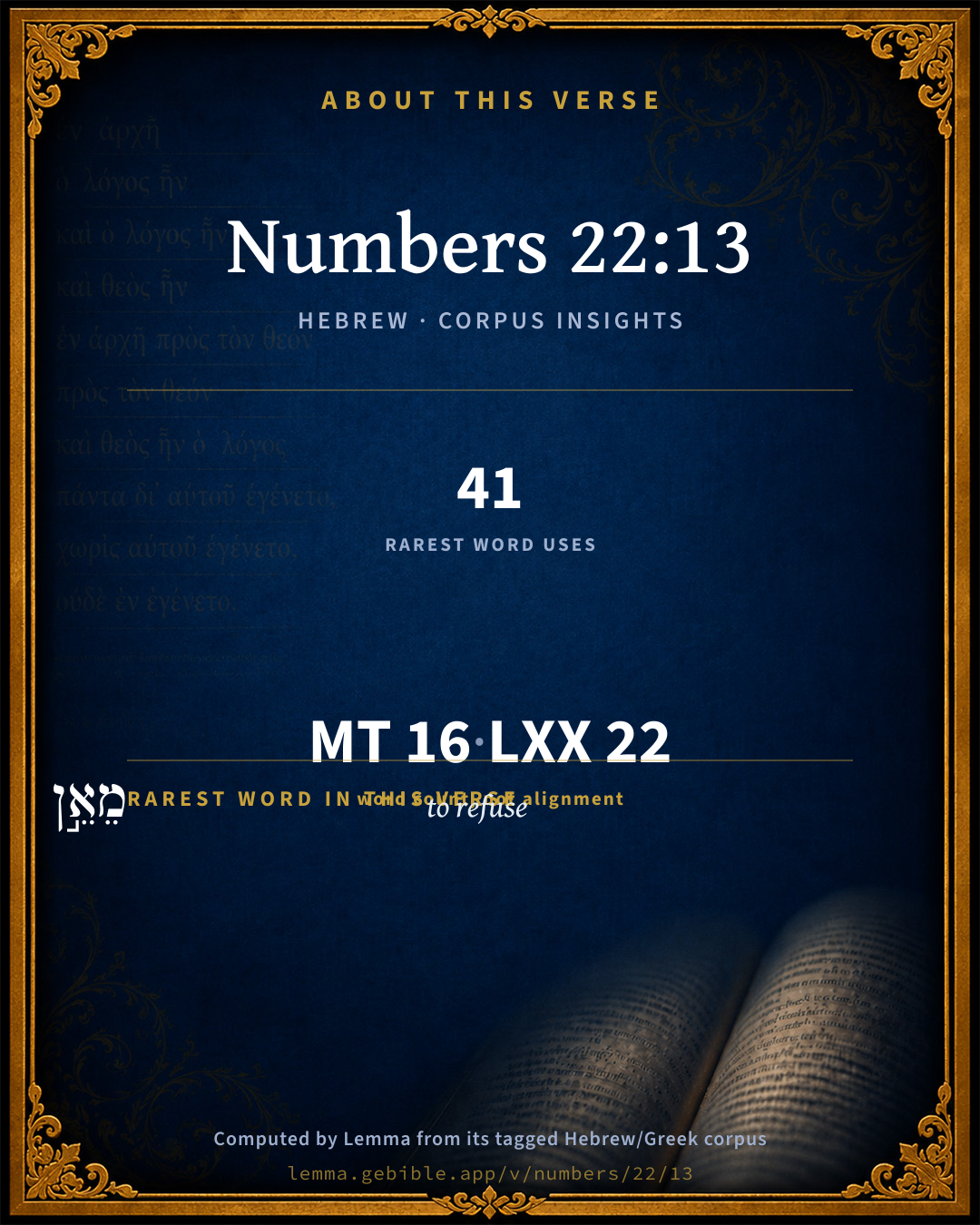
Numbers 22:13

Hebrew (Westminster Leningrad Codex) Numbers 22:13 appears in the Hebrew Old Testament. The text above is from the Westminster Leningrad Codex. Each word links to its Strong’s number, a concise gloss, and parsing drawn from the Open Scriptures Hebrew Bible morphology. Click any word for its full Brown-Driver-Briggs (BDB) entry.
Download image
Cite this verse

Numbers 22:13 (World English Bible). Public Domain. Lemma interlinear Bible study tool, https://lemma.gebible.app/v/numbers/22/13.

Show BibTeX & RIS
BibTeX
RIS
English Translation
Balaam rose up in the morning, and said to the princes of Balak, Get you into your land; for Yahweh refuses to give me leave to go with you.
World English Bible · Public Domain
Download a study sheet

One document with this verse’s original text, its word-by-word gloss line, the meaning frame, cross-references with their text, attributed commentary, and full source and license credits — printable, and it pastes into notes with its structure intact.

This verse Autodidact and up

Study sheet (.html) Plain text (.txt)

A passage Seminary Student

Up to 50 verses in one chapter. A passage sheet keeps up to 6 commentary sources and 12 cross-references per verse, in the order this page ranks them, and says so on the sheet whenever that leaves anything out. Ask for a single verse and you get the Autodidact verse sheet above.

Everything on this page stays free to read, with no account — the sheet is a download of what is already on screen, not access to it.

Want to remove ads? Support Godless Engineer
Compare translations 3

The same verse in 3 English versions, stacked beneath the original-language interlinear above. Click any original word for its lexicon entry.

Each is an independent rendering of the whole verse — the interlinear is not word-aligned to these translations.

Highlighted words mark where these versions differ — a whole-verse word diff, not a word-by-word alignment.

  • World English Bible Public Domain
    Balaam rose up in the morning, and said to the princes of Balak, Get you into your land; for Yahweh refuses to give me leave to go with you.
  • King James Version Public Domain
    And Balaam rose up in the morning, and said unto the princes of Balak, Get you into your land: for the LORD refuseth to give me leave to go with you.
  • unfoldingWord Literal Text CC BY-SA 4.0
    And Balaam rose in the morning and said to the princes of Balak, “Go to your land, for Yahweh has refused to allow me to go with you.”

unfoldingWord Literal Text — © unfoldingWord, licensed CC BY-SA 4.0. Word-aligned USFM3 via Door43 (git.door43.org/unfoldingWord/en_ult).

Versions to compare (up to 4)

3 of 4 selected

Show all 18 translations

Every available English version of this verse, each an independent rendering of the whole verse.

  • World English Bible Public Domain
    Balaam rose up in the morning, and said to the princes of Balak, Get you into your land; for Yahweh refuses to give me leave to go with you.
  • Berean Standard Bible Public Domain
    So Balaam got up the next morning and said to Balak’s princes, “Go back to your homeland, because the LORD has refused to let me go with you.”
  • Majority Standard Bible Public Domain
    So Balaam got up the next morning and said to Balak’s princes, “Go back to your homeland, because the LORD has refused to let me go with you.”
  • King James Version Public Domain
    And Balaam rose up in the morning, and said unto the princes of Balak, Get you into your land: for the LORD refuseth to give me leave to go with you.
  • American Standard Version (1901) Public Domain
    And Balaam rose up in the morning, and said unto the princes of Balak, Get you into your land; for Jehovah refuseth to give me leave to go with you.
  • Revised Version (1885) Public Domain
    And Balaam rose up in the morning, and said unto the princes of Balak, Get you into your land: for the LORD refuseth to give me leave to go with you.
  • Geneva Bible (1599) Public Domain
    And Balaam rose vp in the morning, and sayde vnto ye princes of Balak, Returne vnto your land: for the Lord hath refused to giue me leaue to go with you.
  • Douay-Rheims (1899) Public Domain
    And he rose in the morning and said to the princes: Go into your country, because the Lord hath forbid me to come with you.
  • Young's Literal Translation Public Domain
    And Balaam riseth in the morning, and saith unto the princes of Balak, `Go unto your land, for Jehovah is refusing to suffer me to go with you;'
  • Literal Standard Version CC BY-SA 4.0
    And Balaam rises in the morning and says to the princes of Balak, “Go to your land, for YHWH is refusing to permit me to go with you”;
  • Unlocked Literal Bible CC BY-SA 4.0
    Balaam rose up in the morning and said to Balak's leaders, “Go back to your land because Yahweh refuses to allow me to go with you.”
  • unfoldingWord Literal Text CC BY-SA 4.0
    And Balaam rose in the morning and said to the princes of Balak, “Go to your land, for Yahweh has refused to allow me to go with you.”
  • Darby Bible Public Domain
    And Balaam rose up in the morning, and said to the princes of Balak, Go into your land; for Jehovah refuses to give me leave to go with you.
  • World Messianic Bible Public Domain
    Balaam rose up in the morning, and said to the princes of Balak, “Go to your land; for the LORD refuses to permit me to go with you.”
  • Webster's Bible Public Domain
    And Balaam rose in the morning, and said to the princes of Balak, Depart into your land: for the LORD refuseth to give me leave to go with you.
  • Free Bible Version CC BY-SA 4.0
    In the morning Balaam got up and said to Balak's messengers, “Go back to where you came from because the Lord has refused to allow me to go with you.”
  • Bible in Basic English Public Domain
    In the morning Balaam got up and said to the chiefs of Balak, Go back to your land, for the Lord will not let me go with you.
  • JPS Tanakh (1917) Public Domain
    And Balaam rose up in the morning, and said unto the princes of Balak: 'Get you into your land; for the LORD refuseth to give me leave to go with you.'

Literal Standard Version (2020), Covenant Press — licensed CC BY-SA 4.0. Text via the HelloAO Bible API (eBible.org). Unlocked Literal Bible (unfoldingWord) — licensed CC BY-SA 4.0. Text via the HelloAO Bible API (eBible.org). unfoldingWord Literal Text — © unfoldingWord, licensed CC BY-SA 4.0. Word-aligned USFM3 via Door43 (git.door43.org/unfoldingWord/en_ult). Free Bible Version, Dr. Jonathan Gallagher — licensed CC BY-SA 4.0. Text via the HelloAO Bible API (eBible.org).

Word by word

More ways to search: Search by grammar → Find every occurrence → Compare this word →

Practice this passage: Drill this verse → Learn its vocabulary →

מֵאֵ֣ן
mâʼên
H3985
“to refuse”
Verb, Piel, Perfect, 3rd Person, Masculine, Singular
Part of Speech
Verb
Stem
Piel
Form
Perfect
Person
3rd Person
Gender
Masculine
Number
Singular
Full BDB Definition

Origin: a primitive root

TWOT: 1138

(Piel) to refuse
  1. וַיָּ֤קָם qûwm H6965 “and · to rise” Conjunction + Verb, Qal, Sequential Imperfect, 3rd Person, Masculine, Singular
  2. בִּלְעָם֙ Bilʻâm H1109 “Balaam” Noun, Proper
  3. בַּבֹּ֔קֶר bôqer H1242 “in/at the · morning” Preposition, Determined + Noun, Common, Masculine, Singular, Absolute
  4. וַיֹּ֨אמֶר֙ ʼâmar H559 “and · to say” Conjunction + Verb, Qal, Sequential Imperfect, 3rd Person, Masculine, Singular
  5. אֶל ʼêl H413 “to” Preposition
  6. שָׂרֵ֣י sar H8269 “princes of” Noun, Common, Masculine, Plural, Construct
  7. בָלָ֔ק Bâlâq H1111 “Balak” Noun, Proper
  8. לְכ֖וּ yâlak H3212 “walk” Verb, Qal, Imperative, 2nd Person, Masculine, Plural
  9. אֶֽל ʼêl H413 “to” Preposition
  10. אַרְצְכֶ֑ם ʼerets H776 “land · your” Noun, Common, Both, Singular, Construct + Suffix, Personal, 2nd Person, Masculine, Plural
  11. כִּ֚י kîy H3588 “that” Conjunction
  12. יְהוָ֔ה Yᵉhôvâh H3068 “LORD” Noun, Proper
  13. לְתִתִּ֖י nâthan H5414 “to give · me” Preposition + Verb, Qal, Infinitive Construct + Suffix, Personal, 1st Person, Common, Singular
  14. לַהֲלֹ֥ךְ hâlak H1980 “to walk” Preposition + Verb, Qal, Infinitive Construct
  15. עִמָּכֶֽם ʻim H5973 “with · you” Preposition + Suffix, Personal, 2nd Person, Masculine, Plural

About this verse

These counts appear in no published source. They are computed here, from the morphology-tagged text and Lemma’s own curated glosses. What Lemma adds →

16
words
15
distinct lemmas
Pentateuch
section

Shared distinctive vocabulary

מֵאֵ֣ן to refuse H3985 occurs in 39 verses of the Hebrew Bible. Also found in:

Grammatical profile

  • 6 verbs
  • 6 nouns
  • 3 prepositions
  • 1 conjunction

Verb forms

  • וַיָּ֤קָם Qal · Sequential Imperfect
  • וַיֹּ֨אמֶר֙ Qal · Sequential Imperfect
  • לְכ֖וּ Qal · Imperative
  • מֵאֵ֣ן Piel · Perfect
  • לְתִתִּ֖י Qal · Infinitive Construct
  • לַהֲלֹ֥ךְ Qal · Infinitive Construct

Repetition

A word recurs within this verse — often emphatic in Hebrew:

  • אֶל to H413 ×2

Hebrew & Septuagint length

In English translation the verse runs 29 words from the Hebrew and 28 from the Septuagint (LXX English) — closely comparable.

A rough comparison of the two English renderings, which tokenize alike — not a word-level alignment.

Word counts can differ between the Hebrew and the Greek without any difference in meaning — e.g. the Hebrew direct-object marker אֵת has no separate Greek word, and Greek often adds the article ὁ.

In the original languages it is 16 Hebrew tokens and 22 Greek tokens — but the two are counted differently (Hebrew bundles its prefixes and suffixes into one token; the Greek is in lemma form), so that isn’t a like-for-like length.

Cross-references

2

Topical passages linked to Numbers 22:13 in the Treasury of Scripture Knowledge — connected by theme and wording, ordered by reader-vote popularity; previews shown in the World English Bible.

  • Numbers 22:14 The princes of Moab rose up, and they went to Balak, and said, Balaam refuses to come with us.
  • Deuteronomy 23:5 Nevertheless Yahweh your God wouldn't listen to Balaam; but Yahweh your God turned the curse into a blessing to you, because Yahweh your God loved you.

Cross-references courtesy of OpenBible.info (CC BY 4.0).

Hebrew and Greek witnesses Masoretic Hebrew ↔ Greek Septuagint

The same verse in the two great witnesses to the Old Testament, shown verse-for-verse.

These are two independent witnesses, not word-aligned to each other, and the Septuagint is shown in lemma (dictionary) form.

Hebrew Numbers 22:13 Masoretic · Westminster Leningrad Codex

וַיָּ֤קָם בִּלְעָם֙ בַּבֹּ֔קֶר וַיֹּ֨אמֶר֙ אֶל שָׂרֵ֣י בָלָ֔ק לְכ֖וּ אֶֽל אַרְצְכֶ֑ם כִּ֚י מֵאֵ֣ן יְהוָ֔ה לְתִתִּ֖י לַהֲלֹ֥ךְ עִמָּכֶֽם

Balaam rose up in the morning, and said to the princes of Balak, Get you into your land; for Yahweh refuses to give me leave to go with you.

World English Bible · Public Domain

Greek LXX Numbers 22:13 Septuagint · lemma form

καί ἀναἵστημι βαλααμ ὁ πρωΐ εἶπον ὁ ἄρχων βαλακ ἀποτρέχω πρός ὁ κύριος σύ οὐ ἀποἵημι ἐγώ ὁ θεός πορεύομαι μετά σύ

And Balaam rose up in the morning, and said to the princes of Balac, Depart quickly to your lord; God does not permit me to go with you.

LXX2012 (modern English Septuagint) · Public Domain

Hebrew: Westminster Leningrad Codex (CC BY 4.0). Greek: Septuagint (public domain); English from LXX2012 (modern English Septuagint) (Public Domain). How the Septuagint differs from the Hebrew →

Targum (Aramaic paraphrase)

2

The Targum is the ancient Jewish Aramaic paraphrase of the Hebrew Scriptures — an interpretive translation, not the Hebrew text itself. Onkelos (literal) and Pseudo-Jonathan (expansive) render the Torah, and Jonathan the Prophets. Coverage is partial: where no permissively-licensed English translation exists for a verse, only the Aramaic is shown. This is verse-level text, not a word-by-word alignment to the Hebrew.

  1. Targum Onkelos Torah (Genesis–Deuteronomy)
    וְקָם בִּלְעָם בְּצַפְרָא וַאֲמַר לְרַבְרְבֵי בָלָק אִיזִילוּ לְאַרְעֲכוֹן אֲרֵי לֵית רַעֲוָא קֳדָם יְיָ לְמִשְׁבְּקִי לְמֵיזַל עִמְכוֹן

    (no public-domain English translation for this verse)

    Targum Onkelos — Aramaic: “Onkelos Genesis” (public domain); “Onkelos Exodus” (public domain); “Onkelos Leviticus” (public domain); “Onkelos Numbers” (public domain); “Onkelos Deuteronomy” (public domain). English: “Sefaria Community Translation” (CC0 1.0 (public-domain dedication)); “J.W. Etheridge. The Targums of Onkelos and Jonathan Ben Uzziel on the Pentateuch. London: Longmans, Green, 1862” (public domain). Text via Sefaria.

  2. Targum Pseudo-Jonathan Torah (Genesis–Deuteronomy)
    וְקָם בִּלְעָם בְּצַפְרָא וַאֲמַר לְרַבְרְבֵי מוֹאָב אִזִילוּ לְאַרְעֲכוֹן אֲרוּם לֵית רַעֲוָא מִן קֳדָם יְיָ לְמִשְׁבְּקִי לְמֵיזַל עִמְכוֹן

    And Bileam rose up early, and said to the princes of Moab, Go unto your country, for it is not pleasing before the Lord to permit me to journey with you.

    Targum Pseudo-Jonathan — Aramaic: “Targum Jonathan on Genesis” (public domain); “Targum Jonathan on Exodus” (public domain); “Targum Jonathan on Leviticus” (public domain); “Targum Jonathan on Numbers” (public domain); “Targum Jonathan on Deuteronomy” (public domain). English: “The Targum of Jonathan ben Uzziel, trans. J. W. Etheridge, London, 1862” (public domain). Text via Sefaria.

Commentary

Notes on Numbers 22:13 from classic Christian and Jewish commentators (each source and its license shown beneath its notes). The classic Christian expositions comment on the surrounding passage and are grouped to its opening verse, so a note may address several verses; the Jewish commentaries on the Tanakh (Rashi and others) are per-verse, so they appear only where the commentator wrote on this verse.

Lemma curates 59 commentaries, every one of them public domain or Creative Commons licensed, each selected and text-cleaned for this edition rather than reprinted as found. About our sources →

Trapp's Complete Commentary

John Trapp

Num 22:13 And Balaam rose up in the morning, and said unto the princes of Balak, Get you into your land: for the LORD refuseth to give me leave to go with you.

Ver. 13. For the Lord refuseth.] Like a mercenary, and one that had a month’s mind to the money, he hides from them that part of the answer that might have kept them off from coming again to him, viz., Thou shalt not curse the people, for they are blessed, Auri sacra fames, &c.

John Trapp, A Commentary or Exposition upon All the Books of the Old and New Testament (1647–1656) — public domain. Text from a community e-Sword module.

Joseph Benson's Commentary

Num 22:13. The Lord refuseth to give me leave to go with you — He ought to have informed them that the Lord had strictly forbidden him to curse this people, and assured him that they were blessed. Such a declaration would probably have prevented any further message from Balak, and have preserved Balaam from running into more sin. God, however, overruled it all to his own glory and the good of his people Israel.

Joseph Benson's Commentary on the Old and New Testaments (1811–1818) — public domain. Text from a community e-Sword module.

Geneva Bible (1599)

Geneva Bible translators

Else he showed himself willing, covetousness had so blinded his heart.

Geneva Bible (1599) marginal notes — public domain. Text via Bolls.life.

Jamieson, Fausset & Brown

Robert Jamieson, A. R. Fausset & David Brown

the Lord refuseth to give me leave to go with you--This answer has an appearance of being good, but it studiously concealed the reason of the divine prohibition [Num 22:12], and it intimated his own willingness and desire to go--if permitted. Balak despatched a second mission, which held out flattering prospects, both to his avarice and his ambition (Gen 31:30).

Jamieson, Fausset & Brown — Commentary Critical and Explanatory on the Whole Bible (1871) — public domain (CC PDM 1.0). Text via the HelloAO Bible API.

The Cambridge Bible for Schools and Colleges

gen. ed. J. J. S. Perowne

13. Balaam may have felt regret at being unable to win the offered rewards, but there is no hint of it in the narrative. He could not know that Balak would send again.

The Cambridge Bible for Schools and Colleges (gen. ed. J. J. S. Perowne; Cambridge University Press, 1878–1918) — public domain. Text from a community e-Sword module.

John Gill's Exposition

And Balak sent yet again princes more, and more honourable than they. More in number, and greater in quality, princes of the first rank in his court; supposing that Balaam thought he was not treated with respect enough, they being princes of the meaner sort, and but few, that were sent unto him before, which he imagined was the reason, at least one reason, why he refused to come with them; persons of Balaam's character in those days being highly revered.

And Balak sent yet again princes more, and more honourable than they. More in number, and greater in quality, princes of the first rank in his court; supposing that Balaam thought he was not treated with respect enough, they being princes of the meaner sort, and but few, that were sent unto him before, which he imagined was the reason, at least one reason, why he refused to come with them; persons of Balaam's character in those days being highly revered.

Numbers 22:16

num 22:16

num 22:16

num 22:16And they came to Balaam,.... Though men of such rank and dignity, they did not decline the embassy, being sent by their king; nor did they think it below them to wait upon this soothsayer:

and said unto him, thus saith Balak the son of Zippor; representing their master, and addressing the diviner in his name, as his ambassadors; at the same time doing honour to Balak that sent them, of whom they speak respectfully, and to Balaam, to whom they were sent:

let nothing, I pray thee, hinder thee from coming unto me; no business, though ever so important, that might be upon his hands; nor any want of respect to him he might imagine; nor if the rewards offered were not thought sufficient; nor any persuasions of men to the contrary; and if it could be thought he knew anything of the prohibition of God, that may be included; so urgent was he upon his coming to him.

John Gill's Exposition of the Whole Bible (1746–1763) — public domain (CC PDM 1.0). Text via the HelloAO Bible API.

Matthew Poole's English Annotations

He conceals the principal things, to wit, the reason of God’s prohibition, which might have given a stop to their further course and counsels in this matter, and secretly intimates his own goodwill and readiness to comply with them, if God had not hindered him.

Matthew Poole's English Annotations on the Holy Bible (1683–1685) — public domain. Text from a community e-Sword/MySword module.

Whedon's Commentary on the Bible

Daniel D. Whedon

13. The Lord refuseth — By this answer he seems to intimate his own willingness, and even desire, to accompany them, but that he was under the necessity of obeying his God. Here is an example of garbling God’s word, to which Satan (comp. Mat_4:6, and Psa_91:11-12) and wicked men are ever prone. The most important part of Jehovah’s communication, “Thou shalt not curse the people,” with the reason, “for they are blessed,” is craftily omitted. “If hee had faithfully showed them the whole counsell of God it might have stayed this evill enterprise, and cut off occasion for further sending. But as a man loth to displease, and loving the proffered gaine, hee useth a faint and favourable speech, as if hee should have said, I could be content and glad to gratifie the king herein, but God will not suffer mee at this time to goe; the fault is not mine, therefore I pray thee have mee excused.” — Ainsworth. On the contrary, true obedience is illustrated by Paul, Act_20:27, as it is commanded in Jeremiah xxiii, 28.

Daniel D. Whedon (gen. ed.), Commentary on the Old and New Testaments (1874–1909) — public domain. Text from a community e-Sword module.

The Pulpit Commentary

Balaam, an illustration of systematic resistance of conscience.

The final fall of Balaam was not sudden. A process of deterioration had been going on, the first clear sign of which is in the text. In trying to change God"s will he had been changing himself for the worse (see Homily on verses 5, 6). We can trace his resistance of conscience step by step.

1. When the first embassy came, his knowledge of God and of Israel"shistory should probably have led to a decisive refusal. But if we assume that he needed direction, it is clear that the rewards of divination made him anxious to go. Not that he had a desire to curse Israel; he would just as soon have blessed them for reward. Yet he had no intention then to disobey. If a prophet could have shown him that evening his future career, he might have shrunk in loathing from the self that was to be. The will of God is declared (verse 12), and the struggle between conscience and covetousness begins. At first conscience prevails, but the form of refusal (verse 13) indicates double-mindedness. In contrast to Joseph, (Gen_39:9) Balaam lays himself open to fresh temptations. If we give Satan a hesitating "No," instead of a "Get thee behind me," he will understand that we would like to sin, but dare not, and will try us with more honourable embassies and costlier gifts.

2. The ambassadors leave, but lingering regrets keep the fire of covetousness smouldering in Balaam"s heart. It flames up afresh on the arrival of the second embassy (verses 16, 17). Fair professions (verse 18) reveal his weakness, for what "more" (verse 19) could he want God to say unless it was to give him permission to sin? God gives him leave not to sin, but to go. (Illustrate this act by similar Divine proceedings: e.g., allowing the Israelites, under protest, to elect a king; a wild youth receiving reluctantly permission to carry out his determination to go to sea.)

3. Balaam went, and God is angry, not because he went, but because hewent with a wicked purpose. When he found the ways of transgressors hard, and offers to return (verse 34), God knows that he would only carry his body back to Pethor, and leave his heart hankering after the rewards of Balak. May we not suppose that if he had shown real repentance in the future, and heartily entered into the Divine purposes: though he lost Balak s rewards, he would have received God"s blessing? But he ran greedily after reward, and found, as sinners still find, under God"s providence, that it is hard to retrace false steps. Therefore, "enter not," &c. ; (Pro_4:15)

4. Balaam meets with a flattering reception, yet renews his good professions (verse 38). He means them, for he still hopes to gain God"s consent to his purpose. His use of enchantments to impose on the heathen is one sign of unconscientiousness. His first attempt to curse is a failure, (Num_23:7-10) but the struggle with conscience and God is not abandoned. ("No sun or star so bright," &c., Keble"s "Christian Year," Second Sunday after Easter.) Three times he persists in this "madness," trying to change or circumvent the will of God. At length he ;seems to give up the struggle, but is probably only "making a virtue of a necessity;" at the best it is but a passing impulse, followed by a relapse, and by the infamous act by which he clutched his wages and brought God"s curse on Israel. (Nu 25) He thus shows that he has renounced God, has entered thoroughly into Balak"s schemes, and even outstripped him in wickedness. His perverted conscience does not keep him even from such unutterable baseness. His triumph is brief, and his "end is destruction". (Num_31:8 Psa_34:21) Learn from this the guilt and danger of resisting and thus corrupting conscience. (Explain process of this corruption, and note natural analogies to a conscience dulled by persistence in sin.) To try and bribe conscience is like seeking permission to sin. (Illustrate by story of Glaucus inquiring at the oracle of Delphi whether he might keep stolen money Herodotus, 6:86.) Conscience, like a railway signal-lamp, is intended to warn against danger or direct in the path of safety. If through negligence the lamp is put out or shows a wrong light, the consequences may be fatal. (Isa_5:20 Mat_6:23) A healthy conscience accuses of sin and warns of danger only that it may be a minister to lead us to Christ. P.

HOMILIES BY J. WAITE Vers. 13, 14. Balaam the summons.

The story of Balaam is full of contrarieties. The pure faith and worship of Jehovah is seen coming into strange contact with the superstitions of heathenism; and as regards the personal character of Balaam, utterly discordant moral elements are seen struggling together in the same breast. The chief interest of the story centers in the moral phenomenon presented by the man himself" that strange mixture of a man," as Bishop Newton well calls him. He was a heathen soothsayer, and yet had some real knowledge of God. He was under the influence of sordid passions, and yet was in personal converse with the Spirit of truth, and received from him, at least for the time, a real prophetic gift. He had no part or lot with the chosen people, but rather with their worst enemies, and yet his "eyes were opened," and he had very lofty conceptions of Israel"s dignity and blessedness. His history has its clearly-marked stages. In this first stage we have the summons that came to him from Balak, and the answer he was constrained to send back to it. Note here

I HEATHEN FAITH IN THE UNSEEN. Balak in the extremity of his fear sends beyond the limits of his own people, into distant Mesopotamia, to secure the help of one supposed to be endowed with supernatural gifts, in special relation to the invisible powers, able to "curse and to bless" (verse 6). A striking illustration of that blind instinct of human nature by virtue of which it believes ever in the interposition of Deity in the world"s affairs. All idolatrous rites, oracles, divinations, incantations, sacerdotal benedictions and maledictions, rest ultimately on this basis. It is this makes the sway of the priest and the supposed "prophet of the Invisible" so mighty in every land and age. Christianity teaches us to lay hold on the substantial truth that underlies these distorted forms of superstition. It enlightens this blind instinct; reveals the righteous "God that judgeth in the earth;" leads humanity to Him who is at once its "Prophet, Priest, and King.

II THE WITNESS FOR GOD THAT MAY BE FOUND IN THE SOUL OF A DEPRAVED MAN, even of one whose inward dispositions and whole habit of life are most opposed to his will. Balaam practiced an art that was "an abomination unto the Lord", (Deu_18:12) and his way was altogether "perverse" (verse 32), and yet God was near to him. God spoke to him, and put the spirit of prophecy into his heart, and a word into his mouth. He "heard the words and saw the vision of the Almighty." Whether his knowledge of God was the result of dim traditions of a purer faith handed down from his forefathers, or of influences that had spread in his own time into the land of his birth, we at least see how scattered rays of Divine light then penetrated the deep darkness of heathendom. So now God is often nearer to men than we or they themselves suppose. He does not leave himself without a witness, even in the most ignorant and vile. The light in them is never totally extinguished. They have their gleams of higher thought, their touches of nobler, purer feeling. Conscience rebukes their practical perversity, and the Spirit strives with them to lead them into a better way. When God is absolutely silent in a man"s soul, all hope of guiding him by outward persuasions into the path of righteousness is gone.

III THE PROSTITUTION OF NOBLE POWERS TO BASE USES. Here is a man whose widespread fame was the result, probably, to a great extent of real genius. His native capacity mental insight, influence over men, poetic gift was the secret of this fame. Like Simon Magus, he "bewitched the people," so that they all "gave heed to him, from the least unto the greatest, saying, This man is the great power of God." But these extraordinary powers are perverted to the furtherance of an unhallowed cause; he makes them the servants of his own base ambition and desire for gain. "He loved the wages of unrighteousness." It was in his heart to obey the behest of Balak and secure the offered prize. There is a tone of disappointment in the words, "The Lord refuseth to give me leave to go with you." He lets "I dare not" wait upon "I would." And notwithstanding all his poetic inspiration and his passing raptures of devout and pious feeling, "Yet in the prophet"s soul the dreams of avarice stay.

How full is all human history of examples of the waste of noble faculties, the prostitution to evil uses of God-given powers! The darkest deeds have ever been done and the deepest miseries inflicted on the world by those who were most fitted by nature to yield effective service to the cause of truth and righteousness, and to confer blessings on mankind. And it is generally some one base affection the lust of the flesh, self-love, avarice, an imperious will, &c. that turns the rich tide of their life in a false direction. As the spreading sails of a ship only hasten its destruction when the helm fails, so is it with the noblest faculties of a man when he has lost the guidance of a righteous purpose. ;

IV THE DIVINE RESTRAINT OF MAN"S LIBERTY TO DO EVIL. "And God said, Thou shalt not go with them," &c. The spell of a higher Power is over him. In a sense contrary to that of Paul the Apostle, he "cannot do the thing that he would." So are wicked men often made to feel that there is after all a will stronger than their will; that, free as they seem to be, some invisible hand is holding them in check, limiting their range of action, thwarting their purposes, compelling them to do the very thing they would fain avoid, turning their curses into blessings, so that in the end they serve the cause they meant to destroy. The hope of the world lies in the absolute mastery of the Will that is "holy, and just, and good" over all conceivable opposing forms of human and Satanic power. W.

The Pulpit Commentary (1880–1919), ed. H.D.M. Spence-Jones & Joseph S. Exell — public domain. Text from a community e-Sword module.

Rashi

Rabbi Shlomo Yitzchaki (Rashi)

להלך עמכם [THE LORD REFUSES TO GIVE ME LEAVE] TO GO WITH YOU, but only with princes greater than you. This tells us that he was of a proud nature and he did not wish to divulge that he was under the control of the Omnipresent except in arrogant terms (“God will not permit me to go with you”). Consequently (v. 15), ויוסף עוד בלק “Balak sent yet again [more princes, and more honorable than these] (Midrash Tanchuma, Balak 6).

Rashi on the Tanakh — English translations: “The Judaica Press complete Tanach with Rashi, translated by A. J. Rosenberg” (CC BY 4.0); “Pentateuch with Rashi's commentary by M. Rosenbaum and A.M. Silbermann, 1929-1934” (public domain); “The Metsudah Tanach series, Lakewood, N.J” (CC BY 4.0); and “The Book of Joshua, Metsudah Publications, 1997” (CC BY 4.0). Text via Sefaria.

Ramban (Nachmanides)

Rabbi Moshe ben Nachman (Ramban / Nachmanides)

[AND BALAAM ROSE UP IN THE MORNING, AND SAID] UNTO THE PRINCES OF BALAK. According to the opinion of Rashi the elders of Midian had left [Balaam] when he told them, Lodge here this night [and therefore Scripture here only mentions the princes of Balak — i.e., the elders of Moab]. This is [indeed] possible, because when Balaam mentioned to them [and I will bring you back word,] as the Eternal may speak unto me, they did not want to wait for Balaam’s [message], for they said: “This G-d has always come to the help of Israel. It is He Who brought them out of Egypt and did signs and wonders for them.” For the elders of Midian were wise men, and they knew about all the words of Moses with Jethro, the most distinguished of their country, although Scripture does not mention this [that Jethro informed the elders of his land what Moses had told him]. And Rabbi Abraham ibn Ezra said that “[the reason why Scripture here] did not mention them [the elders of Midian] is because Balak was the principal party [in this matter], and it was he who sent the mission.” Similarly, [the verse stating] and the princes of Moab abode with Balaam [omits “the elders of Midian”] because the main [impetus of the] mission came from their lord [the king of Moab].The correct explanation is that the elders of Midian — who were perhaps the first kings thereof — came from their country to Balak to take counsel about the problem of Israel, and they all decided to send [a mission] to Balaam. Therefore Balak sent his princes, his judges and wise men, and they went together with the elders of Midian to the land of Midian, because from there their way led to Balaam’s city; and the elders of Midian remained in their city, while the princes of Balak, who were the delegates, went on their own to Aram [Balaam’s native land].. This is the meaning of [the expression], and the elders of Moab and the elders of Midian departed, meaning that they all left Balak and went as far as Midian, with the rewards of divination in their hand. And ‘they’ came unto Balaam, [and spoke unto him the words of Balak] — this refers to the elders of Moab, about whom Scripture states, and he sent messengers, not to the elders of Midian.

[FOR THE ETERNAL REFUSETH] TO GIVE ME LEAVE TO GO WITH YOU — “but only with great princes. This teaches us that he was of a haughty spirit, and did not want to tell [them] that he was under the control of G-d. Therefore [he spoke] in arrogant language. It was because of this that Balak sent yet again princes.” This is Rashi’s language. But it is not correct, for Balaam’s whole honor consisted of boasting and glorifying himself in [the fact that he received] the word of G-d [and so he would not have been ashamed to tell the princes of Moab that he was awaiting G-d’s word, as Rashi wrote, but on the contrary would have boasted of it]! Moreover, he did not [in fact] know that G-d would give him permission to go with other, greater, princes! Rather, the meaning [of Balaam’s words] is that G-d did not want him to go at all. But Balak suspected that he was [only] saying so in order to get a greater reward; therefore he said to him, Why camest thou not unto me? am I not able indeed to promote thee to honor? And for this reason too, Balak sent yet again princes, more in number, and more honorable in order to show him that he wanted him very much [to come], and he promised to give him as much wealth and riches as he would demand from, and fix upon him. But Balaam answered him that even for all his money “I cannot go beyond the word of the Eternal, for He is my G-d, and I cannot do any thing, small or great if I transgress His command, for [whatever I do] I do in His Name.” Or [it may be that Balaam] is saying, “I cannot go beyond the word of the Eternal whether [I transgress His word] in a small matter or a great matter, for He is my G-d, and I am His servant.”

Ramban (Nachmanides) on the Tanakh — English translation: “Commentary on the Torah by Ramban (Nachmanides). Translated and annotated by Charles B. Chavel. New York, Shilo Pub. House, 1971-1976” (CC BY 4.0). Text via Sefaria.

Lesson kit

Teaching starters — assembled from the data on this page, not authored interpretation. Every prompt links to the verse data it draws on. Edit before teaching.

Numbers, in the Pentateuch, opens this verse with 16 words (15 distinct Hebrew lemmas). Its most distinctive word is mâʼên (“to refuse”). A historical commentator’s framing appears above. Read the whole chapter for the surrounding context.

Discussion questions

  1. The word mâʼên carries the sense “to refuse.” How does it shape the verse?
  2. Genesis 37:35 shares the word «to refuse» with this verse. How do the two illuminate each other?
  3. “to” occurs 2× in this one verse. What is the effect of the repetition?
  4. The translations on this page render this verse differently — a whole-verse word diff, not a word-by-word alignment. What might account for the different wordings?
  5. The verb «וַיָּ֤קָם» is Qal Sequential Imperfect. How does its form color the action?
  6. Reading how Trapp's Complete Commentary and Joseph Benson's Commentary read this verse, where do the two commentators agree and where do they part?

Things to notice

Reading settings

Reading text

Shown beneath each verse's original-language words.

Old Testament
Old Testament edition

Read the OT as the Masoretic Hebrew (MT) or the Greek Septuagint (LXX).

English shown for the Greek Septuagint (in the Hebrew ↔ Greek comparison).

Comparing translations? Open the Compare panel on any verse page to stack up to four side by side.