
Psalms 90:6

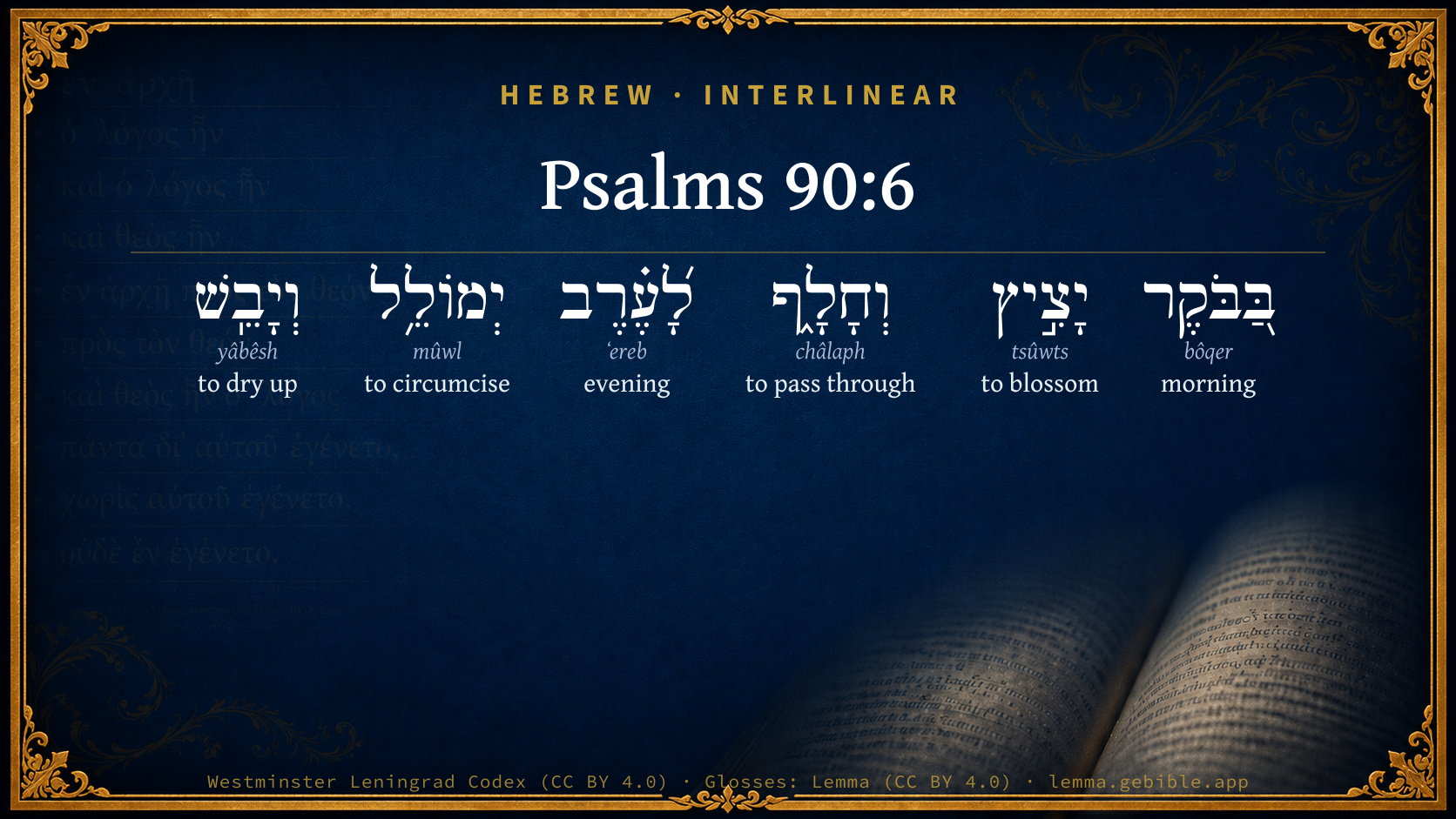
Hebrew (Westminster Leningrad Codex) Psalms 90:6 appears in the Hebrew Old Testament. The text above is from the Westminster Leningrad Codex. Each word links to its Strong’s number, a concise gloss, and parsing drawn from the Open Scriptures Hebrew Bible morphology. Click any word for its full Brown-Driver-Briggs (BDB) entry.
Download image
Cite this verse

Psalms 90:6 (World English Bible). Public Domain. Lemma interlinear Bible study tool, https://lemma.gebible.app/v/psalms/90/6.

Show BibTeX & RIS
BibTeX
RIS
English Translation
In the morning it sprouts and springs up. By evening, it is withered and dry.
World English Bible · Public Domain
Download a study sheet

One document with this verse’s original text, its word-by-word gloss line, the meaning frame, cross-references with their text, attributed commentary, and full source and license credits — printable, and it pastes into notes with its structure intact.

This verse Autodidact and up

Study sheet (.html) Plain text (.txt)

A passage Seminary Student

Up to 50 verses in one chapter. A passage sheet keeps up to 6 commentary sources and 12 cross-references per verse, in the order this page ranks them, and says so on the sheet whenever that leaves anything out. Ask for a single verse and you get the Autodidact verse sheet above.

Everything on this page stays free to read, with no account — the sheet is a download of what is already on screen, not access to it.

Want to remove ads? Support Godless Engineer
Compare translations 3

The same verse in 3 English versions, stacked beneath the original-language interlinear above. Click any original word for its lexicon entry.

Each is an independent rendering of the whole verse — the interlinear is not word-aligned to these translations.

Highlighted words mark where these versions differ — a whole-verse word diff, not a word-by-word alignment.

  • World English Bible Public Domain
    In the morning it sprouts and springs up. By evening, it is withered and dry.
  • King James Version Public Domain
    In the morning it flourisheth, and groweth up; in the evening it is cut down, and withereth.
  • unfoldingWord Literal Text CC BY-SA 4.0
    In the morning it sprouts and passes along; in the evening it withers and dries up.

unfoldingWord Literal Text — © unfoldingWord, licensed CC BY-SA 4.0. Word-aligned USFM3 via Door43 (git.door43.org/unfoldingWord/en_ult).

Versions to compare (up to 4)

3 of 4 selected

Show all 18 translations

Every available English version of this verse, each an independent rendering of the whole verse.

  • World English Bible Public Domain
    In the morning it sprouts and springs up. By evening, it is withered and dry.
  • Berean Standard Bible Public Domain
    in the morning it springs up new, but by evening it fades and withers.
  • Majority Standard Bible Public Domain
    in the morning it springs up new, but by evening it fades and withers.
  • King James Version Public Domain
    In the morning it flourisheth, and groweth up; in the evening it is cut down, and withereth.
  • American Standard Version (1901) Public Domain
    In the morning it flourisheth, and groweth up; In the evening it is cut down, and withereth.
  • Revised Version (1885) Public Domain
    In the morning it flourisheth, and groweth up; in the evening it is cut down, and withereth.
  • Geneva Bible (1599) Public Domain
    In the morning it florisheth and groweth, but in the euening it is cut downe and withereth.
  • Douay-Rheims (1899) Public Domain
    In the morning man shall grow up like grass; in the morning he shall flourish and pass away: in the evening he shall fall, grow dry, and wither.
  • Young's Literal Translation Public Domain
    In the morning it flourisheth, and hath changed, At evening it is cut down, and hath withered.
  • Literal Standard Version CC BY-SA 4.0
    In the morning it flourishes, and has changed, || At evening it is cut down, and has withered.
  • Unlocked Literal Bible CC BY-SA 4.0
    In the morning it blooms and grows up; in the evening it withers and dries up.
  • unfoldingWord Literal Text CC BY-SA 4.0
    In the morning it sprouts and passes along; in the evening it withers and dries up.
  • Darby Bible Public Domain
    In the morning it flourisheth and groweth up; in the evening it is cut down and withereth.
  • World Messianic Bible Public Domain
    In the morning it sprouts and springs up. By evening, it is withered and dry.
  • Webster's Bible Public Domain
    In the morning it flourisheth, and groweth; in the evening it is cut down, and withereth.
  • Free Bible Version CC BY-SA 4.0
    it sprouts in the morning, fresh and new, but by the evening it is withered and dead.
  • Bible in Basic English Public Domain
    In the morning it is green; in the evening it is cut down, and becomes dry.
  • JPS Tanakh (1917) Public Domain
    In the morning it flourisheth, and groweth up; in the evening it is cut down, and withereth.

Literal Standard Version (2020), Covenant Press — licensed CC BY-SA 4.0. Text via the HelloAO Bible API (eBible.org). Unlocked Literal Bible (unfoldingWord) — licensed CC BY-SA 4.0. Text via the HelloAO Bible API (eBible.org). unfoldingWord Literal Text — © unfoldingWord, licensed CC BY-SA 4.0. Word-aligned USFM3 via Door43 (git.door43.org/unfoldingWord/en_ult). Free Bible Version, Dr. Jonathan Gallagher — licensed CC BY-SA 4.0. Text via the HelloAO Bible API (eBible.org).

Word by word

More ways to search: Search by grammar → Find every occurrence → Compare this word →

Practice this passage: Drill this verse → Learn its vocabulary →

About this verse

These counts appear in no published source. They are computed here, from the morphology-tagged text and Lemma’s own curated glosses. What Lemma adds →

6
words
6
distinct lemmas
Wisdom
section

Notable vocabulary

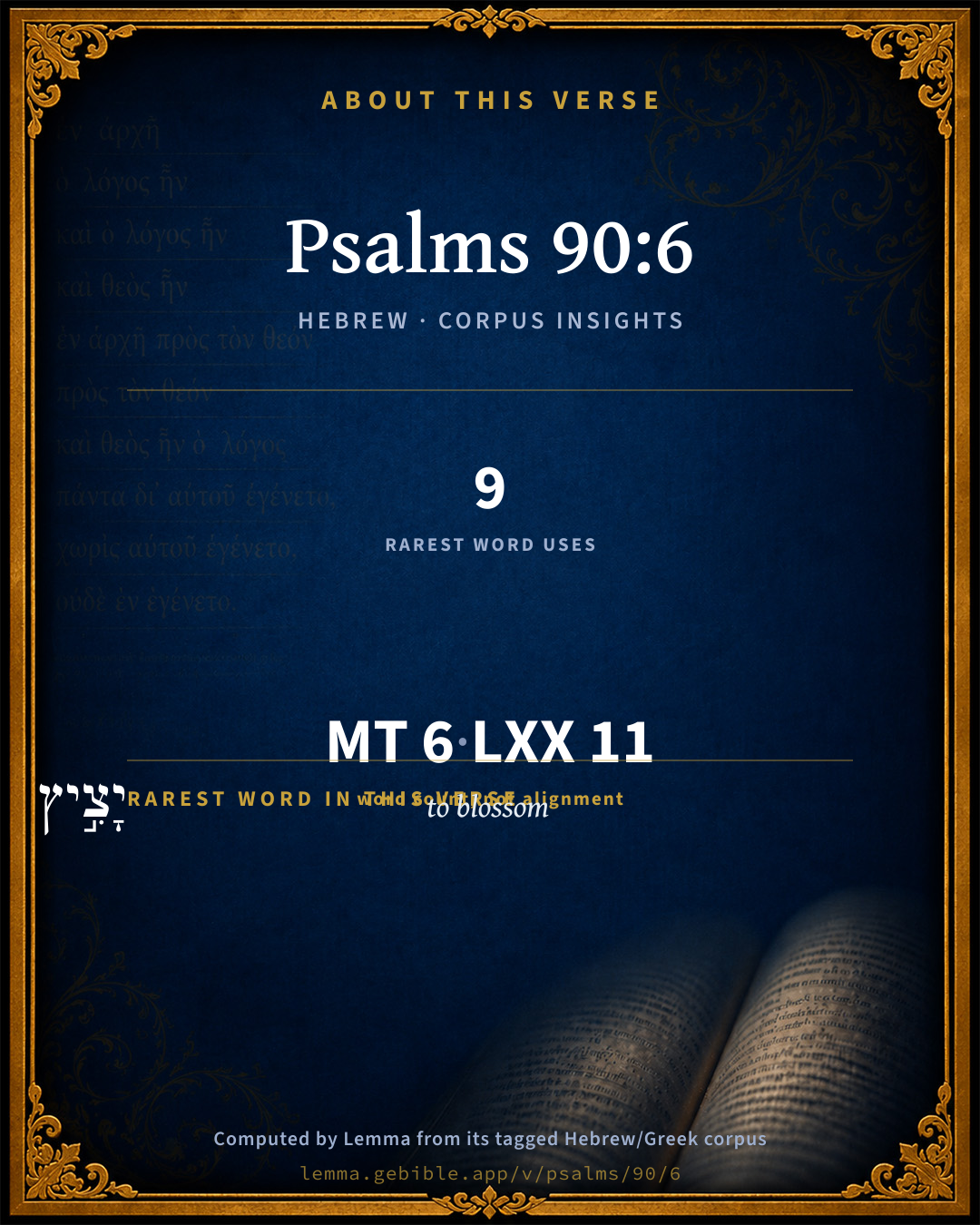
The rarest word here is יָצִ֣יץ to blossom H6692 — appearing just 9 times in the whole Hebrew Bible.

Shared distinctive vocabulary

יָצִ֣יץ to blossom H6692 occurs in 9 verses of the Hebrew Bible. Also found in:

Grammatical profile

  • 4 verbs
  • 2 nouns

Verb forms

  • יָצִ֣יץ Hiphil · Imperfect
  • וְחָלָ֑ף Qal · Sequential Perfect
  • יְמוֹלֵ֥ל Poel · Imperfect
  • וְיָבֵֽשׁ Qal · Sequential Perfect

Hebrew & Septuagint length

In English translation the verse runs 15 words from the Hebrew and 22 from the Septuagint (LXX English) — closely comparable.

A rough comparison of the two English renderings, which tokenize alike — not a word-level alignment.

Word counts can differ between the Hebrew and the Greek without any difference in meaning — e.g. the Hebrew direct-object marker אֵת has no separate Greek word, and Greek often adds the article ὁ.

In the original languages it is 6 Hebrew tokens and 11 Greek tokens — but the two are counted differently (Hebrew bundles its prefixes and suffixes into one token; the Greek is in lemma form), so that isn’t a like-for-like length.

Cross-references

4

Topical passages linked to Psalms 90:6 in the Treasury of Scripture Knowledge — connected by theme and wording, ordered by reader-vote popularity; previews shown in the World English Bible.

  • Job 14:2 He comes forth like a flower, and is cut down. He also flees like a shadow, and doesn't continue.
  • Psalms 92:7 Though the wicked spring up as the grass, And all the evil-doers flourish, They will be destroyed forever.
  • Matthew 6:30 But if God so clothes the grass of the field, which today exists, and tomorrow is thrown into the oven, won't he much more clothe you, you of little faith?
  • James 1:11 For the sun arises with the scorching wind, and withers the grass, and the flower in it falls, and the beauty of its appearance perishes. So also will the rich man fade away in his pursuits.

Cross-references courtesy of OpenBible.info (CC BY 4.0).

Hebrew and Greek witnesses Masoretic Hebrew ↔ Greek Septuagint

The same verse in the two great witnesses to the Old Testament, shown verse-for-verse.

You’re reading Greek Psalm 89 (Hebrew Psalm 90). The Septuagint counts the superscription, so verse numbers can differ from the Hebrew — chapter-level alignment, not verse-by-verse. Numbering follows Rahlfs.

These are two independent witnesses, not word-aligned to each other, and the Septuagint is shown in lemma (dictionary) form.

Hebrew Psalms 90:6 Masoretic · Westminster Leningrad Codex

בַּ֭בֹּקֶר יָצִ֣יץ וְחָלָ֑ף לָ֝עֶ֗רֶב יְמוֹלֵ֥ל וְיָבֵֽשׁ

In the morning it sprouts and springs up. By evening, it is withered and dry.

World English Bible · Public Domain

Greek LXX Greek Psalm 89:6 Septuagint · lemma form

ὁ πρωΐ ἀνθέω καί παραἔρχομαι ὁ ἑσπέρα ἀποπίπτω σκληρύνω καί ξηραίνω

In the morning let it flower, and pass away: in the evening let it droop, let it be withered and dried up.

LXX2012 (modern English Septuagint) · Public Domain

Hebrew: Westminster Leningrad Codex (CC BY 4.0). Greek: Septuagint (public domain); English from LXX2012 (modern English Septuagint) (Public Domain). How the Septuagint differs from the Hebrew →

Commentary

Notes on Psalms 90:6 from classic Christian and Jewish commentators (each source and its license shown beneath its notes). The classic Christian expositions comment on the surrounding passage and are grouped to its opening verse, so a note may address several verses; the Jewish commentaries on the Tanakh (Rashi and others) are per-verse, so they appear only where the commentator wrote on this verse.

Lemma curates 59 commentaries, every one of them public domain or Creative Commons licensed, each selected and text-cleaned for this edition rather than reprinted as found. About our sources →

Trapp's Complete Commentary

John Trapp

Psa 90:6 In the morning it flourisheth, and groweth up; in the evening it is cut down, and withereth.

Ver. 6. In the morning it flourisheth] So doth man in his prime and vigour, his bones full of marrow, his breasts of milk.

In the evening it is cut down] So is man by death’s mortal scythe, which moweth down the lilies of the crown as well as the grass of the field. In the evening grass will cut better, and the mowers can better work at it.

John Trapp, A Commentary or Exposition upon All the Books of the Old and New Testament (1647–1656) — public domain. Text from a community e-Sword module.

J. A. Alexander on Psalms

Joseph Addison Alexander

6. (Psa 90:6) In the morning it blooms and (then) passes away, (for) at evening he mows and it withers. The mention of the morning, in ver. 5, as following the night, suggests the mention of the morning here, as followed by the evening. The first verb means not merely to flourish in the wide sense, but to bloom, as plants do. See above, on Psa 72:16, and compare Num 17:8), which proves it to be a Mosaic expression. The verbs may agree with grass, or with man, whom the grass represents, more probably the latter. The idea conveyed by supplying then is really involved in the grammatical relation of the Hebrew verbs, the second of which never means to grow or sprout, but always to pass or undergo a change. The third verb is active, but may be construed with an indefinite subject, and is then equivalent in meaning to a passive, he is mown and withers. The withering is not here referred to as the effect of natural decay but of violent excision. With the whole verse compare Psa 37:2; Psa 103:15, Job 14:2.

Joseph Addison Alexander, The Psalms Translated and Explained (1850) — public domain. Text from a community e-Sword module.

The Cambridge Bible for Schools and Colleges

gen. ed. J. J. S. Perowne

6. it is cut down] Or, it fadeth. Cp. Psa_37:2.

The Cambridge Bible for Schools and Colleges (gen. ed. J. J. S. Perowne; Cambridge University Press, 1878–1918) — public domain. Text from a community e-Sword module.

John Gill's Exposition

In the morning it flourisheth and groweth up,.... That is, the grass, through the dew that lay all night on it, and by the clear shining of the sun after rain, when it appears in great beauty and verdure; so man in the morning of his youth looks gay and beautiful, grows in the stature and strength of his body, and in the endowments of his mind; and it may be also in riches and wealth; it is well if he grows in grace, and in the knowledge of Christ:

in the evening it is cut down, and withereth; the Targum adds, "through heat"; but it cannot be by the heat of the sun, when it is cut down at evening; but it withers in course, being cut down. This respects the latter part of life, the evening of old age; and the whole expresses the shortness of life, which is compared to grass, that now is in all its beauty and glory, and tomorrow is cast into the oven, Mat 6:30. This metaphor of grass, to set forth the frailty of man, and his short continuance, is frequently used; see Psa 37:2, Pe1 1:24. It may be observed, that man's life is represented but as one day, consisting of a morning and an evening, which signifies the bloom and decline of life.

John Gill's Exposition of the Whole Bible (1746–1763) — public domain (CC PDM 1.0). Text via the HelloAO Bible API.

Albert Barnes' Notes on the Bible

In the morning it flourisheth - This does not mean that it grows with any special vigor or rapidity in the morning, as if that were illustrative of the rapid growth of the young; but merely that, in fact, in the morning it is green and vigorous, and is cut down in the short course of a day, or before evening. The reference here is to grass as an emblem of man.

And groweth up - The same word in the Hebrew which is used in the close of the previous verse.

In the evening it is cut down, and withereth - In the short period of a day. What was so green and flourishing in the morning, is, at the close of the day, dried up. Life has been arrested, and death, with its consequences, has ensued. So with man. How often is this literally true, that those who are strong, healthy, vigorous, hopeful, in the morning, are at night pale, cold, and speechless in death! How striking is this as an emblem of man in general: so soon cut down; so soon numbered with the dead. Compare the notes at Isa 40:6-8; notes at 1Pe 1:24-25.

Albert Barnes' Notes on the Bible (1834–1885) — public domain. Text from a community e-Sword/MySword module.

Matthew Poole's English Annotations

The whole space of man’s life is compared to one day, and his prosperity is confined to a part of that day, and ended in the close of it.

Matthew Poole's English Annotations on the Holy Bible (1683–1685) — public domain. Text from a community e-Sword/MySword module.

The Treasury of David

Charles H. Spurgeon

Ver. 6. In the morning it flourisheth, and groweth up. Blooming with abounding beauty till the meadows are all besprent with gems, the grass has a golden hour, even as man in his youth has a heyday of flowery glory.

In the evening it is cut down, and withereth. The scythe ends the blossoming of the field flowers, and the dews at flight weep their fall. Here is the history of the grass—sown, grown, blown, mown, gone; and the history of man is not much more. Natural decay would put an end both to us and the grass in due time; few, however, are left to experience the full result of age, for death comes with his scythe, and removes our life in the midst of its verdure. How great a change in how short a time! The morning saw the blooming, and the evening sees the withering.

Ver. 6. In the morning. This can hardly mean "in early youth", as some of the Rabbis explain. The words, strictly speaking, are a part of the comparison ("they are as grass which springeth afresh in the morning"), and are only thus placed first to give emphasis to the figure. In the East, one night's rain works a change as if by magic. The field at evening was brown, parched, arid as a desert; in the morning it is green with the blades of grass. The scorching hot wind (Jas 1:11) blows upon it, and again before evening it is withered. —J.J.S. Perowne.

Ver. 6. Cut down.

Stout and strong today,

Tomorrow turned to clay.

This day in his bloom,

The next, in the tomb.

It is true that to some Death sends his grey harbingers before, and gives them timely warning of his approach. But in how many cases does he arrive unannounced, and, lifting up his scythe, mows down the lofty! On shipboard there is but a plank between us and death; on horseback, but a fall. As we walk along the streets, death stretches a threatening finger from every tile upon the roofs! "He comes up into our windows, and enters into our palaces; he cuts off the children from without, and the young men from the streets." Jer 9:21. Our life is less than an handbreadth. How soon and how insensibly we slip into the grave! —Augustus F. Tholuck.

Psalms 90:7*

Charles H. Spurgeon's The Treasury of David (1869–1885) — public domain. Psalms only. Text from a community e-Sword/MySword module.

Whedon's Commentary on the Bible

Daniel D. Whedon

6. In the morning it flourisheth and groweth up—In the morning it blossoms and revives, or freshens with new life. חלŠ, (hhalaph,) translated “groweth up” in the English version, signifies to change, either in the sense of to pass away, perish, or to increase, revive, and the particular sense must be determined by the connexion and the nature of the subject. In Isa_40:31; Isa_41:1, it takes the latter, also in Job_14:7. In the text it stands opposed to withereth, in the next line. The antithetic parallelism of the verse is very perfect.

Daniel D. Whedon (gen. ed.), Commentary on the Old and New Testaments (1874–1909) — public domain. Text from a community e-Sword module.

The Pulpit Commentary

In the morning it flourisheth, and groweth up; in the evening it is cut down, and withered. (comp. Psa_102:4, 11 103:15 Isa_40:7 Jam_1:10, Jam_1:11)

The Pulpit Commentary (1880–1919), ed. H.D.M. Spence-Jones & Joseph S. Exell — public domain. Text from a community e-Sword module.

Rashi

Rabbi Shlomo Yitzchaki (Rashi)

In the morning, it blossoms it passes away immediately, and when evening comes, it is cut off and withered. Why?

Rashi on the Tanakh — English translations: “The Judaica Press complete Tanach with Rashi, translated by A. J. Rosenberg” (CC BY 4.0); “Pentateuch with Rashi's commentary by M. Rosenbaum and A.M. Silbermann, 1929-1934” (public domain); “The Metsudah Tanach series, Lakewood, N.J” (CC BY 4.0); and “The Book of Joshua, Metsudah Publications, 1997” (CC BY 4.0). Text via Sefaria.

Lesson kit

Teaching starters — assembled from the data on this page, not authored interpretation. Every prompt links to the verse data it draws on. Edit before teaching.

Psalms, in the Wisdom, opens this verse with 6 words (6 distinct Hebrew lemmas). Its most distinctive word is tsûwts (“to blossom”). A historical commentator’s framing appears above. Read the whole chapter for the surrounding context.

Discussion questions

  1. The word tsûwts carries the sense “to blossom.” How does it shape the verse?
  2. How does Numbers 17:8, which shares the word «to blossom», read alongside this verse?
  3. The translations on this page render this verse differently — a whole-verse word diff, not a word-by-word alignment. What might account for the different wordings?
  4. «יָצִ֣יץ» is a Hiphil Imperfect verb. How does that grammatical form shape the action described?
  5. Compare how Trapp's Complete Commentary and J. A. Alexander on Psalms read this verse. Where do they agree or differ?

Things to notice

Reading settings

Reading text

Shown beneath each verse's original-language words.

Old Testament
Old Testament edition

Read the OT as the Masoretic Hebrew (MT) or the Greek Septuagint (LXX).

English shown for the Greek Septuagint (in the Hebrew ↔ Greek comparison).

Comparing translations? Open the Compare panel on any verse page to stack up to four side by side.