
1 Kings 3:21

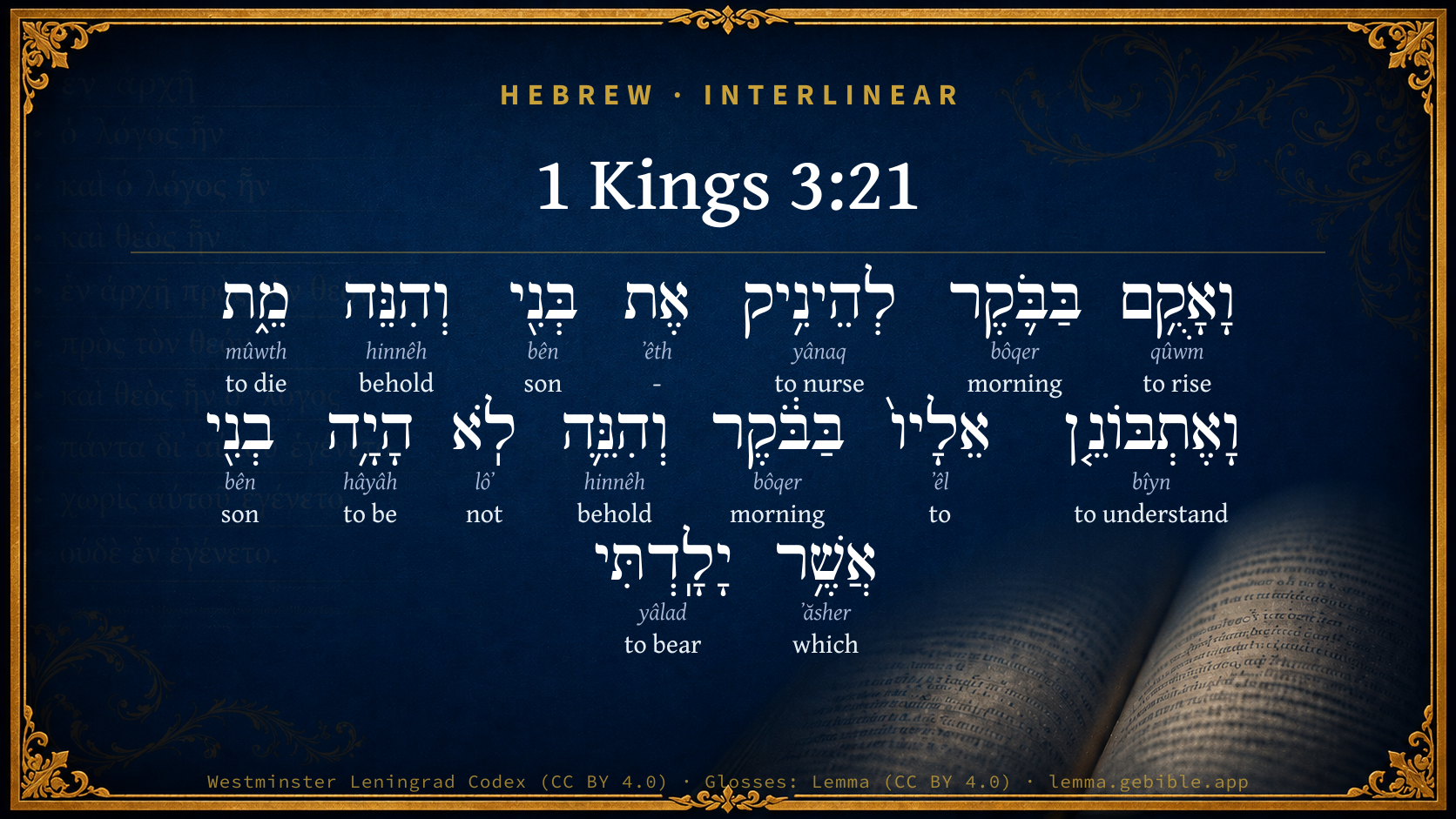
Hebrew (Westminster Leningrad Codex) 1 Kings 3:21 appears in the Hebrew Old Testament. The text above is from the Westminster Leningrad Codex. Each word links to its Strong’s number, a concise gloss, and parsing drawn from the Open Scriptures Hebrew Bible morphology. Click any word for its full Brown-Driver-Briggs (BDB) entry.
Download image
Cite this verse

1 Kings 3:21 (World English Bible). Public Domain. Lemma interlinear Bible study tool, https://lemma.gebible.app/v/1-kings/3/21.

Show BibTeX & RIS
BibTeX
RIS
English Translation
When I rose in the morning to give my child suck, behold, it was dead; but when I had looked at it in the morning, behold, it was not my son, whom I bore.
World English Bible · Public Domain
Download a study sheet

One document with this verse’s original text, its word-by-word gloss line, the meaning frame, cross-references with their text, attributed commentary, and full source and license credits — printable, and it pastes into notes with its structure intact.

This verse Autodidact and up

Study sheet (.html) Plain text (.txt)

A passage Seminary Student

Up to 50 verses in one chapter. A passage sheet keeps up to 6 commentary sources and 12 cross-references per verse, in the order this page ranks them, and says so on the sheet whenever that leaves anything out. Ask for a single verse and you get the Autodidact verse sheet above.

Everything on this page stays free to read, with no account — the sheet is a download of what is already on screen, not access to it.

Want to remove ads? Support Godless Engineer
Compare translations 3

The same verse in 3 English versions, stacked beneath the original-language interlinear above. Click any original word for its lexicon entry.

Each is an independent rendering of the whole verse — the interlinear is not word-aligned to these translations.

Highlighted words mark where these versions differ — a whole-verse word diff, not a word-by-word alignment.

  • World English Bible Public Domain
    When I rose in the morning to give my child suck, behold, it was dead; but when I had looked at it in the morning, behold, it was not my son, whom I bore.
  • King James Version Public Domain
    And when I rose in the morning to give my child suck, behold, it was dead: but when I had considered it in the morning, behold, it was not my son, which I did bear.
  • unfoldingWord Literal Text CC BY-SA 4.0
    And I arose in the morning to nurse my son, and behold, he had died. But I looked carefully upon him in the morning, and behold, he was not my son whom I had borne.”

unfoldingWord Literal Text — © unfoldingWord, licensed CC BY-SA 4.0. Word-aligned USFM3 via Door43 (git.door43.org/unfoldingWord/en_ult).

Versions to compare (up to 4)

3 of 4 selected

Show all 18 translations

Every available English version of this verse, each an independent rendering of the whole verse.

  • World English Bible Public Domain
    When I rose in the morning to give my child suck, behold, it was dead; but when I had looked at it in the morning, behold, it was not my son, whom I bore.
  • Berean Standard Bible Public Domain
    The next morning, when I got up to nurse my son, I discovered he was dead. But when I examined him, I realized that he was not the son I had borne.”
  • Majority Standard Bible Public Domain
    The next morning, when I got up to nurse my son, I discovered he was dead. But when I examined him, I realized that he was not the son I had borne.”
  • King James Version Public Domain
    And when I rose in the morning to give my child suck, behold, it was dead: but when I had considered it in the morning, behold, it was not my son, which I did bear.
  • American Standard Version (1901) Public Domain
    And when I rose in the morning to give my child suck, behold, it was dead; but when I had looked at it in the morning, behold, it was not my son, whom I did bear.
  • Revised Version (1885) Public Domain
    And when I rose in the morning to give my child suck, behold, it was dead: but when I had considered it in the morning, behold, it was not my son, which I did bear.
  • Geneva Bible (1599) Public Domain
    And when I rose in the morning to giue my sonne sucke, beholde, he was dead: and when I had well considered him in the morning, beholde, it was not my sonne, whom I had borne.
  • Douay-Rheims (1899) Public Domain
    And when I rose in the morning to give my child suck, behold it was dead: but considering him more diligently when it was clear day, I found that it was not mine which I bore.
  • Young's Literal Translation Public Domain
    and I rise in the morning to suckle my son, and lo, dead; and I consider concerning it in the morning, and lo, it was not my son whom I did bear.'
  • Literal Standard Version CC BY-SA 4.0
    and I rise in the morning to suckle my son, and behold, [he is] dead; and I consider in the morning concerning it, and behold, it was not my son whom I bore.”
  • Unlocked Literal Bible CC BY-SA 4.0
    When I rose in the morning to nurse my child, he was dead. But when I had looked at him carefully in the morning, he was not my son, whom I had borne.”
  • unfoldingWord Literal Text CC BY-SA 4.0
    And I arose in the morning to nurse my son, and behold, he had died. But I looked carefully upon him in the morning, and behold, he was not my son whom I had borne.”
  • Darby Bible Public Domain
    And when I rose in the morning to give my child suck, behold, it was dead; and I considered it in the morning, and behold, it was not my son, whom I bore.
  • World Messianic Bible Public Domain
    When I rose in the morning to nurse my child, behold, he was dead; but when I had looked at him in the morning, behold, it was not my son whom I bore.”
  • Webster's Bible Public Domain
    And when I rose in the morning to nurse my child, behold, it was dead: but when I had considered it in the morning, behold, it was not my son, which I bore.
  • Free Bible Version CC BY-SA 4.0
    When I got up in the morning to nurse my son I saw that he was dead. When I looked closely at him in the light I realized it wasn't my son.”
  • Bible in Basic English Public Domain
    And when I got up to give my child the breast, I saw that it was dead; but in the morning, looking at it with care, I saw that it was not my son.
  • JPS Tanakh (1917) Public Domain
    And when I rose in the morning to give my child suck, behold, it was dead; but when I had looked well at it in the morning, behold, it was not my son, whom I did bear.'

Literal Standard Version (2020), Covenant Press — licensed CC BY-SA 4.0. Text via the HelloAO Bible API (eBible.org). Unlocked Literal Bible (unfoldingWord) — licensed CC BY-SA 4.0. Text via the HelloAO Bible API (eBible.org). unfoldingWord Literal Text — © unfoldingWord, licensed CC BY-SA 4.0. Word-aligned USFM3 via Door43 (git.door43.org/unfoldingWord/en_ult). Free Bible Version, Dr. Jonathan Gallagher — licensed CC BY-SA 4.0. Text via the HelloAO Bible API (eBible.org).

Word by word

More ways to search: Search by grammar → Find every occurrence → Compare this word →

Practice this passage: Drill this verse → Learn its vocabulary →

לְהֵינִ֥יק
yânaq
H3243
“to nurse”
Preposition + Verb, Hiphil, Infinitive Construct
Part of Speech
Preposition + Verb
Stem
Hiphil
Form
Infinitive Construct
Full BDB Definition

Origin: a primitive root

TWOT: 874

to suckle, nurse, suck - (Qal) - to suck - suckling, babe (substantive) - (Hiphil) - to give suck to, nurse - nursing, nursing woman, nurse (participle)
  1. וָאָקֻ֥ם qûwm H6965 “and · to rise” Conjunction + Verb, Qal, Sequential Imperfect, 1st Person, Common, Singular
  2. בַּבֹּ֛קֶר bôqer H1242 “in/at the · morning” Preposition, Determined + Noun, Common, Masculine, Singular, Absolute
  3. אֶת ʼêth H853 “-” Particle, Direct Object
  4. בְּנִ֖י bên H1121 “son · my” Noun, Common, Masculine, Singular, Construct + Suffix, Personal, 1st Person, Common, Singular
  5. וְהִנֵּה hinnêh H2009 “and · behold” Conjunction + Particle, Demonstrative
  6. מֵ֑ת mûwth H4191 “to die” Verb, Qal, Perfect, 3rd Person, Masculine, Singular
  7. וָאֶתְבּוֹנֵ֤ן bîyn H995 “and · to understand” Conjunction + Verb, Hithpolel, Sequential Imperfect, 1st Person, Common, Singular
  8. אֵלָיו֙ ʼêl H413 “to · him” Preposition + Suffix, Personal, 3rd Person, Masculine, Singular
  9. בַּבֹּ֔קֶר bôqer H1242 “in/at the · morning” Preposition, Determined + Noun, Common, Masculine, Singular, Absolute
  10. וְהִנֵּ֛ה hinnêh H2009 “and · behold” Conjunction + Particle, Demonstrative
  11. לֹֽא lôʼ H3808 “not” Particle, Negative
  12. הָיָ֥ה hâyâh H1961 “to be” Verb, Qal, Perfect, 3rd Person, Masculine, Singular
  13. בְנִ֖י bên H1121 “son · my” Noun, Common, Masculine, Singular, Construct + Suffix, Personal, 1st Person, Common, Singular
  14. אֲשֶׁ֥ר ʼăsher H834 “which” Particle, Relative
  15. יָלָֽדְתִּי yâlad H3205 “to bear” Verb, Qal, Perfect, 1st Person, Common, Singular

About this verse

These counts appear in no published source. They are computed here, from the morphology-tagged text and Lemma’s own curated glosses. What Lemma adds →

16
words
13
distinct lemmas
Historical
section

Shared distinctive vocabulary

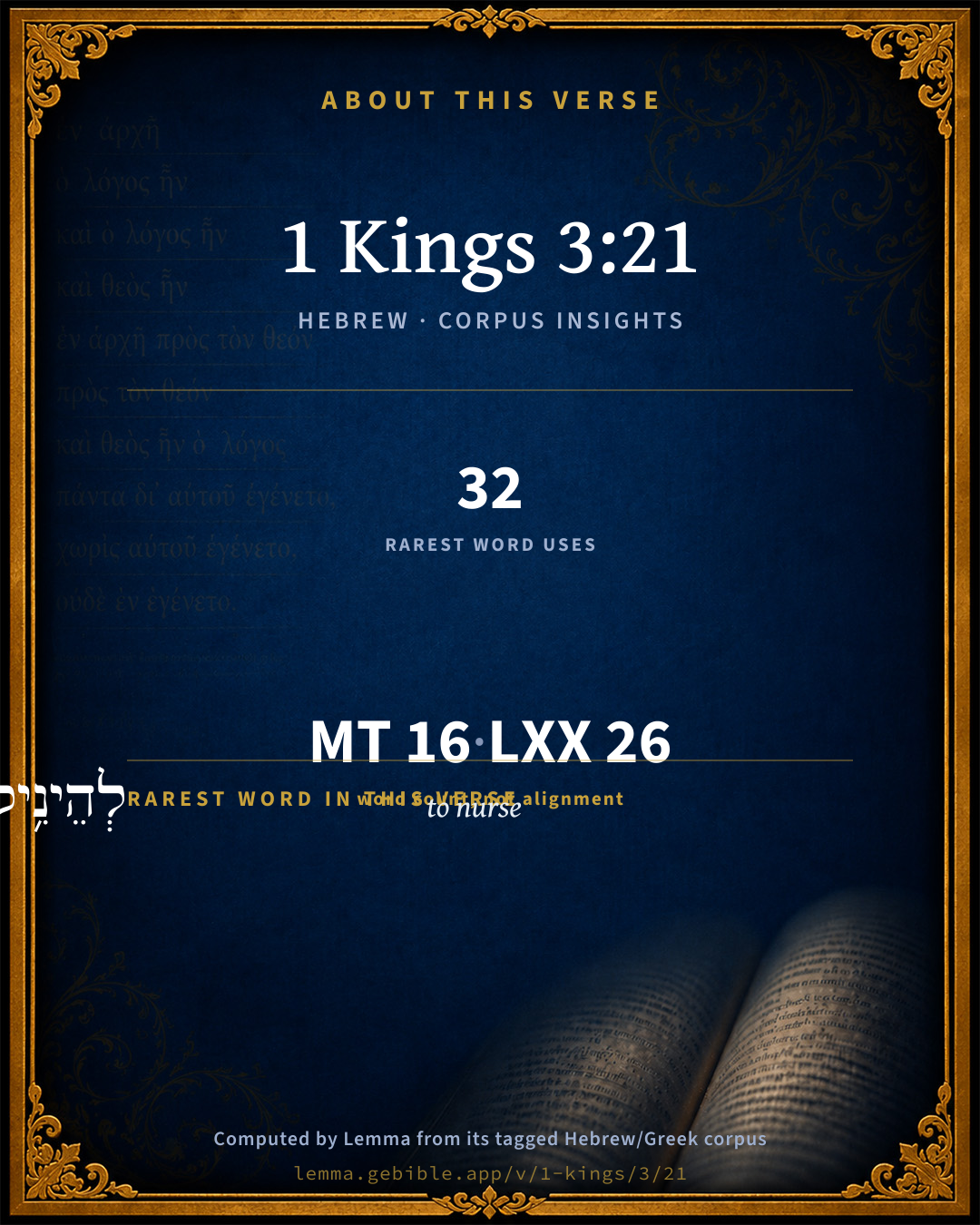
לְהֵינִ֥יק to nurse H3243 occurs in 30 verses of the Hebrew Bible. Also found in:

Grammatical profile

  • 6 verbs
  • 4 nouns
  • 1 preposition
  • 5 particles

Verb forms

  • וָאָקֻ֥ם Qal · Sequential Imperfect
  • לְהֵינִ֥יק Hiphil · Infinitive Construct
  • מֵ֑ת Qal · Perfect
  • וָאֶתְבּוֹנֵ֤ן Hithpolel · Sequential Imperfect
  • הָיָ֥ה Qal · Perfect
  • יָלָֽדְתִּי Qal · Perfect

Repetition

Words recur within this verse — often emphatic in Hebrew:

  • בַּבֹּ֛קֶר morning H1242 ×2
  • בְּנִ֖י son H1121 ×2
  • וְהִנֵּה behold H2009 ×2

Hebrew & Septuagint length

In English translation the verse runs 34 words from the Hebrew and 32 from the Septuagint (LXX English) — closely comparable.

A rough comparison of the two English renderings, which tokenize alike — not a word-level alignment.

Word counts can differ between the Hebrew and the Greek without any difference in meaning — e.g. the Hebrew direct-object marker אֵת has no separate Greek word, and Greek often adds the article ὁ.

In the original languages it is 16 Hebrew tokens and 26 Greek tokens — but the two are counted differently (Hebrew bundles its prefixes and suffixes into one token; the Greek is in lemma form), so that isn’t a like-for-like length.

Cross-references

2

Topical passages linked to 1 Kings 3:21 in the Treasury of Scripture Knowledge — connected by theme and wording, ordered by reader-vote popularity; previews shown in the World English Bible.

  • Genesis 21:7 She said, "Who would have said to Abraham, that Sarah would nurse children? For I have borne him a son in his old age."
  • 1 Samuel 1:23 Elkanah her husband said to her, Do what seems you good; wait until you have weaned him; only Yahweh establish his word. So the woman waited and nursed her son, until she weaned him.

Cross-references courtesy of OpenBible.info (CC BY 4.0).

Hebrew and Greek witnesses Masoretic Hebrew ↔ Greek Septuagint

The same verse in the two great witnesses to the Old Testament, shown verse-for-verse.

These are two independent witnesses, not word-aligned to each other, and the Septuagint is shown in lemma (dictionary) form.

Hebrew 1 Kings 3:21 Masoretic · Westminster Leningrad Codex

וָאָקֻ֥ם בַּבֹּ֛קֶר לְהֵינִ֥יק אֶת בְּנִ֖י וְהִנֵּה מֵ֑ת וָאֶתְבּוֹנֵ֤ן אֵלָיו֙ בַּבֹּ֔קֶר וְהִנֵּ֛ה לֹֽא הָיָ֥ה בְנִ֖י אֲשֶׁ֥ר יָלָֽדְתִּי

When I rose in the morning to give my child suck, behold, it was dead; but when I had looked at it in the morning, behold, it was not my son, whom I bore.

World English Bible · Public Domain

Greek LXX 1 Kings 3:21 Septuagint · lemma form

καί ἀναἵστημι ὁ πρωΐ θηλάζω ὁ υἱός ἐγώ καί ἐκεῖνος εἰμί θνήσκω καί ἰδού κατανοέω αὐτός πρωΐ καί ἰδού οὐ εἰμί ὁ υἱός ἐγώ ὅς τίκτω

and I arose in the morning to suckle my son, and he was dead: and, behold, I considered him in the morning, and, behold, it was not my son whom I bore.

LXX2012 (modern English Septuagint) · Public Domain

Hebrew: Westminster Leningrad Codex (CC BY 4.0). Greek: Septuagint (public domain); English from LXX2012 (modern English Septuagint) (Public Domain). How the Septuagint differs from the Hebrew →

Targum (Aramaic paraphrase)

1

The Targum is the ancient Jewish Aramaic paraphrase of the Hebrew Scriptures — an interpretive translation, not the Hebrew text itself. Onkelos (literal) and Pseudo-Jonathan (expansive) render the Torah, and Jonathan the Prophets. Coverage is partial: where no permissively-licensed English translation exists for a verse, only the Aramaic is shown. This is verse-level text, not a word-by-word alignment to the Hebrew.

  1. Targum Jonathan Prophets (Joshua–Malachi)
    וַאֲקִימַת בְּצַפְרָא לְאוֹנָקָא יַת בְּרִי וְהָא מִית וְאִסְתַּכְּלִית בֵּיהּ בְּצַפְרָא וְהָא לָא הֲוָה בְרִי דִילֵידִית:

    (no public-domain English translation for this verse)

    Targum Jonathan — Aramaic: “Mikraot Gedolot” (public domain). English: “Sefaria Community Translation” (CC0 1.0 (public-domain dedication)); “London "Chaldee Paraphrase," 1871” (public domain). Text via Sefaria.

Commentary

Notes on 1 Kings 3:21 from classic Christian and Jewish commentators (each source and its license shown beneath its notes). The classic Christian expositions comment on the surrounding passage and are grouped to its opening verse, so a note may address several verses; the Jewish commentaries on the Tanakh (Rashi and others) are per-verse, so they appear only where the commentator wrote on this verse.

Lemma curates 59 commentaries, every one of them public domain or Creative Commons licensed, each selected and text-cleaned for this edition rather than reprinted as found. About our sources →

Trapp's Complete Commentary

John Trapp

1Ki 3:21 And when I rose in the morning to give my child suck, behold, it was dead: but when I had considered it in the morning, behold, it was not my son, which I did bear.

Ver. 21. To give my child suck.] This is a check to those nice dames that needlessly refuse to suckle their own children. Not harlots only, but "sea monsters draw out their breasts, and give suck to their young." {Lam 4:3}

Behold, it was not my son.] Though death had somewhat altered the features of the child, yet the true mother could not be mistaken in it.

John Trapp, A Commentary or Exposition upon All the Books of the Old and New Testament (1647–1656) — public domain. Text from a community e-Sword module.

The Cambridge Bible for Schools and Colleges

gen. ed. J. J. S. Perowne

21. behold it was dead] i.e. I had a dead child in my bosom which I supposed to be mine.

I had considered] The form of the verb implies a careful examination, a looking over and over, and noticing such marks on the child’s body as none but its mother would.

in the morning] When the daylight was sufficient for me to examine the child carefully.

The Cambridge Bible for Schools and Colleges (gen. ed. J. J. S. Perowne; Cambridge University Press, 1878–1918) — public domain. Text from a community e-Sword module.

John Gill's Exposition

And the other woman said,.... The defendant:

nay, but the living is my son, and the dead is thy son; she denied what the other said, but offered nothing in proof of it:

and this said; she who was the plaintiff replied in the same language:

no: but the dead is thy son, and the living is my son; without being able to add anything in confirmation of what she had deposed:

thus they spake before the king; several times, over and over again, what is before expressed, having nothing to produce on either side in proof of their assertions; so that it was very difficult to determine to whom the living child belonged.

John Gill's Exposition of the Whole Bible (1746–1763) — public domain (CC PDM 1.0). Text via the HelloAO Bible API.

Whedon's Commentary on the Bible

Daniel D. Whedon

21. When I had considered it in the morning — Here is a graphic word-picture. The true mother, with all the alarm and earnestness of a smitten heart, looks at the dead child again and again, and turns it over, scrutinizing every feature, and lo, it is not hers!

Daniel D. Whedon (gen. ed.), Commentary on the Old and New Testaments (1874–1909) — public domain. Text from a community e-Sword module.

The Pulpit Commentary

And when I rose in the morning (while it was still dusk) to give my child suck, behold it was dead: but when I had considered it in the morning (i.e., in broad daylight; Vulg. clara luce) behold (this second "behold" marks a second discovery) it was not my son which I did bear.

The Pulpit Commentary (1880–1919), ed. H.D.M. Spence-Jones & Joseph S. Exell — public domain. Text from a community e-Sword module.

unfoldingWord translationNotes

Door43 World Missions Community

General Information:

Two prostitutes continue to share their story with Solomon.

nurse my child

This means to feed her baby milk from her breast.

before the king

"before Solomon" or "while Solomon could see and hear them"

translationWords

life

king

unfoldingWord translationNotes — © Distant Shores Media and the Door43 World Missions Community, licensed CC BY-SA 4.0. Source: git.door43.org/Door43/en_tn.

Rashi

Rabbi Shlomo Yitzchaki (Rashi)

I scrutinized him. I concentrated to scrutinize him.

Rashi on the Tanakh — English translations: “The Judaica Press complete Tanach with Rashi, translated by A. J. Rosenberg” (CC BY 4.0); “Pentateuch with Rashi's commentary by M. Rosenbaum and A.M. Silbermann, 1929-1934” (public domain); “The Metsudah Tanach series, Lakewood, N.J” (CC BY 4.0); and “The Book of Joshua, Metsudah Publications, 1997” (CC BY 4.0). Text via Sefaria.

Lesson kit

Teaching starters — assembled from the data on this page, not authored interpretation. Every prompt links to the verse data it draws on. Edit before teaching.

1 Kings, in the Historical, opens this verse with 16 words (13 distinct Hebrew lemmas). Its most distinctive word is yânaq (“to nurse”). A historical commentator’s framing appears above. Read the whole chapter for the surrounding context.

Discussion questions

  1. How does “to nurse” (yânaq) shape what this verse is saying?
  2. How does Genesis 21:7, which shares the word «to nurse», read alongside this verse?
  3. What does the repetition of “morning” (2× in this one verse) do in this verse?
  4. These translations render this verse differently; the difference is in the English rendering, not the original. What questions does that raise?
  5. «וָאָקֻ֥ם» is a Qal Sequential Imperfect verb. How does that grammatical form shape the action described?
  6. Compare how Trapp's Complete Commentary and The Cambridge Bible for Schools and Colleges read this verse. Where do they agree or differ?

Things to notice

Reading settings

Reading text

Shown beneath each verse's original-language words.

Old Testament
Old Testament edition

Read the OT as the Masoretic Hebrew (MT) or the Greek Septuagint (LXX).

English shown for the Greek Septuagint (in the Hebrew ↔ Greek comparison).

Comparing translations? Open the Compare panel on any verse page to stack up to four side by side.