1 Samuel 29:11

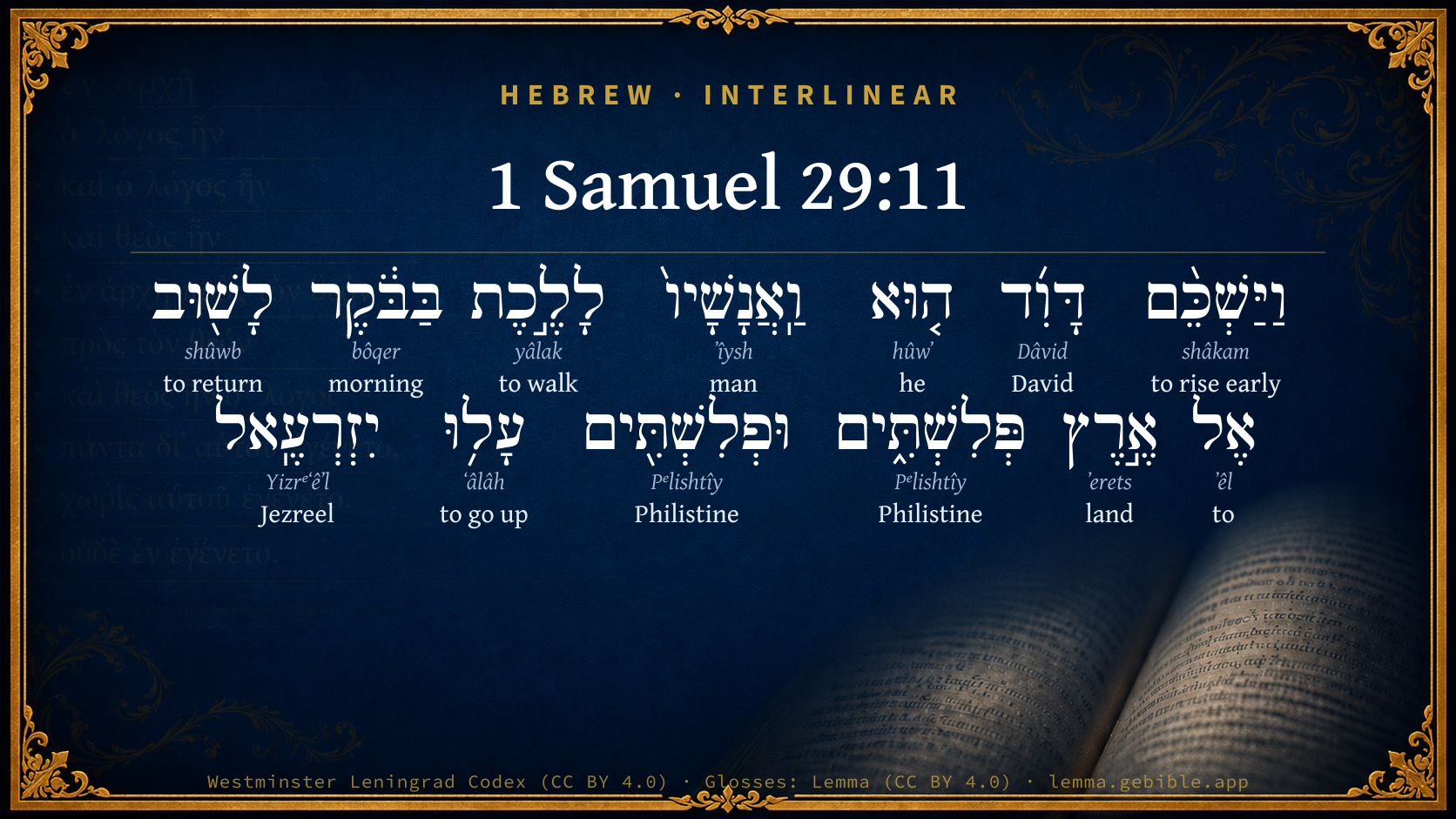
Hebrew (Westminster Leningrad Codex) 1 Samuel 29:11 appears in the Hebrew Old Testament. The text above is from the Westminster Leningrad Codex. Each word links to its Strong’s number, a concise gloss, and parsing drawn from the Open Scriptures Hebrew Bible morphology. Click any word for its full Brown-Driver-Briggs (BDB) entry.
Download image
Cite this verse

1 Samuel 29:11 (World English Bible). Public Domain. Lemma interlinear Bible study tool, https://lemma.gebible.app/v/1-samuel/29/11.

Show BibTeX & RIS
BibTeX
RIS
English Translation
So David rose up early, he and his men, to depart in the morning, to return into the land of the Philistines. The Philistines went up to Jezreel.
World English Bible · Public Domain
Download a study sheet

One document with this verse’s original text, its word-by-word gloss line, the meaning frame, cross-references with their text, attributed commentary, and full source and license credits — printable, and it pastes into notes with its structure intact.

This verse Autodidact and up

Study sheet (.html) Plain text (.txt)

A passage Seminary Student

Up to 50 verses in one chapter. A passage sheet keeps up to 6 commentary sources and 12 cross-references per verse, in the order this page ranks them, and says so on the sheet whenever that leaves anything out. Ask for a single verse and you get the Autodidact verse sheet above.

Everything on this page stays free to read, with no account — the sheet is a download of what is already on screen, not access to it.

Want to remove ads? Support Godless Engineer
Compare translations 3

The same verse in 3 English versions, stacked beneath the original-language interlinear above. Click any original word for its lexicon entry.

Each is an independent rendering of the whole verse — the interlinear is not word-aligned to these translations.

Highlighted words mark where these versions differ — a whole-verse word diff, not a word-by-word alignment.

  • World English Bible Public Domain
    So David rose up early, he and his men, to depart in the morning, to return into the land of the Philistines. The Philistines went up to Jezreel.
  • King James Version Public Domain
    So David and his men rose up early to depart in the morning, to return into the land of the Philistines. And the Philistines went up to Jezreel.
  • unfoldingWord Literal Text CC BY-SA 4.0
    So David arose early, he and his men, to go in the morning to return to the land of the Philistines. And the Philistines went up Jezreel.

unfoldingWord Literal Text — © unfoldingWord, licensed CC BY-SA 4.0. Word-aligned USFM3 via Door43 (git.door43.org/unfoldingWord/en_ult).

Versions to compare (up to 4)

3 of 4 selected

Show all 18 translations

Every available English version of this verse, each an independent rendering of the whole verse.

  • World English Bible Public Domain
    So David rose up early, he and his men, to depart in the morning, to return into the land of the Philistines. The Philistines went up to Jezreel.
  • Berean Standard Bible Public Domain
    So David and his men got up early in the morning to return to the land of the Philistines. And the Philistines went up to Jezreel.
  • Majority Standard Bible Public Domain
    So David and his men got up early in the morning to return to the land of the Philistines. And the Philistines went up to Jezreel.
  • King James Version Public Domain
    So David and his men rose up early to depart in the morning, to return into the land of the Philistines. And the Philistines went up to Jezreel.
  • American Standard Version (1901) Public Domain
    So David rose up early, he and his men, to depart in the morning, to return into the land of the Philistines. And the Philistines went up to Jezreel.
  • Revised Version (1885) Public Domain
    So David rose up early, he and his men, to depart in the morning, to return into the land of the Philistines. And the Philistines went up to Jezreel.
  • Geneva Bible (1599) Public Domain
    So Dauid and his men rose vp earely to depart in the morning, and to returne into the lande of the Philistims: and the Philistims went vp to Izreel.
  • Douay-Rheims (1899) Public Domain
    So David and his men arose in the night, that they might set forward in the morning, and returned to the land of the Philistines: and the Philistines went up to Jezrahel.
  • Young's Literal Translation Public Domain
    And David riseth early, he and his men, to go in the morning, to turn back unto the land of the Philistines, and the Philistines have gone up to Jezreel.
  • Literal Standard Version CC BY-SA 4.0
    And David rises early, he and his men, to go in the morning, to return to the land of the Philistines, and the Philistines have gone up to Jezreel.
  • Unlocked Literal Bible CC BY-SA 4.0
    So David rose up early, he and his men, to leave in the morning, to return into the land of the Philistines. But the Philistines went up to Jezreel.
  • unfoldingWord Literal Text CC BY-SA 4.0
    So David arose early, he and his men, to go in the morning to return to the land of the Philistines. And the Philistines went up Jezreel.
  • Darby Bible Public Domain
    And David rose up early, he and his men, to depart in the morning, to return into the land of the Philistines. And the Philistines went up to Jizreel.
  • World Messianic Bible Public Domain
    So David rose up early, he and his men, to depart in the morning, to return into the land of the Philistines; and the Philistines went up to Jezreel.
  • Webster's Bible Public Domain
    So David and his men rose early to depart in the morning, to return into the land of the Philistines. And the Philistines went up to Jezreel.
  • Free Bible Version CC BY-SA 4.0
    David and his men got up early in the morning and went back to the country of the Philistines. But the Philistines advanced on Jezreel.
  • Bible in Basic English Public Domain
    So David and his men got up early in the morning to go back to the land of the Philistines. And the Philistines went up to Jezreel.
  • JPS Tanakh (1917) Public Domain
    So David rose up early, he and his men, to depart in the morning, to return into the land of the Philistines. And the Philistines went up to Jezreel.

Literal Standard Version (2020), Covenant Press — licensed CC BY-SA 4.0. Text via the HelloAO Bible API (eBible.org). Unlocked Literal Bible (unfoldingWord) — licensed CC BY-SA 4.0. Text via the HelloAO Bible API (eBible.org). unfoldingWord Literal Text — © unfoldingWord, licensed CC BY-SA 4.0. Word-aligned USFM3 via Door43 (git.door43.org/unfoldingWord/en_ult). Free Bible Version, Dr. Jonathan Gallagher — licensed CC BY-SA 4.0. Text via the HelloAO Bible API (eBible.org).

Word by word

More ways to search: Search by grammar → Find every occurrence → Compare this word →

Practice this passage: Drill this verse → Learn its vocabulary →

יִזְרְעֶֽאל
Yizrᵉʻêʼl
H3157
“Jezreel”
Noun, Proper
Part of Speech
Noun
Type
Proper
Full BDB Definition

Origin: from H2232 and H410

TWOT: None

Jezreel = "God sows" - a descendant of the father or founder of Etam of Judah (noun proper masculine) - first son of Hosea the prophet (noun proper masculine) - a city in the Nekeb of Judah (noun proper locative) - a city in Issachar on the northwest spur of Mount Gilboa (noun proper locative)
  1. וַיַּשְׁכֵּ֨ם shâkam H7925 “and · to rise early” Conjunction + Verb, Hiphil, Sequential Imperfect, 3rd Person, Masculine, Singular
  2. דָּוִ֜ד Dâvid H1732 “David” Noun, Proper
  3. ה֤וּא hûwʼ H1931 “he” Pronoun, Personal, 3rd Person, Masculine, Singular
  4. וַֽאֲנָשָׁיו֙ ʼîysh H376 “and · men · his” Conjunction + Noun, Common, Masculine, Plural, Construct + Suffix, Personal, 3rd Person, Masculine, Singular
  5. לָלֶ֣כֶת yâlak H3212 “to walk” Preposition + Verb, Qal, Infinitive Construct
  6. בַּבֹּ֔קֶר bôqer H1242 “in/at the · morning” Preposition, Determined + Noun, Common, Masculine, Singular, Absolute
  7. לָשׁ֖וּב shûwb H7725 “to return” Preposition + Verb, Qal, Infinitive Construct
  8. אֶל ʼêl H413 “to” Preposition
  9. אֶ֣רֶץ ʼerets H776 “land of” Noun, Common, Both, Singular, Construct
  10. פְּלִשְׁתִּ֑ים Pᵉlishtîy H6430 “Philistines” Noun, Gentilic, Masculine, Plural, Absolute
  11. וּפְלִשְׁתִּ֖ים Pᵉlishtîy H6430 “and · Philistines” Conjunction + Noun, Gentilic, Masculine, Plural, Absolute
  12. עָל֥וּ ʻâlâh H5927 “to go up” Verb, Qal, Perfect, 3rd Person, Common, Plural

About this verse

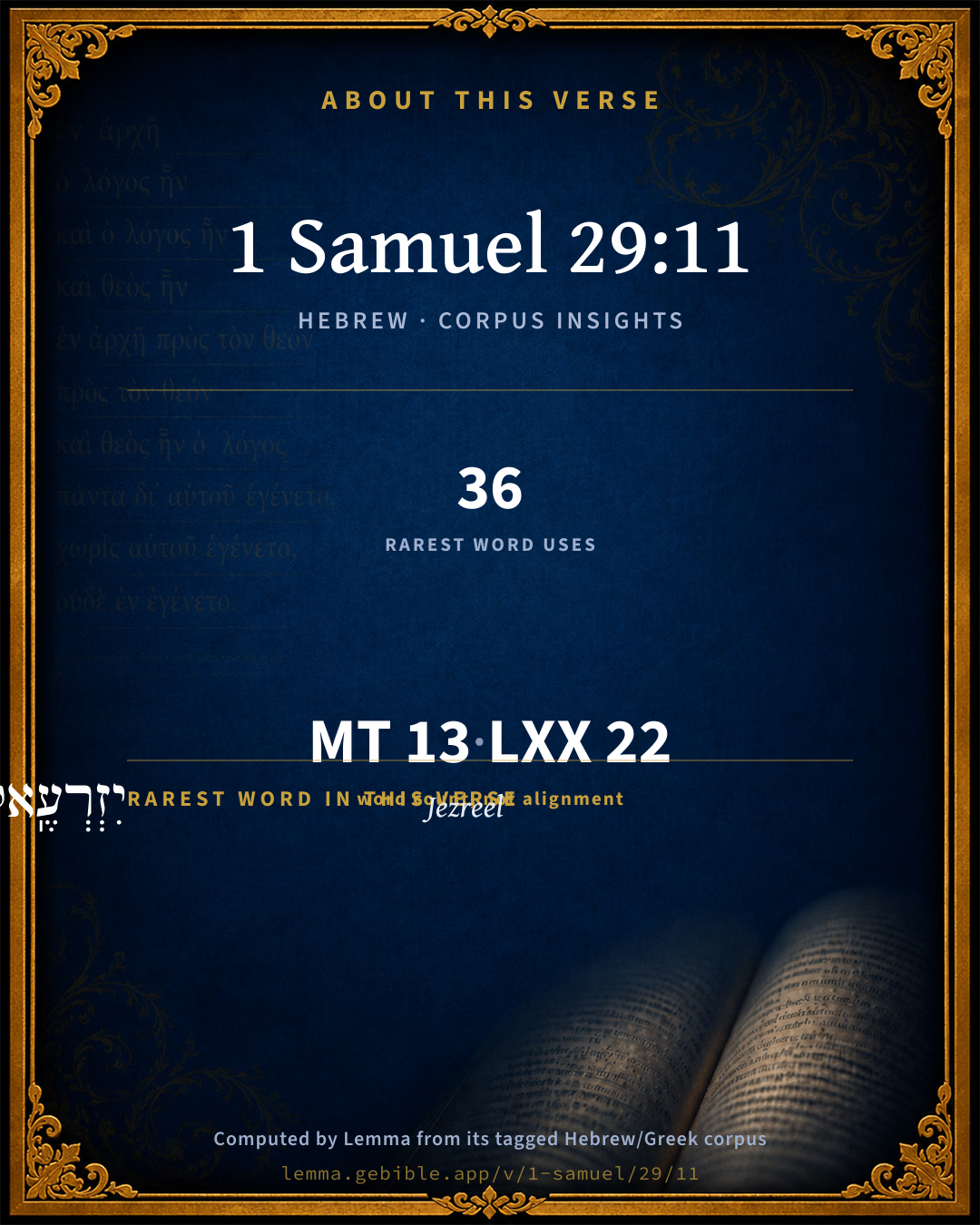
These counts appear in no published source. They are computed here, from the morphology-tagged text and Lemma’s own curated glosses. What Lemma adds →

13
words
12
distinct lemmas
Historical
section

Shared distinctive vocabulary

יִזְרְעֶֽאל Jezreel H3157 occurs in 32 verses of the Hebrew Bible. Also found in:

Grammatical profile

  • 4 verbs
  • 7 nouns
  • 1 pronoun
  • 1 preposition

Verb forms

  • וַיַּשְׁכֵּ֨ם Hiphil · Sequential Imperfect
  • לָלֶ֣כֶת Qal · Infinitive Construct
  • לָשׁ֖וּב Qal · Infinitive Construct
  • עָל֥וּ Qal · Perfect

Repetition

A word recurs within this verse — often emphatic in Hebrew:

  • פְּלִשְׁתִּ֑ים Philistine H6430 ×2

Hebrew & Septuagint length

In English translation the verse runs 28 words from the Hebrew and 26 from the Septuagint (LXX English) — closely comparable.

A rough comparison of the two English renderings, which tokenize alike — not a word-level alignment.

Word counts can differ between the Hebrew and the Greek without any difference in meaning — e.g. the Hebrew direct-object marker אֵת has no separate Greek word, and Greek often adds the article ὁ.

In the original languages it is 13 Hebrew tokens and 22 Greek tokens — but the two are counted differently (Hebrew bundles its prefixes and suffixes into one token; the Greek is in lemma form), so that isn’t a like-for-like length.

Cross-references

3

Topical passages linked to 1 Samuel 29:11 in the Treasury of Scripture Knowledge — connected by theme and wording, ordered by reader-vote popularity; previews shown in the World English Bible.

  • Joshua 19:18 Their border was to Jezreel, and Chesulloth, and Shunem,
  • 1 Samuel 29:1 Now the Philistines gathered together all their hosts to Aphek: and the Israelites encamped by the spring which is in Jezreel.
  • 2 Samuel 4:4 Now Jonathan, Saul's son, had a son who was lame of his feet. He was five years old when the news came of Saul and Jonathan out of Jezreel; and his nurse took him up, and fled: and it happened, as she made haste to flee, that he fell, and became lame. His name was Mephibosheth.

Cross-references courtesy of OpenBible.info (CC BY 4.0).

Hebrew and Greek witnesses Masoretic Hebrew ↔ Greek Septuagint

The same verse in the two great witnesses to the Old Testament, shown verse-for-verse.

These are two independent witnesses, not word-aligned to each other, and the Septuagint is shown in lemma (dictionary) form.

Hebrew 1 Samuel 29:11 Masoretic · Westminster Leningrad Codex

וַיַּשְׁכֵּ֨ם דָּוִ֜ד ה֤וּא וַֽאֲנָשָׁיו֙ לָלֶ֣כֶת בַּבֹּ֔קֶר לָשׁ֖וּב אֶל אֶ֣רֶץ פְּלִשְׁתִּ֑ים וּפְלִשְׁתִּ֖ים עָל֥וּ יִזְרְעֶֽאל

So David rose up early, he and his men, to depart in the morning, to return into the land of the Philistines. The Philistines went up to Jezreel.

World English Bible · Public Domain

Greek LXX 1 Samuel 29:11 Septuagint · lemma form

καί ὀρθρίζω δαυίδ αὐτός καί ὁ ἀνήρ αὐτός ἀποἔρχομαι καί φυλάσσω ὁ γῆ ὁ ἀλλόφυλος καί ὁ ἀλλόφυλος ἀναβαίνω πολεμέω ἐπί ἰσραήλ

So David arose early, he and his men, to depart and guard the land of the Philistines: and the Philistines went up to Jezrael to battle.

LXX2012 (modern English Septuagint) · Public Domain

Hebrew: Westminster Leningrad Codex (CC BY 4.0). Greek: Septuagint (public domain); English from LXX2012 (modern English Septuagint) (Public Domain). How the Septuagint differs from the Hebrew →

Targum (Aramaic paraphrase)

1

The Targum is the ancient Jewish Aramaic paraphrase of the Hebrew Scriptures — an interpretive translation, not the Hebrew text itself. Onkelos (literal) and Pseudo-Jonathan (expansive) render the Torah, and Jonathan the Prophets. Coverage is partial: where no permissively-licensed English translation exists for a verse, only the Aramaic is shown. This is verse-level text, not a word-by-word alignment to the Hebrew.

  1. Targum Jonathan Prophets (Joshua–Malachi)
    וְאַקְדֵים דָוִד הוּא וְגַבְרוֹהִי לְמֵיזַל בְּצַפְרָא לְמֵתַב לַאֲרַע פְּלִשְׁתָּאֵי וּפְלִשְׁתָּאֵי סְלִיקוּ לְיִזְרְעֶאל:

    (no public-domain English translation for this verse)

    Targum Jonathan — Aramaic: “Mikraot Gedolot” (public domain). English: “Sefaria Community Translation” (CC0 1.0 (public-domain dedication)); “London "Chaldee Paraphrase," 1871” (public domain). Text via Sefaria.

Commentary

Notes on 1 Samuel 29:11 from classic Christian and Jewish commentators (each source and its license shown beneath its notes). The classic Christian expositions comment on the surrounding passage and are grouped to its opening verse, so a note may address several verses; the Jewish commentaries on the Tanakh (Rashi and others) are per-verse, so they appear only where the commentator wrote on this verse.

Lemma curates 59 commentaries, every one of them public domain or Creative Commons licensed, each selected and text-cleaned for this edition rather than reprinted as found. About our sources →

Trapp's Complete Commentary

John Trapp

1Sa 29:11 So David and his men rose up early to depart in the morning, to return into the land of the Philistines. And the Philistines went up to Jezreel.

Ver. 11. To return into the land of the Philistines.] Not to defend their borders, as Josephus will have it; but to do God service at Ziklag, and there to receive such as resorted unto him to make him king. See 1Ch 12:19-21.

John Trapp, A Commentary or Exposition upon All the Books of the Old and New Testament (1647–1656) — public domain. Text from a community e-Sword module.

Ellicott's Commentary for English Readers

(11) To return into the land of the Philistines.—No doubt David and his officers rejoiced at their escaping the terrible alternative of either turning traitors to the kindly man who had so hospitably received them in their distress, or of appearing in arms with the Philistines when they came into collision with the Israelites under Saul. But they little thought in how sore a danger their wives and children and homes were at this juncture. Their release from the Philistine army was not a moment too soon to save these.

A Bible Commentary for English Readers, edited by Charles John Ellicott (1878–1897) — public domain. Text from a community e-Sword module.

The Cambridge Bible for Schools and Colleges

gen. ed. J. J. S. Perowne

11. to Jezreel] The Sept. reading (A B) “to fight against Israel” is plausible.

The Cambridge Bible for Schools and Colleges (gen. ed. J. J. S. Perowne; Cambridge University Press, 1878–1918) — public domain. Text from a community e-Sword module.

John Gill's Exposition

So David and his men rose up early to depart in the morning,.... Being as willing and ready to go as the Philistines were desirous they should:

to return into the land of the Philistines; for now they were in the land of Israel, at Aphek, near Jezreel, from whence they went back to Ziklag, which was within the principality of Gath; and, according to Bunting (o), was eighty eight miles from the place where the army of the Philistines was; but it seems not very likely that it should be so far off:

and the Philistines went up to Jezreel; where the army of the Israelites lay encamped, in order to fight them. By the dismission of David from the army of the Philistines, he was not only delivered from a sad plight he was in, either of acting an ungrateful part to Achish, or an unnatural one to Israel; but also, by the pressing charge of Achish to get away as early as possible in the morning, he came time enough to rescue the prey the Amalekites had taken at Ziklag his city, as in the following chapter; and the providence of God in this affair is further observable, as by some represented, since if David had stayed in the camp of the Philistines, it would not have been so easy for him, on the death of Saul, to have got from them, and succeed in the kingdom, as he could and did from Ziklag.

(o) Travels, &c. p. 137.

Next: 1 Samuel Chapter 30

John Gill's Exposition of the Whole Bible (1746–1763) — public domain (CC PDM 1.0). Text via the HelloAO Bible API.

Whedon's Commentary on the Bible

Daniel D. Whedon

11. The Philistines went up to Jezreel — The village of Jezreel, the modern Zerin, (see on Jos_19:18,) was about three miles south of Shunem, so that in this movement the Philistines advanced towards the Israelites. The modern village stands “upon the brow of a very steep rocky descent of one hundred feet or more towards the northeast.” — Robinson.

Daniel D. Whedon (gen. ed.), Commentary on the Old and New Testaments (1874–1909) — public domain. Text from a community e-Sword module.

John Wesley's Explanatory Notes

Rose up early - David did not then know, how necessary this was, for the relief of his own city. But God knew it well, and sent him thither accordingly. On how many occasions may he say, What I do thou knowest not now; but thou shalt know hereafter?

John Wesley, Explanatory Notes Upon the Whole Bible (1754–1765) — public domain. Text via the GEBible commentary corpus.

Lesson kit

Teaching starters — assembled from the data on this page, not authored interpretation. Every prompt links to the verse data it draws on. Edit before teaching.

1 Samuel, in the Historical, opens this verse with 13 words (12 distinct Hebrew lemmas). Its most distinctive word is Yizrᵉʻêʼl (“Jezreel”). A historical commentator’s framing appears above. Read the whole chapter for the surrounding context.

Discussion questions

  1. How does “Jezreel” (Yizrᵉʻêʼl) shape what this verse is saying?
  2. How does Joshua 15:56, which shares the word «Jezreel», read alongside this verse?
  3. What does the repetition of “Philistine” (2× in this one verse) do in this verse?
  4. These translations render this verse differently; the difference is in the English rendering, not the original. What questions does that raise?
  5. «וַיַּשְׁכֵּ֨ם» is a Hiphil Sequential Imperfect verb. How does that grammatical form shape the action described?
  6. Compare how Trapp's Complete Commentary and Ellicott's Commentary for English Readers read this verse. Where do they agree or differ?

Things to notice

Reading settings

Reading text

Shown beneath each verse's original-language words.

Old Testament
Old Testament edition

Read the OT as the Masoretic Hebrew (MT) or the Greek Septuagint (LXX).

English shown for the Greek Septuagint (in the Hebrew ↔ Greek comparison).

Comparing translations? Open the Compare panel on any verse page to stack up to four side by side.