Leviticus 19:13

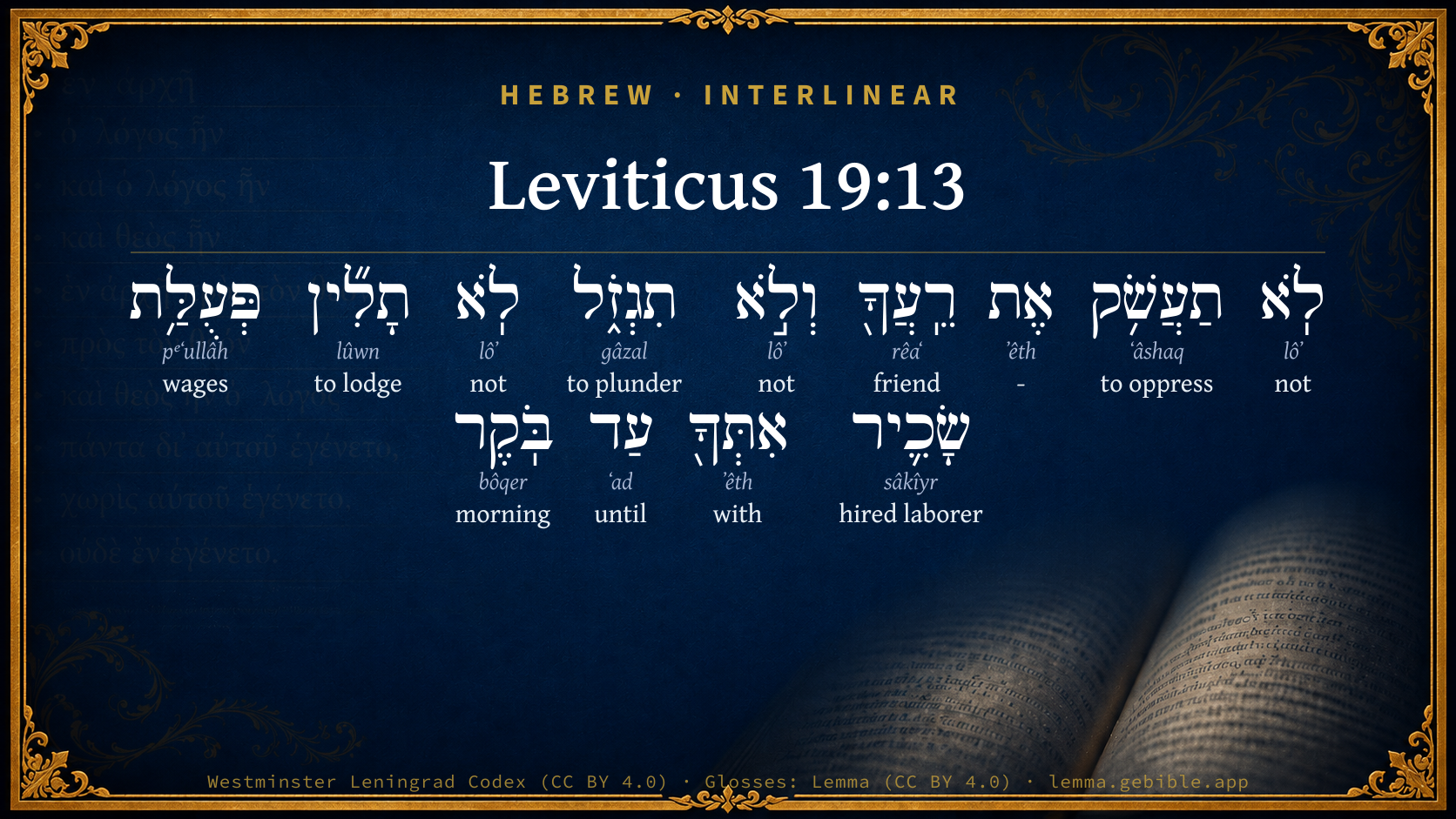
Hebrew (Westminster Leningrad Codex) Leviticus 19:13 appears in the Hebrew Old Testament. The text above is from the Westminster Leningrad Codex. Each word links to its Strong’s number, a concise gloss, and parsing drawn from the Open Scriptures Hebrew Bible morphology. Click any word for its full Brown-Driver-Briggs (BDB) entry.
Download image
Cite this verse

Leviticus 19:13 (World English Bible). Public Domain. Lemma interlinear Bible study tool, https://lemma.gebible.app/v/leviticus/19/13.

Show BibTeX & RIS
BibTeX
RIS
English Translation
"'You shall not oppress your neighbor, nor rob him. The wages of a hired servant shall not remain with you all night until the morning.
World English Bible · Public Domain
Highlights
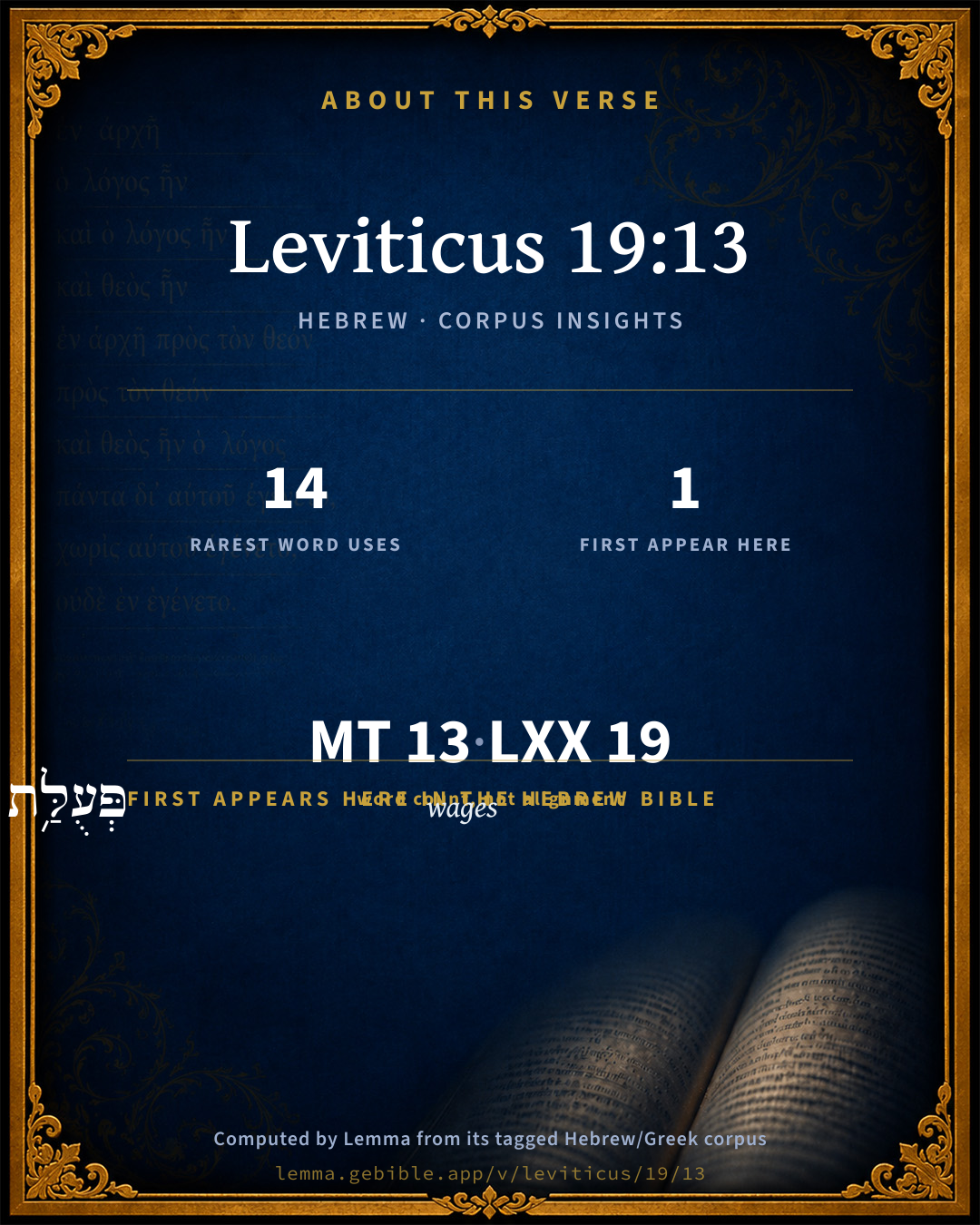
  • 1 first appearance in the Hebrew Bible
Full analysis ↓
Download a study sheet

One document with this verse’s original text, its word-by-word gloss line, the meaning frame, cross-references with their text, attributed commentary, and full source and license credits — printable, and it pastes into notes with its structure intact.

This verse Autodidact and up

Study sheet (.html) Plain text (.txt)

A passage Seminary Student

Up to 50 verses in one chapter. A passage sheet keeps up to 6 commentary sources and 12 cross-references per verse, in the order this page ranks them, and says so on the sheet whenever that leaves anything out. Ask for a single verse and you get the Autodidact verse sheet above.

Everything on this page stays free to read, with no account — the sheet is a download of what is already on screen, not access to it.

Want to remove ads? Support Godless Engineer
Compare translations 3

The same verse in 3 English versions, stacked beneath the original-language interlinear above. Click any original word for its lexicon entry.

Each is an independent rendering of the whole verse — the interlinear is not word-aligned to these translations.

Highlighted words mark where these versions differ — a whole-verse word diff, not a word-by-word alignment.

  • World English Bible Public Domain
    "'You shall not oppress your neighbor, nor rob him. The wages of a hired servant shall not remain with you all night until the morning.
  • King James Version Public Domain
    Thou shalt not defraud thy neighbor, neither rob him: the wages of him that is hired shall not abide with thee all night until the morning.
  • unfoldingWord Literal Text CC BY-SA 4.0
    You shall not extort your neighbor, and you shall not rob. You shall not retain the wages of a hired with you until morning.

unfoldingWord Literal Text — © unfoldingWord, licensed CC BY-SA 4.0. Word-aligned USFM3 via Door43 (git.door43.org/unfoldingWord/en_ult).

Versions to compare (up to 4)

3 of 4 selected

Show all 18 translations

Every available English version of this verse, each an independent rendering of the whole verse.

  • World English Bible Public Domain
    "'You shall not oppress your neighbor, nor rob him. The wages of a hired servant shall not remain with you all night until the morning.
  • Berean Standard Bible Public Domain
    You must not defraud your neighbor or rob him. You must not withhold until morning the wages due a hired hand.
  • Majority Standard Bible Public Domain
    You must not defraud your neighbor or rob him. You must not withhold until morning the wages due a hired hand.
  • King James Version Public Domain
    Thou shalt not defraud thy neighbor, neither rob him: the wages of him that is hired shall not abide with thee all night until the morning.
  • American Standard Version (1901) Public Domain
    Thou shalt not oppress thy neighbor, nor rob him: the wages of a hired servant shall not abide with thee all night until the morning.
  • Revised Version (1885) Public Domain
    Thou shalt not oppress thy neighbour, nor rob him: the wages of a hired servant shall not abide with thee all night until the morning.
  • Geneva Bible (1599) Public Domain
    Thou shalt not do thy neighbour wrong, neither rob him. The workemans hire shall not abide with thee vntil the morning.
  • Douay-Rheims (1899) Public Domain
    Thou shalt not calumniate thy neighbour, nor oppress him by violence. The wages of him that hath been hired by thee shall not abide with thee until the morning.
  • Young's Literal Translation Public Domain
    `Thou dost not oppress thy neighbour, nor take plunder; the wages of the hireling doth not remain with thee till morning.
  • Literal Standard Version CC BY-SA 4.0
    You do not oppress your neighbor, nor take plunder; the wages of the hired worker do not remain with you until morning.
  • Unlocked Literal Bible CC BY-SA 4.0
    Do not oppress your neighbor or rob him. The wages of a hired servant must not stay with you all night until the morning.
  • unfoldingWord Literal Text CC BY-SA 4.0
    You shall not extort your neighbor, and you shall not rob. You shall not retain the wages of a hired with you until morning.
  • Darby Bible Public Domain
    Thou shalt not oppress thy neighbour, neither rob him. The wages of the hired servant shall not abide with thee all night until the morning.
  • World Messianic Bible Public Domain
    “‘You shall not oppress your neighbor, nor rob him. “‘The wages of a hired servant shall not remain with you all night until the morning.
  • Webster's Bible Public Domain
    Thou shalt not defraud thy neighbor, neither rob him: the wages of him that is hired shall not abide with thee all night until the morning.
  • Free Bible Version CC BY-SA 4.0
    Don't cheat others or rob them. Don't refuse to pay wages due to workers until the morning.
  • Bible in Basic English Public Domain
    Do not be cruel to your neighbour or take what is his; do not keep back a servant's payment from him all night till the morning.
  • JPS Tanakh (1917) Public Domain
    Thou shalt not oppress thy neighbour, nor rob him; the wages of a hired servant shall not abide with thee all night until the morning.

Literal Standard Version (2020), Covenant Press — licensed CC BY-SA 4.0. Text via the HelloAO Bible API (eBible.org). Unlocked Literal Bible (unfoldingWord) — licensed CC BY-SA 4.0. Text via the HelloAO Bible API (eBible.org). unfoldingWord Literal Text — © unfoldingWord, licensed CC BY-SA 4.0. Word-aligned USFM3 via Door43 (git.door43.org/unfoldingWord/en_ult). Free Bible Version, Dr. Jonathan Gallagher — licensed CC BY-SA 4.0. Text via the HelloAO Bible API (eBible.org).

Word by word

More ways to search: Search by grammar → Find every occurrence → Compare this word →

Practice this passage: Drill this verse → Learn its vocabulary →

פְּעֻלַּ֥ת
pᵉʻullâh
H6468
“wages of”
Noun, Common, Feminine, Singular, Construct
Part of Speech
Noun
Type
Common
Gender
Feminine
Number
Singular
State
Construct
Full BDB Definition

Origin: pass part of H6466

TWOT: 1792b

work, recompense, reward - work - wages
  1. לֹֽא lôʼ H3808 “not” Particle, Negative
  2. תַעֲשֹׁ֥ק ʻâshaq H6231 “to oppress” Verb, Qal, Imperfect, 2nd Person, Masculine, Singular
  3. אֶת ʼêth H853 “-” Particle, Direct Object
  4. רֵֽעֲךָ֖ rêaʻ H7453 “friend · your” Noun, Common, Masculine, Singular, Construct + Suffix, Personal, 2nd Person, Masculine, Singular
  5. וְלֹ֣א lôʼ H3808 “and · not” Conjunction + Particle, Negative
  6. תִגְזֹ֑ל gâzal H1497 “to plunder” Verb, Qal, Imperfect, 2nd Person, Masculine, Singular
  7. לֹֽא lôʼ H3808 “not” Particle, Negative
  8. תָלִ֞ין lûwn H3885 “to lodge” Verb, Qal, Imperfect, 3rd Person, Feminine, Singular
  9. שָׂכִ֛יר sâkîyr H7916 “hired laborer” Adjective, Adjective, Masculine, Singular, Absolute
  10. אִתְּךָ֖ ʼêth H854 “with · you” Preposition + Suffix, Personal, 2nd Person, Masculine, Singular
  11. עַד ʻad H5704 “until” Preposition
  12. בֹּֽקֶר bôqer H1242 “morning” Noun, Common, Masculine, Singular, Absolute

About this verse

These counts appear in no published source. They are computed here, from the morphology-tagged text and Lemma’s own curated glosses. What Lemma adds →

13
words
11
distinct lemmas
Pentateuch
section

Notable vocabulary

The rarest word here is פְּעֻלַּ֥ת wages H6468 — appearing just 14 times in the whole Hebrew Bible.

First appearance in Scripture

This word makes its first canonical appearance in the Hebrew Bible here:

  • פְּעֻלַּ֥ת wages H6468

Shared distinctive vocabulary

פְּעֻלַּ֥ת wages H6468 occurs in 14 verses of the Hebrew Bible. Also found in:

Grammatical profile

  • 3 verbs
  • 3 nouns
  • 1 adjective
  • 2 prepositions
  • 4 particles

Verb forms

  • תַעֲשֹׁ֥ק Qal · Imperfect
  • תִגְזֹ֑ל Qal · Imperfect
  • תָלִ֞ין Qal · Imperfect

Repetition

A word recurs within this verse — often emphatic in Hebrew:

Hebrew & Septuagint length

In English translation the verse runs 25 words from the Hebrew and 24 from the Septuagint (LXX English) — closely comparable.

A rough comparison of the two English renderings, which tokenize alike — not a word-level alignment.

Word counts can differ between the Hebrew and the Greek without any difference in meaning — e.g. the Hebrew direct-object marker אֵת has no separate Greek word, and Greek often adds the article ὁ.

In the original languages it is 13 Hebrew tokens and 19 Greek tokens — but the two are counted differently (Hebrew bundles its prefixes and suffixes into one token; the Greek is in lemma form), so that isn’t a like-for-like length.

Cross-references

17

Topical passages linked to Leviticus 19:13 in the Treasury of Scripture Knowledge — connected by theme and wording, ordered by reader-vote popularity; previews shown in the World English Bible.

  • James 5:4 Behold, the wages of the laborers who mowed your fields, which you have kept back by fraud, cry out, and the cries of those who reaped have entered into the ears of the Lord of Hosts.
  • Malachi 3:5 I will come near to you to judgment; and I will be a swift witness against the sorcerers, and against the adulterers, and against the perjurers, and against those who oppress the hireling in his wages, the widow, and the fatherless, and who deprive the foreigner of justice, and don't fear me," says Yahweh of Hosts.
  • Deuteronomy 24:14–15 You shall not oppress a hired servant who is poor and needy, whether he be of your brothers, or of your foreigners who are in your land within your gates:
  • Proverbs 20:10 Differing weights and differing measures, Both of them alike are an abomination to Yahweh.
  • Jeremiah 22:13 Woe to him who builds his house by unrighteousness, and his chambers by injustice; who uses his neighbor's service without wages, and doesn't give him his hire;
  • Exodus 22:15 If the owner of it is with it, he shall not make it good. If it is a leased thing, it came for its lease.
  • Exodus 22:21 "You shall not wrong an alien, neither shall you oppress him, for you were aliens in the land of Egypt.
  • Jeremiah 22:3 Thus says Yahweh: Execute you justice and righteousness, and deliver him who is robbed out of the hand of the oppressor: and do no wrong, do no violence, to the foreigner, the fatherless, nor the widow; neither shed innocent blood in this place.
  • Ezekiel 22:29 The people of the land have used oppression, and exercised robbery; yes, they have vexed the poor and needy, and have oppressed the foreigner wrongfully.
  • Mark 10:19 You know the commandments: 'Do not murder,' 'Do not commit adultery,' 'Do not steal,' 'Do not give false testimony,' 'Do not defraud,' 'Honor your father and mother.'"
  • Exodus 22:24–27 and my wrath will grow hot, and I will kill you with the sword; and your wives shall be widows, and your children fatherless.
  • Job 31:39 If I have eaten the fruits of it without money, Or have caused the owners of it to lose their life:
  • Proverbs 22:22 Don't exploit the poor, because he is poor; And don't crush the needy in court;
  • Luke 3:13 He said to them, "Collect no more than that which is appointed to you."
  • 1 Thessalonians 4:6 that no one should take advantage of and wrong a brother or sister in this matter; because the Lord is an avenger in all these things, as also we forewarned you and testified.
  • Exodus 22:8–9 If the thief isn't found, then the master of the house shall come near to God, to find out if he hasn't put his hand to his neighbor's goods.
  • Leviticus 6:3 or has found that which was lost, and dealt falsely therein, and swearing to a lie; in any of all these things that a man does, sinning therein;

Cross-references courtesy of OpenBible.info (CC BY 4.0).

Hebrew and Greek witnesses Masoretic Hebrew ↔ Greek Septuagint

The same verse in the two great witnesses to the Old Testament, shown verse-for-verse.

These are two independent witnesses, not word-aligned to each other, and the Septuagint is shown in lemma (dictionary) form.

Hebrew Leviticus 19:13 Masoretic · Westminster Leningrad Codex

לֹֽא תַעֲשֹׁ֥ק אֶת רֵֽעֲךָ֖ וְלֹ֣א תִגְזֹ֑ל לֹֽא תָלִ֞ין פְּעֻלַּ֥ת שָׂכִ֛יר אִתְּךָ֖ עַד בֹּֽקֶר

"'You shall not oppress your neighbor, nor rob him. The wages of a hired servant shall not remain with you all night until the morning.

World English Bible · Public Domain

Greek LXX Leviticus 19:13 Septuagint · lemma form

οὐ ἀδικέω ὁ πλησίον καί οὐ ἁρπάζω καί οὐ μή κοιμάω ὁ μισθός ὁ μισθωτός παρά σύ ἕως πρωΐ

You shall not injure your neighbor, neither do you rob him, neither shall the wages of your hireling remain with you until the morning.

LXX2012 (modern English Septuagint) · Public Domain

Hebrew: Westminster Leningrad Codex (CC BY 4.0). Greek: Septuagint (public domain); English from LXX2012 (modern English Septuagint) (Public Domain). How the Septuagint differs from the Hebrew →

Targum (Aramaic paraphrase)

2

The Targum is the ancient Jewish Aramaic paraphrase of the Hebrew Scriptures — an interpretive translation, not the Hebrew text itself. Onkelos (literal) and Pseudo-Jonathan (expansive) render the Torah, and Jonathan the Prophets. Coverage is partial: where no permissively-licensed English translation exists for a verse, only the Aramaic is shown. This is verse-level text, not a word-by-word alignment to the Hebrew.

  1. Targum Onkelos Torah (Genesis–Deuteronomy)
    לָא תַעֲשׁוֹק יָת חַבְרָךְ וְלָא תְאַנֵס לָא תְבִית אַגְרָא דַאֲגִירָא לְוָתָךְ עַד צַפְרָא

    (no public-domain English translation for this verse)

    Targum Onkelos — Aramaic: “Onkelos Genesis” (public domain); “Onkelos Exodus” (public domain); “Onkelos Leviticus” (public domain); “Onkelos Numbers” (public domain); “Onkelos Deuteronomy” (public domain). English: “Sefaria Community Translation” (CC0 1.0 (public-domain dedication)); “J.W. Etheridge. The Targums of Onkelos and Jonathan Ben Uzziel on the Pentateuch. London: Longmans, Green, 1862” (public domain). Text via Sefaria.

  2. Targum Pseudo-Jonathan Torah (Genesis–Deuteronomy)
    לָא תִטְלוּם יַת חַבְרָךְ וְלָא תָנִיס וְלָא תְבִית סוּטְרָא דְאַגִירָא לִמְעַכְּבָא גַבָּךְ עַד צַפְרָא

    Thou shalt not be oppressive (hard) upon thy neighbour, nor take away by force, nor let the hire of the hireling be remaining all night at thy side until the morning.

    Targum Pseudo-Jonathan — Aramaic: “Targum Jonathan on Genesis” (public domain); “Targum Jonathan on Exodus” (public domain); “Targum Jonathan on Leviticus” (public domain); “Targum Jonathan on Numbers” (public domain); “Targum Jonathan on Deuteronomy” (public domain). English: “The Targum of Jonathan ben Uzziel, trans. J. W. Etheridge, London, 1862” (public domain). Text via Sefaria.

Commentary

Notes on Leviticus 19:13 from classic Christian and Jewish commentators (each source and its license shown beneath its notes). The classic Christian expositions comment on the surrounding passage and are grouped to its opening verse, so a note may address several verses; the Jewish commentaries on the Tanakh (Rashi and others) are per-verse, so they appear only where the commentator wrote on this verse.

Lemma curates 59 commentaries, every one of them public domain or Creative Commons licensed, each selected and text-cleaned for this edition rather than reprinted as found. About our sources →

Trapp's Complete Commentary

John Trapp

Lev 19:13 Thou shalt not defraud thy neighbour, neither rob [him]: the wages of him that is hired shall not abide with thee all night until the morning.

Ver. 13. The wages of him that is hired.] This is a crying sin, {Jas 5:3} condemned by the very light of nature. Plato {a} would have him double paid that is not paid in due time.

{a} De Legibus, lib. x.

John Trapp, A Commentary or Exposition upon All the Books of the Old and New Testament (1647–1656) — public domain. Text from a community e-Sword module.

The Biblical Illustrator

Joseph S. Exell

Lev_19:13

Thou shalt not defraud thy neighbour.

Against fraud

I. The purchaser is guilty of fraud when he makes use of falsehood or low cunning to diminish the value of any commodity in the estimation of its proprietor. He likewise defrauds his neighbour when he takes advantage of his ignorance to obtain anything for less than its real value; when he receives any part of his property and applies it to his own use, without being careful to make him the equitable return, at the time when he may reasonably expect it; and lastly, when he makes that wise and merciful institution of the legislature, which was only intended for the security of those whom misfortune hath rendered incapable of answering the demands of equity, a protection for extravagance and knavery.

2. The seller defrauds his neighbour when he takes advantage of the ignorance or mistakes of the purchaser, or makes use of arts to impose upon his judgment.

3. The master, or he who employs labourers under him for hire, acts a dishonest part when he lays upon them burdens too heavy to be borne; when he requires harder or longer labour from them than was at first agreed upon, without making them a proportionable acknowledgment; or when he deprives them of their wages, or withholds them beyond a reasonable time.

4. The labourer, or servant, acts contrary to the rules of equity, and defrauds his neighbour when, without good reason, he quits the business he hath undertaken and leaves his master in difficulty; when he performs his engagements in a negligent and defective manner; or when he takes advantage of the confidence which his master hath placed in him, to embezzle or injure his property. I proceed to lay before you the principal argument, to guard you against all the low arts of fraud and deceit, and to enforce the observance of the strictest honour and most perfect equity in your dealings.

I. And, in the first place, let it be considered that the observance of the injunction of the text is of the highest importance to the welfare of society. What would be the consequence if injustice and knavery were daily to gain ground in the world, and at last to become universally prevalent? surely nothing less than universal confusion and wretchedness. On the contrary, were all unrighteousness and deceit banished from the earth, what a long train of evils would take their flight with them I what uninterrupted peace and harmony, what perfect satisfaction and happiness would ensue!

II. But it may be observed, farther, that the virtue of honesty is of essential importance to the happiness of individuals. The honest man is most secure from disappointment in business, and has the fairest prospect of success in his undertakings. It often happens that the artful and designing knave is discovered, and his schemes of iniquity are blasted, before he hath accomplished his purpose. After much care and labour, and many fears and anxieties, he may very possibly betray himself and frustrate his own designs. But the honest man pursues the plain and beaten path of diligence, prudence and integrity, till he gradually obtains a competence which he can behold with satisfaction and enjoy with pleasure. Honesty is likewise the best guard of our reputation. Let two men be in every other respect equal; if the one have the character of an upright and good man, and the other be deemed treacherous and fraudulent, it will be no difficult thing to determine which will be generally espoused, employed and assisted, and which will be treated with neglect and contempt. The honest man likewise enjoys the continual happiness of being satisfied from himself. If he enjoys an abundance of the good things of life, he hath the happiness to reflect that it is the fruit of his honest industry and the blessing of heaven. Or if he meets with disappointment and trouble, he hath this for his consolation, that they have not befallen him for any iniquity in his hands; and can triumph, if not in the success of his undertakings, in the innocence of his life. Let it be remembered, in the last place, that all injustice and fraud are highly displeasing to the Almighty, and that uprightness and honour will always be acceptable in His sight. (W. Enfield.)

Unjust dealing repudiated

A customer of Messrs. Thomas Adams and Co., of Nottingham, from whom they were in the habit of receiving considerable orders, requested that besides Thomas Adams and Cos ticket, the firm would affix the ticket of this customer, marked with a larger number of yards than was really in the piece. Pressure having been put on some of the salesmen, the thing had actually been done a few times, when it was brought under the notice of Mr. Adams. At that period trade was exceedingly bad, and orders scarce, yet, as soon as he was apprised of the facts, he holdly declared to his customer that he could be no party to a transaction so unjust, and that such misleading tickets could not again be affixed to goods going forth from his warehouse. The customer was exceedingly angry at this practical rebuke of his injustice, and withdrew all his orders immediately. After a time, however, he reopened the account on a scale as large as ever, and was content to deal with Mr. Adams on his own terms. (H. A. Page.)

Sad result of an unpaid bill

A wealthy banker, who is noted for his large subscriptions to charities, and for his kindly habits of private benevolence, was called on by his pastor, one evening, and asked to go with him to the help of a man who had attempted suicide. They found the man in a wretched house, in an alley not far from the bankers dwelling. The front room was a cobblers shop; behind it, on a miserable bed, in the kitchen, lay the poor shoemaker, with a gaping gash in his throat, while his wife and children were gathered about him. We have been without food for days, said the woman, when he returned. It is not my husbands fault. He is a hard-working, sober man. But he could neither get work, nor pay for that which he had done. To-day he went for the last time to collect a debt due to him by a rich family, but the gentleman was not at home. My husband was weak from fasting, and seeing us starving drove him mad. So it ended that way, turning to the fainting, motionless figure on the bed. The banker, having fed and warmed the family, hurried home, opened his desk and took out a file of little bills. All his large debts were promptly met, but he was apt to be careless about the accounts of milk, bread, &c., because they were so petty. He found there a bill of Michael Goodlows for repairing childrens shoes, £2. Michael Goodlow was the suicide. It was the bankers unpaid debt which had brought these people to the verge of the grave, and driven this man to desperation, while, at the very time, the banker had given away hundreds in charity. The cobbler recovered, and will never want a friend while the banker lives, nor will a small unpaid bill ever again be found on the bankers table. No man has a right to be generous until his debts are paid; and the most efficient use of money is not alone in almsgiving, but to pay liberally and promptly the people whom we employ.

The wages of him that is hired.

Fairness to hired labourers

I. Work is a just basis for an equitable claim. Therefore it should be paid for, not patronisingly, nor grudgingly, but as a due. The labourer has given you his time, strength, ability, and ingenuity; he has a right to an equivalent from you, and should not be treated ignominiously, but respectfully, in asking a just return.

II. Wages cannot righteously re deferred after work is done. During a day of toil the labourer has put his capital into your service, spent his life for that period for your advantage and gain. You are to that extent his debtor; to detain his wages is to make yourself more his debtor, and delay in payment should be compensated with increment. Short reckonings make long friends.

III. Masters should study the position and comfort of those they employ. A poor man has no capital, wants prompt settlement; he lives day by day upon his hard earnings. His strength--expended by the days toil--must be replenished for the morrows work. To hold back the means for his nourishment is to rob him of the morrows capital, his replenished energy. And he may have dependants in his lowly home waiting to share in the earnings of the day. Hold not back his dues all night until the morning, lest your inconsiderateness inflict privation and embitter poverty (Deu_24:14-15; Jer_32:13; Mal_3:5; Jam_5:4). (W. H. Jellie.)

Gods consideration for hired labourers

What tender care is here! The High and Mighty One that inhabiteth eternity can take knowledge of the thoughts and feelings that spring up in the heart of a poor labourer. He knows and takes into account the expectations of such an one in reference to the fruit of his days toil. The wages will, naturally, be looked for. The labourers heart counts upon them; the family meal depends upon them. Oh I let them not be held back. Send not the labourer home with a heavy heart, to make the heart of his wife and family heavy likewise. By all means give him that for which he has wrought, to which he has a right, and on which his heart is set. Thus does our God take notice of the very throbbings of the labourers heart, and make provision for his rising expectations. Precious grace! Most tender, thoughtful, touching, condescending love! The bare contemplation of such statutes is sufficient to throw one into a flood of tenderness. Could any one read them and thoughtlessly dismiss a poor labourer, not knowing whether he and his family have wherewithal to meet the cravings of hunger? (C. H. Mackintosh.)

Debt forbidden

Far from defrauding, or withholding what is due to thy neighbour, thou shalt not even delay giving him what he is entitled to. This precept is directly pointed against incurring debt. Fraudulent bankruptcies, and pretexts for withholding payments, are condemned by it; but remaining in debt to any one is also pointedly condemned. Owe no man anything, but to love one another. In Jam_5:4, this is spoken of as a sin of the last days. (A. A. Bonar)

.

The Biblical Illustrator, edited by Joseph S. Exell (c. 1880s–1900s) — public domain. Text from a community e-Sword module.

Tyndale Open Study Notes

Tyndale Open Resources

19:13 Day laborers had no land and were a part of Israel’s lowest economic ranks. These hired workers depended on landowners for their livelihood. A hired man needed to receive his wages promptly so that he could feed his family (Deut 24:15); to withhold the wages of such a worker was to cheat him.

Tyndale Open Study Notes — © Tyndale Open Resources, licensed CC BY-SA 4.0. Text via the HelloAO Bible API.

Geneva Bible (1599)

Geneva Bible translators

Or, oppress him by violence.

Geneva Bible (1599) marginal notes — public domain. Text via Bolls.life.

Adam Clarke's Commentary

Verse 13. The wages - shall not abide with thee all night] For this plain reason, it is the support of the man's life and family, and they need to expend it as fast as it is earned.

Adam Clarke's Commentary on the Bible (1810–1826) — public domain. Text from a community e-Sword/MySword module.

Ellicott's Commentary for English Readers

(13) Thou shalt not defraud.—Here oppression by fraud and oppression by violence are forbidden. It is probably in allusion to this passage that John the Baptist warned the soldiers who came to him: “And he said to them, Do violence to no man, neither accuse any falsely; and be content with your wages” (Luk_3:14).

The wages of him that is hired.—From the declaration in the next clause, which forbids the retention of the wages over night, it is evident that the day labourer is here spoken of. As he is dependent upon his wages for the support of himself and his family, the Law protects him by enjoining that the earnings of the hireling should be promptly paid. This benign care for the labourer, and the denunciation against any attempt to defraud him, are again and again repeated in the Scriptures (Deu_24:14-15; Jer_32:13; Mal_3:5; Jas_5:4). Hence the humane interpretation which obtained of this law during the second Temple: “He who treats a hireling with harshness sins as grievously as if he hath taken away life, and transgresses five precepts.”

A Bible Commentary for English Readers, edited by Charles John Ellicott (1878–1897) — public domain. Text from a community e-Sword module.

The Cambridge Bible for Schools and Colleges

gen. ed. J. J. S. Perowne

13, 14. Cp. Deu_24:14-15; Mal_3:5; Jas_5:4. Precepts expressed in 2nd pers. sing. against unjust dealing, and taking advantage of a neighbour’s infirmities. Though the deaf cannot hear, the curse must not be uttered, and the helpless condition of the blind calls for protection and the removal of stumblingblocks (cp. Deu_27:18). Cp. Job’s description of his conduct, ‘I was eyes to the blind’ (Job_29:15).

The Cambridge Bible for Schools and Colleges (gen. ed. J. J. S. Perowne; Cambridge University Press, 1878–1918) — public domain. Text from a community e-Sword module.

John Gill's Exposition

Thou shalt not defraud thy neighbour, neither rob him,.... Not defraud him secretly, nor rob him openly and by force, as Aben Ezra; not defraud him in buying and selling, in retaining wages due to him, and refusing to return to him what has been committed to trust, or to repay him what has been borrowed of him: the Vulgate Latin is, "thou shall not calumniate him", or get anything from him, by raising a calumny upon him; nor rob him by coming into his house, or entering into his fields, and taking away his goods, or his cattle without his will, and in a forcible manner; or by meeting him on the highway and demanding his money, and taking it from him:

the wages of him that is hired shall not abide with thee all night until the morning; unless he that is hired agrees to it; for then it may be kept two or three days, or a week, or for whatsoever time may be agreed upon between them: this must be understood of one that is hired by the day, whose wages are due at night, and who may want his money to buy food for his family, and therefore should not without his consent be detained from him; and not of one that is hired by the week, or by the year, whose wages are not due until the end of the week or year for which he is hired; and the Jewish writers (y) observe, that this Scripture speaks of a day hireling, or a day labourer, whose wages became due at night; as another Scripture, Deu 24:15; speaks of a night hireling, or a night labourer, whose hire is not due until the pillar of the morning arises, or the sun is up, and therefore it must be paid him before it goes down; to detain the wages of such, or defraud them of it, is a very crying sin; see Jer 22:13.

(y) Vid. Misn. Bava Metzia, c. 9. sect. 11. & Maimon. & Bartenora in ib. Jarchi & Ben Gersom in loc.

John Gill's Exposition of the Whole Bible (1746–1763) — public domain (CC PDM 1.0). Text via the HelloAO Bible API.

Haydock's Catholic Bible Commentary

Morning. Pay what is due to the labourer, immediately, if he desire it. (Haydock) --- It was customary among the Jews to pay their workmen in the evening, Matthew xx. 8.

George Leo Haydock (1774–1849), Haydock's Catholic Family Bible and Commentary, 1859 edition — public domain. Excludes Psalms (Douay-Rheims chapter numbering differs from Protestant) and Deuterocanonical books (Catholic canon only).

Matthew Poole's English Annotations

The wages, Heb. the work, put for the wages, as Deu 24:15; Job 7:2; Jer 22:13. Shall not abide with thee all night, because his urgent necessities require it for present subsistence.

Matthew Poole's English Annotations on the Holy Bible (1683–1685) — public domain. Text from a community e-Sword/MySword module.

Whedon's Commentary on the Bible

Daniel D. Whedon

13. Not defraud thy neighbour — This prohibition of fraud is not practically neutralized, as some assent, by the spoiling of the Egyptians by borrowing their jewels, since the borrowing was simply asking for a parting gift. See Exo_3:22, note.

The wages… all night — This is a merciful protection of the labouring class, many of whom had so narrow a margin between themselves and starvation, that the detention of their wages for even a few hours might produce great suffering. According to the Mishna, the proper time for demanding wages is, for the day labourer, the whole of the night, for the night labourer, the whole of the following day. In a suit for wages the plaintiff must prove that his demand was made at the right time. There was in Mosaism no servant without wages, either paid beforehand, for a term of years, or paid daily, if hired by the day, or annually, as the case might be. Exo_21:2; Lev_25:53; Mal_3:5; Jas_5:4. It is evident that God is not favourably disposed toward the modern credit system, with its periodical earthquakes engulfing labour in ruin.

Daniel D. Whedon (gen. ed.), Commentary on the Old and New Testaments (1874–1909) — public domain. Text from a community e-Sword module.

The Pulpit Commentary

Cheating and stealing are again forbidden, and, together with these, other forms of oppression although legal. The command to pay labourers their hire promptly which covers also the case of paying tradesmen promptly is repeated in Deu_24:14. (cf. Jam_5:4)

The Pulpit Commentary (1880–1919), ed. H.D.M. Spence-Jones & Joseph S. Exell — public domain. Text from a community e-Sword module.

unfoldingWord translationNotes

Door43 World Missions Community

Do not oppress your neighbor or rob him

Here "neighbor" means "anyone." The meaning of this can be made explicit. AT: "Do not hurt or rob anyone" (See: Assumed Knowledge and Implicit Information)

The wages of a hired servant must not stay with you all night until the morning

Yahweh commands the employer to pay his servant promptly when his work is done that day. The full meaning of this statement can be made clear. (See: Assumed Knowledge and Implicit Information)

translationWords

oppress

neighbor

servant

curse

stumbling block

fear

unfoldingWord translationNotes — © Distant Shores Media and the Door43 World Missions Community, licensed CC BY-SA 4.0. Source: git.door43.org/Door43/en_tn.

Rashi

Rabbi Shlomo Yitzchaki (Rashi)

לא תעשק THOU SHALT NOT WRONG [THY FELLOW-MAN] — This refers to one who withholds the wages of a hired servant (Sifra, Kedoshim, Section 2 9; Bava Metzia 61a).

לא תלין The word תלין is feminine gender and refers to the wages.

עד בקר UNTIL THE MORNING — Scripture speaks here of a person hired for day-work (שכיר יום) whose departure from work is at sunset. The time for drawing his wages is therefore the whole night (and the law is not infringed provided he pays it before the moment of day break). In another passage (Deuteronomy 24:14) it states, "the sun shall not go down upon it (the man's wages)”. There, however, it is speaking of one hired for night-work (שכיר לילה) the end of whose period of work is at day break, therefore the time for drawing his wages is the whole day (but it must be done before sunset). The reason why he has the whole night or whole day to pay the wages is because the Torah gives the employer the time of one "Ona" (one half of the astronomical day; cf. for the meaning of the word Niddah 65b) to endeavour to obtain the money he requires for paying the wages (Bava Metzia 110b).

Rashi on the Tanakh — English translations: “The Judaica Press complete Tanach with Rashi, translated by A. J. Rosenberg” (CC BY 4.0); “Pentateuch with Rashi's commentary by M. Rosenbaum and A.M. Silbermann, 1929-1934” (public domain); “The Metsudah Tanach series, Lakewood, N.J” (CC BY 4.0); and “The Book of Joshua, Metsudah Publications, 1997” (CC BY 4.0). Text via Sefaria.

Lesson kit

Teaching starters — assembled from the data on this page, not authored interpretation. Every prompt links to the verse data it draws on. Edit before teaching.

Leviticus, in the Pentateuch, opens this verse with 13 words (11 distinct Hebrew lemmas). Its most distinctive word is pᵉʻullâh (“wages”). A historical commentator’s framing appears above. Read the whole chapter for the surrounding context.

Discussion questions

  1. The word pᵉʻullâh carries the sense “wages.” How does it shape the verse?
  2. The word “wages” first appears here in Scripture. What is being introduced at this debut?
  3. 2 Chronicles 15:7 shares the word «wages» with this verse. How do the two illuminate each other?
  4. “not” occurs 3× in this one verse. What is the effect of the repetition?
  5. These translations render this verse differently. What is at stake in choosing one wording over another?
  6. The verb «תַעֲשֹׁ֥ק» is Qal Imperfect. How does its form color the action?
  7. Reading how Trapp's Complete Commentary and The Biblical Illustrator read this verse, where do the two commentators agree and where do they part?

Things to notice

Reading settings

Reading text

Shown beneath each verse's original-language words.

Old Testament
Old Testament edition

Read the OT as the Masoretic Hebrew (MT) or the Greek Septuagint (LXX).

English shown for the Greek Septuagint (in the Hebrew ↔ Greek comparison).

Comparing translations? Open the Compare panel on any verse page to stack up to four side by side.