Isaiah 17:11

Hebrew (Westminster Leningrad Codex) Isaiah 17:11 appears in the Hebrew Old Testament. The text above is from the Westminster Leningrad Codex. Each word links to its Strong’s number, a concise gloss, and parsing drawn from the Open Scriptures Hebrew Bible morphology. Click any word for its full Brown-Driver-Briggs (BDB) entry.
Download image
Cite this verse

Isaiah 17:11 (World English Bible). Public Domain. Lemma interlinear Bible study tool, https://lemma.gebible.app/v/isaiah/17/11.

Show BibTeX & RIS
BibTeX
RIS
English Translation
In the day of your planting you hedge it in, and in the morning you make your seed to blossom; but the harvest flees away in the day of grief and of desperate sorrow.
World English Bible · Public Domain
Highlights Full analysis ↓
Download a study sheet

One document with this verse’s original text, its word-by-word gloss line, the meaning frame, cross-references with their text, attributed commentary, and full source and license credits — printable, and it pastes into notes with its structure intact.

This verse Autodidact and up

Study sheet (.html) Plain text (.txt)

A passage Seminary Student

Up to 50 verses in one chapter. A passage sheet keeps up to 6 commentary sources and 12 cross-references per verse, in the order this page ranks them, and says so on the sheet whenever that leaves anything out. Ask for a single verse and you get the Autodidact verse sheet above.

Everything on this page stays free to read, with no account — the sheet is a download of what is already on screen, not access to it.

Want to remove ads? Support Godless Engineer
Compare translations 3

The same verse in 3 English versions, stacked beneath the original-language interlinear above. Click any original word for its lexicon entry.

Each is an independent rendering of the whole verse — the interlinear is not word-aligned to these translations.

Highlighted words mark where these versions differ — a whole-verse word diff, not a word-by-word alignment.

  • World English Bible Public Domain
    In the day of your planting you hedge it in, and in the morning you make your seed to blossom; but the harvest flees away in the day of grief and of desperate sorrow.
  • King James Version Public Domain
    In the day shalt thou make thy plant to grow, and in the morning shalt thou make thy seed to flourish: but the harvest shall be a heap in the day of grief and of desperate sorrow.
  • unfoldingWord Literal Text CC BY-SA 4.0
    in the day of your planting, you may make grow, and in the morning, you may make your seed blossom, the harvest a heap in the day of being afflicted and incurable pain.

unfoldingWord Literal Text — © unfoldingWord, licensed CC BY-SA 4.0. Word-aligned USFM3 via Door43 (git.door43.org/unfoldingWord/en_ult).

Versions to compare (up to 4)

3 of 4 selected

Show all 18 translations

Every available English version of this verse, each an independent rendering of the whole verse.

  • World English Bible Public Domain
    In the day of your planting you hedge it in, and in the morning you make your seed to blossom; but the harvest flees away in the day of grief and of desperate sorrow.
  • Berean Standard Bible Public Domain
    though on the day you plant you make them grow, and on that morning you help your seed sprout—yet the harvest will vanish on the day of disease and incurable pain.
  • Majority Standard Bible Public Domain
    though on the day you plant you make them grow, and on that morning you help your seed sprout—yet the harvest will vanish on the day of disease and incurable pain.
  • King James Version Public Domain
    In the day shalt thou make thy plant to grow, and in the morning shalt thou make thy seed to flourish: but the harvest shall be a heap in the day of grief and of desperate sorrow.
  • American Standard Version (1901) Public Domain
    In the day of thy planting thou hedgest it in, and in the morning thou makest thy seed to blossom; but the harvest fleeth away in the day of grief and of desperate sorrow.
  • Revised Version (1885) Public Domain
    In the day of thy planting thou hedgest it in, and in the morning thou makest thy seed to blossom: but the harvest fleeth away in the day of grief and of desperate sorrow.
  • Geneva Bible (1599) Public Domain
    In the day shalt thou make thy plant to growe, and in the morning shalt thou make thy seede to florish: but the haruest shall be gone in the day of possession, and there shalbe desperate sorrowe.
  • Douay-Rheims (1899) Public Domain
    In the day of thy planting shall be the wild grape, and in the morning thy seed shall flourish: the harvest is taken away in the day of inheritance, and shall grieve thee much.
  • Young's Literal Translation Public Domain
    In the day thy plant thou causest to become great, And in the morning thy seed makest to flourish, A heap `is' the harvest in a day of overflowing, And of mortal pain.
  • Literal Standard Version CC BY-SA 4.0
    You cause your plant to become great in the day, || And make your seed to flourish in the morning, || The harvest [is] a heap in a day of overflowing, || And of mortal pain.
  • Unlocked Literal Bible CC BY-SA 4.0
    on the day you plant and hedge and cultivate. Soon your seed will grow, but the harvest will fail on a day of grief and of desperate sorrow.
  • unfoldingWord Literal Text CC BY-SA 4.0
    in the day of your planting, you may make grow, and in the morning, you may make your seed blossom, the harvest a heap in the day of being afflicted and incurable pain.
  • Darby Bible Public Domain
    in the day of thy planting wilt thou make [them] to grow, and on the morrow wilt thou make thy seed to flourish; [but] the harvest will flee in the day of taking possession, and the sorrow will be incurable.
  • World Messianic Bible Public Domain
    In the day of your planting, you hedge it in. In the morning, you make your seed blossom, but the harvest flees away in the day of grief and of desperate sorrow.
  • Webster's Bible Public Domain
    In the day shalt thou make thy plant to grow, and in the morning shalt thou make thy seed to flourish: but the harvest shall be a heap in the day of grief and of desperate sorrow.
  • Free Bible Version CC BY-SA 4.0
    even though you make them grow on the day that you plant them, and have them blossom in the morning that you sow them, your harvest will heap of trouble on a day of grief and pain that cannot be cured.
  • Bible in Basic English Public Domain
    In the day of your planting you were watching its growth, and in the morning your seed was flowering: but its fruit is wasted away in the day of grief and bitter sorrow.
  • JPS Tanakh (1917) Public Domain
    In the day of thy planting thou didst make it to grow, and in the morning thou didst make thy seed to blossom — a heap of boughs in the day of grief and of desperate pain.

Literal Standard Version (2020), Covenant Press — licensed CC BY-SA 4.0. Text via the HelloAO Bible API (eBible.org). Unlocked Literal Bible (unfoldingWord) — licensed CC BY-SA 4.0. Text via the HelloAO Bible API (eBible.org). unfoldingWord Literal Text — © unfoldingWord, licensed CC BY-SA 4.0. Word-aligned USFM3 via Door43 (git.door43.org/unfoldingWord/en_ult). Free Bible Version, Dr. Jonathan Gallagher — licensed CC BY-SA 4.0. Text via the HelloAO Bible API (eBible.org).

Word by word

More ways to search: Search by grammar → Find every occurrence → Compare this word →

Practice this passage: Drill this verse → Learn its vocabulary →

תְּשַׂגְשֵׂ֔גִי
sûwg
H7735
“to fence”
Verb, Pilpel, Imperfect, 2nd Person, Feminine, Singular
Part of Speech
Verb
Stem
Pilpel
Form
Imperfect
Person
2nd Person
Gender
Feminine
Number
Singular
Full BDB Definition

Origin: a primitive root

TWOT: 1470

to fence about - (Pilpel) to fence it carefully about
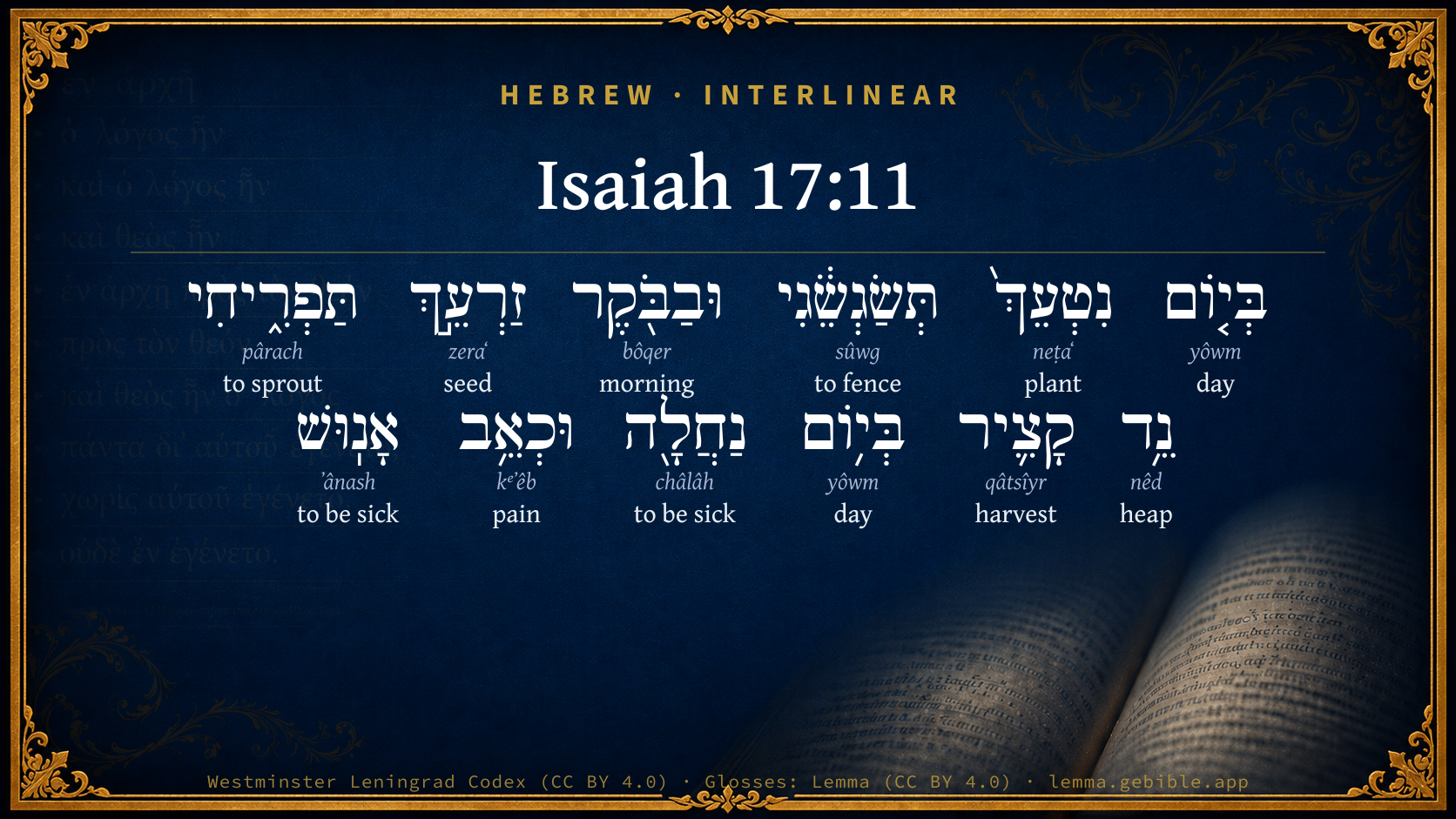
  1. בְּי֤וֹם yôwm H3117 “in/at · day of” Preposition + Noun, Common, Masculine, Singular, Construct
  2. נִטְעֵךְ֙ neṭaʻ H5194 “plant · your” Noun, Common, Masculine, Singular, Construct + Suffix, Personal, 2nd Person, Feminine, Singular
  3. וּבַבֹּ֖קֶר bôqer H1242 “and · in/at the · morning” Conjunction + Preposition, Determined + Noun, Common, Masculine, Singular, Absolute
  4. זַרְעֵ֣ךְ zeraʻ H2233 “seed · your” Noun, Common, Masculine, Singular, Construct + Suffix, Personal, 2nd Person, Feminine, Singular
  5. תַּפְרִ֑יחִי pârach H6524 “to sprout” Verb, Hiphil, Imperfect, 2nd Person, Feminine, Singular
  6. נֵ֥ד nêd H5067 “heap” Noun, Common, Masculine, Singular, Absolute
  7. קָצִ֛יר qâtsîyr H7105 “harvest” Noun, Common, Masculine, Singular, Absolute
  8. בְּי֥וֹם yôwm H3117 “in/at · day of” Preposition + Noun, Common, Masculine, Singular, Construct
  9. נַחֲלָ֖ה châlâh H2470 “being sick” Verb, Niphal, Participle Active, Feminine, Singular, Absolute
  10. וּכְאֵ֥ב kᵉʼêb H3511 “and · pain” Conjunction + Noun, Common, Masculine, Singular, Absolute
  11. אָנֽוּשׁ ʼânash H605 “incurable” Adjective, Adjective, Masculine, Singular, Absolute

About this verse

These counts appear in no published source. They are computed here, from the morphology-tagged text and Lemma’s own curated glosses. What Lemma adds →

12
words
11
distinct lemmas
Prophets
section

Notable vocabulary

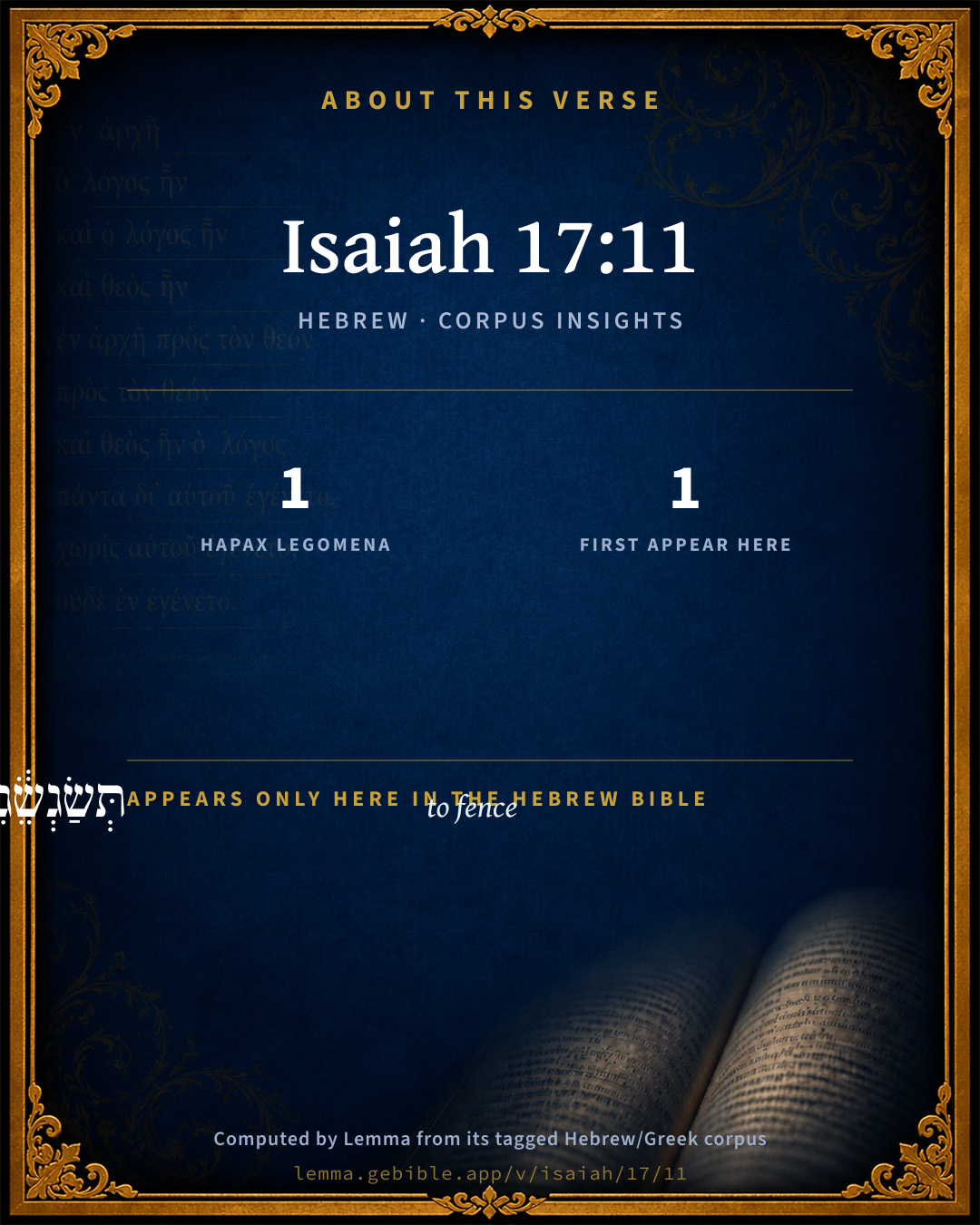
1 hapax legomenon — a word that appears only here in the entire Hebrew Bible:

  • תְּשַׂגְשֵׂ֔גִי to fence H7735

First appearance in Scripture

This word makes its first canonical appearance in the Hebrew Bible here:

  • תְּשַׂגְשֵׂ֔גִי to fence H7735

Shared distinctive vocabulary

נִטְעֵךְ֙ plant H5194 occurs in 4 verses of the Hebrew Bible. Also found in:

Grammatical profile

  • 3 verbs
  • 8 nouns
  • 1 adjective

Verb forms

  • תְּשַׂגְשֵׂ֔גִי Pilpel · Imperfect
  • תַּפְרִ֑יחִי Hiphil · Imperfect
  • נַחֲלָ֖ה Niphal · Participle Active

Repetition

A word recurs within this verse — often emphatic in Hebrew:

  • בְּי֤וֹם day H3117 ×2

Hebrew & Septuagint length

In English translation the verse runs 34 words from the Hebrew and 48 from the Septuagint (LXX English) — the Septuagint runs noticeably longer here. See the side-by-side →

A rough comparison of the two English renderings, which tokenize alike — not a word-level alignment.

Word counts can differ between the Hebrew and the Greek without any difference in meaning — e.g. the Hebrew direct-object marker אֵת has no separate Greek word, and Greek often adds the article ὁ.

Cross-references

14

Topical passages linked to Isaiah 17:11 in the Treasury of Scripture Knowledge — connected by theme and wording, ordered by reader-vote popularity; previews shown in the World English Bible.

  • Job 4:8 According to what I have seen, those who plow iniquity, And sow trouble, Reap the same.
  • Hosea 8:7 For they sow the wind, And they will reap the whirlwind. He has no standing grain. The stalk will yield no head. If it does yield, strangers will swallow it up.
  • Psalms 90:6 In the morning it sprouts and springs up. By evening, it is withered and dry.
  • Isaiah 18:5–6 For before the harvest, when the blossom is over, and the flower becomes a ripening grape, he will cut off the sprigs with pruning-hooks, and the spreading branches will he take away [and] cut down.
  • Isaiah 65:13–14 Therefore thus says the Lord Yahweh, Behold, my servants shall eat, but you shall be hungry; behold, my servants shall drink, but you shall be thirsty; behold, my servants shall rejoice, but you shall be disappointed;
  • Jeremiah 5:31 the prophets prophesy falsely, and the priests bear rule by their means; and my people love to have it so: and what will you do in the end of it?
  • Hosea 9:1–4 Don't rejoice, Israel, to jubilation like the nations; For you were unfaithful to your God. You love the wages of a prostitute at every grain threshing floor.
  • Hosea 9:16 Ephraim is struck. Their root has dried up. They will bear no fruit. Even though they bring forth, yet I will kill the beloved ones of their womb."
  • Hosea 10:12–15 Sow to yourselves in righteousness, Reap according to kindness. Break up your fallow ground; For it is time to seek Yahweh, Until he comes and rains righteousness on you.
  • Joel 1:5–12 Wake up, you drunkards, and weep! Wail, all you drinkers of wine, because of the sweet wine; For it is cut off from your mouth.
  • Matthew 8:11–12 I tell you that many will come from the east and the west, and will sit down with Abraham, Isaac, and Jacob in the Kingdom of Heaven,
  • Romans 2:5 But according to your hardness and unrepentant heart you are treasuring up for yourself wrath in the day of wrath, revelation, and of the righteous judgment of God;
  • Romans 2:8–9 but to those who are self-seeking, and don't obey the truth, but obey unrighteousness, will be wrath and indignation,
  • Galatians 6:7–8 Don't be deceived. God is not mocked, for whatever a man sows, that will he also reap.

Cross-references courtesy of OpenBible.info (CC BY 4.0).

Hebrew and Greek witnesses Masoretic Hebrew ↔ Greek Septuagint

The same verse in the two great witnesses to the Old Testament, shown verse-for-verse.

Here the Septuagint runs noticeably longer than the Hebrew — LXX2012 (modern English Septuagint) 48 words vs World English Bible 34. A rough length comparison of the two English translations, not a word-level alignment — read both below.

These are two independent witnesses, not word-aligned to each other, and the Septuagint is shown in lemma (dictionary) form.

Hebrew Isaiah 17:11 Masoretic · Westminster Leningrad Codex

בְּי֤וֹם נִטְעֵךְ֙ תְּשַׂגְשֵׂ֔גִי וּבַבֹּ֖קֶר זַרְעֵ֣ךְ תַּפְרִ֑יחִי נֵ֥ד קָצִ֛יר בְּי֥וֹם נַחֲלָ֖ה וּכְאֵ֥ב אָנֽוּשׁ

In the day of your planting you hedge it in, and in the morning you make your seed to blossom; but the harvest flees away in the day of grief and of desperate sorrow.

World English Bible · Public Domain

Greek LXX Isaiah 17:11 Septuagint · lemma form

ὁ δέ ἡμέρα ὅς ἄν φυτεύω πλανάω ὁ δέ πρωί ἐάν σπείρω ἀνθέω εἰς ἀμητός ὅς ἄν ἡμέρα κληρόω καί ὡς πατήρ ἄνθρωπος κληρόω ὁ υἱός σύ

In the day wherein you shall plant you shall be deceived; but if you sow in the morning, the seed shall spring up for a crop in the day wherein you shall obtain an inheritance, and as a man's father, you shall obtain an inheritance for your sons.

LXX2012 (modern English Septuagint) · Public Domain

Hebrew: Westminster Leningrad Codex (CC BY 4.0). Greek: Septuagint (public domain); English from LXX2012 (modern English Septuagint) (Public Domain). How the Septuagint differs from the Hebrew →

Targum (Aramaic paraphrase)

1

The Targum is the ancient Jewish Aramaic paraphrase of the Hebrew Scriptures — an interpretive translation, not the Hebrew text itself. Onkelos (literal) and Pseudo-Jonathan (expansive) render the Torah, and Jonathan the Prophets. Coverage is partial: where no permissively-licensed English translation exists for a verse, only the Aramaic is shown. This is verse-level text, not a word-by-word alignment to the Hebrew.

  1. Targum Jonathan Prophets (Joshua–Malachi)
    בַּאֲתַר דְאִתְקַדַשְׁתּוּן לְמֶהֱוֵי עַם תַּמָן קִלְקַלְתּוּן עוֹבָדֵיכוֹן וְאַף כַּד עַלְתּוּן לַאֲרַע בֵּית שְׁכִנְתִּי תַּמָן הֲוָה חֲזֵי לְכוֹן לְמִפְלַח שְׁבַקְתּוּן פּוּלְחָנִי וּפְלַחְתּוּן לְטַעֲוָתָא אַרְחֵיקְתּוּן תְּיוּבְתָּא עַד דִמְטָא יוֹם תְּבַרְכוֹן בְּכֵן הֲוָה כֵּיבְכוֹן לְמַפְחַת נְפָשׁ:

    After that ye were sanctified to be a people, there ye made your works despicable; and also when ye came to the land, the place of my Shekinah, there it was your duty' to worship me; ye forsook my worship, and ye served idols: ye abhorred repentance till the day of your destruction came, then your sorrow was a breathing out of soul.

    Targum Jonathan — Aramaic: “Mikraot Gedolot” (public domain). English: “Sefaria Community Translation” (CC0 1.0 (public-domain dedication)); “London "Chaldee Paraphrase," 1871” (public domain). Text via Sefaria.

Commentary

Notes on Isaiah 17:11 from classic Christian and Jewish commentators (each source and its license shown beneath its notes). The classic Christian expositions comment on the surrounding passage and are grouped to its opening verse, so a note may address several verses; the Jewish commentaries on the Tanakh (Rashi and others) are per-verse, so they appear only where the commentator wrote on this verse.

Lemma curates 59 commentaries, every one of them public domain or Creative Commons licensed, each selected and text-cleaned for this edition rather than reprinted as found. About our sources →

Trapp's Complete Commentary

John Trapp

Isa 17:11 In the day shalt thou make thy plant to grow, and in the morning shalt thou make thy seed to flourish: [but] the harvest [shall be] a heap in the day of grief and of desperate sorrow.

Ver. 11. In the day thou shalt make thy plant to grow.] So Pro 22:8, he that soweth iniquity shall reap vanity; and the more serious and sedulous he is at it, the worse shall it be with him. {Gal 6:8}

But thy harvest shall be an heap.] This is a proverb among the Jews, to signify labour in vain.

In the day of grief and desperate sorrow.] Heb., Aegrae, sc., plagae; for grapes ye shall gather thorns, for figs, thistles.

John Trapp, A Commentary or Exposition upon All the Books of the Old and New Testament (1647–1656) — public domain. Text from a community e-Sword module.

Geneva Bible (1599)

Geneva Bible translators

As the Lord threateneth the wicked in his Law, Lev. 26:16.

Geneva Bible (1599) marginal notes — public domain. Text via Bolls.life.

Jamieson, Fausset & Brown

Robert Jamieson, A. R. Fausset & David Brown

In the day . . . thy plant--rather, "In the day of thy planting" [HORSLEY].

shalt . . . make . . . grow--MAURER translates, "Thou didst fence it," namely, the pleasure-ground. The parallel clause, "Make . . . flourish," favors English Version. As soon as thou plantest, it grows.

in the morning--that is, immediately after; so in Psa 90:14, the Hebrew, "in the morning," is translated "early."

but . . . shall be a heap--rather, "but (promising as was the prospect) the harvest is gone" [HORSLEY].

in . . . day of grief--rather, "in the day of (expected) possession" [MAURER]. "In the day of inundation" [HORSLEY].

of desperate sorrow--rather, "And the sorrow shall be desperate or irremediable." In English Version "heap" and "sorrow" may be taken together by hendiadys. "The heap of the harvest shall be desperate sorrow" [ROSENMULLER].

The connection of this fragment with what precedes is: notwithstanding the calamities coming on Israel, the people of God shall not be utterly destroyed (Isa 6:12-13); the Assyrian spoilers shall perish (Isa 17:13-14).

Jamieson, Fausset & Brown — Commentary Critical and Explanatory on the Whole Bible (1871) — public domain (CC PDM 1.0). Text via the HelloAO Bible API.

Ellicott's Commentary for English Readers

(11) In the day shalt thou make.—Better, thou makest, or, thou fencest, thy plant. The alliance between Syria and Ephraim is compared in the rapidity of its growth with the “gardens of Adonis.” All the “harvest heaps” from such a planting would end, not in the wonted joy of harvest (Isa_9:3), but in “grief and incurable pain” There is no sufficient evidence for the marginal reading of the Authorised version.

A Bible Commentary for English Readers, edited by Charles John Ellicott (1878–1897) — public domain. Text from a community e-Sword module.

The Cambridge Bible for Schools and Colleges

gen. ed. J. J. S. Perowne

11. The verse reads: In the day when thou plantest thou makest it to grow, and in the morning when thou sowest thou makest it to blossom, (but) the harvest disappears in a day of sickness and incurable sorrow. “However successful your enterprise may seem in its early stages, it is doomed to failure.” For “makest it to grow” we may render with R.V. “hedgest it in.” The words “plant” and “seed” must be construed alike, both are taken above as infinitives. The word for “disappears” means “heap” in Exo_15:8; Psa_33:7; Psa_78:13 and so A.V. here. But here it is better taken as a verb; R.V. rightly “fleeth away.”

The Cambridge Bible for Schools and Colleges (gen. ed. J. J. S. Perowne; Cambridge University Press, 1878–1918) — public domain. Text from a community e-Sword module.

John Gill's Exposition

In the day shall thou make thy plant to grow,.... Not that it is in the power of man to make it grow; but the sense is, that all means and methods should be used to make it grow, no cost nor pains should be spared:

and in the morning shall thou make thy seed to flourish; which may denote both diligence in the early care of it, and seeming promising success; and yet all should be in vain, and to no purpose:

but the harvest shall be a heap in the day of grief; or "of inheritance"; when it was about to be possessed and enjoyed, according to expectation, it shall be all thrown together in a heap, and be spoiled by the enemy: or, "the harvest" shall be "removed in the day of inheritance" (w); just when the fruit is ripe, and going to be gathered in, the enemy shall come and take it all away; and so, instead of being a time of joy, as harvest usually is, it will be a time of grief and trouble,

and of desperate sorrow too, or "deadly"; which will leave them in despair, without hope of subsistence for the present year, or of having another harvest hereafter, the land coming into the hands of their enemies.

(w) "recedit messis in die hereditatis sive possessionis"; so some in Vatablus.

John Gill's Exposition of the Whole Bible (1746–1763) — public domain (CC PDM 1.0). Text via the HelloAO Bible API.

Albert Barnes' Notes on the Bible

In the day ... - Thou shalt cultivate it assiduously and constantly. Thou shalt be at special pains that it may be watered and pruned, in order that it may produce abundantly.

And in the morning - With early care and attention - denoting the pains that would be bestowed on the young plant.

The harvest shall be a heap - The margin reads this, ‘the harvest shall be removed in the day of inheritance, rendering it as if the word נד nêd usually meaning a heap, were derived from נוד nûd, to shake, move, wander; or, as if it were to be removed. Probably the translation in the text is correct; and the sense is, ‘When from the plant which was so beautiful and valuable, and which you cherished with so much care, you expected to obtain a rich harvest, you had only sorrow and inexpressible disappointment.’ The figure used here is supposed by Rosenmuller to be that of hendiadys (ἕν διὰ δυοῖν hen dia duoin)by which the phrases ‘shall be an heap,’ and ‘desperate sorrow,’ are to be taken together, meaning ‘the heap of the harvest shall be inexpressible sorrow.’

In the day of grief - The word rendered ‘grief’ here (נחלה nachălâh) means, properly, “inheritance, heirship, possession,” and should have been so rendered here. It means that in the day when they “hoped” to possess the result of their planting, or in the time of the usual harvest, they would obtain only grief and disappointment.

And desperate sorrow - The word rendered ‘desperate’ (אנשׁ 'ânash), denotes that which is “weak, mortal, incurable” Job 34:6; Jer 17:16; Jer 30:12, Jer 30:15. The sense here is, that there would be grievous disappointment, and that there would be no remedy for it; and the idea of the whole is, that calamities were coming upon the nation which would blast all their hopes, and destroy all their prospects. The prophecy was fulfilled in the invasion by Tiglath-pileser, and the army of the Assyrians.

The twelfth verse commences a new prophecy, which has no connection with that which precedes it; and which in itself gives no certain indication of the time when it was uttered, or of the people to which it relates. It is a broken and detached piece, and is evidently the description of some army rushing to conquest, and confident of success, but which was to be overtaken with sudden calamity. The entire description is so applicable to the invasion of the land of Judah by the army of Sennacherib, and his overthrow by the angel of Yahweh, that by the common consent of interpreters it has been regarded as referring to it (see the notes at Isa. 10). But when it was spoken, or why it was placed here, is unknown. It may be added that many commentators, and, among the rest, Gesenius, have supposed that the following chapter is a part of this prophecy. The general sense of the prophecy is, that numerous hostile nations would overrun Palestine, but that Yahweh would destroy them all.

Albert Barnes' Notes on the Bible (1834–1885) — public domain. Text from a community e-Sword/MySword module.

Haydock's Catholic Bible Commentary

Much. Thou hast laboured earnestly, but reaped no benefit. (Haydock)

George Leo Haydock (1774–1849), Haydock's Catholic Family Bible and Commentary, 1859 edition — public domain. Excludes Psalms (Douay-Rheims chapter numbering differs from Protestant) and Deuterocanonical books (Catholic canon only).

Matthew Poole's English Annotations

In the day shalt thou make thy plant to grow, and in the morning shalt thou make thy seed to flourish; thou shalt from day to day, beginning early in the morning, use all care and diligence that what thou hast planted and sown may thrive; and thou shalt see some effect of thy labours, and some hopes of success.

But the harvest shall be a heap in the day of grief and of desperate sorrow: the sense of the words thus rendered is this, But in the time of your grief, &c., or when this grievous calamity shall come, all your harvest shall be but one heap, which in itself is very inconsiderable, and is easily carried away by your enemies. But the place is and may be otherwise rendered, and that very agreeably both to the words and order of the Hebrew text; But the heap (or, heaps, the singular number being most commonly put for the plural) of the harvest (i.e. instead of those heaps of corn which thou didst expect, and which men usually reap in harvest)

in the day or time (to wit, of the harvest; or, in the day of calamity, of which I have spoken, Isa 17:4,9; or, in a day, i.e. speedily or suddenly) shall be (or, thou shalt have)

grief and desperate sorrow. This shall be all thy harvest, and the event of thy labours.

Matthew Poole's English Annotations on the Holy Bible (1683–1685) — public domain. Text from a community e-Sword/MySword module.

Whedon's Commentary on the Bible

Daniel D. Whedon

11. Make thy plant to grow — On the very day of (or, quite at the immediate) planting of his pleasant garden-ground, (of his overture with Damascus,) he assiduously guarded it by a hedge. He turned away totally from Jehovah.

In the morning — On the very next morning he found what he had sown in full bloom — his agreement respecting alliance with a foreign power was hearty, he was ready to take the sensual worship of Damascus as his state religion; and the blossom was rapidly advancing to fruitage, that is, to a place of united attack upon Judah. But this plantation, so promising at first to Israel, and succeeding, apparently, so well, was all at once a harvest heap for the day of terrible judgment.

Daniel D. Whedon (gen. ed.), Commentary on the Old and New Testaments (1874–1909) — public domain. Text from a community e-Sword module.

The Pulpit Commentary

In the day; or, in a day (Kay). Shalt thou make; rather, thou makest. Each new slip that is planted is forced to take root and grow and flourish at once; the next morning it is expected to have formed its seed and reached perfection. So the harvest is hurried on; but when it is reached, the day of visitation has arrived a day of grief and of desperate sorrow. The mission of disappointment; or, disappointment used as a Divine judgment.

In this passage is presented the case of unrewarded toil. Seed is sown, blades spring up, there is every prospect of harvest; but all hopes are disappointed, the harvest proved a failure it was "a heap in the day of grief and of desperate sorrow." One special feature of the discipline of life is the disappointment of our most cherished hopes and expectations. We build our castles on some new enterprise, and at first all seems to go well; but at last our castle lies in ruins about us. We set our hopes on one of our children, and fashion for him a future of honor and success, and our disappointment in him almost breaks our heart. We make important changes, which promise much, and result in the humiliation of failure and distress. God works by disappointments; they are keener rods for smiting than afflictions are. They bear more quickly on the humbling of man"s pride and on the conviction of his self-helplessness. They try temper more. They too often result in hardening and increased willfulness. There is no harder lesson for us to learn than this one, that God works his work of grace by shutting doors against us, and not permitting us to achieve the success which is the desire of our heart. We plan, we work, but all proves in vain; and so we learn that it is the blessing of the Lord alone that maketh rich, and giveth good success. We observe

I DISAPPOINTMENT DIFFERS FROM AFFLICTION. Take two scenes from David"s life. The rebellion of Absalom was an affliction. The refusal to permit him to build the temple was a disappointment. The one was no more under God"s overruling than was the other. They are perfectly distinct in character and in influence. One difference may be effectively illustrated. With "afflictions" there is usually an enfeebled and depressed state of body, involving weakened will and limitation of resistance. With "disappointments" there is usually the full health and energy; and the conflict, that ends in true submission, is therefore more severe.

II DISAPPOINTMENTS MAY INFLUENCE WHEN AFFLICTIONS WOULD NOT. That depends on dispositions. Many a man can bear sufferings who would be thrown into the most violent struggles by having his will crossed. Then that "crossing of his will" may be the only way to accomplish his sanctifying. We should rejoice that he who knows the best methods of chastisement also knows us on whom the correction comes. For us the way to heaven may be round by a series of lifelong disappointments. Most persons, perhaps, looking back over their lives, would say that their bitterest hours were those in which they realized that they "could not do the things that they would." St. Paul knew such times. The story of one such is very simply told, but those who read between the lines may find indication of much feeling. "We assayed to go into Bithynia, but the Spirit Suffered us not." And it is not easy to estimate the educational influence on our Lord"s disciples of that overwhelming disappointment, which came when he who they thought should have redeemed Israel was "hung up and crucified." That may be just the kind of weapon which our heavenly Father may need for our correction; and, in our various disappointments, we may hear his gracious voice saying, "Should it be according to thy mind? R.T.

The Pulpit Commentary (1880–1919), ed. H.D.M. Spence-Jones & Joseph S. Exell — public domain. Text from a community e-Sword module.

John Wesley's Explanatory Notes

In the day - Thou shalt from day to day, beginning early in the morning, use all diligence that what thou hast planted may thrive. But - When this grievous calamity shall come, all your harvest shall be but one heap.

John Wesley, Explanatory Notes Upon the Whole Bible (1754–1765) — public domain. Text via the GEBible commentary corpus.

J. A. Alexander on Isaiah

Joseph Addison Alexander

“In the day of thy planting thou wilt hedge it in, and in the morning thou wilt make thy seed to blossom, (but) away flies the crop in a day of grief and desperate sorrow.” In the morning is an idiomatic phrase for early, which some refer to the rapidity of growth, and others to the assiduity of the cultivator neither of which senses is exclusive of the other.

Joseph Addison Alexander, The Prophecies of Isaiah (1846–1847; New York: Scribner, 1870–1878) — public domain. Text from a community e-Sword module.

Rashi

Rabbi Shlomo Yitzchaki (Rashi)

On the day of your planting you mingled Heb. תְּשַׂגְשֵׂנִי, an expression of mingling. Your branches became mingled with sorts of grasses and mixtures that spoil the branches of the vine. That is to say that in the place where I planted you for Me as a vineyard, there you corrupted your deeds. That is what Ezekiel said to them (20:5): “On the day I chose Israel, and I lifted My hand to the seed of the house of Jacob, and I became known to them in the land of Egypt.” And it says further (verse 8): “And they rebelled against Me and they refused to obey...” Here, too, תְּשַׂגְשֵׂנִי, you became mingled with the abominations of Egypt.

and in the morning you cause your seed to blossom And on the morrow, when I took you out of there, and I brought you into the land, there, too, your evil seed you caused to blossom.

a heap of harvest on a day of sickness a heap of bad harvest that lies by day and by night, that harvest is stricken ill, it has reached a day of distress. [Rashi in printed editions.] [Since it is difficult to make sense of this comment of Rashi, Parshandatha prefers the reading of most mss.:] a heap of harvest on a day of sickness a heap of bad harvest, as “on a day of sickness” proves, that harvest reached a day of distress.

a heap Heb. נֵד. This is an expression of a tall heap. Comp. (Exodus 15:8) “Running water stood erect like a heap (נֵד).” Also (Ps. 33:3), “He gathers like a heap (כַּנֵּד).” [The words:] נֵד and נוֹד are not the same [i.e., נֵד is a heap or a stack, and נוֹד is a flask.]

and mortal pain that you were paid your reward.

mortal Heb. אָנוּשׁ, distressed by severe illness. Comp. (II Sam. 12: 15) “And he became mortally ill (וַיֵּאָנַשׁ),” also (Micah 1:9), “For her wounds are mortal (אֲנוּשָׁה).” Alternatively and in the morning you cause your seed to blossom Before the heat comes, you have blossomed, and it is customary for the vineyard to blossom when the heat comes, and the one that blossoms in the morning does not thrive. This is in the Midrash of Rabbi Tanhuma (Sh’lach 12).

Rashi on the Tanakh — English translations: “The Judaica Press complete Tanach with Rashi, translated by A. J. Rosenberg” (CC BY 4.0); “Pentateuch with Rashi's commentary by M. Rosenbaum and A.M. Silbermann, 1929-1934” (public domain); “The Metsudah Tanach series, Lakewood, N.J” (CC BY 4.0); and “The Book of Joshua, Metsudah Publications, 1997” (CC BY 4.0). Text via Sefaria.

Ibn Ezra

Rabbi Abraham ibn Ezra

תשגשגי Thou shalt make to grow. Root שנא to be large; comp. שניא great. Thou shalt make it to grow quickly. And in the morning shalt thou make thy seed to flourish. The same. As a general rule for the understanding of the prophetical books, I say, that from the one part of the verse we can infer what the words of the other part signify.

נד There will depart. קציר The branch. Comp. בקצירי in my branch (Job 29:19)

נחלה Sore. Supply מכה plague, to which the word is an attribute (מכה נחלה ═ נחלה), a sore plague; comp. בריאה ומאכלו and their meat plenteous (Hab. 1:16) ═ בריאה ומאכלו אכילה. This explanation is supported by the words which follow: וכאב אנוש and of desperate sorrow; with אנוש con-connect ויאנש and it was very sick (2 Sam. 12:15). Thou hast a great many children, but when the day of affliction shall come they will all perish.

Ibn Ezra on the Tanakh — English translations: “Sefaria Community Translation” (CC0 1.0 (public-domain dedication)); “Yalkut, Sifsei Chachomim Chumash, Metsudah Publications, 2009” (CC BY 4.0); and “Commentary of Ibn Ezra on Isaiah - trans. by M. Friedlander, 1873” (public domain). Text via Sefaria.

Lesson kit

Teaching starters — assembled from the data on this page, not authored interpretation. Every prompt links to the verse data it draws on. Edit before teaching.

Isaiah, in the Prophets, opens this verse with 12 words (11 distinct Hebrew lemmas). Its most distinctive word is sûwg (“to fence”). The Greek Septuagint runs longer here. A historical commentator’s framing appears above. Read the whole chapter for the surrounding context.

Discussion questions

  1. What does “to fence” (sûwg) contribute to the verse as a whole?
  2. 1 word here appears nowhere else in the Hebrew Bible. Why might the author reach for such rare wording?
  3. This is the first place “to fence” appears in Scripture (first appears here). What does its debut here establish?
  4. How does Job 14:9, which shares the word «plant», read alongside this verse?
  5. What does the repetition of “day” (2× in this one verse) do in this verse?
  6. The Septuagint runs longer here than the Hebrew. What might account for the difference?
  7. The translations on this page render this verse differently — a whole-verse word diff, not a word-by-word alignment. What might account for the different wordings?
  8. «תְּשַׂגְשֵׂ֔גִי» is a Pilpel Imperfect verb. How does that grammatical form shape the action described?

Things to notice

  • 1 word in this verse appears nowhere else in the Hebrew Bible.
  • 1 word makes its first canonical appearance in Scripture here.
  • These translations choose different wording for 19 words in this verse.
  • “day” occurs 2× in this single verse.
  • 11 distinct Hebrew lemmas span 12 words in this verse.

Reading settings

Reading text

Shown beneath each verse's original-language words.

Old Testament
Old Testament edition

Read the OT as the Masoretic Hebrew (MT) or the Greek Septuagint (LXX).

English shown for the Greek Septuagint (in the Hebrew ↔ Greek comparison).

Comparing translations? Open the Compare panel on any verse page to stack up to four side by side.