
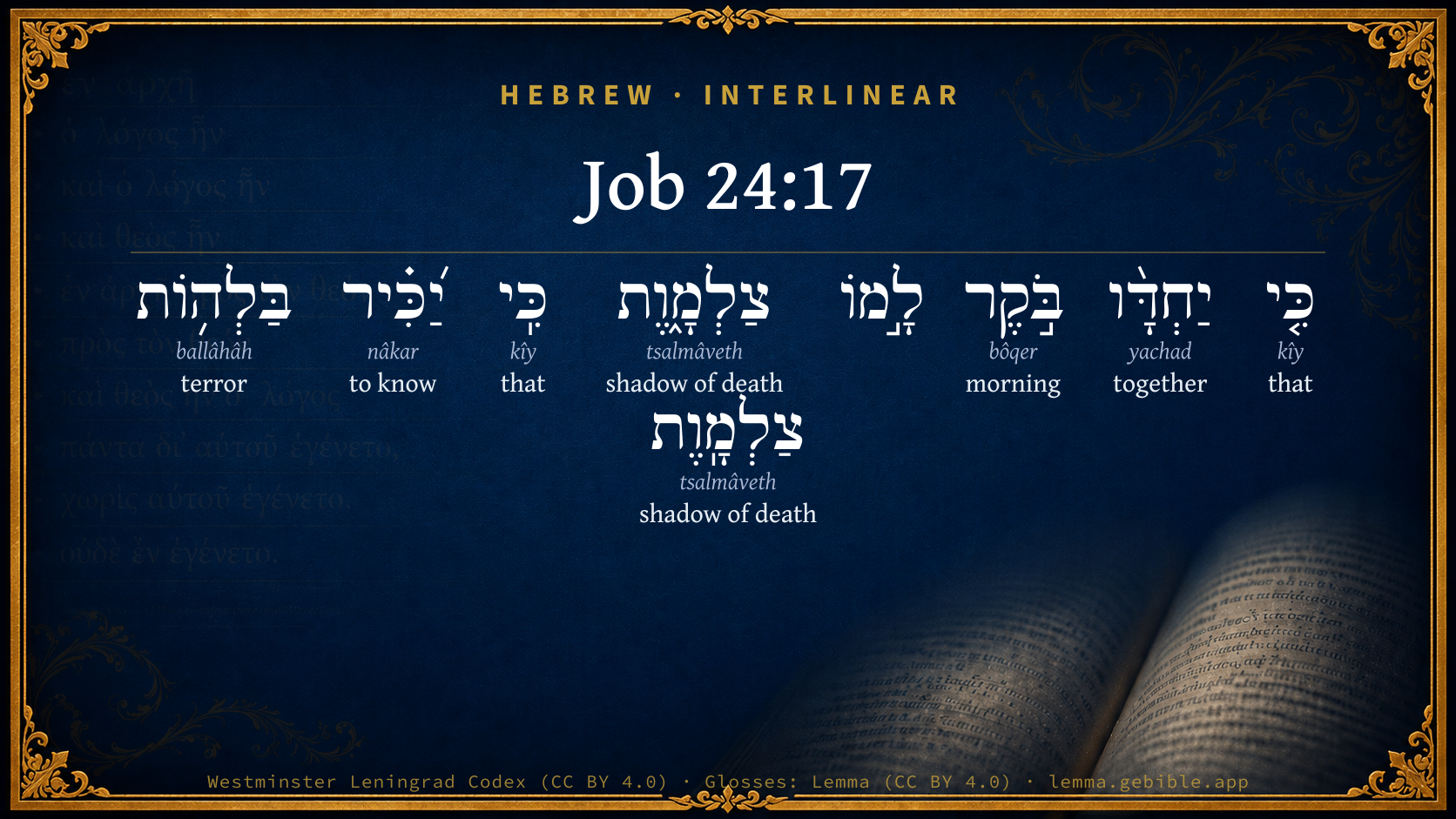
Job 24:17

Hebrew (Westminster Leningrad Codex) Job 24:17 appears in the Hebrew Old Testament. The text above is from the Westminster Leningrad Codex. Each word links to its Strong’s number, a concise gloss, and parsing drawn from the Open Scriptures Hebrew Bible morphology. Click any word for its full Brown-Driver-Briggs (BDB) entry.
Download image
Cite this verse

Job 24:17 (World English Bible). Public Domain. Lemma interlinear Bible study tool, https://lemma.gebible.app/v/job/24/17.

Show BibTeX & RIS
BibTeX
RIS
English Translation
For the morning is to all of them like thick darkness, For they know the terrors of the thick darkness.
World English Bible · Public Domain
Download a study sheet

One document with this verse’s original text, its word-by-word gloss line, the meaning frame, cross-references with their text, attributed commentary, and full source and license credits — printable, and it pastes into notes with its structure intact.

This verse Autodidact and up

Study sheet (.html) Plain text (.txt)

A passage Seminary Student

Up to 50 verses in one chapter. A passage sheet keeps up to 6 commentary sources and 12 cross-references per verse, in the order this page ranks them, and says so on the sheet whenever that leaves anything out. Ask for a single verse and you get the Autodidact verse sheet above.

Everything on this page stays free to read, with no account — the sheet is a download of what is already on screen, not access to it.

Want to remove ads? Support Godless Engineer
Compare translations 3

The same verse in 3 English versions, stacked beneath the original-language interlinear above. Click any original word for its lexicon entry.

Each is an independent rendering of the whole verse — the interlinear is not word-aligned to these translations.

Highlighted words mark where these versions differ — a whole-verse word diff, not a word-by-word alignment.

  • World English Bible Public Domain
    For the morning is to all of them like thick darkness, For they know the terrors of the thick darkness.
  • King James Version Public Domain
    For the morning is to them even as the shadow of death: if one know them, they are in the terrors of the shadow of death.
  • unfoldingWord Literal Text CC BY-SA 4.0
    For together, morning for them deep darkness, for one regards the terrors of thick darkness.

unfoldingWord Literal Text — © unfoldingWord, licensed CC BY-SA 4.0. Word-aligned USFM3 via Door43 (git.door43.org/unfoldingWord/en_ult).

Versions to compare (up to 4)

3 of 4 selected

Show all 18 translations

Every available English version of this verse, each an independent rendering of the whole verse.

  • World English Bible Public Domain
    For the morning is to all of them like thick darkness, For they know the terrors of the thick darkness.
  • Berean Standard Bible Public Domain
    For to them, deep darkness is their morning; surely they are friends with the terrors of darkness!
  • Majority Standard Bible Public Domain
    For to them, deep darkness is their morning; surely they are friends with the terrors of darkness!
  • King James Version Public Domain
    For the morning is to them even as the shadow of death: if one know them, they are in the terrors of the shadow of death.
  • American Standard Version (1901) Public Domain
    For the morning is to all of them as thick darkness; For they know the terrors of the thick darkness.
  • Revised Version (1885) Public Domain
    For the morning is to all of them as the shadow of death; for they know the terrors of the shadow of death.
  • Geneva Bible (1599) Public Domain
    But the morning is euen to them as the shadow of death: if one knowe them, they are in the terrours of the shadowe of death.
  • Douay-Rheims (1899) Public Domain
    If the morning suddenly appear, it is to them the shadow of death: and they walk in darkness as if it were in light.
  • Young's Literal Translation Public Domain
    When together, morning `is' to them death shade, When he discerneth the terrors of death shade.
  • Literal Standard Version CC BY-SA 4.0
    When together, morning [is] death-shade to them, || When he discerns the terrors of death-shade.
  • Unlocked Literal Bible CC BY-SA 4.0
    For all of them, thick darkness is like the morning; for they are friends with the terrors of thick darkness.
  • unfoldingWord Literal Text CC BY-SA 4.0
    For together, morning for them deep darkness, for one regards the terrors of thick darkness.
  • Darby Bible Public Domain
    For the morning is to them all [as] the shadow of death; for they are familiar with the terrors of the shadow of death.
  • World Messianic Bible Public Domain
    For the morning is to all of them like thick darkness, for they know the terrors of the thick darkness.
  • Webster's Bible Public Domain
    For the morning is to them even as the shades of death: if one knoweth them, they are in the terrors of the shades of death.
  • Free Bible Version CC BY-SA 4.0
    Total darkness is like light to them, for they are familiar with the night.
  • Bible in Basic English Public Domain
    For the middle of the night is as morning to them, they are not troubled by the fear of the dark.
  • JPS Tanakh (1917) Public Domain
    For the shadow of death is to all of them as the morning; for they know the terrors of the shadow of death.

Literal Standard Version (2020), Covenant Press — licensed CC BY-SA 4.0. Text via the HelloAO Bible API (eBible.org). Unlocked Literal Bible (unfoldingWord) — licensed CC BY-SA 4.0. Text via the HelloAO Bible API (eBible.org). unfoldingWord Literal Text — © unfoldingWord, licensed CC BY-SA 4.0. Word-aligned USFM3 via Door43 (git.door43.org/unfoldingWord/en_ult). Free Bible Version, Dr. Jonathan Gallagher — licensed CC BY-SA 4.0. Text via the HelloAO Bible API (eBible.org).

Word by word

More ways to search: Search by grammar → Find every occurrence → Compare this word →

Practice this passage: Drill this verse → Learn its vocabulary →

About this verse

These counts appear in no published source. They are computed here, from the morphology-tagged text and Lemma’s own curated glosses. What Lemma adds →

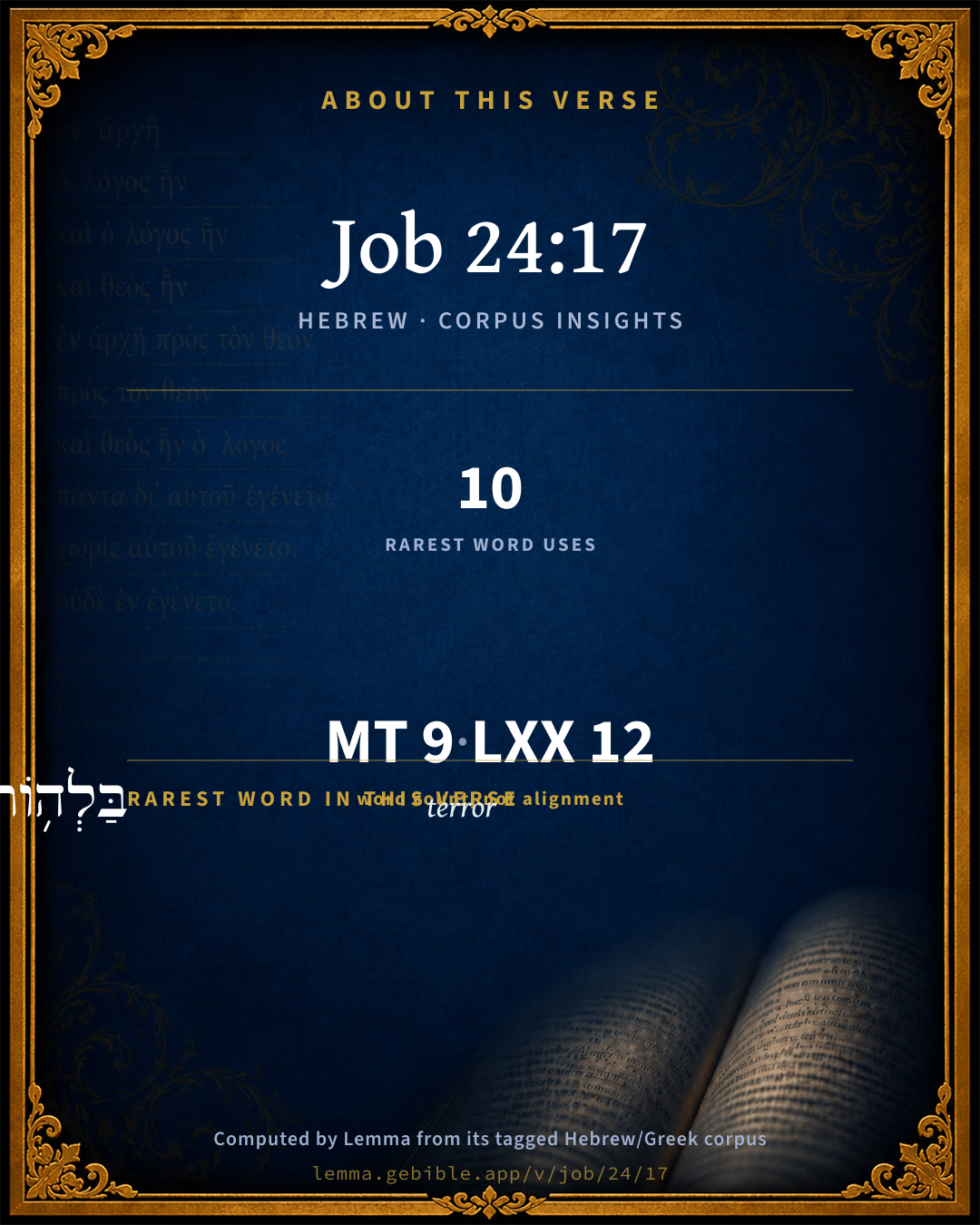
9
words
6
distinct lemmas
Wisdom
section

Notable vocabulary

The rarest word here is בַּלְה֥וֹת terror H1091 — appearing just 10 times in the whole Hebrew Bible.

Shared distinctive vocabulary

בַּלְה֥וֹת terror H1091 occurs in 10 verses of the Hebrew Bible. Also found in:

Grammatical profile

  • 1 verb
  • 4 nouns
  • 1 preposition
  • 2 conjunctions
  • 1 adverb

Verb forms

  • יַ֝כִּ֗יר Hiphil · Imperfect

Repetition

Words recur within this verse — often emphatic in Hebrew:

  • צַלְמָ֑וֶת shadow of death H6757 ×2
  • כִּ֤י that H3588 ×2

Hebrew & Septuagint length

In English translation the verse runs 20 words from the Hebrew and 25 from the Septuagint (LXX English) — closely comparable.

A rough comparison of the two English renderings, which tokenize alike — not a word-level alignment.

Word counts can differ between the Hebrew and the Greek without any difference in meaning — e.g. the Hebrew direct-object marker אֵת has no separate Greek word, and Greek often adds the article ὁ.

In the original languages it is 9 Hebrew tokens and 12 Greek tokens — but the two are counted differently (Hebrew bundles its prefixes and suffixes into one token; the Greek is in lemma form), so that isn’t a like-for-like length.

Cross-references

5

Topical passages linked to Job 24:17 in the Treasury of Scripture Knowledge — connected by theme and wording, ordered by reader-vote popularity; previews shown in the World English Bible.

  • Job 3:5 Let darkness and the shadow of death claim it for their own. Let a cloud dwell on it. Let all that makes black the day terrify it.
  • Psalms 73:18–19 Surely you set them in slippery places. You throw them down to destruction.
  • Jeremiah 2:26 As the thief is ashamed when he is found, so is the house of Israel ashamed; they, their kings, their princes, and their priests, and their prophets;
  • 2 Corinthians 5:10–11 For we must all be revealed before the judgment seat of Christ; that each one may receive the things in the body, according to what he has done, whether good or bad.
  • Revelation 6:16–17 They told the mountains and the rocks, "Fall on us, and hide us from the face of him who sits on the throne, and from the wrath of the Lamb,

Cross-references courtesy of OpenBible.info (CC BY 4.0).

Hebrew and Greek witnesses Masoretic Hebrew ↔ Greek Septuagint

The same verse in the two great witnesses to the Old Testament, shown verse-for-verse.

These are two independent witnesses, not word-aligned to each other, and the Septuagint is shown in lemma (dictionary) form.

Hebrew Job 24:17 Masoretic · Westminster Leningrad Codex

כִּ֤י יַחְדָּ֨ו בֹּ֣קֶר לָ֣מוֹ צַלְמָ֑וֶת כִּֽי יַ֝כִּ֗יר בַּלְה֥וֹת צַלְמָֽוֶת

For the morning is to all of them like thick darkness, For they know the terrors of the thick darkness.

World English Bible · Public Domain

Greek LXX Job 24:17 Septuagint · lemma form

ὅτι ὁμοθυμαδόν ὁ πρωΐ αὐτός σκιά θάνατος ὅτι ἐπιγιγνώσκω ταραχή σκιά θάνατος

For the morning is to them all as the shadow of death, for each will be conscious of the terror of the shadow of death.

LXX2012 (modern English Septuagint) · Public Domain

Hebrew: Westminster Leningrad Codex (CC BY 4.0). Greek: Septuagint (public domain); English from LXX2012 (modern English Septuagint) (Public Domain). How the Septuagint differs from the Hebrew →

Commentary

Notes on Job 24:17 from classic Christian and Jewish commentators (each source and its license shown beneath its notes). The classic Christian expositions comment on the surrounding passage and are grouped to its opening verse, so a note may address several verses; the Jewish commentaries on the Tanakh (Rashi and others) are per-verse, so they appear only where the commentator wrote on this verse.

Lemma curates 59 commentaries, every one of them public domain or Creative Commons licensed, each selected and text-cleaned for this edition rather than reprinted as found. About our sources →

Trapp's Complete Commentary

John Trapp

Job 24:17 For the morning [is] to them even as the shadow of death: if [one] know [them, they are in] the terrors of the shadow of death.

Ver. 17. For the morning is unto them as the shadow of death] i.e. They are in deadly fear lest the light should bewray them, and expose them to condign punishment. How fearful was Judah of being shamed after he had thus sinned! Gen 38:23; and how forward to save his credit by sending his kid by the hand of that hang by Hiram! That young man in Terence (in Eun.) was sore ashamed to be seen in the eunuch’s garment, a token of his uncleanness; whereas to have done the deed did nothing so much trouble him. But the children of light hate and shun sin more for the filth that is in it than for the fire that is in it; the blackness of that coal offendeth them more than the heat of it. Plato condemneth the poets for setting forth Jupiter’s adulteries, whereby the people were drawn to the like wantonness; and for saying, it were no matter though men did commit sin, so they could hide it, Wς λυσιτελει το αδικειν εαν λανθανη. Si non caste, saltem caute, say the Popish shavelings, who are sometimes taken in the manner, as was that carnal Cardinal Cremonensis, the Pope’s legate here, in Henry VlII’s days, and Dr Weston, dean of Windsor, in the reign of Queen Mary, apprehended in adultery, and for the same deprived of all his spiritual livings by Cardinal Pole. Pope John XII being taken to bed with another man’s wife, was killed immediately by her husband. In Germany, a gentleman of note and his harlot were served in like sort, as Luther relateth. So was Rodoaldus VIII, king of Lombardy, and Sergus, a king of Scotland (P. Mel. Chron. Lang. Chron.). Of all these, and many more eiusdem furfuris, it may well be said, as here, that being noted and notified, they were in the terrors of the shadow of death. Which death to escape,

John Trapp, A Commentary or Exposition upon All the Books of the Old and New Testament (1647–1656) — public domain. Text from a community e-Sword module.

The Biblical Illustrator

Joseph S. Exell

Job_24:17

The terrors of the shadow of death.

Death

Scripture speaks of death in two ways. Job calls death the King of Terrors. Of a saint and martyr it is said, He fell asleep.

I. What is it that makes death terrible?

1. It is the rending asunder of what God has joined together. Body and soul. What life is, and what death is, we know by marked outward signs; but what the soul is, whence it comes, whither it goes, who knoweth, except so far as God has taught us?

2. It is the passage to judgment. After this the judgment.

3. It is the breaking up of all we love, and desire, and care for here.

II. Turn to the other side of the picture--what is it that makes death peaceful?

1. The body and spirit shall again be joined. In Christ shall all be made alive.

2. The judgment will be the judgment seat of Christ. Judgment is terrible where sin is; but sin washed away in the blood of the Cross has no sting, no terror left.

3. The Christians treasure is above, his hope is full of immortality. Death to the Christian is the sure and certain hope of a better life. (Alfred Port, B. D.)

The Biblical Illustrator, edited by Joseph S. Exell (c. 1880s–1900s) — public domain. Text from a community e-Sword module.

Jamieson, Fausset & Brown

Robert Jamieson, A. R. Fausset & David Brown

They shrink from the "morning" light, as much as other men do from the blackest darkness ("the shadow of death").

if one know--that is, recognize them. Rather, "They know well (are familiar with) the terrors of," &c. [UMBREIT]. Or, as MAURER, "They know the terrors of (this) darkness," namely, of morning, the light, which is as terrible to them as darkness ("the shadow of death") is to other men.

Jamieson, Fausset & Brown — Commentary Critical and Explanatory on the Whole Bible (1871) — public domain (CC PDM 1.0). Text via the HelloAO Bible API.

The Cambridge Bible for Schools and Colleges

gen. ed. J. J. S. Perowne

17. This verse expands the last clause of Job_24:16 :—

For the morning is to them as the shadow of death,

For they know the terrors of the shadow of death.

The “shadow of death” is equivalent almost to “midnight;” see note ch. Job_3:5. These malefactors know not the light (Job_24:16), the morning seems to them midnight, so much do they fear and shun it; but they know, they are familiar with, the terrors of midnight, for this is their day. Others make “morning” predicate, for midnight is to them (like) the morning. This, however, does not connect so closely with Job_24:16. “Shakespeare has the same thought—as indeed what thought has he not?—and tells us that ‘when the searching eye of heaven, that lights this lower world, is hid behind the globe,’

‘Then thieves and robbers range abroad unseen,

In murders and in outrage …

But when from under this terrestrial ball

He fires the proud tops of the eastern pines,

And darts his light through every guilty hole,

Then murders, treason, and detested sins,

The cloak of night being plucked from off their backs,

Stand bare and naked, trembling at themselves.’ ”

(Cox, Commentary on Job, p. 317.)

The Cambridge Bible for Schools and Colleges (gen. ed. J. J. S. Perowne; Cambridge University Press, 1878–1918) — public domain. Text from a community e-Sword module.

John Gill's Exposition

For the morning is to them even as the shadow of death,.... It is as disagreeable, and as hateful, and as terrible to them as the grossest and thickest darkness can be to others. The word is to be rendered either "alike" or "altogether", and not "even", as in our version: "the morning is to them equally" or "together" (w); that is, to the murderer, robber, thief, adulterer, and housebreaker, "as the shadow of death"; alike disagreeable to them all; or "the shadow of death is to them together" or "alike as the morning"; what the morning is to others, exceeding pleasant and delightful, that to them is the shadow of death, or the darkest night; they love darkness rather than light:

if one know them, they are in the terrors of the shadow of death; they are frightened unto death, they are in as great terror as a man is to whom death is the king of terrors; and who is sensible of the near approach of it, the plain and manifest symptoms of it being upon him: this is the case of the murderer, adulterer, and thief, when they are caught in the fact; or are known by such who are capable of giving notice of them, detecting them, and bearing witness against them: or "he", each and everyone of these, "knows the terrors of the shadow of death" (x); the darkest night, which strikes terrors into others, is known by them, is delighted in by them, is familiar with them, and friendly to them, and is as pleasing as the brightest day to others.

(w) Pariter, Pagninus, Montanus, &c. (x) "agnoscit terrores umbrae mortis", Mercerus, Cocceius; so Codurcus, Schmidt.

John Gill's Exposition of the Whole Bible (1746–1763) — public domain (CC PDM 1.0). Text via the HelloAO Bible API.

Albert Barnes' Notes on the Bible

For the morning is to them even as the shadow of death - They dread the light as one does usually the deepest darkness. The morning or light would reveal their deeds of wickedness, and they therefore avoid it.

As the shadow of death - As the deepest darkness; see the notes at Job 3:5.

If one know them - If they are recognized. Or, more probably, this means “they,” that is, each one of them, “are familiar with the terrors of the shadow of death,” or with the deepest darkness. By this rendering the common signification of the word (יכיר yakı̂yr) will be retained, and the translation will accord with the general sense of the passage. The meaning is, that they are familiar with the blackest night. They do not dread it. They dread only the light of day. To others the darkness is terrible; to them it is familiar. The word rendered “shadow of death” in the latter part of this verse, is the same as in the former. It may mean in both places the gloomy night that resembles the shadow, of death. Such a night is “terrible” to most people, to them it is familiar, and they feel secure only when its deep shades are round about them.

Albert Barnes' Notes on the Bible (1834–1885) — public domain. Text from a community e-Sword/MySword module.

Haydock's Catholic Bible Commentary

CHAPTER XXIV.

Death. They are as much afraid of the light as others are of profound darkness. (Calmet) --- They dread being detected. (Haydock)

George Leo Haydock (1774–1849), Haydock's Catholic Family Bible and Commentary, 1859 edition — public domain. Excludes Psalms (Douay-Rheims chapter numbering differs from Protestant) and Deuterocanonical books (Catholic canon only).

Matthew Poole's English Annotations

As the shadow of death, i.e. terrible and hateful, because it both discovers them and hinders their practices. If they are brought to light or discovered, they are overwhelmed with deadly horrors and terrors. Or, as the words are, and may very agreeably to the Hebrew be rendered thus: but (as the Hebrew particle commonly signifies)

they know (Heb. he knoweth, every one of them knoweth, i.e. approveth and loveth)

the terrors of the shadow of death, i.e. the grossest darkness of the night, which to other men is as terrible as the shadow of death, but to these men is most acceptable: so this clause is fitly opposed to the former; he hates the light, and he likes darkness.

Matthew Poole's English Annotations on the Holy Bible (1683–1685) — public domain. Text from a community e-Sword/MySword module.

Whedon's Commentary on the Bible

Daniel D. Whedon

17. Shadow of death — Delitzsch, Dillmann, and others, make this phrase equivalent to depth of night — the subject of the verb. The passage reads, For to them all, the depth of night is morning: because they know the terrors of thick darkness (shadow of death.)

Know — To be familiar with. Mercerus had early and fortunately hit upon the sense, “Nocturnal terrors are familiar to him; he neither fears nor cares for them… as if he had entered into a compact with them that they should not hurt him.” Midnight is his morning. The shadow of death is his daybreak when he rises to his work. He is as much at home in the horrors of darkness as the good are in the light of day.

Daniel D. Whedon (gen. ed.), Commentary on the Old and New Testaments (1874–1909) — public domain. Text from a community e-Sword module.

The Pulpit Commentary

For the morning is to them even as the shadow of death. They hate the morning light. It is associated in their minds with the idea of detection; for when it breaks in upon them unexpectedly in the midst of their ill deeds, detection commonly follows; and detection is a true "shadow of death," for it commonly means the gallows. If one know them, they are in the terrors of the shadow of death; rather, for they know the terrors of the shadow of death (see the Revised Version). It is a familiar experience to them; as, whenever crime is severely punished, it is to the criminal class generally.

The Pulpit Commentary (1880–1919), ed. H.D.M. Spence-Jones & Joseph S. Exell — public domain. Text from a community e-Sword module.

John Wesley's Explanatory Notes

Is - Terrible and hateful.

John Wesley, Explanatory Notes Upon the Whole Bible (1754–1765) — public domain. Text via the GEBible commentary corpus.

Rashi

Rabbi Shlomo Yitzchaki (Rashi)

For together morning is to them [as] the shadow of death For by day they were locked in, and at night they would go to their tunnel, and they were not at all afraid of the demons.

for he recognizes the terrors of the shadow of death Everyone could recognize the terrifying demons, and he did not fear them. Our Sages, however, explained: By day, they would seal for themselves—By day they would chart the location of the cellar of the house and a rich man’s treasurehouse, for they would deposit balsamum oil with wealthy householders, knowing that he (sic) would put it in his (sic) treasurehouse, and at night they would smell and go there and dig into there.

Rashi on the Tanakh — English translations: “The Judaica Press complete Tanach with Rashi, translated by A. J. Rosenberg” (CC BY 4.0); “Pentateuch with Rashi's commentary by M. Rosenbaum and A.M. Silbermann, 1929-1934” (public domain); “The Metsudah Tanach series, Lakewood, N.J” (CC BY 4.0); and “The Book of Joshua, Metsudah Publications, 1997” (CC BY 4.0). Text via Sefaria.

Lesson kit

Teaching starters — assembled from the data on this page, not authored interpretation. Every prompt links to the verse data it draws on. Edit before teaching.

Job, in the Wisdom, opens this verse with 9 words (6 distinct Hebrew lemmas). Its most distinctive word is ballâhâh (“terror”). A historical commentator’s framing appears above. Read the whole chapter for the surrounding context.

Discussion questions

  1. How does “terror” (ballâhâh) shape what this verse is saying?
  2. How does Job 18:11, which shares the word «terror», read alongside this verse?
  3. What does the repetition of “shadow of death” (2× in this one verse) do in this verse?
  4. These translations render this verse differently; the difference is in the English rendering, not the original. What questions does that raise?
  5. «יַ֝כִּ֗יר» is a Hiphil Imperfect verb. How does that grammatical form shape the action described?
  6. Compare how Trapp's Complete Commentary and The Biblical Illustrator read this verse. Where do they agree or differ?

Things to notice

Reading settings

Reading text

Shown beneath each verse's original-language words.

Old Testament
Old Testament edition

Read the OT as the Masoretic Hebrew (MT) or the Greek Septuagint (LXX).

English shown for the Greek Septuagint (in the Hebrew ↔ Greek comparison).

Comparing translations? Open the Compare panel on any verse page to stack up to four side by side.