
Isaiah 21:12

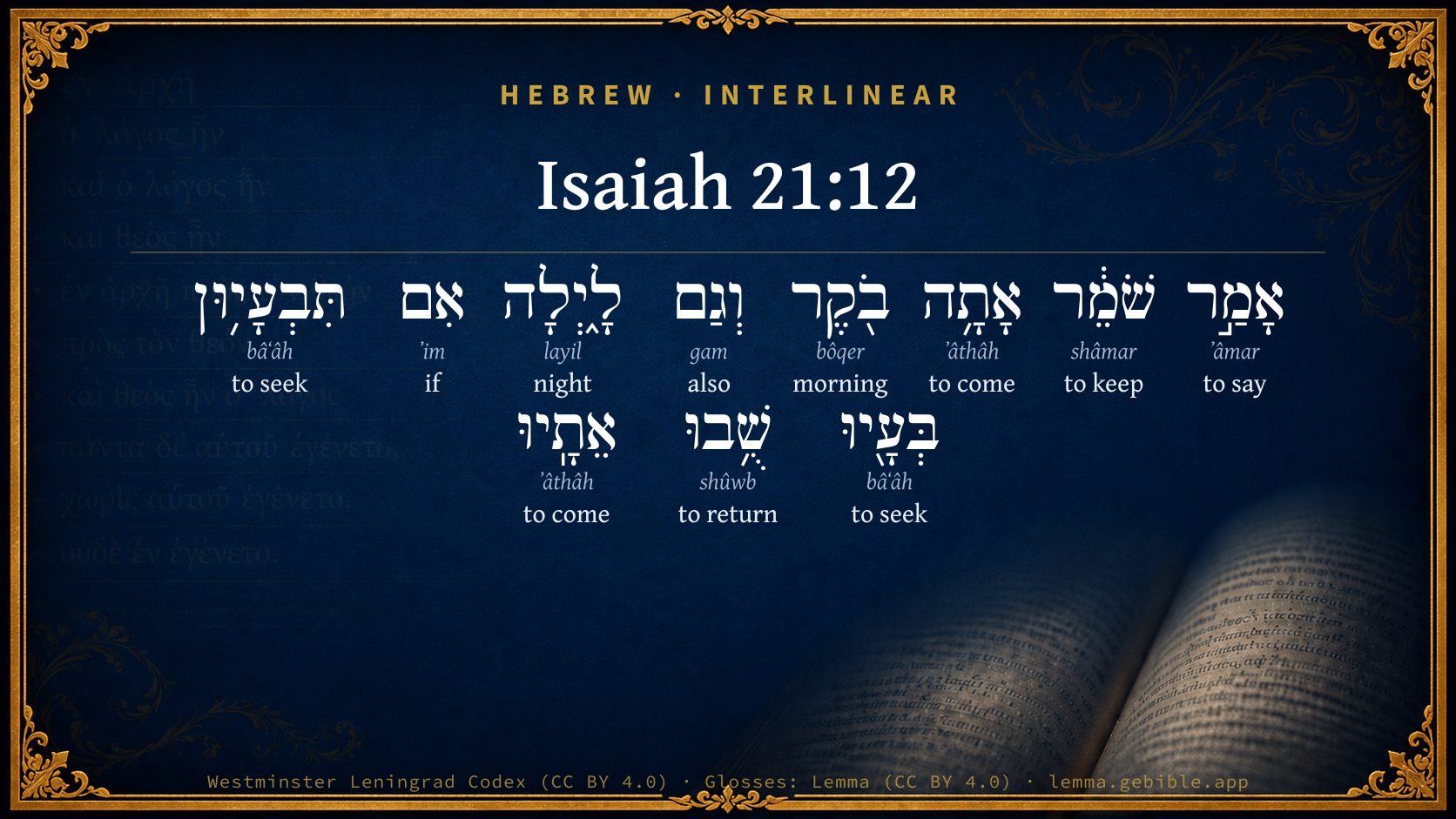
Hebrew (Westminster Leningrad Codex) Isaiah 21:12 appears in the Hebrew Old Testament. The text above is from the Westminster Leningrad Codex. Each word links to its Strong’s number, a concise gloss, and parsing drawn from the Open Scriptures Hebrew Bible morphology. Click any word for its full Brown-Driver-Briggs (BDB) entry.
Download image
Cite this verse

Isaiah 21:12 (World English Bible). Public Domain. Lemma interlinear Bible study tool, https://lemma.gebible.app/v/isaiah/21/12.

Show BibTeX & RIS
BibTeX
RIS
English Translation
The watchman said, "The morning comes, and also the night. If you will inquire, inquire. Come back again."
World English Bible · Public Domain
Highlights
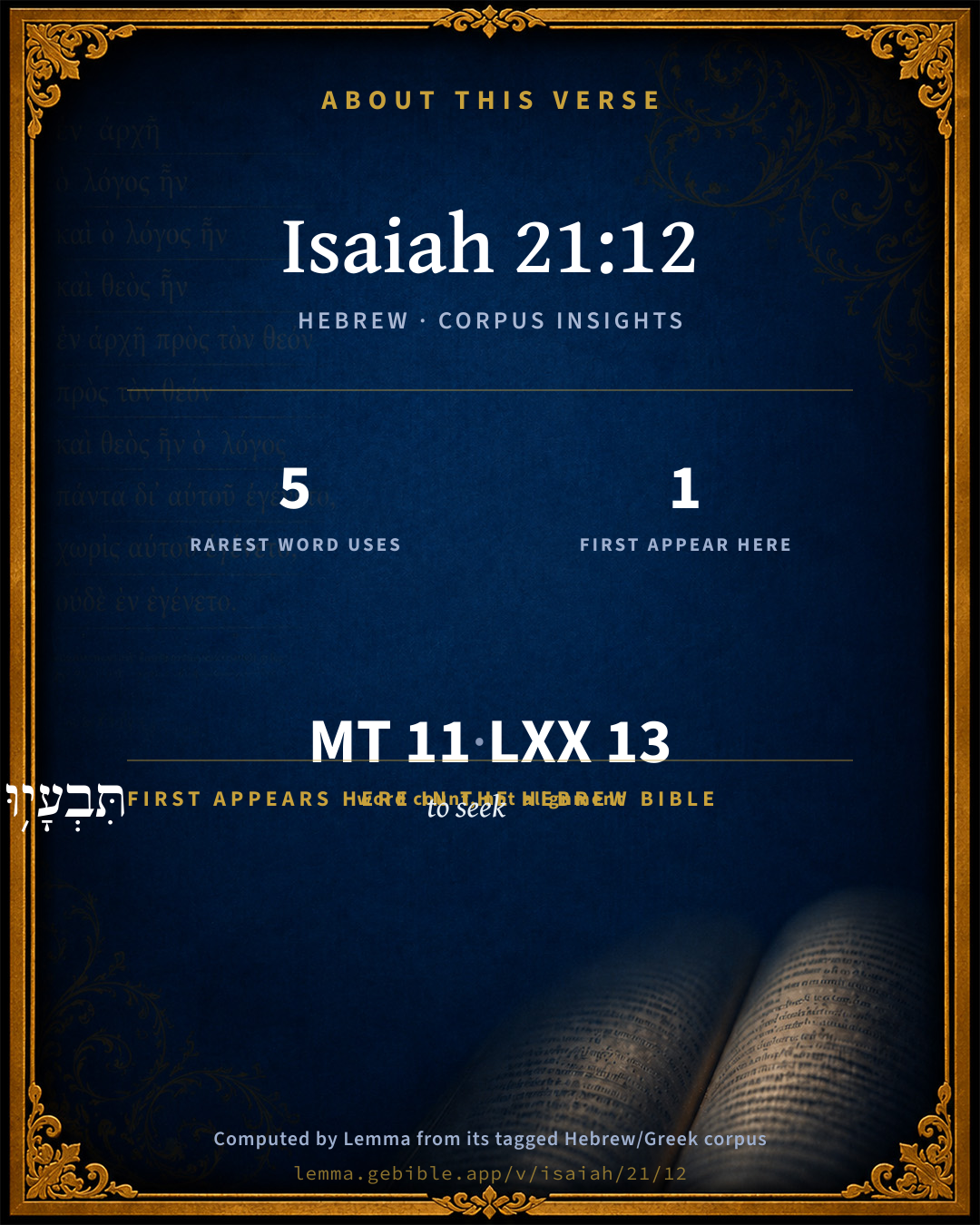
  • 1 first appearance in the Hebrew Bible
Full analysis ↓
Download a study sheet

One document with this verse’s original text, its word-by-word gloss line, the meaning frame, cross-references with their text, attributed commentary, and full source and license credits — printable, and it pastes into notes with its structure intact.

This verse Autodidact and up

Study sheet (.html) Plain text (.txt)

A passage Seminary Student

Up to 50 verses in one chapter. A passage sheet keeps up to 6 commentary sources and 12 cross-references per verse, in the order this page ranks them, and says so on the sheet whenever that leaves anything out. Ask for a single verse and you get the Autodidact verse sheet above.

Everything on this page stays free to read, with no account — the sheet is a download of what is already on screen, not access to it.

Want to remove ads? Support Godless Engineer
Compare translations 3

The same verse in 3 English versions, stacked beneath the original-language interlinear above. Click any original word for its lexicon entry.

Each is an independent rendering of the whole verse — the interlinear is not word-aligned to these translations.

Highlighted words mark where these versions differ — a whole-verse word diff, not a word-by-word alignment.

  • World English Bible Public Domain
    The watchman said, "The morning comes, and also the night. If you will inquire, inquire. Come back again."
  • King James Version Public Domain
    The watchman said, The morning cometh, and also the night: if ye will enquire, enquire ye: return, come.
  • unfoldingWord Literal Text CC BY-SA 4.0
    The watchman said, “Morning comes, and also night. If you would inquire, inquire; return, come.” p

unfoldingWord Literal Text — © unfoldingWord, licensed CC BY-SA 4.0. Word-aligned USFM3 via Door43 (git.door43.org/unfoldingWord/en_ult).

Versions to compare (up to 4)

3 of 4 selected

Show all 18 translations

Every available English version of this verse, each an independent rendering of the whole verse.

  • World English Bible Public Domain
    The watchman said, "The morning comes, and also the night. If you will inquire, inquire. Come back again."
  • Berean Standard Bible Public Domain
    The watchman replies, “Morning has come, but also the night. If you would inquire, then inquire. Come back yet again.”
  • Majority Standard Bible Public Domain
    The watchman replies, “Morning has come, but also the night. If you would inquire, then inquire. Come back yet again.”
  • King James Version Public Domain
    The watchman said, The morning cometh, and also the night: if ye will enquire, enquire ye: return, come.
  • American Standard Version (1901) Public Domain
    The watchman said, The morning cometh, and also the night: if ye will inquire, inquire ye: turn ye, come.
  • Revised Version (1885) Public Domain
    The watchman said, The morning cometh, and also the night: if ye will inquire, inquire ye: turn ye, come.
  • Geneva Bible (1599) Public Domain
    The watchman saide, The morning commeth, and also the night. If yee will aske, enquire: returne and come.
  • Douay-Rheims (1899) Public Domain
    The watchman said: The morning cometh, also the night: if you seek, seek: return, come.
  • Young's Literal Translation Public Domain
    The watchman hath said, `Come hath morning, and also night, If ye inquire, inquire ye, turn back, come.'
  • Literal Standard Version CC BY-SA 4.0
    The watchman has said, “Morning has come, and also night, || If you inquire, inquire, return, come.”
  • Unlocked Literal Bible CC BY-SA 4.0
    The watchman said, “The morning comes and also the night. If you want to ask, then ask; and come back again.”
  • unfoldingWord Literal Text CC BY-SA 4.0
    The watchman said, “Morning comes, and also night. If you would inquire, inquire; return, come.” p
  • Darby Bible Public Domain
    The watchman said, The morning cometh, and also the night: if ye will inquire, inquire; return, come.
  • World Messianic Bible Public Domain
    The watchman said, “The morning comes, and also the night. If you will inquire, inquire. Come back again.”
  • Webster's Bible Public Domain
    The watchman said, The morning cometh, and also the night: if ye will inquire, inquire ye: return, come.
  • Free Bible Version CC BY-SA 4.0
    The watchman replies, “Morning is coming, but the night is coming again soon. If you want to ask again, then come back and ask.”
  • Bible in Basic English Public Domain
    The watchman says, The morning has come, but night is still to come: if you have questions to put, put them, and come back again.
  • JPS Tanakh (1917) Public Domain
    The watchman said: 'The morning cometh, and also the night — if ye will inquire, inquire ye; return, come.'

Literal Standard Version (2020), Covenant Press — licensed CC BY-SA 4.0. Text via the HelloAO Bible API (eBible.org). Unlocked Literal Bible (unfoldingWord) — licensed CC BY-SA 4.0. Text via the HelloAO Bible API (eBible.org). unfoldingWord Literal Text — © unfoldingWord, licensed CC BY-SA 4.0. Word-aligned USFM3 via Door43 (git.door43.org/unfoldingWord/en_ult). Free Bible Version, Dr. Jonathan Gallagher — licensed CC BY-SA 4.0. Text via the HelloAO Bible API (eBible.org).

Word by word

More ways to search: Search by grammar → Find every occurrence → Compare this word →

Practice this passage: Drill this verse → Learn its vocabulary →

תִּבְעָי֥וּן
bâʻâh
H1158
“to seek”
Verb, Qal, Imperfect, 2nd Person, Masculine, Plural + Suffix, n
Part of Speech
Verb
Stem
Qal
Form
Imperfect
Person
2nd Person
Gender
Masculine
Number
Plural
Full BDB Definition

Origin: a primitive root

TWOT: 259

to seek out, swell, cause to swell, boil up, enquire - (Qal) - to seek, enquire - to cause to boil up - (Niphal) - to be searched out - to be swelling, bulging, swelling out
  1. אָמַ֣ר ʼâmar H559 “to say” Verb, Qal, Perfect, 3rd Person, Masculine, Singular
  2. שֹׁמֵ֔ר shâmar H8104 “keeping” Verb, Qal, Participle Active, Masculine, Singular, Absolute
  3. אָתָ֥ה ʼâthâh H857 “to come” Verb, Qal, Perfect, 3rd Person, Masculine, Singular
  4. בֹ֖קֶר bôqer H1242 “morning” Noun, Common, Masculine, Singular, Absolute
  5. וְגַם gam H1571 “and · also” Conjunction + Particle, Accusative
  6. לָ֑יְלָה layil H3915 “night” Noun, Common, Masculine, Singular, Absolute
  7. אִם ʼim H518 “if” Conjunction
  8. בְּעָ֖יוּ bâʻâh H1158 “seek” Verb, Qal, Imperative, 2nd Person, Masculine, Plural
  9. שֻׁ֥בוּ shûwb H7725 “return” Verb, Qal, Imperative, 2nd Person, Masculine, Plural
  10. אֵתָֽיוּ ʼâthâh H857 “come” Verb, Qal, Imperative, 2nd Person, Masculine, Plural

About this verse

These counts appear in no published source. They are computed here, from the morphology-tagged text and Lemma’s own curated glosses. What Lemma adds →

11
words
9
distinct lemmas
Prophets
section

Notable vocabulary

The rarest word here is תִּבְעָי֥וּן to seek H1158 — appearing just 5 times in the whole Hebrew Bible.

First appearance in Scripture

This word makes its first canonical appearance in the Hebrew Bible here:

  • תִּבְעָי֥וּן to seek H1158

Shared distinctive vocabulary

תִּבְעָי֥וּן to seek H1158 occurs in 4 verses of the Hebrew Bible. Also found in:

Grammatical profile

  • 7 verbs
  • 2 nouns
  • 1 conjunction
  • 1 particle

Verb forms

  • אָמַ֣ר Qal · Perfect
  • שֹׁמֵ֔ר Qal · Participle Active
  • אָתָ֥ה Qal · Perfect
  • תִּבְעָי֥וּן Qal · Imperfect
  • בְּעָ֖יוּ Qal · Imperative
  • שֻׁ֥בוּ Qal · Imperative
  • אֵתָֽיוּ Qal · Imperative

Repetition

Words recur within this verse — often emphatic in Hebrew:

  • אָתָ֥ה to come H857 ×2
  • תִּבְעָי֥וּן to seek H1158 ×2

Hebrew & Septuagint length

In English translation the verse runs 18 words from the Hebrew and 17 from the Septuagint (LXX English) — closely comparable.

A rough comparison of the two English renderings, which tokenize alike — not a word-level alignment.

Word counts can differ between the Hebrew and the Greek without any difference in meaning — e.g. the Hebrew direct-object marker אֵת has no separate Greek word, and Greek often adds the article ὁ.

In the original languages it is 11 Hebrew tokens and 13 Greek tokens — but the two are counted differently (Hebrew bundles its prefixes and suffixes into one token; the Greek is in lemma form), so that isn’t a like-for-like length.

Cross-references

12

Topical passages linked to Isaiah 21:12 in the Treasury of Scripture Knowledge — connected by theme and wording, ordered by reader-vote popularity; previews shown in the World English Bible.

  • Acts 17:30–32 The times of ignorance therefore God overlooked. But now he commands that all people everywhere should repent,
  • Acts 2:37–38 Now when they heard this, they were cut to the heart, and said to Peter and the rest of the apostles, "Brothers, what shall we do?"
  • Isaiah 17:14 At evening, behold, terror; [and] before the morning they are no more. This is the portion of those who despoil us, and the lot of those who rob us.
  • Isaiah 55:7 let the wicked forsake his way, and the unrighteous man his thoughts; and let him return to Yahweh, and he will have mercy on him; and to our God, for he will abundantly pardon.
  • Jeremiah 42:19–22 Yahweh has spoken concerning you, remnant of Judah, Don't you go into Egypt: know certainly that I have testified to you this day.
  • Ezekiel 7:5–7 Thus says the Lord Yahweh: An evil, an only evil; behold, it comes.
  • Ezekiel 7:10 Behold, the day, behold, it comes: your doom is gone forth; the rod has blossomed, pride has budded.
  • Ezekiel 7:12 The time is come, the day draws near: don't let the buyer rejoice, nor the seller mourn; for wrath is on all the multitude of it.
  • Ezekiel 14:1–6 Then came certain of the elders of Israel to me, and sat before me.
  • Ezekiel 18:30–32 Therefore I will judge you, house of Israel, everyone according to his ways, says the Lord Yahweh. Return you, and turn yourselves from all your transgressions; so iniquity shall not be your ruin.
  • Acts 17:19–20 They took hold of him, and brought him to the Areopagus, saying, "May we know what this new teaching is, which is spoken by you?
  • Jeremiah 50:27 Kill all her bulls; let them go down to the slaughter: woe to them! for their day is come, the time of their visitation.

Cross-references courtesy of OpenBible.info (CC BY 4.0).

Hebrew and Greek witnesses Masoretic Hebrew ↔ Greek Septuagint

The same verse in the two great witnesses to the Old Testament, shown verse-for-verse.

These are two independent witnesses, not word-aligned to each other, and the Septuagint is shown in lemma (dictionary) form.

Hebrew Isaiah 21:12 Masoretic · Westminster Leningrad Codex

אָמַ֣ר שֹׁמֵ֔ר אָתָ֥ה בֹ֖קֶר וְגַם לָ֑יְלָה אִם תִּבְעָי֥וּן בְּעָ֖יוּ שֻׁ֥בוּ אֵתָֽיוּ

The watchman said, "The morning comes, and also the night. If you will inquire, inquire. Come back again."

World English Bible · Public Domain

Greek LXX Isaiah 21:12 Septuagint · lemma form

φυλάσσω ὁ πρωί καί ὁ νύξ ἐάν ζητέω ζητέω καί παρά ἐγώ οἰκέω

I watch in the morning and the night: if you would enquire, enquire, and dwell by me.

LXX2012 (modern English Septuagint) · Public Domain

Hebrew: Westminster Leningrad Codex (CC BY 4.0). Greek: Septuagint (public domain); English from LXX2012 (modern English Septuagint) (Public Domain). How the Septuagint differs from the Hebrew →

Targum (Aramaic paraphrase)

1

The Targum is the ancient Jewish Aramaic paraphrase of the Hebrew Scriptures — an interpretive translation, not the Hebrew text itself. Onkelos (literal) and Pseudo-Jonathan (expansive) render the Torah, and Jonathan the Prophets. Coverage is partial: where no permissively-licensed English translation exists for a verse, only the Aramaic is shown. This is verse-level text, not a word-by-word alignment to the Hebrew.

  1. Targum Jonathan Prophets (Joshua–Malachi)
    אֲמַר נְבִיָא אִית אֲגַר לְצַדִיקַיָא וְאִית פּוּרְעֲנוּת לְרַשִׁיעַיָא אִם תַּיְבִין אַתּוּן תּוּבוּ עַד דְאַתּוּן יָכְלִין לְמֵגָתָב:

    The prophet said, there is a reward to the righteous, and there is punishment to the wicked: if ye will repent, repent ye, whilst ye are able to repent.

    Targum Jonathan — Aramaic: “Mikraot Gedolot” (public domain). English: “Sefaria Community Translation” (CC0 1.0 (public-domain dedication)); “London "Chaldee Paraphrase," 1871” (public domain). Text via Sefaria.

Commentary

Notes on Isaiah 21:12 from classic Christian and Jewish commentators (each source and its license shown beneath its notes). The classic Christian expositions comment on the surrounding passage and are grouped to its opening verse, so a note may address several verses; the Jewish commentaries on the Tanakh (Rashi and others) are per-verse, so they appear only where the commentator wrote on this verse.

Lemma curates 59 commentaries, every one of them public domain or Creative Commons licensed, each selected and text-cleaned for this edition rather than reprinted as found. About our sources →

Trapp's Complete Commentary

John Trapp

Isa 21:12 The watchman said, The morning cometh, and also the night: if ye will enquire, enquire ye: return, come.

Ver. 12. The watchman said, The morning cometh, and also the night.] This is a short and sharp answer - q.d., say it be yet morning with you and clear day; yet, as sure as the night followeth the day, a change will come such as whereof you shall have small comfort. {a}

If ye will inquire,] sc., Of the Lord by me, whom you call watchman, in disdain; but I profess myself to be so - that is, to be a prophet, and do take it for an honour.

Inquire ye.] Do it seriously, and not sarcastically. "Be not ye mockers, lest your bonds be increased." {Isa 28:22}

Return.] To God by true repentance.

Come.] Come over to us who are his people. And all this is delivered by an elegant Asyndeton {b} in short and quick terms, importing that haste must be made if the aforementioned danger shall be prevented. Habent aulae suum cito, cito; they must be nimble that shall find favour in the court of heaven. It is an unsafe thing always to begin to live. How many are taken away in their offers and essays before they have prepared their hearts to cleave to God! Castigemus ergo mores et moras. Up, therefore, and be doing, that the Lord may be with you.

{a} Non omnium dierum sol occidit. Nescis quid serus vesper vebat.

b} A rhetorical figure which omits the conjunction.

John Trapp, A Commentary or Exposition upon All the Books of the Old and New Testament (1647–1656) — public domain. Text from a community e-Sword module.

Tyndale Open Study Notes

Tyndale Open Resources

21:12 Morning is coming, but it would mark the beginning of another oppressive era. Because the Babylonians were on the horizon, night will soon return.

Tyndale Open Study Notes — © Tyndale Open Resources, licensed CC BY-SA 4.0. Text via the HelloAO Bible API.

Geneva Bible (1599)

Geneva Bible translators

He describeth the unquietness of the people of Dumah, who were night and day in fear of their enemies, and ever ran to and fro to inquire news.

Geneva Bible (1599) marginal notes — public domain. Text via Bolls.life.

Jamieson, Fausset & Brown

Robert Jamieson, A. R. Fausset & David Brown

Reply of the prophet, The morning (prosperity) cometh, and (soon after follows) the night (adversity). Though you, Idumeans, may have a gleam of prosperity, it will soon be followed by adversity again. Otherwise, as BARNES, "Prosperity cometh (to the Jews) to be quickly followed by adversity (to you, Idumeans, who exult in the fall of Jerusalem, have seized on the southern part of their land in their absence during the captivity, and now deride them by your question)" (Isa 34:5-7). This view is favored by Oba 1:10-21.

if ye will inquire, inquire--If ye choose to consult me again, do so (similar phrases occur in Gen 43:14; Kg2 7:4; Est 4:16).

return, come--"Be converted to God (and then), come" [GESENIUS]; you will then receive a more favorable answer.

Probably in the wars between Assyria and Egypt; Idumea and Arabia lay somewhat on the intermediate line of march.

Jamieson, Fausset & Brown — Commentary Critical and Explanatory on the Whole Bible (1871) — public domain (CC PDM 1.0). Text via the HelloAO Bible API.

Ellicott's Commentary for English Readers

(12) If ye will enquire . . .—The words pre-suppose a craving to know the meaning of the mysterious oracle just given. The prophet declines to answer. If they like to ask, they may, and return and go back after a bootless journey. Some interpreters, however. have seen in the “return” a call to repentance like that conveyed by the same word in Jer_3:22, but hardly on sufficient grounds. We should, in that case, have expected “return to Jehovah.”

A Bible Commentary for English Readers, edited by Charles John Ellicott (1878–1897) — public domain. Text from a community e-Sword module.

The Cambridge Bible for Schools and Colleges

gen. ed. J. J. S. Perowne

12. The morning cometh, and also the night] The watchman’s answer is designedly obscure. It may mean either that the seer has obtained no clear vision of the destiny in store for Edom; or that he foresees a transient gleam of prosperity to be followed by a new night of distress; or that hope is dawning for some and gloom settling down on others.

if ye will inquire …] The answer is not final; another time the purpose of Jehovah may be more clearly indicated, if Edom earnestly desires to know it. For return, come render with R.V. marg. come again. It is impossible to suppose that “return” is used in the sense of “be converted to the worship of Jehovah.” The words for “cometh,” “inquire” (twice) and “come” are Aramaic.

The Cambridge Bible for Schools and Colleges (gen. ed. J. J. S. Perowne; Cambridge University Press, 1878–1918) — public domain. Text from a community e-Sword module.

John Gill's Exposition

The watchman said, the morning cometh, and also the night,.... Not only a morning, but a night; and as sure as the morning comes, so shall the night; there wilt be a constant succession of morning and night; as a morning of prosperity, so a night of adversity: the morning of the Gospel dispensation was coming on, or of Christ's coming in the flesh, which was attended with joy and cheerfulness; like the morning, it dispersed the shadows of the law, introduced light, which gradually and irresistibly spread itself over the Gentile world; but then followed a night of darkness to the Jews, blindness happened to them, which still continues; and to the Arabians, Saracens, and Turks, when the bottomless pit was opened by Mahomet, which let out smoke and locusts in the eastern part of the world; and to the western part, when the Romish antichrist established himself as universal bishop: a morning came on again at the Reformation, and a night will follow, which is now begun; it is already a time of darkness, coldness, sleepiness, and of error and heresy, which will issue in an eventide, in a dark night: if it be asked what time it is with us, or how far we are gone toward the night? the answer is, we are in and toward the close of the Sardian church state; we are in the twilight, or in that part of time which is neither day nor night, Zac 14:6 the slaying of the witnesses is yet to come, which, with the general spread of Popery all over Christendom, will make it entire night; after which will come on the morning of the spiritual reign of Christ, when the light of the Gospel will be spread everywhere, and joy and gladness will attend the saints in all places; and it will be a time of great prosperity, both spiritual and temporal; which will be succeeded by another night of coldness, deadness, and carnal security, and will last till the second and personal coming of Christ; which will bring on the morning of a glorious resurrection to the saints, after which there will be no more night to them, though there will be an eternal one to the wicked. The Targum is,

"the prophet said, there is a reward for the righteous, and punishment for the wicked;''

and so the Jews elsewhere (d) interpret it of the morning of redemption to the righteous, and of the night of darkness to the wicked; or, as they sometimes express it (e), the morning is for the righteous, and the night for the wicked; the morning for Israel, and the night for the nations of the world. Dumah they sometimes (f) make to be the angel appointed over spirits, who they suppose gather together, and say to him, "watchman", &c.

if ye will inquire, inquire ye; seriously and in good earnest, diligently and constantly, with all humility and reverence, by prayer to God and by searching the Scriptures, and by application to the watchmen, the ministers of the word, who make it their business to study it, and have the mind of Christ:

return, come; return by repentance, and come to God, who receives backsliders, heals their backslidings, and loves them freely; or, "come again", to the watchman, and to the Lord, and renew your inquiries till you get satisfaction.

(d) Gloss. in T. Bab. Sanhedrin, fol. 94. 1. & in Bava Kama fol, 3. 2. (e) T. Hieros. Taaniot, fol. 64. 1. & Kimchi in loc. (f) T. Bab. Sanhedrin, fol. 94. 1.

John Gill's Exposition of the Whole Bible (1746–1763) — public domain (CC PDM 1.0). Text via the HelloAO Bible API.

Albert Barnes' Notes on the Bible

The watchman said - Or rather “saith;” indicating that this is the answer which the prophet returned to the inquiry from Idumea.

The morning cometh - There are signs of approaching day. The ‘morning’ here is an emblem of prosperity; as the light of the morning succeeds to the darkness of the night. This refers to the deliverance from the captivity of Babylon, and is to be supposed as having been spoken near the time when that captivity was at an end - or nearly at break of day after the long night of their bondage. This declaration is to be understood as referring to a different people from those referred to in the expression which immediately follows - ‘and also the night.’ ‘The morning cometh’ - to the captive Jews; ‘and also the night’ - to some other people - to wit, the Idumeans. It “might” mean that the morning was to be succeeded by a time of darkness to the same people; but the connection seems to demand that we understand it of others.

And also the night - A time of calamity and affliction. This is emphatic. It refers to the Idumeans. ‘The morning cometh to the captive Jews; it shall be closely succeeded by a night - a time of calamity - to the taunting Idumeans.’ During the captivity of the Jews in Babylon, the Idumeans invaded and took possession of the southern part of Judea. The prophet here refers to the fact, perhaps, that on the return of the Jews to their native land, they would revenge this by expelling them, and by inflicting punishment on the land of Edom. For a full proof that calamities came upon the land of Idumea, see Keith “On the Prophecies.” Art. “Idumea,” and the notes at Isa. 34)

If ye will inquire, inquire ye - If you choose to ask anything further in regard to this, you can. The sense is probably this: ‘You Idumeans have asked respecting the night in derision and reproach. An answer has been given somewhat agreeably to that inquiry. But if you seriously wish to know anything further respecting the destiny of your land, you can ask me (Isaiah) or any other prophet, and it will be known. But ask it in seriousness and earnestness, and with a suitable regard for the prophetic character and for God. And especially if you wish a more favorable answer to your inquiries, it is to be obtained only by forsaking sin and turning to God, and then you may come with the hope of a brighter prospect for the future.’ The design of this is, therefore:

(1) to “reprove” them for the manner in which they had asked the question;

(2) to assure them that God was willing to direct humble and serious inquirers; and

(3) to show in what way a favorable answer could be obtained - to wit, by repentance. And this is as true of sinners now as it was then. “They” often evince the reproachful and taunting spirit which the Idumeans did. “They” hear only a similar response - that prosperity and happiness await the Christian, though now in darkness and affliction; and that calamity and destruction are before the guilty. They “might” have the same answer - an answer that God would bless them and save them, if they would inquire in a humble, serious, and docile manner.

Return - Turn from your sins; come back to God, and show respect for him and his declarations.

Come - “Then” come and you shall be accepted, and the watch man will also announce “morning” as about to dawn on you. This seems to be the sense of this very dark and difficult prophecy. It is brief, enigmatical, and obscure. Yet it is beautiful; and if the sense above given be correct, it contains most weighty and important truth - alike for the afflicted and persecuted friends, and the persecuting and taunting foes of God. With reference to the interpretation here proposed, which supposes, as will have been seen:

(1) a state of excited feeling on the part of the Jews toward the Idumeans, for the part which they took in the destruction of their city;

(2) the prospect of speedy deliverance to the Jews in Babylon; and

(3) a consequent desolation and vengeance on the Idumeans for the feelings which they had manifested in the destruction of Jerusalem, see the prophecy of Obadiah, Oba 1:8-21 :

Shall I not in that day, saith the Lord,

Even destroy the wise men out of Edom,

And understanding out of the mount of Esau?

And thy mighty men, O Teman, shall be dismayed,

To the end that every one of the mount of Esau

May be cut off by slaughter.

For thy violence against thy brother Jacob shame shall cover thee,

And thou shalt be cut off for ever.

In the day that thou stoodest on the other side;

In the day that the stranger carried away captive his forces;

And foreigners entered into his gates, and cast lots upon Jerusalem;

Even thou wast as one of them.

But thou shouldest not have looked on the day of thy brother

In the day that he became a stranger;

Neither shouldest thou have rejoiced over the children of Judah

In the day of their destruction;

Neither shouldest thou have spoken proudly in the day of distress.

For the day of the Lord is near upon all the heathen;

As thou hast done, it shall be done unto thee;

Thy reward shall return upon thine own head, etc.

In this prophecy these circumstances are all to be found;

(1) the hostility of the Edomites against Jerusalem, and the part which they took in the destruction of the city, in Isa 21:10-14;

(2) the fact of the deliverance of the Jews from captivity, in Isa 22:17;

(3) the consequent vengeance upon the Idumeans Isa 34:5-6.

This remarkable coincidence in an independent prophecy is a strong circumstance to prove that the interpretation above proposed is correct. In regard to the general reasons for the interpretation here proposed, and the lessons which the prophecy is suited to convey, I may be permitted to refer to my “Practical Sermons,” pp. 325-341.

Albert Barnes' Notes on the Bible (1834–1885) — public domain. Text from a community e-Sword/MySword module.

Haydock's Catholic Bible Commentary

Night. Instead of joy, I must announce dreadful things. (Haydock)

George Leo Haydock (1774–1849), Haydock's Catholic Family Bible and Commentary, 1859 edition — public domain. Excludes Psalms (Douay-Rheims chapter numbering differs from Protestant) and Deuterocanonical books (Catholic canon only).

Matthew Poole's English Annotations

The morning cometh, and also the night: the night is past without any great mischief to you, and the comfortable light of the morning is approaching, which freeth men’s minds from the terrors of the night; but although the morning be coming, it will be gone, and the night will return, and your fears with it. The night seems to be here taken properly, as the morning is; yet so that he alludes to the metaphorical signification of the word, and intimates that the night of affliction was coming upon them.

If ye will inquire, inquire ye: return, come. If this watchman be the prophet Isaiah, then the sense of these words is this, If you will be inquiring, inquire sincerely and seriously of God, by me, concerning your danger, and the way to prevent it; return unto the Lord by true repentance, who alone can secure you, and come unto me for direction. But if it be their own watchman, which, with submission, I conceive most probable, the sense is, If you will inquire, inquire: I perceive, by what I have observed this night, that your danger is not passed, and there will be occasion for further inquiries from time to time; and therefore return, come, i.e. either return to them that sent you with this message, and then come to me for further tidings; or come again, as return, lie down, is put for lie down again, 1Sa 3:5; come to me the next morning, as you have reason to do, and so from morning to morning, for I see every night is likely to bring some evil tidings to you.

Matthew Poole's English Annotations on the Holy Bible (1683–1685) — public domain. Text from a community e-Sword/MySword module.

The Pulpit Commentary

The morning cometh, and also the night. An oracular reply, but probably meaning

(1) that a brighter time would soon dawn upon the Edomite people; and

(2) that this brighter time would be followed by a return of misery and affliction. We may (conjecturally) understand the "morning" of the earlier part of Sennacherib"s reign, when Edom was at peace with Assyria, merely paying a moderate tribute (G. Smith, "Eponym Canon," p. 132), and the "night" of the later period in the same king"s reign, when (about B.C. 694-690) the country suffered from another Assyrian invasion, in which the king"s treasures and his gods were carried off to Nineveh (ibid., p. 137). If ye will inquire, inquire ye; return, come. Some take this very literally, as meaning, If ye would inquire further into the meaning of this answer, do so; return to me; come again." But this implies that the Edomites had sent an actual messenger to make the inquiry of ver. 5, which is improbable. Others understand a reproach to Edom: "If ye will have recourse to God in the time of trouble, do so; but then do more return to him altogether; come, and be one with Judah."

The Pulpit Commentary (1880–1919), ed. H.D.M. Spence-Jones & Joseph S. Exell — public domain. Text from a community e-Sword module.

John Wesley's Explanatory Notes

The night - The night is past without any mischief, and the light of the morning is approaching; but tho' the morning is coming, it will be gone, and the night will return, and your fears with it. Come - If you will inquire, inquire: I perceive your danger is not past, and there will be occasion for farther enquiries. Therefore return, come - Come to me the next morning, and so from morning to morning.

John Wesley, Explanatory Notes Upon the Whole Bible (1754–1765) — public domain. Text via the GEBible commentary corpus.

Keil & Delitzsch

C. F. Keil & F. Delitzsch

"Watchman says, Morning cometh, and also night. Will ye inquire, inquire! Turn, come!!" The answer is intentionally and pathetically expressed in an Aramaean form of Hebrew. אתא (written even with א at the end, cf., Deu 33:2) is the Aramaean word for בּוא; and בּעה בּעא) the Aramaean word for שׁאל, from the primary form of which (בּעי) the future tib‛âyūn is taken here (as in Isa 33:7), and the imperative be'ây (Ges. 75, Anm. 4). אתיוּ, which is here pointed in the Syriac style, אתיוּ, as in Isa 56:9, Isa 56:12, would be similarly traceable to אתי (cf., Ges. 75, Anm. 4, with 23, Anm. 2). But what is the meaning? Luther seems to me to have hit upon it: "When the morning comes, it will still be night." But v'gam (and also) is not equivalent to "and yet," as Schrring explains it, with a reference to Ewald, 354, a. With the simple connection in the clauses, the meaning cannot possibly be, that a morning is coming, and that it will nevertheless continue night, but that a morning is coming, and at the same time a night, i.e., that even if the morning dawns, it will be swallowed up again directly by night. And the history was quite in accordance with such an answer. The Assyrian period of judgment was followed by the Chaldean, and the Chaldean by the Persian, and the Persian by the Grecian, and the Grecian by the Roman. Again and again there was a glimmer of morning dawn for Edom (and what a glimmer in the Herodian age!), but it was swallowed up directly by another night, until Edom became an utter Dūmâh, and disappeared from the history of the nations. The prophet does not see to the utmost end of these Edomitish nights, but he has also no consolation for Edom. It is altogether different with Edom from what it is with Israel, the nocturnal portion of whose history has a morning dawn, according to promise, as its irrevocable close. The prophet therefore sends the inquirers home. Would they ask any further questions, they might do so, might turn and come. In shūbū (turn back) there lies a significant though ambiguous hint. It is only in the case of their turning, coming, i.e., coming back converted, that the prophet has any consolatory answer for them. So long as they are not so, there is suspended over their future an interminable night, to the prophet as much as to themselves. The way to salvation for every other people is just the same as for Israel - namely, the way of repentance.

Keil & Delitzsch — Biblical Commentary on the Old Testament (1861–1891) — public domain (CC PDM 1.0). Text via the HelloAO Bible API. (Old Testament only.)

J. A. Alexander on Isaiah

Joseph Addison Alexander

“The watchman says, Morning comes and also night; if ye will inquire, inquire; return, come.” Most writers understand this as relating to different subjects, morning comes (to one) and night (to another); which would seem to mean that while the Jewish night was about to be dispelled, that of Edom or Arabia should still continue. But connected as the words are with the foregoing prophecy, it is far more natural to understand them as referring to the Babylonian conquest of Judea and the neighboring countries. The last clause intimates that the event was still uncertain. If you wish to know you must inquire again; you are come too soon; the time of your deliverance is not at hand; return or come again. On any hypothesis, however, these two verses still remain enigmatical and doubtful in their meaning.

Joseph Addison Alexander, The Prophecies of Isaiah (1846–1847; New York: Scribner, 1870–1878) — public domain. Text from a community e-Sword module.

Rashi

Rabbi Shlomo Yitzchaki (Rashi)

Said the watchman The Holy One, blessed be He.

Morning has come I have the ability to make the morning shine for you.

and also night is prepared for the wicked at the time of the end.

if you will request, request If you make your request to hasten the end of the exile.

return and come in repentance.

Rashi on the Tanakh — English translations: “The Judaica Press complete Tanach with Rashi, translated by A. J. Rosenberg” (CC BY 4.0); “Pentateuch with Rashi's commentary by M. Rosenbaum and A.M. Silbermann, 1929-1934” (public domain); “The Metsudah Tanach series, Lakewood, N.J” (CC BY 4.0); and “The Book of Joshua, Metsudah Publications, 1997” (CC BY 4.0). Text via Sefaria.

Ibn Ezra

Rabbi Abraham ibn Ezra

Morning hath come, and also the night. Many mornings and nights have passed, and you, O Seirites—for you are one of them—did not come against us to war.

תבעיון Ye wish. The root בעה to wish, to enquire, is of Chaldaic origin; the third letter of the root is here fully written, י being substituted for ה. The same is the case in בְּעָיוּ wish ye, which is like שְׁלָחוּ send (2 Kings 2:17). The meaning of the whole phrase is: If you wish to come, do so.

Return to those that sent you, and come all together.

אתיו Come. The word is irregular, the regular form is אְַתוּ; the א has a Zere, here, in אֵתָיוּ by Zere. probably because of its guttural character.

By the watchman, the chief of the country is perhaps meant; for there are many chiefs that cannot endure hardship, and prefer to surrender their country.

Ibn Ezra on the Tanakh — English translations: “Sefaria Community Translation” (CC0 1.0 (public-domain dedication)); “Yalkut, Sifsei Chachomim Chumash, Metsudah Publications, 2009” (CC BY 4.0); and “Commentary of Ibn Ezra on Isaiah - trans. by M. Friedlander, 1873” (public domain). Text via Sefaria.

Lesson kit

Teaching starters — assembled from the data on this page, not authored interpretation. Every prompt links to the verse data it draws on. Edit before teaching.

Isaiah, in the Prophets, opens this verse with 11 words (9 distinct Hebrew lemmas). Its most distinctive word is bâʻâh (“to seek”). A historical commentator’s framing appears above. Read the whole chapter for the surrounding context.

Discussion questions

  1. How does “to seek” (bâʻâh) shape what this verse is saying?
  2. This is the first place “to seek” appears in Scripture (first appears here). What does its debut here establish?
  3. How does Isaiah 30:13, which shares the word «to seek», read alongside this verse?
  4. What does the repetition of “to come” (2× in this one verse) do in this verse?
  5. These translations render this verse differently. What is at stake in choosing one wording over another?
  6. «אָמַ֣ר» is a Qal Perfect verb. How does that grammatical form shape the action described?
  7. Compare how Trapp's Complete Commentary and Tyndale Open Study Notes read this verse. Where do they agree or differ?

Things to notice

Reading settings

Reading text

Shown beneath each verse's original-language words.

Old Testament
Old Testament edition

Read the OT as the Masoretic Hebrew (MT) or the Greek Septuagint (LXX).

English shown for the Greek Septuagint (in the Hebrew ↔ Greek comparison).

Comparing translations? Open the Compare panel on any verse page to stack up to four side by side.