
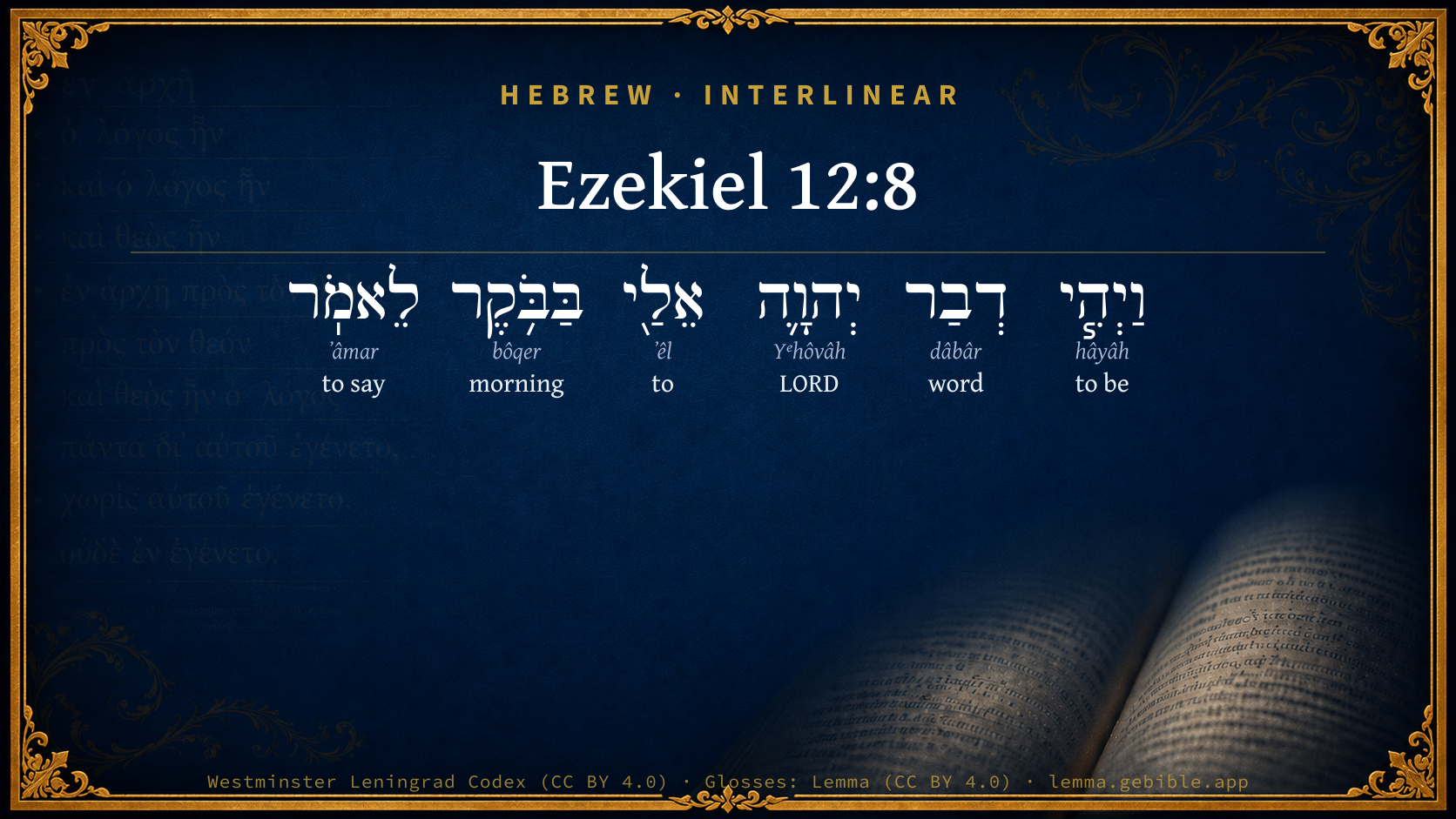
Ezekiel 12:8

Hebrew (Westminster Leningrad Codex) Ezekiel 12:8 appears in the Hebrew Old Testament. The text above is from the Westminster Leningrad Codex. Each word links to its Strong’s number, a concise gloss, and parsing drawn from the Open Scriptures Hebrew Bible morphology. Click any word for its full Brown-Driver-Briggs (BDB) entry.
Download image
Cite this verse

Ezekiel 12:8 (World English Bible). Public Domain. Lemma interlinear Bible study tool, https://lemma.gebible.app/v/ezekiel/12/8.

Show BibTeX & RIS
BibTeX
RIS
English Translation
In the morning came the word of Yahweh to me, saying,
World English Bible · Public Domain
Download a study sheet

One document with this verse’s original text, its word-by-word gloss line, the meaning frame, cross-references with their text, attributed commentary, and full source and license credits — printable, and it pastes into notes with its structure intact.

This verse Autodidact and up

Study sheet (.html) Plain text (.txt)

A passage Seminary Student

Up to 50 verses in one chapter. A passage sheet keeps up to 6 commentary sources and 12 cross-references per verse, in the order this page ranks them, and says so on the sheet whenever that leaves anything out. Ask for a single verse and you get the Autodidact verse sheet above.

Everything on this page stays free to read, with no account — the sheet is a download of what is already on screen, not access to it.

Want to remove ads? Support Godless Engineer
Compare translations 3

The same verse in 3 English versions, stacked beneath the original-language interlinear above. Click any original word for its lexicon entry.

Each is an independent rendering of the whole verse — the interlinear is not word-aligned to these translations.

Highlighted words mark where these versions differ — a whole-verse word diff, not a word-by-word alignment.

  • World English Bible Public Domain
    In the morning came the word of Yahweh to me, saying,
  • King James Version Public Domain
    And in the morning came the word of the LORD unto me, saying,
  • unfoldingWord Literal Text CC BY-SA 4.0
    Then the word of Yahweh came to me in the morning, saying,

unfoldingWord Literal Text — © unfoldingWord, licensed CC BY-SA 4.0. Word-aligned USFM3 via Door43 (git.door43.org/unfoldingWord/en_ult).

Versions to compare (up to 4)

3 of 4 selected

Show all 18 translations

Every available English version of this verse, each an independent rendering of the whole verse.

  • World English Bible Public Domain
    In the morning came the word of Yahweh to me, saying,
  • Berean Standard Bible Public Domain
    And in the morning the word of the LORD came to me, saying,
  • Majority Standard Bible Public Domain
    And in the morning the word of the LORD came to me, saying,
  • King James Version Public Domain
    And in the morning came the word of the LORD unto me, saying,
  • American Standard Version (1901) Public Domain
    And in the morning came the word of Jehovah unto me, saying,
  • Revised Version (1885) Public Domain
    And in the morning came the word of the LORD unto me, saying,
  • Geneva Bible (1599) Public Domain
    And in the morning came the word of the Lord vnto me, saying,
  • Douay-Rheims (1899) Public Domain
    And the word of the Lord came to me in the morning, saying:
  • Young's Literal Translation Public Domain
    And there is a word of Jehovah unto me, in the morning, saying,
  • Literal Standard Version CC BY-SA 4.0
    And there is a word of YHWH to me, in the morning, saying,
  • Unlocked Literal Bible CC BY-SA 4.0
    Then the word of Yahweh came to me in the morning, saying,
  • unfoldingWord Literal Text CC BY-SA 4.0
    Then the word of Yahweh came to me in the morning, saying,
  • Darby Bible Public Domain
    And in the morning the word of Jehovah came unto me, saying,
  • World Messianic Bible Public Domain
    In the morning, the LORD’s word came to me, saying,
  • Webster's Bible Public Domain
    And in the morning came the word of the LORD to me, saying,
  • Free Bible Version CC BY-SA 4.0
    In the morning a message from the Lord came to me, saying,
  • Bible in Basic English Public Domain
    And in the morning the word of the Lord came to me, saying,
  • JPS Tanakh (1917) Public Domain
    And in the morning came the word of the LORD unto me, saying:

Literal Standard Version (2020), Covenant Press — licensed CC BY-SA 4.0. Text via the HelloAO Bible API (eBible.org). Unlocked Literal Bible (unfoldingWord) — licensed CC BY-SA 4.0. Text via the HelloAO Bible API (eBible.org). unfoldingWord Literal Text — © unfoldingWord, licensed CC BY-SA 4.0. Word-aligned USFM3 via Door43 (git.door43.org/unfoldingWord/en_ult). Free Bible Version, Dr. Jonathan Gallagher — licensed CC BY-SA 4.0. Text via the HelloAO Bible API (eBible.org).

Word by word

More ways to search: Search by grammar → Find every occurrence → Compare this word →

Practice this passage: Drill this verse → Learn its vocabulary →

About this verse

These counts appear in no published source. They are computed here, from the morphology-tagged text and Lemma’s own curated glosses. What Lemma adds →

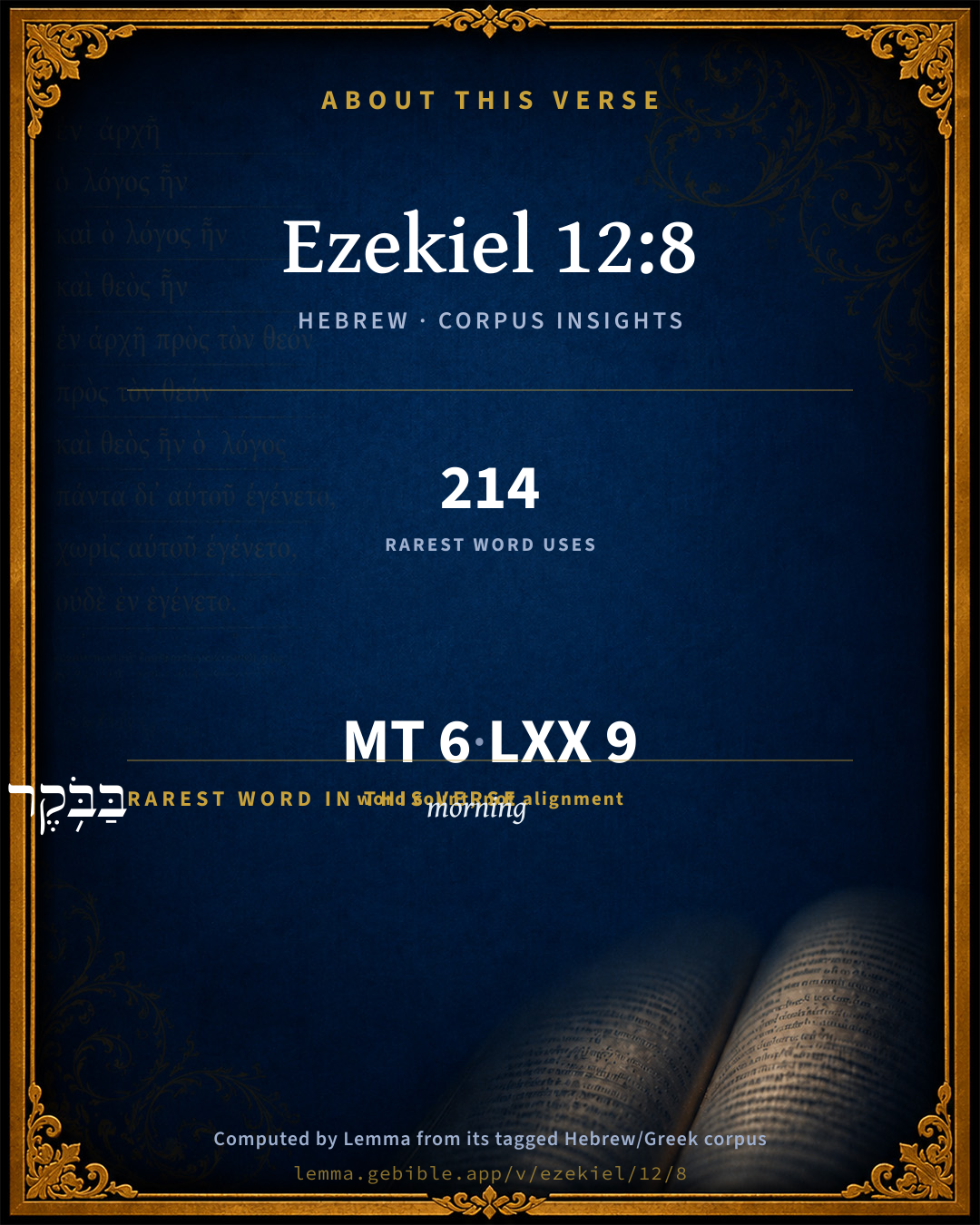
6
words
6
distinct lemmas
Prophets
section

Grammatical profile

  • 2 verbs
  • 3 nouns
  • 1 preposition

Verb forms

  • וַיְהִ֧י Qal · Sequential Imperfect
  • לֵאמֹֽר Qal · Infinitive Construct

Hebrew & Septuagint length

In English translation the verse runs 11 words from the Hebrew and 13 from the Septuagint (LXX English) — closely comparable.

A rough comparison of the two English renderings, which tokenize alike — not a word-level alignment.

Word counts can differ between the Hebrew and the Greek without any difference in meaning — e.g. the Hebrew direct-object marker אֵת has no separate Greek word, and Greek often adds the article ὁ.

In the original languages it is 6 Hebrew tokens and 9 Greek tokens — but the two are counted differently (Hebrew bundles its prefixes and suffixes into one token; the Greek is in lemma form), so that isn’t a like-for-like length.

Hebrew and Greek witnesses Masoretic Hebrew ↔ Greek Septuagint

The same verse in the two great witnesses to the Old Testament, shown verse-for-verse.

These are two independent witnesses, not word-aligned to each other, and the Septuagint is shown in lemma (dictionary) form.

Hebrew Ezekiel 12:8 Masoretic · Westminster Leningrad Codex

וַיְהִ֧י דְבַר יְהוָ֛ה אֵלַ֖י בַּבֹּ֥קֶר לֵאמֹֽר

In the morning came the word of Yahweh to me, saying,

World English Bible · Public Domain

Greek LXX Ezekiel 12:8 Septuagint · lemma form

καί γίγνομαι λόγος κύριος πρός ἐγώ ὁ πρωΐ λέγω

And the word of the Lord came to me in the morning, saying,

LXX2012 (modern English Septuagint) · Public Domain

Hebrew: Westminster Leningrad Codex (CC BY 4.0). Greek: Septuagint (public domain); English from LXX2012 (modern English Septuagint) (Public Domain). How the Septuagint differs from the Hebrew →

Targum (Aramaic paraphrase)

1

The Targum is the ancient Jewish Aramaic paraphrase of the Hebrew Scriptures — an interpretive translation, not the Hebrew text itself. Onkelos (literal) and Pseudo-Jonathan (expansive) render the Torah, and Jonathan the Prophets. Coverage is partial: where no permissively-licensed English translation exists for a verse, only the Aramaic is shown. This is verse-level text, not a word-by-word alignment to the Hebrew.

  1. Targum Jonathan Prophets (Joshua–Malachi)
    וַהֲוָה פִּתְגַם נְבוּאָה מִן קֳדָם יְיָ עִמִי בְצַפְרָא לְמֵימָר:

    (no public-domain English translation for this verse)

    Targum Jonathan — Aramaic: “Mikraot Gedolot” (public domain). English: “Sefaria Community Translation” (CC0 1.0 (public-domain dedication)); “London "Chaldee Paraphrase," 1871” (public domain). Text via Sefaria.

Commentary

Notes on Ezekiel 12:8 from classic Christian and Jewish commentators (each source and its license shown beneath its notes). The classic Christian expositions comment on the surrounding passage and are grouped to its opening verse, so a note may address several verses; the Jewish commentaries on the Tanakh (Rashi and others) are per-verse, so they appear only where the commentator wrote on this verse.

Lemma curates 59 commentaries, every one of them public domain or Creative Commons licensed, each selected and text-cleaned for this edition rather than reprinted as found. About our sources →

Trapp's Complete Commentary

John Trapp

Eze 12:8 And in the morning came the word of the LORD unto me, saying,

Ver. 8. And in the morning came the word of the Lord.] Mane, id est, mature. God not only betime, but timeously, admonished his people; but they refused to be reformed - would have none of his counsel.

John Trapp, A Commentary or Exposition upon All the Books of the Old and New Testament (1647–1656) — public domain. Text from a community e-Sword module.

Keil & Delitzsch

C. F. Keil & F. Delitzsch

Explanation of the Symbolical Action

Eze 12:8. And the word of Jehovah came to me in the morning, saying, Eze 12:9. Son of man, have they not said to thee, the house of Israel, the refractory generation, What art thou doing? Eze 12:10. Say to them, Thus saith the Lord Jehovah, This burden applies to the prince in Jerusalem, and to all the house of Israel to whom they belong. Eze 12:11. Say, I am your sign: as I have done, so shall it happen to them; into exile, into captivity, will they go. Eze 12:12. And the prince who is in the midst of them he will lift it upon his shoulder in the dark, and will go out: they will break through the wall, and carry it out thereby: he will cover his face, that he may not see the land with eyes. Eze 12:13. And I will spread my net over him, so that he will be caught in my snare: and I will take him to Babel, into the land of the Chaldeans; but he will not see it, and will die there. Eze 12:14. And all that is about him, his help and all his troops, I will scatter into all winds, and draw out the sword behind them. Eze 12:15. And they shall learn that I am Jehovah, when I scatter them among the nations, and winnow them in the lands. Eze 12:16. Yet I will leave of them a small number of men from the sword, from the famine, and from the pestilence; that they may relate all their abominations among the nations whither they have come; and learn that I am Jehovah. - As queries introduced with הלא have, as a rule, an affirmative sense, the words "have they not asked," etc., imply that the Israelites had asked the prophet what he was doing, though not in a proper state of mind, not in a penitential manner, as the epithet בּית plainly shows. The prophet is therefore to interpret the action which he had just been performing, and all its different stages. The words הנּשׂיא המּשּׂא הזּה, to which very different renderings have been given, are to be translated simply "the prince is this burden," i.e., the object of this burden. Hammassâ does not mean the carrying, but the burden, i.e., the threatening prophecy, the prophetic action of the prophet, as in the headings to the oracles (see the comm. on Nah 1:1). The "prince" is the king, as in Eze 21:30, though not Jehoiachin, who had been carried into exile, but Zedekiah. This is stated in the apposition "in Jerusalem," which belongs to "the prince," though it is not introduced till after the predicate, as in Gen 24:24. To this there is appended the further definition, "the whole house of Israel," which, being co-ordinated with הנּשׂיא, affirms that all Israel (the covenant nation) will share the fate of the prince. In the last clause of Eze 12:10 בּתוכם does not stand for בּתוכהּ, so that the suffix would refer to Jerusalem, "in the midst of which they (the house of Israel) are." אשׁר cannot be a nominative, because in that case המּה to be understood as referring to the persons addressed, i.e., to the Israelites in exile (Hitzig, Kliefoth): in the midst of whom they are, i.e., to whom they belong. The sentence explains the reason why the prophet was to announce to those in exile the fat of the prince and people in Jerusalem; namely, because the exiles formed a portion of the nation, and would be affected by the judgment which was about to burst upon the king and people in Jerusalem. In this sense Ezekiel was also able to say to the exiles (in Eze 12:11), "I am your sign;" inasmuch as his sign was also of importance for them, as those who were already banished would be so far affected by the departure of the king and people which Ezekiel depicted, that it would deprive them of all hope of a speedy return to their native land.

להם, in Eze 12:11, refers to the king and the house of Israel in Jerusalem. בּגולה is rendered more forcible by the addition of בּשּׁבי. The announcement that both king and people must go into exile, is carried out still further in Eze 12:12 and Eze 12:13 with reference to the king, and in Eze 12:14 with regard to the people. The king will experience all that Ezekiel has described. The literal occurrence of what is predicted here is related in Jer 39:1., Jer 52:4.; Kg2 25:4. When the Chaldeans forced their way into the city after a two years' siege, Zedekiah and his men of war fled by night out of the city through the gate between the two walls. It is not expressly stated, indeed, in the historical accounts that a breach was made in the wall; but the expression "through the gate between the two walls" (Jer 39:4; Jer 52:7; Kg2 25:4) renders this very probable, whether the gate had been walled up during the siege, or it was necessary to break through the wall at one particular spot in order to reach the gate. The king's attendants would naturally take care that a breach was made in the wall, to secure for him a way of escape; hence the expression, "they will break through." The covering of the face, also, is not mentioned in the historical accounts; but in itself it is by no means improbable, as a sign of the shame and grief with which Zedekiah left the city. The words, "that he may not see the land with eyes," do not appear to indicate anything more than the necessary consequence of covering the face, and refer primarily to the simple fact that the king fled in the deepest sorrow, and did not want to see the land; but, as Eze 12:13 clearly intimates, they were fulfilled in another way, namely, by the fact that Zedekiah did not see with his eyes the land of the Chaldeans into which he was led, because he had been blinded at Riblah (Jer 39:5; Jer 52:11; Kg2 25:7). לעין, by eye = with his eyes, is added to give prominence to the idea of seeing. For the same purpose, the subject, which is already implied in the verb, is rendered more emphatic by הוּא; and this הוּא is placed after the verb, so that it stands in contrast with הארץ. The capture of the king was not depicted by Ezekiel; so that in this respect the announcement (Eze 12:13) goes further than the symbolical action, and removes all doubt as to the credibility of the prophet's word, by a distinct prediction of the fate awaiting him. At the same time, his not seeing the land of Babylon is left so indefinite, that it cannot be regarded as a vaticinium post eventum. Zedekiah died in prison at Babylon (Jer 52:11). Along with the king, the whole of his military force will be scattered in all directions (Eze 12:14). עזרה, his help, i.e., the troops that break through with him. כּל־אגפּיו, all his wings (the wings of his army), i.e., all the rest of his forces. The word is peculiar to Ezekiel, and is rendered "wings" by Jos. Kimchi, like kenâphaim in Isa 8:8. For the rest of the verse compare Eze 5:2; and for the fulfilment, Jer 52:8; Jer 40:7, Jer 40:12. The greater part of the people will perish, and only a small number remain, that they may relate among the heathen, wherever they are led, all the abominations of Israel, in order that the heathen may learn that it is not from weakness, but simply to punish idolatry, that God has given up His people to them (cf. Jer 22:8).

Keil & Delitzsch — Biblical Commentary on the Old Testament (1861–1891) — public domain (CC PDM 1.0). Text via the HelloAO Bible API. (Old Testament only.)

John Calvin's Commentaries

We gather from these words of the Prophet, that he was himself derided when he began to migrate: then that he dug through the wall by night secretly, and thus carried away his baggage. For those who think that the Israelites enquired about this, as if it were unknown to them, do not sufficiently consider the Prophet’s words. For the repetition of the epithet rebellious house is not in vain; for if this question had proceeded from mere folly, God would not have called them rebellious. This epithet, then, refers to the present passage, and thus we may determine that the Israelites asked the Prophet deridingly, what does this mean? For he seemed to them to be trifling, and thus they jeered at him; for we know the audacity of the nation in despising their Prophets. It is not, then, to be wondered at, when they obtained a plausible ground for it, if they commented rather freely upon what the Prophet was doing. We said yesterday ‘that this seemed a childish spectacle. Hence the Israelites seemed, not without reason, to reject what the Prophet was doing as a thing of nought. But God does not suffer his servants to be reviled in this way. He now signified to the Prophet that his calling ought to be deservedly held sacred. Since therefore Ezekiel bore certain marks of the prophetic office, although at first sight his conduct could not appear serious, yet the people ought to have enquired modestly. For whatever we know to flow from God should be reverently received without controversy. But if there is any obscurity we may wonder and enquire into it; but as I have said, docility and modesty ought always to precede. But what did the Israelites do? they enquired, indeed, the meaning of the Prophet’s conduct, but only to reject it with ridicule. For this reason God is angry, and announces himself a severe avenger of that audacity, because they persecuted the sacred Prophet. Hence this must be read emphatically — what doest thou? as if they said that the Prophet was foolish, and carried and prepared his goods, and dug through the wall, in vain, since all these things were of no moment. But the answer, when it shows that God is greatly offended with such trifling, sufficiently demonstrates that they did not ask the question through ignorance, or want of thought, but through mere wantonness.

He now says, this prophecy relates to the prince, and the whole house of Israel which is in the midst of them. Without doubt he understands the king, as we shall soon see: nor does he speak of any king indefinitely, but points out Zedekiah, as will be immediately evident from circumstances. He says, therefore, this burden, or this sorrowful prophecy, looks towards the prince, and to the house of Israel, which dwell at Jerusalem. But it is probable that some had fled that they might not fall into the hands of the enemy, since Jerusalem was a safe receptacle for them. The captives thought themselves bad managers, because they had not followed those leaders, since Jerusalem was a safe refuge for them, and hence the greater sorrow at their captivity. Hence God pronounces that the Israelites were comprehended with their king in this prophecy. It is indeed true that this was a common name to all the posterity of Abraham; for the twelve tribes sprung from the patriarch Jacob, but it was then becoming customary for the ten tribes to retain the name of Israel, and for that of Judah to have their own proper and peculiar name. Afterwards he confirms his teaching, that he was as a sign to them. We explained this expression yesterday, showing how the Prophet was placed before them as a sign, so that God represented what was as yet unknown to them; for signs divinely sent are called portents, when they foretell what no one would expect to happen. God, indeed, often shows what he is going’ to do by many, yet ordinary signs; but an extraordinary one, which cannot be considered natural, is called a portent. So therefore the Prophet is ordered to say to the Israelites that he was to them for a wonder, namely, to reprove their obstinacy, which, as we have said, was the cause of their impious contempt. For it was no part of their religion for a Prophet to deride them, so that they should suppose him to be trifling with them, as if frightening children about nothing. God, therefore, that the Israelites might at length be roused up at his own time, pronounces his servant to be a wonder to them. And we gather from the reason which is added, what the name portent meant in yesterday’s lecture. For he says, as I have done, so shall it be done to you; that is, what you now think to be child’s play, shall be seriously fulfilled in yourselves. For the Prophet seemed to act a part, like a player, and on this account was derided. He now declares that it should not be fabulous, since the Israelites, who were left in Judea among the Jews, and the king himself, should not act a part; for God would compel them to collect their baggage, and to take flight by stealth in the darkness of the night, which he follows up through the whole verse. Into banishment and exile, says he, shall they go. When therefore the Prophet was commanded to collect and prepare his goods, he was a sign of the exile of which he now speaks. But the explanation of the second part is added.

John Calvin's Commentaries (1540-1563) — public domain. Text from the Calvin Translation Society English edition (1840s-50s) via the Christian Classics Ethereal Library (ccel.org). Calvin's coverage is partial (roughly two-thirds of the Bible); uncommented books and verses are honest gaps, never fabricated. The 19th-century editor's footnotes and remarks are omitted so the notes are faithfully Calvin's own voice.

Ellicott's Commentary for English Readers

(8) In the morning.—This implies that the foregoing symbolical action was actually performed, since the Divine message comes in answer to the inquiry of the people (Eze_12:9), “What doest thou?”

A Bible Commentary for English Readers, edited by Charles John Ellicott (1878–1897) — public domain. Text from a community e-Sword module.

The Cambridge Bible for Schools and Colleges

gen. ed. J. J. S. Perowne

8, 9. in the morning] This circumstance might seem to imply that the prophet really performed the actions described. But though in this case performance of the action was not an impossibility it was probably only narrated (see on ch. 4). The natural sequel of the action (supposing it done), the curiosity of the people, is described, just as the action itself was, as if it had literally been shewn.

The Cambridge Bible for Schools and Colleges (gen. ed. J. J. S. Perowne; Cambridge University Press, 1878–1918) — public domain. Text from a community e-Sword module.

John Gill's Exposition

Say thou unto them, thus saith the Lord God,.... In answer to their sneering question; or notwithstanding their stupidity and indolence, and in order to awaken them out of it:

this burden concerneth the prince in Jerusalem; the present reigning prince in Jerusalem, King Zedekiah. The sense is, either that that burden of goods the prophet carried out on his shoulders had a regard to the king of Judah and his captivity, and was an emblem of it; or rather that the burden of prophecy, or that sorrowful calamity predicted by the above sign or type, had relation to that prince, and would be fulfilled in him; and so the Targum,

"upon the prince is the burden of this prophecy;''

in like manner Jarchi interprets it of prophecy:

and all the house of Israel which are among them; they were also concerned in it, and would be carried captive with their prince.

John Gill's Exposition of the Whole Bible (1746–1763) — public domain (CC PDM 1.0). Text via the HelloAO Bible API.

Matthew Poole's English Annotations

In the evening he packed, digged through the wall, and removed in the sight of the people; next morning inquiry is made how the people resent it.

Matthew Poole's English Annotations on the Holy Bible (1683–1685) — public domain. Text from a community e-Sword/MySword module.

Whedon's Commentary on the Bible

Daniel D. Whedon

8-12. In reply to the question of the exiles, who have finally been roused to interest, “What doest thou?” (Eze_12:9,) Ezekiel on the following morning is permitted to explain the meaning of his acted parable.

Daniel D. Whedon (gen. ed.), Commentary on the Old and New Testaments (1874–1909) — public domain. Text from a community e-Sword module.

The Pulpit Commentary

Vers. 8, 9. The commands were obeyed, and the prophet waited fur the next inspiration, the next word of the Lord. It would seem as if he had himself done what he was told to do without knowing what it meant. It was not till night had passed to morning that he was able to answer the question which the exiles asked him, What doest thou! At last the answer came.

The Pulpit Commentary (1880–1919), ed. H.D.M. Spence-Jones & Joseph S. Exell — public domain. Text from a community e-Sword module.

unfoldingWord translationNotes

Door43 World Missions Community

the word of Yahweh came

This is an idiom that is used to introduce something that God told his prophets or his people. See how you translated this in Ezekiel 3:16. AT: "Yahweh spoke this message" or "Yahweh spoke these words" (See: Idiom)

Son of man, is the house of Israel, that rebellious house, not asking, 'What are you doing?'

God asks this rhetorical question to remind Ezekiel of something he already knew—that the people had asked him this question. AT: "Son of man, the house of Israel, that rebellious house, is asking, 'What are you doing?'" (See: Rhetorical Question)

the house of Israel, that rebellious house

The word "house" is a metonym for the family that lives in the house, in this case the Israelites, the descendants of Jacob over many years. Translate "rebellious house" as in Ezekiel 2:5. AT: "the people of Israel, that rebellious people" (See: Metonymy)

What are you doing

Since the people had seen what Ezekiel was doing, their question implies their desire to know the reason why he was doing it. AT: "What is the meaning of the things you are doing" (See: Assumed Knowledge and Implicit Information)

in whose midst they are

The phrase "in whose midst" refers to Jerusalem, while "they" refers to the "house of Israel." AT: "who are in Jerusalem" (See: Assumed Knowledge and Implicit Information)

translationWords

word of God

Son of Man

house

Israel

rebel

Lord Yahweh

prince

Jerusalem

unfoldingWord translationNotes — © Distant Shores Media and the Door43 World Missions Community, licensed CC BY-SA 4.0. Source: git.door43.org/Door43/en_tn.

Lesson kit

Teaching starters — assembled from the data on this page, not authored interpretation. Every prompt links to the verse data it draws on. Edit before teaching.

Ezekiel, in the Prophets, opens this verse with 6 words (6 distinct Hebrew lemmas). Its most distinctive word is bôqer (“morning”). A historical commentator’s framing appears above. Read the whole chapter for the surrounding context.

Discussion questions

  1. How does “morning” (bôqer) shape what this verse is saying?
  2. The translations on this page render this verse differently — a whole-verse word diff, not a word-by-word alignment. What might account for the different wordings?
  3. The verb «וַיְהִ֧י» is Qal Sequential Imperfect. How does its form color the action?
  4. Reading how Trapp's Complete Commentary and Keil & Delitzsch read this verse, where do the two commentators agree and where do they part?

Things to notice

Reading settings

Reading text

Shown beneath each verse's original-language words.

Old Testament
Old Testament edition

Read the OT as the Masoretic Hebrew (MT) or the Greek Septuagint (LXX).

English shown for the Greek Septuagint (in the Hebrew ↔ Greek comparison).

Comparing translations? Open the Compare panel on any verse page to stack up to four side by side.