Joshua 8:10

Hebrew (Westminster Leningrad Codex) Joshua 8:10 appears in the Hebrew Old Testament. The text above is from the Westminster Leningrad Codex. Each word links to its Strong’s number, a concise gloss, and parsing drawn from the Open Scriptures Hebrew Bible morphology. Click any word for its full Brown-Driver-Briggs (BDB) entry.
Download image
Cite this verse

Joshua 8:10 (World English Bible). Public Domain. Lemma interlinear Bible study tool, https://lemma.gebible.app/v/joshua/8/10.

Show BibTeX & RIS
BibTeX
RIS
English Translation
Joshua arose up early in the morning, and mustered the people, and went up, he and the elders of Israel, before the people to Ai.
World English Bible · Public Domain
Download a study sheet

One document with this verse’s original text, its word-by-word gloss line, the meaning frame, cross-references with their text, attributed commentary, and full source and license credits — printable, and it pastes into notes with its structure intact.

This verse Autodidact and up

Study sheet (.html) Plain text (.txt)

A passage Seminary Student

Up to 50 verses in one chapter. A passage sheet keeps up to 6 commentary sources and 12 cross-references per verse, in the order this page ranks them, and says so on the sheet whenever that leaves anything out. Ask for a single verse and you get the Autodidact verse sheet above.

Everything on this page stays free to read, with no account — the sheet is a download of what is already on screen, not access to it.

Want to remove ads? Support Godless Engineer
Compare translations 3

The same verse in 3 English versions, stacked beneath the original-language interlinear above. Click any original word for its lexicon entry.

Each is an independent rendering of the whole verse — the interlinear is not word-aligned to these translations.

Highlighted words mark where these versions differ — a whole-verse word diff, not a word-by-word alignment.

  • World English Bible Public Domain
    Joshua arose up early in the morning, and mustered the people, and went up, he and the elders of Israel, before the people to Ai.
  • King James Version Public Domain
    And Joshua rose up early in the morning, and numbered the people, and went up, he and the elders of Israel, before the people to Ai.
  • unfoldingWord Literal Text CC BY-SA 4.0
    And Joshua got up early in the morning and mustered the people. And he and the elders of Israel went up to the face of the people to Ai.

unfoldingWord Literal Text — © unfoldingWord, licensed CC BY-SA 4.0. Word-aligned USFM3 via Door43 (git.door43.org/unfoldingWord/en_ult).

Versions to compare (up to 4)

3 of 4 selected

Show all 18 translations

Every available English version of this verse, each an independent rendering of the whole verse.

  • World English Bible Public Domain
    Joshua arose up early in the morning, and mustered the people, and went up, he and the elders of Israel, before the people to Ai.
  • Berean Standard Bible Public Domain
    Joshua got up early the next morning and mobilized his men, and he and the elders of Israel marched before them up to Ai.
  • Majority Standard Bible Public Domain
    Joshua got up early the next morning and mobilized his men, and he and the elders of Israel marched before them up to Ai.
  • King James Version Public Domain
    And Joshua rose up early in the morning, and numbered the people, and went up, he and the elders of Israel, before the people to Ai.
  • American Standard Version (1901) Public Domain
    And Joshua arose up early in the morning, and mustered the people, and went up, he and the elders of Israel, before the people to Ai.
  • Revised Version (1885) Public Domain
    And Joshua rose up early in the morning, and mustered the people, and went up, he and the elders of Israel, before the people to Ai.
  • Geneva Bible (1599) Public Domain
    And Ioshua rose vp early in the morning, and nombred the people: and he and the Elders of Israel went vp before the people against Ai.
  • Douay-Rheims (1899) Public Domain
    And rising early in the morning, he mustered his soldiers, and went up with the ancients in the front of the army environed with the aid of the fighting men.
  • Young's Literal Translation Public Domain
    And Joshua riseth early in the morning, and inspecteth the people, and goeth up, he and the elders of Israel, before the people to Ai;
  • Literal Standard Version CC BY-SA 4.0
    And Joshua rises early in the morning, and inspects the people, and goes up, he and [the] elderly of Israel, before the people to Ai;
  • Unlocked Literal Bible CC BY-SA 4.0
    Joshua got up early in the morning and got his soldiers ready, Joshua and the elders of Israel, and they attacked the people of Ai.
  • unfoldingWord Literal Text CC BY-SA 4.0
    And Joshua got up early in the morning and mustered the people. And he and the elders of Israel went up to the face of the people to Ai.
  • Darby Bible Public Domain
    And Joshua rose early in the morning, and inspected the people, and went up, he and the elders of Israel, before the people to Ai.
  • World Messianic Bible Public Domain
    Joshua rose up early in the morning, mustered the people, and went up, he and the elders of Israel, before the people to Ai.
  • Webster's Bible Public Domain
    And Joshua rose early in the morning, and numbered the people, and went up, he and the elders of Israel, before the people to Ai.
  • Free Bible Version CC BY-SA 4.0
    Early the next morning Joshua got up early and gathered the people and went up to attack Ai, accompanied by the elders of Israel.
  • Bible in Basic English Public Domain
    And early in the morning Joshua got up, and put the people in order, and he and the chiefs of Israel went up before the people to Ai.
  • JPS Tanakh (1917) Public Domain
    And Joshua rose up early in the morning, and numbered the people, and went up, he and the elders of Israel, before the people to Ai.

Literal Standard Version (2020), Covenant Press — licensed CC BY-SA 4.0. Text via the HelloAO Bible API (eBible.org). Unlocked Literal Bible (unfoldingWord) — licensed CC BY-SA 4.0. Text via the HelloAO Bible API (eBible.org). unfoldingWord Literal Text — © unfoldingWord, licensed CC BY-SA 4.0. Word-aligned USFM3 via Door43 (git.door43.org/unfoldingWord/en_ult). Free Bible Version, Dr. Jonathan Gallagher — licensed CC BY-SA 4.0. Text via the HelloAO Bible API (eBible.org).

Word by word

More ways to search: Search by grammar → Find every occurrence → Compare this word →

Practice this passage: Drill this verse → Learn its vocabulary →

הָעָֽי
ʻAy
H5857
“the · Ai”
Particle, Definite Article + Noun, Proper
Part of Speech
Particle + Noun
Type
Proper
Full BDB Definition

Origin: for H5856

TWOT: None

Ai or Aija or Aiath or Hai = "heap of ruins" - a city lying east of Bethel and beside Bethaven near Jericho and the 2nd city taken on the invasion of Canaan - a city of the Ammonites on the east of the Jordan and apparently attached to Heshbon
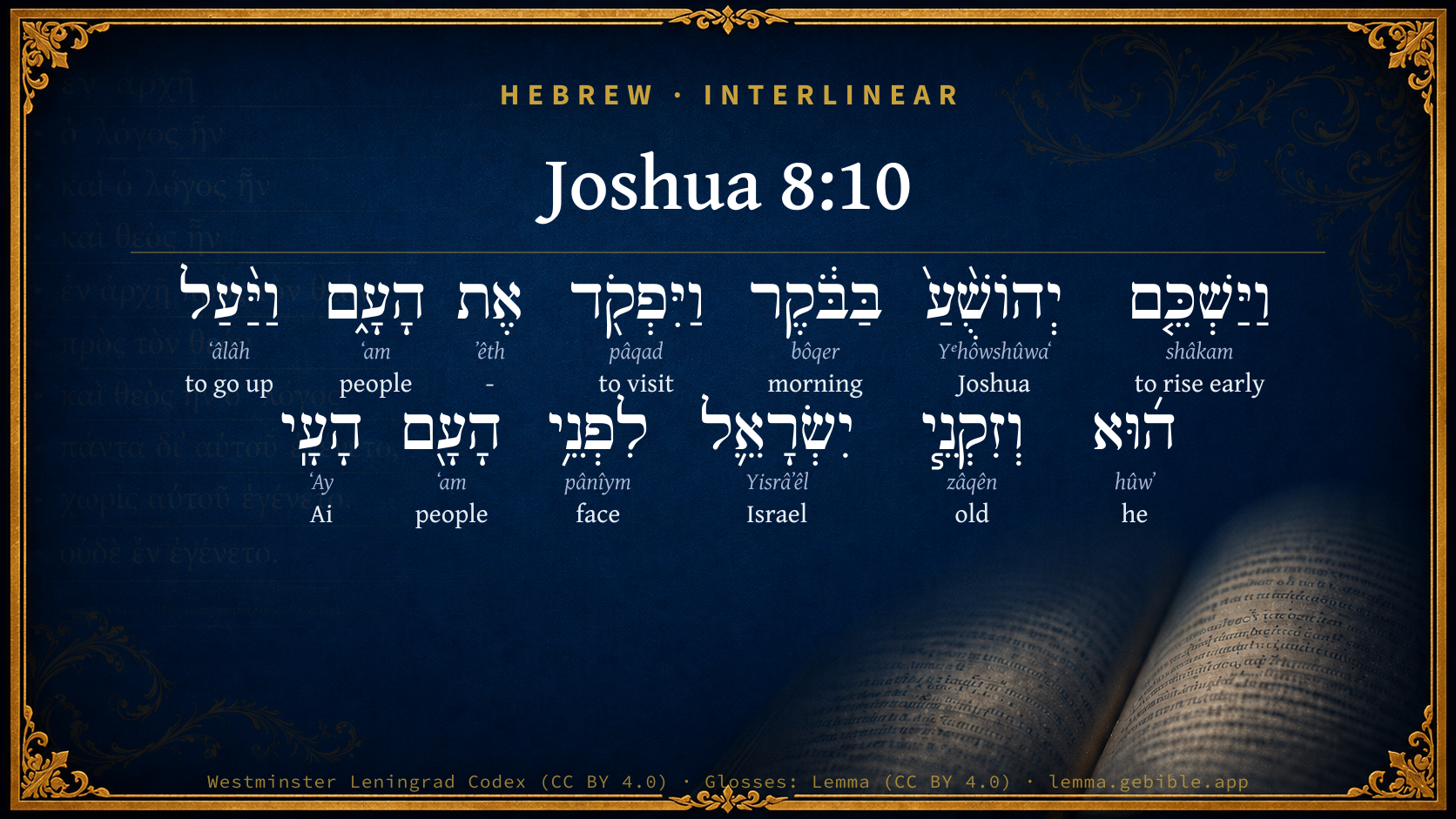
  1. וַיַּשְׁכֵּ֤ם shâkam H7925 “and · to rise early” Conjunction + Verb, Hiphil, Sequential Imperfect, 3rd Person, Masculine, Singular
  2. יְהוֹשֻׁ֨עַ֙ Yᵉhôwshûwaʻ H3091 “Joshua” Noun, Proper
  3. בַּבֹּ֔קֶר bôqer H1242 “in/at the · morning” Preposition, Determined + Noun, Common, Masculine, Singular, Absolute
  4. וַיִּפְקֹ֖ד pâqad H6485 “and · to visit” Conjunction + Verb, Qal, Sequential Imperfect, 3rd Person, Masculine, Singular
  5. אֶת ʼêth H853 “-” Particle, Direct Object
  6. הָעָ֑ם ʻam H5971 “the · people” Particle, Definite Article + Noun, Common, Masculine, Singular, Absolute
  7. וַיַּ֨עַל ʻâlâh H5927 “and · to go up” Conjunction + Verb, Qal, Sequential Imperfect, 3rd Person, Masculine, Singular
  8. ה֜וּא hûwʼ H1931 “he” Pronoun, Personal, 3rd Person, Masculine, Singular
  9. וְזִקְנֵ֧י zâqên H2205 “and · old of” Conjunction + Adjective, Adjective, Masculine, Plural, Construct
  10. יִשְׂרָאֵ֛ל Yisrâʼêl H3478 “Israel” Noun, Proper
  11. לִפְנֵ֥י pânîym H6440 “to/for · face(s) of” Preposition + Noun, Common, Both, Plural, Construct
  12. הָעָ֖ם ʻam H5971 “the · people” Particle, Definite Article + Noun, Common, Masculine, Singular, Absolute

About this verse

These counts appear in no published source. They are computed here, from the morphology-tagged text and Lemma’s own curated glosses. What Lemma adds →

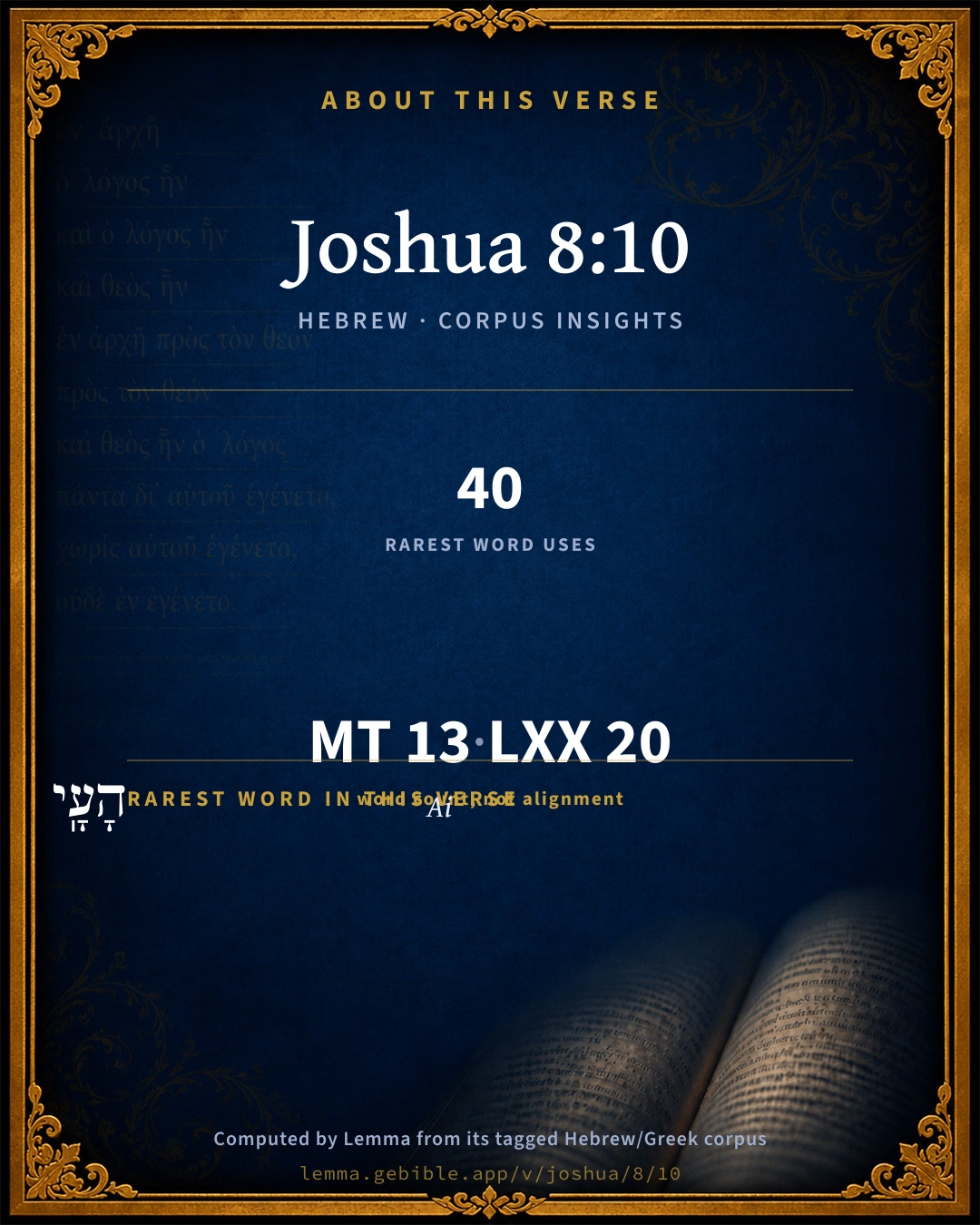
13
words
12
distinct lemmas
Historical
section

Shared distinctive vocabulary

הָעָֽי Ai H5857 occurs in 34 verses of the Hebrew Bible. Also found in:

Grammatical profile

  • 3 verbs
  • 7 nouns
  • 1 adjective
  • 1 pronoun
  • 1 particle

Verb forms

  • וַיַּשְׁכֵּ֤ם Hiphil · Sequential Imperfect
  • וַיִּפְקֹ֖ד Qal · Sequential Imperfect
  • וַיַּ֨עַל Qal · Sequential Imperfect

Repetition

A word recurs within this verse — often emphatic in Hebrew:

  • הָעָ֑ם people H5971 ×2

Hebrew & Septuagint length

In English translation the verse runs 25 words from the Hebrew and 25 from the Septuagint (LXX English) — the same length.

A rough comparison of the two English renderings, which tokenize alike — not a word-level alignment.

Word counts can differ between the Hebrew and the Greek without any difference in meaning — e.g. the Hebrew direct-object marker אֵת has no separate Greek word, and Greek often adds the article ὁ.

In the original languages it is 13 Hebrew tokens and 20 Greek tokens — but the two are counted differently (Hebrew bundles its prefixes and suffixes into one token; the Greek is in lemma form), so that isn’t a like-for-like length.

Cross-references

5

Topical passages linked to Joshua 8:10 in the Treasury of Scripture Knowledge — connected by theme and wording, ordered by reader-vote popularity; previews shown in the World English Bible.

  • Genesis 22:3 Abraham rose early in the morning, and saddled his donkey, and took two of his young men with him, and Isaac his son. He split the wood for the burnt offering, and rose up, and went to the place of which God had told him.
  • Joshua 3:1 Joshua rose up early in the morning; and they removed from Shittim, and came to the Jordan, he and all the children of Israel; and they lodged there before they passed over.
  • Joshua 6:12 Joshua rose early in the morning, and the priests took up the ark of Yahweh.
  • Joshua 7:16 So Joshua rose up early in the morning, and brought Israel near by their tribes; and the tribe of Judah was taken:
  • Psalms 119:60 I will hurry, and not delay, To obey your commandments.

Cross-references courtesy of OpenBible.info (CC BY 4.0).

Hebrew and Greek witnesses Masoretic Hebrew ↔ Greek Septuagint

The same verse in the two great witnesses to the Old Testament, shown verse-for-verse.

These are two independent witnesses, not word-aligned to each other, and the Septuagint is shown in lemma (dictionary) form.

Hebrew Joshua 8:10 Masoretic · Westminster Leningrad Codex

וַיַּשְׁכֵּ֤ם יְהוֹשֻׁ֨עַ֙ בַּבֹּ֔קֶר וַיִּפְקֹ֖ד אֶת הָעָ֑ם וַיַּ֨עַל ה֜וּא וְזִקְנֵ֧י יִשְׂרָאֵ֛ל לִפְנֵ֥י הָעָ֖ם הָעָֽי

Joshua arose up early in the morning, and mustered the people, and went up, he and the elders of Israel, before the people to Ai.

World English Bible · Public Domain

Greek LXX Joshua 8:10 Septuagint · lemma form

καί ὀρθρίζω ἰησοῦς ὁ πρωΐ ἐπισκέπτομαι ὁ λαός καί ἀναβαίνω αὐτός καί ὁ πρεσβύτερος κατά πρόσωπον ὁ λαός ἐπί γαι

And Joshua rose up early in the morning, and numbered the people; and he went up, he and the elders before the people to Gai.

LXX2012 (modern English Septuagint) · Public Domain

On this verse, The Pulpit Commentary discusses the Septuagint’s reading. Read the note in Commentary ↓

Hebrew: Westminster Leningrad Codex (CC BY 4.0). Greek: Septuagint (public domain); English from LXX2012 (modern English Septuagint) (Public Domain). How the Septuagint differs from the Hebrew →

Targum (Aramaic paraphrase)

1

The Targum is the ancient Jewish Aramaic paraphrase of the Hebrew Scriptures — an interpretive translation, not the Hebrew text itself. Onkelos (literal) and Pseudo-Jonathan (expansive) render the Torah, and Jonathan the Prophets. Coverage is partial: where no permissively-licensed English translation exists for a verse, only the Aramaic is shown. This is verse-level text, not a word-by-word alignment to the Hebrew.

  1. Targum Jonathan Prophets (Joshua–Malachi)
    וְאַקְדִים יְהוֹשֻׁעַ בְּצַפְרָא וּמְנָא יַת עַמָא וּסְלִיק הוּא וְסָבֵי יִשְׂרָאֵל קֳדָם עַמָא לָעָי:

    (no public-domain English translation for this verse)

    Targum Jonathan — Aramaic: “Mikraot Gedolot” (public domain). English: “Sefaria Community Translation” (CC0 1.0 (public-domain dedication)); “London "Chaldee Paraphrase," 1871” (public domain). Text via Sefaria.

Commentary

Notes on Joshua 8:10 from classic Christian and Jewish commentators (each source and its license shown beneath its notes). The classic Christian expositions comment on the surrounding passage and are grouped to its opening verse, so a note may address several verses; the Jewish commentaries on the Tanakh (Rashi and others) are per-verse, so they appear only where the commentator wrote on this verse.

Lemma curates 59 commentaries, every one of them public domain or Creative Commons licensed, each selected and text-cleaned for this edition rather than reprinted as found. About our sources →

Adam Clarke's Commentary

Verse 10. Numbered the people] ויפקד את העם vaiyiphkod eth haam, he visited the people - inspected their ranks to see whether every thing was in perfect readiness, that in case they should be needed they might be led on to the attack. There is no doubt that Joshua had left the rest of the army so disposed and ready, part of it having probably advanced towards Ai, that he might easily receive reinforcements in case of any disaster to the thirty thousand which had advanced against the city; and this consideration will serve to remove a part of the difficulty which arises from Jos 8:1; Jos 8:3; Jos 8:10, collated with other parts of this chapter. Had he brought all his troops in sight, the people of Ai would not have attempted to risk a battle, and would consequently have kept within their walls, from which it was the object of Joshua to decoy them. See the preceding observations, particularly 10, 11, and 12 (Jos 8:10-12).

Adam Clarke's Commentary on the Bible (1810–1826) — public domain. Text from a community e-Sword/MySword module.

Trapp's Complete Commentary

John Trapp

Jos 8:10 And Joshua rose up early in the morning, and numbered the people, and went up, he and the elders of Israel, before the people to Ai.

Ver. 10. And Joshua rose up early in the morning.] He is much noted for his early rising: his vigilancy being equal to his valour.

John Trapp, A Commentary or Exposition upon All the Books of the Old and New Testament (1647–1656) — public domain. Text from a community e-Sword module.

Joseph Benson's Commentary

Jos 8:10. Joshua — numbered the people — Not all the people, which was needless, and would now have required more time than could have been spared, but that part of the army which he designed to take with him. And this, it seems, he did, that it might be evident the conquest of Ai was effected without any loss of men, and that they might be encouraged hereby to trust in God, and proceed resolutely and boldly in the work of subduing the Canaanites. The elders of Israel — Their chief magistrates and rulers under Joshua. These, it is probable, went with Joshua and the army to take care that the cattle and the spoil of the city, which were given by God to all Israel for a prey, might be justly and equally divided between those that went to battle, and the rest of the people.

Joseph Benson's Commentary on the Old and New Testaments (1811–1818) — public domain. Text from a community e-Sword module.

Geneva Bible (1599)

Geneva Bible translators

That is, viewed or mustered them, and set them in array.

Geneva Bible (1599) marginal notes — public domain. Text via Bolls.life.

Jamieson, Fausset & Brown

Robert Jamieson, A. R. Fausset & David Brown

Joshua . . . numbered the people--that is, the detachment of liers-in-wait; he did this, to be furnished with clear evidence afterwards, that the work had been done without any loss of men, whereby the people's confidence in God would be strengthened and encouragement given them to prosecute the war of invasion with vigor.

he and the elders of Israel--the chief magistrates and rulers, whose presence and official authority were necessary to ensure that the cattle and spoil of the city might be equally divided between the combatants and the rest of the people (Num 31:27) --a military rule in Israel, that would have been very liable to be infringed, if an excited soldiery, eager for booty, had been left to their own will.

Jamieson, Fausset & Brown — Commentary Critical and Explanatory on the Whole Bible (1871) — public domain (CC PDM 1.0). Text via the HelloAO Bible API.

The Cambridge Bible for Schools and Colleges

gen. ed. J. J. S. Perowne

10. numbered the people] Rather, mustered or arrayed them. The day after the despatch of the ambush would be naturally occupied with the marshalling of the army, and the march from Gilgal to Ai, where they would arrive in the evening.

The Cambridge Bible for Schools and Colleges (gen. ed. J. J. S. Perowne; Cambridge University Press, 1878–1918) — public domain. Text from a community e-Sword module.

John Gill's Exposition

And Joshua rose up early in the morning, and numbered the people,.... To see if there were any wanting, and to put them in proper order for their march:

and went up, he and the elders of Israel, before the people to Ai; these elders were either the seventy elders who went with Joshua as council to him; or it may be rather they were inferior officers, who went at the head of their respective corps under them.

John Gill's Exposition of the Whole Bible (1746–1763) — public domain (CC PDM 1.0). Text via the HelloAO Bible API.

Albert Barnes' Notes on the Bible

Numbered the people - Rather, perhaps, “mustered” or “arrayed” them for their march. The distance from the camp at Gilgal to Ai is about fifteen miles. In the evening of the day after the despatch of the 5,000 liers in wait, Joshua and the host might make their appearance in the neighborhood of the city.

Albert Barnes' Notes on the Bible (1834–1885) — public domain. Text from a community e-Sword/MySword module.

Haydock's Catholic Bible Commentary

Ancients, who had a command in the army, and assisted Josue with their counsel. They gave him an account of the state and numbers of the army. (Calmet)

George Leo Haydock (1774–1849), Haydock's Catholic Family Bible and Commentary, 1859 edition — public domain. Excludes Psalms (Douay-Rheims chapter numbering differs from Protestant) and Deuterocanonical books (Catholic canon only).

Matthew Poole's English Annotations

The people, Heb. that people, not all the people of Israel, which was needless, and required more time than could now be spared; but the rest of that host of thirty thousand, whereof five thousand were sent away; and now the remainder are numbered, partly to see whether some of them had not withdrawn themselves, taking the advantage of the night, and of the design of laying an ambush; and partly that it might be evident that this work was done without any loss of men, and thereby they might be encouraged to trust in God, and to proceed vigorously and resolutely in their work.

The elders of Israel; either,

1. The military elders, the chief commanders of his army. But they seem to be included in the thirty thousand, Jos 8:3, which are supposed to be furnished and led by their several commanders; and such persons are scarce ever called the

elders of Israel. Or rather,

2. The chief magistrates and rulers of Israel under Joshua, who are commonly so called; and these, I suppose, went with Joshua, and with the army, to take care that the cattle and the spoil of the city, which was given by God to all Israel for a prey, Jos 8:2,27, might be justly and equally divided between those that went to battle, and the rest of the people, according to the example and prescript, Num 31:27; and that they who were present and assistant in the taking of that city, might not engross the whole to themselves, as is usual for soldiers in those cases to do.

Matthew Poole's English Annotations on the Holy Bible (1683–1685) — public domain. Text from a community e-Sword/MySword module.

Whedon's Commentary on the Bible

Daniel D. Whedon

10. And Joshua rose up early — This must be regarded as a repetition of Jos_8:3, after the custom of oriental historians.

Numbered the people — Reviewed the troops (thirty thousand) with whom he intended to capture Ai.

Went up — From the Ghor, or Jordanic Valley, to the interior of Palestine. there is a steep ascent. Compare note on Luk_10:30. Ai was distant from Jericho about fifteen English miles.

And the elders — As a council of war. Joshua’s impetuous and rapid movements were attended by a wise senate.

Daniel D. Whedon (gen. ed.), Commentary on the Old and New Testaments (1874–1909) — public domain. Text from a community e-Sword module.

The Pulpit Commentary

And numbered the people. Or reviewed, or mustered. The word is frequently translated visited in Scripture. It then came to mean a visit for the sake of inspection. The elders of Israel. Joshua"s council, alike of war and of peace. Before the people. Literally, in their sight (ford proswpon , LXX), i.e., at their head.

The Pulpit Commentary (1880–1919), ed. H.D.M. Spence-Jones & Joseph S. Exell — public domain. Text from a community e-Sword module.

John Wesley's Explanatory Notes

The people - Hebrew. that people, not all the people of Israel; which was needless, and required more time than could now be spared; but the rest of that host of thirty thousand, whereof five thousand were sent away; the remainder are numbered, to see whether some of them had not withdrawn themselves, taking the advantage of the night, and of the design of laying an ambush; and that it might be evident, this work was done without any loss of men, whereby they might be encouraged to trust in God, and to proceed resolutely in their work. The elders of Israel - The chief magistrates and rulers of Israel under Joshua; and these, I suppose, went with Joshua, and with the army, to take care that the cattle and the spoil of the city, which was given by God to all Israel for a prey, ver. 2, 27, might be justly and equally divided between those that went to battle, and the rest of the people.

John Wesley, Explanatory Notes Upon the Whole Bible (1754–1765) — public domain. Text via the GEBible commentary corpus.

unfoldingWord translationNotes

Door43 World Missions Community

five thousand men

"5,000 men." This group seems to be a portion of the "thirty thousand men" (Joshua 8:9). This smaller group remained in the ambush while the other 25,000 men attacked the city. (See: Numbers)

translationWords

Joshua

elder

Israel

Ai

Bethel

unfoldingWord translationNotes — © Distant Shores Media and the Door43 World Missions Community, licensed CC BY-SA 4.0. Source: git.door43.org/Door43/en_tn.

Rashi

Rabbi Shlomo Yitzchaki (Rashi)

And he went up. He fulfilled that which God had said to him, “If he goes at their head, they will cross, and if not, they will not cross.”

Rashi on the Tanakh — English translations: “The Judaica Press complete Tanach with Rashi, translated by A. J. Rosenberg” (CC BY 4.0); “Pentateuch with Rashi's commentary by M. Rosenbaum and A.M. Silbermann, 1929-1934” (public domain); “The Metsudah Tanach series, Lakewood, N.J” (CC BY 4.0); and “The Book of Joshua, Metsudah Publications, 1997” (CC BY 4.0). Text via Sefaria.

Lesson kit

Teaching starters — assembled from the data on this page, not authored interpretation. Every prompt links to the verse data it draws on. Edit before teaching.

Joshua, in the Historical, opens this verse with 13 words (12 distinct Hebrew lemmas). Its most distinctive word is ʻAy (“Ai”). A historical commentator’s framing appears above. Read the whole chapter for the surrounding context.

Discussion questions

  1. The word ʻAy carries the sense “Ai.” How does it shape the verse?
  2. How does Genesis 12:8, which shares the word «Ai», read alongside this verse?
  3. What does the repetition of “people” (2× in this one verse) do in this verse?
  4. These translations render this verse differently. What is at stake in choosing one wording over another?
  5. «וַיַּשְׁכֵּ֤ם» is a Hiphil Sequential Imperfect verb. How does that grammatical form shape the action described?
  6. Compare how Adam Clarke's Commentary and Trapp's Complete Commentary read this verse. Where do they agree or differ?

Things to notice

Reading settings

Reading text

Shown beneath each verse's original-language words.

Old Testament
Old Testament edition

Read the OT as the Masoretic Hebrew (MT) or the Greek Septuagint (LXX).

English shown for the Greek Septuagint (in the Hebrew ↔ Greek comparison).

Comparing translations? Open the Compare panel on any verse page to stack up to four side by side.