2 Kings 3:20

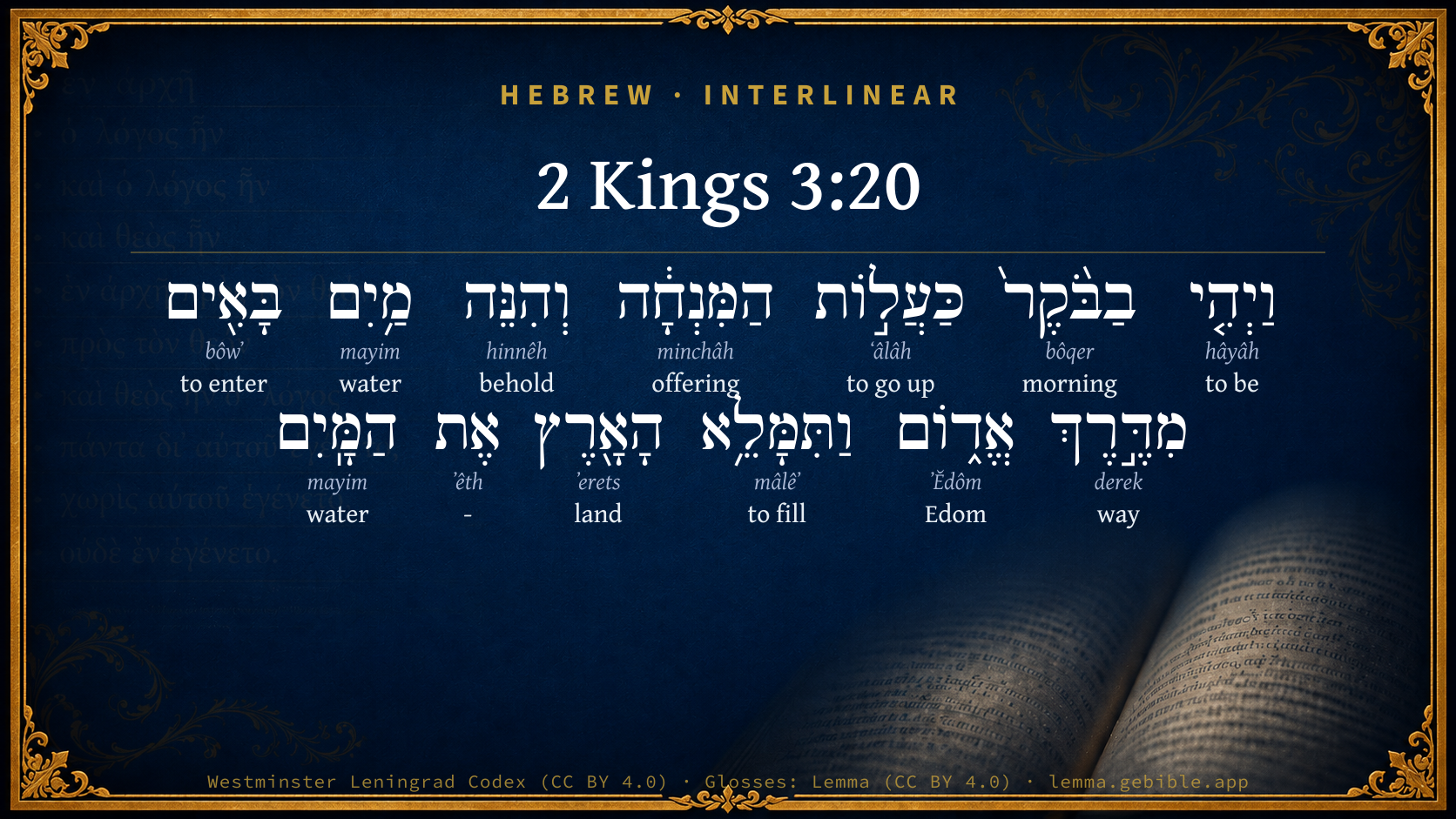
Hebrew (Westminster Leningrad Codex) 2 Kings 3:20 appears in the Hebrew Old Testament. The text above is from the Westminster Leningrad Codex. Each word links to its Strong’s number, a concise gloss, and parsing drawn from the Open Scriptures Hebrew Bible morphology. Click any word for its full Brown-Driver-Briggs (BDB) entry.
Download image
Cite this verse

2 Kings 3:20 (World English Bible). Public Domain. Lemma interlinear Bible study tool, https://lemma.gebible.app/v/2-kings/3/20.

Show BibTeX & RIS
BibTeX
RIS
English Translation
It happened in the morning, about the time of offering the offering, that behold, there came water by the way of Edom, and the country was filled with water.
World English Bible · Public Domain
Download a study sheet

One document with this verse’s original text, its word-by-word gloss line, the meaning frame, cross-references with their text, attributed commentary, and full source and license credits — printable, and it pastes into notes with its structure intact.

This verse Autodidact and up

Study sheet (.html) Plain text (.txt)

A passage Seminary Student

Up to 50 verses in one chapter. A passage sheet keeps up to 6 commentary sources and 12 cross-references per verse, in the order this page ranks them, and says so on the sheet whenever that leaves anything out. Ask for a single verse and you get the Autodidact verse sheet above.

Everything on this page stays free to read, with no account — the sheet is a download of what is already on screen, not access to it.

Want to remove ads? Support Godless Engineer
Compare translations 3

The same verse in 3 English versions, stacked beneath the original-language interlinear above. Click any original word for its lexicon entry.

Each is an independent rendering of the whole verse — the interlinear is not word-aligned to these translations.

Highlighted words mark where these versions differ — a whole-verse word diff, not a word-by-word alignment.

  • World English Bible Public Domain
    It happened in the morning, about the time of offering the offering, that behold, there came water by the way of Edom, and the country was filled with water.
  • King James Version Public Domain
    And it came to pass in the morning, when the meat offering was offered, that, behold, there came water by the way of Edom, and the country was filled with water.
  • unfoldingWord Literal Text CC BY-SA 4.0
    And it happened in the morning when the grain offering went up that behold, waters were coming from the way of Edom, and the land was filled with the waters.

unfoldingWord Literal Text — © unfoldingWord, licensed CC BY-SA 4.0. Word-aligned USFM3 via Door43 (git.door43.org/unfoldingWord/en_ult).

Versions to compare (up to 4)

3 of 4 selected

Show all 18 translations

Every available English version of this verse, each an independent rendering of the whole verse.

  • World English Bible Public Domain
    It happened in the morning, about the time of offering the offering, that behold, there came water by the way of Edom, and the country was filled with water.
  • Berean Standard Bible Public Domain
    The next morning, at the time of the morning sacrifice, water suddenly flowed from the direction of Edom and filled the land.
  • Majority Standard Bible Public Domain
    The next morning, at the time of the morning sacrifice, water suddenly flowed from the direction of Edom and filled the land.
  • King James Version Public Domain
    And it came to pass in the morning, when the meat offering was offered, that, behold, there came water by the way of Edom, and the country was filled with water.
  • American Standard Version (1901) Public Domain
    And it came to pass in the morning, about the time of offering the oblation, that, behold, there came water by the way of Edom, and the country was filled with water.
  • Revised Version (1885) Public Domain
    And it came to pass in the morning, about the time of offering the oblation, that, behold, there came water by the way of Edom, and the country was filled with water.
  • Geneva Bible (1599) Public Domain
    And in the morning whe the meat offring was offred, beholde, there came water by the way of Edom: and the countrey was filled with water.
  • Douay-Rheims (1899) Public Domain
    And it came to pass in the morning, when the sacrifices used to be offered, that behold, water came by the way of Edom, and the country was filled with water.
  • Young's Literal Translation Public Domain
    And it cometh to pass in the morning, at the ascending of the `morning'-present, that lo, waters are coming in from the way of Edom, and the land is filled with the waters,
  • Literal Standard Version CC BY-SA 4.0
    And it comes to pass in the morning, at the ascending of the [morning] present, that behold, waters are coming in from the way of Edom, and the land is filled with the waters,
  • Unlocked Literal Bible CC BY-SA 4.0
    So in the morning about the time of offering the sacrifice, there came water from the direction of Edom; the country was filled with water.
  • unfoldingWord Literal Text CC BY-SA 4.0
    And it happened in the morning when the grain offering went up that behold, waters were coming from the way of Edom, and the land was filled with the waters.
  • Darby Bible Public Domain
    And it came to pass in the morning, when the oblation was offered up, that behold, there came water by the way of Edom, and the country was filled with water.
  • World Messianic Bible Public Domain
    In the morning, about the time of offering the sacrifice, behold, water came by the way of Edom, and the country was filled with water.
  • Webster's Bible Public Domain
    And it came to pass in the morning, when the meat-offering was offered, that behold, there came water by the way of Edom, and the country was filled with water.
  • Free Bible Version CC BY-SA 4.0
    The next day, around the time of the morning sacrifice, water suddenly flowed from the direction of Edom, filling the whole countryside with water.
  • Bible in Basic English Public Domain
    Now in the morning, about the time when the offering was made, they saw water flowing from the direction of Edom till the country was full of water.
  • JPS Tanakh (1917) Public Domain
    And it came to pass in the morning, about the time of making the offering, that, behold, there came water by the way of Edom, and the country was filled with water.

Literal Standard Version (2020), Covenant Press — licensed CC BY-SA 4.0. Text via the HelloAO Bible API (eBible.org). Unlocked Literal Bible (unfoldingWord) — licensed CC BY-SA 4.0. Text via the HelloAO Bible API (eBible.org). unfoldingWord Literal Text — © unfoldingWord, licensed CC BY-SA 4.0. Word-aligned USFM3 via Door43 (git.door43.org/unfoldingWord/en_ult). Free Bible Version, Dr. Jonathan Gallagher — licensed CC BY-SA 4.0. Text via the HelloAO Bible API (eBible.org).

Word by word

More ways to search: Search by grammar → Find every occurrence → Compare this word →

Practice this passage: Drill this verse → Learn its vocabulary →

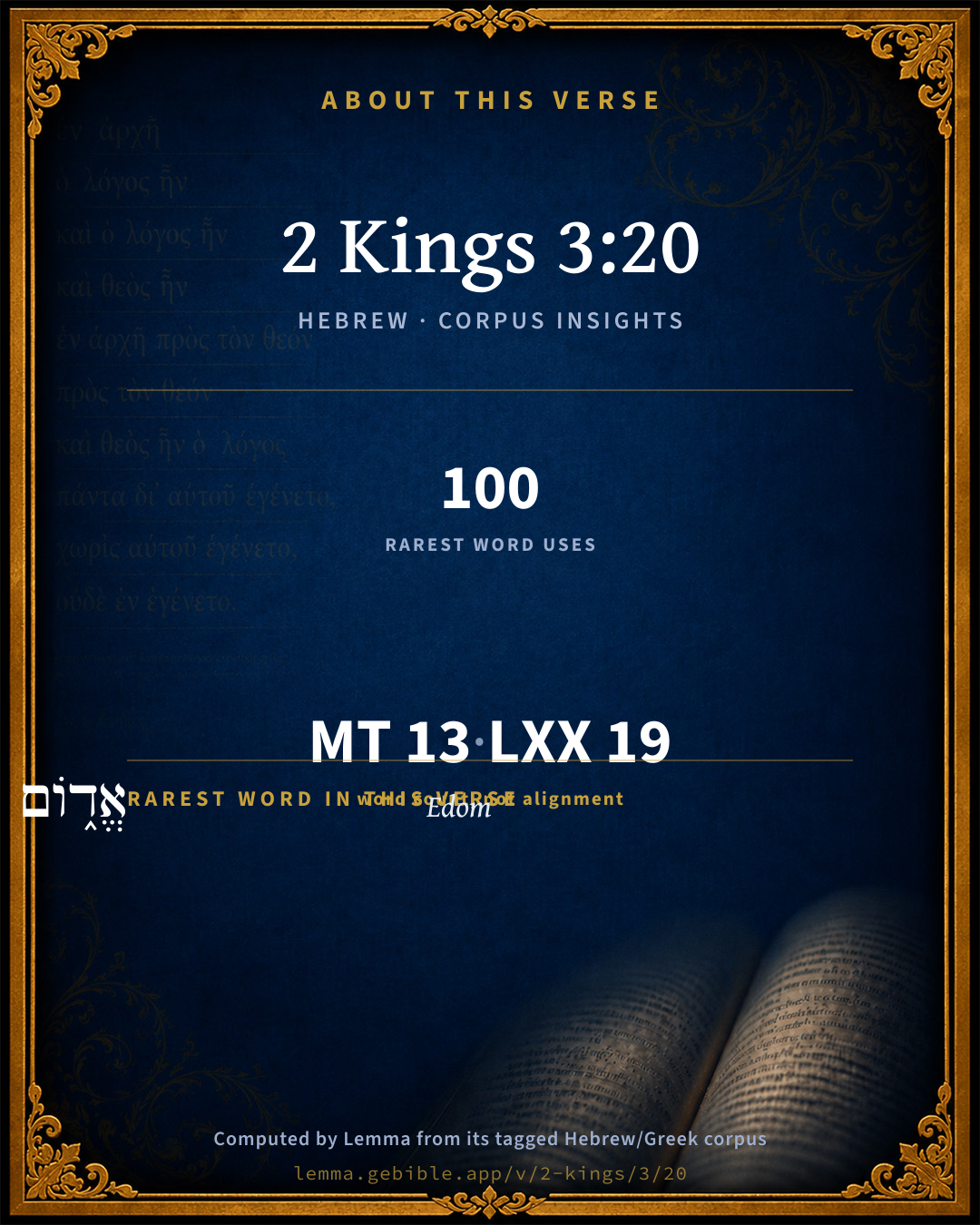
אֱד֑וֹם
ʼĔdôm
H123
“Edom”
Noun, Proper
Part of Speech
Noun
Type
Proper
Full BDB Definition

Origin: from H122

TWOT: 26e

Edom = "red" - Edom - Edomite, Idumean - descendants of Esau - land of Edom, Idumea - land south and south east of Palestine
  1. וַיְהִ֤י hâyâh H1961 “and · to be” Conjunction + Verb, Qal, Sequential Imperfect, 3rd Person, Masculine, Singular
  2. בַבֹּ֨קֶר֙ bôqer H1242 “in/at the · morning” Preposition, Determined + Noun, Common, Masculine, Singular, Absolute
  3. כַּעֲל֣וֹת ʻâlâh H5927 “like/as · to go up” Preposition + Verb, Qal, Infinitive Construct
  4. הַמִּנְחָ֔ה minchâh H4503 “the · offering” Particle, Definite Article + Noun, Common, Feminine, Singular, Absolute
  5. וְהִנֵּה hinnêh H2009 “and · behold” Conjunction + Particle, Demonstrative
  6. מַ֥יִם mayim H4325 “water(s)” Noun, Common, Masculine, Plural, Absolute
  7. בָּאִ֖ים bôwʼ H935 “entering” Verb, Qal, Participle Active, Masculine, Plural, Absolute
  8. מִדֶּ֣רֶךְ derek H1870 “from · way of” Preposition + Noun, Common, Both, Singular, Construct
  9. וַתִּמָּלֵ֥א mâlêʼ H4390 “and · to fill” Conjunction + Verb, Niphal, Sequential Imperfect, 3rd Person, Feminine, Singular
  10. הָאָ֖רֶץ ʼerets H776 “the · land” Particle, Definite Article + Noun, Common, Both, Singular, Absolute
  11. אֶת ʼêth H853 “-” Particle, Direct Object
  12. הַמָּֽיִם mayim H4325 “the · water(s)” Particle, Definite Article + Noun, Common, Masculine, Plural, Absolute

About this verse

These counts appear in no published source. They are computed here, from the morphology-tagged text and Lemma’s own curated glosses. What Lemma adds →

13
words
12
distinct lemmas
Historical
section

Grammatical profile

  • 4 verbs
  • 7 nouns
  • 2 particles

Verb forms

  • וַיְהִ֤י Qal · Sequential Imperfect
  • כַּעֲל֣וֹת Qal · Infinitive Construct
  • בָּאִ֖ים Qal · Participle Active
  • וַתִּמָּלֵ֥א Niphal · Sequential Imperfect

Repetition

A word recurs within this verse — often emphatic in Hebrew:

  • מַ֥יִם water H4325 ×2

Hebrew & Septuagint length

In English translation the verse runs 29 words from the Hebrew and 29 from the Septuagint (LXX English) — the same length.

A rough comparison of the two English renderings, which tokenize alike — not a word-level alignment.

Word counts can differ between the Hebrew and the Greek without any difference in meaning — e.g. the Hebrew direct-object marker אֵת has no separate Greek word, and Greek often adds the article ὁ.

In the original languages it is 13 Hebrew tokens and 19 Greek tokens — but the two are counted differently (Hebrew bundles its prefixes and suffixes into one token; the Greek is in lemma form), so that isn’t a like-for-like length.

Cross-references

6

Topical passages linked to 2 Kings 3:20 in the Treasury of Scripture Knowledge — connected by theme and wording, ordered by reader-vote popularity; previews shown in the World English Bible.

  • Exodus 29:39–40 The one lamb you shall offer in the morning; and the other lamb you shall offer at evening:
  • 1 Kings 18:36 It happened at the time of the offering of the [evening] offering, that Elijah the prophet came near, and said, Yahweh, the God of Abraham, of Isaac, and of Israel, let it be known this day that you are God in Israel, and that I am your servant, and that I have done all these things at your word.
  • Psalms 78:15–16 He split rocks in the wilderness, And gave them drink abundantly as out of the depths.
  • Psalms 78:20 Behold, he struck the rock, so that waters gushed out, Streams overflowed. Can he give bread also? Will he provide flesh for his people?"
  • Isaiah 35:6–7 Then shall the lame man leap as a hart, and the tongue of the mute shall sing; for in the wilderness shall waters break out, and streams in the desert.
  • Daniel 9:21 yes, while I was speaking in prayer, the man Gabriel, whom I had seen in the vision at the beginning, being caused to fly swiftly, touched me about the time of the evening offering.

Cross-references courtesy of OpenBible.info (CC BY 4.0).

Hebrew and Greek witnesses Masoretic Hebrew ↔ Greek Septuagint

The same verse in the two great witnesses to the Old Testament, shown verse-for-verse.

These are two independent witnesses, not word-aligned to each other, and the Septuagint is shown in lemma (dictionary) form.

Hebrew 2 Kings 3:20 Masoretic · Westminster Leningrad Codex

וַיְהִ֤י בַבֹּ֨קֶר֙ כַּעֲל֣וֹת הַמִּנְחָ֔ה וְהִנֵּה מַ֥יִם בָּאִ֖ים מִדֶּ֣רֶךְ אֱד֑וֹם וַתִּמָּלֵ֥א הָאָ֖רֶץ אֶת הַמָּֽיִם

It happened in the morning, about the time of offering the offering, that behold, there came water by the way of Edom, and the country was filled with water.

World English Bible · Public Domain

Greek LXX 2 Kings 3:20 Septuagint · lemma form

καί γίγνομαι ὁ πρωΐ ἀναβαίνω ὁ θυσία καί ἰδού ὕδωρ ἄρχω ἐκ ὁδός εδωμ καί πίμπλημι ὁ γῆ ὕδωρ

And it came to pass in the morning, when the sacrifice was offered, that, behold! waters came from the way of Edom, and the land was filled with water.

LXX2012 (modern English Septuagint) · Public Domain

Hebrew: Westminster Leningrad Codex (CC BY 4.0). Greek: Septuagint (public domain); English from LXX2012 (modern English Septuagint) (Public Domain). How the Septuagint differs from the Hebrew →

Targum (Aramaic paraphrase)

1

The Targum is the ancient Jewish Aramaic paraphrase of the Hebrew Scriptures — an interpretive translation, not the Hebrew text itself. Onkelos (literal) and Pseudo-Jonathan (expansive) render the Torah, and Jonathan the Prophets. Coverage is partial: where no permissively-licensed English translation exists for a verse, only the Aramaic is shown. This is verse-level text, not a word-by-word alignment to the Hebrew.

  1. Targum Jonathan Prophets (Joshua–Malachi)
    וַהֲוָה בְּצַפְרָא כְּמִיסַק מִנְחָתָא וְהָא מַיָא אָתָן בְּאוֹרַח אֱדוֹם וְאִתְמְלִיאַת אַרְעָא יַת מַיָא:

    (no public-domain English translation for this verse)

    Targum Jonathan — Aramaic: “Mikraot Gedolot” (public domain). English: “Sefaria Community Translation” (CC0 1.0 (public-domain dedication)); “London "Chaldee Paraphrase," 1871” (public domain). Text via Sefaria.

Commentary

Notes on 2 Kings 3:20 from classic Christian and Jewish commentators (each source and its license shown beneath its notes). The classic Christian expositions comment on the surrounding passage and are grouped to its opening verse, so a note may address several verses; the Jewish commentaries on the Tanakh (Rashi and others) are per-verse, so they appear only where the commentator wrote on this verse.

Lemma curates 59 commentaries, every one of them public domain or Creative Commons licensed, each selected and text-cleaned for this edition rather than reprinted as found. About our sources →

Matthew Henry's Commentary

I. We have here the divine gift of both those things which God had promised by Elisha - water and victory, and the former not only a pledge of the latter, but a means of it. God, who created, and commands, all the waters, both above and beneath the firmament, sent them an abundance of water on a sudden, which did them double service.

1. It relieved their armies, which were ready to perish, Kg2 3:20. And, which was very observable, this relief came just at the time of the offering of the morning sacrifice upon the altar at Jerusalem, a certain time, and universally known. That time Elisha chose for his hour of prayer (it is likely looking towards the temple, for so there were to do in their prayers when they were going out to battle and encamped at a distance, Kg1 8:44), in token of his communion with the temple-service, and his expectation of success by virtue of the great sacrifice. We now cannot pitch upon any hour more acceptable than another, because our high priest is always appearing for us, to present and plead his sacrifice. That time God chose for the hour of mercy to put an honour upon the daily sacrifice, which had been despised. God answered Daniel's prayer just at the time of the evening sacrifice (Dan 9:21); for he will acknowledge his own institutions.

2. It deceived their enemies, who were ready to triumph, into the destruction. Notice was given to the Moabites of the advances of the confederate army, to oppose which all that were able to put on armour were posted upon the frontiers, where they were ready to give the Israelites a warm reception (v. 21), promising themselves that it would be easy dealing with an army fatigued by so long a march through the wilderness of Edom. But see here,

(1.) How easily they were drawn into their own delusions. Observe the steps of their self-deceit. [1.] They saw the water in the valley where the army of Israel encamped, and conceited it was blood (Kg2 3:22), because they knew the valley to be dry, and (there having been no rain) could not imagine it should be water. The sun shone upon it, and probably the sky was red and lowering, a presage of foul weather that day (Mat 16:3), and so it proved to them. But, this making the water look red, their own fancies, which made them willing to believe what made for them, suggested, This is blood, God permitting them thus to impose upon themselves. [2.] If their camp was thus full of blood, they conclude, "Certainly the kings have fallen out (as confederates of different interests are apt to do) and they have slain one another (Kg2 3:23), for who else should slay them?" And, [3.] "If the armies have slain one another, we have nothing to do but to divide the prey. Now therefore, Moab, to the spoil." These were the gradual suggestions of some sanguine spirits among them, that thought themselves wiser and happier in their conjectures than their neighbours; and the rest, being desirous it should be so, were forward to believe it was so. Quod volumus facile credimus - What we wish we readily believe. Thus those that are to be destroyed are first deceived (Rev 20:8), and none are so effectually deceived as those that deceive themselves.

(2.) How fatally they thereby ran upon their own destruction. They rushed carelessly into the camp of Israel, to plunder it, but were undeceived when it was too late. The Israelites, animated by the assurances Elisha had given them of victory, fell upon them with the utmost fury, routed them, and pursued them into their own country (Kg2 3:24), which they laid waste (Kg2 3:25), destroyed the cities, marred the ground, stopped up the wells, felled the timber, and left only the royal city standing, in the walls of which they made great breaches with their battering engines. This they got by rebelling against Israel. Who ever hardened his heart against God and prospered?

II. In the close of the chapter we are told what the king of Moab did when he found himself reduced to the last extremity by the besiegers, and that his capital city was likely to fall into their hands. 1. He attempted that which was bold and brave. he got together 700 choice men, and with them sallied out upon the intrenchments of the king of Edom, who, being but a mercenary in this expedition, would not, he hoped, make any great resistance if vigorously attacked, and so he might make his escape that way. But it would not do; even the king of Edom proved too hard for him, and obliged him to retire, Kg2 3:26. 2. This failing, he did that which was brutish and barbarous; he took his own son, his eldest son, that was to succeed him, than whom nothing could be more dear to himself and his people, and offered him for a burnt-offering upon the wall, Kg2 3:27. He designed by this, (1.) To obtain the favour of Chemosh his god, which, being a devil, delighted in blood and murder, and the destruction of mankind. The dearer any thing was to them the more acceptable those idolaters thought it must needs be if offered in sacrifice to their gods, and therefore burnt their children in the fire to their honour. (2.) To terrify the besiegers, and oblige them to retire. Therefore he did it upon the wall, in their sight, that they might see what desperate courses he resolved to take rather than surrender, and how dearly he would sell his city and life. He intended hereby to render them odious, and to exasperate and enrage his own subjects against them. This effect it had: There was great indignation against Israel for driving him to this extremity, whereupon they raised the siege and returned. Tender and generous spirits will not do that, though just, which will drive any man distracted, or make him desperate.

Matthew Henry's Commentary on the Whole Bible (1708–1710) — public domain (CC PDM 1.0). Text via the HelloAO Bible API.

Trapp's Complete Commentary

John Trapp

2Ki 3:20 And it came to pass in the morning, when the meat offering was offered, that, behold, there came water by the way of Edom, and the country was filled with water.

Ver. 20. In the morning, when the meat offering was offered.] Which was the hour of public prayer. {Act 3:1} The devotions of all true Jews - all the world over - were in that hour combined. How seasonably doth the wisdom of God pick out that instant wherein he might at once answer both Elisha’s prophecy and his people’s prayers!

That, behold, there came water.] Adductae ab angelis, saith A Lapide, brought thither by the angels.

And the country was filled.] Not the ditches only.

John Trapp, A Commentary or Exposition upon All the Books of the Old and New Testament (1647–1656) — public domain. Text from a community e-Sword module.

The Biblical Illustrator

Joseph S. Exell

2Ki_3:20

And it came to pass in the morning there came water by the way of Moab.

Defeat of the Moabites

I. The threefold preparation for this miraculous interposition.

1. The preparation of supplication. The kings, in their need, inquired of the Lord (2Ki_3:11) by means of His prophet. The act implies an application for the help of Jehovah. Preparation for the reception of special blessing by means of supplication is a law of Gods kingdom. The prayer of the leper made way for Christs miraculous healing (Mat_8:2-4); the beseeching entreaty of the Syro-Phenician woman brought down the blessing she desired (Luk_7:24-30). The supplication (Act_2:14) of the Early Church was the preparation for the descent of the Holy Spirit. Supplication is the placing of the wood in order upon the altar in readiness for the descent of fire from heaven.

2. The preparation of the prophets mind for the reception of the Divine direction. When the minstrel played, the hand of the Lord came upon him (2Ki_3:15). The soul that has to bear the message of God to others needs to rise into some degree of harmony with the mind of God, to partake in some measure of the holy calm which belongs to Him. Music prepares the heart of the good man to receive, and hence to be the bearer of special help from the Divine Spirit.

II. The miracle itself. That the flowing in of the water was miraculous is evident because it came without rain, where there were no natural springs, and in fulfilment of Elishas prophecy. In the New Testament the supernatural Divine workings are classified into signs, wonders, miracles, and gifts of the Holy Ghost. (Heb_2:2).

III. The twofold effect of the miracle. It was the occasion of life to one army and of death to the other. The one was brought about by the supernatural interposition, the other by a natural, though mistaken, inference. The cloud that was the help of Israel at the Red Sea, became the destruction of the Egyptians. (Sermon Outlines.)

Attracted by grace

I noticed on one of our streets during the frost, when the pipes were all congealed and frozen and waterless, that the water authorities opened the main pipe early in the morning. The inhabitants got up that frosty morning, they turned the tap, but no water flowed. Then the neighbours began to tell one another that in a certain street the main pipe was flowing, and the bairns got their pitchers and buckets and flagons, and the women put their shawls over their heads in their hurry, and the domestics were sent out with the utensils from the kitchen. The cry had gone out that the water was flowing, and on that frosty morning they gathered round the main pipe. What brought them? Just the real flowing of real water. That was the reason of the crowd. If Christians were to experience freshly and literally and truly the grace of God, thousands would flock into every assembly in the city, and in the land, just drawn and won by the reality of the grace of Christ. (J. Robertson.)

The Biblical Illustrator, edited by Joseph S. Exell (c. 1880s–1900s) — public domain. Text from a community e-Sword module.

Joseph Benson's Commentary

2Ki 3:20. In the morning when the meat-offering was offered — That is, at the time of the morning sacrifice, which doubtless was attended with the solemn prayers of God’s people. At this time Elisha joined his prayers with the prayers of God’s people, especially those at Jerusalem. And this time God chose to answer their prayers, and to work this miracle, that thereby he might determine the controversy between the Israelites and the Jews, about the place and manner of worship, and give a public testimony from heaven for the Jews, and against the Israelites. God, that commands all the waters both above and beneath the firmament, sent them abundance of water on a sudden.

Joseph Benson's Commentary on the Old and New Testaments (1811–1818) — public domain. Text from a community e-Sword module.

Jamieson, Fausset & Brown

Robert Jamieson, A. R. Fausset & David Brown

when the meat offering was offered--that is, at the time of the morning sacrifice, accompanied, doubtless, with solemn prayers; and these led, it may be, by Elisha on this occasion, as on a similar one by Elijah (Kg1 18:36).

behold, there came water by the way of Edom--Far from the Israelitish camp, in the eastern mountains of Edom, a great fall of rain, a kind of cloudburst, took place, by which the wady was at once filled, but they saw neither the wind nor the rains. The divine interposition was shown by introducing the laws of nature to the determined end in the predetermined way [KEIL]. It brought not only aid to the Israelitish army in their distress, by a plentiful supply of water, but destruction on the Moabites, who, perceiving the water, under the refulgent rays of the morning sun, red like blood, concluded the confederate kings had quarrelled and deluged the field with their mutual slaughter; so that, rushing to their camp in full expectation of great spoil, they were met by the Israelites, who, prepared for battle, fought and pursued them. Their country was laid waste in the way, which has always been considered the greatest desolation in the East (Kg2 3:24).

Jamieson, Fausset & Brown — Commentary Critical and Explanatory on the Whole Bible (1871) — public domain (CC PDM 1.0). Text via the HelloAO Bible API.

Adam Clarke's Commentary

Verse 20. When the meat-offering was offered] This was the first of all offerings, and was generally made at sun-rising.

There came water] This supply was altogether miraculous, for there was neither wind nor rain, nor any other natural means by which it could be supplied.

Adam Clarke's Commentary on the Bible (1810–1826) — public domain. Text from a community e-Sword/MySword module.

Ellicott's Commentary for English Readers

(20) When the meat offering was offered.—Comp. 1Ki_18:29; 1Ki_18:36. A more exact definition of the time. The reckoning by hours was unknown before the captivity. According to the Talmud, the morning sacrifice was offered in the Temple the moment it became light. (Ewald assumes that “the meat offering” was offered on this occasion in the camp.) That help came to the distressed army just at the hour of morning worship was a striking coincidence. (This allusion to the law of Exo_29:38, seq., may be an indirect hit at the northern kingdom.)

There came water.—Water was coming from the way (direction) of Edom. It would seem that a sudden storm of rain had fallen on the mountains of Seir, at some distance from the camp (Josephus says at a distance of three days’ march); and the water found its natural outlet in the dry wady. Reuss thinks this explanation “superfluous,” in the face of “the author’s intention to describe a miracle;” but there are different kinds of miracle, and, in the present instance, the miraculous element is visible in the prophet’s prediction of the coming help, and in the coincidence of the natural phenomena with the needs of the Israelites. (Comp. 2Ki_7:1-2, seq.) [This statement seems to preclude also the naturalistic explanation founded on the meaning of the Arabic name of the locality. Hisyun, hasyun, hasan, mean water which gathers on a hard bottom under the sand in certain localities, and which the Arabs get at by scooping holes in the ground. See Lane, Arab. Eng. Lex. s.v.]

A Bible Commentary for English Readers, edited by Charles John Ellicott (1878–1897) — public domain. Text from a community e-Sword module.

The Cambridge Bible for Schools and Colleges

gen. ed. J. J. S. Perowne

20. when the meat offering was offered] R.V. about the time of offering the oblation. The term meat offering has become misleading to modern English readers, because it would now imply that flesh of some kind formed a part of the offering; whereas the oblation [minchah] here spoken of consisted (see Lev_2:1) of fine flour, oil and frankincense. Hence R.V. has rendered the word very frequently ‘meal offering’, and in some places as here, where there was no need to be specific, by ‘oblation’. The time of the offering was as soon as possible after day-dawn. In a similar manner the time selected by Elijah (1Ki_18:36) for offering his prayer to God on Carmel was at the time of the offering of the evening oblation. Thus in both cases God’s intervention was linked to the worship at Jerusalem. ‘Elijah fetched down his fire at the hour of the evening sacrifice, Elisha fetched up his water at the hour of the morning sacrifice. God gives respect to His own hours for the encouragement of our observation. If His wisdom hath set us any peculiar times, we cannot keep them without a blessing’ (Bp Hall).

by the way of Edom] The fall of rain, to which the supply of water was due, would thus be unknown to the Moabites even more than to the Israelites. Josephus describes the rain as having fallen in abundance at a distance of three days’ journey (Ant. IX. 3. 2).

The Cambridge Bible for Schools and Colleges (gen. ed. J. J. S. Perowne; Cambridge University Press, 1878–1918) — public domain. Text from a community e-Sword module.

John Gill's Exposition

And they said, this is blood,.... They were very confident of it, having no notion of water, there having been no rain for some time; and perhaps it was not usual to see water at any time in this place:

the kings are surely slain; they and their forces:

and they have smitten one another; having quarrelled either about their religion, or about want of water, and the distress they were come into through it, laying the blame of their coming out to war, or of their coming that way, on one another; and the Moabites might rather think something of this kind had happened, from what had lately been done among themselves, and their allies, Ch2 20:23.

now therefore, Moab, to the spoil; having no occasion to fight, or prepare for it; all they had to do was to march directly to the enemy's camp, and plunder it.

John Gill's Exposition of the Whole Bible (1746–1763) — public domain (CC PDM 1.0). Text via the HelloAO Bible API.

Albert Barnes' Notes on the Bible

When the meat offering was offered - i. e. about sunrise, when the morning sacrifice was offered. Compare 1Ki 18:29.

There came water by the way of Edom - The Wady-el-Ahsy drains a considerable portion of northern Edom. Heavy rain had fallen during the night in some part of this tract, and with the morning a freshet of water came down the valley, filling the pits.

Albert Barnes' Notes on the Bible (1834–1885) — public domain. Text from a community e-Sword/MySword module.

Haydock's Catholic Bible Commentary

Offered, at sun-rise, Exodus xxix. 38. --- Water, produced miraculously, without any rain being seen; (ver. 17.; Calmet) though it might fall at a distance in Idumea. (Haydock)

George Leo Haydock (1774–1849), Haydock's Catholic Family Bible and Commentary, 1859 edition — public domain. Excludes Psalms (Douay-Rheims chapter numbering differs from Protestant) and Deuterocanonical books (Catholic canon only).

Matthew Poole's English Annotations

When the meat-offering was offered, i.e. the morning sacrifice; of which Exo 29:39,40, which doubtless was attended with the solemn prayers of God’s people, as the evening sacrifice unquestionably was, Act 3:1, there being the same reason for substance for both times. At this time Elisha joined his prayers with the prayers of God’s people, especially those at Jerusalem, as Elijah had done at a like time, 1Ki 18:29; and this time God chose to answer his and their prayers, and to work this miracle, that thereby he might determine the controversy between the Israelites and the Jews, about the place and manner of worship, and give a public testimony from heaven for the Jews, and against the Israelites.

There came water; miraculously produced out of some rock or vein of the earth.

By the way of Edom; from those parts which were towards Edom.

Matthew Poole's English Annotations on the Holy Bible (1683–1685) — public domain. Text from a community e-Sword/MySword module.

Whedon's Commentary on the Bible

Daniel D. Whedon

20. When the meat offering was offered — That is, at sunrise. “Miraculous manifestations of God’s mercy often take place at stated times of prayer, and thus God’s approval of such appointments is shown.” — Wordsworth.

There came water by the way of Edom — There had been during the night a sudden and heavy fall of rain off among the mountains of Edom, where the valley in which the pits were dug took its rise; and so in the early morning the floods came rushing down, and filled all the pits and the bed of the valley with water.

Daniel D. Whedon (gen. ed.), Commentary on the Old and New Testaments (1874–1909) — public domain. Text from a community e-Sword module.

The Pulpit Commentary

And it came to pass in the morning, when the meat offering was offeredi.e. about sunrise, which was the time of the morning sacrificethat, behold, there came water by the way of Edom. The Wady-el- Ahsy drains a portion of Southern Moab, and also a considerable tract of Northern Edom. The nocturnal storm had burst, not in the Moabite country, where it would have attracted the attention of the Moabites, but in some comparatively distant part of the Idumaean territory, so that the Moabites were not aware of it. Josephus says that the storm burst at a distance of three days" journey from the Israelite camp ("Ant. Jud:," 9:3. but this can only be his conjecture. And the country was filled, with water. By "the country" (ha-arets) must be meant here the bed or channel of the water-course. This was suddenly filled with a rushing stream, which, however, rapidly ran off, leaving the water-course dry, excepting where the pits had been made by the Israelites. But this supply was ample for the army.

The Pulpit Commentary (1880–1919), ed. H.D.M. Spence-Jones & Joseph S. Exell — public domain. Text from a community e-Sword module.

John Wesley's Explanatory Notes

The meal-offering - That is, the morning sacrifice: which doubtless was attended with the solemn prayers of God's people. At this time Elisha joined his prayers with the prayers of God's people, especially those at Jerusalem. And this time God chose to answer their prayers, and to work this miracle, that thereby he might determine the controversy between the Israelites and the Jews, about the place and manner of worship, and give a publick testimony from heaven for the Jews, and against the Israelites. God that commands all the waters both above and beneath the firmament, sent them abundance of water on a sudden.

John Wesley, Explanatory Notes Upon the Whole Bible (1754–1765) — public domain. Text via the GEBible commentary corpus.

unfoldingWord translationNotes

Door43 World Missions Community

there came water

"water began flowing"

the country was filled with water

"and soon the country became filled with water"

country

land, ground

translationWords

sacrifice

Edom

unfoldingWord translationNotes — © Distant Shores Media and the Door43 World Missions Community, licensed CC BY-SA 4.0. Source: git.door43.org/Door43/en_tn.

Rashi

Rabbi Shlomo Yitzchaki (Rashi)

At the time of the morning when the meal-offering was brought up. The water began falling from heaven in the morning in the land of Edom, and at the [time of] offering up the meal-offering, it came surging into that valley, because Elisha had said, “You will not see wind and you will not see rain.” [This is stated] in the Midrash of Rabbi Tanchuma.

Rashi on the Tanakh — English translations: “The Judaica Press complete Tanach with Rashi, translated by A. J. Rosenberg” (CC BY 4.0); “Pentateuch with Rashi's commentary by M. Rosenbaum and A.M. Silbermann, 1929-1934” (public domain); “The Metsudah Tanach series, Lakewood, N.J” (CC BY 4.0); and “The Book of Joshua, Metsudah Publications, 1997” (CC BY 4.0). Text via Sefaria.

Lesson kit

Teaching starters — assembled from the data on this page, not authored interpretation. Every prompt links to the verse data it draws on. Edit before teaching.

2 Kings, in the Historical, opens this verse with 13 words (12 distinct Hebrew lemmas). Its most distinctive word is ʼĔdôm (“Edom”). A historical commentator’s framing appears above. Read the whole chapter for the surrounding context.

Discussion questions

  1. The word ʼĔdôm carries the sense “Edom.” How does it shape the verse?
  2. How does Exodus 29:39–40, which shares this passage’s theme, read alongside this verse?
  3. What does the repetition of “water” (2× in this one verse) do in this verse?
  4. These translations render this verse differently; the difference is in the English rendering, not the original. What questions does that raise?
  5. «וַיְהִ֤י» is a Qal Sequential Imperfect verb. How does that grammatical form shape the action described?
  6. Compare how Matthew Henry's Commentary and Trapp's Complete Commentary read this verse. Where do they agree or differ?

Things to notice

Reading settings

Reading text

Shown beneath each verse's original-language words.

Old Testament
Old Testament edition

Read the OT as the Masoretic Hebrew (MT) or the Greek Septuagint (LXX).

English shown for the Greek Septuagint (in the Hebrew ↔ Greek comparison).

Comparing translations? Open the Compare panel on any verse page to stack up to four side by side.